Trắc nghiệm Tiếng Anh 8 Global Success Unit 11 Writing (có đáp án)
20 câu hỏi
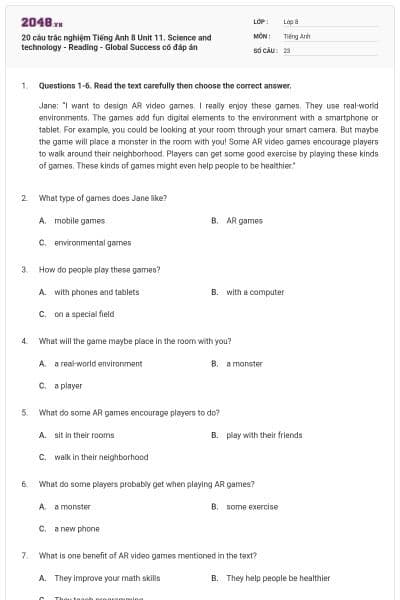
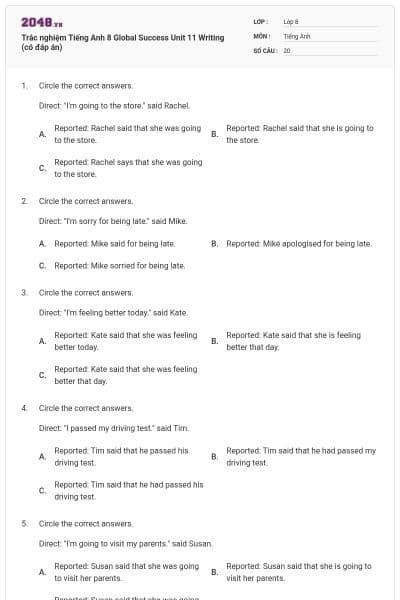
Circle the correct answers.
Direct: "I'm going to the store." said Rachel.
Reported: Rachel said that she was going to the store.
Reported: Rachel said that she is going to the store.
Reported: Rachel says that she was going to the store.
Đáp án đúng: A
Giải thích: "I'm going" → chuyển thành "was going" (hiện tại tiếp diễn → quá khứ tiếp diễn).
Dịch nghĩa: Rachel nói rằng cô ấy đang đi đến cửa hàng.
Circle the correct answers.
Direct: "I'm sorry for being late." said Mike.
Reported: Mike said for being late.
Reported: Mike apologised for being late.
Reported: Mike sorried for being late.
Đáp án đúng: B
Giải thích: dùng động từ "apologise" để tường thuật lời xin lỗi.
Dịch nghĩa: Mike xin lỗi vì đã đến muộn.
Circle the correct answers.
Direct: "I'm feeling better today." said Kate.
Reported: Kate said that she was feeling better today.
Reported: Kate said that she is feeling better that day.
Reported: Kate said that she was feeling better that day.
Đáp án đúng: C
Giải thích: "I'm feeling" → "was feeling", "today" → "that day".
Dịch nghĩa: Kate nói rằng cô ấy cảm thấy khá hơn vào ngày hôm đó.
Circle the correct answers.
Direct: "I passed my driving test." said Tim.
Reported: Tim said that he passed his driving test.
Reported: Tim said that he had passed my driving test.
Reported: Tim said that he had passed his driving test.
Đáp án đúng: C
Giải thích: "passed" (quá khứ đơn) → "had passed" (quá khứ hoàn thành).
Dịch nghĩa: Tim nói rằng anh ấy đã vượt qua kỳ thi lái xe của mình.
Circle the correct answers.
Direct: "I'm going to visit my parents." said Susan.
Reported: Susan said that she was going to visit her parents.
Reported: Susan said that she is going to visit her parents.
Reported: Susan said that she was going to visit my parents.
Đáp án đúng: A
Giải thích: "I'm going to" → "was going to", "my" → "her".
Dịch nghĩa: Susan nói rằng cô ấy sẽ đi thăm bố mẹ mình.
Circle the correct answers.
Direct: "I can't believe he did that." said Emily.
Reported: Emily can't believe that he had done that.
Reported: Emily couldn't believe that he had done that.
Reported: Emily couldn't believe that he did that.
Đáp án đúng: B
Giải thích: "Can't believe" → "couldn't believe", "did" → "had done".
Dịch nghĩa: Emily không thể tin rằng anh ta đã làm điều đó.
Circle the correct answers.
Direct: "I'm a vegetarian." said Joe.
Reported: Joe said that he was a vegetarian.
Reported: Joe said that he is a vegetarian.
Reported: Said Joe that he was a vegetarian.
Đáp án đúng: A
Giải thích: "I'm" → "he was".
Dịch nghĩa: Joe nói rằng anh ấy là người ăn chay.
Circle the correct answers.
Direct: "I haven't seen that movie before." said Alex.
Reported: Alex said that he hasn't seen that movie before.
Reported: Alex said that he hadn't seen this movie before.
Reported: Alex said that he hadn't seen that movie before.
Đáp án đúng: C
Giải thích: "haven't seen" → "hadn't seen".
Dịch nghĩa: Alex nói rằng anh ấy chưa từng xem bộ phim đó trước đây.
Circle the correct answers.
Direct: "I want to go skiing this winter." said Tom.
Reported: Tom said that he wants to go skiing that winter.
Reported: Tom said that he wanted to go skiing that winter.
Reported: Tom said that he wanted to go skiing this winter.
Đáp án đúng: B
Giải thích: "want" → "wanted", "this winter" → "that winter".
Dịch nghĩa: Tom nói rằng anh ấy muốn đi trượt tuyết vào mùa đông đó.
Circle the correct answers.
Direct: "I don't know what to do." said Laura.
Reported: Laura said that she didn't know what to do.
Reported: Laura said that I didn't know what to do.
Reported: Laura said that she doesn't know what to do.
Đáp án đúng: A
Giải thích: "don't know" → "didn't know".
Dịch nghĩa: Laura nói rằng cô ấy không biết phải làm gì.
Circle A, B, C, or D to indicate the sentence that is closest in meaning to the sentence given.
In STEAM education, students learn science, technology, engineering, the arts, and maths.
The arts, technology, and science are important parts of STEAM education.
STEAM education includes the studies of science, technology, English, the arts, and maths.
STEAM education combines the teaching of science, technology, engineering, the arts, and maths.
STEAM education combines the teaching of science, English, technology, the arts, and maths for students.
Đáp án đúng: C
Giải thích: Câu gốc nói về các môn học chính trong STEAM → câu C mô tả chính xác việc kết hợp các môn học đó trong việc giảng dạy.
Dịch nghĩa: Giáo dục STEAM kết hợp việc giảng dạy khoa học, công nghệ, kỹ thuật, nghệ thuật và toán học.
Circle A, B, C, or D to indicate the sentence that is closest in meaning to the sentence given.
STEAM education is becoming more popular because it is effective.
People like STEAM education because it is popular.
As STEAM education is effective, it is becoming more popular.
As STEAM education is popular, it is becoming more effective.
STEAM education is so popular, so it is becoming more popular.
Đáp án đúng: B
Giải thích: Dùng "As" để nói về mối quan hệ nguyên nhân – kết quả (Vì... nên...).
Dịch nghĩa: Vì giáo dục STEAM hiệu quả nên nó ngày càng trở nên phổ biến.
Circle A, B, C, or D to indicate the sentence that is closest in meaning to the sentence given.
"Students learn to solve problems in STEAM classes," said Mr Thompson.
Mr Thompson said that students will learn to solve problems in STEAM classes.
Mr Thompson said that students would learn to solve problems in STEAM classes.
Mr Thompson said that students learn to solve problems in STEAM classes.
Mr Thompson said that students learned to solve problems in STEAM classes.
Đáp án đúng: C
Giải thích: Không có dấu hiệu chuyển thì → giữ nguyên thì hiện tại.
Dịch nghĩa: Ông Thompson nói rằng học sinh học cách giải quyết vấn đề trong các lớp STEAM.
Circle A, B, C, or D to indicate the sentence that is closest in meaning to the sentence given.
"We can learn many skills from STEAM classes," said a student.
A student says we can learn many skills from STEAM classes.
A student says they could learn many skills from STEAM classes.
A student said they could learn many skills from STEAM classes.
A student said we could learn many skills from STEAM classes.
Đáp án đúng: D
Giải thích: Trực tiếp “can” → tường thuật “could”. Chủ ngữ "we" giữ nguyên nếu không rõ người nói có nằm trong nhóm hay không.
Dịch nghĩa: Một học sinh nói rằng chúng tôi có thể học được nhiều kỹ năng từ các lớp STEAM.
Circle A, B, C, or D to indicate the sentence that is closest in meaning to the sentence given.
"Although this education trend is useful, we can't use it right now," said a headmaster.
A headmaster said although this education trend is useful, they can't use it right now.
A headmaster said although that education trend was useful, they couldn't use it right then.
A headmaster said although that education trend was useful, they can't use it right then.
A headmaster said although this education trend is useful, they couldn't use it right now.
Đáp án đúng: B
Giải thích: "this" → "that", "is" → "was", "can't" → "couldn't", "right now" → "right then"
Dịch nghĩa: Một hiệu trưởng nói rằng mặc dù xu hướng giáo dục đó hữu ích, họ không thể sử dụng nó vào lúc đó.
Circle A, B, C, or D to indicate the sentence that is closest in meaning to the sentence given.
"You will like science after you read this book," our teacher said.
Our teacher says we will like science after we read this book.
Our teacher said we would like science after we read this book.
Our teacher said we would like science after we read that book.
Our teacher said you would like science after you read this book.
Đáp án đúng: C
Giải thích:
"You" → "we" (vì người kể đang thuật lại lời của giáo viên cho học sinh)
"will" → "would" (lùi thì)
"this book" → "that book" (lùi về phía người nói)
Dịch nghĩa: Giáo viên của chúng tôi nói rằng chúng tôi sẽ thích khoa học sau khi đọc cuốn sách đó.
Circle A, B, C, or D to indicate the sentence that is closest in meaning to the sentence given.
"Robot ASIMO will retire this year," said the reporter.
The reporter says robot ASIMO will retire this year.
The reporter said robot ASIMO would retire that year.
The reporter said robot ASIMO would retire this year.
The reporter said robot ASIMO could retire that year.
Đáp án đúng: B
Giải thích: "will" → "would", "this year" → "that year"
Dịch nghĩa: Phóng viên nói rằng robot ASIMO sẽ nghỉ hưu vào năm đó.
Circle A, B, C, or D to indicate the sentence that is closest in meaning to the sentence given.
"We are developing an emotional robot," said the engineer.
The engineer said he is developing an emotional robot.
The engineer said he was developing an emotional robot.
The engineer said they are developing an emotional robot.
The engineer said they were developing an emotional robot.
Đáp án đúng: D
Giải thích:
"are developing" → "were developing" (lùi thì hiện tại tiếp diễn → quá khứ tiếp diễn)
"we" → "they" (người kỹ sư và đồng nghiệp của anh ấy)
Dịch nghĩa: Kỹ sư nói rằng họ đang phát triển một robot có cảm xúc.
Circle A, B, C, or D to indicate the sentence that is closest in meaning to the sentence given.
"You can have a video conference and upload homework on this platform," said the teacher.
The teacher said we can have a video conference and upload homework on that platform.
The teacher said you can have a video conference and upload homework on this platform.
The teacher said we could have a video conference and upload homework on that platform.
The teacher said you could have a video conference and upload homework on this platform.
Đáp án đúng: C
Giải thích:
"can" → "could"
"this platform" → "that platform"
"you" → "we" (người kể là học sinh đang thuật lại)
Dịch nghĩa: Giáo viên nói rằng chúng tôi có thể hội họp qua video và nộp bài tập trên nền tảng đó.
Circle A, B, C, or D to indicate the sentence that is closest in meaning to the sentence given.
"Our school has a large laboratory, and our teachers often conduct experiments there," said the headmaster.
The headmaster said their school had a large laboratory, and their teachers often conducted experiments there.
The headmaster said their school had a large laboratory, and our teachers often conducted experiments there.
The headmaster said their school had a large laboratory, and their teachers often conduct experiments there.
The headmaster says their school has a large laboratory, and our teachers often conduct experiments there.
Đáp án đúng: A
Giải thích:
"has" → "had" (lùi thì), "conduct" → "conducted" (lùi thì)
"our" → "their" (vì người nói là hiệu trưởng, còn người kể lại là người ngoài)
Dịch nghĩa: Hiệu trưởng nói rằng trường của họ có một phòng thí nghiệm lớn và giáo viên của họ thường tiến hành thí nghiệm ở đó.