Bộ 5 đề thi giữa kì 1 Tiếng Anh 12 Global Success có đáp án - Đề 4
40 câu hỏi
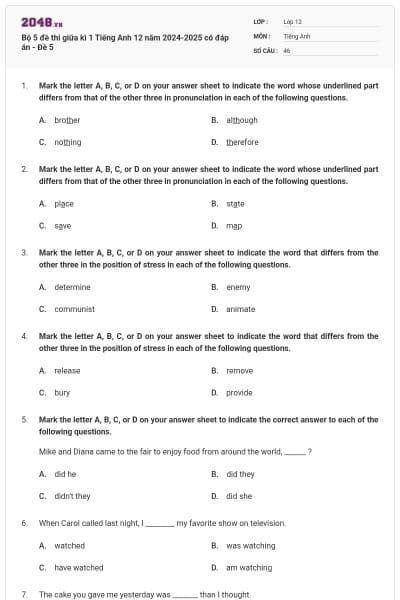
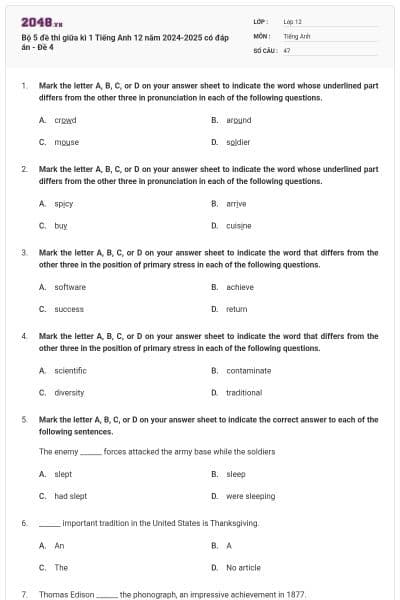
Mark the letter A, B, C or D on your answer sheet to indicate the word whose underlined part differs from the other three in pronunciation in each of the following questions.
admired
contaminated
decomposed
resigned
Mark the letter A, B, C or D on your answer sheet to indicate the word whose underlined part differs from the other three in pronunciation in each of the following questions.
sustainable
air conditioner
campaign
container
Mark the letter A, B, C or D on your answer sheet to indicate the word whose underlined part differs from the other three in pronunciation in each of the following questions.
soldier
product
whole
diagnose
Mark the letter A, B, C or D on your answer sheet to indicate the word that differs from the other three in the position of primary stress in each of the following questions.
marriage
costume
compost
account
Mark the letter A, B, C or D on your answer sheet to indicate the word that differs from the other three in the position of primary stress in each of the following questions.
ceremony
identity
biography
diversity
Mark the letter A, B, C or D on your answer sheet to indicate the correct answer to each of the following questions.
a
some
the
O
the - the
a - 0
the - 0
the - an
experiences
cultures
performances
customs
historical
popular
musical
multicultural
on
off
up
down
for
into
after
at
thrown
thrown away
thrown over
thrown off
Read the following passage and mark the letter A, B, C or D to indicate the correct word or phrase that best fits each of the numbered blanks.
Earth Hour is a movement organised by the World Wildlife Fund (WWF). The event takes (13) annually around the world. It encourages everyone to turn (14) non-essential electric lights, for one hour, from 8:30 to 9:30 p.m. on the last Saturday of March. The initiative was proposed in 2004 in Australia, but the idea of a (15) movement was developed in 2006 under the name 'The Big Flick". In 2007, the first Earth Hour was held on 31 March in Sydney, Australia at 7:30 p.m., local time. Later in October 2007, a similar event called 'Lights (16) was held in San Francisco. (17) the success of these events, the organisers decided to hold Earth Hour annually around the world since then. A study in 2014 claimed that the event (18) electricity consumption by an average of 4%. More importantly, it has helped raise (19) of climate change and has become a symbol of our commitment to protecting our planet. Although one hour can't change the world, it encourages governments and people to set long-term (20) for sustainable development around the world.
part
place
over
on
up
down
off
on
personal
local
wide
worldwide
Up
Over
Out
In
Due to
Besides
Despite
In addition to
reused
reduced
recycled
increased
belief
thoughts
actions
awareness
desires
ideas
goals
activities
Mark the letter A, B, C or D on your answer sheet to indicate the underlined part that needs correction in each of the following questions.
was working
when
was discovering
by
stopped
stood
said
was getting
finished
was standing
their
loudly
on
after
after
about
foreign
experience
studying
an
Mark the letter A, B, C, or D to complete each of the following exchanges.
Teacher: May I present Mr Ellis - our guest speaker in our Class seminar today?
- Class: Good morning, Mr Ellis. _____!
You are welcome in my class
Welcome to our class
We would like to welcome our teacher
Let's welcome her
Mark: _____. My name's Mark Mallows, a friend of Sam.
- Hoa: It's nice to meet you, Mark.
It's my great pleasure
Let me introduce my friend
Allow me to introduce myself
I think we've met before
Mark the letter A, B, C or D on your answer sheet to indicate the sentence that is closest in meaning to each of the following questions.
The last time I saw him was ten years ago.
I saw him ten years ago and will never meet him again.
I have seldom seen him in the last ten years.
I used to see him about ten years ago.
There was a number of tourists visiting this area last year.
The number of tourists visiting this area increased last year.
Last year the tourists visiting this area decreased a lot.
Last year a number of tourists started visiting this area.
This is the first time I have lived in such a friendly neighbourhood.
I used to live in such a friendly neighbourhood.
This is the last time I lived in such an unfriendly neighbourhood before.
This is not the first time I lived in such a friendly neighbourhood.
Read the following passage and circle the letter A, B, C, or D to indicate the correct answer to each of the questions.
A biography is a narrative of a person's life written by another person. There are usually five main steps in writing a good biography.
1. Choose a subject. Choosing the person you want to write about is, of course, the first step. This could be a celebrity, or someone who is lesser known. You could also write about someone who is still alive or someone who is dead. Most importantly, choose a person who has had an impact on other people, or whose life is interesting.
2. Get permission. Although you can still write about a person's life without his or her permission, it is always better to get the subject's agreement. This will not only help you in your research, but you will also avoid upsetting the person later on if he or she thinks your account is not true.
3. Do your research. You can obtain information through primary sources, e.g. the subject's letters or other personal writings, and interviews with her or him. You can also use secondary sources prepared by someone who didn't know the subject or published at a later time.
4. Choose a format. A biography is usually told in chronological or time order. However, you may also choose to organise the events by themes or specific achievements.
5. Outline, write, and edit. It's a good idea to start with a detailed outline including your main points and the number of chapters. After that, write your first draft. Then revise and edit it until you've got a final version you are happy with.
Writing a biography is not easy, but it is worth the effort. A biography often influences or motivates people, and teaches valuable life lessons.
Five steps in writing your life story
Different types of biographies
Things to avoid when writing a biography
How to write a good biography
life
story
impact
research
the topic of a biography
the person that is described in the biography
a celebrity who is still alive
someone with an interesting life
the subject of the biography
writing about a person's life
getting permission from the subject
doing research about the subject
come from the subject himself/ herself
are stories about the subjects written by someone else
are more diverse than secondary sources
are better than secondary sources
primary sources of information
secondary sources of information
both A and B
neither A nor B
is preferred by most biography writers
is the only way to organise a biography
means organising events by topics or themes
means listing the person's achievements in order
It can be done without much effort.
It will be important and useful.
It may have a positive impact on the readers' lives.
We can learn from the experiences of others.
Mark the letter A, B, C, or D to indicate the words) CLOSEST in meaning to the underlined word(s) in each of the following questions.
dropped by
dropped from
dropped out of
dropped over
waste
dedicate
gain
save