Bộ 5 đề thi giữa kì 1 Tiếng Anh 11 Global Success có đáp án - Đề 5
31 câu hỏi
I. LISTENING
Listening. Are the sentences true or false?
The Pomodoro Technique was invented in the 1980s.
Students and workers can use the technique.
The technique is a bit complicated to use.
You need to break down your tasks into smaller sections.
Each break is called a ‘pomodoro’.
II. READING
TASK 1. Read the following passage and choose the correct answer to each of the questions.
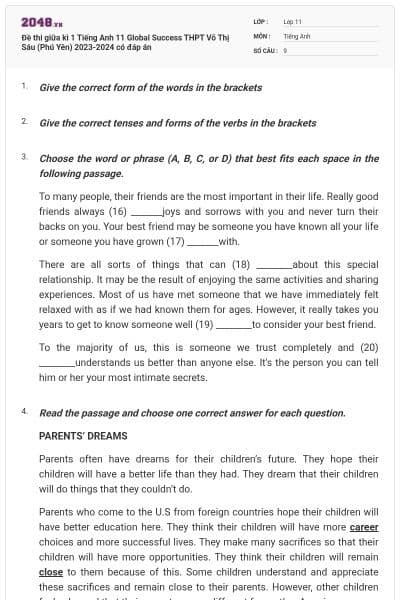
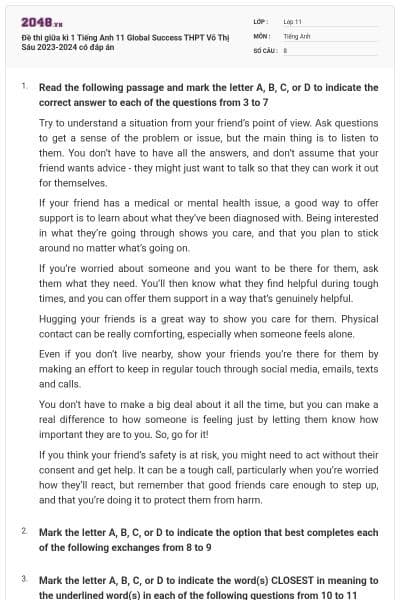
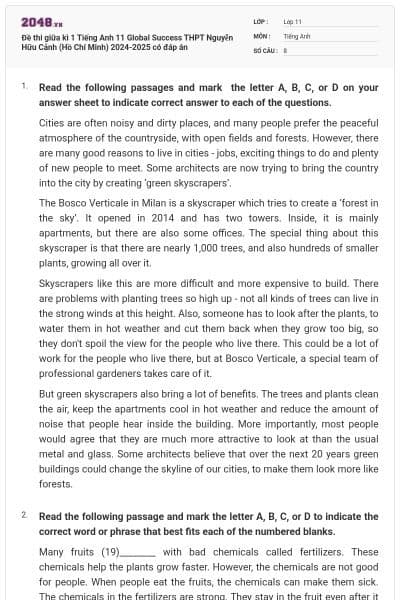
Generally, friendship exists for three reasons: virtue; usefulness; or pleasure. When virtue is the reason, friendship exists for the sake of friendship; where both like each other and cherish each other for some creditable values in the other's personality. You know that you would even die to swear your friendship for that person. You also know that the other would make you live than die for him/her regardless of intelligence, handsomeness, utility or the capability of giving pleasure.
A friendship of the second kind is formed for the practical value of it. How useful so and so is to me? What can I benefit from him? Will he use his reputation and influence to fetch me a good job? Thus a person may maintain relationship for practical, professional, and political reasons. However, once we do away with the usefulness, the friendship eventually dies.
Friendship of the third kind is formed essentially on account of the pleasure the relationship can give. He is a joker. The moment he enters, you forget all your worries. She is cute, intelligent and charming. The very notion that she is your friend makes you feel proud. The point rests here: How good is he/she in giving me pleasure physically, emotionally, mentally and materially?
Now to the question: Which of the three is good? The second type is good, yet since basing on utility, it falls short of longevity and quality. The third type is good too, but how long one enjoys only pleasure in life? But the first type, virtue-based friendship is fantastic for this reason: it lasts till the end of this universe.
There are two main motives for friendship.
You have to die in order to prove your friendship.
Real frienship does not count one person’s cleverness, appearance, utility and his/ her aptitude for creating fun.
Personality is not an important factor in choosing a friend.
ask for
kill
get rid of
escape
Friendship basing on the capacity for creating pleasure still possesses some uncertainty
Friendship usually does not last long if it is built on materialistic need
Frienship requires a lot of patience and efforts from both sides.
Virtue-based friendship's core is a friend's creditable traits in his or her personality
The first
The second
Not mentioned
The third
TASK 2. Read the following passage and choose the correct word that best fits each of the numbered blanks
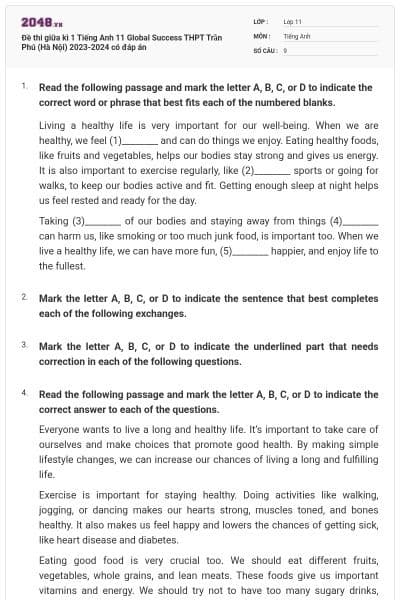
Volunteer Bolivia is the (1)_________ volunteer organization that combines a volunteer service learning experience with a program for an unforgettabe intercultural experience. Their variety of community volunteer positions provide you with the opportunity to make new friends, define a new career, develop new skills, and (2)_________ your skills with others. Short term volunteers are a crucial part of their program allowing you to fulfil the needs of a variety of children’s centers scattered around the region. These centers provide services (3)_________ children. Long term volunteers, are those who stay with them more than five months, speak intermediate Spanish and are specialized volunteers (4)_________ have an expertise that matches their Bolivian colleagues needs.
internationally
international
internation
internationale
→ Cần tính từ bổ nghĩa cho “volunteer organization”.
take
have
share
make
→ Cụm đúng: share your skills with others.
about
at
for
to
→ Cụm đúng: provide services for children.
Long term volunteers, are those who stay with them more than five months, speak intermediate Spanish and are specialized volunteers (4)_________ have an expertise that matches their Bolivian colleagues needs.
who
whom
when
which
→ “volunteers” là danh từ chỉ người → dùng who.
III. WRITING
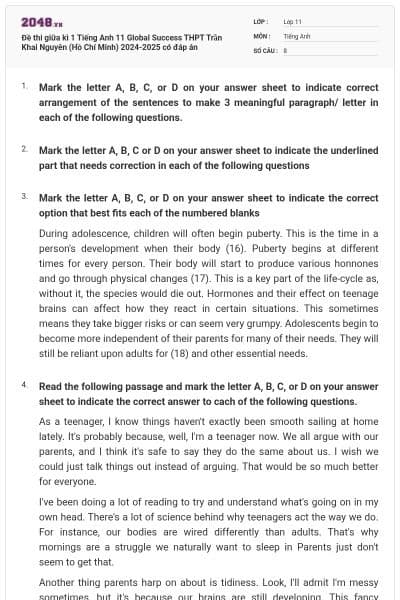
TASK 1. Rewrite each of the sentences in such a way that it means the same as the sentence printed before it.
The boy remembered that they had given him a ball. (Use “passive gerund”)
→ The boy remembered _______________________.
They left their house and went for a walk. . ( Use “a Present participle”)
→ Leaving _______________________.
She decorated the classroom yesterday. (Use “notice”)
→ I noticed _______________________.
During his stay in Singapore, he met many good friends. (Use “While”)
→ While _______________________.
TASK 2. Combine the two sentences into one sentence as requested in each bracket.
Anna read the book. Then she went to bed. (Use “Perfect participle”)
→ Having _______________________.
We answered the emails. Then we watched TV. (Use “Before”)
→ Before _______________________.
IV. LANGUAGE FOCUS
TASK 1. Choose the word whose underlined part differs from the other three in pronunciation in each of the following questions.
Christmas
channel
chicken
challenge
→ Christmas /ˈkrɪs.məs/ (ch = /k/)
→ channel, chicken, challenge (ch = /tʃ/)
IV. LANGUAGE FOCUS
TASK 1. Choose the word whose underlined part differs from the other three in pronunciation in each of the following questions.
lend
heal
could
life
→ could /kʊd/ (oo = /ʊ/)
→ lend /e/, heal /iː/, life /aɪ/
TASK 2. Choose the correct answer to each of the following questions.
have hurt
had hurt
hurt
was hurting
have
had
have had
had had
to leave
left
leave
leaving
worked
working
to work
work
have walked
were walking
are walking
walked
on
for
of
to
to see
seeing
see
saw
good-natured
selfish
quick-witted
honest
volunteered
volunteer
voluntary
voluntarily
appointing
to appoint
being appointed
to be appointed