Trắc nghiệm Chuyên đề 5: Writing có đáp án (Phần 2)
231 câu hỏi
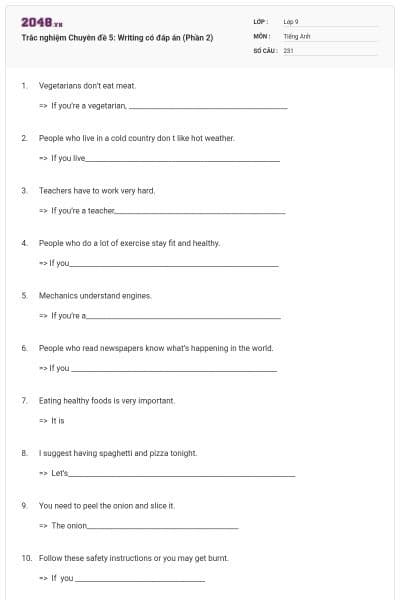
Đáp án: If you’re a vegetarian, you won’t eat meat.
Giải thích:
Kiến thức: Câu điều kiện
Câu gốc là một sự thật chung (Vegetarians don’t eat meat), nên khi viết lại dưới dạng câu điều kiện loại 1 (dùng để diễn tả sự việc có thể xảy ra ở hiện tại hoặc tương lai gần), ta dùng:
If + hiện tại đơn, will + V-inf
Dịch: Nếu bạn là người ăn chay, bạn sẽ không ăn thịt.
If you’re a teacher, you will have to work very hard.
Đáp án: If you do a lot of exercise, you will stay fit and healthy.
Giải thích:
Kiến thức: Câu điều kiện
Câu gốc diễn tả một sự thật chung (người tập thể dục nhiều thì khỏe mạnh).
Khi chuyển sang câu điều kiện loại 1, ta sử dụng:
Mệnh đề If: hiện tại đơn (If you do a lot of exercise, …)
Mệnh đề chính: tương lai đơn (… you will stay fit and healthy.)
Cấu trúc: If + S + V (hiện tại đơn), S + will + V (nguyên mẫu).
Dịch: Nếu bạn tập thể dục nhiều, bạn sẽ giữ được vóc dáng và khỏe mạnh.
Let’s have spaghetti and pizza tonight.
Đáp án: The onion needs to be peeled and sliced.
Giải thích:
- Câu chủ đông: S + need + to V + O.
- Câu bị động: O + need + to + be + V(p2) + (by S).
Dịch: Củ hành cần được lột vỏ và thái lát.

Học thông minh hơn mỗi ngày
Xem toàn bộ 231 câu hỏi và nhiều hơn nữa với tài khoản miễn phí
Đáp án: If you don’t follow these safety instructions, you may get burnt.
Giải thích:
Câu điều kiện loại 1: If + S + V(s, es)..., S + will/may/... + V-inf: diễn tả một sự việc, hành động nào đó có thể xảy ra ở hoặc trong tương lai thông qua một điều kiện cụ thể.
Dịch: Hãy tuân theo những hướng dẫn an toàn này nếu không bạn có thể bị bỏng.
= Nếu bạn không tuân theo những hướng dẫn an toàn này, bạn có thể bị bỏng.
to use.
I don’t agree with a lot of his teaching methods. However, he is a good teacher.
Đáp án: I took you for a friend of Anna’s, I am sorry.
Giải thích:
take somebody for somebody: nhầm ai với ai.
Dịch: Tôi thực sự xin lỗi, tôi nghĩ anh là bạn của Anna.
→ Tôi đã nhầm anh với bạn của Anna, tôi xin lỗi.
I would prefer you do computer science.
I’d rather
It was not until last Monday that he got his visa.
Vietnamese coffee is regarded as one of the best in the world.
Provided you ask me well in advance, I’ll be willing to work overtime.
She is a more sympathetic listener than anyone else I know.
I assumed that she would learn how to take shorthand after this course.
I took it
However jobs which are created by tourism are often seasonal and poorly paid.
___________________________________________________________________
___________________________________________________________________
Finally/ ecotourism/ help/ conservation/ wildlife/ generating funds/ maintaining national park.
___________________________________________________________________
___________________________________________________________________
Nevertheless, it also causes pollution through traffic emissions, littering and noise.
made up her mind
Canada is similar to the United States in that the majority of its people speak English.
Two experiments were conducted so that the hypothesis could be tested.
Middle-class families tend to have person-centered structures, whereas working-class families are usually positional.
Or (Working-class families are usually positional, whereas middle-class families tend to have person-centered structures).
Western Europe has large reserves of fuel. For instance, the UK has a 250-year supply of coal.
Western Europe has large reserves of fuel. For instance, the UK has a 250-year supply of coal.
The heated air expands and rises. As a result, an area of low pressure forms over the land.
Đáp án: It looks as if Jane comes to the performance late.
Giải thích:
Kiến thức: Câu suy đoán với "It looks as if/as though" + mệnh đề
Cấu trúc:
It looks as if + S + V (hiện tại đơn) → dùng khi dựa vào hiện tại mà suy đoán điều gì đang/đã xảy ra.
Trong câu này, "Jane seems to come to the performance late" (Jane có vẻ đến buổi biểu diễn muộn), ta chuyển thành:
→ It looks as if Jane comes to the performance late.
Dịch: Trông có vẻ như Jane đến buổi biểu diễn muộn.
Two experiments were conducted so that the hypothesis could be tested.
Đáp án: Such was Fiona’s disappointment that she could not keep on working.
Giải thích:
Câu gốc sử dụng "so ... that":
so + adjective + that + clause
Đảo ngữ với “such”
Such + be + S + that + clause
Dịch: Fiona thất vọng đến mức không thể tiếp tục làm việc.
→ Quá thất vọng đến mức Fiona không thể tiếp tục làm việc.
We often go to visit our friends in Bristol, which is only 30 miles away.
This is Mr Carter, who I was telling you about.
Please ask them the time when the train started the trip.
There are many hotels. Tourists can enjoy their holidays there.
→ ___________________________________________________________________
If you kept talking, you wouldn’t understand the lesson.
Đáp án: If I knew the answer, I would tell you.
Giải thích:
Kiến thức: Câu điều kiện
Đây là câu điều kiện loại 2 (diễn tả điều không có thật ở hiện tại).
Cấu trúc câu điều kiện loại 2:
If + S + V2/ed, S + would/could + V1
Trong câu gốc:
I don’t know the answer → Chuyển thành If I knew the answer
I can’t tell you → Chuyển thành I could tell you
Dịch: Tôi không biết câu trả lời nên không thể trả lời cho bạn được.
→ Nếu tôi biết câu trả lời, tôi có thể nói cho bạn.
India is the country where the earthquake occurred last month.
The man whom I love with all my heart made me sad the most.
Neil Armstrong, who walked on the moon, lived in the USA.
Earth-like planets.
become the first space tourist in 2001.
Pham Tuan is Viet Nam’s first astronaut, and Christer Fuglesang is Sweden’s first astronaut.
He thinks teamwork, social skills, and foreign languages are important for an astronaut.
Before Neil Armstrong and Buzz Aldrin spoke to President Richard Nixon, they had planted an American flag on the moon.
He had learnt about the universe and had collected lots of books about space.
Đáp án: A friend of mine, whose father is the manager of a company, helped me to get a job.
Giải thích:
Mệnh đề quan hệ không xác định: N, whose + N + V + O,…(‘whose’ là đại từ quan hệ dùng để chỉ sở hữu cho danh từ chỉ người hoặc vật, thường thay cho các từ: her, his, their…)
Dịch: Một người bạn của tôi đã giúp tôi tìm được việc làm. Bố anh ấy là giám đốc của một công ty.
= Một người bạn của tôi, người có bố là giám đốc một công ty, đã giúp tôi tìm được việc làm.
The population of London, which was once the largest city in the world, is now falling.
I couldn’t remember the number of my own car, which made the police suspicious.
Thank you very much for the present (which / that) you sent me.
All of the boys who are being chosen for the school’s football team are under 9. - All of the boys being chosen for the school’s football team...
All of the boys who are being chosen for the school’s football team are under 9. - All of the boys being chosen for the school’s football team...
I went to see my nephew Jimmy who(m) I used to look after when he was small.
Ann, who lives next door, is very friendly.
Students whose homework is late will be punished.
I’ve found the book that/which I was looking for in the morning.
Giải thích:
Dùng đại từ quan hệ ‘who’ để thay thế cho danh từ chỉ người (Sandra) đóng vai trò làm chủ ngữ trong mệnh đề quan hệ: N + who + V
Dịch: Sandra, người mà bạn đang nói chuyện, làm việc trong ngành quảng cáo.
Lake Prespa, which is on the north Greek border, is a lonely beautiful lake.
Đáp án: Julia’s father, who is over 80, has just come back from a skiing holiday.
Giải thích:
Kiến thức: Mệnh đề quan hệ
who is over 80 là mệnh đề quan hệ không xác định, bổ sung thêm thông tin về "Julia’s father".
"He is over 80" → thông tin thêm về "Julia’s father"
Ta dùng "who is over 80" sau danh từ "Julia’s father" để nối hai câu lại thành một câu hoàn chỉnh và mạch lạc.
Dịch: Bố của Julia, người đã ngoài 80 tuổi, vừa trở về sau kỳ nghỉ trượt tuyết.
The problems faced by the company are being resolved. (I’ll look at these in detail in a moment.)
→_________________________________________________________________
The newspaper is owned by the Mears group, whose chairperson is Sir James Hex.
Đáp án: I don’t know the name of the woman whom/ who I spoke to on the phone.
I don’t know the name of the woman to whom I spoke on the phone.
Giải thích:
Kiến thức: Mệnh đề quan hệ
Xác định danh từ mà mệnh đề quan hệ bổ nghĩa cho là “woman”, tương đương với “her” ở câu sau.
“her” đóng vai trò làm tân ngữ, nên dùng “whom/who”
Nếu dùng giới từ đảo lên trước cùng, ta chỉ dùng “whom”.
Dịch: Tôi không biết tên người phụ nữ đó. Tôi đã nói chuyện với cô ấy qua điện thoại.
→ Tôi không biết tên người phụ nữ mà tôi đã nói chuyện qua điện thoại.
Đáp án: The scientist who discovered a new planet has won the Nobel Prize.
Giải thích:
Kiến thức: Mệnh đề quan hệ
Danh từ “A scientist” là danh từ chỉ người, “He” ở câu thứ hai đứng làm chủ ngữ, do đó dùng đại từ quan hệ “who”. Mệnh đề quan hệ đứng ngay sau danh từ nó bổ nghĩa.
Ngoài ra, do danh từ đã được xác định bởi mệnh đề quan hệ, nên dùng mạo từ xác định “the”.
Dịch: Một nhà khoa học đã giành giải Nobel. Ông đã khám phá ra một hành tinh mới.
→ Nhà khoa học phát hiện ra hành tinh mới đã giành được giải Nobel.
Despite (having) a poor memory, she told interesting stories to the children.
In spite of her frequent absence, he has managed to pass the test.
Although he had a headache, he enjoyed the film.
Miss Diep tried several times, but she couldn’t find a taxi.
Despite
Miss Diep tried several times, but she couldn’t find a taxi.
Despite
Despite liking more holidays, Mr. Vinh doesn’t mind going to school.
In spite of the hard work and low wages, he decided to take the job.
In spite of his age, he still does his gymnastics every morning.
She’s a dynamic businesswoman. She has so much energy and focus.
Working as architects, they design buildings.
They have won many big contracts. They are successful businesswomen and businessmen.
In spite of having no qualifications for it, he got the job
Although I didn’t like the CD you have recommended me, I bought it all the same.
Despite playing well / having played well, we couldn’t win the match.
In spite of the rain, we enjoyed our holiday.
In spite of telling her all the truth, she didn’t believe me.
In spite of having all the necessary qualifications, he didn’t get the job.
She attempted to cooperate with the others in the team to finish the work.
He has a talent for fixing things, so he is an excellent mechanic.
Max isn’t home yet which worries me.
Last week I went to see the house in which /where I used to live.
I don’t know the name of the girl who has just gone into the hall.
Đáp án: Be sure to follow the instructions which/that are given at the top of the page.
Giải thích:
Kiến thức: Mệnh đề quan hệ
Ta có hai câu:
Be sure to follow the instructions.
They are given at the top of the page.
→ Trong câu 2, đại từ "they" thay cho "the instructions"
→ Ghép hai câu bằng cách dùng mệnh đề quan hệ xác định với đại từ "that" hoặc "which" làm chủ ngữ.
Cấu trúc:
Noun + that/which + V
Dịch: Hãy chắc chắn làm theo các hướng dẫn được đưa ra ở đầu trang.
Bạn có thích hoạt động này không?
Hãy lưu hoặc chia sẻ nội dung này đến mọi người.
Gợi ý cho bạn

Ý tưởng của bạn, bài học của bạn
Tự thiết kế đề thi, bài giảng hoặc flashcard theo cách riêng.