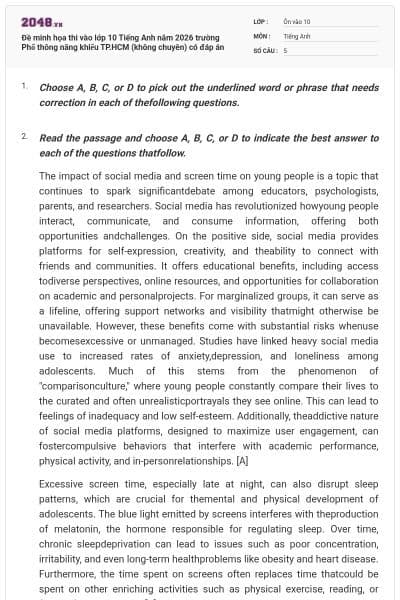
Đề minh họa thi vào lớp 10 Tiếng Anh năm 2026 trường Phổ thông năng khiếu TP.HCM (không chuyên) có đáp án
50 câu hỏi
I. PHẦN TRẮC NGHIỆM
Choose A, B, C, or D to pick out the word whose underlined part is pronounced differently from that of the others in the same group.
naked
cooked
laughed
washed
Hướng dẫn giải:
Đáp án đúng: A
Đáp án A phát âm là /id/, các đáp án còn lại phát âm là /t/
Choose A, B, C, or D to pick out the word whose underlined part is pronounced differently from that of the others in the same group.
cover
over
stove
stone
Hướng dẫn giải:
Đáp án đúng: A
Đáp án A phát âm là /ʌ/, các đáp án còn lại phát âm là /əʊ/
Choose A, B, C, or D to pick out the word whose primary stress is different from that of the others in the same group.
electric
scientist
beautify
recognise
Hướng dẫn giải:
Đáp án đúng: A
Đáp án A trọng âm số 2, các đáp án còn lại trọng âm số 1
Choose A, B, C, or D to pick out the word whose primary stress is different from that of the others in the same group.
hello
welcome
control
behave
Hướng dẫn giải:
Đáp án đúng: B
Đáp án B trọng âm số 1, các đáp án còn lại trọng âm số 2
Choose A, B, C, or D to pick out the word or phrase that best fits each of the blanks in the following questions.
will let you
allowed you
will allow you
is letting you
Hướng dẫn giải:
Đáp án đúng: C
Cấu trúc: allow sb to V (cho phép ai làm gì)
Dịch nghĩa: Bạn có nghĩ bố mẹ bạn sẽ cho phép bạn tham gia cùng chúng tôi vào cuối tuần này không?
"Shall we go to the concert tonight?
"I'm a bit tired and I'd rather ________ home."
stayed
stay
to stay
staying
Hướng dẫn giải:
Đáp án đúng: B
Cấu trúc: would rather + V nguyên mẫu (làm gì đó thì hơn)
Dịch nghĩa: “Tối nay chúng ta đi xem hòa nhạc nhé?” - “Tôi hơi mệt và tôi muốn ở nhà hơn.”
"May I watch the late movie on T.V tonight, mom?"
"No, it's high time you ________ to bed, son."
have gone
go
went
had gone
Hướng dẫn giải:
Đáp án đúng: C
Cấu trúc: It’s high time + S + V2 (Đến lúc phải làm gì)
Dịch nghĩa: “Mẹ ơi, tối nay con xem phim khuya trên TV được không?” - “Không, đã đến lúc con phải đi ngủ rồi.”
reputed
supposed to
hoped
pretended
Hướng dẫn giải:
Đáp án đúng: B
Cụm: be supposed to (được yêu cầu/phải)
Dịch nghĩa: Bất kỳ học sinh nào muốn tham gia khóa học này đều phải vượt qua bài kiểm tra đầu vào.
simplicity
complexity
ease
fluency
Hướng dẫn giải:
Đáp án đúng: B
complexity = sự phức tạp (→ gây khó hiểu)
Dịch nghĩa: Sự phức tạp của ngôn ngữ được sử dụng trong tài liệu là một rào cản đối với việc hiểu nó.
incompetence
skillfulness
professionalism
experience
Hướng dẫn giải:
Đáp án đúng: A
incompetence = sự thiếu năng lực
Dịch nghĩa: Sự thiếu năng lực của ban quản lý công ty khiến nhân viên khó cảm thấy có động lực và gắn bó.
however
but
therefore
so
Hướng dẫn giải:
Đáp án đúng: A
however = tuy nhiên (nối 2 mệnh đề trái ý)
Dịch nghĩa: Tôi không chắc dự án mới nhất của công ty có thành công hay không, tuy nhiên nó đáng để thử.
economic
economical
economics
economist
Hướng dẫn giải:
Đáp án đúng: A
economic (thuộc kinh tế)
Dịch nghĩa: Các chính sách kinh tế của chính phủ đã bị chỉ trích vì bỏ qua nhu cầu của các cộng đồng yếu thế.
I would have cooked dinner
I will cook dinner
I cooked dinner
I cook dinner
Hướng dẫn giải:
Đáp án đúng: A
Câu điều kiện loại 3: If + S + VpII, S + would/could/ might + have VpII.
Dịch nghĩa: Nếu tôi biết bạn sẽ đến, tôi đã nấu bữa tối rồi.
bring in
look over
look into
look after
Hướng dẫn giải:
Đáp án đúng: A
bring in = triển khai/giới thiệu
Dịch nghĩa: Công ty quyết định triển khai một chiến dịch marketing mới để tiếp cận nhiều khách hàng hơn.
look up
put off
carry out
cut back on
Hướng dẫn giải:
Đáp án đúng: A
look up = kiểm tra/xem lại
Dịch nghĩa: Tôi luôn kiểm tra email trước khi gửi để tránh sai sót.
Choose A, B, C, or D to pick out the underlined word or phrase that needs correction in each of thefollowing questions.
(A) Finally, she decided to (B) be quit her job (C) because she wasn't happy (D) with herboss.
Hướng dẫn giải:
Đáp án đúng: B
Sai: be quit → đúng: quit (decide to + V nguyên mẫu)
Dịch nghĩa: Cuối cùng, cô ấy quyết định nghỉ việc vì cô ấy không hài lòng với sếp của mình.
She (A) told me that the car was (B) too expensive (C) for her to buy (D) it.
Hướng dẫn giải:
Đáp án đúng: D
Sai: buy it → đúng: buy (đã có “the car” → không cần “it”)
Dịch nghĩa: Cô ấy nói với tôi rằng chiếc xe quá đắt để cô ấy mua.
It (A) took her a week (B) reading the book (C) because it was (D) very long.
Hướng dẫn giải:
Đáp án đúng: B
Sai: reading → đúng: to read
Cấu trúc: It takes + time + to V
Dịch nghĩa: Cô ấy mất một tuần để đọc cuốn sách vì nó rất dài.
The (A) politician's speech was so (B) inspired that it (C) motivated people (D) to takeaction.
Hướng dẫn giải:
Đáp án đúng: B
Sai: inspired → đúng: inspiring (bài phát biểu mang tính gây cảm hứng)
Dịch nghĩa: Bài phát biểu của chính trị gia rất truyền cảm hứng nên đã thúc đẩy mọi người hành động.
(A) Choosing a career is one of (B) the most important (C) decision a person can (D)make.
Hướng dẫn giải:
Đáp án đúng: C
Sai: decision → đúng: decisions
Cấu trúc: one of the + so sánh nhất + danh từ số nhiều
Dịch nghĩa: Chọn nghề nghiệp là một trong những quyết định quan trọng nhất mà một người có thể đưa ra.
Read the passage and choose A, B, C, or D to indicate the best answer to each of the questions thatfollow.
The impact of social media and screen time on young people is a topic that continues to spark significantdebate among educators, psychologists, parents, and researchers. Social media has revolutionized howyoung people interact, communicate, and consume information, offering both opportunities andchallenges. On the positive side, social media provides platforms for self-expression, creativity, and theability to connect with friends and communities. It offers educational benefits, including access todiverse perspectives, online resources, and opportunities for collaboration on academic and personalprojects. For marginalized groups, it can serve as a lifeline, offering support networks and visibility thatmight otherwise be unavailable. However, these benefits come with substantial risks whenuse becomesexcessive or unmanaged. Studies have linked heavy social media use to increased rates of anxiety,depression, and loneliness among adolescents. Much of this stems from the phenomenon of "comparisonculture," where young people constantly compare their lives to the curated and often unrealisticportrayals they see online. This can lead to feelings of inadequacy and low self-esteem. Additionally, theaddictive nature of social media platforms, designed to maximize user engagement, can fostercompulsive behaviors that interfere with academic performance, physical activity, and in-personrelationships. [A]
Excessive screen time, especially late at night, can also disrupt sleep patterns, which are crucial for themental and physical development of adolescents. The blue light emitted by screens interferes with theproduction of melatonin, the hormone responsible for regulating sleep. Over time, chronic sleepdeprivation can lead to issues such as poor concentration, irritability, and even long-term healthproblems like obesity and heart disease. Furthermore, the time spent on screens often replaces time thatcould be spent on other enriching activities such as physical exercise, reading, or face-to-face socializing.[B]
At the same time, not all screen time is harmful, and the type of content consumed plays a crucial role indetermining its effects. Educational content, for example, can foster learning and skill development,while engaging in moderated, meaningful online interactions can enhance social well-being. Thechallenge lies in finding the balance between the advantages and the drawbacks of screen time. Parentsand educators play a critical role in guiding young people toward healthy media habits. Settingboundaries, such as screen-free times or designated offline activities, can help mitigate negative impacts.Equally important is teaching digital literacy, enabling young people to critically evaluate the contentthey encounter and recognize the manipulative tactics used by some platforms to keep users engaged.Promoting open communication about online experiences is essential in creating a supportiveenvironment where young people feel empowered to share their struggles and seek help when needed. [C]
Ultimately, the truth about social media and screen time's impact on young people is neither entirelypositive nor wholly negative. Its effects depend on factors such as the type of engagement, duration ofuse, and the support systems in place to help navigate the digital world. By fostering awareness andpromoting balanced use, society can maximize the benefits of these technologies while minimizing theirrisks, ensuring young people thrive both online and offline. [D]
Social media only has negative impacts on young people.
Social media provides opportunities but also poses significant risks to young people's well being.
Social media benefits outweigh the harms.
Excessive screen time is only harmful to physical health.
Hướng dẫn giải:
Đáp án đúng: B
Dịch nghĩa: Đoạn văn nói rằng mạng xã hội vừa mang lại cơ hội vừa gây ra nhiều rủi ro đối với giới trẻ.
Increased rates of anxiety and depression.
Opportunities for self-expression and creativity.
Constant comparison with others.
Disruption of sleep patterns.
Hướng dẫn giải:
Đáp án đúng: B
Thông tin: On the positive side, social media provides platforms for self-expression, creativity, and the ability to connect with friends and communities. (Về mặt tích cực, mạng xã hội cung cấp các nền tảng để thể hiện bản thân, sự sáng tạo và khả năng kết nối với bạn bè và cộng đồng.)
By fostering supportive online communities.
By promoting unrealistic portrayals of life that lead to comparison and low self-esteem.
By encouraging physical exercise and healthy habits.
By providing access to educational resources.
Hướng dẫn giải:
Đáp án đúng: B
Thông tin: Much of this stems from the phenomenon of "comparison culture," where young people constantly compare their lives to the curated and often unrealistic portrayals they see online. (Phần lớn điều này bắt nguồn từ hiện tượng "văn hóa so sánh", nơi giới trẻ liên tục so sánh cuộc sống của mình với những hình ảnh được dàn dựng và thường không thực tế mà họ thấy trên mạng.)
It enhances focus and productivity before bedtime.
The blue light emitted by screens disrupts melatonin production, affecting sleep patterns.
It promotes healthy relaxation, leading to better sleep.
It helps regulate the body's natural sleep cycle.
Hướng dẫn giải:
Đáp án đúng: B
Thông tin: The blue light emitted by screens interferes with the production of melatonin, the hormone responsible for regulating sleep. (Ánh sáng xanh phát ra từ màn hình cản trở quá trình sản xuất melatonin, hormone chịu trách nhiệm điều chỉnh giấc ngủ.)
Encouraging unrestricted screen time.
Teaching digital literacy and setting screen time boundaries.
Eliminating access to all forms of technology.
Reducing social interactions altogether.
Hướng dẫn giải:
Đáp án đúng: B
Thông tin: Setting boundaries, such as screen-free times or designated offline activities, can help mitigate negative impacts. (Việc thiết lập các giới hạn, chẳng hạn như thời gian không sử dụng thiết bị điện tử hoặc các hoạt động ngoại tuyến được chỉ định, có thể giúp giảm thiểu tác động tiêu cực.)
The type of content consumed and the duration of use.
The popularity of the social media platform.
The number of followers a young person has online.
The device used to access social media.
Hướng dẫn giải:
Đáp án đúng: A
Thông tin: Its effects depend on factors such as the type of engagement, duration of use, and the support systems in place to help navigate the digital world. (Tác động của nó phụ thuộc vào các yếu tố như loại hình tương tác, thời gian sử dụng và các hệ thống hỗ trợ hiện có để giúp người dùng điều hướng thế giới kỹ thuật số.)
Why is open communication about social media experiences important, as mentionedin the passage?
To encourage excessive use of digital devices.
To create a supportive environment where struggles can be shared and addressed.
To monitor young people's online activity for complete control.
To promote the idea that all screen time is negative.
Hướng dẫn giải:
Đáp án đúng: B
Thông tin: Promoting open communication about online experiences is essential in creating a supportive environment where young people feel empowered to share their struggles and seek help when needed. (Thúc đẩy giao tiếp cởi mở về những trải nghiệm trực tuyến là điều thiết yếu để tạo ra một môi trường hỗ trợ, nơi giới trẻ cảm thấy tự tin chia sẻ khó khăn và tìm kiếm sự giúp đỡ khi cần thiết.)
In which place does the following sentence best fit?
"This sedentary lifestyle not only impacts physical health but also diminishes opportunities for youngpeople to develop essential life skills like effective communication, emotional regulation, andresilience."
[A]
[B]
[C]
[D]
Hướng dẫn giải:
Đáp án đúng: B
Giải thích:
Câu thêm nói về lối sống ít vận động (sedentary lifestyle) → phù hợp đoạn nói về thời gian màn hình thay thế hoạt động khác (đoạn 2)
Dịch bài đọc:
Tác động của mạng xã hội và thời gian sử dụng màn hình đối với giới trẻ là một chủ đề tiếp tục gây tranh luận gay gắt giữa các nhà giáo dục, nhà tâm lý học, phụ huynh và nhà nghiên cứu. Mạng xã hội đã cách mạng hóa cách giới trẻ tương tác, giao tiếp và tiếp nhận thông tin, mang lại cả cơ hội và thách thức. Về mặt tích cực, mạng xã hội cung cấp nền tảng để thể hiện bản thân, sự sáng tạo và khả năng kết nối với bạn bè và cộng đồng. Nó mang lại lợi ích giáo dục, bao gồm tiếp cận các quan điểm đa dạng, tài nguyên trực tuyến và cơ hội hợp tác trong các dự án học thuật và cá nhân. Đối với các nhóm yếu thế, nó có thể đóng vai trò như một cứu cánh, cung cấp mạng lưới hỗ trợ và sự hiện diện mà nếu không có nó thì khó có được. Tuy nhiên, những lợi ích này đi kèm với những rủi ro đáng kể khi việc sử dụng trở nên quá mức hoặc không được quản lý. Các nghiên cứu đã liên kết việc sử dụng mạng xã hội quá mức với tỷ lệ lo âu, trầm cảm và cô đơn gia tăng ở thanh thiếu niên. Phần lớn điều này bắt nguồn từ hiện tượng "văn hóa so sánh", nơi giới trẻ liên tục so sánh cuộc sống của họ với những hình ảnh được chọn lọc và thường không thực tế mà họ thấy trên mạng. Điều này có thể dẫn đến cảm giác thiếu tự tin và lòng tự trọng thấp. Ngoài ra, bản chất gây nghiện của các nền tảng mạng xã hội, được thiết kế để tối đa hóa sự tham gia của người dùng, có thể thúc đẩy các hành vi cưỡng chế gây cản trở đến kết quả học tập, hoạt động thể chất và các mối quan hệ trực tiếp. [A]
Thời gian sử dụng màn hình quá mức, đặc biệt là vào đêm khuya, cũng có thể làm gián đoạn giấc ngủ, điều rất quan trọng đối với sự phát triển tinh thần và thể chất của thanh thiếu niên. Ánh sáng xanh phát ra từ màn hình cản trở quá trình sản xuất melatonin, hormone chịu trách nhiệm điều chỉnh giấc ngủ. Theo thời gian, tình trạng thiếu ngủ mãn tính có thể dẫn đến các vấn đề như khó tập trung, cáu kỉnh, và thậm chí là các vấn đề sức khỏe lâu dài như béo phì và bệnh tim. Hơn nữa, thời gian dành cho màn hình thường thay thế thời gian có thể dành cho các hoạt động bổ ích khác như tập thể dục, đọc sách hoặc giao tiếp trực tiếp. [B]
Đồng thời, không phải tất cả thời gian sử dụng màn hình đều có hại, và loại nội dung được tiêu thụ đóng vai trò quan trọng trong việc xác định tác động của nó. Ví dụ, nội dung giáo dục có thể thúc đẩy việc học tập và phát triển kỹ năng, trong khi tham gia vào các tương tác trực tuyến có kiểm soát và ý nghĩa có thể nâng cao hạnh phúc xã hội. Thách thức nằm ở việc tìm ra sự cân bằng giữa những lợi ích và hạn chế của thời gian sử dụng màn hình. Cha mẹ và các nhà giáo dục đóng vai trò quan trọng trong việc hướng dẫn thanh thiếu niên hình thành thói quen sử dụng phương tiện truyền thông lành mạnh. Việc thiết lập ranh giới, chẳng hạn như thời gian không sử dụng màn hình hoặc các hoạt động ngoại tuyến được chỉ định, có thể giúp giảm thiểu tác động tiêu cực. Điều quan trọng không kém là dạy kỹ năng đọc viết kỹ thuật số, giúp thanh thiếu niên đánh giá một cách phê phán nội dung mà họ gặp phải và nhận ra các chiến thuật thao túng được một số nền tảng sử dụng để giữ chân người dùng. Thúc đẩy giao tiếp cởi mở về trải nghiệm trực tuyến là điều cần thiết để tạo ra một môi trường hỗ trợ, nơi thanh thiếu niên cảm thấy được trao quyền để chia sẻ những khó khăn của họ và tìm kiếm sự giúp đỡ khi cần thiết. [C]
Cuối cùng, sự thật về tác động của mạng xã hội và thời gian sử dụng màn hình đối với thanh thiếu niên không hoàn toàn tích cực cũng không hoàn toàn tiêu cực. Tác động của nó phụ thuộc vào các yếu tố như loại hình tương tác, thời lượng sử dụng và các hệ thống hỗ trợ hiện có để giúp họ điều hướng thế giới kỹ thuật số. Bằng cách nâng cao nhận thức và thúc đẩy việc sử dụng cân bằng, xã hội có thể tối đa hóa lợi ích của các công nghệ này đồng thời giảm thiểu rủi ro, đảm bảo thanh thiếu niên phát triển mạnh cả trực tuyến và ngoại tuyến. [D]
Read the passage and choose A, B, C, or D to indicate the best answer to each of the questions thatfollow.
Tom's writing leaned very much back to the left. He was the only pupil in the class who wrote in thisway. He was a nuisance in poetry lessons as he would giggle and make faces and could never bepersuaded (29)aloud. His silly behaviour made me believe that he didn't like poetry.
However, when I gave the class a test in which they had to write down some poetry they hadlearned byheart, Tom seemed to know a lot.
Tom had a special dislike for art and 1 allowed him to read during this period. He never volunteered fordrama and refused to make a speech. Football was the one thing at which he excelled, but the sportsteacher decided that he did not assert himself enough and he made another boy captain. This boy - hisname was John Jones - could hardly read or write. All attempts to make him work failed, but hecaptained the team (30)amazing skill.
I remember an occasion when he led our school eleven out of the changing rooms for a cup matchagainst our fiercest rivals, the team from nearby Winterton School. The Winterton girls' hockey teamhad already beaten our own girls' team and this - plus their excellent start to the season - had raisedtheir morale to a fearsome level. Even so, John played like a true professional. Our only scorer, he madegood use of Tom's passes and scored a goal for every two that the Winterton players could managebetween them. Though Kingston lost, the match was a triumph for Captain 20 Jones!
(31)all this, the pupil who impressed me most in the end was Tom Halliday. He gained myadmiration on a day when I had his class for art. They came into the hut shouting and pushing and I sentthem out again and told them they would not have a lesson until they walked in properly. They thoughtit was fun to waste as much time as possible, and they jeered and cheered outside the hut. I let them goon for a minute. Suddenly the noise stopped and in marched Tom.
"They are all right now,' he said. 'I've got them lined up." I looked outside and sure enough the pupilsof class 2D were arranged like well drilled soldiers; they were in order of size and in perfect line - sostill I could see them shivering in the chilly air. "Walk in quietly," Tom commanded. They obeyed theirsuperior officer, and the lesson began. Tom himself as usual, (32)to work. "Can I just sitand have a nap? He asked. After the help he had given me, I could hardly refuse.
to read
read
reading
reads
Hướng dẫn giải:
Đáp án đúng: A
Cấu trúc: persuade sb to V (thuyết phục ai làm gì)
Dịch nghĩa: Cậu ấy không bao giờ chịu đọc to.
by
with
on
for
Hướng dẫn giải:
Đáp án đúng: B
Cụm: with amazing skill (với kỹ năng tuyệt vời)
Dịch nghĩa: Nhưng cậu ấy lại làm đội trưởng với kỹ năng đáng kinh ngạc.
Because of
Despite
For
Thanks to
Hướng dẫn giải:
Đáp án đúng: B
Cấu trúc: Despite + N/V-ing (mặc dù)
Dịch nghĩa: Mặc dù tất cả những điều đó, học sinh gây ấn tượng nhất với tôi cuối cùng lại là Tom.
avoided
disliked
objected
refused
Hướng dẫn giải:
Đáp án đúng: D
Cụm: refuse to work (từ chối làm việc)
Dịch nghĩa: Bản thân Tom, như thường lệ, từ chối làm việc.
The Big Match
Jones to Rescue!
A Difficult Class
Tom Halliday Earns a Rest!
Hướng dẫn giải:
Đáp án đúng: D
Nội dung chính xoay quanh Tom và việc cậu xứng đáng được nghỉ
Dịch nghĩa: Tom Halliday xứng đáng được nghỉ ngơi.
he was thought to be crazy.
he was thought to be a poor leader.
Jones was bad at other things and needed encouragement.
Jones was better scoring goals when under pressure.
Hướng dẫn giải:
Đáp án đúng: B
Thông tin: “did not assert himself enough” (không đủ quyết đoán)
Dịch nghĩa: Tom không được chọn làm đội trưởng vì bị cho là không có tố chất lãnh đạo.
Tom's teacher admired his memory for poetry.
Tom's teacher admired his strong personality.
Tom's teacher realized that he deserved to be captain of the football team.
Tom's teacher realized that he deserved to read or rest during art lessons.
Hướng dẫn giải:
Đáp án đúng: B
Tom thể hiện khả năng lãnh đạo khi xếp lớp rất kỷ luật
Dịch nghĩa: Giáo viên ngưỡng mộ tính cách mạnh mẽ (khả năng lãnh đạo) của Tom.
Dịch bài đọc:
Chữ viết của Tom nghiêng rất nhiều về bên trái. Cậu ấy là học sinh duy nhất trong lớp viết theo kiểu này. Trong giờ học thơ, cậu là một đứa trẻ gây phiền toái vì hay cười khúc khích, làm trò và không bao giờ chịu đọc to. Hành vi ngớ ngẩn của cậu khiến tôi nghĩ rằng cậu không thích thơ. Tuy nhiên, khi tôi cho cả lớp làm bài kiểm tra, trong đó họ phải viết lại những bài thơ đã học thuộc, Tom dường như biết rất nhiều.
Tom đặc biệt không thích môn mỹ thuật và tôi cho phép cậu đọc sách trong giờ này. Cậu không bao giờ tình nguyện tham gia kịch và từ chối phát biểu. Bóng đá là điều duy nhất cậu làm tốt, nhưng giáo viên thể dục cho rằng cậu không đủ quyết đoán nên đã chọn một học sinh khác làm đội trưởng. Cậu học sinh đó – tên là John Jones – hầu như không biết đọc hay viết. Mọi nỗ lực để bắt cậu học tập đều thất bại, nhưng cậu lại làm đội trưởng với kỹ năng đáng kinh ngạc.
Tôi nhớ một lần cậu dẫn đội bóng của trường ra khỏi phòng thay đồ để thi đấu một trận cúp với đối thủ lớn nhất của chúng tôi – đội trường Winterton gần đó. Đội khúc côn cầu nữ của Winterton đã đánh bại đội nữ của chúng tôi trước đó và điều này – cùng với khởi đầu mùa giải rất tốt của họ – đã làm tinh thần của họ tăng cao đáng sợ. Dù vậy, John đã chơi như một vận động viên chuyên nghiệp thực thụ. Là người ghi bàn duy nhất của đội chúng tôi, cậu tận dụng tốt những đường chuyền của Tom và ghi được một bàn cho mỗi hai bàn mà đội Winterton ghi được. Mặc dù Kingston thua trận, nhưng đó vẫn là một chiến thắng về tinh thần cho đội trưởng Jones!
Mặc dù tất cả những điều đó, học sinh khiến tôi ấn tượng nhất cuối cùng lại là Tom Halliday. Cậu khiến tôi khâm phục trong một lần tôi dạy lớp cậu môn mỹ thuật. Các em bước vào lớp vừa la hét vừa xô đẩy, tôi yêu cầu họ ra ngoài và nói rằng sẽ không có tiết học nào cho đến khi họ vào lớp một cách trật tự. Họ nghĩ rằng thật thú vị khi lãng phí thời gian, và họ la ó, cổ vũ bên ngoài lớp. Tôi để họ tiếp tục trong một phút. Đột nhiên, tiếng ồn dừng lại và Tom bước vào. “Bây giờ họ ổn rồi,” cậu nói. “Em đã xếp họ vào hàng rồi.” Tôi nhìn ra ngoài và đúng thật, học sinh lớp 2D đứng ngay ngắn như những người lính được huấn luyện kỹ; họ đứng theo thứ tự chiều cao, thành một hàng thẳng tắp – im lặng đến mức tôi có thể thấy họ run lên vì lạnh. “Đi vào một cách trật tự,” Tom ra lệnh. Họ nghe theo “người chỉ huy” của mình và tiết học bắt đầu. Còn Tom, như thường lệ, từ chối làm việc. “Em có thể ngồi và ngủ một lát không ạ?” cậu hỏi. Sau những gì cậu đã giúp tôi, tôi khó mà từ chối.
II. PHẦN TỰ LUẬN
WORD FORMATION
Complete each of the following questions with the most suitable form of the word given inbrackets.
Several__________in the world have conducted detailed studies on how climate change is affecting the migration patterns of local bird species. (ECOLOGY)
Hướng dẫn giải:
Đáp án đúng: ecologists
Danh từ chỉ người: ecology → ecologist (nhà sinh thái học) → số nhiều
Dịch nghĩa: Nhiều nhà sinh thái học trên thế giới đã tiến hành các nghiên cứu chi tiết về việc biến đổi khí hậu ảnh hưởng đến sự di cư của các loài chim địa phương như thế nào.
__________focuses on preserving natural resources to ensure a healthier planet for future generations. (SUSTAIN)
Hướng dẫn giải:
Đáp án đúng: Sustainability
Danh từ: sustain → sustainability (sự bền vững)
Dịch nghĩa: Sự bền vững tập trung vào việc bảo tồn tài nguyên thiên nhiên để đảm bảo một hành tinh khỏe mạnh hơn cho các thế hệ tương lai.
The rainforest is home to incredible__________, with thousands of plant and animal species living in harmony. (DIVERSE)
Hướng dẫn giải:
Đáp án đúng: diversity
Danh từ: diverse → diversity (sự đa dạng)
Dịch nghĩa: Rừng mưa nhiệt đới là nơi có sự đa dạng đáng kinh ngạc, với hàng nghìn loài thực vật và động vật sống hài hòa.
The children ran_________through the grass, laughing as the morning dew tickled their toes. (FOOT)
Hướng dẫn giải:
Đáp án đúng: barefoot
foot → barefoot (chân trần)
Dịch nghĩa: Bọn trẻ chạy chân trần trên cỏ, cười đùa khi làn sương sớm làm nhột chân chúng.
Despite the effort put into the event, it turned out to be an__________evening with nothing remarkable to recall. (MEMORIZE)
Hướng dẫn giải:
Đáp án đúng: unmemorable
Phủ định: un + memorable (đáng nhớ)
Dịch nghĩa: Mặc dù đã nỗ lực tổ chức, buổi tối đó lại trở thành một buổi tối không đáng nhớ, không có gì nổi bật.
The country's most popular tourist__________, from majestic waterfalls to centuries-old castles, provide unforgettable experiences for visitors. (ATTRACT)
Hướng dẫn giải:
Đáp án đúng: attractions
Danh từ: attract → attraction (điểm thu hút) → số nhiều
Dịch nghĩa: Những điểm du lịch nổi tiếng nhất của đất nước, từ thác nước hùng vĩ đến những lâu đài cổ hàng trăm năm tuổi, mang lại những trải nghiệm khó quên cho du khách.
The meeting ended in__________, as the team could not reach a consensus on the proposed strategy. (AGREE)
Hướng dẫn giải:
Đáp án đúng: disagreement
Phủ định: dis + agree → disagreement (sự bất đồng)
Dịch nghĩa: Cuộc họp kết thúc trong sự bất đồng vì nhóm không thể đạt được sự thống nhất về chiến lược đề xuất.
The teacher's__________of late submissions was clear from the strict penalties outlined in the syllabus. (APPROVE)
Hướng dẫn giải:
Đáp án đúng: disapproval
Phủ định: dis + approve → disapproval (sự không đồng tình)
Dịch nghĩa: Sự không đồng tình của giáo viên đối với việc nộp bài muộn được thể hiện rõ qua các hình phạt nghiêm khắc trong đề cương.
SENTENCE TRANSFORMATION
Complete the second sentence in such a way that it has a similar meaning to the first one. DONOT make any change to the given word. You must use BETWEEN 3 AND 6 WORDS,includingthe given word. A contraction is counted as ONE word.
We will not cancel our picnic tomorrow unless it rains.
→ Should _________________________ cancel our picnic. (WILL)
Hướng dẫn giải:
Đáp án đúng: Should it rain, we will not cancel our picnic.
Cấu trúc đảo ngữ điều kiện
Dịch nghĩa: Nếu trời mưa, chúng tôi sẽ không hủy buổi dã ngoại.
"I will call you back to discuss the matter in detail," she said.
→ She promised to _________________________ the matter in detail. (ABOUT)
Hướng dẫn giải:
Đáp án đúng: She promised to call me back about the matter in detail.
Dịch nghĩa: Cô ấy hứa sẽ gọi lại cho tôi để bàn chi tiết về vấn đề đó.
During the next summer, they will be building a new library to provide the communitywith a modern learning space.
→ During the next summer, a new library _________________________ to provide thecommunity with a modern learning space. (BUILT)
Hướng dẫn giải:
Đáp án đúng: a new library will be built to provide…
Câu bị động tương lai
Dịch nghĩa: Một thư viện mới sẽ được xây dựng để phục vụ cộng đồng.
She dedicated herself to the project, which inspired the entire team to work harder.
→ It was _________________________ inspired the entire team to work harder. (HER)
Hướng dẫn giải:
Đáp án đúng: It was her dedication to the project that inspired…
Câu chẻ – nhấn mạnh
Dịch nghĩa: Chính sự tận tâm của cô ấy với dự án đã truyền cảm hứng cho cả nhóm.
You can achieve your goals if you stay focused and put in consistent effort.
→ You can achieve your goals _________________________ and put in consistent effort. (LONG)
Hướng dẫn giải:
Đáp án đúng: You can achieve your goals as long as you stay focused and put in consistent effort.
Dịch nghĩa: Bạn có thể đạt được mục tiêu miễn là bạn luôn tập trung và nỗ lực đều đặn.
Although it rained heavily, the team continued playing until the final whistle.
→ _________________________, the team continued playing until the final whistle. (OF)
Hướng dẫn giải:
Đáp án đúng: In spite of the heavy rain, the team continued…
Dịch nghĩa: Mặc dù trời mưa lớn, đội vẫn tiếp tục thi đấu đến phút cuối.
That she missed the deadline for the application resulted in her losing the opportunity.
→ She missed the deadline _________________________ her losing the opportunity. (WHICH)
Hướng dẫn giải:
Đáp án đúng: She missed the deadline, which resulted in her losing the opportunity.
Dịch nghĩa: Cô ấy đã bỏ lỡ hạn chót, điều này dẫn đến việc cô mất cơ hội.