Đề minh họa thi vào lớp 10 Tiếng Anh năm 2026 Sở GD&ĐT Phú Thọ (chuyên) có đáp án
91 câu hỏi
I. LISTENING (2.0 points)
Part 1. For questions 1-8, you will hear an extract from an audio guide to the Taj Mahal and complete thetasks that follow. Write your answers in the corresponding numbered boxes on your answer sheet.
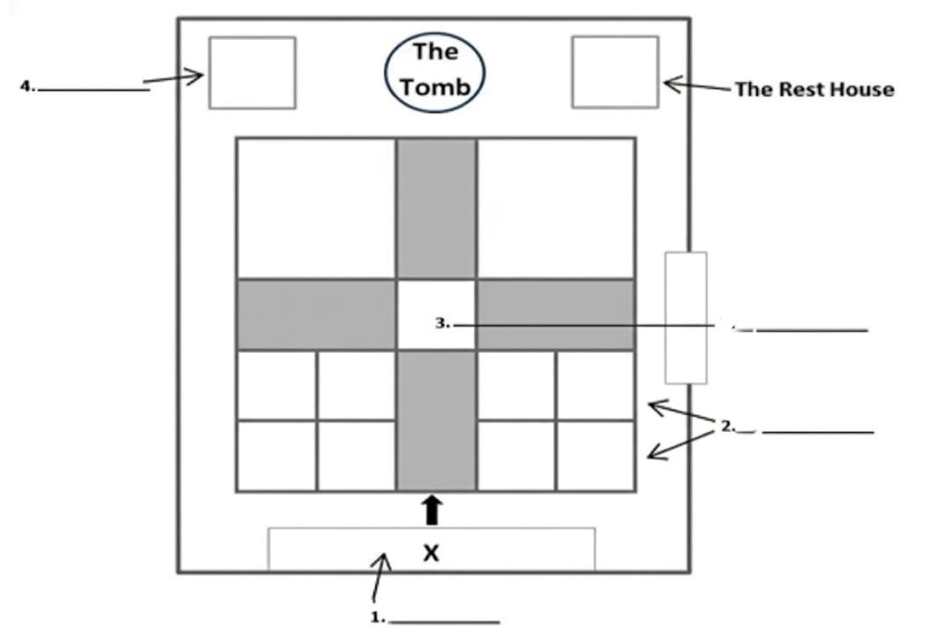
Questions 1-4. Label the plan below.Write NO MORE THAN THREE WORDS for each answer.
Questions 6-8.Complete the flow chart below.Write NO MORE THAN TWO WORDS for each answer.
How running water is provided
Water taken from the 6. __________ by bullocks.
Water channelled into the 7. __________
Water piped to the 8. __________
__________
Đáp án đúng: (The) Main Gateway
__________
Đáp án đúng: (the) (16/sixteen) flower bed
__________
Đáp án đúng: (a/the) (raised) pond
__________
Đáp án đúng: (a/the) Mosque
a place for the poor to stay
a meeting place for pilgrims
an architectural feature
Đáp án đúng: C
Water taken from the 6. __________ by bullocks.
Đáp án đúng: river
Water channelled into the 7. __________
Đáp án đúng: (supply) tanks
Water piped to the 8. __________
Đáp án đúng: fountains
Nội dung bài nghe:
The Taj Mahal is the most popular tourist attraction in India. It is also one of the most spectacular buildings of the world, and is considered as a symbol of love. But how many people realise that it was actually built as a tomb or burial place for the Emperor’s wife?
The Taj Mahal was built by the Mughal Emperor Shahjahan to commemorate his beloved wife Mumtaz Mahal when she died, and, although this was not his original intention, for he had planned to build a black marble tomb for himself, they both lie side by side in the tomb today. Emperor Shahjahan’s two greatest passions were architecture and jewellery and both are represented here in all their splendor.
The most skilled architects and craftsmen came from across India and countries as far away as Persia and Turkey. Much of the structure was built in white marble that was carried by a thousand elephants all the way from the Indian region of Rajasthan some 300km away. Crystal and jade came from China, sapphires from Sri Lanka and turquoise from Tibet.
But there’s a lot more to the Taj Mahal than just the tomb, so let’s have a look at the overall plan before we take a walk through the magnificent gardens. Your tour begins here at the point marked with an X on the plan. This is known as The Main Gateway. Walk through the gate and you come into an magnificent garden. There are two marble canals studded with fountains, which cross in the centre of the garden, dividing it into four equal squares. Each of these four quarters is then subdivided into flower beds. So there are 16 flower beds altogether. The tomb stands majestically at the north end, not in the centre as you might have expected Instead, at the centre of the garden, halfway between the tomb and the gateway, there’s a raised pond which provides a reflection of the Taj Mahal. It’s a magnificent sight. On either side of the tomb there are buildings made of red sandstone. The one to the west – to the left on our plan – is a mosque. It faces towards Mecca and is used for prayer. On the east side of the Teg is a building known as the Rest House. It’s like the twin of the mosque, but because it faces away from Mecca, it was never used for prayer.
Many people have asked what the Rest House was for. Was it a place for pilgrims to stay? Was it a meeting hall of some kind? Perhaps the most likely answer to this question is that its purpose is purely aesthetic, to act as a visual balance for the mosque and to preserve the symmetry of the design of the whole complex.
Let’s have a look at some of the engineering features of the garden. For one thing, they require a constant supply of running water. When it was built, water was drawn from the river manually, using an elaborate rope and bucket system, pulled by a team of bullocks. The water was then brought through a broad water channel and held in a number of supply tanks. These tanks were at varying heights off the ground and were ingeniously designed to store the very large amounts of water required. Using an elaborate system of underground pipes, the water was then distributed from the supply tanks to each of the fountains. To ensure that the water pressure was the same throughout the garden, there was a copper pot under each fountain connected to the water supply. It was undoubtedly a brilliant system.
Dịch nghĩa:
Đền Taj Mahal là điểm tham quan du lịch nổi tiếng nhất Ấn Độ. Đây cũng là một trong những công trình kiến trúc ngoạn mục nhất thế giới và được coi là biểu tượng của tình yêu. Nhưng có bao nhiêu người nhận ra rằng nó thực sự được xây dựng làm lăng mộ hoặc nơi chôn cất cho vợ của Hoàng đế?
Đền Taj Mahal được Hoàng đế Mughal Shahjahan xây dựng để tưởng nhớ người vợ yêu dấu Mumtaz Mahal của mình khi bà qua đời. Mặc dù đây không phải là ý định ban đầu của ông, vì ông đã lên kế hoạch xây dựng một lăng mộ bằng đá cẩm thạch đen cho riêng mình, nhưng cả hai đều nằm cạnh nhau trong lăng mộ ngày nay. Hai niềm đam mê lớn nhất của Hoàng đế Shahjahan là kiến trúc và đồ trang sức, và cả hai đều được thể hiện ở đây với tất cả sự lộng lẫy của chúng.
Những kiến trúc sư và thợ thủ công lành nghề nhất đến từ khắp Ấn Độ và các quốc gia xa xôi như Ba Tư và Thổ Nhĩ Kỳ. Phần lớn công trình được xây dựng bằng đá cẩm thạch trắng được hàng ngàn con voi chở từ vùng Rajasthan của Ấn Độ đến tận nơi cách đó khoảng 300km. Pha lê và ngọc bích đến từ Trung Quốc, đá sapphire từ Sri Lanka và ngọc lam từ Tây Tạng.
Nhưng Taj Mahal không chỉ có lăng mộ, vì vậy hãy cùng xem qua sơ đồ tổng thể trước khi chúng ta đi dạo qua những khu vườn tráng lệ. Chuyến tham quan của bạn bắt đầu tại điểm được đánh dấu X trên sơ đồ. Đây được gọi là Cổng chính. Đi qua cổng, bạn sẽ đến một khu vườn tráng lệ. Có hai kênh đào bằng đá cẩm thạch được trang trí bằng đài phun nước, giao nhau ở trung tâm khu vườn, chia khu vườn thành bốn ô vuông bằng nhau. Mỗi phần trong bốn phần này sau đó được chia thành các luống hoa. Vì vậy, có tổng cộng 16 luống hoa. Lăng mộ đứng uy nghi ở đầu phía bắc, không phải ở trung tâm như bạn có thể mong đợi. Thay vào đó, ở trung tâm của khu vườn, giữa lăng mộ và cổng, có một ao nước cao phản chiếu Taj Mahal. Đó là một cảnh tượng tráng lệ. Ở hai bên lăng mộ có những tòa nhà làm bằng đá sa thạch đỏ. Tòa nhà ở phía tây - bên trái trên sơ đồ của chúng tôi - là một nhà thờ Hồi giáo. Nó hướng về phía Mecca và được sử dụng để cầu nguyện. Phía đông của Teg là một tòa nhà được gọi là Nhà Nghỉ. Nó giống như một công trình song sinh của nhà thờ Hồi giáo, nhưng vì quay lưng lại với Mecca nên chưa bao giờ được sử dụng để cầu nguyện.
Nhiều người đã hỏi Nhà Nghỉ dùng để làm gì. Liệu nó có phải là nơi cho khách hành hương nghỉ ngơi không? Hay nó là một hội trường họp nào đó? Có lẽ câu trả lời hợp lý nhất cho câu hỏi này là mục đích của nó hoàn toàn mang tính thẩm mỹ, đóng vai trò tạo sự cân bằng về mặt thị giác cho nhà thờ Hồi giáo và bảo tồn tính đối xứng của thiết kế của toàn bộ khu phức hợp.
Hãy cùng xem xét một số đặc điểm kỹ thuật của khu vườn. Đầu tiên, chúng đòi hỏi nguồn cung cấp nước liên tục. Khi được xây dựng, nước được lấy từ sông thủ công, sử dụng một hệ thống dây thừng và xô phức tạp, được kéo bởi một đội bò đực. Sau đó, nước được dẫn qua một kênh dẫn nước rộng và được chứa trong một số bể chứa. Những bể chứa này được đặt ở các độ cao khác nhau so với mặt đất và được thiết kế khéo léo để dự trữ lượng nước rất lớn cần thiết. Sử dụng một hệ thống đường ống ngầm phức tạp, nước sau đó được phân phối từ các bể chứa đến từng đài phun nước. Để đảm bảo áp lực nước đồng đều khắp khu vườn, dưới mỗi đài phun nước có một bình đồng được kết nối với nguồn nước. Đây chắc chắn là một hệ thống tuyệt vời.
Part 2. For questions 9-14, listen to a radio discussion about children who invent imaginary friends andchoose the correct answer A, B, C or D which fits best according to what you hear. Write your answers inthe corresponding numbered boxes on your answer sheet.
her daughter asked her to stop the car
she had to interrupt the journey twice
she got angry with her daughter
her daughter wanted to get out of the car
Đáp án đúng: B
What does the presenter say about the latest research into imaginary friends?
It contradicts other research on the subject.
It shows that the number of children who have them is increasing.
It indicates that negative attitudes towards them are wrong.
It focuses on the effect they have on parents.
Đáp án đúng: C
How did Liz feel when her daughter had an imaginary friend?
Always confident that it was only a temporary situation.
Occasionally worried about the friend's importance to her daughter.
Slightly confused as to how she should respond sometimes.
Highly impressed by her daughter's inventiveness.
Đáp án đúng: A
they are having serious problems with their real friends
they can tell imaginary friends what to do
they want something that they cannot be given
they want something that other children haven't got
Đáp án đúng: D
Karen says that the teenager who had invented a superhero is an example of ________.
a very untypical teenager
a problem that imaginary friends can cause
something she had not expected to discover
how children change as they get older
Đáp án đúng: C
According to Karen, how should parents react to imaginary friends?
They should pretend that they like the imaginary friend.
They shouldn't get involved in the child's relationship with the friend.
They should take action if the situation becomes annoying.
They shouldn't discuss the imaginary friend with their child.
Đáp án đúng: B
Nội dung bài nghe:
Host: Today we’re talking about children and their tendency to have imaginary friends. Liz McManus has a daughter called Caitlin, who’s eight now. When she was three, she had an imaginary friend called Tytner. Liz, tell us about Caitlin and Tytner.
Liz: Well, I’ll give you an example. One day I was driving Caitlin and Greg, her baby brother, home, when she solemnly informed me that Tytner was hitting the baby. So I said: ‘You tell Tytner that if he does that again, he’ll be walking home.’ Fifteen seconds later came the inevitable news: ‘He’s just done it again, Mummy.’ So I found myself in the embarrassing position of having to pull over, open the back door and say to this imaginary little boy. ‘Tytner, out, now!’ And of course, as we drove off, Caitlin started crying because her friend was standing on the pavement all alone. I had to turn back and go through the rigmarole of pulling over and opening the door to pick him up again.
Host: Wow, that’s some story! But in fact Caitlin is no different from many children and her invented, make-believe friend is far from unusual. As many as 65% of children have had an imaginary friend at some point in their lives. The latest research suggests that invisible friends, far from being a cause for concern, should be welcomed by parents because they can help children to be more creative, confident and articulate, and have more advanced communication skills. It is thought that these findings will help reverse misconceptions about children with imaginary friends and that they will come to be seen as having an advantage, rather than a problem that needs to be worried about. Did it worry you, Liz?
Liz: I know it does lots of parents but I never fretted about it, I think I was just amused. I’d be reading to her and I’d say, ‘Is Tytner around?’ and she’d say, ‘Yes, he’s just sitting at the end of the bed.’ He became the centre of her life. She’d have tea parties with him, and he’d go to bed with her. She was shy and this was her answer. I knew she would grow out of it.
Host: Now Liz is one of 15 people taking part in a study of imaginary friends at the Institute of Education in London, run by Karen Majors, an education psychologist and lecturer at the institute. Karen, should parents worry about it?
Karen: Well, parents sometimes think, ‘Is this healthy and how long should it go on for?’ But it is a normal phenomenon for normal children. And it’s very healthy.
Host: Why do children invent imaginary friends?
Karen: I think that children create pretend friends for many reasons: as safe, trustworthy best friends at a time when they are just starting to make real friends; as someone to confide in; and as someone to play with. Sometimes it is about wish fulfilment; children who cannot have a pet, for example, will invent one. I interviewed one little girl, aged six, who had a pony called Minty for several years. It went to school with her and the teachers knew all about it. It was a really strong relationship.
Host: Presumably, when they get older, children no longer have these imaginary friends. Karen?
Karen: Well, my most surprising finding is that children don’t always stop having these made-up playmates when they start school. The imaginary friends often stay with them through their teenage years, providing comfort and escape – although in secret. One teenager I talked to had invented a superhero to help him through tricky patches. When things hadn’t gone well at school, he would come home and play with the superhero, for whom everything always went well.
Host: How should parents treat these invisible people, Karen?
Karen: Well, sometimes of course parents get irritated by them – for instance, if a child insists on having the playmate at the dinner table with an imaginary setting and glass. Actually I myself had a friend called Tiger when I was young, who would sit beside me at mealtimes. But I don’t think parents should tell children off for this kind of thing, or tell them that their friends are not real. Perhaps the best way is Liz’s down-to-earth approach.
Host: How did you handle it, Liz?
Liz: Well, I patiently acknowledged Caitlin’s playmate but I tried not to get involved. I never used to have to get out of the friend’s way or anything. Other than that one incident in the car, Caitlin’s imaginary friend didn’t impinge on my life.
Karen: Yes, I agree that parents should recognize imaginary friends, but they shouldn’t try to overly influence the friendship. Parents who interfere too much risk driving their children’s playmates away. If they try to direct the friends, they could spoil the fantasy altogether.
Host: Fascinating subject, thanks for coming in to talk about it, Liz and Karen.
Dịch nghĩa:
Người dẫn chương trình: Hôm nay chúng ta sẽ nói về trẻ em và xu hướng có những người bạn tưởng tượng của chúng. Liz McManus có một cô con gái tên là Caitlin, hiện đã tám tuổi. Khi con bé ba tuổi, con bé có một người bạn tưởng tượng tên là Tytner. Liz, hãy kể cho chúng tôi nghe về Caitlin và Tytner nhé.
Liz: À, tôi sẽ cho bạn một ví dụ. Một hôm, tôi đang lái xe đưa Caitlin và Greg, em trai của con bé, về nhà thì con bé nghiêm nghị nói với tôi rằng Tytner đang đánh em bé. Tôi nói: 'Mẹ hãy nói với Tytner rằng nếu nó còn làm thế nữa, nó sẽ phải tự đi bộ về nhà.' Mười lăm giây sau, tin tức không thể tránh khỏi đến: 'Nó lại làm thế nữa rồi, Mẹ ơi.' Thế là tôi thấy mình rơi vào tình thế ngượng ngùng khi phải tấp xe vào lề, mở cửa sau và nói với cậu bé tưởng tượng này: 'Tytner, ra ngoài ngay!' Và dĩ nhiên, khi chúng tôi lái xe đi, Caitlin bắt đầu khóc vì bạn của con bé đang đứng một mình trên vỉa hè. Tôi phải quay lại và làm đủ mọi thủ tục rườm rà để dừng xe lại và mở cửa đón con bé.
Người dẫn chương trình: Chà, chuyện hay thật! Nhưng thực ra Caitlin cũng chẳng khác gì nhiều đứa trẻ khác, và người bạn tưởng tượng do con bé tự nghĩ ra cũng chẳng có gì lạ. Có tới 65% trẻ em từng có một người bạn tưởng tượng vào một thời điểm nào đó trong đời. Nghiên cứu mới nhất cho thấy những người bạn vô hình, không phải là điều đáng lo ngại, mà nên được các bậc cha mẹ chào đón vì chúng có thể giúp trẻ sáng tạo hơn, tự tin hơn, ăn nói lưu loát hơn, và có kỹ năng giao tiếp tiên tiến hơn. Người ta cho rằng những phát hiện này sẽ giúp đảo ngược những quan niệm sai lầm về trẻ em có bạn tưởng tượng, và chúng sẽ được coi là một lợi thế, thay vì là một vấn đề đáng lo ngại. Liz, em có lo lắng không?
Liz: Em biết là nhiều bậc cha mẹ cũng lo lắng, nhưng em chưa bao giờ lo lắng về điều đó, em nghĩ em chỉ thấy buồn cười thôi. Tôi sẽ đọc sách cho con bé và hỏi, 'Tytner có ở đây không?' và con bé sẽ trả lời, 'Vâng, anh ấy chỉ ngồi ở cuối giường thôi.' Anh ấy trở thành trung tâm cuộc sống của con bé. Con bé sẽ uống trà với anh ấy, và anh ấy sẽ lên giường với con bé. Con bé nhút nhát và đây là câu trả lời của con bé. Tôi biết con bé sẽ vượt qua được điều đó thôi.
Người dẫn chương trình: Liz hiện là một trong 15 người tham gia nghiên cứu về những người bạn tưởng tượng tại Viện Giáo dục ở London, do Karen Majors, một nhà tâm lý học giáo dục và giảng viên tại viện, điều hành. Karen, cha mẹ có nên lo lắng về điều này không?
Karen: Chà, cha mẹ đôi khi nghĩ, 'Điều này có lành mạnh không và nên kéo dài bao lâu?' Nhưng đó là một hiện tượng bình thường đối với trẻ em bình thường. Và nó rất lành mạnh.
Người dẫn chương trình: Tại sao trẻ em lại tự tạo ra những người bạn tưởng tượng?
Karen: Tôi nghĩ rằng trẻ em tạo ra những người bạn tưởng tượng vì nhiều lý do: như những người bạn thân an toàn, đáng tin cậy vào thời điểm chúng mới bắt đầu kết bạn thực sự; như một người để tâm sự; và như một người để chơi cùng. Đôi khi, đó là về việc thực hiện ước mơ; ví dụ, những đứa trẻ không thể nuôi thú cưng sẽ tự nghĩ ra một con. Tôi đã phỏng vấn một bé gái sáu tuổi, nuôi một chú ngựa con tên là Minty trong nhiều năm. Nó đã đi học cùng em và các giáo viên đều biết rõ về nó. Đó là một mối quan hệ thực sự bền chặt.
Người dẫn chương trình: Có lẽ, khi lớn lên, trẻ em không còn những người bạn tưởng tượng này nữa. Karen à?
Karen: Chà, điều đáng ngạc nhiên nhất của tôi là trẻ em không phải lúc nào cũng ngừng có những người bạn tưởng tượng này khi chúng bắt đầu đi học. Những người bạn tưởng tượng này thường ở bên chúng trong suốt những năm tháng tuổi thiếu niên, mang đến sự an ủi và giải tỏa - mặc dù là trong bí mật. Một thiếu niên mà tôi đã nói chuyện đã tự nghĩ ra một siêu anh hùng để giúp em vượt qua những giai đoạn khó khăn. Khi mọi thứ không suôn sẻ ở trường, em sẽ về nhà và chơi với siêu anh hùng, người mà mọi thứ luôn diễn ra tốt đẹp.
Người dẫn chương trình: Cha mẹ nên đối xử với những người vô hình này như thế nào, Karen?
Karen: À, đôi khi tất nhiên cha mẹ cũng thấy khó chịu vì chúng – ví dụ như khi một đứa trẻ cứ khăng khăng muốn có bạn chơi cùng bàn ăn với một khung cảnh và ly rượu tưởng tượng. Thực ra hồi nhỏ tôi cũng có một người bạn tên là Tiger, người thường ngồi cạnh tôi trong giờ ăn. Nhưng tôi không nghĩ cha mẹ nên mắng con cái vì những chuyện như thế này, hoặc nói với chúng rằng bạn bè của chúng không có thật. Có lẽ cách tốt nhất là cách tiếp cận thực tế của Liz.
Người dẫn chương trình: Liz, bạn đã xử lý chuyện đó như thế nào?
Liz: À, tôi đã kiên nhẫn chấp nhận bạn chơi của Caitlin nhưng tôi cố gắng không can thiệp. Tôi chưa bao giờ phải tránh đường cho bạn mình hay làm gì cả. Ngoài sự cố trên xe, người bạn tưởng tượng của Caitlin không ảnh hưởng gì đến cuộc sống của tôi.
Karen: Vâng, tôi đồng ý rằng cha mẹ nên công nhận những người bạn tưởng tượng, nhưng họ không nên cố gắng ảnh hưởng quá mức đến tình bạn. Cha mẹ can thiệp quá nhiều có nguy cơ khiến bạn chơi của con mình xa lánh. Nếu họ cố gắng chỉ đạo những người bạn, họ có thể phá hỏng hoàn toàn câu chuyện tưởng tượng này.
Người dẫn chương trình: Chủ đề hấp dẫn đấy, cảm ơn Liz và Karen đã đến để trò chuyện.
Part 3. You will hear a man called Paul Osborne sharing his work experience as a videogame designer. Forquestions 15-20, complete the sentences with NO MORE THAN TWO WORDS from the listening. Writeyour answers in the corresponding numbered boxes on your answer sheet.
VIDEOGAME DESIGNER
Paul says that people tend to think he’s a game (15) ______ rather than a designer.
As a part of his education Paul did a course in (16) ______ which significantly helped hiscareer.
Paul worked with what is known as (17) ______ in his first job.
Paul uses the word (18) ______ to describe what multiplayers in a game can create forthemselves.
Paul says that getting the level of (19) ______ right is one of the most challenging aspects ofgame design.
Paul names (20) ______ as the most crucial quality any game designer should have.
Paul says that people tend to think he’s a game (15) ______ rather than a designer.
Đáp án đúng: developer
As a part of his education Paul did a course in (16) ______ which significantly helped hiscareer.
Đáp án đúng: animation
Paul worked with what is known as (17) ______ in his first job.
Đáp án đúng: narrative
Paul uses the word (18) ______ to describe what multiplayers in a game can create forthemselves.
Đáp án đúng: user interfaces
Paul says that getting the level of (19) ______ right is one of the most challenging aspects ofgame design.
Đáp án đúng: difficulty
Paul names (20) ______ as the most crucial quality any game designer should have.
Đáp án đúng: dedication
Nội dung bài nghe:
Paul: Hi. My name’s Paul Osborne. I work as a designer in the computer-game industry. Like a lot of my colleagues, I grew up playing video games; wasting money on arcades, playing the early game consoles. Computer games have always been a big part of my life.
Basically, lots of people are involved in the production of a game. As a designer, I’m largely concerned with the visual material that you see, so my background’s artistic. People sometimes wrongly assume that I’m a developer - that’s the guy with a maths background who actually figures out how the game works. We work closely together, of course, also with the game’s market researcher, who tells us what players are asking for.
So, how did I get into game designing? My degree was in art and design, and I did courses in painting and drawing as you’d expect, as well as one in computer graphics, which really captured my imagination, and one in animation. That was the one which enabled me to build up the key conceptual and visual design skills that I use now. But I wasn’t afraid of technology, so my career could’ve gone in a number of directions.
My first job was as a graphic designer, doing book covers largely, though occasionally video game boxes or CD sleeves did come my way too. After a while, an opening came up in the company’s games division for someone who had art and design sensibilities, along with some technical acumen, to work on things called user interfaces. I saw that as the opportunity to move into designing software. It was interesting to put together visual design, ergonomics, psychology and technology. I had some great mentorship from the head of my section and really developed a passion for the work.
Basically, what you’re responsible for as a designer is whether a game’s fun or not. I’ve worked on a number of great games: Purple Moon was my first big challenge, and I had a key role on Defending Planet X. But the one I got most out of was Star City because I was working on defining the multi-player experience. That’s when two or more people play against each other. We wanted multi-players to play the game as if they were creating their own narrative, as compared to a single player when they’re experiencing a story you’ve made up for them.
I love being able to come up with a cool idea and actually see it happen. The most challenging aspect of the game, however, is hitting the right level of difficulty. You want the game to be hard enough to reward people who gain expertise, but not so hard that people become frustrated and stop playing.
So, what does it take to be a game designer? You need the creativity to have a vision – see what will make a game fun and create a great experience. You need the communication to articulate that vision to other people and get them to do what you think needs to be done. But above all, you need dedication to see your vision through – to work your way through the disappointments and failures. When you’re three months from shipping, working until two in the morning, that’s what sees you through.
Dịch nghĩa:
Paul: Xin chào. Tôi tên là Paul Osborne. Tôi làm việc trong ngành công nghiệp trò chơi điện tử. Giống như nhiều đồng nghiệp khác, tôi lớn lên cùng trò chơi điện tử; tiêu tiền vào các máy chơi game thùng, chơi những chiếc máy chơi game đời đầu. Trò chơi điện tử luôn là một phần quan trọng trong cuộc sống của tôi.
Về cơ bản, rất nhiều người tham gia vào quá trình sản xuất trò chơi. Là một nhà thiết kế, tôi chủ yếu quan tâm đến hình ảnh mà bạn thấy, vì vậy nền tảng của tôi là nghệ thuật. Đôi khi mọi người lầm tưởng tôi là một nhà phát triển - tức là người có nền tảng toán học, người thực sự tìm ra cách trò chơi hoạt động. Tất nhiên, chúng tôi làm việc chặt chẽ với nhau, và cũng làm việc với nhà nghiên cứu thị trường của trò chơi, người cho chúng tôi biết người chơi đang yêu cầu gì.
Vậy, tôi đã đến với thiết kế trò chơi như thế nào? Bằng cấp của tôi là về nghệ thuật và thiết kế, và tôi đã tham gia các khóa học về hội họa và vẽ như bạn mong đợi, cũng như một khóa học về đồ họa máy tính, điều này thực sự khơi gợi trí tưởng tượng của tôi, và một khóa học về hoạt hình. Chính những khóa học đó đã giúp tôi xây dựng các kỹ năng thiết kế khái niệm và hình ảnh quan trọng mà tôi sử dụng hiện nay. Nhưng tôi không sợ công nghệ, nên sự nghiệp của tôi có thể đã đi theo nhiều hướng.
Công việc đầu tiên của tôi là thiết kế đồ họa, chủ yếu là làm bìa sách, mặc dù đôi khi tôi cũng làm hộp trò chơi điện tử hoặc vỏ đĩa CD. Sau một thời gian, bộ phận trò chơi của công ty có một vị trí tuyển dụng dành cho người có khiếu nghệ thuật và thiết kế, cùng với sự nhạy bén về kỹ thuật, để làm việc trên những thứ gọi là giao diện người dùng. Tôi thấy đó là cơ hội để chuyển sang thiết kế phần mềm. Thật thú vị khi được kết hợp thiết kế hình ảnh, công thái học, tâm lý học và công nghệ. Tôi đã được trưởng bộ phận hướng dẫn rất nhiều và thực sự phát triển niềm đam mê với công việc này.
Về cơ bản, trách nhiệm của một nhà thiết kế là liệu một trò chơi có thú vị hay không. Tôi đã làm việc trên một số trò chơi tuyệt vời: Purple Moon là thử thách lớn đầu tiên của tôi, và tôi đóng vai trò quan trọng trong Defending Planet X. Nhưng trò chơi mà tôi tâm đắc nhất là Star City vì tôi đang nỗ lực định hình trải nghiệm nhiều người chơi. Đó là khi hai hoặc nhiều người chơi đối đầu với nhau. Chúng tôi muốn nhiều người chơi trải nghiệm trò chơi như thể họ đang tự tạo ra câu chuyện của riêng mình, khác với người chơi đơn khi họ trải nghiệm một câu chuyện mà bạn đã tạo ra cho họ.
Tôi thích việc có thể nghĩ ra một ý tưởng hay và thực sự chứng kiến nó thành hiện thực. Tuy nhiên, khía cạnh thách thức nhất của trò chơi là đạt được đúng độ khó. Bạn muốn trò chơi đủ khó để thưởng cho những người đạt được chuyên môn, nhưng không quá khó đến mức khiến mọi người nản lòng và ngừng chơi.
Vậy, một nhà thiết kế trò chơi cần những gì? Bạn cần sự sáng tạo để có tầm nhìn - hãy xem điều gì sẽ làm cho trò chơi trở nên thú vị và tạo ra trải nghiệm tuyệt vời. Bạn cần khả năng giao tiếp để truyền đạt tầm nhìn đó cho người khác và khiến họ làm những gì bạn nghĩ là cần thiết. Nhưng trên hết, bạn cần sự tận tâm để hiện thực hóa tầm nhìn của mình - để vượt qua những thất vọng và thất bại. Khi bạn còn ba tháng nữa là đến ngày phát hành, làm việc đến tận hai giờ sáng, đó chính là điều giúp bạn vượt qua.
II. LEXICO-GRAMMAR (3.0 points)
Part 1. For questions 21-35, write the letter A, B, C, or D on your answer sheet to indicate the correct word or phrase that best completes each of the following sentences. Write your answers in the corresponding numbered boxes on your answer sheet.
______ from a distance, it resembles a cloud.
There being viewed
When viewed
It being viewed
Having viewed
Đáp án đúng: B
Giải thích: “When viewed from a distance” = Khi được nhìn từ xa → cấu trúc rút gọn mệnh đề bị động: When + Ved.
Dịch nghĩa: Khi nhìn từ xa, nó trông giống như một đám mây.
therefore
nevertheless
however
so
Đáp án đúng: A
Giải thích: Câu mang nghĩa nguyên nhân - kết quả. → therefore = vì thế, do đó.
Dịch nghĩa: Nhiều thành viên không phản hồi trong hơn ba năm và do đó tên của họ đã bị xóa khỏi danh sách gửi thư.
in
with
of
on
Đáp án đúng: A
Giải thích: “consist in” = nằm ở, gồm ở điểm gì.
Dịch nghĩa: Vẻ đẹp của việc đi máy bay nằm ở tốc độ và sự thoải mái.
ought to have been
should have been
must have been
could have been
Đáp án đúng: D
Giải thích: “could have been killed” = đã có thể bị giết → nói về một khả năng đã suýt xảy ra nhưng không xảy ra.
Dịch nghĩa: Thật nhẹ nhõm, Smith đã thoát nạn may mắn. Anh ấy đã có thể bị giết.
having been finished
to have finished
to have been finished
having finished
Đáp án đúng: B
Giải thích: “hope to have finished” = hy vọng sẽ hoàn thành trước thời điểm tương lai (trước khi em bé chào đời).
Dịch nghĩa: Đến lúc đứa bé ra đời, vợ chồng Johnson hy vọng sẽ hoàn thành việc sơn và trang trí phòng mới.
won’t they
will they
did they
didn’t they
Đáp án đúng: A
Giải thích: Câu gốc là khẳng định “will arrive…”, nên đuôi câu hỏi phủ định: won’t they?
Dịch nghĩa: Những bưu kiện vừa gửi ở bưu điện sẽ đến vào thứ Hai, đúng không?
Once primarily observed with official state ceremonies and local gatherings, ______.
the Reunification Day holiday now frequently becomes a peak time for domestic travel
a peak time for domestic travel now frequently becomes the Reunification Day holiday
now frequently becomes the Reunification Day holiday a peak time for domestic travel
domestic travel sees a peak time frequently now during the Reunification Day holiday
Đáp án đúng: A
Giải thích: Cấu trúc đảo ngữ với cụm dẫn nhập: “Once primarily observed…, the Reunification Day holiday now frequently becomes…” → mệnh đề chính phải đi ngay sau dấu phẩy.
Dịch nghĩa: Từng chỉ được quan sát qua các nghi lễ chính thức và tụ họp địa phương, giờ đây kỳ nghỉ Ngày Thống nhất thường trở thành thời điểm cao điểm cho du lịch nội địa.
_______ so incredible is that these insects successfully migrate to places they have never seen.
That makes the monarch butterflies' migration
The migration of the monarch butterflies is
What makes the monarch butterflies' migration
The migration of the monarch butterflies, which is
Đáp án đúng: C
Giải thích: Cấu trúc: What makes + noun phrase + adj = điều khiến …
Dịch nghĩa: Điều khiến cuộc di cư của loài bướm vua trở nên đáng kinh ngạc là chúng di cư đến những nơi chúng chưa từng thấy.
the orders sent
sending the orders
sent the orders
that you sent
Đáp án đúng: A
Giải thích: “would like + the orders sent” = muốn các đơn hàng được gửi đi (bị động).
Dịch nghĩa: Bà Davies nhờ tôi nói với bạn rằng bà ấy muốn các đơn hàng được gửi đi muộn nhất là vào thứ Sáu.
get over
get through
get across
get by
Đáp án đúng: B
Giải thích: “get through” = liên lạc được qua điện thoại.
Dịch nghĩa: Tôi đã cố gọi cho anh ấy cả buổi tối nhưng không thể liên lạc được.
That living alone
Living alone
What living alone
Where to live alone
Đáp án đúng: B
Giải thích: “Living alone while working part-time…” làm chủ ngữ → dùng V-ing.
Dịch nghĩa: Sống một mình trong khi làm thêm có thể giúp sinh viên xây dựng tính độc lập và linh hoạt hơn trong môi trường làm việc.
admitted
confessed
overlooked
approved
Đáp án đúng: A
Giải thích: “admit” = thừa nhận.
Dịch nghĩa: Chính phủ đã thừa nhận rằng tình trạng vô gia cư là một vấn đề, nhưng họ chưa nhận thức được mức độ nghiêm trọng của nó.
comically
jokingly
humorously
hilariously
Đáp án đúng: D
Giải thích: “hilariously funny” = cực kỳ hài hước.
Dịch nghĩa: Helen thấy bộ phim cực kỳ hài hước. Cô ấy không thể ngừng cười mỗi lần xem nó.
out of reach
out of shape
out of touch
out of the question
Đáp án đúng: C
Giải thích: “out of touch (with)” = không cập nhật, không nắm bắt thông tin mới.
Dịch nghĩa: Tôi đã lâu không đọc sách y học về chủ đề này, vì vậy tôi không nắm bắt được các diễn biến mới.
Thank you very much. I am afraid
You are telling a lie
Thank you for your compliment
I don't like your saying
Đáp án đúng: C
Giải thích: Đáp lại lời khen dùng “Thank you for your compliment.”
Dịch nghĩa: John: Bạn có kiểu tóc thật đẹp, Mary! - Mary: Cảm ơn vì lời khen của bạn.
Part 2. For questions 36-45, supply the correct form of the word in brackets. Write your answers in the corresponding numbered boxes on your answer sheet.
Three hundred and fifty years before the first men looked down on the amazingly beautiful surface of the moon from close quarters, Galileo’s newly built telescope (36. ABLE) ______ him to look at the edge of the hitherto mysterious sphere. He saw that the apparently (37. LIVE) ______ surface was not divinely smooth and round, but bumpy and imperfect. He realized that although the moon might appear (38. ACT) ______, resembling a still life painted by the hand of a cosmic (39. ART) ______, it was a real world, perhaps not very different from our own. This amounted to a great (40. ACHIEVE) ______ hardly to be expected in his day and age, although nowadays his (41. CONCLUDE) ______ may appear to some to be trivial and (42. SIGNIFY) ______.
Not long after Galileo’s lunar observations, the skies which had previously been so (43. ELUDE) ______ revealed more of their extraordinary mysteries. Casting around for further wonders, Galileo focused his lens on the (44. STRIKE) ______ planet of Jupiter. Nestling next to it, he saw four little points of light circling the distant planet. Our moon it appeared, perhaps (45. FORTUNE) ______ in the eyes of those fearful of what the discovery might mean, was not alone!
Đáp án đúng: enabled
Giải thích: enable + someone + to do something = cho phép ai làm gì. Dạng quá khứ “enabled” phù hợp với ngữ cảnh kể chuyện.
Dịch nghĩa: ... chiếc kính viễn vọng mới chế tạo của Galileo cho phép ông nhìn vào rìa của quả cầu bí ẩn bấy lâu.
Đáp án đúng: lifeless
Giải thích: Cần tính từ miêu tả bề mặt “không có sự sống” → lifeless surface.
Dịch nghĩa: Ông thấy rằng bề mặt tưởng như vô sinh đó không hề trơn tru và hoàn hảo ...
Đáp án đúng: inactive
Giải thích: “appeared inactive” = trông như bất động, không hoạt động.
Dịch nghĩa: Ông nhận ra rằng mặc dù mặt trăng có vẻ bất động ...
Đáp án đúng: artist
Giải thích: “hand of a cosmic artist” = bàn tay của một nghệ sĩ vũ trụ.
Dịch nghĩa: ... giống như một tĩnh vật được vẽ bởi bàn tay của một nghệ sĩ vũ trụ...
Đáp án đúng: achievement
Giải thích: Cần danh từ: a great achievement = một thành tựu lớn.
Dịch nghĩa: Điều này tạo thành một thành tựu lớn khó có thể mong đợi trong thời đại của ông ...
Đáp án đúng: conclusions
Giải thích: Danh từ số nhiều “conclusions”: những kết luận.
Dịch nghĩa: Mặc dù ngày nay những kết luận của ông có thể bị xem là tầm thường …
may appear to some to be trivial and (42. SIGNIFY) ______.
Đáp án đúng: insignificant
Giải thích: insignificant = không quan trọng.
Dịch nghĩa: ... có vẻ tầm thường và không quan trọng.
Đáp án đúng: elusive
Giải thích: “elusive skies” = bầu trời khó nắm bắt, bí ẩn.
Dịch nghĩa: Không lâu sau các quan sát về mặt trăng, bầu trời vốn trước đó bí ẩn …
Đáp án đúng: striking
Giải thích: “the striking planet” = hành tinh nổi bật/ ấn tượng.
Dịch nghĩa: ... Galileo hướng ống kính của mình vào hành tinh ấn tượng là Sao Mộc.
Our moon it appeared, perhaps (45. FORTUNE) ______ in the eyes of those fearful of what the discovery might mean, was not alone!
Đáp án đúng: unfortunate
Giải thích: unfortunate = đáng tiếc.
Dịch nghĩa: Mặt trăng của chúng ta, có vẻ như thật đáng tiếc trong mắt những người lo sợ ý nghĩa của phát hiện này, không hề cô đơn!
Dịch bài đọc:
Ba trăm năm mươi năm trước khi những người đầu tiên nhìn xuống bề mặt tuyệt đẹp đến kinh ngạc của Mặt Trăng ở cự ly gần, chiếc kính viễn vọng mới chế tạo của Galileo đã cho phép ông quan sát rìa của khối cầu bí ẩn bấy lâu nay. Ông thấy rằng bề mặt tưởng như vô sinh, vốn được cho là trơn tru và hoàn hảo, thực ra lại gồ ghề và không đồng nhất. Ông nhận ra rằng mặc dù Mặt Trăng có vẻ bất động, giống như một bức tĩnh vật được vẽ bởi bàn tay của một nghệ sĩ vũ trụ, nhưng nó là một thế giới thực sự, có lẽ không khác mấy so với Trái Đất của chúng ta. Điều này là một thành tựu vĩ đại, khó có thể mong đợi trong thời đại của ông, mặc dù ngày nay những kết luận ấy có thể bị một số người xem là tầm thường và không quan trọng.
Không lâu sau những quan sát về Mặt Trăng của Galileo, bầu trời - trước đây còn rất bí ẩn - đã hé lộ thêm nhiều điều kỳ diệu phi thường. Khi tìm kiếm thêm những điều thú vị khác, Galileo đã hướng ống kính của mình vào hành tinh ấn tượng là Sao Mộc. Nằm bên cạnh nó, ông nhìn thấy bốn điểm sáng nhỏ chuyển động xung quanh hành tinh xa xôi này. Hóa ra Mặt Trăng của chúng ta - có lẽ là một điều đáng tiếc đối với những người sợ hãi ý nghĩa mà phát hiện này mang lại - không hề cô đơn!
Part 3. For questions 46-50, identify 5 mistakes in the following passage and correct them. Write youranswers in the corresponding numbered boxes on your answer sheet.
It is a well-known fact that Japanese people have a longer life expectancy than the population
of most other countries. A recent report shows that the Japanese also expect to remain healthier for longer. Scientists are trying to work out which keeps elderly Japanese people so healthy, and whether there is a lesson from which we benefit. Should we make any changes to our eating habits, for instance, or go jogging each day before breakfast? Is there some secret ingredient in the Japanese diet that is particularly beneficial for the human body? Because the prospect of a longer, healthier life is a good thing for the individual, it can create a social problem.
A number of people over the age of 65 in the population has doubled in the last 50 years and that has increased pension and medical costs. Japan could soon be encountered an economic
problem: there are more elderly people who need to be looked after and relatively fewer younger people working and pay taxes to support them. One solution could be to raise retirement age from 65 to 70. After all, the elderly have a great deal to contribute. If they continue to be active in society, younger generations will have the chance to learn their wisdom from experience.
Đáp án đúng: Line 3: which => what
Giải thích: Trong câu gián tiếp, mệnh đề danh ngữ phải dùng what, không dùng which.
Đáp án đúng: Line 4: which we benefit => which we can benefit
Giải thích: Thể hiện khả năng có thể chứ không phải sự thật hiển nhiên nên dùng “can” sẽ phù hợp hơn.
Đáp án đúng: Line 8: A number => The number
Giải thích: Ở đây động từ là has, nên phải dùng the number of.
Japan could soon be encountered an economic problem:
Đáp án đúng: Line 9: be encountered => encounter
Giải thích: Encounter là ngoại động từ nên không dùng bị động.
Đáp án đúng: Line 11: pay taxes => paying taxes
Giải thích: Đã có dạng V-ing ở phần trước (working), động từ sau phải song song về dạng → paying.
Dịch bài đọc:
Một thực tế ai cũng biết là người Nhật Bản có tuổi thọ cao hơn dân số của hầu hết các quốc gia khác. Một báo cáo gần đây cho thấy người Nhật cũng mong muốn duy trì sức khỏe lâu dài hơn. Các nhà khoa học đang cố gắng tìm hiểu điều gì giúp người cao tuổi Nhật Bản luôn khỏe mạnh, và liệu có bài học nào mà chúng ta có thể học hỏi được hay không. Ví dụ, chúng ta có nên thay đổi thói quen ăn uống hay nên chạy bộ mỗi ngày trước bữa sáng? Liệu có thành phần bí mật nào trong chế độ ăn uống của người Nhật đặc biệt có lợi cho cơ thể con người không? Bởi vì viễn cảnh về một cuộc sống lâu dài và khỏe mạnh hơn là một điều tốt cho cá nhân, nên nó có thể tạo ra một vấn đề xã hội.
Số người trên 65 tuổi trong dân số đã tăng gấp đôi trong 50 năm qua và điều đó đã làm tăng chi phí lương hưu và y tế. Nhật Bản có thể sớm gặp phải một vấn đề kinh tế: ngày càng có nhiều người cao tuổi cần được chăm sóc trong khi số người trẻ tuổi làm việc và đóng thuế để hỗ trợ họ lại tương đối ít. Một giải pháp có thể là tăng tuổi nghỉ hưu từ 65 lên 70. Suy cho cùng, người cao tuổi có rất nhiều đóng góp. Nếu họ tiếp tục hoạt động trong xã hội, thế hệ trẻ sẽ có cơ hội học hỏi sự khôn ngoan của họ từ kinh nghiệm.
III. READING (3.0 points)
Part 1. For questions 51-60, read the following passage and write the letter A, B, C, or D on your answer sheet to indicate the answer that best fits the blank in the following passage. Write your answers in the corresponding numbered boxes on your answer sheet.
Global warming could cause drought and possibly famine in China, the source of much of Hong Kong's food, by 2050, a new report predicts. Hong Kong could also be (51) ______ from flooding as sea level rose. The report (52) ______ building sea-walls around low-lying areas such as the new port and airport reclamations. (53) ______ by the WorldWide Fund For Nature (WWF), the report, which includes work by members of the Chinese Academic Meteorological Sciences, uses the most recent projections on climate change to point to a gloomy (54) ______ for China.
By 2050, about 30 to 40 per cent of the country will experience changes in the type of vegetation it (55) ______, with tropical and subtropical forest conditions (56) ______ northward and hot desert conditions rising in the west where currently the desert is temperate, crop-growing areas will expand but any benefit is expected to be negated by increased evaporation of (57) ______, making it too dry to grow crops such as rice. The growing season is also expected to (58) ______, becoming shorter in southern and central China, the mainland's (59) ______.
The rapid changes make it (60) ______ that plants could adapt.
at a loss
at risk
at it again
at random
Đáp án đúng: B
Giải thích: be at risk from sth = bị đe dọa/ bị nguy hiểm bởi cái gì.
Dịch nghĩa: Hồng Kông cũng có thể bị đe dọa bởi lũ lụt khi mực nước biển dâng lên.
comments
realizes
agrees
recommends
Đáp án đúng: D
Giải thích: recommend doing sth = khuyến nghị làm gì.
Dịch nghĩa: Bản báo cáo đề xuất xây tường chắn biển quanh các khu vực thấp…
Having published
Published
To publish
Publishing
Đáp án đúng: B
Giải thích: Cấu trúc rút gọn mệnh đề bị động: Published by …
Dịch nghĩa: Được WWF xuất bản, bản báo cáo này…
outlook
perspective
view
sight
Đáp án đúng: A
Giải thích: outlook (for) = viễn cảnh, triển vọng (tương lai).
Dịch nghĩa: … để chỉ ra một viễn cảnh u ám cho Trung Quốc.
supports
grows
raises
rises
Đáp án đúng: A
Giải thích:
A region supports vegetation = vùng đó “duy trì/nuôi dưỡng” kiểu thảm thực vật nào.
grow/ raise thường dùng cho người trồng/ lai; rise là nội động từ “mọc lên, tăng lên”.
Dịch nghĩa: … 30–40% diện tích đất nước sẽ trải qua sự thay đổi về kiểu thảm thực vật mà nó duy trì…
running
shifting
dashing
rushing
Đáp án đúng: B
Giải thích: shift northward = dịch chuyển về phía bắc.
Dịch nghĩa: … khi điều kiện rừng nhiệt đới và cận nhiệt đới dịch chuyển lên phía bắc …
land
soil
moisture
humid
Đáp án đúng: C
Giải thích: evaporation of moisture = sự bốc hơi độ ẩm.
Dịch nghĩa: … sự bay hơi độ ẩm tăng lên, khiến nơi đó quá khô để trồng trọt …
reshape
remain
rotate
alter
Đáp án đúng: D
Giải thích: alter = thay đổi.
Dịch nghĩa: Thời vụ gieo trồng cũng được cho là sẽ thay đổi, trở nên ngắn hơn …
______, becoming shorter in southern and central China, the mainland's (59) ______.
breadwinner
breadline
breadbasket
breadboard
Đáp án đúng: C
Giải thích: breadbasket = “vựa lúa, vựa lương thực” của một quốc gia.
Dịch nghĩa:… miền nam và trung Trung Quốc, vựa lương thực của phần đất liền.
The rapid changes make it (60) ______ that plants could adapt.
unforthcoming
unlikely
unchanged
unregulated
Đáp án đúng: B
Giải thích: make it unlikely that… = khiến điều gì khó có khả năng xảy ra.
Dịch nghĩa: Những thay đổi nhanh chóng khiến khó có khả năng cây cối có thể thích nghi.
Dịch bài đọc:
Sự nóng lên toàn cầu có thể gây ra hạn hán và thậm chí nạn đói ở Trung Quốc - nơi cung cấp phần lớn lương thực cho Hồng Kông - vào năm 2050, theo dự báo của một báo cáo mới. Hồng Kông cũng có thể bị đe dọa bởi tình trạng ngập lụt khi mực nước biển dâng cao. Bản báo cáo đề xuất xây dựng tường chắn biển quanh những khu vực trũng thấp, chẳng hạn như các vùng lấn biển xây dựng cảng và sân bay mới. Được công bố bởi Quỹ Thiên nhiên Thế giới (WWF), báo cáo - có sự tham gia nghiên cứu của các thành viên Viện Khoa học Khí tượng Trung Quốc sử dụng những dự báo mới nhất về biến đổi khí hậu để đưa ra một viễn cảnh u ám cho Trung Quốc.
Đến năm 2050, khoảng 30 đến 40 phần trăm diện tích cả nước sẽ trải qua sự thay đổi về loại thảm thực vật mà khu vực đó có, với điều kiện rừng nhiệt đới và cận nhiệt đới dịch chuyển lên phía bắc, còn điều kiện sa mạc nóng gia tăng ở khu vực phía tây - nơi hiện nay sa mạc có khí hậu ôn hòa. Khu vực canh tác sẽ mở rộng, nhưng bất kỳ lợi ích nào dự kiến cũng sẽ bị xóa bỏ do sự bốc hơi nước tăng lên, khiến khu vực trở nên quá khô hạn để trồng các loại cây như lúa. Mùa vụ cũng được dự đoán sẽ thay đổi, trở nên ngắn hơn ở miền nam và miền trung Trung Quốc - vựa lúa của đại lục. Những thay đổi nhanh chóng này khiến khả năng cây cối kịp thích nghi trở nên khó xảy ra.
Part 2. For questions 61-70, read the following passage and fill each numbered blank with ONE suitable word. Write your answers in the corresponding numbered boxes on your answer sheet.
Genetically modified (GM) foods, also known as genetically engineered foods, are products created by altering the DNA of plants or animals through (61)______ engineering techniques. This manipulation allows scientists to introduce specific traits (62)______ the organisms, such as resistance to pests, tolerance to herbicides, or improve nutritional content. The development of GM foods has raised significant debate and controversy globally. Supporters argue that (63)______ foods hold promise in addressing various agricultural challenges, (64)______ increasing crop yields, reducing the need for chemical pesticides, and enhancing
nutritional value. (65)______, critics express concerns about potential risks to human health and the environment, as well as ethical considerations related to tampering with the genetic makeup of living organisms. (66)______ these controversies, GM foods have become increasingly prevalent in our food supply, with crops (67)______ soybeans, corn, and cotton being commonly genetically modified. Nevertheless, there are ongoing discussions about the need for clear labeling of GM foods to inform consumers and allow them
to (68)______ informed choices. The debate surrounding GM foods reflects the complex interplay (69)______ science, technology, ethics, and agriculture in our modern world. As research continues and technology advances, it is essential to consider both the potential benefits and risks (70)______ with the widespread adoption of GM foods.
Đáp án đúng: genetic
Giải thích: genetic engineering = công nghệ/kỹ thuật di truyền.
Đáp án đúng: into
Giải thích: introduce … into … = đưa/nhập cái gì vào trong cái gì.
Đáp án đúng: these
Giải thích: Đã nhắc GM foods ngay trước đó → dùng these foods (những loại thực phẩm này).
(64)______ increasing crop yields, reducing the need for chemical pesticides, and enhancing nutritional value.
Đáp án đúng: like
Giải thích: like + V-ing / noun = như là…, dùng để đưa ví dụ.
Đáp án đúng: However
Giải thích: Đối lập với ý người ủng hộ → dùng However = Tuy nhiên.
Đáp án đúng: Despite
Giải thích: Cấu trúc: Despite + noun / V-ing = Mặc dù.
Đáp án đúng: like
Giải thích: like + V-ing / noun = như là…, dùng để đưa ví dụ.
Đáp án đúng: make
Giải thích: make informed choices = đưa ra những lựa chọn có hiểu biết.
Đáp án đúng: between
Giải thích: interplay between A and B = sự tương tác/đan xen giữa A và B.
As research continues and technology advances, it is essential to consider both the potential benefits and risks (70)______ with the widespread adoption of GM foods.
Đáp án đúng: associated
Giải thích: be associated with = gắn liền/liên quan với.
Dịch bài đọc:
Thực phẩm biến đổi gen (GM foods), còn được gọi là thực phẩm công nghệ gen, là những sản phẩm được tạo ra bằng cách thay đổi ADN của thực vật hoặc động vật thông qua các kỹ thuật kỹ thuật di truyền (genetic engineering). Việc can thiệp này cho phép các nhà khoa học đưa những đặc tính cụ thể vào các sinh vật, chẳng hạn như khả năng chống sâu bệnh, chịu thuốc diệt cỏ hoặc cải thiện giá trị dinh dưỡng. Sự phát triển của thực phẩm biến đổi gen đã làm dấy lên nhiều tranh luận và tranh cãi trên toàn thế giới. Những người ủng hộ cho rằng những loại thực phẩm này hứa hẹn giải quyết các thách thức nông nghiệp khác nhau, như tăng năng suất cây trồng, giảm nhu cầu sử dụng thuốc trừ sâu hóa học và nâng cao giá trị dinh dưỡng. Tuy nhiên, những người phản đối bày tỏ lo ngại về các rủi ro tiềm ẩn đối với sức khỏe con người và môi trường, cũng như các vấn đề đạo đức liên quan đến việc can thiệp vào cấu trúc di truyền của sinh vật sống. Mặc dù có nhiều tranh cãi, thực phẩm biến đổi gen ngày càng trở nên phổ biến trong nguồn cung thực phẩm của chúng ta, với các loại cây như đậu nành, ngô và bông thường được biến đổi gen. Tuy vậy, vẫn còn các cuộc thảo luận về sự cần thiết phải ghi nhãn rõ ràng đối với thực phẩm biến đổi gen nhằm giúp người tiêu dùng đưa ra lựa chọn có hiểu biết. Cuộc tranh luận xung quanh thực phẩm biến đổi gen phản ánh sự tương tác phức tạp giữa khoa học, công nghệ, đạo đức và nông nghiệp trong thế giới hiện đại. Khi nghiên cứu tiếp tục và công nghệ phát triển, điều quan trọng là phải xem xét cả những lợi ích tiềm năng và những rủi ro liên quan đến việc áp dụng rộng rãi thực phẩm biến đổi gen.
Part 3. For questions 71-80, read the following passage and choose the correct answer (A, B, C or D) for each of the questions below. Write your answers in the corresponding numbered boxes on your answer sheet.
In the course of its history, human inventions have dramatically increased the average amount of energy available for use per person. Primitive peoples in cold regions burned wood and animal dung to heat their caves, cook food, and drive off animals by fire. The first step toward the developing of more efficient fuels was taken when people discovered that they could use vegetable oils and animal fats in lieu of gathered or cut wood. Charcoal gave off a more intense heat than wood and was more easily obtainable than organic fats. The Greeks first began to use coal for metal smelting in the 4th century, but it did not come into extensive use until the Industrial Revolution.
In the 1700s, at the beginning of the Industrial Revolution, most energy used in the United States and other nations undergoing industrialization was obtained from perpetual and renewable sources, such as wood, water streams, domesticated animal labor, and wind. These were predominantly locally available supplies. By mid-1800s, 91 percent of all commercial energy consumed in the United States and European countries was obtained from wood. However, at the beginning of the 20th century, coal became a major energy source and replaced wood in industrializing countries. Although in most regions and climate zones wood was more readily accessible than coal, the latter represents a more concentrated source of energy. In 1910, natural gas and oil firmly replaced coal as the main source of fuel because they are lighter and, therefore, cheaper to transport. They burned more cleanly than coal and polluted less. Unlike coal, oil could be refined to manufacture liquid fuels for vehicles; a very important consideration in the early 1900s, when the automobile arrived on the scene.
By 1984, nonrenewable fossil fuels, such as oil, coal, and natural gas, provided over 82 percent of the commercial and industrial energy used in the world. Small amounts of energy were derived from nuclear fission, and the remaining 16 percent came from burning direct perpetual and renewable fuels, such as biomass. Between 1700 and 1986, a large number of countries shifted from the use of energy from local sources to a centralized generation of hydropower and solar energy converted to electricity. The energy derived from nonrenewable fossil fuels has been increasingly produced in one location and transported to another, as is the case with most automobile fuels. In countries with private, rather than public transportation, the age of nonrenewable fuels has created a dependency on a finite resource that will have to be replaced.
Alternative fuel sources are numerous, and shale oil and hydrocarbons are just two examples. The extraction of shale oil from large deposits in Asian and European regions has proven to be labor consuming and costly. The resulting product is sulfur- and nitrogen- rich, and large-scale extractions are presently prohibitive. Similarly, the extraction of hydrocarbons from tar sands in Alberta and Utah is complex.
Semi-solid hydrocarbons cannot be easily separated from the sandstone and limestone that carry them, and modern technology is not sufficiently versatile for a large-scale removal of the material. However, both sources of fuel may eventually be needed as petroleum prices continue to rise and limitations in fossil fuel availability make alternative deposits more attractive.
Applications of various fuels
Natural resources and fossil fuels
A history of energy use
A historical overview of energy rates
Đáp án đúng: C
Giải thích: Bài đọc lần lượt kể lịch sử sử dụng năng lượng qua các thời kỳ → phù hợp nhất với “A history of energy use” (Lịch sử sử dụn năng lượng).
It can be inferred from the first paragraph that _____.
coal mining was essential for primitive peoples
the Greeks used coal in industrial production
the development of efficient fuels was a gradual process
the discovery of efficient fuels was mostly accidental
Đáp án đúng: C
Giải thích:
Dựa vào câu: The first step toward the developing of more efficient fuels was taken when people discovered that they could use vegetable oils and animal fats in lieu of gathered or cut wood. Charcoal gave off a more intense heat than wood and was more easily obtainable than organic fats. The Greeks first began to use coal for metal smelting in the 4th century, but it did not come into extensive use until the Industrial Revolution. (Bước đầu tiên hướng tới việc phát triển nhiên liệu hiệu quả hơn đã được thực hiện khi con người phát hiện ra rằng họ có thể sử dụng dầu thực vật và mỡ động vật thay cho gỗ thu gom hoặc chặt. Than củi tỏa nhiệt mạnh hơn gỗ và dễ kiếm hơn mỡ hữu cơ. Người Hy Lạp bắt đầu sử dụng than để luyện kim loại vào thế kỷ thứ 4, nhưng phải đến Cách mạng Công nghiệp, nó mới được sử dụng rộng rãi.)
in spite of
in place of
in view of
in charge of
Đáp án đúng: B
Giải thích: in lieu of = in place of = thay cho.
What can be inferred about the global energy situation by 1984?
Nations had become heavily dependent on fuels that could not be renewed within a human lifetime.
Most countries had already transitioned to solar and hydropower as their main energy sources.
The share of renewable fuels had been steadily increasing since the early 1900s.
Energy production had returned to being largely local and community-based.
Đáp án đúng:
Giải thích:
Dựa vào câu: By 1984, nonrenewable fossil fuels, such as oil, coal, and natural gas, provided over 82 percent of the commercial and industrial energy used in the world. (Đến năm 1984, nhiên liệu hóa thạch không tái tạo như dầu, than và khí đốt tự nhiên đã cung cấp hơn 82 phần trăm năng lượng thương mại và công nghiệp được sử dụng trên thế giới.)
wood
coal
most regions
climate zones
Đáp án đúng: B
Giải thích:
Dựa vào câu: Although in most regions and climate zones wood was more readily accessible than coal, the latter represents a more concentrated source of energy. (Mặc dù ở hầu hết các khu vực và vùng khí hậu, gỗ dễ tiếp cận hơn than đá, nhưng than đá lại là nguồn năng lượng tập trung hơn.)
societies have consistently relied on a balance of renewable and non-renewable energy
technological progress has been closely linked to the exploitation of increasingly concentrated fuels
early industrial societies ignored the potential of fossil fuels until the twentieth century
renewable energy sources remained dominant throughout industrialization
Đáp án đúng: B
Giải thích:
Dựa vào câu: Unlike coal, oil could be refined to manufacture liquid fuels for vehicles; a very important consideration in the early 1900s, when the automobile arrived on the scene. (Không giống như than đá, dầu mỏ có thể được tinh chế để sản xuất nhiên liệu lỏng cho xe cộ; một yếu tố rất quan trọng cần xem xét vào đầu những năm 1900, khi ô tô xuất hiện.)
fossil fuels
nuclear fission
hydraulic and solar sources
burning biomass
Đáp án đúng: A
Giải thích:
Dựa vào câu: In 1910, natural gas and oil firmly replaced coal as the main source of fuel because they are lighter and, therefore, cheaper to transport. They burned more cleanly than coal and polluted less. (Vào năm 1910, khí đốt tự nhiên và dầu mỏ đã thay thế than đá làm nguồn nhiên liệu chính vì chúng nhẹ hơn và do đó rẻ hơn khi vận chuyển. Chúng cháy sạch hơn than đá và ít gây ô nhiễm hơn.)
uninhibited
redundant
inexpensive
inexpedient
Đáp án đúng: C
Giải thích: prohibitive (cost) = quá đắt >< inexpensive = rẻ.
Which of the following best captures the author’s overall view of humanity’s changing relationship with energy?
Human progress has depended on moving from easily available local resources to centralized, nonrenewable fuels, a shift that now forces us to seek costly alternatives.
The search for energy efficiency has always benefited both the environment and the global economy equally.
Renewable energy has consistently remained humanity’s main source of power despite industrial expansion.
Modern society has successfully balanced the use of fossil fuels with the preservation of renewable resources.
Đáp án đúng: A
Giải thích: Cả bài: từ nguồn địa phương tái tạo (gỗ, nước, gió…) → nhiên liệu hóa thạch tập trung, vận chuyển xa → phụ thuộc nguồn hữu hạn → phải tính đến nguồn thay thế đắt đỏ (shale oil, tar sands…).
Dịch bài đọc:
Trong suốt chiều dài lịch sử, những phát minh của con người đã làm tăng đáng kể lượng năng lượng trung bình có thể sử dụng cho mỗi người. Người nguyên thủy ở các vùng lạnh giá đã đốt gỗ và phân động vật để sưởi ấm hang động, nấu nướng và xua đuổi động vật bằng lửa. Bước đầu tiên hướng tới việc phát triển các loại nhiên liệu hiệu quả hơn đã được thực hiện khi con người phát hiện ra rằng họ có thể sử dụng dầu thực vật và mỡ động vật thay cho gỗ thu thập hoặc chặt. Than củi tỏa ra nhiệt lượng mạnh hơn gỗ và dễ kiếm hơn mỡ hữu cơ. Người Hy Lạp lần đầu tiên bắt đầu sử dụng than để luyện kim loại vào thế kỷ thứ 4, nhưng nó không được sử dụng rộng rãi cho đến khi Cách mạng Công nghiệp.
Vào những năm 1700, khi bắt đầu Cách mạng Công nghiệp, hầu hết năng lượng được sử dụng ở Hoa Kỳ và các quốc gia khác đang trong quá trình công nghiệp hóa đều được lấy từ các nguồn năng lượng vĩnh cửu và tái tạo, chẳng hạn như gỗ, suối nước, sức lao động của động vật thuần hóa và gió. Đây chủ yếu là những nguồn cung cấp sẵn có tại địa phương. Đến giữa những năm 1800, 91% tổng năng lượng thương mại tiêu thụ ở Hoa Kỳ và các nước châu Âu có nguồn gốc từ gỗ. Tuy nhiên, vào đầu thế kỷ 20, than đá đã trở thành nguồn năng lượng chính và thay thế gỗ ở các nước công nghiệp hóa. Mặc dù ở hầu hết các khu vực và vùng khí hậu, gỗ dễ tiếp cận hơn than đá, nhưng than đá lại là nguồn năng lượng tập trung hơn. Năm 1910, khí đốt tự nhiên và dầu mỏ đã thay thế than đá trở thành nguồn nhiên liệu chính vì chúng nhẹ hơn và do đó, chi phí vận chuyển rẻ hơn. Chúng cháy sạch hơn than đá và ít gây ô nhiễm hơn. Không giống như than đá, dầu mỏ có thể được tinh chế để sản xuất nhiên liệu lỏng cho xe cộ; một yếu tố rất quan trọng cần xem xét vào đầu những năm 1900, khi ô tô xuất hiện.
Đến năm 1984, nhiên liệu hóa thạch không tái tạo, chẳng hạn như dầu mỏ, than đá và khí đốt tự nhiên, đã cung cấp hơn 82% năng lượng thương mại và công nghiệp được sử dụng trên thế giới. Một lượng nhỏ năng lượng được tạo ra từ phản ứng phân hạch hạt nhân, và 16% còn lại đến từ việc đốt nhiên liệu vĩnh cửu và tái tạo trực tiếp, chẳng hạn như sinh khối. Từ năm 1700 đến năm 1986, một số lượng lớn các quốc gia đã chuyển đổi từ việc sử dụng năng lượng từ các nguồn địa phương sang sản xuất thủy điện và năng lượng mặt trời tập trung thành điện. Năng lượng từ nhiên liệu hóa thạch không tái tạo ngày càng được sản xuất tại một địa điểm và vận chuyển đến một địa điểm khác, giống như trường hợp của hầu hết nhiên liệu ô tô. Ở những quốc gia có phương tiện giao thông cá nhân thay vì công cộng, thời đại của nhiên liệu không tái tạo đã tạo ra sự phụ thuộc vào một nguồn tài nguyên hữu hạn cần được thay thế.
Các nguồn nhiên liệu thay thế rất đa dạng, và dầu đá phiến và hydrocarbon chỉ là hai ví dụ. Việc khai thác dầu đá phiến từ các mỏ lớn ở khu vực Châu Á và Châu Âu đã được chứng minh là tốn kém và tốn kém về nhân công. Sản phẩm thu được giàu lưu huỳnh và nitơ, và việc khai thác quy mô lớn hiện đang bị cấm. Tương tự, việc khai thác hydrocarbon từ cát hắc ín ở Alberta và Utah rất phức tạp.
Các hydrocarbon bán rắn không thể dễ dàng tách khỏi đá sa thạch và đá vôi chứa chúng, và công nghệ hiện đại không đủ linh hoạt để loại bỏ vật liệu này trên quy mô lớn. Tuy nhiên, cả hai nguồn nhiên liệu này cuối cùng đều có thể cần thiết khi giá dầu mỏ tiếp tục tăng và hạn chế về nguồn cung nhiên liệu hóa thạch khiến các nguồn nhiên liệu thay thế trở nên hấp dẫn hơn.
V. WRITING (2.0 points)
Part 1. Sentence transformation
For questions 81-85, finish each of the following sentences in such a way that it means exactly the same as the sentence printed before it. Write your answers in the space provided on your answer sheet.
It was a concentrated source of energy.
It was lighter and cheaper than coal.
It replaced wood and coal and reduced pollution.
It could be converted to automobile fuel.
Đáp án đúng: D
Giải thích:
Dựa vào câu: Unlike coal, oil could be refined to manufacture liquid fuels for vehicles; a very important consideration in the early 1900s, when the automobile arrived on the scene. (Không giống như than đá, dầu có thể được tinh chế để sản xuất nhiên liệu lỏng cho xe cộ; một yếu tố rất quan trọng cần cân nhắc vào đầu những năm 1900, khi ô tô xuất hiện.)
Although I didn’t want to go out so late, I had no choice.
Reluctant ______________________________________________.Đáp án đúng: Reluctant as I was to go out so late, I had no choice.
Giải thích: Cấu trúc nhượng bộ: Adj + as/though + S + V → Reluctant as I was… = mặc dù tôi miễn cưỡng.
Dịch nghĩa: Mặc dù tôi miễn cưỡng đi ra ngoài muộn như vậy, tôi cũng không còn lựa chọn nào khác.
Whatever happens, I will never trust him again.
Under _________________________________________________.
Đáp án đúng: Under no circumstances will I ever trust him again.
Giải thích: “Whatever happens” = trong bất kỳ trường hợp nào → chuyển sang: Under no circumstances + đảo trợ động từ.
Dịch nghĩa: Trong bất kỳ trường hợp nào tôi cũng sẽ không bao giờ tin anh ta nữa.
It wasn’t necessary for you to go to so much trouble on my behalf.
You needn’t ____________________________________________.Đáp án đúng: You needn’t have gone to so much trouble on my behalf.
Giải thích: needn’t have + V3 = đã làm nhưng không cần phải làm.
Dịch nghĩa: Bạn đã không cần phải vất vả như vậy vì tôi đâu.
His condition improved so rapidly that he was discharged from the hospital early.
There was so __________________________________________.Đáp án đúng: There was so rapid an improvement in his condition that he was discharged early.
Giải thích: Dùng cấu trúc: so + adj + a/an + noun: biểu đạt đầy đủ ý gốc nhưng theo dạng danh từ.
Dịch nghĩa: Đã có một sự hồi phục nhanh đến mức anh ấy được xuất viện sớm.
Student achievement increases with study time.
The more hours ________________________________________.Đáp án đúng: The more hours students study, the higher their achievement is.
Giải thích: Cấu trúc so sánh: The more…, the more… (càng … càng …)
Dịch nghĩa: Học sinh học càng nhiều giờ thì thành tích của họ càng cao.
For questions 86-90, use the words given in brackets to complete the second sentence so that it has the same meaning as the first. You must use between TWO and SIX words, including the word given. Do not change the word given in brackets. Write your answers in the space provided on your answer sheet.
Everything would have worked out if you hadn’t changed what we originally agreed. (STUCK)
Had you ______________________ , everything would have worked out.
Đáp án đúng: Had you stuck to what we agreed, everything would have worked out.
Giải thích: Cấu trúc điều kiện đảo: Had + S + PP, = If you had…
Dịch nghĩa: Nếu bạn giữ đúng những gì chúng ta đã thống nhất, mọi chuyện đã ổn thỏa rồi.
It didn’t take Steven long to show his true character. (MATTER)
It was ______________________ Steven showed his true character.
Đáp án đúng: It was only a matter of time before Steven showed his true character.
Giải thích: Cấu trúc: It is only a matter of time before + clause = chuyện chắc chắn sẽ sớm xảy ra.
Dịch nghĩa: Chỉ là vấn đề thời gian trước khi Steven bộc lộ tính cách thật của anh ta.
If we take everything into account, the street party was a great success in the end. (CONSIDERED)
All ______________________ out to be a great success in the end.
Đáp án đúng: All things considered, it turned out to be a great success in the end.
Giải thích: Cụm cố định: All things considered = xét mọi yếu tố.
Dịch nghĩa: Xét mọi điều, buổi tiệc đường phố hóa ra rất thành công.
His colleague will do anything to avoid confrontation. (LENGTHS)
His colleague ______________________ to avoid confrontation.
Đáp án đúng: His colleague will go to great lengths to avoid confrontation.
Giải thích: Thành ngữ: go to great lengths (to do sth) = làm mọi thứ có thể, không ngại khó.
Dịch nghĩa: Đồng nghiệp của anh ấy sẽ làm mọi thứ để tránh đối đầu.
I’m sure everything would have gone fine yesterday if Tanya hadn’t interfered. (SMOOTHLY)
Without Tanya’s ______________________ yesterday, I’m sure.
Đáp án đúng: Without Tanya’s interfering, everything would have gone smoothly yesterday, I’m sure.
Giải thích: “interfering” dùng sau sở hữu cách → Tanya’s interfering. Dùng “gone smoothly” để giữ nguyên ý câu gốc.
Dịch nghĩa: Không có sự xen vào của Tanya ngày hôm qua, tôi chắc chắn mọi thứ đã diễn ra suôn sẻ.
Part 2. Paragraph writing
Teenagers should be encouraged to spend more time doing outdoor activities instead of using electronic devices.
Write a paragraph of about 140–160 words expressing your opinion on this view. Write your answer in the space provided on your answer sheet.
Suggested answer:
This paragraph argues that nowadays many children spend a lot of time on computers and electronic entertainment. I believe that spending more time outside playing sports with friends or games is a good way. On the one hand, young people prefer to spend all the time at home playing video games and do not do any exercise body which will cause many health problems, for example, obesity, poor eyesight, and inability to focus anything, in addition, they can not make relationship outside or in school because they feel it is difficult to do that. On the other hand, to solve this problem, we must try to encourage our children to spend there there time outside to build relationships, and also, do exercise by playing sports and games. That relies on helping them to be a smart and social person. In conclusion, we must try to develop skills in our children to improve in school and help them to be a social person and let them learn new things, and not let them stay all their time at home.
Dịch nghĩa:
Đoạn văn này tranh luận rằng ngày nay nhiều trẻ em dành nhiều thời gian cho máy tính và các trò giải trí điện tử. Tôi tin rằng dành nhiều thời gian hơn ở ngoài trời để chơi thể thao với bạn bè hoặc chơi trò chơi là một cách tốt. Một mặt, những người trẻ tuổi thích dành toàn bộ thời gian ở nhà để chơi trò chơi điện tử và không tập thể dục, điều này sẽ gây ra nhiều vấn đề sức khỏe, ví dụ như béo phì, thị lực kém và không thể tập trung vào bất cứ điều gì, ngoài ra, họ không thể tạo mối quan hệ bên ngoài hoặc ở trường vì họ cảm thấy khó làm điều đó. Mặt khác, để giải quyết vấn đề này, chúng ta phải cố gắng khuyến khích con cái mình dành thời gian ở ngoài trời để xây dựng các mối quan hệ và cũng tập thể dục bằng cách chơi thể thao và trò chơi. Điều này phụ thuộc vào việc giúp chúng trở thành một người thông minh và hòa đồng. Tóm lại, chúng ta phải cố gắng phát triển các kỹ năng ở trẻ em để cải thiện ở trường và giúp chúng trở thành một người hòa đồng và để chúng học hỏi những điều mới, chứ không phải để chúng ở nhà suốt.