Đề minh họa thi vào lớp 10 Tiếng Anh năm 2026 trường Phổ thông năng khiếu TP.HCM (chuyên) có đáp án
128 câu hỏi
PART 1. LANGUAGE USE (4.00 pts) - Questions 1-80
Questions 1 - 40 GRAMMAR AND VOCABULARY (2.00 pts)
Choose the answer (A, B, C, or D) which fits best. Write your answers on the Answer Sheet.
will have been arriving
will have arrived
arriving
arrive
Hướng dẫn giải:
Đáp án đúng: D
Thì hiện tại đơn diễn tả thời gian biểu, lịch trình cố định “usual flight: chuyến bay thường lệ”
Cấu trúc thì hiện tại đơn: S + V(s/es)
Hướng dẫn dịch: Khi nào thì nhà Johnsons sẽ đến? - “Ồ, họ thường đến vào buổi trưa trên chuyến bay thường lệ của họ.
Upon
While
During
Meanwhile
Hướng dẫn giải:
Đáp án đúng: A
Upon + N/Ving, S + V: ngay sau khi
While/Meanwhile + S + V, S + V: trong khi
During + N/P, S + V: trong suốt
Hướng dẫn dịch: Ngay sau khi công bố kết quả nghiên cứu, các nhà nghiên cứu đã phát hiện ra một thiếu sót đáng kể.
sugar
salt
pepper
spice
Hướng dẫn giải:
Đáp án đúng: B
Thành ngữ "Take something with a pinch/grain of salt: nghe/tin một nửa, hoài nghi, hoặc thận trọng trước một thông tin nào đó, không nên tin tưởng tuyệt đối vì nó có thể không chính xác hoặc đã được phóng đại
Hướng dẫn dịch: Đừng bận tâm đến những lời nhận xét thô lỗ của cô ấy; cứ xem nhẹ chúng đi.
acclaiming
resounding
tepid
mild
Hướng dẫn giải:
Đáp án đúng: B
Acclaiming: hoan nghênh, tán thưởng, ca ngợi hoặc tôn vinh
Resounding (a) vang dội, lớn, rõ ràng
Tepid (a) thờ ơ, không nồng nhiệt
Mild (a) nhẹ nhàng
Hướng dẫn dịch: Bộ phim nhận được sự khen ngợi vang đội vì hình ảnh sáng tạo.
rings a bell
strikes a chord
plays a tune
hits the mark
Hướng dẫn giải:
Đáp án đúng: A
Thành ngữ “rings a bell”: nghe quen quen (ngụ ý một sự quen thuộc một cách mơ hồ hoặc ký ức không rõ ràng về điều gì đó)
Thành ngữ “strikes a chord”: gây đồng cảm, tạo tiếng vang (khi một câu chuyện, lời nói hoặc âm nhạc chạm đến tâm tư, gợi lại kỷ niệm hoặc được người nghe đồng tình sâu sắc.)
- plays a tune: chơi một giai điệu/bản nhạc
Thành ngữ “hits the mark”: đạt được mục tiêu, đoán trúng, hiệu quả
Hướng dẫn dịch: Tôi không biết tôi đã từng nhìn thấy cô ấy ở đâu trước đây, nhưng mặt cô ấy trông quen quen.
all the way
all the same
all the more
all the time
Hướng dẫn giải:
Đáp án đúng: C
all the more (hơn thế nữa, càng... hơn)
all the way (suốt quãng đường/hoàn toàn)
all the same (tuy thế/vẫn thế)
all the time (suốt thời gian)
Hướng dẫn dịch: Nếu ai đó hỏi cô ấy “Tại sao bạn luôn đeo chiếc vòng cổ này vậy?”, cô ấy chỉ mỉm cười và không bao giờ trả lời, điều đó khiến mọi người càng tò mò về nó hơn.
what initially predicted
was initially predicted
which was predicted initially
that was initially predicted
Hướng dẫn giải:
Đáp án đúng: B
Sau "than" cần một mệnh đề hoặc cụm danh từ. "Was initially predicted" là mệnh đề bị động đầy đủ (chủ ngữ là đại từ thay thế cho "the economic implications of the policy" đã được lược bỏ).
Ở đây than cũng đóng vai trò như một liên từ thay thế chủ ngữ.
Hướng dẫn dịch: Các tác động kinh tế của chính sách nghiêm trọng hơn nhiều so với dự đoán ban đầu.
do
are
prefer
think
Hướng dẫn giải:
Đáp án đúng: A
Cụm từ “do otherwise: làm ngược lại” thay thế cho cụm từ “working from home: làm việc ở nhà”
Hướng dẫn dịch: Anh ấy thích làm việc ở nhà, nhưng các đồng nghiệp của anh ấy lại làm ngược lại.
formative
primitive
elementary
initial
Hướng dẫn giải:
Đáp án đúng: A
Cụm từ cố định “in one's formative stages/years: trong giai đoạn hình thành, phát triển đầu tiên”
formative (a): hình thành, giai đoạn đầu phát triển
primitive (a): nguyên thủy, sơ khai
elementary (a): cơ bản, sơ cấp
initial (a): ban đầu
Hướng dẫn dịch: Dự án vẫn đang trong giai đoạn hình thành nhưng đầy triển vọng.
attained
gained
acquired
achieved
Hướng dẫn giải:
Đáp án đúng: A
attained: đạt tới (mang tính trang trọng cao, thường dùng cho mục tiêu khó khăn hoặc cấp độ cao, nhưng "achieved" phổ biến hơn với "recognition")
gained: thu được (thường dùng cho kinh nghiệm hoặc lợi ích, ít khi đi với "recognition" trong bối cảnh trang trọng này.)
acquired: thu mua/đạt được (thường dùng cho kỹ năng, tài sản, hoặc thói quen.)
achieved: đạt được (thường được sử dụng để nói về việc đạt được mục tiêu, kết quả mong đợi, hoặc danh tiếng sau một quá trình nỗ lực, cố gắng.)
Hướng dẫn dịch: Sau nhiều năm làm việc chăm chỉ, cuối cùng cô ấy đã đạt được sự công nhận là một nhà lãnh đạo trong lĩnh vực của mình.
were
has been
have been
was
Hướng dẫn giải:
Đáp án đúng: D
Quy tắc sự hòa hợp giữa chủ ngữ và động từ: Khi hai danh từ nối với nhau bằng cấu trúc “either…or, neither…nor,...” thì động từ sẽ chia theo chủ ngữ thứ 2
Chủ ngữ thứ 2 “the coach” là số ít nên động từ chia “was”
Hướng dẫn dịch: Cả cầu thủ lẫn huấn luyện viên đều không hài lòng với quyết định của trọng tài.
What is
What has
Being
It is
Hướng dẫn giải:
Đáp án đúng: A
Mệnh đề danh từ "What is described by critics as a masterpiece of modern art" đóng vai trò làm chủ ngữ của câu.
Hướng dẫn dịch: Điều được các nhà phê bình mô tả là "tác phẩm bậc thầy nghệ thuật hiện đại" giờ đây đã được tiết lộ là một món hàng giả.
water
steam
air
wind
Hướng dẫn giải:
Đáp án đúng: D
Thành ngữ “full of hot air: nót nhảm, khoác lác” chỉ người hay khoe khoang, nói nhiều lời vô nghĩa, hứa hươu hứa vượn nhưng thiếu thực tế, rỗng tuếch.
Hướng dẫn dịch: Bài phát biểu của chính trị gia toàn những lời lẽ sáo rỗng mà thiếu nội dung thực chất.
feel it in my bones
hear it in the air
see it in my dream
sense it in the wind
Hướng dẫn giải:
Đáp án đúng: A
Thành ngữ “feel something in one's bones: linh cảm, cảm thấy chắc chắn về một điều gì đó sắp xảy ra hoặc sự thật dù không có bằng chứng hay lý do rõ ràng.”
Hướng dẫn dịch: Tôi biết chắc chắn sắp có chuyện không hay xảy ra; tôi cảm nhận được điều đó tận xương tủy.
reassured
apprehensive
indifferent
elated
Hướng dẫn giải:
Đáp án đúng: B
reassured (a): yên tâm
apprehensive (a): lo lắng
indifferent (a): thờ ơ
elated (a): vui mừng
Hướng dẫn dịch: Việc CEO từ chức đã khiến các nhân viên cảm thấy lo lắng về tương lai của công ty.
cemented
confirmed
validated
established
Hướng dẫn giải:
Đáp án đúng: D
cemented (v): củng cố, làm vững chắc
confirmed (v): xác nhận (sự thật, tin đồn)
validated (v) phê duyệt, chứng minh là đúng, có giá trị
established (v) thành lập, thiết lập, được công nhận rộng rãi, định hình, củng cố
Hướng dẫn dịch: Các công trình đóng góp của nhà khoa học trẻ đã củng cố vị thế của cô như một tài năng triển vọng trong ngành.
have been increasing
are increasing
had increased
were increasing
Hướng dẫn giải:
Đáp án đúng: A
Dấu hiệu nhận biết thì hiện tại hoàn thành, hiện tại hoàn thành tiếp diễn: since (kể từ khi) để diễn tả một hành động bắt đầu trong quá khứ và kéo dài đến hiện tại
Thì hiện tại hoàn thành tiếp diễn: S + have/has + been + V-ing
Hướng dẫn dịch: Lợi nhuận của công ty đã tăng đều đặn kể từ khi triển khai chiến lược mới.
didn't use
isn't used
doesn't get used
hasn't been used
Hướng dẫn giải:
Đáp án đúng: B
Cấu trúc “Be + (not) + used to + V-ing/N: quen với việc gì/cái gì”
Hướng dẫn dịch: - “Samantha có vẻ đang gặp khó khăn với cuộc sống thành thị.” - “Ừ, rõ ràng là cô ấy chưa quen sống trong một môi trường nhộn nhịp như vậy.”
according with
in accordance with
in accordance to
according to
Hướng dẫn giải:
Đáp án đúng: B
in accordance with: tuân theo, phù hợp với
according to: theo như
Hướng dẫn dịch: Việc xây dựng tòa nhà được thực hiện theo các quy định an toàn nghiêm ngặt.
paved
cleared
lit
carved
Hướng dẫn giải:
Đáp án đúng: A
Thành ngữ "Pave the way (for/to): mở đường, tạo điều kiện thuận lợi, hoặc đặt nền móng, thiết lập nền tảng
Hướng dẫn dịch: Nghiên cứu đột phá của nhà khoa học này đã mở đường cho những khám phá trong tương lai.
no matter what
no matter with
what's the matter with
no matter what is
Hướng dẫn giải:
Đáp án đúng: A
Cấu trúc "No matter what + N: không kể, không quan trọng
Hướng dẫn dịch: Mọi học sinh, không kể hoàn cảnh tài chính của họ là gì, đều có quyền tiếp cận giáo dục chất lượng.
rope
thread
string
wire
Hướng dẫn giải:
Đáp án đúng: B
Thành ngữ "Hanging by a thread: ngàn cân treo sợi tóc, mong manh, bấp bênh, tình huống khó khăn, nguy hiểm”
Hướng dẫn dịch: Dự án đang trong tình huống rất khó khăn do thiếu kinh phí.
hold your breath
waste your time
cross your fingers
keep your hopes
Hướng dẫn giải:
Đáp án đúng: A
Thành ngữ “hold one’s breath: hy vọng, chờ đợi”
Thành ngữ “cross one's finger: hy vọng điều tốt đẹp, may mắn sẽ xảy ra hoặc mong điều gì đó như ý.”
Hướng dẫn dịch: Con tàu này luôn luôn đến trễ, vì vậy đừng chờ đợi nó đến đúng giờ.
average
exceptional
disappointing
routine
Hướng dẫn giải:
Đáp án đúng: B
average (a) trung bình
exceptional (a): xuất sắc, phi thường
disappointing (a): đáng thất vọng
routine (n): thường lệ
Hướng dẫn dịch: Màn trình diễn của vận động viên đó thực sự xuất sắc.
must be
must have been
must being
must have being
Hướng dẫn giải:
Đáp án đúng: A
Chủ ngữ là danh từ chỉ vật nên ta sử dụng dạng bị động của động từ khuyết thiếu.
Cấu trúc: S + modal verb + be + Ved/3
Hướng dẫn dịch: Dữ liệu phải được phân tích trước hạn chót vào tuần tới.
herald
precipitate
prolong
alleviate
Hướng dẫn giải:
Đáp án đúng: B
herald (v): báo trước
precipitate (v) gây ra, đẩy nhanh
prolong (v): kéo dài
alleviate (v): làm nhẹ bớt
Hướng dẫn dịch: Việc công ty không thích nghi được với những thay đổi của thị trường sẽ gây ra/đẩy nhanh sự sụp đổ của nó.
most
the most
much
the majority
Hướng dẫn giải:
Đáp án đúng: A
Cấu trúc "Từ chỉ số lượng + of + whom/which" được dùng để bổ nghĩa cho danh từ đứng trước.
Hướng dẫn dịch: Những người tham gia, phần lớn trong số họ đã có kinh nghiệm trước đó, đã nhanh chóng thích nghi với quy trình mới.
would be
will be
could have been
might be
Hướng dẫn giải:
Đáp án đúng: C
Cấu trúc nhấn mạnh danh từ trong câu điều kiện loại 3:
If it hadn’t been for + N, S + would/could/might + have + Ved/3: nếu không có…thì đã
Hướng dẫn dịch: Nếu không nhờ sự nhanh trí của anh ấy, tình hình có thể còn tồi tệ hơn nhiều.
submits
submit
submitted
will submit
Hướng dẫn giải:
Đáp án đúng: B
Cấu trúc câu giả định với các tính từ chỉ sự cần thiết:
It + be + essential/important/necessary... + that + S + V
Hướng dẫn dịch: Điều cần thiết là mỗi ứng viên phải nộp đầy đủ hồ sơ cần có trước thời hạn.
had
had
was
is
Hướng dẫn giải:
Đáp án đúng: B
Cấu trúc đảo ngữ với "no sooner":
No sooner + had + S + Ved/3 + than + S + Ved/2: ngay khi, vừa mới... thì....
Hướng dẫn dịch: Cuộc họp vừa mới bắt đầu thì chuông báo cháy reo lên.
beat around
ran through
walked into
passed over
Hướng dẫn giải:
Đáp án đúng: A
beat around: nói vòng vo, lảng tránh
run through: lướt qua, xem lại
walk into: không ý thức được, làm việc mà không nỗ lực
pass over: bỏ qua, ngó lơ
Hướng dẫn dịch: Khi tôi hỏi anh ta về những tài liệu bị mất, anh ta hoàn toàn lảng tránh vấn đề này.
had to meet
may have met
needn't have met
didn't need to meet
Hướng dẫn giải:
Đáp án đúng: B
Động từ khuyết thiếu hoàn thành (modal perfect)
may/might + have + Ved/3: chỉ những việc có thể đã xảy ra nhưng không chắc chắn
needn’t + have + Ved/3: chỉ những việc lẽ ra đã không cần thiết phải làm nhưng đã làm
Hướng dẫn dịch: - "Bạn nghĩ tôi đã từng gặp Sarah trước đây chưa?" - "Tôi không chắc. Có thể bạn đã gặp cô ấy ở hội nghị năm ngoái."
much to
far from
as to
due to
Hướng dẫn giải:
Đáp án đúng: A
Cấu trúc "Much to + N (tâm trạng/cảm xúc): chỉ cảm xúc rất lớn của ai đó khi sự việc xảy ra.
Hướng dẫn dịch: Đề xuất bị từ chối ngay lập tức, điều này gây thất vọng lớn cho nhóm nghiên cứu.
while
where
although
given that
Hướng dẫn giải:
Đáp án đúng: B
Hướng dẫn dịch: Những người tị nạn tìm nơi trú ẩn trong các trại tạm bợ, nơi mà họ phải chịu đựng điều kiện sống khắc nghiệt và thiếu thốn các nhu yếu phẩm cơ bản.
better to
should better
would better
had better
Hướng dẫn giải:
Đáp án đúng: D
Cấu trúc “Had better + V: nên làm gì”
Hướng dẫn dịch: Bạn nên xin lỗi người bạn của mình vì đã đến muộn.
that she will win
to be winning
that she wins
to win
Hướng dẫn giải:
Đáp án đúng: D
Cấu trúc “Be likely to do sth: có khả năng làm gì”
Hướng dẫn dịch: Bạn có nghĩ Anna sẽ chiến thắng cuộc thi không?” - Chắc chắn rồi! Cô ấy rất có khả năng sẽ giành được giải nhất.”
legs
feet
head
arms
Hướng dẫn giải:
Đáp án đúng: B
Thành ngữ “Find one’s feet: làm quen, thích nghi, tự đứng trên đôi chân của mình (trong một hình huống, môi trường mới)
Hướng dẫn dịch: Nhân viên mới vẫn đang làm quen với công việc tại công ty, nhưng anh ấy học hỏi rất nhanh.
admiring
admired
having admired
to admire
Hướng dẫn giải:
Đáp án đúng: A
Mệnh đề quan hệ rút gọn động từ ở dạng V-ing khi động từ ở thể chủ động (chủ ngữ “they” thực hiện hành động ngắm cảnh một cách chủ động.)
Hướng dẫn dịch: Sau nhiều giờ leo núi mệt mỏi, họ nghỉ ngơi dưới một gốc cây, ngắm nhìn khung cảnh ngoạn mục của thung lũng.
Choose the answer (A, B, C, or D) which fits best. your answers on the Answer Sheet.
Guided Cloze 1
For more than a decade, comic book films have been 41._______ and fairly reliable moneymakers, but the genre has suffered a series of shocking failures in 2023 that 42. ______ questions about its future. Well-established 43. _______ the franchises and characters were, from Marvel's 'Ant-man' and 'the Marvels' to D.C's 'Aquaman' and 'The Flash', box office figures were disappointing to 44. _______ the least. Most notably, 'The Marvels' struggled to crawl past 45. _______ $200 million while its 46. ______ 'Captain Marvel' 47. _______ $1.1 billion in 2019. Some have argued these failures can be blamed entirely on the movies themselves not being up to snuff. 48. ________, most of this year's superhero flops earned lukewarm reviews, and Marvel was coming off poorly received films like "Eternals" and "Thor: Love and Thunder" that likely tainted the brand.
Regardless, it could also be that audiences are simply 49. _______ from being flooded with endless superhero content. After Marvel's Disney+ shows were added to the pool in early 2021, it feels like homework to stay up to date with the movies' 50. ________ universe.
universal
ubiquitous
prevalent
indispensable
Hướng dẫn giải:
Đáp án đúng: B
universal (a): phổ biến, mang tính áp dụng cho tất cả mọi người (phạm vi)
ubiquitous (a): phổ biến, có mặt ở khắp mọi nơi (không gian)
prevalent (a): phổ biến, lan rộng (bệnh tật, quan điểm, xu hướng)
indispensable (a): rất cần thiết, không thể thiếu
Hướng dẫn dịch: Hơn một thập kỷ qua, phim chuyển thể từ truyện tranh đã trở nên phổ biến và khá ổn định về mặt doanh thu, nhưng thể loại này đã phải chịu một loạt thất bại gây sốc trong năm 2023, làm dấy lên những câu hỏi về tương lai của nó.
put up
pose
raise
bring into
Hướng dẫn giải:
Đáp án đúng: C
Cụm từ cố định “Raise questions about”: đặt ra/gây ra các câu hỏi, nghi vấn về điều gì đó
Hướng dẫn dịch: Hơn một thập kỷ qua, phim chuyển thể từ truyện tranh đã trở nên phổ biến và khá ổn định về mặt doanh thu, nhưng thể loại này đã phải chịu một loạt thất bại gây sốc trong năm 2023, làm dấy lên những câu hỏi về tương lai của nó.
despite
though
as
considering
Hướng dẫn giải:
Đáp án đúng: B
despite + N/V-ing: mặc dù
though + S + V: mặc dù
Hướng dẫn dịch: Mặc dù các thương hiệu và nhân vật đã được xây dựng vững chắc, từ "Ant-man" và "The Marvels" của Marvel đến "Aquaman" và "The Flash" của D.C., doanh thu phòng vé lại đáng thất vọng.
claim
suppose
state
say
Hướng dẫn giải:
Đáp án đúng: D
Cụm từ cố định "to say the least: nói một cách nhẹ nhàng nhất/nói không quá lời"
Hướng dẫn dịch: Mặc dù các thương hiệu và nhân vật đã được xây dựng vững chắc, từ "Ant-man" và "The Marvels" của Marvel đến "Aquaman" và "The Flash" của D.C., doanh thu phòng vé lại đáng thất vọng.
to make
and made
having made
making
Hướng dẫn giải:
Đáp án đúng: D
Khi rút gọn mệnh đề quan hệ dạng chủ động, ta chia động từ ở dạng V-ing
Hướng dẫn dịch: Đáng chú ý nhất, "The Marvels" chỉ thu về chưa đến 200 triệu đô la, trong khi phần trước "Captain Marvel" đã thu về 1,1 tỷ đô la vào năm 2019.
predecessor
precursor
antecedent
successor
Hướng dẫn giải:
Đáp án đúng: A
predecessor (n): tiền nhiệm/phim trước/phần trước
precursor (n): tiền thân (ít dùng cho phim)
antecedent (n): điều kiện tiên quyết
successor (n): kế nhiệm
Hướng dẫn dịch: Đáng chú ý nhất, "The Marvels" chỉ thu về chưa đến 200 triệu đô la, trong khi phần trước "Captain Marvel" đã thu về 1,1 tỷ đô la vào năm 2019.
raked in
cashed out
piled up
ploughed through
Hướng dẫn giải:
Đáp án đúng: A
raked in: kiếm được bộn tiền, thu về lợi nhuận lớn
cashed out: rút tiền từ tài khoản, kết thúc một khoản đầu tư
piled up: chất đống, tích tụ
ploughed through: vượt qua nơi khó khăn, xử lí, đọc tài liệu kiên trì
Hướng dẫn dịch: Đáng chú ý nhất, "The Marvels" chỉ thu về chưa đến 200 triệu đô la, trong khi phần trước "Captain Marvel" đã thu về 1,1 tỷ đô la vào năm 2019.
As such
After all
Altogether
Hence
Hướng dẫn giải:
Đáp án đúng: B
As such: như vậy
After all: xét cho cùng, dù sao thì
Altogether: tóm lại
Hence: do đó
Hướng dẫn dịch: Xét cho cùng, hầu hết các phim siêu anh hùng thất bại trong năm nay đều nhận được những đánh giá không mấy tích cực, và Marvel vừa trải qua những bộ phim bị đón nhận kém như "Eternals" và "Thor: Love and Thunder", điều có thể đã làm tổn hại đến thương hiệu.
cast aside
run dry
snowed in
burnt out
Hướng dẫn giải:
Đáp án đúng: D
cast aside: bỏ sang bên
run dry: cạn kiệt
snowed in: bị tuyết lấp
burnt out: bị quá tải, kiệt sức, chán ngán
Hướng dẫn dịch: Tuy nhiên, cũng có thể là do khán giả đã quá tải với nội dung siêu anh hùng không ngừng nghỉ.
After Marvel's Disney+ shows were added to the pool in early 2021, it feels like homework to stay up to date with the movies' 50. ________ universe.
intertwined
convoluted
intricate
sophisticated
Hướng dẫn giải:
Đáp án đúng: B
intertwined (a) đan xen, liên kết
convoluted (a) rối rắm, khó hiểu (mang nghĩa tiêu cực)
intricate (a) nhiều chi tiết, tinh xảo
sophisticated (a) tinh vi, hiện đại, có trình độ cao
Hướng dẫn dịch: Sau khi các series của Marvel trên Disney+ được thêm vào danh sách vào đầu năm 2021, việc cập nhật thông tin về vũ trụ điện ảnh phức tạp của hãng dường như trở thành bài tập về nhà.
Dịch bài đọc:
Hơn một thập kỷ qua, phim chuyển thể từ truyện tranh đã trở nên phổ biến và khá ổn định về mặt doanh thu, nhưng thể loại này đã phải chịu một loạt thất bại gây sốc trong năm 2023, làm dấy lên những câu hỏi về tương lai của nó. Mặc dù các thương hiệu và nhân vật đã được xây dựng vững chắc, từ "Ant-man" và "The Marvels" của Marvel đến "Aquaman" và "The Flash" của D.C., doanh thu phòng vé lại đáng thất vọng. Đáng chú ý nhất, "The Marvels" chỉ thu về chưa đến 200 triệu đô la, trong khi phần trước "Captain Marvel" đã thu về 1,1 tỷ đô la vào năm 2019. Một số người cho rằng những thất bại này hoàn toàn là do chất lượng phim không đạt yêu cầu. Xét cho cùng, hầu hết các phim siêu anh hùng thất bại trong năm nay đều nhận được những đánh giá không mấy tích cực, và Marvel vừa trải qua những bộ phim bị đón nhận kém như "Eternals" và "Thor: Love and Thunder", điều có thể đã làm tổn hại đến thương hiệu.
Tuy nhiên, cũng có thể là do khán giả đã quá tải với nội dung siêu anh hùng không ngừng nghỉ. Sau khi các series của Marvel trên Disney+ được thêm vào danh sách vào đầu năm 2021, việc cập nhật thông tin về vũ trụ điện ảnh phức tạp của hãng dường như trở thành bài tập về nhà.
Guided Cloze 2
Microplastics, as the name 51. _______, are tiny plastic particles. Officially, they are 52. ______ as plastics less than five millimeters (0.2 inches) in diameter—smaller in diameter than the standard pearl used in jewelry. There are two categories of microplastics: primary and secondary.
Primary microplastics are tiny particles 53. _______ for commercial use, such as cosmetics, as well as microfibers shed from clothing and other 54. _______, such as fishing nets. Secondary microplastics are particles that result from the 55. _______ of larger plastic items, such as water bottles. This breakdown is 56. ______ by exposure to 57.______ factors, mainly the sun's radiation and ocean waves.
The problem with microplastics is that—like plastic items of any size—they do not readily break down into harmless molecules. Plastics can take hundreds or thousands of years to 58. _______ and in the meantime, wreak havoc on the environment. On beaches, microplastics are 59. _______ as tiny multicolored plastic bits in sand. In the oceans, microplastic pollution is often 60. _______ by marine animals.
implies
means
points
aims
Hướng dẫn giải:
Đáp án đúng: A
implies (v): ngụ ý, như tên gọi cho thấy
means (v): có nghĩa là
points (v): nhấn mạnh, chỉ, trỏ
aims (v): nhắm, hướng đến, đặt mục tiêu
Hướng dẫn dịch: Như tên gọi cho thấy, vi nhựa là những hạt nhựa cực nhỏ.
defined
discussed
clarified
shown
Hướng dẫn giải:
Đáp án đúng: A
defined (v): định nghĩa
discussed (v): thảo luận
clarified (v): làm rõ, làm sáng tỏ
shown (v): chỉ ra
Hướng dẫn dịch: Theo định nghĩa chính thức, chúng là các loại nhựa có đường kính nhỏ hơn 5 milimet (0,2 inch) – nhỏ hơn đường kính của viên ngọc trai tiêu chuẩn được sử dụng trong đồ trang sức.
carried
destroyed
advertised
designed
Hướng dẫn giải:
Đáp án đúng: D
carried (v): tiến hành
destroyed (v): phá huỷ
advertised (v): quảng cáo
designed (v): thiết kế
Hướng dẫn dịch: Vi nhựa sơ cấp là những hạt nhỏ được thiết kế để sử dụng thương mại, chẳng hạn như mỹ phẩm, cũng như các sợi nhỏ thải ra từ quần áo và các loại vải dệt khác, chẳng hạn như lưới đánh cá.
processes
textiles
ingredients
components
Hướng dẫn giải:
Đáp án đúng: B
processes (n): quá trình
textiles (n): vải, nguyên liệu dệt
ingredients (n): nguyên liệu, thành phần (thực phẩm, mỹ phẩm)
components (n): thành phần, cấu tạo (cơ khí, tin học)
Hướng dẫn dịch: Vi nhựa sơ cấp là những hạt nhỏ được thiết kế để sử dụng thương mại, chẳng hạn như mỹ phẩm, cũng như các sợi nhỏ thải ra từ quần áo và các loại vải dệt khác, chẳng hạn như lưới đánh cá.
mixture
collection
breakdown
production
Hướng dẫn giải:
Đáp án đúng: C
mixture (n) sự pha trộn
collection (n) sự kết hợp
breakdown (n) sự phân huỷ, phá vỡ
production (n) sự sản xuất, chế tạo
Hướng dẫn dịch: Vi nhựa thứ cấp là những hạt hình thành do sự phân hủy của các vật dụng bằng nhựa lớn hơn, chẳng hạn như chai nước.
led
continued
caused
seen
Hướng dẫn giải:
Đáp án đúng: C
Caused by: được gây ra bởi, do, bởi vì
Hướng dẫn dịch: Sự phân hủy này là do tiếp xúc với các yếu tố môi trường, chủ yếu là bức xạ mặt trời và sóng biển.
economic
social
personal
environmental
Hướng dẫn giải:
Đáp án đúng: D
economic (a) thuộc về kinh tế
social (a) thuộc về xã hội
personal (a) thuộc về cá nhân
environmental (a) thuộc về môi trường
Hướng dẫn dịch: Sự phân hủy này là do tiếp xúc với các yếu tố môi trường, chủ yếu là bức xạ mặt trời và sóng biển.
deteriorate
decompose
rot
spoil
Hướng dẫn giải:
Đáp án đúng: B
deteriorate (v): trở nên tệ hơn, suy giảm chất lượng (sức khỏe, tình hình, đồ vật, mối quan hệ, nhấn mạnh quá trình xuống cấp nói chung, không nhất thiết là phân hủy sinh học)
decompose (v): phân hủy (xác chết, thực vật, chất hữu cơ, nhấn mạnh quá trình tự nhiên, khoa học)
rot (v): thối rữa (thực phẩm, gỗ, xác chết, nhấn mạnh quá trình phân hủy với hình ảnh gây khó chịu)
spoil (v): bị hỏng (dùng cho thực phẩm, nhấn mạnh việc không còn dùng được, không nhất thiết đã thối rữa hoàn toàn)
Hướng dẫn dịch: Nhựa có thể mất hàng trăm hoặc hàng nghìn năm để phân hủy và trong thời gian đó, gây ra những tác động tàn phá đối với môi trường.
visible
usable
manageable
convertible
Hướng dẫn giải:
Đáp án đúng: A
visible (a) có thể nhìn thấy
usable (a) có thể sử dụng
manageable (a) có thể quản lý
convertible (a) có thể chuyển đổi
Hướng dẫn dịch: Trên các bãi biển, vi nhựa có thể nhìn thấy dưới dạng những mảnh nhựa nhỏ nhiều màu trong cát.
In the oceans, microplastic pollution is often 60. _______ by marine animals.
marked
consumed
worsened
cleaned
Hướng dẫn giải:
Đáp án đúng: B
be consumed by: bị ăn phải, bị tiêu thụ
Hướng dẫn dịch: Trong đại dương, ô nhiễm vi nhựa thường bị các loài động vật biển ăn phải.
Dịch bài đọc:
Như tên gọi cho thấy, vi nhựa là những hạt nhựa cực nhỏ. Theo định nghĩa chính thức, chúng là các loại nhựa có đường kính nhỏ hơn 5 milimet (0,2 inch) – nhỏ hơn đường kính của viên ngọc trai tiêu chuẩn được sử dụng trong đồ trang sức. Có hai loại vi nhựa: sơ cấp và thứ cấp.
Vi nhựa sơ cấp là những hạt nhỏ được thiết kế để sử dụng thương mại, chẳng hạn như mỹ phẩm, cũng như các sợi nhỏ thải ra từ quần áo và các loại vải dệt khác, chẳng hạn như lưới đánh cá. Vi nhựa thứ cấp là những hạt hình thành do sự phân hủy của các vật dụng bằng nhựa lớn hơn, chẳng hạn như chai nước. Sự phân hủy này là do tiếp xúc với các yếu tố môi trường, chủ yếu là bức xạ mặt trời và sóng biển.
Vấn đề với vi nhựa là – giống như các vật dụng bằng nhựa ở mọi kích thước – chúng không dễ dàng phân hủy thành các phân tử vô hại. Nhựa có thể mất hàng trăm hoặc hàng nghìn năm để phân hủy và trong thời gian đó, gây ra những tác động tàn phá đối với môi trường. Trên các bãi biển, vi nhựa có thể nhìn thấy dưới dạng những mảnh nhựa nhỏ nhiều màu trong cát. Trong đại dương, ô nhiễm vi nhựa thường bị các loài động vật biển ăn phải.
OPEN CLOZE TEST (1.00 pts)
Complete each blank with ONE most suitable word. Write your answers on the Answer Sheet.
Open cloze 1
Everyone who uses the wealth of language wants to use it in some way (0)___that___ is characteristically his own. He wants it, (61) _______ a sense, as his private property. This desire is the most genuine tribute we (62) _______ to our heritage because it is unspoken and often unacknowledged, but it is steady.
Henry Seidel Canby said that style is like happiness: "Everyone recognizes it; everyone describes it, (63) _______ no two people agree as (64) _______ its exact nature.” There are many views and many mysteries (65) _______ which the student can delve, but for working purposes, style may be (66) ________ upon as our personal appearance in print, our self-image given in speech. When we become personal about the language, we become conscious (67) ________ style, for it is through style (68) ________ we make the language our own. A style, representing the sum total of choices made in daily speech and writing, expresses our individual connection with that vast and confusing body of knowledge known as language. It is (69) _______ of our surest and most creative conceits that the way we write and talk must have features that mark us (70) _______ from the mass.
Hướng dẫn giải:
Đáp án đúng: in
Cụm từ cố định “in a sense: theo một khía cạnh/cách/nghĩa nào đó, có thể nói là”
Hướng dẫn dịch: Theo một nghĩa nào đó, họ muốn nó như tài sản riêng của mình.
This desire is the most genuine tribute we (62) _______ to our heritage because it is unspoken and often unacknowledged, but it is steady.
Hướng dẫn giải:
Đáp án đúng: pay
Cụm từ cố định “pay tribute to: tôn vinh, bày tỏ lòng kính trọng, khen ngợi, tưởng nhớ ai đó hoặc điều gì đó một cách công khai.”
Hướng dẫn dịch: Mong muốn này là sự tôn kính chân thành nhất mà chúng ta dành cho di sản của mình bởi vì nó không được nói ra và thường không được thừa nhận, nhưng nó luôn bền vững.
Hướng dẫn giải:
Đáp án đúng: but
Dùng liên từ “but” để thể hiện sự đối lập giữa hai vế trong câu
Hướng dẫn dịch: Henry Seidel Canby từng nói rằng phong cách giống như hạnh phúc: "Ai cũng nhận ra nó; ai cũng mô tả nó, nhưng không ai đồng ý về bản chất chính xác của nó."
Hướng dẫn giải:
Đáp án đúng: to
Agree as to sth: đồng ý, thống nhất về điều gì đó
Hướng dẫn dịch: Henry Seidel Canby từng nói rằng phong cách giống như hạnh phúc: "Ai cũng nhận ra nó; ai cũng mô tả nó, nhưng không ai đồng ý về bản chất chính xác của nó."
Hướng dẫn giải:
Đáp án đúng: into
Cụm động từ “delve into: đào sâu, nghiên cứu kỹ về một vấn đề nào đó”
Hướng dẫn dịch: Có nhiều quan điểm và nhiều bí ẩn mà người học có thể tìm hiểu, nhưng để phục vụ mục đích học tập, phong cách có thể được coi là diện mạo cá nhân của chúng ta trên văn bản, hình ảnh bản thân được thể hiện qua lời nói.
Hướng dẫn giải:
Đáp án đúng: looked
Cụm từ "be looked upon/on as”: được coi là, được xem là, hoặc được nhìn nhận là theo một quan điểm hay đánh giá nhất định.
Hướng dẫn dịch: Có nhiều quan điểm và nhiều bí ẩn mà người học có thể tìm hiểu, nhưng để phục vụ mục đích học tập, phong cách có thể được coi là diện mạo cá nhân của chúng ta trên văn bản, hình ảnh bản thân được thể hiện qua lời nói.
Hướng dẫn giải:
Đáp án đúng: of
Cụm từ "Be conscious of”: ý thức được, nhận thức rõ, nhận biết hoặc chú ý đến điều gì đó (sự vật, hiện tượng, hoặc cảm giác).
Hướng dẫn dịch: Khi chúng ta trở nên cá nhân hóa về ngôn ngữ, chúng ta trở nên ý thức về phong cách, bởi vì chính thông qua phong cách mà chúng ta biến ngôn ngữ thành của riêng mình.
Hướng dẫn giải:
Đáp án đúng: that
Cấu trúc câu chẻ với “it” để nhấn mạnh: "It + be + thành phần nhấn mạnh + that + S + V"
Hướng dẫn dịch: Khi chúng ta trở nên cá nhân hóa về ngôn ngữ, chúng ta trở nên ý thức về phong cách, bởi vì chính thông qua phong cách mà chúng ta biến ngôn ngữ thành của riêng mình.
Hướng dẫn giải:
Đáp án đúng: one
One of + so sánh nhất + danh từ số nhiều: một trong những…
Hướng dẫn dịch: Một trong những ảo tưởng chắc chắn và sáng tạo nhất của chúng ta là cách chúng ta viết và nói phải có những đặc điểm đánh dấu chúng ta khác biệt so với số đông.
Hướng dẫn giải:
Đáp án đúng: off
Cụm động từ "mark off": đánh dấu/gạch bỏ (hoàn tất nhiệm vụ)
Hướng dẫn dịch: Một trong những ảo tưởng chắc chắn và sáng tạo nhất của chúng ta là cách chúng ta viết và nói phải có những đặc điểm đánh dấu chúng ta khác biệt so với số đông.
Dịch bài đọc:
Mỗi người sử dụng kho tàng ngôn ngữ đều muốn sử dụng nó theo cách đặc trưng của riêng mình. Theo một nghĩa nào đó, họ muốn nó như tài sản riêng của mình. Mong muốn này là sự tôn kính chân thành nhất mà chúng ta dành cho di sản của mình bởi vì nó không được nói ra và thường không được thừa nhận, nhưng nó luôn bền vững.
Henry Seidel Canby từng nói rằng phong cách giống như hạnh phúc: "Ai cũng nhận ra nó; ai cũng mô tả nó, nhưng không ai đồng ý về bản chất chính xác của nó." Có nhiều quan điểm và nhiều bí ẩn mà người học có thể tìm hiểu, nhưng để phục vụ mục đích học tập, phong cách có thể được coi là diện mạo cá nhân của chúng ta trên văn bản, hình ảnh bản thân được thể hiện qua lời nói. Khi chúng ta trở nên cá nhân hóa về ngôn ngữ, chúng ta trở nên ý thức về phong cách, bởi vì chính thông qua phong cách mà chúng ta biến ngôn ngữ thành của riêng mình. Một phong cách, đại diện cho tổng thể các lựa chọn được thực hiện trong lời nói và văn bản hàng ngày, thể hiện mối liên hệ cá nhân của chúng ta với khối kiến thức rộng lớn và phức tạp được gọi là ngôn ngữ. Một trong những ảo tưởng chắc chắn và sáng tạo nhất của chúng ta là cách chúng ta viết và nói phải có những đặc điểm đánh dấu chúng ta khác biệt so với số đông.
Open cloze 2
If you (71) ________ writing a novel, I would strongly urge you to look to yourself before you went elsewhere for ideas. As a writer, you couldn't possibly judge (72) ________ the majority of your readers would be, nor could you classify them as if it is often desirable to do with an audience sitting in one room. You would know only that you were writing for an unseen multitude scattered about the country. (73) ________ would therefore be sensible for you to concentrate (74) ________ sharing some of your own experiences and emotions with your readers and hoping that enough of (75) ________ would be interested in the story and characters you create to make your material popular. At any (76) ________ moment, however, you would be dealing with only one person at a (77) ________ . There wouldn't be others peering over a reader's shoulders and influencing him to react as a group. You wouldn't worry if thousands of people rejected your book so (78) ________ as other thousands bought and enjoyed it.
A talk is different. It is really alive at the moment of delivery, and so is the audience. The speaker deals with a mass, many people gathered together and each feeling the subtle influence of the other at the same time. A speech that falls (79) _______ on its face, so to (80) ________ in the first few minutes is almost impossible to revive. You cannot afford to lose the interest of a substantial portion of the people before you because soon you have lost them all.
Hướng dẫn giải:
Đáp án đúng: were
Cấu trúc câu điều kiện loại 2: If + S + Ved/2, S + would/could + V
Hướng dẫn dịch: Nếu bạn đang viết tiểu thuyết, tôi khuyên bạn nên tự nhìn nhận bản thân trước khi tìm kiếm ý tưởng ở nơi khác.
Hướng dẫn giải:
Đáp án đúng: who
Đại từ quan hệ “who” thay thế cho tân ngữ chỉ người “the majority of your readers”
Hướng dẫn dịch: Là một nhà văn, bạn không thể nào đánh giá được đa số độc giả của mình là ai, cũng không thể phân loại họ như cách người ta thường làm với một nhóm người ngồi trong cùng một phòng.
Hướng dẫn giải:
Đáp án đúng: it
Chủ ngữ giả trong cấu trúc "It would be + adj + to V" (thật là... để...)
Hướng dẫn dịch: Vì vậy, sẽ hợp lý hơn nếu bạn tập trung chia sẻ những trải nghiệm và cảm xúc của riêng mình với độc giả và hy vọng rằng đủ số người quan tâm đến câu chuyện và nhân vật bạn tạo ra để tác phẩm của bạn trở nên phổ biến.
Hướng dẫn giải:
Đáp án đúng: on
Cấu trúc “concentrate + on sth”: tập trung, chú ý vào cái gì
Hướng dẫn dịch: Vì vậy, sẽ hợp lý hơn nếu bạn tập trung chia sẻ những trải nghiệm và cảm xúc của riêng mình với độc giả và hy vọng rằng đủ số người quan tâm đến câu chuyện và nhân vật bạn tạo ra để tác phẩm của bạn trở nên phổ biến.
Hướng dẫn giải:
Đáp án đúng: them
Đại từ nhân xưng thay thế cho "the majority of your readers" đã nhắc tới ở câu trước.
Hướng dẫn dịch: Vì vậy, sẽ hợp lý hơn nếu bạn tập trung chia sẻ những trải nghiệm và cảm xúc của riêng mình với độc giả và hy vọng rằng đủ số người quan tâm đến câu chuyện và nhân vật bạn tạo ra để tác phẩm của bạn trở nên phổ biến.
Hướng dẫn giải:
Đáp án đúng: given
Cụm từ "At any given moment: tại bất kỳ thời điểm nào, bất cứ lúc nào, vào một thời điểm cụ thể bất kỳ" nhấn mạnh một sự việc có thể xảy ra hoặc một trạng thái tồn tại tại bất kỳ thời gian cụ thể nào được nhắc tới.
Hướng dẫn dịch: Tuy nhiên, tại bất kỳ thời điểm nào, bạn chỉ đang tương tác với một người tại một thời điểm.
Hướng dẫn giải:
Đáp án đúng: time
Cụm từ cố định "at a time: lần lượt/mỗi lần => "one person at a time: mỗi lần chỉ một người.
Hướng dẫn dịch: Tuy nhiên, tại bất kỳ thời điểm nào, bạn chỉ đang tương tác với một người tại một thời điểm.
You wouldn't worry if thousands of people rejected your book so (78) ________ as other thousands bought and enjoyed it.
Hướng dẫn giải:
Đáp án đúng: long
Cụm từ “so long as”: miễn là, với điều kiện là, nếu như
Hướng dẫn dịch: Bạn sẽ không lo lắng nếu hàng ngàn người từ chối cuốn sách của bạn miễn là hàng ngàn người khác mua và thích nó.
Hướng dẫn giải:
Đáp án đúng: flat
Thành ngữ “Fall flat on one’s face”: thất bại thảm hại, bị vấp ngã, phạm sai lầm một cách bất ngờ, ngớ ngẩn
Hướng dẫn dịch: Một bài phát biểu thất bại ngay trong vài phút đầu tiên thì gần như không thể cứu vãn được.
Hướng dẫn giải:
Đáp án đúng: speak/say
So to speak/so to say: có thể nói là, gần như là, hầu như là...
Hướng dẫn dịch: Một bài phát biểu thất bại ngay trong vài phút đầu tiên thì gần như không thể cứu vãn được.
Dịch bài đọc:
Nếu bạn đang viết tiểu thuyết, tôi khuyên bạn nên tự nhìn nhận bản thân trước khi tìm kiếm ý tưởng ở nơi khác. Là một nhà văn, bạn không thể nào đánh giá được đa số độc giả của mình là ai, cũng không thể phân loại họ như cách người ta thường làm với một nhóm người ngồi trong cùng một phòng. Bạn chỉ biết rằng mình đang viết cho một đám đông vô hình rải rác khắp đất nước. Vì vậy, sẽ hợp lý hơn nếu bạn tập trung chia sẻ những trải nghiệm và cảm xúc của riêng mình với độc giả và hy vọng rằng đủ số người quan tâm đến câu chuyện và nhân vật bạn tạo ra để tác phẩm của bạn trở nên phổ biến. Tuy nhiên, tại bất kỳ thời điểm nào, bạn chỉ đang tương tác với một người tại một thời điểm. Sẽ không có những người khác nhìn qua vai người đọc và tác động đến phản ứng của họ theo nhóm. Bạn sẽ không lo lắng nếu hàng ngàn người từ chối cuốn sách của bạn miễn là hàng ngàn người khác mua và thích nó.
Một bài diễn thuyết thì khác. Nó thực sự sống động vào thời điểm được trình bày, và khán giả cũng vậy. Người diễn thuyết đang tương tác với một đám đông, nhiều người tụ tập lại với nhau và mỗi người đều cảm nhận được ảnh hưởng tinh tế của những người khác cùng một lúc. Một bài phát biểu thất bại ngay trong vài phút đầu tiên thì gần như không thể cứu vãn được. Bạn không thể để mất sự quan tâm của một phần lớn người nghe vì chẳng mấy chốc bạn sẽ mất hết tất cả.
For questions 81-85, read the passage below and answer the questions that follow. Write your answers on the Answer Sheet.
THE TRUTH ABOUT INTELLIGENCE: CAN I BECOME CLEVERER?
Brain-training is thriving despite doubts it can actually boost your smarts. But there is a way to increase your IQ score and keep your brain sharp for longer
By Linda Geddes | 18 July 2018 | Newscientist.com
During the early 1990s, a paper was published in Nature revealing that students performed better on an intelligence test if they listened to Mozart while taking it. So was born the billion-dollar brain-training industry. [A]. Sadly, other researchers have been unable to replicate the “Mozart effect”. Studies of computer games that claim to improve mental performance have produced mixed results too. “Brain training, Baby Einstein, and so on have been fairly disappointing in terms of being able to boost IQ," says Stuart Ritchie at the University of Edinburgh, UK.
However, one intervention has repeatedly been shown to work: education. True, intelligent children often remain in school for longer, but that can't be the whole story. [B]. During the 1960s, the Norwegian government added two extra years of compulsory education to its curriculum and rolled out the change gradually, allowing comparisons between different regions. When researchers investigated IQ scores from tests taken by all Norwegian men as part of their compulsory military service, they concluded that the additional schooling added 3.7 IQ points per year.
This pattern has been seen elsewhere. [C]. In a recent meta-analysis, Ritchie and a colleague concluded that each additional year of schooling boosted IQ by between 1 and 5 points. “That's not to say that if we left people in school forever they would all become super-geniuses; it must plateau out at some point," he says. "But given the variance in schooling we have now, education does provide some degree of boost." It might simply be that reading, studying arithmetic and accruing general knowledge are good training for the kind of abstract thinking you need to perform well in IQ tests. Schooling may also teach children to maintain their concentration. Or it could be doing something else.
Whether adult education has a similar effect is less clear. "It is plausible," says Ritchie, although it hasn't been tested directly. [D]. One study, which compared people's IQ scores at the ages of 11 and 70 found that being in a more complex job was related to being smarter in later life even after controlling for how smart a person was to begin with. This group still had some age-related decline, but it was less pronounced than in other people. “That is evidence consistent with the 'use it or lose it' hypothesis," says Richie.
According to the passage, what could be concluded about the Mozart effect?
There may be some validity of the Mozart effect, however, this phenomenon requires additional research and more rigorous scientific evidence to be proven.
Further empirical investigation is needed to verify the validity of the Mozart effect, and to establish whether it is a genuine phenomenon that can enhance an individual's cognitive abilities.
The Mozart effect has produced inconsistent and conflicting results across different studies, leading to ambiguity regarding the true nature and validity of this effect.
There is no scientific evidence to substantiate the existence of the Mozart effect, thereby making it a questionable claim that lacks substantial empirical proof to back it up.
Hướng dẫn giải:
Đáp án đúng: C
Thông tin: During the early 1990s, a paper was published in Nature revealing that students performed better on an intelligence test if they listened to Mozart while taking it. So was born the billion-dollar brain-training industry. [A]. Sadly, other researchers have been unable to replicate the “Mozart effect”. Studies of computer games that claim to improve mental performance have produced mixed results too. “Brain training, Baby Einstein, and so on have been fairly disappointing in terms of being able to boost IQ," says Stuart Ritchie at the University of Edinburgh, UK. (Vào đầu những năm 1990, một bài báo được công bố trên tạp chí Nature tiết lộ rằng sinh viên làm bài kiểm tra trí thông minh tốt hơn nếu họ nghe nhạc Mozart trong khi làm bài. Từ đó, ngành công nghiệp rèn luyện trí não trị giá hàng tỷ đô la ra đời. [A]. Đáng buồn thay, các nhà nghiên cứu khác đã không thể tái tạo được “hiệu ứng Mozart”. Các nghiên cứu về trò chơi máy tính tuyên bố cải thiện hiệu suất tinh thần cũng cho kết quả trái chiều. “Rèn luyện trí não, Baby Einstein, v.v. khá đáng thất vọng về khả năng tăng cường IQ”, Stuart Ritchie tại Đại học Edinburgh, Anh cho biết.)
Hướng dẫn dịch:
A. Hiệu ứng Mozart có thể có một số tính xác thực, tuy nhiên, hiện tượng này cần nghiên cứu thêm và bằng chứng khoa học chặt chẽ hơn để được chứng minh.
B. Cần tiến hành thêm các nghiên cứu thực nghiệm để xác minh tính xác thực của hiệu ứng Mozart và để xác định xem đó có phải là một hiện tượng thực sự có thể nâng cao khả năng nhận thức của một cá nhân hay không.
C. Hiệu ứng Mozart đã tạo ra các kết quả không nhất quán và mâu thuẫn trong các nghiên cứu khác nhau, dẫn đến sự mơ hồ về bản chất và tính xác thực thực sự của hiệu ứng này. -
D. Không có bằng chứng khoa học nào để chứng minh sự tồn tại của hiệu ứng Mozart, do đó, đây là một tuyên bố đáng ngờ và thiếu bằng chứng thực nghiệm đáng kể để hỗ trợ.
[A]
[B]
[C]
[D]
Hướng dẫn giải:
Đáp án đúng: D
Hướng dẫn dịch: Nhưng không phải tất cả việc học đều diễn ra trong lớp học.
What would be the closest definition of the term "plateau out" in the context of the article?
To reach a point where progress slows down and further improvement becomes increasingly difficult until no further progress can be made.
To go through a process of diminishing returns where further progress leads to decreasing benefits.
To reach a state of stability, where further improvement is no longer possible.
To attain the highest level of progress, after which no additional effort leads to significant gains.
Hướng dẫn giải:
Đáp án đúng: A
Plateau out (v) sự bình ổn, sự chững lại (chỉ trạng thái đạt đến một mức độ cụ thể sau giai đoạn tăng trưởng/phát triển nhanh, rồi duy trì ổn định, không tăng giảm thêm.)
Hướng dẫn dịch:
A. Đạt đến một điểm mà tiến độ chậm lại và việc cải thiện hơn nữa ngày càng trở nên khó khăn cho đến khi không thể đạt được tiến bộ nào nữa.
B. Trải qua một quá trình lợi ích giảm dần, trong đó tiến bộ hơn nữa dẫn đến lợi ích giảm dần.
C. Đạt đến trạng thái ổn định, nơi không còn khả năng cải thiện hơn nữa.
D. Đạt được mức độ tiến bộ cao nhất, sau đó không có nỗ lực bổ sung nào dẫn đến lợi ích đáng kể.
Learning
Accumulating
Acquiring
Procuring
Hướng dẫn giải:
Đáp án đúng: B
accruing = accumulating (v): tích luỹ (kiến thức)
Hướng dẫn dịch: Có thể đơn giản là việc đọc, học toán và tích lũy kiến thức tổng quát là sự rèn luyện tốt cho kiểu tư duy trừu tượng cần thiết để làm tốt các bài kiểm tra IQ.
What can be inferred about the relationship between complex jobs and cognitive abilities based on the passage?
Complex jobs enhance cognitive abilities because intelligent people tend to choose more challenging careers.
The cognitive benefits of complex jobs are strong enough to prevent normal age-related mental decline.
People in complex jobs experience mental decline with age, but at a slower rate than others.
Complex jobs improve cognitive abilities in the same way that additional years of education boost IQ scores.
Hướng dẫn giải:
Đáp án đúng: C
Thông tin: One study, which compared people's IQ scores at the ages of 11 and 70 found that being in a more complex job was related to being smarter in later life even after controlling for how smart a person was to begin with. This group still had some age-related decline, but it was less pronounced than in other people. “That is evidence consistent with the 'use it or lose it' hypothesis," says Richie.
Hướng dẫn dịch: Một nghiên cứu so sánh điểm số IQ của mọi người ở độ tuổi 11 và 70 cho thấy rằng việc làm một công việc phức tạp hơn có liên quan đến việc thông minh hơn ở tuổi già ngay cả sau khi đã kiểm soát yếu tố thông minh ban đầu của người đó. Nhóm này vẫn có sự suy giảm liên quan đến tuổi tác, nhưng ít rõ rệt hơn so với những người khác. "Đó là bằng chứng phù hợp với giả thuyết 'sử dụng nó hoặc mất nó'," Richie nói.
Dịch bài đọc:
Sự thật về trí thông minh: tôi có thể trở nên thông minh hơn không?
Việc rèn luyện trí não đang phát triển mạnh mẽ bất chấp những nghi ngờ về khả năng thực sự giúp tăng cường trí thông minh. Nhưng có một cách để tăng điểm IQ và giữ cho bộ não của bạn luôn nhạy bén lâu hơn.
Bởi Linda Geddes | 18 tháng 7 năm 2018 |Newscientist.com
Vào đầu những năm 1990, một bài báo được công bố trên tạp chí Nature tiết lộ rằng sinh viên làm bài kiểm tra trí thông minh tốt hơn nếu họ nghe nhạc Mozart trong khi làm bài. Từ đó, ngành công nghiệp rèn luyện trí não trị giá hàng tỷ đô la ra đời. [A]. Đáng buồn thay, các nhà nghiên cứu khác đã không thể tái tạo được “hiệu ứng Mozart”. Các nghiên cứu về trò chơi máy tính tuyên bố cải thiện hiệu suất tinh thần cũng cho kết quả trái chiều. “Rèn luyện trí não, Baby Einstein, v.v. khá đáng thất vọng về khả năng tăng cường IQ”, Stuart Ritchie tại Đại học Edinburgh, Anh cho biết.
Tuy nhiên, một biện pháp can thiệp đã được chứng minh là có hiệu quả nhiều lần: giáo dục. Đúng là trẻ em thông minh thường ở lại trường lâu hơn, nhưng đó không thể là toàn bộ câu chuyện. [B]. Trong những năm 1960, chính phủ Nauy đã bổ sung thêm hai năm giáo dục bắt buộc vào chương trình giảng dạy và triển khai thay đổi dần dần, cho phép so sánh giữa các vùng khác nhau. Khi các nhà nghiên cứu điều tra điểm số IQ từ các bài kiểm tra được thực hiện bởi tất cả nam giới Na Uy như một phần của nghĩa vụ quân sự bắt buộc, họ kết luận rằng việc học thêm đã làm tăng 3,7 điểm IQ mỗi năm.
Mô hình này đã được thấy ở những nơi khác. [C]. Trong một phân tích tổng hợp gần đây, Ritchie và một đồng nghiệp đã kết luận rằng mỗi năm học thêm sẽ làm tăng chỉ số IQ từ 1 đến 5 điểm. Ông nói: “Điều đó không có nghĩa là nếu chúng ta để mọi người đi học mãi mãi thì tất cả họ sẽ trở thành siêu thiên tài; nó phải đạt đến một mức độ nhất định. Nhưng với sự khác biệt về trình độ học vấn hiện nay, giáo dục thực sự mang lại một mức độ cải thiện nhất định.” Có thể đơn giản là việc đọc, học toán và tích lũy kiến thức tổng quát là sự rèn luyện tốt cho kiểu tư duy trừu tượng cần thiết để làm tốt các bài kiểm tra IQ. Việc đi học cũng có thể dạy trẻ em cách duy trì sự tập trung. Hoặc cũng có thể là làm điều gì khác.
Liệu giáo dục người lớn có tác động tương tự hay không thì vẫn chưa rõ ràng. "Điều đó hoàn toàn có thể xảy ra," Ritchie nói, mặc dù chưa được kiểm chứng trực tiếp. [D]. Một nghiên cứu so sánh điểm số IQ của mọi người ở độ tuổi 11 và 70 cho thấy rằng việc làm một công việc phức tạp hơn có liên quan đến việc thông minh hơn ở tuổi già ngay cả sau khi đã kiểm soát yếu tố thông minh ban đầu của người đó. Nhóm này vẫn có sự suy giảm liên quan đến tuổi tác, nhưng ít rõ rệt hơn so với những người khác. "Đó là bằng chứng phù hợp với giả thuyết 'sử dụng nó hoặc mất nó'," Richie nói.
For questions 86-89, you are going to read a text with 6 paragraphs (A-F). Decide which paragraph gives you the information in the following sentences. Write your answers on the Answer Sheet.
The Digital Shift in Employment
(A) The job market has seen a seismic shift in recent years, primarily due to the pervasive integration of digital technology. From the initial job search to the final hiring process, technology is at the forefront. Nowadays, job seekers are expected to navigate numerous online platforms, from LinkedIn to specialized job boards. The process has expanded from merely submitting a resume to cultivating a digital presence that can attract potential employers.
(B) Once a candidate has been spotted, the interview process has also transitioned to the digital realm. Video interviews via platforms such as Zoom or Skype are now commonplace. This shift has not only made it more convenient for employers to screen candidates but has also expanded the talent pool, as geographical limitations become less of an impediment to finding the right fit for a job.
(C) Artificial Intelligence (AI) and machine learning are revolutionizing how employers assess candidates. Many companies now use sophisticated algorithms to sift through applications before a human eye ever sees them. These algorithms can scan for keywords, evaluate experience, and even predict a candidate's fit within the company culture. While this efficiency is advantageous for employers, it requires job seekers to be more strategic in their applications.
(D) The nature of the jobs themselves has evolved, with many roles now necessitating a degree of technical proficiency that was not required a decade ago. For instance, marketing positions often require knowledge of data analytics and social media strategy, merging creative skills with technical understanding. As a result, the workforce is continuously upskilling to meet the demands of these tech-infused roles.
(E) Remote work, which has surged in popularity due to advancements in technology and external factors such as the global pandemic, is expected to persist as a standard mode of operation. Companies are investing in cloud services, collaborative online tools, and secure remote access to systems, signaling a long-term commitment to this model. The ability to work from anywhere has also reshaped the concept of work-life balance, making it a significant consideration for job seekers.
(F) Finally, the rise of the gig economy has introduced a new dimension to employment, with platforms like Upwork and Freelancer facilitating short-term, flexible job opportunities. This model is powered by technology, enabling individuals to offer their skills on a global market. It underscores the increasing importance of digital literacy, as the ability to navigate these platforms can determine one's success in securing work.
Certain job positions now demand a combination of creative and tech skills.
Hướng dẫn giải:
Đáp án đúng: D
Thông tin: The nature of the jobs themselves has evolved, with many roles now necessitating a degree of technical proficiency that was not required a decade ago.
Hướng dẫn dịch: Bản chất của chính các công việc đã thay đổi, với nhiều vai trò hiện nay đòi hỏi trình độ kỹ năng kỹ thuật mà trước đây một thập kỷ không yêu cầu.
Short-term job opportunities have become more accessible through specific platforms.
Hướng dẫn giải:
Đáp án đúng: F
Thông tin: Finally, the rise of the gig economy has introduced a new dimension to employment, with platforms like Upwork and Freelancer facilitating short-term, flexible job opportunities.
Hướng dẫn dịch: Cuối cùng, sự trỗi dậy của nền kinh tế việc làm tự do đã mang đến một chiều hướng mới cho việc làm, với các nền tảng như Upwork và Freelancer tạo điều kiện thuận lợi cho các cơ hội việc làm ngắn hạn, linh hoạt.
The method for applying for jobs has grown to include maintaining an online profile.
Hướng dẫn giải:
Đáp án đúng: A
Thông tin: Nowadays, job seekers are expected to navigate numerous online platforms, from LinkedIn to specialized job boards. The process has expanded from merely submitting a resume to cultivating a digital presence that can attract potential employers.
Hướng dẫn dịch: Ngày nay, người tìm việc được kỳ vọng phải sử dụng nhiều nền tảng trực tuyến, từ LinkedIn đến các trang web tuyển dụng chuyên ngành. Quy trình đã mở rộng từ việc chỉ đơn thuần nộp sơ yếu lý lịch sang việc xây dựng sự hiện diện trực tuyến có thể thu hút các nhà tuyển dụng tiềm năng.
Job interviews can now be conducted regardless of where the candidate is located.
Hướng dẫn giải:
Đáp án đúng: B
Thông tin: Video interviews via platforms such as Zoom or Skype are now commonplace. This shift has not only made it more convenient for employers to screen candidates but has also expanded the talent pool, as geographical limitations become less of an impediment to finding the right fit for a job.
Hướng dẫn dịch: Phỏng vấn qua video trên các nền tảng như Zoom hoặc Skype hiện nay rất phổ biến. Sự thay đổi này không chỉ giúp nhà tuyển dụng dễ dàng sàng lọc ứng viên hơn mà còn mở rộng nguồn nhân tài, vì những hạn chế về địa lý không còn là trở ngại lớn trong việc tìm kiếm người phù hợp cho công việc.
Dịch bài đọc:
Sự chuyển đổi số trong việc làm
(A) Thị trường việc làm đã chứng kiến một sự thay đổi mạnh mẽ trong những năm gần đây, chủ yếu là do sự tích hợp rộng rãi của công nghệ kỹ thuật số. Từ khâu tìm kiếm việc làm ban đầu đến quy trình tuyển dụng cuối cùng, công nghệ luôn đóng vai trò tiên phong. Ngày nay, người tìm việc được kỳ vọng phải sử dụng nhiều nền tảng trực tuyến, từ LinkedIn đến các trang web tuyển dụng chuyên ngành. Quy trình đã mở rộng từ việc chỉ đơn thuần nộp sơ yếu lý lịch sang việc xây dựng sự hiện diện trực tuyến có thể thu hút các nhà tuyển dụng tiềm năng.
(B) Sau khi tìm được ứng viên, quy trình phỏng vấn cũng đã chuyển sang lĩnh vực kỹ thuật số. Phỏng vấn qua video trên các nền tảng như Zoom hoặc Skype hiện nay rất phổ biến. Sự thay đổi này không chỉ giúp nhà tuyển dụng dễ dàng sàng lọc ứng viên hơn mà còn mở rộng nguồn nhân tài, vì những hạn chế về địa lý không còn là trở ngại lớn trong việc tìm kiếm người phù hợp cho công việc.
(C) Trí tuệ nhân tạo (AI) và máy học đang cách mạng hóa cách nhà tuyển dụng đánh giá ứng viên. Nhiều công ty hiện nay sử dụng các thuật toán phức tạp để sàng lọc đơn xin việc trước khi con người xem xét chúng. Các thuật toán này có thể quét từ khóa, đánh giá kinh nghiệm và thậm chí dự đoán mức độ phù hợp của ứng viên với văn hóa công ty. Mặc dù hiệu quả này có lợi cho nhà tuyển dụng, nhưng nó đòi hỏi người tìm việc phải có chiến lược hơn trong đơn xin việc của mình.
(D) Bản chất của chính các công việc đã thay đổi, với nhiều vai trò hiện nay đòi hỏi trình độ kỹ năng kỹ thuật mà trước đây một thập kỷ không yêu cầu. Ví dụ, các vị trí tiếp thị thường yêu cầu kiến thức về phân tích dữ liệu và chiến lược truyền thông xã hội, kết hợp các kỹ năng sáng tạo với hiểu biết kỹ thuật. Kết quả là, lực lượng lao động liên tục nâng cao kỹ năng để đáp ứng nhu cầu của các vai trò tích hợp công nghệ này.
(E) Làm việc từ xa, vốn đã trở nên phổ biến nhờ những tiến bộ trong công nghệ và các yếu tố bên ngoài như đại dịch toàn cầu, dự kiến sẽ tiếp tục là phương thức hoạt động tiêu chuẩn. Các công ty đang đầu tư vào dịch vụ đám mây, các công cụ cộng tác trực tuyến và truy cập từ xa an toàn vào hệ thống, báo hiệu cam kết lâu dài với mô hình này. Khả năng làm việc từ bất cứ đâu cũng đã định hình lại khái niệm cân bằng giữa công việc và cuộc sống, khiến nó trở thành một yếu tố quan trọng đối với người tìm việc.
(F) Cuối cùng, sự trỗi dậy của nền kinh tế việc làm tự do đã mang đến một chiều hướng mới cho việc làm, với các nền tảng như Upwork và Freelancer tạo điều kiện thuận lợi cho các cơ hội việc làm ngắn hạn, linh hoạt. Mô hình này được hỗ trợ bởi công nghệ, cho phép các cá nhân cung cấp kỹ năng của họ trên thị trường toàn cầu. Điều này nhấn mạnh tầm quan trọng ngày càng tăng của kỹ năng số, vì khả năng sử dụng thành thạo các nền tảng này có thể quyết định sự thành công của một người trong việc tìm kiếm việc làm.
For questions 90-99, you are going to read an article. Choose the item (A, B, C or D) that best answers each question or completes the sentences about the passage. Write your answers on the Answer Sheet.
Suppose that 54.3 percent of a country's population had cancer. That figure might set off a nationwide panic—a search for something wrong with people's diet, the environment, activity levels. In fact, that's the percentage of Americans who show a positive skin response to one or more allergens. Allergic reactions, such as sneezing, itching, and rashes, are due to the immune system mistakenly attacking harmless substances like pollen, dust mites, or certain foods. Even if symptoms are rarely life- threatening, allergies can prove to be a great source of discomfort for sufferers, who are supposed to just 'deal with it.
Allergies have been labeled as an "epidemic of modernity," with industrialized countries experiencing a much higher prevalence. Factors like diet, pollution, and environmental changes have all contributed to the increase. In contrast, regions with limited industrialization, such as parts of South America and Africa, report significantly lower rates of allergies, suggesting that modernization plays a critical role in the rise of allergic reactions.
For children in the United States, food allergies are increasingly common, affecting about six percent. Due to this, federal legislation mandates that food manufacturers clearly label major allergens. For families dealing with severe allergies, special provisions, such as designated allergy-free tables in schools and support groups, are essential for managing these challenges.
Allergic reactions develop when the immune system identifies a substance as a threat and creates antibodies against it. The first exposure to an allergen may cause no symptoms, but the body "remembers" and reacts more strongly on subsequent exposures. This immune response can progress, potentially becoming more severe with each encounter. [A]
There is a hereditary component to allergies, meaning genetics can increase a person's risk of developing allergies or asthma, particularly if parents have similar conditions. However, genetics alone cannot explain the rapid increase in allergy rates, which has led researchers to investigate environmental and lifestyle factors. One such factor is diet: the rise in processed foods, reduced intake of fruits and vegetables, and lower levels of antioxidants may contribute to the increased likelihood of allergies. Antibiotic overuse is another probable cause, as it disrupts gut bacteria that may help suppress allergic reactions. Additionally, exposure to environmental pollutants, like diesel fumes near highways, has been shown to increase sensitivity to allergens. [B]
The "hygiene hypothesis" is a popular theory explaining the allergy epidemic. It suggests that modern society's obsession with cleanliness prevents people, especially children, from being exposed to bacteria and allergens that would help build a stronger immune system. In highly sanitized environments, immune systems may overreact to harmless substances, leading to allergies. [C]
However, the "right kind of dirt" seems necessary to provide this benefit. For instance, inner-city neighborhoods, which are often exposed to pollutants, still show high allergy rates, indicating that certain pollutants rather than a lack of exposure to natural microbes might be the issue. [D]
While we still lack clear solutions to prevent allergies, some scientists believe that exposing children to microbes and allergens early in life may help reduce allergy rates. However, the best approach remains uncertain, as some early exposures could make allergies worse later on. Food allergies, in particular, may need entirely different treatment methods.
Despite these challenges, there is hope. Today, a growing market offers allergy sufferers various products and services, such as hypoallergenic hotels and improved ventilation systems. Scientists are also exploring genetic engineering, like creating hypoallergenic plants that do not trigger allergic responses. Such innovations offer some relief, but the question remains: can allergies be fully prevented, and if so, what new triggers might arise for the immune system to react against?
What is the main idea of the passage?
Genetic inheritance plays a primary role in deciding allergic response.
Industrialized societies have seen a significant rise in allergies due to various factors.
Allergies are becoming more common yet less severe in modern life.
Food allergies are the most severe type of allergic reaction affecting Americans today.
Hướng dẫn giải:
Đáp án đúng: B
Hướng dẫn dịch:
A. Yếu tố di truyền đóng vai trò chính trong việc quyết định phản ứng dị ứng.
B. Các xã hội công nghiệp hóa đã chứng kiến sự gia tăng đáng kể các trường hợp dị ứng do nhiều yếu tố khác nhau.
C. Dị ứng đang trở nên phổ biến hơn nhưng mức độ nghiêm trọng lại ít hơn trong cuộc sống hiện đại.
D. Dị ứng thực phẩm là loại phản ứng dị ứng nghiêm trọng nhất ảnh hưởng đến người Mỹ hiện nay.
To draw attention to the dangers of allergy
To question the priority of finding a cure for one over the other
To draw a link between the causes of the two
To contrast public perception towards the two
Hướng dẫn giải:
Đáp án đúng: D
Thông tin: Suppose that 54.3 percent of a country's population had cancer. That figure might set off a nationwide panic—a search for something wrong with people's diet, the environment, activity levels. (Giả sử 54,3% dân số một quốc gia mắc bệnh ung thư. Con số đó có thể gây ra sự hoảng loạn trên toàn quốc—một cuộc tìm kiếm nguyên nhân có vấn đề với chế độ ăn uống, môi trường, mức độ hoạt động của người dân.)
Thông tin: Even if symptoms are rarely life- threatening, allergies can prove to be a great source of discomfort for sufferers, who are supposed to just 'deal with it. (“Ngay cả khi các triệu chứng hiếm khi đe dọa đến tính mạng, dị ứng vẫn có thể gây khó chịu rất lớn cho người mắc phải, những người được cho là chỉ cần "chấp nhận sống chung với nó".)
Hướng dẫn dịch:
A. Nhằm thu hút sự chú ý đến những nguy hiểm của dị ứng
B. Nhằm đặt câu hỏi về mức độ ưu tiên tìm ra phương pháp chữa trị cho bệnh này hơn bệnh kia
C. Nhằm chỉ ra mối liên hệ giữa các nguyên nhân gây ra hai bệnh
D. Nhằm so sánh nhận thức của công chúng đối với hai bệnh này
What is the purpose of mentioning "the hygiene hypothesis" in the passage?
To explain that cleanliness reduces the prevalence of allergies in industrialized societies.
To suggest that excessive cleanliness may prevent immune systems from developing properly.
To show that allergies are mainly caused by pollution and environmental factors.
To argue that exposure to allergens early in life has no effect on the development of allergies.
Hướng dẫn giải:
Đáp án đúng: B
Thông tin: Nó cho rằng sự ám ảnh của xã hội hiện đại với sự sạch sẽ ngăn cản mọi người, đặc biệt là trẻ em, tiếp xúc với vi khuẩn và chất gây dị ứng giúp xây dựng hệ thống miễn dịch mạnh mẽ hơn. Trong môi trường được khử trùng kỹ lưỡng, hệ thống miễn dịch có thể phản ứng quá mức với các chất vô hại, dẫn đến dị ứng. (It suggests that modern society's obsession with cleanliness prevents people, especially children, from being exposed to bacteria and allergens that would help build a stronger immune system. In highly sanitized environments, immune systems may overreact to harmless substances, leading to allergies.)
Hướng dẫn dịch:
A. Để giải thích rằng sự sạch sẽ làm giảm tỷ lệ mắc bệnh dị ứng trong các xã hội công nghiệp hóa.
B. Để gợi ý rằng sự sạch sẽ quá mức có thể ngăn cản hệ thống miễn dịch phát triển đúng cách.
C. Để chứng minh rằng dị ứng chủ yếu do ô nhiễm và các yếu tố môi trường gây ra.
D. Để lập luận rằng việc tiếp xúc với chất gây dị ứng từ sớm trong đời không ảnh hưởng đến sự phát triển của bệnh dị ứng.
According to the passage, what is true about children's food allergy in the U.S.?
Certain accommodations should be made to help children affected.
It is the most common type of allergy affecting children.
The government has restricted the inclusion of certain allergens in food.
Over 1 in 10 children are affected by some sort of food allergy.
Hướng dẫn giải:
Đáp án đúng: A
Thông tin: For families dealing with severe allergies, special provisions, such as designated allergy-free tables in schools and support groups, are essential for managing these challenges. (Đối với các gia đình đang phải đối mặt với chứng dị ứng nghiêm trọng, các biện pháp đặc biệt, chẳng hạn như bàn ăn không gây dị ứng trong trường học và các nhóm hỗ trợ, là rất cần thiết để quản lý những thách thức này.)
Hướng dẫn dịch:
A. Cần có những biện pháp hỗ trợ nhất định để giúp đỡ trẻ em bị ảnh hưởng.
B. Đây là loại dị ứng phổ biến nhất ở trẻ em.
C. Chính phủ đã hạn chế việc đưa một số chất gây dị ứng nhất định vào thực phẩm.
D. Hơn 1 trong 10 trẻ em bị ảnh hưởng bởi một loại dị ứng thực phẩm nào đó.
intensity
severity
occurrence
spread
Hướng dẫn giải:
Đáp án đúng: C
Prevalence (n) = Occurrence (n) tỷ lệ mắc bệnh, tần suất xảy ra dị ứng
Hướng dẫn dịch: Dị ứng được coi là "đại dịch của thời hiện đại", với tỷ lệ mắc bệnh cao hơn nhiều ở các nước công nghiệp hóa.
What is true about how allergies work?
Those with a weak immune system tend to get severe allergic response.
Allergy sufferers might see no reaction from the first contact with allergens.
Suffering from multiple allergies can worsen the reaction to each.
Immune systems of allergy sufferers might fail to detect serious threats.
Hướng dẫn giải:
Đáp án đúng: B
Thông tin: The first exposure to an allergen may cause no symptoms, but the body "remembers" and reacts more strongly on subsequent exposures. This immune response can progress, potentially becoming more severe with each encounter. (Lần tiếp xúc đầu tiên với chất gây dị ứng có thể không gây ra triệu chứng nào, nhưng cơ thể "ghi nhớ" và phản ứng mạnh hơn trong những lần tiếp xúc sau đó. Phản ứng miễn dịch này có thể tiến triển, có khả năng trở nên nghiêm trọng hơn sau mỗi lần tiếp xúc.)
Hướng dẫn dịch:
A. Những người có hệ miễn dịch yếu thường có phản ứng dị ứng nghiêm trọng.
B. Người bị dị ứng có thể không thấy phản ứng nào khi tiếp xúc lần đầu với chất gây dị ứng.
C. Mắc nhiều loại dị ứng có thể làm trầm trọng thêm phản ứng với từng loại.
D. Hệ miễn dịch của người bị dị ứng có thể không phát hiện ra các mối đe dọa nghiêm trọng.
Vehicular emission poisoning
Lack of gut bacteria
Overconsumption of antioxidants
Misuse of certain medicines
Hướng dẫn giải:
Đáp án đúng: D
Thông tin: Antibiotic overuse is another probable cause, as it disrupts gut bacteria that may help suppress allergic reactions.
Hướng dẫn dịch: Lạm dụng kháng sinh cũng là một nguyên nhân có thể xảy ra, vì nó làm rối loạn hệ vi khuẩn đường ruột có thể giúp ngăn chặn các phản ứng dị ứng.
[A]
[B]
[C]
[D]
Hướng dẫn giải:
Đáp án đúng: C
Hướng dẫn dịch: "Giả thuyết vệ sinh" là một lý thuyết phổ biến giải thích dịch bệnh dị ứng. Lý thuyết này cho rằng sự ám ảnh về sạch sẽ của xã hội hiện đại ngăn cản mọi người, đặc biệt là trẻ em, tiếp xúc với vi khuẩn và chất gây dị ứng có thể giúp xây dựng hệ miễn dịch mạnh mẽ hơn. Trong môi trường được vệ sinh quá mức, hệ miễn dịch có thể phản ứng quá mức với các chất vô hại, dẫn đến dị ứng.
Modifying genetic make-up of plants
Medicines that suppress allergic reactions
Special accommodations for allergy sufferers
Upgraded air circulation system in buildings
Hướng dẫn giải:
Đáp án đúng: B
Thông tin đáp án A, C, D: Today, a growing market offers allergy sufferers various products and services, such as hypoallergenic hotels and improved ventilation systems. Scientists are also exploring genetic engineering, like creating hypoallergenic plants that do not trigger allergic responses. (Ngày nay, thị trường đang phát triển cung cấp cho người bị dị ứng nhiều sản phẩm và dịch vụ khác nhau, chẳng hạn như khách sạn không gây dị ứng và hệ thống thông gió được cải tiến. Các nhà khoa học cũng đang nghiên cứu kỹ thuật di truyền, chẳng hạn như tạo ra các loại cây không gây dị ứng, không gây ra phản ứng dị ứng.)
Hướng dẫn dịch:
A. Thay đổi cấu trúc di truyền của thực vật
B. Thuốc ức chế phản ứng dị ứng
C. Chỗ ở đặc biệt cho người bị dị ứng
D. Hệ thống thông gió được nâng cấp trong các tòa nhà
What does the author imply by: “Such innovations offer some relief, but the question remains: can allergies be fully prevented, and if so, what new triggers might arise for the immune system to react against?”
It is not worth investing in allergy relief innovations.
Our immune system is a flawed design that needs improvement.
Allergy is certainly not the only threat posed by our immune system.
A cure to allergy might be impossible.
Hướng dẫn giải:
Đáp án đúng: C
Dịch câu in đậm: Những cải tiến như vậy mang lại một số sự giảm nhẹ, nhưng câu hỏi vẫn còn đó: liệu dị ứng có thể được ngăn ngừa hoàn toàn hay không, và nếu có, những tác nhân gây dị ứng mới nào có thể xuất hiện để hệ thống miễn dịch phản ứng lại?”
Hướng dẫn dịch:
A. Việc đầu tư vào các phương pháp giảm dị ứng tiên tiến là không đáng.
B. Hệ thống miễn dịch của chúng ta là một thiết kế khiếm khuyết cần được cải thiện.
C. Dị ứng chắc chắn không phải là mối đe dọa duy nhất do hệ thống miễn dịch của chúng ta gây ra.
D. Có thể không thể chữa khỏi hoàn toàn bệnh dị ứng.
Dịch bài đọc:
Giả sử 54,3% dân số một quốc gia mắc bệnh ung thư. Con số đó có thể gây ra sự hoảng loạn trên toàn quốc—một cuộc tìm kiếm nguyên nhân có vấn đề với chế độ ăn uống, môi trường, mức độ hoạt động của người dân. Trên thực tế, đó là tỷ lệ người Mỹ có phản ứng da dương tính với một hoặc nhiều chất gây dị ứng. Phản ứng dị ứng, chẳng hạn như hắt hơi, ngứa và phát ban, là do hệ thống miễn dịch tấn công nhầm các chất vô hại như phấn hoa, mạt bụi hoặc một số loại thực phẩm. Ngay cả khi các triệu chứng hiếm khi đe dọa đến tính mạng, dị ứng vẫn có thể gây khó chịu rất lớn cho người mắc phải, những người được cho là chỉ cần "chấp nhận sống chung với nó".
Dị ứng được coi là "đại dịch của thời hiện đại", với tỷ lệ mắc bệnh cao hơn nhiều ở các nước công nghiệp hóa. Các yếu tố như chế độ ăn uống, ô nhiễm và biến đổi môi trường đều góp phần vào sự gia tăng này. Ngược lại, các khu vực có mức độ công nghiệp hóa hạn chế, chẳng hạn như một số vùng ở Nam Mỹ và Châu Phi, lại có tỷ lệ dị ứng thấp hơn đáng kể, cho thấy rằng quá trình hiện đại hóa đóng vai trò quan trọng trong sự gia tăng các phản ứng dị ứng.
Đối với trẻ em ở Hoa Kỳ, dị ứng thực phẩm ngày càng phổ biến, ảnh hưởng đến khoảng sáu phần trăm. Do đó, luật liên bang quy định các nhà sản xuất thực phẩm phải ghi rõ các chất gây dị ứng chính. Đối với các gia đình đang phải đối mặt với chứng dị ứng nghiêm trọng, các biện pháp đặc biệt, chẳng hạn như bàn ăn không gây dị ứng trong trường học và các nhóm hỗ trợ, là rất cần thiết để quản lý những thách thức này.
Phản ứng dị ứng phát triển khi hệ thống miễn dịch nhận diện một chất là mối đe dọa và tạo ra kháng thể chống lại nó. Lần tiếp xúc đầu tiên với chất gây dị ứng có thể không gây ra triệu chứng nào, nhưng cơ thể "ghi nhớ" và phản ứng mạnh hơn trong những lần tiếp xúc sau đó. Phản ứng miễn dịch này có thể tiến triển, có khả năng trở nên nghiêm trọng hơn sau mỗi lần tiếp xúc. [A]
Dị ứng có yếu tố di truyền, nghĩa là gen có thể làm tăng nguy cơ mắc dị ứng hoặc hen suyễn ở một người, đặc biệt nếu cha mẹ có các bệnh tương tự. Tuy nhiên, chỉ riêng yếu tố di truyền không thể giải thích được sự gia tăng nhanh chóng tỷ lệ dị ứng, điều này đã khiến các nhà nghiên cứu điều tra các yếu tố môi trường và lối sống. Một trong những yếu tố đó là chế độ ăn uống: sự gia tăng thực phẩm chế biến sẵn, giảm lượng trái cây và rau quả, và mức độ chất chống oxy hóa thấp hơn có thể góp phần làm tăng khả năng bị dị ứng. Lạm dụng kháng sinh cũng là một nguyên nhân có thể xảy ra, vì nó làm rối loạn hệ vi khuẩn đường ruột có thể giúp ngăn chặn các phản ứng dị ứng. Ngoài ra, việc tiếp xúc với các chất ô nhiễm môi trường, như khói diesel gần đường cao tốc, đã được chứng minh là làm tăng độ nhạy cảm với các chất gây dị ứng. [B]
"Giả thuyết vệ sinh" là một lý thuyết phổ biến giải thích dịch bệnh dị ứng. Nó cho rằng sự ám ảnh của xã hội hiện đại với sự sạch sẽ ngăn cản mọi người, đặc biệt là trẻ em, tiếp xúc với vi khuẩn và chất gây dị ứng giúp xây dựng hệ thống miễn dịch mạnh mẽ hơn. Trong môi trường được khử trùng kỹ lưỡng, hệ thống miễn dịch có thể phản ứng quá mức với các chất vô hại, dẫn đến dị ứng. [C]
Tuy nhiên, "loại bụi bẩn phù hợp" dường như là cần thiết để mang lại lợi ích này. Ví dụ, các khu dân cư nội thành, thường xuyên tiếp xúc với chất ô nhiễm, vẫn cho thấy tỷ lệ dị ứng cao, cho thấy rằng một số chất ô nhiễm nhất định chứ không phải việc thiếu tiếp xúc với vi sinh vật tự nhiên mới là vấn đề. [D]
Mặc dù chúng ta vẫn chưa có giải pháp rõ ràng để ngăn ngừa dị ứng, một số nhà khoa học tin rằng việc cho trẻ tiếp xúc với vi khuẩn và chất gây dị ứng từ sớm có thể giúp giảm tỷ lệ dị ứng. Tuy nhiên, phương pháp tốt nhất vẫn chưa chắc chắn, vì một số lần tiếp xúc sớm có thể làm cho tình trạng dị ứng trở nên tồi tệ hơn về sau. Đặc biệt, dị ứng thực phẩm có thể cần các phương pháp điều trị hoàn toàn khác.
Bất chấp những thách thức này, chúng ta vẫn còn có hy vọng. Ngày nay, thị trường đang phát triển cung cấp cho người bị dị ứng nhiều sản phẩm và dịch vụ khác nhau, chẳng hạn như khách sạn không gây dị ứng và hệ thống thông gió được cải tiến. Các nhà khoa học cũng đang nghiên cứu kỹ thuật di truyền, chẳng hạn như tạo ra các loại cây không gây dị ứng, không gây ra phản ứng dị ứng. Những đổi mới như vậy mang lại một số sự giảm nhẹ, nhưng câu hỏi vẫn còn đó: liệu dị ứng có thể được ngăn ngừa hoàn toàn hay không, và nếu có, những tác nhân gây dị ứng mới nào có thể xuất hiện để hệ thống miễn dịch phản ứng lại?
For questions 100-105, six paragraphs have been removed from a book extract below. Choose from the paragraphs A-G the one that fits each gap. There is one extra paragraph which you do not need to use. Write your answers on the Answer Sheet.
LANGUAGE AND REALITY
One morning in the rainforested uplands of Kri territory in central Laos, I was traveling between village hamlets as I sought to learn more about the Kri language during my first field expedition to the area. All my energy was focused on building a vocabulary of the language. I had my notebook at the ready every minute. Two village men, Baai and Kham, were heading in the same direction as I was, and so they gave me a ride in their longboat.
100 |
|
That morning, we sat in file, pushing along through a still and spacious river pool with no perceptible flow. The only sound was the light cutting of oars into the mirror-like water and the trickle of runoff. Suddenly, an enormous bird emerged from the jungle overstory to our right, arcing high over the open expanse ò river and heading north. At the front of the boat, Baai pointed up. He turned to look at Kham and called out vung vaawq!
101 |
|
Later that evening, I puzzled over that moment as I checked my notes. From photographs, I figured out which bird Baai had referred to. But why, in that moment, had Baai turned to look at Kham and say the bird’s name? Just think about what this little example of language use consists of. A man sees something interesting, turns to his companion, and says the word for the thing out loud. If languages are problem-solving systems, what problem was Baai solving by calling out the word for the crested argus that day?
102 |
|
Words directly reflect this perceptual prominence. According to this view, when Baai turned to Kham and said vung vaawq, it was an intellectual act, a sheer expression of mental interest in distinguishing bird species and an act that was possible because the Kri language has a word for this bird.
103 |
|
This is the case with the Kri word for the crested argus. Kri speakers do not hunt, breed, eatch, or otherwise use these birds, or any other birds for that matter. Does this mean the word vung vaawq cannot be explained in utilitarian terms?
104 |
|
Let’s return to the crest argus. That day on the river, when Baai turned to Kham and said the name of the bird, one possibility is that he was taking a simple opportunity for social bonding through sharing experience. In that boat, both men individually had the same visual experience of seeing the bird, but when Baai looked at Kham and called its name, it was a public act that took two parallel experiences and converted them into a shared experience. Pointing something out serves a bonding function between people by aligning their attention on a common focus.
105 |
|
After all, Kri speakers know well over a hundred bird species names and yet have virtually no direct interactions with birds or any practical uses for them. They don’t raise or eat birds or any practical uses for them. They don’t raise or eat birds apart from chickens. According to the commonsense referential view of language, we have words to convey information about the world and to update others about things they haven’t experienced themselves. But in this case, the function of the word arguably has more to do with matters of social coordination and social bonding.
A. A long-standing scientific debate points to some possible answers. Why is it that "only a small subset of the species diversity in any one local habitat is ever recognized linguistically by local human populations"? The cognitive anthropologist Brent Berlin has pointed to two possible explanations. One is the intellectualist view: languages make the distinctions they make because human beings are inherently interested in acknowledging—by naming—the distinctions that are perceptually most prominent in nature.
B. Kri territory is nestled just to the west of the Annamite Cordillera, the mountain chain whose ridge serves as the Laos-Vietnam border, near where Vietnam is at its narrowest. The riverine environment features chains of river pools, expanses of still water that create breaks in the forest canopy. Traveling along these pools quietly in a canoe is a time to see wildlife, such as bands of macaques coming down to drink at the edge of the river, or to hear the calls of gibbons from the distant hilltops.
C. There are words for plants that appear to be of no direct utility to people who know the word—that is, where there are no consequences of knowing or not knowing those plants. But there is what we might call indirect utility. An example of the indirect utility of knowing a particular tree species is being able to distinguish it from others.
D. We should also note that Baai's act of saying the bird's name may also have been a display of expertise. Maybe he was bragging: I know what that bird is called. Could it be that the only reason the Kri language even has a word for that bird is so that speakers can display that they know it?
E. This is the Kri word for the crested argus (Rheinardia ocellata), a spectacular peafowl-like pheasant of the forest. And as quick as that, the great bird was gone. That was all. Everyone was silent, and on we went.
F. One idea is that the ideal communicative system would combine "perfectly informative (lossless) communication with perfect simplicity (no cognitive cost)," that is, telepathy or mind reading. But nothing remotely like literal mind reading is necessary if your purpose is to coordinate with someone.
G. Another view is utilitarian. According to this view, the naming of a plant or animal in a language will be guided by the “practical consequences of knowing or not knowing [that] plant or animal” in the relevant cultural context. An obvious problem with this claim is that languages often have words for plants and animals that are of no obvious utility to speakers, whether this utility be concerned with the need to pursue, avoid, or otherwise be invested in the ability to identify a life form.
Two village men, Baai and Kham, were heading in the same direction as I was, and so they gave me a ride in their longboat.
100 |
|
Hướng dẫn giải:
Đáp án đúng: B
Hướng dẫn dịch: Lãnh thổ Kri nằm nép mình ngay phía tây dãy núi Annamite, dãy núi có đỉnh núi tạo thành biên giới giữa Lào và Việt Nam, gần nơi Việt Nam hẹp nhất. Môi trường ven sông có nhiều chuỗi hồ nước, những vùng nước tĩnh lặng tạo nên những khoảng trống trong tán rừng. Chèo thuyền nhẹ nhàng dọc theo những hồ nước này là cơ hội để ngắm nhìn động vật hoang dã, chẳng hạn như những đàn khỉ đuôi dài xuống uống nước bên bờ sông, hoặc nghe tiếng kêu của vượn từ những đỉnh đồi xa xa.
At the front of the boat, Baai pointed up. He turned to look at Kham and called out vung vaawq!
101 |
|
Hướng dẫn giải:
Đáp án đúng: E
Hướng dẫn dịch: Đây là từ tiếng Kri dùng để chỉ loài chim trĩ mào (Rheinardia ocellata), một loài chim trĩ tuyệt đẹp giống như chim công sống trong rừng. Và nhanh như chớp, con chim lớn đã biến mất. Chỉ vậy thôi. Mọi người im lặng, và chúng tôi tiếp tục cuộc hành trình.
If languages are problem-solving systems, what problem was Baai solving by calling out the word for the crested argus that day?
102 |
|
Hướng dẫn giải:
Đáp án đúng: A
Hướng dẫn dịch: Một cuộc tranh luận khoa học kéo dài đã chỉ ra một số câu trả lời khả thi. Tại sao "chỉ một phần nhỏ sự đa dạng loài trong bất kỳ môi trường sống địa phương nào được người dân địa phương nhận biết bằng ngôn ngữ"? Nhà nhân chủng học nhận thức Brent Berlin đã chỉ ra hai lời giải thích khả thi. Một là quan điểm trí tuệ: ngôn ngữ tạo ra những sự phân biệt như vậy bởi vì con người vốn dĩ quan tâm đến việc thừa nhận - bằng cách đặt tên - những sự phân biệt nổi bật nhất về mặt nhận thức trong tự nhiên.
....... and an act that was possible because the Kri language has a word for this bird.
103 |
|
Hướng dẫn giải:
Đáp án đúng: G
Hướng dẫn dịch: Một quan điểm khác là theo chủ nghĩa vị lợi. Theo quan điểm này, việc đặt tên cho một loài thực vật hoặc động vật trong một ngôn ngữ sẽ được hướng dẫn bởi “những hậu quả thực tiễn của việc biết hoặc không biết về loài thực vật hoặc động vật đó” trong bối cảnh văn hóa liên quan. Một vấn đề hiển nhiên với lập luận này là các ngôn ngữ thường có những từ ngữ chỉ thực vật và động vật mà không có tiện ích rõ ràng nào đối với người nói, cho dù tiện ích đó liên quan đến nhu cầu tìm kiếm, tránh né, hay liên quan đến khả năng nhận dạng một dạng sống.
Does this mean the word vung vaawq cannot be explained in utilitarian terms?
104 |
|
Hướng dẫn giải:
Đáp án đúng: C
Hướng dẫn dịch: Có những từ chỉ các loài thực vật dường như không có ích lợi trực tiếp nào đối với những người biết từ đó—nghĩa là, việc biết hay không biết về những loài thực vật đó không gây ra hậu quả gì. Nhưng vẫn có cái mà chúng ta có thể gọi là ích lợi gián tiếp. Một ví dụ về ích lợi gián tiếp của việc biết một loài cây cụ thể là khả năng phân biệt nó với những loài khác.
Pointing something out serves a bonding function between people by aligning their attention on a common focus.
105 |
|
Hướng dẫn giải:
Đáp án đúng: D
Hướng dẫn dịch: Chúng ta cũng nên lưu ý rằng hành động của Baai khi nói tên con chim cũng có thể là một cách thể hiện kiến thức chuyên môn. Có lẽ anh ta đang khoe khoang: Tôi biết con chim đó tên là gì. Phải chăng lý do duy nhất mà ngôn ngữ Kri có từ để chỉ loài chim đó là để người nói có thể thể hiện rằng họ biết về nó?
Dịch bài đọc:
NGÔN NGỮ VÀ THỰC TẾ
Một buổi sáng nọ, trên vùng cao nguyên rừng mưa nhiệt đới thuộc lãnh thổ Kri ở miền trung Lào, tôi đang di chuyển giữa các thôn xóm để tìm hiểu thêm về tiếng Kri trong chuyến thám hiểm thực địa đầu tiên của mình đến khu vực này. Toàn bộ năng lượng của tôi tập trung vào việc xây dựng vốn từ vựng của ngôn ngữ này. Tôi luôn mang theo sổ tay bên mình. Hai người đàn ông trong làng, Baai và Kham, đang đi cùng hướng với tôi, vì vậy họ đã cho tôi đi nhờ thuyền.
Lãnh thổ Kri nằm nép mình ngay phía tây dãy núi Annamite, dãy núi có đỉnh núi đóng vai trò là biên giới Lào-Việt Nam, gần nơi Việt Nam hẹp nhất. Môi trường ven sông có những chuỗi hồ nước, những vùng nước tĩnh lặng tạo nên những khoảng trống trong tán rừng. Đi thuyền dọc theo những hồ nước này một cách yên tĩnh là thời gian để ngắm nhìn động vật hoang dã, chẳng hạn như những đàn khỉ đuôi dài xuống uống nước ở ven sông, hoặc nghe tiếng kêu của vượn từ những đỉnh đồi xa xôi. Sáng hôm đó, chúng tôi ngồi thành hàng, chèo thuyền nhẹ nhàng trên một khúc sông tĩnh lặng và rộng lớn, không có dòng chảy nào đáng kể. Âm thanh duy nhất là tiếng mái chèo khẽ khuấy động mặt nước phẳng lặng như gương và tiếng nước chảy róc rách. Bỗng nhiên, một con chim khổng lồ xuất hiện từ tán rừng bên phải chúng tôi, bay vút cao trên dòng sông rộng mở và hướng về phía bắc. Ở phía trước thuyền, Baai chỉ tay lên. Anh quay sang nhìn Kham và gọi lớn vung vaawq!
Đây là từ tiếng Kri chỉ loài chim trĩ mào (Rheinardia ocellata), một loài chim trĩ tuyệt đẹp giống như chim công sống trong rừng. Và nhanh như vậy, con chim lớn đã biến mất. Chỉ vậy thôi. Mọi người im lặng, và chúng tôi tiếp tục hành trình.
Tối hôm đó, tôi suy nghĩ về khoảnh khắc ấy khi xem lại ghi chú của mình. Từ những bức ảnh, tôi đã tìm ra loài chim mà Baai nhắc đến. Nhưng tại sao, vào khoảnh khắc đó, Baai lại quay sang nhìn Kham và gọi tên con chim? Hãy thử nghĩ xem ví dụ nhỏ về việc sử dụng ngôn ngữ này gồm những gì. Một người nhìn thấy thứ gì đó thú vị, quay sang người bạn đồng hành và nói to từ chỉ thứ đó. Nếu ngôn ngữ là hệ thống giải quyết vấn đề, thì Baai đã giải quyết vấn đề gì khi gọi tên con chim mào mào ngày hôm đó?
Một cuộc tranh luận khoa học lâu đời chỉ ra một số câu trả lời khả thi. Tại sao "chỉ một phần nhỏ sự đa dạng loài trong bất kỳ môi trường sống địa phương nào được người dân địa phương nhận biết bằng ngôn ngữ"? Nhà nhân chủng học nhận thức Brent Berlin đã chỉ ra hai lời giải thích khả thi. Một là quan điểm trí tuệ: ngôn ngữ tạo ra những sự phân biệt như vậy bởi vì con người vốn dĩ quan tâm đến việc thừa nhận - bằng cách đặt tên - những sự phân biệt nổi bật nhất về mặt nhận thức trong tự nhiên.
Từ ngữ phản ánh trực tiếp sự nổi bật về mặt nhận thức này. Theo quan điểm này, khi Baai quay sang Kham và nói vung vaawq, đó là một hành động trí tuệ, một biểu hiện thuần túy của sự quan tâm về mặt tinh thần trong việc phân biệt các loài chim và một hành động có thể thực hiện được vì ngôn ngữ Kri có từ để chỉ loài chim này.
Một quan điểm khác là theo chủ nghĩa vị lợi. Theo quan điểm này, việc đặt tên cho một loài thực vật hoặc động vật trong một ngôn ngữ sẽ được hướng dẫn bởi “hậu quả thực tiễn của việc biết hoặc không biết về loài thực vật hoặc động vật đó” trong bối cảnh văn hóa liên quan. Một vấn đề hiển nhiên với lập luận này là các ngôn ngữ thường có những từ chỉ thực vật và động vật mà không có tiện ích rõ ràng nào đối với người nói, cho dù tiện ích đó liên quan đến nhu cầu theo đuổi, tránh né, hay được đầu tư vào khả năng nhận dạng một dạng sống.
Đây là trường hợp của từ Kri chỉ loài chim trĩ mào. Người nói tiếng Kri không săn bắn, nuôi dưỡng, ăn uống, hoặc sử dụng những loài chim này, hoặc bất kỳ loài chim nào khác. Điều này có nghĩa là từ vung vaawq không thể được giải thích theo thuật ngữ vị lợi? Có những từ chỉ thực vật dường như không có tiện ích trực tiếp nào đối với những người biết từ đó—nghĩa là, không có hậu quả nào khi biết hoặc không biết về những loài thực vật đó. Nhưng có cái mà chúng ta có thể gọi là tiện ích gián tiếp. Một ví dụ về tiện ích gián tiếp của việc biết một loài cây cụ thể là khả năng phân biệt nó với những loài khác.
Hãy quay lại với câu chuyện về loài chim ưng trên bờ sông. Hôm đó trên sông, khi Baai quay sang Kham và nói tên con chim, một khả năng là anh ấy đang tận dụng một cơ hội đơn giản để gắn kết xã hội thông qua việc chia sẻ trải nghiệm. Trên chiếc thuyền đó, cả hai người đều có cùng một trải nghiệm thị giác khi nhìn thấy con chim, nhưng khi Baai nhìn Kham và gọi tên nó, đó là một hành động công khai đã biến hai trải nghiệm song song thành một trải nghiệm chung. Việc chỉ ra một điều gì đó có chức năng gắn kết giữa mọi người bằng cách hướng sự chú ý của họ vào một điểm chung.
Chúng ta cũng nên lưu ý rằng hành động của Baai khi nói tên con chim cũng có thể là một sự thể hiện kiến thức chuyên môn. Có lẽ anh ta đang khoe khoang: Tôi biết con chim đó tên là gì. Phải chăng lý do duy nhất mà ngôn ngữ Kri có từ để chỉ loài chim đó là để người nói có thể thể hiện rằng họ biết về nó?
Xét cho cùng, người nói tiếng Kri biết tên của hơn một trăm loài chim nhưng hầu như không có tương tác trực tiếp nào với chim hoặc bất kỳ công dụng thực tiễn nào của chúng. Họ không nuôi hoặc ăn thịt chim, ngoại trừ gà. Theo quan điểm tham chiếu thông thường về ngôn ngữ, chúng ta có từ ngữ để truyền đạt thông tin về thế giới và cập nhật cho người khác về những điều họ chưa tự mình trải nghiệm. Nhưng trong trường hợp này, chức năng của từ ngữ có lẽ liên quan nhiều hơn đến các vấn đề phối hợp xã hội và gắn kết xã hội.
PART 3. WRITING (3.50 pts) - Questions 106-130
Questions 106 - 115 WORD FORMATION (1.00 pts)
Provide the most suitable form of the given word in brackets to complete each space in the passage below. Write no more than ONE word for each space. Write your answers on the Answer Sheet.
A good example of how a (0) skilled (SKILL) speaker can (106) _________ (COME) a poor voice is the late Mrs. Franklin D. Roosevelt. Here was a woman who was in constant demand to address audiences on a variety of subjects. Yet, by certain standards, her shrill, sometimes grating, often uneven tones would have been judged totally unsatisfactory for public speaking. That her remarks were (107) _________ (ENTHUSE) received by people all over the world was a tribute to the sheer force of personality she was able to inject into the rather (108) _________ (ATTRACT) vocal instrument she had at her (109) _________ (DISPOSE). Sincerity, (110) ___________ (WAVER) hope and idealism, personal warmth and integrity, and dedication to mankind's needs broke through the barrier of harsh sounds and (111) ____________ (SEEM) gave them a special and (112) _________ (RESIST) appeal.
Your attitude toward your voice should be this. Accept the fact that by the time you are old enough to organize and deliver a sustained talk, your body structure (especially the mouth, throat, and chest areas), your physical habits of sound production, and your central (113) __________ (NERVE) system have largely determined what your voice will be for the rest of your life. Only prolonged and rather expensive training and instruction may (114) _________ (MATERIAL) change the general quality of your voice, and there is no guarantee since intensive psychiatric attention may also be necessary. It makes more sense to spend your time learning a few techniques that can help you exert the force of your personality through your voice in such a way that it becomes (115) _________ (ACCEPT) to an audience regardless of how far from ideal it is.
Hướng dẫn giải:
Đáp án đúng: overcome
Sau động từ khuyết thiếu “can” cần một động từ ở dạng nguyên thể, nhưng “come” chưa phù hợp về nghĩa, ta cần động từ “overcome (v) vượt qua, khắc phục”
Hướng dẫn dịch: Một ví dụ điển hình về cách một diễn giả tài năng có thể khắc phục giọng nói kém là cố bà Franklin D. Roosevelt.
Hướng dẫn giải:
Đáp án đúng: enthusiastically
Cần trạng từ để bổ nghĩa cho động từ “received”
enthusiastically (adv) được đón nhận một cách nhiệt tình
Hướng dẫn dịch: Việc những bài phát biểu của bà được mọi người trên khắp thế giới đón nhận nhiệt tình là minh chứng cho sức mạnh cá tính mà bà đã truyền vào giọng nói không mấy hấp dẫn của mình.
Hướng dẫn giải:
Đáp án đúng: unattractive
Trước danh từ “vocal instrument” cần một tính từ
unattractive (a) không thu hút, không hấp dẫn
Hướng dẫn dịch: Việc những bài phát biểu của bà được mọi người trên khắp thế giới đón nhận nhiệt tình là minh chứng cho sức mạnh cá tính mà bà đã truyền vào giọng nói không mấy hấp dẫn của mình.
Hướng dẫn giải:
Đáp án đúng: disposal
Cụm từ cố định “at one’s disposal”: có sẵn để dùng, sẵn có
Hướng dẫn dịch: Việc những bài phát biểu của bà được mọi người trên khắp thế giới đón nhận nhiệt tình là minh chứng cho sức mạnh cá tính mà bà đã truyền vào giọng nói không mấy hấp dẫn của mình.
Hướng dẫn giải:
Đáp án đúng: unwavering
Cần tính từ để bổ nghĩa cho danh từ “hope”
unwavering (a) không lay chuyển, kiên định
Hướng dẫn dịch: Sự chân thành, niềm hy vọng và lý tưởng kiên định, sự ấm áp và chính trực cá nhân, cùng sự tận tâm với nhu cầu của nhân loại đã vượt qua rào cản của những âm thanh chói tai và dường như mang lại cho chúng một sức hấp dẫn đặc biệt và không thể cưỡng lại.
Hướng dẫn giải:
Đáp án đúng: seemingly
Cần trạng từ để bổ nghĩa cho động từ “gave”
seemingly: dường như
Hướng dẫn dịch: Sự chân thành, niềm hy vọng và lý tưởng kiên định, sự ấm áp và chính trực cá nhân, cùng sự tận tâm với nhu cầu của nhân loại đã vượt qua rào cản của những âm thanh chói tai và dường như mang lại cho chúng một sức hấp dẫn đặc biệt và không thể cưỡng lại.
Hướng dẫn giải:
Đáp án đúng: irresistible
Cần tính từ để bổ nghĩa cho danh từ “appeal”
irresistible (a) không thể cưỡng lại được
Hướng dẫn dịch: Sự chân thành, niềm hy vọng và lý tưởng kiên định, sự ấm áp và chính trực cá nhân, cùng sự tận tâm với nhu cầu của nhân loại đã vượt qua rào cản của những âm thanh chói tai và dường như mang lại cho chúng một sức hấp dẫn đặc biệt và không thể cưỡng lại.
Hướng dẫn giải:
Đáp án đúng: nervous
Cụm từ “central nervous system (n) hệ thần kinh trung ương
Hướng dẫn dịch: Hãy chấp nhận sự thật rằng khi bạn đủ lớn để có thể tổ chức và trình bày một bài nói dài, cấu trúc cơ thể của bạn (đặc biệt là vùng miệng, cổ họng và ngực), thói quen phát âm và hệ thần kinh trung ương của bạn phần lớn đã quyết định giọng nói của bạn sẽ như thế nào trong suốt phần đời còn lại.
Hướng dẫn giải:
Đáp án đúng: materially
Cần trạng từ để bổ nghĩa cho động từ “change”
materially (adv) một cách đáng kể
Hướng dẫn dịch: Chỉ có quá trình đào tạo và hướng dẫn kéo dài và khá tốn kém mới có thể thay đổi đáng kể chất lượng giọng nói nói chung của bạn, và không có gì đảm bảo vì đôi khi cũng cần đến sự chăm sóc tâm thần chuyên sâu.
Hướng dẫn giải:
Đáp án đúng: acceptable
Sau “becomes” cần tính từ
acceptable (a) có thể chấp nhận được
Hướng dẫn dịch: Sẽ hợp lý hơn nếu bạn dành thời gian học một vài kỹ thuật có thể giúp bạn thể hiện cá tính của mình thông qua giọng nói theo cách mà nó trở nên dễ chấp nhận đối với khán giả bất kể nó còn xa lý tưởng đến mức nào.
Dịch bài đọc:
Một ví dụ điển hình về cách một diễn giả tài năng có thể khắc phục giọng nói kém là cố bà Franklin D. Roosevelt. Bà là một người phụ nữ luôn được mời phát biểu trước công chúng về nhiều chủ đề khác nhau. Tuy nhiên, theo một số tiêu chuẩn, giọng nói the thé, đôi khi chói tai, thường không đều của bà sẽ bị đánh giá là hoàn toàn không đạt yêu cầu đối với việc diễn thuyết trước công chúng. Việc những bài phát biểu của bà được mọi người trên khắp thế giới đón nhận nhiệt tình là minh chứng cho sức mạnh cá tính mà bà đã truyền vào giọng nói không mấy hấp dẫn của mình. Sự chân thành, niềm hy vọng và lý tưởng kiên định, sự ấm áp và chính trực cá nhân, cùng sự tận tâm với nhu cầu của nhân loại đã vượt qua rào cản của những âm thanh chói tai và dường như mang lại cho chúng một sức hấp dẫn đặc biệt và không thể cưỡng lại.
Thái độ của bạn đối với giọng nói của mình cũng nên như vậy. Hãy chấp nhận sự thật rằng khi bạn đủ lớn để có thể tổ chức và trình bày một bài nói dài, cấu trúc cơ thể của bạn (đặc biệt là vùng miệng, cổ họng và ngực), thói quen phát âm và hệ thần kinh trung ương của bạn phần lớn đã quyết định giọng nói của bạn sẽ như thế nào trong suốt phần đời còn lại. Chỉ có quá trình đào tạo và hướng dẫn kéo dài và khá tốn kém mới có thể thay đổi đáng kể chất lượng giọng nói nói chung của bạn, và không có gì đảm bảo vì đôi khi cũng cần đến sự chăm sóc tâm thần chuyên sâu. Sẽ hợp lý hơn nếu bạn dành thời gian học một vài kỹ thuật có thể giúp bạn thể hiện cá tính của mình thông qua giọng nói theo cách mà nó trở nên dễ chấp nhận đối với khán giả bất kể nó còn xa lý tưởng đến mức nào.
Questions 116 - 120 ERROR CORRECTION (0.5 pts)
Identify the FIVE errors in the following passage and correct them. Indicate the line at which mistakes are found, and how to correct them. Write your answers on the Answer Sheet.
Example (*):
Line | Error | Correction |
1 | Introduce | Introduces |
(*) this example can not be written on your answer sheer
Write NO MORE THAN THREE WORDS for each error/correction on the answer sheet.
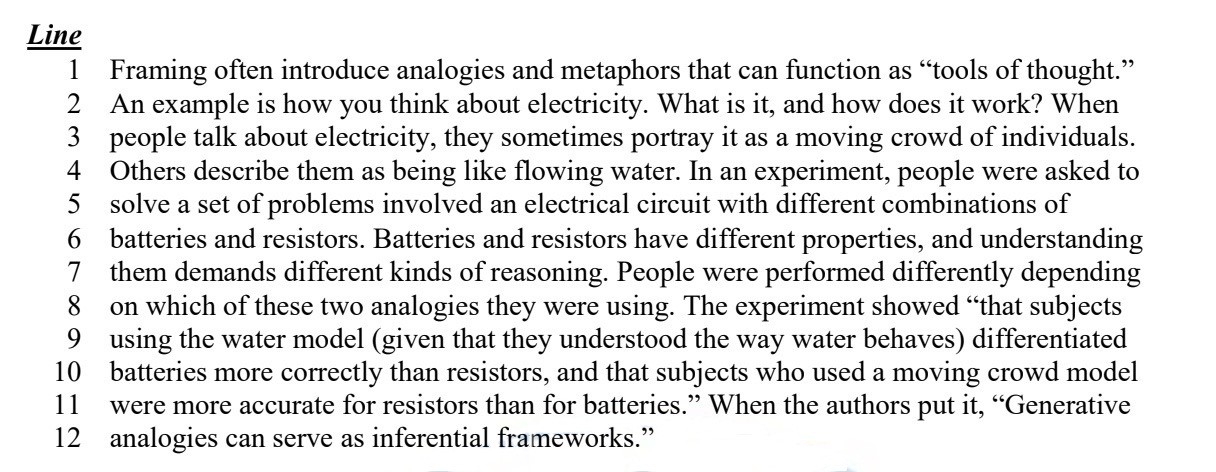
Others describe them asbeing flowing water.
Hướng dẫn giải:
Đáp án đúng: them (dòng 4)
Sửa lại: them => it
“Electricity” là danh từ không đếm được (số ít) nên phải dùng đại từ “it”
Hướng dẫn dịch: Những người khác lại mô tả nó như dòng nước chảy.
solve a set of problems involved an electrical circuit with different ...
Hướng dẫn giải:
Đáp án đúng: involved (dòng 5)
Sửa lại: involved => involving
Khi rút gọn mệnh đề quan hệ dạng chủ động, ta dùng động từ dạng V-ing
Hướng dẫn dịch: Trong một thí nghiệm, người ta được yêu cầu giải một loạt bài toán liên quan đến mạch điện với các sự kết hợp khác nhau giữa pin và điện trở.
People were performed differently depending
Hướng dẫn giải:
Đáp án đúng: were performed (dòng 7)
Sửa lại: were performed => performed
Vì “people” là chủ thể thực hiện hành động nên không thể dùng dạng bị động mà phải dùng ở dạng chủ động.
Hướng dẫn dịch: Pin và điện trở có các đặc tính khác nhau, và việc hiểu chúng đòi hỏi các loại suy luận khác nhau.
..., and that subjects who used a moving crowd model
Hướng dẫn giải:
Đáp án đúng: a (dòng 10)
Sửa lại: a => the
Hướng dẫn dịch: Thí nghiệm cho thấy "những người tham gia sử dụng mô hình nước (với điều kiện họ hiểu cách nước hoạt động) phân biệt pin chính xác hơn điện trở, và những người tham gia sử dụng mô hình đám đông đang chuyển động chính xác hơn đối với điện trở so với pin."
When the authors put it, ...
Hướng dẫn giải:
Đáp án đúng: When (dòng 11)
Sửa lại: When => As
Liên từ “When: khi” không phù hợp về nghĩa, dùng “As: như…”
Hướng dẫn dịch: Như các tác giả đã nói, "Các phép so sánh tạo sinh có thể đóng vai trò như các khung suy luận."
Dịch bài đọc:
Việc định khung thường đưa ra các phép so sánh và ẩn dụ có thể hoạt động như "công cụ tư duy". Ví dụ, hãy xem cách bạn nghĩ về điện. Điện là gì và hoạt động như thế nào? Khi nói về điện, đôi khi người ta miêu tả nó như một đám đông đang chuyển động. Những người khác lại mô tả nó như dòng nước chảy. Trong một thí nghiệm, người ta được yêu cầu giải một loạt bài toán liên quan đến mạch điện với các sự kết hợp khác nhau giữa pin và điện trở. Pin và điện trở có các đặc tính khác nhau, và việc hiểu chúng đòi hỏi các loại suy luận khác nhau. Kết quả của mọi người khác nhau tùy thuộc vào phép so sánh nào trong hai phép so sánh này mà họ sử dụng. Thí nghiệm cho thấy "những người tham gia sử dụng mô hình nước (với điều kiện họ hiểu cách nước hoạt động) phân biệt pin chính xác hơn điện trở, và những người tham gia sử dụng mô hình đám đông đang chuyển động chính xác hơn đối với điện trở so với pin." Như các tác giả đã nói, "Các phép so sánh tạo sinh có thể đóng vai trò như các khung suy luận."
Questions 121 - 130 SENTENCE TRANSFORMATION (2.0 pts)
Complete the second sentence so that it has a similar meaning to the first sentence, using the word given in the brackets. Do NOT make any changes to the word given. You must write from THR…, and WEE to EIGHT words, including the given word.
Example:
0. Do you mind if I watch you while you paint?
=> Do you ____________________________ you while you pain? (OBJECTION)
Write on your answer sheet:
0 | have any objection to my watching |
Write only the missing words on the answer sheet.
For the audience, the effortless performance of the acrobats was astonishing. (HOW)
The audience was ________________________________ performed.
Hướng dẫn giải:
Đáp án đúng: The audience was astonished by/at how effortlessly the acrobats performed.
Cấu trúc "astonished at/by something":kinh ngạc bởi điều gì.
"Effortless performance: diễn xuất không tốn sức" được chuyển thành trạng từ “effortlessly” bổ nghĩa cho động từ performed.
Hướng dẫn dịch: Khán giả đã kinh ngạc trước sự dễ dàng mà các nghệ sĩ xiếc biểu diễn.
It appears that our team provided this customer with inaccurate information about the product features, and I believe we should apologise to her. (MISINFORMED)
I believe we owe this customer an apology, as she seems __________________ the product features our sales team.
Hướng dẫn giải:
Đáp án đúng: I believe we owe this customer an apology, as she seems to have been misinformed the product features our sales team.
Cấu trúc seem to have been + V3/ed (có vẻ như đã bị...).
Provided with inaccurate information = misinformed (bị cung cấp thông tin sai).
Hướng dẫn dịch: Tôi tin rằng chúng ta cần phải xin lỗi khách hàng này, vì dường như cô ấy đã bị đội ngũ bán hàng của chúng ta cung cấp thông tin sai lệch về các tính năng sản phẩm.
Despite their contrasting personalities and diverse interests, Karen and Mark have managed to cultivate a strong and harmonious bond. (ALONG)
Having contrasting personalities and diverse interests does not prevent Karen and Mark from __________________________________ another.
Hướng dẫn giải:
Đáp án đúng: Having contrasting personalities and diverse interests does not prevent Karen and Mark from getting along with another.
Cấu trúc "prevent somebody from doing sth: ngăn cản ai làm gì".
Cụm từ "get along with: hòa hợp, có mối quan hệ tốt.”
Hướng dẫn dịch: Việc có tính cách trái ngược và sở thích khác nhau không ngăn cản Karen và Mark hòa thuận với nhau.
Though he had been under extensive training, John failed to meet the qualifying criteria for the Olympic team by a small margin in the final race. (SHORT)
Despite his extensive training, John _________________________________ qualifying for the Olympic team by just a few seconds in the final race.
Hướng dẫn giải:
Đáp án đúng: Despite his extensive training, John fell short of qualifying for the Olympic team by just a few seconds in the final race.
Cấu trúc “fall short of: không đạt được tiêu chuẩn/mục tiêu.”
Hướng dẫn dịch: Mặc dù đã được đào tạo bài bản, John vẫn không đủ điều kiện tham gia đội tuyển Olympic chỉ với vài giây trong cuộc đua chung kết.
The stock market is in decline and no one knows how things will turn out. (RECOVER)
Whether the stock market __________________________________ guess.
Hướng dẫn giải:
Đáp án đúng: Whether the stock market will recover is anybody's/anyone's guess.
Is anyone's guess: không ai chắc chắn điều gì.
“Recover “được dùng để thay thế cho nghĩa “in decline” và “how things will turn out.”
Hướng dẫn dịch: Liệu thị trường chứng khoán có phục hồi hay không thì ai cũng có thể đoán được.
The sky was so breathtakingly beautiful, with vibrant hues of fiery orange and enchanting pink, that it left us in awe of the mesmerizing sunset. (WITH)
The sky was painted ___________________________________, showcasing vibrant hues of fiery orange and enchanting pink, that it left us in awe of the mesmerizing sunset.
Hướng dẫn giải:
Đáp án đúng: The sky was painted with such a breathtaking beauty, showcasing vibrant hues of fiery orange and enchanting pink, that it left us in awe of the mesmerizing sunset.
“Painted with such”... dùng để miêu tả cảnh vật.
"So beautiful that" được chuyển thành "with such beauty that".
Hướng dẫn dịch: Bầu trời được tô điểm bằng một vẻ đẹp ngoạn mục, với những sắc màu rực rỡ của màu cam rực lửa và màu hồng quyến rũ, khiến chúng ta choáng ngợp trước cảnh hoàng hôn mê hoặc.
They will do whatever it takes to save the company. (STOP)
They will _____________________________________ the company going.
Hướng dẫn giải:
Đáp án đúng: They will stop at nothing to keep the company going.
Cấu trúc "stop at nothing to do sth: không từ thủ đoạn nào/sẵn sàng làm mọi thứ để đạt mục đích" thay thế cho "do whatever it takes to save".
"Keep... going" có nghĩa tương đương với "save: duy trì sự hoạt động, cứu"
Hướng dẫn dịch: Họ sẽ không từ bỏ bất cứ điều gì để duy trì hoạt động của công ty.
The rebel minister refused to do what the president said when it came to citizen's privacy abuses. (ACCOUNT)
"On ____________________________________ toe the president's line when it comes to citizens' privacy abuses!" said the rebel minister.
Hướng dẫn giải:
Đáp án đúng: “On no account will I toe the president's line when it comes to citizens' privacy abuses!" said the rebel minister.
Cấu trúc đảo ngữ "On no account: không vì lý do gì, không đời nào" + đảo trợ động từ lên trước chủ ngữ.
"Refused to do what the president said: từ chối làm theo" được chuyển thành "will not/will no account... toe the line: không tuân theo luật, mệnh lệnh."
Hướng dẫn dịch: "Tôi nhất quyết không tuân theo đường lối của tổng thống khi nói đến việc xâm phạm quyền riêng tư của công dân!" vị bộ trưởng bất đồng quan điểm nói.
Nothing good can come out of blaming him for what happened. (GAINED)
There is nothing __________________________________ finger at him for what happened.
Hướng dẫn giải:
Đáp án đúng: There is nothing to be gained from/by pointing a/the finger at him for what happened.
Cấu trúc "There is nothing to be gained from + V-ing: Không đạt được gì từ việc làm gì" thay thế cho "Nothing good can come out of".
"Blaming: đổ lỗi" tương đương với thành ngữ "pointing the finger at: đổ lỗi, chỉ trích hoặc buộc tội ai đó chịu trách nhiệm cho một việc xấu, một sai lầm hoặc một tình huống tiêu cực.
Hướng dẫn dịch: Không có lợi ích gì khi chỉ trích anh ta về những gì đã xảy ra.
The manager has recently been made aware of the staff complaining about their workload and lack of support. (ATTENTION)
It ____________________________________ that the staff are complaining about their workload and lack of support.
Hướng dẫn giải:
Đáp án đúng: It has recently come/been brought to the manager's attention that the staff are complaining about their workload and lack of support.
Cấu trúc "Bring something to someone's attention: làm cho ai đó chú ý/nhận biết điều gì” thay thế cho "make someone aware of".
Câu gốc "made aware of" (bị động) chuyển thành "brought to... attention"
Hướng dẫn dịch: Gần đây, người quản lý đã được thông báo rằng nhân viên đang phàn nàn về khối lượng công việc và thiếu sự hỗ trợ.