Đề minh họa thi vào lớp 10 Tiếng Anh năm 2026 Sở GD&ĐT Đồng Nai có đáp án
37 câu hỏi
I. MULTIPLE-CHOICE SECTION (7.5 points)
Choose the letter (A, B, C or D) to indicate the correct answer to each of the following questions.
The / the
A/ a
A/ the
The / a
Hướng dẫn giải:
Đáp án đúng: A
Tên sa mạc Sahara là danh từ riêng → dùng The.
“largest desert in the world” là so sánh nhất → dùng the.
Dịch nghĩa: Sa mạc Sahara thường được xem là sa mạc lớn nhất trên thế giới.
trains
train
trained
will train
Hướng dẫn giải:
Đáp án đúng: B
Câu điều kiện loại 1: If + hiện tại đơn, ... + tương lai đơn / can.
Dịch nghĩa: Nếu bạn luyện tập chăm chỉ hơn, bạn có thể thắng cuộc đua.
turn
turning
to turn
turned
Hướng dẫn giải:
Đáp án đúng: B
Cấu trúc: Would you mind + V-ing (Phiền khi làm gì)
Dịch nghĩa: Bạn có phiền vặn nhỏ radio một chút không?
reaches
climbs
explores
spoils
Hướng dẫn giải:
Đáp án đúng: D
Động từ phù hợp với nghĩa “làm hỏng, phá hỏng” = spoil.
Dịch nghĩa: Tôi ghét việc xả rác. Bạn có biết rằng nó làm hỏng vẻ đẹp tự nhiên ở đây không?
But
Therefore
Because
Though
Hướng dẫn giải:
Đáp án đúng: D
Cần liên từ chỉ sự tương phản → Though (mặc dù).
Dịch nghĩa: Mặc dù chúng tôi đến muộn, chúng tôi vẫn không bỏ lỡ phần đầu của bài phát biểu.
across
down
back
over
Hướng dẫn giải:
Đáp án đúng: B
Cụm động từ: come across = tình cờ tìm thấy.
Dịch nghĩa: Trang web mà anh trai tôi tình cờ tìm thấy có những phương pháp giúp cải thiện ngữ pháp của anh ấy.
Choose the letter (A, B, C or D) to indicate the word whose underlined part differs from the other three in pronunciation in the following question.
promise
surprise
because
amuse
Hướng dẫn giải:
Đáp án đúng: A
Đáp án A phát âm /s/, các đáp án còn lại phát âm /z/
Choose the letter (A, B, C or D) to indicate the word that differs from the other three in the position of primary stress in the following question.
parade
problem
reduce
believe
Hướng dẫn giải:
Đáp án đúng: B
Đáp án B trọng âm số 1, các đáp án còn lại trọng âm số 2
Choose the letter (A, B, C or D) to indicate the underlined part that needs correction in each of the following questions.
The woman which always wears white dresses is the principal of our school.
which
wears
is
of
Hướng dẫn giải:
Đáp án đúng: A
Đại từ quan hệ chỉ người phải dùng “who/that”, không dùng which.
Dịch nghĩa: Người phụ nữ luôn mặc váy trắng là hiệu trưởng của trường chúng tôi.
These are his blue gloves; her are on the desk.
his
gloves
her
on
Hướng dẫn giải:
Đáp án đúng: C
Sau “his blue gloves” cần đại từ sở hữu → hers.
Dịch nghĩa: Đây là găng tay màu xanh của anh ấy; của cô ấy ở trên bàn.
Complete the conversation between David and his mum. Choose the correct letter (A-G).There are TWO extra letters you do not need to use.
David: Did you go to Australia when you were young, Mum?
Mum: Yes, I did! I was only 21 when I went there.
David: How long were you there?
Mum: (11)
David: Really? And who did you go with?
Mum: (12)
David: Where did you stay?
Mum: (13)
David: That's great. And what did you do there?
Mum: (14)
David: Did you enjoy it?
Mum: (15)
A. Oh, for about five weeks.
B. Yes, I did. Tom loved it too.
C. My friend Tom - we had great fun!
D. You're welcome! Please stay with us.
E. Lots of things - one was camel riding!
F. Tom's uncle lives in a large house in Sydney. We were with him for a few weeks.
G. Pardon? Tom didn't go!
Mum: (11)
Hướng dẫn giải:
Đáp án đúng: A
Câu hỏi: “How long were you there?” → hỏi thời gian ở bao lâu.
Dịch nghĩa: Ồ, khoảng năm tuần.
Mum: (12)
Hướng dẫn giải:
Đáp án đúng: C
Câu hỏi: “And who did you go with?” → hỏi đi cùng ai.
Dịch nghĩa: Bạn tôi Tom - chúng tôi đã có khoảng thời gian rất vui!
Mum: (13)
Hướng dẫn giải:
Đáp án đúng: F
Câu hỏi: “Where did you stay?” → hỏi ở đâu.
Dịch nghĩa: Chú của Tom sống trong một ngôi nhà lớn ở Sydney, chúng tôi ở với ông ấy vài tuần.
Mum: (14)
Hướng dẫn giải:
Đáp án đúng: E
Câu hỏi: “What did you do there?” → hỏi đã làm gì.
Dịch nghĩa: Rất nhiều thứ - một trong số đó là cưỡi lạc đà!
Mum: (15)
Hướng dẫn giải:
Đáp án đúng: B
Câu hỏi: “Did you enjoy it?” → hỏi có thích không.
Dịch nghĩa: Có chứ. Tom cũng rất thích.
Choose the letter (A, B, C or D) to indicate the best arrangement of utterances or sentencesto make a meaningful exchange or text in each of the following questions.
a. Helen: Thank you.
b. Jenny: Go straight for two blocks, then turn right.
c. Helen: How do I get to the post office?
b-c-a
a-b-c
c-b-a
c-a-b
Hướng dẫn giải:
Đáp án đúng: C
Xét logic hội thoại: Hỏi đường → trả lời → cảm ơn.
Dịch nghĩa:
Helen: Làm thế nào để tôi đến bưu điện?
Jenny: Đi thắng hai dãy nhà, sau đó rẽ phải.
Helen: Cảm ơn bạn.
Hi Tom,
I hope you're fine. I need your help with something for school.
a. I know you did a great presentation on this, so maybe you have some tips for me.
b. I chose to talk about natural wonders because I think they are very interesting.
c. Do you have any advice on how to make my talk better?
d. I have to give a presentation in front of the class next week.
Write soon, Lucy
d -b-a - c
b-d- a - c
d - a -b - c
b-a -d - c
Hướng dẫn giải:
Đáp án đúng: A
Sắp xếp logic của một email:
1. Nêu vấn đề
2. Nói chi tiết hơn
3. Nhắc đến kinh nghiệm của Tom
4. Hỏi lời khuyên.
Thứ tự đúng: d → b → a → c
Dịch nghĩa đoạn văn:
Chào Tom,
Mình hi vong bạn vẫn khỏe. Mình cần sự giúp đỡ của bạn về một việc ở trường.
Mình phải thuyết trình trước lớp vào tuần tới.
Mình chọn nói về các kỳ quan thiên nhiên vì mình nghĩ chúng rất thú vị.
Mình biết bạn đã có một bài thuyết trình rất hay về chủ đề này, nên có lẽ bạn có vài mẹo cho mình.
Bạn có lời khuyên nào để bài nói của mình tốt hơn không?
Read the following passage. Choose the letter (A, B, C or D) to indicate the correct wordor phrase that best fits each of the numbered blanks.
Vietnamese customs
What should you do when you visit a different country? It's important to know their customs
and you need to respect the local people. Read on to (18)about some customs inVietnam.
Greetings
Most people greet each other by shaking hands or bowing their heads slightly with a smile.
Eating and drinking
It's important to wait (19)the oldest person at the table to start eating beforeyou take a bite. This custom shows that the local people really respect the elderly. Also, neverplace yourchopsticks standing straight up in your bowl of rice; it's extremely rude.
Giving and receiving gifts
It's polite to accept a gift, (20) you shouldn't refuse if someone offers you one. Youshould also ask the giver whether you can open a wrapped gift as soon as you receive it. Ifsomeone invites you to their home, you should (21)a gift to the host like food orfruit.
Body language
Don't cross your (22)or stand with your hands on your hips; it is impolite inVietnam.
find
follow
learn
get
Hướng dẫn giải:
Đáp án đúng: C
Cấu trúc: read on to learn about (đọc tiếp để tìm hiểu về).
Dịch nghĩa: Hãy đọc tiếp để tìm hiểu về một số phong tục ở Việt Nam.
at
in
for
of
Hướng dẫn giải:
Đáp án đúng: C
Cấu trúc: wait for someone (chờ ai đó).
Dịch nghĩa: Điều quan trọng là phải chờ người lớn tuổi nhất ở bàn bắt đầu ăn trước khi bạn ăn.
but
because
though
so
Hướng dẫn giải:
Đáp án đúng: D
Hai mệnh đề mang nghĩa nhân quả → dùng so (vì vậy).
Dịch nghĩa:
Thật lịch sự khi nhận quà, vì vậy bạn không nên từ chối nếu ai đó tặng bạn.
Ifsomeone invites you to their home, you should (21)a gift to the host like food orfruit.
offer
to offer
offering
offered
Hướng dẫn giải:
Đáp án đúng: A
Sau “should” dùng động từ nguyên mẫu.
Dịch nghĩa: Bạn nên tặng một món quà cho chủ nhà như thức ăn hoặc trái cây.
Don't cross your (22)or stand with your hands on your hips; it is impolite inVietnam.
hips
arms
heads
noses
Hướng dẫn giải:
Đáp án đúng: B
Cụm cố định: cross your arms (khoanh tay).
Dịch nghĩa: Đừng khoanh tay hoặc đứng chống tay vào hông; điều đó bị coi là bất lịch sự ở Việt Nam.
Dịch bài đọc:
Phong tục Việt Nam
Bạn nên làm gì khi đến thăm một đất nước khác? Điều quan trọng là phải biết phong tục của họ và bạn cần tôn trọng người dân địa phương. Hãy đọc tiếp để tìm hiểu về một số phong tục ở Việt Nam.
Chào hỏi
Hầu hết mọi người chào nhau bằng cách bắt tay hoặc cúi đầu nhẹ kèm theo một nụ cười.
Ăn uống
Điều quan trọng là phải đợi người lớn tuổi nhất trong bàn bắt đầu ăn trước khi bạn ăn. Phong tục này cho thấy người dân địa phương rất tôn trọng người lớn tuổi. Ngoài ra, không bao giờ cắm đũa thẳng đứng vào bát cơm, vì điều đó bị coi là cực kỳ bất lịch sự.
Tặng và nhận quà
Thật lịch sự khi nhận một món quà, vì thế bạn không nên từ chối nếu ai đó tặng quà cho bạn. Bạn cũng nên hỏi người tặng xem bạn có thể mở món quà được gói ngay khi nhận hay không. Nếu ai đó mời bạn đến nhà họ, bạn nên mang một món quà cho chủ nhà, chẳng hạn như đồ ăn hoặc trái cây.
Ngôn ngữ cơ thể
Đừng khoanh tay hoặc đứng chống tay vào hông; điều đó bị coi là bất lịch sự ở Việt Nam.
Read the passage and choose the letter (A, B, C or D) to indicate the correct answer toeach of the following questions.
All your friends have gone to a party. You can't go because you have homework, but youcan't stop checking your phone. Have you ever been in this situation? Then perhaps you haveFOMO - Fear of Missing Out.
"Sometimes I see a picture of some friends online," explains Lucas, 16. "They're doingsomething amazing, like surfing or snorkeling. It makes me unhappy. My friends are havingfunand I'm not!"
About 25% of teenagers say that they get this feeling, but there's another, far better feeling:
JOMO - the joy of missing out!
Grace, 18, has learned to feel JOMO. "In the past, I never stayed in. But I wasn't in controlof my life, and other people were organizing it for me! When I finally understood this, I madechanges. Now, I only go out occasionally and spend more time on my interests. I'm writing myown novel, and I've never felt happier!"
Dr. Stella Taylor, a psychologist, says social media makes FOMO worse. "It makes otherpeople's lives interesting and our own lives feel boring," she says. So how can we learn to feelJOMO?
"Remember that you are in control of your life," says Dr. Taylor. "When you're older, youwon't remember those boring parties. You'll think about the time you wasted! With JOMO,you'll have more time for hobbies you enjoy, and you'll feel much happier!"
Right! It's time to put down your phone and find your pajamas. How about some TV?
don't want to see your friends
worry about your homework
want to do what other people are doing
can't find your phone
Hướng dẫn giải:
Đáp án đúng: C
Thông tin: All your friends have gone to a party. You can't go because you have homework, but you can't stop checking your phone. Have you ever been in this situation? Then perhaps you have FOMO - Fear of Missing Out. (Tất cả bạn bè của bạn đều đi dự tiệc. Bạn không thể đi vì phải làm bài tập về nhà, nhưng bạn lại không thể ngừng kiểm tra điện thoại. Bạn đã bao giờ rơi vào tình huống này chưa? Nếu vậy, có lẽ bạn đang mắc chứng FOMO - Nỗi sợ bỏ lỡ.)
have experienced JOMO
don't know what FOMO is
have had FOMO
have never missed a party
Hướng dẫn giải:
Đáp án đúng: C
Thông tin: About 25% of teenagers say that they get this feeling. (Khoảng 25% thanh thiếu niên đã từng có cảm giác FOMO.)
jobs
pastimes
assignments
duties
Hướng dẫn giải:
Đáp án đúng: B
interests = hobbies / things you like (điều bạn thích)
a psychologist
social media
a novel
a party
Hướng dẫn giải:
Đáp án đúng: B
Thông tin: Dr. Stella Taylor says social media makes FOMO worse. It makes other people's lives interesting… (Tiến sĩ Stella Taylor cho rằng mạng xã hội làm trầm trọng thêm hội chứng FOMO (sợ bỏ lỡ). Nó khiến cuộc sống của người khác trở nên thú vị hơn…)
we'll go to more boring parties in the future
we won't worry about the parties we missed
we won't have time for hobbies
we'll spend more time watching TV
Hướng dẫn giải:
Đáp án đúng: B
Thông tin: When you're older, you won't remember those boring parties. (Khi lớn lên, bạn sẽ không còn nhớ những bữa tiệc nhàm chán đó nữa.)
Dịch bài đọc:
Tất cả bạn bè của bạn đều đi dự tiệc. Bạn không thể đi vì phải làm bài tập về nhà, nhưng bạn không thể ngừng kiểm tra điện thoại. Bạn đã bao giờ rơi vào tình huống này chưa? Nếu vậy, có lẽ bạn đang mắc chứng FOMO - Nỗi sợ bỏ lỡ.
"Đôi khi tôi thấy ảnh của một vài người bạn trên mạng," Lucas, 16 tuổi, giải thích. "Họ đang làm điều gì đó tuyệt vời, như lướt sóng hoặc lặn biển. Điều đó khiến tôi không vui. Bạn bè tôi đang vui vẻ còn tôi thì không!"
Khoảng 25% thanh thiếu niên nói rằng họ có cảm giác này, nhưng có một cảm giác khác, tốt hơn nhiều:
JOMO - niềm vui khi bỏ lỡ!
Grace, 18 tuổi, đã học được cách cảm nhận JOMO. "Trước đây, tôi không bao giờ ở nhà. Nhưng tôi không kiểm soát được cuộc sống của mình, và người khác đang sắp xếp nó cho tôi! Khi cuối cùng tôi hiểu ra điều này, tôi đã thay đổi. Bây giờ, tôi chỉ thỉnh thoảng ra ngoài và dành nhiều thời gian hơn cho sở thích của mình. Tôi đang viết tiểu thuyết của riêng mình, và tôi chưa bao giờ cảm thấy hạnh phúc hơn thế!"
Tiến sĩ Stella Taylor, một nhà tâm lý học, cho biết mạng xã hội làm cho chứng FOMO trở nên tồi tệ hơn. "Nó khiến cuộc sống của người khác trở nên thú vị hơn, còn cuộc sống của chính chúng ta lại trở nên nhàm chán," cô ấy nói. Vậy làm thế nào để học cách cảm nhận JOMO (niềm vui khi bỏ lỡ)?
"Hãy nhớ rằng bạn đang kiểm soát cuộc sống của mình," Tiến sĩ Taylor nói. "Khi bạn lớn tuổi hơn, bạn sẽ không nhớ đến những bữa tiệc nhàm chán đó. Bạn sẽ nghĩ về thời gian bạn đã lãng phí! Với JOMO, bạn sẽ có nhiều thời gian hơn cho những sở thích mình yêu thích, và bạn sẽ cảm thấy hạnh phúc hơn rất nhiều!"
Read the texts and choose the letter (A, B, C or D) to indicate the correct answer to eachof the following questions.
What does the sign say?
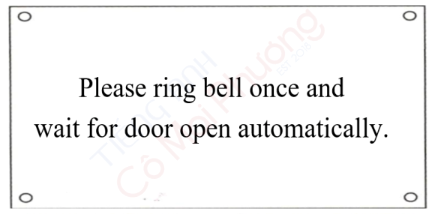
Someone will open the door when you ring the bell.
The door will open after you ring the bell.
You can open the door after ringing the bell.
The door will open before you ring the bell.
Hướng dẫn giải:
Đáp án đúng: B
Biển báo ghi: “Please ring bell once and wait for door open automatically.”
→ Hãy bấm chuông một lần và đợi cửa tự động mở.
Dịch nghĩa: Cánh cửa sẽ mở sau khi bạn bấm chuông.
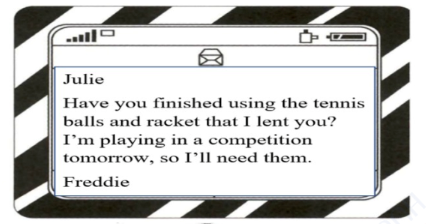
to give him some advice about tennis
to play tennis with him tomorrow
to return his sports equipment
to join the tennis competition with him
Hướng dẫn giải:
Đáp án đúng: C
Freddie hỏi Julie đã dùng xong chưa vì anh ấy cần lấy lại đồ cho cuộc thi ngày mai.
Dịch nghĩa: Freddie muốn Julie trả lại dụng cụ thể thao của anh ấy.
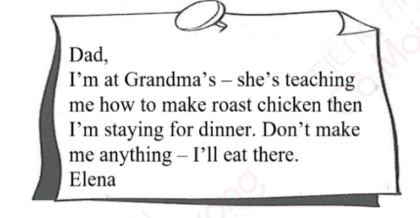
to tell her dad about her dinner plans
to ask if her dad likes roast chicken
to check where her dad is having dinner
to remind her dad to make dinner for her
Hướng dẫn giải:
Đáp án đúng: A
Tờ ghi chú viết: Elena thông báo sẽ ăn tối ở nhà bà nên bố không cần nấu cho cô ấy.
Dịch nghĩa: Elena viết ghi chú để nói với bố về kế hoạch ăn tối của mình.
II. WRITING (2.5 points)
Rewrite the second sentence so that it has a similar meaning to the original one, beginningwith the given word(s).
We look after the neighbours' cat while they're away.
→ We take _________________________________.
Hướng dẫn giải:
Đáp án đúng: We take care of the neighbours' cat while they're away.
look after = take care of (chăm sóc)
Dịch nghĩa: Chúng tôi chăm sóc con mèo của hàng xóm khi họ đi vắng.
My sister doesn't have a smartphone and she'd like to have one.
→ My sister wishes _________________________________.
Hướng dẫn giải:
Đáp án đúng: My sister wishes she had a smartphone.
Cấu trúc wish + past simple (ước điều không có ở hiện tại).
Dịch nghĩa: Chị tôi ước rằng mình có một chiếc điện thoại thông minh.
My mother asked me, "Are you coming to the dance class this afternoon?"
→ My mother asked me _________________________________.
Hướng dẫn giải:
Đáp án đúng: My mother asked me if I was coming to the dance class that afternoon.
Câu hỏi Yes/No trong câu tường thuật → asked if/whether + S + V (lùi thì).
Dịch nghĩa: Mẹ tôi hỏi tôi liệu tôi có đến lớp học nhảy chiều hôm đó không.
The weather was so awful that we had to cancel our trip to the mountains.
→ It was such _________________________________.
Hướng dẫn giải:
Đáp án đúng: It was such awful weather that we had to cancel our trip to the mountains.
Cấu trúc đổi: so + adj + that → such + (a/an) + adj + noun + that
Dịch nghĩa: Thời tiết tệ đến mức chúng tôi phải hủy chuyến đi lên núi.
Order the words to make complete sentences.
teenagers. / an excellent way / Setting goals / to / motivate / is/
_________________________________.
Hướng dẫn giải:
Đáp án đúng: Setting goals is an excellent way to motivate teenagers.
Dịch nghĩa: Đặt mục tiêu là một cách tuyệt vời để tạo động lực cho thanh thiếu niên.
what / on / understanding / sleep, / Based / for. / we/ a rich / ask / sleep / is /good/ of/ no/ longer/ have/ to /
_________________________________.
Hướng dẫn giải:
Đáp án đúng: Based on a rich understanding of sleep, we no longer have to ask what sleep is good for.
Dịch nghĩa: Dựa trên sự hiểu biết sâu sắc về giấc ngủ, chúng ta không còn phải hỏi giấc ngủ có ích lợi gì nữa.
In 100-120 words, write a paragraph about how to keep fit in your daily life. You canuse the following questions as cues or your own ideas.
- What do you often do to keep fit?
- What food and drinks do you usually have?
- Do you get enough sleep?
- How often do you take part in outdoor activities?
Gợi ý:
Keeping fit in daily life is very important for our health. First, we should exercise regularly, such as walking, jogging, cycling, or doing sports for at least 30 minutes a day. Physical activities help our bodies stay strong and improve our health. In addition, we should eat healthy food like vegetables, fruits, and drink enough water every day. It is also important to get enough sleep and avoid unhealthy habits such as eating too much fast food. Finally, keeping a positive attitude and reducing stress can also help us stay healthy and energetic. By following these simple habits, we can keep fit and enjoy a better life.
Dịch nghĩa:
Giữ gìn sức khỏe trong cuộc sống hàng ngày rất quan trọng đối với sức khỏe của chúng ta. Trước hết, chúng ta nên tập thể dục thường xuyên, chẳng hạn như đi bộ, chạy bộ, đạp xe hoặc chơi thể thao ít nhất 30 phút mỗi ngày. Hoạt động thể chất giúp cơ thể khỏe mạnh và cải thiện sức khỏe. Ngoài ra, chúng ta nên ăn những thực phẩm lành mạnh như rau, trái cây và uống đủ nước mỗi ngày. Ngủ đủ giấc và tránh những thói quen không lành mạnh như ăn quá nhiều đồ ăn nhanh cũng rất quan trọng. Cuối cùng, giữ thái độ tích cực và giảm căng thẳng cũng giúp chúng ta khỏe mạnh và tràn đầy năng lượng. Bằng cách tuân thủ những thói quen đơn giản này, chúng ta có thể giữ gìn sức khỏe và tận hưởng một cuộc sống tốt đẹp hơn.