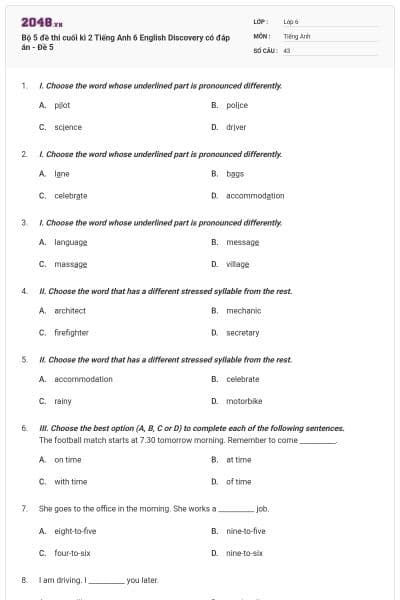
40 câu hỏi
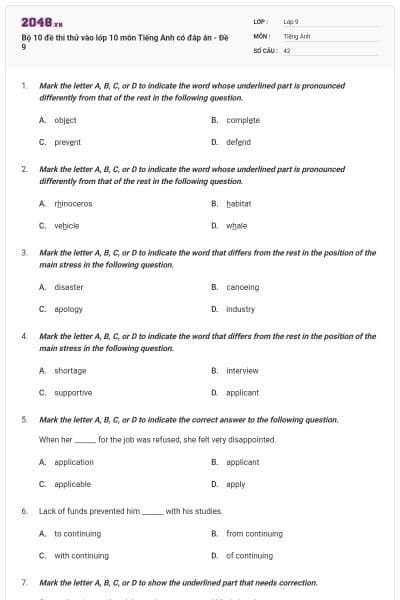
pilot
police
science
driver
Kiến thức: Phát âm “i”
Giải thích:
A. pilot /ˈpaɪ.lət/
B. police /pəˈliːs/
C. science /ˈsaɪ.əns/
D. driver /ˈdraɪ.vər/
Phần được gạch chân ở phương án B được phát âm /i:/, các phương án còn lại phát âm /aɪ/.
Chọn B
lane
bags
celebrate
accommodation
Kiến thức: Phát âm “a”
Giải thích:
A. lane /leɪn/
B. bags /bæɡ/
C. celebrate /ˈsel.ə.breɪt/
D. accommodation /əˌkɒm.əˈdeɪ.ʃən/
Phần được gạch chân ở phương án B được phát âm /æ/, các phương án còn lại phát âm /eɪ/.
Chọn B
language
message
massage
village
Kiến thức: Phát âm “ge”
Giải thích:
A. language /ˈlæŋ.ɡwɪdʒ/
B. message /ˈmes.ɪdʒ/
C. massage /ˈmæs.ɑːʒ/
D. village /ˈvɪl.ɪdʒ/
Phần được gạch chân ở phương án C được phát âm /ʒ/, các phương án còn lại phát âm /dʒ/.
Chọn C
architect
mechanic
firefighter
secretary
Kiến thức: Trọng âm
Giải thích:
A. architect /ˈɑː.kɪ.tekt/
B. mechanic /məˈkæn.ɪk/
C. firefighter /ˈfaɪəˌfaɪ.tər/
D. secretary /ˈsek.rə.tər.i/
Phương án B có trọng âm 2, các phương án còn lại có trọng âm 1.
Chọn B
accommodation
celebrate
rainy
motorbike
Kiến thức: Trọng âm
Giải thích:
A. accommodation /əˌkɒm.əˈdeɪ.ʃən/
B. celebrate /ˈsel.ə.breɪt/
C. rainy /ˈreɪ.ni/
D. motorbike /ˈməʊ.tə.baɪk/
Phương án A có trọng âm 4, các phương án còn lại có trọng âm 1.
Chọn A
on time
at time
with time
of time
Kiến thức: Cụm từ
Giải thích:
Cụm từ “on time” (đúng giờ)
The football match starts at 7.30 tomorrow morning. Remember to come on time.
(Trận đấu bóng đá bắt đầu lúc 7h30 sáng mai. Nhớ đến đúng giờ.)
Chọn A
eight-to-five
nine-to-five
four-to-six
nine-to-six
Kiến thức: Từ vựng
Giải thích:
A. eight-to-five: tám đến năm
B. nine-to-five: chín đến năm
C. four-to-six: bốn đến sáu
D. nine-to-six: chín đến sau
=> nine to five job: công việc giờ hành chính
She goes to the office in the morning. She works a nine-to-five job.
(Cô ấy đi đến văn phòng vào buổi sáng. Cô ấy làm công việc giờ hành chính.)
Chọn B

Học thông minh hơn mỗi ngày
Xem toàn bộ 40 câu hỏi và nhiều hơn nữa với tài khoản miễn phí
am calling
won’t call
will call
call
Kiến thức: Thì tương lai đơn
Giải thích:
- Thì tương lai đơn chỉ quyết định đưa ra trong lúc nói.
- Cấu trúc thì tương lai đơn ở dạng khẳng định: S + will + Vo (nguyên thể)
I am driving. I will call you later.
(Tôi đang lái xe. Tôi sẽ gọi cho bạn sau.)
Chọn C
have
are going to have
are having
am having
Kiến thức: Thì tương lai
Giải thích:
- Dấu hiệu nhận biết “tomorrow morning” (sáng mai).
- Thì hiện tại tiếp diễn dùng để chỉ hành động đã chuẩn bị kế hoạch sẵn, thường có thời gian cụ thể trong tương lai.
- Cấu trúc thì hiện tại tiếp diễn: S + am/is/ are + Ving.
have (v): có
We are having a Maths lesson tomorrow morning.
(Chúng tôi có tiết học Toán vào sáng mai.)
Chọn C
bike lane
bus station
car park
train station
Kiến thức: Từ vựng
Giải thích:
A. bike lane (n): làn xe đạp
B. bus station (n): trạm xe buýt
C. car park (n): bãi đỗ xe hơi
D. train station (n): trạm xe lửa
There are not usually bike lane for bikers in Vietnam.
(Ở Việt Nam thường không có làn đường dành cho xe đạp.)
Chọn A
cloudy
sunny
rainy
warm
Kiến thức: Từ vựng
Giải thích:
A. cloudy (adj): nhiều mây
B. sunny (adj): nhiều năng
C. rainy (adj): có mưa
D. warm (adj): ấm
People say we should not go hiking on rainy days. We may get wet.
(Mọi người nói rằng chúng ta không nên đi leo núi vào những ngày mưa. Chúng ta có thể bị ướt.)
Chọn C
take off
take on
taking off
to take off
Kiến thức: Dạng động từ
Giải thích:
Sau “have to” (phải) cần một động từ ở dạng nguyên thể.
“take off”: cởi ra
In many Asian countries, you have to take off your shoes if you want to visit someone’s home.
(Ở nhiều nước châu Á, bạn phải cởi giày nếu muốn đến thăm nhà ai đó.)
Chọn A
Foreign language
Ethnic language
Native language
Nation language
Kiến thức: Từ vựng
Giải thích:
A. Foreign language: ngôn ngữ nước ngoài
B. Ethnic language: ngôn ngữ dân tộc
C. Native language: ngôn ngữ bản địa
D. Nation language: ngôn ngữ quốc gia
Native language is the language that a person learns from earliest childhood.
(Ngôn ngữ bản địa là ngôn ngữ mà một người học từ thời thơ ấu sớm nhất.)
Chọn C
search engine
social network
smartphone
Kiến thức: Từ vựng
Giải thích:
A. search engine (n): công cụ tìm kiếm
B. email (n): thư điện tử
C. social network (n): mạng xã hội
D. smartphone (n): điện thoại thông minh
“What is your favourite search engine?”- “It’s Google. I use it to check information.”
(“Công cụ tìm kiếm yêu thích của bạn là gì?” - “Đó là Google. Tôi dùng nó để kiểm tra thông tin.”)
Chọn A
Are you interested in sports?
What do you do in your free time?
What did you do when you were younger?
Are you a sports fanatic?
Kiến thức: Chức năng giao tiếp
Giải thích:
A. Are you interested in sports?
(Bạn có thích thể thao không?)
B. What do you do in your free time?
(Bạn làm gì trong thời gian rảnh rỗi?)
C. What did you do when you were younger?
(Bạn đã làm gì khi còn nhỏ?)
D. Are you a sports fanatic?
(Bạn có phải là người đam mê thể thao không?)
“What do you do in your free time?” - “I do judo in my free time.”
("Bạn sẽ làm gì trong thời gian rảnh rỗi?" - “Tôi tập judo trong thời gian rảnh.”)
Chọn B
Kiến thức: Từ vựng – Từ loại
Giải thích:
Sau lượng từ “a lot of” (nhiều) cần một danh từ đếm được số nhiều hoặc danh từ không đếm được.
assist (v): phụ tá => assistants (n): trợ lý
My father is a CEO. He has a lot of assistants to help him with work.
(Cha tôi là một CEO. Ông ấy có rất nhiều trợ lý để hỗ trợ ông ấy trong công việc.)
Đáp án: assistants
Kiến thức: Từ vựng – Từ loại
Giải thích:
Sau động từ tobe “be” cần một tính từ.
employ (v): tuyển dụng => unemployed (adj): thất nghiệp
My work everyday is so tiring but I don’t want to quit. I don’t want to be unemployed.
(Công việc của tôi hàng ngày rất mệt mỏi nhưng tôi không muốn nghỉ việc. Tôi không muốn thất nghiệp.)
Đáp án: unemployed
Kiến thức: Từ vựng – Từ loại
Giải thích:
Trước danh từ “weather” (thời tiết) cần một tính từ.
fog (n): sương mù => foggy (adj): có sương mù
Driving is very dangerous in the foggy weather.
(Lái xe rất nguy hiểm trong thời tiết sương mù.)
Đáp án: foggy
Kiến thức: Từ vựng – Từ loại
Giải thích:
Sau động từ tobe “be” cần một tính từ.
sun (n): mặt trời => sunny (adj): có nắng
We're having the party in the garden, so I hope it'll be sunny.
(Chúng tôi tổ chức tiệc trong vườn, vì vậy tôi hy vọng trời sẽ nắng.)
Đáp án: sunny
Kiến thức: Từ vựng – Từ loại
Giải thích:
Sau động từ tobe “are” cần một tính từ.
litterate (adj): biết chữ => illiterate (adj): không biết chữ
These people are illiterate. They don’t go to school and they cannot read or write.
(Những người này mù chữ. Họ không đi học và họ không thể đọc hoặc viết.)
Đáp án: illiterate
10:45
22:45
Maths
Biology
Kiến thức: Nghe hiểu
Giải thích:
Họ sẽ đến Glasgow lúc __________ p.m.
A. 10:45
B. 22:45
C. Toán
D. Sinh học
Thông tin: We're due to arrive in Glasgow at 10:45 p.m.
(Chúng tôi sẽ đến Glasgow lúc 10:45 tối.)
Chọn A
hot
rainy
cloudy
foggy
Kiến thức: Nghe hiểu
Giải thích:
Thời tiết ở London thì _________.
A. nóng
B. mưa
C. nhiều mây
D. sương mù
Thông tin: The foggy weather in London is not going to delay us at all,
(Thời tiết sương mù ở London sẽ không làm chúng ta chậm trễ chút nào,)
Chọn D
foggy
windy
sunny
good
Kiến thức: Nghe hiểu
Giải thích:
Thời tiết ở phía bắc Carlisle là _________.
A. sương mù
B. gió
C. nắng
D. tốt
Thông tin: We may need to slow down when it starts getting windy north of Carlisle.
(Chúng ta có thể cần giảm tốc độ khi trời bắt đầu có gió ở phía bắc Carlisle.)
Chọn B
hot
cloudy
sunny
rainy
Kiến thức: Nghe hiểu
Giải thích:
Vào mùa hè năm 1976, thời tiết ___ hàng ngày trong nhiều tuần.
A. nóng
B. nhiều mây
C. nắng
D. mưa
Thông tin: It was sunny every day for weeks, and we were out all day every day.
(Trời nắng mỗi ngày trong nhiều tuần, và chúng tôi ra ngoài cả ngày mỗi ngày.)
Chọn C
park
picnic
camp
beach
Kiến thức: Nghe hiểu
Giải thích:
Năm đó, bọn trẻ đã dành cả mùa hè ở __________.
A. công viên
B. dã ngoại
C. cắm trại
D. bãi biển
Thông tin: The children spent the whole summer in the park.
(Những đứa trẻ đã dành cả mùa hè trong công viên.)
Chọn A
Bài nghe:
One: This is a 615 train from London, Houston to Glasgow and finally to Carlisle. We're due to arrive in Glasgow at 10:45 p.m. The foggy weather in London is not going to delay us at all, and we're leaving on time. The weather in Scotland is not looking too good. We may need to slow down when it starts getting windy north of Carlisle.
Two:
A: It's raining again. Every summer is the same in Yorkshire.
B: That isn't true, Jack. It's different every year. I remember in 1976, there was the most wonderful summer. It was sunny every day for weeks, and we were out all day every day. The children spent the whole summer in the park. We even took picnics there in the evening 40 years ago.
Tạm dịch:
Một: Đây là chuyến tàu 615 từ London, Houston đến Glasgow và cuối cùng là Carlisle. Chúng tôi sẽ đến Glasgow lúc 10:45 tối. Thời tiết sương mù ở Luân Đôn sẽ không làm chúng tôi chậm trễ chút nào, và chúng tôi sẽ khởi hành đúng giờ. Thời tiết ở Scotland trông không được tốt cho lắm. Chúng ta có thể cần giảm tốc độ khi trời bắt đầu có gió ở phía bắc Carlisle.
Hai:
A: Trời lại mưa rồi. Mùa hè nào cũng giống nhau ở Yorkshire.
B: Điều đó không đúng, Jack. Nó khác mọi năm. Tôi nhớ năm 1976, có một mùa hè tuyệt vời nhất. Trời nắng mỗi ngày trong nhiều tuần, và chúng tôi ra ngoài cả ngày mỗi ngày. Những đứa trẻ đã dành cả mùa hè trong công viên. Chúng tôi thậm chí đã đi dã ngoại ở đó vào buổi tối 40 năm trước.
13
14
12
15
Kiến thức: Đọc hiểu
Giải thích:
Ở tuổi nào trẻ em có thể có một công việc ở Anh?
A. 13
B. 14
C. 12
D. 15
Thông tin: In Britain, children can have a part-time job when they are thirteen.
(Ở Anh, trẻ em có thể có một công việc bán thời gian khi chúng mười ba tuổi.)
Chọn A
airport
police station
restaurant
hospital
Kiến thức: Đọc hiểu
Giải thích:
Trẻ em có thể làm trợ lý ở đâu?
A. sân bay
B. đồn cảnh sát
C. nhà hàng
D. bệnh viện
Thông tin: A lot of teenagers work in the evenings or at weekends as assistants at some shops, or in restaurants and fast-food places.
(Rất nhiều thanh thiếu niên làm việc vào buổi tối hoặc cuối tuần với vai trò trợ lý tại một số cửa hàng, nhà hàng và cửa hàng thức ăn nhanh.)
Chọn C
60%
66%
16%
50%
Kiến thức: Đọc hiểu
Giải thích:
Có bao nhiêu học sinh tại trường Trung học Westminster có việc làm thêm?
A. 60%
B. 66%
C. 16%
D. 50%
Thông tin: In Westminster Secondary school near London, sixty percent of students say that they have a part-time job.
(Ở trường trung học Westminster gần London, 60% học sinh nói rằng họ có một công việc bán thời gian.)
Chọn A
games
cosmetics
toys
clothes
Kiến thức: Đọc hiểu
Giải thích:
Sinh viên thường tiêu tiền vào việc gì?
A. trò chơi
B. mỹ phẩm
C. đồ chơi
D. quần áo
Thông tin: Most say that they use the money from their jobs to buy new clothes and CDs or comic books.
(Hầu hết nói rằng họ sử dụng tiền từ công việc của mình để mua quần áo mới và đĩa CD hoặc truyện tranh.)
Chọn D
books
work experience
excitement
a lot of money
Kiến thức: Đọc hiểu
Giải thích:
Trẻ em có thể nhận được gì từ công việc bán thời gian?
A. sách
B. kinh nghiệm làm việc
C. hứng thú
D. rất nhiều tiền
Thông tin: Most part-time jobs don’t get much money, but children can get important work experience and learn many things about the world.
(Hầu hết các công việc bán thời gian không kiếm được nhiều tiền, nhưng trẻ em có thể có được kinh nghiệm làm việc quan trọng và học hỏi nhiều điều về thế giới.)
Chọn B
a
an
the
x
Kiến thức: Mạo từ
Giải thích:
Mạo từ “the” đứng trước một đối tượng đã xác định cụ thể và duy nhất.
=> the capital: thủ đô
A visit to Scotland often begins in Edinburgh, the capital city of Scotland.
(Một chuyến viếng thăm Scotland thường bắt đầu ở Edinburgh, thủ đô của Scotland.)
Chọn C
Before
After
With
Next
Kiến thức: Từ vựng
Giải thích:
A. Before: trước khi
B. After: sau khi
C. With: với
D. Next: kế tiếp
After London, Edinburgh is the second city for visitors in Britain every year.
(Sau London, Edinburgh là thành phố đón du khách thứ hai ở Anh hàng năm.)
Chọn B
but
and
so
or
Kiến thức: Từ vựng
Giải thích:
A. but: nhưng
B. and: và
C. so: vì vậy
D. or: hoặc
Edinburgh is a hilly city, but it is a good city to visit on foot.
(Edinburgh là một thành phố nhiều đồi núi, nhưng đây là một thành phố tốt để đi bộ tham quan.)
Chọn A
walks
runs
jogs
goes
Kiến thức: Từ vựng
Giải thích:
A. walks (v): đi bộ
B. runs (v): chạy
C. jogs (v): đi bộ nhanh
D. goes (v): đi
Cụm từ “go with”: đi kèm với
Some shops sell the famous Scottish tartans and you can see the name of the family which goes with each tartan.
(Một số cửa hàng bán những tấm tartan nổi tiếng của Scotland và bạn có thể thấy tên của gia đình đi kèm với mỗi tấm tartan.)
Chọn D
must
will
can
have to
Kiến thức: Từ vựng
Giải thích:
A. must: phải
B. will: sẽ
C. can: có thể
D. have to: phải
In August, you can visit the Edinburgh Festival,
(Vào tháng 8, bạn có thể tham quan Lễ hội Edinburgh,)
Chọn C
Bài đọc hoàn chỉnh:
Edinburgh
A visit to Scotland often begins in Edinburgh, (31) the capital city of Scotland. Edinburgh is an old city with many important and interesting buildings. (32) After London, Edinburgh is the second city for visitors in Britain every year.
Edinburgh is a hilly city, (33) but it is a good city to visit on foot. You can look at the shops on the Royal Mile of Princes Street in the New Town. Some shops sell the famous Scottish tartans and you can see the name of the family which (34) goes with each tartan. Near Princes Street is Charlotte Square, which is very beautiful. There is also the National Gallery of Scotland, with pictures from Scotland and from many other countries too.
In August, you (35) can visit the Edinburgh Festival, the biggest arts festival in the world, in autumn, with hundreds of different things to do and see.
Tạm dịch:
Edinburg
Một chuyến viếng thăm Scotland thường bắt đầu ở Edinburgh, (31) thủ đô của Scotland. Edinburgh là một thành phố cổ với nhiều tòa nhà quan trọng và thú vị. (32) Sau London, Edinburgh là thành phố thứ hai dành cho du khách ở Anh hàng năm.
Edinburgh là một thành phố đồi núi, (33) nhưng nó là một thành phố tốt để đi bộ tham quan. Bạn có thể nhìn vào các cửa hàng trên Royal Mile of Princes Street ở New Town. Một số cửa hàng bán tartan Scotland nổi tiếng và bạn có thể thấy tên của gia đình mà (34) đi với mỗi tartan. Gần Princes Street là Charlotte Square, rất đẹp. Ngoài ra còn có Phòng trưng bày Quốc gia Scotland, với những bức tranh từ Scotland và từ nhiều quốc gia khác.
Vào tháng 8, bạn (35) có thể ghé thăm Lễ hội Edinburgh, lễ hội nghệ thuật lớn nhất thế giới vào mùa thu, với hàng trăm thứ khác nhau để làm và xem.
Kiến thức: Sắp xếp trật tự câu
Giải thích:
Cấu trúc câu điều kiện loại 1 ở dạng phủ định chủ ngữ số nhiều “I” (tôi): If + S + don’t + Vo, S + will + Vo (nguyên thể).
do (v): làm
Đáp án: If I don’t do the housework, my mom will be very angry.
(Nếu tôi không làm việc nhà, mẹ tôi sẽ rất tức giận.)
Kiến thức: Sắp xếp trật tự câu
Giải thích:
- Thì hiện tại đơn diễn tả sự việc có thật ở hiện tại.
- Cấu trúc thì hiện tại đơn chủ ngữ số ít “Kevin” ở dạng khẳng định: S + Vs/es.
want (v): muốn
grow (v): lớn
- Sau động từ “want” (muốn) cần một động từ ở dạng TO V.
Đáp án: Kevin wants to become a police officer when he grows up.
(Kevin muốn trở thành cảnh sát khi lớn lên.)
Kiến thức: Sắp xếp trật tự câu
Giải thích:
- Cấu trúc viết câu với “have to” (phải) chủ ngữ số nhiều “you” (bạn) ở dạng khẳng định: S + have to + Vo (nguyên thể)
go (v): đi
wear (v): mặc
Đáp án: You have to go to work on time and wear a uniform.
(Bạn phải đi làm đúng giờ và mặc đồng phục.)
Kiến thức: Sắp xếp trật tự câu
Giải thích:
- Thì tương lai gần diễn tả một việc có khả năng xảy ra trong tương lai, một lịch trình lên kế hoạch sẵn.
- Cấu trúc thì tương lai gần ở dạng khẳng định chủ ngữ số nhiều “we” (chúng tôi): S + are + going to + Vo (nguyên thể).
get on (v): lên xe
Đáp án: We are going to get on a bus at 8:00.
(Chúng tôi sẽ lên xe buýt lúc 8:00.)
Kiến thức: Sắp xếp trật tự câu
Giải thích:
- Thì hiện tại tiếp diễn diển tả hành động đang xảy ra trong lúc nói.
- Cấu trúc thì hiện tại tiếp diễn ở dạng khẳng định chủ ngữ số nhiều “they” (họ): S + are + V-ing.
sit (v): ngồi
Đáp án: They are sitting in front of the bike lane.
(Họ đang ngồi trước làn đường dành cho xe đạp.)
Bạn có thích hoạt động này không?
Ý kiến của bạn sẽ giúp chúng tôi đề xuất nội dung phù hợp hơn.
![[Năm 2022] Đề thi thử môn Vật lí THPT Quốc gia có lời giải - Đề số 21](/_next/image?url=https%3A%2F%2Fvideo.vietjack.com%2Fupload%2Fimages%2Fvj-image%2Fimage-3izficdefgfoel0s9j8s-1786772791.jpg&w=3840&q=75)
![[Năm 2022] Đề thi thử môn Vật lí THPT Quốc gia có lời giải - Đề số 20](/_next/image?url=https%3A%2F%2Fvideo.vietjack.com%2Fupload%2Fimages%2Fvj-image%2Fimage-emy0gtcksawvorajezvv-1786772460.jpg&w=3840&q=75)