Bài tập Trắc nghiệm Unit 11 Writing có đáp án
15 câu hỏi
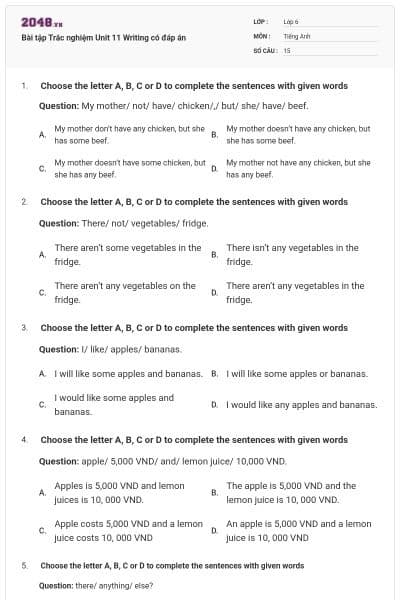
My mother don’t have any chicken, but she has some beef.
My mother doesn’t have any chicken, but she has some beef.
My mother doesn’t have some chicken, but she has any beef.
My mother not have any chicken, but she has any beef.
Đáp án: B
Giải thích: Some: dùng cho câu khẳng định
Any: dùng cho câu phủ định và nghi vấn
Dịch: Mẹ của mình không có gà, nhưng bà ấy có một ít thịt bò.
There aren’t some vegetables in the fridge.
There isn’t any vegetables in the fridge.
There aren’t any vegetables on the fridge.
There aren’t any vegetables in the fridge.
Đáp án: D
Giải thích: Any: dùng cho câu phủ định và nghi vấn
Dịch: Không có rau trong tủ lạnh.
I will like some apples and bananas.
I will like some apples or bananas.
I would like some apples and bananas.
I would like any apples and bananas.
Đáp án: C
Giải thích: would like+ N: Cần…
Dịch: Mình muốn một ít táo và chuối.
Apples is 5,000 VND and lemon juices is 10, 000 VND.
The apple is 5,000 VND and the lemon juice is 10, 000 VND.
Apple costs 5,000 VND and a lemon juice costs 10, 000 VND
An apple is 5,000 VND and a lemon juice is 10, 000 VND
Đáp án: D
Giải thích: An+ N bắt đầu bằng nguyên âm
A+ N bắt đầu bằng phụ âm
Dịch: Một quả táo hết 5,000 VND và một cốc nước chanh hết 10,000 VND.
Are there anything else?
Is there anything else?
Is there anything or else?
Is there anything has else?
Đáp án: B
Giải thích:
Cấu trúc câu hỏi với "there is/are":
Is there + danh từ số ít/không đếm được ...? (dùng "Is" vì "anything" là danh từ không đếm được).
"Else" có nghĩa là "khác, nữa", thường đi sau đại từ bất định như anything, something, someone, anyone...
→ Is there anything else? (Có gì khác nữa không?)
Chọn B.
Dịch: Có gì khác nữa không?
Your brother does like chicken or beef?
Does your brother like chicken or beef?
Does brother like your chicken or beef?
Chicken or beef does your brother like?
Đáp án: B
Giải thích: A or B: A hoặc B
Dịch: Anh trai của bạn thích gà hay bò?
Nam has breakfast with every bread and morning warm milk.
Nam has every morning breakfast with bread and warm milk.
Every morning Nm has bread and warm milk with breakfast.
Nam has breakfast with bread and warm milk every morning.
Đáp án: D
Giải thích: Have breakfast with sth: Ăn bữa sáng với
Dịch: Nam ăn bữa sáng với bánh mì và sữa nóng mỗi sáng.
She is plane by travelling at present.
She travelling by plane is at present.
She is travelling by plane at present.
She is travelling by present at plane.
Đáp án: C
Giải thích: Câu chia thời hiện tại tiếp diễn vì có dấu hiệu “at present”
Dịch: Cô ấy đang đi du lịch bằng máy bay.
Mai would order to like a glass of lemon juice
A glass of lemon juice Mai would like to order.
Mai like to would like a glass of lemon juice.
Mai would like to order a glass of lemon juice.
Đáp án: D
Giải thích: A glass of lemon juice: Một cốc nước chanh
Dịch: Mai muốn gọi một cốc nước chanh.

Học thông minh hơn mỗi ngày
Xem toàn bộ 15 câu hỏi và nhiều hơn nữa với tài khoản miễn phí
There are some strawberries and apples on the shelf.
Some apples and strawberries are there on the shelf.
There are strawberries and some shelf on the apples.
On the shelf there are some apples and strawberries.
Đáp án: A
Giải thích: There are+ N số nhiều đếm được
Dịch: Có một ít dâu tây và táo ở trên giá.
Could you please closing the window?
Do you mind if I close the window?
Would you mind closing the window?
Do you like closing the window?
Đáp án: B
Giải thích: Would you mind if I +V (quá khứ đơn) = Do you mind if I + V (hiện tại đơn)
Dịch: Bạn có phiền nếu tôi đóng cửa sổ không?
How much is this pencil cost?
Is this pencil expensive or cheap?
Do you want to buy this pencil?
What is the price of this pencil?
Đáp án: D
Giải thích: How much+ Trợ động từ + S+ cost? = What to be the price of sth?
Dịch: Cái bút chì kia bao nhiêu tiền vậy?
My father goes to work in car every morning.
My father travels to work by car every morning.
My father uses car to work every morning.
With car, my father goes to work every morning.
Đáp án: B
Giải thích: Drive to work= Travel to work by car
Dịch: Bố tôi lái ô tô đi làm vào mỗi sáng.
What about we play soccer tomorrow?
What about do we play soccer tomorrow?
I suggest we play soccer tomorrow.
How about playing soccer tomorrow?
Đáp án: D
Giải thích: Why don’t we+ V nguyên thể = How about+ V_ing: Rủ ai đó cùng làm
Dịch: Chúng mình chơi đá bóng vào ngày mai đi?
Because it’s cold so you can’t go out.
It is too cold so you can’t go out.
It is too cold for you to go out.
Because of it’s cold, you can’t go out.
Đáp án: C
Giải thích: Too+ adj+ for sb to do sth: Quá để ai làm gì
Dịch: Bạn không thể ra ngoài vì trời lạnh
Bạn có thích hoạt động này không?
Hãy lưu hoặc chia sẻ nội dung này đến mọi người.
Gợi ý cho bạn

Ý tưởng của bạn, bài học của bạn
Tự thiết kế đề thi, bài giảng hoặc flashcard theo cách riêng.