Bài tập Trắc nghiệm Unit 1 Writing có đáp án
15 câu hỏi
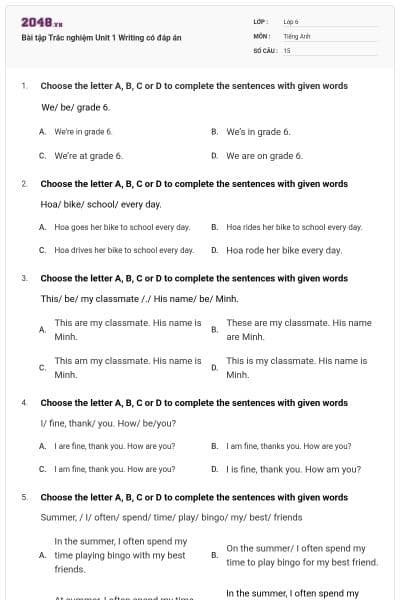
Choose the letter A, B, C or D to complete the sentences with given words
We/ be/ grade 6.
We’re in grade 6.
We’s in grade 6.
We’re at grade 6.
We are on grade 6.
Đáp án: A
Giải thích: Chủ ngữ “we” đi với to be là “are”, viết tắt “we’re”
“In +grade lớp”: Học lớp mấy
Dịch: Chúng mình học lớp 6
Choose the letter A, B, C or D to complete the sentences with given words
Hoa/ bike/ school/ every day.
Hoa goes her bike to school every day.
Hoa rides her bike to school every day.
Hoa drives her bike to school every day.
Hoa rode her bike every day.
Đáp án: B
Giải thích: Câu chia thì hiện tại đơn vì có dấu hiệu “every day”
“ride+bike”: Đi xe đạp
Dịch Hằng ngày Hoa đi xe đạp tới trường.
Choose the letter A, B, C or D to complete the sentences with given words
This/ be/ my classmate /./ His name/ be/ Minh.
This are my classmate. His name is Minh.
These are my classmate. His name are Minh.
This am my classmate. His name is Minh.
This is my classmate. His name is Minh.
Đáp án: D
Giải thích: “This is+ N số ít”, “These are+ N số nhiều”
Chủ ngữ “name” số ít nên to be chia “is”
Dịch Đây là bạn cùng lớp của mình. Cậu ấy tên Minh
Choose the letter A, B, C or D to complete the sentences with given words
I/ fine, thank/ you. How/ be/you?
I are fine, thank you. How are you?
I am fine, thanks you. How are you?
I am fine, thank you. How are you?
I is fine, thank you. How am you?
Đáp án: C
Giải thích: Chủ ngữ “I” nên to be chia “am”
“Thank you”: Cảm ơn
Cấu trúc hỏi sức khỏe “How are you?
Dịch Mình khỏe, cảm ơn cậu? Còn cậu có khỏe không?
Choose the letter A, B, C or D to complete the sentences with given words
Summer, / I/ often/ spend/ time/ play/ bingo/ my/ best/ friends
In the summer, I often spend my time playing bingo with my best friends.
On the summer/ I often spend my time to play bingo for my best friend.
At summer, I often spend my time play bingo with my best friend
In the summer, I often spend my time to play bingo with my best friends
Đáp án: A
Giải thích: “In+ the+ mùa”: Vào mùa nào
“spend+ time+ V_ing”: dành thời gian làm gì
Dịch Vào mùa hè, mình thường dành thời gian chơi bingo với các bạn thân của mình.
Rearrange the sentences to make meaningful sentences
name/ What/ ‘s/ her?
What her’s name?
What is her name?
Her name’s what?
What her name’s?
Đáp án: B
Giải thích: Cấu trúc hỏi tên “What is your name?”
Dịch Cậu tên gì vậy?
Rearrange the sentences to make meaningful sentences
Lan/ is/ this/is/ friend/./ her/ name/ my/./
This is my name. Her friend is Lan.
This is my name. Lan is her friend.
This is my friend. Her name is Lan.
Her name are my friend. This is Lan.
Đáp án: C
Giải thích: “This is” là cấu trúc để giới thiệu
Chủ ngữ “name” số ít nên to be chia là “is”
Dịch Đây là bạn của mình. Tên của bạn ấy là Lan.
Rearrange the sentences to make meaningful sentences
old/ are/ How/ you?
How old are you?
How are you old?
You are how old?
How old you are?
Đáp án: A
Giải thích: Cấu trúc hỏi về tuổi “How old are you?”
Dịch Cậu năm nay bao nhiêu tuổi?
Chủ ngữ “name” số ít nên to be chia là “is”
Dịch Đây là bạn của mình. Tên của bạn ấy là Lan.
Rearrange the sentences to make meaningful sentences
name/ is/ old/ is/ years/ Lan/ her/eleven.
She is Lan. Her name is eleven years old.
Her name is Lan. She is eleven years old.
Eleven years old is Lan. She is her
Lan is she name. Her is eleven years old
Đáp án: B
Giải thích:
Dịch
Rearrange the sentences to make meaningful sentences
evening/ my /,/ Mai/ is/ good/ name/./
My name Mai good is evening.
My good evening name is Mai.
Good evening, my name is Mai.
Good name is Mai. My evening
Đáp án: C
Giải thích: “Good evening”: Chào buổi chiều
Cấu trúc giới thiệu tên là “my name”
Dịch Chào buổi chiều, tên mình là Mai.
Rewrite sentences without changing the meaning
Hoa is six years old. Lan is seven years old.
Hoa is younger than Lan.
Hoa is older than Lan.
Lan is younger than Hoa.
Hoa is as young as Lan.
Đáp án: A
Giải thích: Hoa ít tuổi hơn Lan nên sử dụng adj “young”
Cấu trúc so sánh hơn với adj ngắn: Adj+ “er”
DịchHoa năm nay 6 tuổi còn Lan 7 tuổi.
Rewrite sentences without changing the meaning
I often go to school on foot every day.
I go by foot to school every day.
I often walk to school every day.
I often move to school by foot every day.
I use my foot to school every day.
Đáp án: B
Giải thích: “on foot” = “walk”
Dịch Tôi thường đi bộ tới trường.
Rewrite sentences without changing the meaning
Nam is a student. I am a student, too.
Nam and I am students.
Nam is a student. Am I, too.
Both Nam and I am students
Nam is a student and I am, too.
Đáp án: D
Giải thích: “Both A and B”: Động từ chia số nhiều
“Chủ ngữ + to be, too”: Cũng như vậy
Dịch: Nam là một học sinh. Tôi cũng là một học sinh.
Rewrite sentences without changing the meaning
I spend two hours per day doing the household chores with my mother.
It costs me two hours per day to do the household chores with my mother.
It takes me two hours per day to do the household chores with my mother.
It is two hours per day for me to do the household chores with my mother.
I take two hours per day doing the household chores with my mother.
Đáp án: B
Giải thích: “Sb spend time+ doing sth” ~ “It take sb time to do sth”
Dịch: Tôi dành 2 giờ mỗi ngày làm việc nhà cùng mẹ tôi.
“Chủ ngữ + to be, too”: Cũng như vậy
Dịch: Nam là một học sinh. Tôi cũng là một học sinh.
Rewrite sentences without changing the meaning
Let’s play volleyball tomorrow.
How about playing volleyball tomorrow?
Why don’t you play volleyball tomorrow?
What about to play volleyball tomorrow?
Do you like playing volleyball tomorrow?
Đáp án: B
Giải thích: “Let’s + V= How about +V_ing”: Rủ ai đó cùng làm
Dịch: Chúng mình cùng chơi bóng chuyền ngày mai đi.