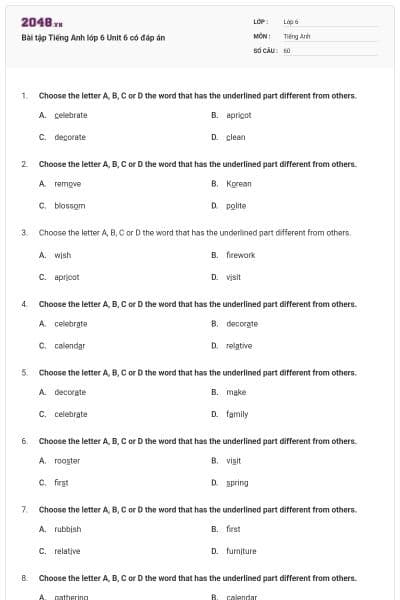
Bài tập Tiếng Anh lớp 6 Unit 6 có đáp án
60 câu hỏi
celebrate
apricot
decorate
clean
Đáp án A

remove
Korean
blossom
polite
Đáp án A

wish
firework
apricot
visit
Đáp án B

celebrate
decorate
calendar
relative
Đáp án C

decorate
make
celebrate
family
Đáp án D

rooster
visit
first
spring
Đáp án B

rubbish
first
relative
furniture
Đáp án B


Học thông minh hơn mỗi ngày
Xem toàn bộ 60 câu hỏi và nhiều hơn nữa với tài khoản miễn phí
gathering
calendar
apricot
hang
Đáp án C

prepare
special
decorate
messy
Đáp án A
Giải thích: Đáp án A phát âm là /ɪ/ các đáp án còn lại phát âm là /e/
flower
down
blossom
cow
Đáp án C

April
apricot
make
prepare
Đáp án D

peach
watch
chemistry
Dutch
Đáp án C

empty
receive
key
deceive
Đáp án A
Giải thích: Đáp án A phát âm là /e/ các đáp án còn lại phát âm là /i:/
rubbish
furniture
Dutch
lucky
Đáp án B

gathering
footer
celebrate
feather
Đáp án C

watch
decorate
hang
All are correct
Đáp án B
Giải thích: decorate: trang trí
Dịch: Mọi người thường trang trí nhà cửa vào dịp Tết.
first-footer
feather
rubbish
firework
Đáp án A
Giải thích: first-footer: người xông đất
Dịch: Người đầu tiên bước vào nhà trong dịp năm mới là người xông đất.
apricot
peach
daisy
rose
Đáp án B
Giải thích: peach blossoms: hoa đào
Dịch: Ở miền Bắc của Việt Nam, mọi người thường mua hoa đào vào dịp năm mới.
hang
hangs
will hang
hanged
Đáp án C
Giải thích: câu chia ở thời tương lai đơn “will + V” vì có mốc thời gian “tomorrow”.
Dịch: Chúng ta sẽ treo lịch lên tường vào ngày mai.
out
on
in
over
Đáp án A
Giải thích: empty out the rubbish: đổ rác
Tell sb to V: bảo ai làm gì
Dịch: Mẹ bảo tôi đổ rác.
do
make
have
get
Đáp án B
Giải thích: make a wish: cầu nguyện
Dịch: Vào đêm giao thừa, chúng tôi xem pháo hoa và cầu nguyện
calendar
furniture
pagoda
shopping
Đáp án C
Giải thích: go to the pagoda: đi chùa
Dịch: Gia đình tôi sẽ đi chùa và cầu nguyện cho năm mới.
must
can’t
shouldn’t
have to
Đáp án C
Giải thích: shouldn’t + V: không nên làm gì
Dịch: Chúng ta không nên ăn quá nhiều đồ ngọt.
won’t wear
don’t wear
should wear
may wear
Đáp án A
Giải thích: câu chia ở thời tương lai đơn vì có mốc thời gian “tomorrow”.
Dịch: Hanna sẽ không mặc quần ngắn và áo phông vào chùa ngày mai.
in
at
on
for
Đáp án C
Giải thích: in + tháng: vào tháng mấy.
Dịch: Tết của người Thái là vào tháng Tư.
celebrate
give
watch
visit
Đáp án D
Giải thích: visit: thăm
Dịch: Người Việt Nam thường thăm bạn bè và người thân vào dịp Tết.
cook
hang
plant
give
Đáp án A
Giải thích: cook special food: nấu các món đặc sản
Dịch: Mẹ bạn có thường nấu các món đặc sản vào dịp năm mới không?
cleaning
gathering
watching
talking
Đáp án B
Giải thích: family gathering: sum họp gia đình
Dịch: Chúng tôi sẽ có cuộc sum họp gia đình vào ngày tất niên.
mustn’t
can’t
needn’t
shouldn’t
Đáp án D
Giải thích: shouldn’t + V: không nên làm gì
Dịch: Tôi nghĩ chúng ta không nên làm vỡ đồ đạc vào ngày đầu năm mới.
making
doing
having
getting
Đáp án B
Giải thích: do the shopping: đi mua sắm
Dịch: Chị gái và tôi thích đi mua sắm ở chợ Tết.
True
False
Đáp án A
Giải thích: Dựa vào câu: “Tet or Lunar New Year is the most important holiday in Vietnam.”.
Dịch: Tết hay còn gọi là Tết âm lịch là kì nghỉ quan trọng nhất ở Việt Nam.
True
False
Đáp án B
Giải thích: Dựa vào câu: “It generally takes place around late January or early February.”.
Dịch: Nó thường diễn ra vào cuối tháng 1 hoặc đầu tháng 2 dương lịch.
True
False
Đáp án A
Giải thích: Dựa vào câu: “During Tet, Vietnamese spend time shopping for the New Year, go to pagodas and temples.”.
Dịch: Trong dịp tết, người Việt dành thời gian mua sắm cho năm mới, đi chùa và đền.
True
False
Đáp án A
Giải thích: Dựa vào câu: “The items of shopping range from food to clothing to household decorations.”.
Dịch: Những đồ cần mua trải dài từ đồ ăn, quần áo đến đồ trang trí nhà cửa.
True
False
Đáp án B
Giải thích: Dựa vào câu: “The Vietnamese believe that Tet Holiday is an occasion to enjoy life after a full hard-working year.”.
Dịch: Người Việt tin rằng tết là dịp để tận hưởng sau một năm dài làm việc vất vả.
clean
make
hang
watch
Đáp án A
Giải thích: clean the furniture: lau chùi đồ đạc
Dịch: Họ lau chùi đồ đạc và trồng ít hoa.
celebrated
to celebrate
celebrate
celebrating
Đáp án C
Giải thích: celebrate a party: tổ chức một bữa tiệc
Dịch: Bố mẹ của họ sẽ tổ chức một bữa tiệc lớn.
go
will go
goes
to go
Đáp án B
Giải thích: câu chia ở thời tương lai đơn vì có trạng từ “tomorrow”
Dịch: Ngày mai họ sẽ đi chợ mua sắm.
thrilling
fantastic
terrible
special
Đáp án D
Giải thích: special food: món đặc sản
Dịch: Mẹ của họ sẽ làm bánh chưng và nấu ít món đặc sản.
on
in
at
to
Đáp án A
Giải thích: on the first day: vào ngày đầu tiên
Dịch: Vào ngày đầu năm mới, họ sẽ đi chùa cầu nguyện cho năm mới.
a tradition
a first-footer
a morality
a success
Đáp án B
Giải thích: Dựa vào câu: “They believe that the first-footer of a family determines their luck for the next year.”.
Dịch: Họ tin rằng người xông đất xác định vận may của gia đình vào năm mới.
good-tempered
moral
successful
all are correct
Đáp án D
Giải thích: Dựa vào câu: “Usually, people will invite a good-tempered, moral and successful person to visit their houses.”.
Dịch: Thường thì người ta sẽ mời người có tính cách hoà nhã, đạo đức tốt và thành công đến xông nhà.
No, they won’t
Yes, he is
Yes, they will
No, he isn’t
Đáp án C
Giải thích: Dựa vào câu: “Children will dress in new clothes.”.
Dịch: Trẻ con sẽ mặc quần áo mới.
Because it’s long
Because people can get together
Because family members can celebrate birthday.
Because a long year is important.
Đáp án B
Giải thích: Dựa vào câu: “Family gathering is really important because it’s time family members get together after a long year.”.
Dịch: Sum họp gia đình là rất quan trọng vì đó là khoảng thời gian các thành viên gia đình tụ họp sau 1 năm dài đằng đẵng.
bamboo
furniture
flowers
food
Đáp án C
Giải thích: Dựa vào câu: “At Tet every house is usually decorated by flowers and colored lights.”.
Dịch: Vào dịp Tết, mỗi nhà thường được trang hoàng bằng hoa và đèn nháy nhiều màu.
People go back to hometown to celebrate new year with their families.
People go back to their hometown to celebrate the new year with their families.
People go back to their hometown celebrating the new year with their families.
People go back to their hometown celebrating new year with their families.
Đáp án B
Giải thích: celebrate: tổ chức
Dịch: Mọi người về quê và tổ chức năm mới với gia đình.
The new year festival is important to me because we have family gathering.
The new year festival important to me because we have family gathering.
The new year festival is important at me because we have family gathering.
The new year festival are important to me because we have family gathering.
Đáp án A
Giải thích: cấu trúc “be important to sb”: quan trọng đối với ai
Dịch: Năm mới rất quan trọng với tôi vì chúng tôi có buổi sum họp gia đình.
We also have many activities such like making “chung” cake and visiting pagodas.
We also have many activities such as making “chung” cake and visiting pagodas.
We also have some activities such like making “chung” cake and visiting pagodas.
We also have some activities such as making “chung” cake and visiting pagodas.
Đáp án D
Giải thích: cấu trúc “such as”: ví dụ như là
Dịch: Chúng tôi cũng có một ít hoạt động như làm bánh chưng, và thăm các ngôi chùa.
Tet is the time when we have more time spending with our families.
Tet is the time when we have more time to spend with our families.
Tet is a time when we have more time spending with our families.
Tet is a time when we have more time to spend with our families.
Đáp án B
Giải thích: have more time to V: có nhiều thời gian hơn để làm gì
Dịch: Tết là thời gian chúng ta có nhiều thời gian bên gia đình hơn.
There are lots of kinds of fruits on the fruits tray.
There are a lots of kinds of fruits on the fruits tray.
There is lots of kinds of fruits on the fruits tray.
There is a lots of kinds of fruits on the fruits tray.
Đáp án A
Giải thích: Cấu trúc “there are + Ns”: có…
lots of + Ns: nhiều cái gì
Dịch: Có nhiều loại hoa quả trong khay ngũ quả.
To prepare for Tet, people often spend time cleaning their house.
To prepare for Tet, people often spend time their house cleaning.
To spend for Tet, people often prepare time their house cleaning.
To spend for Tet, people often prepare time cleaning their house.
Đáp án B
Giải thích: cấu trúc “prepare for st”: chuẩn bị cho cái gì
“spend + thời gian + Ving”; dành thời gian làm gì
Dịch: Để chuẩn bị cho tết, mọi người thường dành thời gian lau dọn nhà cửa
They decorate will their house with many flowers tomorrow.
They will decorate their house with many flowers tomorrow.
They decorate will house with many their flowers tomorrow.
They will house decorate with their many flowers tomorrow.
Đáp án B
Giải thích: câu chia ở thời tương lai đơn vì có mốc thời gian tomorrow.
Dịch: Họ sẽ trang hoàng nhà cửa bằng nhiều loại hoa vào ngày mai
We don’t to go have to school at Tet.
We don’t go to have to school at Tet.
We don’t have to go to school at Tet.
We don’t have to school go to at Tet.
Đáp án C
Giải thích: cấu trúc “have to V”: phải làm gì
Dịch: Chúng tôi không phải đi học vào dịp tết.
We shouldn’t they’re not good because eat too many sweets.
We shouldn’t eat because too many sweets they’re not good.
We shouldn’t eat too many sweets because they’re not good.
We eat shouldn’t too many sweets because they’re not good.
Đáp án C
Giải thích: shouldn’t + V: không nên làm gì
Dịch: Chúng ta không nên ăn quá nhiều đồ ngọt vì nó không tốt.
My mother will make Chung cake next week.
My mother will Chung cake make next week.
Chung cake will make my mother next week.
Chung cake will my mother make next week.
Đáp án A
Giải thích: câu chia ở thời tương lai đơn vì có mốc thời gian “next week”
Dịch: Mẹ tôi sẽ gói bánh chưng tuần tới.
They go to the pagoda to pray for the new year.
They go to the pagoda for pray for the new year.
They go to the pagoda at pray for the new year.
They go to the pagoda and pray for the new year.
Đáp án A
Giải thích: in order to V = to V: để làm gì
Dịch: Họ đi chùa để cầu nguyện cho năm mới
My sister in Chicago will send a letter to me.
I will send a letter to my sister in Chicago.
A letter will receive me in Chicago
Chicago will send my sister a letter to me.
Đáp án A
Giải thích: cấu trúc “receive st from sb” (nhận cái gì từ ai) = “send st to sb” (gửi cho ai cái gì)
Dịch: Chị tôi bên Chicago sẽ gửi cho tôi 1 lá thư.
The special food is too cheap for me to buy.
The special food is too expensive for me to buy.
The special food is so cheap for me to buy.
The special food is so expensive for me to buy.
Đáp án B
Giải thích: chuyển đổi giữa 2 cấu trúc: “not enough + N + to V” (không đủ cái gì để làm gì) ⇔ “too + adj + to V” (quá như thế nào nên không thể làm gì)
Dịch: Chúng tôi không có đủ tiền mua món đặc sản đó.
It’s boring to watch the lion dance.
To watch the lion dance is boring.
Exciting is to watch the lion dance.
Watching the lion dance is exciting.
Đáp án D
Giải thích: cấu trúc: “it’s + adj + to V”: thật là như thế nào khi làm gì
Dịch: Thật thú vị khi xem múa lân.
During time of Tet, the streets are crowded but people go shopping.
During time of Tet, people go shopping, so the streets are crowded.
During time of Tet, the streets are not crowded because people go shopping.
During time of Tet, people go shopping and the streets are not crowded.
Đáp án B
Giải thích: mệnh đề trạng ngữ chỉ nguyên nhân-kết quả
Dịch: Trong dịp tết, đường xá đông đúc vì mọi người đi mua sắm.
Bạn có thích hoạt động này không?
Hãy lưu hoặc chia sẻ nội dung này đến mọi người.
Gợi ý cho bạn

Ý tưởng của bạn, bài học của bạn
Tự thiết kế đề thi, bài giảng hoặc flashcard theo cách riêng.