Bài tập Đọc hiểu có đáp án Phần 4
50 câu hỏi
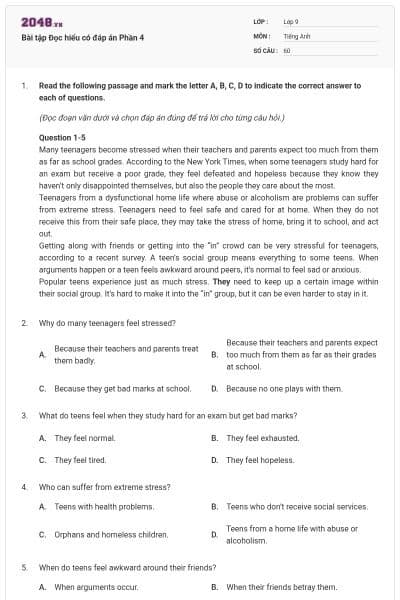
Read the following passage and mark the letter A, B, C, D to indicate the correct answer to each of questions.
(Đọc đoạn văn dưới và chọn đáp án đúng để trả lời cho từng câu hỏi.)
Question 1-5
Many teenagers become stressed when their teachers and parents expect too much from them as far as school grades. According to the New York Times, when some teenagers study hard for an exam but receive a poor grade, they feel defeated and hopeless because they know they haven’t only disappointed themselves, but also the people they care about the most.
Teenagers from a dysfunctional home life where abuse or alcoholism are problems can suffer from extreme stress. Teenagers need to feel safe and cared for at home. When they do not receive this from their safe place, they may take the stress of home, bring it to school, and act out.
Getting along with friends or getting into the “in” crowd can be very stressful for teenagers, according to a recent survey. A teen’s social group means everything to some teens. When arguments happen or a teen feels awkward around peers, it’s normal to feel sad or anxious.
Popular teens experience just as much stress. They need to keep up a certain image within their social group. It’s hard to make it into the “in” group, but it can be even harder to stay in it.
Why do many teenagers feel stressed?
Because their teachers and parents treat them badly.
Because their teachers and parents expect too much from them as far as their grades at school.
Because they get bad marks at school.
Because no one plays with them.
Đáp án đúng là: B
What do teens feel when they study hard for an exam but get bad marks?
They feel normal.
They feel exhausted.
They feel tired.
They feel hopeless.
Đáp án đúng là: D
Who can suffer from extreme stress?
Teens with health problems.
Teens who don’t receive social services.
Orphans and homeless children.
Teens from a home life with abuse or alcoholism.
Đáp án đúng là: D
When do teens feel awkward around their friends?
When arguments occur.
When their friends betray them.
When their friends move to another city.
When their friends are too bad.
Đáp án đúng là: A
Friends
Parents
Teachers
Teens
Đáp án đúng là: D
Question 6-10
Pollution is an environmental concern for people throughout the world. One university study suggests that pollutants in the water, air, and soil cause up to 40% of the premature deaths in the world’s population. The majority of these deaths occur in developing countries.
Water in many developing countries is contaminated with toxic chemicals, also known as toxins. The World Health Organization (WHO) estimates that 1.1 billion people have little or no access to clean water. In many of these regions the water that is used for drinking, cooking, and washing is the same water that is used for dumping sewage and hazardous waste. Most developing countries cannot afford water treatment facilities. Approximately 80% of infectious diseases in the world are caused by contaminated water.
Air pollution is a growing problem throughout the world. Indoor air pollution is one of the leading causes of lung cancer. Families in developing countries use open stoves for cooking and heating their homes. These homes do not have proper ventilation. The smoke, which is full of chemicals and carcinogens, gets trapped inside where families eat and sleep. Outdoor pollution also causes disease and illness, especially in industrial cities such as Beijing, China, where cancer is the leading cause of death. China relies heavily on coal, which is considered the dirtiest source of energy. According to the European Union, only 1% of urban dwellers in China breathe clean air on an average day.
Soil pollution is also a major concern, both in industrial and developing countries. Pollutants such as metals and pesticides seep into the earth’s soil and contaminate the food supply. Soil pollution causes major health risks to entire ecosystems. This type of pollution reduces the amount of land suitable for agricultural production and contributes to global food shortages.
As more people move to urban centres, premature deaths caused by pollution are expected to increase worldwide. Today, the developed nations who achieved their wealth at the expense of the environment will be held accountable for protecting the earth’s resources for future generations.
The passage mainly discusses
main types of pollution, causes and effects.
premature deaths in developing countries.
study results on pollution.
an environmental concern for people.
Đáp án đúng là: A
Carcinogens
Metals
Pesticides
Polluted water
Đáp án đúng là: D
What is the leading cause of death in Beijing, China?
Heart diseases
Respiratory diseases
Pulmonary diseases
Cancer
Đáp án đúng là: D
The word “pollutants” in paragraph 4 could best be replaced by “_________”.
substances
contaminants
chemicals
agents
Đáp án đúng là: B
Who is responsible for protecting the earth’s resources for future generations?
The developing nations faced with acute environmental problems.
The developed nations with modern technology.
The developing nations investing into the environment.
The developed nations achieving their wealth at the expense of the environment.
Đáp án đúng là: D
Question 11-15
Earthquakes in Japan
Your body needs fuel in the form of food every day, but the wrong kind of fuel can lead to health problems. A balanced diet consists of fruits, vegetables, low-fat or fat-free dairy, whole grains, protein, and fats, but it limits cholesterol, saturated fats, trans fats, and sodium. When poor eating habits spiral out of control, it could cause serious health problems down the road.
Healthy eating habits affect both mental and physical wellness. What you eat affects your immune system, bone health, and athletic performance, among other functions. It plays a role in your mental health, too - healthy eating supports cognition, problem-solving, memory, alertness, sleep, and information processing, according to the Linus Pauling Institute, which also notes that good nutrition is important for proper brain development and maintenance of normal cognitive function.
When combined with regular physical activity, a balanced diet can help prevent such conditions as cardiovascular disease, type-2 diabetes, and obesity. Columbia University reports that the three leading causes of death in the United States - coronary heart disease, some types of cancer, and stroke - are directly linked with dietary behavior. To help prevent such conditions as cardiovascular disease, you need to keep your blood cholesterol, blood pressure and weight under control. All of this can be done through healthy eating and exercise.
Simple changes in your daily eating behaviors such as eating more slowly and avoiding large serving sizes can result in healthier eating over time. Eating slowly, for example, can reduce overeating, heartburn, indigestion, and feeling bloated. The University of Arkansas notes that it takes 15 to 20 minutes for the stomach to send signals to the brain, letting you know you are full, other ways to support healthy eating habits include recording your eating habits throughout the day and shopping with nutrition in mind by reading food labels and focusing on fresh vs. processed foods.
A balanced diet consists of _______
fruits, vegetables, cholesterol, whole grains, protein, and fats.
fruits, vegetables, saturated fats, whole grains, protein, and fats.
fruits, vegetables, low-fat or fat-free dairy, whole grains, protein, and fats.
fruits, vegetables, low-fat or fat-free dairy, whole grains, and sodium.
Đáp án đúng là: C
According to the Linus Pauling Institute, which of the following can NOT be supported by healthy eating?
Cognition
Memory
Mood
Problem solving
Đáp án đúng là: C
What are the three leading causes of death in the United States directly associated with dietary behavior?
Coronary heart disease, some types of cancer, and stroke
Pulmonary diseases, some types of cancer, and stroke
Heart diseases, some types of cancer, and dysfunction
Respiratory diseases, some types of cancer, and stroke
Đáp án đúng là: A
The word ' cardiovascular” in paragraph 3 refers to _________.
relating to the heart
relating to the pulmonary
relating to the skin
relating to the digestive system
Đáp án đúng là: A
Which of the following could be the best title for the passage?
How to prepare a healthy meal
General situation of eating habits in the world
Serious diseases by poor eating habits
Healthy eating - Healthy life
Đáp án đúng là: D
Question 16-20
Culture shock is a common phenomenon and, though it may take months to develop, it often affects travelers and people living far from home in unexpected ways. Culture shock generally moves through four different phases: honeymoon, frustration, adjustment, and acceptance.
The first stage of culture shock is often overwhelmingly positive during which travelers become infatuated with the language, people, and food in their new surroundings. At the honeymoon stage, the trip or move seems like the greatest decision ever made, an exciting adventure to stay on forever.
Frustration may be the most difficult stage of culture shock and is probably familiar to anyone who has lived abroad or who travels frequently. At this stage, the fatigue of not understanding gestures, signs, and the language sets in and miscommunications may be happening frequently.
Frustrations are often subdued as travelers begin to feel more familiar and comfortable with the cultures, people, food and languages of new environments. Navigation becomes easier, friends, and communities of support are established and details of local languages may become more recognizable during the adjustment stage.
Generally - though sometimes weeks, months or years after wrestling with the emotional stages outlined above - the final stage of culture shock is acceptance. Acceptance doesn’t mean that new cultures or environments are completely understood, rather it signifies realization that complete understanding isn’t necessary to function and thrive in the new surroundings.
Though it can be one of the hardest parts of traveling, culture shock is just as integral to the experience as food, people, and scenery. By recognizing it for what it is and finding ways to cope, you can prevent culture shock from ruining an otherwise fantastic experience abroad.
Cultural shock is divided into 4 stages including...................................
honeymoon, frustration, sympathy, and acceptance
acquaintance, frustration, adjustment, and sympathy
honeymoon, frustration, adjustment, and acceptance
frustration, adjustment, pride, and acceptance
Đáp án đúng là: C
In which stage can travelers feel like on cloud nine?
Sympathy
Adjustment
Acceptance
Honeymoon
Đáp án đúng là: D
What is regarded as the most difficult stage of culture shock?
Communication
Acquaintance
Acceptance
Frustration
Đáp án đúng là: D
Which of the following statements is NOT true?
Miscommunications may happen in the honeymoon phrase.
When travelers begin to feel more familiar and comfortable with new environments, they are in the adjustment phase.
Acceptance doesn’t mean that new cultures or environments are completely understood.
Culture shock plays an integral part in the experience as food, people, and scenery.
Đáp án đúng là: A
What does the passage mainly discuss?
Causes and effects of culture shock
Types of culture shock
Overcoming culture shock
Definition of culture shock and its stages
Đáp án đúng là: D
Question 21-25
In 2016, the capital’s authorities made great efforts to remove congestion horn 20 out of 44 sites across the city; however, currently, the number of such sites has increased to 41. In streets towards the centre, arterial roads and areas around bus stops, traffic congestion always occurs during peak hours.
According to the experts, there are many reasons for traffic jams, including inconsistent transport infrastructure. In addition, the progress of the construction of urban railway lines is very slow, creating difficulties for traffic. It can be seen that the number of personal vehicles in Hanoi has increased rapidly. There are now more than 5.045 million motorcycles, an average increase of 7.66% over the 2010-2015 period; over 546,000 cars of all kinds, up 12.9%; over 1 million bicycles; and over 10,000 electric bikes in Hanoi. Meanwhile, the development pace of transport infrastructure in the city only reached an average of 3.9% per year. The imbalanced development of personal transport vehicles and transport infrastructure has led to increasingly serious traffic jams.
Furthermore, more urban areas and high-rise buildings have been constructed, with a very high population density, putting pressure on transport infrastructure.
The problem of urban transport requires drastic, urgent, and synchronous measures from the Government, ministry, agencies, and the city. It is highly essential to strictly comply with and implement urban planning as well as to set out plans to limit the ownership of personal vehicles. The Government should have a special mechanism for Hanoi to accelerate the investment and implementation of urgent transport projects as well as to authorise the city to select investors for important and urgent public-private partnership (PPP) infrastructure projects.
It can be inferred from paragraph 1 that __________.
the government has taken effective measures to reduce traffic jam
despite the government’s efforts, traffic congestion is not improving but worsening
traffic jam is an alarming problem in big cities
there are more and more transportations, which results in traffic jam
Đáp án đúng là: B
According to the passage, what can lead to traffic jams?
Faulty traffic lights
Obstacles in the road
Inconsistent transport infrastructure
More industrial zones
Đáp án đúng là: C
What has caused increasingly serious traffic jams?
Slow construction of urban railway lines
More urban areas and high-rise buildings
Very high population density
Imbalanced development of private vehicles and transport infrastructure
Đáp án đúng là: D
What can be done to reduce traffic congestion?
Putting pressure on transport infrastructure
Setting out plans to limit the ownership of personal vehicles
Decreasing the investment of urgent transport projects
Moving the industrial factories to the countryside
Đáp án đúng là: B
The word “authorise” in paragraph 5 could be replaced by..................................
approve
empower
support
provide
Đáp án đúng là: B
Question 26-30
Cultural diversity means a range of different societies or people of different origins, religions, and traditions all living and interacting together. Britain has benefited from diversity throughout its long history and is currently one of the most culturally diverse countries in the world.
The food they eat, the music they listen to, and the clothes they wear have all been influenced by different cultures coming into Britain. Ethnic food, for example, is part of an average British diet. One of Britain’s favourite dishes is Indian curry. Britons have enjoyed curry for a surprisingly long time - the first curry went on an English menu in 1773.
Even the English language developed from the languages spoken by Anglo-Saxons, Scandinavian Vikings, and Norman-French invaders. New words were added from the languages of other immigrants over the years.
Valuing the diverse culture is all about understanding and respecting the beliefs of others and their way of life, as we would expect someone to respect ours. It is about supporting individuals in keeping their cultural traditions alive and appreciating the fact that all these different traditions will enrich British life both today and in the future.
Cultural diversity in Britain goes as far back as recorded history. Only when we consider our history do we get a true picture of how diverse Britain today really is. Each group of settlers brought with them different foods, fashions, languages, beliefs, and lifestyles. People from all over the world have contributed to Britain and they continue to do so.
Which of the following is NOT true about Britain?
Britain has benefited from diversity throughout its long history.
Britain is a blending of different rich cultures of countries.
Britain is now one of the most culturally diverse countries in the world.
Britain is regarded as one of the richest countries in the world.
Đáp án đúng là: D
When did the first curry go on an English menu?
In 1773
In 1737
In 1337
ln 1373
Đáp án đúng là: A
The English language developed from the languages spoken by __________.
Jutes, Norman-French, and Scandinavian Vikings
Scandinavian Vikings, Anglo-Saxons, and Jutes
Angles, Saxons, Jutes, and Norman-French
Anglo-Saxons, Scandinavian Vikings, and Norman-French
Đáp án đúng là: D
Which of the following is NOT true, according to the passage?
Valuing the diverse culture means understanding and respecting the beliefs of others and their way of life.
Valuing the diverse culture is about supporting individuals in keeping their cultural traditions alive.
Valuing the diverse culture means appreciating the fact that all these different traditions will enrich British life.
Valuing the diverse culture means keeping traditional cultures only, not borrowing from other cultures.
Đáp án đúng là: D
The word “settlers” in paragraph 5 could be replaced by
ancestors
citizens
immigrants
invaders
Đáp án đúng là: C
Question 31-35
The Beatles were one of the most influential music groups of the rock era, and many consider them the best musical group on Earth. Initially, they affected the post-war baby boom generation of Britain and the U.S. during the 1960s, and later the rest of the world. Certainly, they were the most successful group, with global sales exceeding 1.1 billion records.
While they were originally famous for light-weight pop music (and the extreme hysterical reaction they received from young women), their later works achieved a combination of popular and critical acclaim perhaps unequaled in the 20th century.
Eventually, they became more than recording artists, branching out into film and - particularly in the case of John Lennon - political activism. They achieved an iconic status beyond mere celebrity, with far reaching effects difficult to exaggerate.
The members of the group were John Lennon, (James) Paul McCartney, George Harrison, and Ringo Starr (Richard Starkey), all from Liverpool, Merseyside, England. Original drummer Pete Best was asked to leave the group just before it started recording. Stuart Sutcliffe was with them in Hamburg but also left.
Beatlemania began in the UK and exploded following the appearance of the Beatles on The Ed Sullivan Show in the United States, on February 9th, 1964. The pop-music band became a worldwide phenomenon with worshipful fans, hysterical adulation, and denunciations by culture commentators and others such as Frank Sinatra.
Some of this was confusion over the sources of their music (a similar confusion was evinced in 1956 over Elvis Presley by commentators who were unaware of the tradition of blues, R&B and gospel out of which Presley emerged), and some of it was simply an incredulous reaction
What was the first generation influenced by the Beatles?
The post-war baby boom generation of Britain and Australian
The pre-war baby boom generation of Britain and the U.S
The post-war baby boom generation of Britain and the U.S
The pre-war baby boom generation of Australian and the U.S
Đáp án đúng là: C
What kind of music did the Beatles originally famous for?
Blues
Gospel
R&B
Light-weight pop
Đáp án đúng là: D
Which of the following is NOT true, according to the passage?
Initially, the Beatles received the extreme hysterical reaction from young women.
The Beatles achieved global sales exceeding 1.1 billion records.
The Beatles achieved an iconic status beyond mere celebrity due to their voice and up-to-date records.
Drummer Pete Best used to be a member of the Beatles.
Đáp án đúng là: C
When did the pop-music band become a worldwide phenomenon?
When they became more than recording artists, branching out into film and political activism.
They achieved an iconic status beyond mere celebrity.
After The Ed Sullivan Show in the United States, on February 9th, 1964.
After Stuart Sutcliffe left the band.
Đáp án đúng là: C
What can be the best title of the passage?
The Beatles Changed American Music
The Beatles - An International Phenomenon
Cultural Impacts Of The Beatles
Guinness World Records by The Beatles
Đáp án đúng là: B
Question 36-40
All of our energy comes from the Sun, which is our nearest star. The Sun sends out huge amounts of energy through its rays every day. We call this energy solar energy or radiant energy. Without the Sun, life on Earth would not exist, since our planet would be totally frozen. We use this solar energy in many different ways. The sunlight lets US see and warms US. Plants use the light from the Sun to grow. They store it as chemical energy. This process is called photosynthesis. The energy is stored in their roots, fruits, and leaves. This energy feeds every living thing on the earth. When humans and animals eat plants and the food made from plants, we store the energy in our bodies, in our muscles and in our brain cells.
Just as humans store energy in their bodies, the Earth stores the Sun’s energy too. The Sun’s energy is stored in coal, natural gas, water and wind. Coal, oil, and natural gas are known as fossil fuels. Fossil fuels were formed over millions of years ago when the remains and fossils of prehistoric plants and animals sank to the bottom of swamps and oceans. These animal and plant remains were slowly covered and crushed by layers of rock, mud, sand, and water. The pressure of all those layers caused the plants and animals to break down and change into coal, oil, and natural gas. We use the energy in these fossil fuels to make electricity. We use electricity in many different ways. We light and heat our homes, schools, and businesses using electricity, and to run computers, refrigerators, washing machines, and air conditioners. Our cars and planes run on gasoline, which comes from oil. As of the year 2013, most of the energy we use comes from fossil fuels.
However, fossil fuels are known as non-renewable sources of energy. They cannot be used over and over again. This means that one day they will run out!
Where does all of our energy come from?
Renewable sources
Non-renewable sources
Fossil fuels
The Sun
Đáp án đúng là: D
What would happen if the sun disappeared, according to the passage?
Energy sources will run out.
Our planet was bathed in darkness.
Most plants would die in a few weeks.
Our planet would be totally frozen.
Đáp án đúng là: D
Which of the following is NOT true according to the passage?
Photosynthesis is the process in which plants use the light from the sun to grow and store it as chemical energy.
The energy we store in our bodies comes from the sun.
The earth stores the sun’s energy in coal, natural gas, water, and wind.
Fossil fuels were formed over thousands of years ago.
Đáp án đúng là: D
Based on the evidence in the passage, how can the sun be best described?
Crucial for life on earth
An important mythological object
A developing black hole
The biggest star in the universe
Đáp án đúng là: A
What is this passage mostly about?
How long it takes for light from the sun to reach the earth
The importance of energy to human life and where energy comes from
Different types of non-renewable sources of energy
How fossil fuels were formed
Đáp án đúng là: B
Question 41-45
The solar system is the Sun and the objects that travel around it. The Earth is part of the solar system because it also travels around the Sun. The Sun is a star similar to the other stars in the sky but it is much closer to the Earth. The Sun is mostly a big ball of gases composed mainly of hydrogen and helium.
There are seven other planets that travel around the Sun, too. These planets, in order, include Mercury, Venus, Mars, Jupiter, Saturn, Uranus, and Neptune. Earth is located between Venus and Mars. The path the planets use when traveling around the Sun is oval-shaped and is called its orbit. Each of the planets in the solar system take a different amount of time to orbit or travel around the Sun.
The planet Earth takes 365 days or one year to orbit the Sun. The other planets take more or less time to orbit the Sun. It takes Mercury less than two months or 88 days to travel around the Sun. It is the shortest time compared to the other planets. The planet taking the longest time to go around the Sun is Neptune. It takes Neptune almost 165 years to travel around the Sun.
Other objects in space include the moons of six planets. A moon is a celestial object (object in space) that orbits another body in space. There are approximately 173 moons throughout the solar system. Earth has a single moon, Mercury and Venus have none, and the planet with the most moons is Jupiter with 63. Not far behind Jupiter is Saturn with 62 moons.
The asteroid belt is another object in the solar system. The asteroid belt is approximately located between the orbits of the planets Mars and Jupiter. The asteroid belt contains irregularly shaped bodies called asteroids which are believed to be leftovers from the beginning of the solar system 4.6 billion years ago. The objects are rocky and irregular in shape, and some may be hundreds of miles across, but most of the asteroids are very small.
The Sun and the objects that travel around it is called ________________.
the planets
the solar system
the moons
the asteroid belt
Đáp án đúng là: B
Which planet takes the shortest time to orbit the Sun?
Mercury
Neptune
Venus
Jupiter
Đáp án đúng là: A
Which planet has no moon?
Venus and Mars
Saturn and Neptune
Mercury and Saturn
Mercury and Venus
Đáp án đúng là: D
Which of the following is the definition of an asteroid?
Irregularly shaped bodies which are believed to be leftovers from the beginning of the solar system
Celestial objects that orbits another body in space
Similar to stars in the sky but they are much closer to the Earth
The name of the rings encircling several planets of the solar system
Đáp án đúng là: A
The word “objects” in paragraph 5 refers to ___________.
orbits
planets
asteroids
belts
Đáp án đúng là: C
Question 46-50
Abraham Lincoln was born on February 12, 1809, in Hodgenville, Kentucky, USA. His parents were Thomas Lincoln, a farmer, and Nancy Hanks. His family was very poor. Abraham had one brother and one sister. His brother died in childhood. They grew up in a small log cabin house, with just one room inside.
Although slavery was legal in Kentucky at that time, Lincoln’s father, who was a religious Baptist, refused to own any slaves, when Lincoln was seven years old, his family moved to Indiana, and later to Illinois. In his childhood, he helped his father on the farm, but when he was 22 years old, he left home and moved to New Salem, Illinois, where he worked in a general store. Later, he said that he had gone to school for just one year, but that was enough to learn how to read, write, and do simple math.
In 1842, he married Mary Todd Lincoln. They had four children, but three of them died when they were very young. Abraham Lincoln was sometimes called Abe Lincoln or “Honest Abe” after he ran miles to give a customer the right amount of change. The nickname “Honest Abe” came from a time when he started a business that failed. Instead of running away like many people would have, he stayed and worked to pay off his debt.
He has also been called the “Great Emancipator” because of his work to end slavery in the United States. In 1863, he declared that all slaves held in the rebellious Confederate States were free. He also sponsored the Thirteenth Amendment to the United States Constitution. Ratified in 1865, nine months after his assassination, that amendment completely outlawed slavery in the United States.
How many people are there in Lincoln’s family?
Three
Four
Five
Six
Đáp án đúng là: C
Which of the following is TRUE, according to the passage?
Lincoln grew up in a small log cabin house, with two rooms inside.
At that time, slavery was illegal in Kentucky.
When Lincoln was seven years old, his family moved to Illinois, and later to Indiana.
Lincoln studied at school for just one year.
Đáp án đúng là: D
What happened to Lincoln’s children?
They moved to New Salem, Illinois with Lincoln.
They dropped out of high school.
Three of them died when they were very young.
They joined the army.
Đáp án đúng là: C
What did Lincoln do after he failed in his business?
He started a new one.
He moved to a new city.
He stayed and worked to pay off his debt.
He asked his friends for help.
Đáp án đúng là: C
Why has Lincoln been called the “Great Emancipator”?
Because he started a business that failed.
Because he worked to end slavery in the United States.
Because he sponsored the Thirteenth Amendment to the United States Constitution.
Because he declared that he would save the slaves.
Đáp án đúng là: B