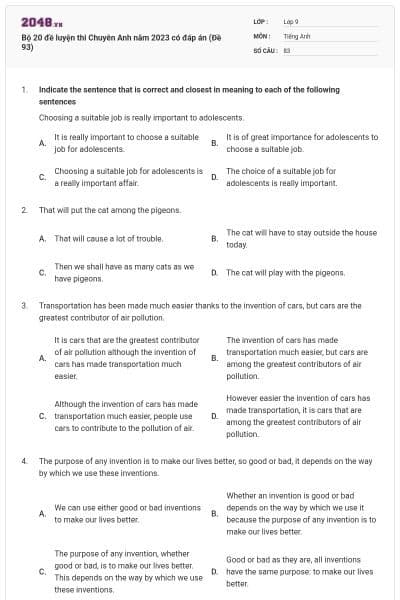
Bộ 20 đề luyện thi Chuyên Anh năm 2023 có đáp án (Đề 93)
80 câu hỏi
Indicate the sentence that is correct and closest in meaning to each of the following sentences
Choosing a suitable job is really important to adolescents.
It is really important to choose a suitable job for adolescents.
It is of great importance for adolescents to choose a suitable job.
Choosing a suitable job for adolescents is a really important affair.
The choice of a suitable job for adolescents is really important.
That will cause a lot of trouble.
The cat will have to stay outside the house today.
Then we shall have as many cats as we have pigeons.
The cat will play with the pigeons.
It is cars that are the greatest contributor of air pollution although the invention of cars has made transportation much easier.
The invention of cars has made transportation much easier, but cars are among the greatest contributors of air pollution.
Although the invention of cars has made transportation much easier, people use cars to contribute to the pollution of air.
However easier the invention of cars has made transportation, it is cars that are among the greatest contributors of air pollution.
We can use either good or bad inventions to make our lives better.
Whether an invention is good or bad depends on the way by which we use it because the purpose of any invention is to make our lives better.
The purpose of any invention, whether good or bad, is to make our lives better. This depends on the way by which we use these inventions.
Good or bad as they are, all inventions have the same purpose: to make our lives better.
Đáp án: B
Dịch: Mục đích của bất kỳ phát minh nào là làm cho cuộc sống của chúng ta tốt hơn, tốt hay xấu, điều đó phụ thuộc vào cách chúng ta sử dụng những phát minh này.
A. Chúng ta có thể sử dụng những phát minh tốt hoặc xấu để làm cho cuộc sống của chúng ta tốt đẹp hơn. => sai nghĩa
B. Một phát minh tốt hay xấu phụ thuộc vào cách chúng ta sử dụng nó vì mục đích của bất kỳ phát minh nào là làm cho cuộc sống của chúng ta tốt đẹp hơn. => đúng nghĩa
C. Mục đích của bất kỳ phát minh nào, dù tốt hay xấu, đều là làm cho cuộc sống của chúng ta tốt đẹp hơn. Điều này phụ thuộc vào cách chúng ta sử dụng những phát minh này. => sai nghĩa
D. Dù tốt hay xấu, tất cả các phát minh đều có chung mục đích là làm cho cuộc sống của chúng ta tốt đẹp hơn. => sai nghĩa
Vietnam is acknowledged to have completely controlled SARS from a very early stage of the epidemic.
Vietnam is acknowledged to have controlled SARS from a very early stage of the epidemic.
Vietnam was acknowledged to have had a complete control over SARS from a very early stage of the epidemic.
Vietnam is acknowledged to have a complete control over SARS from a very early stage of the epidemic.
Read the following passage and choose the word or phrase that best fits each of the numbered blanks
ENGLISH SPELLING
Why does English spelling have a reputation for being difficult? English was first written down when Christian monks came to England in Anglo-Saxon (6) _________. They used the 23 letters of Latin to write down the sounds of Anglo-Saxon (7) _________ as they heard it. However, English has a (8) __________ range of basic sounds (over 40) than Latin. The alphabet was too small, and so combinations of letters were needed to (9) ________ the different sounds. Inevitably, there were inconsistencies in the way that letters were combined. With the Norman invasion of England, the English language was put at risk. English survived, but the spelling of many English words changed to follow French (10) __________, and many French words were introduced into the language. The result was more irregularity. When the printing press was (11) __________ in the fifteenth century, many early printers of English texts spoke other first languages. They made little effort to respect English spelling. Although one of the short-term (12) __________ of printing was to produce a number of variant spellings, in the long term it created fixed spellings. People became used to seeing words spelt in the same way. Rules were (13) __________, and dictionaries were put together which printers and writers could refer to. However, spoken English was not fixed and continued to change slowly- just as it still does now. Letters that were sounded in the Anglo-Saxon period, like the ‘k’ in ‘knife’, now became (14) ______. Also, the pronunciation of vowels then had little in common with how they sound now, but the way they are spelt hasn’t changed. No (15) ______, then, that it is often difficult to see the link between sound and spelling.
English was first written down when Christian monks came to England in Anglo-Saxon (6) _________.
centuries
times
ages
years
chat
communication
speech
discussion
longer
deeper
thicker
wider
tell
express
explain
perform
types
guides
plans
patterns
discovered
made up
taken in
invented
conclusions
actions
meanings
effects
filled in
drawn up
handed out
got across
silent
dumb
quiet
speechless
problem
mention
wonder
idea
Appearance of the steamboats and the railroads have reduced transportation cost and had effects in conditions of workers.
The appearance of the steamboats and railroads have reduced transportation cost and had effects on conditions of workers.
The appearance of steamboats and railroads had reduced transportation cost and had effects on conditions of workers.
The appearance of steamboats and railroads reduced transportation cost and had effects on the conditions of workers.
He liked nothing better than to sit to read science books in his father’s library.
He liked nothing better than to sit and read science books in his father’s library.
He liked nothing better than to sit and read science books in father’s library.
He liked nothing better than sitting and read science books in his father’s library.
New machinery have been put in this year with a view to increase output.
New machinery has put in this year with a view to increasing output.
New machinery has been put in this year with a view to increase output.
New machinery has been put in this year with a view to increasing output.
James Watt whose invention of the steam engine is famous throughout the world was Scottish scientist.
James Watt, whose invention of the steam engine is famous throughout the world, was a Scottish scientist.
James Watt whose invention of the steam engine is famous round the world was a Scottish scientist.
James Watt, whose invention of the steam engine is famous all the world, is a Scottish scientist.
Scientists have proved that there is a close link between smoking and lung diseases, such as cough and tuberculosis and the worst of all is fatal cancer.
Scientists have proved that there has been a close link of smoking with lung diseases, such as cough and tuberculosis and the worst of all, fatal cancer.
Scientists proved that there has been a close link from smoking to lung diseases, such as from cough to tuberculosis and worst of all, fatal cancer.
Scientists have been proving that there is a close link between smoking and lung diseases, such as cough and tuberculosis and worst of all is fatal cancer.
Indicate the word or phrase closest in meaning to the underlined word(s) in each of the following questions
Although the staff did expand somewhat, for the first century of its existence, the entire teaching staff consisted of the president and three or four tutors.
back and forth
to and fro
more or less
side by side
speaking indirectly
making a mistake
doing things in the wrong order
saying embarrassing things
resolve
medicate
understand
renew
Indicate the correct answer to each of the following questions.
In 1864, twelve nations signed the first Geneva Convention, _ down rules for the treatment and protection of the wounded.
lying
lied
laying
laid
step
practice
fitness
breath
went
interrupted
intervened
broke
hadn’t
wouldn’t have
didn’t have
hadn’t had
doing
playing
going
taking
for me use
at my use
for my use
at my disposal
on
across
off
around
Well, actually I’d rather you didn’t
That’s a good idea
You’re welcome
Oh, I didn’t realize it
only if
even if
provided that
if
would be built
be built
is to be built
will be built
fingers
legs
arms
hands
overlook
influential
furniture
oceanic
on/for/to
ø/ about/ for
for/ on/ for
ø/ for/ to
I can get a paper for you
I’m not sure
I’m with you there
I will, first thing in the morning
As the train being late
The train was late
The train being late
To be late
does the town lie
lies the town
which the town lies
the town lies
rhino
trade
protect
receipt
ignoring
ignorance
ignorant
ignorantly
cooperation
supervise
reinforce
committee
The quicker – the better you can get marks
The more quickly – the better marks you can get
More quickly – better marks you can get
The quickest – the best marks you can get
up with
clear
up
out
purchase
ignorant
tuition
vigorous
faults
mistakes
errors
fouls
I’m sorry. Sometimes I’m too aggressive
You’re right. I’m a bit jealous
You are absolutely right.I’m crazy about candy
I’m sorry. I should not be so selfish
CANCER
CARE
LASER
AIDS
it has
has
which has
and
diphthong
southern
breathing
smooth
pay
express
have
indicate
takeoffs
kickoffs
standoffs
warm-ups
reserves
reverses
conserves
reservoirs
Indicate the word(s) opposite in meaning to the underlined word(s) in each of the following questions from 54 to 55.
Some vegetables are grown without soil and artificial light.
real
natural
true
genuine
alike
likely
similar
dislike
Đáp án: A
Giải thích:
Kiến thức: Từ vựng – Từ trái nghĩa
unlike (adj): khác nhau
Xét các đáp án:
A. alike (adj): giống nhau
B. likely (adj): có khả năng xảy ra
C. similar (adj): tương tự
D. dislike (v): không thích
→ unlike >< alike
Dịch: "Mutualism" là một dạng cộng sinh xảy ra khi hai sinh vật khác nhau sống cùng nhau trong một trạng thái có lợi cho cả hai bên.
Read the following passage and indicate the answer to each of the questions
DESERTIFICATION
Desertification is the degradation of once-productive land into unproductive or poorly productive land. Since the first great urban-agricultural centers in Mesopotamia nearly 6,000 years ago, human activity has had a destructive impact on soil quality, leading to gradual desertification in virtually every area of the world. It is a common misconception that desertification is caused by droughts. Although drought does make land more vulnerable, well-managed land can survive droughts and recover, even in arid regions. Another mistaken belief is that the process occurs only along the edges of deserts. In fact, it may take place in any arid or semiarid region, especially where poor land management is practised. Most vulnerable, however, are the transitional zones between deserts and arable land; wherever human activity leads to land abuse in these fragile marginal areas, soil destruction is inevitable. [1] Agriculture and overgrazing are the two major sources of desertification. [2] Large-scale farming requires extensive irrigation, which ultimately destroys lands by depleting its nutrients and leaching minerals into the topsoil. [3] Grazing is especially destructive to land because , in addition to depleting cover vegetation, herds of grazing mammals also trample the fine organic particles of the topsoil, leading to soil compaction and erosion. [4] It takes about 500 years for the earth to build up 3 centimeters of topsoil. However, cattle ranching and agriculture can deplete as much as 2 to 3 centimeters of topsoil every 25 years- 60 to 80 times faster than it can be replaced by nature. Salination is a type of land degradation that involves an increase in the salt content of the soil. This usually occurs as a result of improper irrigation practices. The greatest Mesopotamian empires- Sumer, Akkad and Babylon- were built on the surplus of the enormously productive soil of the ancient Tigris-Euphrates alluvial plain. After nearly a thousand years of intensive cultivation, land quality was in evident decline. In response, around 2800 BC the Sumerians began digging the huge Tigris-Euphrates canal system to irrigate the exhausted soil. A temporary gain in crop yield was achieved in this way, but over-irrigation was to have serious and unforeseen consequences. From as early as 2400 BC we find Sumerian documents referring to salinization as a soil problem. It is believed that the fall of the Akkadian Empire around 2150 BC may have been due to a catastrophic failure in land productivity; the soil was literally turned into salt. Even today, four thousand years later, vast tracks of salinized land between the Tigris and Euphrates rivers still resemble rock-hard fields of snow. Soil erosion is another form of desertification. It is a self-reinforcing process; once the cycle of degradation begins, conditions are set for continual deterioration. As the vegetative cover begins to disappear, soil becomes more vulnerable to raindrop impact. Water runs off instead of soaking in to provide moisture for plans. This further diminishes plan cover by leaching away nutrients from the soil. As soil quality declines and runoff is increased, floods become more frequent and more severe. Flooding washes away topsoil, the thin, rich, uppermost layer of the earth’s soil, and leaves finer underlying particles more vulnerable to wind erosion. Topsoil contains the earth’s greatest concentration of organic matter and microorganisms, and is where most of the earth’s land-based biological activity occurs. Without this fragile coat of nutrient-laden material, plan life cannot exist. An extreme case of its erosion is found in the Sahel, a transitional zone between the Sahara Desert and the tropical African rain forests; home to some 56 million people. Overpopulation and overgrazing have opened the hyperarid land to wind erosion, which is stripping away the protective margin of the Sahel, and causing the desert to grow at an alarming rate. Between 1950 and 1975, the Sahara Desert spread 100 kilometers southward through the Sahel.
Which of the following statements is true about desertification?
It has a history as long as that of civilization.
It was just as serious in the past as it is today.
It is a fairly recent problem.
Ancient societies managed the problem well.
cultivatable
dry
settled
populated
they do not think of it as a serious problem
they see it as being reversible
they do not see it as being caused by human activity
they think of it as a very slow process
Most of the vulnerable areas are in transition from desert to arable land; a process that because of human activity and the delicate nature of these areas, always leads to soil loss.
Human activity in the transition areas is vulnerable because of the fragile nature of these areas that are neither desert nor arable land because they have suffered damage to the soil
Soil loss in the transitional zones is especially severe where human activity is damaging the environment through agriculture which is causing the loss of soil.
It is the areas that exist between the deserts and the land that is usable for agriculture that are most at risk because they are susceptible to poor land management methods from human activity which will always result in the loss of soil.
fragmentation
depletion
disruption
compression
The repetitive planting of the same crops
Irrigation
The stripping away of native vegetation
Over fertilization
rejuvenation
deterioration
contribution
consumption
Show the progress of desertification down through history
Propose a method for dealing with the desertification problem.
Describe one process that leads to desertification
Describe the main cause of desertification in one particular area
washing
depositing
concentrating
dispersing
Look at numbers [1], [2], [3], [4] in paragraph 3 of the passage. Where would the following sentence best fit?
Each furthers the process dramatically, but they act in quite different ways
[1]
[2]
[4]
[3]
Read the following passage and indicate the answer to each of the questions
Though Edmund Halley was most famous because of his achievements as an astronomer, he was a scientist of diverse interests and great skill. In addition to studying the skies, Halley was also deeply interested in exploring the unknown depths of the oceans. One of his lesser-known accomplishments that were quite remarkable was his design for a diving bell that facilitated exploration of the watery depths. The diving bell that Halley designed had a major advantage over the diving bells that were in use prior to his. Earlier diving bells could only make use of the air contained within the bell itself, so divers had to surface when the air inside the bell ran low. Halley’s bell was an improvement in that its design allowed for an additional supply of fresh air that enabled a crew of divers to remain underwater for several hours. The diving contraption that Halley designed was in the shape of a bell that measured three feet across the top and five feet across the bottom and could hold several divers comfortably; it was open at the bottom so that divers could swim in and out at will. The bell was built of wood, which was first heavily tarred to make it water repellent and was then covered with a half-ton sheet of lead to make the bell heavy enough to sink in water. The bell shape held air inside for the divers to breathe as the bell sank to the bottom. The air inside the bell was not the only source of air for the divers to breathe, and it was this improvement that made Halley’s bell superior to its predecessors. In addition to the air already in the bell, air was also supplied to the divers from a lead barrel that was lowered to the ocean floor close to the bell itself. Air flowed through a leather pipe from the lead barrel on the ocean floor to the bell. The diver could breathe the air from a position inside the bell, or he could move around outside the bell wearing a diving suit that consisted of a lead bell-shaped helmet with a glass viewing window and a leather body suit, with a leather pipe carrying fresh air from the diving bell to the helmet.
The subject of the preceding passage was most likely Halley’s
childhood
work as an astronomer
invention of the diving bell
many different interests
was bigger
provided more air
weighed less
could rise more quickly
sank to the bottom
was almost exhausted
had been replenished
move slowly
Just a few seconds
Only a few minutes
For days on end
For hours at a time
was completely enclosed
was wider at the top than at the bottom
could hold more than one diver
was made of tarred wood
in the future
upside down
as they wanted
with great speed
float
get wet
trap the divers
suffocate the divers
Lines 8-10
Lines 11-13
Lines 17-18
line 20
The first paragraph
The second paragraph
The third paragraph
The fourth paragraph
astronomy
physiology
oceanography
recreation
Show the underlined part that needs correction in each of the following questions
(A) One another (B) surprising method of forest (C) conservation is (D) controlled cutting of trees.
Đáp án: A
Đáp án: D
Đáp án: B
Đáp án: D