(2024) Đề minh họa tham khảo BGD môn Tiếng Anh có đáp án (Đề 27)
50 câu hỏi
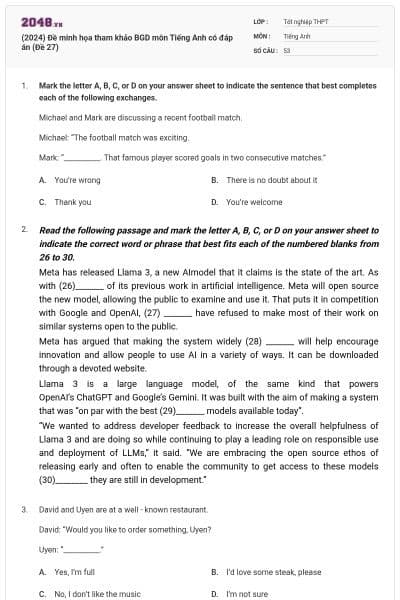
Mark the letter A, B, C, or D on your answer sheet to indicate the sentence that best completes each of the following exchanges.
Michael and Mark are discussing a recent football match.
Michael: “The football match was exciting.
Mark: “__________. That famous player scored goals in two consecutive matches.”
You’re wrong
There is no doubt about it
Thank you
You’re welcome
Tạm dịch: Michael và Mark đang thảo luận về một trận đấu bóng đá gần đây.
Michael: “Trận đấu bóng đá thực sự hấp dẫn.”
Mark: __________. Cầu thủ nổi tiếng đó đã ghi bàn trong hai trận liên tiếp.”
A. Bạn sai rồi B. Không có nghi ngờ gì
C. Cảm ơn bạn D. Không có gì
Giải thích: B
Câu hỏi đưa ra ý kiến
David and Uyen are at a well - known restaurant.
David: “Would you like to order something, Uyen?
Uyen: “__________.”
Yes, I’m full
I’d love some steak, please
No, I don’t like the music
I’m not sure
Tạm dịch:
David và Uyen đang ở một nhà hàng nổi tiếng.
David: “Uyen, bạn có muốn đặt món gì không?”
Uyen:” ____________.”
A. Vâng, tôi no rồi B. Tôi muốn một ít steak, làm ơn
C. Không, tôi không thích nhạc D. Tôi chưa chắc
Giải thích: B
Cấu trúc Would you like + Vo….? Bạn có muốn….?
Ans: I’d like/I’d love….
Mark the letter A, B, C, or D on your answer sheet to indicate the correct answer to each of the following questions.
My teacher, Phuong is ________ lecturer at my univeristy.
the more outstanding
the most outstanding
more and more outstanding
more outstanding
Tạm dịch:
Giáo viên của tôi, Phương là giảng viên xuất sắc nhất tại trường đại học của tôi.
Giải thích: B
So sánh nhất với tính từ dài
Thanks to many enormous ________ advances, many schools are equipped with computers.
technology
technological
technologically
technologist
Tạm dịch:
Nhờ vào nhiều tiến bộ của công nghệ, nhiều trường học được trang bị máy tính.
Giải thích: B
Từ loại (technological (adj) + advances (noun)
Den Vau’s song “Nau an cho em”, ________ on May 13, has made a significant impact on social media music.
is released
releasing
released
to release
Tạm dịch:
Bài hát “Nấu ăn cho em” của Đen Vâu, được phát hành vào ngày 13 tháng 5, đã tạo ra một sự ảnh hưởng lớn trên âm nhạc mạng xã hội.
Giải thích: C
Rút gọn mệnh đề quan hệ dạng bị động/ Câu đầy đủ: Den Vau’s song “Nau an cho em”, which was released on May 13, has made a significant impact on social media music.
According to recent research, a significant number of young people nowadays have a habit of waking up late and skipping ________ breakfast.
an
the
Ø (no article)
a
Tạm dịch:
Theo nghiên cứu gần đây, một số lượng đáng kể thanh niên hiện nay có thói quen thức dậy muộn và bỏ bữa sáng.
Giải thích: C
Mạo từ / bữa ăn (breakfast, lunch, dinner không dùng mạo từ).
The new policies are expected to ________ significant changes in the company's operations.
get in
give away
bring about
take on
Tạm dịch:
Các chính sách mới được kỳ vọng sẽ mang lại những thay đổi đáng kể trong hoạt động của công ty.
A. đến B. cung cấp C. mang lại D. đảm nhận
Giải thích: C
Cụm động từ
Two suspects ________ by the police from their investigation.
are eliminated
have been eliminated
was eliminating
was eliminated
Tạm dịch:
Hai nghi phạm đã bị loại trừ bởi cảnh sát trong cuộc điều tra của họ.
Giải thích: B
bị động (thì HTHT – have/has been + V3/Ved) - Việc sử dụng “đã bị loại trừ” (have been eliminated) trong bị động hiện tại hoàn thành cho thấy hành động loại trừ nghi phạm đã xảy ra trong quá khứ và có sự liên quan đến hiện tại.
to inform
informing
inform
to informing
Tạm dịch:
Chúng tôi rất tiếc để thông báo với bạn rằng chúng tôi không thể chấp thuận đề nghị của bạn.
Giải thích: A
To Vo/Gerund (regret + to-Vo: hối tiếc để làm gì, regret + V-ing: hối hận đã làm gì)
There’s no event taking place at the stadium tonight, _______?
is there
isn’t there
is it
isn’t it
Tạm dịch:
Không có sự kiện nào diễn ra tại sân vận động tối nay, phải không?
Giải thích: A
Câu hỏi đuôi, there’s no-> is there?
Over the past four months in particular HCMC residents have ______ an intense period of scorching heat.
dampened
endured
obscured
amplified
Tạm dịch:
Trong những tháng gần đây, người dân TP.HCM đã chịu đựng một thời gian nhiệt đới nóng gay gắt.
A. làm ẩm B. chịu đựng C. che khuất D. làm tăng cường
Giải thích: B
Từ vựng
It’s ten years since I ________ from Oxford university.
have graduated
was graduating
graduated
has graduated
Tạm dịch: Đã mười năm kể từ khi tôi tốt nghiệp trường đại học Oxford.
Giải thích: C
Sự phối hợp thì (HTHT + since + QKĐ)
I decided to _______ on behalf of my friend to help resolve the conflict between them and their colleague.
interrupt
interfere
intercede
intervene
Tạm dịch:
Thay mặt bạn tôi, tôi quyết định can thiệp để giúp giải quyết xung đột giữa họ và đồng nghiệp của họ.
A. cắt ngang B. can thiệp/gây cản trở
C. can ngăn D. can thiệp/can dự giải quyết vấn đề
Giải thích: D
Từ vựng
I am willing to lend you money_________.
once you had returned it by next month
by the time you returned it by next month
on the condition that you return it by next month
when you will return it by next month
Tạm dịch:
Tôi sẵn lòng cho bạn vay tiền với điều kiện là bạn trả lại trước tháng sau.
Giải thích: C
Liên từ on the condition that: với điều kiện là+ HTĐ, TLĐ)
After conducting experiments for a period of six months, he _______ a significant breakthrough in his research.
made
set
followed
gave
Tạm dịch:
Sau khi tiến hành các thí nghiệm trong một khoảng thời gian sáu tháng, anh ấy đã đạt được một bước đột phá đáng kể trong nghiên cứu của mình.
A. đã đạt được B. đã thiết lập C. đã theo D. đã cho
Giải thích: A
Collocation make a significant breakthrough: đạt được một bước đột phá đáng kể
Party members were less than enthusiastic ________ the candidates on offer.
of
with
on
about
Tạm dịch:
Các thành viên đảng không mấy hứng thú với các ứng viên được đề xuất.
Giải thích:D
Giới từ: enthusiastic about: hứng thú/nhiệt tình với.
The council and local residents are ________ over the plans for a new car park.
at cross purposes
At the drop of a hat
at loggerheads
At the eleventh hour
Tạm dịch: Hội đồng và cư dân địa phương đang đối đầu với kế hoạch xây dựng một bãi đỗ xe mới.
A. đối lập ý kiến B. Sẵn sàng ngay C. đối đầu D. vào phút chót.
Giải thích: C
Idiom – thành ngữ:
Mark the letter A, B, C, or D on your answer sheet to indicate the word whose underlined part differs from the other three in pronunciation in each of the following questions.
hamster
honey
honor
homage
Giải thích: C
Hamster, honey, homage âm “h” phát âm là / h/
Honor âm “h” phát âm là âm câm
Mark the letter A, B, C, or D on your answer sheet to indicate the word whose underlined part differs from the other three in pronunciation in each of the following questions.
issue
picture
image
idea
Giải thích: D
Issue, picture, image âm “i” là /ɪ/
idea âm “i” là /aɪ/
Mark the letter A, B, C, or D on your answer sheet to indicate the word that differs from the other three in the position of primary stress in each of the following questions.
assistant
tourism
advantage
dependence
Giải thích: B
Assistant, advantage, dependence trọng âm chính là âm 2
Toursim trọng âm chính là âm 1
Mark the letter A, B, C, or D on your answer sheet to indicate the word that differs from the other three in the position of primary stress in each of the following questions.
normal
patient
solid
polite
Giải thích: D
Normal, patient, solid trọng âm chính là âm 1
Polite trọng âm chính là âm 2
Mark the letter A, B, C, or D on your answer sheet to indicate the word (s) CLOSEST in meaning to the underlined word (s) in each of the following questions.
During the harsh winter, many animals perished due to the extreme cold and lack of food.
succumbed
survived
departed
declined
Tạm dịch: Trong mùa đông khắc nghiệt, nhiều động vật đã chết do lạnh quá đỗi và thiếu thức ăn.
A. không đủ sức chống cự B. sống sót C. rời đi D. suy giảm
Giải thích:A
từ đồng nghĩa: perished = succumbed
Mark the letter A, B, C, or D on your answer sheet to indicate the word (s) CLOSEST in meaning to the underlined word (s) in each of the following questions.
After 4 years of being crowned, Do Thi Ha has been praised for her increasingly elevated beauty ranking.
subdued
enhanced
diminished
depressed
Tạm dịch: Sau 4 năm đăng quang, Đỗ Thị Hà đã được khen ngợi vì vị trí đẹp ngày càng tăng lên.
A. điềm tĩnh B. nâng cao/tôn vinh C. giảm bớt D. chán nản
Giải thích: B
từ đồng nghĩa: elevated = enhanced
Mark the letter A, B, C, or D on your answer sheet to indicate the word (s) OPPOSITE in meaning to the underlined word (s) in each of the following questions.
After weeks of procrastination, the president finally resigned.
diligence
scandal
laziness
Delay
Tạm dịch: Sau nhiều tuần trì hoãn, tổng thống cuối cùng đã từ chức.
A. cần cù B. vụ bê bối C. lười biếng D. trì hoãn
Giải thích:A
từ trái nghĩa: procrastination: trì hoãn >< diligence: siêng năng, chăm chỉ, cần cù
Mark the letter A, B, C, or D on your answer sheet to indicate the word (s) OPPOSITE in meaning to the underlined word (s) in each of the following questions.
We mustn’t drag our heels over implementing the new legislation.
start well
run slowly
act promptly
None is correct
Tạm dịch: Chúng ta không được chần chừ trong việc thực thi luật mới.
A. bắt đầu tốt B. chạy chậm
C. hành động ngay lập tức D. Không có câu trả lời đúng
Giải thích:C
từ trái nghĩa: drag our heels: chần chừ>< act promptly: hành động ngay lập tức
Read the following passage and mark the letter A, B, C, or D on your answer sheet to indicate the correct word or phrase that best fits each of the numbered blanks from 26 to 30.
Meta has released Llama 3, a new AImodel that it claims is the state of the art. As with (26)_______ of its previous work in artificial intelligence. Meta will open source the new model, allowing the public to examine and use it. That puts it in competition with Google and OpenAI, (27) _______ have refused to make most of their work on similar systems open to the public.
Meta has argued that making the system widely (28) _______ will help encourage innovation and allow people to use AI in a variety of ways. It can be downloaded through a devoted website.
Llama 3 is a large language model, of the same kind that powers OpenAI’s ChatGPT and Google’s Gemini. It was built with the aim of making a system that was “on par with the best (29)_______ models available today”.
“We wanted to address developer feedback to increase the overall helpfulness of Llama 3 and are doing so while continuing to play a leading role on responsible use and deployment of LLMs,” it said. “We are embracing the open source ethos of releasing early and often to enable the community to get access to these models (30)________ they are still in development.”
As with (26)_______ of its previous work in artificial intelligence.
many
little
much
few
Giải thích: C
lượng từ, much + N không đếm được
Tạm dịch:
Meta đã phát hành Llama 3, một mô hình trí tuệ nhân tạo mới mà họ khẳng định là tối tân. Tương tự như nhiều phần trong công việc trước đây về trí tuệ nhân tạo.
That puts it in competition with Google and OpenAI, (27) _______ have refused to make most of their work on similar systems open to the public.
which
when
that
who
Giải thích: A
đại từ quan hệ, which + S + V/ +V (chỉ vật)
Tạm dịch:
Meta sẽ công khai mã nguồn mô hình mới này, cho phép công chúng xem xét và sử dụng nó. Điều đó đặt Meta vào cuộc cạnh tranh với Google và OpenAI, những công ty đã từ chối công khai hầu hết công việc của họ về các hệ thống tương tự đối với công chúng.
Meta has argued that making the system widely (28) _______ will help encourage innovation and allow people to use AI in a variety of ways.
available
various
modern
popular
Giải thích: A
từ vựng
Tạm dịch: A. có sẵn B. đa dạng C. hiện đại D. phổ biến
Meta đã lập luận rằng việc làm cho hệ thống có sẵn rộng rãi sẽ giúp thúc đẩy sự đổi mới và cho phép mọi người sử dụng trí tuệ nhân tạo theo nhiều cách khác nhau.
It was built with the aim of making a system that was “on par with the best (29)_______ models available today”.
private
proprietary
secretful
personal
Giải thích:B
từ vựng
Tạm dịch: A. riêng tư B. độc quyền/sở hữu riêng C. bí mật D. cá nhân
Llama 3 là một mô hình ngôn ngữ lớn, cùng loại với ChatGPT của OpenAI và Gemini của Google. Nó được xây dựng với mục tiêu tạo ra một hệ thống "tương đương với những mô hình độc quyền tốt nhất hiện có".
“We are embracing the open source ethos of releasing early and often to enable the community to get access to these models (30)________ they are still in development.”
until
when
if
while
Giải thích:D
liên từ
Tạm dịch: A. mãi cho đến khi B. khi
C. nếu D. trong khi
“Chúng tôi đang hưởng ứng triết lý mã nguồn mở bằng cách phát hành sớm và thường xuyên để cho phép cộng đồng tiếp cận với những mô hình này trong quá trình phát triển”
Read the following passage and mark the letter A, B, C, or D on your answer sheet to indicate the correct answer to each of the questions from 31 to 35.
Urbanisation is the process by which urban areas grow bigger as more and more people leave the
countryside to live in towns and cities.
Before the 1950s, urbanisation mainly occurred in more economically developed countries (MEDCs). Rapid urbanisation happened during the period of industrialisation in Europe and North America in the nineteenth and early twentieth centuries. A lot of people left their home villages for urban areas hoping to find jobs in the rapidly expanding industries in big towns and cities. Since 1950s urbanisation has become slower in most MEDCs. Now, some of the biggest cities are losing population because people go back to live in rural areas. This is known as counter-urbanisation.
Since 1950, urbanisation has grown rapidly in LEDCs (Less Economically Developed Countries) in Asia, Africa and South America. Between 1950 and 1990, while the urban population in LEDCs doubled, the increase was less than half in developed countries.
There are various causes of urbanisation in LEDCs. Here are some major ones. First, people migrate to urban areas on a massive scale due to lack of resources in rural areas. Second, small farmers find it harder to make a living not just because of bad weather conditions such as drought, floods, or storms, but because they can’t compete with large agricultural companies. These are considered ‘push’ factors.
People living in rural areas are also ‘pulled’ to cities, which are known to be places of financial centres,
services, wealth and opportunities. Believing that the standard of living in urban areas will be higher than
in rural areas, many people come to the city seeking their fortune. Today, about half of the world’s population lives in urban areas. Urbanisation has provided job opportunities, higher incomes and better access to
health facilities and education.
The urban population will continue to grow and it is expected that its proportion will increase to 70% by 2050.
What is the best title of the passage?
The period of industrialisation in Europe and North America
Causes and development of urbanisation
Urbanisation has provided job opportunities, higher incomes
People’s immigration leads to urbanisation
Tạm dịch: Tiêu đề tốt nhất cho đoạn văn là gì?
A. Thời kỳ công nghiệp hóa ở châu Âu và Bắc Mỹ
B. Những nguyên nhân và quá trình phát triển của đô thị hóa
C. Đô thị hóa đã cung cấp cơ hội việc làm, thu nhập cao hơn
D. Di dân của con người dẫn đến đô thị hóa.
Urbanisation is the process by which urban areas grow bigger as more and more people leave the Before the 1950s, urbanisation mainly occurred in more economically developed countries (MEDCs). Rapid urbanisation happened during the period of industrialisation in Europe and North America in the nineteenth and early twentieth centuries. A lot of people left their home villages for urban areas hoping to find jobs in the rapidly expanding industries in big towns and cities. Since 1950s urbanisation has become slower in most MEDCs. Now, some of the biggest cities are losing population because people go back to live in rural areas. This is known as counter-urbanisation. Since 1950, urbanisation has grown rapidly in LEDCs (Less Economically Developed Countries) in Asia, Africa and South America. Between 1950 and 1990, while the urban population in LEDCs doubled, the increase was less than half in developed countries. There are various causes of urbanisation in LEDCs. Here are some major ones. First, people migrate to urban areas on a massive scale due to lack of resources in rural areas. Second, small farmers find it harder to make a living not just because of bad weather conditions such as drought, floods, or storms, but because they can’t compete with large agricultural companies. These are considered ‘push’ factors. People living in rural areas are also ‘pulled’ to cities, which are known to be places of financial centres, services, wealth and opportunities. Believing that the standard of living in urban areas will be higher than in rural areas, many people come to the city seeking their fortune. Today, about half of the world’s population lives in urban areas. Urbanisation has provided job opportunities, higher incomes and better access to health facilities and education. The urban population will continue to grow and it is expected that its proportion will increase to 70% by 2050. | Đô thị hóa là quá trình mà các khu vực đô thị ngày càng lớn khi ngày càng có nhiều người rời bỏ nông thôn để sống ở các thị trấn và thành phố. Trước những năm 1950, đô thị hóa chủ yếu xảy ra ở các nước phát triển kinh tế cao (MEDCs). Đô thị hóa nhanh chóng diễn ra trong giai đoạn công nghiệp hóa ở châu Âu và Bắc Mỹ vào thế kỷ 19 và đầu thế kỷ 20. Rất nhiều người đã từ bỏ ngôi làng quê nhà của mình để đến các khu vực đô thị trong hy vọng tìm kiếm công việc trong các ngành công nghiệp đang mở rộng nhanh chóng ở các thành phố lớn. Từ năm 1950 trở đi, đô thị hóa đã trở nên chậm lại ở hầu hết các MEDCs. Hiện nay, một số thành phố lớn đang mất dân số vì người dân trở lại sống ở các khu vực nông thôn. Điều này được gọi là đô thị hóa ngược. Từ năm 1950, đô thị hóa đã phát triển nhanh chóng ở các LEDCs (các nước đang phát triển kinh tế kém) ở châu Á, châu Phi và Nam Mỹ. Trong khoảng thời gian từ năm 1950 đến 1990, trong khi dân số đô thị ở các LEDCs tăng gấp đôi, tăng trưởng này chỉ tăng một nửa ở các nước phát triển. Có nhiều nguyên nhân gây ra đô thị hóa ở các LEDCs. Dưới đây là một số nguyên nhân chính. Thứ nhất, người dân di cư vào các khu vực đô thị với quy mô lớn do thiếu tài nguyên ở các khu vực nông thôn. Thứ hai, những người nông dân nhỏ gặp khó khăn trong việc kiếm sống không chỉ do điều kiện thời tiết xấu như hạn hán, lũ lụt hoặc bão, mà còn vì họ không thể cạnh tranh với các công ty nông nghiệp lớn. Đây được coi là các yếu tố ‘thúc đẩy’. Người sống ở các khu vực nông thôn cũng bị "hút" đến thành phố, nơi được biết đến là nơi có các trung tâm tài chính, dịch vụ, giàu có và cơ hội. Tin rằng mức sống ở các khu vực đô thị sẽ cao hơn so với khu vực nông thôn, nhiều người đến thành phố để tìm vận may của mình. Hiện nay, khoảng một nửa dân số thế giới sống ở các khu vực đô thị. Đô thị hóa đã cung cấp cơ hội việc làm, thu nhập cao hơn và cơ hội tiếp cận tốt hơn đến các cơ sở y tế và giáo dục. Dân số đô thị sẽ tiếp tục tăng và dự kiến tỷ lệ này sẽ tăng lên 70% vào năm 2050. |
Giải thích: B
Đáp án A, C, D đều là dẫn chứng/ví dụ cho bài đọc. Đáp án B đề cập bao quát toàn nội dung (Nguyên nhân hình thành và sự phát triển của đô thị hoá).
The word their in paragraph 2 refers to _______.
people
local people
urban people
rural people
Tạm dịch: Từ "their" trong đoạn 2 đề cập đến.
A. con người B. người dân địa phương
C. người dân thành thị D. người dân nông thôn
Giải thích:A
A lot of people left their home villages for urban areas hoping to find jobs in the rapidly expanding industries in big towns and cities. (Rất nhiều người đã từ bỏ ngôi làng quê nhà của mình để đến các khu vực đô thị trong hy vọng tìm kiếm công việc trong các ngành công nghiệp đang mở rộng nhanh chóng ở các thành phố lớn.)
Which of the following is NOT mentioned in urbanisation?
Europe and North America industrialized in 19th century and early 20th century.
Asia, Africa and South America has grown quickly urbanisation since 1950.
About 50 percent the world’s population lives in urban areas.
People migrate to urban areas on a massive scale due to government’s policies.
Tạm dịch: Thông tin nào sau đây KHÔNG được đề cập trong đoạn văn về đô thị hóa?
A. Châu Âu và Bắc Mỹ đã công nghiệp hóa vào thế kỷ 19 và đầu thế kỷ 20.
B. Châu Á, châu Phi và Nam Mỹ đã trải qua đô thị hóa nhanh chóng kể từ năm 1950.
C. Khoảng 50% dân số thế giới sống ở khu vực đô thị.
D. Người dân di cư sang khu vực đô thị với quy mô lớn do chính sách của chính phủ.
Giải thích: D
Đáp án A: đoạn 2: Rapid urbanisation happened during the period of industrialisation in Europe and North America in the nineteenth and early twentieth centuries.
Đáp án B: đoạn 3: Since 1950, urbanisation has grown rapidly in LEDCs (Less Economically Developed Countries) in Asia, Africa and South America.
Đáp án C: đoạn 5: Today, about half of the world’s population lives in urban areas.
The word migrate in paragraph 4 is closest in meaning to_______.
move
come
go
run
Tạm dịch:
Từ “migrate” trong đoạn 4 gần nghĩa nhất với.
A. di chuyển B. đến C. đi D. chạy
Giải thích: A
First, people migrate to urban areas on a massive scale due to lack of resources in rural areas. (Thứ nhất, người dân di cư vào các khu vực đô thị với quy mô lớn do thiếu tài nguyên ở các khu vực nông thôn.)
What is true about the cause of urbanisation?
The shortage of water for cultivation in rural areas.
Many natural disaters such as floods, or storms.
People in the cities seek wealth and opportunities.
Urbanisation has not yet provided chances to work.
Tạm dịch: Điều gì là đúng về nguyên nhân của đô thị hóa?
A. Sự thiếu nước để canh tác ở vùng nông thôn.
B. Nhiều thảm họa tự nhiên như lũ lụt hoặc bão.
C. Người dân ở thành phố tìm kiếm sự giàu có và cơ hội.
D. Đô thị hóa chưa cung cấp cơ hội làm việc.
Giải thích: B
Second, small farmers find it harder to make a living not just because of bad weather conditions such as drought, floods, or storms, but because they can’t compete with large agricultural companies. (Thứ hai, những người nông dân nhỏ gặp khó khăn trong việc kiếm sống không chỉ do điều kiện thời tiết xấu như hạn hán, lũ lụt hoặc bão, mà còn vì họ không thể cạnh tranh với các công ty nông nghiệp lớn.)
Read the following passage and mark the letter A, B, C, or D on your answer sheet to indicate the correct answer to each of the questions from 36 to 42.
Shopping malls have never been just about shopping. They began in the United States after the Second World War and, for the young, they were always a face to ‘hang out’ and be seen. However, the world has moved on, and just providing shops and a food court is no longer enough to keep malls alive. Malls became less popular at the start of the 21st century, mainly because of online shopping. There is even a website, deadmalls.com, which shows the end of many US malls. Malls need to change to survive.
Malls are already becoming bigger and better all over the world. Asia and not the US is now the ‘mall
capital’ of the world and is home to the five largest malls in the world. China is home to the two largest. Some malls in the Middle East and East Asia are starting to specialise. It is predicted that this will
happen more and more in the future. Some malls will only sell electrical items, for example, or only
fashion for young people. Some malls will only include expensive shops or cheap shops, as already
happens in Bangkok and Singapore. Malls are becoming ‘the new downtown’, with cinemas, bowling alleys, climbing walls and even concert halls. Xanadu, a mall 30 km from Madrid, is a recreation centre for a family day out as well as a shopping centre, with ski slopes, minigolf, go-karts, balloon rides, bowling and billiards. We have always been able to grab a burger at the mall, but in the future we are going to see ‘fine dining’ too, with more expensive restaurants based at malls, as well as spas, fitness centres and art galleries. There are also going to be more apartments and office space so that more people can live, work, shop and be entertained in one location.
The future of malls looks exciting: there will be ‘virtual malls’ and technology will be used within malls to help us shop, fid bargains and even park our car. With all these creative innovations, the mall will go from strength to strength.
Which of the following can be the best title of the passage?
The future of shopping malls: innovations and transformations.
Malls became less popular at the start of the 21st century.
Malls are already becoming bigger and better all over the world.
Virtual malls and technology will be used in shops.
Tạm dịch: Tiêu đề tốt nhất cho đoạn văn là gì?
A. Tương lai của các trung tâm mua sắm: sự đổi mới và biến đổi.
B. Các trung tâm mua sắm trở nên ít phổ biến hơn vào đầu thế kỷ 21.
C. Các trung tâm mua sắm đang ngày càng lớn và tốt hơn trên toàn thế giới.
D. Trung tâm mua sắm ảo và công nghệ sẽ được sử dụng trong cửa hàng.
Shopping malls have never been just about shopping. They began in the United States after the Second World War and, for the young, they were always a face to ‘hang out’ and be seen. However, the world has moved on, and just providing shops and a food court is no longer enough to keep malls alive. Malls became less popular at the start of the 21st century, mainly because of online shopping. There is even a website, deadmalls.com, which shows the end of many US malls. Malls need to change to survive. Malls are already becoming bigger and better all over the world. Asia and not the US is now the ‘mall capital’ of the world and is home to the five largest malls in the world. China is home to the two largest. Some malls in the Middle East and East Asia are starting to specialise. It is predicted that this will happen more and more in the future. Some malls will only sell electrical items, for example, or only fashion for young people. Some malls will only include expensive shops or cheap shops, as already happens in Bangkok and Singapore. Malls are becoming ‘the new downtown’, with cinemas, bowling alleys, climbing walls and even concert halls. Xanadu, a mall 30 km from Madrid, is a recreation centre for a family day out as well as a shopping centre, with ski slopes, minigolf, go-karts, balloon rides, bowling and billiards. We have always been able to grab a burger at the mall, but in the future we are going to see ‘fine dining’ too, with more expensive restaurants based at malls, as well as spas, fitness centres and art galleries. There are also going to be more apartments and office space so that more people can live, work, shop and be entertained in one location. The future of malls looks exciting: there will be ‘virtual malls’ and technology will be used within malls to help us shop, fid bargains and even park our car. With all these creative innovations, the mall will go from strength to strength. | Các trung tâm mua sắm không bao giờ chỉ là nơi để mua sắm. Chúng bắt đầu xuất hiện tại Hoa Kỳ sau Thế chiến II và đối với giới trẻ, chúng luôn là nơi để "hẹn hò" và gặp gỡ. Tuy nhiên, thế giới đã tiến xa hơn và chỉ cung cấp các cửa hàng và khu ẩm thực không còn đủ để duy trì sự sống của các trung tâm mua sắm. Các trung tâm mua sắm trở nên ít phổ biến hơn vào đầu thế kỷ 21, chủ yếu do mua sắm trực tuyến. Thậm chí có một trang web, deadmalls.com, hiển thị sự kết thúc của nhiều trung tâm mua sắm ở Mỹ. Các trung tâm mua sắm cần thay đổi để tồn tại. Các trung tâm mua sắm đang ngày càng lớn và tốt hơn trên khắp thế giới. Châu Á, chứ không phải Mỹ, hiện là ‘thủ đô trung tâm mua sắm’ của thế giới và là nơi có năm trung tâm mua sắm lớn nhất trên thế giới. Trung Quốc là quê hương của hai trung tâm mua sắm lớn nhất. Một số trung tâm mua sắm ở Trung Đông và Đông Á đang bắt đầu chuyên môn hóa. Dự đoán rằng điều này sẽ xảy ra nhiều hơn trong tương lai. Một số trung tâm mua sắm chỉ bán các sản phẩm điện tử, ví dụ như hoặc chỉ bán thời trang cho giới trẻ. Một số trung tâm mua sắm chỉ bao gồm các cửa hàng đắt tiền hoặc cửa hàng rẻ tiền, như đã xảy ra ở Bangkok và Singapore. Các trung tâm mua sắm trở thành ‘trung tâm thành phố mới’, với rạp chiếu phim, sân bowling, tường leo núi và thậm chí cả nhà hát. Xanadu, một trung tâm mua sắm cách Madrid 30 km, là một trung tâm giải trí cho cả gia đình cũng như một trung tâm mua sắm, với các đường trượt tuyết, minigolf, xe go-kart, chuyến đi bóng bay, sân bowling và bida. Chúng ta luôn có thể ăn một chiếc burger tại trung tâm mua sắm, nhưng trong tương lai, chúng ta sẽ thấy cả nhà hàng cao cấp hơn tại các trung tâm mua sắm, cũng như spa, trung tâm thể dục và các phòng triển lãm nghệ thuật. Cũng sẽ có nhiều căn hộ và không gian văn phòng hơn để nhiều người sống, làm việc, mua sắm và được giải trí tại cùng một địa điểm. Tương lai của các trung tâm mua sắm trông rất thú vị: sẽ có ‘trung tâm mua sắm ảo’ và công nghệ sẽ được sử dụng trong các trung tâm mua sắm để giúp chúng ta mua sắm, tìm kiếm ưu đãi và thậm chí đỗ xe. Với tất cả các đổi mới sáng tạo này, các trung tâm mua sắmsẽ ngày càng mạnh mẽ hơn. |
Giải thích: A
Đáp án B, C, D đều đề cập ví dụ trong bài đọc (nội dung chi tiết). Đáp án A (các trung tâm mua sắm và tương lai của chúng)
The phrase they in the first paragraph is closest in meaning to ________.
young people
shopping malls
customers
items
Tạm dịch: Cụm từ “they” trong đoạn đầu tiên có nghĩa gần nhất là ________.
A. những người trẻ tuổi B. các trung tâm mua sắm C. khách hàng D. các mặt hàng
Giải thích: B
Shopping malls have never been just about shopping. They began in the United States after the Second World War and, for the young, they were always a face to ‘hang out’ and be seen. (Các trung tâm mua sắm không bao giờ chỉ là nơi để mua sắm. Chúng bắt đầu xuất hiện tại Hoa Kỳ sau Thế chiến II và đối với giới trẻ, chúng luôn là nơi để "hẹn hò" và gặp gỡ.
What does the word fine dining in the second paragraph refer to?
good dinner
delicious meal
luxurious restaurant
fine meal
Tạm dịch: Từ “fine dining” trong đoạn thứ hai đề cập đến ________.
A. bữa tối ngon B. bữa ăn ngon miệng C. nhà hàng sang trọng D. bữa ăn tốt
Giải thích: C
We have always been able to grab a burger at the mall, but in the future we are going to see ‘fine dining’ too (Chúng ta luôn có thể ăn một chiếc burger tại trung tâm mua sắm, nhưng trong tương lai, chúng ta sẽ thấy cả nhà hàng cao cấp hơn tại các trung tâm mua sắm)
According to the passage, shopping malls in the future are ________.
bigger and better
few shops
expensive shops
art galleries
Tạm dịch: Theo đoạn văn, các trung tâm mua sắm trong tương lai sẽ là ________.
A. lớn hơn và tốt hơn B. ít cửa hàng
C. cửa hàng đắt đỏ D. bảo tàng nghệ thuật
Giải thích: A
đoạn cuối bài đọc
The phrase virtual in the last paragraph is closest in meaning to ________.
artificial
real
offline
practical
Tạm dịch: Cụm từ “virtual” trong đoạn cuối cùng có nghĩa gần nhất là ________.
A. giả B. thật C. ngoại tuyến D. thực tế
Giải thích: A
The future of malls looks exciting: there will be ‘virtual malls’ (Tương lai của các trung tâm mua sắm trông rất thú vị: sẽ có ‘trung tâm mua sắm ảo’)
Which of the following is NOT TRUE according to the passage?
There are going to be more apartments and office space.
China is home to the two largest.
Xanadu is a recreation centre for a family.
Asia and US is home to the five largest malls in the world.
Tạm dịch: Câu nào DƯỚI ĐÂY KHÔNG ĐÚNG theo đoạn văn?
A. Sẽ có nhiều căn hộ và không gian văn phòng hơn.
B. Trung Quốc là quê hương của hai trung tâm mua sắm lớn nhất.
C. Xanadu là một trung tâm giải trí cho gia đình.
D. Châu Á và Mỹ là quê hương của năm trung tâm mua sắm lớn nhất trên thế giới.
Giải thích: D
Đáp án A: đoạn 2: There are also going to be more apartments and office space so that more people can live, work, shop and be entertained in one location.
Đáp án B: đoạn 2: China is home to the two largest.
Đáp án C: đoạn 2: Xanadu, a mall 30 km from Madrid, is a recreation centre for a family day out.
Which of the following can be inferred from the reading passage?
The development of shopping malls and their better future.
Shopping malls provide more place for people to live, work and shop.
Shopping malls won’t use technology in the future.
None is correct.
Tạm dịch: Từ đoạn văn, có thể suy ra điều gì?
A. Sự phát triển của các trung tâm mua sắm và tương lai tốt đẹp của chúng.
B. Các trung tâm mua sắm cung cấp nhiều không gian cho mọi người sống, làm việc và mua sắm.
C. Các trung tâm mua sắm sẽ không sử dụng công nghệ trong tương lai.
D. Không có đáp án nào đúng.
Giải thích: A
Suy ra từ đoạn cuối: The future of malls looks exciting: there will be ‘virtual malls’ and technology will be used within malls to help us shop, fid bargains and even park our car. With all these creative innovations, the mall will go from strength to strength. (Tương lai của các trung tâm mua sắm trông rất thú vị: sẽ có ‘trung tâm mua sắm ảo’ và công nghệ sẽ được sử dụng trong các trung tâm mua sắm để giúp chúng ta mua sắm, tìm kiếm ưu đãi và thậm chí đỗ xe. Với tất cả các đổi mới sáng tạo này, các trung tâm mua sắmsẽ ngày càng mạnh mẽ hơn.)
Mark the letter A, B, C or D to indicate the underlined part that needs correction in each of the following questions.
You don’t draw attention to your family. They ignore you all the time.
Should you draw attention to your family, they won’t ignore you all the time.
Only after they ignored you all the time did you draw attention to your family.
Not until you drew attention to your family did they ignore you all the time.
Scarely had you drawn attention to your family when they ignored you all the time.
Tạm dịch:
Bạn không chú ý đến gia đình. Họ phớt lờ bạn suốt thời gian.
Giải thích: A
Đảo ngữ câu điều kiện loại 1 (Should + S + Vo, S + will/may/can + Vo)
John didn’t study hard at the university, so he discontinued his education.
If John studied hard at the university, he wouldn’t discontinued his education.
If John had studied hard at the university, he wouldn’t have discontinued his education.
If John had studied hard at the university, he wouldn’t discontinue his education.
If John has studied hard at the university, he wouldn’t have discontinued his education.
Tạm dịch:
John đã không học chăm chỉ ở trường đại học, vì vậy anh ấy đã bỏ học.
Giải thích:B
Câu đk loại 3
Mark the letter A, B, C, or D on your answer sheet to indicate the underlined part that needs correction in each of the following questions.
She showed great sympathy towards her friend who was going through a difficult time, offering
A B C
a listening ear and providing support.
D
sympathy
who
though
ear
Tạm dịch:
Cô ấy đã thể hiện sự thông cảm lớn đối với người bạn đang trải qua thời gian khó khăn, nghe lắng nghe và hỗ trợ.
Giải thích: A
từ vựng: sympathy-> empathy (khả năng hiểu và cảm nhận cảm xúc tốt)
Hai Nhu, a 23-year-old girl, was missing for several years, and they are still searching for her
A B C
now.
D
was missing
are
for.
now
Tạm dịch:
Hai Nhu, một cô gái 23 tuổi, đã mất tích trong vài năm, và họ vẫn đang tìm kiếm cô ấy hiện nay.
Giải thích: A
thì hiện tại hoàn thành: was missing -> has missed
In recent years, management positions have lost her appeal to Gen Z-ers and Millennials,
A B C
resulting in their lack of interest.
D
management
her
to
resulting in
Tạm dịch:
Trong những năm gần đây, các vị trí quản lý đã mất đi sức hấp dẫn với thế hệ Gen Z và Millennials, dẫn đến sự thiếu hứng thú của họ.
Giải thích: B
Đại từ: her -> their
Mark the letter A, B, C, or D on your answer sheet to indicate the sentence that is closest in meaning to each of the following questions.
It’s mandatory for students to participate in vocational activities during the summer.
Students should participate in vocational activities during the summer.
Students need participate in vocational activities during the summer.
Students must participate in vocational activities during the summer.
Students can participate in vocational activities during the summer.
Tạm dịch:
Việc tham gia hoạt động nghề nghiệp vào mùa hè là bắt buộc cho sinh viên.
Giải thích: C
động từ khuyết thiếu
The last time my cousin invested in stocks was in 2010.
My cousin hasn’t invested in stocks since 2010.
It is the first time my cousin has invested in stocks in 2010.
My cousin has been investing in stocks since 2010 until now.
My cousin didn’t invest in stocks in 2010.
Tạm dịch:
Họ hàng tôi không đầu tư vào cổ phiếu từ năm 2010.
Giải thích: A
thì (QKĐ -> HTHT)
“You haven’t done your homework yet.” My mom said
My mom said I haven’t done my homework yet.
My mom said you hadn’t done your homework before.
My mom said I hadn’t done my homework yet..
My mom said I hadn’t done my homework the day before
Tạm dịch:
“Con chưa làm bài tập về nhà.” Mẹ tôi nói.
Giải thích: C
câu gián tiếp