15 câu hỏi
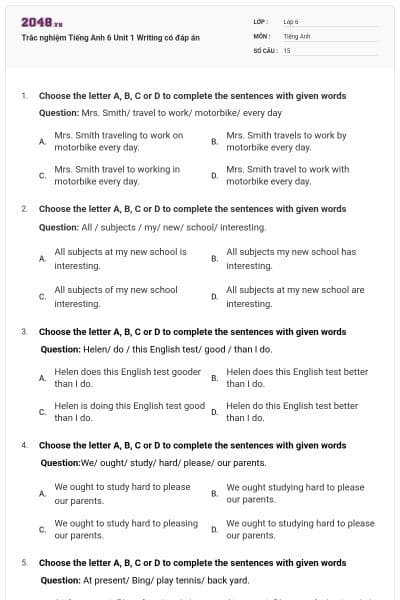
Mrs. Smith traveling to work on motorbike every day.
Mrs. Smith travels to work by motorbike every day.
Mrs. Smith travel to working in motorbike every day.
Mrs. Smith travel to work with motorbike every day.
Chọn đáp án: B
Giải thích: Câu chia ở hiện tại đơn vì có mốc thời gian “every day”
Dịch: Bà Smith đi làm bằng xe máy mỗi ngày.
All subjects at my new school is interesting.
All subjects my new school has interesting.
All subjects of my new school interesting.
All subjects at my new school are interesting.
Chọn đáp án: D
Giải thích: At + school: ở trường học
Chủ ngữ là “all subjects” số nhiều nên động từ chia ở dạng số nhiều “are”
Dịch: Tất cả các môn ở trường mới của tôi đều rất thú vị.
Helen does this English test gooder than I do.
Helen does this English test better than I do.
Helen is doing this English test good than I do.
Helen do this English test better than I do.
Chọn đáp án: B
Giải thích: Câu so sánh hơn với chủ ngữ số ít.
Dịch: Helen làm bài kiểm tra này tốt hơn tôi.
We ought to study hard to please our parents.
We ought studying hard to please our parents.
We ought to study hard to pleasing our parents.
We ought to studying hard to please our parents.
Chọn đáp án: A
Giải thích: Cấu trúc “ought to V”: có bổn phận phải làm gì
Dịch: Chúng ta phải học chăm chỉ để làm bố mẹ hài lòng.
At the present, Bing plays tennis in back yard.
At present, Bing are playing tennis in back yard.
At present, Bing is playing tennis in the back yard.
At the present, Bing play tennis in the back yard.
Chọn đáp án: C
Giải thích:
Câu chia thời hiện tại tiếp diễn vì có mốc thời gian “at present”
Dịch: Bây giờ Bing đang chơi tennis ở sân sau.
My teacher has long straight black hair.
My teacher has straight black long hair.
My teacher has hair black long straight.
My hair teacher has long straight black.
Chọn đáp án: A
Giải thích: “Long straight black hair” tóc dài, thẳng và đen.
Dịch: Cô giáo tôi có mái tóc dài, thẳng và đen.
He playing most of time his sports free spends.
He spends most his free time of playing sports.
He spends most of his free time playing sports.
He playing sports most of his free time spends.
Chọn đáp án:C
Giải thích: Cấu trúc “spend + thời gian + Ving”: Dành thời gian làm gì
Dịch: Anh ấy dành hầu hết thời gian rảnh chơi thể thao.

Học thông minh hơn mỗi ngày
Xem toàn bộ 15 câu hỏi và nhiều hơn nữa với tài khoản miễn phí
Please her to take and ask your teacher the form to sign.
Please your teacher her take the form to and ask to sign.
Please sign to take form your teacher ask to the her and.
Please take the form to your teacher and ask her to sign.
Chọn đáp án: D
Giải thích: Cấu trúc “take st to sw” mang cái gì đến đâu
“ask sb to V” yêu cầu ai làm gì
Dịch: Vui lòng mang lá đơn đến cho cô giáo của em và nhờ cô kí.
There is three books a pencil, and a compass on the bookshelf.
There a pencil, a compass, and three books is on the bookshelf.
There is a pencil and a compass on the three books bookshelf.
There is a pencil, a compass, and three books on the bookshelf.
Chọn đáp án: D
Giải thích: Cấu trúc “There is + a/ an + N”
Dịch: Có một chiếc bút chì, 1 chiếc compa, và 3 quyển sách trên giá.
Let’s dinner out for go tonight.
Let’s go out for dinner tonight.
Let’s tonight go out for dinner.
Let’s out for dinner go tonight.
Chọn đáp án: B
Giải thích: Cấu trúc: “go out for dinner”: đi ăn tiệm, ăn ngoài
Dịch: Tối nay đi ra ngoài ăn nào!
I enjoy learning foreign languages.
I hate learning foreign languages.
I don’t like learning foreign languages.
I am learning foreign languages.
Chọn đáp án: A
Giải thích:
Cấu trúc “be interested in Ving” = “enjoy Ving”: thích làm gì
Dịch: Tôi thích học ngoại ngữ.
Students must do homework after class.
Students may do homework after class.
Students can do homework after class.
Students have to do homework after class.
Chọn đáp án: D
Giải thích: Cấu trúc “have to V” = “ought to V”: có bổn phận phải làm gì
Dịch: Học sinh cần phải làm bài tập sau giờ học.
2000 students are staying in our school.
Our school is very big.
There are 2000 students in our school.
It’s crowded in our school.
Chọn đáp án: C
Giải thích:
Chuyển đổi giữa 2 cấu trúc “S + have/ has N(s)” => “there are/ is N(s)”
Dịch: Trường tôi có 2000 học sinh.
Mr. Brown teaches very good.
Mr. Brown teaches very well.
Mr. Brown is very well teacher.
Mr. Brown is teaching very well.
Chọn đáp án: B
Giải thích: Chuyển đối 2 dạng thức “Adj + N” <=> “V+adv”
Dịch: Thầy Brown dạy rất hay.
That little girl is too young to be in my class.
That little girl is old enough to be in my class
That little girl isn’t too young to be in my class.
That little girl is young enough to be in my class.
Chọn đáp án: A
Giải thích:
Chuyển đổi 2 cấu trúc “Be adj enough to V” (đủ như thế nào để làm gì) <=> “be too adj to V” (quá như thế nào nên không thể làm gì)
Dịch: Bé gái kia không đủ tuổi để theo học lớp của tôi.
Bạn có thích hoạt động này không?
Ý kiến của bạn sẽ giúp chúng tôi đề xuất nội dung phù hợp hơn.