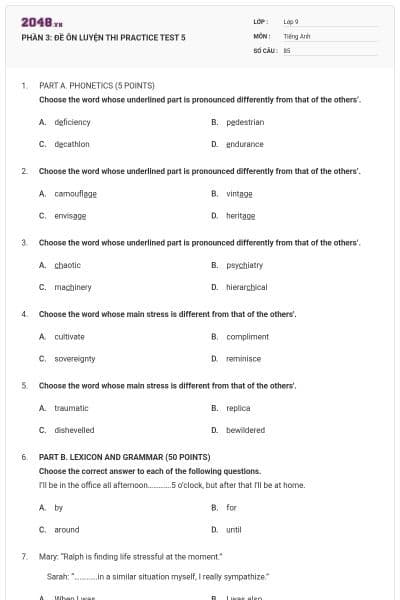
PHẦN 3: ĐỀ ÔN LUYỆN THI PRACTICE TEST 5
82 câu hỏi
deficiency
pedestrian
decathlon
endurance
Chọn B
camouflage
vintage
envisage
heritage
Chọn A
chaotic
psychiatry
machinery
hierarchical
Chọn C
cultivate
compliment
sovereignty
reminisce
Chọn D
traumatic
replica
dishevelled
bewildered
Chọn B
by
for
around
until
Chọn D
When I was
I was also
Having been
That I have been
Chọn C
level pegging
level off
level headed
level-crossing
Chọn A
the accident was occurring
did the accident occur
the accident occurred
was the accident occurred
Đáp án: C
Giải thích:
Kiến thức: Câu gián tiếp
Câu này là câu tường thuật lại một câu hỏi Wh-. Câu trực tiếp có thể là:
“What time did the accident occur?”
→ Khi chuyển sang câu tường thuật:
Giữ nguyên từ để hỏi (what time)
Đổi thì: did occur → occurred (quá khứ đơn → dạng khẳng định, không đảo ngữ)
Trật tự câu là S + V, không phải dạng câu hỏi.
Dựa vào cấu trúc câu tường thuật Wh-question và lùi thì, chọn C.
Dịch: Viên cảnh sát hỏi tôi tai nạn đã xảy ra lúc mấy giờ.

Học thông minh hơn mỗi ngày
Xem toàn bộ 82 câu hỏi và nhiều hơn nữa với tài khoản miễn phí
at that time
during which time
the time when
whenever
Chọn B
screwed
fixed
riveted
nailed
Chọn C
It is such elegant couture evening dress
Such is the elegance of this couture evening dress
So elegant this couture evening dress is
It is so elegant couture evening dress
Chọn B
off the cuff
off the beaten track
off the deep end
off the record
Chọn D
has 100 sit-ups a day done
will have done me 100 sit-ups a day
had done 100 sit-ups a day
will have had me doing 100 sit-ups a day
Chọn D
a ridiculous wide yellow silk
a yellow wide ridiculous silk
a ridiculous yellow wide silk
a wide silk yellow ridiculous
Chọn A
will be invested
be invested
to be invested
being invested
Chọn B
rave
keen
wild
vigorous
Chọn A
escaping
neglecting
resisting
missing
Chọn B
cry for the moon
look for a needle in a haystack
look a gift horse in the mouth
take the rough with the smooth
Chọn C
Such was the success of
It was so successful
How much was the success of
So successful has
Chọn A
increasing rapidly
remaining stable
declining gradually
falling sharply
Chọn D
stop
ask for help
start
continue
Chọn A
arguing with my sister
teasing my sister
controlling my sister
playing with my sister
Chọn B
wealthy
generous
selfish
poor
Chọn D
failed
became successful
surprised everyone
beat a storm
Chọn A
Ever since I can remember, I °always love to draw. When I was very young, I scribbled 26all them over my bedroom walls until I mastered paper and pencil. Later, an enlightened schoolteacher made sure 27of I went on to art school and it was there 28did I draw my first life model, which was a wonderful experience. My tutors encouraged me to take 29in drawing seriously, but I ignored their advice. I wanted to do something more exciting 30like a career and I chose graphic design. After college, I worked for a number of years as Art Director at a small publishing company. I loved the sociability of office life, but gradually became more and more frustrated. I found myself 31long to draw properly again, but 32what meant having time to draw those things which interested me. Then, out of the 33black, it was announced that the firm was being reorganized and I was offered voluntary redundancy with quite a large 34number of cash payment. I leapt at the chance. With enough money in the bank to support me for two years, I went back to art college, determined to get my drawing skills 35backed up to scratch so that I could embark on a career as an illustrator.
|
26. all them → |
them all/ them/ all/ all of them |
27. of→ that/ Ø |
|
28. did I draw |
→ that I drew |
29. in → up |
|
30. like → as |
31. long → longing | |
|
32. what → that |
33. black → blue | |
|
34. number→ |
amount |
35.backed → back |
Exhaust
economic
imagine
trouble
fresh
breathe
feel
become
fall
drop
Chọn C
once
ago
past
prior
Chọn A
at
for
down
into
Chọn D
keen
serious
excited
eager
Chọn B
largely
fully
quite
plenty
Chọn C
joined
united
attached
linked
Chọn D
give
take
hold
make
Chọn B
cure
resolution
repair
correction
Chọn B
subtract
descend
reduce
sink
Chọn C
do
stand
deal
put
Chọn A
A. The barrister
At the age of nine, without a word of English, Hashi was sent from Kenya to live in Britain, where he was raised exclusively on state benefits, with very little to live on. “I attended badly performing schools and was always moving around between different relatives.” Despite this, Hashi managed to scrape through his exams and get into university to study law. Much later, having done a master’s degree, he was inspired to become a barrister so that he could represent people in court. “But first you have to do a work replacement where you shadow a barrister. Unfortunately, it took me 18 months before I was accepted because I didn’t have any contacts in the profession. It isn't fair, but there is no point trying to pick a fight with a system.” Now a junior barrister at a top firm, Hash! attributes this outstanding achievement against the odds to a combination of the people who believed in him, the scholarships and loans which enabled him to afford the course, strong self-discipline and a lot of hard work.
C. The banker
While still at the London School of Economics (LSE), Wen Du got some work experience in banking. "LSE helps you to find these work placements but its’ still quite tough, so I had to do loads of networking. When you are eventually looking for a job, you need certain academic qualifications so companies will be interested in interviewing you. But, after that, it’s more about how much you know about banking, so experience while you are still at university is vital. I was working 12-13 hours a day during my placements but you take long hours in your stride provided you are learning. After I finished university, I was offered a job at one of my work placements. However, I had the opportunity to do a master's degree in finance, so I did that first. For me, salary isn’t the main priority in a first job; it’s about how much you can learn and how much responsibility your line manager will give you. I want to do well, but because there are so many uncertainties in our field, I can’t foresee where I’ll be in five years.”
B. The fashion designer
Having set her heart from childhood on a career in costume design, Lilly worked in the theatre straight after school, only to realize that this job wasn't for her. Literature, which she tried next, bored her. “So I sent some drawing off and was accepted for an art degree, which I loved because I had tutors who knew what they were talking about. But it was the head of the course on my master’s degree in fashion who really helped me to develop my confidence and individual style. Every summer, I was taken on for a three- month work placement, organized by the college. I took these really seriously - I can’t understand people who are half-hearted about them. In my second year I was making prints 16 hours a day for a famous designer and some of them got used in his fashion collection.” However, though Lilly did work for a number of well-known designers, there were also discouragingly long periods of unemployment before she finally got a permanent job.
D. The architect
Having eventually settled on architecture as a career, Amandine came to London from the USA and started building a portfolio of her work by attending local college courses. This got her onto a university foundation art course and then into the highly competitive Architectural Association (AA) school. “I picked the AA because it has such a close-knit family atmosphere, which for me is essential. But I knew I couldn’t go there unless I got a scholarship because the fees are so high, especially given that the course takes seven years. Even though I had two-thirds of it paid for me, I still owe a fortune, the debt is a huge weight on your shoulders at my age. I now have a job in a company that has always interested me, thanks to friends that worked here and could vouch for me. It's great to have an impressive CV but even better to have a good character reference.”
A. The barrister
At the age of nine, without a word of English, Hashi was sent from Kenya to live in Britain, where he was raised exclusively on state benefits, with very little to live on. “I attended badly performing schools and was always moving around between different relatives.” Despite this, Hashi managed to scrape through his exams and get into university to study law. Much later, having done a master’s degree, he was inspired to become a barrister so that he could represent people in court. “But first you have to do a work replacement where you shadow a barrister. Unfortunately, it took me 18 months before I was accepted because I didn’t have any contacts in the profession. It isn't fair, but there is no point trying to pick a fight with a system.” Now a junior barrister at a top firm, Hash! attributes this outstanding achievement against the odds to a combination of the people who believed in him, the scholarships and loans which enabled him to afford the course, strong self-discipline and a lot of hard work.
B. The fashion designer
Having set her heart from childhood on a career in costume design, Lilly worked in the theatre straight after school, only to realize that this job wasn't for her. Literature, which she tried next, bored her. “So I sent some drawing off and was accepted for an art degree, which I loved because I had tutors who knew what they were talking about. But it was the head of the course on my master’s degree in fashion who really helped me to develop my confidence and individual style. Every summer, I was taken on for a three- month work placement, organized by the college. I took these really seriously - I can’t understand people who are half-hearted about them. In my second year I was making prints 16 hours a day for a famous designer and some of them got used in his fashion collection.” However, though Lilly did work for a number of well-known designers, there were also discouragingly long periods of unemployment before she finally got a permanent job.
D. The architect
Having eventually settled on architecture as a career, Amandine came to London from the USA and started building a portfolio of her work by attending local college courses. This got her onto a university foundation art course and then into the highly competitive Architectural Association (AA) school. “I picked the AA because it has such a close-knit family atmosphere, which for me is essential. But I knew I couldn’t go there unless I got a scholarship because the fees are so high, especially given that the course takes seven years. Even though I had two-thirds of it paid for me, I still owe a fortune, the debt is a huge weight on your shoulders at my age. I now have a job in a company that has always interested me, thanks to friends that worked here and could vouch for me. It's great to have an impressive CV but even better to have a good character reference.”
B. The fashion designer
Having set her heart from childhood on a career in costume design, Lilly worked in the theatre straight after school, only to realize that this job wasn't for her. Literature, which she tried next, bored her. “So I sent some drawing off and was accepted for an art degree, which I loved because I had tutors who knew what they were talking about. But it was the head of the course on my master’s degree in fashion who really helped me to develop my confidence and individual style. Every summer, I was taken on for a three- month work placement, organized by the college. I took these really seriously - I can’t understand people who are half-hearted about them. In my second year I was making prints 16 hours a day for a famous designer and some of them got used in his fashion collection.” However, though Lilly did work for a number of well-known designers, there were also discouragingly long periods of unemployment before she finally got a permanent job.
C. The banker
While still at the London School of Economics (LSE), Wen Du got some work experience in banking. "LSE helps you to find these work placements but its’ still quite tough, so I had to do loads of networking. When you are eventually looking for a job, you need certain academic qualifications so companies will be interested in interviewing you. But, after that, it’s more about how much you know about banking, so experience while you are still at university is vital. I was working 12-13 hours a day during my placements but you take long hours in your stride provided you are learning. After I finished university, I was offered a job at one of my work placements. However, I had the opportunity to do a master's degree in finance, so I did that first. For me, salary isn’t the main priority in a first job; it’s about how much you can learn and how much responsibility your line manager will give you. I want to do well, but because there are so many uncertainties in our field, I can’t foresee where I’ll be in five years.”
D. The architect
Having eventually settled on architecture as a career, Amandine came to London from the USA and started building a portfolio of her work by attending local college courses. This got her onto a university foundation art course and then into the highly competitive Architectural Association (AA) school. “I picked the AA because it has such a close-knit family atmosphere, which for me is essential. But I knew I couldn’t go there unless I got a scholarship because the fees are so high, especially given that the course takes seven years. Even though I had two-thirds of it paid for me, I still owe a fortune, the debt is a huge weight on your shoulders at my age. I now have a job in a company that has always interested me, thanks to friends that worked here and could vouch for me. It's great to have an impressive CV but even better to have a good character reference.”
Đáp án: Anthony accused the other man of causing the collision.
Giải thích:
accuse somebody of doing something: buộc tội ai đó đã làm gì
Dịch: Anthony khẳng định người đàn ông kia đã gây ra vụ va chạm.
→ Anthony cáo buộc người đàn ông kia gây ra vụ va chạm.
Suggested paragraph:
It is hard for me to choose which film is my favourite because each one has its own meaning as well as artistic value. However, the one that I have seen several times without feeling bored is 'Flipped' - a sweet teenage love story film by Rob Reiner. Released in 2010, the movie is an adaptation of an award-winning young adult novel with the same title by Wendelin Van Draanen. The story revolves around two youngsters named Bryce Loski and Juli Baker. When a new family moves into the house across the street, second-grader Juli is instantly smitten with the new boy in town. He may be trying his hardest to get away from her, but she thinks he is playing coy and shy. It is not until six years pass that the love-hate relationship reaches fruition, with both kids learning about life and love. What I am absolutely impressed by the film is the creative way that the director develops the story. Reiner, never subtle, transitions each segment with a top to bottom flip of the frame, showing how the same events are seen differently from the perspective of each actor. So, if you are looking for a story that is refreshing yet vintage, and wanting to have a lovey-dovey grin plastered on your face, this is the movie to watch.
Bạn có thích hoạt động này không?
Hãy lưu hoặc chia sẻ nội dung này đến mọi người.
Gợi ý cho bạn

Ý tưởng của bạn, bài học của bạn
Tự thiết kế đề thi, bài giảng hoặc flashcard theo cách riêng.