Đề tuyển sinh vào lớp 10 Tiếng Anh năm 2026-2027 Sở Đồng Tháp (có đáp án)
40 câu hỏi
Mark the letter A, B, C, or D on your answer sheet to indicate the word whose underlined part differs from the other three in pronunciation in each of the following questions from 1 to 2.
hoped
joined
wanted
served
Đáp án đúng: C
Đáp án C có phần gạch chân phát âm là /ɪd/, các đáp án còn lại phát âm là /t/ hoặc /d/.
Mark the letter A, B, C, or D on your answer sheet to indicate the word whose underlined part differs from the other three in pronunciation in each of the following questions from 1 to 2.
life
silk
milk
chill
Đáp án đúng: A
Đáp án A có phần gạch chân phát âm là /aɪ/, các đáp án còn lại phát âm là /ɪ/.
Mark the letter A, B, C, or D on your answer sheet to indicate the word that differs from the other three in the position of primary stress in each of the following questions from 3 to 4.
advice
summer
music
village
Đáp án đúng: A
Đáp án A có trọng âm số 2, các đáp án còn lại có trọng âm số 1.
Mark the letter A, B, C, or D on your answer sheet to indicate the word that differs from the other three in the position of primary stress in each of the following questions from 3 to 4.
happen
enjoy
agree
decide
Đáp án đúng: A
Đáp án A có trọng âm số 1, các đáp án còn lại có trọng âm số 2.
Mark the letter A, B, C, or D on your answer sheet to indicate the word(s) CLOSEST in meaning to the underlined word(s) in the following question.
My house has a lot of solar panels on the roof. They generate electricity for us to use.
produce
waste
destroy
kill
Đáp án đúng: A
"generate" = tạo ra, sản xuất = "produce" (sản xuất, tạo ra).
Dịch nghĩa: Nhà tôi có rất nhiều tấm pin năng lượng mặt trời trên mái nhà. Chúng tạo ra điện để chúng tôi sử dụng.
Mark the letter A, B, C, or D on your answer sheet to indicate the word(s) OPPOSITE in meaning to the underlined word(s) in the following question.
Living in the countryside is very peaceful and quiet with almost no crowds or excitement.
calm
noisy
safe
silent
Đáp án đúng: B
"peaceful and quiet" = yên bình và yên tĩnh >< "noisy" (ồn ào).
Dịch nghĩa: Sống ở vùng nông thôn rất yên bình và yên tĩnh, hầu như không có đám đông hay sự náo nhiệt.
Mark the letter A, B, C, or D on your answer sheet to indicate the correct answer to each of the following questions from 7 to 16.
They said to her, “Can you swim?”→ They asked her if ______.
I am swimming
she swims
I have swum
she could swim
Đáp án đúng: D
Câu tường thuật dạng câu hỏi Yes/No: asked + O + if/whether + S + V (lùi thì).
Dịch nghĩa: Họ hỏi cô ấy liệu cô ấy có biết bơi không.
The sales assistant suggested that my Dad ______ a new laptop.
buys
buying
buy
to buy
Đáp án đúng: C
Cấu trúc: suggest + (that) + S + V (bare infinitive / động từ nguyên mẫu không "to")
Dịch nghĩa: Nhân viên bán hàng đề xuất rằng bố tôi nên mua một chiếc máy tính xách tay mới.
At
In
On
Of
Đáp án đúng: C
Giới từ chỉ ngày cụ thể trong tuần dùng "on" → on Sunday.
Dịch nghĩa: Vào Chủ nhật, Sarah đã dọn dẹp căn phòng bừa bộn của mình.
plays
played
is playing
will play
Đáp án đúng: B
Hành động xảy ra tại thời điểm cụ thể trong quá khứ "last week" → Quá khứ đơn: played.
Dịch nghĩa: Anh ấy đã chơi bóng đá tuần trước.
tell
telling
told
to tell
Đáp án đúng: D
Cấu trúc: want + to V = muốn làm gì.
Dịch nghĩa: Tôi muốn kể cho bạn nghe về chuyến đi Paris của tôi.
lived
live
living
to live
Đáp án đúng: C
Cấu trúc: enjoy + V-ing = thích làm gì.
Dịch nghĩa: Anh ấy thích sống ở một thành phố lớn.
was saving
will save
saved
would save
Đáp án đúng: B
Cấu trúc: Câu điều kiện loại 1: If + S + V (hiện tại đơn), S + will + V → "will save".
Dịch nghĩa: Nếu chúng ta giảm thiểu rác thải nhựa, chúng ta sẽ cứu bãi biển địa phương của mình.
inventive
invent
invention
invented
Đáp án đúng: C
Cần danh từ bổ nghĩa cho mệnh đề quan hệ "of useful machines" → "invention" (sự phát minh).
Dịch nghĩa: Vào thế kỷ 19, sự phát minh ra các máy móc hữu ích đã giúp nông dân làm việc nhanh hơn.
waits
will wait
wait
was waiting
Đáp án đúng: D
Hành động đang diễn ra song song với hành động khác trong quá khứ.
Dịch nghĩa: Trước đây, cô ấy thường nghe nhạc trong khi đang chờ xe buýt.
improve
conserve
waste
conclude
Đáp án đúng: B
"conserve" = bảo tồn, giữ gìn → phù hợp nhất với ngữ cảnh
Dịch nghĩa: Tái chế giúp bảo tồn tài nguyên thiên nhiên như gỗ, nước, khoáng sản và nhiên liệu hóa thạch.
Mark the letter A, B, C, or D on your answer sheet to indicate the sentence that best completes each of the following exchanges from 17 to 18.
Ann asks Sue about her age.
Ann: “______ are you?” - Sue: “I am 15.”
What color
How old
How many
What time
Đáp án đúng: B
Sue trả lời "I am 15" → Ann hỏi về tuổi → "How old are you?" = Bạn bao nhiêu tuổi?
Dịch nghĩa: Ann: "Bạn bao nhiêu tuổi?" - Sue: "Tôi 15 tuổi."
Kate is thanking Mike for his help.
Kate: “Thank you very much for helping me with my homework.” - Mike: “______.”
You’re welcome
Good idea
No, thanks
Yes, please
Đáp án đúng: A
Khi ai đó cảm ơn, câu trả lời phù hợp là "You're welcome" = Không có gì.
Dịch nghĩa: Kate: "Cảm ơn bạn rất nhiều vì đã giúp tôi làm bài tập về nhà." - Mike: "Không có gì."
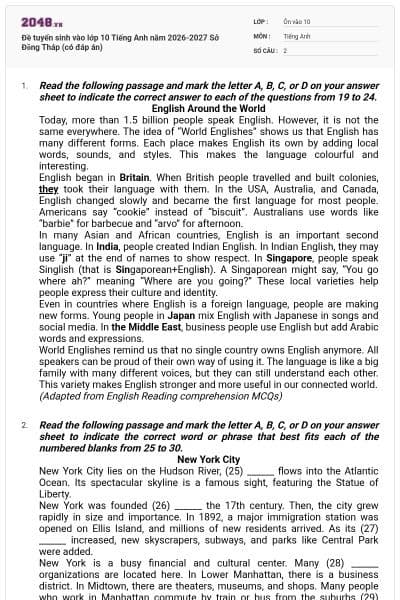
Read the following passage and mark the letter A, B, C, or D on your answer sheet to indicate the correct answer to each of the questions from 19 to 24.
English Around the World
Today, more than 1.5 billion people speak English. However, it is not the same everywhere. The idea of “World Englishes” shows us that English has many different forms. Each place makes English its own by adding local words, sounds, and styles. This makes the language colourful and interesting.
English began in Britain. When British people travelled and built colonies, they took their language with them. In the USA, Australia, and Canada, English changed slowly and became the first language for most people. Americans say “cookie” instead of “biscuit”. Australians use words like “barbie” for barbecue and “arvo” for afternoon.
In many Asian and African countries, English is an important second language. In India, people created Indian English. In Indian English, they may use “ji” at the end of names to show respect. In Singapore, people speak Singlish (that is Singaporean+English). A Singaporean might say, “You go where ah?” meaning “Where are you going?” These local varieties help people express their culture and identity.
Even in countries where English is a foreign language, people are making new forms. Young people in Japan mix English with Japanese in songs and social media. In the Middle East, business people use English but add Arabic words and expressions.
World Englishes remind us that no single country owns English anymore. All speakers can be proud of their own way of using it. The language is like a big family with many different voices, but they can still understand each other. This variety makes English stronger and more useful in our connected world.
(Adapted from English Reading comprehension MCQs)
What is the main idea of the passage?
English only belongs to Britain and America.
Learning British English is the most important thing.
English is difficult because it changes too much.
English has many different forms around the world.
Đáp án đúng: D
Ý chính toàn bài: tiếng Anh có nhiều hình thức khác nhau trên thế giới, mỗi nơi tạo nên phiên bản tiếng Anh riêng của mình → "English has many different forms around the world."
What does the word “they” in paragraph 2 refer to?
Australian people
Canadian people
American people
British people
Đáp án đúng: D
"they" trong đoạn 2 thay thế cho chủ ngữ của câu trước: "When British people travelled and built colonies, they took their language with them" → "they" chỉ người Anh (British people).
In what country do people use “ji” at the end of names to show respect?
Japan
Britain
India
Singapore
Đáp án đúng: C
Thông tin trong bài: "In India, people created Indian English. In Indian English, they may use 'ji' at the end of names to show respect." → Ấn Độ.
Which example shows Singlish?
“Please prepone the meeting.”
“Let’s have a barbie this arvo.”
“You go where ah?”
“I want to eat cookies.”
Đáp án đúng: C
Thông tin trong bài: "A Singaporean might say, 'You go where ah?' meaning 'Where are you going?'" → đây là ví dụ về Singlish.
Which of the following is NOT mentioned in the passage?
Young people in Japan mix English with their language.
World Englishes are exactly the same as British English.
English is used in business in the Middle East.
Local varieties of English help people express their culture.
Đáp án đúng: B
Bài đọc KHÔNG đề cập "World Englishes are exactly the same as British English" (Tiếng Anh thế giới hoàn toàn giống với tiếng Anh của Anh). Thực tế, bài nói ngược lại. Các đáp án A, C, D đều được đề cập trong bài.
From the passage, we might say ______.
British English will disappear soon.
only Britain and the USA should use English.
World Englishes make English difficult for students.
World Englishes help connect the world.
Đáp án đúng: D
Đoạn cuối bài: "This variety makes English stronger and more useful in our connected world." → Tiếng Anh thế giới giúp kết nối thế giới.
Dịch bài đọc:
TIẾNG ANH TRÊN KHẮP THẾ GIỚI
Ngày nay, hơn 1,5 tỷ người nói tiếng Anh. Tuy nhiên, tiếng Anh không giống nhau ở khắp mọi nơi. Khái niệm "Tiếng Anh thế giới" cho thấy tiếng Anh có nhiều hình thức khác nhau. Mỗi nơi tạo ra phiên bản tiếng Anh riêng bằng cách thêm các từ, âm thanh và phong cách địa phương. Điều này làm cho ngôn ngữ trở nên phong phú và thú vị.
Tiếng Anh bắt nguồn từ nước Anh. Khi người Anh đi du lịch và xây dựng các thuộc địa, họ mang theo ngôn ngữ của mình. Ở Mỹ, Úc và Canada, tiếng Anh dần thay đổi và trở thành ngôn ngữ đầu tiên của hầu hết mọi người. Người Mỹ nói "cookie" thay vì "biscuit". Người Úc dùng từ "barbie" cho barbecue và "arvo" cho buổi chiều.
Ở nhiều quốc gia châu Á và châu Phi, tiếng Anh là ngôn ngữ thứ hai quan trọng. Ở Ấn Độ, người ta đã tạo ra tiếng Anh kiểu Ấn Độ. Trong tiếng Anh Ấn Độ, họ có thể dùng "ji" ở cuối tên để thể hiện sự tôn trọng. Ở Singapore, người ta nói Singlish (tức là Singaporean + English). Một người Singapore có thể nói: "You go where ah?" có nghĩa là "Bạn đang đi đâu vậy?" Những phương ngữ địa phương này giúp mọi người thể hiện văn hóa và bản sắc của họ.
Ngay cả ở những quốc gia mà tiếng Anh là ngoại ngữ, người ta cũng đang tạo ra những hình thức mới. Giới trẻ Nhật Bản pha trộn tiếng Anh với tiếng Nhật trong các bài hát và mạng xã hội. Ở Trung Đông, các doanh nhân sử dụng tiếng Anh nhưng thêm vào các từ và cụm từ tiếng Ả Rập.
Tiếng Anh thế giới nhắc nhở chúng ta rằng không có quốc gia nào sở hữu tiếng Anh nữa. Tất cả người nói đều có thể tự hào về cách sử dụng tiếng Anh của riêng mình. Ngôn ngữ này giống như một gia đình lớn với nhiều giọng nói khác nhau, nhưng họ vẫn có thể hiểu nhau. Sự đa dạng này làm cho tiếng Anh mạnh hơn và hữu ích hơn trong thế giới kết nối của chúng ta.
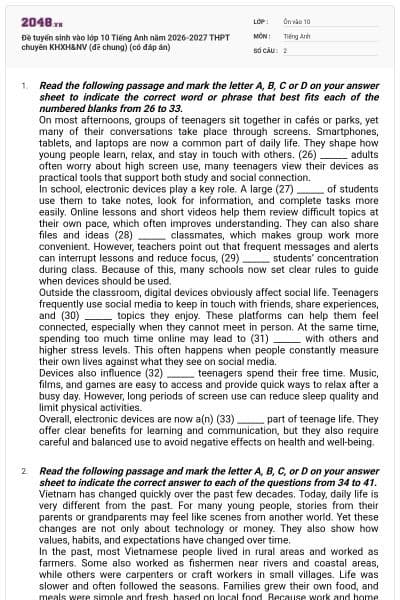
Read the following passage and mark the letter A, B, C, or D on your answer sheet to indicate the correct word or phrase that best fits each of the numbered blanks from 25 to 30.
New York City
New York City lies on the Hudson River, (25) ______ flows into the Atlantic Ocean. Its spectacular skyline is a famous sight, featuring the Statue of Liberty.
New York was founded (26) ______ the 17th century. Then, the city grew rapidly in size and importance. In 1892, a major immigration station was opened on Ellis Island, and millions of new residents arrived. As its (27) ______ increased, new skyscrapers, subways, and parks like Central Park were added.
New York is a busy financial and cultural center. Many (28) ______ organizations are located here. In Lower Manhattan, there is a business district. In Midtown, there are theaters, museums, and shops. Many people who work in Manhattan commute by train or bus from the suburbs (29) ______ buying an apartment in the city center is expensive. Different parts of New York are linked by yellow cabs, buses, and the subway.
People from all over the world are attracted to New York and it is an international, multicultural city. Many go there only for the Broadway shows or the shops. Others take their children to Times Square. Young people are attracted to the lively music concerts, rooftop bars, and (30) ______ exciting things.
(Adapted from OALD, 8th edition, Oxford University Press)
who
whom
which
when
Đáp án đúng: C
Mệnh đề quan hệ bổ nghĩa cho vật "the Hudson River" → dùng "which".
Dịch nghĩa: Thành phố New York nằm trên sông Hudson, con sông chảy ra Đại Tây Dương.
in
at
to
on
Đáp án đúng: A
Giới từ chỉ thế kỷ/giai đoạn thời gian dùng "in".
Dịch nghĩa: New York được thành lập vào thế kỷ 17.
As its (27) ______ increased, new skyscrapers, subways, and parks like Central Park were added.
cities
population
bridges
river
Đáp án đúng: B
"population" = dân số → phù hợp nhất với ngữ cảnh
Dịch nghĩa: Khi dân số tăng lên, các tòa nhà chọc trời, tàu điện ngầm và công viên như Central Park được xây dựng thêm.
importantly
importance
important
unimportantly
Đáp án đúng: C
Trước danh từ "organizations" cần tính từ → "important" (quan trọng).
Dịch nghĩa: Nhiều tổ chức quan trọng đặt trụ sở tại đây.
so
and
but
because
Đáp án đúng: D
"because" = bởi vì → liên từ chỉ nguyên nhân, phù hợp ngữ cảnh
Dịch nghĩa: Nhiều người làm việc ở Manhattan đi tàu hoặc xe buýt từ các vùng ngoại ô vì mua căn hộ ở trung tâm thành phố rất đắt.
Young people are attracted to the lively music concerts, rooftop bars, and (30) ______ exciting things.
the others
other
another
others
Đáp án đúng: B
"other + danh từ số nhiều" = những thứ khác (không xác định)
Dịch nghĩa: Giới trẻ bị thu hút bởi các buổi hòa nhạc sôi động, quán bar trên sân thượng và những thứ thú vị khác.
Dịch bài đọc:
THÀNH PHỐ NEW YORK
Thành phố New York nằm trên sông Hudson, con sông chảy ra Đại Tây Dương. Đường chân trời ngoạn mục của nó là một cảnh tượng nổi tiếng, với Tượng Nữ thần Tự do.
New York được thành lập vào thế kỷ 17. Sau đó, thành phố phát triển nhanh chóng về quy mô và tầm quan trọng. Năm 1892, một trạm nhập cư lớn được mở tại Đảo Ellis, và hàng triệu cư dân mới đã đến đây. Khi dân số tăng lên, các tòa nhà chọc trời, tàu điện ngầm và các công viên như Central Park được xây dựng thêm.
New York là một trung tâm tài chính và văn hóa sôi động. Nhiều tổ chức quan trọng đặt trụ sở tại đây. Ở Hạ Manhattan, có một khu thương mại. Ở Midtown, có các rạp hát, bảo tàng và cửa hàng. Nhiều người làm việc ở Manhattan đi tàu hoặc xe buýt từ các vùng ngoại ô vì mua căn hộ ở trung tâm thành phố rất đắt. Các khu vực khác nhau của New York được kết nối bởi taxi vàng, xe buýt và tàu điện ngầm.
Người dân từ khắp nơi trên thế giới đều bị thu hút đến New York và đây là một thành phố quốc tế, đa văn hóa. Nhiều người đến đây chỉ để xem các buổi diễn Broadway hoặc mua sắm. Những người khác đưa con em đến Quảng trường Thời đại. Giới trẻ bị thu hút bởi các buổi hòa nhạc sôi động, quán bar trên sân thượng và những thứ thú vị khác.
Write the letter A, B, C, or D on your answer sheet to indicate the underlined part that needs correction in each of the following questions from 31 to 33.
While you are doing the test, try to look into the dictionary for the meanings of difficult words.
While
into
are doing
the meanings
Đáp án đúng: B
Cụm từ đúng là: "look up a word in the dictionary" (tra từ trong từ điển).
Dịch nghĩa: Trong khi làm bài kiểm tra, hãy cố tra từ điển để tìm nghĩa của các từ khó.
After doing my homework for a long time, I still don’t know how solving this problem.
homework
for a long time
doing
solving
Đáp án đúng: D
Cấu trúc: "know + how + to V" → "how to solve" (không dùng "how solving").
Dịch nghĩa: Sau khi làm bài tập về nhà trong một thời gian dài, tôi vẫn không biết cách giải quyết vấn đề này.
The higher the mountain is, the coldest it becomes.
becomes
the
coldest
higher
Đáp án đúng: C
Cấu trúc: The + so sánh hơn..., the + so sánh hơn...
Dịch nghĩa: Ngọn núi càng cao, trời càng lạnh hơn.
Mark the letter A, B, C, or D on your answer sheet to indicate the best arrangement of utterances or sentences to make a cohesive and coherent exchange or text in each of the following items from questions 34 to 36.
a-Nam: Nice to meet you, too.
b-Nam: Hello, my name is Nam. What’s your name?
c-Lan: Hi, Nam. I’m Lan. Nice to meet you.
b-c-a
a-c-b
a-b-c
b-a-c
Đáp án đúng: A
Sắp xếp đoạn hội thoại theo logic: (b) Nam chào hỏi và hỏi tên → (c) Lan tự giới thiệu và nói "Nice to meet you" → (a) Nam đáp lại "Nice to meet you, too."
→ Thứ tự đúng: b – c – a
Dịch nghĩa:
Nam: Chào, tôi tên là Nam. Bạn tên là gì?
Lan: Chào Nam. Tôi là Lan. Rất vui được làm quen.
Nam: Tôi cũng rất vui được làm quen với bạn.
Dear Paula,
a-I use my smartphone every day to study English and talk with my friends online.
b-What about you? How often do you use electronic devices for studying?
c-I hope you are doing well these days.
d-Best wishes.
a-b-d-c
c-a-b-d
c-d-a-b
a-c-b-d
Đáp án đúng: B
Sắp xếp lá thư theo logic: (c) Mở đầu: hy vọng bạn khỏe → (a) Nội dung chính: tôi dùng smartphone để học tiếng Anh và nói chuyện với bạn bè → (b) Hỏi lại: Còn bạn thì sao? → (d) Lời kết: Chúc những điều tốt đẹp nhất.
→ Thứ tự đúng: c – a – b – d
Dịch nghĩa:
Chào Paula,
Mình hy vọng dạo này bạn vẫn khỏe.
Mình dùng điện thoại thông minh mỗi ngày để học tiếng Anh và nói chuyện với bạn bè trực tuyến.
Còn bạn thì sao? Bạn dùng thiết bị điện tử để học tập thường xuyên như thế nào?
Chúc bạn mọi điều tốt đẹp.
a-Second, electronic devices allow teenagers to communicate with friends and teachers online.
b-Finally, spending too much time on screens may cause health problems such as eye strain and poor sleep.
c-Electronic devices have many impacts on teenagers’ lives today.
d-First, smartphones and laptops help students study faster and find information more easily.
e-In conclusion, teenagers should use electronic devices wisely to balance study, communication, and health.
c-d-a-b-e
a-e-b-c-d
a-b-c-d-e
c-a-b-e-d
Đáp án đúng: A
Sắp xếp đoạn văn theo logic: (c) Câu chủ đề: thiết bị điện tử có nhiều tác động đến cuộc sống của thanh thiếu niên → (d) Thứ nhất: smartphone và laptop giúp học sinh học nhanh hơn → (a) Thứ hai: thiết bị điện tử giúp giao tiếp online → (b) Cuối cùng: dành quá nhiều thời gian trước màn hình gây hại sức khỏe → (e) Kết luận.
→ Thứ tự đúng: c – d – a – b – e
Dịch nghĩa:
Các thiết bị điện tử có nhiều tác động đến cuộc sống của thanh thiếu niên ngày nay. Đầu tiên, điện thoại thông minh và máy tính xách tay giúp học sinh học nhanh hơn và tìm kiếm thông tin dễ dàng hơn. Thứ hai, các thiết bị điện tử cho phép thanh thiếu niên giao tiếp với bạn bè và giáo viên trực tuyến. Cuối cùng, dành quá nhiều thời gian trước màn hình có thể gây ra các vấn đề về sức khỏe như mỏi mắt và ngủ không ngon. Tóm lại, thanh thiếu niên nên sử dụng các thiết bị điện tử một cách khôn ngoan để cân bằng giữa việc học tập, giao tiếp và sức khỏe.
Mark the letter A, B, C, or D on your answer sheet to indicate the sentence that is closest in meaning to each of the following questions from 37 to 38.
There was a power cut, so I couldn’t use my computer.
I couldn’t use my computer because there was a power cut.
Since I couldn’t use my computer, there was a power cut.
There was a power cut, but I could use my computer.
Although there was a power cut, I could use my computer.
Đáp án đúng: A
"There was a power cut, so I couldn't use my computer." → Nguyên nhân: mất điện; Kết quả: không dùng được máy tính → chuyển thành "I couldn't use my computer because there was a power cut."
Dịch nghĩa: Tôi không thể sử dụng máy tính vì mất điện.
He cannot live near his school. He wants to live nearer.
He wishes he will live near his school.
He wishes he lives near his school.
He wishes he is living near his school.
He wishes he could live near his school.
Đáp án đúng: D
Cấu trúc: I wish + S + could + V → diễn đạt ước muốn không có thực ở hiện tại.
Dịch nghĩa: Anh ấy ước mình có thể sống gần trường học của mình.
Mark the letter A, B, C, or D on your answer sheet to indicate the part of the sentence that best completes each of the following questions from 39 to 40.
My Dad suggested that ______ the art gallery.
we shall visit
we are visiting
we should visit
us visiting
Đáp án đúng: C
Cấu trúc: suggest + (that) + S + should + V (bare infinitive) → "we should visit".
Dịch nghĩa: Bố tôi đề nghị chúng tôi nên thăm phòng trưng bày nghệ thuật.
Air pollution is getting so bad ______.
such people will start to get sick
such people to get sick
that people to get sick
that people will start to get sick
Đáp án đúng: D
Cấu trúc: "so + tính từ/trạng từ + that + S + V" = quá...đến nỗi...
Dịch nghĩa: Ô nhiễm không khí đang trở nên tệ đến mức mọi người sẽ bắt đầu bị bệnh.