Đề tuyển sinh vào lớp 10 Tiếng Anh năm 2026-2027 PTNK TP.HCM (đề chuyên) (có đáp án)
130 câu hỏi
LANGUAGE USE (4.00 pts)
For questions 1-60, mark your answers on the provided MULTIPLE-CHOICE ANSWER SHEET.
Questions 1 - 40 (2.00 pts) GRAMMAR AND VOCABULARY
Choose the answer (A, B, C, or D) which fits best
The executive requires his assistant to run all sorts of _______ for him, including getting his laundry, picking up his children from school, and walking his dog.
errands
menial tasks
odd jobs
gigs
Đáp án đúng: A
run errands = chạy việc vặt (cụm cố định).
Dịch nghĩa: Vị giám đốc yêu cầu trợ lý chạy đủ thứ việc vặt, gồm lấy đồ giặt, đón con ở trường và dắt chó đi dạo.
Alfred: "Her latest album feels completely derivative and uninspired."
Bruce: "_______ It heavily relies on the out-of-fashion Euro-pop sound. "
My thoughts exactly.
I beg to differ.
That's a bit of a stretch.
Agree to disagree.
Đáp án đúng: A
My thoughts exactly = đúng ý tôi nghĩ (Bruce đồng tình với Alfred).
Dịch nghĩa:
Alfred: "Album mới của cô ấy nghe hoàn toàn rập khuôn, thiếu cảm hứng."
Bruce: "Đúng ý tôi nghĩ. Nó dựa nhiều vào âm hưởng Euro-pop đã lỗi mốt."
The law requires that this factory _______ the machines every week.
have an engineer to inspect
has an engineer to inspect
has an engineer inspect
have an engineer inspect
Đáp án đúng: D
Cấu trúc giả định: require that + S + (should) be/ V nguyên thể; "have an engineer inspect" = sai khiến (have sb do).
Dịch nghĩa: Luật quy định nhà máy này phải cho kỹ sư kiểm tra máy móc mỗi tuần.
_______ a medic present at the scene of the accident, the victim would not have survived.
Had it been for
Were there not
Were it not for
Had there not been
Đáp án đúng: D
Đảo ngữ điều kiện loại 3: Had there not been... + would not have survived (quá khứ).
Dịch nghĩa: Nếu không có một nhân viên y tế tại hiện trường, nạn nhân đã không sống sót.
Sales figures released by the company are suspicious as they do not _______ shipment records.
add up to
square away with
live up to
check out with
Đáp án đúng: D
check out with = khớp/ăn khớp với (số liệu được kiểm chứng phù hợp).
Dịch nghĩa: Số liệu bán hàng công ty công bố đáng ngờ vì không khớp với hồ sơ vận chuyển.
discursive
pretentious
fastidious
meticulous
Đáp án đúng: A
discursive = lan man, dài dòng (đi với "digressions" – các đoạn lạc đề).
Dịch nghĩa: Bản thảo của ông bị phá hỏng bởi lối viết lan man với những đoạn lạc đề thiếu mạch lạc.
The famous movie star looks surprisingly casual today; his only _______ is a plain necklace.
decoration
adornment
embellishment
upkeep
Đáp án đúng: B
adornment = món trang sức/điểm tô (cho người); decoration thường cho vật/nơi chốn.
Dịch nghĩa: Ngôi sao điện ảnh hôm nay trông giản dị bất ngờ; món trang sức duy nhất là một chiếc vòng cổ trơn.
His explanation was so _______ that even the experts were unconvinced.
far-fetched
far-flung
far-sighted
far-reaching
Đáp án đúng: A
far-fetched = khó tin, gượng ép.
Dịch nghĩa: Lời giải thích của anh ta khó tin đến mức ngay cả các chuyên gia cũng không bị thuyết phục.
Children are often described as _______ easily influenced by their parental and guardian figures.
ephemeral
sporadic
volatile
malleable
Đáp án đúng: D
malleable = dễ uốn nắn, dễ bị tác động.
Dịch nghĩa: Trẻ em thường được mô tả là dễ uốn nắn, dễ bị ảnh hưởng bởi cha mẹ và người giám hộ.
Grace was praised for her _______ judgement when she reported the scammer pretending to be a police officer on the phone.
sound
fair
firm
snap
Đáp án đúng: A
sound judgement = phán đoán đúng đắn, sáng suốt.
Dịch nghĩa: Grace được khen vì phán đoán sáng suốt khi báo cáo kẻ lừa đảo giả danh cảnh sát qua điện thoại.
layover
crossover
runover
spillover
Đáp án đúng: B
crossover = màn kết hợp (nhân vật/series khác nhau).
Dịch nghĩa: Người hâm mộ hào hứng trước viễn cảnh một màn kết hợp giữa hai loạt anime được yêu thích.
By completing
With the completion
Having completed
On being completed
Đáp án đúng: A
By + V-ing = bằng cách làm gì.
Dịch nghĩa: Bằng cách hoàn thành một khóa học trực tuyến ngắn theo nhịp độ riêng, người ta có thể nhận chứng chỉ.
intolerant
indigestible
repellant
averse
Đáp án đúng: A
lactose intolerant = không dung nạp lactose.
Dịch nghĩa: Hãy tránh ăn phô mai hoặc kem nếu bạn không dung nạp lactose.
For basing their argument on _______ evidence rather than verified documentation, the plaintif's civil lawsuit was dismissed.
incidental
hypothetical
anecdotal
accidental
Đáp án đúng: C
anecdotal evidence = bằng chứng giai thoại (lời kể, chưa kiểm chứng).
Dịch nghĩa: Vì lập luận dựa trên bằng chứng giai thoại thay vì tài liệu được kiểm chứng, vụ kiện dân sự của nguyên đơn bị bác.
If you _______ with the shares that you have, it might be your ticket to early retirement.
stick to your guns
play your cards right
follow your nose
throw your hat in the ring
Đáp án đúng: B
play your cards right = xử lý/tính toán khéo léo.
Dịch nghĩa: Nếu bạn xử lý khéo số cổ phiếu đang có, đó có thể là tấm vé giúp bạn nghỉ hưu sớm.
squared up to
cottoned on to
muscled in on
pandered to
Đáp án đúng: B
cotton on to = hiểu ra, bắt được ý (ở đây: Ricky mãi không hiểu câu đùa).
Dịch nghĩa: Vì Ricky mãi không bắt được ý câu đùa, chúng tôi phải giải thích cho cậu ấy, thật cụt hứng.
It took the panel quite some time to _______ this conclusion.
land on
reach at
jump to
arrive at
Đáp án đúng: D
arrive at a conclusion = đi đến kết luận.
Dịch nghĩa: Hội đồng mất khá nhiều thời gian mới đi đến kết luận này.
_______ is comfortable with relocating the fragile fresco.
Both the restoration experts and the museum curator
The restoration experts as well as the museum curator
Either the museum curator or the restoration experts
Neither the restoration experts nor the museum curator
Đáp án đúng: D
Neither... nor...: động từ chia theo chủ ngữ gần nhất (curator – số ít) → is; nghĩa: không ai thoải mái.
Dịch nghĩa: Cả các chuyên gia phục chế lẫn người phụ trách bảo tàng đều không thoải mái với việc di dời bức bích họa mong manh.
Harry displays an _______ attitude to religion, often joking about heaven and hell.
incorrigible
irreverent
irreconcilable
irrelevant
Đáp án đúng: B
irreverent = bất kính, thiếu tôn kính.
Dịch nghĩa: Harry tỏ thái độ bất kính với tôn giáo, thường đùa cợt về thiên đường và địa ngục.
With no major releases _______, the media company decided to lay off a portion of its staff.
in the offing
in the balance
on the back burner
against the grain
Đáp án đúng: A
in the offing = sắp xảy ra.
Dịch nghĩa: Vì không có sản phẩm lớn nào sắp ra mắt, công ty truyền thông quyết định sa thải một phần nhân sự.
_______, the movie was panned by critics as formulaic and lacking in substance.
Commercially successful though was the film
Successfully commercial though the film was
Commercially successful though the film was
Successfully commercial though was the film
Đáp án đúng: C
Đảo ngữ nhượng bộ: Adj + though + S + V; "Commercially successful" (trạng từ + tính từ) đúng chuẩn.
Dịch nghĩa: Dù thành công về mặt thương mại, bộ phim vẫn bị giới phê bình chê là rập khuôn, thiếu chiều sâu.
Jerry's coach _______ for failing to defend his champion title.
phased him out
passed him up
wrote him off
ruled him out
Đáp án đúng: C
write somebody off = xem như ai đó hết thời/hết hi vọng.
Dịch nghĩa: Huấn luyện viên của Jerry xem như anh hết thời vì để mất danh hiệu vô địch.
Not until the files were declassified decades later _______ the true extent of the criminal operation.
did the public realize
were the public realizing
that the public realized
had the public realized
Đáp án đúng: A
Not until + mệnh đề + đảo ngữ: did the public realize.
Dịch nghĩa: Mãi đến khi các hồ sơ được giải mật nhiều thập kỷ sau, công chúng mới nhận ra mức độ thực sự của chiến dịch tội phạm.
_______, I would have visited you a month ago.
Had it been for my fear of flying
Should I not be afraid of flying
Had I not been afraid of flying
Were it not for my fear of flying
Đáp án đúng: D
Câu điều kiện hỗn hợp: Were it not for (nỗi sợ hiện tại) + would have visited (kết quả quá khứ).
Dịch nghĩa: Nếu không vì nỗi sợ đi máy bay, tôi đã đến thăm bạn từ một tháng trước.
The journalist refused to disclose her source, even _______ legal action threats.
by virtue of
in the face of
for the sake of
on account of
Đáp án đúng: B
in the face of = bất chấp, đối mặt với.
Dịch nghĩa: Nhà báo từ chối tiết lộ nguồn tin, ngay cả khi đối mặt với những lời đe dọa kiện tụng.
In preparation for a large incoming shipment, warehouse workers were instructed to _______.
bridge the gaps
clear the decks
cut corners
draw lines
Đáp án đúng: B
clear the decks = dọn dẹp, chuẩn bị sẵn sàng cho việc lớn.
Dịch nghĩa: Để chuẩn bị cho lô hàng lớn sắp đến, công nhân kho được yêu cầu dọn dẹp sẵn sàng mọi thứ.
Sabrina wrote down "baking soda for mom" on her shopping list, lest in her hurry she _______ it.
forgets
will forget
forgot
forget
Đáp án đúng: D
lest + S + (should) + V nguyên thể (giả định) = kẻo, e rằng.
Dịch nghĩa: Sabrina ghi "mua baking soda cho mẹ" vào danh sách, kẻo lúc vội vàng cô lại quên.
The boy denied _______ the answer key, but his perfect score makes it hard to believe.
having been stolen
stealing
to steal
to have stolen
Đáp án đúng: B
deny + V-ing (chối đã làm gì).
Dịch nghĩa: Cậu bé chối việc lấy trộm đáp án, nhưng điểm tuyệt đối khiến điều đó khó tin.
and
but
as
than
Đáp án đúng: C
not so much X as Y = không hẳn là X mà là Y.
Dịch nghĩa: Bộ phim tài liệu bị chỉ trích không hẳn vì những gì nó nói mà vì những gì nó bỏ ngỏ.
out on a limb
on a hiding to nothing
in the doldrums
digging their own grave
Đáp án đúng: B
on a hiding to nothing = ở thế cầm chắc thất bại, không có cơ hội thắng.
Dịch nghĩa: Bị bao vây ở Điện Biên Phủ với các tuyến tiếp tế bị cắt đứt, quân Pháp ở vào thế cầm chắc thất bại.
Realizing that his matcha-flavored dog food venture had completely failed, the entrepreneur chose to _______.
burn his boats
bide his time
cut his losses
raise his stakes
Đáp án đúng: C
cut one's losses = cắt lỗ, dừng lại để tránh thiệt hại thêm.
Dịch nghĩa: Nhận ra dự án thức ăn cho chó vị matcha đã thất bại hoàn toàn, doanh nhân chọn cách cắt lỗ.
Only after the committee had reviewed the raw data _______ to publish the preliminary results.
it agreed
did it agree
it had agreed
had it agreed
Đáp án đúng: B
Only after + mệnh đề + đảo ngữ: did it agree.
Dịch nghĩa: Chỉ sau khi ủy ban xem xét dữ liệu thô thì họ mới đồng ý công bố kết quả sơ bộ.
Growing up in a middle class suburban family, Alice is _______ from the hardships of inner-city children.
restricted
stranded
covered
insulated
Đáp án đúng: D
be insulated from = được che chắn/cách ly khỏi.
Dịch nghĩa: Lớn lên trong một gia đình trung lưu ở ngoại ô, Alice được che chắn khỏi những khó khăn của trẻ em nội thành.
fecund
excessive
abundant
opulent
Đáp án đúng: A
fecund = màu mỡ, phì nhiêu (đất nông nghiệp).
Dịch nghĩa: Được bồi đắp bởi phù sa màu mỡ, Đồng bằng sông Cửu Long là một vùng đất nông nghiệp phì nhiêu.
Lowering interest rates is often an economic _______ to encourage spending and investment.
stimulant
stimulus
stimulation
stimuli
Đáp án đúng: B
an economic stimulus = một biện pháp kích thích kinh tế (số ít, đi với "an"); stimuli là số nhiều.
Dịch nghĩa: Hạ lãi suất thường là một biện pháp kích thích kinh tế nhằm khuyến khích chi tiêu và đầu tư.
Molly: " _______ our meeting to tomorrow afternoon?"
Holly: "_______ Tomorrow afternoon actually works better for me."
Would you object to rescheduling / Yes, please!
Do you mind rescheduling / Of course!
Would you mind if I rescheduled / Not at all!
Would you be objected to reschedule / Never mind!
Đáp án đúng: C
Would you mind if I + V quá khứ; đáp "Not at all" = không sao (đồng ý).
Dịch nghĩa: Molly: "Bạn có phiền không nếu tôi dời cuộc họp sang chiều mai?" – Holly: "Không sao đâu! Chiều mai thật ra tiện cho tôi hơn."
Passed down through generations, 'Quan Ho' singing requires vocal precision that is _______ to the region's identity.
intrinsic
identical
systemic
ingrained
Đáp án đúng: A
intrinsic to = vốn có/thiết yếu đối với (ingrained thì đi với "in").
Dịch nghĩa: Được truyền qua nhiều thế hệ, hát Quan Họ đòi hỏi độ chính xác trong giọng hát vốn gắn liền với bản sắc của vùng.
The university is offering grants in astrophysics, _______ have to be women currently pursuing a PhD program.
the recipients of which
the recipients of those
which the recipients for them
of that the recipients
Đáp án đúng: A
Mệnh đề quan hệ: ..., the recipients of which have to be women.
Dịch nghĩa: Trường đang cấp học bổng ngành vật lý thiên văn, mà người nhận phải là phụ nữ đang theo học chương trình tiến sĩ.
having had
by having
having
to have
Đáp án đúng: D
only + to V chỉ kết quả không mong đợi; "to have it withdrawn" (have sth done).
Dịch nghĩa: Trưởng khoa thông báo cấp thêm kinh phí cho khoa, chỉ để rồi nó bị rút lại hai tuần sau.
check
checked
would check
had checked
Đáp án đúng: B
would rather + S + V quá khứ = muốn ai làm gì (ở hiện tại/tương lai).
Dịch nghĩa: Tôi muốn bạn kiểm tra kỹ phần trích dẫn trong bài luận trước khi nộp vào ngày mai.
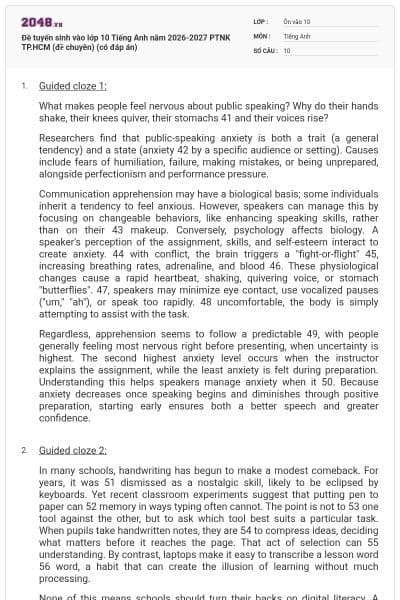
Guided cloze 1:
What makes people feel nervous about public speaking? Why do their hands shake, their knees quiver, their stomachs 41 and their voices rise?
Researchers find that public-speaking anxiety is both a trait (a general tendency) and a state (anxiety 42 by a specific audience or setting). Causes include fears of humiliation, failure, making mistakes, or being unprepared, alongside perfectionism and performance pressure.
Communication apprehension may have a biological basis; some individuals inherit a tendency to feel anxious. However, speakers can manage this by focusing on changeable behaviors, like enhancing speaking skills, rather than on their 43 makeup. Conversely, psychology affects biology. A speaker's perception of the assignment, skills, and self-esteem interact to create anxiety. 44 with conflict, the brain triggers a "fight-or-flight" 45, increasing breathing rates, adrenaline, and blood 46. These physiological changes cause a rapid heartbeat, shaking, quivering voice, or stomach "butterflies". 47, speakers may minimize eye contact, use vocalized pauses ("um," "ah"), or speak too rapidly. 48 uncomfortable, the body is simply attempting to assist with the task.
Regardless, apprehension seems to follow a predictable 49, with people generally feeling most nervous right before presenting, when uncertainty is highest. The second highest anxiety level occurs when the instructor explains the assignment, while the least anxiety is felt during preparation. Understanding this helps speakers manage anxiety when it 50. Because anxiety decreases once speaking begins and diminishes through positive preparation, starting early ensures both a better speech and greater confidence.
Questions 41 - 60 (1.00 pt) GUIDED CLOZE TEST
Choose the answer (A, B, C, or D) which fits best.
flutter
vibrate
shiver
murmur
Đáp án đúng: A
flutter = (bụng) nôn nao, xao động.
Dịch nghĩa: ...bụng họ nôn nao và giọng cao lên?
advanced
evoked
sustained
triggered
Đáp án đúng: D
triggered = bị kích hoạt (bởi khán giả/bối cảnh cụ thể).
Dịch nghĩa: ...lo âu bị kích hoạt bởi một khán giả hoặc bối cảnh cụ thể.
organic
cultural
natural
genetic
Đáp án đúng: D
genetic makeup = cấu tạo gen.
Dịch nghĩa: ...thay vì tập trung vào cấu tạo gen của mình.
Caught
Bound
Dealt
Faced
Đáp án đúng: D
be faced with = đối mặt với.
Dịch nghĩa: Khi đối mặt với xung đột, não kích hoạt phản ứng "chiến hay chạy".
reflection
response
reaction
reply
Đáp án đúng: B
fight-or-flight response = phản ứng "chiến hay chạy" (cụm cố định).
Dịch nghĩa: ...kích hoạt phản ứng "chiến hay chạy".
surge
stream
flow
pulse
Đáp án đúng: C
blood flow = lưu lượng máu.
Dịch nghĩa: ...làm tăng nhịp thở, adrenaline và lưu lượng máu.
Finally
Interestingly
Consequently
Ironically
Đáp án đúng: C
Consequently = do đó (chỉ kết quả).
Dịch nghĩa: Do đó, người nói có thể giảm giao tiếp bằng mắt, dùng từ đệm hoặc nói quá nhanh.
Despite
Unless
Though
Since
Đáp án đúng: C
Though + tính từ = dù (rút gọn "Though it is uncomfortable").
Dịch nghĩa: Dù gây khó chịu, cơ thể chỉ đang cố hỗ trợ thực hiện nhiệm vụ.
trend
pattern
schedule
rhythm
Đáp án đúng: B
follow a predictable pattern = theo một khuôn mẫu dự đoán được.
Dịch nghĩa: ...sự lo âu dường như theo một khuôn mẫu dự đoán được.
arouses
rears
arises
raises
Đáp án đúng: C
arise = nảy sinh, xuất hiện (nội động từ).
Dịch nghĩa: Hiểu điều này giúp người nói kiểm soát lo âu khi nó nảy sinh.
Dịch bài đọc:
NỖI LO KHI NÓI TRƯỚC ĐÁM ĐÔNG
Điều gì khiến người ta lo lắng khi nói trước đám đông? Vì sao tay họ run, đầu gối run rẩy, bụng nôn nao và giọng cao lên?
Các nhà nghiên cứu nhận thấy lo âu khi nói trước công chúng vừa là một đặc điểm (xu hướng chung), vừa là một trạng thái (lo âu bị kích hoạt bởi một khán giả hoặc bối cảnh cụ thể). Nguyên nhân gồm nỗi sợ bị bẽ mặt, thất bại, mắc lỗi hay chưa chuẩn bị kỹ, cùng với tính cầu toàn và áp lực thể hiện.
Sự e ngại giao tiếp có thể có cơ sở sinh học; một số người thừa hưởng xu hướng dễ lo âu. Tuy nhiên, người nói có thể kiểm soát điều này bằng cách tập trung vào những hành vi có thể thay đổi, như nâng cao kỹ năng nói, thay vì vào cấu tạo gen của mình. Ngược lại, tâm lý cũng tác động đến sinh học. Cách người nói nhìn nhận nhiệm vụ, kỹ năng và lòng tự trọng tương tác với nhau tạo nên lo âu. Khi đối mặt với xung đột, não kích hoạt phản ứng "chiến hay chạy", làm tăng nhịp thở, adrenaline và lưu lượng máu. Những thay đổi sinh lý này gây tim đập nhanh, run rẩy, giọng run hoặc cảm giác nôn nao trong bụng. Do đó, người nói có thể giảm giao tiếp bằng mắt, dùng những từ đệm ("ừm", "à") hoặc nói quá nhanh. Dù gây khó chịu, cơ thể chỉ đang cố hỗ trợ thực hiện nhiệm vụ.
Dù vậy, sự lo âu dường như theo một khuôn mẫu dự đoán được: người ta thường lo nhất ngay trước khi trình bày, khi mức độ bất định cao nhất. Mức lo âu cao thứ hai xuất hiện khi giáo viên giải thích nhiệm vụ, còn lo âu ít nhất là trong lúc chuẩn bị. Hiểu điều này giúp người nói kiểm soát lo âu khi nó nảy sinh. Vì lo âu giảm dần khi bắt đầu nói và vơi đi nhờ chuẩn bị tích cực, nên bắt đầu sớm sẽ đảm bảo cả bài nói tốt hơn lẫn sự tự tin cao hơn.
Guided cloze 2:
In many schools, handwriting has begun to make a modest comeback. For years, it was 51 dismissed as a nostalgic skill, likely to be eclipsed by keyboards. Yet recent classroom experiments suggest that putting pen to paper can 52 memory in ways typing often cannot. The point is not to 53 one tool against the other, but to ask which tool best suits a particular task. When pupils take handwritten notes, they are 54 to compress ideas, deciding what matters before it reaches the page. That act of selection can 55 understanding. By contrast, laptops make it easy to transcribe a lesson word 56 word, a habit that can create the illusion of learning without much processing.
None of this means schools should turn their backs on digital literacy. A child who cannot search responsibly or revise a shared document is at a 57. But a curriculum that treats handwriting as obsolete may be throwing away a simple 58 for thought. The best classrooms are not those that 59 to old methods or chase every new device; they teach students to choose deliberately. In that sense, the revival of handwriting is less a reactionary move than a reminder that learning is not always 60 by speed.
totally
utterly
summarily
superficially
Đáp án đúng: C
summarily = một cách vội vàng, dứt khoát (bác bỏ ngay lập tức).
Dịch nghĩa: Trong nhiều năm, nó bị bác bỏ vội vàng như một kỹ năng hoài cổ.
restore
retrieve
reinforce
recollect
Đáp án đúng: C
reinforce memory = củng cố trí nhớ.
Dịch nghĩa: ...việc đặt bút lên giấy có thể củng cố trí nhớ theo cách mà gõ phím thường không làm được.
pit
position
plant
place
Đáp án đúng: A
pit one against the other = đặt cái này đối đầu cái kia.
Dịch nghĩa: Vấn đề không phải đặt công cụ này chống lại công cụ kia.
prompted
permitted
prohibited
forced
Đáp án đúng: A
be prompted to + V = được thúc đẩy/khơi gợi làm gì.
Dịch nghĩa: Khi ghi chép bằng tay, học sinh được thúc đẩy phải cô đọng ý tưởng.
extend
inflate
deepen
enlarge
Đáp án đúng: C
deepen understanding = đào sâu/hiểu sâu hơn.
Dịch nghĩa: Hành động chọn lọc đó có thể giúp hiểu sâu hơn.
by
over
for
in
Đáp án đúng: C
word for word = từng chữ một.
Dịch nghĩa: ...máy tính khiến việc chép lại bài học từng chữ một trở nên dễ dàng.
drawback
deficit
disadvantage
downfall
Đáp án đúng: C
at a disadvantage = ở thế bất lợi (cụm cố định).
Dịch nghĩa: Một đứa trẻ không biết tìm kiếm có trách nhiệm hay chỉnh sửa tài liệu chung sẽ ở thế bất lợi.
substitute
shortcut
shelter
scaffold
Đáp án đúng: D
scaffold = giàn đỡ, khung nâng đỡ (cho tư duy).
Dịch nghĩa: Nhưng một chương trình học coi viết tay là lỗi thời có thể đang vứt bỏ một giàn đỡ đơn giản cho tư duy.
commit
cling
affix
abide
Đáp án đúng: B
cling to = bám víu vào (phương pháp cũ).
Dịch nghĩa: Những lớp học tốt nhất không phải nơi bám víu phương pháp cũ hay chạy theo mọi thiết bị mới.
exceeded
exacerbated
enriched
accelerated
Đáp án đúng: D
accelerated by speed = được thúc đẩy nhanh hơn bằng tốc độ (việc học không phải lúc nào cũng nhanh hơn nhờ vội vàng).
Dịch nghĩa: ...một lời nhắc rằng việc học không phải lúc nào cũng có thể được thúc đẩy nhanh hơn bằng tốc độ.
Dịch bài đọc:
SỰ TRỞ LẠI CỦA VIỆC VIẾT TAY
Ở nhiều trường học, viết tay đã bắt đầu trở lại một cách khiêm tốn. Trong nhiều năm, nó bị bác bỏ vội vàng như một kỹ năng hoài cổ, nhiều khả năng sẽ bị bàn phím lấn át. Tuy nhiên, các thử nghiệm gần đây trong lớp học cho thấy việc đặt bút lên giấy có thể củng cố trí nhớ theo cách mà gõ phím thường không làm được. Vấn đề không phải đặt công cụ này chống lại công cụ kia, mà là hỏi công cụ nào phù hợp nhất với một nhiệm vụ cụ thể. Khi ghi chép bằng tay, học sinh được thúc đẩy phải cô đọng ý tưởng, quyết định điều gì quan trọng trước khi viết ra. Hành động chọn lọc đó có thể giúp hiểu sâu hơn. Ngược lại, máy tính xách tay khiến việc chép lại bài học từng chữ một trở nên dễ dàng - một thói quen có thể tạo ra ảo giác về việc học mà không thật sự xử lý thông tin.
Điều này không có nghĩa là trường học nên quay lưng với năng lực số. Một đứa trẻ không biết tìm kiếm có trách nhiệm hay chỉnh sửa một tài liệu chung sẽ ở thế bất lợi. Nhưng một chương trình học coi viết tay là lỗi thời có thể đang vứt bỏ một giàn đỡ đơn giản cho tư duy. Những lớp học tốt nhất không phải nơi bám víu vào phương pháp cũ hay chạy theo mọi thiết bị mới; chúng dạy học sinh biết lựa chọn một cách có chủ đích. Theo nghĩa đó, sự trở lại của viết tay không hẳn là một bước lùi bảo thủ mà là lời nhắc rằng việc học không phải lúc nào cũng được thúc đẩy nhanh hơn bằng tốc độ.
Open cloze 1:
Every museum tells a story, but the most honest ones admit that their story could have been told otherwise. Objects rarely speak for 61. They acquire meaning in relation 62 the labels, rooms and routes that surround them. A cracked bowl may be presented 63 evidence of hardship, ingenuity or trade, 64 on the questions curators ask. This does not make museums unreliable; on the 65, it makes their responsibility clearer. Visitors need to know not only what is on 66_ but also what has been left out. In recent years, many museums have begun to invite communities 67 histories were once treated as marginal to help decide how collections should be interpreted. Such collaboration is not always easy. There are arguments over ownership, over painful memories, and over 68 a national institution can ever speak for those it once ignored. Still, the attempt matters. A museum that refuses to revise its story 69 turning heritage into decoration. A museum that listens, by contrast, allows the past to remain alive enough to challenge the present. It asks visitors to see history not as a set of facts over and done with, but as a conversation in which they too have a 70.
For questions 61-130, write your answers on the provided WRITTEN ANSWER SHEET.
Questions 61 - 80 (1.00 pt) OPEN CLOZE TEST
Complete each blank with ONE most suitable word.
Đáp án đúng: themselves
speak for themselves = tự lên tiếng (đồ vật hiếm khi tự nói lên ý nghĩa).
Đáp án đúng: to
in relation to = trong mối liên hệ với.
Đáp án đúng: as
be presented as = được trình bày như/dưới dạng.
Đáp án đúng: depending
depending on = tùy thuộc vào (những câu hỏi mà người phụ trách đặt ra).
Đáp án đúng: contrary
on the contrary = trái lại.
Đáp án đúng: display
on display = đang được trưng bày.
Đáp án đúng: whose
whose histories = mệnh đề quan hệ sở hữu (những cộng đồng mà lịch sử của họ...).
Đáp án đúng: whether
arguments over whether = tranh cãi về việc liệu...
Đáp án đúng: risks
risk + V-ing = có nguy cơ/liều biến di sản thành đồ trang trí.
It asks visitors to see history not as a set of facts over and done with, but as a conversation in which they too have a 70.
Đáp án đúng: say / voice
have a say/voice = có tiếng nói (trong cuộc đối thoại).
Dịch bài đọc:
Mỗi bảo tàng đều kể một câu chuyện, nhưng những bảo tàng trung thực nhất thừa nhận rằng câu chuyện ấy lẽ ra có thể được kể theo cách khác. Hiện vật hiếm khi tự nói lên ý nghĩa của mình. Chúng có ý nghĩa trong mối liên hệ với các nhãn chú thích, gian phòng và lối tham quan bao quanh. Một chiếc bát nứt có thể được trình bày như bằng chứng của sự gian khó, sự khéo léo hay thương mại, tùy vào những câu hỏi mà người phụ trách đặt ra. Điều này không khiến bảo tàng kém đáng tin; trái lại, nó làm rõ trách nhiệm của họ hơn. Khách tham quan cần biết không chỉ thứ gì đang được trưng bày mà cả những gì đã bị bỏ qua. Những năm gần đây, nhiều bảo tàng đã bắt đầu mời các cộng đồng từng bị xem là bên lề cùng tham gia quyết định cách diễn giải bộ sưu tập. Sự hợp tác đó không phải lúc nào cũng dễ. Có những tranh cãi về quyền sở hữu, về những ký ức đau thương, và về việc liệu một thiết chế quốc gia có bao giờ thật sự nói thay được cho những người mà nó từng phớt lờ. Dù vậy, nỗ lực ấy vẫn đáng giá. Một bảo tàng từ chối xem lại câu chuyện của mình có nguy cơ biến di sản thành đồ trang trí. Ngược lại, một bảo tàng biết lắng nghe sẽ để quá khứ sống động đủ để thách thức hiện tại. Nó mời khách tham quan nhìn lịch sử không phải như một tập hợp sự kiện đã xong xuôi, mà như một cuộc đối thoại mà chính họ cũng có tiếng nói.
Open cloze 2:
The latest Al slop to take the internet by 71 features anthropomorphic fruit, specifically TikTok-based soap 72 videos channeling fruit and their love lives. Created with minimal human input, this low-quality, AI-generated content is as easy to absorb as it is to churn out. While specifics may 73 the majority of these clips are telenovela or reality TV-styled, featuring cartoony humanoid fruits with strangely mature 74 matter. For instance, viewers might watch a weeping strawberry discover her partner cheating 75 her, or two coconuts struggling to feed their children.
While to adults, the propagation of these fruit videos feels ridiculous on the 76 there is an insidious underbelly, namely the exploitation of children's media and its subsequent 77 on younger audiences. With bright colors and speedy pacing, these videos mimic the style of 78 marketed at children, such as by Cocomelon, albeit with wildly inappropriate themes. While it is true that children consuming age-inappropriate media is not new, AI has accelerated the output rate, 79 multiplies exposure frequency and normalizes such content. Frankly, tech corporations, specifically Al companies, ought to be 80 accountable for this rampant, uncontrolled spread of harmful AI slop.
Đáp án đúng: storm
take ... by storm = gây bão, làm mưa làm gió.
Đáp án đúng: opera
soap opera = phim truyền hình dài tập ướt át.
Đáp án đúng: vary / differ
specifics may vary/differ = các chi tiết có thể khác nhau.
Đáp án đúng: subject
subject matter = nội dung, đề tài.
Đáp án đúng: on
cheat on somebody = phản bội/ngoại tình với ai.
Đáp án đúng: surface
on the surface = nhìn bề ngoài.
Đáp án đúng: effect(s) / influence(s) / impact(s)
effect/influence/impact on = tác động đến (khán giả nhỏ tuổi).
Đáp án đúng: those
those (marketed at children) = những nội dung/video được nhắm tới trẻ em.
Đáp án đúng: which
which = đại từ quan hệ thay cho cả mệnh đề trước (việc AI tăng tốc sản xuất).
Frankly, tech corporations, specifically Al companies, ought to be 80 accountable for this rampant, uncontrolled spread of harmful AI slop.
Đáp án đúng: held
hold somebody accountable = buộc ai chịu trách nhiệm.
Dịch bài đọc:
"Rác AI" mới nhất gây bão trên mạng có nội dung về các loại trái cây được nhân cách hóa, cụ thể là những video kiểu phim truyền hình dài tập trên TikTok xoay quanh trái cây và chuyện tình cảm của chúng. Được tạo ra với rất ít sự tham gia của con người, loại nội dung kém chất lượng do AI sản sinh này dễ tiếp nhận đến mức nào thì cũng dễ sản xuất hàng loạt đến mức đó. Dù các chi tiết có thể khác nhau, phần lớn các clip này mang phong cách phim mê-lô hoặc truyền hình thực tế, với những trái cây hình người ngộ nghĩnh nhưng nội dung lại "người lớn" một cách kỳ lạ. Chẳng hạn, người xem có thể thấy một quả dâu khóc lóc phát hiện bạn đời phản bội mình, hay hai quả dừa chật vật nuôi con.
Với người lớn, sự lan tràn của những video trái cây này trông thật lố bịch; nhưng nhìn bề ngoài thôi đã thấy một mặt trái nguy hiểm: sự lợi dụng nội dung dành cho trẻ em và tác động kéo theo lên khán giả nhỏ tuổi. Với màu sắc rực rỡ và nhịp độ nhanh, các video này bắt chước phong cách của những nội dung nhắm tới trẻ em, như của Cocomelon, nhưng lại kèm những chủ đề hoàn toàn không phù hợp. Đúng là việc trẻ em xem nội dung không phù hợp lứa tuổi không phải chuyện mới, nhưng AI đã tăng tốc độ sản xuất, từ đó nhân lên tần suất tiếp xúc và bình thường hóa loại nội dung này. Thẳng thắn mà nói, các tập đoàn công nghệ, đặc biệt là các công ty AI, phải bị buộc chịu trách nhiệm về sự lan tràn tràn lan, mất kiểm soát của thứ rác AI độc hại này.
Read the passage below and answer the questions that follow.
A librarian reflects on the value of libraries
Unlike many librarians who always dreamed of standing behind a counter and stamping books, I came to the profession by accident. When I left university with a humanities degree in the 1970s, I had no clue about what I wanted to do with my state-funded higher education. I applied for a job as a gas meter reader which seemed suitable for a working-class lad from a council estate, but at the interview I was told that I was over-qualified and so I became a library assistant instead. I quickly discovered that there wasn't much to the library lark, and if I wanted to get on I would have to become a fully qualified librarian.
Armed with my diploma and a burning social conscience, I set out to change the world of public libraries. Nearly 40 years on I have made the smallest of dents in its battleship armour. But on the way I have met some amazing people. My bosses have mostly been of the keep-your-head-down-and-don't-rock-the-boat variety. Colleagues have ranged from shrinking violets to strident activists who share my passion. And the customers - whom we endearingly call borrowers, like those little people who live under the floor - have come from every walk of life. Public libraries seem to attract more than their fair share of what might be called "characters".
There is never a dull moment in the life of a public library. We open our doors and anyone can come in, so we never know quite what to expect and every day is very different. One of the most extraordinary things that has happened to me at work was when I was asked to search my central London library for bombs during a terror alert. I had contacted the police when I received a bomb threat but, as they pointed out, "you know what the library looks like, so please have a walk around to see if anything is out of place". Fortunately, it was a false alarm and there were no incendiary devices hidden in the card catalogue. Some of the funniest things that have happened to me at work include the discovery of a piece of streaky bacon stuck between the pages of a detective novel. I pictured the borrower, reading his book at the breakfast table before rushing off to work, and reaching out for whatever was at hand to mark his page.
I love my job so much that work-life balance has never been an issue. Plus, I am very happy to take my work home with me because I never leave the library without a big stack of books, CDs and DVDs. The only regret I have about my long career in public libraries is that I have not been able to convince more librarians that they should be less book-focused and more people-focused; that they should look outward to the community rather than inward to the library; that they should get rid of desks and counters and do more active roving inside the library and outside in the community; that they should put less emphasis on the excellence of the collection and more on providing books that people actually want to read; and, most important of all, that libraries should be community-led and based on the needs of the public they serve.
What I dislike most about the profession is its insistence on standards of excellence and a rule-bound culture which tends to exclude those for whom public libraries were founded in the first place - the deserving poor and, indeed, the undeserving poor as well. For it is a fact that libraries are used most by those who need them the least (the middle class) and used the least by those who need them the most (the working class).
The job has, regrettably, not changed much from when I started out. Libraries have been modernised through technology but their underlying strategies, structures, systems and culture remain the same. We have a plethora of rules and regulations, and the part of my job I dread the most is having to ban someone from the library, because usually they come from the section of society that needs libraries the most. But this is more than balanced out by the many pleasures of the job, which include helping borrowers to improve the quality of their lives and meet their needs - whether that is for books and information, or helping them to find a job or a roof over their head.
Librarians are chronically underpaid but we don't do the job just for the money. [I] More money is always good, but what we really want is recognition from politicians that we are the fourth emergency service. [II] Proving this is difficult, but we are already starting to see what happens when public libraries are closed down. [III] Library closures are low-hanging fruit but the tiny amounts that this saves from the public purse is more than outweighed by the costs of increased crime, and worsening health and education outcomes. [IV] While we cannot demonstrate a direct link, every librarian knows that we are an important ingredient of the glue that sticks communities together.
READING (2.5 pts) - Questions 81-105
Questions 81 - 88 READING PASSAGE 1 (0.80 pt)
What was the main reason the writer decided to become a qualified librarian?
He had no career plans after graduation.
He was dissatisfied with being an assistant.
He was over-qualified as an assistant.
He was not suitable for other career paths.
Đáp án đúng: B
Bài viết: vì "library lark" chẳng có gì nhiều, nếu muốn tiến thân anh phải trở thành thủ thư chính quy → không hài lòng với vị trí trợ lý.
What does the writer say about his experiences as a librarian in the second paragraph?
He did not respect his bosses' opinions.
He mostly encountered eccentric people.
He was not very successful with his cause.
He was surprised by the diversity of visitors.
Đáp án đúng: C
"Nearly 40 years on I have made the smallest of dents" → anh không mấy thành công với lý tưởng của mình.
What is the tone of the writer in the third paragraph?
ironic
nostalgic
amused
excited
Đáp án đúng: C
Đoạn 3 kể những chuyện dở khóc dở cười (miếng thịt xông khói kẹp làm dấu sách, lùng bom hóa báo động giả) → giọng điệu hài hước, thích thú.
What criticism does the writer have of some librarians in the fourth paragraph?
They are not friendly enough to visitors.
They fail to maintain the excellence of book collections.
They adopt a passive attitude to work.
They are negligent of the community.
Đáp án đúng: D
Anh phê phán các thủ thư nên hướng ra cộng đồng thay vì chỉ chăm chăm vào sách và bên trong thư viện → họ lơ là cộng đồng.
What is the writer's attitude to the fact that his job has changed very little?
indifferent
relieved
surprised
disappointed
Đáp án đúng: D
"regrettably, not changed much" → thái độ thất vọng.
Which can best replace the word 'chronically' in the final paragraph?
incurably
sickeningly
constantly
severely
Đáp án đúng: D
Ở đây "chronically" mang nghĩa nhấn mạnh mức độ → severely (bị trả lương thấp trầm trọng).
What does the writer suggest about library closures?
Their impact is not immediately noticeable.
They represent a short-sighted approach.
They can have adverse financial effects.
They threaten the well-being of poor people.
Đáp án đúng: B
Đóng cửa thư viện chỉ tiết kiệm chút ít nhưng kéo theo chi phí lớn về tội phạm, sức khỏe, giáo dục → một cách làm thiển cận.
Where does the following sentence best fit in the final paragraph?
'It brings a great deal of satisfaction helping others who are significantly less fortunate than ourselves.'
I]
[I]
[lI]
[IV]
Đáp án đúng: A (vị trí [I])
Câu "Giúp đỡ những người kém may mắn hơn mang lại rất nhiều niềm vui" nối tiếp ý "chúng tôi không làm nghề chỉ vì tiền" → vị trí [I].
Dịch bài đọc:
Khác với nhiều thủ thư luôn mơ được đứng sau quầy đóng dấu sách, tôi đến với nghề một cách tình cờ. Khi rời đại học với tấm bằng khoa học xã hội nhân văn vào những năm 1970, tôi chẳng biết mình muốn làm gì với nền học vấn được nhà nước tài trợ. Tôi nộp đơn xin làm nhân viên đọc đồng hồ ga - công việc có vẻ hợp với một cậu trai lao động ở khu nhà ở xã hội - nhưng tại buổi phỏng vấn, tôi được bảo là quá thừa trình độ, thế là tôi thành trợ lý thư viện. Tôi nhanh chóng nhận ra công việc thư viện chẳng có gì nhiều, và nếu muốn tiến thân thì phải trở thành thủ thư chính quy.
Với tấm bằng và một bầu nhiệt huyết vì xã hội, tôi quyết tâm thay đổi thế giới thư viện công cộng. Gần 40 năm trôi qua, tôi chỉ tạo được vết lõm nhỏ xíu trên lớp giáp thiết giáp hạm của nó. Nhưng trên đường đi tôi đã gặp những con người tuyệt vời. Các sếp của tôi phần lớn thuộc kiểu "cúi đầu mà làm, đừng làm xáo trộn". Đồng nghiệp thì từ những người rụt rè đến những nhà hoạt động mạnh mẽ chung chí hướng với tôi. Còn khách hàng - mà chúng tôi trìu mến gọi là "người mượn" - đến từ mọi tầng lớp. Thư viện công cộng dường như thu hút nhiều "nhân vật đặc biệt" hơn mức bình thường.
Cuộc sống ở thư viện công cộng chẳng bao giờ buồn tẻ. Chúng tôi mở cửa và ai cũng có thể vào, nên chẳng bao giờ biết trước điều gì, ngày nào cũng rất khác. Một trong những chuyện phi thường nhất từng xảy ra với tôi là khi tôi được yêu cầu lùng bom trong thư viện ở trung tâm London giữa lúc báo động khủng bố. Tôi đã gọi cảnh sát khi nhận lời đe dọa đánh bom, nhưng họ bảo: "Anh biết thư viện trông thế nào, nên hãy đi một vòng xem có gì bất thường không." May thay, đó là báo động giả và chẳng có thiết bị nổ nào giấu trong tủ phiếu mục lục. Một trong những chuyện buồn cười nhất là tôi phát hiện một miếng thịt xông khói kẹp giữa các trang một cuốn tiểu thuyết trinh thám. Tôi hình dung người mượn sách đang đọc ở bàn ăn sáng rồi vội đi làm, tiện tay vớ lấy thứ gì gần nhất để đánh dấu trang.
Tôi yêu công việc này đến mức cân bằng công việc - cuộc sống chưa bao giờ là vấn đề. Hơn nữa, tôi vui vẻ mang việc về nhà vì chẳng bao giờ rời thư viện mà không ôm theo một chồng sách, CD và DVD. Điều duy nhất tôi tiếc trong sự nghiệp dài là chưa thuyết phục được nhiều thủ thư hơn rằng họ nên bớt chú trọng vào sách mà chú trọng vào con người hơn; nên hướng ra cộng đồng thay vì hướng vào trong thư viện; nên bỏ bàn và quầy để đi lại nhiều hơn trong thư viện và ra ngoài cộng đồng; nên bớt nhấn mạnh vào sự hoàn hảo của bộ sưu tập mà cung cấp những cuốn sách người ta thật sự muốn đọc; và quan trọng nhất, thư viện nên do cộng đồng dẫn dắt và dựa trên nhu cầu của công chúng mà nó phục vụ.
Điều tôi ghét nhất ở nghề này là việc nó khăng khăng theo các chuẩn mực "xuất sắc" và một văn hóa cứng nhắc đầy quy tắc, vốn lại loại trừ chính những người mà thư viện công cộng được lập ra để phục vụ - người nghèo "xứng đáng" và cả người nghèo "không xứng đáng". Bởi sự thật là thư viện được dùng nhiều nhất bởi những người ít cần nó nhất (tầng lớp trung lưu) và ít được dùng nhất bởi những người cần nó nhất (tầng lớp lao động).
Đáng tiếc, công việc gần như không thay đổi nhiều so với khi tôi mới vào nghề. Thư viện đã được hiện đại hóa nhờ công nghệ, nhưng các chiến lược, cơ cấu, hệ thống và văn hóa nền tảng vẫn như cũ. Chúng tôi có vô số quy tắc, và phần việc tôi sợ nhất là phải cấm cửa ai đó, vì thường họ thuộc nhóm cần thư viện nhất. Nhưng điều này được bù đắp hơn cả bởi nhiều niềm vui của nghề, gồm việc giúp người mượn cải thiện chất lượng sống và đáp ứng nhu cầu của họ - dù là sách và thông tin, hay giúp họ tìm việc làm hoặc một mái nhà.
Thủ thư bị trả lương thấp triền miên, nhưng chúng tôi không làm nghề chỉ vì tiền. Giúp đỡ những người kém may mắn hơn mình rất nhiều mang lại niềm thỏa mãn lớn lao. Tiền nhiều hơn thì luôn tốt, nhưng điều chúng tôi thật sự mong là sự công nhận từ các chính trị gia rằng chúng tôi là lực lượng khẩn cấp thứ tư. Chứng minh điều đó rất khó, nhưng ta đã bắt đầu thấy chuyện gì xảy ra khi thư viện công cộng bị đóng cửa. Đóng cửa thư viện là "trái chín dễ hái", nhưng khoản tiền ít ỏi tiết kiệm được cho ngân sách công lại không bù nổi chi phí do tội phạm gia tăng cùng sức khỏe và giáo dục sa sút. Dù không thể chứng minh mối liên hệ trực tiếp, mọi thủ thư đều biết chúng tôi là một thành phần quan trọng trong thứ keo gắn kết cộng đồng.
The True Price of a Tree
By David Suzuki
We were standing in an ancient forest that was threatened with clear-cut logging. He was the CEO of the company that had been allotted the tree farm license that enabled him to drive a road into the valley and begin the industrial extraction of the trees that would destroy what took millennia to evolve. We had engaged in an animated argument about the fate of that forest while standing face to face less than half a meter apart.
89
"Unless, of course, you tree huggers decide you'll pay money to save it so you can enjoy it. Think your cronies can raise enough money to save the entire forest? Logging is what keeps the economy of this province growing and makes it possible for you preservationists to wear clothes, drive cars, and watch TV."
90
But the perspective through which I viewed the forest-of which that tree was a part—was radically different. That one tree was a tiny part of a community of organisms thousands of years in the making. That community is made up of trees ("merchantable timber," or "fiber," in the jargon of the industry) that are a tiny minority of the lifeforms that comprise the forest.
91
This is the community that we recognize as a forest, complex and interlinked beyond comprehension and all held together by the air, water, and sunlight that suffuse them.
92
Consequently, companies require geneticists to breed fast-growing strains of commercially valuable trees, tree planters, herbicides to clear out "weed" (i.e., commercially worthless) species, insecticides to eliminate pests, fertilizers to restore nutrition to the soil, and firefighters. Large clear-cuts and the use of heavy machinery expose soil flora and fauna to sunlight, wind, and air. This alters water retention in the streams and rivers that are the lifeblood of the forest, radically transforming the remaining species mix.
93
The entire forest is like the goose that laid golden eggs in the children's fable; as long as the goose is fat and healthy, it will yield golden eggs indefinitely. In the short-term perspective of global economics, as in the children's story, forestry companies attempt to gather all of the eggs at once by killing the goose.
94
Returning to the CEO's statement that the tree only acquires value when it enters our economy by generating revenue, consider what the tree does before humans define its value. Hundreds of years old, that tree has absorbed carbon dioxide (a greenhouse gas) from the air, thereby playing a part in life's climate engine, and releases oxygen as a byproduct of photosynthesis-not a bad byproduct for all animals like us that are completely dependent on that oxygen for survival.
95
All of these natural services performed by that single standing tree affect human health and survival, yet they are entirely ignored by our economy. It's long past time when we started lifting our horizons and values beyond the extremely limited perspective of conventional economics.
List of paragraphs:
A. As I pointed out in the book Good News for a Change: Hope for a Troubled Planet, by selective logging at or below the growth rate of the trees in a forest, trees can be profitably "harvested" indefinitely instead of once every hundred years or more. Nor is the diversity that is the key to resilience and regeneration sacrificed when trees are selectively removed.
B. Recent studies on urban forestry indicate that compared to natural wild areas, isolated city parks do not offer the same microclimate stability. There, only invasive species and drought-tolerant shrub species thrive rather than native canopy trees. Because of this, urban planners cannot rely solely on localized tree-planting initiatives to emulate the effects of natural forests.
C. The soil is a living organism made up of tens of thousands of species of microorganisms-viruses, bacteria, fungi, protozoa-and larger nematodes, worms, insects, and mites. Plants and animals blanket the forest floor, lichens and mosses coat rocks and decaying wood, snags and fallen logs provide nutrition and protection for countless organisms.
D. "You see that tree over there?" he shouted, pointing to a giant that was probably many centuries old. Without waiting for my response, he continued, "It doesn't have any value until it's cut down." I was dumbstruck by the statement, giving him the opening to carry on.
E. Foresters rationalize these practices as "proper silvicultural management," as if they know what it is that creates the original forest that was cut down. Of course, they have no idea. They lack both a proper inventory of all the constituent species that make up the forest and a blueprint that explains how all of the components are interconnected.
F. What had made me speechless was the realization that he was right. In the value system inherent in the form of economics our society has embraced, only when money is exchanged for goods and services is the transaction recognized as having economic worth.
G. Likewise, the roots of the tree cling to soil even under the hardest of rains, thereby inhibiting erosion while siphoning vast quantities of water up into the canopy, where it is released through transpiration, hence ameliorating weather. From roots to tips of branches, the tree offers a habitat for countless forms of life, from lichens and fungi to insects, birds, and mammals.
H. What foresters refer to as a "second-growth forest" is not a forest at all but a tree plantation - an attempt to grow trees like a crop of tomato or corn plants. But of course, such a "managed forest," or "fiber farm," no longer has the resilience, regenerative capacity, or self-protective devices of a natural forest.
I. Consequently, while carbon offset credits offer a lucrative alternative for developing nations to preserve forest areas, local enforcement often fails to prevent illegal logging operations along unmarked borders. This instability makes it difficult for conservation groups to project the long-term financial viability of these corporate partnerships.
Questions 89 - 95 READING PASSAGE 2 (0.70 pt)
Seven paragraphs have been removed from Reading Passage 2. Choose from the texts A - I the one which fits each gap (89 - 95). There are TWO extra paragraphs you do not need.
Đáp án đúng: D
Sau đoạn mở đầu về cuộc tranh luận, D bắt đầu bằng lời CEO chỉ vào cái cây: "It doesn't have any value until it's cut down."
Đáp án đúng: F
Nối tiếp lời CEO, F: "Điều khiến tôi á khẩu là nhận ra ông ta đúng..." (trong hệ giá trị kinh tế hiện hành)
This is the community that we recognize as a forest, complex and interlinked beyond comprehension and all held together by the air, water, and sunlight that suffuse them.
Đáp án đúng: C
C mô tả đất rừng là một cơ thể sống đầy vi sinh vật, cây cỏ, địa y... dẫn tới câu sau: "Đây là cộng đồng mà ta gọi là rừng".
Đáp án đúng: H
H giải thích "rừng tái sinh" thực chất chỉ là đồn điền cây, mất khả năng tự phục hồi → dẫn đến "Do đó, các công ty cần đến nhà di truyền học...".
Đáp án đúng: E
E: "Các nhà lâm nghiệp biện minh đây là 'quản lý lâm sinh hợp lý'..." nối tiếp việc khai thác làm biến đổi hệ loài.
Đáp án đúng: A
A nói về khai thác chọn lọc dưới mức tăng trưởng để thu hoạch bền vững mãi mãi — đối lập với việc "giết con ngỗng" ở đoạn trước.
Đáp án đúng: G
G: "Tương tự, rễ cây bám đất..." nối tiếp đoạn nói về việc cây hấp thụ CO₂ và nhả oxy.
Dịch bài đọc:
Chúng tôi đứng trong một khu rừng nguyên sinh đang bị đe dọa chặt trắng. Ông ta là CEO của công ty được cấp phép khai thác, cho phép ông mở đường vào thung lũng và bắt đầu khai thác công nghiệp những cây cối phải mất hàng thiên niên kỷ mới hình thành. Chúng tôi tranh luận gay gắt về số phận khu rừng, đứng đối mặt cách nhau chưa đầy nửa mét.
"Anh thấy cái cây kia chứ?" ông ta hét lên, chỉ vào một cây khổng lồ có lẽ đã nhiều thế kỷ tuổi. Không đợi tôi đáp, ông tiếp: "Nó chẳng có giá trị gì cho đến khi bị đốn hạ." Tôi sững người trước câu nói đó, để ông có cơ hội nói tiếp.
"Trừ phi, dĩ nhiên, mấy kẻ ôm cây các anh chịu bỏ tiền ra cứu nó để mà thưởng thức. Anh nghĩ đám bạn anh gom đủ tiền cứu cả khu rừng à? Khai thác gỗ mới là thứ giữ cho kinh tế tỉnh này tăng trưởng và giúp những người bảo tồn như anh có quần áo mặc, xe để lái, tivi để xem."
Điều khiến tôi á khẩu là nhận ra ông ta nói đúng. Trong hệ giá trị của thứ kinh tế học mà xã hội ta đã chấp nhận, chỉ khi tiền được trao đổi lấy hàng hóa và dịch vụ thì giao dịch mới được xem là có giá trị kinh tế.
Nhưng lăng kính tôi nhìn khu rừng mà cái cây ấy là một phần lại khác hẳn. Cái cây đó chỉ là một phần nhỏ của một cộng đồng sinh vật hình thành qua hàng nghìn năm. Cộng đồng đó gồm những cây gỗ (mà ngành công nghiệp gọi là "gỗ thương phẩm" hay "sợi") vốn chỉ là thiểu số nhỏ bé trong vô vàn dạng sống tạo nên rừng.
Đất là một cơ thể sống gồm hàng chục nghìn loài vi sinh vật - virus, vi khuẩn, nấm, động vật nguyên sinh cùng giun tròn, giun đất, côn trùng và ve bét. Cây cỏ và muông thú phủ kín nền rừng, địa y và rêu bám trên đá và gỗ mục, cây khô đứng và thân cây đổ cung cấp dinh dưỡng và nơi trú ẩn cho vô số sinh vật.
Đây là cộng đồng mà ta nhận ra là một khu rừng, phức tạp và liên kết với nhau ngoài sức tưởng tượng, tất cả được gắn kết bởi không khí, nước và ánh sáng thấm đẫm chúng.
Cái mà các nhà lâm nghiệp gọi là "rừng tái sinh" thực ra không phải rừng mà là một đồn điền cây - một nỗ lực trồng cây như trồng cà chua hay ngô. Nhưng dĩ nhiên, một "khu rừng được quản lý" hay "trang trại sợi" như vậy không còn khả năng phục hồi, tái sinh hay tự bảo vệ của một khu rừng tự nhiên.
Do đó, các công ty cần đến nhà di truyền học để lai tạo những giống cây thương phẩm tăng trưởng nhanh, cần người trồng cây, thuốc diệt cỏ để dọn các loài "cỏ dại" (loài vô giá trị thương mại), thuốc trừ sâu, phân bón để phục hồi dinh dưỡng cho đất, và lính cứu hỏa. Những khoảnh chặt trắng lớn và việc dùng máy móc hạng nặng phơi bày hệ động thực vật trong đất ra nắng, gió và không khí. Điều này làm thay đổi khả năng giữ nước của các con suối và sông - mạch sống của rừng biến đổi tận gốc thành phần loài còn lại.
Các nhà lâm nghiệp biện minh những việc làm này là "quản lý lâm sinh hợp lý", như thể họ biết điều gì tạo nên khu rừng nguyên sinh đã bị chặt. Tất nhiên họ chẳng biết. Họ vừa thiếu bản kiểm kê đầy đủ về mọi loài cấu thành rừng, vừa thiếu một bản thiết kế giải thích tất cả các thành phần liên kết với nhau ra sao.
Toàn bộ khu rừng giống như con ngỗng đẻ trứng vàng trong ngụ ngôn thiếu nhi: chừng nào con ngỗng còn béo tốt khỏe mạnh, nó sẽ đẻ trứng vàng mãi. Trong tầm nhìn ngắn hạn của kinh tế toàn cầu, như trong câu chuyện cổ, các công ty lâm nghiệp cố vơ hết trứng cùng một lúc bằng cách giết con ngỗng.
Như tôi đã chỉ ra trong cuốn Good News for a Change, bằng cách khai thác chọn lọc ở mức bằng hoặc dưới tốc độ tăng trưởng của cây, ta có thể "thu hoạch" cây sinh lời vô thời hạn thay vì cả trăm năm mới một lần. Sự đa dạng - chìa khóa của khả năng phục hồi và tái sinh cũng không bị hy sinh khi cây được lấy đi có chọn lọc.
Trở lại lời CEO rằng cái cây chỉ có giá trị khi bước vào nền kinh tế của chúng ta bằng cách tạo ra doanh thu, hãy xét xem cái cây làm gì trước khi con người định giá nó. Hàng trăm năm tuổi, cây ấy đã hấp thụ khí carbon dioxide (một khí nhà kính) từ không khí, qua đó góp phần vào cỗ máy khí hậu của sự sống, và nhả ra oxy như sản phẩm phụ của quang hợp — một sản phẩm phụ không tệ chút nào với những loài động vật như chúng ta vốn hoàn toàn phụ thuộc vào oxy để sống.
Tương tự, rễ cây bám chặt đất ngay cả dưới những trận mưa dữ dội nhất, nhờ đó ngăn xói mòn trong khi hút lượng nước khổng lồ lên tán lá, nơi nước được giải phóng qua thoát hơi, từ đó điều hòa thời tiết. Từ rễ đến ngọn cành, cây là nơi cư trú cho vô số dạng sống, từ địa y, nấm đến côn trùng, chim và thú.
Tất cả những dịch vụ tự nhiên do một cái cây đang đứng đó thực hiện đều ảnh hưởng đến sức khỏe và sự sống còn của con người, vậy mà nền kinh tế của chúng ta hoàn toàn phớt lờ chúng. Đã quá muộn để ta bắt đầu nâng tầm nhìn và giá trị của mình vượt ra khỏi lăng kính cực kỳ hạn hẹp của kinh tế học thông thường.
Read the passage below and answer the questions which follow.
British anthropologist Sir Edward Burnett Tylor espoused the classic definition of culture in 1871, describing it as that complex whole which includes knowledge, belief, arts, morals, law, custom, and any other capabilities and habits acquired by man as a member of society." Culture is learned; it is not something that is biologically determined. This is in contrast to our innate ability to acquire language. Regardless, the particular language an individual first learns - their "mother tongue" - can "only be acquired by man as a member of society." Language, therefore, is a part of one's culture, but at the same time, language is used to transmit that culture, to teach that culture. In fact, culture and language are interdependent. No type of human society can be maintained if its members do not share a common language. Moreover, language, the most common way people communicate, could not have developed outside a social setting
Language both expresses culture and reflects culture. Some linguists and anthropologists argue that different languages produce different ways of thinking. Cultures organize and view the world in diverse ways, and their languages support these differences through grammar and vocabulary. By studying lexical classification in various languages, scientists have been able to show that speakers of different languages perceive and distinguish things differently. The Nuer people of Sudan, for instance, traditionally were cattle herders, and their entire lifestyle centered on cattle, so their language has dozens of words for cattle. Another cultural-dependent concept is time. English speakers divide time into past, present and future, and English grammar has tenses to reflect this view of time. On the other hand, the Hopi, a Native American tribe of the Southwest United States, only make a distinction between events that have existed or exist (English past and present) and those that do not exist or do not yet exist (English future, including the subjunctive case used for possibility). Their language does not differentiate between present and past. Similarly, the complexity of vocabulary in a language to describe family relationships varies depending on the role of kinship in that culture. Color terminology also varies widely by language. Those that involved in areas with a history of using dyes and artificial coloring have the broadest range of color vocabulary.
Living languages, of course, undergo constant but often gradual transformation, as new words and expressions are added to the lexicon and meanings of words are altered. Different cultures can speak the same basic language, but it will have variations reflecting those different cultures. For instance, Koreans share a common language, but after six decades of being separated by a tightly sealed border, the cultures of North and South Korea have diverged along with the Korean language. If a South Korean asks a North Korean how they are doing, the North Korean would likely reply "liupsopneda", an expression that literally means "not much," which has a sense similar to "I'm fine, thanks." Yet, that same expression would mean "Mind your own business!" to the South Korean. Both North and South Korean use the word "mije," but in the North it means "American imperialist," while in the South it means, "Made in the USA."
Within a culture, language can also play an important role in differentiating occupational groups and social status. Many groups have their own "focal vocabulary," that is, a specialized set of terms that are important to them and what they do. On a Hollywood film set, when the gaffer, head electrician, yells to the crew to "Kill the baby!" he is not talking about child murder. He is instructing the electricians to turn off a small light. Moreover, people want to improve their social status will try to adopt the habits, attitudes, and behavioural traits of the group to which they aspire. In terms of language, this includes trying to shift how they speak by taking on the speech patterns and vocabulary associated in their culture with the higher social status.
In any culture, language is more than just a means of conveying information. Significant aspects of a culture are embedded in the structure of its language, in its vocabulary, grammar, and usage. The distinctions a language makes between genders, how it refers to time and space, and the different ways language conveys rank, respect, and love are all related to the culture in which it is used.
Questions 96 - 100: Do the following statements agree with the information given in the passage?
Write TRUE if the statement agrees with the information
FALSE if the statement contradicts the information
NOT GIVEN if there is no information on this
Each person is born with specific cultural traits.
Đáp án đúng: FALSE
Bài viết: "Culture is learned; it is not biologically determined" → văn hóa là học được, không phải bẩm sinh.
Certain animals can be referred to with different words in Nuer culture.
Đáp án đúng: TRUE
Người Nuer có hàng chục từ chỉ gia súc → cùng một loài vật có thể được gọi bằng nhiều từ.
The Hopi people's expression of time is more limited compared to English speakers.
Đáp án đúng: NOT GIVEN
Bài chỉ nói tiếng Hopi phân biệt thời gian khác (tồn tại/chưa tồn tại), không khẳng định nó "hạn chế hơn" so với tiếng Anh.
Đáp án đúng: TRUE
"liupsopneda" với người Hàn Quốc lại mang nghĩa "Việc của anh, anh lo!" → nghe có vẻ thiếu thiện cảm.
Some Hollywood terms are derived from murder mystery films.
Đáp án đúng: NOT GIVEN
Bài không đề cập các thuật ngữ Hollywood bắt nguồn từ phim trinh thám giết người.
Dịch bài đọc:
Nhà nhân học người Anh Sir Edward Burnett Tylor đưa ra định nghĩa kinh điển về văn hóa năm 1871, mô tả nó là "cái tổng thể phức hợp bao gồm tri thức, niềm tin, nghệ thuật, đạo đức, luật pháp, phong tục, và mọi năng lực, thói quen khác mà con người tiếp thu với tư cách là thành viên của xã hội." Văn hóa là thứ học được; nó không do sinh học quyết định. Điều này trái với khả năng bẩm sinh của ta trong việc thụ đắc ngôn ngữ. Dù vậy, ngôn ngữ đầu tiên mà một người học "tiếng mẹ đẻ" lại "chỉ có thể được tiếp thu với tư cách thành viên của xã hội." Do đó, ngôn ngữ là một phần của văn hóa, nhưng đồng thời ngôn ngữ được dùng để truyền tải và dạy văn hóa đó. Thực vậy, văn hóa và ngôn ngữ phụ thuộc lẫn nhau. Không một kiểu xã hội loài người nào có thể duy trì nếu các thành viên không chia sẻ một ngôn ngữ chung. Hơn nữa, ngôn ngữ, cách phổ biến nhất để con người giao tiếp không thể phát triển ngoài một bối cảnh xã hội.
Ngôn ngữ vừa biểu đạt vừa phản ánh văn hóa. Một số nhà ngôn ngữ và nhân học cho rằng những ngôn ngữ khác nhau tạo ra những cách tư duy khác nhau. Các nền văn hóa tổ chức và nhìn nhận thế giới theo những cách đa dạng, và ngôn ngữ của họ thể hiện những khác biệt đó qua ngữ pháp và từ vựng. Qua việc nghiên cứu cách phân loại từ vựng trong các ngôn ngữ, các nhà khoa học đã chỉ ra rằng người nói các ngôn ngữ khác nhau tri giác và phân biệt sự vật theo những cách khác nhau. Chẳng hạn, người Nuer ở Sudan vốn chăn nuôi gia súc, cả lối sống của họ xoay quanh gia súc, nên ngôn ngữ của họ có hàng chục từ chỉ gia súc. Một khái niệm khác phụ thuộc văn hóa là thời gian. Người nói tiếng Anh chia thời gian thành quá khứ, hiện tại và tương lai, và ngữ pháp tiếng Anh có các thì phản ánh điều này. Trong khi đó, người Hopi - một bộ tộc bản địa ở Tây Nam nước Mỹ chỉ phân biệt giữa những sự việc đã hoặc đang tồn tại (quá khứ và hiện tại của tiếng Anh) và những sự việc chưa tồn tại (tương lai, kể cả thức giả định chỉ khả năng). Ngôn ngữ của họ không phân biệt hiện tại với quá khứ. Tương tự, độ phong phú của vốn từ mô tả quan hệ gia đình thay đổi tùy vai trò của quan hệ thân tộc trong nền văn hóa đó. Thuật ngữ màu sắc cũng khác nhau rất nhiều theo ngôn ngữ. Những nền văn hóa ở các vùng có lịch sử dùng thuốc nhuộm và chất tạo màu thường có vốn từ chỉ màu phong phú nhất.
Dĩ nhiên, các ngôn ngữ sống liên tục biến đổi, dù thường là từ từ, khi các từ và cách diễn đạt mới được thêm vào kho từ vựng và nghĩa của từ thay đổi. Các nền văn hóa khác nhau có thể nói cùng một ngôn ngữ cơ bản, nhưng nó sẽ có những biến thể phản ánh các văn hóa khác nhau ấy. Ví dụ, người Hàn Quốc chung một ngôn ngữ, nhưng sau sáu thập kỷ bị ngăn cách bởi một đường biên đóng chặt, văn hóa Bắc và Nam Triều Tiên đã phân kỳ cùng với tiếng Hàn. Nếu một người Hàn Quốc hỏi một người Triều Tiên dạo này thế nào, người Triều Tiên có thể đáp "liupsopneda", một cách nói có nghĩa đen là "không có gì nhiều," hàm ý giống "Tôi ổn, cảm ơn." Thế nhưng chính cách nói đó lại có nghĩa "Lo việc của mình đi!" với người Hàn Quốc. Cả hai miền đều dùng từ "mije," nhưng ở miền Bắc nó nghĩa là "đế quốc Mỹ," còn ở miền Nam lại nghĩa là "hàng sản xuất tại Mỹ."
Trong một nền văn hóa, ngôn ngữ còn đóng vai trò quan trọng trong việc phân biệt các nhóm nghề nghiệp và địa vị xã hội. Nhiều nhóm có "vốn từ trọng tâm" riêng một tập hợp thuật ngữ chuyên biệt quan trọng với họ và công việc của họ. Trên phim trường Hollywood, khi người thợ điện trưởng hô đoàn "Kill the baby!", ông ta không nói về việc giết trẻ con ông đang bảo các thợ điện tắt một ngọn đèn nhỏ. Hơn nữa, người muốn nâng địa vị xã hội sẽ cố tiếp nhận thói quen, thái độ và đặc điểm hành vi của nhóm họ khao khát gia nhập. Về ngôn ngữ, điều này gồm việc cố thay đổi cách nói bằng cách tiếp thu lối nói và vốn từ gắn với địa vị xã hội cao hơn trong văn hóa của họ.
Trong bất kỳ nền văn hóa nào, ngôn ngữ không chỉ là phương tiện truyền đạt thông tin. Những khía cạnh quan trọng của một nền văn hóa được gắn chặt trong cấu trúc ngôn ngữ — trong từ vựng, ngữ pháp và cách dùng. Cách một ngôn ngữ phân biệt giới tính, cách nó nói về thời gian và không gian, và những cách khác nhau để diễn đạt thứ bậc, sự tôn trọng và tình yêu đều liên quan đến nền văn hóa sử dụng nó.
Questions 101 - 105: Complete the summary below. Choose NO MORE THAN TWO WORDS from the passage for each answer.
Language and culture
Although humans possess the 101 to learn languages, they cannot effectively do so without belonging to a shared culture. In a similar fashion, cultures can hardly exist without a shared language between its members. This interdependence is demonstrated in multiple aspects. Firstly, vocabulary and grammar reflect the importance and perception of various domains in a culture. For example, cultures that highly regard 102 might have a richer vocabulary to denote relationships. Secondly, the 103 of any language constantly receives new additions as well as alterations to current words, a process which is tied to historical developments of the culture. Finally, within a society, language can be used to signify social group. This is illustrated by the 104 employed only in certain professions with very different meanings from their literal counterparts, while the words and 105 of desirable social groups are often copied by people who wish to be part of those groups.
Đáp án đúng: innate ability
Bài viết: "our innate ability to acquire language".
Đáp án đúng: kinship
Vốn từ về quan hệ thân tộc thay đổi tùy vai trò của kinship trong văn hóa.
Đáp án đúng: lexicon
Ngôn ngữ sống liên tục bổ sung từ mới vào lexicon (kho từ vựng)
Đáp án đúng: focal vocabulary
Mỗi nhóm nghề có "focal vocabulary" riêng (như "Kill the baby" trên phim trường).
......., while the words and 105 of desirable social groups are often copied by people who wish to be part of those groups.
Đáp án đúng: speech patterns
Người muốn thăng tiến địa vị thường bắt chước "speech patterns" của nhóm họ hướng tới.
Dịch bài đọc:
Mặc dù con người sở hữu khả năng bẩm sinh để học ngôn ngữ, nhưng họ không thể học hiệu quả nếu không thuộc về một nền văn hóa chung. Tương tự, các nền văn hóa khó có thể tồn tại nếu thiếu một ngôn ngữ chung giữa các thành viên. Sự phụ thuộc lẫn nhau này được thể hiện ở nhiều khía cạnh. Thứ nhất, từ vựng và ngữ pháp phản ánh tầm quan trọng và nhận thức về các lĩnh vực khác nhau trong một nền văn hóa. Ví dụ, các nền văn hóa coi trọng quan hệ họ hàng có thể có vốn từ vựng phong phú hơn để diễn tả các mối quan hệ. Thứ hai, từ vựng của bất kỳ ngôn ngữ nào cũng liên tục được bổ sung thêm từ mới cũng như thay đổi các từ hiện có, một quá trình gắn liền với sự phát triển lịch sử của nền văn hóa đó. Cuối cùng, trong một xã hội, ngôn ngữ có thể được sử dụng để biểu thị nhóm xã hội. Điều này được minh họa bằng vốn từ vựng trọng tâm chỉ được sử dụng trong một số ngành nghề nhất định với ý nghĩa rất khác so với nghĩa đen của chúng, trong khi các từ ngữ và kiểu nói của các nhóm xã hội được ưa chuộng thường được những người muốn trở thành một phần của các nhóm đó bắt chước.
Questions 106 - 115 WORD FORMATION (1.00 pt)
Provide the most suitable form of the given words in the brackets to complete each blank in the passage below. Write no more than ONE word for each space.
Even in today's ecologically aware world, a declaration of vegetarianism is often met with expressions of incredulity, cynical smirks, and suspicion. While such intolerant attitudes might have been understandable in the previous century-when vegetarianism was a novel ideology closely linked to the youth 106 (CULTURE) known for challenging social conventions-they are outdated today. Currently, vegetarians span all walks of life, far 107 (NUMBER) the old "tree-hugging" stereotypes. As information becomes more accessible, more people are consciously adopting a 108 (MEAT) diet for a host of different compelling reasons.
In a health-obsessed society, eliminating meat is increasingly common among those looking to avoid its links to chronic 109 (AlL) like heart disease and arthritis. Furthermore, many are 110 (JUST) concerned about the accumulation of chemical treatments and steroids used in intensive industrial farming to make it most 111 (PROFIT). Calves and lambs grow at prodigious rates thanks to various treatments, administered both orally and intramuscularly. Studies indicate these substances, which travel up the food chain into human consumers, may trigger serious hormonal 112 (BALANCE) and behavioral disorders.
Concurrently, 113 (HIGH) awareness of modern agricultural methods has also led to humanitarian concerns. Many choose to boycott meat because they cannot condone the systemic suffering inflicted upon 114 (LIVE) - such as the severe 115 (CONFINE) of calves to produce veal or the manipulation of avian ovulation cycles through artificial light to induce egg production. Ultimately, modern vegetarians are not setting themselves up as moral ideals. A vegetarian isn't necessarily a crank, an eccentric, a subversive. A vegetarian is someone who doesn't eat meat.
WRITING (3.50 pts) - Questions 106-130
Đáp án đúng: counterculture(s)
CULTURE → counterculture (phản văn hóa của giới trẻ).
Dịch nghĩa: ...gắn liền với nền phản văn hóa của giới trẻ vốn nổi tiếng vì thách thức các quy ước xã hội.
Đáp án đúng: outnumbering
NUMBER → outnumber (đông hơn); phân từ outnumbering.
Dịch nghĩa: Người ăn chay nay thuộc mọi tầng lớp, vượt xa khuôn mẫu "ôm cây" cũ kỹ.
As information becomes more accessible, more people are consciously adopting a 108 (MEAT) diet for a host of different compelling reasons.
Đáp án đúng: meat-free
MEAT → meat-free (không thịt): a meat-free diet.
Dịch nghĩa: ...nhiều người chủ động theo chế độ ăn không thịt vì nhiều lý do thuyết phục khác nhau.
Đáp án đúng: ailments
AIL → danh từ số nhiều ailments (bệnh tật).
Dịch nghĩa: ...nhằm tránh mối liên hệ của thịt với các bệnh mãn tính như tim mạch và viêm khớp.
Đáp án đúng: justifiably
JUST → trạng từ justifiably (một cách chính đáng).
Dịch nghĩa: ...nhiều người lo ngại một cách chính đáng về sự tích tụ hóa chất và steroid trong chăn nuôi công nghiệp.
Đáp án đúng: profitable
PROFIT → tính từ profitable (sinh lời): most profitable.
Dịch nghĩa: ...để khiến nó sinh lời tối đa.
Studies indicate these substances, which travel up the food chain into human consumers, may trigger serious hormonal 112 (BALANCE) and behavioral disorders.
Đáp án đúng: imbalances
BALANCE → danh từ số nhiều imbalances: hormonal imbalances (mất cân bằng nội tiết).
Dịch nghĩa: ...có thể gây ra những rối loạn nội tiết và rối loạn hành vi nghiêm trọng.
Đáp án đúng: heightened
HIGH → heightened (gia tăng): heightened awareness.
Dịch nghĩa: Đồng thời, nhận thức gia tăng về các phương thức nông nghiệp hiện đại cũng làm dấy lên những mối quan tâm nhân đạo.
Đáp án đúng: livestock
LIVE → danh từ livestock (gia súc, vật nuôi).
Dịch nghĩa: ...vì họ không thể dung thứ nỗi đau khổ có hệ thống gây ra cho vật nuôi.
Đáp án đúng: confinement
CONFINE → danh từ confinement (sự giam nhốt).
Dịch nghĩa: ...như việc nhốt chật bê con để sản xuất thịt bê.
Dịch bài đọc:
Ngay cả trong thế giới ngày nay, khi ý thức về môi trường ngày càng cao, việc tuyên bố ăn chay thường gặp phải những biểu hiện hoài nghi, nụ cười mỉa mai và sự ngờ vực. Mặc dù những thái độ thiếu khoan dung như vậy có thể hiểu được trong thế kỷ trước - khi ăn chay là một hệ tư tưởng mới lạ gắn liền với văn hóa phản kháng của giới trẻ nổi tiếng với việc thách thức các quy ước xã hội - nhưng chúng đã lỗi thời ngày nay. Hiện nay, người ăn chay đến từ mọi tầng lớp xã hội, vượt xa những định kiến cũ về người ăn chay. Khi thông tin trở nên dễ tiếp cận hơn, ngày càng nhiều người chủ động áp dụng chế độ ăn không thịt vì nhiều lý do thuyết phục khác nhau.
Trong một xã hội ám ảnh về sức khỏe, việc loại bỏ thịt ngày càng phổ biến đối với những người muốn tránh mối liên hệ của nó với các bệnh mãn tính như bệnh tim và viêm khớp. Hơn nữa, nhiều người có lý do chính đáng để lo ngại về sự tích tụ các phương pháp điều trị hóa học và steroid được sử dụng trong chăn nuôi công nghiệp thâm canh để đạt lợi nhuận cao nhất. Bê và cừu con phát triển với tốc độ đáng kinh ngạc nhờ các phương pháp điều trị khác nhau, được sử dụng cả bằng đường uống và tiêm bắp. Các nghiên cứu chỉ ra rằng những chất này, khi truyền qua chuỗi thức ăn đến người tiêu dùng, có thể gây ra sự mất cân bằng nội tiết tố nghiêm trọng và rối loạn hành vi. Đồng thời, nhận thức ngày càng cao về các phương pháp nông nghiệp hiện đại cũng dẫn đến những mối quan ngại về nhân đạo. Nhiều người chọn cách tẩy chay thịt vì họ không thể chấp nhận sự đau khổ có hệ thống gây ra cho vật nuôi - chẳng hạn như việc nhốt bê trong điều kiện khắc nghiệt để sản xuất thịt bê non hoặc việc can thiệp vào chu kỳ rụng trứng của gia cầm bằng ánh sáng nhân tạo để kích thích sản xuất trứng. Cuối cùng, những người ăn chay hiện đại không tự coi mình là những người theo chủ nghĩa đạo đức lý tưởng. Một người ăn chay không nhất thiết là một kẻ lập dị, một người kỳ quặc hay một kẻ nổi loạn. Một người ăn chay chỉ đơn giản là người không ăn thịt.
Identify the FIVE errors in the following passage and correct them. Indicate the line at which mistakes are found, and how to correct them.
1 2 3 4 5 6 7 8 9 10 11 | It is traditionally belief that paper was invented in China during the Eastern Han Dynasty. There, a resourceful court official with the name of Ts'ai Lun first developed a material that was similar to the paper we use today. Although the factual details of his story have remained unknown, it is thought that his original ingredients included bits of tree bark, old rags, and fishing nets. The legends surrounded this invention speak of the inspiration, which Ts'ai Lun apparently drew from watching paper wasps construct thin- shelled nests from tiny pieces of wood fibre. Centuries later, the first industrial machine for manufacturing paper in a continuing roll was perfected in France in 1799. Since then, the world has enjoyed an uninterrupted supply of the material. The wide variety of paper options today, ranging from fine white sheets and tough brown wrapping paper, wouldn't exist without these monumental advancements centuries before. |
Questions 116 -120 ERROR CORRECTION (0.50 pt)
There, a resourceful court official with the name of Ts'ai Lun first developed a
Đáp án đúng: Line 2: with => by
by the name of = có tên là (thành ngữ cố định).
story have remained unknown, it is thought that his original ingredients included bits of
Đáp án đúng: Line 4: have remained => remain
Dùng hiện tại đơn cho trạng thái hiện vẫn đúng (chi tiết câu chuyện đến nay vẫn chưa rõ).
The legends surrounded this invention speak of the
Đáp án đúng: Line 5: surrounded => surrounding
Phân từ hiện tại "surrounding this invention" bổ nghĩa chủ động cho "The legends".
Đáp án đúng: Line 8: continuing => continuous
continuous = liên tục, không gián đoạn (a continuous roll); continuing không phù hợp.
Đáp án đúng: Line 10: and => to
Cấu trúc: ranging from X to Y.
Dịch bài đọc:
Theo truyền thống, người ta tin rằng giấy được phát minh ở Trung Quốc vào thời Đông Hán. Tại đó, một quan lại tài giỏi tên là Ts'ai Lun đã phát triển một loại vật liệu tương tự như giấy chúng ta sử dụng ngày nay. Mặc dù chi tiết thực tế về câu chuyện của ông vẫn chưa được biết rõ, nhưng người ta cho rằng các nguyên liệu ban đầu của ông bao gồm vỏ cây vụn, giẻ rách cũ và lưới đánh cá. Truyền thuyết xung quanh phát minh này kể về nguồn cảm hứng mà Ts'ai Lun dường như đã lấy từ việc quan sát ong bắp cày xây tổ có vỏ mỏng từ những mảnh sợi gỗ nhỏ. Nhiều thế kỷ sau, máy sản xuất giấy cuộn liên tục đầu tiên được hoàn thiện ở Pháp vào năm 1799. Kể từ đó, thế giới đã có nguồn cung cấp giấy liên tục. Sự đa dạng các loại giấy ngày nay, từ những tờ giấy trắng mịn đến giấy gói màu nâu dai chắc, sẽ không tồn tại nếu không có những tiến bộ vượt bậc hàng thế kỷ trước.
Questions 121 - 130
SENTENCE TRANSFORMATION (2.00 pts)
Complete the second sentence so that it has a similar meaning to the first sentence, using the word given in the brackets. Do NOT make any changes to the word given. You must write from THREE to EIGHT words, including the given word.
The fraudster was given the maximum prison sentence as a warning to others. (EXAMPLE)
→ The fraudster ____________________ with the maximum prison sentence.
Đáp án đúng: was made an example of
make an example of somebody = trừng phạt ai để làm gương (ở thể bị động).
Dịch nghĩa: Kẻ lừa đảo bị xử mức án tù tối đa để làm gương răn đe người khác.
The children were so tired that they fell asleep almost immediately. (EXHAUSTION)
→ Such ____________________ like a light.
Đáp án đúng: was the children's exhaustion that they were / went out
Đảo ngữ: Such + be + N + that... ; go out like a light = ngủ thiếp đi tức thì.
Dịch nghĩa: Bọn trẻ kiệt sức đến mức gần như lăn ra ngủ ngay lập tức.
It seemed to me that they already knew each other. (ACQUAINTED)
→ I was under ____________________.
Đáp án đúng: the impression that they were (already) acquainted
be under the impression that = cứ ngỡ/có ấn tượng rằng.
Dịch nghĩa: Tôi cứ ngỡ họ đã quen biết nhau từ trước.
Catherine never thought of paying for her medical bills with her children's money. (COVER)
→ It never crossed ____________________ with her children's money.
Đáp án đúng: Catherine's mind to cover her medical costs / expenses
It never crossed one's mind to + V = chưa bao giờ nảy ra ý nghĩ làm gì; cover costs = chi trả chi phí.
Dịch nghĩa: Catherine chưa bao giờ nghĩ đến việc dùng tiền của con để trả viện phí.
With multiple delays, I fear this project cannot be saved. (LIKELY)
→ Having been ____________________ in the water.
Đáp án đúng: delayed multiple times, this project is likely dead
Rút gọn phân từ bị động "Having been delayed..."; dead in the water = bế tắc, vô vọng.
Dịch nghĩa: Bị trì hoãn nhiều lần, tôi e dự án này khó lòng cứu vãn.
It is typical for teenagers to be defiant towards their parents. (REBELLING)
→ Teenagers ____________________ the course.
Đáp án đúng: rebelling against their parents is par for
be par for the course = là chuyện thường tình; "Teenagers rebelling..." là cụm danh động từ làm chủ ngữ.
Dịch nghĩa: Việc thiếu niên chống đối cha mẹ là chuyện thường tình.
Leon was suspended for one week for breaking the rules repeatedly. (EARNED)
→ Repeatedly running ____________________ suspension.
Đáp án đúng: afoul of the rules earned Leon a one-week
run afoul of = vi phạm; earn somebody something = khiến ai phải lãnh/nhận gì.
Dịch nghĩa: Việc liên tục vi phạm nội quy khiến Leon bị đình chỉ một tuần.
The construction has not seen much progress since the start of the year. (HEADWAY)
→ Little ____________________ since the start of the year.
Đáp án đúng: headway has been made in / on / with the construction
make headway = đạt tiến triển (thể bị động: headway has been made).
Dịch nghĩa: Công trình hầu như chưa có mấy tiến triển kể từ đầu năm.
Americans are disappointed with the fact that their taxes are paying for foreign wars. (DISMAY)
→ Much to the Americans' ____________________ the bill for foreign wars.
Đáp án đúng: dismay, their taxes are footing
much to one's dismay = khiến ai vô cùng thất vọng; foot the bill = chi trả.
Dịch nghĩa: Người Mỹ vô cùng thất vọng khi tiền thuế của họ phải chi trả cho các cuộc chiến ở nước ngoài.
Plastic surgery changed Jim's looks to the point that we do not recognize him anymore. (RECOGNITION)
→ Jim's looks ____________________ to plastic surgery.Đáp án đúng: were changed beyond recognition thanks / due / owing
beyond recognition = đến mức không nhận ra; thanks/due/owing to = nhờ vào/do.
Dịch nghĩa: Phẫu thuật thẩm mỹ đã thay đổi diện mạo của Jim đến mức chúng tôi không còn nhận ra anh ấy.