Đề tuyển sinh vào lớp 10 Tiếng Anh năm 2026-2027 Chuyên Anh Phan Bội Châu Nghệ An (có đáp án)
69 câu hỏi
Now turn to Section 1
Choose the correct letter A, B or C for Questions from 1 to 8. (2.0 pts)
LISTENING COMPREHENSION - QUESTIONS 1 – 16: (4.0 pts)
(Instructions: Listen to the recording and answer the questions. You will hear each part of the recording TWICE)
The students in Akira Miyake’s study were all majoring in ________
STEM-based subjects.
Psychology or Physics.
gender-specific Physics.
Hướng dẫn giải:
Đáp án đúng: A. STEM-based subjects.
Giải thích: Câu hỏi hỏi chuyên ngành của tất cả sinh viên trong nghiên cứu; bài nghe nêu họ đều học các môn thuộc khối STEM.
Dịch nghĩa: Các sinh viên trong nghiên cứu của Akira Miyake đều đang học các ngành thuộc khối STEM.
The aim of Miyake’s study was to explore ________
a method to optimise women’s performances in Physics.
certain groups of women who are in favour of Physics.
whether male students outnumber female ones in Physics.
Hướng dẫn giải:
Đáp án đúng: A. a method to optimise women’s performances in Physics.
Giải thích: Mục đích của nghiên cứu là tìm hiểu một cách giúp nữ sinh cải thiện hoặc tối ưu hóa kết quả môn Vật lý.
Dịch nghĩa: Mục tiêu nghiên cứu của Miyake là khám phá một phương pháp để tối ưu hóa thành tích môn Vật lý của nữ sinh.
Miyake’s team asked the students to write about ________
the successful stories of other people.
their enjoyment of studying Physics.
something of great importance to them.
Hướng dẫn giải:
Đáp án đúng: C. something of great importance to them.
Giải thích: Nhóm nghiên cứu yêu cầu sinh viên viết về một điều có ý nghĩa quan trọng đối với bản thân họ, tức là một giá trị cá nhân.
Dịch nghĩa: Nhóm của Miyake yêu cầu các sinh viên viết về một điều rất quan trọng đối với họ.
What was the aim of the writing exercise done by the subjects?
to strengthen verbal ability
to encourage logical thinking
to deal with mental exhaustion
Hướng dẫn giải:
Đáp án đúng: C. to deal with mental exhaustion.
Giải thích: Bài viết về giá trị cá nhân nhằm giúp người tham gia giảm áp lực tâm lý và đối phó với sự mệt mỏi tinh thần.
Dịch nghĩa: Mục đích của bài tập viết mà các đối tượng thực hiện là để đối phó với sự mệt mỏi về tinh thần.
What surprised the researchers about the study?
The marked improvements in women’s Physics results
The significant gap between male and female performances
Fewer students managing to obtain A-level grades
Hướng dẫn giải:
Đáp án đúng: A. The marked improvements in women’s Physics results.
Giải thích: Điều gây ngạc nhiên là kết quả môn Vật lý của nữ sinh được cải thiện rõ rệt sau hoạt động viết.
Dịch nghĩa: Điều khiến các nhà nghiên cứu ngạc nhiên là sự cải thiện rõ rệt trong kết quả môn Vật lý của nữ sinh.
Two students think Miyake’s results could have been influenced by ________
the length of the writing task.
the ignorance of many details.
the number of participants.
Hướng dẫn giải:
Đáp án đúng: B. the ignorance of many details.
Giải thích: Hai sinh viên cho rằng kết quả có thể bị ảnh hưởng vì nghiên cứu chưa xét đến hoặc đã bỏ qua nhiều chi tiết.
Dịch nghĩa: Hai sinh viên nghĩ rằng kết quả của Miyake có thể đã bị ảnh hưởng bởi việc bỏ qua nhiều chi tiết.
Choose the best option for the information of the project
Which thing is NOT MENTIONED as research methods suggested by Lisa to be used in their own study?
two distinctive writing tasks
a writing task with a broader scope
a writing test and a speaking test
Hướng dẫn giải:
Đáp án đúng: C. a writing test and a speaking test.
Giải thích: Câu hỏi yêu cầu chọn ý không được nhắc đến; Lisa có đề cập các dạng bài viết, nhưng không nhắc một bài viết kèm một bài nói.
Dịch nghĩa: Điều không được nhắc đến như một phương pháp nghiên cứu mà Lisa gợi ý dùng trong nghiên cứu của họ là một bài kiểm tra viết và một bài kiểm tra nói.
Which thing is NOT MENTIONED as future actions that should be taken next?
conduct some classroom observations
double-check the science classes’ schedules
make an appointment with a professor
Hướng dẫn giải:
Đáp án đúng: A. conduct some classroom observations.
Giải thích: Các việc tiếp theo được nhắc tới gồm kiểm tra lại lịch các lớp khoa học và hẹn gặp giáo sư, không có việc quan sát lớp học.
Dịch nghĩa: Việc không được nhắc đến như hành động cần làm tiếp theo là tiến hành một số buổi quan sát trong lớp học.
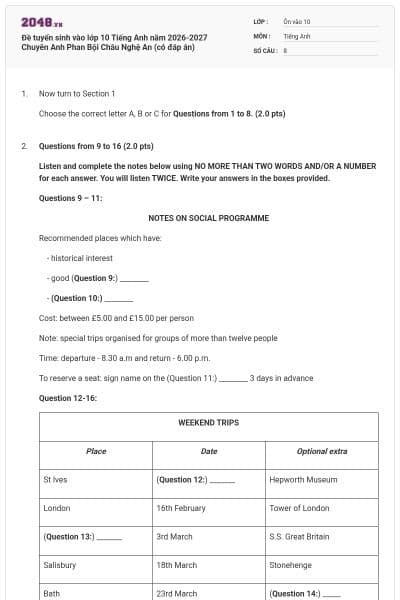
Questions from 9 to 16 (2.0 pts)
Listen and complete the notes below using NO MORE THAN TWO WORDS AND/OR A NUMBER for each answer. You will listen TWICE. Write your answers in the boxes provided.
Questions 9 – 11:
NOTES ON SOCIAL PROGRAMME
Recommended places which have:
- historical interest
- good (Question 9:) ________
- (Question 10:) ________
Cost: between £5.00 and £15.00 per person
Note: special trips organised for groups of more than twelve people
Time: departure - 8.30 a.m and return - 6.00 p.m.
To reserve a seat: sign name on the (Question 11:) ________ 3 days in advance
Question 12-16:
WEEKEND TRIPS | ||
Place | Date | Optional extra |
St Ives | (Question 12:) _______ | Hepworth Museum |
London | 16th February | Tower of London |
(Question 13:) _______ | 3rd March | S.S. Great Britain |
Salisbury | 18th March | Stonehenge |
Bath | 23rd March | (Question 14:) _____ |
For further information: + Read the (Question 15:) ________ + See Social Assistant: Jane (Question 16:) ________ | ||
- good (Question 9:) ________
Đáp án đúng: shopping
Giải thích: Sau tính từ good cần một danh từ hoặc cụm danh từ; bài nghe mô tả các địa điểm được gợi ý có hoạt động mua sắm tốt.
Dịch nghĩa: Những địa điểm được gợi ý có giá trị lịch sử và khu mua sắm tốt.
Đáp án đúng: guided tours
Giải thích: Mục ghi chú liệt kê các đặc điểm của nơi tham quan; guided tours nghĩa là các chuyến tham quan có hướng dẫn viên.
Dịch nghĩa: Những địa điểm được gợi ý có giá trị lịch sử, mua sắm tốt và các chuyến tham quan có hướng dẫn viên.
Đáp án đúng: notice board
Giải thích: Cụm sign name on the notice board nghĩa là ghi tên lên bảng thông báo để đặt chỗ trước.
Dịch nghĩa: Để đặt chỗ, hãy ghi tên lên bảng thông báo trước ba ngày.
Đáp án đúng: 13/13th February
Giải thích: Trong bảng chuyến đi cuối tuần, ngày của chuyến St Ives là ngày 13 tháng Hai.
Dịch nghĩa: Chuyến đi đến St Ives diễn ra vào ngày 13 tháng Hai.
Đáp án đúng: Bristol
Giải thích: Địa điểm gắn với ngày 3 tháng Ba và lựa chọn thêm là S.S. Great Britain là Bristol.
Dịch nghĩa: Chuyến đi đến Bristol vào ngày 3 tháng Ba có lựa chọn tham quan thêm S.S. Great Britain.
Đáp án đúng: American museum
Giải thích: Với chuyến đi Bath, mục Optional extra trong bảng là American museum.
Dịch nghĩa: Chuyến đi đến Bath vào ngày 23 tháng Ba có lựa chọn thêm là Bảo tàng Mỹ.
Đáp án đúng: student newspaper
Giải thích: Phần For further information yêu cầu đọc student newspaper để biết thêm thông tin.
Dịch nghĩa: Để biết thêm thông tin, hãy đọc báo sinh viên.
Đáp án đúng: Yentob
Giải thích: Tên đầy đủ của trợ lý xã hội được nhắc đến là Jane Yentob.
Dịch nghĩa: Hãy gặp trợ lý xã hội Jane Yentob.
LANGUAGE IN USE - QUESTIONS 17 - 40: (6.0 pts)
Mark the letter A, B, C, or D on your answer sheet to indicate the word that differs from the other three in the position of primary stress in each of the following questions. (0.75 pt)
spectacular
psychedelic
disappointed
Interactive
Hướng dẫn giải:
Đáp án đúng: A. spectacular
Giải thích: spectacular nhấn âm chính ở âm tiết thứ hai, trong khi psychedelic, disappointed và interactive nhấn chính ở âm tiết thứ ba.
Dịch nghĩa: spectacular = ngoạn mục; psychedelic = gây ảo giác; disappointed = thất vọng; interactive = có tính tương tác.
Mark the letter A, B, C, or D on your answer sheet to indicate the word that differs from the other three in the position of primary stress in each of the following questions. (0.75 pt)
mature
cancel
routine
Beneath
Hướng dẫn giải:
Đáp án đúng: B. cancel
Giải thích: cancel nhấn âm đầu, còn mature, routine và beneath đều nhấn âm thứ hai.
Dịch nghĩa: mature = trưởng thành; cancel = hủy bỏ; routine = thường lệ; beneath = bên dưới.
Mark the letter A, B, C, or D on your answer sheet to indicate the word that differs from the other three in the position of primary stress in each of the following questions. (0.75 pt)
marvellous
currency
physical
Suspicious
Hướng dẫn giải:
Đáp án đúng: D. suspicious
Giải thích: suspicious nhấn âm thứ hai, trong khi marvellous, currency và physical nhấn âm đầu.
Dịch nghĩa: marvellous = tuyệt diệu; currency = tiền tệ; physical = thuộc thể chất; suspicious = đáng ngờ.
Mark the letter A, B, C, or D on your answer sheet to indicate the word whose underlined part differs from the other three in pronunciation in each of the following questions. (0.75 pt)
chorus
orchard
orchid
Chronic
Hướng dẫn giải:
Đáp án đúng: B. orchard
Giải thích: ch trong chorus, orchid và chronic được phát âm là /k/, còn ch trong orchard được phát âm là /tʃ/.
Dịch nghĩa: chorus = dàn đồng ca; orchard = vườn cây ăn quả; orchid = hoa lan; chronic = mãn tính.
Mark the letter A, B, C, or D on your answer sheet to indicate the word whose underlined part differs from the other three in pronunciation in each of the following questions. (0.75 pt)
height
weight
sleigh
Freight
Hướng dẫn giải:
Đáp án đúng: A. height
Giải thích: height có âm /aɪ/, còn weight, sleigh và freight có âm /eɪ/.
Dịch nghĩa: height = chiều cao; weight = cân nặng; sleigh = xe trượt tuyết; freight = hàng hóa vận chuyển.
Mark the letter A, B, C, or D on your answer sheet to indicate the word whose underlined part differs from the other three in pronunciation in each of the following questions. (0.75 pt)
baggage
damage
hostage
Massage
Hướng dẫn giải:
Đáp án đúng: D. Massage
Giải thích: baggage, damage và hostage có phần cuối phát âm gần /ɪdʒ/, còn massage có âm cuối /ʒ/.
Dịch nghĩa: baggage = hành lý; damage = thiệt hại; hostage = con tin; massage = mát-xa.
Read the text below and look carefully at each line. Some of the lines are correct, but some have a word which should not be there. If a line is correct, put a tick (✓) in the space provided on your answer sheet. If a line has a word which should not be there, write the word on your answer sheet. There are two examples at the beginning (0 and 00). (1.0 pt)
How to Embrace Minimalism When Traveling
0 There's a certain romance to the traveller been weighed down by an .....been.....
00 oversized suitcase, or so the airline advertising would have us believe. Yet ..... ✓ .....
23 seasoned globetrotters have not long known a different truth: baggage is a ...............
24 burden, not a blessing. Consider the frantic queues at luggage carousels or ...............
25 the quiet panic when a bag does fails to appear. These small miseries, ...............
26 however, can barely be avoided. The emerging philosophy of 'travel ...............
minimalism' argues that packing less isn't merely about saving on check-in
fees; rather, it's a gateway to sharper focus and unexpected freedom.
seasoned globetrotters have not long known a different truth: baggage is a ...............
Đáp án đúng: not
Giải thích: Cụm đúng là have long known, nghĩa là từ lâu đã biết; thêm not làm sai nghĩa của câu.
Dịch nghĩa: Những người đi nhiều nơi dày dạn từ lâu đã biết một sự thật khác: hành lý là gánh nặng chứ không phải phước lành.
Đáp án đúng: ✓
Giải thích: Dòng này đúng ngữ pháp và không có từ thừa; cụm burden, not a blessing và các ví dụ phía sau đều hợp lý.
Dịch nghĩa: Hãy nghĩ đến những hàng người hỗn loạn ở băng chuyền hành lý hoặc sự hoảng hốt thầm lặng khi một chiếc túi không xuất hiện.
Đáp án đúng: does
Giải thích: Chủ ngữ a bag đã đi trực tiếp với động từ fails; không dùng thêm trợ động từ does trước fails.
Dịch nghĩa: Hãy nghĩ đến sự hoảng hốt thầm lặng khi một chiếc túi không xuất hiện.
Đáp án đúng: barely
Giải thích: Ngữ cảnh nói các phiền toái này có thể tránh được nhờ du lịch tối giản; barely làm câu mang nghĩa gần như không thể tránh được nên sai.
Dịch nghĩa: Tuy nhiên, những phiền toái nhỏ này có thể tránh được.
Read the text below. Use the word given in capitals at the end of each line to form a word that fits in the space in the same line. Write your answer on the answer sheet. (1.0 pt)
A GREAT STAYCATION Holidays at home are usually a last (0) recourse when all other options have been ruled out for one reason or another, but, in these tough times when money is perhaps tighter than ever before, the grim reality that the stay-at-home vacation may be the only realistic alternative is one that more and more of us are faced with. However, this does not have to mean a (27) __________ time in the same old surroundings you are in for the other 355-odd days of the year. For those willing to think outside the box a little, there are, in fact, a (28) ___of possibilities that should be explored. Ever thought about a house swap, for example? The house swap is the ultimate holiday recession buster. And there are now websites on which (29) __________ individuals, couples and families looking to get a flavor of the life lived in someone else's home can hook up and start house swapping. Okay, so it's not the two weeks in Gran Canaria you might have hoped for, but staying in someone else's (30) __________ for a few days at least, whether it be ten, fifty or one hundred miles away, sure beats slouching around at home on your own sofa. (Adapted from Success in Cambridge English)
|
COURSE
MISERY
MULTIPLE
MIND
RESIDE |
Đáp án đúng: miserable
Giải thích: Sau mạo từ a và trước danh từ time cần tính từ; từ MISERY chuyển thành tính từ miserable.
Dịch nghĩa: Tuy nhiên, điều này không nhất thiết có nghĩa là một khoảng thời gian khốn khổ trong khung cảnh cũ kỹ quen thuộc.
Hướng dẫn giải:
Đáp án đúng: multitude / multiplicity
Giải thích: Cấu trúc a multitude of hoặc a multiplicity of possibilities nghĩa là rất nhiều khả năng; cần danh từ tạo từ MULTIPLE.
Dịch nghĩa: Với những ai sẵn sàng suy nghĩ khác đi một chút, thực ra có vô số khả năng nên được khám phá.
Đáp án đúng: like-minded
Giải thích: Trước danh từ individuals cần tính từ ghép; like-minded nghĩa là có cùng suy nghĩ hoặc cùng chí hướng.
Dịch nghĩa: Những cá nhân, cặp đôi và gia đình có cùng chí hướng muốn trải nghiệm cuộc sống trong nhà người khác có thể kết nối và bắt đầu trao đổi nhà.
Okay, so it's not the two weeks in Gran Canaria you might have hoped for,but staying in someone else's (30) __________ for a few days at least, whether it be ten, fifty or one hundred miles away, sure beats slouching around at home on your own sofa.
Hướng dẫn giải:
Đáp án đúng: residence
Giải thích: Sau sở hữu someone else’s cần danh từ; residence nghĩa là nơi ở hoặc nhà ở.
Dịch nghĩa: Ở trong nơi ở của người khác vài ngày, dù cách xa mười, năm mươi hay một trăm dặm, chắc chắn vẫn tốt hơn nằm dài trên ghế sofa ở nhà.
Complete the passage with the correct tense/ forms of the verbs given in the brackets. (1.0 pt)
__________ (constrain) by insufficient financial resources, several developing nations struggle to implement comprehensive climate policies.
Hướng dẫn giải:
Đáp án đúng: Being constrained
Giải thích: Câu cần mệnh đề rút gọn mang nghĩa bị hạn chế bởi nguồn lực tài chính; dùng dạng bị động Being constrained.
Dịch nghĩa: Bị hạn chế bởi nguồn lực tài chính không đủ, một số quốc gia đang phát triển gặp khó khăn trong việc thực hiện các chính sách khí hậu toàn diện.
Don't phone me at nine tomorrow. I (watch) __________ a football match then.
Hướng dẫn giải:
Đáp án đúng: will be watching
Giải thích: Mốc thời gian at nine tomorrow chỉ một hành động đang diễn ra tại một thời điểm trong tương lai, nên dùng tương lai tiếp diễn.
Dịch nghĩa: Đừng gọi cho tôi lúc chín giờ ngày mai. Khi đó tôi sẽ đang xem một trận bóng đá.
If city planners __________ (pay) greater attention to sustainable design in the past, current environmental problems would be less severe.
Hướng dẫn giải:
Đáp án đúng: had paid
Giải thích: Đây là câu điều kiện hỗn hợp: điều kiện trái với quá khứ dẫn đến kết quả hiện tại, nên mệnh đề if dùng quá khứ hoàn thành.
Dịch nghĩa: Nếu các nhà quy hoạch đô thị trước đây chú ý hơn đến thiết kế bền vững, các vấn đề môi trường hiện nay sẽ ít nghiêm trọng hơn.
He was the only student (award) __________ the special prize in a poetry competition.
Hướng dẫn giải:
Đáp án đúng: to be awarded
Giải thích: Sau the only student thường dùng to-infinitive; vì học sinh được trao giải nên dùng dạng bị động to be awarded.
Dịch nghĩa: Cậu ấy là học sinh duy nhất được trao giải đặc biệt trong một cuộc thi thơ.
Match each half-sentence in COLUMN A with its suitable one in COLUMN B to make a complete sentence. There are two left out. (1.5 pts)
A | B |
Question 35: The curator felt the gold mask was so significant an exhibit | A. David will definitely be accepted if he applies to do a doctorate here. |
Question 36: After months of intergenerational disagreement over work-life balance policies, the committee decreed | B. than did Henry Ford, a pioneer in automobile production. |
Question 37: Probably no man had more effect on the daily lives of most people in the United States | C. that there be stricter limits on working hours. |
Question 38: Having been first domesticated for milk production, | D. that it should be at the center of the display. |
Question 39: Owing to his excellent master's thesis on voting behavior in the Netherlands, | E. the more vitality and character the painting seems to possess. |
Question 40: The looser the brushwork is in Stevenson's landscapes, | F. it is nearly impossible for us to know where he is now. |
| G. when he realised a fundamental error in his methodology. |
| H. sheep were then used for wool. |
Đáp án đúng: D. that it should be at the center of the display.
Giải thích: Cấu trúc so significant an exhibit that... diễn tả kết quả: chiếc mặt nạ quan trọng đến mức nên đặt ở trung tâm trưng bày.
Dịch nghĩa: Người phụ trách bảo tàng cảm thấy chiếc mặt nạ vàng là một hiện vật quan trọng đến mức nó nên được đặt ở trung tâm khu trưng bày.
Hướng dẫn giải:
Đáp án đúng: C. that there be stricter limits on working hours.
Giải thích: Động từ decreed đi với mệnh đề giả định; that there be stricter limits tạo nghĩa ra sắc lệnh rằng cần có giới hạn chặt chẽ hơn.
Dịch nghĩa: Sau nhiều tháng bất đồng giữa các thế hệ về chính sách cân bằng công việc và cuộc sống, ủy ban ra quyết định rằng phải có giới hạn nghiêm ngặt hơn về giờ làm việc.
Đáp án đúng: B. than did Henry Ford, a pioneer in automobile production.
Giải thích: Câu so sánh dùng than did Henry Ford để tránh lặp động từ had và hoàn chỉnh ý so sánh về mức độ ảnh hưởng.
Dịch nghĩa: Có lẽ không ai có ảnh hưởng lớn hơn đến đời sống hằng ngày của phần lớn người dân Hoa Kỳ hơn Henry Ford, một người tiên phong trong sản xuất ô tô.
Đáp án đúng: H. sheep were then used for wool.
Giải thích: Chủ ngữ hợp lý sau mệnh đề Having been first domesticated là sheep; câu nói cừu ban đầu được thuần hóa để lấy sữa rồi sau đó dùng để lấy len.
Dịch nghĩa: Sau khi lần đầu được thuần hóa để sản xuất sữa, cừu sau đó được dùng để lấy len.
Đáp án đúng: A. David will definitely be accepted if he applies to do a doctorate here.
Giải thích: Owing to his excellent master’s thesis nêu lý do khiến David chắc chắn được nhận nếu nộp đơn học tiến sĩ.
Dịch nghĩa: Nhờ luận văn thạc sĩ xuất sắc về hành vi bầu cử ở Hà Lan, David chắc chắn sẽ được nhận nếu anh ấy nộp đơn làm nghiên cứu sinh tiến sĩ ở đây.
Đáp án đúng: E. the more vitality and character the painting seems to possess.
Giải thích: Cặp cấu trúc The looser..., the more... diễn tả quan hệ tỉ lệ: nét cọ càng phóng khoáng thì tranh càng có sức sống và cá tính.
Dịch nghĩa: Nét cọ trong các bức phong cảnh của Stevenson càng phóng khoáng, bức tranh dường như càng có nhiều sức sống và cá tính.
READING COMPREHENSION - QUESTIONS 41 - 60: (5.0 pts)
Read the passage and choose the correct answer to each of the questions below. (2.5 pts)
Christophe Petyt is sitting in a Paris café, listing the adornments of his private art collection: several Van Goghs, and a comprehensive selection of the better impressionists. “I can,” he says quietly, “really get to know any painting I like, and so can you.” Half an hour later I am sitting in his office with Degas’ The Jockeys on my lap. If fine art looks good in a gallery, believe me, it feels even better in your hands. Petyt is the world’s leading dealer in fake masterpieces, a man whose activities provoke both admiration and exasperation in the higher levels of the art world. Name the painting and for as little as 1,000 pounds he will deliver you a copy so well executed that even the original artist might have been taken in.
Petyt’s company employs over eighty painters, each ordered in the style. of a particular artist or school. “We choose them very carefully,” he says. “They’re usually people with very good technique but not much creativity, who are unlikely to make it as artists in their own right. But they love the great works and have real insight into what’s gone into them.” Every work is individually commissioned, using new canvases and traditional oil paints, before being artificially aged by a variety of simple but ingenious techniques.
The notional value of the original is not the determining factor, however, when it comes to setting the retail value of Petyt’s paintings. This is actually linked to the amount of effort and expertise that has gone into producing the copy. An obscure miniature may therefore cost much more than a bigger, better-known painting by a grand master. The Degas I’m holding looks as though it came off the artist’s easel yesterday. Before being sold it has to be aged, and this, so to speak, is the real “art” of the copy. A few minutes in a hot oven can put years on a canvas, black tea apparently stains it beautifully and new frames can be buried underground, then sprayed with acid. [1]
The view when Petyt started out was that very little of this could be legal. He was pursued through the French courts by museums and by descendants of the artists. This concern was perhaps understandable in a country that has been rocked by numerous art fraud scandals. “The establishment was suspicious of us,” huffs Petyt, “but for the wrong reasons, I think Some people want to keep all the best art for themselves.” He won the case and as the law now stands, the works and signatures of any artist who has been dead for seventy years can be freely copied. The main proviso is that the copy cannot be passed off to dealers as the real thing. [II] To prevent this every new painting is indelibly marked on the back of the canvas, and as an additional precaution a tiny hidden piece of gold leaf is worked into the paint.
Until he started the business ten years ago, Paetyt, a former business-school student, barely knew one artist from another. Then one particular painting by Van Gogh caught his eye. [III] At $10 million, it was well beyond his reach so he came up with the idea of getting an art-student friend to paint him a copy. In an old frame. it looked absolutely wonderful, and Petyt began to wonder what market there might be for it. He picked up a coffee-table book of well-known paintings, earmarked a random selection of works and got his friend to knock them off. “Within a few months I had about twenty good copies.” he says, “so I organised an exhibition. In two weeks we’d sold the lot, and got commissions for sixty more.” It became clear that a huge and lucrative market existed for fake art.
Petyt's paintings are exhibited away from the traditional art centres - in places with lavish houses in need of equally impressive works of art. Although their owners include rock stars, fashion designers and top businesspeople, they either cannot afford or more likely simply cannot obtain great works of art. Petyt is understandably reluctant to name any of his clients, but says that sometimes even the owner of the original will occasionally commission a copy. [IV] The best paintings are so valuable,' he explains, 'that it's risky to have them at home and the costs of security and insurance are huge. So some collectors keep the original in a bank vault and hang our copy.'
Is it art? Petyt draws a parallel: 'Take music, for example. Does Celine Dion compose her own tunes - write her own lyrics? She's interpreting someone else's work, but she's still an artist. Classical musicians often try to produce a sound as close as possible to what they think the composer intended. Nobody's suggesting they're anything but artists. With us, maybe, it's the same.'
The writer implies in paragraph 1 that he shares ________
Petyl's enjoyment of the works of a range of painters.
the art world's suspicious attitude towards Petyt's activities.
Petyt's desire to appreciate great works of art at close quarters.
the general inability to distinguish copies from real paintings.
Hướng dẫn giải:
Đáp án đúng: C. Petyt’s desire to appreciate great works of art at close quarters.
Giải thích: Đoạn 1 cho thấy người viết thích cảm giác được cầm và quan sát tác phẩm ở khoảng cách gần, giống mong muốn của Petyt là thực sự hiểu một bức tranh.
Dịch nghĩa: Người viết ngụ ý ở đoạn 1 rằng ông chia sẻ mong muốn của Petyt được thưởng thức những tác phẩm nghệ thuật vĩ đại ở cự ly gần.
When given £1,000, he will cheat the real artist out of his painting with a copy then send it to you.
The lowest price to have the original artist create a fake painting as good as the real one is £1,000.
Spend no more than £1,000 and you can buy a carefully copied version produced by its author.
With just about £1,000, you can get him to produce a replica which can even deceive the real author.
Hướng dẫn giải:
Đáp án đúng: D. With just about £1,000, you can get him to produce a replica which can even deceive the real author.
Giải thích: Câu gốc nói chỉ từ 1.000 bảng, Petyt có thể giao một bản sao được làm tinh vi đến mức ngay cả họa sĩ gốc cũng có thể bị đánh lừa.
Dịch nghĩa: Chỉ với khoảng 1.000 bảng, bạn có thể nhờ ông ấy tạo ra một bản sao thậm chí có thể đánh lừa cả tác giả thật.
The word commissioned in paragraph 2 is CLOSEST in meaning to ________
supervised strictly.
ordered in advance.
featured prominently.
reproduced accurately.
Hướng dẫn giải:
Đáp án đúng: B. ordered in advance.
Giải thích: commissioned trong ngữ cảnh này nghĩa là được đặt làm theo yêu cầu trước, không phải chỉ được giám sát hay sao chép chính xác.
Dịch nghĩa: Từ commissioned ở đoạn 2 gần nghĩa nhất với được đặt làm trước.
The phrase This concern in paragraph 4 refers to ________
the support Petyt gets from art dealers.
Petyt's belief that his business is legal.
the widespread art fraud scandals in France.
the legal action against Petyt.
Hướng dẫn giải:
Đáp án đúng: D. the legal action against Petyt.
Giải thích: This concern quay lại việc các bảo tàng và hậu duệ nghệ sĩ kiện hoặc theo đuổi Petyt qua tòa án Pháp.
Dịch nghĩa: Cụm This concern ở đoạn 4 chỉ hành động pháp lý chống lại Petyt.
How does Petyt feel about the attempts to prove that his activities were illegal?
He regrets that they gained the support of other art dealers in France.
He accepts that they were useful in helping to establish his integrity.
He respects the right of the real artists' families to protect their interests.
He suspects that they were not driven by public-spirited motives.
Hướng dẫn giải:
Đáp án đúng: D. He suspects that they were not driven by public-spirited motives.
Giải thích: Petyt nói giới nghệ thuật nghi ngờ ông vì những lý do sai và cho rằng một số người muốn giữ tác phẩm đẹp cho riêng mình, nên ông nghi ngờ động cơ của họ không vì lợi ích chung.
Dịch nghĩa: Petyt nghi ngờ rằng những nỗ lực chứng minh hoạt động của ông là bất hợp pháp không xuất phát từ động cơ vì lợi ích công chúng.
What can be inferred about the French legal and cultural landscape regarding art from paragraph 4?
Petyt's legal victory has led to a completely unregulated market for art copies in France.
French law strictly prohibits all forms of art reproduction, regardless of intent.
France maintains a vigilant and skeptical stance towards art replication businesses.
The French art establishment is generally open to innovative approaches to art distribution.
Hướng dẫn giải:
Đáp án đúng: C. France maintains a vigilant and skeptical stance towards art replication businesses.
Giải thích: Đoạn 4 nhắc đến các vụ bê bối gian lận nghệ thuật và sự nghi ngờ của giới thiết lập nghệ thuật, cho thấy Pháp rất cảnh giác với việc sao chép tác phẩm.
Dịch nghĩa: Có thể suy ra rằng Pháp duy trì thái độ thận trọng và hoài nghi đối với các doanh nghiệp sao chép nghệ thuật.
What is implied about the majority of Petyt's customers?
They have little genuine interest in contemporary art.
They may buy the paintings purely as a form of financial investment.
They regard works of art as a lifestyle accessory.
They are wealthy enough to buy the original works of art if they wanted.
Hướng dẫn giải:
Đáp án đúng: C. They regard works of art as a lifestyle accessory.
Giải thích: Tranh của Petyt được trưng bày ở những nơi có nhà sang trọng cần tác phẩm ấn tượng, cho thấy khách hàng xem tranh như một phần của phong cách sống và không gian sống.
Dịch nghĩa: Có thể hiểu rằng phần lớn khách hàng của Petyt coi tác phẩm nghệ thuật như một phụ kiện thể hiện lối sống.
Which of the following is NOT TRUE according to the passage?
The notional value of the originals is not the determining factor in valuing Petyt's paintings.
Petyt's employees make copies of the paintings on individual request.
The paintings pirated in Petyt's company are made to look like the originals.
Painters in Petyt's company have been seriously trained in the techniques of forgery.
Hướng dẫn giải:
Đáp án đúng: D. Painters in Petyt’s company have been seriously trained in the techniques of forgery.
Giải thích: Bài đọc chỉ nói họ có kỹ thuật tốt, ít sáng tạo và được chọn theo phong cách họa sĩ, không nói họ được đào tạo bài bản về kỹ thuật làm giả.
Dịch nghĩa: Điều không đúng theo bài đọc là các họa sĩ trong công ty của Petyt đã được đào tạo nghiêm túc về kỹ thuật làm giả.
Where in the passage does the following sentence best fit?
Petyt is understandably reluctant to name any of his clients, but says that sometimes even the owner of the original will order a copy.
[IV]
[III]
[I]
Hướng dẫn giải:
Đáp án đúng: A. [IV]
Giải thích: Câu cho sẵn nói về việc khách hàng đôi khi là chủ sở hữu bản gốc, phù hợp nhất trước câu giải thích vì sao họ giữ bản gốc trong két ngân hàng và treo bản sao ở nhà.
Dịch nghĩa: Petyt không muốn nêu tên khách hàng, nhưng nói rằng đôi khi ngay cả chủ sở hữu của bản gốc cũng đặt làm một bản sao.
Thal Petyt was opposed by museums and by descendants of the artists does not prevent copying masterpieces from becoming popular.
Despite obstacles, Christophe Petyt has turned the production of exact copies of masterpieces by the world's most famous painters into big business.
The notional value of original paintings is overshadowed by the affordable prices of fake one, which makes fake masterpieces sell well.
Christophe Petyt's paintings meet the demands of those who cannot afford originals and enable him to earn a fortune.
Hướng dẫn giải:
Đáp án đúng: B. Despite obstacles, Christophe Petyt has turned the production of exact copies of masterpieces by the world’s most famous painters into big business.
Giải thích: Toàn bài trình bày việc Petyt vượt qua tranh cãi pháp lý và biến hoạt động sao chép kiệt tác thành một thị trường lớn, sinh lợi.
Dịch nghĩa: Bất chấp trở ngại, Christophe Petyt đã biến việc sản xuất các bản sao chính xác của những kiệt tác bởi các họa sĩ nổi tiếng thế giới thành một ngành kinh doanh lớn.
Read the following passage and do the task that follows. (1.0 pt)
A. More than eighty years after its first publication. Thach Lam's "Hanoi's 36 Streets" still teaches readers how to see a city. Unlike travel guides that list monuments and museums, this collection of essays captures something more elusive: the soul of Hanoi through everyday moments. A member of the Self-Reliance Literary Group, Thach Lam avoided both grand descriptions and harsh criticism. Instead, he wrote gently about small beauties the night cries of street vendors on Hang Bac Street, the aroma of early-season sticky rice from Vong Village, and a morning cup of tea. These are not grand events. But together, they form a portrait of a city where elegance hides in simplicity. His approach was unusual for the 1930s and 1940s. While many writers focused on social realism, Thach Lam chose sentimentalism, believing that preserving ordinary beauty was itself an act of resistance
B. Consider how Thach Lam writes about a single dish: bun cha. He wondered why ordinary ingredients rice noodles, grilled meat, herbs could create such an extraordinary flavor. His answer reveals his philosophy. The person who first invented bun cha, he argued, deserved recognition as a creative artist. Not a cook, but an artist. The magic lay not in expensive ingredients but in perfect balance: the grilled meat on fresh bamboo skewers, the thinly wrapped noodles, the precisely mixed dipping sauce. And especially the Lang mint a herb that grows only in Hanoi. Take it anywhere else, Thach Lam noted, and it loses its distinctive scent For him, bun cha was not fast food. It was a "masterpiece" - rustic yet elegant, ordinary yet irreplaceable.
C. The book also traces the rhythm of Tet, Vietnam's lunar New Year, through three acts. Before Tet the streets buzz with shoppers; the scent of candies, jams, and incense fills every alley. During Tet. Hanoi seems to exhale. Street vendors disappear. Firecrackers echo through quiet neighborhoods. A feeling of togetherness seeps into each home. Then comes the aftermath. Thach Lam captures this with heartbreaking precision: "The joy of Tet has gone with the firecracker remnants that people sweep away, never to return. And so another year has passed." He does not mourn loudly. Instead, he lets the emptiness speak for itself. What makes his writing timeless is this restraint - the ability to describe loss without sentimentality, to feel deeply without shouting.
D. Published in 1943, "Hanoi's 36 Streets" contains just fourteen short essays. Yet its influence extends far beyond literature. As Hanoi modernises, expanding streets, erecting high-rises, speeding up daily life, the book is a bridge between past and present. It reminds readers that a city's identity does not reside in concrete structures. It lives in how people love, how they eat, how they greet each other on a quiet morning. Thach Lam teaches us to value the simple beauty around us: a bowl of pho at a street corner, the smile of a vendor, the scent of Lang mint that refuses to grow elsewhere. Seventy-one years after Hanoi's liberation, the soul of the capital still beats in those small moments. Thech Lam simply showed us where to listen.
The passage has four paragraphs A-D. Choose the correct heading for each paragraph from
list of headings below. Write the correct number i-viii in boxes 51-54 on your answer sheet.
51: Paragraph A ______ 52: Paragraph B ______ 53: Paragraph C ______ 54: Paragraph D ______
| List of Headings i A three-part journey through Vietnam's most important holiday ii The problem with modern travel guides iii The forgotten political messages in Thach Lam's writing iv Listening to the silence after the firecrackers fade ν Why a bowl of noodles can be considered a work of art ví Finding a city's heartbeat in quiet moments, not grand monuments vii How one writer turned ordinary street food into cultural treasure viii Why fourteen short essays outlast skysorapers
|
Đáp án đúng: vi. Finding a city’s heartbeat in quiet moments, not grand monuments.
Giải thích: Đoạn A nhấn mạnh Thạch Lam không viết về tượng đài lớn mà nắm bắt linh hồn Hà Nội qua những khoảnh khắc đời thường và vẻ đẹp nhỏ bé.
Dịch nghĩa: Tìm nhịp đập của một thành phố trong những khoảnh khắc tĩnh lặng, chứ không phải trong các công trình đồ sộ.
Đáp án đúng: v. Why a bowl of noodles can be considered a work of art.
Giải thích: Đoạn B tập trung vào bún chả và cách Thạch Lam xem người tạo ra món ăn như một nghệ sĩ nhờ sự cân bằng tinh tế của nguyên liệu.
Dịch nghĩa: Vì sao một bát bún có thể được xem là một tác phẩm nghệ thuật.
Đáp án đúng: i. A three-part journey through Vietnam’s most important holiday.
Giải thích: Đoạn C mô tả Tết theo ba giai đoạn: trước Tết, trong Tết và sau Tết.
Dịch nghĩa: Một hành trình ba phần qua ngày lễ quan trọng nhất của Việt Nam.
Đáp án đúng: viii. Why fourteen short essays outlast skyscrapers.
Giải thích: Đoạn D nói cuốn sách chỉ gồm mười bốn bài tiểu luận ngắn nhưng vẫn bền bỉ trước quá trình hiện đại hóa, cao ốc và nhịp sống nhanh.
Dịch nghĩa: Vì sao mười bốn bài tiểu luận ngắn lại tồn tại lâu hơn những tòa nhà chọc trời.
Read the passage and fill in ONE suitable word for each blank. (1.5 pts)
Across the low-lying coastal regions of Vietnam. a quiet but remarkable change is (55)_______ shape. For decades, local communities faced the full (56)_______ of ferocious typhoons and rising sea levels, which ate away at their land and threatened their livelihoods. But a strategic move towards ecological restoration has brought a powerful natural defence system: mangrove forests. This layered green canopy does more than just make the shoreline look beautiful. It serves (57)_______ an essential buffer zone. By absorbing the energy of powerful waves and trapping sediment in their intricate root networks, these coastal forests hold back erosion effectively. As a result, coastal towns that were (58)_______ highly vulnerable to seasonal disasters now enjoy a level of environmental stability they have never known, proving that nature-based solutions can work better than artificial barriers.
Beyond their immediate protective role, these intertidal ecosystems are an unparalleled asset in the global fight against climate change. Mangroves are exceptionally good at pulling carbon dioxide from the air, locking it away in their biomass and the soil beneath for centuries. Scientists call this stored carbon "blue carbon", a resource with immense value in the global carbon market. (59)_______ that a single hectare of healthy mangrove forest can store up to ten (60)_______ more carbon than a rainforest on land, protecting these habitats is absolutely vital. By contrast, destroying such areas releases huge amounts of greenhouse gases back into the atmosphere, which compounds global warming. So preserving these coastal forests is no longer just a local necessity; it has become a core part of international climate action.
(Adapted from: https://www.undp.org)
Đáp án đúng: taking
Giải thích: Cụm cố định take shape nghĩa là hình thành; ở thì hiện tại tiếp diễn cần taking.
Dịch nghĩa: Ở các vùng ven biển thấp của Việt Nam, một sự thay đổi thầm lặng nhưng đáng chú ý đang hình thành.
Đáp án đúng: force
Giải thích: Cụm face the full force of something nghĩa là hứng chịu toàn bộ sức mạnh của điều gì đó.
Dịch nghĩa: Trong nhiều thập kỷ, các cộng đồng địa phương đã hứng chịu toàn bộ sức mạnh của những cơn bão dữ dội và mực nước biển dâng.
Đáp án đúng: as
Giải thích: Cấu trúc serve as nghĩa là đóng vai trò là hoặc hoạt động như một thứ gì đó.
Dịch nghĩa: Tán rừng xanh nhiều tầng này đóng vai trò như một vùng đệm thiết yếu.
Đáp án đúng: once
Giải thích: once trong câu này nghĩa là trước đây; các thị trấn ven biển từng rất dễ bị tổn thương nhưng nay ổn định hơn.
Dịch nghĩa: Những thị trấn ven biển trước đây rất dễ bị tổn thương trước thiên tai theo mùa nay có mức ổn định môi trường chưa từng có.
Đáp án đúng: Given / Now
Giải thích: Given that nghĩa là xét rằng, phù hợp để nêu lý do bảo vệ rừng ngập mặn là rất quan trọng; Now that cũng có thể dùng với nghĩa hiện nay khi đã biết rằng.
Dịch nghĩa: Xét rằng một hecta rừng ngập mặn khỏe mạnh có thể lưu trữ lượng carbon gấp đến mười lần rừng mưa trên cạn, việc bảo vệ các môi trường sống này là vô cùng thiết yếu.
Đáp án đúng: times
Giải thích: Cấu trúc ten times more carbon nghĩa là lượng carbon nhiều gấp mười lần.
Dịch nghĩa: Một hecta rừng ngập mặn khỏe mạnh có thể lưu trữ lượng carbon nhiều gấp mười lần rừng mưa trên cạn.
SENTENCE TRANSFORMATION - QUESTIONS 61-68: (2.0 pts)
Write the second sentence so that it has the same meaning as the first one. (1.0 pt)
I know this reporter's background well. and he's 100% honest.
This reporter, _________________________________.
Hướng dẫn giải:
Đáp án đúng: This reporter, whose background I know well, is 100% honest.
Giải thích: Dùng mệnh đề quan hệ không xác định với whose để thay cho this reporter’s background và nối hai câu thành một câu tự nhiên.
Dịch nghĩa: Phóng viên này, người mà tôi biết rõ lý lịch, hoàn toàn trung thực.
The students have many complicated lessons. They have to study hard to achieve their goals.
The more _________________________________.
Hướng dẫn giải:
Đáp án đúng: The more complicated lessons the students have, the harder they have to study to achieve their goals.
Giải thích: Cấu trúc The more..., the harder... diễn tả hai mức độ tăng song song: bài học càng phức tạp thì học sinh càng phải học chăm chỉ.
Dịch nghĩa: Học sinh càng có nhiều bài học phức tạp, họ càng phải học chăm chỉ hơn để đạt mục tiêu.
It was wrong of them not to give the newcomers any instructions to do the tasks.
The newcomers _________________________________.
Hướng dẫn giải:
Đáp án đúng: The newcomers should/ought to have been given some instructions to do the tasks.
Giải thích: It was wrong of them not to... được viết lại bằng should/ought to have been + past participle để diễn tả điều đáng lẽ phải được làm trong quá khứ.
Dịch nghĩa: Những người mới đáng lẽ nên được hướng dẫn để làm các nhiệm vụ.
Health care costs increased from £1.9 billion in 2000 to £4 billion in 2001.
There was _________________________________.
Hướng dẫn giải:
Đáp án đúng: There was an increase/a rise in health care costs from £1.9 billion in 2000 to £4 billion in 2001.
Giải thích: Động từ increased được chuyển thành danh từ an increase hoặc a rise sau cấu trúc There was.
Dịch nghĩa: Chi phí chăm sóc sức khỏe đã tăng từ 1,9 tỉ bảng năm 2000 lên 4 tỉ bảng năm 2001.
Complete the second sentence so that it has the similar meaning to the first sentence, using the word given. DO NOT change the word given. You must use between FIVE AND SEVEN words including the word given. (1.0 pt)
Luke made it clear that there is no chance he will ever go to university.
RULED
Luke _________________________________ ever going to university.
Hướng dẫn giải:
Đáp án đúng: Luke ruled out the possibility of (his/him) ever going to university.
Giải thích: rule out the possibility of nghĩa là loại trừ khả năng; sau giới từ of dùng danh động từ going.
Dịch nghĩa: Luke đã loại trừ khả năng cậu ấy sẽ từng học đại học.
People believe the novel was written by a fifteenth century author.
ATTRIBUTED
The novel _________________________________ author.
Hướng dẫn giải:
Đáp án đúng: The novel is attributed to a fifteenth-century author.
Giải thích: be attributed to nghĩa là được cho là do ai viết hoặc tạo ra; câu chuyển từ people believe sang dạng bị động học thuật.
Dịch nghĩa: Cuốn tiểu thuyết được cho là của một tác giả thế kỷ mười lăm.
Critics are hoping the new director can bring some positive changes into the French filın industry.
BREATHE
Critics are hoping _________________________________ the French film industry.
Hướng dẫn giải:
Đáp án đúng: Critics are hoping the new director can breathe life into the French film industry.
Giải thích: breathe life into là thành ngữ nghĩa là đem lại sức sống mới hoặc tạo thay đổi tích cực cho điều gì.
Dịch nghĩa: Các nhà phê bình hy vọng vị đạo diễn mới có thể thổi luồng sinh khí mới vào ngành điện ảnh Pháp.
The naughty kid admitted that he played tricks on the new students.
FAST
The naughty kid owned _________________________________ the new students.
Hướng dẫn giải:
Đáp án đúng: The naughty kid owned up to pulling a fast one on the new students.
Giải thích: own up to nghĩa là thú nhận và theo sau là V-ing; pull a fast one on someone nghĩa là lừa hoặc chơi khăm ai.
Dịch nghĩa: Đứa trẻ nghịch ngợm đã thú nhận việc chơi khăm các học sinh mới.
WRITING AN ESSAY (3.0 pts)
Write about the following topic:
Some people prefer to learn from their own mistakes, while others prefer to follow the advice of older people. Discuss both views and give your opinion.
Give reasons for your answer and include any relevant examples from your own knowledge or experience.
Write 200-250 words.
Học sinh tự làm.