Đề thi cuối kì 2 Tiếng Anh 11 Global Success có đáp án - Đề 6
35 câu hỏi
I. LISTENING
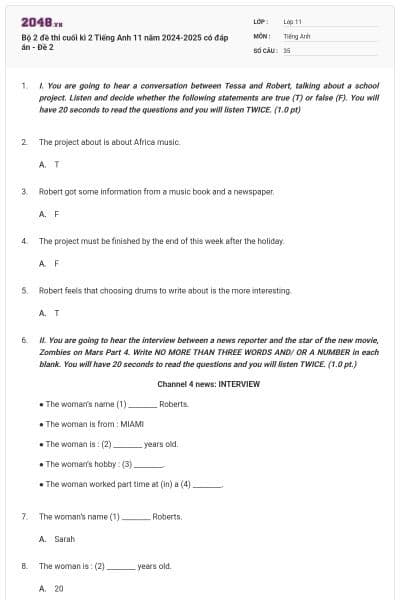
Listen to the conversation between Lan and a receptionist at ABC Vocational School. Decide whether the following statements are True or False. You will listen TWICE.
True
False
True
False
True
False
True
False
True
False
Script:
Lan: Good morning.
Receptionist: Good morning. Welcome to ABC Vocational School. How can I help you?
Lan: I watched a TV programme about your school last week. I'd like to ask for information about your courses.
Receptionist: Sure. What's your name, please?
Lan: I'm Nguyen Thanh Lan
Receptionist: OK, Lan. We offer a wide range of courses including tour guide training, hotel and restaurant management, and cooking. Are you interested in a specific trade?
Lan: Yes, I'd like to know more about your cooking courses. How long does it take to complete a cooking course?
Receptionist: Well, it depends. We have short cooking courses for all ages and abilities. They are usually two to three months, and mainly for people who want to learn about food preparation and have fun in the kitchen. We also have professional cooking courses, which take two years to complete, for those who want to train to be restaurant cooks.
Lan: Do you offer any apprenticeships?
Receptionist: Yes, once you join a course, you'll have the opportunity to work as an apprentice in a real restaurant and learn from the best chefs.
Lan: That's amazing!
Receptionist: Would you like to fill in the application form?
Lan: Oh, I'm only in grade 11.I haven't discussed my plans with my parents either.
Receptionist: OK, no problem. Please take a copy of our school brochure. It has detailed information about all the courses.
Lan: Thank you so much. Goodbye.
Receptionist: Bye, Lan. Good luck.
II. READING
TASK 1. Read the passage. Circle the best answer A, B or C to each of the questions.
One threat to South East Asia’s biodiversity is the illegal wildlife trade. Worth approximately US$20 billion annually, it’s the fourth-biggest illegal trade in the world.
In Southeast Asia, hunting represents the greatest threat to the future survival of many species, with few native mammals of over 2kg surviving outside protected areas. Hunting represents a threat to all species, with high-value species sought and traded by criminal groups and smaller species traded for medicine, food or sport.
Trade in wildlife in Asia can be grouped into three main types: for medicinal purposes, for status (either in wildlife restaurants or as ornaments) or for the pet, zoo and aquarium trades (principally birds and reptiles).
Traditional medicine in Viet Nam and China represents a threat to a wide variety of species, but most notably the pangolin, which is the most trafficked animal on the planet. Sadly, the use of endangered species in medicine shows little sign of decrease. Whereas celebrities have campaigned for species that are targeted for status and ornamentation, such as elephant ivory, many other animals and plants have failed to get the attention needed to prevent over-exploitation. And a number are now facing extinction.
The pet and zoo trade in wildlife, especially for reptiles and birds, have recently received attention, as many species formerly thought to be captive-bred are now known to be wild-caught. They have suffered serious population declines as a result of exploitation for trade.
The Diverse wildlife of South East Asia
The Illegal Wildlife Trade in South East Asia
The Threat of Hunting to Southeast Asian Species
The Impact of Traditional Medicine on wildlife
Habitat loss
Climate change
Hunting
Pollution
included
protected
preferred
hunted
trades
plants
celebrities
species
Which of the following is NOT true according to the passage?
High-value species are mainly traded for medicinal purposes.
Exploitation for trade has led to population declines in many reptiles and bird species.
The pangolin is the most illegally traded animal in the world.
Traditional medicine in Viet Nam and China threatens various species.
TASK 2. Read the following passage and mark the letter A, B, C, or D to indicate the correct word that best fits each of the numbered blanks.
Peers affect each other just by spending time together. You learn from them, and they learn from you. It’s natural to listen to and learn from other people your age.
Peers can affect you in many ways. For example, you might see what teens in your class are wearing, like it, and wear something like that, too. It (1) _________ both ways. Your peers might watch what you do and start doing it, too.
Peers can influence each other in good ways. Maybe a teen in your science class taught you an easy way to remember the planets in the solar system. Maybe you admire a friend (2) _________ is a good sport, and you try (3) _________ more like them. Maybe you got others excited about your new favourite book and now everyone’s reading it.
But peers can also influence each other in ways that aren’t so good. They might try to pressure you (4) _________ doing something you know is wrong. For example, what if a few teens in school try to get you to (5) _________ class with them? What if your soccer teammate tries to convince you to be mean to another player and never pass them the ball? What if a kid in the neighbourhood wants you to drink alcohol with them?
Adapted from: https://kidshealth.org/en/kids/peer-pressure.html
It (1) _________ both ways. Your peers might watch what you do and start doing it, too.
goes
makes
takes
sets
which
whom
who
why
being
to be
be
been
of
from
into
with
target
consider
argue
ski
III. WRITING
TASK 1. Rewrite the following sentences, beginning as shown, without changing their meaning.
After he wrote his song, he sent it to the producer. (perfect participle)
_________________________________________________________________
Having written his song, he sent it to the producer.
He won a scholarship. He was so excited about that. (perfect gerund)
_________________________________________________________________
He was so excited about having won a scholarship.
My mom is making some cakes for our dinner. (cleft sentence)
_________________________________________________________________It is my mom who/ that is making some cakes for our dinner.
I'll watch MTV this afternoon. I want to see Cher's new video. (to infinitive)
_________________________________________________________________I'll watch MTV this afternoon to see Cher's new video.
People thought that thousands of people died in the tsunami in 2004. (Change into passive voice)
_________________________________________________________________
Thousands of people were thought to die in the tsunami in 2004.
TASK 2. You are organising your school’s Green Fair. Write about 120-150 words to complete the leaflet.
Sample writing
Welcome to Our School’s Green Fair!
We are delighted to invite you to this year’s Green Fair, an event dedicated to promoting environmental awareness and sustainability. We aim to encourage students, teachers, and community members to adopt eco-friendly habits that help reduce carbon emissions and protect our planet.
At the fair, you will enjoy a wide range of fun and interactive activities, including:
Educational workshops and talks on topics such as climate change, recycling, and sustainable lifestyles.
A plant sale where you can buy different kinds of plants and learn about their benefits for the environment.
A clothing exchange that allows participants to swap gently used clothes, helping to reduce waste and support a circular economy.
A food court offering local and organic dishes, along with a cooking demonstration on preparing healthy and sustainable meals.
A recycling campaign where you can drop off old electronics, batteries, and other items for responsible recycling.
We hope this fair will be both enjoyable and informative, and that it will inspire positive change. By putting the eco-friendly ideas you learn here into practice, you can make a meaningful difference for our planet and future generations.
We look forward to welcoming you!
IV. LANGUAGE FOCUS
TASK 1.
Choose the word with a different way of pronunciation in the underlined part. Circle A, B, C or D.site
kind
like
mix
TASK 1.
Choose the word with a different way of pronunciation in the underlined part. Circle A, B, C or D.
marked
tested
presented
needed
Choose the word which has a different stress pattern from that of the others. Circle A, B, C or D.
pursue
provide
broaden
succeed
Choose the word which has a different stress pattern from that of the others. Circle A, B, C or D.
achievement
solution
history
mechanic
TASK 2. Choose the best option to complete each sentence. Circle A, B, C or D.
Cyberbullying
Self-confidence
Peer pressure
Overpopulation
However
Therefore
Despite
Since
competitions
games
programme
activities
researching
research
researcher
researchers
making
controlling
hanging
living
TASK 3. Fill each blank with the correct form of the verb in brackets.
He regretted __________ (kill) and eaten several rare species.
having killed
A Bachelor’s degree is a third – year or four – year course you take in undergraduate higher education after you __________ (finish) further education.
Ethan is usually the last person __________ (understand) the joke.
to understand
__________ (talk) with my teacher helped me understand the lesson better.
Having talked
It was Nam who Mai _______ (teach) how to cook rice yesterday.