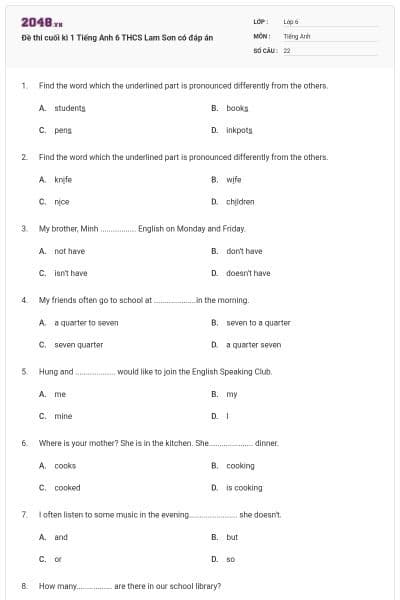
Đề thi cuối kì 1 Tiếng Anh 6 THCS Lam Sơn có đáp án
22 câu hỏi
Find the word which the underlined part is pronounced differently from the others.
students
books
pens
inkpots
Đáp án C
Giải thích: Đáp án C phát âm là /z/, các đáp án còn lại phát âm là /s/
Find the word which the underlined part is pronounced differently from the others.
knife
wife
nice
children
Đáp án D
Giải thích: Đáp án D phát âm là /i/, các đáp án còn lại phát âm là /ai/
My brother, Minh ................. English on Monday and Friday.
not have
don't have
isn't have
doesn't have
Đáp án D
Giải thích: dùng thì hiện tại đơn để diễn tả thói quen (on Monday and Friday), trong câu phủ định với chủ ngữ ngôi 3 số ít ta dùng “S + doesn’t + Vinf.”
Dịch: Anh tôi, Minh không có tiếng Anh vào thứ hai và thứ sáu.
My friends often go to school at ....................in the morning.
a quarter to seven
seven to a quarter
seven quarter
a quarter seven
Đáp án A
Giải thích: a quarter to seven = 7h kém 15
Dịch: Bạn bè tôi thường đến trường vào lúc 7h kém 15 phút sáng.
Hung and ................... would like to join the English Speaking Club.
me
my
mine
I
Đáp án D
Giải thích: ô trống cần đại từ làm chủ ngữ
Dịch: Hùng và tôi muốn tham gia Câu lạc bộ Nói tiếng Anh.
Where is your mother? She is in the kitchen. She..................... dinner.
cooks
cooking
cooked
is cooking
Đáp án D
Giải thích: dùng thì hiện tại tiếp diễn để diễn tả hành động đang xảy ra tại thời điểm nói
Dịch: Mẹ của bạn ở đâu? - Bà ấy đang ở trong bếp. Bà ấy đang nấu ăn tối.
I often listen to some music in the evening....................... she doesn't.
and
but
or
so
Đáp án B
Giải thích: dùng “but” vì 2 vế mang ý nghĩa tương phản nhau
Dịch: Tôi thường nghe một số bản nhạc vào buổi tối nhưng cô ấy thì không.
How many................. are there in our school library?
bookshelf
bookshelfs
bookshelves
bookshelfves
Đáp án C
Giải thích: khi chuyển danh từ có tận cùng là “f” thì đuôi “f” đổi thành “lves”
Dịch: Thư viện trường ta có bao nhiêu giá sách?
Is your house in the city? - …………….
Yes, it is
No, it is
Yes, it is not
No, it doesn't
Đáp án A
Giải thích: Nhà bạn ở thành phố à? - Vâng, đúng vậy.
She ............. her teeth twice a day.
brush
to brush
brushes
brushing
Đáp án C
Giải thích: dùng thì hiện tại đơn để diễn tả thói quen (twice a day), trong câu với chủ ngữ ngôi 3 số ít ta thêm “es” vào động từ
Dịch: Cô đánh răng hai lần một ngày.
Read the passage carefully, then decide whether the following statements are true (T) or false (F)
Henry likes fishing. He fishes in the river near my house. In his free time , he often goes down to the river with a little seat and some sandwiches and fishes until it is quite dark. There are some other people there. They love fishing, too, and they all sit quietly for hours. Sometimes they catch some fish, sometimes they do not. I do not like that kind of sport, because I am not very patient.
Henry often fishes near the lake.
True
False
Đáp án B
Giải thích: Dựa vào câu: He fishes in the river near my house.
Dịch: Anh ấy câu cá ở con sông gần nhà tôi.
He often takes a little seat and some sandwiches when he goes fishing.
True
False
Đáp án A
Giải thích: Dựa vào câu: In his free time , he often goes down to the river with a little seat and some sandwiches and fishes until it is quite dark.
Dịch: Những lúc rảnh rỗi, anh thường xuống sông ngồi với một ít chỗ ngồi và một ít bánh mì và câu cá cho đến khi trời khá tối.
Some other people come there to fish.
True
False
Đáp án A
Giải thích: Dựa vào câu: There are some other people there. They love fishing, too, and they all sit quietly for hours.
Dịch: Có một số người khác ở đó. Họ cũng thích câu cá và họ đều ngồi yên lặng hàng giờ.
They never catch fish.
True
False
Đáp án B
Giải thích: Dựa vào câu: Sometimes they catch some fish, sometimes they do not.
Dịch: Đôi khi họ bắt được một số cá, đôi khi họ không.
How old is Huong?
Đáp án: Huong is eleven.
Giải thích: Dựa vào câu: Huong is eleven.
Dịch: Hương mười một tuổi.
What do her parents do?
Đáp án: They are workers.
Giải thích: Dựa vào câu: She lives in a small house in HCM City with her parents. They are both workers.
Dịch: Cô sống trong một căn nhà nhỏ ở TP HCM cùng bố mẹ. Họ đều là công nhân.
What time does she go to school?
Đáp án: She goes to school at half past six.
Giải thích: Dựa vào câu: She gets dressed and leaves house at half past six.
Dịch: Cô ấy mặc quần áo và rời khỏi nhà lúc sáu giờ rưỡi.
How does she go to school?
Đáp án: She goes to school on foot.
Giải thích: Dựa vào câu: The school is near her house, so she walks.
Dịch: Trường gần nhà nên cô ấy đi bộ.
My school has seven hundred students.
=>There....................................................................
Đáp án: There are seven hundred students.
Giải thích: Cấu trúc: There are + Ns (Có …)
Dịch: Trường tôi có bảy trăm học sinh.
The garden is behind Nam's classroom.
=>Nam's classroom...................................................
Đáp án: Nam's classroom is in front of the garden.
Giải thích: behind (sau) >< in front of (trước)
Dịch: Khu vườn phía sau lớp học của Nam.
= Phòng học của Nam ở trước vườn.
This is a big tree.
=>This tree.................................................................
Đáp án: This tree is big.
Dịch: Đây là một cây lớn. = Cây này lớn.
Are there twenty desks in your classroom?
=>Does your classroom............................................ ?
Đáp án: Does your classroom have twenty desks?
Dịch: Có 20 cái bàn trong lớp học của bạn không?
= Lớp học của bạn có hai mươi bàn?