Đề kiểm tra cuối học kì 2 Tiếng Anh 9 có đáp án (Mới nhất) (Đề 10)
40 câu hỏi
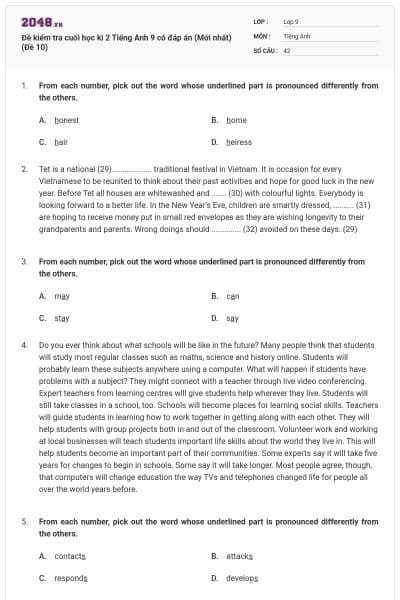
From each number, pick out the word whose underlined part is pronounced differently from the others.
honest
home
hair
heiress
Chọn đáp án A
Đáp án A là âm câm. Các đáp án còn lại phát âm là /h/
may
can
stay
say
Chọn đáp án B
Đáp án B phát âm là /a/. Các đáp án còn lại phát âm là /ei/
From each number, pick out the word whose underlined part is pronounced differently from the others.
contacts
attacks
responds
develops
Chọn đáp án C
Đáp án C phát âm là /z/. Các đáp án còn lại phát âm là /s/
failed
reached
absorbed
solved
Chọn đáp án B
Đáp án B phát âm là /t/. Các đáp án còn lại phát âm là /d/
Do they
Did they
Don't they
Weren't they
Chọn đáp án B
Câu hỏi đuôi của phủ định thì quá khứ đơn với V là Did + S?
Dịch: Họ đã không chơi cầu lông ngày hôm qua. Có phải không?
who
whose
where
which
Chọn đáp án D
Dùng “which” thay thế danh từ chỉ vật “a house”
Dịch: Chúng tôi muốn mua một căn nhà nhìn ra Hồ Tây.
I do to
So don't
I do either
Neither do I
Chọn đáp án D
Vì câu trước là câu phủ định nên câu sau dùng Neither/ Either
Đáp án C sai cấu trúc nên chọn D
Dịch: A: Tôi không thích chơi bóng đá. - B: Tôi cũng vậy.
the suit
the shirt
the Ao dai
the blouse
Chọn đáp án C
Dịch: Trang phục truyền thống của phụ nữ Việt Nam là gì? – Nó là áo dài.
must
can
could n't
mustn't
Chọn đáp án D
Mustn’t + Vinf = không được phép
Dịch: Biển báo "Dừng lại" nghĩa là bạn không được đi tiếp.
in
at
of
on
Chọn đáp án A
In + buổi trong ngày
Dịch: Anh ấy đến Anh vào tối thứ Hai.
very perfect
perfective
the most perfectively
the most perfectly
Chọn đáp án D
Cấu trúc so sánh nhất với trạng từ dài: the most + ADV
Dịch: Tiếng Anh của Maria rất xuất sắC. Cô ấy nói tiếng Anh hoàn hảo nhất trong lớp.
enough old
old enough
very old
too old
Chọn đáp án B
Cấu trúc: be + ADJ + enough + to V (đủ … để làm gì)
Dịch: Tôi chưa đủ tuổi lái xe ô tô.
to grow
grown
grow
grew
Chọn đáp án B
Cấu trúc bị động thì hiện tại đơn: be + VpII
Dịch: Lúa được trồng nhiều ở các nước nhiệt đới.
white square Japanese
white Japanese square
square white Japanese
square Japanese white
Chọn đáp án C
Thứ tự các tính từ: opinion – size – age
Dịch: Cô ấy đã mua một chiếc bánh Nhật màu trắng hình vuông.
see
to see
seeing
saw
Chọn đáp án C
Look forward to + Ving = mong đợi làm gì
Dịch: Tôi mong được gặp bạn.
in order to
in order that
because
as long as
Chọn đáp án A
In order to V: để mà …
Dịch: Em trai tôi muốn học tiếng Anh thật tốt để có thể kiếm được một công việc tốt trong tương lai.
look after
look at
look up
look for
Chọn đáp án C
Look up (ph.v) tra từ điển
Dịch: Tôi không hiểu từ này. Để tôi tra cứu nó trong từ điển.
happy
happiness
happier
happily
Chọn đáp án D
Ô trống cần một trạng từ
Dịch: Nhìn những đứa trẻ hạnh phúc. Họ đang chơi vui vẻ trong sân trường.
home
homeless
houseless
house
Chọn đáp án B
Homeless = vô gia cư
Dịch: Những đứa trẻ có cha mẹ mất sớm. Một số người trong số họ không có nhà để ở. Điều đó có nghĩa là chúng là những đứa trẻ vô gia cư.
Good fortune
Good luck
Good outcome
Good success
Chọn đáp án B
Dịch: "Ngày mai tôi sẽ thi lái xe." - "Chúc may mắn."
Yes, I mind it, sorry.
What will you do if I don't mind it?
Yes. Please do it.
I'd rather you didn't, if you don't mind.
Chọn đáp án D
Dịch: "Bạn có phiền không nếu tôi tắt đèn?" - "Tôi mong bạn không làm, nếu bạn không phiền."
sings
sing
singes
sang
Chọn đáp án A
Trong câu khẳng định thì hiện tại đơn, động từ thêm “s” với chủ ngữ ngôi 3 số ít
“Sing” là trường hợp thêm “s”
Dịch: Cô ấy hát rất hay.
be
to be
being
been
Chọn đáp án B
Used to V: đã từng …
Dịch: Ở đây từng có một rạp chiếu phim nhưng đã đóng cửa từ lâu.
see
seeing
saw
to see
Chọn đáp án B
Remember + Ving: nhớ đã làm gì
Dịch: Tôi nhớ đã gặp cô ấy ở đâu đó.
about
for
the
on
Chọn đáp án C
Sửa lại: A. Cấu trúc: go for a walk = đi dạo
Dịch: Đi dạo vào Chủ nhật thì sao?
was
playing
Tom
yesterday
Chọn đáp án B
Sửa lại: played (bị động)
Dịch: Tom đang chơi bóng đá khi trời bắt đầu đổ mưa lúc 5 giờ chiều ngày hôm qua.
exercise
such
that
can
Chọn đáp án B
Sửa lại: so. So + ADJ + that ….
Dịch: Bài tập khó đến mức không ai làm được.
Ha Noi
is
the
beautiful
Chọn đáp án C
Sửa lại: bỏ “the”. So sánh hơn không có “the” trước tính từ
Dịch: Hà Nội đẹp hơn Việt Trì.
Tet is a national (29)................... traditional festival in Vietnam.
but
so
and
or
Chọn đáp án C
A. but = nhưng
B. so = vì thế
C. and = và
D. or = hoặc
Dịch: Tết là một lễ hội dân tộc và truyền thống ở Việt Nam.
decorate
decorating
to decorate
decorated
Chọn đáp án D
Cấu trúc bị động: be + VpII
Dịch: Trước Tết, tất cả mọi nhà đều được quét vôi trắng và trang trí bằng đèn nhiều màu sắc.
them
who
these
they
Chọn đáp án D
Dịch: Trong đêm giao thừa, trẻ em được ăn mặc lịch sự, họ mong nhận được những đồng tiền được đựng trong những phong bao lì xì nhỏ như mong muốn ông bà, cha mẹ được trường thọ.
Wrong doings should .............. (32) avoided on these days.
take
not
we
be
Chọn đáp án D
Cấu trúc bị động: be + VpII
Dịch: Những việc làm sai trái nên tránh vào những ngày này.
Do you ever think about what schools will be like in the future? Many people think that students will study most regular classes such as maths, science and history online. Students will probably learn these subjects anywhere using a computer. What will happen if students have problems with a subject? They might connect with a teacher through live video conferencing. Expert teachers from learning centres will give students help wherever they live. Students will still take classes in a school, too. Schools will become places for learning social skills. Teachers will guide students in learning how to work together in getting along with each other. They will help students with group projects both in and out of the classroom. Volunteer work and working at local businesses will teach students important life skills about the world they live in. This will help students become an important part of their communities. Some experts say it will take five years for changes to begin in schools. Some say it will take longer. Most people agree, though, that computers will change education the way TVs and telephones changed life for people all over the world years before.
What is the main idea of the passage?
All classes will be taught online in the future.
Teachers will help students from home in the future.
Kids won’t have to go to school in the future.
Computers will change education in the future.
Chọn đáp án D
Ý chính của bài văn: Máy tính sẽ thay đổi nền giáo dục trong tương lai.
learn all subjects
play with their friends
use computers
learn social skills
Chọn đáp án D
Dựa vào câu: Students will still take classes in a school, too. Schools will become places for learning social skills.
Dịch: Học sinh cũng sẽ vẫn tham gia các tiết học ở trường. Trường học sẽ trở thành nơi để học tập các kỹ năng xã hội.
providing students with knowledge
guiding students to learn computers
helping students with group projects
organising live video conferences
Chọn đáp án C
Dựa vào câu: Teachers will guide students in learning how to work together in getting along with each other. They will help students with group projects both in and out of the classroom.
Dịch: Các giáo viên sẽ hướng dẫn học sinh trong việc học cách làm việc hòa hợp với nhau. Họ sẽ giúp học sinh với các dự án theo nhóm cả trong và ngoài lớp học.
teachers
schools
experts
students
Chọn đáp án C
Dựa vào câu: Some experts say it will take five years for changes to begin in schools. Some say it will take longer.
Dịch: Một số chuyên gia nói rằng sẽ mất 5 năm để các thay đổi bắt đầu trong các trường học. Một số người nói rằng nó sẽ mất nhiều thời gian hơn.
They are watching my father's new car.
→ My father's new car ................................
Đáp án đúng là: My father's new car is being watched.
Cấu trúc bị động thì hiện tại tiếp diễn: am/ is/ are + being + VpII
Dịch: Họ đang xem chiếc xe hơi mới của bố tôi.
= Chiếc xe mới của bố tôi đang được theo dõi.
He said "I will leave now"
→ He said ....................................................
Đáp án đúng là: He said he would leave then.
Khi chuyển từ lời nói trực tiếp sang gián tiếp, cần thay đổi S, V, ADV
Dịch: Anh ấy nói "Tôi sẽ đi ngay bây giờ"
= Anh ấy nói rằng anh ấy sẽ rời đi sau đó.
Susan doesn't have a watch, so she is often late for work.
→ If Susan ...................................................
Đáp án đúng là: If Susan has a watch, she won’t be often late for work.
Dùng câu điều kiện loại I để diễn tả giả thiết có thể xảy ra ở hiện tại/ tương lai
Dịch: Susan không có đồng hồ nên thường đi làm muộn.
= Nếu Susan có đồng hồ, cô ấy sẽ không thường xuyên đi làm muộn.
My sister failed the exam because she was lazy.
→ Because of ..............................................Đáp án đúng là: Because of her laziness, my sister failed the exam.
Because of + N (Bởi vì …)
Dịch: Em gái tôi thi trượt vì lười biếng.
= Vì sự lười biếng của cô ấy, em gái tôi đã thi trượt.