Đề cương ôn tập cuối kì 1 Tiếng Anh 12 Friends Global có đáp án - Part 3: Speaking and writing
14 câu hỏi
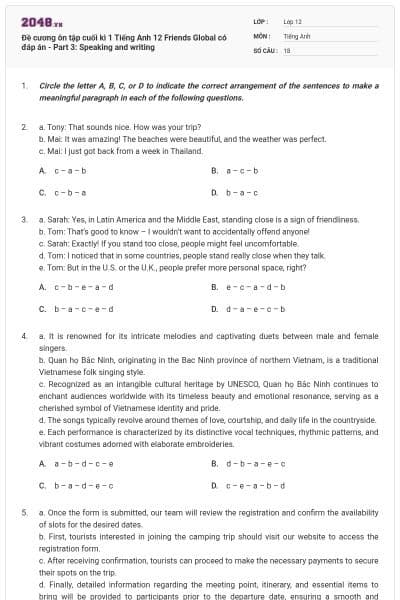
Circle the letter A, B, C, or D to indicate the correct arrangement of the sentences to make a meaningful paragraph in each of the following questions.
a. Tony: That sounds nice. How was your trip?
b. Mai: It was amazing! The beaches were beautiful, and the weather was perfect.
c. Mai: I just got back from a week in Thailand.
c – a – b
a – c – b
c – b – a
b – a – c
A
Thứ tự đúng: A. c – a – b
c. Mai: I just got back from a week in Thailand.
a. Tony: That sounds nice. How was your trip?
b. Mai: It was amazing! The beaches were beautiful, and the weather was perfect.
Dịch:
c. Mai: Mình vừa mới trở về sau một tuần ở Thái Lan.
a. Tony: Nghe hay đấy. Chuyến đi của bạn thế nào?
b. Mai: Tuyệt vời lắm! Các bãi biển rất đẹp và thời tiết thì hoàn hảo.
=> Mai thông báo về việc mình đi đâu trước => sau đó Tony hỏi về chuyến đi => và cuối cùng Mai trả lời.
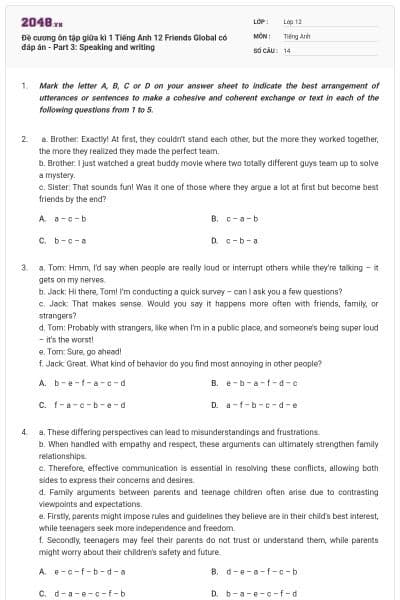
a. Sarah: Yes, in Latin America and the Middle East, standing close is a sign of friendliness.
b. Tom: That’s good to know – I wouldn’t want to accidentally offend anyone!
c. Sarah: Exactly! If you stand too close, people might feel uncomfortable.
d. Tom: I noticed that in some countries, people stand really close when they talk.
e. Tom: But in the U.S. or the U.K., people prefer more personal space, right?
c – b – e – a – d
e – c – a – d – b
b – a – c – e – d
d – a – e – c – b
D
Thứ tự đúng: D. d – a – e – c – b
d. Tom: I noticed that in some countries, people stand really close when they talk.
a. Sarah: Yes, in Latin America and the Middle East, standing close is a sign of friendliness.
e. Tom: But in the U.S. or the U.K., people prefer more personal space, right?
c. Sarah: Exactly! If you stand too close, people might feel uncomfortable.
b. Tom: That’s good to know – I wouldn’t want to accidentally offend anyone!
Dịch:
d. Tom: Mình để ý thấy ở một số nước, mọi người đứng rất sát nhau khi trò chuyện.
a. Sarah: Ừ, ở Mỹ Latin và Trung Đông, đứng gần là biểu hiện của sự thân thiện.
e. Tom: Nhưng ở Mỹ hay Anh, mọi người lại thích giữ khoảng cách cá nhân, đúng không?
c. Sarah: Đúng vậy! Nếu bạn đứng quá gần, người ta có thể thấy khó chịu.
b. Tom: Thật tốt khi biết điều đó - mình không muốn vô tình xúc phạm ai cả!
=> Đoạn hội thoại này bắt đầu bằng một quan sát, sau đó đi sâu vào giải thích các quy tắc về không gian cá nhân ở các nền văn hóa khác nhau.
a. It is renowned for its intricate melodies and captivating duets between male and female singers.
b. Quan họ Bắc Ninh, originating in the Bac Ninh province of northern Vietnam, is a traditional Vietnamese folk singing style.
c. Recognized as an intangible cultural heritage by UNESCO, Quan họ Bắc Ninh continues to enchant audiences worldwide with its timeless beauty and emotional resonance, serving as a cherished symbol of Vietnamese identity and pride.
d. The songs typically revolve around themes of love, courtship, and daily life in the countryside.
e. Each performance is characterized by its distinctive vocal techniques, rhythmic patterns, and vibrant costumes adorned with elaborate embroideries.
a – b – d – c – e
d – b – a – e – c
b – a – d – e – c
c – e – a – b – d
C
Thứ tự đúng: C. b – a – d – e – c
b. Quan họ Bắc Ninh, originating in the Bac Ninh province of northern Vietnam, is a traditional Vietnamese folk singing style.
a. It is renowned for its intricate melodies and captivating duets between male and female singers.
d. The songs typically revolve around themes of love, courtship, and daily life in the countryside.
e. Each performance is characterized by its distinctive vocal techniques, rhythmic patterns, and vibrant costumes adorned with elaborate embroideries.
c. Recognized as an intangible cultural heritage by UNESCO, Quan họ Bắc Ninh continues to enchant audiences worldwide with its timeless beauty and emotional resonance, serving as a cherished symbol of Vietnamese identity and pride.
Dịch:
b. Quan họ Bắc Ninh, có nguồn gốc từ tỉnh Bắc Ninh, miền Bắc Việt Nam, là một loại hình dân ca truyền thống của Việt Nam.
a. Nó nổi tiếng với những giai điệu tinh tế và những màn song ca lôi cuốn giữa nam và nữ.
d. Các bài hát thường xoay quanh chủ đề tình yêu, tình yêu lứa đôi và cuộc sống thường nhật ở nông thôn.
e. Mỗi màn trình diễn đều đặc trưng bởi kỹ thuật thanh nhạc đặc trưng, nhịp điệu uyển chuyển và trang phục rực rỡ được thêu tinh xảo.
c. Được UNESCO công nhận là di sản văn hóa phi vật thể, Quan họ Bắc Ninh tiếp tục làm say đắm khán giả trên toàn thế giới với vẻ đẹp vượt thời gian và sự cộng hưởng cảm xúc, trở thành biểu tượng trân quý của bản sắc và niềm tự hào Việt Nam.
=> Đoạn văn này giới thiệu về Quan họ Bắc Ninh, sau đó mô tả các đặc điểm của nó, và cuối cùng là tầm quan trọng và sự công nhận quốc tế.
a. Once the form is submitted, our team will review the registration and confirm the availability of slots for the desired dates.
b. First, tourists interested in joining the camping trip should visit our website to access the registration form.
c. After receiving confirmation, tourists can proceed to make the necessary payments to secure their spots on the trip.
d. Finally, detailed information regarding the meeting point, itinerary, and essential items to bring will be provided to participants prior to the departure date, ensuring a smooth and enjoyable camping experience for all.
e. Next, they will need to fill out the required information, including their name, contact details, and any special requests or dietary restrictions they may have.
b – a – c – e – d
a – b – c – e – d
b – e – a – c – d
c – b – e – d – a
C
Thứ tự đúng: C. b – e – a – c – d
b. First, tourists interested in joining the camping trip should visit our website to access the registration form.
e. Next, they will need to fill out the required information, including their name, contact details, and any special requests or dietary restrictions they may have.
a. Once the form is submitted, our team will review the registration and confirm the availability of slots for the desired dates.
c. After receiving confirmation, tourists can proceed to make the necessary payments to secure their spots on the trip.
d. Finally, detailed information regarding the meeting point, itinerary, and essential items to bring will be provided to participants prior to the departure date, ensuring a smooth and enjoyable camping experience for all.
Dịch:
b. Trước tiên, du khách quan tâm đến chuyến cắm trại vui lòng truy cập trang web của chúng tôi để lấy mẫu đăng ký.
e. Tiếp theo, du khách cần điền đầy đủ thông tin bắt buộc, bao gồm họ tên, thông tin liên lạc và bất kỳ yêu cầu đặc biệt hoặc hạn chế về chế độ ăn uống nào.
a. Sau khi gửi mẫu đăng ký, đội ngũ của chúng tôi sẽ xem xét đơn đăng ký và xác nhận tình trạng chỗ trống cho các ngày mong muốn.
c. Sau khi nhận được xác nhận, du khách có thể tiến hành thanh toán các khoản cần thiết để giữ chỗ cho chuyến đi.
d. Cuối cùng, thông tin chi tiết về điểm tập trung, hành trình và các vật dụng cần thiết cần mang theo sẽ được cung cấp cho du khách trước ngày khởi hành, đảm bảo trải nghiệm cắm trại suôn sẻ và thú vị cho tất cả mọi người.
=> Đoạn văn này mô tả một quy trình đăng ký tuần tự, bắt đầu từ bước đầu tiên và kết thúc bằng bước cuối cùng. Các từ nối "First", "Next", "Once", "After receiving confirmation", "Finally" là các dấu hiệu rõ ràng.
Dear Sir or Madam,
a. To begin with, the room was not clean when I arrived, and the air conditioning did not work properly.
b. I look forward to hearing your response and hope that you will address these concerns.
c. I feel strongly that as guests, we were treated very poorly. I would appreciate it if you could offer some compensation for these issues, as well as do a comprehensive review of your staff members.
d. Despite informing the reception, these problems were not fixed during my stay. To make matters worse, the receptionist’s voice when I contacted them was very dismissive and ignorant.
e. I am writing to express my dissatisfaction with my recent stay at your hotel from the 16th to the 19th.
Yours faithfully,
Judy Addams.
a – b – c – d – e
e – a – d – c – b
b – e – c – a – d
d – a – e – c – b
B
Thứ tự đúng: B. e – a – d – c – b
Dear Sir or Madam,
e. I am writing to express my dissatisfaction with my recent stay at your hotel from the 16th to the 19th.
a. To begin with, the room was not clean when I arrived, and the air conditioning did not work properly.
d. Despite informing the reception, these problems were not fixed during my stay. To make matters worse, the receptionist’s voice when I contacted them was very dismissive and ignorant.
c. I feel strongly that as guests, we were treated very poorly. I would appreciate it if you could offer some compensation for these issues, as well as do a comprehensive review of your staff members.
b. I look forward to hearing your response and hope that you will address these concerns.
Yours faithfully,
Judy Addams.
Dịch:
Kính gửi Ông/Bà,
e. Tôi viết thư này để bày tỏ sự không hài lòng của tôi về kỳ nghỉ gần đây tại khách sạn của quý khách từ ngày 16 đến ngày 19.
a. Trước hết, phòng không được sạch sẽ khi tôi đến, và điều hòa không hoạt động bình thường.
d. Mặc dù đã thông báo cho lễ tân, những vấn đề này vẫn không được khắc phục trong thời gian tôi lưu trú. Tệ hơn nữa, giọng điệu của lễ tân khi tôi liên hệ với họ rất coi thường và thiếu hiểu biết.
c. Tôi cảm thấy mạnh mẽ rằng với tư cách là khách, chúng tôi đã bị đối xử rất tệ. Tôi rất mong quý khách có thể bồi thường cho những vấn đề này, cũng như đánh giá toàn diện về đội ngũ nhân viên của quý khách.
b. Tôi mong nhận được phản hồi của quý khách và hy vọng quý khách sẽ giải quyết những lo ngại này.
Trân trọng,
Judy Addams.
=> Trình tự 1 bức thư: Mở đầu: nêu lý do viết thư => Vấn đề: phòng không sạch, máy lạnh hỏng => Thông báo với lễ tân nhưng không được xử lý => Mong muốn được bồi thường và xem xét lại nhân viên → Kết thư, hy vọng phản hồi
Choose A, B, C or D to complete each dialogue.
Tam: Tet is not just about food but also about reconnecting with relatives.
Diep: ________
Yes, in other words, it strengthens family bonds.
To be honest, I find relatives annoying.
Actually, I don’t really visit anyone.
Personally, I prefer spending time alone.
A
Dịch:
Tâm: Tết không chỉ là ăn uống mà còn là dịp để kết nối lại với họ hàng.
Diệp: ________
A. Yes, in other words, it strengthens family bonds.
(Đúng vậy, nói cách khác, nó giúp gắn kết tình cảm gia đình.)
=> Phản hồi đồng tình, lịch sự
B. To be honest, I find relatives annoying.
(Thành thật mà nói, mình thấy họ hàng khá phiền phức.)
C. Actually, I don’t really visit anyone. (Thật ra thì mình cũng chẳng đi thăm ai cả.)
D. Personally, I prefer spending time alone. (Cá nhân mình thì thích ở một mình hơn.)
Mai: What do you think is better: travelling alone or with friends?
Tuan: ________
I’d rather never leave my hometown because I hate new places.
I’d choose to stay at home all year without seeing anyone at all.
I’d go by myself to the garden near my house instead of travelling far.
I’d prefer going with friends because it’s more fun and safer.
D
Dịch:
Mai: Bạn nghĩ đi du lịch một mình hay với bạn bè thì tốt hơn?
Tuan: ________
A. I’d rather never leave my hometown because I hate new places. (Tôi thà không bao giờ rời quê hương vì tôi ghét những nơi mới.)
=> Không trực tiếp trả lời câu hỏi so sánh "một mình hay với bạn bè" mà đưa ra ý kiến hoàn toàn khác.
B. I’d choose to stay at home all year without seeing anyone at all. (Tôi sẽ chọn ở nhà cả năm mà không gặp bất cứ ai cả.)
=> Không trả lời trực tiếp câu hỏi.
C. I’d go by myself to the garden near my house instead of travelling far. (Tôi sẽ tự mình đi đến khu vườn gần nhà thay vì đi du lịch xa.)
=> Không đưa ra so sánh giữa việc đi một mình hay với bạn bè khi đi du lịch.
D. I’d prefer going with friends because it’s more fun and safer. (Tôi thích đi với bạn bè hơn vì nó vui hơn và an toàn hơn.)
=> Trả lời trực tiếp cho câu hỏi, đưa ra lựa chọn và lý do.
Linh: Could you help me clean the kitchen later today?
Nam: ________
I really don’t want to do any cleaning at all tonight.
I guess I can help if we share the other chores fairly, can’t we?
You always expect me to clean everything by myself, don’t you?
I’d rather just relax and leave the kitchen messy for now.
B
Dịch:
Linh: Bạn có thể giúp mình dọn bếp chiều nay được không?
Nam: ________
A. I really don’t want to do any cleaning at all tonight. (Tối nay mình thực sự không muốn dọn dẹp gì cả.)
=> Từ chối một cách thẳng thừng và tiêu cực.
B. I guess I can help if we share the other chores fairly, can’t we? (Tôi nghĩ tôi có thể giúp nếu chúng ta chia sẻ các công việc khác một cách công bằng, được không?)
=> Đây là câu trả lời đồng ý giúp đỡ nhưng có điều kiện, thể hiện sự hợp tác và có thể dẫn đến cuộc trò chuyện tiếp theo về việc chia sẻ công việc nhà.
C. You always expect me to clean everything by myself, don’t you? (Bạn luôn mong mình tự mình dọn dẹp mọi thứ, phải không?)
=> Câu này thể hiện sự phàn nàn, không phải là một câu trả lời mang tính hợp tác.
D. I’d rather just relax and leave the kitchen messy for now. (Mình thà cứ thư giãn và để căn bếp bừa bộn bây giờ.)
=> Từ chối đề nghị một cách thiếu trách nhiệm.
Choose A, B, C or D that has the CLOSEST meaning to the given sentence in each question.
Tourists may find it difficult to adapt to different dining etiquette in other cultures.
Tourists are likely to find it difficult to adapt to different dining etiquette in other cultures.
Tourists have to find it easy to adapt to different dining etiquette in other cultures.
Tourists must find it easy to adapt to different dining etiquette in other cultures.
Tourists can’t possibly find it difficult to adapt to different dining etiquette in other cultures.
A
May ~ are likely to: có khả năng
Must, have to: phải, chắc chắn => không phù hợp
Can’t possibly: chắc chắn không thể => trái ngược hoàn toàn với câu gốc
=> Tourists may find it difficult to adapt to different dining etiquette in other cultures.
= Tourists are likely to find it difficult to adapt to different dining etiquette in other cultures.
Dịch: Khách du lịch có thể gặp khó khăn trong việc thích nghi với các nghi thức ăn uống khác nhau ở các nền văn hóa khác.
I should have asked for permission before taking photos at the ceremony.
It was unnecessary to ask for permission before taking pictures.
I mustn’t have needed to ask for permission to take those photos.
I could have taken photos without asking anyone for permission.
It would have been better if I had asked for permission back then.
D
I should have asked for permission before taking photos at the ceremony. (Tôi lẽ ra nên xin phép trước khi chụp ảnh tại buổi lễ.)
Cấu trúc "should have + V3/ed" dùng để diễn tả một hành động đáng lẽ ra nên làm trong quá khứ nhưng đã không làm. Nó mang ý hối tiếc hoặc chỉ trích.
A. It was unnecessary to ask for permission before taking pictures. (Là không cần thiết để xin phép.) => Trái nghĩa
B. I mustn’t have needed to ask for permission to take those photos. ("Mustn't have needed" diễn tả sự suy luận chắc chắn không cần, khác nghĩa.)
C. I could have taken photos without asking anyone for permission. ("Could have taken" diễn tả một khả năng có thể làm nhưng không làm, và "without asking" thể hiện sự không xin phép, trái nghĩa với ý "lẽ ra nên xin phép".)
D. It would have been better if I had asked for permission back then. (Sẽ tốt hơn nếu tôi đã xin phép lúc đó.) =>Đây là cách diễn đạt ý hối tiếc hoặc một điều đáng lẽ nên làm trong quá khứ, tương đương với "should have asked".
Some parents find it hard to accept their children leaving home at an early age.
Some parents don’t mind accepting their children leaving home when they’re young.
Some parents struggle to accept their children leaving home so soon.
Some parents are pleased to see their children leaving home early.
Some parents are forced to accept their children to leave home early.
B
Some parents find it hard to accept their children leaving home at an early age. (Một số phụ huynh thấy khó chấp nhận việc con cái rời nhà khi còn nhỏ tuổi.)
"Find it hard to accept" có nghĩa là khó khăn trong việc chấp nhận điều gì đó.
A. Some parents don’t mind accepting their children leaving home when they’re young.
=> Don't mind: không phiền, trái ngược với "find it hard".
B. Some parents struggle to accept their children leaving home so soon.
=> Find it hard to = struggle to: thấy khó để làm gì…, at an early age = so soon
C. Some parents are pleased to see their children leaving home early.
=> Are pleased: hài lòng, trái ngược với "find it hard".
D. Some parents are forced to accept their children to leave home early.
=> Are forced to accept: bị buộc phải chấp nhận, khác với ý "thấy khó chấp nhận" nhưng không phải bị ép buộc.
Choose A, B, C or D that has the CLOSEST meaning to the given pair of sentences in each question.
If he speaks the local language, he will fully enjoy the cultural festival.
If he spoke the local language, he could fully enjoy the cultural festival.
If he was speaking the local language, he will fully enjoy the cultural festival.
If he spoke the local language, he can fully enjoyed the cultural festival.
B
He doesn’t speak the local language. He can’t fully enjoy the cultural festival.
(Anh ấy không nói được ngôn ngữ địa phương. Anh ấy không thể tận hưởng trọn vẹn lễ hội văn hóa.)
=> Dùng câu điều kiện loại II (không có thực ở hiện tại)
Cấu trúc: If + S + V2/ed (quá khứ đơn), S + would/could/might + V (nguyên mẫu).
=> Đáp án B: If he spoke the local language, he could fully enjoy the cultural festival.
A. câu điều kiện loại I => sai
C. sai thì, sai cấu trúc
D. sai chia động từ (can)
We will visit the traditional village. We will buy some handmade souvenirs there.
When we will visit the traditional village, we will buy some handmade souvenirs.
We visit the traditional village when we will buy some handmade souvenirs.
When we visit the traditional village, we will buy some handmade souvenirs.
When we will visiting the traditional village, we buy some handmade souvenirs.
C
We will visit the traditional village. We will buy some handmade souvenirs there.
(Chúng tôi sẽ thăm làng truyền thống. Chúng tôi sẽ mua một số đồ lưu niệm thủ công ở đó.)
=> Câu dùng mệnh đề thời gian với “when”
=> mệnh đề “when” chia thì hiện tại, mệnh đề chính chia tương lai.
Cấu trúc: When + S + V (hiện tại đơn), S + will + V (nguyên mẫu).
=> Chọn đáp án C
A. sai vì mệnh đề “when” dùng “will”
B. sai thứ tự, sai thì
D. sai cấu trúc, will visiting => sai
Mark hardly ever apologizes for his mistakes. His brother is a lot more considerate.
Mark is just as considerate as his brother when it comes to saying sorry.
Mark is nowhere near as considerate as his brother about apologizing.
Mark is a bit more considerate than his brother about apologizing.
Mark is slightly more considerate than his brother when he apologizes.
B
Mark hardly ever apologizes for his mistakes. His brother is a lot more considerate.
(Mark hầu như không bao giờ xin lỗi về lỗi lầm của mình. Anh trai cậu ấy thì chu đáo hơn nhiều.)
=> Dùng so sánh hơn: Anh trai Mark chu đáo (considerate) hơn Mark ↔ Mark không chu đáo bằng anh trai
=> Chọn đáp án B: Mark is nowhere near as considerate as his brother about apologizing. (Mark không chu đáo bằng anh trai mình chút nào khi nói xin lỗi)
A. Mark chu đáo như anh trai khi nói lời xin lỗi. => trái nghĩa
C. Mark chu đáo hơn một chút => trái nghĩa
D. Mark hơi chu đáo hơn => trái nghĩa