Đề cương ôn tập cuối kì 1 Tiếng Anh 12 Friends Global có đáp án - Part 1: Listening
28 câu hỏi
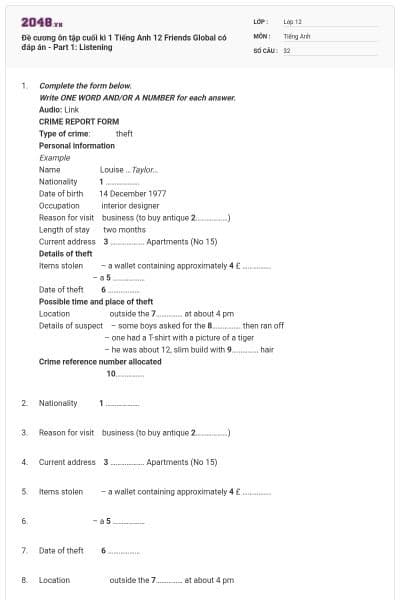
Complete the form below.
Write ONE WORD AND/OR A NUMBER for each answer.
Audio: Link
CRIME REPORT FORM
Type of crime: theft
Personal information
Example
Name Louise …Taylor…
Nationality 1 ……………….
Date of birth 14 December 1977
Occupation interior designer
Reason for visit business (to buy antique 2………………)
Length of stay two months
Current address 3 ………………. Apartments (No 15)
Details of theft
Items stolen – a wallet containing approximately 4 £ …………….
– a 5 ………………
Date of theft 6 ………………
Possible time and place of theft
Location outside the 7…………… at about 4 pm
Details of suspect – some boys asked for the 8……………. then ran off
– one had a T-shirt with a picture of a tiger
– he was about 12, slim build with 9…………… hair
Crime reference number allocated
10…………….
Nationality 1 ……………….
Canadian
Nationality: quốc tịch
Thông tin trong bài: And are you resident in the UK? No, I’m actually Canadian, though my mother was British.
(Thực ra tôi là người Canada, dù mẹ của tôi là người Anh)
Reason for visit business (to buy antique 2………………)
furniture
Thông tin trong bài: I come over most summers on business. I’m an interior designer and I come over to buy old furniture, antiques…
(…Tôi đến đây để mua đồ nội thất cũ, đồ cổ…)
=> Cô ấy đến để mua đồ nội thất cổ
Current address 3 ………………. Apartments (No 15)
Park
Thông tin trong bài: Well at present I’ve got a place at Park Apartments, that’s on King Street. I was staying at the Riverside Apartments on the same street, …
(Vâng, hiện tại tôi đã có một chỗ ở tại Park Apartments…)
=> Câu hỏi trong bài yêu cầu điển thông tin về “current address” (địa chỉ hiện tại), còn Riverside Apartments người nói dung “I was” (tôi đã)
Items stolen – a wallet containing approximately 4 £ …………….
250
Thông tin trong bài: Well, fortunately I don’t keep my credit cards in that wallet - I keep them with my passport in an inside compartment in my backpack. But there was quite a bit of cash there ... about £250 sterling, I should think. I withdrew £300 from my account yesterday, but I did a bit of shopping, so I must have already spent about £50 of that.
(có khá nhiều tiền mặt ở đó…khoảng 250 bảng)
=> Câu hỏi trong bài yêu cầu điền thông tin về giá tiền ở trong chiếc ví đã mất. Đáp án ở đây là 250, còn 300 là số tiền mà người phụ nữ “withdrew” (rút) và 50 là số tiền người phụ nữ “spent” (đã tiêu).
– a 5 ………………
phone
Thông tin trong bài: At first I thought, oh I must have left the wallet back in the apartment, but then I realized my phone had gone as well.
(…Tôi nhận ra điện thoại của tôi cũng đã mất)
=> Ngoài ví, Louise còn bị mất điện thoại.
Date of theft 6 ………………
6. 10th September
Thông tin trong bài: Yes. So you say the theft occurred yesterday? - Yes.
So that was September the tenth. And do you have any idea at all of where or ...
(đó là ngày mười tháng chín)
Location outside the 7…………… at about 4 pm
museum
Thông tin trong bài: Anyway, I met up with a friend, and we spent a couple of hours in the museum. But I do remember that as we were leaving there, at about 4 o’clock, a group of young boys ran up to us, and ...
=> Vụ việc có thể xảy ra ở bên ngoài bảo tàng
Details of suspect – some boys asked for the 8……………. then ran off
time
Thông tin trong bài: … a group of young boys ran up to us, and they were really crowding round us, and they were asking us what time it was, then all of a sudden they ran off.
A group of young boys = some boys
(… họ hỏi chúng tôi về thời gian…)
– he was about 12, slim build with 9…………… hair
Blond(e)
Thông tin trong bài: And can you remember anything else about his appearance?
Not much. He was quite thin ...
Colour of hair?
I do remember that - he was blond. All the others were dark - haired.
=> Màu tóc của cậu bé đó là màu vàng “blond”, còn “dark” cũng chỉ về màu tóc nhưng chỉ miêu tả những đứa trẻ khác.
10…………….
87954 82361
Thông tin trong bài: Right. So what I’m going to do now is give you a crime reference number so you can contact your insurance company. So this is ten digits: 87954 82361.
Nội dung bài nghe:
OFFICER: Good morning. What can I do for you?
LOUISE: I want to report a theft. I had some things stolen out of my bag yesterday.
OFFICER: I’m sorry to hear that. Right, so I’ll need to take a few details. Can I start with your name?
LOUISE: Louise Taylor. (Example)
OFFICER: OK, thank you. And are you resident in the UK?
LOUISE: No, I’m actually Canadian (Q1). Though my mother was British.
OFFICER: And your date of birth?
LOUISE: December 14th, 1977.
OFFICER: So you’re just visiting this country?
LOUISE: That’s right. I come over most summers on business. I’m an interior designer and I come over to buy old furniture (Q2), antiques you know. There are some really lovely things around here, but you need to get out to the small towns. I’ve had a really good trip this year, until this happened.
OFFICER: OK. So you’ve been here quite a while?
LOUISE: Yes, I’m here for two months. I go back next week.
OFFICER: So may I ask where you’re staying now?
LOUISE: Well at present I’ve got a place at Park (Q3) Apartments, that’s on King Street. I was staying at the Riverside Apartments on the same street, but the apartment there was only available for six weeks so I had to find another one.
OFFICER: OK. And the apartment number?
LOUISE: Fifteen.
LOUISE: Right.
…………………………………………..
OFFICER: Now, I need to take some details of the theft. So you said you had some things stolen out of your bag?
LOUISE: That’s right.
OFFICER: And were you actually carrying the bag when the theft took place?
LOUISE: Yes, I really can’t understand it. I had my backpack on. And I went into a supermarket to buy a few things and when I opened it up my wallet wasn’t there.
OFFICER: And what did your wallet have in it?
LOUISE: Well, fortunately I don’t keep my credit cards in that wallet – I keep them with my passport in an inside compartment in my backpack. But there was quite a bit of cash there … about £250 (Q4) sterling, I should think. I withdrew £300 from my account yesterday, but I did a bit of shopping, so I must have already spent about £50 of that.
OFFICER: OK.
LOUISE: At first I thought, oh I must have left the wallet back in the apartment, but then I realised my phone (Q5) had gone as well. It was only a week old, and that’s when I realised I’d been robbed. Anyway at least they didn’t take the keys to my rental car.
OFFICER: Yes. So you say the theft occurred yesterday?
LOUISE: Yes.
OFFICER: So that was September the tenth (Q6). And do you have any idea at all of where or when the things might possibly have been stolen?
LOUISE: Well at first I couldn’t believe it because the bag had been on my back ever since I left the apartment after lunch. It’s just a small backpack, but I generally use it when I’m travelling because it seems safer than a handbag. Anyway, I met up with a friend, and we spent a couple of hours in the museum (Q7). But I do remember that as we were leaving there, at about 4 o’clock, a group of young boys ran up to us, and they were really crowding round us, and they were asking us what time (Q8) it was, then all of a sudden they ran off.
OFFICER: Can you remember anything about them?
LOUISE: The one who did most of the talking was wearing a T-shirt with a picture of something … let’s see … a tiger.
OFFICER: Right. Any idea of how old he might have been?
LOUISE: Around twelve years old?
OFFICER: And can you remember anything else about his appearance?
LOUISE: Not much. He was quite thin …
OFFICER: Colour of hair?
LOUISE: I do remember that – he was blond (Q9). All the others were dark-haired.
OFFICER: And any details of the others?
LOUISE: Not really. They came and went so quickly.
OFFICER: Right. So what I’m going to do now is give you a crime reference number so you can contact your insurance company. So this is ten digits: 87954 82361 (Q10).
LOUISE: Thank you. So should I …
Match speakers 1-4 with sentences A-E. There is one extra sentence.
A The speaker is persuading people to buy something.
B The speaker is remembering a family tradition from when he / she was younger.
C The speaker is thanking his / her guests for coming to a special family meal.
D The speaker is praising a family member for preventing a family argument.
E The speaker is complaining about a bad experience at a family reunion.
A The speaker is persuading people to buy something.
A. The speaker is persuading people to buy something.
(Người nói đang thuyết phục mọi người mua thứ gì đó.)
Thông tin: “Available now from all good newsagents, only £3.99.”
(Hiện có sẵn ở tất cả các quầy bán báo tốt, chỉ £3,99.)
=> Speaker 2
B The speaker is remembering a family tradition from when he / she was younger.
B. The speaker is remembering a family tradition from when he / she was younger.
(Người nói đang nhớ lại một truyền thống gia đình từ khi anh ấy/cô ấy còn nhỏ.)
Thông tin: “They used to argue sometimes, but it was never a bad argument. It was a happy time.”
(Đôi khi họ cũng từng tranh cãi, nhưng đó chưa bao giờ là một cuộc tranh cãi tồi. Đó là khoảng thời gian hạnh phúc.)
=> Speaker 4
C The speaker is thanking his / her guests for coming to a special family meal.
C. The speaker is thanking his / her guests for coming to a special family meal.
(Người nói đang cảm ơn những vị khách đã đến dự một bữa ăn đặc biệt của gia đình.)
=> Không có người nói phù hợp.
D The speaker is praising a family member for preventing a family argument.
D. The speaker is praising a family member for preventing a family argument.
(Người nói đang khen ngợi một thành viên trong gia đình đã ngăn chặn cuộc tranh cãi trong gia đình.)
Thông tin: “You managed to change the subject, and everyone had a chance to calm down … so well done!”
(Bạn đã thay đổi được chủ đề và mọi người đã có cơ hội bình tĩnh lại… làm tốt lắm!)
=> Speaker 1
E The speaker is complaining about a bad experience at a family reunion.
E. The speaker is complaining about a bad experience at a family reunion.
(Người nói đang phàn nàn về một trải nghiệm tồi tệ trong buổi đoàn tụ gia đình.)
Thông tin: “As soon as we all got together, all the old arguments started again.”
(Ngay khi tất cả chúng ta gặp nhau, mọi cuộc tranh cãi cũ lại bắt đầu.)
=> Speaker 3
Nội dung bài nghe:
1 To be honest, I think you did really well. We could all see that dad was about to lose his temper completely – and Lucy was pretty angry too. And then you suddenly started telling that long story about a family reunion twenty years ago … and everybody thought, ‘what’s he talking about?’ But it worked. You managed to change the subject, and everyone had a chance to calm down … so well done!
2 In this month’s edition of Family Issues, there’s a fascinating feature on how to prevent arguments in your family. It’s full of fantastic tips: how to get through a big family reunion without any tears, how to keep the whole family happy at meal times – and many more. Available now from all good newsagents, only £3.99.
3 You know, I really thought it would be nice to see everyone – especially after so many years. But I guess I was being too optimistic. As soon as we all got together, all the old arguments started again. My brother fell out with my dad and they almost had a fight! I just thought, I can’t stand this – so I went home. I didn’t say anything to anyone – I just left.
4 There were six of us in the family home: me, my mum and dad, my two brothers and my grandmother. I loved getting up late on Sunday morning and smelling the roast dinner cooking in the oven. We always had roast dinner on Sunday. My dad cooked the meal, but my grandmother used to give him lots of advice – advice he didn’t ask for, or want. They used to argue sometimes, but it was never a bad argument. It was a happy time.
Listen to four people talk about their experiences living abroad. For questions 16 to 23, decide whether the following statements are T (True) or F (False).
F
Andrew's landlord sent him an apology letter.
(Chủ nhà của Andrew đã gửi cho anh ấy một lá thư xin lỗi)
Thông tin: But to my surprise, my landlord gave me a beautifully wrapped towel set as an apology!
(Nhưng điều ngạc nhiên là chủ nhà đã tặng tôi một bộ khăn tắm được gói đẹp mắt như một lời xin lỗi!)
=> Andrew nhận được khăn là quà xin lỗi, không phải thư.
T
Andrew isn't good at wrapping gifts.
(Andrew không giỏi gói quà)
Thông tin: But what I found most interesting was how much thought people put into choosing the perfect way to wrap a gift. It's an art form I haven't mastered yet…
(…Đó là một hình thức nghệ thuật mà tôi vẫn chưa thành thạo)
=> Andrew nói anh ấy chưa thành thạo gói quà.
F
Erica wasn't the typical Brit when she first arrived in Brazil.
(Erica không phải là người Anh điển hình khi cô mới đến Brazil)
Thông tin: I was invited to a barbecue and, Brits being Brits, I showed up exactly at 1 p.m.—the time I was told the event would start. To my surprise, no one else arrived until well past 2!
(Tôi được mời đến một bữa tiệc nướng và, người Anh thì vẫn luôn là người Anh, tôi đến đúng 1 giờ chiều—thời điểm tôi được thông báo sự kiện sẽ bắt đầu. Thật ngạc nhiên, không có ai khác đến cho đến tận hơn 2 giờ!)
=> Erica ban đầu đến đúng giờ theo văn hóa người Anh điển hình
=> Erica là người Anh điển hình
T
Now, Erica has to make an effort when she's in England.
(Bây giờ, Erica phải nỗ lực khi ở Anh)
Thông tin: And I have to admit, when I visit England, it's hard for me to adapt back to the rigid schedules.
(Và tôi phải thừa nhận rằng, khi đến thăm Anh, tôi thấy khó có thể thích nghi lại với lịch trình cứng nhắc)
=> Erica thấy khó thích nghi lại với giờ giấc của Anh.
T
April went to Vietnam because she wanted to change her life.
(April đến Việt Nam vì cô ấy muốn thay đổi cuộc sống của mình)
Thông tin: I moved to Vietnam because I was in a bad place personally, and I wanted to experience something completely new.
(Tôi đã chuyển đến Việt Nam vì đang gặp khủng hoảng trong cuộc sống cá nhân và tôi muốn trải nghiệm một điều gì đó hoàn toàn mới mẻ.)
=> April đến Việt Nam để thay đổi cuộc sống.
F
April talks about what happens to the people who visit her.
(April kể về những điều xảy ra với những người đến thăm cô)
Thông tin: Now, whenever someone from the States visits me, I can't wait to see their reaction when they experience it for the first time.
(Bây giờ, bất cứ khi nào có ai đó từ Mỹ đến thăm tôi, tôi đều háo hức muốn xem phản ứng của họ khi họ trải nghiệm điều đó lần đầu tiên)
=> April mong chờ, không kể về phản ứng của khách đến thăm cô ở Việt Nam.
F
For Scott, wildlife is the most remarkable thing about Kenya.
(Đối với Scott, động vật hoang dã là điều đáng chú ý nhất ở Kenya)
Thông tin: But what really surprised me was how much people rely on community.
(Nhưng điều thực sự khiến tôi ngạc nhiên là mọi người ở đây sống phụ thuộc vào cộng đồng nhiều đến mức nào)
=> Scott cho rằng điều đáng chú ý nhất là sự gắn bó cộng đồng, không phải động vật hoang dã.
T
Back home, Scott once had to wait hours to receive road assistance.
(Trở về nhà, Scott đã từng phải chờ hàng giờ để nhận được sự hỗ trợ trên đường)
Thông tin: It was such a contrast to what I was used to—back home, I might have been stranded for hours, waiting for roadside assistance.
(Điều đó thực sự trái ngược hoàn toàn với những gì tôi từng quen – ở quê nhà, có khi tôi đã phải mắc kẹt hàng giờ chỉ để chờ cứu hộ đường bộ)
=> Scott từng phải đợi hàng giờ mới được hỗ trợ ở quê nhà.
Nội dung bài nghe:
ANDREW: I moved to Japan two years ago to teach English, and something that really surprised me was the culture around gift-giving. When I first moved in, there was a small issue with my apartment - nothing major, just a small leak. But to my surprise, my landlord gave me a beautifully wrapped towel set as an apology! I later learned that in Japan, people give small gifts on many different occasions. Now, I love giving small gifts too - it's such a thoughtful tradition. But what I found most interesting was how much thought people put into choosing the perfect way to wrap a gift. It's an art form I haven't mastered yet—but I hope it's the thought that counts!
ERICA: I moved to Brazil for love—my partner's Brazilian. When I first moved here from the UK, I was quite surprised at how relaxed people were about arrival times for social events. Once, I was invited to a barbecue and, Brits being Brits, I showed up exactly at 1 p.m.—the time I was told the event would start. To my surprise, no one else arrived until well past 2! I soon realised that was just common practice. It was a shock at first, but I've learnt to embrace the relaxed approach to time. Now, I actually enjoy how everything feels more spontaneous and less rushed. And I have to admit, when I visit England, it's hard for me to adapt back to the rigid schedules.
APRIL: I moved to Vietnam because I was in a bad place personally, and I wanted to experience something completely new. The first thing that struck me was the traffic. Crossing the street felt like a real-life video game! There's a constant flow of traffic, so you just walk slowly and trust that the scooters will swerve around you. It was terrifying at first, but you get used to it—until you don't even think about it anymore. Now, whenever someone from the States visits me, I can't wait to see their reaction when they experience it for the first time. It's so much fun! Cities here are so vibrant and full of life. I love how people gather at little street stalls, sitting on tiny plastic stools, chatting over steaming bowls of pho—a fragrant noodle soup with fresh herbs and meat. There's an energy in the air—music, motorbikes, the scent of grilled meat. Life here moves fast, but in the best way. Looking back, I can't believe how much this place has changed me. I came here feeling lost, but now I feel more alive than ever.
SCOTT: I moved to Kenya to work on a wildlife conservation project. The sheer scale of the landscapes here is breathtaking—nothing prepared me for seeing elephants roam freely under the vast, open skies. But what really surprised me was how much people rely on community. People's lives here are deeply connected—whether it's families sharing meals, neighbours looking out for each other, or strangers offering a helping hand without hesitation. Once, my car broke down in a remote area, and within minutes, locals came to help, chatting and laughing as they fixed it. It was such a contrast to what I was used to—back home, I might have been stranded for hours, waiting for roadside assistance. This sense of togetherness has changed how I see life. It is a reminder of how much we miss out on by living so independently. Here, people understand that no one truly thrives alone, and that is something I will carry with me wherever I go.
Listen to an interview with a traveller and choose the correct answers.
How does the presenter describe Colin?
She says he’s had a serious physical disability since birth.
She says he’s confessed to problems with alcohol addiction.
She says he’s shown more bravery than average travellers.
She says he’s been held back by his disability.
C
Dịch: Người dẫn chương trình mô tả Colin như thế nào?
A. She says he’s had a serious physical disability since birth.
(Cô ấy nói rằng anh ấy đã mắc một khuyết tật nghiêm trọng về thể chất từ khi mới sinh.)
B. She says he’s confessed to problems with alcohol addiction.
(Cô ấy nói rằng anh ấy đã thú nhận từng có vấn đề với việc nghiện rượu.)
C. She says he’s shown more bravery than average travellers.
(Cô ấy nói rằng anh ấy đã thể hiện sự dũng cảm hơn so với những người du lịch bình thường.)
D. She says he’s been held back by his disability.
(Cô ấy nói rằng anh ấy đã bị cản trở bởi khuyết tật của mình.)
Thông tin: But there’s one thing about Colin, apart from his courage and determination, that makes him stand out from typical backpackers, and that’s the disability he’s had since he was two.
(Nhưng có một điều về Colin, ngoài lòng dũng cảm và quyết tâm, khiến anh ấy nổi bật so với những người đi du lịch ba lô thông thường, đó là khuyết tật mà anh ấy mắc phải từ khi mới hai tuổi)
=> Colin là một người can đảm và quyết đoán, điều khiến anh nổi bật hơn những người du lịch bụi thông thường.
He says it’s not at all attractive.
He describes it in positive terms.
He says it has an unusual name.
He says it’s situated near Alice Springs.
A
Dịch: Colin mô tả nơi mà anh ấy đang ở vào lúc người dẫn chương trình nói chuyện với anh như thế nào?
A. He says it’s not at all attractive. (Anh ấy nói rằng nơi đó hoàn toàn không hấp dẫn chút nào.)
B. He describes it in positive terms. (Anh ấy mô tả nó bằng những từ ngữ tích cực.)
C. He says it has an unusual name. (Anh ấy nói rằng nơi đó có một cái tên kỳ lạ.)
D. He says it’s situated near Alice Springs. (Anh ấy nói rằng nơi đó nằm gần Alice Springs.)
Thông tin: It’s a pretty dingy, run-down place, as well.
(Đó cũng là một nơi khá tồi tàn và xuống cấp)
=> "dingy" (tồi tàn) và "run-down" (xuống cấp) đều là mô tả tiêu cực
=> Colin không thấy nơi đó hấp dẫn.
How does Colin describe his own personality?
He says that because of his limitations, he can lack confidence sometimes.
He says he’s always felt that he should have a go at things despite what others say.
He says he’s become more fearless as he’s grown up and matured.
He says he now has a better understanding of what he can and can’t do.
B
Dịch: Colin mô tả tính cách của bản thân như thế nào?
A. He says that because of his limitations, he can lack confidence sometimes.
(Anh ấy nói rằng vì những giới hạn của mình, đôi khi anh cảm thấy thiếu tự tin.)
B. He says he’s always felt that he should have a go at things despite what others say.
(Anh ấy nói rằng anh luôn cảm thấy mình nên thử mọi thứ, bất chấp người khác nói gì.)
C. He says he’s become more fearless as he’s grown up and matured.
(Anh ấy nói rằng anh trở nên dũng cảm hơn khi lớn lên và trưởng thành.)
D. He says he now has a better understanding of what he can and can’t do.
(Anh ấy nói rằng giờ đây anh hiểu rõ hơn về những gì mình có thể và không thể làm.)
Thông tin: Well, I guess I don’t let my limitations hold me back. If someone tells me I can’t do something, that’ll just make me want to do it more.
(Vâng, tôi đoán là tôi không để những hạn chế của mình kìm hãm tôi. Nếu ai đó nói với tôi rằng tôi không thể làm điều gì đó, điều đó chỉ khiến tôi muốn làm điều đó nhiều hơn)
=> Colin luôn có xu hướng thử sức, nhất là khi người khác nghĩ anh không thể. Anh không bị khuyết tật ngăn cản mình.
What does Colin say about the preparations he makes for his journeys?
He generally plans his holidays abroad with his mother and brothers.
He usually stays in hotels that are more accessible rather than in hostels.
He always has everything sorted out long before he sets off on a trip.
He never uses public transport, so has to organise his own vehicle in advance.
C
Dịch: Colin nói gì về việc chuẩn bị cho những chuyến đi của mình?
A. He generally plans his holidays abroad with his mother and brothers.
(Anh ấy thường lên kế hoạch đi nghỉ ở nước ngoài với mẹ và các anh em của mình.)
B. He usually stays in hotels that are more accessible rather than in hostels.
(Anh ấy thường ở khách sạn mà dễ tiếp cận hơn là ở nhà trọ.)
C. He always has everything sorted out long before he sets off on a trip.
(Anh ấy luôn sắp xếp mọi thứ ổn thỏa từ rất lâu trước khi lên đường.)
D. He never uses public transport, so has to organise his own vehicle in advance.
(Anh ấy không bao giờ dùng phương tiện công cộng, nên phải tự sắp xếp xe trước.)
Thông tin: The secret is to be well-prepared. If I want to go somewhere, I’ll plan a year in advance, ...
(Bí quyết là phải chuẩn bị thật kỹ. Nếu tôi muốn đi đâu đó, tôi sẽ lên kế hoạch trước một năm)
=> Anh ấy lên kế hoạch trước cả năm, chuẩn bị rất kỹ.
He will be travelling down the west coast.
He expects it will be cheaper than other people’s holidays.
He’ll book places to stay as he travels.
He won’t be going on his own.
D
Dịch: Colin nói gì về chuyến đi Canada năm tới của anh ấy?
A. He will be travelling down the west coast. (Anh ấy sẽ đi dọc bờ Tây.)
B. He expects it will be cheaper than other people’s holidays.
(Anh ấy mong rằng chuyến đi sẽ rẻ hơn so với của người khác.)
C. He’ll book places to stay as he travels. (Anh ấy sẽ đặt chỗ ở trong khi đang di chuyển.)
D. He won’t be going on his own. (Anh ấy sẽ không đi một mình.)
Thông tin: And I have to go with a friend, or sometimes with my mum because it’s just too difficult to do everything by myself.
(Và tôi phải đi cùng một người bạn, hoặc đôi khi là đi cùng mẹ tôi vì thật sự rất khó để tự mình làm mọi việc)
=> Colin nói rõ: anh ấy không thể tự đi một mình, nên sẽ đi cùng bạn hoặc mẹ.
Nội dung bài nghe:
Presenter Today’s guest on Travel Online is nineteen-year-old, self-confessed travel addict Colin Patterson. But there’s one thing about Colin, apart from his courage and determination, that makes him stand out from typical backpackers, and that’s the disability he’s had since he was two. Colin has spinal muscular atrophy, which means he can’t walk, and has to use a wheelchair. Hi, Colin. Where are you?
Colin Well, I’m in the middle of Australia, on my way to Alice Springs, the only big town around here. We’ve stopped over in a pretty remote place for tonight. I don’t even know its name.
PresenterThat sounds seriously remote.
Colin Yeah. It’s a pretty dingy, run-down place, as well. We had to stop here because our car broke down. I’m getting to see the real Australia, I guess.
PresenterSure. Right, what our listeners would like to hear is your story. How have you overcome serious physical disability to become a traveller with a worldwide following on the internet?
Colin Well, I guess I don’t let my limitations hold me back. If someone tells me I can’t do something, that’ll just make me want to do it more. I’ve always been like that. Some young people who use a wheelchair can lack confidence, and it’s only later in life that they realise they have just as much right as everyone else to take on challenges. Not me, though. When I was young, my mum used to take me and my brothers on family holidays abroad, and she’d get really exasperated if anybody suggested I shouldn’t go to the same places as the rest of my family. So, perhaps I’ve learned to be fearless from her.
PresenterGood for you. But how do you manage to travel round the world in a wheelchair?
Colin The secret is to be well-prepared. If I want to go somewhere, I’ll plan a year in advance, checking out the accessibility of hotels or hostels, and of transport options. Sadly, some countries, especially in Asia and Africa, are just not set up for wheelchair users, so I’ve had to avoid them. But, usually I go where I want.
PresenterSo, where next?
Colin This time next year, I’ll be making my way across Canada, from coast to coast, but I’ll have booked everything way before I set off. That way, I won’t have any disappointments, and I’ll be able to keep the costs down. Unlike most people, I can’t travel on the cheap, you see. And I have to go with a friend, or sometimes with my mum because it’s just too difficult to do everything by myself.