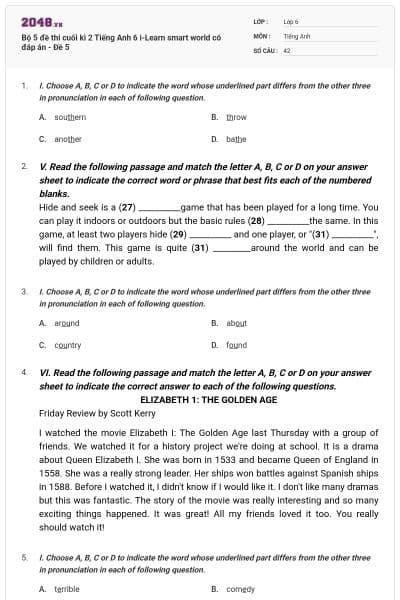
40 câu hỏi
southern
throw
another
bathe
Kiến thức: Phát âm “th”
Giải thích:
A. southern /ˈsʌðən/
B. throw /θrəʊ/
C. another /əˈnʌðə(r)/
D. bathe /beɪð/
Phần được gạch chân ở phương án B được phát âm /θ/, các phương án còn lại phát âm /ð/.
Đáp án B
around
about
country
found
Kiến thức: Phát âm “ou”
Giải thích:
A. around /əˈraʊnd/
B. about /əˈbaʊt/
C. country /ˈkʌntri/
D. found /faʊnd/
Phần được gạch chân ở phương án C được phát âm /ʌ/, các phương án còn lại phát âm /aʊ/.
Đáp án C
terrible
comedy
president
general
Kiến thức: Phát âm “e”
Giải thích:
A. terrible /ˈterəbl/
B. comedy /ˈkɒmədi/
C. president /ˈprezɪdənt/
D. general /ˈdʒenrəl/
Phần được gạch chân ở phương án B được phát âm /ə/, các phương án còn lại phát âm /e/.
Đáp án B
station
bottle
movie
donate
Kiến thức: Trọng âm từ có 2 âm tiết
Giải thích:
A. station (n) /ˈsteɪʃn/
B. bottle (n) /ˈbɒtl/
C. movie (n) /ˈmuːvi/
D. donate (v) /dəʊˈneɪt/
Phương án D có trọng âm 2, các phương án còn lại có trọng âm 1.
Đáp án D
wildlife
protect
purpose
useful
Kiến thức: Trọng âm từ có 2 âm tiết
Giải thích:
A. wildlife (n) /ˈwaɪldlaɪf/
B. protect (v) /prəˈtekt/
C. purpose (n) /ˈpɜːpəs/
D. useful (adj) /ˈjuːsfl/
Phương án B có trọng âm 2, các phương án còn lại có trọng âm 1.
Đáp án B
action
drama
horror
arrive
Kiến thức: Trọng âm từ có 2 âm tiết
Giải thích:
A. action (n) /ˈækʃn/
B. drama (n) /ˈdrɑːmə/
C. horror (n) /ˈhɒrə(r)/
D. arrive (v) /əˈraɪv/
Phương án D có trọng âm 2, các phương án còn lại có trọng âm 1.
Đáp án D
can
should
can’t
shouldn’t
Kiến thức: Động từ khuyết thiếu
Giải thích:
A. can: có thể
B. should: nên
C. can’t: không thể
D. shouldn’t: không nên
Astronauts can’t have a shower in space because there is no gravity in space.
(Phi hành gia không thể tắm ở ngoài không gian bởi vì không có trọng lực ở ngoài không gian.)
Đáp án C

Học thông minh hơn mỗi ngày
Xem toàn bộ 40 câu hỏi và nhiều hơn nữa với tài khoản miễn phí
might
must
can’t
shouldn’t
Kiến thức: Động từ khuyết thiếu
Giải thích:
Dùng cấu trúc: “might + Vinf” để diễn tả một dự đoán về tương lai
In the future, people might have driverless cars.
(Ở tương lai, con người có thể có ô tô không người lái.)
Đáp án A
can
should
can’t
shouldn’t
Kiến thức: Động từ khuyết thiếu
Giải thích:
A. can: có thể
B. should: nên
C. can’t: không thể
D. shouldn’t: không nên
You shouldn’t drive fast in the town centre.
(Bạn không nên lái xe nhanh ở trung tâm thị trấn.)
Đáp án D
so
but
and
or
Kiến thức: Liên từ
Giải thích:
A. so: nên
B. but: nhưng
C. and: và
D. or: hoặc
Minh didn’t do his homework, so the teacher was angry with him.
(Minh đã không làm bài tập về nhà, vì vậy giáo viên đã rất tức giận với cậu ấy.)
Đáp án A
so
but
and
or
Kiến thức: Liên từ
Giải thích:
A. so: nên
B. but: nhưng
C. and: và
D. or: hoặc
There is no gravity, so astronauts must tie their sleeping bags to the wall.
(Không có trọng lực, vì vậy những phi hành gia phải buộc túi ngủ của mình lên tường.)
Đáp án A
think
to think
thinking
thinks
Kiến thức: Thì hiện tại đơn
Giải thích:
Chủ ngữ số ít “she” => động từ thường “think” cần chia
She thinks they will live in a megacity.
(Cô ấy nghĩ rằng họ sẽ sống ở những siêu đô thị.)
Đáp án D
Mai lives
will Mai live
does Mai
Mai will live
Kiến thức: Thì tương lai đơn
Giải thích:
Cấu trúc: S think(s) + S + will + Vinf dùng để nên ra ý kiến về tương lai
Do you think Mai will live on the sea?
(Bạn có nghĩ rằng Mai sẽ sống ở vùng biển không?)
Đáp án D
beautiful
more beautiful
most beautiful
beautifulest
Kiến thức: So sánh nhất
Giải thích:
Dấu hiệu “the”. Cấu trúc: S + be/V + the adj-est/ most adj + N + (in a group).
This is the most beautiful city in Vietnam.
(Đây là thành phố đẹp nhất Việt Nam.)
Đáp án C
more comfortable
more comfortable than
the more comfortable
the most comfortable
Kiến thức: So sánh hơn
Giải thích:
Cấu trúc: S1 + be/V + adj-er/ more adj + than + S2.
My bedroom is more comfortable than yours.
(Phòng ngủ của tôi thoải mái hơn của bạn.)
Đáp án B
read
reading
to read
reads
Kiến thức: Câu điều kiện loại 1
Giải thích:
Cách dùng: Diễn tả một giả thuyết có khả năng xảy ra ở hiện tại/ tương lai
Cấu trúc: If + S + V(HTĐ), S will/can/may + Vinf.
If she reads in bad light, she will ruin her eyes.
(Nếu cô ấy đọc sách ở nơi ánh sáng không tốt, cô ấy sẽ làm hại mắt.)
Đáp án D
make
will make
making
to make
Kiến thức: Câu điều kiện loại 1
Giải thích:
Cách dùng: Diễn tả một giả thuyết có khả năng xảy ra ở hiện tại/ tương lai
Cấu trúc: S + will/can/may + Vinf + if + S + V(HTĐ)
I will get angry if you make more mistakes.
(Tôi sẽ bực mình nếu bạn mắc thêm nhiều lỗi.)
Đáp án A
visit
visits
visiting
will visit
Kiến thức: Câu điều kiện loại 1
Giải thích:
Cách dùng: Diễn tả một giả thuyết có khả năng xảy ra ở hiện tại/ tương lai
Cấu trúc: If + S + V(HTĐ), S will/can/may + Vinf.
If she travels to London, she will visit the museums.
(Nếu cô ấy đi tới London, cô ấy sẽ thăm các bảo tàng.)
Đáp án D
go
going
goes
to go
Kiến thức: Động từ
Giải thích:
Cấu trúc: might + Vinf: dùng để diễn tả dự đoán về tương lai
She might go to Greenwater Cave.
(Cô ấy có thể đi tới Động Greenwater.)
Đáp án A
lot of
lots
lots of
much
Kiến thức: Lượng từ
Giải thích:
Dùng: a lot of = lots of + danh từ số nhiều; “people” là danh từ đếm được, số nhiều
I think lots of people will live in megacities.
(Tôi nghĩ nhiều người sẽ sống ở các siêu đô thị.)
Đáp án C
at
on
in
after
Kiến thức: Cụm động từ
Giải thích:
A. look at: nhìn vào
B. look on: đứng ngoài nhìn/ xem
C. look in: đến thăm một người trong thời gian ngắn
D. look after: chăm sóc
Will robots look after the elderly and children?
(Rô-bốt sẽ chăm sóc người già và trẻ em chứ?)
Đáp án D
eat
at
with
my family
Kiến thức: V-ing/ to Vinf
Giải thích:
Cấu trúc: would like to Vinf: thích làm gì
Sửa: eat => to eat
I’d like to eat lunch at home with my family.
(Tôi thích ăn trưa ở nhà cùng gia đình.)
Đáp án A
Not
bags
to
our
Kiến thức: Mệnh lệnh thức
Giải thích:
Cấu trúc: V!/ Don’t V! dùng để yêu cầu/ khuyên ai làm gì
Sửa: Not => Do not/ Don’t
Don’t use plastic bags to save our environment.
(Không dùng túi ni-lông để bảo vệ môi trường.)
Đáp án A
is
a
at
in
Kiến thức: Giới từ
Giải thích:
Cụm “on the wall” (ở trên tường)
Sửa: at => on
There is a clock on the wall in class.
(Có một cái đồng hồ ở trên tường trong lớp.)
Đáp án C
Where
is
is
next
Kiến thức: Giới từ
Giải thích:
next to: sát cạnh
Sửa: next => next to
Where is Susan? She is sitting next to Jim.
(Susan ở đâu? - Cô ấy đang ngồi cạnh Jim.)
Đáp án D
is
studying
at
University
Kiến thức: Sự hòa hợp chủ ngữ - động từ
Giải thích:
Chủ ngữ số nhiều “We” đi kèm động từ tobe “are”
Sửa: is => are
We are studying at Ha Noi University.
(Chúng tôi đang học ở trường Đại học Hà Nội.)
Đáp án A
children
child
children's
child's
Kiến thức: Từ vựng
Giải thích:
A. children: trẻ em
B. child: một đứa trẻ
C. children’s: của trẻ em
D. child’s: của một đứa trẻ
Hide and seek is a children’s game that has been played for a long time.
(Trốn tìm là một trò chơi trẻ con đã được chơi trong một khoảng thời gian dài.)
Đáp án C
often are
are often
are not often
are often not
Kiến thức: Vị trí trạng từ chỉ tần suất
Giải thích:
Vị trí của trạng từ chỉ tần suất: đứng sau động từ tobe
You can play it indoors or outdoors, but the basic rules are often the same.
(Bạn có thể chơi nó trong nhà hoặc ngoài trời nhưng các quy tắc cơ bản thường giống nhau.)
Đáp án B
themselves
theirs
them
their
Kiến thức: Đại từ phản thân
Giải thích:
S + V + oneself: Ai đó tự làm gì; chủ ngữ số nhiều “two players” => đại từ phản thân “themselves”
In this game, at least two players hide (29) themselves…
(Trong trò chơi này, ít nhất hai người chơi tự đi trốn)
Đáp án A
finder
hider
looker
seeker
Kiến thức: Từ vựng
Giải thích:
A. finder: người tìm
B. hider: người trốn
C. looker: người nhìn
D. seeker: người đi tìm
In this game, at least two players hide themselves and one player, or "(30) seeker ", will find them.
(Trong trò chơi này, ít nhất hai người chơi tự trốn và một người chơi khác, hoặc "người tìm kiếm", sẽ tìm thấy họ.)
Trò chơi “hide-and-seek” => người đi tìm “seeker”
Đáp án D
common
popular
usual
important
Kiến thức: Từ vựng
Giải thích:
A. common (adj): quen thuộc
B. popular (adj): phổ biến
C. usual (adj): thông thường
D. important (adj): quan trọng
This game is quite (31) popular around the world and can be played by children or adults.
(Trò chơi này khá phổ biến trên toàn thế giới và trẻ em hoặc người lớn đều có thể chơi được.)
Đáp án B
Bài đọc hoàn chỉnh:
Hide and seek is a (27) children's game that has been played for a long time. You can play it indoors or outdoors but the basic rules (28) are often the same. In this game, at least two players hide (29) themselves and one player, or "(30) seeker ", will find them. This game is quite (31) popular around the world and can be played by children or adults.
Tạm dịch bài đọc:
Trốn tìm là một trò chơi của trẻ em đã xuất hiện từ rất lâu. Bạn có thể chơi trong nhà hoặc ngoài trời nhưng luật chơi cơ bản vẫn giống nhau. Trong trò chơi này, có ít nhất hai người chơi tìm cách trốn và một người, hay “người đi tìm”, sẽ đi tìm họ. Trò chơi khá phổ biến trên thế giới và cả trẻ em lẫn người lớn đều chơi được.
Thursday
Wednesday
Saturday
Sunday
Kiến thức: Đọc hiểu
Giải thích:
Scott đã xem bộ phim khi nào?
A. thứ Năm
B. thứ Tư
C. thứ Bảy
D. Chủ nhật
Thông tin: I watched the movie Elizabeth I: The Golden Age last Thursday with a group of friends.
(Tôi đã xem bộ phim “Elizabeth I: The Golden Age” vào thứ năm tuần trước cùng một nhóm bạn.)
Đáp án A
He likes dramas.
For a history project
His friends wanted to
His teacher wanted him
Kiến thức: Đọc hiểu
Giải thích:
Tại sao Scott lại xem bộ phim?
A. Cậu ấy thích thể loại phim chính kịch.
B. Cho một dự án môn lịch sử.
C. Các bạn cậu ấy muốn
D. Giáo viên muốn cậu xem
Thông tin: We watched it for a history project we're doing at school.
(Chúng tôi xem vì một dự án môn lịch sử ở trường.)
Đáp án B
A Spanish Queen.
A movie
An English queen
A character
Kiến thức: Đọc hiểu
Giải thích:
Elizabeth đệ nhất là ai?
A. Nữ hoàng Tây Ban Nha
B. Một bộ phim
C. Nữ hoàng Anh
D. Một nhân vật
Thông tin: It is a drama about Queen Elizabeth I. She was born in 1533 and became Queen of England in 1558.
(Đó là một bộ phim chính kịch về nữ hoàng Elizabeth đệ nhất. Bà sinh năm 1533 và trở thành nữ hoàng nước Anh vào năm 1558.)
Đáp án C
He was busy.
He was with a group of friends.
He was excited about it.
He doesn't like many dramas.
Kiến thức: Đọc hiểu
Giải thích:
Tại sao ban đầu Scott không muốn xem bộ phim này?
A. Cậu ây bận.
B. Cậu đã ở cùng một nhóm bạn.
C. Cậu đã rất hào hứng về nó.
D. Cậu ấy không thích nhiều bộ phim chính kịch.
Thông tin: Before I watched it, I didn't know if I would like it. I don't like many dramas
(Trước khi xem, tôi không biết là mình có thích không. Tôi không thích nhiều bộ phim chính kịch)
Đáp án D
It was boring
It had an interesting story
He didn't like it
It was terrible
Kiến thức: Đọc hiểu
Giải thích:
Scott nghĩ gì về bộ phim?
A. Nó rất chán.
B. Nó có một câu chuyện thú vị.
C. Cậu đã không thích nó.
D. Nó rất tệ.
Thông tin: The story of the movie was really interesting and so many exciting things happened.
(Câu chuyện bộ phim thật sự thú vị và nhiều chuyện lý thú đã xảy ra.)
Đáp án B
Tạm dịch bài đọc:
ELIZABETH ĐỆ NHẤT: THỜI ĐẠI HOÀNG KIM
Đánh giá vào ngày Thứ sáu bởi Scott Kerry
Tôi đã xem bộ phim “Elizabeth I: The Golden Age” vào thứ năm tuần trước cùng một nhóm bạn. Chúng tôi xem vì một dự án môn lịch sử ở trường. Đó là một bộ phim chính kịch về nữ hoàng Elizabeth đệ nhất. Bà sinh năm 1533 và trở thành nữ hoàng nước Anh vào năm 1558. Bà là một nữ vương mạnh mẽ. Tàu chiến của bà đã chiến thắng đội quân Tây Ban Nha vào năm 1588. Trước khi xem, tôi không biết là mình có thích không. Tôi không thích nhiều bộ phim chính kịch nhưng bộ phim này quá tuyệt. Câu chuyện bộ phim thật sự thú vị và nhiều chuyện lý thú đã xảy ra. Nó thật tuyệt! Tất cả các bạn tôi cũng yêu thích bộ phim này. Bạn rất nên xem nó.
You need to bring bottled water.
You need bring a bottled water.
You needed to bring a bottled water.
You were need bring a bottled water.
Kiến thức: Cấu trúc câu tương đương
Giải thích:
Cấu trúc: It’s necessary (for somebody) to Vinf = S need to Vinf
Các đáp án B, C, D sai cấu trúc/ sai thì.
It’s necessary for you to bring a bottled water.
(Cần thiết cho bạn để mang theo nước đóng chai.)
= You need to bring bottled water.
(Bạn cần mang theo nước đóng chai.)
Đáp án A
My grandfather is older than anyone.
My grandfather is the oldest person in my family.
My grandfather is the oldest person.
My grandfather is as old as everyone.
Kiến thức: So sánh hơn – so sánh nhất
Giải thích:
Cấu trúc so sánh nhất: S + be/V + the adj-est/ most adj + N + (in a group).
Nobody in my family is older than my grandfather.
(Không ai trong gia đình tôi già hơn ông. )
= My grandfather is the oldest person in my family.
(Ông là người cao tuổi nhất trong gia đình tôi.)
Đáp án B
I think Chemistry is as difficult as Math.
I think Chemistry is more easy than Math.
I think Chemistry is as easy as Math.
I think Chemistry is easier than Math.
Kiến thức: So sánh hơn – so sánh bằng
Giải thích:
I think Math is more difficult than Chemistry.
(Tôi nghĩ Toán khó hơn Hóa học. )
A. Tôi nghĩ Hóa học khó như Toán.
B. sai ngữ pháp
C. Tôi nghĩ Hóa học dễ như Toán.
D. Tôi nghĩ Hóa học dễ hơn Toán.
Đáp án D
You can't pick flowers in the park.
You don’t have to pick flowers in the park.
You mustn’t pick flowers in the park.
You won’t pick flowers in the park.
Kiến thức: Cấu trúc câu tương đương
Giải thích:
Cấu trúc: Do not Vinf = S + mustn’t Vinf: (Ai đó) không được phép làm gì
Don't pick flowers in the park.
(Đừng hái hoa trong công viên.)
A. Bạn không thể hái hoa trong công viên.
B. Bạn không cần phải hái hoa trong công viên.
C. Bạn không được phép hái hoa trong công viên.
D. Bạn sẽ không hái hoa trong công viên.
Đáp án C
Bạn có thích hoạt động này không?
Ý kiến của bạn sẽ giúp chúng tôi đề xuất nội dung phù hợp hơn.
![[Năm 2022] Đề thi thử môn Vật lí THPT Quốc gia có lời giải - Đề số 21](/_next/image?url=https%3A%2F%2Fvideo.vietjack.com%2Fupload%2Fimages%2Fvj-image%2Fimage-3izficdefgfoel0s9j8s-1786772791.jpg&w=3840&q=75)
![[Năm 2022] Đề thi thử môn Vật lí THPT Quốc gia có lời giải - Đề số 20](/_next/image?url=https%3A%2F%2Fvideo.vietjack.com%2Fupload%2Fimages%2Fvj-image%2Fimage-emy0gtcksawvorajezvv-1786772460.jpg&w=3840&q=75)