34 câu hỏi
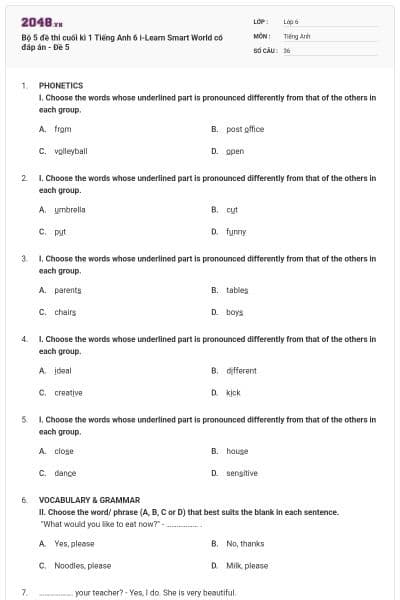
from
post office
volleyball
open
Kiến thức: Phát âm từ “o”
Giải thích:
A. from /frɒm/
B. office /ˈɒfɪs/
C. volleyball /ˈvɒlibɔːl/
D. open /ˈəʊpən/
Đáp án D.
umbrella
cut
put
funny
Kiến thức: Phát âm từ “u”
Giải thích:
A. umbrella /ʌmˈbrelə/
B. cut /kʌt/
C. put /pʊt/
D. funny /ˈfʌni/
Đáp án C.
parents
tables
chairs
boys
Kiến thức: Phát âm từ “s”
Giải thích:
A. parents /ˈpeərənts/
B. tables /ˈteɪblz/
C. chairs /tʃeə(r)z/
D. boys /bɔɪz/
Đáp án A.
ideal
different
creative
kick
Kiến thức: Phát âm từ “i”
Giải thích:
A. ideal /aɪˈdiːəl/
B. different /ˈdɪfrənt/
C. creative /kriˈeɪtɪv/
D. kick /kɪk/
Đáp án A.
close
house
dance
sensitive
Kiến thức: Phát âm từ “s”/”c”
Giải thích:
A. close /kləʊz/
B. house /haʊs/
C. dance /dɑːns/
D. sensitive /ˈsensətɪv/
Đáp án A.
Yes, please
No, thanks
Noodles, please
Milk, please
Kiến thức: Tình huống giao tiếp
Giải thích: “Bạn giờ muốn ăn gì?” – “ _________.”
A. Yes, please. : Vâng. -> không phù hợp
B. No, thanks. : Không, cảm ơn. -> không phù hợp
C. Noodles, please. : Cho tôi mì nhé.
D. Milk, please. : Cho tôi sữa nhé.
Đáp án C.
Do you like
Do you want
Would you like
How is
Kiến thức: Tình huống giao tiếp
Giải thích: “_____ giáo viên của bạn?” – “Có. Cô ấy rất đẹp.”
Câu trả lời “Yes, I do” -> Câu hỏi sẽ là “Do you”, động từ “like”: thích
Đáp án A.

Học thông minh hơn mỗi ngày
Xem toàn bộ 34 câu hỏi và nhiều hơn nữa với tài khoản miễn phí
many
much
often
about
Kiến thức: Câu hỏi có từ để hỏi
Giải thích: “ _______ kí lô thịt bò mà cô ấy muốn?”
Câu hỏi về số lượng: “How many + N đếm được số nhiều”…?
Đáp án A.
bottle
bar
tube
packet
Kiến thức: Lượng từ
Giải thích: Tôi cần một chút trà. Hãy đưa cho tôi một ….. trà.
A. a bottle of: một chai
B. a bar of: một thanh
C. a tube of: một tuýp
D. a packet of: một túi
Đáp án D.
to go
to travel
to walk
Both A and B
Kiến thức: Dạng động từ
Giải thích: “Họ muốn _______ đi làm?” – “Bằng xe buýt mini.”
A. to go: đi
B. to travel: đi
C. to walk: đi bộ
D. cả A và B
Đáp án D.
What are you doing
What are you do
What do you do
Both A and B
Kiến thức: Thì động từ
Giải thích: ________ tối nay? – Không gì cả.
Khi nhắc đến một hành động ở tương lai, có dự định từ trước, ta có thể dùng thì Hiện tại tiếp diễn.
Cấu trúc câu hỏi có từ để hỏi thì HTTD: WH – am/is/are + S + V-ing?
Đáp án A.
Kiến thức: Từ loại
Giải thích: Vị trí ô trống sau “tobe” và “so”, cần điền một tính từ
peace (n) => peaceful (adj)
Tạm dịch: Tôi thích không khí ở miền quê. Nó rất thanh bình.
Đáp án peaceful.
Kiến thức: Từ loại
Giải thích: Vị trí ô trống sau sở hữu cách, cần điền một danh từ
behave (v) => behaviour/behavior (n)
Tạm dịch: Cách hành xử của John đã cải thiện hơn rất nhiều ở trường mới của cậu ấy.
Đáp án behaviour.
Kiến thức: Từ loại
Giải thích: Vị trí ô trống sau chủ ngữ, cần điền một động từ
hopeful (adj) => hope (v)
Tạm dịch: Tôi rất mong được gặp bạn han trở về từ Huế.
Đáp án hope.
Kiến thức: Từ loại
Giải thích: Vị trí ô trống trước một danh từ, cần điền một tính từ
difference (n) => different (adj)
Tạm dịch: Màu sắc khác nhau phù hợp vào từng phòng khác nhau trong nhà.
Đáp án different.
Kiến thức: Từ loại
Giải thích: Vị trí ô trống sau chủ ngữ, cần điền một động từ
decoration (n) => decorate (n), chủ ngữ số ít “My mother”, dấu hiệu thì HTĐ “always” -> thêm s/es vào sau động từ
Tạm dịch: Mẹ tôi luôn trang trí nhà mỗi khi Tết đến.
Đáp án decorates.
Kiến thức: Động từ
Giải thích: Cấu trúc “This is + N”
Tạm dịch: Đây là phòng của Smith.
Đáp án is.
Kiến thức: Động từ
Giải thích: Cấu trúc “There are + Ns”
Tạm dịch: Có 2 cái ghế, một cái bàn, một cái giường, một tủ quần áo và một giá sách ở trong phòng cậu ấy.
Đáp án There.
Kiến thức: Mạo từ
Giải thích: Trước danh từ xác định cần điền một mạo từ.
Tạm dịch: Bàn học gần cửa sổ.
Đáp án the.
Kiến thức: Giới từ
Giải thích: Cụm “on the wall”: ở trên tường
Tạm dịch: Giá sách ở trên tường.
Đáp án on.
Kiến thức: Danh từ
Giải thích: Cấu trúc There are many + danh từ đếm được số nhiều.
Mạch đoạn văn đang miêu tả cái giá sách -> danh từ “book”.
Tạm dịch: Giá sách ở trên tường. Có rất nhiều sách ở trên đó.
Đáp án books.
Dịch bài đọc:
Đây là phòng của Smith. Bạn có thể thấy, phòng của cậu ấy không quá rộng. Có 2 cái ghế, 1 cái bàn, 1 cái giường, 1 tủ quần áo và 1 cái giá sách trong phòng. Bàn học đặt ở gần cửa sổ. Có một lọ mực, một số quyển sách, một cái từ điển Anh – Việt ở trên bàn. Giường ngủ ở phía bên phải. Có nhiều sách và báo ở trên giường. Tủ quần áo ở đối diện trên giường. Smith có rất nhiều quần áo. Những bộ quần áo này đều treo trong tủ. Giá sách ở trên tường. Có rất nhiều sách ở trên đó.
Kiến thức: Đọc hiểu
Giải thích: Có bao nhiêu mùa ở đất nước của họ? Chúng là gì?
Thông tin: There are four seasons in a year in their country. They are spring, summer, fall and winter.
Tạm dịch: Có 4 mùa ở nước của họ. Đó là xuân, hạ, thu và đông.
Đáp án There are four seasons: spring, summer, fall and winter.
Kiến thức: Đọc hiểu
Giải thích: Thời tiết vào mùa xuân như thế nào?
Thông tin: In the spring, the weather is usually warm.
Tạm dịch: Vào mùa xuân, thời tiết thường ấm áp.
Đáp án It’s warm.
Kiến thức: Đọc hiểu
Giải thích: Họ thường làm gì vào mùa hè?
Thông tin: They often go on vacation in the summer.
Tạm dịch: Họ thường đi nghỉ mát vào mùa hè.
Đáp án They often go on vacation in the summer.
Kiến thức: Đọc hiểu
Giải thích: Ngày dài hay ngắn vào mùa đông?
Thông tin: The days are short and the nights are long.
Tạm dịch: Ngày thường ngắn và đêm thì dài.
Đáp án They are short.
Kiến thức: Đọc hiểu
Giải thích: Họ luôn mặc gì vào mùa đông?
Thông tin: They always wear warm clothes in the winter.
Tạm dịch: Họ luôn mặc quần áo ấm vào mùa đông.
Đáp án They always wear warm clothes in the winter.
Dịch bài đọc:
Hiền và Hòa là học sinh. Họ sống ở Việt Nam. Có 4 mùa trong năm ở nước của họ. Đó là mùa xuân, hạ, thu và đông. Vào mùa xuân, thời tiết thường ấm áp. Thỉnh thoảng trời có lạnh, nhưng không quá buốt. Có nhiều loài hoa nở vào mùa này. Sau mùa xuân là mùa hè. Vào mùa hè, ngày thường dài và đêm thì ngắn. Họ thường đi du lịch vào mùa hè. Mùa thu rất đẹp. Thời tiết thường mát mẻ. Vào mùa đông, trời thường rất lạnh. Ngày thường ngắn và đêm thì dài. Họ luôn mặc quần áo ấm vào mùa đông.
Kiến thức: Viết lại câu
Tạm dịch: Bạn nên đi xe buýt tới cửa hàng bách hóa.
Đáp án You should take a bus to get to the department store.
Kiến thức: Viết lại câu
Tạm dịch: Đi cắm trại cuối tuần này là một ý kiến hay.
Đáp án It would be a good idea to go camping this weekend.
Kiến thức: Viết lại câu
Tạm dịch: Winsor là một trong những lâu đài đẹp nhất thế giới.
Đáp án The Winsor castle is one of the most beautiful castles in the world.
Kiến thức: Viết lại câu
Tạm dịch: Có rất nhiều cây trên đường tôi tới trường.
Đáp án There are a lot of trees on the way to my school.
Kiến thức: Viết lại câu
Tạm dịch: Có một cái máy chiếu, một cái máy tính trong mỗi phòng học ở trường tôi.
Đáp án one projector and one computer in each classroom in my school.
Kiến thức: Viết lại câu
Tạm dịch: Chúng tôi sẽ đi thăm anh ấy vài thứ ba tuần tới.
Đáp án visiting him on Tuesday next week.
Kiến thức: Viết lại câu
Tạm dịch: Dave giỏi môn Toán hơn Mary.
Đáp án better at Maths than Mary.
Kiến thức: Viết lại câu
Tạm dịch: Đại Kim tự tháp Giza là kim tự tháp lớn nhất thế giới.
Đáp án is the greatest pyramid in the world.
Bạn có thích hoạt động này không?
Ý kiến của bạn sẽ giúp chúng tôi đề xuất nội dung phù hợp hơn.
![[Năm 2022] Đề thi thử môn Vật lí THPT Quốc gia có lời giải - Đề số 21](/_next/image?url=https%3A%2F%2Fvideo.vietjack.com%2Fupload%2Fimages%2Fvj-image%2Fimage-3izficdefgfoel0s9j8s-1786772791.jpg&w=3840&q=75)
![[Năm 2022] Đề thi thử môn Vật lí THPT Quốc gia có lời giải - Đề số 20](/_next/image?url=https%3A%2F%2Fvideo.vietjack.com%2Fupload%2Fimages%2Fvj-image%2Fimage-emy0gtcksawvorajezvv-1786772460.jpg&w=3840&q=75)