Bài tập Tiếng Anh lớp 6 Unit 11 có đáp án
Đề thi

Bài tập Tiếng Anh lớp 6 Unit 11 có đáp án

A
Admin
Tiếng AnhLớp 6115 lượt thi
59 câu hỏi
1. Trắc nghiệm
1 điểm

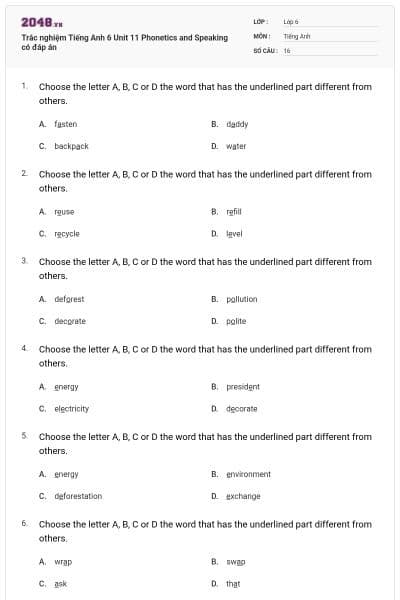
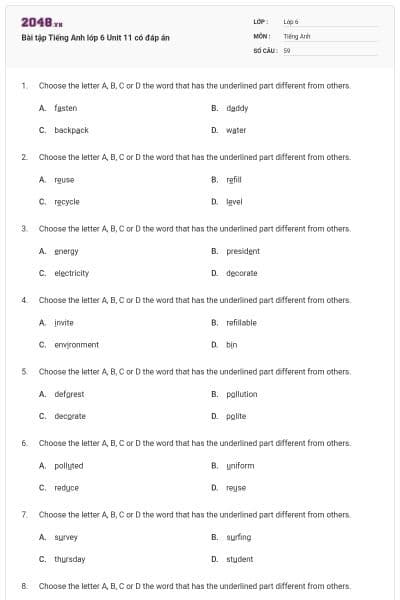
Choose the letter A, B, C or D the word that has the underlined part different from others.

fasten

daddy

backpack

water

Xem đáp án

Đáp án D

Bài tập Tiếng Anh lớp 6 Unit 11 có đáp án

2. Trắc nghiệm
1 điểm

Choose the letter A, B, C or D the word that has the underlined part different from others.

reuse

refill

recycle

level

Xem đáp án

Đáp án D

Bài tập Tiếng Anh lớp 6 Unit 11 có đáp án

3. Trắc nghiệm
1 điểm

Choose the letter A, B, C or D the word that has the underlined part different from others.

energy

president

electricity

decorate

Xem đáp án

Đáp án B

Bài tập Tiếng Anh lớp 6 Unit 11 có đáp án

4. Trắc nghiệm
1 điểm

Choose the letter A, B, C or D the word that has the underlined part different from others.

invite

refillable

environment

bin

Xem đáp án

Đáp án C

Bài tập Tiếng Anh lớp 6 Unit 11 có đáp án

5. Trắc nghiệm
1 điểm

Choose the letter A, B, C or D the word that has the underlined part different from others.

deforest

pollution

decorate

polite

Xem đáp án

Đáp án A

Bài tập Tiếng Anh lớp 6 Unit 11 có đáp án

6. Trắc nghiệm
1 điểm

Choose the letter A, B, C or D the word that has the underlined part different from others.

polluted

uniform

reduce

reuse

Xem đáp án

Đáp án A

Bài tập Tiếng Anh lớp 6 Unit 11 có đáp án

7. Trắc nghiệm
1 điểm

Choose the letter A, B, C or D the word that has the underlined part different from others.

survey

surfing

thursday

student

Xem đáp án

Đáp án D

Bài tập Tiếng Anh lớp 6 Unit 11 có đáp án

8. Trắc nghiệm
1 điểm

Choose the letter A, B, C or D the word that has the underlined part different from others.

charity

natural

classmate

exchange

Xem đáp án

Đáp án D

Bài tập Tiếng Anh lớp 6 Unit 11 có đáp án

9. Trắc nghiệm
1 điểm

Choose the letter A, B, C or D the word that has the underlined part different from others.

effect

pollution

invite

charity

Xem đáp án

Đáp án B

Bài tập Tiếng Anh lớp 6 Unit 11 có đáp án

10. Trắc nghiệm
1 điểm

Choose the letter A, B, C or D the word that has the underlined part different from others.

noise

reuse

house

because

Xem đáp án

Đáp án C

Bài tập Tiếng Anh lớp 6 Unit 11 có đáp án

11. Trắc nghiệm
1 điểm

Choose the letter A, B, C or D the word that has the underlined part different from others.

appear

hear

bear

ear

Xem đáp án

Đáp án C

Bài tập Tiếng Anh lớp 6 Unit 11 có đáp án

12. Trắc nghiệm
1 điểm

Choose the letter A, B, C or D the word that has the underlined part different from others.

wrap

swap

ask

that

Xem đáp án

Đáp án B

Bài tập Tiếng Anh lớp 6 Unit 11 có đáp án

13. Trắc nghiệm
1 điểm

Choose the letter A, B, C or D the word that has the underlined part different from others.

recycle

happy

study

windy

Xem đáp án

Đáp án A

Bài tập Tiếng Anh lớp 6 Unit 11 có đáp án

14. Trắc nghiệm
1 điểm

Choose the letter A, B, C or D the word that has the underlined part different from others.

what

wrap

when

with

Xem đáp án

Đáp án B

Bài tập Tiếng Anh lớp 6 Unit 11 có đáp án

15. Trắc nghiệm
1 điểm

Choose the letter A, B, C or D the word that has the underlined part different from others.

energy

environment

deforestation

exchange

Xem đáp án

Đáp án A

Bài tập Tiếng Anh lớp 6 Unit 11 có đáp án

16. Trắc nghiệm
1 điểm

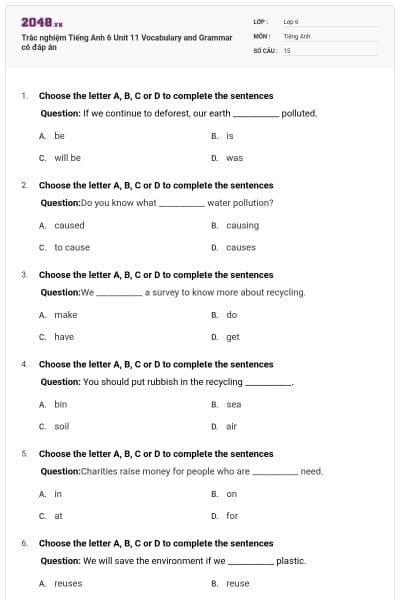
Choose the letter A, B, C or D to complete the sentences

If we continue to deforest, our earth ___________ polluted.

be

is

will be

was

Xem đáp án

Đáp án C

Giải thích: câu điều kiện loại 1: “If + S V(s/es), S + will V”

Dịch: Nếu chúng ta tiếp tục chặt phá rừng, trái đất sẽ bị ô nhiễm.

17. Trắc nghiệm
1 điểm

Do you know what ___________ water pollution?

caused

causing

to cause

causes

Xem đáp án

Đáp án D

Giải thích: từ để hỏi + động từ số ít, câu chia ở thời hiện tại đơn.

Dịch: Bạn có biết cái gì gây ra ô nhiễm nguồn nước không?

18. Trắc nghiệm
1 điểm

We ___________ a survey to know more about recycling

make

do

have

get

Xem đáp án

Đáp án B

Giải thích: cụm từ “do a survey”: làm cuộc khảo sát

Dịch: Chúng tôi làm cuộc khảo sát để biết thêm về tái chế.

19. Trắc nghiệm
1 điểm

You should put rubbish in the recycling ___________.

bin

sea

soil

air

Xem đáp án

Đáp án A

Giải thích: recycling bin: thùng rác tái chế

Dịch: Bạn nên bỏ rác vào thùng rác tái chế.

20. Trắc nghiệm
1 điểm

Charities raise money for people who are ___________ need.


in

on

at

for

Xem đáp án

Đáp án A

Giải thích: be in need: thiếu thốn, cần giúp đỡ

Dịch: Tổ chức từ thiện quyên góp tiền cho người có hoàn cảnh khó khăn.

21. Trắc nghiệm
1 điểm

We will save the environment if we ___________ plastic.

reuses

reuse

reusing

reused

Xem đáp án

Đáp án B

Giải thích: câu điều kiện loại 1: “If + S V(s/es), S + will V”

Dịch: Chúng ta sẽ bảo vệ môi trường nếu chúng ta tái sử dụng chai nhựa.

22. Trắc nghiệm
1 điểm

They are using leaves __________ food.

wrap

to wrap

wrapping

will wrap

Xem đáp án

Đáp án B

Giải thích: to V chỉ mục đích

Dịch: Họ đang dùng lá để gói đồ ăn.

23. Trắc nghiệm
1 điểm

We are trying to __________ the president to the party.

pollute

exchange

invite

cause

Xem đáp án

Đáp án C

Giải thích: invite sb to sw: mời ai đến đâu

Dịch: Chúng tôi đang cố gắng mời chủ tịch đến dự bữa tiệc.

24. Trắc nghiệm
1 điểm

Why don’t we __________ old school objects for candies?

swap

raise

wrap

recycle

Xem đáp án

Đáp án A

Giải thích: cấu trúc “swap st for st”: đổi cái gì lấy cái gì

Cấu trúc rủ rê, gợi ý: “why don’t we + V?”

Dịch: Tại sao chúng ta không đổi đồ dùng học tập cũ lấy kẹo nhỉ?

25. Trắc nghiệm
1 điểm

Water is used to generate __________.

pollution

electricity

money

deforestation

Xem đáp án

Đáp án B

Giải thích: electricity: điện

Dịch: Nước được sử dụng để tạo ra điện

26. Trắc nghiệm
1 điểm

If students recycle and use recycled materials, they will save _________.

energy

food

water

Xem đáp án

Đáp án A

Giải thích: energy: năng lượng

Dịch: Nếu học sinh tái chế và dùng các vật dụng tái chế, chúng sẽ bảo vệ được môi trường.

27. Trắc nghiệm
1 điểm

Let’s reduce the __________ of deforestation.

environment

polluted

effect

disappear

Xem đáp án

Đáp án C

Giải thích: effect: hậu quả

Dịch: Hãy cùng làm giảm hậu quả của nạn chặt phá rừng.

28. Trắc nghiệm
1 điểm

They use ________ plastic bottles to keep water.

refillable

natural

polluting

charitable

Xem đáp án

Đáp án A

Giải thích: refillable: có thể làm đầy lại được

Dịch: Họ dùng chai nhựa có thể tái làm đầy để giữ nước.

29. Trắc nghiệm
1 điểm

We can find noise pollution __________ most cities.

of

on

to

in

Xem đáp án

Đáp án D

Giải thích: in: ở trong

Dịch: Chúng ta có thể tìm thấy ô nhiễm tiếng ồn ở hầu hết các thành phố.

30. Trắc nghiệm
1 điểm

If you turn _________ the lights when you don’t use it, you will save electricity.

on

off

up

down

Xem đáp án

Đáp án B

Giải thích: turn off: tắt

Dịch: Nếu bạn tắt đèn khi không dùng, bạn sẽ tiết kiệm điện.

31. Trắc nghiệm
1 điểm

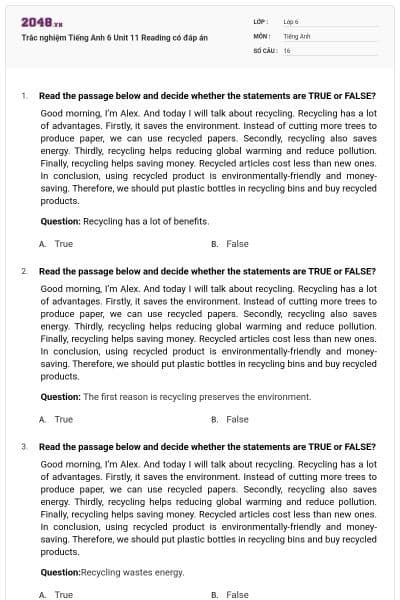
Read the passage below and decide whether the statements are TRUE or FALSE?

Good morning, I’m Alex. And today I will talk about recycling. Recycling has a lot of advantages. Firstly, it saves the environment. Instead of cutting more trees to produce paper, we can use recycled papers. Secondly, recycling also saves energy. Thirdly, recycling helps reducing global warming and reduce pollution. Finally, recycling helps saving money. Recycled articles cost less than new ones. In conclusion, using recycled product is environmentally-friendly and money-saving. Therefore, we should put plastic bottles in recycling bins and buy recycled products.

Recycling has a lot of benefits.

T

F

Xem đáp án

Đáp án A

Giải thích: Dựa vào câu: “Recycling has a lot of advantages.”.

Dịch: Tái chế có rất nhiều lợi ích.

32. Trắc nghiệm
1 điểm

Read the passage below and decide whether the statements are TRUE or FALSE?

Good morning, I’m Alex. And today I will talk about recycling. Recycling has a lot of advantages. Firstly, it saves the environment. Instead of cutting more trees to produce paper, we can use recycled papers. Secondly, recycling also saves energy. Thirdly, recycling helps reducing global warming and reduce pollution. Finally, recycling helps saving money. Recycled articles cost less than new ones. In conclusion, using recycled product is environmentally-friendly and money-saving. Therefore, we should put plastic bottles in recycling bins and buy recycled products.

The first reason is recycling preserves the environment.

T

F

Xem đáp án

Đáp án A

Giải thích: Dựa vào câu: “Firstly, it saves the environment.”.

Dịch: Đầu tiên, nó báo vệ môi trường.

33. Trắc nghiệm
1 điểm

Read the passage below and decide whether the statements are TRUE or FALSE?

Good morning, I’m Alex. And today I will talk about recycling. Recycling has a lot of advantages. Firstly, it saves the environment. Instead of cutting more trees to produce paper, we can use recycled papers. Secondly, recycling also saves energy. Thirdly, recycling helps reducing global warming and reduce pollution. Finally, recycling helps saving money. Recycled articles cost less than new ones. In conclusion, using recycled product is environmentally-friendly and money-saving. Therefore, we should put plastic bottles in recycling bins and buy recycled products.

Recycling wastes energy.

T

F

Xem đáp án

Giải thích: Dựa vào câu: “Secondly, recycling also saves energy.”.

Dịch: Thứ hai, tái chế tiết kiệm năng lượng.

34. Trắc nghiệm
1 điểm

Read the passage below and decide whether the statements are TRUE or FALSE?

Good morning, I’m Alex. And today I will talk about recycling. Recycling has a lot of advantages. Firstly, it saves the environment. Instead of cutting more trees to produce paper, we can use recycled papers. Secondly, recycling also saves energy. Thirdly, recycling helps reducing global warming and reduce pollution. Finally, recycling helps saving money. Recycled articles cost less than new ones. In conclusion, using recycled product is environmentally-friendly and money-saving. Therefore, we should put plastic bottles in recycling bins and buy recycled products.

Recycling pollutes the environment.

T

F

Xem đáp án

Đáp án B

Giải thích: Dựa vào câu: “Thirdly, recycling helps reducing global warming and reduce pollution.”.

Dịch: Thứ ba, tái chế giúp giảm nóng lên toàn cầu và giảm ô nhiễm.

35. Trắc nghiệm
1 điểm

Read the passage below and decide whether the statements are TRUE or FALSE?

Good morning, I’m Alex. And today I will talk about recycling. Recycling has a lot of advantages. Firstly, it saves the environment. Instead of cutting more trees to produce paper, we can use recycled papers. Secondly, recycling also saves energy. Thirdly, recycling helps reducing global warming and reduce pollution. Finally, recycling helps saving money. Recycled articles cost less than new ones. In conclusion, using recycled product is environmentally-friendly and money-saving. Therefore, we should put plastic bottles in recycling bins and buy recycled products.

Recycling is both environmentally-friendly and money-saving.

T

F

Xem đáp án

Đáp án A

Giải thích: Dựa vào câu: “In conclusion, using recycled products is environmentally-friendly and money-saving.”.

Dịch: Nói tóm lại, dùng các sản phẩm tái chế thì thân thiện với môi trường và tiết kiệm tiền.

36. Trắc nghiệm
1 điểm

Choose the letter A, B, C or D to complete the passage below

Air pollution is one of _________ (6) problems of the current time all over the world. There ___________ (7) a lot of reasons for this pollution. First of all, the release of air pollutants such as smog and solid materials cause air pollution and health issues ___________ (8) human. ___________ (9) dirty wastes in big cities are polluting the whole atmospheric air. Thirdly, motor vehicles are releasing polluted gases contributing to the air pollution. Finally, some natural ________ (10) like dust, soil particles, and natural gases are also the source of air pollution.

Question 6

serious

more serious

the most serious

serious than

Xem đáp án

Đáp án C

Giải thích: cấu trúc “one of the most + Ns”: một trong những

Dịch: Ô nhiễm không khí là một trong những vấn đề của thời đại hiện nay trên khắp thế giới.

37. Trắc nghiệm
1 điểm

Choose the letter A, B, C or D to complete the passage below

Air pollution is one of _________ (6) problems of the current time all over the world. There ___________ (7) a lot of reasons for this pollution. First of all, the release of air pollutants such as smog and solid materials cause air pollution and health issues ___________ (8) human. ___________ (9) dirty wastes in big cities are polluting the whole atmospheric air. Thirdly, motor vehicles are releasing polluted gases contributing to the air pollution. Finally, some natural ________ (10) like dust, soil particles, and natural gases are also the source of air pollution.

Question 7

are

is

being

be

Xem đáp án

Đáp án A

Giải thích: there are + Ns: có

Dịch: Có nhiều lý do cho sự ô nhiễm này.

38. Trắc nghiệm
1 điểm

Choose the letter A, B, C or D to complete the passage below

Air pollution is one of _________ (6) problems of the current time all over the world. There ___________ (7) a lot of reasons for this pollution. First of all, the release of air pollutants such as smog and solid materials cause air pollution and health issues ___________ (8) human. ___________ (9) dirty wastes in big cities are polluting the whole atmospheric air. Thirdly, motor vehicles are releasing polluted gases contributing to the air pollution. Finally, some natural ________ (10) like dust, soil particles, and natural gases are also the source of air pollution.

Question 8

in

of

to

with

Xem đáp án

Đáp án C

Giải thích: cấu trúc “cause st to sb”: gây ra cái gì cho ai

Dịch: Đầu tiên, sự thải ra các chất gây ô nhiễm không khí như sương khói, và chất thải rắn gây ra ô nhiễm không khí và các vấn đề sức khoẻ cho con người.

39. Trắc nghiệm
1 điểm

Choose the letter A, B, C or D to complete the passage below

Air pollution is one of _________ (6) problems of the current time all over the world. There ___________ (7) a lot of reasons for this pollution. First of all, the release of air pollutants such as smog and solid materials cause air pollution and health issues ___________ (8) human. ___________ (9) dirty wastes in big cities are polluting the whole atmospheric air. Thirdly, motor vehicles are releasing polluted gases contributing to the air pollution. Finally, some natural ________ (10) like dust, soil particles, and natural gases are also the source of air pollution.

Question 9

Thirdly

Secondly

Fourthly

fifthly

Xem đáp án

Đáp án B

Giải thích: theo trình tự mạch văn, sau “first of all” là “secondly”

Dịch: Thứ hai, rác thải ở các thành phố lớn đang làm ô nhiểm cả hệ khí quyển.

40. Trắc nghiệm
1 điểm

Choose the letter A, B, C or D to complete the passage below


Air pollution is one of _________ (6) problems of the current time all over the world. There ___________ (7) a lot of reasons for this pollution. First of all, the release of air pollutants such as smog and solid materials cause air pollution and health issues ___________ (8) human. ___________ (9) dirty wastes in big cities are polluting the whole atmospheric air. Thirdly, motor vehicles are releasing polluted gases contributing to the air pollution. Finally, some natural ________ (10) like dust, soil particles, and natural gases are also the source of air pollution.

Question 10

pollutes

pollutions

pollutants

polluting

Xem đáp án

Đáp án C

Giải thích: pollutants: chất bẩn, chất gây ô nhiễm

Dịch: Cuối cùng, các chất gây ô nhiễm tự nhiên như bụi, các chất có trong đất, hay khí tự nhiên cũng là nguyên nhây gây ô nhiễm không khí.

41. Trắc nghiệm
1 điểm

Choose the letter A, B, C or D to answer these following questions

Glass is a wonderful substance. It can be recycled over and over again. The good thing about glass recycling is that the glass retains its quality. Imagine how many bottles of soda, juice and glass jars are used daily. If we simply throw them away, the environment will suffer greatly. There are many advantages of glass recycling. The first thing is that glass recycling reduces industrial pollution. Reducing industrial pollution benefits not only the environment but also the entire ecosystem. Another benefit is the recycling of glass conserves natural resources. Recycling glass saves on the need to obtain more materials to make new glass; therefore, they save existing natural resources.

Can glass be recycled many times?

Yes, it can

Yes, it will

No, it can’t

No, it won’t

Xem đáp án

Đáp án A

Giải thích: Dựa vào câu: “It can be recycled over and over again.”.

Dịch: Nó có thể được tái chế nhiều lần.

42. Trắc nghiệm
1 điểm

Choose the letter A, B, C or D to answer these following questions

Glass is a wonderful substance. It can be recycled over and over again. The good thing about glass recycling is that the glass retains its quality. Imagine how many bottles of soda, juice and glass jars are used daily. If we simply throw them away, the environment will suffer greatly. There are many advantages of glass recycling. The first thing is that glass recycling reduces industrial pollution. Reducing industrial pollution benefits not only the environment but also the entire ecosystem. Another benefit is the recycling of glass conserves natural resources. Recycling glass saves on the need to obtain more materials to make new glass; therefore, they save existing natural resources.

What is the good point of glass recycling?

The glass retains its quality

The glass breaks

The glass disappears

The glass reduced its quality

Xem đáp án

Đáp án A

Giải thích: Dựa vào câu: “The good thing about glass recycling is that the glass retains its quality.”.

Dịch: Điểm cộng của tái chế thuỷ tinh là thuỷ tinh không bị mai một chất lượng.

43. Trắc nghiệm
1 điểm

Choose the letter A, B, C or D to answer these following questions

Glass is a wonderful substance. It can be recycled over and over again. The good thing about glass recycling is that the glass retains its quality. Imagine how many bottles of soda, juice and glass jars are used daily. If we simply throw them away, the environment will suffer greatly. There are many advantages of glass recycling. The first thing is that glass recycling reduces industrial pollution. Reducing industrial pollution benefits not only the environment but also the entire ecosystem. Another benefit is the recycling of glass conserves natural resources. Recycling glass saves on the need to obtain more materials to make new glass; therefore, they save existing natural resources.

What are the advantages of glass recycling?

It reduces industrial pollution

It conserves natural resources

It is convenient

Both A&B

Xem đáp án

Đáp án D

Giải thích: Dựa vào câu: “The first thing is that glass recycling reduces industrial pollution… Another benefit is the recycling of glass conserves natural resources.”.

Dịch: Điều đầu tiên là tái chế thuỷ tinh làm giảm ô nhiểm công nghiệp… Một lợi ích nữa là tái chế thuỷ tinh bảo tồn tài nguyên thiên nhiên.

44. Trắc nghiệm
1 điểm

Choose the letter A, B, C or D to answer these following questions

Glass is a wonderful substance. It can be recycled over and over again. The good thing about glass recycling is that the glass retains its quality. Imagine how many bottles of soda, juice and glass jars are used daily. If we simply throw them away, the environment will suffer greatly. There are many advantages of glass recycling. The first thing is that glass recycling reduces industrial pollution. Reducing industrial pollution benefits not only the environment but also the entire ecosystem. Another benefit is the recycling of glass conserves natural resources. Recycling glass saves on the need to obtain more materials to make new glass; therefore, they save existing natural resources.

What do reducing industrial pollution benefit?

both the environment and ecosystem

either the environment or ecosystem

neither the environment nor ecosystem

whether the environment or ecosystem

Xem đáp án

Đáp án A

Giải thích: Dựa vào câu: “Reducing industrial pollution benefits not only the environment but also the entire ecosystem.”.

Dịch: Giảm ô nhiễm công nghiệp có lợi cho cả môi trường và cả hệ sinh thái.

45. Trắc nghiệm
1 điểm

Choose the letter A, B, C or D to answer these following questions

Glass is a wonderful substance. It can be recycled over and over again. The good thing about glass recycling is that the glass retains its quality. Imagine how many bottles of soda, juice and glass jars are used daily. If we simply throw them away, the environment will suffer greatly. There are many advantages of glass recycling. The first thing is that glass recycling reduces industrial pollution. Reducing industrial pollution benefits not only the environment but also the entire ecosystem. Another benefit is the recycling of glass conserves natural resources. Recycling glass saves on the need to obtain more materials to make new glass; therefore, they save existing natural resources.

Why does recycling glass save existing natural resources?

Because it saves materials.

Because it saves new glass.

Because it saves environment.

Because it saves recycling glass.

Xem đáp án

Đáp án A

Giải thích: Dựa vào câu: “Recycling glass saves on the need to obtain more materials to make new glass; therefore, they save existing natural resources.”.

Dịch: Thuỷ tinh tái chế làm giảm nhu cầu lấy thêm nguyên liệu để làm thuỷ tinh mới, nhờ đó bảo vệ được các tài nguyên thiên nhiên.

46. Trắc nghiệm
1 điểm

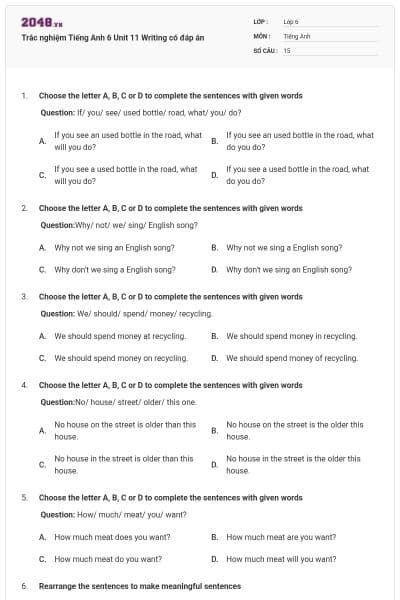
Choose the letter A, B, C or D to complete the sentences with given words

If/ you/ see/ used bottle/ road, what/ you/ do?

If you see an used bottle in the road, what will you do?

If you see an used bottle in the road, what do you do?

If you see a used bottle in the road, what will you do?

If you see a used bottle in the road, what do you do?

Xem đáp án

Đáp án C

Giải thích: Câu điều kiện loại 1: “If + S V(s/es), S + will V”

Dịch: Nếu bạn thấy 1 chiếc lọ ở trên đường, bạn sẽ làm gì?

47. Trắc nghiệm
1 điểm

Why/ not/ we/ sing/ English song?

Why not we sing an English song?

Why not we sing a English song?

Why don't we sing a English song?

Why don't we sing an English song?

Xem đáp án

Đáp án D

Giải thích: cấu trúc: “Why don’t we + V”: tại sao chúng ta không…?

Dịch: Tại sao chúng ta không hát một bài hát tiếng Anh nhỉ?

48. Trắc nghiệm
1 điểm

We/ should/ spend/ money/ recycling

We should spend money at recycling.

We should spend money in recycling.

We should spend money on recycling.

We should spend money of recycling.

Xem đáp án

Đáp án C

Giải thích: cấu trúc: spend money on st: dành tiền vào cái gì

Dịch: Chúng ta nên dành tiền vào tái chế.

49. Trắc nghiệm
1 điểm

No/ house/ street/ older/ this one.

No house on the street is older than this house.

No house on the street is the older this house.

No house in the street is older this house

No house in the street is more old than this house

Xem đáp án

Đáp án: A

Giải thích:

Cụm từ “on the street”: ở trên đường

Câu so sánh hơn với tính từ ngắn: “S1 + be + adj đuôi –er + than S2”

Dịch: Không ngôi nhà nào trên con đường này cũ hơn ngôi nhà này.

50. Trắc nghiệm
1 điểm

Rearrange the sentences to make meaningful sentences

area/ has become/ my/ great/ in/ pollution/ Water/ problem/ a.

Water in my area pollution has become a great problem.

Water problem has become a great pollution in my area.

Water pollution in my area has become a great problem.

Water pollution has become a great problem in my area.

Xem đáp án

Đáp án D

Giải thích: a great problem: một vấn đề lớn

Dịch: Ô nhiễm nước đã và đang trở thành vấn đề lớn ở khu vực của tôi.

51. Trắc nghiệm
1 điểm

throw/ environment/ If/ pollute/ will/ you/ it/ the/ the rubbish.

If it throw the rubbish, you will pollute the environment.

If you will throw the rubbish, it pollute the environment.

If you throw the rubbish, it will pollute the environment.

If it pollute the environment, you will throw rubbish.

Xem đáp án

Đáp án C

Giải thích: câu điều kiện loại 1: “If + S V(s/es), S + will V”

Dịch: Nếu bạn vứt rác, nó sẽ gây ô nhiễm môi trường.

52. Trắc nghiệm
1 điểm

seven/ fifteen/ He/ to/ goes/ at/ work.

He at seven fifteen goes to work.

He goes to work at seven fifteen.

He goes to seven fifteen at work.

He goes at work to seven fifteen.

Xem đáp án

Đáp án B

Giải thích: at + số giờ: vào lúc mấy giờ

Dịch: Anh ấy đi làm lúc 7h15p.

53. Trắc nghiệm
1 điểm

soil/ I/ do/ on/ pollution/ will/ a/ survey.

I will do a survey on soil pollution.

I will do soil pollution on a survey.

I will survey a do on soil pollution.

I will do a soil pollution survey on.

Xem đáp án

Đáp án A

Giải thích: cụm từ: “do a survey on st”: làm khảo sát

Dịch: Tôi sẽ làm khảo sát về ô nhiễm đất đai.

54. Trắc nghiệm
1 điểm

effects/ causes/ noise/ What/ of/ the/ are/ pollution?

What the causes and effects of noise pollution are?

What are the noise pollution of causes and effects?

What the noise pollution of causes and effects are?

What are the causes and effects of noise pollution?

Xem đáp án

Đáp án D

Giải thích: cause and effect: nguyên nhân và hậu quả

Dịch: Nguyên nhân và hậu quả của ô nhiễm tiếng ồn là gì?

55. Trắc nghiệm
1 điểm

Rewrite sentences without changing the meaning

We can use this bottle once again.

We can reduce this bottle.

We can reuse this bottle.

We can refill this bottle.

We can recycle this bottle.

Xem đáp án

Đáp án B

Giải thích: reuse = use again: tái sử dụng

Dịch: Chúng ta có thể tái sử dụng chiếc lọ này.

56. Trắc nghiệm
1 điểm

This recycling bin belongs to them.

This recycling bin is them.

This recycling bin is their.

This recycling bin is theirs.

This recycling bin is they’s.

Xem đáp án

Đáp án C

Giải thích: theirs là đại từ sở hữu

Dịch: Chiếc thùng rác này là của họ.

57. Trắc nghiệm
1 điểm

My house is behind the hotel.

The hotel is in front of my house.

The hotel is between my house.

My house is opposite the hotel.

My house is next to the hotel.

Xem đáp án

Đáp án A

Giải thích: in front of: ở đằng trước >< behind: ở đằng sau

Dịch: Nhà tôi ở đằng sau khách sạn.

58. Trắc nghiệm
1 điểm

Shall we raise fund for the charity this weekend?

Don’t raise fund for the charity this weekend.

Please raise fund for the charity this weekend.

Let’s raise fund for the charity this weekend.

Why raise fund for the charity this weekend.

Xem đáp án

Đáp án C

Giải thích: Cấu trúc gợi ý: “Let’s V = shall we…”: hãy cùng…

Dịch: Hãy cùng gây quỹ cho tổ chức từ thiện cuối tuần này nào.

59. Trắc nghiệm
1 điểm

What is your father’s job?

What does your father do?

What is job your father do?

What does your father do job?

What do your father doD. What do your father do?

Xem đáp án

Đáp án A

Giải thích: câu hỏi nghề nghiệp: “what + be + S’s + job?” = “what do/ does + S + do?”

Dịch: Nghề của bố bạn là gì?