500 bài viết lại câu ôn thi chuyên Tiếng Anh có đáp án cực hay (Phần 3)
110 câu hỏi
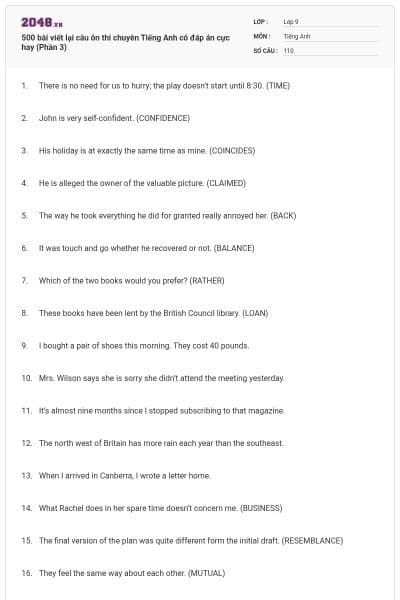
There is no need for us to hurry; the play doesn’t start until 8:30. (TIME)
Đáp án: We can take our time; the play doesn’t start until 8:30.
Giải thích:
"There is no need for us to hurry" có thể diễn đạt lại bằng "We can take our time," nghĩa là chúng ta có thể dành thời gian mà không cần vội vàng. Cụm "take our time" là một cách diễn đạt thông dụng để nói rằng không cần phải làm gì vội.
Đáp án này giữ đúng ý nghĩa gốc của câu, là không cần phải vội vì còn nhiều thời gian trước khi vở kịch bắt đầu.
Dịch: Chúng ta có thể thong thả; vở kịch sẽ không bắt đầu cho đến 8:30.
John is very self-confident. (CONFIDENCE)
→John has a lot of confidence in himself.
His holiday is at exactly the same time as mine. (COINCIDES)
→His holiday time coincides with mine.
He is alleged the owner of the valuable picture. (CLAIMED)
→He is claimed to be the owner of the valuable picture.
The way he took everything he did for granted really annoyed her. (BACK)
→The way he took everything he did for granted really got/put her back up.
It was touch and go whether he recovered or not. (BALANCE)
→It was in the balance whether he recovered or not.
Which of the two books would you prefer? (RATHER)
Đáp án: Which of the two books would you rather read?
Giải thích:
Cấu trúc:
would rather do something: muốn, thích làm gì hơn
Dịch: Bạn thích cuốn sách nào hơn trong hai cuốn sách này?
→ Trong hai cuốn sách này, bạn thích đọc cuốn nào hơn?
These books have been lent by the British Council library. (LOAN)
→These books have been on loan from the British Council library.
I bought a pair of shoes this morning. They cost 40 pounds.
→This morning I spent 40 pounds on a pair of shoes.
Mrs. Wilson says she is sorry she didn’t attend the meeting yesterday.
Đáp án: Mrs. Wilson sends her apologies for not having attended the meeting yesterday.
Giải thích:
apology for something/doing something: lời xin lỗi vì việc gì/đã làm gì
Dịch: Bà Wilson nói rằng bà rất tiếc vì đã không tham dự cuộc họp ngày hôm qua.
→ Bà Wilson gửi lời xin lỗi vì đã không tham dự cuộc họp ngày hôm qua.
It’s almost nine months since I stopped subscribing to that magazine.
→I cancelled my subscription to that magazine nine months ago.
The north west of Britain has more rain each year than the southeast.
→The annual rainfall in/for the North West of Britain is greater/higher than that in the southeast.
When I arrived in Canberra, I wrote a letter home.
→On arriving in Canberra, I wrote a letter home.
What Rachel does in her spare time doesn’t concern me. (BUSINESS)
It’s none of my business what Rachel does in her spare time.
The final version of the plan was quite different form the initial draft. (RESEMBLANCE)
→The final version of the plan bore no/little resemblance to the initial draft.
They feel the same way about each other. (MUTUAL)
→Their feeling about each other is mutual.
The bottle must not be laid on its side. (UPRIGHT)
→The bottle must be kept/ placed in an upright position.
Not many people attended the meeting. (TURNOUT)
→There was a poor turnout for the meeting.
I’d like to visit Singapore more than any other countries in the world.
→Singapore is the country I’d like to visit most.
She listens more sympathetically than anyone else I know.
→She is a person who listens more sympathetically than anyone else I know.
People don’t want to buy cars with large engines any more. (CALL)
→There is no longer any call for cars with large engines.
In the end, I felt I had been right to leave the club. (REGRETS)
→I had no regrets about leaving the club in the end.
His reactions are quite unpredictable. (KNOWS)
→Nobody knows how he is going to react.
“If you don’t apologize immediately, I’m leaving”, she told him. (THREATENED)
→She threatened to leave if he didn’t apologize immediately.
There isn’t enough space in this room for a big cupboard. (TAKE)
→A big cupboard would take up too much space in this room.
Could I stay with you for the weekend? (PUT)
→Could you put me up for the weekend?
The service given by the bank has improved recently. (IMPROVEMENTS)
→The bank has made improvements to its service recently.
They are letting the well-known gang leader out of prison tomorrow. (RELEASED)
→The well-known gang leader is being released from prison tomorrow.
Is this the only way to reach the city center?
→Isn’t there any another way to reach the city center?
I have never seen such a mess in my life!
Đáp án: Never in my life have I seen such a mess!
Giải thích:
Kiến thức: Đảo ngữ
Đây là câu đảo ngữ với trạng từ phủ định "Never". Khi câu bắt đầu bằng "Never", ta phải đảo trợ động từ "have" lên trước chủ ngữ "I".
Động từ chính "seen" phải ở dạng quá khứ phân từ để phù hợp với cấu trúc hoàn thành.
Cấu trúc:
Never in my life + have + S + V3...
Dịch: Chưa bao giờ trong đời tôi thấy một mớ hỗn độn như vậy!
The weather is probably not going to change.
→There will probably be no change in the weather.
I’d made up my mind, but at the last minute I lost my confidence. (FEET)
→I’d made up my mind, but at the last minutes I got/had cold feet.
I couldn’t help smiling when he told me of his plan. (A STRAIGHT FACE)
→I couldn’t keep a straight face when he told me of his plan.
He seemed to be worried about something. (IMPRESSION)
Đáp án: I got the impression that he was worried about something.
Giải thích:
Get the impression that: có ấn tượng rằng
Worry sb: làm ai lo lắng
Dịch: Tôi có ấn tượng rằng có điều gì đó đang làm anh ấy lo lắng.
I’ve never seen anyone play so skillfully before. (MUCH)
→I’ve never seen anyone play with so much skill before.
When should we collect the books we ordered last week? (SUPPOSED)
→When are we supposed to collect the books …
His memory gradually failed as he grew old.
→The older he got, the more his memory failed him.
The house has got everything except for a large garden. (LACKS)
→The only thing the house lacks is a large garden.
I hardly think she will agree to give you a pay rise. (LIKELIHOOD)
→There is little likelihood of her giving you a pay rise.
I remained neutral during their disagreement because I like both of them. (SIDES
→I didn’t take sides during their disagreement because I like both of them.
A great many people will congratulate her if she wins. (SHOWERED)
→She will be showered with great many congratulations if she wins.
I’m annoyed with you for not phoning me to say you’d be late. (MIGHT)
→You might have phoned me if you’d be late.
She thought she had paid the bill but she hadn’t.
→She was convinced that she had paid the bill but she hadn’t.
The hurricane blew the roof off the house.
Đáp án: The house had its roof blown off by the hurricane.
Giải thích:
Cấu trúc:
have something done by somebody/something: có cái gì được/bị làm gì bởi ai/cái gì
Dịch: Cơn bão đã thổi bay mái nhà.
→ Ngôi nhà bị cơn bão thổi bay mái.
This affair doesn’t concern you
→This affair is no concern of yours.
That dress has only the slightest mark on it.
→I can barely see any marks on that dress.
No one stands a chance of beating Mansell in this year’s championship.
→It’s a foregone conclusion that Mansell will win this year’s championship.
The only thing that makes this job worthwhile is the money.
→Were it not for the money, the job wouldn’t be worthwhile.
Her success went beyond her expectation.
Đáp án: Never had she expected that she was so successful.
Giải thích:
Kiến thức: Cấu trúc đảo ngữ với “never”
Never + trợ động từ + S + V: chưa bao giờ ai đó làm gì
Dịch: Sự thành công của cô đã vượt xa sự mong đợi của cô.
→ Chưa bao giờ cô mong đợi mình lại thành công đến thế.
How likely is it she will pass the exam? (CHANCES)
→What are her chances of passing the exam?
He did the puzzle in two minutes. (SOLUTION)
Đáp án: He found the solution to the puzzle in two minutes.
Giải thích:
Cấu trúc:
To find a solution for something: tìm được giải pháp cho cái gì
Dịch: Anh ấy đã giải câu đố trong 2 phút.
= Anh ấy đã tìm ra lời giải cho câu đố trong 2 phút.
My brother is not feeling terribly well. (UNDER)
→My brother is under the weather.
It will be necessary to pay the full amount when you look. (HAVE)
→The full amount will have to be paid when you look.
The room seemed to have been unoccupied for weeks.
→It looked though the room had been unoccupied for weeks.
I didn’t see her again for five years.
Đáp án: Five years have passed since I last saw her.
Giải thích:
Kiến thức: Viết lại câu từ thì quá khứ đơn thành hiện tại hoàn thành
HTHT since + mốc thời gian / for + khoảng thời gian
Dịch: Tôi đã không gặp lại cô ấy trong năm năm.
→ Đã năm năm trôi qua kể từ lần cuối tôi gặp cô ấy.
People no longer smoke so many cigarettes as they used to.
→The smoking of cigarettes is no longer as popular as it used to be.
The millionaire decided to give away his money to the poor. (PRESENT)
→The millionaire decided to make a present of his money the poor.
There is no ice cream left. (RUN)
→We have run out of ice cream.
I had better go back to work. (TIME)
→It is high time I went back to work.
He is more a lecturer than a teacher.
→He is considered a lecturer rather than a teacher.
I’m the only child in my family.
→My mother gave birth to only one child.
She was smoking in the bathroom, I went in to the bathroom and knew that. (CAUGHT)
→I caught her smoking in the bathroom.
He was forced to apologize. (CHOICE)
→He had no choice but apologize.
John inflated the tires of his bicycle. (BLEW)
→John blew up the tires of his bicycle.
Alternative medicine is a complete mystery to some people.
→Some people are strange to alternative medicine.
You may be disqualified if you don’t obey the regulations.
→Failure to obey the regulations may cause your disqualification.
He tried hard so that he would win the first prize.
→With the hope to win the first prize, he tried hard.
They declared war on the pretext of defending their territorial rights.
→The excuse for the declaration of the war is the defence of their territorial rights.
Can I speak to someone about my problem?
→ Would it be ____________________ to someone about my problem?
Đáp án: Would it be possible for me to talk to someone about my problem?
Giải thích:
Would it be possible (for somebody) to do sth? (được sử dụng khi hỏi một cách lịch sự xem bạn có thể làm gì hoặc có gì đó không)
Dịch: Tôi có thể nói chuyện với ai đó về vấn đề của mình không?
He is said to be a very hard bargainer. (REPUTATION)
→He has a reputation for being a very hard bargainer.
He doesn’t appreciate his wife. (GRANTED)
Đáp án: He takes his wife for granted.
Giải thích:
take sb for granted: xem thường, không biết quý trọng ai đó
Dịch: Anh ấy không quý trọng vợ của mình.
= Anh ấy xem thường vợ của mình.
The amount of firm spent on the project initially was $15,000. (OUTLAY)
→The initial outlay on the project was $15,000.
It was a red-letter day.
→That day was a memorial one for me.
We regret to inform you that your application has not been successful.
→Much to our regret we must inform …
He made no bones about helping me.
→He didn’t hesitate to help me.
He never thought of telling her.
→It never occurred to him to tell her.
The dress was so temping that I bought it.
→I couldn’t resist the temptation to buy the dress.
The idea no longer interests her
→She has gone off the idea.
Very little money was raised by the charity appeal. (RESPONSE)
Đáp án: The response to the charity appeal was very poor./ There was very little response to the charity appeal.
Giải thích:
response to somebody/something: phản ứng lại ai/cái gì
Tính từ đi kèm để miêu tả “response” thấp, ta dùng “poor”.
Dịch: Rất ít tiền đã được quyên góp từ lời kêu gọi từ thiện.
→ Phản hồi về lời kêu gọi từ thiện rất kém./ Có rất ít phản hồi cho lời kêu gọi từ thiện.
His irresponsible attitude is endangering his career as a doctor. (JEOPARDY)
→His irresponsible attitude is putting his career as a doctor in jeopardy.
He liked the new job straight away. (DUCK)
→He took to the new job like duck to water.
He’s not sure whether to go or not. (MINDS)
→He’s in two minds about whether to go or not.
She has extensive knowledge of ancient Egypt. (VERY)
→She is very knowledgeable about ancient Egypt.
We were very impressed by the new camera but found it rather expensive.
→Impressed by the new camera as/though we were, we found it rather expensive.
The team is the same as it for last Saturday’s match.
→There have been no changes to the team since last Saturday’s match.
Couldn’t you have got a bus to the station?
→Wasn’t it possible for you to get a bus …
I’m telling you this for you not to make a mistake. (FEAR)
→I’m telling you this for fear that you might make a mistake.
They have security guards so that people won’t try to steal. (DISCOURAGE)
→They have security guards in order to discourage someone from trying to steal.
This government has changed its taxation policy completely since the last general election. (UNDERGONE)
→This government has undergone a complete change in its taxation policy since …
We won’t get to the airport in less than 30 minutes. (LEAST)
Đáp án: It will take us at least 30 minutes to get to the airport.
Giải thích:
It + take + someone + time + to do something: ai đó mất bao lâu để làm gì
at least: ít nhất
Dịch: Chúng ta sẽ không thể đến sân bay trong vòng chưa đầy 30 phút.
→ Sẽ mất ít nhất 30 phút để chúng ta tới sân bay.
Claire suddenly realized what a blunder she had made. (DAWNED)
→It suddenly dawned on Clair what a …
Collecting stamps is Peter’s great passion. (CRAZY)
→Peter is crazy about collecting stamps.
Don’t run away with the idea that this job is easy. (CONCLUSION)
→Don’t come to/draw a conclusion that this job is easy.
Tony’s very charming, but I wouldn’t trust him.
→Charming as/though Tony may be/is, I wouldn’t trust him.
I left without saying goodbye as I didn’t want to disturb the meeting.
→Rather than disturbing the meeting, I left without saying goodbye.
The thief must have come in through the window.
→The thief almost certainly came in through the window.
Driving at that speed is dangerous whether you are an experienced driver or not
→However experienced a driver you are, driving at that speed is dangerous.
The play is so popular that the theater is likely to be full every night.
Đáp án: Such is the popularity of the play that the theater is likely to be full every night.
Giải thích:
Cấu trúc:
S + V + so + adj/adv + that + S + V: quá… đến mức mà…
Đảo ngữ với “such… that”:
Such + be + S (danh từ) + that + S + V: quả là… đến mức mà…
Vậy cần đổi tính từ “popular” (phổ biến) về danh từ “popularity” (sự nổi tiếng).
Dịch: Vở kịch này rất được ưa chuộng đến nỗi nhà hát thường đông nghẹt khán giả vào mỗi đêm.
All of you are likely to be able to enter college. (CHANCES)
→The chances are that all of you will be able to enter college.
I think his theory is clear and logical. (STANDS)
→I think his theory stands to reason.
Don’t panic about something so trivial. (MOUNTAIN)
→Don‘t make a mountain out of the molehill.
Mass tourism has been one of the causes of the problem. (BLAME)
→Mass tourism is partly to blame for the problem.
Teaching doesn’t really suit her. (CUT)
Đáp án: She isn’t really cut out for teaching.
Giải thích:
be cut out for something: đủ khả năng làm gì/phù hợp để làm gì
Dịch: Việc giảng dạy không thực sự phù hợp với cô ấy.
→ Cô ấy không thực sự phù hợp với công việc giảng dạy.
Graham spends all his time doing research. (DEVOTED)
→ Graham has ________________ doing research.
Đáp án: Graham has devoted all his time to doing research.
Giải thích:
devote(s) sth to sth/doing sth: tận tụy/cống hiến cái gì cho cái gì
Dịch: Graham đã dành toàn bộ thời gian của mình cho việc nghiên cứu.
You must accept the fact that she has left you. (RESIGN)
→You must resign yourself to the fact that she has left you.
My friend took no notice of my advice. (DEAF)
→My friend turned a deaf ear to my advice.
She was just as good as they had thought. (CAME)
→She came up to their expectations.
They will not announce the decision formally.
→No formal announcement of the decision was made/ given.
She firmly believed John to be telling the truth.
→It was her firm belief that was telling the truth.
Although he didn’t want to pay such a high price, he had no choice.
→Reluctant as/though he was to pay such a high price, he had no choice.