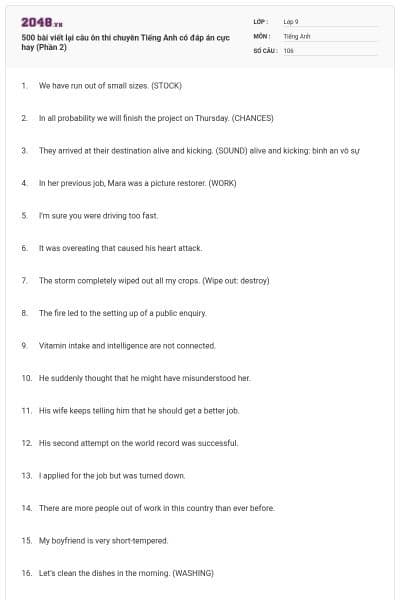
500 bài viết lại câu ôn thi chuyên Tiếng Anh có đáp án cực hay (Phần 2)
106 câu hỏi
We have run out of small sizes. (STOCK)
→We have no small sizes in stock. / We are out of stock of small sizes. / Small sizes are out of stock.
In all probability we will finish the project on Thursday. (CHANCES)
→The chances are that the project will be finished on Thursday.
They arrived at their destination alive and kicking. (SOUND) alive and kicking: bình an vô sự
→They arrived at their destination safe and sound
In her previous job, Mara was a picture restorer. (WORK)
→Mara used to work as a picture restorer.
I’m sure you were driving too fast.
→You must have been driving too fast.
It was overeating that caused his heart attack.
→If he hadn’t overeaten, he wouldn’t have had a heart attack.
The storm completely wiped out all my crops. (Wipe out: destroy)
I have had all my crops completely wiped out by the storm.
The fire led to the setting up of a public enquiry.
→As a result of the fire, a public enquiry was set up.
Vitamin intake and intelligence are not connected.
Đáp án: There is no connection between vitamin intake and intelligence.
Giải thích:
Dịch: Lượng vitamin và trí thông minh không có mối liên hệ với nhau.
Ta có:
connect (v): liên kết, liên hệ
connection (n): mối liên kết, sự liên kết
connection between A and B: mối liên hệ giữa A và B
→ There is no connection between vitamin intake and intelligence.
Dịch: Không có mối liên hệ nào giữa lượng vitamin và trí thông minh.
He suddenly thought that he might have misunderstood her.
→It crossed his mind that he might have misunderstood her.
His wife keeps telling him that he should get a better job.
→His wife is pushing him to get a better job.
His second attempt on the world record was successful.
→ He broke the work record at/on his second attempt.
I applied for the job but was turned down.
→My application for the job was turned down.
There are more people out of work in this country than ever before.
→Never have there been more people out of work in this country.
My boyfriend is very short-tempered.
Đáp án: My boyfriend loses his temper very easily.
Giải thích:
short-tempered (adj): dễ nổi nóng, dễ mất bình tĩnh
lose one’s temper: nổi nóng
Dịch: Bạn trai tôi rất dễ nổi nóng.
Let’s clean the dishes in the morning. (WASHING)
→Let’s do the washing-up in the morning.
Despite his age, he’s still working. (RETIRED)
→He still has not retired despite his age.
Whose name should I write on the cheque? (MAKE)
→Who should I make out the cheque to?
“Please don’t drive so fast!” Ann begged her friend
Đáp án: Ann pleaded with her friend not to drive so fast.
Giải thích:
plead with sb (not) to do sth: cầu xin, năn nỉ ai (không) làm gì
Dịch: “Làm ơn đừng lái xe nhanh thế!” Ann nài nỉ bạn mình.
→ Ann đã nài nỉ bạn mình đừng lái xe quá nhanh.
My protests were ignored.
→Nobody took notice of my protests.
I’m sure he took your briefcase by mistake.
Đáp án: I am sure he didn’t take your briefcase deliberately.
Giải thích:
by mistake: nhẫm lẫn, không cố ý
deliberately (adv): cố ý
Dịch: Tôi chắc chắn rằng anh ấy không cố ý lấy cặp tài liệu của bạn.
We only despatch goods after receiving the money.
→Only after the money is received can we despatch goods.
You pay 20 pounds a month for a period of one year.
→You pay in twelve successive monthly instalments of 20 pounds.
He’ll settle down. Then his performance will improve.
→Once he settles/ has settled down, his performance will improve.
The result of the match was never in doubt.
→At no time was the result of the match in doubt.
This will be the orchestra’s first performance outside London.
→This will be the first time the orchestra has performed/ played outside London.
He will not be put off by their comments. (DETER)
→Their comment won’t deter him.
She complains far too often for my liking. (FREQUENT)
→She makes frequent complaint about my liking.
Some people accept that a storm is inevitable. (RESIGNED)
→Some people are resigned to the fact that a storm is inevitable.
The fridge is completely empty. (LEFT)
→There is nothing left in the fridge.
Money is of little value on a desert island. (COUNTS)
→Money counts for little in the island.
Can you tell me where the Midland Hotel is? (DIRECT)
→Can you direct me to the …
The Prime Minister felt it appropriate to make a statement. (FIT)
→The Prime Minister saw/ thought fit to make a statement.
I’d rather we started at seven. (PREFERENCE)
→My preference was for a seven o’clock start.
The accident wasn’t his fault. (BLAME)
→He wasn’t to blame for the accident.
Although he seems friendly, he’s not to be trusted.-->_____________________________________
Đáp án: Friendly as he may seem, he’s not to be trusted.
Giải thích:
Cấu trúc: Adj/adv + as/though + S + V, mệnh đề: dù, mặc dù, cho dù
Dịch: Mặc dù anh ta có vẻ thân thiện nhưng anh ta không đáng tin cậy.
= Dù có vẻ thân thiện nhưng anh ta không đáng tin cậy.
Not until the body was found did the police believe her.
→It was only when the body was found that the police believed her.
“Whatever you do, don’t give up hope” they said.
→They urged me not to give up hope
Far more people live to retirement age in Britain than in the Philippines.
→Not as many people live to retirement age in Philippines as in Britain.
We have no seats left for the concert on December 12th.
→All the seats for the concert on December 12th have been booked.
The foreigner declared his innocence. (DENIED)
→The foreigner denied knowing anything about it.
Everyone but Jane failed to produce the correct answer. (SUCCEEDED)
→ ________________________________________________.
Đáp án: Only Jane succeeded in producing the correct answer.
Giải thích:
Cấu trúc: S + succeed in + danh từ/V-ing: thành công trong điều gì đó
Dịch: Tất cả mọi người trừ Jane không thể đưa ra câu trả lời chính xác.
= Chỉ có Jane thành công trong việc đưa ra câu trả lời đúng.
An open fire can’t be compared to/with central heating. (COMPARISON)
→There is no comparison between an open fire and central heating.
There is no way that young man can achieve success in this test. (BOUND)
→That young man is bound to fail in this test.
I was scared to tell him what I really thought. (COURAGE)
→I didn’t have enough courage to tell him what I really thought.
The Greens consider Henry a good friend. (LOOK)
→The Greens look on Henry as a good friend.
Teachers think that hard work is good for you. (HARM)
→Teachers think that work does/causes you no harm.
Because of the delay we missed our connecting flight. (MEANT)
→The delay meant that we missed our connecting flight.
Don’t wait to be asked if you want a sandwich! (HELP)
→Help yourself to a sandwich. (= take some of it)
Most people regard Dr. Peters as being the best surgeon in his field. (WIDELY)
→Dr. Peters is widely regarded as being …
The Prime Minister was determined to remain in office.
Đáp án: The Prime Minister had no intention of resigning office.
Giải thích:
be determined to do something: kiên quyết làm gì
have intention of doing something: có ý định làm gì
have no intention of doing something: không có ý định làm gì
resign (v): từ chức
Dịch: Thủ tướng quyết tâm tiếp tục giữ chức vụ.
→ Thủ tướng không có ý định từ chức.
I don’t know the first thing about aeronautics.
Đáp án: I am utterly ignorant of aeronautics.
Giải thích:
not know the first thing about something: không biết gì cả về cái gì
utterly ignorant of something: hoàn toàn không biết gì về cái gì
Dịch: Tôi không biết chút gì về hàng không.
The students’ riotous behaviour should have been severely punished.
→The students deserved severe punishment for their riotous behaviour.
The chances are that the whole thing will have been forgotten by next term.
→In all probability/likelihood the whole thing will …
Despite his ungainly air he is remarkably agile.
→Although he looks ungainly, he is remarkably agile.
The numbers of cars on the roads must be reduced. (DOWN)
→We must cut down on the number of cars on the roads.
Interrupting when someone is speaking is rude. (CUT)
→It’s rude to cut in when someone is speaking.
We have an emergency electricity supply in case we are cut off. (BACK)
→If we are cut off, we can fall back on our emergency electricity supply.
We’ve decided to leave early tomorrow morning. (SET)
Đáp án: We are going to set off early tomorrow morning.
Giải thích:
Kiến thức: Cụm động từ
set off (phr.v): khởi hành
Dùng thì tương lai gần (be going to) để diễn tả kế hoạch, dự định có sẵn trong tương lai.
Dịch: Chúng tôi quyết định sẽ khởi hành vào sáng sớm ngày mai.
→ Chúng tôi sẽ khởi hành vào sáng sớm ngày mai.
I know you are hiding something from me. (BACK)
→What are you keeping back from me?
Come on Thursday or Friday. It’s all the same to me. (DIFFERENCE)
Đáp án: Come on Thursday or Friday. It makes no difference to me.
Giải thích:
It makes no difference to me: tôi không quan tâm, tôi chẳng có cảm xúc gì đặc biệt.
Dịch: Hãy đến vào thứ năm hoặc thứ sáu. Đối với tôi ngày nào cũng được.
= Hãy đến vào thứ năm hoặc thứ sáu. Nó không có gì khác biệt với tôi.
Amanda has improved a lot this term. (PROGRESS)
Amanda has made great/good progress this term.
Gunman kills 3 people in Bank Drama.
→A man with a gun kills 3 people in …
The riddle of the missing heiress has been solved.
→The police has found the cause of the missing heiress.
His appearance was completely unexpected.
→His appearance was beyond our expectation.
He is by no means a smart boy.
→He is not completely a smart boy.
I take it for granted that he is influential person.
→I assume that he is …
He won’t let anyone touch his records. (OBJECTS)
→He objects to anyone else touching his records.
He didn’t think much of the musical show yesterday. (OPINION)
→ ______________________________________________.
Đáp án: He had a low opinion of the musical show yesterday.
Giải thích:
Cấu trúc: not think much of someone/something = have a low opinion of someone/something: không coi trọng, đánh giá cao ai đó hay điều gì đó
Dịch: Anh ấy không đánh giá cao buổi biểu diễn âm nhạc ngày hôm qua.
= Anh ấy đánh giá thấp buổi biểu diễn âm nhạc ngày hôm qua.
The concert was not as good as he had hoped. (EXPECTATIONS)
→The concert failed to come/live up to his expectations.
The music teacher was the only member of staff not to attend the concert. (EXCEPTION)
→With the exception of the music teacher every member of staff attended the concert.
The impression most people have of him is that he is a good singer. (REPUTATION)
→ He has a reputation as a good singer.
He is said to be a very good violinist. (COMES)
→He comes over/across as a very good violinist.
We missed the beginning of the concert because we had overslept. (CONSEQUENCE)
→We missed the beginning of the concert as a consequence of oversleeping.
It is your duty to tell him what to do.
Đáp án: You are supposed to tell him what to do.
Giải thích:
Dịch: Nhiệm vụ của bạn là phải bảo anh ấy phải làm gì.
be supposed to do something: được cho là phải làm gì, có nhiệm vụ/trách nhiệm phải làm gì
→ Bạn có nhiệm vụ bảo anh ấy phải làm gì.
My boss works better when he’s pressed for time.
Đáp án: The less hurried the boss is, the worse he works.
Giải thích:
Kiến thức: So sánh kép
Câu gốc: "My boss works better when he’s pressed for time."
→ Nghĩa là: Sếp tôi làm việc hiệu quả hơn khi ông ấy bị áp lực thời gian.
→ Tức là: Càng ít thời gian / càng bị thúc ép (hurried), ông ấy làm việc càng tốt.
→ Câu chuyển tương đương cần mang ý: Càng ít bị vội (less hurried) → làm việc càng tệ hơn (worse).
The + comparative + S + V, the + comparative + S + V
→ Dùng để nói về mối quan hệ: càng... thì càng...
"hurried" = bị thúc ép/vội vã
"less hurried" = ít bị thúc ép → tức là ít áp lực hơn, làm việc kém hiệu quả hơn
"worse" = tệ hơn
Dịch: Sếp tôi làm việc tốt hơn khi ông ấy không có nhiều thời gian.
→ Càng ít bị thúc ép, sếp tôi càng làm việc tệ hơn.
It is expected that the company can get more profit this year.
Đáp án: The company is expected to get more profit this year.
Giải thích:
Kiến thức: Bị động
be expected to do something: được kì vọng sẽ làm gì
Dịch: Công ty kì vọng sẽ thu được nhiều lợi nhuận hơn trong năm nay.
I was astonished by her confidence.
→What astonished me was her confidence.
Someone told me my flight was cancelled when I got to the airport.
→Arriving at the airport, someone told me my flight was cancelled.
knew I had met him before, but I can’t remember his name. (TONGUE)
→I knew I had met him before, but his name is on the tip of my tongue.
His choice always followed what his wife decided. (STEP)
→His choice was always in step with his wife’s decision/what his wife decided.
Remember to write to us! (DROP)
→Remember to drop us a line/note!
Phone and write to him if you can’t talk directly to him. (GET)
→Get in touch with him if you can’t talk directly to him.
Don’t worry. There will be another chance. (KEEP)
→Keep your end up, there will be another chance.
On the day she agreed to marry him, he was happier than he had ever been in his life.
→The day she agreed to marry him was the happiest he had ever had in his life.
Is it really necessary for me to arrive so early?
→Do I have to arrive so early?
Someone has stolen the boss’s car.
→The boss has had his car stolen/ been robbed of his car.
Whoever did that must have been a very brave person.
→Only a very brave person could have done that.
The last time we were here was in 1980.
→We haven’t been here since 1980.
The fourth time he asked her to marry him, she accepted.
→Only on his fourth proposal did she accept him.
Has she written to you lately? (HEARD)
→Has you heard form her lately?
We must have your answer tonight at the latest. (INSIST)
→We insist on having your answer tonight at the latest.
We’ve decided to replace those plastic shower curtains with these rubber ones. (SUBSTITUTE)
→We have decided to substitute those plastic shower curtains for these rubber ones.
Somebody has stolen all Miranda’s jewellery. (ROBBED)
→Miranda has been robbed of all her jewelry.
Nothing ever frightens him. (AFRAID)
→He is afraid of nothing.
It’s not my habit to get up quite so early as this. (USED)
→I am not used to getting up quite so early like this.
Everything went well that morning. (NOTHING)
→Nothing went wrong that morning.
A portion of strawberries and cream costs a lot in the café. (CHARGES)
→The café charges a lot for a portion …
How likely am I to pass the examination, do you think? (CHANCE)
→What chance have I of passing the examination, do you think?
He had no idea how difficult the exercise would be until he was half way through it.
→Only when he was half way through the exercise did he realize how difficult it was.
Further progress was impossible because of the floods.
→The floods made further progress impossible.
As he rose to speak, the crowd began cheering.
→The cheering from the crowd began as he rose to speak.
We had not expected that we should have so much difficulty in finding the place.
→The place was much more difficult to find than we had expected.
Our present financial problems will soon be a thing of the past.
→We’ll soon find a solution to/overcome our present financial problems.
It’s nobody’s fault that the meeting was cancelled.
Đáp án: Nobody is to blame/is responsible for the fact that the meeting was cancelled.
Giải thích:
Câu gốc sử dụng cấu trúc "It’s nobody’s fault that..." để diễn tả rằng không ai chịu trách nhiệm về việc cuộc họp bị hủy. Khi viết lại câu, ta có thể dùng các cấu trúc tương đương:
"be to blame for..." = chịu trách nhiệm cho (thường dùng trong ngữ cảnh tiêu cực).
"be responsible for..." = chịu trách nhiệm về điều gì đó.
Do đó, câu viết lại sẽ là:
"Nobody is to blame/is responsible for the fact that the meeting was cancelled."
Dịch: Không ai phải chịu trách nhiệm cho việc cuộc họp bị hủy.
The fate of the two climbers is unknown.
→It’s a mystery as to what happened to the two climbers.