15 Bài tập Trắc nghiệm Unit 10 Reading
15 câu hỏi
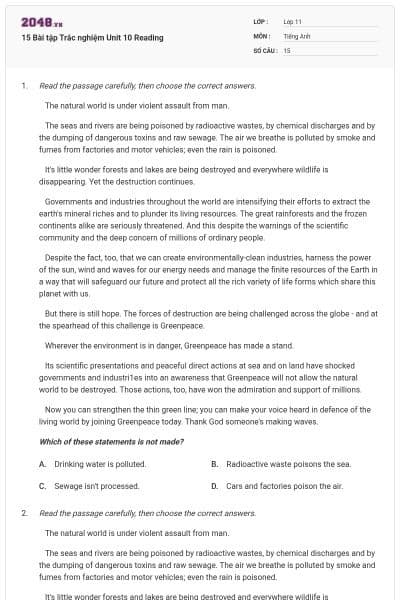
Read the passage carefully, then choose the correct answers.
The natural world is under violent assault from man.
The seas and rivers are being poisoned by radioactive wastes, by chemical discharges and by the dumping of dangerous toxins and raw sewage. The air we breathe is polluted by smoke and fumes from factories and motor vehicles; even the rain is poisoned.
It's little wonder forests and lakes are being destroyed and everywhere wildlife is disappearing. Yet the destruction continues.
Governments and industries throughout the world are intensifying their efforts to extract the earth's mineral riches and to plunder its living resources. The great rainforests and the frozen continents alike are seriously threatened. And this despite the warnings of the scientific community and the deep concern of millions of ordinary people.
Despite the fact, too, that we can create environmentally-clean industries, harness the power of the sun, wind and waves for our energy needs and manage the finite resources of the Earth in a way that will safeguard our future and protect all the rich variety of life forms which share this planet with us.
But there is still hope. The forces of destruction are being challenged across the globe - and at the spearhead of this challenge is Greenpeace.
Wherever the environment is in danger, Greenpeace has made a stand.
Its scientific presentations and peaceful direct actions at sea and on land have shocked governments and industri1es into an awareness that Greenpeace will not allow the natural world to be destroyed. Those actions, too, have won the admiration and support of millions.
Now you can strengthen the thin green line; you can make your voice heard in defence of the living world by joining Greenpeace today. Thank God someone's making waves.
Which of these statements is not made?
Drinking water is polluted.
Radioactive waste poisons the sea.
Sewage isn't processed.
Cars and factories poison the air.
Đáp án: B
Giải thích: Thông tin: The seas and rivers are being poisoned by radioactive wastes, by chemical discharges and by the dumping of dangerous toxins and raw sewage.
Dịch: Biển và sông đang bị nhiễm độc chất thải phóng xạ, do thải hóa chất và thải chất độc nguy hiểm và nước thải thô.
Read the passage carefully, then choose the correct answers.
The natural world is under violent assault from man.
The seas and rivers are being poisoned by radioactive wastes, by chemical discharges and by the dumping of dangerous toxins and raw sewage. The air we breathe is polluted by smoke and fumes from factories and motor vehicles; even the rain is poisoned.
It's little wonder forests and lakes are being destroyed and everywhere wildlife is disappearing. Yet the destruction continues.
Governments and industries throughout the world are intensifying their efforts to extract the earth's mineral riches and to plunder its living resources. The great rainforests and the frozen continents alike are seriously threatened. And this despite the warnings of the scientific community and the deep concern of millions of ordinary people.
Despite the fact, too, that we can create environmentally-clean industries, harness the power of the sun, wind and waves for our energy needs and manage the finite resources of the Earth in a way that will safeguard our future and protect all the rich variety of life forms which share this planet with us.
But there is still hope. The forces of destruction are being challenged across the globe - and at the spearhead of this challenge is Greenpeace.
Wherever the environment is in danger, Greenpeace has made a stand.
Its scientific presentations and peaceful direct actions at sea and on land have shocked governments and industri1es into an awareness that Greenpeace will not allow the natural world to be destroyed. Those actions, too, have won the admiration and support of millions.
Now you can strengthen the thin green line; you can make your voice heard in defence of the living world by joining Greenpeace today. Thank God someone's making waves.
The writer ............
is surprised that the rain is poisoned.
is unsured why the air is polluted.
wonders why the natural world is being destroyed.
understands why forests and lakes are being destroyed.
Đáp án: C
Giải thích: It's little wonder forests and lakes are being destroyed and everywhere wildlife is disappearing.
Dịch: Đó là một khu rừng nhỏ và hồ nước đang bị phá hủy và mọi nơi động vật hoang dã đang biến mất.
Read the passage carefully, then choose the correct answers.
The natural world is under violent assault from man.
The seas and rivers are being poisoned by radioactive wastes, by chemical discharges and by the dumping of dangerous toxins and raw sewage. The air we breathe is polluted by smoke and fumes from factories and motor vehicles; even the rain is poisoned.
It's little wonder forests and lakes are being destroyed and everywhere wildlife is disappearing. Yet the destruction continues.
Governments and industries throughout the world are intensifying their efforts to extract the earth's mineral riches and to plunder its living resources. The great rainforests and the frozen continents alike are seriously threatened. And this despite the warnings of the scientific community and the deep concern of millions of ordinary people.
Despite the fact, too, that we can create environmentally-clean industries, harness the power of the sun, wind and waves for our energy needs and manage the finite resources of the Earth in a way that will safeguard our future and protect all the rich variety of life forms which share this planet with us.
But there is still hope. The forces of destruction are being challenged across the globe - and at the spearhead of this challenge is Greenpeace.
Wherever the environment is in danger, Greenpeace has made a stand.
Its scientific presentations and peaceful direct actions at sea and on land have shocked governments and industri1es into an awareness that Greenpeace will not allow the natural world to be destroyed. Those actions, too, have won the admiration and support of millions.
Now you can strengthen the thin green line; you can make your voice heard in defence of the living world by joining Greenpeace today. Thank God someone's making waves.
Rainforests are being destroyed because governments and industries .......
are unaware of what they're doing wrong.
are rich and powerful.
choose to ignore criticism.
basically care about the environment.
Đáp án: C
Giải thích: And this despite the warnings of the scientific community and the deep concern of millions of ordinary people.
Dịch: Và điều này bất chấp những cảnh báo của cộng đồng khoa học và mối quan tâm sâu sắc của hàng triệu người dân thường.
Read the passage carefully, then choose the correct answers.
The natural world is under violent assault from man.
The seas and rivers are being poisoned by radioactive wastes, by chemical discharges and by the dumping of dangerous toxins and raw sewage. The air we breathe is polluted by smoke and fumes from factories and motor vehicles; even the rain is poisoned.
It's little wonder forests and lakes are being destroyed and everywhere wildlife is disappearing. Yet the destruction continues.
Governments and industries throughout the world are intensifying their efforts to extract the earth's mineral riches and to plunder its living resources. The great rainforests and the frozen continents alike are seriously threatened. And this despite the warnings of the scientific community and the deep concern of millions of ordinary people.
Despite the fact, too, that we can create environmentally-clean industries, harness the power of the sun, wind and waves for our energy needs and manage the finite resources of the Earth in a way that will safeguard our future and protect all the rich variety of life forms which share this planet with us.
But there is still hope. The forces of destruction are being challenged across the globe - and at the spearhead of this challenge is Greenpeace.
Wherever the environment is in danger, Greenpeace has made a stand.
Its scientific presentations and peaceful direct actions at sea and on land have shocked governments and industri1es into an awareness that Greenpeace will not allow the natural world to be destroyed. Those actions, too, have won the admiration and support of millions.
Now you can strengthen the thin green line; you can make your voice heard in defence of the living world by joining Greenpeace today. Thank God someone's making waves.
The earth's resources ..........
should only be for people
can be made to last longer.
will last forever.
belong to just humans and animals
Đáp án: B
Giải thích: Despite the fact, too, that we can create environmentally-clean industries, harness the power of the sun, wind and waves for our energy needs and manage the finite resources of the Earth in a way that will safeguard our future and protect all the rich variety of life forms which share this planet with us.
Dịch: Mặc dù thực tế cũng vậy, chúng ta có thể tạo ra các ngành công nghiệp sạch môi trường, khai thác sức mạnh của mặt trời, gió và sóng cho nhu cầu năng lượng của chúng ta và quản lý tài nguyên hữu hạn của Trái đất theo cách bảo vệ tương lai của chúng ta và bảo vệ tất cả người giàu nhiều dạng sống khác nhau chia sẻ hành tinh này với chúng ta.
Read the passage carefully, then choose the correct answers.
The natural world is under violent assault from man.
The seas and rivers are being poisoned by radioactive wastes, by chemical discharges and by the dumping of dangerous toxins and raw sewage. The air we breathe is polluted by smoke and fumes from factories and motor vehicles; even the rain is poisoned.
It's little wonder forests and lakes are being destroyed and everywhere wildlife is disappearing. Yet the destruction continues.
Governments and industries throughout the world are intensifying their efforts to extract the earth's mineral riches and to plunder its living resources. The great rainforests and the frozen continents alike are seriously threatened. And this despite the warnings of the scientific community and the deep concern of millions of ordinary people.
Despite the fact, too, that we can create environmentally-clean industries, harness the power of the sun, wind and waves for our energy needs and manage the finite resources of the Earth in a way that will safeguard our future and protect all the rich variety of life forms which share this planet with us.
But there is still hope. The forces of destruction are being challenged across the globe - and at the spearhead of this challenge is Greenpeace.
Wherever the environment is in danger, Greenpeace has made a stand.
Its scientific presentations and peaceful direct actions at sea and on land have shocked governments and industri1es into an awareness that Greenpeace will not allow the natural world to be destroyed. Those actions, too, have won the admiration and support of millions.
Now you can strengthen the thin green line; you can make your voice heard in defence of the living world by joining Greenpeace today. Thank God someone's making waves.
Governments and industries ............
don't know what Greenpeace thinks.
are forced to understand the problems by Greenpeace.
can easily ignore Greenpeace.
misunderstand what Greenpeace thinks.
Đáp án: B
Giải thích: Its scientific presentations and peaceful direct actions at sea and on land have shocked governments and industri1es into an awareness that Greenpeace will not allow the natural world to be destroyed.
Dịch: Các bài thuyết trình khoa học và các hành động trực tiếp hòa bình trên biển và trên đất liền đã khiến các chính phủ và công nghiệp sửng sốt khi nhận ra rằng Greenpeace sẽ không cho phép thế giới tự nhiên bị phá hủy.
Read the following passage and mark the letter A, B, C or D on your answer sheet to indicate the correct word or phrase that best fits each of the numbered blanks.
When the weather is cold, it is not very much fun to (1) ______a bus. People have to stand at a bus-stop for minutes or even hours. They talk about the bus and (2) _______about the weather. Most of them feel cold. Some have to drink coffee to stay warm.
Traveling by buses (3) _______pollution, but people often would rather drive their cars. Many people are not used to the bus schedules, and they do not like to wait.
On the other hand, many people have been (4) ______the bus every day for many years. They are used to it. They say the bus has been coming on time every day, and they have never been late for work. In (5) _______, they do not need a parking place in all that time. Buses are very convenient when you are used to them.
Điền vào ô số 1
search
look for
stand for
wait for
Đáp án: D
Giải thích: wait for a bus: chờ đợi xe bus
Read the following passage and mark the letter A, B, C or D on your answer sheet to indicate the correct word or phrase that best fits each of the numbered blanks.
When the weather is cold, it is not very much fun to (1) ______a bus. People have to stand at a bus-stop for minutes or even hours. They talk about the bus and (2) _______about the weather. Most of them feel cold. Some have to drink coffee to stay warm.
Traveling by buses (3) _______pollution, but people often would rather drive their cars. Many people are not used to the bus schedules, and they do not like to wait.
On the other hand, many people have been (4) ______the bus every day for many years. They are used to it. They say the bus has been coming on time every day, and they have never been late for work. In (5) _______, they do not need a parking place in all that time. Buses are very convenient when you are used to them.
Điền vào ô số 2
tell
complain
comment
judge
Đáp án: B
Giải thích: Cấu trúc: complain about something: than phiền về cái gì
Read the following passage and mark the letter A, B, C or D on your answer sheet to indicate the correct word or phrase that best fits each of the numbered blanks.
When the weather is cold, it is not very much fun to (1) ______a bus. People have to stand at a bus-stop for minutes or even hours. They talk about the bus and (2) _______about the weather. Most of them feel cold. Some have to drink coffee to stay warm.
Traveling by buses (3) _______pollution, but people often would rather drive their cars. Many people are not used to the bus schedules, and they do not like to wait.
On the other hand, many people have been (4) ______the bus every day for many years. They are used to it. They say the bus has been coming on time every day, and they have never been late for work. In (5) _______, they do not need a parking place in all that time. Buses are very convenient when you are used to them.
Điền vào ô số 3
cuts
reduces
stops
eliminates
Đáp án: B
Giải thích: To reduce something: làm cái gì giảm về lượng, kích thước, mức độ, tầm quan trọng,… reduce pollution: làm giảm sự ô nhiễm (về mức độ)
Read the following passage and mark the letter A, B, C or D on your answer sheet to indicate the correct word or phrase that best fits each of the numbered blanks.
When the weather is cold, it is not very much fun to (1) ______a bus. People have to stand at a bus-stop for minutes or even hours. They talk about the bus and (2) _______about the weather. Most of them feel cold. Some have to drink coffee to stay warm.
Traveling by buses (3) _______pollution, but people often would rather drive their cars. Many people are not used to the bus schedules, and they do not like to wait.
On the other hand, many people have been (4) ______the bus every day for many years. They are used to it. They say the bus has been coming on time every day, and they have never been late for work. In (5) _______, they do not need a parking place in all that time. Buses are very convenient when you are used to them.
Điền vào ô số 4
looking
waiting
getting
taking
Đáp án: D
Giải thích: take the bus/ the train,…: đi đến đâu bằng 1 phương tiện giao thông nhất định
Read the following passage and mark the letter A, B, C or D on your answer sheet to indicate the correct word or phrase that best fits each of the numbered blanks.
When the weather is cold, it is not very much fun to (1) ______a bus. People have to stand at a bus-stop for minutes or even hours. They talk about the bus and (2) _______about the weather. Most of them feel cold. Some have to drink coffee to stay warm.
Traveling by buses (3) _______pollution, but people often would rather drive their cars. Many people are not used to the bus schedules, and they do not like to wait.
On the other hand, many people have been (4) ______the bus every day for many years. They are used to it. They say the bus has been coming on time every day, and they have never been late for work. In (5) _______, they do not need a parking place in all that time. Buses are very convenient when you are used to them.
Điền vào ô số 5
end
last
addition
conclusion
Đáp án: C
Giải thích: In addition: ngoài ra (được dùng để chỉ sự nói thêm cho ý trước)
Read the following passage and mark the letter A, B, C or D on your answer sheet to indicate the correct word or phrase that best fits each of the numbered blanks.
Wind, water, air, ice and heat all work to cause erosion. As the wind blows over the land, it often (1) ______ small grains of sand. When these grains of sand strike against solid rocks, the rocks are slowly worn away. In this way, even very hard rocks are worn away by the wind.
When particles of rocks or soil became loosened in any way, running water carries them down the (3) ______. Some rocks and soil particles are carried into streams and then into the sea.
Land that is covered with trees, grass and other plants wears away very slowly, and so loses very (4) ______ of its soil. The roots of plants help to (5) ______ the rocks and soil in place. Water that falls on grasslands runs away more slowly than water that falls on bare ground.
Đền vào ô số 1
cleans out
picks up
carries out
holds up
Đáp án: B
Giải thích: pick st up = lift st up: nâng lên, làm bay đi
clean st out: lấy cắp, làm sạch hoàn toàn bên trong
carry st out: thực hiện điều gì
hold st up: trì hoãn, lấy cắp
Read the following passage and mark the letter A, B, C or D on your answer sheet to indicate the correct word or phrase that best fits each of the numbered blanks.
Wind, water, air, ice and heat all work to cause erosion. As the wind blows over the land, it often (1) ______ small grains of sand. When these grains of sand strike against solid rocks, the rocks are slowly worn away. In this way, even very hard rocks are worn away by the wind.
When particles of rocks or soil became loosened in any way, running water carries them down the (3) ______. Some rocks and soil particles are carried into streams and then into the sea.
Land that is covered with trees, grass and other plants wears away very slowly, and so loses very (4) ______ of its soil. The roots of plants help to (5) ______ the rocks and soil in place. Water that falls on grasslands runs away more slowly than water that falls on bare ground.
Đền vào ô số 2
borders
topside
backside
hillsides
Đáp án: D
Giải thích: hillside: (n) sườn đồi
Dịch: Khi các hòn đất đá trở nên tơi ra, nước xoáy làm chúng rơi xuống sườn đồi.
Read the following passage and mark the letter A, B, C or D on your answer sheet to indicate the correct word or phrase that best fits each of the numbered blanks.
Wind, water, air, ice and heat all work to cause erosion. As the wind blows over the land, it often (1) ______ small grains of sand. When these grains of sand strike against solid rocks, the rocks are slowly worn away. In this way, even very hard rocks are worn away by the wind.
When particles of rocks or soil became loosened in any way, running water carries them down the (3) ______. Some rocks and soil particles are carried into streams and then into the sea.
Land that is covered with trees, grass and other plants wears away very slowly, and so loses very (4) ______ of its soil. The roots of plants help to (5) ______ the rocks and soil in place. Water that falls on grasslands runs away more slowly than water that falls on bare ground.
Đền vào ô số 3
much
few
little
large
Đáp án: C
Giải thích: Tính từ little chỉ sự khan hiếm hoặc thiếu và gần như mang nghĩa phủ định được dùng trước danh từ không đếm được (trong câu này là soil: đất trồng). Ta có thể dùng trạng từ chỉ mức độ so/ very để bổ nghĩa cho tính từ little.
Dịch: Đất được bao phủ bởi cây cối, cỏ và các loại thực vật khác bị trôi đi rất chậm, và như thế mất rất ít đất trồng.
Read the following passage and mark the letter A, B, C or D on your answer sheet to indicate the correct word or phrase that best fits each of the numbered blanks.
Wind, water, air, ice and heat all work to cause erosion. As the wind blows over the land, it often (1) ______ small grains of sand. When these grains of sand strike against solid rocks, the rocks are slowly worn away. In this way, even very hard rocks are worn away by the wind.
When particles of rocks or soil became loosened in any way, running water carries them down the (3) ______. Some rocks and soil particles are carried into streams and then into the sea.
Land that is covered with trees, grass and other plants wears away very slowly, and so loses very (4) ______ of its soil. The roots of plants help to (5) ______ the rocks and soil in place. Water that falls on grasslands runs away more slowly than water that falls on bare ground.
Đền vào ô số 4
aid
facilitate
assist
help
Đáp án: D
Giải thích: help to do st: giúp đỡ
Dịch: Do đó, rừng và đồng cỏ giúp làm chậm lại sự xói mòn.
Read the following passage and mark the letter A, B, C or D on your answer sheet to indicate the correct word or phrase that best fits each of the numbered blanks.
Wind, water, air, ice and heat all work to cause erosion. As the wind blows over the land, it often (1) ______ small grains of sand. When these grains of sand strike against solid rocks, the rocks are slowly worn away. In this way, even very hard rocks are worn away by the wind.
When particles of rocks or soil became loosened in any way, running water carries them down the (3) ______. Some rocks and soil particles are carried into streams and then into the sea.
Land that is covered with trees, grass and other plants wears away very slowly, and so loses very (4) ______ of its soil. The roots of plants help to (5) ______ the rocks and soil in place. Water that falls on grasslands runs away more slowly than water that falls on bare ground.
Đền vào ô số 5
building
formed
melted
melting
Đáp án: D
Giải thích: melting: (adj) tan chảy. Tính từ ‘melting’ có dạng V_ing chỉ tính chất của tuyết.
Dịch: Vào mùa đông, tuyết tan chảy biến thành một lượng nước khổng lồ và chảy xuống các con suối.