Trắc nghiệm Tiếng Anh 12 Global Success Unit 2 Reading (có đáp án)
20 câu hỏi
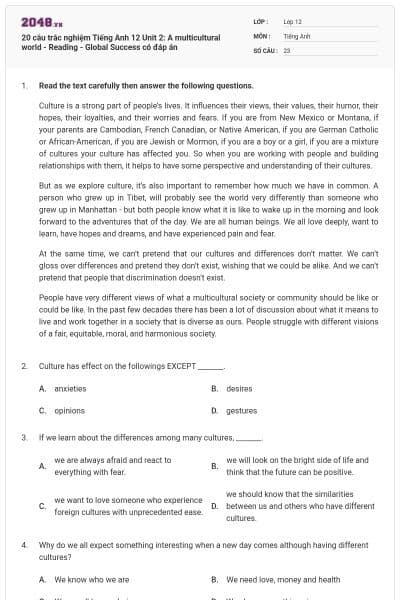
Read the text carefully then answer the following questions.
Culture is a strong part of people’s lives. It influences their views, their values, their humor, their hopes, their loyalties, and their worries and fears. If you are from New Mexico or Montana, if your parents are Cambodian, French Canadian, or Native American, if you are German Catholic or African-American, if you are Jewish or Mormon, if you are a boy or a girl, if you are a mixture of cultures your culture has affected you. So when you are working with people and building relationships with them, it helps to have some perspective and understanding of their cultures.
But as we explore culture, it’s also important to remember how much we have in common. A person who grew up in Tibet, will probably see the world very differently than someone who grew up in Manhattan - but both people know what it is like to wake up in the morning and look forward to the adventures that of the day. We are all human beings. We all love deeply, want to learn, have hopes and dreams, and have experienced pain and fear.
At the same time, we can’t pretend that our cultures and differences don’t matter. We can’t gloss over differences and pretend they don’t exist, wishing that we could be alike. And we can’t pretend that people that discrimination doesn’t exist.
People have very different views of what a multicultural society or community should be like or could be like. In the past few decades there has been a lot of discussion about what it means to live and work together in a society that is diverse as ours. People struggle with different visions of a fair, equitable, moral, and harmonious society.
Culture has effect on the followings EXCEPT _______.
anxieties
desires
opinions
gestures
Đáp án đúng: D
Giải thích:
Dựa vào câu: It influences their views, their values, their humor, their hopes, their loyalties, and their worries and fears. (Nó ảnh hưởng đến quan điểm, giá trị, khiếu hài hước, hy vọng, lòng trung thành, cũng như nỗi lo lắng và sợ hãi của họ.)
If we learn about the differences among many cultures, _______.
we are always afraid and react to everything with fear.
we will look on the bright side of life and think that the future can be positive.
we want to love someone who experience foreign cultures with unprecedented ease.
we should know that the similarities between us and others who have different cultures.
Đáp án đúng: D
Giải thích:
Dựa vào câu: But as we explore culture, it’s also important to remember how much we have in common. (Nhưng khi khám phá văn hóa, điều quan trọng là phải nhớ rằng chúng ta có bao nhiêu điểm chung.)
Why do we all expect something interesting when a new day comes although having different cultures?
We know who we are
We need love, money and health
We are all human beings
We share many things in common
Đáp án đúng: C
Giải thích:
Dựa vào câu: A person who grew up in Tibet, will probably see the world very differently than someone who grew up in Manhattan - but both people know what it is like to wake up in the morning and look forward to the adventures that of the day. (Một người lớn lên ở Tây Tạng có thể sẽ nhìn thế giới rất khác so với người lớn lên ở Manhattan - nhưng cả hai đều biết cảm giác thức dậy vào buổi sáng và mong chờ những cuộc phiêu lưu trong ngày là như thế nào.)
According to the passage, which of the following statements is NOT TRUE?
Culture has become an important part of our daily lives.
When we get acquaintance with someone, we shouldn’t know about their cultures.
Discrimination is still a problem in modern society.
People have very different attitudes towards cultural diversity.
Đáp án đúng: B
Giải thích:
Dựa vào câu: So when you are working with people and building relationships with them, it helps to have some perspective and understanding of their cultures. (Vì vậy, khi làm việc với mọi người và xây dựng mối quan hệ với họ, bạn sẽ cần có góc nhìn và hiểu biết về văn hóa của họ.)
The word “equitable” in the passage is OPPOSITE in meaning to _______.
one-sided
even-handed
touch-oriented
impartial
Đáp án đúng: A
Giải thích:
“equitable” = công bằng, bình đẳng >< “one-sided” = phiến diện, thiên vị.
According to the passage, what is one common experience shared by all humans?
Having the same culture and traditions
Waking up in the morning and looking forward to the day
Growing up in the same environment
Sharing the same religion
Đáp án đúng: B
Giải thích:
Dựa vào câu: A person who grew up in Tibet, will probably see the world very differently than someone who grew up in Manhattan - but both people know what it is like to wake up in the morning and look forward to the adventures that of the day. (Một người lớn lên ở Tây Tạng có thể sẽ nhìn thế giới rất khác so với người lớn lên ở Manhattan - nhưng cả hai đều biết cảm giác thức dậy vào buổi sáng và mong chờ những cuộc phiêu lưu trong ngày là như thế nào.)
What does the passage suggest about multicultural societies?
Everyone agrees on how they should look.
They often create problems that cannot be solved.
People have different ideas of what they should be like.
They are always harmonious and fair.
Đáp án đúng: C
Giải thích:
Dựa vào câu: People have very different views of what a multicultural society or community should be like or could be like. (Mọi người có quan điểm rất khác nhau về việc một xã hội hay cộng đồng đa văn hóa nên như thế nào hoặc có thể như thế nào.)
Dịch bài đọc:
Văn hóa là một phần quan trọng trong cuộc sống của con người. Nó ảnh hưởng đến quan điểm, giá trị, sự hài hước, hy vọng, lòng trung thành, cũng như những lo lắng và sợ hãi của họ. Cho dù bạn đến từ New Mexico hay Montana, nếu cha mẹ bạn là người Campuchia, người Canada gốc Pháp, hay người Mỹ bản địa, nếu bạn là người Đức theo Công giáo hay người Mỹ gốc Phi, nếu bạn là người Do Thái hay người Mặc Môn, nếu bạn là con trai hay con gái, nếu bạn là người pha trộn nhiều nền văn hóa, văn hóa của bạn đã ảnh hưởng đến bạn. Vì vậy, khi bạn làm việc với mọi người và xây dựng mối quan hệ với họ, việc có một số quan điểm và hiểu biết về văn hóa của họ sẽ rất hữu ích.
Nhưng khi chúng ta khám phá văn hóa, điều quan trọng là phải nhớ rằng chúng ta có bao nhiêu điểm chung. Một người lớn lên ở Tây Tạng có thể sẽ nhìn thế giới rất khác so với một người lớn lên ở Manhattan - nhưng cả hai người đều biết cảm giác thức dậy vào buổi sáng và mong chờ những cuộc phiêu lưu trong ngày là như thế nào. Tất cả chúng ta đều là con người. Tất cả chúng ta đều yêu thương sâu sắc, muốn học hỏi, có hy vọng và ước mơ, và đã trải qua nỗi đau và nỗi sợ hãi.
Đồng thời, chúng ta không thể giả vờ rằng văn hóa và sự khác biệt của chúng ta không quan trọng. Chúng ta không thể che giấu sự khác biệt và giả vờ như chúng không tồn tại, ước ao rằng chúng ta có thể giống nhau. Và chúng ta cũng không thể giả vờ rằng sự phân biệt đối xử không tồn tại.
Mọi người có quan điểm rất khác nhau về việc một xã hội hay cộng đồng đa văn hóa nên như thế nào, hoặc có thể như thế nào. Trong vài thập kỷ qua, đã có rất nhiều cuộc thảo luận về ý nghĩa của việc sống và làm việc cùng nhau trong một xã hội đa dạng như xã hội của chúng ta. Mọi người đấu tranh với những quan điểm khác nhau về một xã hội công bằng, bình đẳng, đạo đức và hài hòa.
Read the text carefully then answer the following questions.
The tradition of gift giving is a worldwide practice that is said to have been around since the beginning of human beings. Over time different cultures have developed their own gift giving customs and traditions. In France the gift of wine for the hostess of a dinner party is not an appropriate gift as the hostess would prefer to choose the vintage for the night. In Sweden, a bottle of wine or flowers are an appropriate gift for the hostess. In Vietnam, a gift of whisky is appropriate for the host, and some fruit or small gifts for the hostess, children or elders of the home. Besides, gifts should never be wrapped in black paper because this color is unlucky and associated with funerals in this country. Gifts that symbolize cutting such as scissors, knives and other sharp objects should be avoided because they mean the cutting of the relationship. Also, in some countries you should not open the gift in front of the giver and in others it would be an insult if you did not open the gift. Beyond the gift itself, give careful consideration to the manner in which it is presented. Different culture have different customs regarding how a gift should be offered – using only your right hand or using both hand, for example. Others have strong traditions related to the appropriate way to accept a gift. In Singapore, for instance, it is the standard to graciously refuse a gift several times before finally accepting it. The recipient would never unwrap a gift in front of the giver for fear of appearing greedy. Understanding these traditions and customs, as well as taking time to choose an appropriate gift, will help you to avoid any awkwardness or embarrassment as you seek to build a better cross – cultural relationship.
When did the tradition of gift-giving become popular all over the world?
A long time ago
Thousands of years ago
Since the beginning of humans
Since the beginning of industrialization
Đáp án đúng: C
Giải thích:
Dựa vào câu: The tradition of gift giving is a worldwide practice that is said to have been around since the beginning of human beings. (Truyền thống tặng quà là một tập tục trên toàn thế giới được cho là đã có từ khi con người xuất hiện.)
Which of the following is NOT true about gift-giving customs?
In France, wine is not considered a suitable gift for the hostess of a dinner party.
In Sweden, it is not customary to bring some wine or flowers when you are invited to a dinner party.
In Vietnam, such things as scissors, knives and other sharp objects shouldn’t be used as a gift.
In Singapore, it is unacceptable to open the gift right in front of the giver.
Đáp án đúng: B
Giải thích:
Dựa vào câu: In Sweden, a bottle of wine or flowers are an appropriate gift for the hostess. (Ở Thụy Điển, một chai rượu vang hoặc hoa là món quà phù hợp dành cho nữ chủ nhà.)
The phrase “associated with” is closest in meaning to ______.
connected with
familiar with
informed of
similar to
Đáp án đúng: A
Giải thích:
“associated with” = “connected with” (có liên quan đến).
The word “it” in paragraph 3 refers to ______.
consideration
manner
gift
culture
Đáp án đúng: C
Giải thích:
Dựa vào câu: Beyond the gift itself, give careful consideration to the manner in which it is presented. (Ngoài bản thân món quà, hãy cân nhắc kỹ lưỡng đến cách tặng quà.)
Which of the following is the main idea of the passage?
The people who are presented with gifts
The traditions of giving and receiving gifts
The occasions of giving and receiving gifts
The manners of giving and receiving gifts
Đáp án đúng: B
Giải thích:
Toàn bài bàn về các phong tục, tập quán tặng quà ở nhiều nền văn hóa khác nhau.
Why should gifts not be wrapped in black paper in Vietnam?
Because it is considered lucky
Because it is associated with funerals
Because it is too expensive
Because it is considered a wedding color
Đáp án đúng: B
Giải thích:
Dựa vào câu: Besides, gifts should never be wrapped in black paper because this color is unlucky and associated with funerals in this country. (Ngoài ra, quà tặng không bao giờ nên được gói bằng giấy đen vì màu này không may mắn và gắn liền với đám tang ở đất nước này.)
According to the passage, what is the custom of receiving gifts in Singapore?
Recipients should open gifts immediately in front of the giver
Recipients should refuse a gift several times before accepting it
Recipients always exchange gifts with the giver
Recipients should keep the gift unopened forever
Đáp án đúng: B
Giải thích:
Dựa vào câu: In Singapore, for instance, it is the standard to graciously refuse a gift several times before finally accepting it. (Ví dụ, ở Singapore, tiêu chuẩn là phải lịch sự từ chối một món quà nhiều lần trước khi chấp nhận nó.)
Dịch bài đọc:
Truyền thống tặng quà là một tập tục trên toàn thế giới được cho là đã có từ thời kỳ đầu của loài người. Theo thời gian, các nền văn hóa khác nhau đã phát triển các phong tục và truyền thống tặng quà riêng. Ở Pháp, tặng rượu vang cho nữ chủ tiệc tối không phải là một món quà phù hợp vì nữ chủ tiệc thường thích chọn loại rượu vang cổ điển cho buổi tối đó. Ở Thụy Điển, một chai rượu vang hoặc hoa là một món quà phù hợp cho nữ chủ tiệc. Ở Việt Nam, tặng rượu whisky là phù hợp cho chủ tiệc, và một ít trái cây hoặc quà nhỏ cho nữ chủ tiệc, trẻ em hoặc người lớn tuổi trong nhà. Bên cạnh đó, quà tặng không bao giờ nên được gói bằng giấy đen vì màu này được coi là không may mắn và gắn liền với đám tang ở quốc gia này. Những món quà tượng trưng cho sự cắt đứt như kéo, dao và các vật sắc nhọn khác nên tránh vì chúng mang ý nghĩa cắt đứt mối quan hệ. Ngoài ra, ở một số quốc gia, bạn không nên mở quà trước mặt người tặng, và ở những quốc gia khác, việc không mở quà sẽ bị coi là một sự xúc phạm. Ngoài bản thân món quà, hãy cân nhắc kỹ lưỡng cách tặng quà. Mỗi nền văn hóa có phong tục tặng quà khác nhau – ví dụ như chỉ dùng tay phải hoặc cả hai tay. Một số nền văn hóa khác lại có truyền thống sâu sắc về cách nhận quà sao cho phù hợp. Ví dụ, ở Singapore, tiêu chuẩn là phải từ chối quà một cách lịch sự nhiều lần trước khi nhận. Người nhận sẽ không bao giờ mở quà trước mặt người tặng vì sợ bị coi là tham lam. Hiểu rõ những truyền thống và phong tục này, cũng như dành thời gian để chọn một món quà phù hợp, sẽ giúp bạn tránh khỏi những bối rối hay ngượng ngùng khi xây dựng mối quan hệ giao thoa văn hóa tốt đẹp hơn.
Read the text carefully then answer the following questions.
In Viet Nam, festivals often take place during the three months in spring and in autumn when people have a lot of leisure time. In addition, the climate in spring and autumn is especially suitable for holding festivals and for festivals goers to enjoy.
Traditional festivals constitute a form of cultural activities, a spiritual product which the people have created and developed during the course of history. From generation to generation, the Vietnamese people preserve the fine tradition of “remembering the source while drinking water.” Festivals are events which represent this tradition of the community as well as honor the holy figures named as “gods” the real persons in national history or legendary persons. The images of gods converge the noble characteristics of mankind. They are national heroes who fought against foreign invaders, reclaimed new lands, treated people, fought against natural calamities, or those legendary characters who affect the earthly life.
Accordingly, first and foremost, festivals are events when people pay tribute to divinities that rendered merits to the community and the nation. These are occasions when people come back to either their natural or national roots, which form a sacred part in their mind. Furthermore, festivals represent the strength of the commune or village, the local region or even the whole nation. Worshipping the same god, the people unite in solidarity to overcome difficulties, striving for a happy and wealthy life.
Moreover, festivals display the demand for creativity and enjoyment of spiritual and material cultural values of all social strata. Festivals become a form of education under which fine traditional moral values can be handed from one generation to the next in a unique way of combining spiritual characters with competition and entertainment games.
Festivals are also the time people can express their sadness and worries in a wish that gods might bestow favor on them to help them strive for a better life.
What affects the time to hold festivals in Vietnam?
Festival holders’ timetable and festival goers’ preference.
The abundance of fruits and flowers and people’s health.
Weather conditions and people’s working pattern.
People’s preference of leisure time and climate.
Đáp án đúng: C
Giải thích:
Dựa vào câu: In Viet Nam, festivals often take place during the three months in spring and in autumn when people have a lot of leisure time. In addition, the climate in spring and autumn is especially suitable for holding festivals and for festivals goers to enjoy. (Ở Việt Nam, lễ hội thường diễn ra vào ba tháng mùa xuân và mùa thu, khi người dân có nhiều thời gian rảnh rỗi. Hơn nữa, khí hậu mùa xuân và mùa thu đặc biệt thích hợp cho việc tổ chức lễ hội và tạo điều kiện cho người tham dự lễ hội tận hưởng.)
Which of the followings best replace the word “course” in the second paragraph?
lesson
road
creation
development
Đáp án đúng: D
Giải thích:
“during the course of history” = trong suốt quá trình lịch sử.
What does the author mean by saying “remembering the source while drinking water?”
Appreciating the contributing of national heroes
Only drinking water of clear production sources
Forgetting the outlet as the source is more important
Comparing the number of gods to the amount of water
Đáp án đúng: A
Giải thích:
Đây là truyền thống “uống nước nhớ nguồn”, nghĩa là biết ơn công lao của anh hùng dân tộc.
What does the word “they” in the second paragraph refer to?
Images
Gods
Characteristics
Invaders
Đáp án đúng: B
Giải thích:
Dựa vào câu: The images of gods converge the noble characteristics of mankind. They are national heroes who fought against foreign invaders, reclaimed new lands, treated people, fought against natural calamities, or those legendary characters who affect the earthly life. (Hình ảnh các vị thần hội tụ những phẩm chất cao quý của nhân loại. Họ là những anh hùng dân tộc đã chiến đấu chống ngoại xâm, khai hoang mở đất, cứu dân, chống thiên tai, hay những nhân vật huyền thoại ảnh hưởng đến cuộc sống trần thế.)
Which of the following is NOT mentioned as a value of festivals?
Remembering national heroes
Educating young generations
Showing community’s union
Questioning personal bad lucks
Đáp án đúng: D
Giải thích:
Dựa vào câu: Festivals are also the time people can express their sadness and worries in a wish that gods might bestow favor on them to help them strive for a better life. (Lễ hội cũng là thời điểm mọi người có thể bày tỏ nỗi buồn, nỗi lo lắng của mình với mong muốn các vị thần ban ơn giúp họ phấn đấu cho một cuộc sống tốt đẹp hơn.)
What is the best title of the passage?
Time, formation and meaning of traditional Vietnamese festivals
Social, educational and historical values of Vietnamese festivals
Similarities, differences and changes in Vietnamese festivals
When, how and why festivals in Vietnam keep their traditions
Đáp án đúng: A
Giải thích:
Đoạn văn tập trung nói về thời gian tổ chức, hình thành, ý nghĩa của lễ hội truyền thống Việt Nam.
Dịch bài đọc:
Ở Việt Nam, lễ hội thường diễn ra vào ba tháng mùa xuân và mùa thu, thời điểm người dân có nhiều thời gian rảnh rỗi. Hơn nữa, khí hậu mùa xuân và mùa thu đặc biệt thích hợp cho việc tổ chức lễ hội và cho người tham dự thưởng thức.
Lễ hội truyền thống là một hình thức sinh hoạt văn hóa, một sản phẩm tinh thần được người dân sáng tạo và phát triển qua quá trình lịch sử. Từ đời này sang đời khác, người Việt Nam vẫn gìn giữ truyền thống tốt đẹp “Uống nước nhớ nguồn”. Lễ hội là những sự kiện đại diện cho truyền thống này của cộng đồng, đồng thời tôn vinh những vị thần linh, những nhân vật có thật trong lịch sử dân tộc hoặc những nhân vật huyền thoại. Hình tượng các vị thần hội tụ những phẩm chất cao quý của con người. Họ là những anh hùng dân tộc đã chiến đấu chống giặc ngoại xâm, khai hoang mở đất, cứu dân, chống thiên tai, hay những nhân vật huyền thoại ảnh hưởng đến cuộc sống trần thế.
Theo đó, trước hết, lễ hội là những sự kiện mà người dân tưởng nhớ đến các vị thần linh đã có công với cộng đồng và đất nước. Đây là dịp để con người trở về với cội nguồn tự nhiên hoặc cội nguồn dân tộc, tạo thành một phần thiêng liêng trong tâm thức họ. Hơn nữa, lễ hội còn đại diện cho sức mạnh của một xã, một làng, một vùng, thậm chí là cả một dân tộc. Cùng thờ phụng một vị thần, người dân đoàn kết, vượt qua khó khăn, phấn đấu cho một cuộc sống ấm no, hạnh phúc.
Hơn nữa, lễ hội còn thể hiện nhu cầu sáng tạo và hưởng thụ các giá trị văn hóa vật chất và tinh thần của mọi tầng lớp xã hội. Lễ hội trở thành một hình thức giáo dục, qua đó các giá trị đạo đức truyền thống tốt đẹp được truyền từ thế hệ này sang thế hệ khác, kết hợp độc đáo giữa yếu tố tâm linh với các trò chơi thi đấu, giải trí.
Lễ hội cũng là dịp để người dân bày tỏ nỗi buồn, nỗi lo lắng, cầu mong thần linh phù hộ, giúp họ vươn tới một cuộc sống tốt đẹp hơn.