Đề kiểm tra Tiếng Anh 12 Global Success Unit 2 (có đáp án)
40 câu hỏi
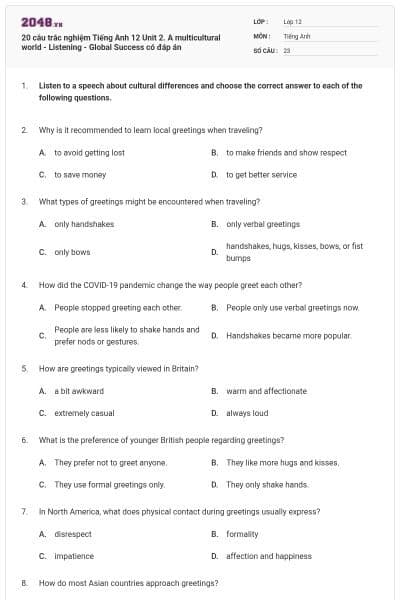
Listen to an interview and complete each sentence with no more than TWO words.
The students at the New Era Secondary School are preparing for a(n) ______.
Đáp án đúng: special event
Thông tin: We're at the new era secondary school in Hanoi and the students are preparing for a special event. (Chúng tôi đang ở trường trung học cơ sở New Era tại Hà Nội và các học sinh đang chuẩn bị cho một sự kiện đặc biệt.)
Đáp án đúng: popular
Thông tin: Actually, it's an annual event at my school and it's very popular among my classmates. (Thực ra, đây là sự kiện thường niên ở trường tôi và rất được các bạn cùng lớp yêu thích.)
Halloween has its roots in a(n) ______ Celtic festival celebrated in Ireland.
Đáp án đúng: ancient
Thông tin: Halloween is believed to originate from an ancient festival in Ireland. (Người ta tin rằng Halloween có nguồn gốc từ một lễ hội cổ xưa ở Ireland.)
Nowadays, Halloween is quite popular in ______.
Đáp án đúng: Vietnam
Thông tin:
- Really? I didn't know you celebrated Halloween in Vietnam. (Thật sao? Tớ không biết cậu tổ chức Halloween ở Việt Nam đấy.)
- Actually, it's an annual event at my school and it's very popular among my classmates. (Thực ra, đó là một sự kiện thường niên ở trường tớ và rất được các bạn cùng lớp yêu thích.)
In Viet Nam, ______ are still of great importance.
Đáp án đúng: traditional festivals
Thông tin:
- Why should we celebrate it here when other countries don't celebrate tet or other Vietnamese festivals? (Tại sao chúng ta phải ăn mừng ở đây khi các nước khác không tổ chức Tết hay các lễ hội khác của Việt Nam?)
- You have a point. (Bạn nói đúng.)
Nội dung bài nghe:
- Hello. We're at the new era secondary school in Hanoi and the students are preparing for a special event. I'm going to talk to some of them. Hi, Minh. What are you doing?
- I'm helping my classmates create a Halloween haunted house.
- Really? I didn't know you celebrated Halloween in Vietnam.
- Actually, it's an annual event at my school and it's very popular among my classmates.
- Do you like taking part in Halloween parties?
- Yes, it's great fun. But I'm more interested in its origin. Halloween is believed to originate from an ancient festival in Ireland. It marked the beginning of the Celtic new year. Actually, it's an annual event at my school and it's very popular among my classmates.
- Wow, you know so much about Halloween.
- Thank you.
- Now let’s interview another student. Hi Mai. Are you going to any Halloween parties today?
- Not really. Wearing scary costumes is very childish. I also find the Halloween custom of trick or treating a bit childish. So what do you think about celebrating Halloween in Vietnam?
- It's a waste of time. Why should we celebrate it here when other countries don't celebrate tet or other Vietnamese festivals?
- You have a point.
Hướng dẫn dịch:
- Xin chào. Chúng tôi đang ở trường trung học cơ sở thế hệ mới ở Hà Nội và các em học sinh đang chuẩn bị cho một sự kiện đặc biệt. Tôi sẽ nói chuyện với một số người trong số họ. Chào Minh. Bạn đang làm gì thế?
- Tôi đang giúp các bạn cùng lớp tạo ra một ngôi nhà ma Halloween.
- Thật sự? Tôi không biết bạn tổ chức lễ Halloween ở Việt Nam.
- Thực ra, đây là một sự kiện thường niên ở trường tôi và nó rất được các bạn cùng lớp biết đến.
- Bạn có thích tham gia các bữa tiệc Halloween không?
- Ừ, vui lắm. Nhưng tôi quan tâm nhiều hơn đến nguồn gốc của nó. Halloween được cho là có nguồn gốc từ một lễ hội cổ xưa ở Ireland. Nó đánh dấu sự khởi đầu của năm mới của người Celtic. Thực ra, đây là một sự kiện thường niên ở trường tôi và nó rất được các bạn cùng lớp biết đến.
- Wow, bạn biết nhiều về Halloween quá.
- Cảm ơn.
- Bây giờ chúng ta hãy phỏng vấn một sinh viên khác. Chào Mai. Hôm nay bạn có đi dự tiệc Halloween không?
- Không hẳn. Mặc trang phục đáng sợ là rất trẻ con. Tôi cũng thấy phong tục chơi trò lừa hoặc đối xử trong Halloween hơi trẻ con. Vậy bạn nghĩ sao về việc tổ chức lễ Halloween ở Việt Nam?
- Thật là phí thời gian. Tại sao chúng ta lại ăn mừng ở đây trong khi các nước khác không tổ chức Tết hay các lễ hội khác của người Việt?
- Bạn có lý.
Mark the letter А, B, C, or D on your answer sheet to indicate theword that differs from the other three in the position of primary stress in each of the following questions.
barrier
bravery
feminine
reflection
Đáp án đúng: D
Đáp án D trọng âm số 2. Các đáp án còn lại trọng âm số 1
Mark the letter А, B, C, or D on your answer sheet to indicate theword that differs from the other three in the position of primary stress in each of the following questions.
invade
reflect
worship
confine
Đáp án đúng: C
Đáp án C trọng âm số 1. Các đáp án còn lại trọng âm số 2
Mark the letter А, B, C, or D on your answer sheet to indicate theword that differs from the other three in the position of primary stress in each of the following questions.
admiration
captivation
celebration
identity
Đáp án đúng: D
Đáp án D trọng âm số 2. Các đáp án còn lại trọng âm số 3
Mark the letter А, B, C, or D on your answer sheet to indicate theword that differs from the other three in the position of primary stress in each of the following questions.
generation
tradition
reception
reflection
Đáp án đúng: A
Đáp án A trọng âm số 3. Các đáp án còn lại trọng âm số 2
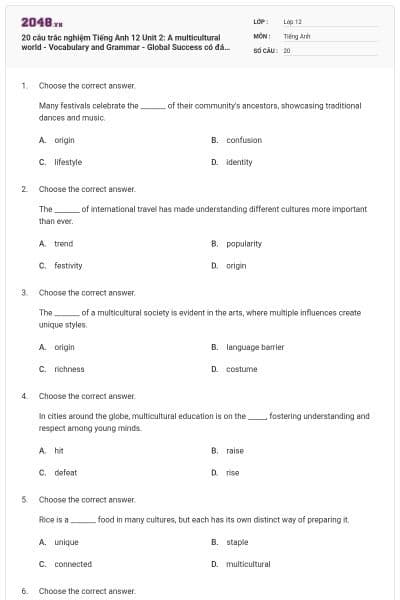
Mark the letter А, B, C, or D on your answer sheet to indicate the correct answer to each of the following questions.
Many festivals celebrate the _______ of their community's ancestors, showcasing traditional dances and music.
origin
confusion
lifestyle
identity
Đáp án đúng: A
Giải thích: “origin” = nguồn gốc, phù hợp với “ancestors” (tổ tiên).
Dịch nghĩa: Nhiều lễ hội tôn vinh nguồn gốc tổ tiên của cộng đồng, thể hiện qua các điệu múa và âm nhạc truyền thống.
trend
popularity
festivity
origin
Đáp án đúng: B
Giải thích: “popularity” = sự phổ biến → “sự phổ biến của du lịch quốc tế”.
Dịch nghĩa: Sự phổ biến của du lịch quốc tế đã khiến việc hiểu các nền văn hóa khác nhau trở nên quan trọng hơn bao giờ hết.
origin
language barrier
richness
costume
Đáp án đúng: C
Giải thích: “richness” = sự phong phú, đa dạng → phù hợp với “multicultural society”.
Dịch nghĩa: Sự phong phú của một xã hội đa văn hóa thể hiện rõ trong nghệ thuật, nơi nhiều ảnh hưởng tạo nên những phong cách độc đáo.
the
a
an
0
Đáp án đúng: A
Giải thích: Danh từ “dead” đã xác định nên dùng mạo từ “the”.
Dịch nghĩa: Thi thể của những người thiệt mạng trong vụ tai nạn thảm khốc ngày hôm qua đã được đưa đi.
The
A
An
0
Đáp án đúng: A
Giải thích: Tên quốc gia “The Socialist Republic of Vietnam” luôn đi với mạo từ xác định “The”.
Dịch nghĩa: Nước Cộng hòa Xã hội Chủ nghĩa Việt Nam là một đất nước có tinh thần yêu nước vĩ đại xuyên suốt lịch sử.
Read the following advertisement/ announcement and mark the letter A, B, C or D on your answer sheet to indicate the correct option that best fits each of the numbered blanks from 15 to 20.
EXPERIENCE VIET NAM: A JOURNEY OF CULTURE AND FLAVOR!
1. Activities:
- Watch the Water Puppet Show, a traditional Vietnamese art form.
- Try (15) __________ our Ao Dai (traditional dress) cornerfor a unique photo experience.
- Master the art of Vietnamese calligraphy in engaging hands-on sessions.
2. Landmark Showcase:
- Admire the beauty of Ha Long Bay with our (16) __________ model display.
- Discover the charm of (17) __________ Hoi An Ancient Town through captivating visual presentations.
3. Contact:
For more information, reach us at discovervietnam@gmail.com or visit our booth at Booth 216.
DISCOVER THE UK: WHERE TRADITION MEETS INNOVATION!
1. Activities:
- Enjoy snippets of Shakespearean brilliance with our mini-theater performances.
- Learn the art of British tea-drinking etiquette in our interactive workshop.
- Dive (18) __________ British history and traditions with a live session on royal heritage.
2. Landmark Showcase:
- Marvel at a miniature model of (19) __________ historic Tower of London.
- Explore the mystery of Stonehenge through captivating (20) __________ displays.
- Take a virtual tour of Buckingham Palace, the iconic symbol of British royalty.
3. Contact:
For inquiries, contact us at 51476329 or visit our booth at Booth 85. Join us for an unforgettable journey into the heart of the United Kingdom!
in
on
of
at
Đáp án đúng: D
Giải thích: Cụm cố định “try at + địa điểm” = thử tại (một nơi cụ thể).
Dịch nghĩa: Hãy thử tại góc áo dài truyền thống của chúng tôi để có một trải nghiệm chụp ảnh độc đáo.
detailed
detailing
detailtion
detail
Đáp án đúng: A
Giải thích: cụm tính từ – danh từ đúng ngữ pháp.
Dịch nghĩa: Chiêm ngưỡng vẻ đẹp của Vịnh Hạ Long với mô hình thu nhỏ được làm chi tiết của chúng tôi.
an
a
the
Ø
Đáp án đúng: C
Giải thích: “the Hoi An Ancient Town” — dùng mạo từ xác định the vì đây là địa danh cụ thể, nổi tiếng và duy nhất.
Dịch nghĩa: Khám phá nét quyến rũ của Phố cổ Hội An qua những màn trình chiếu sinh động.
into
of
down
from
Đáp án đúng: A
Giải thích: “dive into” = đắm mình, khám phá sâu vào (một chủ đề).
Dịch nghĩa: Hãy đắm mình vào lịch sử và truyền thống Anh Quốc qua buổi giao lưu trực tiếp về hoàng gia.
a
an
the
Ø
Đáp án đúng: C
Giải thích: “the Tower of London” là tên riêng của công trình lịch sử → luôn đi với the.
Dịch nghĩa: Chiêm ngưỡng mô hình thu nhỏ của Tháp Luân Đôn lịch sử.
information
informationally
informational
inform
Đáp án đúng: C
Giải thích: “informational displays” = những màn trình chiếu cung cấp thông tin (dạng tính từ mô tả).
Dịch nghĩa: Khám phá bí ẩn của Stonehenge qua những màn trình chiếu thông tin hấp dẫn.
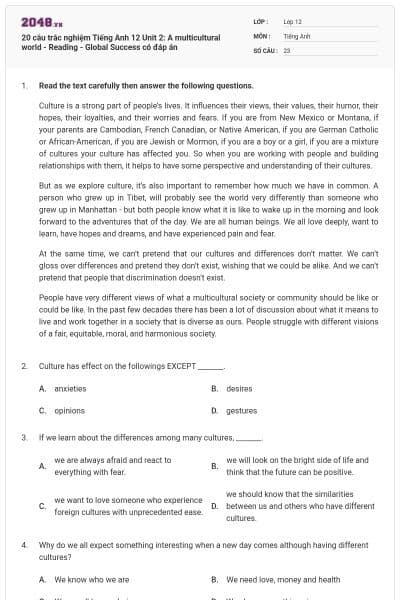
Read the text carefully then answer the following questions from 21 to 27.
Culture is a strong part of people’s lives. It influences their views, their values, their humor, their hopes, their loyalties, and their worries and fears. If you are from New Mexico or Montana, if your parents are Cambodian, French Canadian, or Native American, if you are German Catholic or African-American, if you are Jewish or Mormon, if you are a boy or a girl, if you are a mixture of cultures your culture has affected you. So when you are working with people and building relationships with them, it helps to have some perspective and understanding of their cultures.
But as we explore culture, it’s also important to remember how much we have in common. A person who grew up in Tibet, will probably see the world very differently than someone who grew up in Manhattan - but both people know what it is like to wake up in the morning and look forward to the adventures that of the day. We are all human beings. We all love deeply, want to learn, have hopes and dreams, and have experienced pain and fear.
At the same time, we can’t pretend that our cultures and differences don’t matter. We can’t gloss over differences and pretend they don’t exist, wishing that we could be alike. And we can’t pretend that people that discrimination doesn’t exist.
People have very different views of what a multicultural society or community should be like or could be like. In the past few decades there has been a lot of discussion about what it means to live and work together in a society that is diverse as ours. People struggle with different visions of a fair, equitable, moral, and harmonious society.
anxieties
desires
opinions
gestures
Đáp án đúng: D
Giải thích:
Dựa vào câu: It influences their views, their values, their humor, their hopes, their loyalties, and their worries and fears. (Nó ảnh hưởng đến quan điểm, giá trị, khiếu hài hước, hy vọng, lòng trung thành, cũng như nỗi lo lắng và sợ hãi của họ.)
we are always afraid and react to everything with fear.
we will look on the bright side of life and think that the future can be positive.
we want to love someone who experience foreign cultures with unprecedented ease.
we should know that the similarities between us and others who have different cultures.
Đáp án đúng: D
Giải thích:
Dựa vào câu: But as we explore culture, it’s also important to remember how much we have in common. (Nhưng khi khám phá văn hóa, điều quan trọng là phải nhớ rằng chúng ta có bao nhiêu điểm chung.)
We know who we are
We need love, money and health
We are all human beings
We share many things in common
Đáp án đúng: C
Giải thích:
Dựa vào câu: A person who grew up in Tibet, will probably see the world very differently than someone who grew up in Manhattan - but both people know what it is like to wake up in the morning and look forward to the adventures that of the day. (Một người lớn lên ở Tây Tạng có thể sẽ nhìn thế giới rất khác so với người lớn lên ở Manhattan - nhưng cả hai đều biết cảm giác thức dậy vào buổi sáng và mong chờ những cuộc phiêu lưu trong ngày là như thế nào.)
Culture has become an important part of our daily lives.
When we get acquaintance with someone, we shouldn’t know about their cultures.
Discrimination is still a problem in modern society.
People have very different attitudes towards cultural diversity.
Đáp án đúng: B
Giải thích:
Dựa vào câu: So when you are working with people and building relationships with them, it helps to have some perspective and understanding of their cultures. (Vì vậy, khi làm việc với mọi người và xây dựng mối quan hệ với họ, bạn sẽ cần có góc nhìn và hiểu biết về văn hóa của họ.)
one-sided
even-handed
touch-oriented
impartial
Đáp án đúng: A
Giải thích: “equitable” = công bằng, bình đẳng >< “one-sided” = phiến diện, thiên vị.
Having the same culture and traditions
Waking up in the morning and looking forward to the day
Growing up in the same environment
Sharing the same religion
Đáp án đúng: B
Giải thích:
Dựa vào câu: A person who grew up in Tibet, will probably see the world very differently than someone who grew up in Manhattan - but both people know what it is like to wake up in the morning and look forward to the adventures that of the day. (Một người lớn lên ở Tây Tạng có thể sẽ nhìn thế giới rất khác so với người lớn lên ở Manhattan - nhưng cả hai đều biết cảm giác thức dậy vào buổi sáng và mong chờ những cuộc phiêu lưu trong ngày là như thế nào.)
Everyone agrees on how they should look.
They often create problems that cannot be solved.
People have different ideas of what they should be like.
They are always harmonious and fair.
Đáp án đúng: C
Giải thích:
Dựa vào câu: People have very different views of what a multicultural society or community should be like or could be like. (Mọi người có quan điểm rất khác nhau về việc một xã hội hay cộng đồng đa văn hóa nên như thế nào hoặc có thể như thế nào.)
Dịch bài đọc:
Văn hóa là một phần quan trọng trong cuộc sống của con người. Nó ảnh hưởng đến quan điểm, giá trị, sự hài hước, hy vọng, lòng trung thành, cũng như những lo lắng và sợ hãi của họ. Cho dù bạn đến từ New Mexico hay Montana, nếu cha mẹ bạn là người Campuchia, người Canada gốc Pháp, hay người Mỹ bản địa, nếu bạn là người Đức theo Công giáo hay người Mỹ gốc Phi, nếu bạn là người Do Thái hay người Mặc Môn, nếu bạn là con trai hay con gái, nếu bạn là người pha trộn nhiều nền văn hóa, văn hóa của bạn đã ảnh hưởng đến bạn. Vì vậy, khi bạn làm việc với mọi người và xây dựng mối quan hệ với họ, việc có một số quan điểm và hiểu biết về văn hóa của họ sẽ rất hữu ích.
Nhưng khi chúng ta khám phá văn hóa, điều quan trọng là phải nhớ rằng chúng ta có bao nhiêu điểm chung. Một người lớn lên ở Tây Tạng có thể sẽ nhìn thế giới rất khác so với một người lớn lên ở Manhattan - nhưng cả hai người đều biết cảm giác thức dậy vào buổi sáng và mong chờ những cuộc phiêu lưu trong ngày là như thế nào. Tất cả chúng ta đều là con người. Tất cả chúng ta đều yêu thương sâu sắc, muốn học hỏi, có hy vọng và ước mơ, và đã trải qua nỗi đau và nỗi sợ hãi.
Đồng thời, chúng ta không thể giả vờ rằng văn hóa và sự khác biệt của chúng ta không quan trọng. Chúng ta không thể che giấu sự khác biệt và giả vờ như chúng không tồn tại, ước ao rằng chúng ta có thể giống nhau. Và chúng ta cũng không thể giả vờ rằng sự phân biệt đối xử không tồn tại.
Mọi người có quan điểm rất khác nhau về việc một xã hội hay cộng đồng đa văn hóa nên như thế nào, hoặc có thể như thế nào. Trong vài thập kỷ qua, đã có rất nhiều cuộc thảo luận về ý nghĩa của việc sống và làm việc cùng nhau trong một xã hội đa dạng như xã hội của chúng ta. Mọi người đấu tranh với những quan điểm khác nhau về một xã hội công bằng, bình đẳng, đạo đức và hài hòa.
Read the text carefully then answer the following questions from 28 to 33.
The tradition of gift giving is a worldwide practice that is said to have been around since the beginning of human beings. Over time different cultures have developed their own gift giving customs and traditions. In France the gift of wine for the hostess of a dinner party is not an appropriate gift as the hostess would prefer to choose the vintage for the night. In Sweden, a bottle of wine or flowers are an appropriate gift for the hostess. In Vietnam, a gift of whisky is appropriate for the host, and some fruit or small gifts for the hostess, children or elders of the home. Besides, gifts should never be wrapped in black paper because this color is unlucky and associated with funerals in this country. Gifts that symbolize cutting such as scissors, knives and other sharp objects should be avoided because they mean the cutting of the relationship. Also, in some countries you should not open the gift in front of the giver and in others it would be an insult if you did not open the gift. Beyond the gift itself, give careful consideration to the manner in which it is presented. Different culture have different customs regarding how a gift should be offered – using only your right hand or using both hand, for example. Others have strong traditions related to the appropriate way to accept a gift. In Singapore, for instance, it is the standard to graciously refuse a gift several times before finally accepting it. The recipient would never unwrap a gift in front of the giver for fear of appearing greedy. Understanding these traditions and customs, as well as taking time to choose an appropriate gift, will help you to avoid any awkwardness or embarrassment as you seek to build a better cross – cultural relationship.
A long time ago
Thousands of years ago
Since the beginning of humans
Since the beginning of industrialization
Đáp án đúng: C
Giải thích:
Dựa vào câu: The tradition of gift giving is a worldwide practice that is said to have been around since the beginning of human beings. (Truyền thống tặng quà là một tập tục trên toàn thế giới được cho là đã có từ khi con người xuất hiện.)
Which of the following is NOT true about gift-giving customs?
In France, wine is not considered a suitable gift for the hostess of a dinner party.
In Sweden, it is not customary to bring some wine or flowers when you are invited to a dinner party.
In Vietnam, such things as scissors, knives and other sharp objects shouldn’t be used as a gift.
In Singapore, it is unacceptable to open the gift right in front of the giver.
Đáp án đúng: B
Giải thích:
Dựa vào câu: In Sweden, a bottle of wine or flowers are an appropriate gift for the hostess. (Ở Thụy Điển, một chai rượu vang hoặc hoa là món quà phù hợp dành cho nữ chủ nhà.)
connected with
familiar with
informed of
similar to
Đáp án đúng: A
Giải thích: “associated with” = “connected with” (có liên quan đến).
consideration
manner
gift
culture
Đáp án đúng: C
Giải thích:
Dựa vào câu: Beyond the gift itself, give careful consideration to the manner in which it is presented. (Ngoài bản thân món quà, hãy cân nhắc kỹ lưỡng đến cách tặng quà.)
Which of the following is the main idea of the passage?
The people who are presented with gifts
The traditions of giving and receiving gifts
The occasions of giving and receiving gifts
The manners of giving and receiving gifts
Đáp án đúng: B
Giải thích: Toàn bài bàn về các phong tục, tập quán tặng quà ở nhiều nền văn hóa khác nhau.
Because it is considered lucky
Because it is associated with funerals
Because it is too expensive
Because it is considered a wedding color
Đáp án đúng: B
Giải thích:
Dựa vào câu: Besides, gifts should never be wrapped in black paper because this color is unlucky and associated with funerals in this country. (Ngoài ra, quà tặng không bao giờ nên được gói bằng giấy đen vì màu này không may mắn và gắn liền với đám tang ở đất nước này.)
Dịch bài đọc:
Truyền thống tặng quà là một tập tục trên toàn thế giới được cho là đã có từ thời kỳ đầu của loài người. Theo thời gian, các nền văn hóa khác nhau đã phát triển các phong tục và truyền thống tặng quà riêng. Ở Pháp, tặng rượu vang cho nữ chủ tiệc tối không phải là một món quà phù hợp vì nữ chủ tiệc thường thích chọn loại rượu vang cổ điển cho buổi tối đó. Ở Thụy Điển, một chai rượu vang hoặc hoa là một món quà phù hợp cho nữ chủ tiệc. Ở Việt Nam, tặng rượu whisky là phù hợp cho chủ tiệc, và một ít trái cây hoặc quà nhỏ cho nữ chủ tiệc, trẻ em hoặc người lớn tuổi trong nhà. Bên cạnh đó, quà tặng không bao giờ nên được gói bằng giấy đen vì màu này được coi là không may mắn và gắn liền với đám tang ở quốc gia này. Những món quà tượng trưng cho sự cắt đứt như kéo, dao và các vật sắc nhọn khác nên tránh vì chúng mang ý nghĩa cắt đứt mối quan hệ. Ngoài ra, ở một số quốc gia, bạn không nên mở quà trước mặt người tặng, và ở những quốc gia khác, việc không mở quà sẽ bị coi là một sự xúc phạm. Ngoài bản thân món quà, hãy cân nhắc kỹ lưỡng cách tặng quà. Mỗi nền văn hóa có phong tục tặng quà khác nhau – ví dụ như chỉ dùng tay phải hoặc cả hai tay. Một số nền văn hóa khác lại có truyền thống sâu sắc về cách nhận quà sao cho phù hợp. Ví dụ, ở Singapore, tiêu chuẩn là phải từ chối quà một cách lịch sự nhiều lần trước khi nhận. Người nhận sẽ không bao giờ mở quà trước mặt người tặng vì sợ bị coi là tham lam. Hiểu rõ những truyền thống và phong tục này, cũng như dành thời gian để chọn một món quà phù hợp, sẽ giúp bạn tránh khỏi những bối rối hay ngượng ngùng khi xây dựng mối quan hệ giao thoa văn hóa tốt đẹp hơn.
Mark the letter A, B, C or D on your answer sheet to indicate the correct arrangement of the sentences to make a meaningful paragraph/ letter in each of the following questions.
a. Firstly, it’s considered impolite to point your feet at someone, especially an older person, as the feet are considered the lowest part of the body.
b. In conclusion, these cultural taboos reflect the importance placed on harmony, respect, and maintaining social order in Vietnamese society.
c. Additionally, raising your voice or showing anger in public is seen as breaking social harmony.
d. In Viet Nam, respecting elders is a cultural norm that holds great significance.
e. Lastly, discussing personal matters or asking someone’s age, salary, or marital status upon first meeting is often seen as intrusive.
d-a-c-e-b
c-b-e-d-a
b-d-a-c-e
a-d-e-c-d
Đáp án đúng: A
Giải thích:
d mở đầu giới thiệu chủ đề về tôn trọng người lớn – một chuẩn mực văn hóa Việt Nam.
a nêu ví dụ đầu tiên về hành vi bị coi là bất lịch sự.
c bổ sung một điều cấm kỵ khác liên quan đến cư xử nơi công cộng.
e nêu thêm một ví dụ cuối cùng về việc hỏi chuyện riêng tư.
b kết luận về ý nghĩa của các điều cấm kỵ này trong văn hóa Việt.
Dịch nghĩa:
a. Thứ nhất, việc chĩa chân vào người khác, đặc biệt là người lớn tuổi, bị coi là bất lịch sự vì bàn chân được coi là bộ phận thấp nhất của cơ thể.
b. Tóm lại, những điều cấm kỵ trong văn hóa này phản ánh tầm quan trọng của sự hòa hợp, tôn trọng và duy trì trật tự xã hội trong xã hội Việt Nam.
c. Ngoài ra, việc lớn tiếng hoặc thể hiện sự tức giận ở nơi công cộng bị coi là phá vỡ sự hòa hợp xã hội.
d. Ở Việt Nam, tôn trọng người lớn tuổi là một chuẩn mực văn hóa có ý nghĩa rất lớn.
e. Cuối cùng, việc thảo luận về các vấn đề cá nhân hoặc hỏi tuổi, mức lương hoặc tình trạng hôn nhân của ai đó ngay lần gặp đầu tiên thường bị coi là xâm phạm.
a. I hope you have a fantastic time exploring Vietnamese cuisine!
b. Secondly, using both hands to receive or give something is a sign of respect.
c. First and foremost, it’s common to wait for the host to start the meal before you begin eating.
d. Best regards,
e. Dear Michael, I hope you’re doing well! I am writing to share some dining etiquette tips for your upcoming visit to Viet Nam.
f. Lastly, don’t be surprised if people insist you take more servings - it’s a way of expressing hospitality.
f-c-d-a-b-e
d-a-e-b-c-f
e-c-b-f-a-d
c-e-a-b-f-d
Đáp án đúng: C
Giải thích:
e mở đầu: lời chào và mục đích của bức thư (chia sẻ quy tắc ăn uống).
c quy tắc thứ nhất: chờ chủ nhà bắt đầu bữa ăn.
b quy tắc thứ hai: dùng hai tay khi nhận hoặc đưa đồ.
f quy tắc cuối cùng: chủ nhà thường mời ăn thêm.
a lời chúc kết thư.
d lời chào kết thúc thư.
Dịch nghĩa:
a. Chúc bạn có một khoảng thời gian tuyệt vời khám phá ẩm thực Việt Nam!
b. Thứ hai, việc dùng cả hai tay để nhận hoặc đưa đồ ăn là một biểu hiện của sự tôn trọng.
c. Trước hết, thông thường bạn sẽ đợi chủ nhà bắt đầu bữa ăn trước khi bắt đầu ăn.
d. Trân trọng,
e. Michael thân mến, Chúc bạn luôn khỏe! Tôi viết thư này để chia sẻ một số mẹo về phép lịch sự trong ăn uống cho chuyến thăm Việt Nam sắp tới của bạn.
f. Cuối cùng, đừng ngạc nhiên nếu mọi người yêu cầu bạn lấy thêm đồ ăn - đó là một cách thể hiện lòng hiếu khách.
Read the following passage and mark the letter A, B, C or D on your answer sheet to indicate the correct option that best fits each of the numbered blanks from 36 to 40.
Dining together with family is an important tradition in many cultures, and for good reason. However, shifting social realities might be painting a newer picture for the future of restaurants. (36) _________ an increasing number of individuals choose to live alone, this means that the restaurant business will need to continue to evolve and adapt to allow customers to savour their dining experience, (37) _________ translates to more single-serving meals, better food delivery options, or more specialised restaurants and cafes. One thing is certain: the future of diners in Japan (38) _________ by the rise of single households.
One of the most (39) _________ changes in the dining industry has been the rise of single-serving meals. This has led to a rise (40) _________ “lonely meals” or meals that are eaten alone at home or in public spaces like parks and cafes.
As
Despite
Although
So
Đáp án đúng: A
Giải thích: “As” diễn tả nguyên nhân
Dịch nghĩa: Khi mà ngày càng có nhiều người chọn sống một mình, điều đó có nghĩa là ngành kinh doanh nhà hàng sẽ phải tiếp tục phát triển và thích ứng.
when
which
that
where
Đáp án đúng: B
Giải thích: Đại từ quan hệ “which” thay thế cho mệnh đề trước (“to allow customers to savour their dining experience”)
Dịch nghĩa: ... để khách hàng có thể tận hưởng bữa ăn của mình, điều này đồng nghĩa với việc có thêm nhiều suất ăn đơn, dịch vụ giao đồ ăn tốt hơn hoặc các nhà hàng, quán cà phê chuyên biệt hơn.
One thing is certain: the future of diners in Japan (38) _________ by the rise of single households.
is shaped
shapes
will be shaped
will shape
Đáp án đúng: C
Thì tương lai bị động – “will be shaped” = sẽ bị định hình bởi... → phù hợp với ý nói “tương lai của thực khách sẽ bị ảnh hưởng bởi xu hướng sống một mình”.
Dịch nghĩa: Một điều chắc chắn là: tương lai của các thực khách ở Nhật Bản sẽ được định hình bởi sự gia tăng của các hộ độc thân.
big
noticeable
global
raw
Đáp án đúng: B
Giải thích: “noticeable” = dễ nhận thấy, rõ rệt.
Dịch nghĩa: Một trong những thay đổi rõ rệt nhất trong ngành ẩm thực là sự gia tăng của các suất ăn dành cho một người.
This has led to a rise (40) _________ “lonely meals” or meals that are eaten alone at home or in public spaces like parks and cafes.
of
on
to
in
Đáp án đúng: A
Giải thích: “a rise of + noun” = sự gia tăng của...
Dịch nghĩa: Điều này đã dẫn đến sự gia tăng của những “bữa ăn cô đơn”, tức là những bữa ăn được ăn một mình ở nhà hoặc tại những nơi công cộng như công viên và quán cà phê.
Dịch bài đọc:
Việc cùng ăn tối với gia đình là một truyền thống quan trọng trong nhiều nền văn hóa – và điều đó hoàn toàn có lý.
Tuy nhiên, những thay đổi trong đời sống xã hội hiện đại có thể đang vẽ nên một bức tranh mới cho tương lai của các nhà hàng.
Khi mà ngày càng nhiều người lựa chọn sống một mình, điều đó đồng nghĩa với việc ngành kinh doanh nhà hàng sẽ cần tiếp tục phát triển và thích nghi để giúp khách hàng tận hưởng trải nghiệm ẩm thực của họ – điều này có nghĩa là sẽ có nhiều suất ăn dành cho một người hơn, nhiều lựa chọn giao đồ ăn thuận tiện hơn, hoặc nhiều nhà hàng và quán cà phê chuyên biệt hơn.
Một điều chắc chắn là tương lai của các thực khách tại Nhật Bản sẽ được định hình bởi sự gia tăng của các hộ gia đình độc thân.
Một trong những thay đổi dễ nhận thấy nhất trong ngành ẩm thực là sự phổ biến của các bữa ăn dành cho một người.
Điều này đã dẫn đến sự gia tăng của các “bữa ăn cô đơn” – tức là những bữa ăn được ăn một mình tại nhà hoặc ở những nơi công cộng như công viên và quán cà phê.