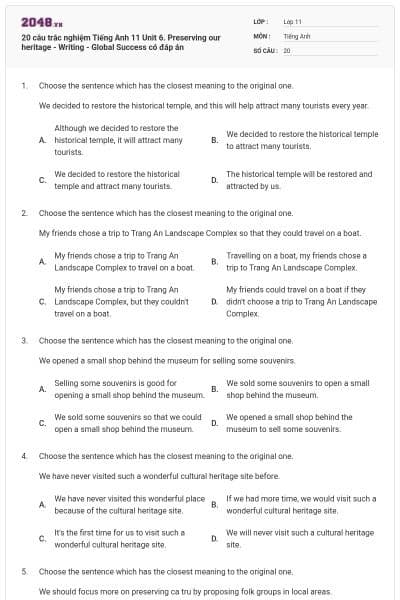
Trắc nghiệm Tiếng Anh 11 Global Success Unit 6 Writing (có đáp án)
20 câu hỏi
Although we decided to restore the historical temple, it will attract many tourists.
We decided to restore the historical temple to attract many tourists.
We decided to restore the historical temple and attract many tourists.
The historical temple will be restored and attracted by us.
Đáp án đúng: B
Giải thích: Câu gốc mang nghĩa “việc trùng tu ngôi đền sẽ giúp thu hút khách du lịch”, diễn đạt mục đích → dùng “to + V” (để làm gì).
Dịch nghĩa: Chúng tôi quyết định trùng tu ngôi đền cổ để thu hút nhiều khách du lịch hơn mỗi năm.
My friends chose a trip to Trang An Landscape Complex to travel on a boat.
Travelling on a boat, my friends chose a trip to Trang An Landscape Complex.
My friends chose a trip to Trang An Landscape Complex, but they couldn't travel on a boat.
My friends could travel on a boat if they didn't choose a trip to Trang An Landscape Complex.
Đáp án đúng: A
Giải thích: “so that they could” diễn tả mục đích → có thể rút gọn bằng “to + V”.
Dịch nghĩa: Bạn tôi chọn chuyến đi đến quần thể danh thắng Tràng An để được đi thuyền.
Selling some souvenirs is good for opening a small shop behind the museum.
We sold some souvenirs to open a small shop behind the museum.
We sold some souvenirs so that we could open a small shop behind the museum.
We opened a small shop behind the museum to sell some souvenirs.
Đáp án đúng: D
Giải thích: “for + V-ing” chỉ mục đích có thể thay bằng “to + V”.
Dịch nghĩa: Chúng tôi mở một cửa hàng nhỏ phía sau bảo tàng để bán một số đồ lưu niệm.
We have never visited this wonderful place because of the cultural heritage site.
If we had more time, we would visit such a wonderful cultural heritage site.
It's the first time for us to visit such a wonderful cultural heritage site.
We will never visit such a cultural heritage site.
Đáp án đúng: C
Giải thích: Cấu trúc “have/has never + P.P before” ≈ “It’s the first time + S + have/has + P.P”.
Dịch nghĩa: Đây là lần đầu tiên chúng tôi đến thăm một di sản văn hóa tuyệt vời như vậy.
We should focus more on folk groups and ca tru.
We should propose folk groups in local areas to preserve ca tru.
Proposing folk groups in local areas should be focused by ca tru.
We should preserve folk groups in local areas to propose ca tru.
Đáp án đúng: B
Giải thích: Cụm “by doing something” tương đương “to do something” khi diễn tả mục đích.
Dịch nghĩa: Chúng ta nên tập trung nhiều hơn vào việc bảo tồn ca trù bằng cách đề xuất các nhóm dân ca ở địa phương.
The local authority can help a photo competition on cultural heritage more quickly.
The local authority can spread the information about a photo competition more quickly by cultural heritage.
The local authority can organize a photo competition to spread the information on cultural heritage more quickly.
The local authority will organize a photo competition if they help spread the information on cultural heritage more quickly.
Đáp án đúng: C
Giải thích: Mệnh đề quan hệ “which will help them…” → có thể rút gọn thành “to help them…” diễn tả mục đích.
Dịch nghĩa: Chính quyền địa phương có thể tổ chức một cuộc thi ảnh để truyền bá thông tin về di sản văn hóa nhanh hơn.
Designing a website is one of the most effective ways to promote a cultural heritage site.
Designing a website is the only way to promote a cultural heritage site effectively.
Designing a website is for a cultural heritage site to become effective.
By designing a website, promoting a cultural heritage site becomes the most effective way.
Đáp án đúng: A
Giải thích: Câu gốc nói “thiết kế website giúp quảng bá và là cách hiệu quả nhất” → tương đương “Designing a website is one of the most effective ways to promote...”.
Dịch nghĩa: Thiết kế một trang web là một trong những cách hiệu quả nhất để quảng bá di sản văn hóa.
Jack went to Ha Noi to want to see Ho Chi Minh’s Mausoleum and Hoan Kiem Lake.
Jack went to Ha Noi, wanted to see Ho Chi Minh's Mausoleum and Hoan Kiem Lake.
Jack went to Ha Noi to see Ho Chi Minh's Mausoleum and Hoan Kiem Lake.
Jack went to Ha Noi and see Ho Chi Minh’s Mausoleum and Hoan Kiem Lake.
Đáp án đúng: C
Giải thích: Hai câu được nối bằng cách diễn đạt mục đích → dùng “to + V” (để làm gì).
Dịch nghĩa: Jack đến Hà Nội để tham quan Lăng Chủ tịch Hồ Chí Minh và Hồ Hoàn Kiếm.
He is the only person to answer all questions about President Ho Chi Minh.
He is the only person answered all questions about President Ho Chi Minh.
He was the only person to answer all questions about President Ho Chi Minh.
He is the only person answering all questions about President Ho Chi Minh.
Đáp án đúng: A
Giải thích: “No one can do that” nhấn mạnh tính duy nhất → dùng cấu trúc “the only person to + V”.
Dịch nghĩa: Anh ấy là người duy nhất có thể trả lời tất cả các câu hỏi về Chủ tịch Hồ Chí Minh.

Học thông minh hơn mỗi ngày
Xem toàn bộ 20 câu hỏi và nhiều hơn nữa với tài khoản miễn phí
My friend has booked a plane ticket to Hue to see monuments.
My friend has booked a plane ticket to Hue seeing monuments.
My friend has booked a plane ticket to Hue seen monuments there.
My friend has booked a plane ticket to Hue and seen monuments there.
Đáp án đúng: A
Giải thích: Diễn tả mục đích dùng “to + V”.
Dịch nghĩa: Bạn tôi đã đặt vé máy bay đến Huế để tham quan các di tích ở đó.
Learning about Champa culture is an unusual thing to do in My Son Sanctuary.
The most exciting thing to do in My Son Sanctuary is to learn about Champa culture.
Learning about Champa culture is one of the most boring things to do in My Son Sanctuary.
You can show an interest in learning about Champa culture in My Son Sanctuary.
Đáp án đúng: B
Giải thích: “The most interesting thing (that) you can do is to + V” ≈ “The most exciting thing to do is to + V” → cùng nghĩa “điều thú vị nhất để làm là…”.
Dịch nghĩa: Điều thú vị nhất mà bạn có thể làm ở Thánh địa Mỹ Sơn là tìm hiểu về văn hóa Chăm-pa.
Bai Dinh temple is a fascinating place for us to explore in our tour today.
The first issue to be explored in our tour today is Bai Dinh temple.
Bai Dinh temple is the first destination to explore in our tour today.
The first place to exploring in our tour today is Bai Dinh temple.
Đáp án đúng: C
Giải thích: Cấu trúc “the first destination that we will explore” có thể viết lại thành “the first destination to explore”.
Dịch nghĩa: Điểm đến đầu tiên mà chúng tôi sẽ khám phá trong chuyến tham quan hôm nay là chùa Bái Đính.
There are some ways for the local community to preserve Vi-Dam singing.
It is likely that the local community can preserve Vi-Dam singing.
The local community has the ability to preserve Vi-Dam singing in a few ways.
There are several reasons for the local community preserved Vi-Dam singing.
Đáp án đúng: A
Giải thích: “There are several ways that + S + can + V” = “There are several/ some ways for + S + to + V”.
Dịch nghĩa: Có một số cách mà cộng đồng địa phương có thể bảo tồn dân ca Ví Dặm.
Lisa was the last person to join our trip to the Temple of Literature in Ha Noi.
Lisa was the last person to be joined in our trip to the Temple of Literature in Ha Noi.
Lisa joined our trip to the Temple of Literature in Ha Noi to be the last person doing so.
Lisa joined our trip to the Temple of Literature in Ha Noi but she was the last person doing so.
Đáp án đúng: A
Giải thích: “The last person who did so” có thể rút gọn thành “the last person to + V”.
Dịch nghĩa: Lisa là người cuối cùng tham gia chuyến đi của chúng tôi đến Văn Miếu – Quốc Tử Giám ở Hà Nội.
My family had a trip to India last year, moreover, we visited the Taj Mahal which is a beautiful mausoleum of white marble.
My family visited the Taj Mahal, which is a beautiful mausoleum of white marble so that my family had a trip to India last year.
My family visited the Taj Mahal which is a beautiful mausoleum of white marble despite having a trip to India last year.
My family had a trip to India last year to visit the Taj Mahal which is a beautiful mausoleum of white marble.
Đáp án đúng: D
Giải thích: Câu thứ hai thể hiện mục đích nên dùng cấu trúc “to + V” để nối hai câu.
Dịch nghĩa: Gia đình tôi đã có một chuyến đi đến Ấn Độ vào năm ngoái để tham quan Taj Mahal – một lăng mộ tuyệt đẹp làm bằng đá cẩm thạch trắng.
When coming to the site, visitors can enjoy mountain climbing but have no chance to explore the caves and grottos.
As there are too many visitors, the site only offers exploring caves and grottos not mountain climbing.
When coming to the site, in addition to exploring the caves and grottos, visitors can also enjoy mountain climbing.
When coming to the site, visitors can neither enjoy mountain climbing nor explore the caves and grottos.
Đáp án đúng: C
Giải thích: Hai câu gốc đều liệt kê các hoạt động du khách có thể làm → dùng cấu trúc “in addition to …, S can also …” để diễn đạt.
Dịch nghĩa: Khi đến khu di tích, ngoài việc khám phá các hang động và hang nhỏ, du khách còn có thể leo núi.
Having visited the heritage site before, Victor fell in love with the scenery there.
Having fallen in love with the scenery of the heritage site, Victor visited the place many times.
Despite falling in love with the scenery of the heritage site, Victor visited the place again.
Had Victor visited the heritage site before, he would have fallen in love with the scenery there.
Đáp án đúng: A
Giải thích: Dùng “Having + P.P” để diễn tả hành động đã hoàn thành trước một hành động khác trong quá khứ.
Dịch nghĩa: Sau khi đã từng ghé thăm khu di sản, Victor đã phải lòng khung cảnh nơi đó.
It's a long trip to the world heritage site, but we have to start off early and come back in the afternoon.
It's a long trip to the world heritage site because we have to start off early and come back in the afternoon.
It's a long trip to the world heritage site, so we have to start off early and come back in the afternoon.
It's a long trip to the world heritage site if we have to start off early and come back in the afternoon.
Đáp án đúng: C
Giải thích: Hai mệnh đề có quan hệ nguyên nhân – kết quả dùng liên từ “so” để nối.
Dịch nghĩa: Đó là một chuyến đi dài đến khu di sản thế giới, vì vậy chúng tôi phải khởi hành sớm và trở về vào buổi chiều.
He objected to removing relics from the heritage site.
He denied having removed the relics from the heritage site.
He accepted to remove relics from the heritage site.
He advised against removing relics from the heritage site.
Đáp án đúng: B
Giải thích: Khi tường thuật lời phủ định “No, I did not …”, dùng cấu trúc “deny + V-ing / having + P.P” để diễn đạt “phủ nhận đã làm gì”.
Dịch nghĩa: Anh ta phủ nhận rằng mình đã di dời các cổ vật khỏi khu di sản.
Locating in Thanh Hoa Province, the Citadel of the Ho Dynasty was added to UNESCO's World Heritage List in 2011.
Located in Thanh Hoa Province, the Citadel of the Ho Dynasty was added to UNESCO's World Heritage List in 2011.
The Citadel of the Ho Dynasty, that is located in Thanh Hoa Province, was added to UNESCO's World Heritage List in 2011.
The Citadel of the Ho Dynasty, locating in Thanh Hoa Province, was added to UNESCO's World Heritage List in 2011.
Đáp án đúng: B
Giải thích: “which is located in …” → có thể rút gọn thành “Located in …” (dạng phân từ quá khứ vì động từ “locate” mang nghĩa bị động – “được đặt tại”).
Dịch nghĩa: Thành nhà Hồ, nằm ở tỉnh Thanh Hóa, đã được thêm vào Danh sách Di sản Thế giới của UNESCO vào năm 2011.
Bạn có thích hoạt động này không?
Hãy lưu hoặc chia sẻ nội dung này đến mọi người.
Gợi ý cho bạn

Ý tưởng của bạn, bài học của bạn
Tự thiết kế đề thi, bài giảng hoặc flashcard theo cách riêng.