Trắc nghiệm Tiếng Anh 11 Global Success Unit 6 Reading (có đáp án)
20 câu hỏi
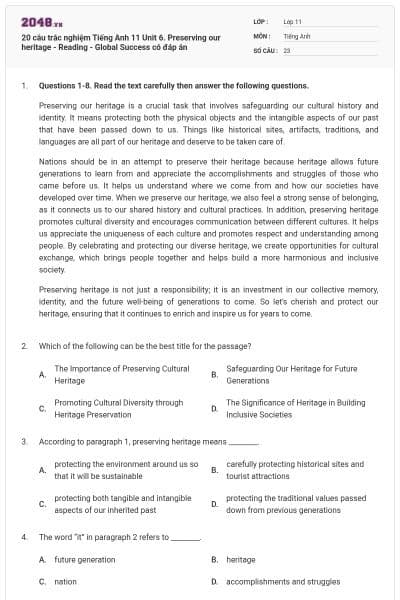
Questions 1-8. Read the text carefully then answer the following questions.
Preserving our heritage is a crucial task that involves safeguarding our cultural history and identity. It means protecting both the physical objects and the intangible aspects of our past that have been passed down to us. Things like historical sites, artifacts, traditions, and languages are all part of our heritage and deserve to be taken care of.
Nations should be in an attempt to preserve their heritage because heritage allows future generations to learn from and appreciate the accomplishments and struggles of those who came before us. It helps us understand where we come from and how our societies have developed over time. When we preserve our heritage, we also feel a strong sense of belonging, as it connects us to our shared history and cultural practices. In addition, preserving heritage promotes cultural diversity and encourages communication between different cultures. It helps us appreciate the uniqueness of each culture and promotes respect and understanding among people. By celebrating and protecting our diverse heritage, we create opportunities for cultural exchange, which brings people together and helps build a more harmonious and inclusive society.
Preserving heritage is not just a responsibility; it is an investment in our collective memory, identity, and the future well-being of generations to come. So let's cherish and protect our heritage, ensuring that it continues to enrich and inspire us for years to come.
Which of the following can be the best title for the passage?
The Importance of Preserving Cultural Heritage
Safeguarding Our Heritage for Future Generations
Promoting Cultural Diversity through Heritage Preservation
The Significance of Heritage in Building Inclusive Societies
Đáp án đúng: A
Giải thích: Đoạn văn nói toàn diện về tầm quan trọng của việc bảo tồn di sản, không chỉ vì tương lai hay sự đa dạng văn hoá mà còn vì bản sắc và ký ức tập thể.
According to paragraph 1, preserving heritage means ________.
protecting the environment around us so that it will be sustainable
carefully protecting historical sites and tourist attractions
protecting both tangible and intangible aspects of our inherited past
protecting the traditional values passed down from previous generations
Đáp án đúng: C
Giải thích:
Dựa vào câu: It means protecting both the physical objects and the intangible aspects of our past that have been passed down to us. (Điều này có nghĩa là bảo vệ cả những vật thể hữu hình lẫn những khía cạnh vô hình trong quá khứ đã được truyền lại cho chúng ta.)
The word “it” in paragraph 2 refers to ________.
future generation
heritage
nation
accomplishments and struggles
Đáp án đúng: B
Giải thích:
Dựa vào câu: When we preserve our heritage, we also feel a strong sense of belonging, as it connects us to our shared history and cultural practices. (Khi chúng ta bảo tồn di sản của mình, chúng ta cũng cảm thấy có ý thức gắn bó mạnh mẽ, vì nó kết nối chúng ta với lịch sử và các tập tục văn hóa chung.)
The word “uniqueness” in paragraph 2 is closest in meaning to ________.
differentiation
similarity
resemblance
distinctiveness
Đáp án đúng: D
Giải thích: “uniqueness” = tính độc đáo, khác biệt → đồng nghĩa với “distinctiveness”.
Which of the following is not true according to the passage?
Preserving heritage helps us understand our roots and societal development.
Heritage preservation fosters a strong sense of belonging.
Protecting physical objects is more important than intangible aspects of heritage.
Preserving heritage promotes cultural diversity and intercultural understanding.
Đáp án đúng: C
Giải thích:
Dựa vào câu: It means protecting both the physical objects and the intangible aspects of our past that have been passed down to us. (Điều này có nghĩa là bảo vệ cả những vật thể hữu hình lẫn những khía cạnh vô hình trong quá khứ đã được truyền lại cho chúng ta.)
What does the author suggest will happen if people preserve their heritage?
They will lose their connection to the past.
They will strengthen their sense of identity and community.
They will forget their cultural traditions.
They will have fewer opportunities for communication.
Đáp án đúng: B
Giải thích:
Dựa vào câu: When we preserve our heritage, we also feel a strong sense of belonging, as it connects us to our shared history and cultural practices. (Khi chúng ta bảo tồn di sản của mình, chúng ta cũng cảm thấy có ý thức gắn bó mạnh mẽ, vì nó kết nối chúng ta với lịch sử và các tập tục văn hóa chung.)
What is the main benefit of preserving cultural diversity, according to the passage?
It increases competition among nations.
It helps people respect and understand each other.
It limits communication between different cultures.
It prevents societies from changing over time.
Đáp án đúng: B
Giải thích:
Dựa vào câu: It helps us appreciate the uniqueness of each culture and promotes respect and understanding among people. (Nó giúp chúng ta đánh giá cao sự độc đáo của mỗi nền văn hóa và thúc đẩy sự tôn trọng và hiểu biết giữa mọi người.)
What can be inferred from the passage about heritage preservation?
It is a long-term investment in human civilization.
It only benefits historians and researchers.
It mainly focuses on maintaining old buildings.
It prevents modernization and development.
Đáp án đúng: A
Giải thích:
Dựa vào câu: Preserving heritage is not just a responsibility; it is an investment in our collective memory, identity, and the future well-being of generations to come. (Bảo tồn di sản không chỉ là trách nhiệm; đó là sự đầu tư vào ký ức tập thể, bản sắc và hạnh phúc tương lai của các thế hệ mai sau.)
Dịch bài đọc:
Bảo tồn di sản là một nhiệm vụ quan trọng, bao gồm việc bảo vệ lịch sử văn hóa và bản sắc dân tộc. Điều này có nghĩa là bảo vệ cả những hiện vật hữu hình lẫn những giá trị vô hình của quá khứ đã được truyền lại cho chúng ta. Những thứ như di tích lịch sử, hiện vật, truyền thống và ngôn ngữ đều là một phần di sản của chúng ta và xứng đáng được chăm sóc.
Các quốc gia nên nỗ lực bảo tồn di sản của mình bởi vì di sản cho phép các thế hệ tương lai học hỏi và trân trọng những thành tựu cũng như nỗ lực của những người đi trước. Nó giúp chúng ta hiểu được nguồn gốc của mình và xã hội của chúng ta đã phát triển như thế nào theo thời gian. Khi chúng ta bảo tồn di sản, chúng ta cũng cảm thấy một cảm giác gắn kết mạnh mẽ, vì nó kết nối chúng ta với lịch sử và các hoạt động văn hóa chung. Ngoài ra, bảo tồn di sản còn thúc đẩy sự đa dạng văn hóa và khuyến khích giao lưu giữa các nền văn hóa khác nhau. Nó giúp chúng ta trân trọng sự độc đáo của mỗi nền văn hóa và thúc đẩy sự tôn trọng và hiểu biết giữa mọi người. Bằng cách tôn vinh và bảo vệ di sản đa dạng của mình, chúng ta tạo ra cơ hội giao lưu văn hóa, gắn kết mọi người lại với nhau và góp phần xây dựng một xã hội hài hòa và hòa nhập hơn.
Bảo tồn di sản không chỉ là một trách nhiệm; đó là một sự đầu tư vào ký ức tập thể, bản sắc và hạnh phúc tương lai của các thế hệ mai sau. Vì vậy, hãy trân trọng và bảo vệ di sản của chúng ta, đảm bảo rằng nó tiếp tục làm giàu và truyền cảm hứng cho chúng ta trong nhiều năm tới.
Questions 9-15. Read the text carefully then answer the following questions.
Due to natural disasters or man-made damages during the war, a great deal of historical sites and artifacts have been damaged. It is difficult to repair these sites, as it may take a lot of time, cost, and there is a lack of the information on how the original work actually looked. Rebuilding cultural heritage sites and artifacts is similar to solving a big jigsaw puzzle without knowing what it should look like - everything starts from the beginning and guesses.
One project has been run by a group of scientists to help with the time-consuming restoration of the heritage sites. The technologies in the project are robotics, 3-D scanning, modern machines and artificial intelligence.
These artifact pieces are scanned by high-tech computers to predict their original architecture. Throughout the process, the computer system is guided by humans to ensure that the pieces are accurately rebuilt. The computer software collects all pieces and connects them together to draw a picture of what the original heritage site looked like.
The second component brings robots into the workplace. The robot should be able to scan those pieces of a heritage site on its own, and connects them together as a complete one. The robot looks like an average person to save a large amount of time and human resources when gathering the information about the heritage sites.
Which best serves as the title for the passage?
Why we restore cultural heritage sites
How technology helps restore heritage sites
How we promote our world heritage sites
Why robots replace human beings
Đáp án đúng: B
Giải thích: Bài viết trình bày về vai trò của công nghệ hiện đại (AI, robotics, 3D scanning...) trong việc khôi phục các di sản bị hư hại.
The word “run” can be best replaced by ________.
moved quickly
chosen
set up
carried
Đáp án đúng: C
Giải thích: “run a project” = “set up or manage a project” (thiết lập hoặc điều hành một dự án).
Which of the following statements about high-tech computers is true?
It is impossible to predict the heritage's original shape.
It works automatically without people's control.
It can show us how heritage sites looked like.
The computer system cannot work properly.
Đáp án đúng: C
Giải thích:
Dựa vào câu: The computer software collects all pieces and connects them together to draw a picture of what the original heritage site looked like. (Phần mềm máy tính thu thập tất cả các mảnh ghép và kết nối chúng lại với nhau để vẽ nên bức tranh về diện mạo ban đầu của di sản.)
The word “one” can be best replaced by ________.
heritage site
robot
workplace
person
Đáp án đúng: A
Giải thích:
Dựa vào câu: The robot should be able to scan those pieces of a heritage site on its own, and connects them together as a complete one. (Robot này có khả năng tự quét các phần của di sản và kết nối chúng lại với nhau thành một di sản hoàn chỉnh.)
Which of the following is NOT mentioned as the use of robots?
Robots do not waste our natural resources.
Robots can help us collect the information about heritage sites.
If we use robots, the time spent on gathering information about heritage sites can be reduced.
Robots can connect all pieces of a world heritage site to make a complete one.
Đáp án đúng: A
Giải thích: Bài viết không đề cập đến “natural resources”.
What is the main difficulty in restoring damaged heritage sites?
There is not enough time and money to rebuild them.
There is little information about their original appearance.
Scientists do not want to participate in the restoration process.
People no longer care about cultural preservation.
Đáp án đúng: B
Giải thích:
Dựa vào câu: It is difficult to repair these sites, as it may take a lot of time, cost, and there is a lack of the information on how the original work actually looked. (Việc sửa chữa những vị trí này rất khó khăn vì có thể tốn nhiều thời gian, chi phí và thiếu thông tin về diện mạo thực sự của tác phẩm gốc.)
What can be inferred about the project mentioned in the passage?
It aims to reduce human involvement in heritage restoration.
It helps make restoration work faster and more efficient.
It replaces traditional methods with manual labor.
It has already completed the restoration of all heritage sites.
Đáp án đúng: B
Giải thích:
Dựa vào câu: One project has been run by a group of scientists to help with the time-consuming restoration of the heritage sites. (Một nhóm các nhà khoa học đã thực hiện một dự án nhằm hỗ trợ quá trình phục hồi di sản tốn nhiều thời gian.)
Dịch bài đọc:
Do thiên tai hoặc thiệt hại do con người gây ra trong chiến tranh, rất nhiều di tích lịch sử và hiện vật đã bị hư hại. Việc phục hồi những di tích này rất khó khăn, vì có thể mất nhiều thời gian, chi phí và thiếu thông tin về diện mạo thực tế của công trình gốc. Việc tái thiết các di sản văn hóa và hiện vật cũng giống như việc giải một trò chơi ghép hình lớn mà không biết nó trông như thế nào - mọi thứ đều bắt đầu từ đầu và phỏng đoán.
Một dự án đã được một nhóm các nhà khoa học thực hiện để hỗ trợ việc trùng tu tốn thời gian các di sản. Các công nghệ trong dự án bao gồm robot, quét 3D, máy móc hiện đại và trí tuệ nhân tạo.
Những mảnh hiện vật này được quét bằng máy tính công nghệ cao để dự đoán kiến trúc ban đầu của chúng. Trong suốt quá trình, hệ thống máy tính được điều khiển bởi con người để đảm bảo các mảnh được phục dựng chính xác. Phần mềm máy tính thu thập tất cả các mảnh và kết nối chúng lại với nhau để vẽ nên hình ảnh về diện mạo ban đầu của di sản.
Thành phần thứ hai đưa robot vào nơi làm việc. Robot sẽ có khả năng tự quét các mảnh của một di sản và kết nối chúng lại với nhau thành một di sản hoàn chỉnh. Robot có hình dáng giống người bình thường giúp tiết kiệm nhiều thời gian và nguồn nhân lực khi thu thập thông tin về các di sản.
Questions 16-20. Read the text and decide whether the following statements are true or false.
What is the importance of preserving cultural heritage?
The cultural heritage and its history show the identity and values of a country, which can be introduced to the world. Therefore, it is important to preserve cultural heritage such as historical sites, buildings, landmarks and even monuments. Another reason for preserving one's heritage and culture is that traditional values and customs should be passed down from one generation to the next. The value of this is very important for not only the minority groups but also the bigger nations.
So, what can we do to help preserve cultural heritage?
It simply starts with raising young people's awareness. A nation is able to preserve their cultural heritage through education. The future generation should be taught and encouraged to learn about the importance of the cultural heritage at school. In the modern world, social media also plays an extremely important role in creating awareness and building an appreciation towards the local culture and traditions.
Besides, we should control local tourism and avoid its negative effects although it also helps us to introduce our cultural heritage. Each tourism destination should identify an acceptable level of travelers. This also helps to prevent overcrowding and creates a better visitor experience.
We should begin to take an active role in conserving our cultural assets for future generations.
uestion 1.
Preserving cultural heritage is important because cultural heritage is a part of the country's identity.
True
False
Đáp án đúng: A
Dựa vào câu: The cultural heritage and its history show the identity and values of a country, which can be introduced to the world. (Di sản văn hóa và lịch sử của nó thể hiện bản sắc và giá trị của một quốc gia, có thể giới thiệu với thế giới.)
Protecting traditional values is necessary for minority groups only.
True
False
Đáp án đúng: B
Dựa vào câu: The value of this is very important for not only the minority groups but also the bigger nations. (Giá trị này rất quan trọng không chỉ đối với các nhóm thiểu số mà còn đối với các quốc gia lớn hơn.)
We can start preserving heritage by educating people of all ages about the importance of the cultural heritage at school.
True
False
Đáp án đúng: B
Dựa vào câu: It simply starts with raising young people's awareness. A nation is able to preserve their cultural heritage through education. The future generation should be taught and encouraged to learn about the importance of the cultural heritage at school. (Mọi việc chỉ đơn giản bắt đầu bằng việc nâng cao nhận thức của giới trẻ. Một quốc gia có thể bảo tồn di sản văn hóa thông qua giáo dục. Thế hệ tương lai cần được giáo dục và khuyến khích tìm hiểu về tầm quan trọng của di sản văn hóa ngay từ trường học.)
Using social media is one good way of improving people's knowledge about cultural heritage.
True
False
Đáp án đúng: A
Dựa vào câu: In the modern world, social media also plays an extremely important role in creating awareness and building an appreciation towards the local culture and traditions. (Trong thế giới hiện đại, mạng xã hội cũng đóng vai trò cực kỳ quan trọng trong việc nâng cao nhận thức và xây dựng lòng trân trọng đối với văn hóa và truyền thống địa phương.)
Tourism only has positive effects on cultural heritage.
True
False
Đáp án đúng: B
Dựa vào câu: We should control local tourism and avoid its negative effects although it also helps us to introduce our cultural heritage. (Chúng ta nên kiểm soát du lịch địa phương và tránh những tác động tiêu cực của nó mặc dù nó cũng giúp chúng ta giới thiệu di sản văn hóa của mình.)
Dịch bài đọc:
Tầm quan trọng của việc bảo tồn di sản văn hóa là gì?
Di sản văn hóa và lịch sử của nó thể hiện bản sắc và giá trị của một quốc gia, có thể được giới thiệu ra thế giới. Do đó, việc bảo tồn di sản văn hóa như các di tích lịch sử, công trình kiến trúc, địa danh và thậm chí cả tượng đài là rất quan trọng. Một lý do khác để bảo tồn di sản và văn hóa là các giá trị và phong tục truyền thống cần được truyền từ thế hệ này sang thế hệ khác. Giá trị của điều này rất quan trọng không chỉ đối với các nhóm thiểu số mà còn đối với các quốc gia lớn hơn.
Vậy, chúng ta có thể làm gì để góp phần bảo tồn di sản văn hóa?
Điều này đơn giản bắt đầu bằng việc nâng cao nhận thức của giới trẻ. Một quốc gia có thể bảo tồn di sản văn hóa của mình thông qua giáo dục. Thế hệ tương lai nên được dạy dỗ và khuyến khích tìm hiểu về tầm quan trọng của di sản văn hóa tại trường học. Trong thế giới hiện đại, mạng xã hội cũng đóng một vai trò cực kỳ quan trọng trong việc nâng cao nhận thức và xây dựng lòng trân trọng đối với văn hóa và truyền thống địa phương.
Bên cạnh đó, chúng ta nên kiểm soát du lịch địa phương và tránh những tác động tiêu cực của nó, mặc dù nó cũng giúp chúng ta giới thiệu di sản văn hóa của mình. Mỗi điểm đến du lịch nên xác định một mức độ du khách chấp nhận được. Điều này cũng giúp ngăn ngừa tình trạng quá tải và tạo ra trải nghiệm tốt hơn cho du khách.
Chúng ta nên bắt đầu đóng vai trò tích cực trong việc bảo tồn di sản văn hóa cho các thế hệ tương lai.