Trắc nghiệm ôn thi Tốt nghiệp THPT Tiếng Anh Dạng bài 4. Đọc hiểu (có đáp án)
54 câu hỏi
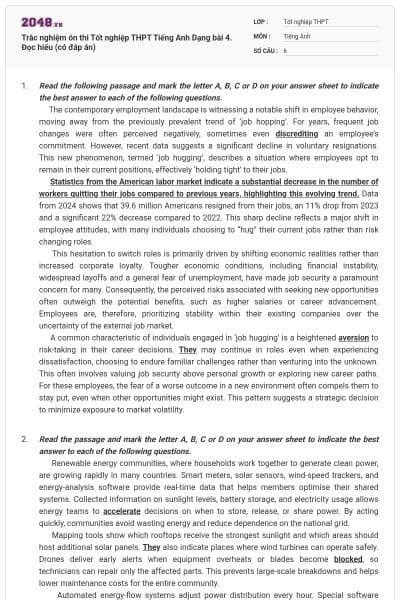
Read the following passage and mark the letter A, B, C or D on your answer sheet to indicate the best answer to each of the following questions.
The contemporary employment landscape is witnessing a notable shift in employee behavior, moving away from the previously prevalent trend of ‘job hopping’. For years, frequent job changes were often perceived negatively, sometimes even discrediting an employee’s commitment. However, recent data suggests a significant decline in voluntary resignations. This new phenomenon, termed ‘job hugging’, describes a situation where employees opt to remain in their current positions, effectively ‘holding tight’ to their jobs.
Statistics from the American labor market indicate a substantial decrease in the number of workers quitting their jobs compared to previous years, highlighting this evolving trend. Data from 2024 shows that 39.6 million Americans resigned from their jobs, an 11% drop from 2023 and a significant 22% decrease compared to 2022. This sharp decline reflects a major shift in employee attitudes, with many individuals choosing to “hug” their current jobs rather than risk changing roles.
This hesitation to switch roles is primarily driven by shifting economic realities rather than increased corporate loyalty. Tougher economic conditions, including financial instability, widespread layoffs and a general fear of unemployment, have made job security a paramount concern for many. Consequently, the perceived risks associated with seeking new opportunities often outweigh the potential benefits, such as higher salaries or career advancement. Employees are, therefore, prioritizing stability within their existing companies over the uncertainty of the external job market.
A common characteristic of individuals engaged in ‘job hugging’ is a heightened aversion to risk-taking in their career decisions. They may continue in roles even when experiencing dissatisfaction, choosing to endure familiar challenges rather than venturing into the unknown. This often involves valuing job security above personal growth or exploring new career paths. For these employees, the fear of a worse outcome in a new environment often compels them to stay put, even when other opportunities might exist. This pattern suggests a strategic decision to minimize exposure to market volatility.
displacing
confirming
degrading
undermining
D
Từ discrediting ở đoạn 1 gần nghĩa nhất với từ nào?
A. displacing (v): thay thế
B. confirming (v): xác nhận
C. degrading (v): làm suy giảm giá trị
D. undermining (v): làm mất uy tín / làm giảm sự tin cậy
→ discrediting (v): làm mất uy tín, làm suy yếu sự tin tưởng = undermining
Thông tin: For years, frequent job changes were often perceived negatively, sometimes even discrediting an employee’s commitment.
(Trong nhiều năm, việc thay đổi công việc thường xuyên thường bị nhìn nhận tiêu cực, đôi khi còn làm giảm uy tín về sự cam kết của người lao động.)
Chọn D.
The American labor market shows that fewer people are leaving their jobs now than before, reflecting a new trend.
The evolving trend in the American labor market is a decrease in job hugging due to new statistics recorded over the previous years.
In the last couple of years, the number of workers quitting jobs has soared, indicating a new trend in the American labor market.
There are more workers deciding to commit to their jobs in the American labor market, changing the employment trend.
A
Câu nào sau đây diễn giải đúng nhất câu được gạch chân ở đoạn 2?
Statistics from the American labor market indicate a substantial decrease in the number of workers quitting their jobs compared to previous years, highlighting this evolving trend.
(Thống kê từ thị trường lao động Mỹ cho thấy số người nghỉ việc giảm đáng kể so với các năm trước, qua đó cho thấy xu hướng mới này.)
A. Thị trường lao động Mỹ cho thấy số người bỏ việc hiện nay ít hơn so với trước đây, phản ánh một xu hướng mới.
B. Xu hướng đang phát triển trên thị trường lao động Mỹ là sự giảm sút tình trạng bám trụ công việc do số liệu thống kê mới được ghi nhận trong những năm qua.
C. Trong vài năm gần đây, số lượng người lao động bỏ việc đã tăng vọt, cho thấy một xu hướng mới trên thị trường lao động Mỹ.
D. Ngày càng có nhiều người lao động quyết định gắn bó với công việc của mình trên thị trường lao động Mỹ, làm thay đổi xu hướng việc làm.
Chọn A.
widespread layoffs
fear of unemployment
career advancement
financial instability
C
Theo đoạn 3, yếu tố nào sau đây KHÔNG được nhắc đến là nguyên nhân dẫn đến “job hugging”?
A. widespread layoffs: sa thải hàng loạt
B. fear of unemployment: nỗi sợ thất nghiệp
C. career advancement: thăng tiến nghề nghiệp
D. financial instability: bất ổn tài chính
Thông tin: Tougher economic conditions, including financial instability, widespread layoffs and a general fear of unemployment, have made job security a paramount concern for many.
(Điều kiện kinh tế khó khăn hơn, bao gồm bất ổn tài chính, sa thải diện rộng và nỗi sợ thất nghiệp, khiến an toàn việc làm trở thành ưu tiên hàng đầu.)
Chọn C.
Which of the following is TRUE according to paragraph 3?
Job security is less important than personal growth for job huggers
Job huggers often leave their jobs if they are dissatisfied.
Job huggers are usually eager to take risks in their careers.
Job huggers may stay in roles despite feeling unhappy.
D
Điều nào sau đây là ĐÚNG theo đoạn văn?
A. An toàn việc làm kém quan trọng hơn phát triển bản thân với job huggers.
Thông tin: This often involves valuing job security above personal growth or exploring new career paths.
(Điều này thường liên quan đến việc coi trọng sự ổn định công việc hơn sự phát triển cá nhân hoặc khám phá con đường sự nghiệp mới.)
→ Đáp án A nói job security kém quan trọng hơn personal growth → không đúng với thông tin trong bài.
B. Job huggers thường nghỉ việc nếu không hài lòng.
Thông tin: They may continue in roles even when experiencing dissatisfaction
(Họ có thể tiếp tục ở lại công việc ngay cả khi cảm thấy không hài lòng.)
→ Đáp án B nói thường rời bỏ công việc khi không hài lòng, trong khi bài nói vẫn tiếp tục ở lại. → Sai
C. Job huggers thường thích mạo hiểm trong sự nghiệp.
Thông tin: A common characteristic of individuals engaged in ‘job hugging’ is a heightened aversion to risk-taking in their career decisions.
(Một đặc điểm phổ biến của những người “job hugging” là sự né tránh cao đối với việc chấp nhận rủi ro trong các quyết định nghề nghiệp.)
→ Ngược lại với đáp án C
D. Job huggers có thể ở lại công việc dù cảm thấy không vui/không hài lòng.
Thông tin: They may continue in roles even when experiencing dissatisfaction, choosing to endure familiar challenges rather than venturing into the unknown.
(Họ có thể tiếp tục ở lại vai trò hiện tại dù đang không hài lòng, chọn chịu những khó khăn quen thuộc thay vì bước vào điều chưa biết.)
Chọn D.
The word aversion in paragraph 4 is OPPOSITE in meaning to _______.
commitment
preference
trend
negligence
B
Từ “aversion” ở đoạn 4 TRÁI NGHĨA với từ nào?
A. commitment (n): sự cam kết
B. preference (n): sự ưa thích
C. trend (n): xu hướng
D. negligence (n): sự cẩu thả/thiếu trách nhiệm
→ aversion (n): ghét/né tránh/không thích >< preference
Thông tin: A common characteristic of individuals engaged in ‘job hugging’ is a heightened aversion to risk-taking in their career decisions.
(Một đặc điểm chung của những người “bám víu vào công việc” là họ rất ngại rủi ro trong các quyết định nghề nghiệp của mình.)
Chọn B.
familiar challenges
individuals
career decisions
career paths
B
Từ “They” ở đoạn 4 dùng để chỉ ______.
A. familiar challenges: những khó khăn quen thuộc
B. individuals: các cá nhân
C. career decisions: quyết định sự nghiệp
D. career paths: con đường sự nghiệp
Thông tin: A common characteristic of individuals engaged in ‘job hugging’ is a heightened aversion to risk-taking in their career decisions. They may continue in roles even when experiencing dissatisfaction, choosing to endure familiar challenges rather than venturing into the unknown. (Một đặc điểm chung của những người “bám víu vào công việc” là họ rất ngại rủi ro trong các quyết định nghề nghiệp. Họ có thể tiếp tục công việc hiện tại ngay cả khi cảm thấy không hài lòng, chọn cách chịu đựng những thử thách quen thuộc thay vì dấn thân vào những điều chưa biết.)
Chọn B.
Paragraph 4
Paragraph 1
Paragraph 3
Paragraph 2
D
Đoạn nào cung cấp số liệu để cho thấy xu hướng “job hugging” đang tăng?
A. Đoạn 4
B. Đoạn 1
C. Đoạn 3
D. Đoạn 2
Thông tin: Data from 2024 shows that 39.6 million Americans resigned from their jobs, an 11% drop from 2023 and a significant 22% decrease compared to 2022. (Đoạn 2)
(Dữ liệu năm 2024 cho thấy 39,6 triệu người Mỹ đã nghỉ việc, giảm 11% so với năm 2023 và giảm đáng kể 22% so với năm 2022.)
Chọn D.
Paragraph 1
Paragraph 2
Paragraph 3
Paragraph 4
A
Dịch:
Đoạn nào nhắc đến định nghĩa của “job hugging”?
A. Đoạn 1
B. Đoạn 2
C. Đoạn 3
D. Đoạn 4
Thông tin: This new phenomenon, termed ‘job hugging’, describes a situation where employees opt to remain in their current positions, effectively ‘holding tight’ to their jobs. (Đoạn 1)
(Hiện tượng mới này, được gọi là “job hugging”, mô tả tình huống trong đó người lao động chọn ở lại vị trí công việc hiện tại, về cơ bản là “bám chặt” vào công việc của mình.)
Chọn A.
Dịch bài đọc:
Bối cảnh việc làm đương đại đang chứng kiến một sự thay đổi đáng chú ý trong hành vi của người lao động, rời xa xu hướng từng rất phổ biến trước đây là “nhảy việc” (job hopping). Trong nhiều năm, việc thay đổi công việc thường xuyên thường bị nhìn nhận tiêu cực, thậm chí đôi khi còn làm giảm uy tín về mức độ gắn bó của một nhân viên. Tuy nhiên, dữ liệu gần đây cho thấy số lượng người tự nguyện nghỉ việc đã giảm đáng kể. Hiện tượng mới này, được gọi là “ôm việc” (job hugging), mô tả tình huống khi người lao động chọn ở lại vị trí hiện tại của mình, tức là “giữ chặt” lấy công việc.
Các số liệu thống kê từ thị trường lao động Mỹ cho thấy số lượng người bỏ việc đã giảm mạnh so với những năm trước, qua đó làm nổi bật xu hướng đang thay đổi này. Dữ liệu năm 2024 cho thấy 39,6 triệu người Mỹ đã nghỉ việc, giảm 11% so với năm 2023 và giảm đáng kể 22% so với năm 2022. Mức sụt giảm rõ rệt này phản ánh một sự thay đổi lớn trong thái độ của người lao động, khi nhiều người chọn “ôm” công việc hiện tại thay vì mạo hiểm chuyển sang vai trò khác.
Sự do dự trong việc đổi việc chủ yếu xuất phát từ những thay đổi trong thực tế kinh tế, chứ không phải vì lòng trung thành với công ty tăng lên. Điều kiện kinh tế khó khăn hơn, bao gồm sự bất ổn tài chính, làn sóng sa thải trên diện rộng và nỗi lo thất nghiệp nói chung, đã khiến sự an toàn công việc trở thành mối quan tâm hàng đầu đối với nhiều người. Vì vậy, những rủi ro được cho là sẽ gặp phải khi tìm kiếm cơ hội mới thường “nặng” hơn những lợi ích tiềm năng như lương cao hơn hoặc thăng tiến nghề nghiệp. Do đó, người lao động đang ưu tiên sự ổn định trong chính công ty hiện tại của mình hơn là sự bấp bênh của thị trường lao động bên ngoài.
Một đặc điểm phổ biến của những người đang “job hugging” là họ có xu hướng né tránh rủi ro cao trong các quyết định nghề nghiệp. Họ có thể tiếp tục làm công việc hiện tại ngay cả khi không hài lòng, chọn chịu đựng những khó khăn quen thuộc thay vì bước vào điều chưa biết. Điều này thường đồng nghĩa với việc họ coi trọng sự an toàn công việc hơn sự phát triển bản thân hoặc việc khám phá những con đường nghề nghiệp mới. Với những người lao động này, nỗi sợ rằng môi trường mới có thể dẫn đến kết quả tệ hơn thường khiến họ quyết định ở yên, ngay cả khi vẫn có những cơ hội khác tồn tại. Mô hình này cho thấy đó là một quyết định mang tính chiến lược nhằm giảm thiểu sự “phơi nhiễm” trước biến động của thị trường.
Read the passage and mark the letter A, B, C or D on your answer sheet to indicate the best answer to each of the following questions.
Renewable energy communities, where households work together to generate clean power, are growing rapidly in many countries. Smart meters, solar sensors, wind-speed trackers, and energy-analysis software provide real-time data that helps members optimise their shared systems. Collected information on sunlight levels, battery storage, and electricity usage allows energy teams to accelerate decisions on when to store, release, or share power. By acting quickly, communities avoid wasting energy and reduce dependence on the national grid.
Mapping tools show which rooftops receive the strongest sunlight and which areas should host additional solar panels. They also indicate places where wind turbines can operate safely. Drones deliver early alerts when equipment overheats or blades become blocked, so technicians can repair only the affected parts. This prevents large-scale breakdowns and helps lower maintenance costs for the entire community.
Automated energy-flow systems adjust power distribution every hour. Special software tracks household energy needs and forecasts weather patterns for the coming days. When energy demand increases or storms approach, the system changes the power route instantly. This saves electricity and keeps renewable-energy projects viable, especially in regions where weather conditions are unpredictable.
Digital platforms link households, engineers, and energy suppliers so they can update battery levels, output measurements, and transfer times immediately. Blockchain tools secure every entry, encouraging members to trust the recorded information. Over time, analytic programs compare seasonal data to predict energy shortages, plan resource allocation, and reveal weak points in the power network.
electricity usage
battery storage
sunlight levels
wind directions
D
Which of the following is NOT mentioned in paragraph 1 as a type of collected real-time data?
(Câu nào sau đây KHÔNG được nhắc đến ở đoạn 1 như một loại dữ liệu thời gian thực được thu thập?)
A. electricity usage: mức sử dụng điện
B. battery storage: lưu trữ pin
C. sunlight levels: mức độ ánh nắng
D. wind directions: hướng gió
Thông tin: Collected information on sunlight levels, battery storage, and electricity usage … (Thông tin được thu thập về mức độ ánh nắng, lưu trữ pin và mức sử dụng điện …)
→ Đoạn 1 không nhắc “wind directions” (hướng gió).
Chọn D.
The word accelerate in paragraph 1 can be best replaced by _______.
speed
explain
reduce
request
A
The word accelerate in paragraph 1 can be best replaced by _______.
(Từ accelerate ở đoạn 1 có thể được thay thế tốt nhất bằng _______.)
accelerate (v): tăng tốc
A. speed (v): tăng tốc/đẩy nhanh
B. explain (v): giải thích
C. reduce (v): giảm
D. request (v): yêu cầu
→ accelerate = speed up
Thông tin: Collected information on sunlight levels, battery storage, and electricity usage allows energy teams to accelerate decisions on when to store, release, or share power.
(Thông tin thu thập được về mức độ ánh sáng mặt trời, dung lượng lưu trữ pin và mức tiêu thụ điện năng cho phép các nhóm chuyên gia năng lượng đưa ra quyết định nhanh hơn về thời điểm lưu trữ, giải phóng hoặc chia sẻ năng lượng.)
Chọn A.
The word blocked in paragraph 2 is OPPOSITE in meaning to _______.
cleared
stuck
obstructed
jammed
A
The word blocked in paragraph 2 is OPPOSITE in meaning to _______.
(Từ blocked ở đoạn 2 TRÁI NGHĨA với ______.)
blocked (adj/pp): bị chặn, bị kẹt, bị tắc
A. cleared: được thông/được dọn sạch
B. stuck: kẹt
C. obstructed: bị cản trở/bị chắn
D. jammed: kẹt/tắc
→ blocked (adj/pp): bị chặn, bị kẹt, bị tắc >< cleared = được thông/không còn bị tắc
Thông tin: Drones deliver early alerts when equipment overheats or blades become blocked, so technicians can repair only the affected parts.
(Máy bay không người lái cung cấp cảnh báo sớm khi thiết bị quá nóng hoặc cánh quạt bị tắc nghẽn, nhờ đó kỹ thuật viên chỉ cần sửa chữa những bộ phận bị ảnh hưởng.)
Chọn A.
mapping tools
rooftops
solar panels
wind turbines
A
The word They in paragraph 2 refers to _______.
(Từ They ở đoạn 2 đề cập đến _______.)
A. mapping tools: công cụ lập bản đồ
B. rooftops: mái nhà
C. solar panels: tấm pin mặt trời
D. wind turbines: tuabin gió
Thông tin:Mapping tools show which rooftops receive the strongest sunlight and which areas should host additional solar panels. They also indicate places where wind turbines can operate safely.
(Các công cụ lập bản đồ cho thấy những mái nhà nào nhận được ánh nắng mặt trời mạnh nhất và những khu vực nào nên lắp đặt thêm tấm pin mặt trời. Chúng cũng chỉ ra những nơi mà tua bin gió có thể hoạt động an toàn.)
→ “They” thay thế cho “Mapping tools”.
Chọn A.
Saving electricity helps renewable-energy projects remain affordable and effective.
Renewable-energy projects work only when weather is stable.
Saving electricity is unnecessary for the success of energy projects.
Renewable-energy projects are successful because they always produce extra power.
A
Which of the following best paraphrases the underlined sentence in paragraph 3?
(Câu nào sau đây diễn giải đúng nhất câu được gạch chân ở đoạn 3?)
This saves electricity and keeps renewable-energy projects viable (Việc tiết kiệm điện giúp các dự án năng lượng tái tạo vẫn khả thi)
A. Saving electricity helps renewable-energy projects remain affordable and effective.
(Tiết kiệm điện giúp các dự án năng lượng tái tạo duy trì tính khả thi và hiệu quả.)
B. Renewable-energy projects work only when weather is stable.
(Dự án năng lượng tái tạo chỉ hoạt động khi thời tiết ổn định.)
C. Saving electricity is unnecessary for the success of energy projects.
(Tiết kiệm điện không cần thiết cho thành công của các dự án năng lượng.)
D. Renewable-energy projects are successful because they always produce extra power.
(Dự án thành công vì luôn tạo ra điện dư.)
→ A diễn đạt đúng ý “save electricity” và “projects viable”.
Chọn A.
Which of the following is TRUE according to paragraph 4?
Blockchain makes energy data unsafe.
Members can trust information because blockchain protects it.
Energy suppliers upload data only when requested.
Analytic programs remove all seasonal information.
B
Which of the following is TRUE according to paragraph 4?
(Theo đoạn 4, điều nào sau đây là ĐÚNG?)
A. Blockchain makes energy data unsafe. (Blockchain làm dữ liệu không an toàn.)
B. Members can trust information because blockchain protects it.
(Các thành viên có thể tin thông tin vì blockchain bảo vệ nó.)
C. Energy suppliers upload data only when requested.
(Nhà cung cấp chỉ tải dữ liệu lên khi được yêu cầu.)
D. Analytic programs remove all seasonal information.
(Chương trình phân tích xóa hết dữ liệu theo mùa.)
Thông tin: Blockchain tools secure every entry, encouraging members to trust the recorded information.
(Công cụ blockchain bảo mật mọi bản ghi, khuyến khích các thành viên tin tưởng thông tin được ghi lại.)
Chọn B.
Paragraph 1
Paragraph 2
Paragraph 3
Paragraph 4
C
Which paragraph mentions real-time tracking of power distribution?
(Đoạn nào đề cập đến việc theo dõi/điều chỉnh phân phối điện theo thời gian thực?)
A. Đoạn 1
B. Đoạn 2
C. Đoạn 3
D. Đoạn 4
Thông tin: Automated energy-flow systems adjust power distribution every hour. (Paragraph 3)
(Hệ thống dòng năng lượng tự động điều chỉnh phân phối điện mỗi giờ.)
→ “adjust… every hour” = điều chỉnh liên tục theo thời gian thực.
Chọn C.
Paragraph 1
Paragraph 2
Paragraph 3
Paragraph 4
B
Which paragraph mentions a preventive measure against equipment failure?
(Đoạn nào đề cập đến biện pháp phòng ngừa hỏng hóc thiết bị?)
A. Đoạn 1
B. Đoạn 2
C. Đoạn 3
D. Đoạn 4
Thông tin: Drones deliver early alerts when equipment overheats or blades become blocked, so technicians can repair only the affected parts. This prevents large-scale breakdowns and helps lower maintenance costs for the entire community. (Paragraph 2)
(Máy bay không người lái (drone) gửi cảnh báo sớm khi thiết bị bị quá nhiệt hoặc khi cánh quạt bị kẹt, nhờ đó kỹ thuật viên chỉ cần sửa những bộ phận bị ảnh hưởng. Điều này ngăn ngừa các sự cố hỏng hóc trên diện rộng và giúp giảm chi phí bảo trì cho toàn bộ cộng đồng.)
→ Biện pháp phòng ngừa: drone phát hiện sớm → sửa chữa kịp thời → ngăn chặn hỏng hóc lớn.
Chọn B.
Dịch bài đọc:
Các cộng đồng năng lượng tái tạo, nơi các hộ gia đình cùng hợp tác để tạo ra nguồn điện sạch, đang phát triển nhanh chóng ở nhiều quốc gia. Công tơ thông minh, cảm biến năng lượng mặt trời, thiết bị theo dõi tốc độ gió và phần mềm phân tích năng lượng cung cấp dữ liệu theo thời gian thực, giúp các thành viên tối ưu hóa hệ thống dùng chung của họ. Thông tin thu thập về mức độ ánh nắng, dung lượng lưu trữ pin, và mức sử dụng điện cho phép các nhóm năng lượng đẩy nhanh quyết định về thời điểm lưu trữ, xả, hoặc chia sẻ điện. Nhờ hành động kịp thời, các cộng đồng tránh lãng phí năng lượng và giảm sự phụ thuộc vào lưới điện quốc gia.
Các công cụ lập bản đồ cho biết mái nhà nào nhận được ánh nắng mạnh nhất và khu vực nào nên lắp thêm các tấm pin mặt trời. Chúng cũng chỉ ra những nơi mà tuabin gió có thể vận hành an toàn. Máy bay không người lái (drone) gửi cảnh báo sớm khi thiết bị bị quá nhiệt hoặc khi cánh quạt bị kẹt, nhờ đó kỹ thuật viên chỉ cần sửa những bộ phận bị ảnh hưởng. Điều này ngăn ngừa các sự cố hỏng hóc trên diện rộng và giúp giảm chi phí bảo trì cho toàn bộ cộng đồng.
Các hệ thống tự động điều phối dòng năng lượng điều chỉnh việc phân phối điện mỗi giờ. Phần mềm chuyên dụng theo dõi nhu cầu điện của từng hộ gia đình và dự báo kiểu thời tiết trong những ngày tới. Khi nhu cầu điện tăng hoặc khi bão sắp đến, hệ thống sẽ thay đổi đường truyền điện ngay lập tức. Việc này giúp tiết kiệm điện và duy trì tính khả thi của các dự án năng lượng tái tạo, đặc biệt ở những khu vực có điều kiện thời tiết khó lường.
Các nền tảng kỹ thuật số kết nối các hộ gia đình, kỹ sư và nhà cung cấp năng lượng để họ có thể cập nhật mức pin, số đo sản lượng và thời gian chuyển điện ngay lập tức. Công cụ blockchain bảo mật mọi bản ghi, khuyến khích các thành viên tin tưởng vào thông tin được lưu lại. Theo thời gian, các chương trình phân tích so sánh dữ liệu theo mùa để dự đoán tình trạng thiếu hụt năng lượng, lên kế hoạch phân bổ nguồn lực và chỉ ra các điểm yếu trong mạng lưới điện.
Read the following passage about nomophobia and mark the letter A, B, C or D on your answer sheet to indicate the best answer to each of the following questions.
Nomophobia, short for “no-mobile-phone phobia,” is a modern phenomenon that affects many people in today’s digital age.
What is nomophobia? It is the irrational fear of being without one’s mobile phone or being unable to use it. This condition can cause anxiety and distress, and it highlights the profound impact mobile devices have on our lives. The fear of losing or being separated from one’s phone is a growing concern. Some common situations that trigger nomophobia include misplacing one’s phone, running out of battery, or losing network signal. The fear intensifies when people imagine not having their phones to contact friends and family, access the internet, or use GPS for navigation.
Who easily suffers from nomophobia? Nomophobia is not limited to any age group and can affect individuals of all backgrounds. It often becomes evident when people experience panic or anxiety when they forget their phones at home or are unable to use them temporarily. Symptoms may include restlessness, rapid heartbeat, sweating, and a sense of insecurity.
The roots of nomophobia lie in the convenience and connectedness that mobile phones provide. These devices have become integral to our daily lives, serving as not just communication tools but also cameras, entertainment hubs, personal organizers, and more. This dependence on mobile phones can lead to a feeling of vulnerability when separated from them.
The word distress in paragraph 2 is OPPOSITE in meaning to _______.
relief
anxiety
confusion
sadness
A
Từ “distress” ở đoạn 2 TRÁI NGHĨA với từ nào?
distress (n): sự đau khổ, lo lắng hoặc căng thẳng mạnh.
A. relief (n): sự nhẹ nhõm, giải tỏa
B. anxiety (n): sự lo lắng
C. confusion (n): sự bối rối
D. sadness (n): sự buồn bã
→ distress >< relief (sự nhẹ nhõm, giải tỏa).
Thông tin: This condition can cause anxiety and distress... (Tình trạng này có thể gây lo lắng và căng thẳng...)
Chọn A.
Which of the following is NOT considered a common trigger of nomophobia?
Misplacing one’s phone
Running out of battery
Losing network signal
Forgetting to update phone applications
D
Điều nào sau đây KHÔNG được xem là nguyên nhân phổ biến gây nomophobia?
A. Misplacing one’s phone: làm thất lạc điện thoại
B. Running out of battery: hết pin
C. Losing network signal: mất tín hiệu mạng
D. Forgetting to update phone applications: quên cập nhật ứng dụng
Thông tin: Some common situations that trigger nomophobia include misplacing one’s phone, running out of battery, or losing network signal.
(Một số tình huống phổ biến gây nomophobia gồm làm mất điện thoại, hết pin hoặc mất tín hiệu mạng.)
→ Không nhắc đến quên cập nhật ứng dụng.
Chọn D.
The pronoun them in paragraph 3 refers to _______.
people
mobile phones
symptoms
triggers
B
Đại từ “them” ở đoạn 3 dùng để chỉ ______.
A. people: con người
B. mobile phones: điện thoại di động
C. symptoms: các triệu chứng
D. triggers: các yếu tố kích hoạt
Thông tin: It often becomes evident when people experience panic or anxiety when they forget their phones at home or are unable to use them temporarily. Symptoms may include restlessness, rapid heartbeat, sweating, and a sense of insecurity.
(Tình trạng này thường trở nên rõ ràng khi mọi người cảm thấy hoảng sợ hoặc lo lắng khi quên điện thoại ở nhà hoặc tạm thời không thể sử dụng nó. Các triệu chứng có thể bao gồm bồn chồn, tim đập nhanh, đổ mồ hôi và cảm giác bất an.)
→ “them” chỉ mobile phones (điện thoại di động).
Chọn B.
Which of the following best paraphrases the underlined sentence in paragraph 3?
Nomophobia is an issue that can affect anyone regardless of their background.
Only younger individuals are prone to experiencing nomophobia.
People who suffer from nomophobia tend to be from specific social groups.
Nomophobia affects people in similar ways regardless of age.
A
Câu nào sau đây diễn giải đúng nhất câu được gạch chân ở đoạn 3?
Nomophobia is not limited to any age group and can affect individuals of all backgrounds.
(Nomophobia không giới hạn ở bất kỳ độ tuổi nào và có thể ảnh hưởng đến mọi người thuộc mọi hoàn cảnh.)
A. Nomophobia là một vấn đề có thể ảnh hưởng đến bất kỳ ai, bất kể hoàn cảnh của họ.
→ Diễn đạt đúng ý câu gốc
B. Chỉ những người trẻ tuổi mới dễ gặp phải nomophobia. → sai.
C. Những người bị nomophobia có xu hướng đến từ các nhóm xã hội cụ thể. → sai.
D. Nomophobia ảnh hưởng đến mọi người theo những cách tương tự nhau bất kể độ tuổi. → sai.
Chọn A.
The word integral in paragraph 4 is CLOSEST in meaning to _______.
fundamental
temporary
irrelevant
unnecessary
A
Từ “integral” ở đoạn 4 gần nghĩa nhất với từ nào?
A. fundamental (adj): thiết yếu, cơ bản
B. temporary (adj): tạm thời
C. irrelevant (adj): không liên quan
D. unnecessary (adj): không cần thiết
→ integral (adj): rất quan trọng, không thể thiếu.
Thông tin: These devices have become integral to our daily lives...
(Những thiết bị này đã trở thành một phần thiết yếu của cuộc sống hàng ngày.)
→ integral ≈ fundamental
Chọn A.
Paragraph 1
Paragraph 2
Paragraph 3
Paragraph 4
C
Đoạn nào mô tả các triệu chứng của nomophobia?
A. Đoạn 1
B. Đoạn 2
C. Đoạn 3
D. Đoạn 4
Thông tin:Symptoms may include restlessness, rapid heartbeat, sweating, and a sense of insecurity. (Đoạn 3)
(Các triệu chứng có thể bao gồm bồn chồn, tim đập nhanh, đổ mồ hôi và cảm giác bất an.)
→ Nội dung nằm ở đoạn 3.
Chọn C.
According to the passage, which of the following is TRUE?
Nomophobia is a recent condition caused by mobile phone overuse.
The symptoms of nomophobia include improved focus and attention.
Everyone experiences the same level of anxiety related to nomophobia.
Nomophobia is only present in high-tech, urban societies.
A
Theo bài đọc, điều nào sau đây ĐÚNG?
A. Nomophobia là một tình trạng gần đây gây ra bởi việc lạm dụng điện thoại di động.
B. Các triệu chứng của nomophobia bao gồm cải thiện sự tập trung và chú ý.
C. Mọi người đều trải qua mức độ lo lắng giống nhau liên quan đến nomophobia.
D. Nomophobia chỉ xuất hiện ở các xã hội thành thị, công nghệ cao.
Thông tin trong bài: Nomophobia, short for “no-mobile-phone phobia,” is a modern phenomenon that affects many people in today’s digital age.
(Nomophobia là một hiện tượng hiện đại ảnh hưởng đến nhiều người trong thời đại kỹ thuật số.)
→ Điều này cho thấy đây là một vấn đề mới trong thời đại điện thoại di động.
Chọn A.
Paragraph 1
Paragraph 2
Paragraph 3
Paragraph 4
D
Đoạn nào đề cập đến vai trò của điện thoại di động trong cuộc sống hàng ngày?
A. Đoạn 1
B. Đoạn 2
C. Đoạn 3
D. Đoạn 4
Thông tin: These devices have become integral to our daily lives, serving as not just communication tools but also cameras, entertainment hubs, personal organizers, and more. (Đoạn 4)
(Những thiết bị này đã trở thành một phần thiết yếu của cuộc sống, không chỉ là công cụ liên lạc mà còn là máy ảnh, trung tâm giải trí, công cụ tổ chức cá nhânvà nhiều chức năng khác.)
→ Đoạn 4 nói về vai trò hằng ngày của điện thoại.
Chọn D.
Dịch bài đọc:
Nomophobia, viết tắt của cụm từ “no-mobile-phone phobia” (nỗi sợ không có điện thoại di động), là một hiện tượng hiện đại ảnh hưởng đến nhiều người trong thời đại kỹ thuật số ngày nay.
Nomophobia là gì? Đó là nỗi sợ vô lý khi không có điện thoại di động bên mình hoặc không thể sử dụng nó. Tình trạng này có thể gây ra lo lắng và căng thẳng, đồng thời cho thấy điện thoại di động đã ảnh hưởng sâu sắc đến cuộc sống của chúng ta như thế nào. Nỗi sợ làm mất hoặc bị tách khỏi điện thoại đang trở thành một mối quan ngại ngày càng lớn. Một số tình huống phổ biến có thể kích hoạt nomophobia bao gồm làm thất lạc điện thoại, hết pin hoặc mất tín hiệu mạng. Nỗi sợ này trở nên mạnh hơn khi mọi người tưởng tượng rằng họ không có điện thoại để liên lạc với bạn bè và gia đình, truy cập Internet hoặc sử dụng GPS để định vị.
Ai dễ mắc nomophobia? Nomophobia không giới hạn ở bất kỳ độ tuổi nào và có thể ảnh hưởng đến những người thuộc mọi hoàn cảnh khác nhau. Tình trạng này thường trở nên rõ ràng khi mọi người cảm thấy hoảng sợ hoặc lo lắng khi quên điện thoại ở nhà hoặc tạm thời không thể sử dụng nó. Các triệu chứng có thể bao gồm bồn chồn, tim đập nhanh, đổ mồ hôi và cảm giác bất an.
Nguồn gốc của nomophobia nằm ở sự tiện lợi và khả năng kết nối mà điện thoại di động mang lại. Những thiết bị này đã trở thành một phần không thể thiếu trong cuộc sống hằng ngày, không chỉ đóng vai trò là công cụ liên lạc mà còn là máy ảnh, trung tâm giải trí, công cụ tổ chức cá nhân và nhiều chức năng khác. Sự phụ thuộc này vào điện thoại di động có thể khiến con người cảm thấy dễ bị tổn thương hoặc bất an khi bị tách khỏi chúng.
Read the following passage and mark the letter A, B, C, D on your answer sheet to indicate the best answer to each of the following questions.
Are You Living or Just Surviving?
Imagine waking up each day, only to find that the world feels exactly the same as it did the day before. [I] The routine is unchanging, and the excitement of life seems to have slipped through your fingers. [II] Research indicates that when individuals fall into a cycle of monotony, they experience higher levels of stress, dissatisfaction, and burnout. [III] This pattern can drain energy, leaving people feeling disconnected from their passions and purpose. [IV]
As time passes, the reasons for beginning a particular path can be easily forgotten. The spark of enthusiasm that once fueled people’s ambitions might fade as obligations and responsibilities take over. In fact, studies in the Journal of Positive Psychology reveal that when people reconnect with the reasons they initially set their goals, they experience a significant increase in motivation and fulfillment. A lack of reflection on one’s purpose can lead to a life that feels passive, as if decisions are made out of habit rather than intention. Those who forget why they started something often lose sight of what truly matters to them, resulting in an existence that drifts along without much meaning or direction.
To shift from mere survival to meaningful living, it’s essential to create and pursue goals with intention. Living with purpose doesn’t have to involve grand achievements. Experts have found that having a sense of purpose is linked to better health, including reduced risk of cardiovascular diseases and improved mental well-being. Purpose doesn’t need to come from a monumental task – it can arise from everyday actions like nurturing relationships, taking care of personal health, or contributing to the community.
At the end of the day, the choice between living and surviving comes down to presence and intention. Instead of following the same unthinking routine, we have the power to make conscious choices that reflect what matters most to us. By embracing even the smallest goals, individuals can overcome the numbness of survival and experience life more fully. As Viktor Frankl wisely said, “Life is never made unbearable by circumstances, but only by lack of meaning and purpose.” A life of purpose is not just about surviving – it’s about truly living.
(Adapted from health.harvard.edu)
The word they in paragraph 2 refers to _________.
people
reasons
goals
studies
A
Từ “they” trong đoạn 2 ám chỉ _______.
A. people (n): những người
B. reasons (n): những lý do
C. goals (n): những mục tiêu
D. studies (n): những nghiên cứu
Thông tin: Studies in the Journal of Positive Psychology reveal that when people reconnect with the reasons they initially set their goals, they experience a significant increase in motivation and fulfillment.
(Các nghiên cứu trên Journal of Positive Psychology cho thấy rằng khi mọi người kết nối lại với lý do ban đầu họ đặt ra mục tiêu, họ sẽ trải nghiệm sự gia tăng đáng kể về động lực và sự thỏa mãn.)
→ Từ “they” đứng sau chủ ngữ “people” và thực hiện hành động “set their goals” nên ám chỉ “people”.
Chọn A.
Which of the following can be inferred from the passage?
Research demonstrates the impact of living with purpose on lifespan.
Small, consistent steps toward goals are more effective than taking large ones.
It is impossible to regain motivation without taking small gradual steps.
People should consciously choose actions that reflect their personal values.
D
Which of the following can be inferred from the passage?
(Điều nào sau đây có thể suy ra từ bài đọc?)
A. Research demonstrates the impact of living with purpose on lifespan.
(Nghiên cứu chứng minh tác động của việc sống có mục đích đối với tuổi thọ.)
B. Small, consistent steps toward goals are more effective than taking large ones.
(Những bước đi nhỏ, nhất quán hướng tới mục tiêu hiệu quả hơn là những bước đi lớn.)
C. It is impossible to regain motivation without taking small gradual steps.
(Không thể lấy lại động lực nếu không thực hiện từng bước nhỏ dần dần.)
D. People should consciously choose actions that reflect their personal values.
(Mọi người nên chủ động lựa chọn các hành động phản ánh giá trị cá nhân của mình.)
Thông tin: Instead of following the same unthinking routine, we have the power to make conscious choices that reflect what matters most to us.
(Thay vì đi theo thói quen vô thức, chúng ta có khả năng đưa ra những lựa chọn có ý thức phản ánh điều quan trọng nhất đối với mình.)
→ Cụm “what matters most to us” chính là “personal values” (giá trị cá nhân). Việc đưa ra “conscious choices” tương ứng với việc “consciously choose actions”.
Chọn D.
The word monumental in paragraph 3 is OPPOSITE in meaning to _________.
indispensable
insignificant
undesirable
inconsiderate
B
Từ “monumental” trong đoạn 3 trái nghĩa với _______.
monumental (adj): vĩ đại, cực kỳ quan trọng
A. indispensable (adj): không thể thiếu
B. insignificant (adj): tầm thường, không quan trọng
C. undesirable (adj): không mong muốn
D. inconsiderate (adj): thiếu chu đáo/vô tâm
Thông tin: Purpose doesn’t need to come from a monumental task – it can arise from everyday actions.
(Mục đích sống không nhất thiết phải đến từ những nhiệm vụ to lớn – nó có thể đến từ những hành động hàng ngày.)
→ monumental (vĩ đại, cực kỳ quan trọng) >< insignificant (nhỏ bé, không đáng kể).
Chọn B.
Which of the following is TRUE according to the passage?
Having a social status contributes to living a purposeful life.
Purpose doesn’t always have to come from big achievements.
People should not aim for monumental tasks to find purpose.
A sense of monotony may provide a strong sense of purpose.
B
Câu nào sau đây đúng theo bài đọc?
A. Having a social status contributes to living a purposeful life.
(Có địa vị xã hội góp phần tạo nên một cuộc sống có mục đích.)
B. Purpose doesn’t always have to come from big achievements.
(Mục đích không phải lúc nào cũng đến từ những thành tựu lớn.)
C. People should not aim for monumental tasks to find purpose.
(Mọi người không nên nhắm tới những nhiệm vụ vĩ đại để tìm thấy mục đích.)
D. A sense of monotony may provide a strong sense of purpose.
(Cảm giác đơn điệu có thể mang lại ý thức mạnh mẽ về mục đích.)
Thông tin: Purpose doesn’t need to come from a monumental task – it can arise from everyday actions.
(Mục đích sống không cần phải đến từ nhiệm vụ lớn mà có thể đến từ hành động hàng ngày.)
→ Ý này trùng với đáp án B.
Chọn B.
Where in paragraph 1 does the following sentence best fit?
This sense of repetitiveness is a common trap many people fall into, where they aren’t really living, they’re simply surviving.
[II]
[IV]
[I]
[III]
A
Where in paragraph 1 does the following sentence best fit?
“This sense of repetitiveness is a common trap many people fall into, where they aren’t really living, they’re simply surviving.”
(Cảm giác lặp lại này là cái bẫy phổ biến khiến nhiều người không thực sự sống mà chỉ đang tồn tại.)
Câu cần chèn có cụm “This sense of repetitiveness” (cảm giác lặp lại này).
→ “This” phải chỉ ý vừa được nói trước đó.
Câu ngay trước vị trí [II] là:
The routine is unchanging, and the excitement of life seems to have slipped through your fingers.
(Thói quen lặp đi lặp lại không thay đổi…)
→ Đây chính là “repetitiveness” (sự lặp lại).
Sau khi nói đó là một cái bẫy khiến con người chỉ tồn tại, câu tiếp theo đưa bằng chứng nghiên cứu:
Research indicates that when individuals fall into a cycle of monotony…
→ Trình tự logic của đoạn:
mô tả cuộc sống lặp lại → nói đó là cái bẫy → đưa nghiên cứu chứng minh hậu quả
Vì vậy câu cần chèn phù hợp nhất ở [II].
Thông tin: Imagine waking up each day, only to find that the world feels exactly the same as it did the day before. [I] The routine is unchanging, and the excitement of life seems to have slipped through your fingers. [II]This sense of repetitiveness is a common trap many people fall into, where they aren’t really living, they’re simply surviving.Research indicates that when individuals fall into a cycle of monotony, they experience higher levels of stress, dissatisfaction, and burnout. [III] This pattern can drain energy, leaving people feeling disconnected from their passions and purpose. [IV]
(Hãy tưởng tượng mỗi ngày thức dậy, bạn chỉ thấy thế giới vẫn y hệt như ngày hôm trước. [I] Thói quen không thay đổi, và niềm hứng thú của cuộc sống dường như đã vuột khỏi tầm tay bạn. [II] Cảm giác lặp đi lặp lại này là một cái bẫy phổ biến mà nhiều người mắc phải, nơi họ không thực sự sống, mà chỉ đơn giản là tồn tại. Nghiên cứu chỉ ra rằng khi các cá nhân rơi vào vòng xoáy đơn điệu, họ sẽ trải nghiệm mức độ căng thẳng, bất mãn và kiệt sức cao hơn. [III] Mô thức này có thể rút cạn năng lượng, khiến con người cảm thấy xa rời niềm đam mê và mục đích sống của mình. [IV])
Chọn A.
Which of the following best paraphrases the underlined sentence in paragraph 4?
Embracing bigger challenges doesn’t mean that people can live with purpose.
Focusing on short-term tasks helps people feel more connected to other people.
The key to living lies in achieving goals helping people overcome survival mode.
By setting achievable goals, people can escape the feeling of merely existing.
D
Which of the following best paraphrases the underlined sentence in paragraph 4?
“By embracing even the smallest goals, individuals can overcome the numbness of survival and experience life more fully.”
(Bằng cách theo đuổi cả những mục tiêu nhỏ, con người có thể vượt qua trạng thái chỉ tồn tại và trải nghiệm cuộc sống trọn vẹn hơn.)
A. Chấp nhận những thử thách lớn hơn không có nghĩa là mọi người có thể sống có mục đích.
B. Tập trung vào các nhiệm vụ ngắn hạn giúp mọi người cảm thấy kết nối hơn với những người khác.
C. Chìa khóa của cuộc sống nằm ở việc đạt được các mục tiêu giúp con người vượt qua chế độ sinh tồn.
D. Bằng cách thiết lập các mục tiêu có thể đạt được, con người có thể thoát khỏi cảm giác đơn thuần là đang tồn tại.
→ “Embracing even the smallest goals” tương ứng với “setting achievable goals” (mục tiêu nhỏ = dễ đạt được). “Overcome the numbness of survival” tương ứng với “escape the feeling of merely existing”.
Chọn D.
Which of the following best summarizes the passage?
To live with purpose, individuals must move beyond routine tasks and seek both small and significant achievements, which contribute to better health, motivation, and a sense of direction.
Living with purpose does not necessarily require monumental achievements and avoiding any form of routine to maintain motivation and improve mental health.
A life of purpose can be achieved through intentional actions, whether small or large, fostering personal growth, better health, and a deeper sense of fulfillment, in contrast to mere survival.
Focusing on small, consistent goals instead of monumental ones can contribute to combating monotony and bringing fulfillment, leading to better health and well-being.
C
Câu nào tóm tắt tốt nhất bài đọc?
A. Để sống có mục đích, mỗi người cần vượt ra khỏi những công việc thường nhật và tìm kiếm cả những thành tựu nhỏ và lớn, góp phần cải thiện sức khỏe, động lực và định hướng cuộc sống.
B. Sống có mục đích không nhất thiết phải đạt được những thành tựu to lớn và tránh mọi hình thức thói quen để duy trì động lực và cải thiện sức khỏe tinh thần.
C. Một cuộc sống có mục đích có thể đạt được thông qua những hành động có chủ đích, dù nhỏ hay lớn, thúc đẩy sự phát triển cá nhân, sức khỏe tốt hơn và cảm giác viên mãn sâu sắc hơn, trái ngược với việc chỉ đơn thuần là sinh tồn.
D. Tập trung vào những mục tiêu nhỏ, nhất quán thay vì những mục tiêu to lớn có thể giúp chống lại sự nhàm chán và mang lại sự viên mãn, dẫn đến sức khỏe và hạnh phúc tốt hơn.
Tổng kết toàn bài: đối lập “living” vs “surviving”; nhấn mạnh purpose qua intentional actions, small everyday things; lợi ích health, motivation, fulfillment; trích dẫn Frankl về meaning and purpose.
→ Đáp án C bao quát được toàn bộ các khía cạnh: cách thức (intentional actions), quy mô (small or large), lợi ích (growth, health, fulfillment) và sự đối lập (survival).
Chọn C.
A thiếu nhấn mạnh small actions và contrast survival.
B sai (không phải “avoiding any form of routine”).
D quá hẹp (chỉ focus small goals, bỏ qua large và intentional actions tổng quát).
accomplishing planned feats
building meaningful connections
giving back to the community
focusing on personal well-being
A
According to the passage, which is NOT mentioned as a way to create and pursue purpose?
(Điều nào KHÔNG được nhắc đến là cách tạo mục đích sống?)
A. accomplishing planned feats (hoàn thành những thành tích đã lên kế hoạch)
B. building meaningful connections (xây dựng các mối quan hệ ý nghĩa)
C. giving back to the community (đóng góp cho cộng đồng)
D. focusing on personal well-being (chăm sóc sức khỏe bản thân)
Thông tin: ...it can arise from everyday actions like nurturing relationships (B), taking care of personal health (D), or contributing to the community (C).
(...nó có thể nảy sinh từ những hành động hàng ngày như nuôi dưỡng các mối quan hệ (B), chăm sóc sức khỏe cá nhân (D), hoặc đóng góp cho cộng đồng (C).)
→ Ý A (hoàn thành kỳ tích) không hề được nhắc tới như một phương pháp trong bài.
Chọn A.
The phrase take over in paragraph 2 could be best replaced by _________.
overwhelm their lives
alleviate their responsibilities
attract their attention
surpass their expectations
A
Cụm từ “take over” trong đoạn 2 có thể được thay thế tốt nhất bởi _________.
A. overwhelm their lives (áp đảo cuộc sống của họ)
B. alleviate their responsibilities (giảm trách nhiệm)
C. attract their attention (thu hút sự chú ý)
D. surpass their expectations (vượt kỳ vọng)
Thông tin: The spark of enthusiasm might fade as obligations and responsibilities take over.
(Đam mê có thể phai nhạt khi nghĩa vụ và trách nhiệm lấn át.)
→ take over = overwhelm
Chọn A.
Which of the following best summarizes paragraph 2?
The lack of reflection on one’s purpose can contribute to the loss of motivation, making life feel routine and directionless.
A passive life can stem from forgetting one’s initial reasons for setting goals, causing decisions to be made without intention.
As people continue along their paths, their motivations may not evolve over time, leading to a passive existence.
People often tend to forget the reasons they set their goals, which results in a lack of motivation and fulfillment.
A
Câu nào sau đây tóm tắt đoạn 2 tốt nhất?
A. Việc thiếu suy ngẫm về mục đích sống có thể dẫn đến mất động lực, khiến cuộc sống trở nên nhàm chán và thiếu định hướng.
B. Một cuộc sống thụ động có thể bắt nguồn từ việc quên đi những lý do ban đầu khi đặt ra mục tiêu, dẫn đến việc đưa ra các quyết định thiếu chủ đích.
C. Khi con người tiếp tục con đường của mình, động lực của họ có thể không phát triển theo thời gian, dẫn đến một cuộc sống thụ động.
D. Mọi người thường có xu hướng quên đi những lý do họ đặt ra mục tiêu, dẫn đến thiếu động lực và sự thỏa mãn.
Đoạn 2 nhấn mạnh vào hậu quả của việc “lack of reflection” dẫn đến “passive life” và “lose sight of what truly matters”. Đáp án A tóm gọn được cả nguyên nhân và kết quả này một cách đầy đủ nhất.
Chọn A.
B, C, D chỉ bao quát một phần, thiếu ý tổng quát về hậu quả (directionless, lack of meaning).
Dịch bài đọc:
Bạn đang sống hay chỉ đang tồn tại?
Hãy tưởng tượng bạn thức dậy mỗi ngày, chỉ để nhận ra rằng thế giới vẫn y hệt như ngày hôm qua. Thói quen lặp đi lặp lại không thay đổi, và sự hứng thú với cuộc sống dường như đã trượt khỏi tầm tay bạn. Các nghiên cứu chỉ ra rằng khi con người rơi vào vòng lặp đơn điệu như vậy, họ thường trải qua mức độ căng thẳng, sự không hài lòng và kiệt sức cao hơn. Mô thức này có thể rút cạn năng lượng, khiến con người cảm thấy xa rời niềm đam mê và mục đích sống của mình.
Theo thời gian, lý do khiến chúng ta bắt đầu một con đường nào đó có thể dễ dàng bị lãng quên. Ngọn lửa nhiệt huyết từng thúc đẩy tham vọng của mỗi người có thể dần phai nhạt khi nghĩa vụ và trách nhiệm chiếm lấy cuộc sống. Thực tế, các nghiên cứu trên Journal of Positive Psychology cho thấy rằng khi con người kết nối lại với những lý do ban đầu khiến họ đặt ra mục tiêu, họ sẽ trải nghiệm sự gia tăng đáng kể về động lực và cảm giác thỏa mãn. Việc thiếu sự suy ngẫm về mục đích sống của bản thân có thể khiến cuộc sống trở nên thụ động, như thể các quyết định được đưa ra theo thói quen chứ không phải do ý thức. Những người quên mất lý do mình bắt đầu điều gì đó thường đánh mất những điều thực sự quan trọng đối với họ, dẫn đến một cuộc sống trôi đi mà thiếu ý nghĩa và định hướng.
Để chuyển từ trạng thái chỉ đơn thuần tồn tại sang một cuộc sống có ý nghĩa, điều quan trọng là phải tạo ra và theo đuổi mục tiêu một cách có chủ đích. Sống có mục đích không nhất thiết phải gắn với những thành tựu vĩ đại. Các chuyên gia đã phát hiện rằng việc có ý thức về mục đích sống liên quan đến sức khỏe tốt hơn, bao gồm việc giảm nguy cơ mắc các bệnh tim mạch và cải thiện sức khỏe tinh thần. Mục đích sống không cần phải xuất phát từ những nhiệm vụ to lớn – nó có thể hình thành từ những hành động rất đời thường như nuôi dưỡng các mối quan hệ, chăm sóc sức khỏe cá nhân hoặc đóng góp cho cộng đồng.
Cuối cùng, sự khác biệt giữa việc sống và chỉ tồn tại nằm ở sự hiện diện và ý thức lựa chọn. Thay vì tiếp tục theo đuổi những thói quen vô thức lặp đi lặp lại, chúng ta có khả năng đưa ra những lựa chọn có ý thức phản ánh điều thực sự quan trọng đối với mình. Bằng cách đón nhận ngay cả những mục tiêu nhỏ nhất, mỗi người có thể vượt qua trạng thái tê liệt của việc chỉ tồn tại và trải nghiệm cuộc sống một cách trọn vẹn hơn. Như Viktor Frankl đã từng nói: “Cuộc sống không bao giờ trở nên không thể chịu đựng được vì hoàn cảnh, mà chỉ vì thiếu ý nghĩa và mục đích.” Một cuộc sống có mục đích không chỉ là tồn tại – đó là thực sự được sống.
Read the passage and mark the letter A, B, C, or D on your answer sheet to indicate the best answer to each of the following questions.
The rapid proliferation of artificial intelligence (AI) tools, particularly generative AI, has sparked a profound debate concerning their impact on human cognition. While celebrated for their capacity to enhance productivity and automate complex tasks, a growing body of research suggests that an over-reliance on these technologies might inadvertently blunt our thinking skills. This apprehension echoes historical concerns, such as Socrates’s distrust of the written word, which he feared would diminish memory and intellectual rigor. Though the great philosopher’s specific fears about writing proved unfounded, the underlying anxiety about new cognitive technologies and their potential to reshape our mental faculties persists in the age of AI.
Empirical studies are now providing concrete evidence for these contemporary worries. Researchers have observed that even seasoned professionals tend to disengage their critical thinking skills when routinely using generative AI for tasks requiring analysis or synthesis. Furthermore, excessive dependence on AI during learning processes has been linked to reduced brain connectivity and a decrease in the memorability of information. This phenomenon is often attributed to a maladaptive form of “cognitive offloading,” where instead of using AI to free up mental resources for higher-order thinking, individuals delegate fundamental cognitive processes entirely. Such delegation, when unchecked, hinders the development and maintenance of essential mental muscles, potentially transforming our minds into mere passive recipients rather than active processors of information.
[I] However, the narrative is not entirely one of decline. Many experts propose that AI, when leveraged judiciously, can serve as a powerful tool for human intelligence. The key lies in shifting from passive consumption to active, critical engagement. [II] Instead of asking AI for complete answers, users can employ it to generate diverse perspectives, identify potential biases, or even challenge their own assumptions. This approach transforms AI from a crutch into a sparring partner, fostering a dynamic interaction that can sharpen reasoning and deepen understanding. [III] Strategies include fact-checking AI outputs, iteratively refining prompts to encourage deeper processing, and dedicating mental effort to understanding why AI provides certain information. The challenge, therefore, is not to reject AI, but to cultivate a mindful approach to its integration into our daily lives and professional practices. [IV]
By understanding the mechanisms of cognitive offloading and consciously designing interactions that promote active learning and critical evaluation, we can harness AI’s immense potential without succumbing to its pitfalls. This requires a concerted effort from individuals, educators, and developers to foster “AI literacy” - the ability to effectively and ethically engage with AI technologies. Ultimately, the future impact of AI on human cognition will be less about the technology’s inherent nature and more about how we choose to interact with it.
The author mentions Socrates’s historical concerns in paragraph 1 primarily to _______.
highlight the philosophical debate between ancient and modern thinkers
prove that historical anxieties about technology are always misplaced
suggest that writing, like AI, ultimately harms human memory
demonstrate a constant fear surrounding innovative cognitive technologies
D
The author mentions Socrates’s historical concerns in paragraph 1 primarily to ______.
(Tác giả nhắc đến những mối lo ngại lịch sử của Socrates trong đoạn 1 chủ yếu để ______.)
A. highlight the philosophical debate between ancient and modern thinkers
(làm nổi bật cuộc tranh luận triết học giữa tư tưởng cổ đại và hiện đại)
B. prove that historical anxieties about technology are always misplaced
(chứng minh rằng những nỗi lo công nghệ trong lịch sử luôn sai lầm)
C. suggest that writing, like AI, ultimately harms human memory
(cho rằng chữ viết, giống như AI, cuối cùng sẽ gây hại cho trí nhớ)
D. demonstrate a constant fear surrounding innovative cognitive technologies
(cho thấy nỗi sợ hãi luôn tồn tại xung quanh các công nghệ nhận thức mới)
Thông tin: This apprehension echoes historical concerns, such as Socrates’s distrust of the written word, which he feared would diminish memory and intellectual rigor. Though the great philosopher’s specific fears about writing proved unfounded, the underlying anxiety about new cognitive technologiesand their potential to reshape our mental faculties persists in the age of AI.
(Nỗi lo lắng này phản ánh những mối quan ngại trong lịch sử, chẳng hạn như việc Socrates không tin tưởng chữ viết vì ông sợ nó làm suy giảm trí nhớ và sự nghiêm cẩn trí tuệ. Mặc dù những nỗi sợ cụ thể của nhà triết học vĩ đại này về chữ viết là không đúng, nhưng nỗi lo sâu xa về các công nghệ nhận thức mới và khả năng chúng định hình lại năng lực tinh thần của con người vẫn tồn tại trong thời đại AI.)
→ Tác giả dùng ví dụ Socrates để chứng minh rằng nỗi lo về các công nghệ nhận thức mới (như chữ viết ngày xưa, AI ngày nay) là nỗi lo luôn tồn tại xuyên suốt lịch sử → Mục đích chính là thể hiện sự liên tục của nỗi sợ hãi này.
Chọn D.
Which of the following best summarizes the main idea of paragraph 2?
Experienced professionals are more susceptible to the negative cognitive effects of AI than other people due to the nature of their work.
Empirical evidence suggests over-reliance on AI can impair critical thinking and memory due to improper cognitive offloading.
It has been argued among researchers whether AI tools are inherently detrimental to brain connectivity and memory formation when used constantly.
Cognitive offloading is the use of external tools such as AI to reduce the mental effort needed for a task, thereby lowering cognitive load.
B
Ý chính của đoạn 2 là gì?
A. Experienced professionals are more susceptible to the negative cognitive effects of AI than other people due to the nature of their work.
(Do tính chất công việc, các chuyên gia giàu kinh nghiệm dễ bị ảnh hưởng tiêu cực về nhận thức bởi trí tuệ nhân tạo hơn những người khác.)
B. Empirical evidence suggests over-reliance on AI can impair critical thinking and memory due to improper cognitive offloading.
(Bằng chứng nghiên cứu cho thấy việc phụ thuộc quá mức vào AI có thể làm suy giảm tư duy phản biện và trí nhớ do chuyển giao nhận thức sai cách.)
C. It has been argued among researchers whether AI tools are inherently detrimental to brain connectivity and memory formation when used constantly.
(Các nhà nghiên cứu đang tranh luận liệu AI có vốn dĩ gây hại cho não bộ hay không.)
D. Cognitive offloading is the use of external tools such as AI to reduce the mental effort needed for a task, thereby lowering cognitive load.
(Chuyển giao nhận thức là việc dùng công cụ bên ngoài để giảm gánh nặng tư duy.)
Đoạn 2 đưa ra bằng chứng thực nghiệm:
- người dùng AI thường xuyên → giảm tư duy phản biện
- phụ thuộc AI khi học → giảm kết nối não bộ, giảm khả năng ghi nhớ
- nguyên nhân: “maladaptive cognitive offloading” = offload sai cách, giao luôn phần tư duy nền tảng cho AI.
Chọn B.
Which of the following is NOT mentioned in the passage as a potential negative consequence of using generative AI excessively?
Reduced brain connectivity
Lowered interpersonal competence
Weakened mental muscles
Decreased memorability of information
B
Which of the following is NOT mentioned in the passage as a potential negative consequence of using generative AI excessively?
(Điều nào KHÔNG được nhắc đến là hậu quả tiêu cực của việc sử dụng AI tạo sinh quá mức?)
A. Reduced brain connectivity: Giảm kết nối não bộ
B. Lowered interpersonal competence: Giảm kỹ năng giao tiếp xã hội
C. Weakened mental muscles: Cơ bắp tinh thần suy yếu
D. Decreased memorability of information: Khả năng ghi nhớ thông tin giảm sút.
Thông tin: Furthermore, excessive dependence on AI during learning processes has been linked to reduced brain connectivity and a decrease in the memorability of information.... Such delegation, when unchecked, hinders the development and maintenance of essential mental muscles.
(Hơn nữa, việc phụ thuộc quá mức vào trí tuệ nhân tạo trong quá trình học tập có liên quan đến việc giảm kết nối não bộ và giảm khả năng ghi nhớ thông tin... Việc ủy thác như vậy, nếu không được kiểm soát, sẽ cản trở sự phát triển và duy trì các chức năng trí tuệ thiết yếu.)
→ Không có ý nào nói lạm dụng AI làm giảm kỹ năng giao tiếp / năng lực tương tác xã hội.
Chọn B.
The phrase apprehension in paragraph 1 most likely means _______.
worry
uncertainty
adversity
argument
A
Từ apprehension trong đoạn 1 có nghĩa là gì?
A. worry (n): sự lo lắng
B. uncertainty (n): sự không chắc chắn
C. adversity (n) sự khó khăn/vận đen
D. argument (n): sự tranh cãi
→ apprehension (n): sự lo lắng = worry
Thông tin:
While celebrated for their capacity to enhance productivity and automate complex tasks, a growing body of research suggests that an over-reliance on these technologies might inadvertently blunt our thinking skills. This apprehension echoes historical concerns, such as Socrates’s distrust of the written word, which he feared would diminish memory and intellectual rigor.
(Mặc dù được ca ngợi vì khả năng nâng cao năng suất và tự động hóa các nhiệm vụ phức tạp, ngày càng nhiều nghiên cứu cho thấy rằng việc quá phụ thuộc vào các công nghệ này có thể vô tình làm suy giảm khả năng tư duy của chúng ta. Mối lo ngại này lặp lại những mối quan ngại trong lịch sử, chẳng hạn như sự hoài nghi của Socrates đối với chữ viết, vì ông lo sợ nó sẽ làm suy giảm trí nhớ và sự chặt chẽ về mặt trí tuệ.)
Chọn A.
The word their in paragraph 3 refers to _______.
biases’
professionals’
users’
perspectives’
C
Từ their trong đoạn 3 ám chỉ _____.
A. biases’: của những thiên kiến
B. professionals’: của những chuyên gia
C. users’: của người dùng
D. perspectives’: của những quan điểm
Thông tin: Instead of asking AI for complete answers, users can employ it to generate diverse perspectives, identify potential biases, or even challenge their own assumptions.
(Thay vì yêu cầu AI đưa ra câu trả lời đầy đủ, người dùng có thể sử dụng nó để tạo ra nhiều góc nhìn khác nhau, xác định những thành kiến tiềm ẩn, hoặc thậm chí thách thức những giả định của chính họ.)
→ “their” đứng sau chủ ngữ “users” → giả định của chính người dùng.
Chọn C.
If left unregulated, delegating tasks to AI might prevent us from staying active, causing the brain to lose certain cognitive functions assisting with processing information.
The uncontrolled usage of AI for mental tasks will inevitably impede cognitive growth, making individuals less active in processing information.
Giving mental tasks to AI, without proper oversight, can weaken cognitive development, leading to a state where minds passively accept information instead of actively engaging with it.
The unchecked delegation of mental responsibilities to AI has been reported to lead to a decline in cognitive functions, turning individuals into passive receivers of data.
C
Câu nào sau đây diễn đạt lại câu được gạch chân trong đoạn 2 một cách chính xác nhất?
Such delegation, when unchecked, hinders the development and maintenance of essential mental muscles, potentially transforming our minds into mere passive recipients rather than active processors of information.
(Việc giao phó nhận thức như vậy, nếu không được kiểm soát, sẽ cản trở sự phát triển và duy trì các năng lực tư duy thiết yếu, có thể biến bộ não của chúng ta thành những người tiếp nhận thông tin thụ động thay vì xử lý thông tin một cách chủ động.)
A. Nếu không được kiểm soát, việc giao nhiệm vụ cho AI có thể khiến chúng ta không còn năng động, dẫn đến não bộ mất đi một số chức năng nhận thức hỗ trợ xử lý thông tin.
B. Việc sử dụng AI một cách không kiểm soát cho các nhiệm vụ trí tuệ chắc chắn sẽ cản trở sự phát triển nhận thức, khiến cá nhân ít chủ động hơn trong việc xử lý thông tin.
C. Giao các nhiệm vụ trí tuệ cho AI mà không có sự giám sát thích hợp có thể làm suy yếu sự phát triển nhận thức, dẫn đến tình trạng tâm trí thụ động tiếp nhận thông tin thay vì chủ động tương tác với nó.
D. Việc giao phó trách nhiệm trí tuệ cho AI một cách không kiểm soát được đã được báo cáo là dẫn đến sự suy giảm các chức năng nhận thức, biến cá nhân thành những người tiếp nhận dữ liệu thụ động.
→ Ta thấy C giữ đủ 3 ý chính: delegation không kiểm soát → yếu phát triển nhận thức/mental muscles → thụ động nhận thông tin thay vì xử lý chủ động.
Chọn C
The phrase succumbing to its pitfalls in paragraph 4 is OPPOSITE in meaning to _______.
falling into traps
overcoming obstacles
giving in to hazards
yielding to challenges
B
Cụm “succumbing to its pitfalls” TRÁI NGHĨA với cụm nào?
A. falling into traps: rơi vào bẫy
B. overcoming obstacles: vượt qua chướng ngại vật
C. giving in to hazards: khuất phục trước nguy hiểm
D. yielding to challenges: chấp nhận thử thách
→ succumbing to its pitfalls: rơi vào cạm bẫy >< overcoming obstacles
Thông tin:
By understanding the mechanisms of cognitive offloading and consciously designing interactions that promote active learning and critical evaluation, we can harness AI’s immense potential without succumbing to its pitfalls.
(Bằng cách hiểu rõ cơ chế của việc chuyển giao nhận thức và chủ động thiết kế các tương tác thúc đẩy học tập tích cực và đánh giá phản biện, chúng ta có thể khai thác tiềm năng to lớn của AI mà không rơi vào những cạm bẫy của nó.)
Chọn B.
It can be inferred from the passage that developing ‘AI literacy’ would primarily involve _______.
focusing solely on the technical aspects of AI development and programming
learning to critically evaluate, actively engage with, and ethically use AI technologies
passively accepting AI outputs to maximize efficiency and productivity
completely avoiding the use of generative AI tools in academic and professional settings
B
Từ đoạn văn, có thể suy ra rằng việc phát triển “kiến thức về AI” chủ yếu sẽ bao gồm ______.
A. chỉ tập trung vào các khía cạnh kỹ thuật của việc phát triển và lập trình AI
Thông tin:
- The key lies in shifting from passive consumption to active, critical engagement. (Điều mấu chốt nằm ở việc chuyển từ tiêu thụ thụ động sang tham gia chủ động, có tư duy phản biện.)
- This requires a concerted effort from individuals, educators, and developers.
(Điều này đòi hỏi nỗ lực phối hợp từ các cá nhân, nhà giáo dục và nhà phát triển.)
→ Bài không nói AI literacy chỉ dành cho lập trình viên mà nhấn mạnh người dùng, giáo viên, nhà phát triển, trọng tâm là tư duy phản biện & cách tương tác, không phải kỹ thuật lập trình. Do vậy, đáp án A sai.
B. học cách đánh giá một cách phê phán, chủ động tham gia và sử dụng các công nghệ AI một cách có đạo đức
Thông tin:
- The key lies in shifting from passive consumption to active, critical engagement. (Mấu chốt nằm ở việc chuyển từ tiêu thụ thụ động sang tham gia chủ động và có tư duy phản biện.)
- Instead of asking AI for complete answers, users can employ it to generate diverse perspectives, identify potential biases, or even challenge their own assumptions. (Thay vì yêu cầu AI đưa ra câu trả lời đầy đủ, người dùng có thể sử dụng nó để tạo ra nhiều góc nhìn khác nhau, xác định những thành kiến tiềm ẩn, hoặc thậm chí thách thức những giả định của chính họ.)
- By understanding the mechanisms of cognitive offloading and consciously designing interactions that promote active learning and critical evaluation, we can harness AI’s immense potential without succumbing to its pitfalls. (Bằng cách hiểu rõ các cơ chế giảm tải nhận thức và chủ động thiết kế các tương tác thúc đẩy học tập tích cực và đánh giá phản biện, chúng ta có thể khai thác tiềm năng to lớn của AI mà không rơi vào những cạm bẫy của nó.)
- This requires a concerted effort from individuals, educators, and developers to foster ‘AI literacy’ - the ability to effectively and ethically engage with AI technologies. (Điều này đòi hỏi sự phối hợp từ cá nhân, nhà giáo dục và nhà phát triển để thúc đẩy “AI literacy” - khả năng tương tác với công nghệ AI một cách hiệu quả và có đạo đức.)
C. thụ động chấp nhận các kết quả đầu ra của AI để tối đa hóa hiệu quả và năng suất
Thông tin:
- The key lies in shifting from passive consumption to active, critical engagement. (Mấu chốt nằm ở việc chuyển từ tiêu thụ thụ động sang tham gia chủ động và có tư duy phản biện.)
- Instead of asking AI for complete answers, users can employ it to generate diverse perspectives. (Thay vì yêu cầu AI đưa ra câu trả lời đầy đủ, người dùng có thể sử dụng nó để tạo ra nhiều góc nhìn khác nhau.)
→ Bài phê phán việc dùng AI thụ động, yêu cầu chuyển từ thụ động sang chủ động. Đáp án C nói chấp nhận thụ động, trái ngược hoàn toàn với bài.
D. hoàn toàn tránh sử dụng các công cụ AI tạo sinh trong môi trường học thuật và chuyên nghiệp
Thông tin: The challenge, therefore, is not to reject AI, but to cultivate a mindful approach to its integration into our daily lives and professional practices. (Do đó, thách thức không phải là bác bỏ AI, mà là trau dồi một cách tiếp cận có ý thức đối với việc tích hợp nó vào cuộc sống hàng ngày và hoạt động chuyên môn của chúng ta.)
→ Bài khẳng định không phải từ chối AI, vấn đề là cách sử dụng AI, không phải có dùng hay không. Do vậy đáp án D sai.
Chọn B.
Where in the passage does the following sentence best fit?
This means that users must consciously adopt strategies that encourage active thought rather than simply accepting AI-generated content.
[III]
[IV]
[II]
[I]
C
Câu sau đây phù hợp nhất ở vị trí nào trong đoạn văn?
‘This means that users must consciously adopt strategies that encourage active thought rather than simply accepting AI-generated content.’
(Điều này có nghĩa là người dùng phải chủ động áp dụng các chiến lược khuyến khích tư duy tích cực thay vì chỉ đơn giản chấp nhận nội dung do AI tạo ra.)
Ta có: “This means that…” = “Điều này có nghĩa là…”
→ Nó phải nối tiếp ngay sau một ý vừa nêu (một “key point/nhận định”), rồi diễn giải hệ quả/ý nghĩa của ý đó.
Ngay trước [II] có câu: “The key lies in shifting from passive consumption to active, critical engagement.” → Đây là một ý tổng quát/luận điểm chính (key idea).
→ “This means that users must consciously adopt strategies…” (diễn giải cụ thể: muốn “active engagement” thì phải làm gì?)
→ Sau đó câu tiếp theo đưa ví dụ minh họa: “Instead of asking AI for complete answers, users can…”
Chọn C.
Thông tin: The key lies in shifting from passive consumption to active, critical engagement. [II] This means that users must consciously adopt strategies that encourage active thought rather than simply accepting AI-generated content.Instead of asking AI for complete answers, users can employ it to generate diverse perspectives, identify potential biases, or even challenge their own assumptions. (Mấu chốt nằm ở việc chuyển từ tiêu thụ thụ động sang tham gia tích cực, có tính phê phán. [II] Điều này có nghĩa là người dùng phải chủ động áp dụng các chiến lược khuyến khích tư duy tích cực thay vì chỉ đơn giản chấp nhận nội dung do AI tạo ra. Thay vì yêu cầu AI đưa ra câu trả lời đầy đủ, người dùng có thể sử dụng nó để tạo ra nhiều quan điểm khác nhau, xác định những thành kiến tiềm ẩn hoặc thậm chí thách thức những giả định của chính họ.)
Which of the following best summarizes the main idea of the passage?
Cognitive offloading, a millennial-old strategy, is now being misused with AI, requiring a complete overhaul of educational systems in order to prevent people from over-relying on it.
The debate surrounding AI’s impact on human cognition is complex, but current research has supported its negative effects, urging people to refrain from this risky technology.
While AI presents risks to cognitive function through over-reliance, mindful and active engagement can transform it into a powerful tool for intellectual augmentation.
Generative AI tools are fundamentally detrimental to human cognitive abilities, echoing ancient philosophical warnings.
C
Câu nào sau đây tóm tắt ý chính của đoạn văn một cách tốt nhất?
A. Việc giảm tải nhận thức, một chiến lược đã có từ hàng nghìn năm trước, hiện đang bị lạm dụng bởi trí tuệ nhân tạo (AI), đòi hỏi phải cải tổ hoàn toàn hệ thống giáo dục để ngăn chặn việc mọi người quá phụ thuộc vào nó.
B. Cuộc tranh luận xung quanh tác động của AI đối với nhận thức của con người rất phức tạp, nhưng các nghiên cứu hiện tại đã ủng hộ những tác động tiêu cực của nó, kêu gọi mọi người nên tránh xa công nghệ đầy rủi ro này.
C. Mặc dù AI tiềm ẩn rủi ro đối với chức năng nhận thức thông qua sự phụ thuộc quá mức, nhưng sự tham gia có ý thức và chủ động có thể biến nó thành một công cụ mạnh mẽ để tăng cường trí tuệ.
D. Các công cụ AI tạo sinh về cơ bản gây bất lợi cho khả năng nhận thức của con người, lặp lại những lời cảnh báo triết học cổ xưa.
→ Bài đọc nói về việc AI có thể gây hại cho năng lực nhận thức nếu con người phụ thuộc quá mức, nhưng nếu được sử dụng một cách tỉnh táo, chủ động và có tư duy phản biện, AI lại có thể trở thành công cụ mạnh mẽ giúp nâng cao trí tuệ con người.
Từ đây, ta có thể suy ra đáp án đúng là C.
Dịch bài đọc:
Sự bùng nổ nhanh chóng của các công cụ trí tuệ nhân tạo (AI), đặc biệt là AI tạo sinh (generative AI), đã làm dấy lên một cuộc tranh luận sâu rộng về tác động của chúng đối với nhận thức con người. Mặc dù được ca ngợi vì khả năng nâng cao năng suất và tự động hóa các nhiệm vụ phức tạp, ngày càng có nhiều nghiên cứu cho thấy việc phụ thuộc quá mức vào những công nghệ này có thể vô tình làm suy giảm kỹ năng tư duy của con người. Mối lo ngại này gợi nhớ đến những quan điểm lịch sử, chẳng hạn như sự hoài nghi của Socrates đối với chữ viết – ông lo sợ rằng việc ghi chép sẽ làm suy yếu trí nhớ và sự nghiêm cẩn trong tư duy. Dù những lo lắng cụ thể của vị triết gia vĩ đại về chữ viết cuối cùng đã chứng minh là không có cơ sở, nhưng nỗi bất an tiềm ẩn về các công nghệ nhận thức mới và khả năng chúng tái định hình năng lực tinh thần của con người vẫn tiếp tục tồn tại trong thời đại AI.
Các nghiên cứu thực nghiệm hiện nay đang cung cấp những bằng chứng cụ thể cho các mối lo ngại đương đại này. Các nhà nghiên cứu nhận thấy rằng ngay cả những chuyên gia giàu kinh nghiệm cũng có xu hướng giảm sử dụng tư duy phản biện khi thường xuyên dùng AI tạo sinh cho các nhiệm vụ đòi hỏi phân tích hoặc tổng hợp. Hơn nữa, việc phụ thuộc quá nhiều vào AI trong quá trình học tập có liên quan đến sự suy giảm kết nối não bộ và khả năng ghi nhớ thông tin kém hơn. Hiện tượng này thường được lý giải bằng một dạng “chuyển giao gánh nặng nhận thức” (cognitive offloading) mang tính lệch lạc, trong đó thay vì sử dụng AI để giải phóng nguồn lực trí tuệ cho tư duy bậc cao, con người lại phó thác hoàn toàn các quá trình nhận thức cơ bản cho máy móc. Sự phó mặc này, nếu không được kiểm soát, sẽ cản trở sự phát triển và duy trì những “cơ bắp tinh thần” thiết yếu, có nguy cơ biến tâm trí con người thành những người tiếp nhận thông tin thụ động thay vì những chủ thể xử lý thông tin một cách chủ động.
[I] Tuy nhiên, câu chuyện không hoàn toàn mang màu sắc suy thoái. Nhiều chuyên gia cho rằng AI, nếu được sử dụng một cách thận trọng và có chủ đích, có thể trở thành một công cụ mạnh mẽ hỗ trợ trí tuệ con người. Chìa khóa nằm ở việc chuyển từ tiêu thụ thụ động sang tương tác chủ động và phản biện. [II] Thay vì yêu cầu AI đưa ra câu trả lời hoàn chỉnh, người dùng có thể tận dụng nó để tạo ra nhiều góc nhìn khác nhau, xác định các thiên kiến tiềm ẩn, hoặc thậm chí thách thức chính những giả định của bản thân. Cách tiếp cận này biến AI từ một chiếc “nạng” hỗ trợ thành một “đối thủ luyện tập trí tuệ”, thúc đẩy sự tương tác năng động giúp mài giũa khả năng lập luận và đào sâu hiểu biết. [III] Các chiến lược cụ thể bao gồm việc kiểm chứng thông tin do AI tạo ra, liên tục tinh chỉnh câu lệnh để khuyến khích quá trình xử lý sâu hơn, và dành nỗ lực nhận thức để hiểu vì sao AI lại cung cấp những thông tin nhất định. Do đó, thách thức không nằm ở việc bác bỏ AI, mà ở việc nuôi dưỡng một cách tiếp cận tỉnh táo và có ý thức trong việc tích hợp AI vào đời sống hằng ngày cũng như thực hành nghề nghiệp. [IV]
Bằng cách hiểu rõ cơ chế của việc chuyển giao gánh nặng nhận thức và chủ động thiết kế các tương tác nhằm thúc đẩy học tập tích cực và đánh giá phản biện, chúng ta có thể khai thác tiềm năng to lớn của AI mà không rơi vào những cạm bẫy của nó. Điều này đòi hỏi sự nỗ lực phối hợp từ cá nhân, nhà giáo dục và các nhà phát triển nhằm thúc đẩy “năng lực hiểu biết về AI” (AI literacy) - tức khả năng tương tác với các công nghệ AI một cách hiệu quả và có đạo đức. Sau cùng, tác động tương lai của AI đối với nhận thức con người sẽ ít phụ thuộc vào bản chất nội tại của công nghệ hơn, mà phụ thuộc nhiều hơn vào cách chúng ta lựa chọn tương tác với nó.
Read the following passage and mark the letter A, B, C, D on your answer sheet to indicate the best answer to each of the following questions.
[I] Cultural diversity has long been a defining trait of human societies, and in recent years, the world has witnessed a significant surge in cultural exchanges. [II] Various factors, including globalization, migration, and technological innovations, have facilitated this intensifying interconnection among cultures. [III] Experts anticipate that by 2050, the global cultural landscape will be even more closely connected than it is today. [IV]This rapid cultural exchange offers great benefits but also presents significant challenges for societies worldwide.
A primary driver of cultural exchange is the increasing prevalence of migration. As individuals relocate across national borders in pursuit of enhanced career prospects, education, or a more secure environment, they inevitably transport their cultural customs, languages, and values. This often leads to the blending of different cultural practices, enriching the social life of the host country. Furthermore, advancements in communication technologies have revolutionized the way people disseminate and celebrate cultural distinctions. The internet, social media platforms, and accessible global travel enable individuals to immerse themselves in cultures from distant corners of the world without necessitating physical relocation.
However, cultural exchange is not without its complexities. Interactions between individuals from different cultural backgrounds can sometimes give rise to misunderstandings or value-based conflicts. For example, certain cultural practices may be at odds with local norms, resulting in social conflict. Additionally, the widespread dissemination of globalized culture, particularly Western culture, often threatens to overlook or replace indigenous traditions and heritage, leading to the erosion of unique cultural identities.
Despite these impediments, cultural exchange remains an invaluable mechanism for fostering mutual comprehension and respect among diverse communities. To ensure that cultural diversity thrives while minimizing conflict, it is essential for societies to develop inclusive policies that both honor and celebrate differences, while promoting constructive dialogue and integration. By cultivating cultural awareness and tolerance, communities can harness the wealth of diverse traditions and perspectives, ultimately creating a more harmonious and enriched global society.
Where in paragraph 1 does the following sentence best fit?
Over the years, people from different parts of the world have become more connected through various cultural exchanges.
[I]
[IV]
[II]
[III]
C
Câu sau đây phù hợp nhất với vị trí nào trong đoạn 1?
“Over the years, people from different parts of the world have become more connected through various cultural exchanges.”
(Qua nhiều năm, mọi người từ các vùng khác nhau trên thế giới đã trở nên kết nối hơn thông qua các cuộc trao đổi văn hóa khác nhau.)
Câu cần chèn giải thích rõ hơn về sự gia tăng trao đổi văn hóa đã được nhắc tới ở câu [I]. Đồng thời, nó tạo tiền đề cho câu ngay sau vị trí [II] sử dụng cụm “this intensifying interconnection” (sự kết nối ngày càng tăng này). Cụm “this” phải thay thế cho ý “mọi người trở nên kết nối hơn” ở câu trước đó.
Thông tin:[I] Cultural diversity has long been a defining trait of human societies, and in recent years, the world has witnessed a significant surge in cultural exchanges. [II]Over the years, people from different parts of the world have become more connected through various cultural exchanges.Various factors, including globalization, migration, and technological innovations, have facilitated this intensifying interconnection among cultures. [III] Experts anticipate that by 2050, the global cultural landscape will be even more closely connected than it is today. [IV] This rapid cultural exchange offers great benefits but also presents significant challenges for societies worldwide.
([I] Sự đa dạng văn hóa từ lâu đã là một đặc điểm nổi bật của các xã hội loài người, và trong những năm gần đây, thế giới đã chứng kiến sự gia tăng đáng kể của các hoạt động trao đổi văn hóa. [II] Nhiều yếu tố khác nhau, bao gồm toàn cầu hóa, di cư và những đổi mới về công nghệ, đã thúc đẩy sự kết nối ngày càng mạnh mẽ giữa các nền văn hóa. [III] Các chuyên gia dự đoán rằng đến năm 2050, bức tranh văn hóa toàn cầu sẽ còn gắn kết chặt chẽ hơn so với hiện nay. [IV] Sự trao đổi văn hóa nhanh chóng này mang lại nhiều lợi ích to lớn nhưng cũng đặt ra những thách thức đáng kể cho các xã hội trên toàn thế giới.)
Chọn C.
technological advancements
globalization
migration
global conflicts
D
According to paragraph 1, which of the following is NOT a reason for cultural exchange?
(Theo đoạn 1, điều nào sau đây KHÔNG phải là lý do của trao đổi văn hóa?)
A. technological advancements: những tiến bộ công nghệ
B. globalization: toàn cầu hóa
C. migration: di cư
D. global conflicts: xung đột toàn cầu
Thông tin: Various factors, including globalization (B), migration (C), and technological innovations (A), have facilitated this intensifying interconnection...
(Nhiều yếu tố khác nhau, bao gồm toàn cầu hóa, di cư và đổi mới công nghệ, đã thúc đẩy sự kết nối ngày càng tăng này...)
→ Chỉ có “global conflicts” là không được nhắc tới như một tác nhân thúc đẩy.
Chọn D.
The phrase distinctions in paragraph 2 OPPOSITE in meaning to _______.
problems
differences
similarities
influences
C
Từ “distinctions” trong đoạn 2 TRÁI NGHĨA với _______.
distinctions (n): sự khác biệt, nét đặc trưng
A. problems (n): vấn đề
B. differences (n): sự khác nhau
C. similarities (n): sự tương đồng
D. influences (n): sự ảnh hưởng
Thông tin: ...advancements in communication technologies have revolutionized the way people disseminate and celebrate cultural distinctions.
(...những tiến bộ trong công nghệ truyền thông đã cách mạng hóa cách mọi người truyền bá và tôn vinh những đặc trưng văn hóa.)
→ distinctions (sự khác biệt) >< similarities (sự tương đồng).
Chọn C.
The word they in paragraph 2 refers to _______.
cultural practices
societies
languages
migrants
D
Từ “they” trong đoạn 2 ám chỉ _______.
A. cultural practices (n): thực hành văn hóa
B. societies (n): xã hội
C. languages (n): ngôn ngữ
D. migrants (n): người di cư
Thông tin: As individuals relocate across national borders in pursuit of enhanced career prospects, education, or a more secure environment, they inevitably transport their cultural customs, languages, and values.
(Khi các cá nhân di chuyển qua biên giới quốc gia để tìm kiếm cơ hội nghề nghiệp tốt hơn, giáo dục hoặc một môi trường sống an toàn hơn, họ tất yếu mang theo những phong tục văn hóa, ngôn ngữ và giá trị của mình.)
→ Từ “they” thay thế cho chủ ngữ “individuals” (những cá nhân di cư), tương ứng với “migrants”.
Chọn D.
Which of the following best summarizes paragraph 2?
Migration and technology are major drivers of cultural exchange, enabling individuals to share and experience diverse cultures.
People migrate primarily to escape conflict, and technology helps them maintain their original cultural practices.
Technological advancements are the sole factor in increasing cultural exchange, without the need for migration.
While migration promotes the blending of cultures, technology has no role to play in the facilitation of cultural exchange.
A
Câu nào sau đây tóm tắt tốt nhất đoạn 2?
A. Di cư và công nghệ là những động lực chính của trao đổi văn hóa, cho phép các cá nhân chia sẻ và trải nghiệm các nền văn hóa đa dạng.
B. Mọi người di cư chủ yếu để thoát khỏi xung đột, và công nghệ giúp họ duy trì các thực hành văn hóa ban đầu.
C. Những tiến bộ công nghệ là yếu tố duy nhất làm tăng sự trao đổi văn hóa mà không cần di cư.
D. Trong khi di cư thúc đẩy sự pha trộn các nền văn hóa, công nghệ không đóng vai trò gì trong việc thúc đẩy trao đổi văn hóa.
Đoạn 2 chia làm hai ý chính: Ý đầu nói về việc di cư (migration) mang theo giá trị văn hóa; ý sau nói về công nghệ (technology/internet) giúp mọi người tiếp cận văn hóa từ xa. Đáp án A bao quát đầy đủ cả hai nhân tố này.
Chọn A.
limit
end
control
spread
D
Từ “dissemination” trong đoạn 3 có thể được thay thế tốt nhất bởi _______.
dissemination (n): sự truyền bá, sự phổ biến
A. limit (n/v): giới hạn
B. end (n/v): kết thúc
C. control (n/v): kiểm soát
D. spread (n/v): sự lan truyền/truyền bá
Thông tin: Additionally, the widespread dissemination of globalized culture...
(Ngoài ra, việc truyền bá rộng rãi của văn hóa toàn cầu hóa...)
→ dissemination = spread.
Chọn D.
Which of the following is TRUE according to the passage?
Migration brings negative effects to the societies that host migrants.
Cultural exchange can sometimes result in the complete loss of cultural identities.
Globalized culture often poses a threat to indigenous traditions and heritage.
Misunderstandings in cultural exchange are rare and easily resolved.
C
Câu nào sau đây là ĐÚNG theo bài đọc?
A. Di cư mang lại những tác động tiêu cực cho các xã hội tiếp nhận người di cư.
B. Trao đổi văn hóa đôi khi dẫn đến việc mất đi hoàn toàn các bản sắc văn hóa.
C. Văn hóa toàn cầu hóa thường gây đe dọa đến các truyền thống và di sản bản địa.
D. Những hiểu lầm trong trao đổi văn hóa là hiếm gặp và dễ dàng giải quyết.
Thông tin: ...the widespread dissemination of globalized culture... often threatens to overlook or replace indigenous traditions and heritage.
(...việc truyền bá rộng rãi văn hóa toàn cầu hóa... thường đe dọa bỏ qua hoặc thay thế các truyền thống và di sản bản địa.)
→ Ý này khớp với đáp án C.
Chọn C.
Cultural exchange is difficult but necessary for creating lasting connections between diverse communities.
Cultural exchange is important because it helps us learn about other communities, regardless of the obstacles it faces.
Because of its challenges, cultural exchange is not an effective means of fostering understanding and respect between different communities.
Cultural exchange, despite its difficulties, is a powerful way to promote understanding and respect among different groups.
D
Câu nào sau đây diễn đạt tốt nhất câu được gạch chân trong đoạn 4?
Despite these impediments, cultural exchange remains an invaluable mechanism for fostering mutual comprehension and respect among diverse communities.
(Bất chấp những rào cản này, trao đổi văn hóa vẫn là một cơ chế vô giá để thúc đẩy sự hiểu biết và tôn trọng lẫn nhau giữa các cộng đồng đa dạng.)
A. Trao đổi văn hóa khó khăn nhưng cần thiết để tạo ra các kết nối lâu dài giữa các cộng đồng.
B. Trao đổi văn hóa quan trọng vì giúp chúng ta học hỏi về các cộng đồng khác, bất kể những trở ngại nó đối mặt.
C. Vì những thách thức của nó, trao đổi văn hóa không phải là phương tiện hiệu quả để thúc đẩy sự hiểu biết.
D. Trao đổi văn hóa, bất chấp những khó khăn, là một cách mạnh mẽ để thúc đẩy sự hiểu biết và tôn trọng giữa các nhóm khác nhau.
“impediments” = “difficulties/obstacles”; “invaluable mechanism” = “powerful way”; “fostering mutual comprehension and respect” = “promote understanding and respect”.
Đáp án D giữ nguyên sắc thái và ý nghĩa của câu gốc.
Chọn D.
Which of the following can be inferred from the passage?
The more people are exposed to and experience other cultures, the less they value their own cultural identity.
Migration and technology have made the world more interconnected, but they also pose challenges.
Cultural exchange is only beneficial if it does not affect local traditions.
Western culture is the primary cause of cultural clashes and misunderstandings globally.
B
Điều nào sau đây có thể được suy ra từ bài đọc?
A. Càng tiếp xúc với các nền văn hóa khác, con người càng ít coi trọng bản sắc văn hóa của chính mình.
B. Di cư và công nghệ đã làm thế giới kết nối hơn, nhưng chúng cũng đặt ra những thách thức.
C. Trao đổi văn hóa chỉ có lợi nếu nó không ảnh hưởng đến truyền thống địa phương.
D. Văn hóa phương Tây là nguyên nhân chính gây ra các xung đột và hiểu lầm văn hóa trên toàn cầu.
Xuyên suốt bài đọc, tác giả nêu ra các động lực (di cư, công nghệ) tạo ra sự kết nối, đồng thời cũng dành đoạn 3 để nói về các “complexities” (sự phức tạp) và “conflicts” (xung đột).
→ Thế giới kết nối hơn nhưng cũng có thách thức.
Chọn B.
Technology and migration are the main drivers of cultural clashes, undermining the benefits of cultural diversity.
Migration and technology boost cultural exchange but can erode traditions and increase tensions.
Cultural exchange, driven by migration and technology, not only offers benefits but also presents challenges to maintaining cultural identities.
Global cultural exchange offers opportunities to promote understanding, but it requires careful management to avoid social conflicts.
C
Câu nào sau đây tóm tắt tốt nhất bài đọc?
A. Công nghệ và di cư là những động lực chính của các xung đột văn hóa, làm giảm đi lợi ích của đa dạng văn hóa.
B. Di cư và công nghệ thúc đẩy trao đổi văn hóa nhưng có thể làm xói mòn truyền thống và gia tăng căng thẳng.
C. Trao đổi văn hóa, dưới tác động của di cư và công nghệ, không chỉ mang lại lợi ích mà còn đặt ra những thách thức đối với việc duy trì bản sắc văn hóa.
D. Trao đổi văn hóa toàn cầu mang lại cơ hội thúc đẩy sự hiểu biết, nhưng nó đòi hỏi sự quản lý cẩn thận để tránh xung đột xã hội.
Bài đọc gồm 4 ý:
1. Cultural exchange tăng lên.
2. Nguyên nhân: migration + technology.
3. Thách thức: conflict, mất bản sắc.
4. Lợi ích: tăng hiểu biết giữa các cộng đồng.
→ Đáp án C bao quát đầy đủ nhất.
Chọn C.
Dịch bài đọc:
[I] Sự đa dạng văn hóa từ lâu đã là một đặc điểm nổi bật của các xã hội loài người, và trong những năm gần đây, thế giới đã chứng kiến sự gia tăng đáng kể của các hoạt động trao đổi văn hóa. [II] Nhiều yếu tố khác nhau, bao gồm toàn cầu hóa, di cư và những đổi mới về công nghệ, đã thúc đẩy sự kết nối ngày càng mạnh mẽ giữa các nền văn hóa. [III] Các chuyên gia dự đoán rằng đến năm 2050, bức tranh văn hóa toàn cầu sẽ còn gắn kết chặt chẽ hơn so với hiện nay. [IV] Sự trao đổi văn hóa nhanh chóng này mang lại nhiều lợi ích to lớn nhưng cũng đặt ra những thách thức đáng kể cho các xã hội trên toàn thế giới.
Một động lực chính của trao đổi văn hóa là sự gia tăng phổ biến của hiện tượng di cư. Khi con người di chuyển qua biên giới quốc gia để tìm kiếm cơ hội nghề nghiệp tốt hơn, giáo dục hoặc một môi trường sống an toàn hơn, họ tất yếu mang theo những phong tục văn hóa, ngôn ngữ và giá trị của mình. Điều này thường dẫn đến sự hòa trộn giữa các thực hành văn hóa khác nhau, làm phong phú đời sống xã hội của quốc gia tiếp nhận. Bên cạnh đó, những tiến bộ trong công nghệ truyền thông đã cách mạng hóa cách con người lan truyền và tôn vinh sự khác biệt văn hóa. Internet, các nền tảng mạng xã hội và sự thuận tiện của việc du lịch toàn cầu cho phép con người trải nghiệm và tiếp cận các nền văn hóa ở những vùng xa xôi trên thế giới mà không cần phải di chuyển đến đó.
Tuy nhiên, trao đổi văn hóa không phải lúc nào cũng đơn giản. Sự tương tác giữa những người đến từ các nền văn hóa khác nhau đôi khi có thể dẫn đến những hiểu lầm hoặc xung đột về giá trị. Ví dụ, một số tập quán văn hóa có thể không phù hợp với các chuẩn mực địa phương, từ đó gây ra căng thẳng xã hội. Ngoài ra, sự lan rộng của văn hóa toàn cầu hóa, đặc biệt là văn hóa phương Tây, thường có nguy cơ làm lu mờ hoặc thay thế các truyền thống và di sản bản địa, dẫn đến sự mai một của những bản sắc văn hóa độc đáo.
Mặc dù tồn tại những trở ngại như vậy, trao đổi văn hóa vẫn là một cơ chế vô cùng quan trọng giúp thúc đẩy sự hiểu biết và tôn trọng lẫn nhau giữa các cộng đồng đa dạng. Để đảm bảo rằng sự đa dạng văn hóa được duy trì đồng thời giảm thiểu xung đột, các xã hội cần xây dựng những chính sách bao trùm, vừa tôn trọng và tôn vinh sự khác biệt, vừa khuyến khích đối thoại và hội nhập mang tính xây dựng. Bằng cách nuôi dưỡng nhận thức văn hóa và tinh thần khoan dung, các cộng đồng có thể tận dụng sự phong phú của những truyền thống và góc nhìn đa dạng, từ đó tạo ra một xã hội toàn cầu hài hòa và giàu bản sắc hơn.