Tổng hợp 20 đề thi Tiếng anh ôn thi vào 10 có đáp án - Đề 19
40 câu hỏi
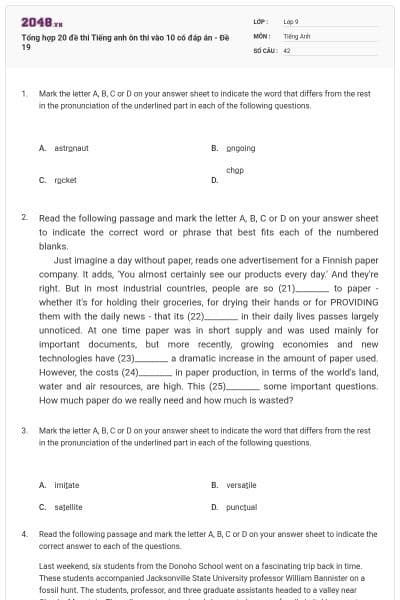
Mark the letter A, B, C or D on your answer sheet to indicate the word that differs from the rest in the pronunciation of the underlined part in each of the following questions.
astronaut
ongoing
rocket
chop
Đáp án A
Mark the letter A, B, C or D on your answer sheet to indicate the word that differs from the rest in the pronunciation of the underlined part in each of the following questions.
imitate
versatile
satellite
punctual
Đáp án D
Mark the letter A, B, C or D on your answer sheet to indicate the word that differs from the other three in the position of primary stress in the following questions.
virtual
burden
promote
sector
Đáp án C
Mark the letter A, B, C or D on your answer sheet to indicate the word that differs from the other three in the position of primary stress in the following questions.
certificate
operate
facilitate
affordable
Đáp án B
Mark the letter A, B, C or D on your answer sheet to indicate the correct answer to each of the following questions.
A lot of people have come tonight to ___________the forum.
apply
attend
arrive
concentrate
Đáp án B
The villagers are trying to learn English ________ they can communicate with foreign customers.
in order that
even though
however
because of
Đáp án: A
Giải thích:
A. in order that + mệnh đề: để mà
B. even though + mệnh đề: mặc dù
C. however: tuy nhiên
D. because of + N/V-ing: bởi vì
Dựa vào nghĩa, chọn A.
Dịch: Dân làng đang cố gắng học tiếng Anh để có thể giao tiếp với khách nước ngoài.
over
up
down
in
Đáp án A
The farmers in my home village___________ride home on trucks; they used buffalo-driven carts.
didn’t used to
didn’t use to
not used to
not use to
Đáp án B
The farmers in my home village___________ride home on trucks; they used buffalo-driven carts.
didn’t used to
didn’t use to
not used to
not use to
Đáp án B
The new girl in our class, ___________name is Mina, is reasonably good at English.
whose
who
which
that
Đáp án A
Our teacher asked us___________in the previous examination.
how we did
how did we
how had we done
how we had done
Đáp án D
Women these days prefer to be___________independent.
finance
financial
financially
finalize
Đáp án C
I don’t feel___________at interviews because my English is not very good.
confidently
confidence
condifential
confident
Đáp án D
He asked_________to speak to.
who I wanted
who I want
I wanted who
who did I want
Đáp án A
.– Janet: “What a lovely house you have!”
- Jane: “___________”No problem.
Thank you. Hope you will drop in.
Of course not, it’s not costly.
I think so.
Đáp án B
– Mubarak: “Did you enjoy the movie yesterday?”
- Mark: “___________”
Certainly, I’d be glad to.
Yes, it is warmer than today.
Not really. I couldn’t follow the story.
No, I dislike moving.
Đáp án C
Mark the letter A, B, C or D on your answer sheet to indicate the word(s) CLOSEST in meaning to the underlined word(s) in each of the following questions.
They suggested their students learn English to collaborate with their foreign teammates.
go out
study abroad
work together
tell stories
Đáp án C
Vietnam used to be male-dominated, with men being the voice of the family and society.
men doing housework
men earning money
men looking after children
men playing the leading role
Đáp án D
Mark the letter A, B, C or D on your answer sheet to indicate the word(s) OPPOSITE in meaning to the underlined word(s) in each of the following questions.
My parents always disapproved of my smoking. They even told me once it would stop me growing taller.
objected to
supported
denied
refused
Đáp án B
hungry
rich
rich
full
Đáp án D
Read the following passage and mark the letter A, B, C or D on your answer sheet to indicate the correct word or phrase that best fits each of the numbered blanks.
Just imagine a day without paper, reads one advertisement for a Finnish paper company. It adds, 'You almost certainly see our products every day.' And they're right. But in most industrial countries, people are so (21)________ to paper - whether it's for holding their groceries, for drying their hands or for PROVIDING them with the daily news - that its (22)________ in their daily lives passes largely unnoticed. At one time paper was in short supply and was used mainly for important documents, but more recently, growing economies and new technologies have (23)________ a dramatic increase in the amount of paper used. However, the costs (24)________ in paper production, in terms of the world's land, water and air resources, are high. This (25)________ some important questions. How much paper do we really need and how much is wasted?
But in most industrial countries, people are so (21)________ to paper - whether it's forholding
conscious
acquainted
familiar
accustomed
Đáp án: D
Giải thích:
Kiến thức: Collocation – Tính từ + giới từ
A. conscious of: ý thức về
B. acquainted with: làm quen với (dùng cho người hoặc kiến thức)
C. familiar with: quen thuộc với (nhưng thường dùng khi nói đến kiến thức hoặc thông tin cụ thể)
D. accustomed to: quen với
Cần một tính từ đi với “to” để diễn tả sự quen thuộc trong việc sử dụng giấy hằng ngày → đúng nhất là accustomed to = quen với cái gì.
Dịch: Nhưng ở hầu hết các quốc gia công nghiệp, người ta đã quá quen với giấy – dù là để đựng…
- whether it's for holding their groceries, for drying their hands or for PROVIDING them with the daily news - that its (22) ________ in their daily lives passes largely unnoticed.
task
operation
service
role
Đáp án: D
Giải thích:
Kiến thức: Từ vựng
A. task (n): nhiệm vụ (thường là hành động cụ thể mà con người thực hiện)
B. operation (n): hoạt động, quá trình → mang nghĩa kỹ thuật
C. service (n): dịch vụ
D. role (n): vai trò, chức năng mà thứ gì đó đảm nhiệm trong một hệ thống hay tình huống
Dựa vào nghĩa, chọn D.
Dịch: - dù là để đựng đồ tạp hóa, để lau khô tay hay để CUNG CẤP cho họ tin tức hàng ngày - thì vai trò của nó trong cuộc sống hàng ngày của họ phần lớn vẫn không được chú ý.
At one time paper was in short supply and was used mainly for important documents, but more recently, growing economies and new technologies have (23) ________ a dramatic increase in the amount of paper used.
called on
came around
brought about
drawn
Đáp án: C
Giải thích:
A. call on: kêu gọi, yêu cầu
B. come around: thay đổi ý kiến
C. bring about: gây ra, dẫn đến
D. draw: vẽ, thu hút
Dựa vào nghĩa, chọn C.
Dịch: Vào một thời điểm nào đó, giấy là thứ hiếm có và chủ yếu được dùng cho các tài liệu quan trọng, nhưng gần đây, sự phát triển của nền kinh tế và công nghệ mới đã gây ra một sự gia tăng đáng kể trong lượng giấy sử dụng.
However, the costs (24) ________ in paper production, in terms of the world's land, water and air resources, are high.
involved
contained
held
connected
Đáp án: A
Giải thích:
A. involve (v): liên quan đến, gắn liền với, đặc biệt dùng trong các tình huống mô tả những yếu tố, chi phí hay tác động liên quan đến một hành động hay quá trình.
B. contain (v): bao gồm, chứa đựng
C. hold (v): giữ, tổ chức
D. connect (v): kết nối
Dựa vào nghĩa, chọn A.
Dịch: Tuy nhiên, các chi phí liên quan đến việc sản xuất giấy, xét về tài nguyên đất, nước và không khí trên thế giới, là rất cao.
This (25) ________ some important questions. How much paper do we really need and how much is wasted?
puts
raised
gets
places
Đáp án: B
Giải thích:
"raised" là lựa chọn chính xác vì "raise questions" có nghĩa là dấy lên những câu hỏi, gợi ra những vấn đề. Đây là cụm từ phổ biến khi đề cập đến việc đặt ra các câu hỏi hoặc vấn đề.
Dịch: Điều này dấy lên một số câu hỏi quan trọng. Chúng ta thực sự cần bao nhiêu giấy và bao nhiêu giấy bị lãng phí?
Dịch bài
Hãy tưởng tượng một ngày không có giấy, một quảng cáo của một công ty giấy Phần Lan viết. Quảng cáo tiếp theo, "Chắc chắn bạn sẽ nhìn thấy sản phẩm của chúng tôi mỗi ngày." Và họ đã đúng. Tuy nhiên, ở hầu hết các quốc gia công nghiệp, người ta đã quá quen với giấy – dù là để đựng đồ tạp hóa, lau khô tay hay để cung cấp tin tức hàng ngày – đến mức sự hiện diện của nó trong cuộc sống hàng ngày gần như không được để ý đến. Vào một thời điểm nào đó, giấy là thứ hiếm có và chủ yếu được dùng cho các tài liệu quan trọng, nhưng gần đây, sự phát triển của nền kinh tế và công nghệ mới đã gây ra một sự gia tăng đáng kể trong lượng giấy sử dụng. Tuy nhiên, các chi phí liên quan đến việc sản xuất giấy, xét về tài nguyên đất, nước và không khí trên thế giới, là rất cao. Điều này dấy lên một số câu hỏi quan trọng. Chúng ta thực sự cần bao nhiêu giấy và bao nhiêu giấy bị lãng phí?
Read the following passage and mark the letter A, B, C or D on your answer sheet to indicate the correct answer to each of the questions.
Last weekend, six students from the Donoho School went on a fascinating trip back in time. These students accompanied Jacksonville State University professor William Bannister on a fossil hunt. The students, professor, and three graduate assistants headed to a valley near Cheaha Mountain. The valley was not previously known to have any fossils in it. However, two months ago, some campers in the valley stumbled upon some bones sticking out from the ground. When they brought them to the museum, they were told that the bones were those of a brontosaurus, a species of dinosaur. Thanks to a generous grant from the Damke Foundation, the students were able to accompany the professor on his dig. They spent most of both Saturday and Sunday carefully digging in the area. "We found a few bones," said Wendy Jacobs, a Donoho senior. "We're not sure which animal they're from, but the professor assured us they were from a dinosaur." The students, all of whom intend to major in science at college, are looking forward to returning this coming weekend. "There's enough money in the grant for the next month, so we should get to return at least three more times." said Donoho student Philip Peters.
What would be the most appropriate headline for this article?
Dinosaur Fossils Found near Cheaha Moutain
Donoho students meet professor bannister
Local studetns go Fossil hunting
Dinosaurs: Did they live arround here?
Đáp án: C
Giải thích:
Dịch: Tiêu đề nào sẽ phù hợp nhất cho bài viết này?
A. Hóa thạch khủng long được tìm thấy gần Cheaha Moutain
B. Sinh viên Donoho gặp giáo sư Bannister
C. Sinh viên địa phương đi săn hóa thạch
D. Khủng long: Chúng có sống quanh đây không?
Câu hỏi yêu cầu chọn tiêu đề phù hợp nhất với nội dung bài viết. Bài viết chủ yếu nói về việc các học sinh của trường Donoho cùng giáo sư Bannister tham gia một chuyến khảo cổ và phát hiện ra hóa thạch khủng long gần núi Cheaha. Vì vậy, tiêu đề phù hợp nhất là tiêu đề tóm gọn được nội dung chính của bài: việc phát hiện hóa thạch khủng long tại địa điểm đó.
tripped on
accidentally found
dug up
conducted research on
Đáp án: B
Giải thích:
Dịch: Ở dòng 5, cụm từ ‘stumbled upon – tình cờ gặp phải’ có nghĩa gần nhất với ___________.
A. vấp phải
B. vô tình tìm thấy
C. đào lên
D. tiến hành nghiên cứu về
Chọn B.
Why does the author mention the Damke Foundation?
To claim it has an interest in dinosaurs
To note a group that is financing the students
To focus on its relationship with the Donoho School
To claim that it sponsord many local digs
Đáp án: B
Giải thích:
Dịch: Tại sao tác giả lại đề cập đến Quỹ Damke?
A. Để khẳng định rằng tổ chức này quan tâm đến khủng long
B. Để lưu ý đến một nhóm đang tài trợ cho sinh viên
C. Để tập trung vào mối quan hệ của tổ chức này với Trường Donoho
D. Để khẳng định rằng tổ chức này đã tài trợ cho nhiều cuộc khai quật tại địa phương
Thông tin ở: “Thanks to a generous grant from the Damke Foundation, the students were able to accompany the professor on his dig.”
(Nhờ khoản tài trợ hào phóng từ Quỹ Damke, các sinh viên đã có thể đi cùng giáo sư trong chuyến khai quật của ông.)
Trong đoạn văn, tác giả đề cập đến Damke Foundation với mục đích giải thích nguồn tài trợ cho chuyến khảo cổ. Cụ thể, nhờ vào một khoản tài trợ hào phóng từ quỹ này, các học sinh mới có cơ hội tham gia chuyến đi cùng giáo sư Bannister.
Who is Wendy Jacobs?
A student at Jacksonville State University
One of professor bannister's graduate assitants
A fourth-year student at the Donoho school
A representative of the Damke Foundation
Đáp án: C
Giải thích:
Dịch: Wendy Jacobs là ai?
A. Một sinh viên tại Đại học Jacksonville State
B. Một trong những trợ lý sau đại học của giáo sư Bannister
C. Một sinh viên năm thứ tư tại trường Donoho
D. Một đại diện của Quỹ Damke
Thông tin ở: "We found a few bones," said Wendy Jacobs, a Donoho senior.
Từ “senior” trong ngữ cảnh của hệ thống giáo dục Mỹ thường được hiểu là học sinh năm cuối trung học hoặc sinh viên năm cuối đại học. Ở đây, vì cô ấy thuộc trường Donoho, nên Wendy là học sinh lớp 12 tại trường này.
According to the article, when will the students go back to the dig site?
within a week
in two months
during summer vacation
next autumn
Đáp án: A
Giải thích:
Dịch: Theo bài viết, khi nào các sinh viên sẽ quay lại địa điểm khai quật?
A. trong vòng một tuần
B. trong hai tháng
C. trong kỳ nghỉ hè
D. vào mùa thu tới
Thông tin ở: “The students, all of whom intend to major in science at college, are looking forward to returning this coming weekend.”
(Các sinh viên, những người có ý định theo học chuyên ngành khoa học tại trường đại học, đang mong chờ được trở lại trường vào cuối tuần tới.)
Cụm từ "this coming weekend" có nghĩa là cuối tuần tới, tức là trong vòng một tuần kể từ khi bài viết được viết.
Dịch bài đọc
Cuối tuần trước, sáu học sinh từ trường Donoho đã có một chuyến đi thú vị trở về quá khứ. Những học sinh này đã đi cùng Giáo sư William Bannister từ Đại học Jacksonville State trong một cuộc săn tìm hóa thạch. Các học sinh, giáo sư và ba trợ lý sau đại học đã đến một thung lũng gần núi Cheaha. Trước đây, thung lũng này chưa từng được biết đến là có hóa thạch. Tuy nhiên, hai tháng trước, một số người cắm trại tại đây đã tình cờ phát hiện ra một số khúc xương nhô lên khỏi mặt đất. Khi họ mang chúng đến bảo tàng, họ được thông báo rằng những khúc xương này thuộc về một con brontosaurus, một loài khủng long.
Nhờ vào một khoản tài trợ hào phóng từ Quỹ Damke, các học sinh đã có cơ hội đồng hành cùng giáo sư trong cuộc khai quật. Họ đã dành phần lớn thời gian vào cả thứ Bảy và Chủ Nhật để cẩn thận đào bới khu vực này.
"Chúng tôi đã tìm thấy một vài khúc xương," Wendy Jacobs, một học sinh năm cuối tại trường Donoho, cho biết. "Chúng tôi không chắc đó là của loài động vật nào, nhưng giáo sư đã đảm bảo với chúng tôi rằng chúng thuộc về một con khủng long."
Tất cả các học sinh đều có ý định học chuyên ngành khoa học tại trường đại học và rất mong được quay lại vào cuối tuần tới. "Khoản tài trợ đủ để chúng tôi tiếp tục trong tháng tới, vì vậy chúng tôi sẽ có cơ hội trở lại ít nhất ba lần nữa," học sinh Philip Peters của trường Donoho chia sẻ.
Mark the letter A, B, C, or D to indicate the underlined part that needs correction in each of the following questions.
My father is very busy with his business; therefore he is always willing to give a hand with the housework
A B C
D
Đáp án B
I found my new contact lenses strangely at first, but I got used to them in the end
A B C D
Đáp án B
Rattan, a close relative of bamboo, is often used to make tables, chairs, and other furnitures.
A B C D
Đáp án D
Why don’t you congratulate our son about passing his final exam?
A B C D
Đáp án B
Mark the letter A, B, C, or D on your answer to indicate the sentence that is closest in meaning to the original sentence in each of the following questions.
Charlie said, “I don’t know what Fred is doing”
Charlie said that he doesn’t know what Fred is doing.
Charlie said that he didn’t know what Fred is doing.
Charlie said that he doesn’t know what Fred was doing
Charlie said that he didn’t know what Fred was doing.
Đáp án D
He said, “I hardly ever go out these days”.
He said that he hardly ever went out these days.
He said that I hardly ever go out these days.
He said that I hardly ever went out these days.
He said that he hardly ever goes out these days.
Đáp án A
I can’t swim so I’m not going scuba diving with Jack.
If I could swim, I would go scuba diving with Jack.
Unless I could swim, I will not go scuba diving with Jack
If I could swim, I will go scuba diving with Jack.
Unless I can swim, I will go scuba diving with Jack
Đáp án A
He / say / he / be/ artisan / workshop / since 2010.
He said he was an artisan of the workshop since 2010.
He said was an artisan at the workshop since 2010.
He said he had been an artisan of the workshop since 2010.
He said he has been an artisan atthe workshop since 2010.
Đáp án C
I / look forward / make / own conical hat / Tay Ho village / Hue.
I look forward to making my own conical hat in Tay Ho village in Hue.
I look forward making my own conical hat in Tay Ho village in Hue.
I look forward to make my own conical hat in Tay Ho village in Hue
I am looking forward to make my own conical hat in Tay Ho village in Hue
Đáp án A
They / live / Moscow/ before / they / move / London.
They had lived in Moscow before they moved to London.
They lived in Moscow before they move to London.
They lived in Moscow before they had moved to London
They had lived in Moscow before they had moved to London.
Đáp án A