15 câu hỏi
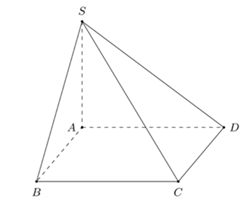
Cho hình chóp tứ giác S.ABCD. Trong các vectơ có điểm đầu và điểm cuối phân biệt thuộc tập {S, A, B, C, D}:
a) Những vectơ nào có điểm đầu là S?
b) Những vectơ nào có giá nằm trong mặt phẳng (SAB)?
c) Vectơ nào là vectơ đối của vectơ \(\overrightarrow {BC} \)?
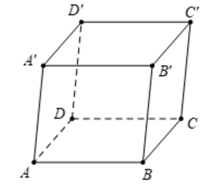
a) Ta có tứ giác ACC'A' là hình bình hành nên AC // A'C', suy ra \(\overrightarrow {A'C'} \) cùng phương với vectơ \(\overrightarrow {AC} \).
Do đó, các vec tơ \(\overrightarrow {CA} \), \(\overrightarrow {A'C'} \) và \(\overrightarrow {C'A'} \) cũng cùng phương với \(\overrightarrow {AC} \).
Vectơ cùng phương với vectơ \(\overrightarrow {AC} \) là: \(\overrightarrow {CA} \), \(\overrightarrow {A'C'} \) và \(\overrightarrow {C'A'} \).
b) Tứ giác ABC'D' là hình bình hành nên \(\overrightarrow {AD'} = \overrightarrow {BC'} \).
c) Vectơ đối của vectơ \(\overrightarrow {AA'} \) là: \(\overrightarrow {A'A} \), \(\overrightarrow {B'B} \), \(\overrightarrow {C'C} \), \(\overrightarrow {D'D} \).
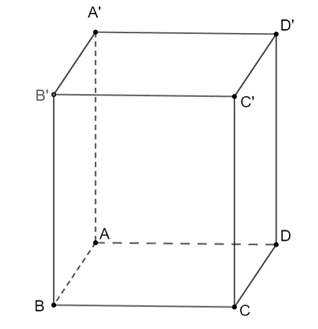
a) Ta có tam giác ABD vuông tại cân tại A và AB = AD = 1,
Suy ra \(\left| {\overrightarrow {BD} } \right|\) = BD = \(\sqrt {A{B^2} + A{D^2}} \)= \(\sqrt 2 \).
b) Tam giác CDD' vuông tại D có CD = AB = 1, DD' = AA' = 2.
Do đó, \(\left| {\overrightarrow {CD'} } \right|\) = CD' = \(\sqrt 5 \).
c) Do AB = AD = 1 nên đáy ABCD là hình vuông, suy ra AC = BD = \(\sqrt 2 \).
Tam giác ACC' vuông tại C, có AC = \(\sqrt 2 \) và CC' = 2.
Suy ra \(\left| {\overrightarrow {AC'} } \right|\) = AC' = \(\sqrt {C{{C'}^2} + A{C^2}} \) = \(\sqrt 6 \).
a) Ta có: \(\overrightarrow {AB} + \overrightarrow {BC} + \overrightarrow {CD} = \)\(\overrightarrow {AC} \) + \(\overrightarrow {CD} \) = \(\overrightarrow {AD} \) = \(\overrightarrow {AE} + \overrightarrow {ED} \) = \(\overrightarrow {AE} - \overrightarrow {DE} \).
Vậy \(\overrightarrow {AB} + \overrightarrow {BC} + \overrightarrow {CD} = \overrightarrow {AE} - \overrightarrow {DE} \).
b) Ta có: \(\overrightarrow {AB} + \overrightarrow {BD} = \overrightarrow {AD} = \overrightarrow {AE} + \overrightarrow {ED} \)
⇒ \(\overrightarrow {AB} + \overrightarrow {BD} = \overrightarrow {AE} + \overrightarrow {ED} \)
⇔ \(\overrightarrow {AB} - \overrightarrow {ED} = \overrightarrow {AE} - \overrightarrow {BD} \)
⇔ \(\overrightarrow {AB} + \overrightarrow {DE} = \overrightarrow {AE} - \overrightarrow {BD} \)
Vậy ta có đpcm.
c) Ta có: \(\overrightarrow {BC} + \overrightarrow {CD} = \overrightarrow {BD} = \overrightarrow {BE} + \overrightarrow {ED} \)
⇒ \(\overrightarrow {BC} + \overrightarrow {CD} = \overrightarrow {BE} + \overrightarrow {ED} \)
⇔ \(\overrightarrow {BC} - \overrightarrow {ED} = \overrightarrow {BE} - \overrightarrow {CD} \)
⇔ \(\overrightarrow {BC} + \overrightarrow {DE} = \overrightarrow {BE} - \overrightarrow {CD} \)
Vậy ta có đpcm.
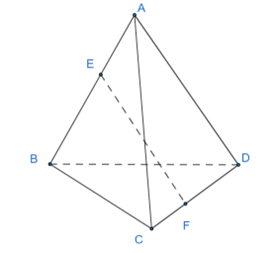
a) Ta có: \(\overrightarrow {EF} = \overrightarrow {EA} + \overrightarrow {AD} + \overrightarrow {DF} \)
= −\(\overrightarrow {AE} \) + \(\overrightarrow {AD} \) − \(\overrightarrow {FD} \)
= \(\overrightarrow {AD} \)− \(\frac{1}{3}\overrightarrow {AB} \) − \(\frac{2}{3}\overrightarrow {CD} \).
Vậy \(\overrightarrow {EF} = \overrightarrow {AD} - \frac{1}{3}\overrightarrow {AB} - \frac{2}{3}\overrightarrow {CD} \).
b) Ta có: \(\overrightarrow {EF} = \overrightarrow {EB} + \overrightarrow {BC} + \overrightarrow {CF} \)
= \(\frac{2}{3}\overrightarrow {AB} + \overrightarrow {CB} + \frac{1}{3}\overrightarrow {CD} \).
Vậy \(\overrightarrow {EF} = \overrightarrow {BC} + \frac{2}{3}\overrightarrow {AB} + \frac{1}{3}\overrightarrow {CD} \).
c) Từ câu a và b, ta có:
\(3\overrightarrow {EF} = \left( {\overrightarrow {AD} - \frac{1}{3}\overrightarrow {AB} - \frac{2}{3}\overrightarrow {CD} } \right) + 2\left( {\frac{2}{3}\overrightarrow {AB} + \overrightarrow {CB} + \frac{1}{3}\overrightarrow {CD} } \right)\)
= \(\overrightarrow {AD} - \frac{1}{3}\overrightarrow {AB} - \frac{2}{3}\overrightarrow {CD} \) + \(\frac{4}{3}\overrightarrow {AB} + 2\overrightarrow {CB} + \frac{2}{3}\overrightarrow {CD} \)
= \(\overrightarrow {AD} \) + \(\left( { - \frac{1}{3}\overrightarrow {AB} + \frac{4}{3}\overrightarrow {AB} } \right)\) + \(\left( { - \frac{2}{3}\overrightarrow {CD} + \frac{2}{3}\overrightarrow {CD} } \right)\) + \(2\overrightarrow {CB} \)
= \(\overrightarrow {AD} \) + \(2\overrightarrow {CB} \) + \(\overrightarrow {AB} \)
⇒ \(\overrightarrow {EF} = \frac{1}{3}\overrightarrow {AD} + \frac{2}{3}\overrightarrow {BC} + \frac{1}{3}\overrightarrow {AB} \).
Vậy ta có đpcm.
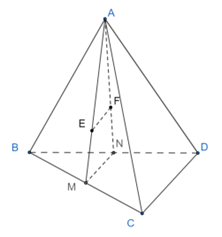
a) Xét tam giác AMN, ta có: AE = \(\frac{2}{3}\)AM, AF = \(\frac{2}{3}\)AN (E, F là trọng tâm tam giác ABC, ABD).
Theo định lí Thales đảo suy EF // MN và EF = \(\frac{2}{3}\)MN.
Vì \(\overrightarrow {EF} \) và \(\overrightarrow {MN} \) cùng hướng nên \(\overrightarrow {EF} = \frac{2}{3}\overrightarrow {MN} \).
b) Xét tam giác BCD, có M, N là trung điểm CB, DB nên MN là đường trung bình của tam giác.
Ta có: MN // CD và MN = \(\frac{1}{2}\)CD.
\(\overrightarrow {CD} \) và \(\overrightarrow {MN} \) cùng hướng nên \(\overrightarrow {MN} = \frac{1}{2}\overrightarrow {CD} \).
Do đó, \(\overrightarrow {EF} = \frac{2}{3}\overrightarrow {MN} = \frac{2}{3}.\frac{1}{2}\overrightarrow {CD} = \frac{1}{3}\overrightarrow {CD} \).
Vậy \(\overrightarrow {EF} = \frac{1}{3}\overrightarrow {CD} \).
Gọi vectơ thể hiện độ dịch chuyển của thang máy từ tầng 10 lên tầng 26 là \(\overrightarrow a \).
Gọi vectơ thể hiện độ dịch chuyển của thang máy từ tầng 26 xuống tầng 18 là \(\overrightarrow b \).
Khi đó, \(\overrightarrow a \) và \(\overrightarrow b \) cùng phương và ngược hướng.
Hơn nữa độ dài của \(\overrightarrow a \) bằng độ cao của 16 tầng, độ dài của \(\overrightarrow b \) bằng độ cao của 8 tầng, suy ra \(\left| {\overrightarrow a } \right| = 2\left| {\overrightarrow b } \right|\).
Từ cách lập luận trên suy ra \(\overrightarrow a = \left( { - 2} \right)\overrightarrow b = - 2\overrightarrow b \).

Học thông minh hơn mỗi ngày
Xem toàn bộ 15 câu hỏi và nhiều hơn nữa với tài khoản miễn phí
Một chiếc bàn cân đối được đặt trên mặt sàn nằm ngang, mặt bàn song song với mặt sàn và ba chân bàn vuông góc với mặt sàn. Trọng lực tác dụng lên bàn (biểu thị bởi vectơ \(\overrightarrow u \)) phân tán đều qua các chân bàn và tạo nên các phản lực từ mặt sàn lên các chân bàn (biểu thị bởi các vectơ \(\overrightarrow x ,\overrightarrow y ,\overrightarrow z \)). Hãy giải thích vì sao \(\overrightarrow x = \overrightarrow y = \overrightarrow z = - \frac{1}{3}\overrightarrow u \).
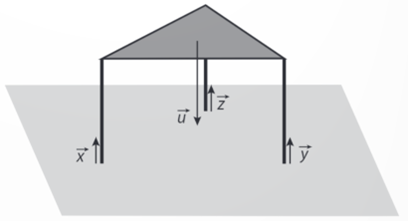
Các vectơ \(\overrightarrow x ,\overrightarrow y ,\overrightarrow z \) đôi một cùng phương vì giá của chúng đề vuông góc với mặt đất. Ba vectơ đó cùng hướng vì đều ngược hướng với trọng lực.
Ba vectơ đó có độ lớn bằng nhau vì trọng lực phân tán đều qua ba chân bàn.
Do đó \(\overrightarrow x = \overrightarrow y = \overrightarrow z \).
Hai vectơ \(\overrightarrow x \) và \(\overrightarrow u \) cùng phương, ngược hướng và \(\left| {\overrightarrow x } \right| = \frac{1}{3}\left| {\overrightarrow u } \right|\) nên \(\overrightarrow x = - \frac{1}{3}\overrightarrow u \).
Vậy \(\overrightarrow x = \overrightarrow y = \overrightarrow z = - \frac{1}{3}\overrightarrow u \).
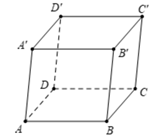
a) Ta có: \(\overrightarrow {AD} = \overrightarrow {AC} - \overrightarrow {AB} = \overrightarrow z - \overrightarrow y \).
b) Ta có: \(\overrightarrow {AC'} = \overrightarrow {AA'} + \overrightarrow {AB} + \overrightarrow {AD} = \overrightarrow x + \overrightarrow y + \left( {\overrightarrow z - \overrightarrow y } \right) = \overrightarrow x + \overrightarrow z \).
c) Ta có: \(\overrightarrow {BD'} \) = \(\overrightarrow {BA} + \overrightarrow {BC} + \overrightarrow {BB'} \) = \( - \overrightarrow {AB} + \overrightarrow {AD} + \overrightarrow {AA'} \) = −\(\overrightarrow y + \left( {\overrightarrow z - \overrightarrow y } \right) + \overrightarrow x \) = \(\overrightarrow x - 2\overrightarrow y + \overrightarrow z \).
a) Ta có: \(\overrightarrow {BB'} = \overrightarrow {AB'} - \overrightarrow {AB} \) và \(\overrightarrow {DD'} = \overrightarrow {AD'} - \overrightarrow {AD} \).
Suy ra \(\overrightarrow {BB'} + \overrightarrow {DD'} = \overrightarrow {AB'} + \overrightarrow {AD'} - \overrightarrow {AB} - \overrightarrow {AD} \).
b) Vì tứ giác ABCD là hình bình hành nên \(\overrightarrow {AB} + \overrightarrow {AD} = \overrightarrow {AC} \).
Vì tứ giác A'B'C'D' là hình bình hành nên \(\overrightarrow {AB'} + \overrightarrow {AD'} = \overrightarrow {AC'} \).
Kết hợp với câu a suy ra \(\overrightarrow {BB'} + \overrightarrow {DD'} = \overrightarrow {AB'} + \overrightarrow {AD'} - \overrightarrow {AB} - \overrightarrow {AD} = \overrightarrow {AC'} - \overrightarrow {AC} \) = \(\overrightarrow {CC'} \).
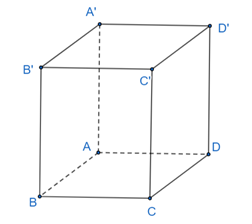
a) Ta có: \(\left( {\overrightarrow {AB} ,\overrightarrow {A'D'} } \right) = \left( {\overrightarrow {AB} ,\overrightarrow {AD} } \right) = \widehat {BAC} = 180^\circ - 60^\circ = 120^\circ \).
Do đó, \(\overrightarrow {AB} .\overrightarrow {A'D'} = AB.A'D'.\cos \left( {\overrightarrow {AB} ,\overrightarrow {A'D'} } \right)\) = 1.1. cos120° = \( - \frac{1}{2}\).
b) Ta có: AA' vuông góc với mặt phẳng (ABCD) nên \(\left( {\overrightarrow {AA'} ,\overrightarrow {BD} } \right)\) = 90°.
Do đó, \(\overrightarrow {AA'} .\overrightarrow {BD} \) = AA'.BD.cos90° = 0.
c) Tam giác ABC có AB = BC = 1 và \(\widehat {ABC}\) = 60° nên tam giác ABC đều.
Do đó, \(\widehat {BAC}\) = 60° và AC = 1.
Ta có: \(\left( {\overrightarrow {AB} ,\overrightarrow {A'C'} } \right) = \left( {\overrightarrow {AB} ,\overrightarrow {AC} } \right) = \widehat {BAC}\) = 60° và \(\overrightarrow {AB} .\overrightarrow {A'C'} \) = AB.A'C'.cos60° = 1.1.\(\frac{1}{2}\) = \(\frac{1}{2}\).
a) Ta có: \({\left( {\overrightarrow a + \overrightarrow b } \right)^2}\) = \({\overrightarrow a ^2} + 2\overrightarrow a \overrightarrow b + {\overrightarrow b ^2}\)= 12 + 22 + 2.1.2.cos45° = 5 + 2\(\sqrt 2 \).
b) Ta có: \(\left( {\overrightarrow a + \overrightarrow b } \right).\left( {\overrightarrow a - \overrightarrow b } \right)\)= \({\overrightarrow a ^2} - {\overrightarrow b ^2}\) = 12 – 22 = −3.
c) Ta có: \(\left( {2\overrightarrow a - \overrightarrow b } \right).\left( {\overrightarrow a + 3\overrightarrow b } \right)\) = \(2{\overrightarrow a ^2} - 3{\overrightarrow b ^2} + 5\overrightarrow a .\overrightarrow b \) = 2.12 – 3.22 + 5.1.2.cos45° = −10 + \(5\sqrt 2 \).
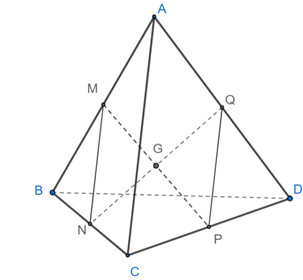
Vì MN là đường trung bình của tam giác ABC nên MN // AC và MN = \(\frac{1}{2}\)AC.
Vì PQ là đường trung bình của tam giác ADC nên NP // AC và NP = \(\frac{1}{2}\)AC.
Do dó, MN // AC và MNPQ là hình bình hành.
Theo đề bài, G là giao điểm của MNPQ là hình bình hành và G là giao điểm MP và NQ nên G là trung điểm của mỗi đoạn thẳng đó.
Ta có: \(\left( {\overrightarrow {GA} + \overrightarrow {GB} } \right) + \left( {\overrightarrow {GC} + \overrightarrow {GD} } \right)\) = \(2\overrightarrow {GM} + 2\overrightarrow {GP} \) = 2\(\left( {\overrightarrow {GM} + \overrightarrow {GP} } \right)\) = 2.\(\overrightarrow 0 \) = \(\overrightarrow 0 \).
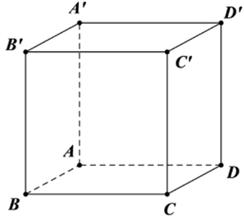
a) Do hai vectơ \(\overrightarrow {AC} \) và \(\overrightarrow {B'D'} \) vuông góc với nhau nên \(\overrightarrow {AC} .\overrightarrow {B'D'} \) = 0
b) Ta có: \(\overrightarrow {BD} .\overrightarrow {B'C'} \) = \(\overrightarrow {BD} .\overrightarrow {BC} \) = BD.BD.cos45° = a.a\(\sqrt 2 \).cos45° = a2.
c) Ta có: \(\overrightarrow {A'B'} .\overrightarrow {AC'} \) = \(\overrightarrow {AB} .\overrightarrow {AC'} \)
= \(\overrightarrow {AB} .\left( {\overrightarrow {AA'} + \overrightarrow {AC} } \right)\)
= \(\overrightarrow {AB} .\overrightarrow {AA'} + \overrightarrow {AB} .\overrightarrow {AC} \)
= 0 + AB.AC.cos45° = a.a\(\sqrt 2 \).\(\frac{{\sqrt 2 }}{2}\) = a2.
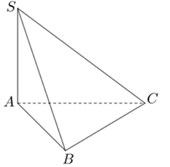
Ta có: \(\overrightarrow {SA} .\overrightarrow {BC} = \overrightarrow {SA} \left( {\overrightarrow {SC} - \overrightarrow {SB} } \right)\)
= \(\overrightarrow {SA} .\overrightarrow {SC} - \overrightarrow {SA} .\overrightarrow {SB} \)
= SA.SC.cos\(\widehat {ASC}\) − SA.SB.cos\(\widehat {ASB}\)
= 0.
\(\overrightarrow {SB} .\overrightarrow {AC} \) = \(\overrightarrow {SB} \left( {\overrightarrow {SC} - \overrightarrow {SA} } \right)\)
= \(\overrightarrow {SB} .\overrightarrow {SC} - \overrightarrow {SA} .\overrightarrow {SB} \)
= SC.SB.cos\(\widehat {BSC}\) − SA.SB.cos\(\widehat {ASB}\)
= 0.
\(\overrightarrow {SC} .\overrightarrow {AB} \) = \(\overrightarrow {SC} \left( {\overrightarrow {SB} - \overrightarrow {SA} } \right)\)
= \(\overrightarrow {SB} .\overrightarrow {SC} - \overrightarrow {SA} .\overrightarrow {SC} \)
= SC.SB.cos\(\widehat {BSC}\) − SA.SC.cos\(\widehat {ASC}\)
= 0.
Vậy \(\overrightarrow {SA} .\overrightarrow {BC} = \overrightarrow {SB} .\overrightarrow {AC} = \overrightarrow {SC} .\overrightarrow {AB} = 0\).
Bạn có thích hoạt động này không?
Ý kiến của bạn sẽ giúp chúng tôi đề xuất nội dung phù hợp hơn.
![[Năm 2022] Đề thi thử môn Vật lí THPT Quốc gia có lời giải - Đề số 21](/_next/image?url=https%3A%2F%2Fvideo.vietjack.com%2Fupload%2Fimages%2Fvj-image%2Fimage-3izficdefgfoel0s9j8s-1786772791.jpg&w=3840&q=75)
![[Năm 2022] Đề thi thử môn Vật lí THPT Quốc gia có lời giải - Đề số 20](/_next/image?url=https%3A%2F%2Fvideo.vietjack.com%2Fupload%2Fimages%2Fvj-image%2Fimage-emy0gtcksawvorajezvv-1786772460.jpg&w=3840&q=75)