Đề thi tổng ôn tốt nghiệp THPT Tiếng Anh (Đề số 3)
40 câu hỏi
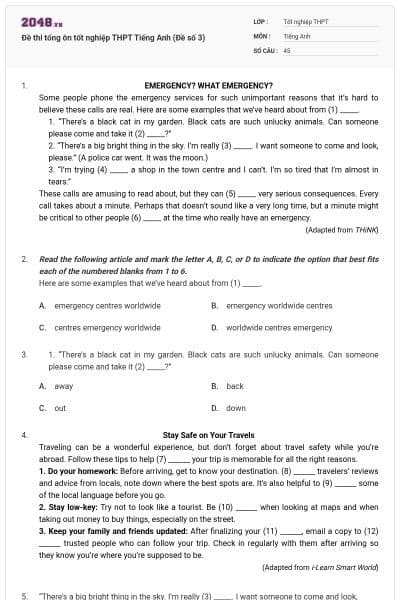
EMERGENCY? WHAT EMERGENCY?
Some people phone the emergency services for such unimportant reasons that it’s hard to believe these calls are real. Here are some examples that we’ve heard about from (1) _____.
1. “There’s a black cat in my garden. Black cats are such unlucky animals. Can someone please come and take it (2) _____?”
2. “There’s a big bright thing in the sky. I’m really (3) _____. I want someone to come and look, please.” (A police car went. It was the moon.)
3. “I’m trying (4) _____ a shop in the town centre and I can’t. I’m so tired that I’m almost in tears.”
These calls are amusing to read about, but they can (5) _____ very serious consequences. Every call takes about a minute. Perhaps that doesn’t sound like a very long time, but a minute might be critical to other people (6) _____ at the time who really have an emergency.
(Adapted from THiNK)
Read the following article and mark the letter A, B, C, or D to indicate the option that best fits each of the numbered blanks from 1 to 6.
emergency centres worldwide
emergency worldwide centres
centres emergency worldwide
worldwide centres emergency
Kiến thức về trật tự từ
- Ta có cụm danh từ: emergency centres – trung tâm cấp cứu
- Như vậy có thể chọn ngay A là đáp án duy nhất dùng đúng cụm từ trên.
- Theo quy tắc thông thường thì tính từ đơn đứng trước bổ nghĩa cho danh từ. Tuy nhiên một vài tính từ đặc biệt có thể đứng sau danh từ (trong trường hợp này cũng có thể phân loại các từ này là trạng từ bổ nghĩa cho danh từ). Một số ví dụ:
For a holiday abroad you need a valid passport.
We have plenty of office space available.
→ trật tự đúng: emergency centres worldwide
Dịch: Dưới đây là một số ví dụ mà chúng tôi nghe được từ các trung tâm cấp cứu trên toàn thế giới.
Chọn A.
1. “There’s a black cat in my garden. Black cats are such unlucky animals. Can someone please come and take it (2) _____?”
away
back
out
down
Kiến thức về giới từ
A. take away: đem đi
B. take back: lấy lại
C. take out: đem ra ngoài
D. take down: đem xuống
Dịch: Ai đó làm ơn đến và đem nó đi với?
Chọn A.
worrying
worried
worryingly
worry
Kiến thức về từ loại
A. worrying /ˈwʌriɪŋ/, /ˈwɜːriɪŋ/ (adj): đáng lo
B. worried /ˈwʌrid/, /ˈwɜːrid/ (adj): lo lắng
C. worryingly /ˈwʌriɪŋli/, /ˈwɜːriɪŋli/ (adv): một cách lo lắng
D. worry /ˈwʌri/, /ˈwɜːri/ (n): nỗi lo lắng
Ta có quy tắc: be + adv + adj → vị trí chỗ trống cần một tính từ → loại C, D.
Phân biệt tính từ đuôi -ing và đuôi -ed:
- adj-ing: chỉ bản chất của chủ thể
- adj-ed: chỉ tâm trạng, cảm xúc của chủ thể
Dịch: Có một thứ gì đó sáng to trên bầu trời. Tôi thực sự lo lắng.
Chọn B.
to finding
finding
find
to find
Kiến thức về danh động từ và động từ nguyên mẫu
Phân biệt to-V và V-ing theo sau động từ với khác biệt về nghĩa:
- try + to V: cố gắng, nỗ lực làm gì
- try + V-ing: thử làm gì đó để xem kết quả hoặc trải nghiệm
Dịch: Tôi đang cố tìm một cửa hàng ở trung tâm thành phố mà mãi không tìm thấy.
Chọn D.
face
bear
have
take
Kiến thức về cụm từ cố định
Các cụm từ với consequence:
- to face/bear the consequences: đối mặt, hứng chịu hậu quả
- to have consequences: gây ra, để lại hậu quả
Dịch: Những cuộc gọi này đọc có vẻ buồn cười, nhưng chúng có thể dẫn đến những hậu quả nghiêm trọng.
Chọn C.
that calls
whomcall
called
calling
Kiến thức về mệnh đề quan hệ
- people là danh từ số nhiều nên động từ ở hiện tại đơn chia theo ngôi thứ ba → loại A.
- people là chủ thể của hành động call mà đại từ quan hệ whom chỉ dùng để thay thế cho danh từ chỉ người ở vị trí tân ngữ trong câu → loại B.
- Muốn rút gọn MĐQH khi động từ mang nghĩa chủ động, ta lược bỏ đại từ quan hệ và trợ động từ, đưa động từ chính về dạng V-ing → loại C.
Dịch: Nghe có vẻ không dài nhưng một phút lại có thể rất quan trọng đối với những người khác gọi vào thời điểm đó mà thực sự đang gặp trường hợp khẩn cấp.
Chọn D.
Bài hoàn chỉnh | Dịch bài đọc |
EMERGENCY? WHAT EMERGENCY? Some people phone the emergency services for such unimportant reasons that it’s hard to believe these calls are real. Here are some examples that we’ve heard about from emergency centres worldwide. 1. “There’s a black cat in my garden. Black cats are such unlucky animals. Can someone please come and take it away?” 2. “There’s a big bright thing in the sky. I’m really worried. I want someone to come and look, please.” (A police car went. It was the moon.) 3. “I’m trying to find a shop in the town centre and I can’t. I’m so tired that I’m almost in tears.” These calls are amusing to read about, but they can have very serious consequences. Every call takes about a minute. Perhaps that doesn’t sound like a very long time, but a minute might be critical to other people calling at the time who really have an emergency. | KHẨN CẤP? CÓ CHUYỆN GÌ KHẨN CẤP VẬY? Có những người gọi đến các dịch vụ khẩn cấp vì những lý do không quan trọng đến nỗi khó có thể tin rằng những cuộc gọi này là có thật. Dưới đây là một số ví dụ mà chúng tôi nghe được từ các trung tâm cấp cứu trên toàn thế giới. 1. “Có một con mèo đen trong vườn nhà tôi. Mèo đen rất là xui xẻo. Ai đó làm ơn đến và đem nó đi với?” 2. “Có một thứ gì đó sáng to trên bầu trời. Tôi thực sự lo lắng. Tôi muốn ai đó đến xem giúp, làm ơn.” (Một xe cảnh sát đã đến xem. ‘thứ gì đó’ là mặt trăng.) 3. “Tôi đang cố tìm một cửa hàng ở trung tâm thành phố mà mãi không tìm thấy. Tôi mệt đến mức sắp khóc ra đây rồi.” Những cuộc gọi này đọc có vẻ buồn cười, nhưng chúng có thể dẫn đến những hậu quả nghiêm trọng. Mỗi cuộc gọi mất khoảng một phút. Nghe có vẻ không dài nhưng một phút lại có thể rất quan trọng đối với những người khác gọi vào thời điểm đó mà thực sự đang gặp trường hợp khẩn cấp. |
Stay Safe on Your Travels
Traveling can be a wonderful experience, but don’t forget about travel safety while you’re abroad. Follow these tips to help (7) ______ your trip is memorable for all the right reasons.
1. Do your homework: Before arriving, get to know your destination. (8) ______ travelers’ reviews and advice from locals, note down where the best spots are. It’s also helpful to (9) ______ some of the local language before you go.
2. Stay low-key: Try not to look like a tourist. Be (10) ______ when looking at maps and when taking out money to buy things, especially on the street.
3. Keep your family and friends updated: After finalizing your (11) ______, email a copy to (12) ______ trusted people who can follow your trip. Check in regularly with them after arriving so they know you’re where you’re supposed to be.
(Adapted from i-Learn Smart World)
Read the following travel guide and mark the letter A, B, C, or D to indicate the option that best fits each of the numbered blanks from 7 to 12.
assure
ensure
insure
censure
Kiến thức về từ vựng – nghĩa của từ
A. assure /əˈʃɔː(r)/, /əˈʃʊr/ (v): làm ai yên tâm → assure sb (that) ... / assure sb of sth
B. ensure /ɪnˈʃɔː(r)/, /ɪnˈʃʊr/ (v): đảm bảo điều gì đó xảy ra → ensure (that) ... / ensure sth
C. insure /ɪnˈʃɔː(r)/, /ɪnˈʃʊr/ (v): mua bảo hiểm → insure sth/yourself against/for sth
D. censure /ˈsenʃə(r)/ (v): chỉ trích nặng nề → be censured for (doing) sth
Dịch: Làm theo những mẹo sau để đảm bảo chuyến đi của bạn đáng nhớ vì tất cả những lý do chính đáng.
Chọn B.
Instead of
In light of
In case of
In spite of
Kiến thức về liên từ
A. Instead of: thay vì
B. In light of sth = after considering sth: sau khi xem xét cái gì
C. In case of sth: trong trường hợp điều gì xảy ra
D. In spite of sth = despite sth: mặc dù
Dịch: Dựa trên các đánh giá của du khách và lời khuyên từ người dân địa phương để ghi lại những điểm nên đến.
Chọn B.
catch up with
make for
check out
pick up
Kiến thức về cụm động từ
A. catch up with sb: bắt kịp tốc độ/trình độ của ai
B. make for sth = move towards sth: di chuyển đến nơi nào
C. check out: thanh toán và rời khách sạn
D. pick up: học một ngôn ngữ, kỹ năng mới
Dịch: Học một ít ngôn ngữ địa phương trước khi đi cũng rất hữu ích.
Chọn D.
guarded
tactful
conscious
discreet
Kiến thức về từ vựng – từ cùng trường nghĩa
A. guarded /ˈɡɑːdɪd/ (adj): thận trọng, đề phòng khi giao tiếp để không bộc lộ quá nhiều thông tin hay cảm xúc, e.g. You should be more guarded in what you say to reporters.
B. tactful /ˈtæktfl/ (adj): khéo léo, ứng xử tế nhị, e.g. Mentioning his baldness wasn't very tactful.
C. conscious /ˈkɒnʃəs/, /ˈkɑːnʃəs/ (adj): nhận thức được vấn đề
D. discreet /dɪˈskriːt/ (adj): cảnh giác khi xử lý tình huống nhạy cảm
- Xét các nét nghĩa thì phù hợp nhất là discreet, vì câu đưa ra lời khuyên cẩn thận trong hành động.
Dịch: Hãy kín đáo khi xem bản đồ và khi rút tiền để mua đồ, đặc biệt là trên đường phố.
Chọn D.
itinerary
journey
reservation
route
Kiến thức về từ vựng – nghĩa của từ
A. itinerary /aɪˈtɪnərəri/ (n): lịch trình du lịch
B. journey /ˈdʒɜːni/ (n): chuyến đi nói chung
C. reservation /ˌrezəˈveɪʃn/ (n): đặt chỗ trước
D. route /ruːt/, /raʊt/ (n): tuyến đường di chuyển
Dịch: Cập nhật cho gia đình và bạn bè: Sau khi lên lịch trình xong...
Chọn A.
a few
few
a little
little
Kiến thức về lượng từ
A. a few + N(s/es): có một chút, đủ để làm gì (nghĩa khẳng định)
B. few + N(s/es): có rất ít, không đủ để làm gì (nghĩa phủ định)
C. a little + N(không đếm được): có một chút, đủ để làm gì (nghĩa khẳng định)
D. little + N(không đếm được): có rất ít, không đủ để làm gì (nghĩa phủ định)
Dịch: Sau khi lên lịch trình xong, hãy gửi một bản sao cho một vài người đáng tin để họ có thể theo dõi chuyến đi.
Chọn A.
Bài hoàn chỉnh | Dịch bài đọc |
Stay Safe on Your Travels Traveling can be a wonderful experience, but don’t forget about travel safety while you’re abroad. Follow these tips to help ensure your trip is memorable for all the right reasons. 1. Do your homework: Before arriving, get to know your destination. In light of travelers’ reviews and advice from locals, note down where the best spots are. It’s also helpful to pick up some of the local language before you go. 2. Stay low-key: Try not to look like a tourist. Be discreet when looking at maps and when taking out money to buy things, especially on the street. 3. Keep your family and friends updated After finalizing your itinerary, email a copy to a few trusted people who can follow your trip. Check in regularly with them after arriving so they know you’re where you’re supposed to be. | Giữ An Toàn Khi Du Lịch Du lịch có thể là một trải nghiệm tuyệt vời, nhưng đừng quên giữ an toàn khi đi du lịch nước ngoài. Làm theo những mẹo sau để đảm bảo chuyến đi của bạn đáng nhớ vì tất cả những lý do chính đáng. 1. Nghiên cứu trước: Trước khi đến, hãy tìm hiểu về điểm đến của bạn. Dựa trên các đánh giá của du khách và lời khuyên từ người dân địa phương để ghi lại những điểm nên đến. Học một chút ngôn ngữ địa phương trước khi bạn đi cũng rất hữu ích. 2. Giữ kín đáo: Hãy cố gắng để không trông giống khách du lịch. Kín đáo khi xem bản đồ và khi rút tiền ra mua đồ, đặc biệt là trên đường phố. 3. Cập nhật cho gia đình và bạn bè: Sau khi lên lịch trình xong, hãy gửi một bản sao cho một vài người đáng tin để họ có thể theo dõi chuyến đi. Giữ liên lạc thường xuyên với họ sau khi đến nơi để họ biết bạn đang ở đúng nơi bạn nên đến. |
Mark the letter A, B, C, or D to indicate the best arrangement of utterances or sentences to make a meaningful exchange or text in each of the following questions from 13 to 17.
a. Mary: What an interesting family history!
b. Mary: How did your aunt learn to cook couscous?
c. Albert: Her great-uncle married a woman from North Africa. That’s where couscous is from. They always ate it on special occasions.
(Adapted from Explore New Worlds)
a-b-c
b-a-c
b-c-a
c-a-b
Kiến thức sắp xếp câu thành đoạn hội thoại
Thứ tự sắp xếp đúng:
b. Mary: How did your aunt learn to cook couscous?
c. Albert: Her great-uncle married a woman from North Africa. That’s where couscous is from. They always ate it on special occasions.
a. Mary: What an interesting family history!
Dịch:
b. Mary: Dì cậu đã học nấu món couscous như thế nào vậy?
c. Albert: Ông chú của dì kết hôn với một người phụ nữ đến từ Bắc Phi. Đó là nơi bắt nguồn của món couscous. Họ luôn ăn nó vào những dịp đặc biệt.
a. Mary: Lịch sử gia đình cậu thật thú vị!
Chọn C.
a. Nam: Hmm, do you think we need to have a university degree to pursue a career?
b. Mr Kien: ... So, I’ve talked to you about future job opportunities. Any questions?
c. Nam: But how do you get a job without a degree or any experience? Employers look down on job applicants without a university degree.
d. Mr Kien: Well, it depends on the industry and the field of work that you’re interested in. There’re many jobs that don’t require a university degree.
e. Mr Kien: Not necessarily. You need to show that you’re hard-working and willing to learn. Many companies hire school-leavers and provide on-the-job training.
(Adapted from Global Success)
a-d-c-e-b
b-a-e-c-d
a-e-c-d-b
b-a-d-c-e
Kiến thức sắp xếp câu thành đoạn hội thoại
Thứ tự sắp xếp đúng:
b. Mr Kien: ... So, I’ve talked to you about future job opportunities. Any questions?
a. Nam: Hmm, do you think we need to have a university degree to pursue a career?
d. Mr Kien: Well, it depends on the industry and the field of work that you’re interested in. There’re many jobs that don’t require a university degree.
c. Nam: But how do you get a job without a degree or any experience? Employers look down on job applicants without a university degree.
e. Mr Kien: Not necessarily. You need to show that you’re hard-working and willing to learn. Many companies hire school-leavers and provide on-the-job training.
Dịch:
b. Thầy Kiên: ...Thầy đã nói với em về các cơ hội việc làm trong tương lai. Em có câu gì muốn hỏi thầy không?
a. Nam: Hmm, thầy có nghĩ bọn em cần phải có bằng đại học để tìm việc không ạ?
d. Thầy Kiên: Điều đó phụ thuộc vào ngành và lĩnh vực công việc mà em quan tâm. Có nhiều công việc không yêu cầu bằng đại học.
c. Nam: Nhưng làm sao mà xin được việc nếu không có bằng cấp hay chút kinh nghiệm nào ạ? Nhà tuyển dụng coi thường những ứng viên không có bằng đại học.
e. Thầy Kiên: Không nhất thiết là vậy. Em cần chứng minh bản thân chăm chỉ và sẵn sàng học hỏi. Nhiều công ty tuyển dụng những người mới ra trường và đào tạo trực tiếp tại môi trường làm việc.
Chọn D.
Hi Inika,
a. Well, since we last met I’ve been working on my new house mostly.
b. Although we’ve spoken to three different builders so far, we haven’t decided which one to hire.
c. We’ve decided to build an extension, so we’ve taken all the measurements and talked to some builders.
d. Sorry to hear you haven’t been feeling well lately, but it’s good that you’ve seen a doctor. I’m sure it’s nothing serious.
e. I’ve been busy with work and Fahim has started a new job, so we haven’t had much spare time, but we’ve spent every spare minute doing jobs in the house and garden.
Anyway, let’s meet up soon. I haven’t seen you in ages.
Hadia.
(Adapted from C21-Smart)
a-c-b-d-e
e-d-c-b-a
c-b-a-e-d
d-a-e-c-b
Kiến thức sắp xếp câu thành lá thư
Thứ tự sắp xếp đúng:
Hi Inika,
d. Sorry to hear you haven’t been feeling well lately, but it’s good that you’ve seen a doctor. I’m sure it’s nothing serious.
a. Well, since we last met I’ve been working on my new house mostly.
e. I’ve been busy with work and Fahim has started a new job, so we haven’t had much spare time, but we’ve spent every spare minute doing jobs in the house and garden.
c. We’ve decided to build an extension, so we’ve taken all the measurements and talked to some builders.
b. Although we’ve spoken to three different builders so far, we haven’t decided which one to hire.
Anyway, let’s meet up soon. I haven’t seen you in ages.
Hadia.
Dịch:
Inika thân mến,
d. Rất tiếc khi nghe tin dạo này cậu không được khỏe, nhưng thật may là cậu đã đi khám bác sĩ rồi. Mình chắc là không có gì nghiêm trọng đâu.
a. Từ lần cuối ta gặp nhau, mình chủ yếu bận tới bận lui với nhà mới của mình thôi.
e. Mình có công việc của mình, mà Fahim thì cũng vừa bắt đầu một công việc mới nên cả hai chẳng có mấy thời gian rảnh. Nhưng hễ có chút thời gian là bọn mình lại làm mấy việc trong nhà với chăm sóc vườn.
c. Bọn mình đã quyết định xây cơi nới thêm ngôi nhà, nên đã đo đạc kỹ càng và trao đổi với thợ xây.
b. Tới giờ hai đứa đã nói chuyện với ba nhóm thợ khác nhau rồi, nhưng vẫn chưa chọn được nhóm nào cả.
Dù sao thì gặp nhau sớm nhé! Lâu lắm rồi không gặp cậu.
Hadia.
Chọn D.
a. I don’t like to have my husband make me coffee in the morning.
b. Actually, we use AI every day at home to get things done, but we are unaware of it.
c. When I’m busy I have it find me a good nearby Japanese restaurant or have it tell me when the next flight to Hà Nội leaves.
d. He never does it the way I like it, but my coffee machine has learned my schedule and makes a fresh cup of coffee for me just the way I like it.
e. I use a smart assistant, like Alexa and Siri, to have my voice commands translated into action.
(Adapted from English Discovery)
a-d-b-c-e
b-a-d-e-c
b-e-c-a-d
e-a-d-c-b
Kiến thức sắp xếp câu thành đoạn văn
Thứ tự sắp xếp đúng:
b. Actually, we use AI every day at home to get things done, but we are unaware of it.
e. I use a smart assistant, like Alexa and Siri, to have my voice commands translated into action.
c. When I’m busy I have it find me a good nearby Japanese restaurant or have it tell me when the next flight to Hà Nội leaves.
a. I don’t like to have my husband make me coffee in the morning.
d. He never does it the way I like it, but my coffee machine has learned my schedule and makes a fresh cup of coffee for me just the way I like it.
Dịch:
b. Thực ra, chúng ta sử dụng AI hàng ngày ở nhà để làm nhiều việc, nhưng lại không mấy nhận ra.
e. Tôi dùng trợ lý thông minh, như Alexa và Siri, để biến các lệnh thoại của mình thành hành động.
c. Khi tôi bận, tôi nhờ trợ lý tìm cho tôi một nhà hàng Nhật Bản ngon ở gần hay nhờ trợ lý báo cho tôi biết khi nào thì chuyến bay tiếp theo đến Hà Nội khởi hành.
a. Tôi không thích chồng pha cà phê cho tôi vào buổi sáng.
d. Anh ấy chẳng bao giờ pha được theo kiểu tôi thích, nhưng máy pha cà phê của tôi đã học được lịch trình của tôi và luôn pha cho tôi một tách cà phê ngon rất vừa miệng tôi.
Chọn C.
a. John Lyne from Britain is perhaps the world’s most unfortunate man.
b. The older he got, the worse things became. He’s been run over, nearly drowned and had a car crash.
c. John’s life has been more accident-filled than one would think possible. But he doesn’t think he’s unlucky.
d. At eighteen months old, he accidentally drank disinfectant and had to have his stomach pumped.
e. As far as he’s concerned, most of his accidents could have ended a lot more seriously, so he may actually be the world’s luckiest man!
(Adapted from Friends Global)
a-d-b-c-e
a-b-d-c-e
a-c-d-b-e
a-d-c-b-e
Kiến thức sắp xếp câu thành đoạn văn
Thứ tự sắp xếp đúng:
a. John Lyne from Britain is perhaps the world’s most unfortunate man.
d. At eighteen months old, he accidentally drank disinfectant and had to have his stomach pumped.
b. The older he got, the worse things became. He’s been run over, nearly drowned and had a car crash.
c. John’s life has been more accident-filled than one would think possible. But he doesn’t think he’s unlucky.
e. As far as he’s concerned, most of his accidents could have ended a lot more seriously, so he may actually be the world’s luckiest man!
Dịch:
a. John Lyne đến từ Anh có lẽ là người đàn ông xui xẻo nhất thế giới.
d. 18 tháng tuổi, anh đã vô tình uống phải thuốc khử trùng và phải đi rửa dạ dày.
b. Càng lớn thì tình hình càng tệ hơn với anh. Anh đã bị xe đâm, suýt chết đuối và từng gặp tai nạn ô tô.
c. Cuộc đời John là một chuỗi tai nạn nhiều đến mức người ta không thể tin nổi. Nhưng anh không nghĩ mình xui xẻo.
e. Theo anh thì hầu hết các tai nạn của anh đều đã có thể kết thúc tồi tệ hơn rất nhiều, nên có lẽ anh mới thực sự là người may mắn nhất thế giới!
Chọn A.
Building a Greener Future for Vietnam
The Centre for Energy and Green Growth Research (CEGR), established in 1998, (18) ______ that aims at promoting sustainable development in Vietnam. As a non-governmental member of the Vietnam Union of Science and Technology Associations (VUSTA), CEGR has made significant contributions to the development of sustainable energy and green growth in Vietnam.
The first goal of CEGR is to promote renewable energy sources. CEGR has been working closely with the government, private sectors and civil societies (19) ______ in Vietnam. For example, CEGR has played a vital role in developing wind power in Vietnam. In 2019, the country added 376 MW of wind power capacity, with over 80% of the capacity located in the central and southern regions. CEGR has actively developed strategies to promote wind power. (20) ______, which outlines key targets for the sector’s growth.
In addition, CEGR has been strongly promoting sustainable development in Vietnam. It has developed sustainable transport strategies for the country in order to reduce greenhouse emissions. The strategies involve promoting law-carbon transport options such as electric vehicles and public transport systems. (21) ______ sustainable agricultural practices to reduce emissions and improve energy efficiency.
Overall, CEGR’s contributions in Vietnam have been significant, and the organisation’s work has had a major positive impact on the country’s energy sector. Its efforts have aided in the increased use of renewable energy sources and the promotion of sustainable development practices, (22) ______ and Vietnam’s economy.
(Adapted from Bright)
at which non-profit research and consulting are held
being a non-profit organisation to research and consult
is a non-profit research and consulting organisation
does research and holds consultations on a non-profit basis
Kiến thức về cấu trúc câu
- Ta thấy câu đã có chủ ngữ là CEGR nhưng chưa có vị ngữ → cần một động từ hòa hợp với chủ ngữ để tạo thành câu hoàn chỉnh.
- A là MĐQH với giới từ, B là cụm phân từ hiện tại → loại A, B.
- Xét sau chỗ trống cần điền là một MĐQH xác định, that thay thế và bổ nghĩa cho danh từ đi trước. Nếu điền D thì phần được bổ nghĩa là a non-profit basis, ta thấy ghép nghĩa với phần bổ nghĩa không phù hợp → loại D.
- Nếu điền C thì phần được bổ nghĩa là organisation ta thấy phù hợp với phần bổ nghĩa.
Dịch: Trung tâm Nghiên cứu Năng lượng và Tăng trưởng xanh (CEGR), được thành lập năm 1998, là một tổ chức nghiên cứu và tư vấn phi lợi nhuận nhằm mục đích thúc đẩy phát triển bền vững tại Việt Nam.
Chọn C.
on the encouragement of harnessing renewable energy through many initiatives
so that they have policies encouraging renewable energy’s consumption promoted
to promote policies and initiatives that encourage the growth of renewable energy
whose promotion of policies and initiatives deal with renewable energy sources
Kiến thức về mệnh đề trạng ngữ
A. Dùng đúng cấu trúc ‘work on sth’ – làm việc về vấn đề gì. Tuy nhiên encouragement chỉ mang nghĩa hành động, lời nói động viên ai đó, không phù hợp dùng trong ngữ cảnh này (động từ encourage có nghĩa thúc đẩy việc gì, có thể dùng trong ngữ cảnh này, tuy nhiên dạng danh từ của nó không có nét nghĩa này, cần lưu ý) → loại A.
B. Cấu trúc ‘have sth done’ dùng khi nói ai đó làm việc gì đó cho mình, xét ngữ cảnh thì không cho thấy vai trò chủ động của tổ chức CEGR như được thể hiện trong toàn bài → loại B.
C. Mệnh đề trạng ngữ chỉ mục đích với to-V phù hợp nhất về mặt nghĩa để điền vào chỗ trống, cho thấy mục đích của CEGR khi hợp tác cùng các bên khác.
D. Đại từ quan hệ whose chỉ sự sở hữu của ‘the government, private sectors and civil societies’, chuyển trọng tâm của các hành động sang các tổ chức này, làm giảm vai trò của CEGR trong khi câu sau đó nhấn mạnh “CEGR has played a vital role...” → loại D.
Dịch: CEGR đã hợp tác chặt chẽ với chính phủ, các khu vực tư nhân và các tổ chức dân sự để thúc đẩy các chính sách và sáng kiến khuyến khích phát triển năng lượng tái tạo tại Việt Nam.
Chọn C.
Their goal is centred around reducing dependence on fossil fuels
This includes the development of a wind power roadmap for Vietnam
They have made a move in the right direction towards cleaner energy
This encompasses the construction of large-scale solar farms in different regions
Kiến thức về mệnh đề độc lập
Xét nghĩa các câu:
A. Mục tiêu của họ tập trung vào giảm sự phụ thuộc vào nhiên liệu hóa thạch
B. Điều này bao gồm phát triển một lộ trình điện gió cho Việt Nam
C. Họ đã có động thái đúng hướng hướng tới năng lượng sạch hơn
D. Điều này bao gồm xây dựng các trang trại năng lượng mặt trời quy mô lớn ở các khu vực khác nhau
- Từ “For example,...” đến hết đoạn 2 đều nói về năng lượng gió, A và D chuyển mục tiêu sang ‘nhiên liệu hóa thạch’ và ‘năng lượng mặt trời’ → loại A, D.
- Sau chỗ trống cần điền là một MĐQH với which, có thể bổ nghĩa cho một đối tượng hoặc cả mệnh đề trước dấu phẩy.
- Ghép C vào chỗ trống ta có, hoặc ‘năng lượng sạch nêu rõ các mục tiêu phát triển’, hoặc ‘việc họ có động thái nêu rõ các mục tiêu phát triển’ → đều không hợp lý, loại C.
- Ghép B vào chỗ trống ta có ‘lộ trình điện gió nêu rõ các mục tiêu phát triển’ → vừa nói về năng lượng gió có liên kết với các câu xung quanh, vừa có đối tượng phù hợp để which bổ nghĩa.
Dịch: Điều này bao gồm phát triển một lộ trình điện gió cho Việt Nam, trong đó nêu rõ các mục tiêu chính cho sự phát triển của ngành.
Chọn B.
Not to mention that CEGR has helped farmers in Vietnam develop
Indeed, farmers in Vietnam have received assistance to adopt
CEGR has accordingly supportedVietnamese farmersin adopting
Furthermore, CEGR has assisted Vietnamese farmers in developing
Kiến thức về mệnh đề độc lập
- Chỗ trống cần một mệnh đề đầy đủ chủ vị; ‘not to mention sth’ – chưa kể đến cái gì, dùng để thêm thông tin hoặc nhấn mạnh, không tạo mệnh đề độc lập → loại A.
- B, C, D khác nhau chính ở dùng liên từ. Ta có indeed (thật vậy – dùng để nhấn mạnh), accordingly (theo đó – liên kết với ý trước), và furthermore (thêm vào đó – giới thiệu ý khác với ý trước).
→ Ta cần xét hai ý trước sau để chọn: ý trước nói về ‘xe điện và giao thông công cộng’, ý sau nói về ‘nông nghiệp bền vững’ → Đây là hai ý khác nhau trong phạm vi các chiến lược phát triển xanh, ta chọn furthermore.
Dịch: Các chiến lược này bao gồm khuyến khích sử dụng phương tiện giao thông ít carbon như xe điện và giao thông công cộng. Hơn nữa, CEGR đã hỗ trợ nông dân Việt Nam phát triển các hoạt động nông nghiệp bền vững để giảm phát thải và cải thiện hiệu quả năng lượng.
Chọn D.
all of which are going to be beneficial to the environment in the long run
both of which will have long-term benefits for the environment
each of which is likely to go a long way to the benefit of the environment
among other things, they are to provide lasting benefits for the environment
Kiến thức về mệnh đề quan hệ, lượng từ
- Ta xác định which trong các đáp án A, B, C và they trong đáp án D đều chỉ ‘the increased use of renewable energy sources and the promotion of sustainable development practices’.
A. all chỉ từ ba đối tượng trở lên, câu chỉ có hai đối tượng nối với nhau bởi and → loại A.
B. both là lượng từ phù hợp để chỉ hai đối tượng.
C. each dùng khi muốn nói về từng đối tượng riêng biệt, không phù hợp như both vì hai đối tượng này (tăng cường việc sử dụng các nguồn năng lượng tái tạo và thúc đẩy các hoạt động phát triển bền vững) liên kết chặt chẽ với nhau.
- go a long way towards doing sth (idiom): tạo ra khác biệt lớn trong việc đạt được điều gì
D. among other things ý nói còn những yếu tố khác; cấu trúc be + to V diễn tả một hành động dự kiến, mục tiêu hay kế hoạch → ý nói các hành động của CEGR chưa tạo ra được hiệu quả cụ thể mà còn phải chờ xem → nghĩa không hợp lý, loại D.
Dịch: Những nỗ lực của tổ chức đã hỗ trợ tăng cường việc sử dụng các nguồn năng lượng tái tạo và thúc đẩy các hoạt động phát triển bền vững, cả hai đều sẽ mang lại lợi ích lâu dài cho môi trường và nền kinh tế Việt Nam.
Chọn B.
Dịch bài đọc:
Xây Dựng Tương Lai Xanh Cho Việt Nam
Trung tâm Nghiên cứu Năng lượng và Tăng trưởng Xanh (CEGR), thành lập năm 1998, là tổ chức nghiên cứu và tư vấn phi lợi nhuận với mục tiêu thúc đẩy phát triển bền vững ở Việt Nam. Là thành viên phi chính phủ của Liên hiệp các Hội Khoa học và Kỹ thuật Việt Nam (VUSTA), CEGR đã có những đóng góp đáng kể cho sự phát triển năng lượng bền vững và tăng trưởng xanh tại Việt Nam.
Mục tiêu đầu tiên của CEGR là thúc đẩy các nguồn năng lượng tái tạo. CEGR đã hợp tác chặt chẽ với chính phủ, các khu vực tư nhân và các tổ chức dân sự để thúc đẩy các chính sách và sáng kiến khuyến khích phát triển năng lượng tái tạo tại Việt Nam. Ví dụ, CEGR đã đóng vai trò quan trọng trong việc phát triển năng lượng gió ở Việt Nam. Năm 2019, cả nước đã bổ sung thêm 376 MW công suất điện gió, với hơn 80% công suất tập trung ở khu vực miền Trung và miền Nam. CEGR đã tích cực xây dựng các chiến lược để thúc đẩy năng lượng gió, bao gồm việc phát triển lộ trình điện gió cho Việt Nam với các mục tiêu quan trọng cho sự phát triển của ngành này.
Ngoài ra, CEGR đã thúc đẩy mạnh mẽ sự phát triển bền vững tại Việt Nam. Tổ chức này đã phát triển các chiến lược giao thông bền vững nhằm giảm thiểu khí thải nhà kính. Các chiến lược này bao gồm khuyến khích sử dụng phương tiện giao thông ít carbon như xe điện và giao thông công cộng. Thêm vào đó, CEGR đã hỗ trợ nông dân Việt Nam phát triển các phương pháp canh tác bền vững nhằm giảm thiểu khí thải và nâng cao hiệu quả năng lượng.
Nhìn chung, đóng góp của CEGR ở Việt Nam là rất đáng kể, và các hành động của tổ chức này đã có tác động tích cực lớn đến ngành năng lượng của đất nước. Những nỗ lực của CEGR làm gia tăng việc sử dụng các nguồn năng lượng tái tạo và thúc đẩy các hoạt động phát triển bền vững, cả hai đều mang lại lợi ích lâu dài cho môi trường và nền kinh tế Việt Nam.
THE KITE RUNNER
Ali and Baba grew up together as childhood playmates just like Hassan and I grew up a generation later. Baba was always telling us about their mischiefs he and Ali used to cause. But in none of his stories did Baba ever refer to Ali as his friend.
The curious thing was, I never thought of Hassan and me as friends either. Not in the usual sense, anyhow. Never mind that we taught each other to ride a bicycle with no hands, or to build a fully functional homemade camera out of a cardboard box. Never mind that we spent entire winters flying kites, running kites. Never mind that to me, the face of Afghanistan is that of a boy with a thin-boned frame, a shaved head, and low-set ears, a boy with a Chinese doll face perpetually lit by a harelipped smile.
Never mind any of those things. Because history isn’t easy to overcome. Neither is religion. In the end, I was a Pashtun and he was a Hazara, I was Sunni and he was Shi’a, and nothing was ever going to change that. Nothing.
We saw our first Western together, Rio Bravo with John Wayne, at the Cinema Park. I remember begging Baba to take us to Iran so we could meet John Wayne. Baba burst out in gales of his deep-throated laughter and then explained to us the concept of voice dubbing. Hassan and I were stunned. Dazed. John Wayne didn’t really speak Farsi and he wasn’t Iranian! He was American, just like the friendly, long-haired men and women we always saw hanging around in Kabul, dressed in their tattered, brightly colored shirts.
During the school year, we had a daily routine. By the time I dragged myself out of bed and lumbered to the bathroom, Hassan had already washed up, prayed the morning namaz with Ali, and prepared my breakfast. While I ate and complained about homework, Hassan made my bed, polished my shoes, ironed my outfit for the day, packed my books and pencils. I’d hear him singing to himself in the foyer as he ironed, singing old Hazara songs in his nasal voice.
(Adapted from Friends Global)
long-haired
thin-boned frame
Chinese doll face
low-set ears
Cái nào sau đây KHÔNG được dùng để mô tả ngoại hình của Hassan theo quan sát của người kể chuyện?
A. tóc dàiB. khung xương nhỏ
C. mặt giống búp bê TàuD. đôi tai mọc thấp
Thông tin: ...the face of Afghanistan is that of a boy with a thin-boned frame, a shaved head, and low-set ears, a boy with a Chinese doll face... (...bộ mặt của người Afghanistan chính là bộ mặt của thằng bé có khung xương nhỏ, với cái đầu cạo trọc, đôi tai mọc thấp, thằng bé với bộ mặt búp bê Tàu...)
Chọn A.
confusing
inquisitive
odd
uncertain
Từ ‘curious’ trong đoạn 2 có thể được thay thế bởi từ nào?
A. confusing /kənˈfjuːzɪŋ/ (adj): gây bối rối
B. inquisitive /ɪnˈkwɪzətɪv/ (adj): tò mò (chỉ người)
C. odd /ɒd/, /ɑːd/ (adj): kỳ lạ
D. uncertain /ʌnˈsɜːtn/ (adj): không chắc chắn
- Xét ngữ cảnh:
Ali and Baba grew up together as childhood playmates just like Hassan and I grew up a generation later. Baba was always telling us about their mischiefs he and Ali used to cause. But in none of his stories did Baba ever refer to Ali as his friend.
The curious thing was, I never thought of Hassan and me as friends either.
(Ali và Baba lớn lên cùng nhau như đôi bạn để chỏm, hệt như tôi và Hassan cùng lớn lên ở thế hệ sau. Baba luôn kể cho chúng tôi nghe về những trò tinh nghịch của ông và Ali. Nhưng không có một chuyện nào ông kể mà trong đó Baba lại xem Ali như bạn của mình.
Điều lạ lùng là, tôi cũng không bao giờ nghĩ tôi và Hassan là một đôi bạn.)
→ Hai đứa trẻ có tuổi thơ lớn lên bên nhau giống hai người lớn, nhưng kỳ lạ là trong cả hai mối quan hệ một người đều không xem người kia là bạn.
Chọn C.
flying kites and running kites in winter
the activities the narrator and Hassan did together
their attempts to overcome their differences
the narrator’s impressions of Afghanistan
Cụm ‘those things’ trong đoạn 3 chỉ ______.
A. thả diều và chạy diều vào mùa đông
B. những việc mà người kể chuyện và Hassan đã làm cùng nhau
C. nỗ lực của họ để vượt qua sự khác biệt
D. ấn tượng của người kể chuyện về Afghanistan
Thông tin:
- Never mind any of those things. (Bất chấp mọi điều đó.) → Mọi điều đó chính là cả đoạn từ “Never mind that we taught each other ... a harelipped smile.”
- ‘thả diều và chạy diều’ và ‘ấn tượng về Afghanistan’ đều là những ý nhỏ trong ‘mọi điều đó’, không mang tính bao quát → loại A, D.
- ‘các hoạt động hai người đã cùng nhau thực hiện’ nói lên bao quát nhất cả đoạn.
- sự khác biệt chỉ được nhắc đến sau those things nên ‘nỗ lực để vượt qua khác biệt’ là không đúng → loại C.
Chọn B.
History and religion are complex concepts to grasp.
Some differences are almost impossible to erase.
Cultural and religious barriers are difficult to break.
Time and faith eventually heal all divisions.
Câu nào sau đây diễn giải lại tốt nhất câu gạch chân trong đoạn 3?
A. Lịch sử và tôn giáo là những khái niệm phức tạp để hiểu được.
B. Một vài sự khác biệt là gần như không thể xóa bỏ.
C. Rào cản văn hóa và tôn giáo rất khó phá vỡ.
D. Thời gian và lòng tin cuối cùng sẽ chữa lành mọi chia rẽ.
Thông tin: Because history isn’t easy to overcome. Neither is religion. In the end, I was a Pashtun and he was a Hazara, I was Sunni and he was Shi’a, and nothing was ever going to change that. Nothing. (Bởi vì lịch sử không dễ để mà vượt qua. Tôn giáo cũng vậy. Rốt cuộc tôi vẫn cứ là người Pashtun, còn cậu ấy là người Hazara. Tôi là người Sunmi và cậu ấy là người Shi’a, và không gì có thể thay đổi điều đó. Không gì hết.)
→ Đến đây ta hiểu hai đứa trẻ thuộc hai tầng lớp xã hội khác nhau, vì vậy dù có thân thiết lớn lên cùng nhau cũng không coi nhau là bạn.
Chọn C.
astonished
attentive
overjoyed
indifferent
Từ ‘Dazed’ trong đoạn 4 TRÁI NGHĨA với từ nào?
- dazed /deɪzd/ (adj) = unable to think clearly, especially because of a shock (Oxford): sốc đến không nói nên lời
A. astonished /əˈstɒnɪʃt/, /əˈstɑːnɪʃt/ (adj): kinh ngạc
B. attentive /əˈtentɪv/ (adj): chăm chú
C. overjoyed /ˌəʊvəˈdʒɔɪd/ (adj): vui mừng khôn xiết
D. indifferent /ɪnˈdɪfrənt/ (adj): thờ ơ
Thông tin: Hassan and I were stunned. Dazed. John Wayne didn’t really speak Farsi and he wasn’t Iranian! (Hassan và tôi sửng sốt. Sững sờ. John Wayne không thực sự nói tiếng Farsi và ông ta không phải người Iran!)
→ Từ ‘stunned’ đứng ngay trước ‘dazed’ quen thuộc hơn và có thể giúp suy ra nghĩa của ‘dazed’ là một phản ứng trước chuyện bất ngờ.
→ dazed >< indifferent
Chọn D.
The narrator has a generally negative attitude towards Americans.
The narrator does think that he and Hassan had a typical friendship.
The narrator and Hassan had a childhood that was similar to Ali and Baba’s.
The narrator’s daily experiencesduring school year were the same as Hassan’s.
Theo đoạn trích, câu nào sau đây là ĐÚNG?
A. Người kể chuyện có thái độ nhìn chung là tiêu cực đối với người Mỹ.
B. Người kể chuyện nghĩ rằng anh ta và Hassan có một tình bạn điển hình.
C. Người kể chuyện và Hassan có tuổi thơ giống với Ali và Baba.
D. Những trải nghiệm hàng ngày của người kể chuyện trong năm học giống với Hassan.
Thông tin:
- He was American, just like the friendly, long-haired men and women we always saw hanging around in Kabul... (Ông ta là người Mỹ, hệt như những người đàn ông và đàn bà tóc dài thân thiện chúng tôi luôn thấy vơ vẩn ở Kabul...) → Tác giả dùng từ ‘thân thiện’ để miêu tả người Mỹ cho thấy thái độ không tiêu cực → A sai.
- I never thought of Hassan and me as friends either. Not in the usual sense, anyhow. (tôi cũng không bao giờ nghĩ tôi và Hassan là một đôi bạn. Dẫu sao, cũng không theo nghĩa thông thường.) → B sai.
- Ali and Baba grew up together as childhood playmates just like Hassan and I grew up a generation later. (Ali và Baba lớn lên cùng nhau như đôi bạn để chỏm, hệt như tôi và Hassan cùng lớn lên ở thế hệ sau.) → C đúng.
- During the school year, we had a daily routine. By the time I dragged myself out of bed and lumbered to the bathroom, Hassan had already washed up, prayed the morning namaz with Ali, and prepared my breakfast. While I ate and complained about homework, Hassan made my bed, polished my shoes, ironed my outfit for the day, packed my books and pencils. (Trong năm học, chúng tôi có lệ quen hàng ngày. Vào lúc tôi lề mề ra khỏi giường và lê đến buồng tắm thì Hassan đã tắm rửa rồi, cả cầu nguyện kinh Namaz buổi sáng với ông Ali và sửa soạn bữa sáng cho tôi. Trong khi tôi ăn và phàn nàn về bài tập về nhà, Hassan dọn dẹp giường ngủ, đánh giày cho tôi, là áo ngoài mặc hôm đó và xếp sách bút cho tôi.) → Đến đây đã rõ người kể chuyện thuộc tầng lớp cao hơn Hassan, Hassan là người giúp việc, vì vậy trong năm học mỗi người có công việc và nhiệm vụ khác nhau → D sai.
Chọn C.
Paragraph 5
Paragraph 4
Paragraph 3
Paragraph 2
Trong đoạn văn nào tác giả đề cập đến hệ quả của một sự hiểu lầm về văn hóa?
Thông tin ở đoạn 4:
- We saw our first Western together, Rio Bravo with John Wayne, at the Cinema Park. I remember begging Baba to take us to Iran so we could meet John Wayne. Baba burst out in gales of his deep-throated laughter and then explained to us the concept of voice dubbing. Hassan and I were stunned. Dazed. John Wayne didn’t really speak Farsi and he wasn’t Iranian! He was American... (Chúng tôi cùng nhau đi xem bộ phim cao bồi viễn Tây đầu tiên, Rio Bravo, với diễn viên John Wayne thủ vai, ở Công viên Điện ảnh. Tôi nhớ mình đã từng nài xin Baba đưa chúng tôi tới Iran để gặp John Wayne. Baba phá lên cười một chuỗi dài tưởng vỡ họng rồi giải thích cho chúng tôi khái niệm về lồng tiếng. Hassan và tôi sửng sốt. Sững sờ. John Wayne không thực sự nói tiếng Farsi và ông ta không phải người Iran! Ông ta là người Mỹ...)
→ Hai đứa trẻ nhầm tưởng một diễn viên người Mỹ là người Iran vì không biết đến lồng tiếng, một khái niệm phổ biến trong phim ảnh phương Tây.
Chọn B.
one
two
three
four
Tác giả đề cập đến mối quan hệ giữa các tầng lớp xã hội, văn hóa khác nhau trong bao nhiêu đoạn văn?
Trả lời: hai đoạn văn
- Đoạn 3: Người kể chuyện làm rõ lý do vì sao hai đứa trẻ không coi nhau là bạn, chính vì khác biệt về tầng lớp xã hội.
- Đoạn 5: Người kể chuyện tả lại công việc hàng ngày khác nhau của hai đứa trẻ, cho thấy vai trò của từng tầng lớp trong xã hội.
Chọn B.
Dịch bài đọc:
NGƯỜI ĐUA DIỀU
Ali và Baba lớn lên cùng nhau như đôi bạn để chỏm, hệt như tôi và Hassan cùng lớn lên ở thế hệ sau. Baba luôn kể cho chúng tôi nghe về những trò tinh nghịch của ông và Ali. Nhưng không có một chuyện nào ông kể mà trong đó Baba lại xem Ali như bạn của mình.
Điều lạ lùng là, tôi cũng không bao giờ nghĩ tôi và Hassan là đôi bạn. Dẫu sao, cũng không theo nghĩa thông thường. Bất kể là việc chúng tôi dạy nhau đi xe đạp buông hai tay, hay thiết kế một chiếc máy ảnh tại nhà có đủ chức năng từ một hộp các tông. Bất kể là chúng tôi cùng nhau thả diều suốt mùa đông, và đua diều. Bất kể đối với tôi, bộ mặt của người Afghanistan chính là bộ mặt của thằng bé có dáng người thon thả, với cái đầu cạo trọc, đôi tai mọc thấp, thằng bé với bộ mặt búp bê Tàu vĩnh viễn ngời sáng nụ cười môi hẻ.
Bất chấp mọi điều đó. Bởi vì lịch sử không dễ để mà vượt qua. Tôn giáo cũng vậy. Rốt cuộc rồi vẫn cứ là người Pashtun, còn cậu ấy là người Hazara. Tôi là người Sunmi và cậu ấy là người Shi’a, và không gì có thể thay đổi điều đó. Không gì hết.
Chúng tôi cùng nhau đi xem bộ phim cao bồi viễn Tây đầu tiên, Rio Bravo, do diễn viên John Wayne thủ vai, ở Công viên Điện ảnh. Tôi nhớ mình đã từng nài xin Baba mang chúng tôi tới Iran, để chúng tôi có thể gặp John Wayne. Baba phá lên cười một chuỗi dài tưởng vỡ họng, rồi giải thích cho chúng tôi khái niệm về lồng tiếng. Hassan và tôi sửng sốt. Sững sờ. John Wayne không thực sự nói tiếng Farsi và ông ta không phải người Iran! Ông ta là người Mỹ, hệt như những người đàn ông và đàn bà tóc dài thân thiện chúng tôi luôn thấy vơ vẩn ở Kabul, mặc những chiếc váy màu sặc sỡ và xơ gấu.
Trong năm học, chúng tôi có lệ quen hàng ngày. Vào lúc tôi lề mề ra khỏi giường và lê đến buồng tắm thì Hassan đã tắm rửa rồi, cả cầu nguyện kinh Namaz buổi sáng với ông Ali và sửa soạn bữa sáng cho tôi. Trong khi tôi ăn và phàn nàn về bài tập về nhà, Hassan dọn dẹp giường ngủ, đánh giày cho tôi, là áo ngoài mặc hôm đó và xếp sách bút cho tôi. Tôi thường nghe thấy cậu hát một mình ở ngoài tiền sảnh lúc là quần áo, hát nhưng bài ca cổ Hazara bằng giọng mũi.
In today’s fast-paced world, the ability to learn and adapt is becoming increasingly essential. [I] This is why lifelong learning skills are crucial for students’ development. [II]
[III] Two primary lifelong learning skills are the capacity to summarise information and engage in reflective thinking. [IV] These involve identifying the key points of a text or lecture, reducing them into a shorter form, and subsequently reflecting on past learning experiences to determine how newfound knowledge can be applied in the future. Learning from others and personalising one’s educational journey are equally vital. Students need to seek out mentors, peers and experts in their fields to gain insights from their experiences. Nevertheless, learning from others does not mean copying from them; rather, students ought to tailor others’ approach to learning to their own needs and preferences. For example, some peers learn best through visual aids, but others may prefer hands-on activities.
Extensive reading open doors for students to explore novel ideas and perspectives. While reading a wide range of genres and topics, students not only cultivate their curiosity with the texts but also draw connections between ideas, thereby enriching their comprehension of the materials. One further necessity for lifelong learning is familiarising oneself with new technologies. As technological advancements are reshaping education, students must learn to adapt to these innovations, utilizing online learning platforms, online courses, digital textbooks, and educational apps to enhance their learning experiences.
In conclusion, the above-mentioned lifelong learning skills are indispensable for students aspiring to thrive in today’s dynamic world.
(Adapted from English Discovery)
Where in paragraph 1 or paragraph 2 does the following sentence best fit?
These skills go beyond memorising facts and figures.
[I]
[II]
[III]
[IV]
Câu sau đây phù hợp nhất ở vị trí nào trong đoạn 1 hoặc đoạn 2?
Những kỹ năng này không chỉ dừng lại ở việc ghi nhớ các sự kiện và con số.
Xét vị trí [II]: This is why lifelong learning skills are crucial for students’ development. [II] (Đó là lý do tại sao kỹ năng học tập suốt đời đóng vai trò thiết yếu trong sự phát triển của học sinh. [II]).
→ Ta thấy câu này nhắc đến ‘lifelong learning skills’ lần đầu tiên nên câu trên ở vị trí [II] là hợp lý, nó có chức năng bổ sung thông tin cho ‘lifelong learning skills’ nói chung.
Chọn B.
mentors
peers
experts
people students need to seek out
Từ ‘their’ trong đoạn 2 chỉ ______.
A. người cố vấnB. bạn bè
C. các chuyên giaD. những người mà học sinh cần học hỏi
Thông tin: Students need to seek out mentors, peers and experts in their fields to gain insights from their experiences. (Học sinh cần tìm kiếm người cố vấn, bạn bè và chuyên gia trong các lĩnh vực để tìm hiểu những góc nhìn từ trải nghiệm của họ.)
→ ‘their’ trong ‘their fields’ là chỉ các chuyên gia, khác với ‘their’ trong ‘their experiences’ mới là chỉ chung những người mà học sinh cần tìm kiếm học hỏi.
Chọn C.
imitate
modify
reflect
develop
Từ ‘tailor’ trong đoạn 2 có thể được thay thế bằng từ nào?
- tailor /ˈteɪlə(r)/ (v) = to make or adapt sth for a particular purpose, a particular person, etc. (Oxford): chỉnh sửa cho phù hợp
A. imitate /ˈɪmɪteɪt/ (v): bắt chước
B. modify /ˈmɒdɪfaɪ/, /ˈmɑːdɪfaɪ/ (v): sửa đổi
C. reflect /rɪˈflekt/ (v): phản ánh, nhìn nhận lại
D. develop /dɪˈveləp/ (v): phát triển
→ tailor = modify
Chọn B.
figure out a text’s main ideas
find ways to apply new knowledge
condense information learned
create one’s own learning style
Theo đoạn 2, bước nào sau đây KHÔNG nằm trong ba bước tóm tắt và tư duy phản chiếu?
A. tìm ý chính của văn bảnB. tìm cách áp dụng kiến thức mới
C. cô đọng thông tin đã họcD. tạo phong cách học tập riêng
Thông tin:
- These involve identifying the key points of a text or lecture (A), reducing them into a shorter form (C), and subsequently reflecting on past learning experiences to determine how newfound knowledge can be applied in the future (B). (Những kỹ năng này bao gồm xác định ý chính của văn bản hay bài giảng, tóm tắt các ý chính đó và suy ngẫm về những trải nghiệm trong học tập để tìm cách ứng dụng kiến thức mới cho tương lai.)
Chọn D.
Lifelong learning involves learning from others and applying both direct copying and personalized strategies.
Students must summarise information and reflect on their learning to ensure they do not copy others’ approaches.
Reflecting on past experiences and seeking mentorship are more valuable than learning independently from resources.
Two key lifelong learning skills are summarizing information and reflecting on learning while adapting others’ methods to suit individual needs.
Câu nào sau đây là tóm tắt tốt nhất của đoạn 2?
A. Học tập suốt đời bao gồm học hỏi từ người khác và vừa sao chép trực tiếp vừa có các chiến lược cá nhân hóa.
B. Học sinh phải tóm tắt thông tin và suy ngẫm về việc học của mình để đảm bảo họ không sao chép phương pháp học của người khác.
C. Suy ngẫm về những trải nghiệm trong quá khứ và tìm kiếm sự hướng dẫn từ người đi trước có ích hơn là tự học từ các nguồn tài liệu.
D. Hai kỹ năng học tập suốt đời chính là tóm tắt thông tin và suy ngẫm về việc học, đồng thời điều chỉnh các phương pháp của người khác để phù hợp với nhu cầu của cá nhân.
Thông tin:
- Two primary lifelong learning skills are the capacity to summarise information and engage in reflective thinking. (Hai kỹ năng học tập suốt đời quan trọng đó là khả năng tóm tắt thông tin và tư duy phản chiếu.) → câu chủ đề của cả đoạn
- Learning from others and personalising one’s educational journey are equally vital. (Học hỏi từ người khác và cá nhân hóa lộ trình học tập cũng rất cần thiết.) → câu bổ sung ý
→ Ta thấy D diễn giải lại câu chủ đề và liên kết ý bổ sung một cách phù hợp, thể hiện rõ nhất tinh thần của cả đoạn.
Chọn D.
hinder creativity
block opportunities
limit exposure
provide access
Cụm từ ‘open doors’ trong đoạn 3 TRÁI NGHĨA với cụm nào?
- open doors for sb (idiom) = to provide opportunities for sb to do sth and be successful (Oxford): mở ra những cơ hội cho ai làm gì
A. hinder creativity: cản trở sức sáng tạo
B. block opportunities: khép lại các cơ hội
C. limit exposure: giới hạn sự tiếp xúc
D. provide access: tạo điều kiện tiếp cận
→ open doors >< block opportunities
Chọn B.
Students won’t thrive academically unless they adopt all five skills discussed.
Extensive readingguarantees students will fully understand all subjects.
Extensive readingbroadens students’ understanding of materials.
Digital tools will eventually replace traditional learning methods.
Theo đoạn văn, câu nào sau đây là ĐÚNG?
A. Học sinh sẽ không phát triển về mặt học tập nếu không áp dụng cả 5 kỹ năng được nêu.
B. Phương pháp đọc mở rộng đảm bảo học sinh sẽ hiểu đầy đủ tất cả các môn học.
C. Phương pháp đọc mở rộng giúp học sinh hiểu sâu hơn về tài liệu mình đọc.
D. Công cụ kỹ thuật số cuối cùng sẽ thay thế các phương pháp học tập truyền thống.
Thông tin:
- Có bao nhiêu kỹ năng được nêu trong bài? Trả lời: summarising information (tóm tắt thông tin chính), reflective thinking (tư duy phản chiếu), learning from others (học hỏi từ người khác), personalising educational journey (cá nhân hóa phương pháp học), extensive reading (đọc mở rộng), familiarising oneself with new technologies (làm quen với công nghệ) → có 6 kỹ năng, không phải 5 kỹ năng → A sai.
- Không có thông tin nào đảm bảo chỉ cần áp dụng phương pháp đọc mở rộng thì học sinh sẽ nắm được hết tất cả môn học mà còn phụ thuộc nhiều yếu tố → B sai.
- Extensive reading open doors for students to explore novel ideas and perspectives. [...] thereby enriching their comprehension of the materials. (Phương pháp đọc mở rộng cho học sinh cơ hội khám phá những ý tưởng và quan điểm mới lạ. [...] từ đó làm phong phú thêm hiểu biết của các em về tài liệu đọc) → C đúng.
- D là một ý suy ra không có căn cứ trong bài → D sai.
Chọn C.
Reading various genres encourages students to think creatively and make connections across ideas.
By reading multiple genres, students become more curious and develop the ability to memorize new ideas.
Students need to read a variety of genres to satisfy their curiosity and learn to compare texts effectively.
Reading extensively can help students improve their reading skills by using new ideas creatively.
Câu nào sau đây diễn giải đúng nhất câu gạch chân trong đoạn 4?
A. Học sinh cần đọc nhiều thể loại khác nhau để thỏa mãn trí tò mò và học cách so sánh các văn bản hiệu quả.
B. Bằng cách đọc nhiều thể loại, học sinh trở nên tò mò hơn và phát triển khả năng ghi nhớ các ý tưởng mới.
C. Đọc các thể loại khác nhau khuyến khích học sinh suy nghĩ sáng tạo và tạo kết nối giữa các ý tưởng.
D. Đọc mở rộng có thể giúp học sinh cải thiện kỹ năng đọc của họ bằng cách sử dụng các ý tưởng mới một cách sáng tạo.
Câu gạch chân: While reading a wide range of genres and topics, students not only cultivate their curiosity with the texts but also draw connections between ideas (Khi đọc đa dạng các thể loại và chủ đề khác nhau, học sinh không chỉ nuôi dưỡng sự tò mò với các văn bản mà còn rút ra mối liên hệ giữa các ý tưởng).
Chọn C.
Lifelong learners must depend on others to build up their knowledge.
Every student has a unique learning style, such as visual or hands-on methods.
Reflective thinking should be given more focus than acquiring new knowledge.
Students who avoid technology will struggle to keep up with modern education.
Có thể suy ra điều nào sau đây từ văn bản?
A. Người học suốt đời phải phụ thuộc vào người khác để tích lũy kiến thức cho bản thân.
B. Mỗi học sinh có một cách học riêng, ví dụ như phương pháp trực quan hoặc thực hành.
C. Suy nghĩ phản chiếu nên được chú trọng hơn là tiếp thu kiến thức mới.
D. Những học sinh tránh xa công nghệ sẽ khó theo kịp nền giáo dục hiện đại.
Phân tích:
- Một trong sáu kỹ năng học tập suốt đời đó là học hỏi từ người khác (đã giải thích trong câu 37), tuy nhiên không có nghĩa là luôn phải phụ thuộc vào người khác, vì đây là một quá trình dài cần bản thân tự nỗ lực → loại A.
- ...students ought to tailor others’ approach to learning to their own needs and preferences. For example, some peers learn best through visual aids, but others may prefer hands-on activities. (...học sinh nên điều chỉnh cách tiếp cận học tập của người khác sao cho phù hợp với nhu cầu và sở thích cá nhân. Chẳng hạn, một số bạn học tốt hơn thông qua hình ảnh trực quan, trong khi có bạn khác có thể thích các hoạt động thực hành hơn.) → Ý chính ở đây là khuyến khích học sinh tự tìm ra cách học phù hợp nhất với bản thân, không phải muốn nói rằng cách học của mỗi cá nhân là khác biệt → loại B.
- Tư duy phản chiếu là một trong sáu kỹ năng học tập suốt đời, kỹ năng này quan trọng nhưng toàn bài nhìn chung không có ý so sánh kỹ năng nào quan trọng hơn kỹ năng nào → loại C.
- As technological advancements are reshaping education, students must learn to adapt to these innovations... (Khi những tiến bộ trong công nghệ đang định hình lại nền giáo dục, học sinh phải học cách thích nghi với những đổi mới này...) → dùng ‘must’ cho thấy yêu cầu bức thiết học sinh cần làm để đáp ứng những thay đổi của thời đại, vì vậy có thể suy ra nếu học sinh không làm như vậy, nói cách khác là nếu tránh xa công nghệ, thì sẽ bị bỏ lại phía sau.
Chọn D.
To succeed in education, students must develop skills such as summarizing, reflecting, reading extensively, and using new technologies.
Personalizing learning methods is the key takeaway, as students need to follow strategies from mentors while reflecting on past experiences.
The main focus of lifelong learning is encouraging students to read more and engage with online learning platforms effectively.
Lifelong learning requires students to consult mentors, think about previous experiences, and adopt new technologies.
Câu nào sau đây là tóm tắt tốt nhất cho toàn văn bản?
A. Để thành công trong học tập, học sinh phải phát triển các kỹ năng như tóm tắt, suy ngẫm, đọc mở rộng và áp dụng các công nghệ mới.
B. Cá nhân hóa phương pháp học tập là điều cốt yếu, vì học sinh cần tuân theo các chiến lược từ người hướng dẫn trong khi suy ngẫm về các trải nghiệm.
C. Trọng tâm chính của học tập suốt đời là khuyến khích học sinh đọc nhiều hơn và tham gia vào các nền tảng học trực tuyến một cách hiệu quả.
D. Muốn học tập suốt đời thì học sinh cần tham khảo tìm kiếm sự hướng dẫn, suy ngẫm về các trải nghiệm, và áp dụng các công nghệ mới.
Chọn A.
Dịch bài đọc:
Trong thế giới hối hả hiện nay, khả năng học hỏi và thích nghi ngày càng trở nên quan trọng. Đó là lý do tại sao kỹ năng học tập suốt đời đóng vai trò thiết yếu trong sự phát triển của học sinh. Những kỹ năng này không chỉ dừng lại ở việc ghi nhớ các sự kiện và số liệu.
Hai kỹ năng học tập suốt đời quan trọng đó là khả năng tóm tắt thông tin và tư duy phản chiếu. Những kỹ năng này bao gồm xác định ý chính của văn bản hay bài giảng, tóm tắt các ý chính đó và suy ngẫm về những trải nghiệm trong học tập để tìm cách ứng dụng kiến thức mới cho tương lai. Học hỏi từ người khác và cá nhân hóa lộ trình học tập cũng rất cần thiết. Học sinh cần tìm kiếm người cố vấn, bạn bè và chuyên gia trong các lĩnh vực để tìm hiểu những góc nhìn từ trải nghiệm của họ. Tuy nhiên, học hỏi từ người khác không có nghĩa là sao chép hoàn toàn mà nên điều chỉnh cách tiếp cận của họ sao cho phù hợp với nhu cầu và sở thích cá thân. Chẳng hạn, một số bạn học tốt hơn thông qua hình ảnh trực quan, trong khi có bạn khác có thể thích các hoạt động thực hành hơn.
Phương pháp đọc mở rộng cho học sinh cơ hội khám phá những ý tưởng và quan điểm mới lạ. Khi đọc đa dạng các thể loại và chủ đề, học sinh không chỉ nuôi dưỡng trí tò mò mà còn tìm ra mối liên kết giữa các ý tưởng, qua đó nâng cao khả năng hiểu biết của các em. Một điều kiện cần thiết khác cho học tập suốt đời là làm quen với công nghệ mới. Khi những tiến bộ trong công nghệ đang định hình lại nền giáo dục, học sinh phải học cách thích nghi với những đổi mới này, từ việc sử dụng nền tảng học trực tuyến, các khóa học trực tuyến, sách điện tử đến các ứng dụng giáo dục để làm phong phú trải nghiệm học tập.
Tóm lại, những kỹ năng học tập suốt đời nêu trên là không thể thiếu đối với học sinh mong muốn phát triển trong thế giới đầy biến động ngày nay.