Đề thi tổng ôn tốt nghiệp THPT Tiếng Anh (Đề số 20)
40 câu hỏi
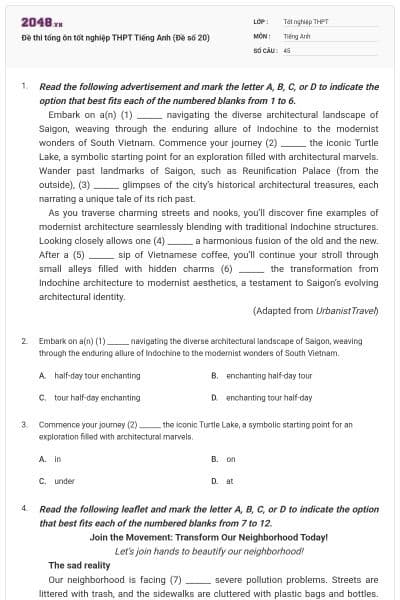
Read the following advertisement and mark the letter A, B, C, or D to indicate the option that best fits each of the numbered blanks from 1 to 6.
Embark on a(n) (1) ______ navigating the diverse architectural landscape of Saigon, weaving through the enduring allure of Indochine to the modernist wonders of South Vietnam. Commence your journey (2) ______ the iconic Turtle Lake, a symbolic starting point for an exploration filled with architectural marvels. Wander past landmarks of Saigon, such as Reunification Palace (from the outside), (3) ______ glimpses of the city’s historical architectural treasures, each narrating a unique tale of its rich past.
As you traverse charming streets and nooks, you’ll discover fine examples of modernist architecture seamlessly blending with traditional Indochine structures. Looking closely allows one (4) ______ a harmonious fusion of the old and the new. After a (5) ______ sip of Vietnamese coffee, you’ll continue your stroll through small alleys filled with hidden charms (6) ______ the transformation from Indochine architecture to modernist aesthetics, a testament to Saigon’s evolving architectural identity.
(Adapted from UrbanistTravel)
half-day tour enchanting
enchanting half-day tour
tour half-day enchanting
enchanting tour half-day
Kiến thức về trật tự từ
- enchanting /ɪnˈtʃɑːntɪŋ/ (adj): làm say mê, thu hút
- half-day /ˌhɑːf ˈdeɪ/ (adj): kéo dài nửa ngày
- tour /tʊə(r)/, /tɔː(r)/ (n): chuyến tham quan (danh từ đứng cuối)
*Ta có quy tắc trật tự tính từ OSASCOMP: Opinion - Size - Age -Shape - Color - Origin - Material - Purpose
→ Tính từ ‘enchanting’ thuộc nhóm Opinion đứng trước tính từ ‘half-day’ chỉ thời gian, có thể phân loại vào nhóm Age.
→ Trật tự đúng: enchanting half-day tour
Dịch: Bắt đầu một hành trình thú vị trong nửa ngày khám phá bức tranh kiến trúc đa dạng của Sài Gòn,...
Chọn B.
in
on
under
at
Kiến thức về giới từ
- Ta dùng giới từ ‘at’ (tại nơi nào đó) cho một địa điểm chi tiết có địa chỉ cụ thể, hoặc một công trình, địa điểm nào đó có tên tuổi hay vai trò cụ thể mà ai cũng biết.
Dịch: Chuyến đi khởi hành tại Hồ Con Rùa mang tính biểu tượng, mở ra một hành trình mãn nhãn với những kiệt tác kiến trúc.
Chọn D.
catching
doing
making
seeking
Kiến thức về cụm từ cố định
- Ta có cụm từ: catch a glimpse of sth - nhìn thoáng qua, lướt qua cái gì
Dịch: Dọc theo các địa danh nổi tiếng của Sài Gòn như Dinh Độc Lập (tham quan bên ngoài), bạn sẽ có cơ hội chiêm ngưỡng những công trình lịch sử,...
Chọn A.
to notice
notice
noticing
to noticing
Kiến thức về danh động từ và động từ nguyên mẫu:
- Ta có cấu trúc: allow sb to do sth - cho phép ai đó làm gì
Dịch: Quan sát kỹ hơn, bạn sẽ cảm nhận được sự kết hợp hài hòa giữa cái cũ và cái mới.
Chọn A.
refreshment
refreshing
refreshingly
refresh
Kiến thức về từ loại
A. refreshment /rɪ'freʃmənt/ (n): sự tỉnh táo; đồ uống
B. refreshing /rɪˈfreʃɪŋ/(adj): tỉnh táo, sảng khoái
C. refresh /rɪ'freʃ/ (v): làm mới, làm cho tỉnh táo
D. refreshingly /rɪˈfreʃɪŋli/(adv): một cách tỉnh táo, sảng khoái
- Căn cứ vào danh từ ‘sip’ ở sau vị trí cần điền, ta cần điền một tính từ: Adj + N.
Dịch: Sau khi thưởng thức một ly cà phê Việt Nam đầy sảng khoái,...
Chọn B.
you’ll continue your stroll through small alleys filled with hidden charms (6) ______ the transformation from Indochine architecture to modernist aesthetics, a testament to Saigon’s evolving architectural identity.
revealed
which reveals
which revealing
that reveal
Kiến thức về rút gọn mệnh đề quan hệ
- Trong một câu không thể có 2 động từ chính cùng chia theo thì của câu, động từ thứ hai phải ở trong MĐQH hoặc chia ở dạng rút gọn MĐQH.
- Ta loại C vì động từ trong MĐQH phải chia sao cho hoà hợp với thì của câu nên ‘revealing’ ở đây là sai.
- Ta loại luôn A vì ‘revealed’ chia quá khứ đơn không phù hợp với thì của câu cũng như ngữ cảnh bài đọc đang ở thời hiện tại.
- MĐQH bổ nghĩa cho danh từ số nhiều ‘charms’ nên động từ phải chia ở dạng số nhiều → loại B (‘reveals’ phải là ‘reveal’ mới đúng)
→ D dùng đại từ quan hệ ‘that’ hợp lý và chia đúng động từ, là đáp án chính xác nhất.
Dịch: ...bạn sẽ tiếp tục dạo bước qua những con hẻm nhỏ đầy duyên dáng, phác họa rõ nét sự chuyển mình của Sài Gòn từ kiến trúc Đông Dương sang phong cách hiện đại.
Chọn D.
Bài hoàn chỉnh:
Embark on an enchanting half-day tour navigating the diverse architectural landscape of Saigon, weaving through the enduring allure of Indochine to the modernist wonders of South Vietnam. Commence your journey atthe iconic Turtle Lake, a symbolic starting point for an exploration filled with architectural marvels. Wander past landmarks of Saigon, such as Reunification Palace (from the outside), catchingglimpses of the city’s historical architectural treasures, each narrating a unique tale of its rich past.
As you traverse charming streets and nooks, you’ll discover fine examples of modernist architecture seamlessly blending with traditional Indochine structures. Looking closely allows one to noticea harmonious fusion of the old and the new. After a refreshing sip of Vietnamese coffee, you’ll continue your stroll through small alleys filled with hidden charms that reveal the transformation from Indochine architecture to modernist aesthetics, a testament to Saigon’s evolving architectural identity.
Dịch bài đọc:
Bắt đầu một hành trình thú vị trong nửa ngày khám phá bức tranh kiến trúc đa dạng của Sài Gòn, nơi giao thoa giữa vẻ đẹp trường tồn của phong cách Đông Dương và những công trình hiện đại đặc trưng của miền Nam Việt Nam. Chuyến đi khởi hành tại Hồ Con Rùa mang tính biểu tượng, mở ra một hành trình mãn nhãn với những kiệt tác kiến trúc. Dọc theo các địa danh nổi tiếng của Sài Gòn như Dinh Độc Lập (tham quan bên ngoài), bạn sẽ có cơ hội chiêm ngưỡng những công trình lịch sử, mỗi nơi đều kể một câu chuyện riêng về quá khứ thịnh vượng của thành phố.
Bước qua những con phố và ngõ nhỏ đầy quyến rũ, bạn sẽ bắt gặp những công trình tiêu biểu cho kiến trúc hiện đại được hòa quyện một cách tinh tế với phong cách Đông Dương truyền thống. Quan sát kỹ hơn, bạn sẽ cảm nhận được sự kết hợp hài hòa giữa nét cổ điển và hơi thở đương đại. Sau khi thưởng thức một ly cà phê Việt Nam đầy sảng khoái, bạn sẽ tiếp tục dạo bước qua những con hẻm nhỏ đầy duyên dáng, phác họa rõ nét sự chuyển mình của Sài Gòn từ kiến trúc Đông Dương sang phong cách hiện đại—một minh chứng sống cho kiến trúc không ngừng phát triển của thành phố này.
Read the following leaflet and mark the letter A, B, C, or D to indicate the option that best fits each of the numbered blanks from 7 to 12.
Join the Movement: Transform Our Neighborhood Today!
Let’s join hands to beautify our neighborhood!
The sad reality
Our neighborhood is facing (7) ______ severe pollution problems. Streets are littered with trash, and the sidewalks are cluttered with plastic bags and bottles. Overflowing garbage bins release unpleasant (8) ______ and attract pests. This not only affects the beauty of our community but also harms the health of residents and the environment.
How we can help
• Always throw your trash into designated bins and separate recyclable (9) ______ from non-recyclable waste. This simple habit can significantly reduce the litter scattered around the neighborhood.
• Participate in monthly community events to (10) ______ the environment. Working together not only makes the (11) ______ faster but also strengthens our sense of community.
• Share the importance of keeping our surroundings clean with family, friends, and neighbors. A little encouragement can inspire many people to take action and (12) ______ environmentally friendly habits.
much
few
some
little
Kiến thức về lượng từ
A. much + N(không đếm được): nhiều
B. few + N(s/es): ít, không đủ
C. some + N(không đếm được)/ N(s/es): một chút, một số
D. little +N(không đếm được): ít
- Chỗ trống đứng trước danh từ số nhiều ‘problems’→ loại A, D; dựa vào nghĩa chọn C.
Dịch: Khu phố của chúng ta đang đối mặt với một vài vấn đề ô nhiễm nghiêm trọng.
Chọn C.
scents
odors
favors
perfumes
Kiến thức về từ vựng - từ cùng trường nghĩa
A. scent /sent/ (n): mùi thơm hoặc mùi hương, đặc biệt là mùi từ hoa, cây cỏ hoặc các vật thể có mùi dễ chịu
B. odor /'əʊ.dər/ (n): mùi hôi, khó chịu, một loại mùi có thể được cảm nhận bằng mũi
C. flavor /'fleɪ.vər/ (n): hương vị của thức ăn hoặc đồ uống, cảm nhận của mùi và vị khi chúng ta ăn hoặc uống
D. perfume /'pɜ:.fju:m/(n): nước hoa hoặc mùi hương thơm được tạo ra từ các hợp chất tự nhiên hoặc nhân tạo, thường dùng để xức lên cơ thể
Dịch: Các thùng rác đầy tràn bốc mùi khó chịu, thu hút côn trùng và chuột bọ.
Chọn B.
items
substances
aspects
resources
Kiến thức về từ vựng - từ cùng trường nghĩa
A. item /'aɪ.təm/(n): các món đồ, vật phẩm, hạng mục trong một danh sách, bộ sưu tập,...
B. substance /'sʌb.stəns/ (n): chất liệu hoặc vật chất, đặc biệt là trong hóa học hoặc vật lý
C. aspect /'æs.pekt/ (n): khía cạnh, mặt, phương diện của một vấn đề, sự kiện,...
D. resource /ri'zͻ:s/ (n): tài nguyên, đặc biệt là các nguồn lực cần thiết để thực hiện hoặc phát triển một cái gì đó
Dịch: Luôn vứt rác đúng nơi quy định và phân loại rác tái chế với rác không tái chế.
Chọn A.
take out
keep off
put away
clean up
Kiến thức về cụm động từ:
A. take out: mang ra ngoài, đem ra ngoài (thường là từ trong nhà ra ngoài)
B. keep off: tránh xamột khu vực hay vật gì đó
C. put away: cất đi, xếp vào chỗ cũ (thường dùng khi nói đến việc dọn dẹp hoặc cất giữ đồ đạc sau khi sử dụng)
D. clean up: dọn dẹp, làm sạch (thường dùng khi nói đến việc làm sạch hoặc tổ chức lại một không gian)
Dịch: Tham gia các hoạt động dọn dẹp môi trường mỗi tháng.
Chọn D.
period
process
routine
measure
Kiến thức về từ vựng - nghĩa của từ
A. period /'pɪə.ri.əd/ (n): khoảng thời gian nhất định, giai đoạn
B. process /'prəʊ.ses/ (n): quá trình, tiến trình
C. routine /ru:'ti:n/ (n): thói quen, công việc hàng ngày
D. measure /'meӡ.ər/ (n): đơn vị đo lường, biện pháp, phương pháp
Dịch: Làm việc cùng nhau không chỉ đẩy nhanh quá trình mà còn gắn kết tình làng nghĩa xóm.
Chọn B.
adjust
recruit
adopt
pursue
Kiến thức về từ vựng - nghĩa của từ:
A. adjust /ə'dӡʌst/ (v): điều chỉnh, thích nghi
B. recruit /rɪ'kru:t/ (v): tuyển dụng, chiêu mộ
C. adopt /ə'dɒpt/ (v): nhận nuôi; bắt đầu thói quen mới
D. pursue /pə'sju:/ (v): theo đuổi, đuổi theo
Dịch: Một lời khích lệ nhỏ có thể truyền cảm hứng để nhiều người hành động và hình thành thói quen sống xanh.
Chọn C.
Bài hoàn chỉnh:
Join the Movement: Transform Our Neighborhood Today!
Let’s join hands to beautify our neighborhood!
The sad reality
Our neighborhood is facing some severe pollution problems. Streets are littered with trash, and the sidewalks are cluttered with plastic bags and bottles. Overflowing garbage bins release unpleasant odors and attract pests. This not only affects the beauty of our community but also harms the health of residents and the environment.
How we can help
• Always throw your trash into designated bins and separate recyclable items from non-recyclable waste. This simple habit can significantly reduce the litter scattered around the neighborhood.
• Participate in monthly community events to clean up the environment. Working together not only makes the process faster but also strengthens our sense of community.
• Share the importance of keeping our surroundings clean with family, friends, and neighbors. A little encouragement can inspire many people to take action and adopt environmentally friendly habits.
Dịch bài đọc:
Hãy hành động: Cùng biến khu phố của chúng ta trở nên đẹp hơn!
Chung tay làm đẹp khu phố ngay hôm nay!
Thực trạng đáng buồn
Khu phố của chúng ta đang đối mặt với một vài vấn đề ô nhiễm nghiêm trọng. Rác thải vương vãi khắp đường phố, vỉa hè đầy những túi ni lông và chai nhựa. Các thùng rác quá tải bốc mùi khó chịu, thu hút côn trùng và chuột bọ. Không chỉ làm mất mỹ quan đô thị, tình trạng này còn ảnh hưởng đến sức khỏe của cư dân và môi trường sống.
Chúng ta có thể làm gì?
- Luôn vứt rác đúng nơi quy định và phân loại rác tái chế với rác không tái chế. Thói quen nhỏ này có thể giúp giảm đáng kể lượng rác thải xung quanh khu phố.
- Tham gia các hoạt động dọn dẹp cộng đồng mỗi tháng. Làm việc cùng nhau không chỉ đẩy nhanh quá trình mà còn gắn kết tình làng nghĩa xóm.
- Chia sẻ ý thức bảo vệ môi trường với gia đình, bạn bè và hàng xóm. Một lời khích lệ nhỏ có thể truyền cảm hứng để nhiều người hành động và hình thành thói quen sống xanh.
Mark the letter A, B, C, or D to indicate the best arrangement of sentences to make a meaningful exchange or text in each of the following questions from 13 to 17.
a. Mark: Manchester City has lost four games in a row. What’s going on?
b. Mark: Yeah, but they need to bounce back quickly if they want to stay competitive in the league.
c. Brown: It’s really surprising. They’ve been struggling with injuries, and their defense hasn’t been solid.
a-c-b
c-a-b
b-a-c
a-b-c
Kiến thức về sắp xếp câu tạo thành đoạn hội thoại
Thứ tự sắp xếp đúng:
a. Mark: Manchester City has lost four games in a row. What’s going on?
c. Brown: It’s really surprising. They’ve been struggling with injuries, and their defense hasn’t been solid.
b. Mark: Yeah, but they need to bounce back quickly if they want to stay competitive in the league.
Dịch:
a. Mark: Manchester City đã thua bốn trận liên tiếp rồi. Chuyện gì đang xảy ra vậy?
c. Brown: Bất ngờ đấy. Họ đang gặp khó khăn vì chấn thương, hàng phòng ngự của họ cũng không chắc chắn lắm.
b. Mark: Đúng, nhưng họ cần phải vực dậy nhanh thôi nếu vẫn muốn cạnh tranh cho một vị trí tốt trong giải đấu.
Chọn A.
a. Daniel: I think it’s fascinating. A city where everything is connected - traffic, utilities, security - could make life so much more efficient.
b. Emma: I’ve been reading about smart cities. What do you think about the idea of living
in one?
c. Emma: I agree! And with renewable energy and green spaces, it could also be much more sustainable.
d. Emma: Same here. It’s the future we should aim for.
e. Daniel: Exactly! A city that works for the people and the planet. I’d love to see that kind of development in the future.
c-a-d-e-b
c-e-b-a-d
b-a-c-e-d
b-e-d-a-c
Kiến thức về sắp xếp câu tạo thành đoạn hội thoại
Thứ tự sắp xếp đúng:
b. Emma: I’ve been reading about smart cities. What do you think about the idea of living in one?
a. Daniel: I think it’s fascinating. A city where everything is connected-traffic, utilities, security-could make life so much more efficient.
c. Emma: I agree! And with renewable energy and green spaces, it could also be much more sustainable.
e. Daniel: Exactly! A city that works for the people and the planet. I’d love to see that kind of development in the future.
d. Emma: Same here. It’s the future we should aim for.
Dịch:
b. Emma: Mình dạo này đang đọc về các thành phố thông minh. Cậu nghĩ gì về ý tưởng sống trong một thành phố như vậy?
a. Daniel: Mình nghĩ sẽ thú vị lắm. Một thành phố nơi mọi thứ đều được kết nối, từ giao thông, tiện ích, cho đến an ninh, sẽ làm cho cuộc sống trở nên tiện lợi hơn nhiều.
c. Emma: Đồng ý! Và nếu sử dụng năng lượng tái tạo và có các không gian xanh, thành phố đó cũng sẽ bền vững hơn rất nhiều.
e. Daniel: Chính xác! Một thành phố có lợi cho con người và hành tinh. Mình rất mong được thấy sự phát triển như vậy trong tương lai.
d. Emma: Ừ, đó là một tương lai mà chúng ta nên hướng đến.
Chọn C.
Dear Emily,
a. It’s inspiring to see your passion for music recognized on such a prestigious platform.
b. I was delighted to hear that you won the piano competition this year.
c. I am certain this is just the beginning of many more successes in your musical journey.
d. Your dedication and countless hours of practice have truly paid off with this incredible achievement.
e. This victory not only reflects your talent but also your determination to excel.
Warm regards,
Jessica
c-b-a-d-e
b-d-a-e-c
a-e-c-d-b
e-c-b-d-a
Kiến thức về sắp xếp câu tạo thành lá thư
Thứ tự sắp xếp đúng:
Dear Emily,
b. I was delighted to hear that you won the piano competition this year.
d. Your dedication and countless hours of practice have truly paid off with this incredible achievement.
a. It’s inspiring to see your passion for music recognized on such a prestigious platform.
e. This victory not only reflects your talent but also your determination to excel.
c. I am certain this is just the beginning of many more successes in your musical journey.
Warm regards,
Jessica
Dịch:
Thân gửi Emily,
b. Mình rất vui khi nghe tin cậu đã giành chiến thắng trong cuộc thi piano năm nay.
d. Sự tận tâm và những giờ luyện tập không ngừng nghỉ của cậu thực sự đã được đền đáp bằng thành tựu tuyệt vời này.
a. Nhìn thấy niềm đam mê âm nhạc của cậu được công nhận trên một sân khấu danh giá như vậy, mình thấy được truyền cảm hứng rất nhiều.
e. Chiến thắng này không chỉ là minh chứng cho tài năng mà còn cả quyết tâm vươn đến vị trí cao hơn của cậu.
c. Mình tin chắc đây sẽ chỉ là khởi đầu cho nhiều thành công hơn nữa trên hành trình âm nhạc của cậu trong tương lai.
Thân mến, Jessica
Chọn B.
a. The role of water is crucial in many bodily functions, from regulating body temperature and preserving normal organ function to delivering nutrients to cells and preventing infections.
b. For men, that amount sits at approximately 13 cups per day, while women should drink at least 9 glasses of water daily.
c. Failure to consume an adequate amount of water can lead to dehydration, which may lead to serious complications, such as urinary and kidney problems, seizures, or low blood volume shock.
d. Furthermore, it can impact sleep quality, mood, and cognition, so consuming plenty of water daily is vital.
e. Water makes up a considerable portion of the body, accounting for 60% and 55% of the body in adult men and women, respectively.
(Adapted from piurify.com)
e-d-b-c-a
e-d-e-b-c
e-a-c-d-b
e-a-d-b-c
Kiến thức về sắp xếp câu tạo thành đoạn văn
Thứ tự sắp xếp đúng:
e. Water makes up a considerable portion of the body, accounting for 60% and 55% of the body in adult men and women, respectively.
a. The role of water is crucial in many bodily functions, from regulating body temperature and preserving normal organ function to delivering nutrients to cells and preventing infections.
d. Furthermore, it can impact sleep quality, mood, and cognition, so consuming plenty of water daily is vital.
b. For men, that amount sits at approximately 13 cups per day, while women should drink at least nine glasses of water daily.
c. Failure to consume an adequate amount of water can lead to dehydration, which may lead to serious complications, such as urinary and kidney problems, seizures, or low blood volume shock.
Dịch:
e. Nước chiếm một phần đáng kể trong cơ thể, cụ thể là 60% ở nam giới trưởng thành và 55% ở nữ giới trưởng thành.
a. Vai trò của nước rất quan trọng trong nhiều chức năng của cơ thế, từ điều chỉnh nhiệt độ cơ thể, giúp các cơ quan hoạt động bình thường, cho đến vận chuyển dưỡng chất đến các tế bào và ngăn ngừa nhiễm trùng.
d. Thêm vào đó, nước có thể ảnh hưởng đến chất lượng giấc ngủ, tâm trạng và khả năng nhận thức, vì vậy uống đủ nước mỗi ngày là rất quan trọng.
b. Với nam giới, lượng nước cần nạp vào người là khoảng 13 cốc/ngày, trong khi nữ giới nên uống ít nhất 9 cốc/ngày.
c. Không uống đủ lượng nước cần thiết có thể dẫn đến mất nước, gây ra các biến chứng nghiêm trọng như vấn đề đường tiết niệu và thận, co giật hoặc sốc do thể tích máu thấp.
Chọn D.
a. Vietnam and Japan have cultivated a strong partnership that has evolved significantly over time.
b. In recent years, cultural and educational exchanges have flourished as thousands of Vietnamese students have chosen to study in Japan, while Japanese culture has gained a strong presence in Vietnam.
c. Over the decades, this relationship expanded, with Japan becoming one of Vietnam’s largest trade partners and investors, particularly in infrastructure projects like bridges and metro systems.
d. Overall, their collaboration today spans numerous fields, reflecting a strong and enduring partnership built on trust and mutual benefit.
e. Their cooperation began in the 1970s with development aid and technical support provided by Japan to help rebuild Vietnam after the war.
a-d-c-b-e
a-b-e-d-c
a-c-e-d-b
a-e-c-b-d
Kiến thức về sắp xếp trật tự câu tạo thành đoạn văn
Thứ tự sắp xếp đúng:
a. Vietnam and Japan have cultivated a strong partnership that has evolved significantly over time.
e. The cooperation began in the 1970s with development aid and technical support provided
by Japan to help rebuild Vietnam after the war.
c. Over the decades, this relationship expanded, with Japan becoming one of Vietnam’s largest trade partners and investors, particularly in infrastructure projects like bridges and metro systems.
b. In recent years, cultural and educational exchanges have flourished as thousands of Vietnamese students have chosen to study in Japan, while Japanese culture has gained a strong presence in Vietnam.
d. Overall, their collaboration today spans numerous fields, reflecting a strong and enduring partnership built on trust and mutual benefit.
Dịch:
a. Việt Nam và Nhật Bản đã xây dựng một mối quan hệ đối tác vững mạnh, không ngừng phát triển qua thời gian.
e. Sự hợp tác giữa hai nước bắt đầu từ những năm 1970, khi Nhật Bản cung cấp viện trợ phát triển và hỗ trợ kỹ thuật giúp Việt Nam tái thiết sau chiến tranh.
c. Qua nhiều thập kỷ, mối quan hệ hợp tác ngày càng mở rộng, với việc Nhật Bản trở thành một trong những đối tác thương mại và nhà đầu tư lớn nhất của Việt Nam, đặc biệt trong các dự án hạ tầng như cầu đường và hệ thống tàu điện ngầm.
b. Những năm gần đây, các hoạt động giao lưu văn hóa và giáo dục giữa hai nước ngày càng phát triển, hàng ngàn du học sinh Việt Nam chọn học tập tại Nhật và văn hóa Nhật Bản ngày càng có chỗ đứng vững chắc tại Việt Nam.
d. Nhìn chung, sự hợp tác ngày nay trải rộng trên nhiều lĩnh vực, thể hiện mối quan hệ đối tác bền chặt và lâu dài của hai nước xây dựng trên nền tảng tin cậy và lợi ích chung.
Chọn D.
Read the following passage about The Red Cross and mark the letter A, B, C, or D to indicate the option that best fits each of the numbered blanks from 18 to 22.
There are many humanitarian organizations worldwide dedicated to improving lives and providing support to those in need. The Red Cross, as an example, (18) ______. Founded in 1863 by Henry Dunant, the organization focuses on alleviating human suffering and promoting health. It operates in over 190 countries worldwide, making it one of the largest humanitarian networks.
One of the Red Cross’s most notable achievements is its emergency response program, (19) ______. The organization maintains a global network of volunteers and resources to ensure quick and effective action during crises. (20) ______. In many cases, their efforts have saved countless lives and helped rebuild communities.
The Red Cross also prioritizes public health education and preparedness. (21) ______. In addition to these efforts, the organization frequently collaborates with governments and NGOs to implement large-scale health initiatives. Providing aid and fostering resilience, (22) ______. Its unwavering commitment to humanity, guided by principles of impartiality and independence, inspires people worldwide.
whose role in providing humanitarian aid during natural disasters and conflicts is important
having played a crucial role in providing humanitarian aid during natural disasters and conflicts
plays a crucial role in providing humanitarian aid during natural disasters and conflicts
which plays a crucial role in providing humanitarian aid during natural disasters and conflicts
Kiến thức về cấu trúc câu
- Ta có cấu trúc của một mệnh đề độc lập: S + V ... Căn cứ vào vị trí chỗ trống, ta thấy câu đã có chủ ngữ là ‘The Red Cross’ và chưa có động từ chính.
→ Ta cần một động từ chính hòa hợp với chủ ngữ để tạo thành câu hoàn chỉnh.
→ Loại A, D (ta không dùng MĐQH); loại B (ta không dùng rút gọn động từ ở dạng phân từ hoàn thành).
Dịch: Lấy ví dụ Hội Chữ Thập Đỏ là một tổ chức đóng vai trò quan trọng trong việc cung cấp viện trợ nhân đạo khi xảy ra các thảm họa thiên nhiên và xung đột.
Chọn C.
that provided immediate relief to disaster-stricken areas
which provides immediate relief to disaster-stricken areas
offers immediate relief for disaster-stricken areas
provides immediate relief to disaster-stricken areas
Kiến thức về mệnh đề quan hệ.
- Căn cứ vào câu chứa chỗ trống đã có to-be là động từ chính được chia theo thì của câu, vì vậy chỗ trống ta cần một MĐQH hoặc động từ chia theo rút gọn MĐQH.
→ Loại C (động từ ‘offers’) và D (động từ ‘provides’) đều chia theo hiện tại đơn giống động từ chính.
→ Loại luôn A vì chia quá khứ đơn thì xung đột về thì với động từ chính.
Dịch: Một trong những thành tựu đáng chú ý nhất của Hội Chữ Thập Đỏ là chương trình phản ứng khẩn cấp với mục đích cung cấp viện trợ tức thì cho các khu vực bị ảnh hưởng bởi thiên tai.
Chọn B.
Receiving essential supplies, medical care, and emotional support, this approach supports affected individuals
Essential supplies, medical care, and emotional support are provided by affected individuals through this approach
Affected individuals can use this approach to be given essential supplies, medical care, and emotional support
This approach helps affected individuals receive essential supplies, medical care, and emotional support
Kiến thức về mệnh đề độc lập - nghĩa của câu
*Xét các đáp án:
A. Khi nhận được các nhu yếu phẩm, chăm sóc y tế, và hỗ trợ tinh thần, cách tiếp cận này hỗ trợ các cá nhân bị ảnh hưởng.
→ Mệnh đề trước dấu phẩy lược bỏ đi chủ ngữ tức có cùng chủ ngữ với mệnh đề chính → sai ngữ pháp vì ‘cách tiếp cận’ không thể là đối tượng ‘nhận được các nhu yếu phẩm’.
B. Các nhu yếu phẩm, chăm sóc y tế, và hỗ trợ tinh thần được cung cấp bởi các cá nhân bị ảnh hưởng thông qua cách tiếp cận này.
→ Hoàn toàn không logic về nghĩa, những người bị ảnh hưởng thì nhận được sự giúp đỡ chứ họ không thể đang khó khăn mà giúp ngược lại người khác được.
C. Các cá nhân bị ảnh hưởng có thể sử dụng cách tiếp cận này để được cung cấp các nhu yếu phẩm, chăm sóc y tế, và hỗ trợ tinh thần.
→ Không logic về nghĩa, cách diễn đạt này cho rằng những người bị ảnh hưởng có thể chủ động tìm kiếm sự giúp đỡ, nhưng thực tế là họ ở thế bị động, cần người khác đến giúp.
D. Cách tiếp cận này giúp các cá nhân bị ảnh hưởng nhận được các nhu yếu phẩm, chăm sóc y tế, và hỗ trợ tinh thần.
→ Lựa chọn hợp lý nhất, cho thấy sự chủ động cần thiết của Hội Chữ Thập Đỏ để giúp đỡ những người rơi vào bế tắc.
Dịch: Tổ chức duy trì một mạng lưới toàn cầu gồm các tình nguyện viên và nguồn lực để đảm bảo hành động kịp thời và hiệu quả khi xảy ra khủng hoảng. Cách tiếp cận này giúp các cá nhân bị ảnh hưởng nhận được vật phẩm thiết yếu, chăm sóc y tế và hỗ trợ tinh thần.
Chọn D.
It conducts training sessions on first aid, disaster readiness, and disease prevention, benefiting millions of people annually
Organizing training sessions on first aid, disaster readiness, and disease prevention, for millions of people annually can have benefits
Millions of people annually make a profit so that the organization conducts training sessions on first aid, disaster readiness, and disease prevention
Except for training sessions on first aid, disaster readiness, and disease prevention, millions of people annually can benefit from it
Kiến thức về mệnh đề độc lập - nghĩa của câu:
*Xét các đáp án:
A. Tổ chức này tiến hành các buổi đào tạo về sơ cứu, sẵn sàng đối phó thảm họa và phòng ngừa dịch bệnh, mang lại lợi ích cho hàng triệu người mỗi năm.
B. Bằng cách tiến hành các buổi đào tạo về sơ cứu, sẵn sàng đối phó thảm họa và phòng ngừa dịch bệnh, hàng triệu người mỗi năm có thể nhận được lợi ích.
→ Rút gọn đồng chủ ngữ, sai ngữ pháp vì ‘hàng triệu người’ là phải đối tượng hưởng lợi từ tổ chức, không thể tự ‘tiến hành các buổi đào tạo về sơ cứu’.
C. Hàng triệu người mỗi năm kiếm được lợi nhuận nhờ việc tổ chức này tiến hành các buổi đào tạo về sơ cứu, sẵn sàng đối phó thảm họa và phòng ngừa dịch bệnh.
→ Hoàn toàn không logic về nghĩa, tổ chức giúp đỡ những người gặp hoàn cảnh khó khăn vượt qua khó khăn, chứ không phải giúp họ kiếm tiền.
D. Ngoài các buổi đào tạo về sơ cứu, sẵn sàng đối phó thảm họa và phòng ngừa dịch bệnh, hàng triệu người mỗi năm có thể hưởng lợi từ tổ chức này.
→ Không logic về nghĩa, vì chính đào tạo sơ cứu hay đối phó thảm họa là mục đích chính của tổ chức và hàng triệu người hưởng lợi từ đó chứ không từ đâu khác.
Dịch: Hội Chữ Thập Đó cũng ưu tiên giáo dục y tế cộng đồng và chuẩn bị đối phó. Tổ chức này tiến hành các buổi đào tạo về sơ cứu, sẵn sàng ứng phó thảm họa và phòng ngừa dịch bệnh, mang lại lợi ích cho hàng triệu người mỗi năm.
Chọn A.
communities are encouraged to overcome adversity with the help of the Red Cross
adversity can be overcome thanks to the Red Cross
individuals can call for the help of the Red Cross to overcome adversity
the Red Cross empowers communities to overcome adversity
Kiến thức về phân từ hiện tại, phân từ hoàn thành
- Ta thấy trước chỗ trống có cấu trúc V-ing..., S + V, và mệnh đề này lược bỏ đi chủ ngữ → MĐTN có cùng chủ ngữ với mệnh đề chính.
- Ta xác định được chủ ngữ của V-ing, hay chính là đối tượng ‘cung cấp trợ cấp’ chính là tổ chức Hội Chữ Thập Đỏ.
→ loại A (chủ ngữ ‘communities’ - các cộng đồng), B (chủ ngữ ‘adversity’ - nghịch cảnh), và D (chủ ngữ ‘individuals’ - các cá nhân).
Dịch: ... tổ chức còn thường xuyên hợp tác với các chính phủ và tổ chức phi chính phủ để thực hiện các sáng kiến y tế quy mô lớn. Cung cấp trợ cấp và thúc đẩy khả năng phục hồi, Hội Chữ Thập Đỏ trao quyền cho cộng đồng để vượt qua nghịch cảnh.
Chọn D.
Bài hoàn chỉnh:
There are many humanitarian organizations worldwide dedicated to improving lives and providing support to those in need. The Red Cross, as an example, plays a crucial role in providing humanitarian aid during natural disasters and conflicts. Founded in 1863 by Henry Dunant, the organization focuses on alleviating human suffering and promoting health. It operates in over 190 countries worldwide, making it one of the largest humanitarian networks.
One of the Red Cross’s most notable achievements is its emergency response program, which provides immediate relief to disaster-stricken areas. The organization maintains a global network of volunteers and resources to ensure quick and effective action during crises. This approach helps affected individuals receive essential supplies, medical care, and emotional support. In many cases, their efforts have saved countless lives and helped rebuild communities.
The Red Cross also prioritizes public health education and preparedness. It conducts training sessions on first aid, disaster readiness, and disease prevention, benefiting millions of people annually. In addition to these efforts, the organization frequently collaborates with governments and NGOs to implement large-scale health initiatives. Providing aid and fostering resilience, the Red Cross empowers communities to overcome adversity. Its unwavering commitment to humanity, guided by principles of impartiality and independence, inspires people worldwide.
Dịch bài đọc:
Có rất nhiều tổ chức nhân đạo trên thế giới tận tâm cải thiện cuộc sống và hỗ trợ những người gặp khó khăn. Một ví dụ điển hình là Hội Chữ thập đỏ, tổ chức đóng vai trò quan trọng trong việc cứu trợ nhân đạo khi xảy ra thiên tai và xung đột. Được thành lập vào năm 1863 bởi Henry Dunant, tổ chức này có sứ mệnh giảm thiểu nỗi đau khổ cho con người và thúc đẩy y tế. Hoạt động tại hơn 190 quốc gia, Hội Chữ thập đỏ là một trong những mạng lưới nhân đạo lớn nhất thế giới.
Một trong những thành tựu nổi bật nhất của Hội Chữ thập đỏ là chương trình ứng phó khẩn cấp, cung cấp viện trợ ngay lập tức cho các khu vực chịu thiên tai. Nhờ mạng lưới tình nguyện viên và nguồn lực rộng khắp, tổ chức có thể hành động nhanh chóng và hiệu quả trong các cuộc khủng hoảng. Cách tiếp cận này giúp những người bị ảnh hưởng nhận được nhu yếu phẩm, chăm sóc y tế và hỗ trợ về mặt tinh thần kịp thời. Trong nhiều trường hợp, nỗ lực của họ đã cứu sống vô số người và góp phần tái thiết cộng đồng.
Bên cạnh hoạt động cứu trợ, Hội Chữ thập đỏ còn chú trọng nâng cao nhận thức về sức khỏe cộng đồng và khả năng ứng phó với thảm họa. Tổ chức thường xuyên tổ chức các khóa đào tạo về sơ cứu, chuẩn bị đối phó thiên tai và phòng chống dịch bệnh, mang lại lợi ích cho hàng triệu người mỗi năm. Ngoài ra, Hội Chữ thập đỏ còn hợp tác chặt chẽ với chính phủ và các tổ chức phi chính phủ (NGO) để triển khai các chương trình y tế quy mô lớn. Hỗ trợ cứu trợ và giúp xây dựng khả năng phục hồi, tổ chức này trao quyền cho các cộng đồng để vượt qua khó khăn. Cam kết bền bỉ với tinh thần nhân đạo và được dẫn dắt bởi các nguyên tắc công bằng, độc lập, Hội Chữ thập đỏ đã truyền cảm hứng cho hàng triệu người trên khắp thế giới.
Read the following passage about K-pop and mark the letter A, B, C, or D to indicate the option that best fits each of the following questions from 23 to 30.
K-pop, or Korean pop music, has become a global phenomenon in recent years, sweeping across continents and attracting millions of fans worldwide. This genre, known for its catchy beats, high-energy performances, and stunning visuals, has garnered a massive following far beyond South Korea. K-pop groups such as BTS, BLACKPINK, and EXO have amassed dedicated fanbases, known as ‘ARMY’, ‘Blinks’ and ‘EXO-L’, who passionately support their favorite artists both online and at live events.
The rise of K-pop is not just a passing trend; it’s a cultural movement that has changed the landscape of global music. Social media platforms like Twitter, Instagram, and YouTube have played a crucial role in magnifying the reach of K-pop, allowing fans from all over the world to connect and share their love for the music. Through these platforms, K-pop groups are able to interact with their fans in real-time, creating a sense of community and engagement that transcends borders.
What sets K-pop apart from other music genres is its fusion of various musical styles, including pop, hip-hop, R&B, and EDM. This blend of genres has allowed K-pop to appeal to a wide range of listeners, regardless of their cultural background. Additionally, the emphasis on impressive choreography and visually striking music videos has set new standards for performance in the global music industry. As K-pop continues to grow in popularity, it is clear that the genre’s influence on the music industry will only continue to expand.
K-pop’s success has also had a significant cultural impact, promoting Korean language, fashion, and even food worldwide. What began as a niche genre has now become a dominant force in global music. K-pop artists are collaborating with international stars and performing on world stages. The genre’s global influence shows no signs of slowing down, marking the rise of a new era in popular music.
According to paragraph 1, which of the following is NOT mentioned as a feature known of the K-pop genre?
infectious melodies
striking visuals
international tours
dynamic performances
Kiến thức về tìm thông tin trong bài
Theo đoạn 1, cái nào KHÔNG được đề cập đến như một đặc điểm nổi bật của K-pop?
A. giai điệu lôi cuốn B. hình ảnh ấn tượng
C. các chuyến lưu diễn quốc tế D. các màn trình diễn năng động
Thông tin: This genre, known for its catchy beats, high-energy performances, and stunning visuals,... (Thể loại này, được biết đến với nhịp điệu hấp dẫn, màn trình diễn năng lượng cao và hình ảnh tuyệt đẹp,...)
→ ‘infectious melodies’ = ‘catchy beats’ (A), ‘striking visuals’ = ‘stunning visuals’ (B), ‘dynamic performances’ = ‘high-energy performances’ (D) → chỉ C không được nhắc tới.
Chọn C.
The word ‘garnered’ in paragraph 1 could be best replaced by ______.
dispersed
suffered
acquired
neglected
Kiến thức về từ vựng gần nghĩa
Từ ‘garnered’ trong đoạn 1 có thể được thay thế bằng ______.
- garner /ˈɡɑːnə(r)/ (v) = to obtain or collect sth such as information, support, etc. (Oxford): kiếm được thông tin, sự ủng hộ,...
A. disperse /dɪ'spɜ:s/ (v): phân tán, rải rác
B. suffer /'sʌfə(r)/ (v): chịu đựng
C. acquire /ə'kwaɪə(r)/ (v): giành được
D. neglect /nɪ'glekt/ (v): từ chối
Thông tin: This genre, known for its catchy beats, high-energy performances, and stunning visuals, has garnered a massive following far beyond South Korea. (Thể loại nhạc này nổi tiếng với nhịp điệu hấp dẫn, cácmàn trình diễn đầy năng lượng và hình ảnh tuyệt đẹp, đã thu về lượng người theo dõi đông đảo vượt ra ngoài biên giới Hàn Quốc.)
→ garnered = acquired.
Chọn C.
The word ‘their’ in paragraph 2 refers to ______.
platforms
K-pop groups
fans
borders
Kiến thức về từ quy chiếu
Từ ‘their’ trong đoạn 2 đề cập tới ______.
A. nền tảng B. nhóm nhạc K-pop C. người hâm mộ D. biên giới
Thông tin: Through these platforms, K-pop groups are able to interact with their fans in real-time, creating a sense of community and engagement that transcends borders. (Thông qua các nền tảng này, các nhóm nhạc Kpop có thểtương tác với người hâm mộ của họ theo thời gian thực, tạo ra cảm giác cộng đồng và gắn kết vượt biên giới.)
→ their = K-pop groups
Chọn B.
The word ‘various’ in paragraph 3 is OPPOSITE in meaning to ______.
similar
different
diverse
numerous
Kiến thức về từ vựng trái nghĩa
Từ ‘various’ ở đoạn 3 TRÁI nghĩa với ______.
A. similar /'sɪmələ(r)/ (adj): tương tự, tương đồng
B. different /'dɪfrənt/ (adj): khác nhau
C. diverse /daɪ'vз:s/ (adj): đa dạng
D. numerous /'nju:mərəs/ (adj): nhiều
Thông tin: What sets K-pop apart from other music genres is its fusion of various musical styles, including pop, hip-hop, R&B, and EDM. (Điều khiến Kpop khác biệt so với các thể loại nhạc khác là sự kết hợp của nhiều phong cách âm nhạc khác nhau, bao gồm nhạc pop, hip-hop, R&B và EDM.)
→ various >< similar
Chọn A.
Which of the following best paraphrases underlined sentence in paragraph 4?
K-pop artists, who initially had a limited following, have now expanded their influence.
Despite its global success, K-pop is still considered a niche genre by many fans.
K-pop was initially a niche genre that only a few people enjoyed, and now it’s still unpopular.
K-pop, which was once a minor genre, is now at the forefront of global music.
Kiến thức về paraphrasing
Câu nào sau đây diễn giải lại gần nghĩa nhất câu được gạch chân ở đoạn 4 ?
*Câu gạch chân: What began as a niche genre has now become a dominant force in global music. (Những gì bắt đầu như một thể loại nhỏ giờ đã trở thành một thế lực thống trị trong nền âm nhạc toàn cầu.)
*niche /niːʃ/, /nɪtʃ/ (adj) = (of products, services or interests) appealing to only a small section of the population (Oxford): chỉ một phân khúc nhỏ của thị trường rộng lớn hơn
A. Các nghệ sĩ K-pop ban đầu chỉ có lượng người theo dõi hạn chế nay đã mở rộng tầm ảnh hưởng → không phù hợp do câu gốc không nói về các nghệ sĩ K-pop.
B. Mặc dù thành công trên toàn cầu, K-pop vẫn được nhiều người hâm mộ coi là một thể loại ngách → không phù hợp vì câu gốc nói rằng giờ đây K-pop đã là một thế lực lớn.
C. K-pop ban đầu là một thể loại nhỏ mà chỉ một số ít người thích, và giờ đây vẫn không được ưa chuộng → trái ngược hoàn toàn nghĩa của câu.
D. K-pop từng là một thể loại nhỏ nay đang đi đầu trong nền âm nhạc toàn cầu → dùng các cụm từ đồng nghĩa ‘minor genre’ = ‘niche genre’ và ‘at the forefront’ = ‘a dominant force’.
*at the forefront of sth (idiom) = in or into an important or leading position in a particular group or activity (Oxford): đi đầu, nắm giữ vị trí quan trọng
Chọn D.
Which of the following is TRUE according to the passage?
K-pop’s success is mainly due to its influence on fashion and food worldwide.
K-pop groups have gained a large following globally due to the influence of social media.
K-pop’s success can be attributed solely to its striking music videos.
K-pop’s global influence is limited to the music industry without affecting other cultural aspects.
Kiến thức về thông tin true/not true
Ý nào sau đây là ĐÚNG theo bài văn ?
A. Thành công của K-pop chủ yếu là do ảnh hưởng đến thời trang và ẩm thực trên toàn cầu.
B. Các nhóm nhạc K-pop đã thu hút được lượng người theo dõi lớn trên toàn cầu nhờ ảnh hưởng của mạng xã hội.
C. Thành công của K-pop chỉ có thể được quy cho các video âm nhạc bắt mắt.
D. Ảnh hưởng toàn cầu của K-pop chỉ giới hạn trong ngành công nghiệp âm nhạc mà không có tác động đến các khía cạnh văn hóa khác.
Thông tin:
- Social media platforms like Twitter, Instagram, and YouTube have played a crucial role in magnifying the reach of K-pop, allowing fans from all over the world to connect and share their love for the music. (Các nền tảng mạngxã hội như Twitter, Instagram và YouTube đóng một vai trò quan trọng trong việc khuếch đại phạm vi tiếp cận của K-pop, cho phép người hâm mộ từ khắp nơi trên thế giới kết nối và chia sẻ tình yêu của họ dành cho âm nhạc.) → B đúng.
*magnify /ˈmæɡnɪfaɪ/ (v) = to make sth bigger, louder or stronger: làm to hơn, mạnh hơn
- K-pop’s success has also had a significant cultural impact, promoting Korean language, fashion, and even food worldwide. (Thành công của K-pop cũng đã có tác động văn hóa đáng kể như tạo động lực học tiếng Hàn, thúc đẩy thời trang và quảng bá ẩm thực trên toàn thế giới)
→ D sai; A cũng sai do đảo ngược mối quan hệ nhân quả: K-pop thành công mới thu hút người hâm mộ quan tâm đến các khía cạnh văn hóa khác của Hàn Quốc chứ không phải do K-pop có ảnh hưởng đến các yếu tố khác rồi mới thành công.
- Additionally, the emphasis on impressive choreography and visually striking music videos has set new standards for performance in the global music industry. (Ngoài ra, sự nhấn mạnh vào vũ đạo ấn tượng và video âm nhạc bắt mắt đã đặt ra các tiêu chuẩn mới cho màn trình diễn trong ngành công nghiệp âm nhạc toàn cầu.)
→ Câu trên nhắc đến hai yếu tố dẫn đến thành công của K-pop, không phải chỉ nhờ MV đẹp → C sai.
Chọn B.
In which paragraph does the writer mention a complementary relationship that helps distinguish K-pop from others?
Paragraph 1
Paragraph 2
Paragraph 3
Paragraph 4
In which paragraph does the writer mention the cooperation between K-pop artists and musicians from other countries?
Paragraph 1
Paragraph 2
Paragraph 3
Paragraph 4
Kiến thức về tìm thông tin trong bài
Trong đoạn văn nào tác giả nhắc tới sự kết hợp giữa các nghệ sĩ K-pop và các nghệ sĩ từ những nước khác?
Đoạn 4: K-pop artists are collaborating with international stars and performing on world stages. (Các nghệ sĩ K-pop đang hợp tác với các ngôi sao quốc tế và biểu diễn trên các sân khấu thế giới.)
Chọn D.
Dịch bài đọc:
K-pop, hay nhạc pop Hàn Quốc, đã trở thành một hiện tượng toàn cầu trong những năm gần đây, lan rộng khắp các châu lục và thu hút hàng triệu người hâm mộ trên toàn thế giới. Thể loại nhạc này nổi tiếng với nhịp điệu hấp dẫn, màn trình diễn đầy năng lượng và hình ảnh tuyệt đẹp, đã thu về lượng người theo dõi đông đảo vượt ra ngoài phạm vi Hàn Quốc. Các nhóm nhạc K-pop như BTS, BLACKPINK và EXO đã thu hút được lượng người hâm mộ trung thành, gọi là ‘ARMY’, ‘Blinks’, và ‘EXO-L’, những người ủng hộ nhiệt tình các nghệ sĩ yêu thích của họ cả trên mạng và tại các sự kiện offline.
Sự trỗi dậy của K-pop không chỉ là xu hướng nhất thời; đó là một phong trào văn hóa đã và đang thay đổi bối cảnh âm nhạc toàn cầu. Các nền tảng mạng xã hội như Twitter, Instagram và YouTube đóng một vai trò quan trọng trong việc mở rộng phạm vi tiếp cận của K-pop, cho phép người hâm mộ từ khắp nơi trên thế giới kết nối và chia sẻ tình yêu của họ dành cho âm nhạc. Thông qua các nền tảng này, các nhóm nhạc K-pop có thể tương tác với người hâm mộ của họ theo thời gian thực, tạo ra cảm giác cộng đồng và gắn kết vượt qua biên giới.
Điều khiến K-pop khác biệt so với các thể loại nhạc khác là sự kết hợp của nhiều phong cách âm nhạc khác nhau, bao gồm nhạc pop, hip-hop, R&B và EDM. Sự pha trộn giữa các thể loại này đã giúp K-pop thu hút nhiều đối tượng người nghe bất kể nền tảng văn hóa. Ngoài ra, sự nhấn mạnh vào vũ đạo ấn tượng và video âm nhạc bắt mắt đã đặt ra các tiêu chuẩn mới cho màn trình diễn trong ngành công nghiệp âm nhạc toàn cầu. Khi K-pop tiếp tục phát triển về mức độ phổ biến, rõ ràng là ảnh hưởng của thể loại này đối với ngành công nghiệp âm nhạc sẽ chỉ tiếp tục lớn hơn.
Thành công của K-pop cũng đã có những tác động văn hóa đáng kể như tạo động lực học tiếng Hàn, thúc đẩy thời trang và quảng bá ẩm thực trên toàn thế giới. Cái bắt đầu như một thể loại nhỏ giờ đã trở thành một thế lực thống trị trong nền âm nhạc toàn cầu. Các nghệ sĩ K-pop đang hợp tác với các ngôi sao quốc tế và tiến đến biểu diễn trên các sân khấu thế giới. Ảnh hưởng toàn cầu của K-pop không có dấu hiệu chậm lại, đánh dấu sự trỗi dậy của một kỷ nguyên mới trong nền âm nhạc đại chúng.
Read the following passage and mark the letter A, B, C, or D to indicate the option that best fits each of the following questions from 31 to 40.
CHANGE IN BUSINESS ORGANISATIONS
1. The forces driving change in organisations can be compared to winds - ranging from mild breezes to powerful gales. [I] During this time, wealth was created within an agriculturally based society influenced by local markets and factors like weather. People could predict life’s cycles, which, although often at a subsistence level, were manageable and stable. [II]
2. Stronger winds of change arrived with the Industrial Revolution, marking the shift to the industrial age. This period, which lasted until around 1945, was characterised by technological innovations that reduced the need for agricultural labor and enabled the mass production of goods. [III] Organisations were structured along mechanistic lines of rigid hierarchies and strong controls to manage predictable demand and supply. The goal was to produce more and meet the growing demand for manufactured goods.
3. As time passed, organisations faced new challenges. [IV] In the neo-industrial age, consumer preferences became more diverse, and supply began to outstrip demand. Companies sought new markets abroad, and competition intensified. In the West, a transition occurred from a manufacturing-based economy to a service-oriented one, where organisations prioritized enhancing product value instead of merely boosting output levels. This period marked the beginning of what Goodman (1995) refers to as the ‘value-oriented’ time.
4. Today, in the post-industrial age, change is accelerating. The pace of innovation and globalisation is increasing, making the future harder to predict. According to Nadler and Tushman (1999), we are witnessing a profound transformation in organisational strategies, structures, and scope. By 2020, predictions suggested that 25-30% of the workforce would be temporary, and many employees would work from home.
5. Though forecasting the future is uncertain, one thing is clear: organisational change is inevitable and rapid. For instance, Mannesmann (1998) sees future studies as part art and part science and notes: “The future is full of surprises, uncertainty, trends and trend breaks, irrationality and rationality, and it is changing and escaping from our hands as time goes by. It is also the result of actions made by innumerable more or less powerful forces.” What seems certain is that the organisational world is changing at a fast rate - even if the direction of change is not always predictable. Consequently, it is crucial that organisational managers and decision makers have a good grasp of and are able to analyse the factors which trigger organisational change.
(Adapted from IELTS Practice Test Plus 3)
Where in this passage does the following sentence best fit?
Historically, the agricultural age, which lasted until the early 1700s, was a period of relative stability.
[I]
[II]
[III]
[IV]
Kiến thức về điền câu phù hợp vào đoạn
Câu sau đây phù hợp nhất ở vị trí nào trong bài văn?
Lịch sử cho thấy thời kỳ nông nghiệp, kéo dài đến đầu những năm 1700, là một thời kỳ tương đối ổn định.
→ Câu trên nói về bối cảnh lịch sử và nhận xét chung về thời kỳ nông nghiệp, vậy thì trước hoặc sau câu này cũng phải đề cập đến thời kỳ nông nghiệp.
*Xét vị trí [I]:[I] During this time, wealth was created within an agriculturally based society influenced by local markets and factors like weather. ([I] Trong thời kỳ này, của cải được tạo ra trong một xã hội dựa vào nông nghiệp, chịu ảnh hưởng của chợđịa phương và các yếu tố như thời tiết.)
→ Câu trên ở vị trí [I] là hợp lý, nó có chức năng giới thiệu, nhắc đến thời kỳ nông nghiệp lần đầu tiên, và câu sau nó đưa thêm thông tin về thời kỳ này.
Chọn A.
Which of the following best summarises paragraph 2?
The industrial age saw a decline in demand for manufactured goods, impacting economic stability and production strategies.
Organisational changes during the industrial age were largely driven by consumer preferences.
Technological innovations during the industrial age led to mass production and new organisational structures.
Organisations during this period relied solely on manual labor for production, limiting efficiency and growth potential.
Kiến thức về ý chính của đoạn
Câu nào sau đây tóm tắt tốt nhất đoạn 2?
A. Thời kỳ công nghiệp chứng kiến sự suy giảm nhu cầu hàng hóa sản xuất, ảnh hưởng đến ổn định kinh tế và chiến lược sản xuất.
B. Các thay đổi trong tổ chức ở thời kỳ công nghiệp chủ yếu được thúc đẩy bởi thị hiếu người tiêu dùng.
C. Các đổi mới công nghệ trong thời kỳ công nghiệp dẫn đến sản xuất hàng loạt và cấu trúc tổ chức mới.
D. Các tổ chức trong giai đoạn này chỉ dựa vào lao động thủ công để sản xuất, hạn chế hiệu quả và tiềm năng phát triển.
*Phân tích ý chính: Cuộc Cách mạng Công nghiệp đánh dấu sự chuyển đổi sang thời kỳ công nghiệp (“marking the shift to the industrial age”), với những thay đổi quan trọng:
- Công nghệ đổi mới dẫn đến giảm lao động nông nghiệp (“technological innovations that reduced the need for agricultural labor”).
- Cấu trúc tổ chức cứng nhắc để quản lý cung và cầu (“rigid hierarchies and strong controls to manage predictable demand and supply”).
- Sản xuất hàng loạt để đáp ứng nhu cầu ngày càng tăng (“produce more and meet the growing demand for manufactured goods”).
*Phân tích các đáp án:
- A nói rằng nhu cầu hàng hóa giảm, nhưng đoạn văn nói nhu cầu gia tăng và các tổ chức phải sản xuất nhiều hơn để đáp ứng.
- B sai trọng tâm: Thay đổi tổ chức thời kỳ công nghiệp chủ yếu được thúc đẩy bởi đổi mới công nghệ và nhu cầu sản xuất hàng loạt, chứ không chỉ bởi sở thích người tiêu dùng.
- D mâu thuẫn thông tin: Đoạn nhấn mạnh đổi mới công nghệ làm giảm nhu cầu lao động nông nghiệp, tức lao động chân tay, thay vào đó là sản xuất hàng loạt.
- C nêu được cả ba yếu tố chính định hình thời kỳ công nghiệp như đã phân tích ở trên, đó là công nghệ, sản xuất hàng loạt và cấu trúc tổ chức → C là lựa chọn phù hợp nhất.
Chọn C.
According to paragraph 3, which of the following is NOT mentioned as a challenge faced by organisations in the neo-industrial age?
The surplus of goods compared to demand
The escalating competition
The varying consumer preferences
The collapse of supply chains
Kiến thức về tìm thông tin trong bài
Theo đoạn 3, cái nào sau đây KHÔNG được đề cập như một thách thức mà các tổ chức phải đối mặt trong thời kỳ tân công nghiệp?
A. Sự dư thừa của hàng hóa so với nhu cầu B. Sự cạnh tranh ngày càng leo thang
C. Sự thay đổi sở thích của người tiêu dùng D. Sự sụp đổ của chuỗi cung ứng
Thông tin: In the neo-industrial age, consumer preferences became more diverse (C), and supply began to outstrip demand (A). Companies sought new markets abroad, and competition intensified (B). (Trong thời kỳ tân công nghiệp, thị hiếu của người tiêu dùng trở nên đa dạng hơn, trong khi nguồn cung bắt đầu vượt quá nhu cầu. Các doanh nghiệp tìm kiếm thị trường mới ở nước ngoài, và cạnh tranh ngày càng gay gắt.)
*outstrip /ˌaʊtˈstrɪp/ (v) = to become larger, more important, etc. than sb/sth (Oxford): vượt qua, trở nên lớn hơn về số lượng, mức độ,... so với ai/cái gì đó
*intensify /ɪnˈtensɪfaɪ/ (v) = escalate /ˈeskəleɪt/ = to increase in degree or strength; to make sth increase in degree or strength (Oxford): làm gia tăng mức độ, sức mạnh của cái gì
*surplus /ˈsɜːpləs/, /ˈsɜːrplʌs/ (n) = an amount that is extra or more than you need (Oxford): một lượng dư thừa
Chọn D.
Which of the following best paraphrases underlined sentence in paragraph 3?
In Western countries, there was a shift from a focus on manufacturing to an emphasis on services, with organisations aiming to increase the value of products rather than just increasing production.
Western economies completely abandoned manufacturing and focused solely on service industries to add more value to their products.
In the West, while the focus continued to be on manufacturing, companies also started to significantly increase their production levels in order to meet growing demand and enhance their competitiveness in the market.
The transition in the West saw organisations maintaining their focus on manufacturing while also trying to enhance the value of their products.
Kiến thức về paraphrasing
Câu nào sau đây diễn đạt lại gần đúng nhất câu gạch chân trong đoạn 3?
*Câu gạch chân: In the West, a transition occurred from a manufacturing-based economy to a service-oriented one, where organisations prioritized enhancing product value instead of merely boosting output levels. (Ở phương Tây đã diễn ra một sự chuyển dịchtừ kinh tế dựa vào sản xuất sang kinh tế định hướng dịch vụ, nơi các tổ chức ưu tiên nâng cao giá trị sản phẩm thay vì chỉ tập trung vào sản lượng.)
A. Ở các nước phương Tây, đã có sự chuyển đổi từ tập trung vào sản xuất sang tập trung vào dịch vụ, các tổ chức hướng đến tăng giá trị sản phẩm thay vì chỉ tăng sản lượng.
→ A diễn giải lại sát và đủ ý câu gốc với các (cụm) từ đồng nghĩa: ‘shift’ = ‘transition’, ‘focus on manufacturing’ = ‘manufacturing-based’, ‘emphasis on services’ = ‘service-oriented’, ‘increase the value of products’ = ‘enhanceproduct value’, ‘rather than’ = ‘instead of’, ‘just increasing production’ = ‘merely boosting output levels’.
B. Các nền kinh tế phương Tây hoàn toàn từ bỏ sản xuất và chỉ tập trung vào ngành dịch vụ để gia tăng giá trị sản phẩm.
→ B sai do câu gốc chỉ nói giảm bớt sản xuất để tập trung hơn vào dịch vụ, không nói từ bỏ hoàn toàn sản xuất.
C. Ở phương Tây, trong khi tiếp tục tập trung vào sản xuất, các công ty cũng bắt đầu tăng
sản lượng để đáp ứng nhu cầu gia tăng và nâng cao khả năng cạnh tranh trên thị trường.
→ C sai vì câu gốc nêu rõ rằng trọng tâm đã chuyển đổi từ sản xuất sang dịch vụ.
D. Sự chuyển đổi ở phương Tây cho thấy các tổ chức duy trì sự tập trung vào sản xuất đồng thời cố gắng nâng cao giá trị sản phẩm.
→ D sai tương tự C, câu gốc nói rằng trọng tâm đã chuyển đổi từ sản xuất sang dịch vụ.
Chọn A.
The word ‘profound’ in paragraph 4 is OPPOSITE in meaning to ______.
consequential
superficial
mysterious
intellectual
Kiến thức về từ vựng trái nghĩa
Từ ‘profound’ trong đoạn 4 TRÁI NGHĨA với ______.
- profound /prəˈfaʊnd/ (adj) = very great; felt or experienced very strongly (Oxford): sâu sắc, có thể cảm nhận được tác động mạnh mẽ
A. consequential /ˌkɒnsɪˈkwenʃl/ (adj): quan trọng, để lại hậu quả lớn
B. superficial /ˌsuːpəˈfɪʃl/ (adj): hời hợt, nông cạn; không sâu sắc, chỉ có tác động bề mặt
C. mysterious /mɪˈstɪəriəs/ (adj): khó hiểu, khó giải thích, bí ẩn
D. intellectual /ˌɪntəˈlektʃuəl/ (adj): (thuộc) trí óc; có tri thức, hiểu biết rộng
Thông tin: According to Nadler and Tushman (1999), we are witnessing a profound transformation in organisational strategies, structures, and scope. (Theo Nadler và Tushman (1999), chúng ta đang chứng kiến một sự chuyển mình mạnh mẽ trong chiến lược, cơ cấu và phạm vi hoạt động của các tổ chức.)
→ profound >< superficial
Chọn B.
The word ‘It’ in paragraph 5 refers to ______.
the future
uncertainty
the result
time
Kiến thức về từ quy chiếu
Từ ‘It’ trong đoạn 5 đề cập đến ______.
A. tương lai B. sự không chắc chắnC. kết quả D. thời gian
Thông tin: The future is full of surprises, uncertainty, trends and trend breaks, irrationality and rationality, and it is changing and escaping from our hands as time goes by. It is also the result of actions made by innumerable more or less powerful forces. (Tương lai đầy rẫy bất ngờ, sự không chắc chắn, các xu hướng và sự phá vỡ xu hướng, tính phi lý và hợp lý, và nó sẽ không ngừng thay đổi, trượt khỏi tầm kiểm soát của chúng ta. Đồng thời, nó cũng sẽ là kết quả của vô số lực tác động, dù lớn hay nhỏ.)
→ It = the future.
Chọn A.
The phrase ‘have a good grasp of’ in paragraph 5 could be best replaced by ______.
struggle with
understand thoroughly
are unconscious of
become familiar with
Kiến thức về từ vựng, cụm từ gần nghĩa
Cụm ‘have a good grasp of’ trong đoạn 5 có thể được thay thế bởi______.
- grasp /ɡrɑːsp/, /ɡræsp/ (n) = a person’s understanding of a subject or of difficult facts (Oxford): sự hiểu biết về một chủ đề nào đó
A. struggle with: gặp khó khăn, vật lộn với; đấu tranh
B. understand thoroughly: hiểu một cách thấu đáo
C. are unconscious of: không nhận thức được, không biết
D. become familiar with: trở nên quen thuộc với
Thông tin: Consequently, it is crucial that organisational managers and decision makers have a good grasp of, and are able to analyse the factors which trigger organisational change. (Do đó, điều quan trọng là các nhà quản lý và nhữngngười ra quyết định cần có hiểu biết sâu sắc và khả năng phân tích các yếu tố gây ra sự thay đổi trong tổ chức.)
→ have a good grasp of = understand thoroughly
Chọn B.
Which of the following is NOT true according to the passage?
The industrial age ended around the mid-1940s due to a lack of technological progress.
It was predicted that around three quarters of the workforce would hold permanent positions by 2020.
Gentle breezes can be associated with the agricultural era where natural conditions playeda crucial role.
Although the direction of change is not always foreseeable, it is evident that the business world is evolving at a remarkable speed.
Kiến thức về thông tin true/not true
Theo bài văn, ý nào sau đây KHÔNG đúng?
A. Thời kỳ công nghiệp kết thúc vào khoảng giữa những năm 1940 do thiếu các tiến bộ về công nghệ.
B. Người ta dự đoán rằng khoảng ¾ lực lượng lao động sẽ nắm giữ các vị trí cố định vào năm 2020.
C. Những cơn gió nhẹ có thể được dùng để hình dung thời đại nông nghiệp, khi điều kiện tự nhiên đóng vai trò quan trọng.
D. Mặc dù hướng thay đổi không phải lúc nào cũng có thể lường trước được, nhưng rõ ràng là thế giới kinh doanh đang phát triển với tốc độ đáng kinh ngạc.
Thông tin:
- The forces driving change in organisations can be compared to winds - ranging from mild breezes to powerful gales. During this time, wealth was created within an agriculturally based society influenced by local markets and factors like weather. People could predict life’s cycles, which, although often at a subsistence level, were manageable and stable. (Các yếu tố thúc đẩy sự thay đổi trong tổ chức có thể ví như những cơn gió - từ làn gió nhẹ cho đến những cơn bão mạnh mẽ. Trong thời kỳ này, của cải được tạo ra trong một xã hội dựa vào nông nghiệp, chịu ảnh hưởng của các chợ địa phương và các yếu tố như thời tiết. Con người có thể dự đoán các chu kỳ của cuộc sống, dù chỉ ở mức đủ sống, nhưng vẫn duy trì được sự ổn định.)
→ Câu mở đầu đoạn 1 đưa ra hình ảnh so sánh lực thúc đẩy thay đổi với lực thổi của gió. Câu tiếp theo giới thiệu và miêu tả tính chất của thời kỳ đầu tiên - thời kỳ nông nghiệp - chịu tác động của yếu tố thời tiết (tức là điều kiện tự nhiên, C đã đúng vế thông tin sau), từ đó nhận xét rằng thời kỳ này không có nhiều biến động. Như vậy có thể hình dung đoạn này đang muốn so sánh thời kỳ nông nghiệp với những cơn gió nhẹ, làm tiền đề cho những cơn gió mạnh đến cùng với thời kỳ công nghiệp ở đoạn 2 → C đúng vế thông tin trước, C là một nhận định đúng toàn diện.
- By 2020, predictions suggested that 25-30% of the workforce would be temporary, and many employees would work from home. (Dự đoán vào năm 2020, khoảng 25-30% lực lượng lao động sẽ làm việc theo hình thức tạm thời, và nhiều nhân viên sẽ làm việc từ xa.)
→ Nhìn từ góc độ ngược lại thì 70-75%, hay chính là khoảng ¾ lực lượng lao động sẽ không phải lao động tạm thời vào thời điểm trên → B đúng.
- What seems certain is that the organisational world is changing at a fast rate - even if the direction of change is not always predictable. (Một điều chắc chắn đó là thế giới tổ chức đang biến đổi với tốc độ chóng mặt - ngay cả khi hướng đi của sự thay đổi không phải lúc nào cũng có thể dự đoán được.)
→ D diễn giải lại sát ý câu trên với các (cụm) từ, cấu trúc đồng nghĩa: ‘foreseeable’ = ‘predictable’, ‘it is evident that’ = ‘what seems certain is that’, ‘evolving at a remarkable speed’ = ‘changing at a fast rate’ → D đúng.
- Stronger winds of change arrived with the Industrial Revolution, marking the shift to the industrial age. This period, which lasted until around 1945, was characterised by technological innovations... (Những cơn gió đổi thay mạnh mẽ hơn xuất hiện cùng với Cách mạng Công nghiệp, đánh dấu sự chuyển mình sang thời kỳ công nghiệp. Giai đoạn này kéo dài đến khoảng năm 1945 và có đặc trưng là những đổi mới trong công nghệ...).
→ Thời kỳ công nghiệp kết thúc vào khoảng năm 1945, tức giữa những năm 1940 (A đúng vế thông tin về thời gian), tuy nhiên nói dấu ấn nổi bật của thời kỳ này là đổi mới công nghệ không đồng nghĩa không còn đổi mới công nghệ nữa dẫn đến chấm dứt thời kỳ này. Thay vào đó, đoạn 3 có giải thích lý do bắt đầu thời kỳ mới (thời kỳ tân công nghiệp) do có những thách thức mới (thông tin ở câu 33), và sự chuyển dịch trọng tâm sang dịch vụ (câu 34). Như vậy tiêu chí để phân biệt giữa hai thời kỳ này không phải là có hay không có đổi mới công nghệ → A sai vế thông tin về nguyên nhân, A là một nhận định sai.
Chọn A.
Which of the following can be inferred from the passage?
The post-industrial age has slowed down the pace of organisational change.
The shift to the industrial age resulted in complete stability for organisations.
Technological advancements will eliminate the need for organisational change.
Future organisational structures will likely continue to evolve unpredictably.
Kiến thức về thông tin suy luận
Điều nào sau đây có thể suy ra từ bài văn?
A. Thời kỳ hậu công nghiệp đã làm chậm lại tốc độ thay đổi tổ chức.
B. Sự chuyển đổi sang thời đại công nghiệp mang lại sự ổn định hoàn toàn cho các tổ chức.
C. Các tiến bộ công nghệ sẽ loại bỏ nhu cầu thay đổi tổ chức.
D. Cấu trúc tổ chức trong tương lai có thể sẽ tiếp tục phát triển một cách khó đoán.
Phân tích:
- Today, in the post-industrial age, change is accelerating. (Ngày nay, trong thời kỳ hậu công nghiệp, sự thay đổi diễn ra với tốc độ nhanh chóng.) → A sai.
*accelerate /əkˈseləreɪt/ (v) = to happen faster or earlier; to make sth happen faster or earlier (Oxford): tăng nhanh, làm cho tăng nhanh
- Đoạn 2 (bàn về thời kỳ công nghiệp) nói rằng công nghệ thay đổi, tổ chức phải điều chỉnh, tức là không có sự ổn định tuyệt đối. Hơn nữa, cả bài đều nhấn mạnh rằng sự thay đổi là không thể tránh khỏi → loại B vì suy luận sai bản chất sự kiện.
- Đoạn cuối nhấn mạnh rằng thay đổi là không thể tránh khỏi và ngày càng nhanh hơn (“organisational change is inevitable and rapid”). Nếu công nghệ có thể loại bỏ nhu cầu thay đổi, thì sẽ không có sự tiến hóa liên tục của các tổ chức → C sai.
- Đoạn cuối nói rằng “The future is full of surprises, uncertainty, trends and trend breaks” (Tương lai đầy rẫy những điều bất ngờ, không chắc chắn, xu hướng và sự phá vỡ xu hướng), cho thấy sự thay đổi không thể đoán trước. Đồng thời, bài nhấn mạnh rằng các tổ chức liên tục tiến hóa do tác động của công nghệ và toàn cầu hóa → D là ý suy ra đúng.
Chọn D.
Which of the following best summarises the passage?
The agricultural, industrial, and post-industrial ages share similar challenges for organisations in terms of consumer demand and production.
The evolution of organisations from the agricultural age to the post-industrial age is marked by consistent patterns of growth and stability.
Understanding the forces behind organisational change is inessential for effective management in today’s business environment.
Organisational change is driven by technology and globalisation, increasing in speed and unpredictability, requiring leaders to adapt quickly.
Kiến thức về ý chính toàn bài
Câu nào sau đây tóm tắt tốt nhất bài văn?
A. Thời kỳ nông nghiệp, công nghiệp, và hậu công nghiệp đều có những thách thức giống nhau về nhu cầu người tiêu dùng và sản xuất.
B. Sự phát triển của các tổ chức từ thời kỳ nông nghiệp đến hậu công nghiệp được đánh dấu bằng các mô hình tăng trưởng và ổn định nhất quán.
C. Hiểu rõ các yếu tố thúc đẩy thay đổi tổ chức là không cần thiết để quản lý hiệu quả trong môi trường kinh doanh ngày nay.
D. Thay đổi tổ chức được thúc đẩy bởi công nghệ và toàn cầu hóa, với tốc độ nhanh chóng và khó dự đoán, đòi hỏi các nhà lãnh đạo phải thích nghi nhanh chóng.
Phân tích ý chính từng đoạn:
- Đoạn 1: Nhấn mạnh rằng có nhiều yếu tố khác nhau thúc đẩy thay đổi trong tổ chức.
- Đoạn 2: Đề cập đến việc công nghệ đã thúc đẩy thay đổi trong tổ chức.
- Đoạn 3: Đề cập đến việc toàn cầu hóa đã thúc đẩy thay đổi trong tổ chức.
- Đoạn 4: Nhấn mạnh rằng công nghệ và toàn cầu hóa đang thúc đẩy thay đổi với tốc độ nhanh và khó đoán.
- Đoạn 5: Kết luận rằng các nhà lãnh đạo cần thích nghi nhanh chóng với thay đổi.
→B tóm tắt đúng và đủ hai yếu tố thúc đẩy thay đổi trong tổ chức và đưa ra thông điệp phù hợp với đoạn kết của bài.
Chọn D.
Dịch bài đọc:
Thay đổi trong các tổ chức kinh doanh
1. Các yếu tố thúc đẩy sự thay đổi trong tổ chức có thể ví như những cơn gió - từ làn gió nhẹ cho đến những cơn bão mạnh mẽ. Trong lịch sử, thời kỳ nông nghiệp kéo dài đến đầu những năm 1700 là một giai đoạn tương đối ổn định. Khi đó, của cải được tạo ra trong một xã hội dựa vào nông nghiệp, chịu ảnh hưởng của chợ địa phương và các yếu tố như thời tiết. Con người có thể dự đoán các chu kỳ của cuộc sống, dù chỉ ở mức đủ sống, nhưng vẫn duy trì được sự ổn định.
2. Những cơn gió đổi thay mạnh mẽ hơn xuất hiện cùng với Cách mạng Công nghiệp, đánh dấu sự chuyển mình sang thời kỳ công nghiệp. Giai đoạn này kéo dài đến khoảng năm 1945 và có đặc trưng là những tiến bộ công nghệ làm giảm nhu cầu lao động trong nông nghiệp, đồng thời thúc đẩy sản xuất hàng loạt. Các tổ chức lúc này được xây dựng theo mô hình cơ giới hóa với hệ thống phân cấp chặt chẽ và kiểm soát nghiêm ngặt nhằm quản lý nhu cầu và nguồn cung có thể dự đoán được. Mục tiêu chính là gia tăng sản xuất để đáp ứng nhu cầu ngày càng lớn của thị trường.
3. Khi thời gian trôi qua, các tổ chức phải đối mặt với những thách thức mới. Trong thời kỳ tân công nghiệp, thị hiếu của người tiêu dùng trở nên đa dạng hơn, trong khi nguồn cung bắt đầu vượt quá nhu cầu. Các doanh nghiệp tìm kiếm thị trường mới ở nước ngoài, làm gia tăng sự cạnh tranh. Ở các nước phương Tây, nền kinh tế chuyển dịch từ sản xuất công nghiệp sang dịch vụ, nơi các tổ chức chú trọng nâng cao giá trị sản phẩm thay vì chỉ tập trung vào sản lượng. Đây cũng là thời kỳ đánh dấu sự khởi đầu của “thời kỳ định hướng giá trị”, theo Goodman (1995).
4. Ngày nay, trong thời kỳ hậu công nghiệp, sự thay đổi diễn ra với tốc độ nhanh chóng. Nhịp độ đổi mới và toàn cầu hóa ngày càng tăng, khiến tương lai trở nên khó dự đoán hơn. Theo Nadler và Tushman (1999), chúng ta đang chứng kiến một sự chuyển mình mạnh mẽ trong chiến lược, cơ cấu và phạm vi hoạt động của các tổ chức. Dự đoán vào năm 2020, khoảng 25-30% lực lượng lao động sẽ làm việc theo hình thức tạm thời, và nhiều nhân viên sẽ làm việc từ xa.
5. Dù dự báo tương lai luôn tiềm ẩn sự bất định, một điều chắc chắn là sự thay đổi trong tổ chức là điều tất yếu và sẽ diễn ra nhanh chóng. Mannesmann (1998) ví lĩnh vực nghiên cứu về tương lai vừa mang tính khoa học vừa mang tính nghệ thuật, ông nhận xét: “Tương lai đầy rẫy bất ngờ, sự bất định, xu hướng và những bước ngoặt, sự phi lý và hợp lý, và nó sẽ không ngừng thay đổi, trượt khỏi tầm kiểm soát của chúng ta. Đồng thời, nó cũng sẽ là kết quả của vô số lực lượng tác động, dù lớn hay nhỏ.” Một điều chắc chắn đó là thế giới tổ chức đang biến đổi với tốc độ chóng mặt - ngay cả khi hướng đi của sự thay đổi không phải lúc nào cũng rõ ràng. Do đó, việc các nhà quản lý và những người ra quyết định nắm bắt và phân tích các yếu tố dẫn đến sự thay đổi trong tổ chức là điều vô cùng quan trọng.