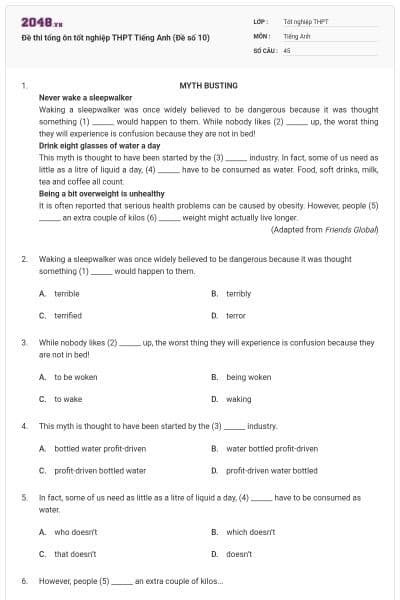
Đề thi tổng ôn tốt nghiệp THPT Tiếng Anh (Đề số 10)
40 câu hỏi
MYTH BUSTING
Never wake a sleepwalker
Waking a sleepwalker was once widely believed to be dangerous because it was thought something (1) ______ would happen to them. While nobody likes (2) ______ up, the worst thing they will experience is confusion because they are not in bed!
Drink eight glasses of water a day
This myth is thought to have been started by the (3) ______ industry. In fact, some of us need as little as a litre of liquid a day, (4) ______ have to be consumed as water. Food, soft drinks, milk, tea and coffee all count.
Being a bit overweight is unhealthy
It is often reported that serious health problems can be caused by obesity. However, people (5) ______ an extra couple of kilos (6) ______ weight might actually live longer.
(Adapted from Friends Global)
terrible
terribly
terrified
terror
Kiến thức về từ loại
A. terrible /ˈterəbl/ (adj): tồi tệ
B. terribly /ˈterəbli/ (adv): một cách tồi tệ
C. terrified /ˈterɪfaɪd/ (adj): khiếp sợ (tính từ đuôi -ed miêu tả cảm xúc con người)
D. terror /ˈterə(r)/ (n): nỗi kinh hoàng
- Cần một tính từ theo sau và bổ nghĩa cho đại từ bất định something → loại B, D; xét ngữ cảnh của câu đang cần một tính từ miêu tả tính chất của sự việc, chọn terrible.
Dịch: Đánh thức người mộng du từng được cho là một hành động nguy hiểm vì có thể điều gì đó khủng khiếp sẽ xảy ra với họ.
Chọn A.
to be woken
being woken
to wake
waking
Kiến thức về danh động từ và động từ nguyên mẫu
*Phân biệt hai cấu trúc với ‘like’:
- like + V-ing: diễn tả sở thích chung, thói quen, điều mà ai đó thích làm một cách tự nhiên.
- like + to V: diễn tả sự lựa chọn, hành động cụ thể trong tình huống nhất định vì lợi ích, mục đích nào đó.
e.g. You like swimming, but do you like to swim in cold water? → ‘swimming’ là sở thích bình thường, ‘to swim’ nhấn mạnh một tình huống cụ thể.
*Xét ngữ cảnh đang nói đến việc đánh thức người mộng du, câu sau chỗ trống nói về cảm xúc của người mộng du khi bị thức dậy → dùng cấu trúc bị động.
→ Ta thấy việc bị đánh thức không phải là hành động có chủ đích mà là nói chung cảm xúc thích hay không thích làm gì → chọn ‘being woken’.
Dịch: Mặc dù không ai thích bị đánh thức, nhưng điều tệ nhất họ có thể gặp phải khi choàng tỉnh là sự bối rối vì mình không ở trên giường!
Chọn B.
bottled water profit-driven
water bottled profit-driven
profit-driven bottled water
profit-driven water bottled
Kiến thức về trật tự từ
- Ta có cụm danh từ: bottled water – nước đóng chai → bottled water industry – ngành công nghiệp nước đóng chai
- Muốn thêm tính từ để miêu tả một cụm danh từ ghép, ta thêm vào ngay trước cụm đó.
→ trật tự đúng: profit-driven bottled water (industry)
Dịch: Quan niệm này được cho là bắt nguồn từ ngành công nghiệp nước đóng chai vì mục đích lợi nhuận.
Chọn C.
who doesn’t
which doesn’t
that doesn’t
doesn’t
Kiến thức về mệnh đề quan hệ
- Câu đã có động từ chính là ‘need’ nên nếu có thêm động từ thì không thể cùng chia theo thì của câu giống động từ chính mà phải ở trong MĐQH → loại D.
- MĐQH sau dấu phẩy là MĐQH không xác định, không dùng với ‘that’ → loại C.
- Chỗ trống bổ nghĩa cho ‘a litre of liquid’ nên dùng ‘which’ để thay thế cho vật.
Dịch: Trên thực tế, chúng ta chỉ cần một lít chất lỏng mỗi ngày, và lượng này không nhất thiết phải là nước.
Chọn B.
holding
bringing
carrying
taking
Kiến thức về cụm từ
- Ta có: carry + ‘chỉ số cân nặng’ – nặng bao nhiêu cân
Dịch: Tuy nhiên, những người nặng hơn bình thường vài cân thực tế có thể sống lâu hơn.
Chọn C.
at
in
of
on
Kiến thức về giới từ
- Ta có: in weight – dùng sau chỉ số cân nặng để nói về trọng lượng
Dịch: Tuy nhiên, những người nặng hơn bình thường vài cân thực tế có thể sống lâu hơn.
Chọn B.
Bài hoàn chỉnh | Dịch bài đọc |
MYTH BUSTING Never wake a sleepwalker Waking a sleepwalker was once widely believed to be dangerous because it was thought something terrible would happen to them. While nobody likes being woken up, the worst thing they will experience is confusion because they are not in bed! Drink eight glasses of water a day This myth is thought to have been started by the profit-driven bottled water industry. In fact, some of us need as little as a litre of liquid a day, which doesn’t have to be consumed as water. Food, soft drinks, milk, tea and coffee all count. Being a bit overweight is unhealthy It is often reported that serious health problems can be caused by obesity. However, people carrying an extra couple of kilos in weight might actually live longer. | PHÁ BỎ CÁC QUAN NIỆM SAI LẦM Đừng bao giờ đánh thức người mộng du Đánh thức người mộng du từng được cho là một hành động nguy hiểm vì có thể điều gì đó khủng khiếp sẽ xảy ra với họ. Mặc dù không ai thích bị đánh thức, nhưng điều tệ nhất họ có thể gặp phải khi choàng tỉnh là sự bối rối vì mình không ở trên giường! Uống tám ly nước mỗi ngày Quan niệm này được cho là bắt nguồn từ ngành công nghiệp nước đóng chai vì mục đích lợi nhuận. Trên thực tế, chúng ta chỉ cần một lít chất lỏng mỗi ngày, và lượng này không nhất thiết phải là nước. Thực phẩm, nước ngọt, sữa, trà và cà phê đều được tính là chất lỏng. Thừa cân một chút là không tốt cho sức khỏe Người ta thường cho rằng béo phì có thể gây ra các vấn đề sức khỏe nghiêm trọng. Tuy nhiên, những người nặng hơn bình thường vài cân thực tế có thể sống lâu hơn. |
Tips to Improve Your Study Skills
Map Out a Study Plan: Create a schedule that includes what you need to study and when. This keeps you on track as well as prevents burnout and (7) ______.
Get Active with Your Learning: Passive reading won’t do. Use active techniques like note-taking, summarizing, and self-quizzing to (8) ______ what you learned.
Team Up with a Study Buddy: Studying with others can boost motivation because they can (9) ______ you ______ when you want to give up. You can support (10) ______ when one of you doesn’t understand something.
Take Breaks: Long, uninterrupted study sessions can backfire. (11) ______, take a few minutes every half-hour to refresh your mind and stay sharp.
Prioritize Quality Sleep: Your brain needs rest to effectively retain information. Make sure you’re well-rested to help your brain (12) ______ the materials you’ve studied.
(Adapted from i-Learn Smart World)
depression
despair
discouragement
dismay
Kiến thức về từ vựng – nghĩa của từ
A. depression /dɪˈpreʃn/ (n): trầm cảm
B. despair /dɪˈspeə(r) (n): tuyệt vọng
C. discouragement /dɪsˈkʌrɪdʒmənt/, /dɪsˈkɜːrɪdʒmənt/ (n): nản lòng
D. dismay /dɪsˈmeɪ/ (n): mất tinh thần (vì một bất ngờ không dễ chịu)
Dịch: Điều này giúp bạn đi đúng tiến độ và tránh cảm giác kiệt sức hay chán nản.
Chọn C.
reinforce
maintain
cement
strengthen
Kiến thức về từ vựng – từ cùng trường nghĩa
A. reinforce /ˌriːɪnˈfɔːs/ (v): củng cố, tăng cường
B. maintain /meɪnˈteɪn/ (v): duy trì
C. cement /sɪˈment/ (v): gắn kết mối quan hệ
D. strengthen /ˈstreŋkθn/ (v): làm cho mạnh lên
Dịch: Áp dụng các phương pháp chủ động như ghi chép, tóm tắt, và tự kiểm tra để củng cố những gì đã học.
Chọn A.
calm – down
freak – out
light – up
cheer – up
Kiến thức về cụm động từ
A. calm (sb) down (phr.v): (làm ai đó) bình tĩnh lại
B. freak (sb) out (phr.v): (làm ai đó) hốt hoảng
C. light up (phr.v): chiếu sáng, mắt sáng lên vì vui vẻ, hào hứng
D. cheer (sb) up (phr.v): (làm ai đó) vui vẻ lên, cổ vũ cho ai
Dịch: Học cùng người khác có thể thúc đẩy động lực cho bạn vì họ sẽ động viên bạn cố lên khi bạn muốn bỏ cuộc.
Chọn D.
another
one another
the other
each other
Kiến thức về đại từ
A. another: một người/vật khác so với người/vật đã nhắc trước đó, e.g. I don’t like this room. I’m going to ask for another.
B. one another: lẫn nhau (giữa ba người trở lên), e.g. She encourage her students to interact with one another in class.
C. the other: người/vật còn lại trong số hai người/vật, e.g. He raised one arm and then the other.
D. each other: lẫn nhau (giữa hai người), e.g. Don and Susie really loved each other.
- Xét ngữ cảnh đang nói về hai người (bạn và bạn cùng học) trong một hoàn cảnh có qua có lại, hỗ trợ lẫn nhau → chọn each other
Dịch: Hai bạn có thể hỗ trợ nhau khi một trong hai chưa hiểu bài.
Chọn D.
Rather than
Instead
In lieu
In place
Kiến thức về liên từ
- rather than = instead of = in lieu of = in place of sb/sth (prep.): thay vì, thay cho ai/cái gì
- Rather = Instead (adv): Thay vào đó (có thể đứng đầu câu làm trạng ngữ)
Dịch: Học liên tục trong thời gian dài có thể phản tác dụng. Thay vào đó, dành vài phút nghỉ ngơi sau mỗi 30 phút học cho tinh thần sảng khoái và đầu óc tỉnh táo.
Chọn B.
condense
convert
proceed
process
Kiến thức về từ vựng – nghĩa của từ
A. condense /kənˈdens/ (v): cô đọng, tóm gọn lại
B. convert /kənˈvɜːt/ (v): biến đổi sang dạng khác
C. proceed /prəˈsiːd/, /prəʊˈsiːd/ (v): tiến hành
D. process /ˈprəʊses/, /ˈprɑːses/ (v): hiểu, xử lý thông tin
Dịch: Hãy đảm bảo ngủ đủ giấc để giúp não xử lý những gì bạn đã học.
Chọn D.
Bài hoàn chỉnh | Dịch bài đọc |
Tips to Improve Your Study Skills 1.Map Out a Study Plan: Create a schedule that includes what you need to study and when. This keeps you on track as well as prevents burnout and discouragement. 2.Get Active with Your Learning: Passive reading won’t do. Use active techniques like note-taking, summarizing, and self-quizzing to reinforce what you learned. 3.Team Up with a Study Buddy: Studying with others can boost motivation because they can cheer you up when you want to give up. You can support each other when one of you doesn’t understand something. 4.Take Breaks: Long, uninterrupted study sessions can backfire. Instead, take a few minutes every half-hour to refresh your mind and stay sharp. 5.Prioritize Quality Sleep: Your brain needs rest to effectively retain information. Make sure you’re well-rested to help your brain process the materials you’ve studied. | Mẹo Để Cải Thiện Kỹ Năng Học Tập 1. Lập kế hoạch học tập: Tạo thời gian biểu bao gồm những nội dung cần học và thời gian cụ thể. Điều này giúp bạn đi đúng tiến độ và tránh bị kiệt sức hay chán nản. 2. Chủ động trong việc học: Đọc thụ động không thôi là chưa đủ. Áp dụng các phương pháp chủ động như ghi chép, tóm tắt, và tự kiểm tra để củng cố những gì đã học. 3. Học cùng bạn bè: Học cùng người khác có thể thúc đẩy động lực cho bạn vì họ sẽ động viên bạn cố lên khi bạn muốn bỏ cuộc. Hai bạn có thể hỗ trợ nhau khi một trong hai chưa hiểu bài. 4. Nghỉ giải lao: Học liên tục trong thời gian dài có thể phản tác dụng. Thay vào đó, dành vài phút nghỉ ngơi sau mỗi 30 phút học cho sảng khoái và giữ đầu óc tỉnh táo. 5. Ưu tiên giấc ngủ chất lượng: Não bộ cần được nghỉ ngơi để lưu giữ thông tin hiệu quả. Hãy đảm bảo ngủ đủ giấc để giúp não xử lý những gì bạn đã học. |
a. The Shenzhen Special Economic Zone is part of the China Greater Bay Area development plan, which connects ten major cities in southern China.
b. In order to reach this goal, the Chinese government will have to carry out a wide variety of reforms for the city, regarding legal, financial, medical and social sectors.
c. Moreover, the government is encouraging international organisations and big companies to set up branches or headquarters in Shenzhen.
d. Shenzhen (China) is expected to become a model of high-quality development by 2035, and one of the leading citites in the world in terms of economic strength.
e. The plan sets long-term goals for 2035 to induce faster growth in the region, turning the Bay Area into a global innovation centre and financial powerhouse.
(Adapted from C-21 Smart)
d-b-c-a-e
a-c-e-b-d
d-a-c-e-b
a-e-b-d-c
Kiến thức sắp xếp câu thành đoạn văn
Thứ tự sắp xếp đúng:
d. Shenzhen (China) is expected to become a model of high-quality development by 2035, and one of the leading citites in the world in terms of economic strength.
b. In order to reach this goal, the Chinese government will have to carry out a wide variety of reforms for the city, regarding legal, financial, medical and social sectors.
c. Moreover, the government is encouraging international organisations and big companies to set up branches or headquarters in Shenzhen.
a. The Shenzhen Special Economic Zone is part of the China Greater Bay Area develop ment plan, which connects ten major cities in southern China.
e. The plan sets long-term goals for 2035 to induce faster growth in the region, turning the Bay Area into a global innovation centre and financial powerhouse.
Dịch:
d. Thành phố Thâm Quyến (Trung Quốc) được kỳ vọng sẽ trở thành hình mẫu phát triển vào năm 2035 và là một trong những thành phố dẫn đầu thế giới về tiềm lực kinh tế.
b. Để đạt được mục tiêu này, chính phủ Trung Quốc sẽ phải thực hiện nhiều cải cách cho thành phố trong nhiều lĩnh vực như pháp lý, tài chính, y tế và xã hội.
c. Thêm vào đó, chính phủ nước này đang khuyến khích các tổ chức quốc tế và các công ty
lớn thành lập chi nhánh hoặc trụ sở tại Thâm Quyến.
a. Khu kinh tế đặc biệt Thâm Quyến là một phần của kế hoạch phát triển khu vực Vịnh Lớn của Trung Quốc, kết nối 10 thành phố lớn ở miền nam nước này.
e. Kế hoạch này đặt ra các mục tiêu dài hạn đến năm 2035 nhằm thúc đẩy tăng trưởng nhanh trong khu vực, biến Vịnh Lớn thành trung tâm đổi mới toàn cầu và ông lớn tài chính.
Chọn A.
a. Doctor: I see. Do you have this pain all the time?
b. Andrew: Doctor, I’ve got this pain in my chest since a few days ago.
c. Andrew: No, I get it in the evening after dinner and sometimes after lunch.
(Adapted from English Discovery)
a-c-b
b-a-c
b-c-a
c-a-b
Kiến thức sắp xếp câu thành đoạn hội thoại
Thứ tự sắp xếp đúng:
b. Andrew: Doctor, I’ve got this pain in my chest since a few days ago.
a. Doctor: I see. Do you have this pain all the time?
c. Andrew: No, I get it in the evening after dinner and sometimes after lunch.
Dịch:
b. Andrew: Bác sĩ, tôi bị đau ngực từ mấy ngày trước.
a. Bác sĩ: Tôi thấy rồi. Bạn có hay bị đau liên tục không?
c. Andrew: Không, tôi hay đau vào buổi tối sau bữa tối và đôi khi sau bữa trưa.
Chọn B.
a. Nam: It’s hard to predict who’ll win. Other classes also have very interesting projects.
b. Mark: True. There’re so many great ideas. The judges will have a difficult decision to make.
c. Nam: You’re telling me! It’s a good habit that will lead to healthier lifestyles in the long run.
d. Mark: Tomorrow we’ll get the results of the Green Classroom Competition. Do you think we will win?
e. Mark: I agree. The Cycling-to-school programme proposed by Class 12C is going to impress the judges.
(Adapted from Global Success)
d-a-b-c-e
d-c-b-a-e
d-a-e-c-b
d-c-e-a-b
Kiến thức sắp xếp câu thành đoạn hội thoại
Thứ tự sắp xếp đúng:
d. Mark: Tomorrow we’ll get the results of the Green Classroom Competition. Do you think we will win?
a. Nam: It’s hard to predict who’ll win. Other classes also have very interesting projects.
e. Mark: I agree. The Cycling-to-school programme proposed by Class 12C is going to impress the judges.
c. Nam: You’re telling me! It’s a good habit that will lead to healthier lifestyles in the long run.
b. Mark: True. There’re so many great ideas. The judges will have a difficult decision to make.
Dịch:
d. Mark: Mai là ta sẽ biết kết quả của Cuộc thi Lớp học Xanh rồi. Cậu có nghĩ lớp mình sẽ thắng không?
a. Nam: Khó đoán đấy. Các lớp khác cũng có những dự án thú vị lắm.
e. Mark: Đồng ý. Chương trình Đi xe đạp đến trường của lớp 12C chắc chắn sẽ gây ấn tượng với ban giám khảo.
c. Nam: Chuẩn luôn! Đó là một thói quen tốt sẽ dẫn đến lối sống lành mạnh hơn về lâu dài.
b. Mark: Ừ. Có quá nhiều ý tưởng tuyệt vời. Ban giám khảo sẽ phải vò đầu bứt rai mà đưa ra quyết định đây.
* You’re telling me! = I completely agree with you: một cách nói thể hiện đồng ý
Chọn C.
Dear Doctor Clark,
I am writing to you about the serious threat of lionfish in the Atlantic Ocean.
a. We have already tested the first model, though it hasn’t been very effective so far.
b. Since then, we have been working on making a robot that will be able to kill lionfish with electricity.
c. Since 2004, the lionfish have been eating local fish, and they are continuing to destroy native species.
d. Until we can find a solution, we can only hope that the lionfish do not end up wiping out populations of native fish.
e. There are no natural enemies of the lionfish here, so we have been trying to train sharks to prey on them, but it didn’t work.
Your colleague,
Doctor Lewis
(Adapted from i-Learn Smart World)
e-a-b-c-d
e-c-a-b-d
c-b-a-e-d
c-e-b-a-d
Kiến thức sắp xếp câu thành lá thư
Thứ tự sắp xếp đúng:
Dear Doctor Clark,
I am writing to you about the serious threat of lionfish in the Atlantic Ocean.
c. Since 2004, the lionfish have been eating local fish, and they are continuing to destroy native species.
e. There are no natural enemies of the lionfish here, so we have been trying to train sharks to prey on them, but it didn’t work.
b. Since then, we have been working on making a robot that will be able to kill lionfish with electricity.
a. We have already tested the first model, though it hasn’t been very effective so far.
d. Until we can find a solution, we can only hope that the lionfish do not end up wiping out populations of native fish.
Your colleague,
Doctor Lewis
Dịch:
Gửi Tiến sĩ Clark,
Tôi viết thư này để thông báo về mối đe dọa nghiêm trọng từ cá sư tử ở Đại Tây Dương.
c. Từ năm 2004, cá sư tử đã ăn dần các loài cá địa phương và chúng vẫn tiếp tục phá hoại các loài khác.
e. Ở đây không có thiên địch của cá sư tử, nên chúng tôi đã cố gắng huấn luyện cá mập săn cá sư tử, nhưng không thành công lắm.
b. Sau đó chúng tôi đã nghiên cứu chế tạo một con robot có thể diệt cá sư tử bằng điện.
a. Chúng tôi đã thử nghiệm mô hình đầu tiên, nhưng đến nay vẫn chưa mấy hiệu quả.
d. Cho đến khi tìm ra giải pháp, ta chỉ có thể hy vọng là cá sư tử sẽ không xóa sổ các loài cá bản địa.
Trân trọng,
Đồng nghiệp của ông,
Tiến sĩ Lewis
Chọn D.
a. It’s a difficult balancing act and, of course, parents get it wrong sometimes. After all, they’re only human too.
b. But it’s not always so easy. Children grow up so fast these days and it can be difficult to get it right all the time.
c. If they are too strict, their children might rebel. If they are too soft, then the children might only do the things they want to do.
d. For sure, parents know the importance of school and they want their children to do well, but what happens when the child doesn’t want to try?
e. Most parents want to do their best for their children and help them get ahead in life. They try to bring their children up well and give them a happy childhood.
(Adapted from THiNK)
e-a-c-b-d
d-a-b-e-c
e-b-d-c-a
d-c-e-a-b
Kiến thức sắp xếp câu thành đoạn văn
Thứ tự sắp xếp đúng:
e. Most parents want to do their best for their children and help them get ahead in life. They try to bring their children up well and give them a happy childhood.
b. But it’s not always so easy. Children grow up so fast these days and it can be difficult to get it right all the time.
d. For sure, parents know the importance of school and they want their children to do well, but what happens when the child doesn’t want to try?
c. If they are too strict, their children might rebel. If they are too soft, then the children might only do the things they want to do.
a. It’s a difficult balancing act and, of course, parents get it wrong sometimes. After all, they’re only human too.
Dịch:
e. Hầu hết các bậc cha mẹ đều muốn những gì tốt nhất cho con và giúp chúng thành công trong cuộc sống. Họ cố gắng nuôi dạy con thật tốt và mang lại cho con tuổi thơ hạnh phúc.
b. Nhưng điều đó không phải lúc nào cũng dễ dàng. Ngày nay, trẻ em lớn lên rất nhanh, và đôi khi để nuôi dạy con đúng cách rất khó.
d. Chắc chắn là cha mẹ hiểu tầm quan trọng của việc học và muốn con mình học tốt, nhưng sẽ ra sao nếu đứa trẻ không muốn cố gắng?
c. Nếu quá nghiêm khắc, con có thể trở nên nổi loạn. Nếu quá mềm mỏng, con sẽ được nước lấn tới và chỉ làm những gì chúng thích.
a. Thật khó để cân bằng và tất nhiên, đôi khi cha mẹ cũng mắc sai lầm. Suy cho cùng, họ cũng chỉ là con người mà thôi.
Chọn C.
From Cave Walls to Social Media Walls
The word ‘media’ refers to the different ways in which people transmit information. By this definition, we can say with confidence that (18) ______ when we first began painting simplistic symbols on the walls of caves. Since then, (19) ______.
According to experts, it was sometime around 3,400 BC when human beings first began utilising written language as a means of communication. For generations, apart from verbal communication, people had to write everything manually until the mid-1440s. It was Johannes Gutenberg (20) ______. This marked the beginning of what we now call ‘mass media’. Gutenberg’s innovative invention enabled the large-scale production of print media like books, newspapers and magazines, making it possible to share information with a wider audience than ever before.
Several hundred years after the invention of the printing press, during the 19th century, we created cameras and later, the radio. The invention of the radio began the age of broadcast media, (21) ______. This allowed many people to watch fascinating movies, programmes and documentaries, all of which remain popular today.
In the 2000s, we saw the rise of digital media. Now, we visit web pages, listen to podcasts, (22) ______. We even use QR codes to share information instantly. We have come a long way, and so have the ways we communicate!
(Adapted from Bright)
as the earliest form of media, it was invented about 64,000 years ago
human beings created the first type of media around 64,000 years ago
human had media in its initial phase created roughly 64,000 years ago
dating back to 64,000 years ago,human developed the first form of media
Kiến thức về mệnh đề độc lập
A. Câu không sai về ngữ pháp tuy nhiên dùng đại từ ‘it’ tức là để thay thế cho cái gì đó đã xuất hiện ở câu trước, cụ thể là một hình thức truyền thông → không có hình thức nào được nhắc đến trước đó → loại A.
C. Cấu trúc thể sai khiến ‘have sth done’ dùng khi ai đó nhờ người khác làm việc gì đó thay họ → con người không thể nhờ người khác tạo ra truyền thông được → loại C.
D. date back to (phr.v): có từ, bắt nguồn từ. Ta thấy vế trước lược bỏ đi chủ ngữ tức là hai vế phải đồng chủ ngữ ‘human’, mà ‘date back to’ phải là động từ của ‘media’ → câu sai về mặt ngữ pháp → loại D.
→ B dùng cấu trúc S + V thông thường chia quá khứ đơn là lựa chọn đúng nhất.
Dịch: Theo định nghĩa này, ta có thể tự tin nói rằng loài người đã tạo ra phương tiện truyền thông đầu tiên từ khoảng 64.000 năm trước khi chúng ta bắt đầu vẽ những biểu tượng đơn giản lên tường hang động.
Chọn B.
our media have becomeadvanced more quickly thanwe have evolved
we have evolved more quickly than our media have become advanced
the moreadvanced our media have become, the morewe have evolved
the more we have evolved, the more advanced our media have become
Kiến thức về mệnh đề độc lập
Xét nghĩa các câu:
A. phương tiện truyền thông đã phát triển nhanh hơn tốc độ tiến hóa của con người
B. con người đã tiến hóa nhanh hơn tốc độ phát triển của phương tiện truyền thông
C. phương tiện truyền thông càng trở nên tiên tiến thì con người càng tiến hóa
D. con người càng tiến hóa thì phương tiện truyền thông càng trở nên tiên tiến
- A, B dùng cấu trúc so sánh hơn của trạng từ dài:
S + (not) V + more/less + adv + than + N/clause.
- C, D dùng cấu trúc so sánh kép của trạng từ dài:
The more + (adv) + S + V, the more (adv) + S + V.
→ Ta thấy sự phát triển của truyền thông phải phụ thuộc vào những người sáng tạo ra nó là con người → loại A, C.
→ Theo cách diễn đạt của B thì nhấn mạnh tốc độ tiến hóa của con người, trong khi xét ngữ cảnh thì văn bản đang nói về sự phát triển của truyền thông → loại B.
Chọn D.
revolutionising media with an inventioncalled the printing press
created an inventioncalled the printing press and revolutionised media
of whom an inventioncalled the printing press helped to revolutionise media
who revolutionised media when he created an invention called the printing press
Kiến thức về mệnh đề quan hệ
- Ta có cấu trúc câu chẻ dùng để nhấn mạnh: It + be + S + who/that + V.
→ Chỉ có D dùng đúng cấu trúc này. A là MĐQH rút gọn mang nghĩa chủ động, B là một cụm vị ngữ, C là MĐQH với giới từ.
Dịch: Johannes Gutenberg chính là người đã cách mạng hóa truyền thông khi phát minh ra máy in.
Chọn D.
which was timed to coincide with the advent of television
though television was invented long before the radio
hence progress made in the development of television
and the development of television swiftly followed it
Kiến thức về mệnh đề độc lập
Xét nghĩa mệnh đề trước chỗ trống:
- The invention of the radio began the age of broadcast media,... (Radio đã mở ra kỷ nguyên của truyền thông phát sóng,...)
Xét nghĩa các lựa chọn:
A. được tính toán thời gian trùng với thời điểm ra đời của truyền hình
B. mặc dù truyền hình đã được phát minh từ rất lâu trước khi có radio
C. do đó, truyền hình đã có những bước tiến trong quá trình phát triển
D. và sự phát triển của truyền hình nhanh chóng theo sau
→ Radio mở ra kỷ nguyên nên A (truyền hình ra đời cùng lúc với radio) và B (truyền hình ra đời trước cả radio) đều không logic về mặt nghĩa. C hàm ý truyền hình đã đang trong quá trình phát triển thì radio ra đời nên truyền hình có bước tiến, cũng không hợp logic.
Chọn D.
stream music, communicate on social media, and use our smartphones
stream music and communicate on social media using our smartphones
stream music and using our smartphones to communicate on social media
stream music by communicating on social media and using our smartphones
Kiến thức về cấu trúc câu
- Ta có các hành động ‘visit web pages’ (truy cập các trang web), ‘listen to podcasts’ (nghe podcast), ‘stream music’ (phát nhạc trực tuyến), và ‘communicate on social media’ (giao tiếp trên mạng xã hội) đều là những ví dụ của việc ta làm trên điện thoại.
→ Các động từ trên theo cấu trúc song song (đều không chia) còn ‘using our smart-phones’ (dùng điện thoại) ở dạng V-ing như một trạng ngữ chỉ cách thức, bổ nghĩa cho các động từ.
Dịch: Giờ đây, ta truy cập các trang web, nghe podcast, phát nhạc trực tuyến và giao tiếp trên mạng xã hội dùng điện thoại thông minh.
Chọn B.
Dịch bài đọc:
Từ Tường Hang Động Đến Tường Mạng Xã Hội
‘Truyền thông’ có nghĩa là cách con người truyền tải thông tin. Theo định nghĩa này, ta có thể tự tin nói rằng loài người đã tạo ra phương tiện truyền thông đầu tiên từ khoảng 64.000 năm trước, khi chúng ta bắt đầu vẽ những biểu tượng đơn giản lên tường hang động. Kể từ đó, con người càng tiến hóa, phương tiện truyền thông càng trở nên tiên tiến hơn.
Theo các chuyên gia, phải đến khoảng năm 3.400 TCN, con người mới bắt đầu sử dụng ngôn ngữ viết làm phương tiện giao tiếp. Qua nhiều thế hệ, bên cạnh giao tiếp bằng lời nói, chúng ta viết mọi thứ bằng tay cho đến giữa những năm 1440. Johannes Gutenberg chính là người đã cách mạng hóa truyền thông khi phát minh ra máy in. Đây là khởi đầu của ‘truyền thông đại chúng’ theo cách ta gọi ngày nay. Phát minh đột phá này của Gutenberg đã cho phép sản xuất hàng loạt các phương tiện in ấn trên quy mô lớn như sách, báo và tạp chí, giúp thông tin được chia sẻ đến lượng khán giả rộng lớn hơn bao giờ hết.
Vài trăm năm sau máy in được phát minh, vào thế kỷ 19, con người đã phát minh ra máy ảnh và sau đó là đài phát thanh (radio). Radio đã mở ra kỷ nguyên của truyền thông phát sóng, và sự phát triển của truyền hình (TV) nhanh chóng theo sau. Điều này có nghĩa là chúng ta đã có thể xem các bộ phim, chương trình và phim tài liệu hấp dẫn, tất cả vẫn đều phổ biến cho đến ngày nay.
Vào những năm 2000, chúng ta chứng kiến sự bùng nổ của truyền thông kỹ thuật số. Giờ đây, ta truy cập các trang web, nghe podcast, phát nhạc trực tuyến và giao tiếp trên mạng xã hội dùng điện thoại thông minh. Thậm chí ta còn dùng mã QR để chia sẻ thông tin trong tíc tắc. Loài người đã đi một chặng đường dài, và cách chúng ta giao tiếp cũng vậy!
Out-of-the-Ordinary Jobs
Around the world, there are some unexpected jobs that might just leave you scratching your head in surprise.
Train Pushers
In Japan, the railway system is so extensive and busy that it’s almost a culture in itself. With trains constantly packed during rush hours, a special breed of station attendants, known as ‘pushers’ or ‘oshiya’ do the strangest job in the world – they push passengers into carriages. Pushers have to cram people in as tightly as possible so that a large number of commuters can arrive at their desired locations on time. While this may sound uncomfortable, they must endure the squeeze daily as part of urban life.
Cleaners of the World’s Tallest Building
Have you ever wondered how the towering Burj Khalifa in Dubai keeps its windows sparkling? It takes a team of 36 window cleaners a total of three months to clean the tower’s reflective windows, which reduce the need for air conditioning but are prone to dirt accumulation. Working from the height of over 800 metres, the cleaners battle fierce winds and unsteady weather to polish the skyscraper’s hundreds of windows. It’s no job for the chicken-hearted – they must be the bravest cleaners in the world!
Golf Balls Divers
Every year in the UK, millions of golf balls go astray, sinking in the water around golf courses. This gave rise to the demand for golf ball divers whose job is to dive deep into the lakes and ponds to retrieve them. Most of them are professional scuba divers, but they spend long hours crawling around in mud and carrying heavy buckets. On average, they find 5,000 balls per lake. Once cleaned, the balls are resold or recycled. Sounds dangerous, doesn’t it?
Legal Bank Robbers
Imagine robbing a bank without the potential for punishment and the unpleasantness of concrete walls. A licensed bank robber’s role is to outsmart security systems and expose vulnerabilities. In the past, the job involved physically breaking into banks; today it has expanded to include identity theft, computer hacking, tricking operators into handing over customer information, and even posing as police officers to install surveillance equipment in vaults. It sounds like a profession that former secret agents would be good at.
(Adapted from Global Success & Bored Panda)
golf ball diver
legal bank robber
passenger pusher
train cleaner
Cái nào sau đây KHÔNG phải là một công việc bất thường được đề cập?
A. thợ lặn tìm bóng golfB. cướp ngân hàng hợp pháp
C. nhân viên đẩy hành kháchD. nhân viên vệ sinh tàu hỏa
Thông tin: 4 công việc kỳ lạ tương ứng với 4 đoạn trong văn bản là ‘train pushers’ (có nhiệm vụ đẩy hành khách vào toa tàu → tương ứng với C. passenger pusher), ‘cleaners of the world’s tallest building’, ‘golf ball divers’ (A), và ‘legal bank robbers’ (B).
Chọn D.
attendants
locations
commuters
pushers
Từ ‘they’ trong đoạn 1 chỉ ______.
A. nhân viên phục vụB. các địa điểmC. hành kháchD. người đẩy
Thông tin: Pushers have to cram people in as tightly as possible so that a large number of commuters can arrive at their desired locations on time. While this may sound uncomfortable, they must endure the squeeze daily as part of urban life. (Người đẩy phải nhồi nhét người càng chặt càng tốt để đảm bảo số lượng lớn hành khách có thể đến nơi họ cần đến đúng giờ. Dù nghe có vẻ khó chịu, người dân đô thị ở đây vẫn phải quen với sự chen chúc này mỗi ngày.)
Chọn C.
courageous
cowardly
feeble
reluctant
Từ ‘chicken-hearted’ trong đoạn 2 có thể được thay thế bởi từ nào?
- chicken-hearted /ˈtʃɪkɪn ˈhɑːtɪd/ (adj) = easily frightened: thiếu can đảm, dễ bị dọa sợ
A. courageous /kəˈreɪdʒəs/ (adj): gan dạ, dũng cảm
B. cowardly /ˈkaʊədli/ (adj): hèn nhát
C. feeble /ˈfiːbl/ (adj): sức khỏe yếu đuối
D. reluctant /rɪˈlʌktənt/ (adj): miễn cưỡng, hay do dự
→ chicken-hearted = cowardly
→ Đây không phải là từ hay gặp tuy nhiên hoàn toàn có thể suy ra được nghĩa từ ngữ cảnh:
- It’s no job for the chicken-hearted – they must be the bravest cleaners in the world! (Đây chắc chắn không phải công việc dành cho những người yếu tim – họ hẳn là những người lau kính dũng cảm nhất thế giới!) → Ta thấy có sự tương phản giữa hai nét tính cách.
Chọn B.
unauthorised
unverified
recognised
certified
Từ ‘licensed’ trong đoạn 4 TRÁI NGHĨA với từ nào?
- licensed /ˈlaɪsnst/ (adj) = having official permission to do sth (Oxford): được cấp phép
A. unauthorised /ʌnˈɔːθəraɪzd/ (adj): không được cấp phép
B. unverified /ʌnˈverɪfaɪd/ (adj): chưa được kiểm chứng
C. recognised /ˈrekəɡnaɪzd/ (adj): được công nhận
D. certified /ˌsɜːtɪfaɪd (adj): được chứng nhận
→ licensed >< unauthorised
Chọn A.
Think of stealing from a bank without needing to break in or use any force.
Think of stealing from a bank but in a way that can escape punishment later.
Think of stealing from a bank while avoiding being caught and dealing with police.
Think of stealing from a bank but not having to face jail time or other consequences.
Câu nào sau đây diễn giải lại tốt nhất câu gạch chân trong đoạn 4?
A. Thử nghĩ đến việc cướp ngân hàng mà không cần phải đột nhập hay sử dụng vũ lực.
B. Thử nghĩ đến việc cướp ngân hàng nhưng sau đó có thể thoát khỏi hình phạt.
C. Thử nghĩ đến việc cướp ngân hàng trong khi tránh bị bắt và đối phó với cảnh sát.
D. Thử nghĩ đến việc cướp ngân hàng nhưng không phải nhận án tù hay hậu quả khác.
Câu gạch chân: Imagine robbing a bank without the potential for punishment and the unpleasantness of concrete walls. (Hãy tưởng tượng đi cướp ngân hàng mà không lo bị trừng phạt hay phải đối mặt với bốn bức tường bê tông.) → tường bê tông là hình ảnh hoán dụ chỉ nhà tù.
Chọn D.
Golf ball divers collect lost golf balls without using any special equipment.
Golf ball divers are responsible for reselling collected balls after cleaning them.
Overcrowded trains in Japan call for train pushers to ensure efficient boarding.
Modern day legal bank robbers no longer use traditional tactics to test bank security.
Theo văn bản, câu nào sau đây là ĐÚNG?
A. Thợ lặn bóng golf tìm lại bóng golf bị mất mà không cần sử dụng thiết bị đặc biệt nào.
B. Thợ lặn bóng golf có trách nhiệm bán lại những quả bóng tìm lại được sau khi rửa sạch.
C. Những chuyến tàu quá tải ở Nhật cần có người đẩy tàu để đảm bảo việc lên tàu hiệu quả.
D. Cướp ngân hàng hợp pháp thời nay không còn sử dụng cách truyền thống để kiểm tra an ninh ngân hàng nữa.
Thông tin:
- Most of them are professional scuba divers, but they spend long hours crawling around in mud and carrying heavy buckets. (Hầu hết họ là thợ lặn chuyên nghiệp, nhưng họ phải dành hàng giờ bò trong bùn lầy và mang vác những xô bóng nặng.) → Họ là thợ lặn chuyên nghiệp vậy thì khi họ lặn cần đeo các thiết bị đặc biệt để hỗ trợ lặn → A sai.
- Once cleaned, the balls are resold or recycled. (Sau khi được làm sạch, bóng sẽ được bán lại hoặc tái chế.) → Không hề nhắc đến công việc này ai sẽ làm, không có đủ thông tin khẳng định các thợ lặn kiêm luôn việc này → B sai.
- With trains constantly packed during rush hours, a special breed of station attendants, known as ‘pushers’ or ‘oshiya’ do the strangest job in the world – they push passengers into carriages. (Trong giờ cao điểm, các chuyến tàu thường chật kín người, và một nhóm nhân viên nhà ga đặc biệt, được gọi là ‘oshiya’ hay ‘người đẩy’, đảm nhận một công việc kỳ lạ – họ đẩy hành khách vào trong toa tàu.) → C đúng.
- In the past, the job involved physically breaking into banks; today it has expanded to include identity theft, computer hacking,... (Trước đây, công việc này yêu cầu đột nhập trực tiếp vào ngân hàng; ngày nay thì đã mở rộng ra bao gồm đánh cắp danh tính, hack máy tính,...) → Ngày nay phương thức hoạt động của cướp ngân hàng hợp pháp đã đa dạng hơn tuy nhiên không nói không còn sử dụng phương thức cũ là đột nhập trực tiếp nữa → D sai.
Chọn C.
Paragraph 1
Paragraph 2
Paragraph 3
Paragraph 4
Trong đoạn văn nào tác giả mô tả mối quan hệ giải thích?
* explanatory /ɪkˈsplænətri/, /ɪkˈsplænətɔːri/ (adj) = intended to describe how sth works or to make sth easier to understand (Oxford): có tính chất giải thích
Đoạn 2:
- Have you ever wondered how the towering Burj Khalifa in Dubai keeps its windows sparkling? It takes a team of 36 window cleaners a total of three months to clean the tower’s reflective windows,... (Bạn đã bao giờ tự hỏi làm thế nào tòa nhà chọc trời Burj Khalifa ở Dubai luôn giữ được vẻ ngoài sáng bóng? Một đội gồm 36 nhân viên lau kính phải mất ba tháng để lau sạch toàn bộ cửa sổ phản quang của tòa tháp này,...)
→ Đoạn này đặt ra một câu hỏi tu từ nhằm mục đích giải thích về một công việc.
Chọn B.
Paragraph 1
Paragraph 2
Paragraph 3
Paragraph 4
Trong đoạn văn nào tác giả đề cập đến một thứ giống như một con dao hai lưỡi?
* be a double-edged/two-edged sword/weapon (idiom) = to be sth that has both advantages and disadvantages (Oxford): một thứ vừa có lợi vừa có hại
Đoạn 2:
- ...the tower’s reflective windows, which reduce the need for air conditioning but are prone to dirt accumulation. (...các cửa sổ phản quang của tòa tháp, loại cửa sổ giúp giảm nhu cầu sử dụng điều hòa nhưng lại dễ tích tụ bụi bẩn.)
Chọn B.
Dịch bài đọc:
Những Công Việc Lạ Lùng
Trên thế giới có những công việc kỳ lạ có thể khiến bạn phải gãi đầu ngạc nhiên.
Nhân Viên Đẩy Hành Khách
Ở Nhật Bản, hệ thống đường sắt rộng lớn và đông đúc đã trở thành một nét văn hóa riêng. Trong giờ cao điểm, các chuyến tàu thường chật kín người, và một nhóm nhân viên nhà ga đặc biệt, được gọi là ‘oshiya’ hay ‘người đẩy’, đảm nhận một công việc kỳ lạ – họ đẩy hành khách vào trong toa tàu. Nhiệm vụ của họ là nhồi nhét người càng chặt càng tốt để đảm bảo số lượng lớn hành khách có thể đến nơi họ cần đến đúng giờ. Dù nghe có vẻ khó chịu, người dân đô thị ở đây vẫn phải quen với sự chen chúc này mỗi ngày.
Nhân Viên Lau Kính Tòa Nhà Cao Nhất Thế Giới
Bạn đã bao giờ tự hỏi làm thế nào tòa nhà chọc trời Burj Khalifa ở Dubai luôn giữ được vẻ ngoài sáng bóng? Một đội gồm 36 nhân viên lau kính phải mất ba tháng để lau sạch toàn bộ cửa sổ phản quang của tòa tháp này, loại cửa sổ giúp giảm nhu cầu sử dụng điều hòa nhưng lại dễ tích tụ bụi bẩn. Làm việc ở độ cao hơn 800 mét, các nhân viên này phải đối mặt với những cơn gió mạnh và thời tiết khắc nghiệt để đánh bóng hàng trăm cửa sổ. Đây chắc chắn không phải công việc dành cho những người yếu tim – họ hẳn là những người lau kính dũng cảm nhất thế giới!
Thợ Lặn Tìm Bóng Golf
Mỗi năm ở Anh, hàng triệu quả bóng golf bị thất lạc, chìm xuống nước quanh các sân golf. Điều này tạo ra nhu cầu cần những thợ lặn tìm bóng golf – công việc của họ là lặn sâu xuống các hồ ao để vớt bóng. Hầu hết những người này là thợ lặn chuyên nghiệp, nhưng họ phải dành hàng giờ bò trong bùn lầy và mang vác những xô bóng nặng. Trung bình, mỗi hồ họ tìm được khoảng 5.000 quả bóng. Sau khi được làm sạch, bóng sẽ được bán lại hoặc tái chế. Nghe có vẻ nguy hiểm, phải không?
Cướp Ngân Hàng Hợp Pháp
Hãy tưởng tượng đi cướp ngân hàng mà không lo bị trừng phạt hay phải đối mặt với bốn bức tường bê tông lạnh lẽo. Đó là công việc của những cướp ngân hàng được cấp phép – đánh bại các hệ thống an ninh và phơi bày những điểm yếu. Trước đây, công việc này yêu cầu đột nhập trực tiếp vào ngân hàng; ngày nay thì đã mở rộng ra bao gồm đánh cắp danh tính, hack máy tính, lừa nhân viên cung cấp thông tin khách hàng hay thậm chí giả làm cảnh sát để lắp thiết bị giám sát trong các kho tiền. Nghe giống như nghề dành cho những cựu điệp viên nhỉ?
Culture is an integral part of every society. [I] It is a learned pattern of behaviour and ways in which a person lives his or her life. [II] Culture is essential for the existence of a society, because it binds people together. [III] In the explicit sense of the term, culture constitutes the music, food, arts and literature of a society. [IV]
According to English Anthropologist Edward B Taylor, culture is that complex whole which includes knowledge, belief, law, custom, and any other capabilities and habits acquired by man as a member of society. Culture is something that a person learns from his family and surroundings, and is not ingrained in him from birth. Even if a person is brought up in a culture different from that in which he was born, he imbibes the culture of the society where he grows up. Some people feel the need to follow the beliefs and traditions of their own culture, even though they might be not subscribing to certain ideologies within.
Culture is the means through which people interact with others in the society. It acts in a subconscious way and whatever we see and perceive, seems to be normal and natural. Sometimes, other societies and people seem to be a little odd because they have a different culture from ours. We must remember that every society has a distinct culture that forms the backbone of the society. Culture does not remain stagnant, on the other hand it is evolving constantly and is in fact somewhat influenced by the other cultures and societies.
Every society has a different culture, where people share a specific language, traditions, behaviours, perceptions and beliefs. Culture gives them an identity which makes them unique and different from people of other cultures. When people of different cultures migrate and settle in another society, the culture of that society becomes the dominant culture and those of the immigrants form the subculture of the community. Usually, people who settle in other nations embrace the new culture, while at the same time strive to preserve their own.
Although every society has a specific culture, there are certain elements of culture that are universal. They are known as cultural universals, in which there are behavioural traits and patterns that are shared by all cultures around the world. These include classifying relations based on blood relations and marriage, telling right from wrong, having some forms of art, use of jewelry, classifying people according to gender and age, etc.
Culture is necessary to establish an order and discipline in the society. It creates a feeling of belonging and togetherness among people in the society.
(Adapted from THiNK)
Where in paragraph 1 does the following sentence best fit?
However, these are only the products of culture followed by the society and cannot be defined as culture.
[I]
[II]
[III]
[IV]
Câu sau đây phù hợp nhất ở vị trí nào trong đoạn 1?
Tuy nhiên, đây chỉ là những sản phẩm của văn hóa mà xã hội tuân theo và không thể định nghĩa hoàn toàn văn hóa.
Xét vị trí [IV]: In the explicit sense of the term, culture constitutes the music, food, arts and literature of a society. [IV] (Theo nghĩa rõ ràng, văn hóa bao gồm âm nhạc, ẩm thực, nghệ thuật và văn học của một xã hội. [IV])
→ Ta thấy câu này liệt kê ra một số ví dụ của văn hóa nên câu trên ở vị trí [IV] là hợp lý, nó đưa ra nhận xét về một định nghĩa của văn hóa, có liên kết với câu trước bởi từ ‘these’.
Chọn D.
disapproving of
believing in
giving in to
settling for
Cụm ‘subscribing to’ trong đoạn 2 có thể được thay thế bằng cụm nào?
- subscribe to sth (phr.v) = to agree with or support an opinion, a theory, etc. (Oxford): đồng ý. ủng hộ quan điểm, lý thuyết nào đó
A. disapprove of sb/sth (v): không chấp nhận, phản đối ai/cái gì
B. believe in sb/sth (v): tin tưởng vào ai/cái gì
C. give in (to sb/sth) (phr.v): chấp nhận thất bại trước ai/cái gì
D. settle for sth (phr.v): chấp nhận cái gì đó dù không như mong muốn
→ subscribing to = believing in
Chọn B.
As people grow up, they will absorb the culture with appropriate beliefs and traditions.
Culture is a complicated combination of many aspects that are passed down in family.
Culture is acquired through family and environment, and is not biologically inherited.
People are endowed with their culture, which is influenced by the society they grow up in.
Câu nào sau đây là tóm tắt tốt nhất của đoạn 2?
A. Khi lớn lên, con người tiếp thu nền văn hóa với các tín ngưỡng và truyền thống phù hợp.
B. Văn hóa là sự kết hợp phức tạp của nhiều khía cạnh được truyền xuống trong gia đình.
C. Văn hóa có được thông qua gia đình và môi trường, không được di truyền về sinh học.
D. Con người được ban tặng nền văn hóa của họ, chịu ảnh hưởng bởi xã hội mà họ lớn lên.
Phân tích:
- Some people feel the need to follow the beliefs and traditions of their own culture, even though they might be not subscribing to certain ideologies within. (Có những người cảm thấy cần phải tuân theo các tín ngưỡng và truyền thống của văn hóa mình, dù họ có thể không đồng tình với một số hệ tư tưởng nhất định trong đó.) → Không phải con người lựa chọn tiếp thu nền văn hóa họ thấy có những tư tưởng phù hợp mà họ lớn lên với văn hóa và tôn trọng những tư tưởng trong đó cho dù có thể không hoàn toàn tuân theo → A sai.
- ...culture is that complex whole which includes knowledge, belief, law, custom, and any other capabilities and habits acquired by man as a member of society. (...văn hóa là tổng thể phức tạp bao gồm tri thức, tín ngưỡng, luật lệ, phong tục, và bất kỳ khả năng hay thói quen nào mà con người có được khi sống trong xã hội.) → Khái niệm nhấn mạnh văn hóa trong xã hội chứ không chỉ trong gia đình → B không đầy đủ.
- Culture is something that a person learns from his family and surroundings, and is not ingrained in him from birth. (Văn hóa là thứ một người học được từ gia đình và môi trường xung quanh, chứ không phải bẩm sinh.) → Đây là ý chính của cả đoạn, C diễn giải lại rõ nhất ý này → C đúng.
- be endowed with sth (phr.v) = to naturally have a particular feature, quality, etc. (Oxford): được ban tặng từ khi sinh ra → Khái niệm văn hóa nhấn mạnh đó là thứ học được chứ không phải bẩm sinh dưới bất kỳ hình thức nào → D sai.
Chọn C.
our societies
our people
our means
our culture
Từ ‘ours’ trong đoạn 3 chỉ ______.
A. xã hộiB. con ngườiC. phương tiệnD. văn hóa
Thông tin: Sometimes, other societies and people seem to be a little odd because they have a different culture from ours. (Đôi khi, các xã hội khác và những người đến từ đó trông có vẻ kỳ lạ vì họ có nền văn hóa khác với chúng ta.)
Chọn D.
One culture can be the mainstay of different communities.
We may not be fully aware of the way culture works.
Culture can be a means of interaction.
Culture is not fixed throughout time.
Theo đoạn 3, câu nào sau đây là KHÔNG đúng?
A. Một nền văn hóa có thể là trụ cột của các cộng đồng khác nhau.
B. Chúng ta có thể không nhận thức đầy đủ về cách văn hóa vận hành.
C. Văn hóa có thể là một phương tiện tương tác.
D. Văn hóa không cố định theo thời gian.
Thông tin:
- We must remember that every society has a distinct culture that forms the backbone of the society. (Chúng ta cần nhớ rằng mỗi xã hội đều có văn hóa đặc trưng, là nền tảng xương sống của xã hội đó.) → A sai.
- It acts in a subconscious way and whatever we see and perceive, seems to be normal and natural. (Nó hoạt động theo tiềm thức, khiến mọi thứ ta nhìn thấy và cảm nhận đều trở nên bình thường và tự nhiên.) → B đúng.
* subconscious /ˌsʌbˈkɒnʃəs/, /ˌsʌbˈkɑːnʃəs/ (adj) = connected with feelings that influence your behaviour even though you are not aware of them (Oxford): một cách vô thức
- Culture is the means through which people interact with others in the society. (Văn hóa là phương tiện để con người tương tác với các cá thể khác trong xã hội.) → C đúng.
- Culture does not remain stagnant, on the other hand it is evolving constantly... (Văn hóa không phải là bất biến mà luôn biến đổi...) → D đúng.
Chọn A.
marginal
prominent
supplementary
subordinate
Từ ‘dominant’ trong đoạn 4 TRÁI NGHĨA với từ nào?
- dominant /ˈdɒmɪnənt/, /ˈdɑːmɪnənt/ (adj) = more important, powerful or easy to notice than other things (Oxford): chi phối, chiếm ưu thế, có ảnh hưởng lớn hơn
A. marginal /ˈmɑːdʒɪnl/ (adj): bên lề, không quan trọng
B. prominent /ˈprɒmɪnənt/, /ˈprɑːmɪnənt/ (adj): nổi bật, dễ thấy
C. supplementary /ˌsʌplɪˈmentri/ (adj): bổ sung, phụ trợ
D. subordinate /səˈbɔːdɪnət/ (adj): kém quan trọng hơn, dưới quyền
→ dominant (culture) >< subordinate (culture).
Chọn D.
Marriage customs and jewelry usage are examples of cultural universals.
Strengthening closeness among people is one of the functions of culture.
Culture provides an identity and a common possession, setting people apart from others.
The differentiation between good deeds and wrongdoings is observed in some cultures.
Theo văn bản, câu nào sau đây là ĐÚNG?
A. Phong tục kết hôn và dùng đồ trang sức là những ví dụ về phổ quát văn hóa.
B. Gắn kết mối quan hệ giữa người với người là một trong những chức năng của văn hóa.
C. Văn hóa là bản sắc và tài sản chung, giúp con người khác biệt với những người khác.
D. Phân biệt giữa việc làm tốt và việc làm sai được quan sát thấy ở một số nền văn hóa.
Thông tin:
- They are known as cultural universals, in which there are behavioural traits and patterns that are shared by all cultures around the world. These include classifying relations based on blood relations and marriage, telling right from wrong, use of jewelry,... (Chúng được gọi là các yếu tố văn hóa phổ quát, bao gồm các đặc điểm và mô hình hành vi được chia sẻ bởi tất cả các nền văn hóa trên thế giới. Chẳng hạn như phân loại quan hệ dựa trên huyết thống và hôn nhân, phân biệt đúng sai, dùng trang sức...).
→ Phân loại quan hệ dựa trên hôn nhân mới là một yếu tố phổ quát văn hóa, còn phong tục hôn nhân thì rõ ràng mỗi nơi mỗi khác; Phân biệt đúng sai là một yếu tố phổ quát văn hóa có nghĩa tất cả nền văn hóa đều có hành vi này, không phải chỉ một số → A, D sai.
- It creates a feeling of belonging and togetherness among people in the society. (Văn hóa mang lại cảm giác gắn kết và đoàn kết giữa các cá thể trong cộng đồng.) → B đúng.
- Culture gives them an identity which makes them unique and different from people of other cultures. (Văn hóa cho con người một bản sắc, khiến họ trở nên độc đáo và khác biệt so với những người thuộc các nền văn hóa khác.) → Chỉ nói văn hóa tạo bản sắc, văn hóa không được coi là một tài sản chung → C sai.
Chọn B.
Societies cannot exist without culture, as it unifies people.
Culture holds people together, making them less individualistic.
The unity of a society depends on the structure provided by culture.
Culture is the main reason societies survive and remain connected.
Câu nào sau đây diễn giải đúng nhất câu gạch chân trong đoạn 1?
A. Xã hội không thể tồn tại nếu không có văn hóa, vì văn hóa thống nhất con người.
B. Văn hóa gắn kết mọi người lại với nhau, khiến họ ít có tính cá nhân hơn.
C. Sự thống nhất của một xã hội phụ thuộc vào cấu trúc của văn hóa.
D. Văn hóa là lý do chính khiến các xã hội tồn tại và duy trì sự kết nối.
Câu gạch chân: Culture is essential for the existence of a society, because it binds people together. (Văn hóa là cần thiết cho sự tồn tại của một xã hội, vì nó gắn kết mọi người lại với nhau.)
* bind A (and B) (together) = to unite people or to make them feel that they share sth (Cambridge): đem con người xích lại gần nhau hơn.
Chọn A.
It requires great effort to maintain.
It mostly differs from the dominant culture.
It shares something in common with the larger culture.
It is a group within a larger culture.
Có thể suy ra điều nào sau đây về tiểu văn hóa?
A. Cần nỗ lực rất nhiều để duy trì tiểu văn hóa.
B. Tiểu văn hóa chủ yếu khác với văn hóa chủ đạo.
C. Tiểu văn hóa có điểm chung với nền văn hóa lớn hơn.
D. Tiểu văn hóa là một nhóm trong một nền văn hóa lớn hơn.
Phân tích: When people of different cultures migrate and settle in another society, the culture of that society becomes the dominant culture and those of the immigrants form the subculture of the community. Usually, people who settle in other nations embrace the new culture, while at the same time strive to preserve their own. (Khi người từ một nền văn hóa di cư và định cư ở một xã hội khác, văn hóa của xã hội đó sẽ trở thành văn hóa chủ đạo, trong khi văn hóa của người nhập cư hình thành tiểu văn hóa trong cộng đồng. Thường thì người nhập cư sẽ tiếp nhận nền văn hóa mới, đồng thời cố gắng giữ gìn văn hoá gốc của họ.)
→ Người nhập cư vừa tiếp nhận văn hóa mới vừa giữ văn hoá gốc thì cách họ thực hành những phong tục, truyền thống của xã hội mới sẽ chịu ảnh hưởng từ văn hóa gốc, vừa khác đi phần nào lại vừa giống với văn hóa chủ đạo.
Chọn C.
Culture varies across societies, but is fundamental to societal existence, influencing behavior, beliefs, and personal identity.
Culture shapes people’s behavior and interactions, connects members of a society and evolves over time.
Culture, both unique and universal, defines a society’s identity through shared practices, values, and customs learned from one’s surroundings.
Culture is a shared system of knowledge, beliefs, and practices passed on through social interactions, shaping the identity of each society.
Câu nào sau đây tóm tắt tốt nhất toàn văn bản?
A. Văn hóa khác nhau ở các xã hội, nhưng là nền tảng cho sự tồn tại của xã hội, ảnh hưởng đến hành vi, tín ngưỡng, và bản sắc cá nhân.
B. Văn hóa định hình hành vi và cách con người giao tiếp, kết nối các thành viên trong xã hội và phát triển theo thời gian.
C. Văn hóa, vừa độc đáo vừa phổ quát, định nghĩa bản sắc của một xã hội thông qua các hành vi, giá trị và phong tục chung học được từ môi trường xung quanh.
D. Văn hóa là hệ thống tri thức, tín ngưỡng và thực hành chung được truyền lại qua giao tiếp, định hình bản sắc của mỗi xã hội.
Chọn C.
Dịch bài đọc:
Văn hóa là một phần không thể thiếu của mọi xã hội. Văn hóa là mô hình hành vi và cách sống mà một người học được. Văn hóa cần thiết cho sự tồn tại của xã hội vì văn hóa kết nối con người lại với nhau. Theo nghĩa rõ ràng, văn hóa bao gồm âm nhạc, ẩm thực, nghệ thuật và văn học của một xã hội. Tuy nhiên, đây chỉ là những sản phẩm của văn hóa mà xã hội tuân theo và không thể định nghĩa hoàn toàn văn hóa.
Theo nhà nhân chủng học người Anh Edward B. Taylor, văn hóa là tổng thể phức tạp bao gồm tri thức, tín ngưỡng, luật lệ, phong tục, và bất kỳ khả năng hay thói quen nào mà con người có được khi sống trong xã hội. Văn hóa là thứ một người học được từ gia đình và môi trường xung quanh, chứ không phải bẩm sinh. Ngay cả khi một người được nuôi dưỡng trong một nền văn hóa khác với nền văn hóa nơi họ sinh ra, họ vẫn tiếp thu văn hóa của xã hội nơi họ lớn lên. Có những người cảm thấy cần phải tuân theo các tín ngưỡng và truyền thống của văn hóa mình, dù họ có thể không đồng tình với một số hệ tư tưởng nhất định trong đó.
Văn hóa là phương tiện để con người tương tác với các cá thể khác trong xã hội. Nó hoạt động theo tiềm thức, khiến mọi thứ ta nhìn thấy và cảm nhận đều trở nên bình thường và tự nhiên. Đôi khi, các xã hội khác và những người đến từ đó trông có vẻ kỳ lạ vì họ có nền văn hóa khác với chúng ta. Chúng ta cần nhớ rằng mỗi xã hội đều có văn hóa đặc trưng, là nền tảng xương sống của xã hội đó. Văn hóa không phải là bất biến mà luôn biến đổi và thường chịu ảnh hưởng phần nào từ các nền văn hóa và xã hội khác.
Mỗi xã hội đều có một nền văn hóa riêng, nơi con người nói cùng một ngôn ngữ, có chung những truyền thống, hành vi, nhận thức và niềm tin. Văn hóa cho con người một bản sắc, khiến họ trở nên độc đáo và khác biệt so với những người thuộc các nền văn hóa khác. Khi người từ một nền văn hóa di cư và định cư ở một xã hội khác, văn hóa của xã hội đó sẽ trở thành văn hóa chủ đạo, trong khi văn hóa của người nhập cư hình thành tiểu văn hóa trong cộng đồng. Thường thì người nhập cư sẽ tiếp nhận nền văn hóa mới, đồng thời cố gắng giữ gìn văn hoá gốc của họ.
Mặc dù văn hóa mỗi nơi mỗi khác, nhưng có vài yếu tố văn hóa mang tính toàn cầu. Chúng được gọi là các yếu tố văn hóa phổ quát, bao gồm các đặc điểm và mô hình hành vi được chia sẻ bởi tất cả các nền văn hóa trên thế giới. Chẳng hạn như phân loại quan hệ dựa trên huyết thống và hôn nhân, phân biệt đúng sai, có một số hình thức nghệ thuật, dùng trang sức, phân loại con người theo giới tính và độ tuổi, v.v.
Văn hóa là cần thiết để thiết lập trật tự và kỷ luật trong xã hội. Văn hóa mang lại cảm giác gắn kết và đoàn kết giữa các cá thể trong cộng đồng.