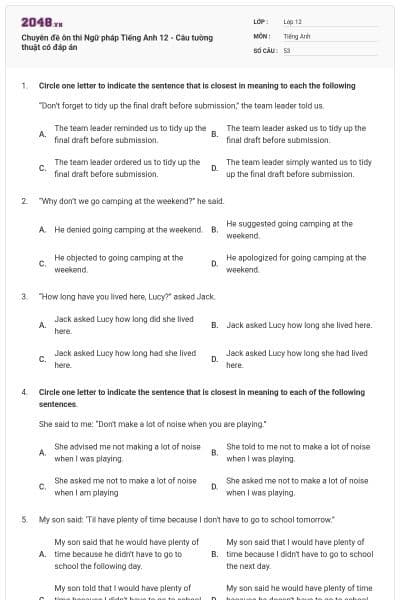
Chuyên đề ôn thi Ngữ pháp Tiếng Anh 12 - Câu tường thuật có đáp án
53 câu hỏi
“Don’t forget to tidy up the final draft before submission,” the team leader told us.
The team leader reminded us to tidy up the final draft before submission.
The team leader asked us to tidy up the final draft before submission.
The team leader ordered us to tidy up the final draft before submission.
The team leader simply wanted us to tidy up the final draft before submission.
(Trưởng nhóm nói với chúng tôi: “Đừng quên thu dọn bản thảo cuối cùng trước khi nộp.)
don’t forget (đừng quên) → hành động nhắc nhớ
Ta có phương án A. (remind sb to do sth: nhắc nhở ai đó làm gì)
→ Chọn A.“Why don’t we go camping at the weekend?” he said.
He denied going camping at the weekend.
He suggested going camping at the weekend.
He objected to going camping at the weekend.
He apologized for going camping at the weekend.
(Anh ta hỏi: “Tại sao chúng ta không đi cắm trại cuối tuần này nhỉ?”)
“why don’t we”: tại sao chúng ta không làm gì → lời gợi ý.
Ta có phương án B (suggest + Ving: gợi ý làm gì)
Chọn B.“How long have you lived here, Lucy?” asked Jack.
Jack asked Lucy how long did she lived here.
Jack asked Lucy how long she lived here.
Jack asked Lucy how long had she lived here.
Jack asked Lucy how long she had lived here.
(Jack hỏi: “Bạn sống ở đây lâu chưa vậy Lucy?”)
Câu hỏi ở dạng Wh-question ta có cấu trúc:
S + asked sb + Wh-question + S + V(áp dụng quy tắc lùi thì)
Chọn D.Circle one letter to indicate the sentence that is closest in meaning to each of the following sentences.
She said to me: “Don't make a lot of noise when you are playing.”
She advised me not making a lot of noise when I was playing.
She told to me not to make a lot of noise when I was playing.
She asked me not to make a lot of noise when I am playing
She asked me not to make a lot of noise when I was playing.
Đáp án: D
Giải thích:
Kiến thức: Câu gián tiếp
Câu trực tiếp là một lời yêu cầu → câu tường thuật có thể dùng cấu trúc: ask sb not to V sth + lùi thì ở mệnh đề thứ 2.
Ta chọn D.
A sai vì động từ tường thuật advised không phù hợp.
B sai cấu trúc “told to me”. (không cần “to”)
C sai vì mệnh đề thứ 2 chưa lùi thì.
Dịch: Cô ấy nói với tôi: “Đừng gây ồn ào quá khi chơi đùa.”
→ Cô ấy yêu cầu tôi không được ồn ào quá khi chơi đùa.
My son said: ‘Til have plenty of time because I don't have to go to school tomorrow.”
My son said that he would have plenty of time because he didn't have to go to school the following day.
My son said that I would have plenty of time because I didn't have to go to school the next day.
My son told that I would have plenty of time because I didn't have to go to school the next day.
My son said he would have plenty of time because he doesn't have to go to school the next day.
Đáp án. A
Giải thích:
Câu trực tiếp là một câu kể có 2 mệnh đề → câu tường thuật ta chỉ cần lùi thì ở cả 2 mệnh đề. Chọn A. Dịch nghĩa: Con trai tôi nói rằng ngày mai nó có rất nhiều thời gian vì nó không phải đi học.
Rita said to me: “Don't worry. I'll pay you back on Saturday.”
Rita advised to pay me back on Saturday.
Rita threatened to pay me back on Sunday.
Rita suggested paying me back on Sunday.
Rita promised to pay me back on Sunday.
Đáp án. D
Giải thích:
Câu trực tiếp diễn tả một lời hứa → sử dụng cấu trúc promise to V sth, ta chọn D.
Các lựa chọn còn lại dùng sai động từ tường thuật.
Dịch nghĩa: Rita hứa sẽ trả lại cho tôi vào thứ 7.
He asked Melda what time would she get up tomorrow morning?
He asked Melda what time she will get up tomorrow morning.
He asked Melda what time she would get up tomorrow morning.
He asks Melda what time she would get up tomorrow morning.
Đáp án. C
Giải thích:
Không thay đổi tomorrow morning vì nếu lời nói và hành động xảy ra cùng ngày thì không cần phải đổi thời gian. Câu trực tiếp là câu hỏi có từ để hỏi Wh_question thì cấu trúc câu gián tiếp là: S + asked + Wh-question + S + V (áp dụng quy tắc lùi thì) → chọn C.
A sai vì vẫn giữ trật tự của câu hỏi, B sai vì chưa lùi thì động từ, D sai vì động từ tường thuật dùng sai thì.
Dịch nghĩa: Anh ấy hỏi Melda rằng sáng mai mấy giờ cô ấy dậy.
“Would you mind moving your case?” said the other passenger. “It's blocking the door.”
The other passenger asked me to move my case as it was blocking the door.
The other passenger offered to move my case as it was blocking the door.
The other passenger suggested moving my case as it was blocking the door.
The other passenger reminded me to move my case as it was blocking the door.
Đáp án. A
Giải thích:
Câu trực tiếp là một lời yêu cầu would you mind moving vì vậy cấu trúc động từ tường thuật phù hợp sẽ là ask sb to V sth ở phương án A.
Không chọn B, C hoặc D vì động từ tường thuật ở các lựa chọn này không phù hợp.
Dịch nghĩa: Vị hành khách kia yêu cầu tôi di chuyển cái va li vì nó đang chắn ngang lối đi.
He said: “I always encourage my students to have a gap year before going to university.”
He said that he always encouraged his students to have a gap year before going to university.
He said that he always encourages his students to have a gap year before going to university.
He said that he had always encouraged his students to have a gap year before going to university.
He said that he had always been encouraging his students to have a gap year before going to university.
Đáp án. A
Giải thích:
Câu trực tiếp sử dụng thì hiện tại đơn → câu gián tiếp sử dụng thì quá khứ đơn. Ta chọn A.
B sai vì không lùi thì của động từ, C và D sai vì lùi sai thì động từ.
Dịch nghĩa: Anh ta nói rằng anh luôn khuyến khích học sinh của mình nên có một năm trải nghiệm thực tế trước khi vào học đại học.
“Remember to book a table, Kate” said Ann.
Ann reminded Kate to book a table.
Ann asked Kate to book a table.
Ann suggested Kate booking a table.
Ann advised Kate to book a table.
Đáp án. A
Giải thích:
Câu trực tiếp có cấu trúc remember to V sth (nhớ làm gì đó) dùng để nhắc nhở. Vì vậy câu tường thuật sẽ dùng động từ remind → chọn A.
Dịch nghĩa: Ann nhắc Kate nhớ đặt bàn.
My sister said to me: “Don’t turn off the light. I’m studying.”
My sister told me not turning off the light as she was studying.
My sister told to me not turn off the light as she was studying.
My sister told me not to turn off the light as she was studying.
My sister told me turn the light off as she was studying
Đáp án. C
Giải thích:
Câu trực tiếp là một lời yêu cầu, và cấu trúc phù hợp trong câu tường thuật là tell sb not to V sth → chọn C.
Dịch nghĩa: Em gái tôi dặn không tắt đèn vì con bé còn đang ngồi học.
“Would you like to have lunch with me today?” said Tom.
Tom suggested me to have dinner with him that day.
Tom suggested to have dinner with him that day.
Tom invited me to have dinner with him that day.
Tom invited me having dinner with him that day.
Đáp án. C
Giải thích:
Câu trực tiếp diễn đạt một lời mời, vì vậy cấu trúc câu tường thuật nên là invite sb to V sth → chọn C.
Dịch nghĩa: Hôm nay Tom mời tôi đi ăn trưa.
Tom asked Janet why did she keep staring at him.
Tom asked Janet why she keeps staring at him.
Tom asked Janet why she had kept staring at him.
Tom asked Janet why she kept staring at him
Đáp án. D
Giải thích:
Câu trực tiếp là câu hỏi có từ để hỏi Wh-question thì cấu trúc câu gián tiếp là: S + asked + Wh-question + S + V (áp dụng quy tắc lùi thì) → chọn D.
A sai vì vẫn giữ trật tự của câu hỏi, B sai vì chưa lùi thì động từ, C sai vì lùi sai thì.
Dịch nghĩa: Tom hỏi Janet sao cô ấy cứ nhìn anh chằm chằm như thế.
My father said: “Let’s go for a walk now. It’s not raining anymore.”
My father suggested that we should go for a walk as it was not raining anymore.
My father suggested to go for a walk as it was not raining anymore.
My father suggested us going for a walk as it was not raining anymore.
My father suggested go for a walk as it was not raining anymore.
Đáp án. A
Giải thích:
Câu trực tiếp dùng cấu trúc let’s V sth diễn tả một lời gợi ý → câu tường thuật sẽ thường sử dụng động từ suggest ở một trong 2 cấu trúc sau để diễn đạt: suggest + Ving sth hoặc suggest that sb should V sth.
Chọn A. Phương án B, C và D dùng sai cấu trúc.
Dịch nghĩa: Bố tôi gợi ý đi dạo vì trời không còn mưa nữa.
Molly said: “I’ll go crazy if I study chemistry all day.”
Molly said that she would go crazy if I studied chemistry all day.
Molly said that she would go crazy if she studied chemistry all day.
Molly said that she will go crazy if she studied chemistry all day.
Molly said that she would go crazy if she studies chemistry all day.
Đáp án. B
Giải thích:
Câu trực tiếp là câu điều kiện loại 1 → câu gián tiếp sử dụng câu điều kiện loại 2. A sai vì sử dụng sai đại từ, C và D sai cấu trúc câu điều kiện loại 2 → Chọn B
Dịch nghĩa: Molly nói rằng cô ấy sẽ phát điên mất nếu phải học hóa cả ngày.
“You should take better care of your health:” said Tom’s mother.
Tom’s mother promised to take better care of his health.
Tom’s mother ordered him to take better care of his health.
Tom’s mother required him to take better care of his health.
Tom’s mother advised him to take better care of his health.
Đáp án. D
Giải thích:
Câu trực tiếp có cụm từ diễn tả lời khuyên I should...If I were you → câu tường thuật dùng advise (khuyên bảo). Chọn D.
Dịch nghĩa: Mẹ của Tom khuyên anh ấy nên chăm sóc sức khỏe của mình tốt hơn.
She asked me: “Do you know which buses go to downtown?”
She wanted to know which buses went to downtown.
She asked me that which buses went to downtown.
She wondered that which buses go to downtown.
She asked me which buses had come to downtown.
Đáp án. A
Giải thích:
Câu trực tiếp là câu hỏi dạng YES/NO - question thì cấu trúc câu gián tiếp được sử dụng trong câu này là: S wanted to know S + V → chọn A.
B sai cấu trúc, C sai vì không lùi thì, D lùi thì sai.
Dịch nghĩa: Cô ấy muốn biết chuyến xe buýt nào đi vào trung tâm thành phố.
“Could I have your name and address, please?” said the travel agent to me.
The travel agent asked for my name and my address.
The travel agent asks me my name and my address.
The travel agent wanted to know your name and your address.
The travel agent wanted to have your name and your address.
Đáp án. A
Giải thích:
Câu trực tiếp là một lời yêu cầu → dùng cấu trúc ask for sth (yêu cầu cái gì) để tường thuật lại. Do đó chúng ta chọn A, B sai vì động từ tường thuật chia sai thì. C và D sai vì câu tường thuật không thay đổi tính từ sở hữu cho phù hợp.
Dịch nghĩa: Nhân viên đại lý du lịch hỏi xin tên và địa chỉ của tôi.
“Would you mind taking off your hat?” I said to the woman in front of me.
I reminded the woman in front of me to take off her hat.
I suggested the woman in front of me taking off her hat.
I asked the woman in front of me to take off her hat.
I invited the woman in front of me to take off her hat
Đáp án. C
Giải thích:
Câu trực tiếp là một lời yêu cầu would you mind + V_ing vì vậy cấu trúc động từ tường thuật phù hợp sẽ là ask sb to V sth ở phương án C.
Dịch nghĩa: Tôi nhắc/đề nghị người phụ nữ đứng trước mặt tôi bỏ mũ xuống
She said: “How often do you go to the cinema: Alison?”
She asked Alison how often did she go to the cinema.
She asked Alison how often does she go to the cinema.
She asked Alison how often she had gone to the cinema.
She asked Alison how often she went to the cinema
Đáp án. D
Giải thích:
Câu trực tiếp là câu hỏi có từ để hỏi How often thì cấu trúc câu gián tiếp là: S + asked + how often + S + V (áp dụng quy tắc lùi thì) → chọn D.
Dịch nghĩa:Cô ấy hỏi Alison rằng bao lâu cô ấy đi xem phim một lần.
Diana said to Jack: “Please stop asking me such questions. I don't want to tell lies.”
Diana told Jack to stop asking her such questions as she did not want to tell lies.
Diana advised Jack to stop asking her such questions as she did not want to tell lies.
Diana asked Jack stop asking her such questions as she did not want to tell lies.
Diana suggested that Jack should stop asking her such questions as she did not want to tell lies.
Đáp án. A
Giải thích:
Câu trực tiếp là một lời yêu cầu với cấu trúc câu please, stop Ving sth. Vì vậy khi tường thuật lại chúng ta có thể dùng cấu trúc tell/ask sb to V sth. Lựa chọn A dùng đúng động từ tường thuật, đúng cấu trúc. Không chọn B và D vì sai động từ tường thuật, không chọn C vì dùng sai cấu trúc.
Dịch nghĩa: Diana đề nghị Jack không hỏi cô ấy những câu hỏi như thế nữa vì cô không muốn nói dối anh.
The flight attendant said to the passenger: “Fasten your seatbelts because we have to make a compulsory landing.”
The flight attendant suggested fastening their seatbelts because they had to make a compulsory landing.
The flight attendant advised the passengers to fasten their seatbelts because they had to make a compulsory landing.
The flight attendant required the passenger to fasten their seatbelts because they had to make a compulsory landing.
The flight attendant reminded the passenger to fasten their seatbelts because they had to make a compulsory landing.
Đáp án. C
Giải thích:
Câu trực tiếp được dùng ở mệnh lệnh thức để diễn đạt một lời yên cầu → câu tường thuật có thể dùng cấu trúc require sb to V sth để diễn đạt. Ta chọn C.
Các phương án A, B, D dùng sai động từ tường thuật.
Dịch nghĩa: Cô tiếp viên hàng không yêu cầu hành khách thắt dây an toàn vì họ phải hạ cánh khẩn cấp.
The old man said to the children: “Don't go near the house because there is a gas leak.”
The old man reminded the children not going near the house because there was a gas leak.
The old man warned the children not to go near the house because there was a gas leak.
The old man threatened the children not to go near the house because there was a gas leak.
The old man persuaded the children not to go near the house because there was a gas leak
Đáp án. B
Giải thích:
Câu trực tiếp có cấu trúc don’t V sth + lí do để đưa ra lời cảnh báo → ta dùng cấu trúc warn sb not to Vsth để tường thuật. Chọn B.
Dịch nghĩa: Ông già cảnh báo lũ trẻ không đến gần ngôi nhà vì đang có khí ga rò rỉ.
My teacher asked me if I have decided which courses I am going to take.
My teacher wanted to know whether I had decided which courses I am going to take.
My teacher asked me whether I decided which courses I was going to take.
My teacher wanted to know if I had decided which course I was going to take.
Đáp án. D
Giải thích:
Câu trực tiếp là câu hỏi dạng YES/NO - question thì cấu trúc câu gián tiếp là: S + asked + if/whether+ S + V → chọn D.
Dịch nghĩa: Cô giáo hỏi tôi rằng tôi đã quyết định sẽ học khóa học nào chưa.My father said me that the car needed to have some maintenance though it was in good condition.
My father told me that the car needed to have some maintenance though it is in good condition.
My father said to me that the car needed to have some maintenance though it was in good condition.
My father told to me that the car needed to have some maintenance though it was in good condition.
Đáp án. C
Giải thích:
Câu trực tiếp là một câu kể có 2 mệnh đề → câu tường thuật ta chỉ cần lùi thì ở cả 2 mệnh đề. Chọn C.
Dịch nghĩa: Bố tôi nói với tôi rằng chiếc ô tô đó vẫn cần bảo dưỡng dù nó không hỏng hóc gì.
The boss said to me: “Pay particular attention when you are doing your work.”
The boss suggested paying particular attention when I was doing my work.
The boss persuaded me to pay particular attention when I was doing my work.
The boss advised me to pay particular attention when I was doing my work.
The boss required me to pay particular attention when I was doing my work.
Đáp án. D
Giải thích:
Câu trực tiếp được dùng ở mệnh lệnh thức, diễn tả lời yêu cầu. do đó câu tường thuật có thể dùng cấu trúc require sb to V sth + lùi thì ở mệnh đề còn lại → chọn D.
Dịch nghĩa: Sếp tôi yêu cầu tôi phải tập trung chú ý khi làm việc.
Mary said to me: “Do you know how long Alice has been playing the piano?”
Mary wanted to know how long Alice has been playing the piano.
Mary asked me whether I knew how long Alice had been playing the piano.
Mary wondered if I knew how long had Alice been playing the piano.
Mary asked me how long had Alice been playing the piano.
Đáp án. B
Giải thích:
Câu trực tiếp là câu hỏi dạng YES/NO - question thì cấu trúc câu gián tiếp là: S + asked + if/whether + S + V → chọn B.
Dịch nghĩa: Mary hỏi tôi có biết Alice đã chơi đàn được bao lâu rồi.
Mike said to Kate: “Would you like to go out for a coffee?”
Mike suggested going out for a coffee.
Mike asked Kate to go out for a coffee.
Mike persuaded Kate to go out for a coffee.
Mike invited Kate to go out for a coffee.
Đáp án. D
Giải thích:
Câu trực tiếp là một lời mời Woud you like to do sth?, do đó chúng ta có thể dùng cấu trúc invite sb to do sth để tường thuật lại → chọn D.
Dịch nghĩa: Mike mời Kate ra ngoài uống cafe.
“Don’t forget to submit your assignments by Thursday,” said the teacher to the students.
The teacher reminded the students to submit their assignments by Thursday.
The teacher allowed the students to submit their assignments by Thursday
The teacher ordered the students to submit their assignments by Thursday.
The teacher encouraged the students to submit their assignments by Thursday.
Đáp án. A
Giải thích:
Câu trực tiếp có don’t forget (đừng quên) → hành động nhắc nhở.
Chọn A. (remind sb to do V: nhắc nhở ai đó làm gì)
Dịch nghĩa: Giáo viên nhắc nhở học sinh nộp bài tập vào thứ năm.
“No, I won’t go to work at the weekend,” said Sally.
Sally apologized for not going to work at the weekend.
Sally regretted not going to work at the weekend.
Sally promised to go to work at the weekend.
Sally refused to go to work at the weekend.
Đáp án. D
Giải thích:
Câu trực tiếp là một lời từ chối nên có thể dùng cấu trúc refuse to V st trong câu gián tiếp → Chọn D.
Dịch nghĩa: Sally nói cô ấy không muốn làm việc vào cuối tuần.
“Why don’t you talk to her face-to-face?” asked Bill.
Bill suggested that I should talk to her face-to-face.
Bill advised that I could talk to her face-to-face.
Bill asked me why I hadn’t talked to her face-to-face.
Bill wondered why I don’t talk to her face-to-face.
Đáp án. A
Giải thích:
Câu trực tiếp là lời gợi ý do có cấu trúc Why don’t you. Do đó, câu gián tiếp dùng S + suggest + (that) S + (should) V + O → chọn A.
B, C, D dùng sai động từ tường thuật và lùi sai thì động từ.
Dịch nghĩa: Bill khuyên tôi nói trực tiếp với cô ấy.
“Have a drink!” said Mr. Smith.
Mr. Smith said that I should have a drink.
Mr. Smith recommended me with a drink.
Mr. Smith asked me for a drink.
Mr. Smith offered me a drink.
Đáp án. D
Giải thích:
Câu trực tiếp diễn tả một lời mời nên ta có thể sử dụng cấu trúc offer sb something: (mời ai cái gì) trong câu gián tiếp → chọn D.
Dịch nghĩa: Ông Smith mời tôi uống nước.
“Cigarette?” he said. “No, thanks” I said.
He asked for a cigarette, and I immediately refused.
He mentioned a cigarette, so I thanked him.
He offered me a cigarette, but I promptly declined.
He asked if I was smoking, and I denied at once.
Đáp án. C
Giải thích:
Câu trực tiếp diễn tả một lời mời nên ta có thể sử dụng cấu trúc offer sb something: (mời ai cái gì) trong câu gián tiếp → chọn C.
Dịch nghĩa:Anh ta đưa cho tôi một điếu thuốc, nhưng tôi từ chối ngay.
“If I hadn’t had so much work to do, I would have gone to the movies.” said the boy.
As the boy did not have much work to do, he went to the movies.
The boy said that if he hadn’t had so much work to do, he would have gone to the movies.
The boy explained the reason why he had so much work to do that he couldn’t go to the movies.
The boy didn’t want to go to the movies because he did have so much to do.
Đáp án. B
Giải thích:
Với câu điều kiện loại 3 khi chuyển câu nói trực tiếp sang tường thuật không cần thay đổi về thì.
Dịch nghĩa: Chàng trai nói rằng nếu anh ta không có quá nhiều việc phải làm, anh ta sẽ đi xem phim.
“We’re having a reunion this weekend. Why don’t you come?” John said to us.
John cordially invited us to a reunion this weekend.
John didn’t understand why we came to a reunion.
John simply asked us why we wouldn’t come to a reunion.
John asked us why we didn’t come to a reunion this weekend.
Đáp án. A
Giải thích:
Câu trực tiếp có Why don’t you come là một lời gợi ý nên lời gián tiếp sẽ có cấu trúc invite Sb to (do) sth. Do đó A đúng.
Dịch nghĩa: John thân ái mời chúng tôi đến một cuộc hội ngộ vào cuối tuần này.
She asked if I had passed the English test the week before.
“Have you passed the English test the week before?” she asked.
“Had you passed the English test the week before?” she asked
“Did you pass the English test last week?” she asked.
“If you passed the English test last week?” she asked.
Đáp án. C
Giải thích:
Chuyển câu gián tiếp về câu trực tiếp:
- Câu gián tiếp dùng “if” → câu trực tiếp là câu hỏi nghi vấn
- Thì: quá khứ hoàn thành → quá khứ đơn: If I had passed ...→ Did I pass?
- Trạng từ: the week before → last week
Câu A, B, D sai về ngữ pháp.
Dịch nghĩa: Cô ấy hỏi: “Bạn có qua được bài kiểm tra tuần trước không?”
“What a silly thing to say!”, Martha said.
Martha threatened that it was a silly thing to say.
Martha exclaimed that it was a silly thing to say.
Martha suggested that it was a silly thing to say.
Martha offered that it was a silly thing to say.
Đáp án: B
Giải thích:
Giải thích:
Kiến thức: Câu gián tiếp
“Thật là một điều ngớ ngẩn để nói!” Martha nói.
A. Martha đe dọa rằng đó là một điều ngớ ngẩn để nói.
B. Martha đã thốt lên rằng đó là một điều ngớ ngẩn để nói.
C. Martha gợi ý rằng đó là một điều ngớ ngẩn để nói.
D. Martha đề nghị rằng đó là một điều ngớ ngẩn để nói.
Câu A, C, D không phù hợp về nghĩa.
Chọn B.
“Please, let my child go!” she begged the kidnapper.
She begged the kidnapper to let her child to go.
She pleaded with the kidnapper to release her child.
She solemnly ordered the kidnapper to set her child free.
She pleaded the kidnapper to let her child go.
Đáp án. B
Giải thích:
Câu trúc beg sb (not) to do sth = plead with sb (not) to do sth (cầu xin, nài nỉ ai)
A sai cấu trúc vì let sb do sth. D sai cấu trúc plead with sb. C sai động từ tường thuật solemnly (long trọng ra lệnh)
Dịch nghĩa: Cô ấy nài nỉ kẻ bắt cóc thả con mình ra.
Rewrite the following sentences so that the meaning stays the same.
“Do you television every night, Janice?”, said Chandler.
→ Chandlerasked Janice_____________________________________.
Chandler asked Janice if she watched TV every night
Giải thích: Câu trực tiếp là câu hỏi dạng YES/NO - question thì cấu trúc câu gián tiếp là:
S + asked + if/whether + S + V.
Dịch nghĩa: Chandler hỏi Janice có phải cô ấy tối nào cũng xem TV không.
“I’m sorry. I didn’t do the homework,” Linh said to her teacher.
→ Linh apologized_____________________________________ .
Linh apologized to her teacher for not having done the homework.
Giải thích: cấu trúc apologize (to sb) for (not) V_ing/having + V (xin lỗi ai về việc gì)
Dịch nghĩa: Linh xin lỗi giáo viên về việc đã không làm bài tập về nhà
“How beautiful the shawl you have just bought is!” Ann said to Rachel.
→ Ann complimented_____________________________________.
Ann complimented Rachel on her shawl she had just bought.
Giải thích: cấu trúc compliment sb on sth(khen ngợi ai đó về thứ gì)
Dịch nghĩa: Ann khen ngợi Rachel về cái khăn choàng mà cô ấy vừa mua.
→ The father encouraged_____________________________________.
The father encouraged Hang to apply the job at that prestigious company.
Giải thích: cấu trúc ecourage sb to + V sth(khuyến khích ai đó làm gì)
Dịch nghĩa: Bố khuyến khích Hằng đi xin việc tại công ty danh giá đó.
→ He said if_____________________________________
He said if he had enough money, he could buy that fabulous car.
Giải thích: Câu trực tiếp là câu điều kiện loại 2, khi chuyển sang câu tường thuật ta sẽ giữ nguyên thì ở cả 2 mệnh đề và thay đổi các đại từ cho phù hợp.
Dịch nghĩa: Anh ta nói nếu anh ta có đủ tiền, anh ta có thể mua chiếc xe tuyệt vời đó.
→ The boss promised _____________________________________.
Đáp án: The boss promised that none of his co-workers had to work overtime the following month.
Giải thích:
Kiến thức: Câu gián tiếp
Cần lùi thì hiện tại đơn về quá khứ đơn và thay đổi thời gian “next month” thành “the next month”
Dịch: Ông chủ nói: “Không có đồng nghiệp nào của tôi phải làm thêm giờ vào tháng tới”.
→ Ông chủ đã hứa rằng không có đồng nghiệp nào của ông phải làm thêm giờ vào tháng tiếp theo.
→ The shop assistant asked_____________________________________.
The shop assistant asked the man which jeans he had already tried on.
Giải thích: Câu trực tiếp là câu hỏi có từ để hỏi Wh-question thì cấu trúc câu gián tiếp là: S + asked + Wh_question+ S + V (áp dụng quy tắc lùi thì)
Dịch nghĩa: Người trợ lý cửa hàng hỏi người đàn ông chiếc quần bò nào mà anh ta đã thử.
→ The zookeeper told_____________________________________.
The zookeeper told the children not to feed the animals.
Giải thích: cấu trúc not to do sth được dùng khi câu trực tiếp là câu mệnh lệnh phủ định.
Dịch nghĩa: Người quản lý vườn thú bảo bọn trẻ không được cho động vật ăn.
→ The teacher warned_____________________________________.
The teacher warned the children not to play around the edge of the swimming pool or they would fall in.
Giải thích: cấu trúc warn sb not to to + V + sth (cảnh báo ai không được làm gì)
Dịch nghĩa: Giáo viên cảnh báo bọn trẻ không được chơi quanh bể bơi nếu không chúng sẽ ngã vào đó.
→ The coach ordered_____________________________________.
The coach ordered Jim to turk his shirt immediately.
Giải thích: cấu trúc order sb to + V + sth (yêu cầu ai làm gì).
Dịch nghĩa: Huấn luyện viên ra lệnh cho Jim phải sơ vin ngay lập tức.
“You choose the right washing cycle first, and then you press this button.” she told the children.
→ She instructed_____________________________________.
She instructed the children to choose the right washing cycle first and then press that button.
Giải thích: cấu trúc instruct sb to do + V(hướng dẫn ai làm gì).
Dịch nghĩa: Cô ấy hướng dẫn bọn trẻ chọn đúng mức độ giặt trước rồi nhấn nút đó.
“I’d like to see your student card before I can let you into the library” the librarian said to me.
→ The librarian wanted_____________________________________
The librarian wanted to see my student card before he could let me into the library.
Giải thích: cấu trúc want to do + V (muốn làm gì).
Dịch nghĩa: Người thủ thư muốn xem thẻ sinh viên của tôi trước khi anh ta có thể cho tôi vào thư viện.
→ The robber threatened _____________________________________
The robber threatened to kill me if I didn’t give him all the money and that diamond ring.
Giải thích: Câu trúc threaten to + V(đe doạ)
Dịch nghĩa: Tên cướp đe dọa sẽ giết tôi nếu tôi không đưa cho anh ta tất cả số tiền và chiếc nhẫn kim cương đó.
→ Jane accused_____________________________________
Jane accused Ron of having broken her priceless vase.
Giải thích: cấu trúc accuse sb of + Ving/ having +VpII + sth (buộc tội ai đã làm gì).
Dịch nghĩa: Jane cáo buộc Ron đã làm vỡ chiếc bình vô giá của mình.
→ Kevin denied_____________________________________
Kevin denied having taken her purse.
Giải thích: cấu trúc deny Ving/ havng +VpII + sth (chối đã làm gì).
Dịch nghĩa: Kevin phủ nhận đã lấy ví của cô gái ấy.
Bạn có thích hoạt động này không?