Bài tập Trắc nghiệm Unit 4 Reading
15 câu hỏi
Hãy chọn đáp án đúng để trả lời các câu hỏi sau.
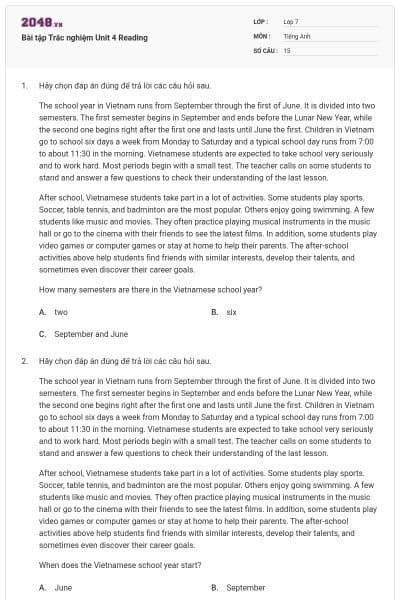
The school year in Vietnam runs from September through the first of June. It is divided into two semesters. The first semester begins in September and ends before the Lunar New Year, while the second one begins right after the first one and lasts until June the first. Children in Vietnam go to school six days a week from Monday to Saturday and a typical school day runs from 7:00 to about 11:30 in the morning. Vietnamese students are expected to take school very seriously and to work hard. Most periods begin with a small test. The teacher calls on some students to stand and answer a few questions to check their understanding of the last lesson.
After school, Vietnamese students take part in a lot of activities. Some students play sports. Soccer, table tennis, and badminton are the most popular. Others enjoy going swimming. A few students like music and movies. They often practice playing musical instruments in the music hall or go to the cinema with their friends to see the latest films. In addition, some students play video games or computer games or stay at home to help their parents. The after-school activities above help students find friends with similar interests, develop their talents, and sometimes even discover their career goals.
How many semesters are there in the Vietnamese school year?
two
six
September and June
Đáp án: A
Giải thích: The school year in Vietnam runs from September through the first of June. It is divided into two semesters.
Dịch: Năm học tại Việt Nam diễn ra từ tháng 9 đến đầu tháng 6. Nó được chia thành hai học kỳ.
Hãy chọn đáp án đúng để trả lời các câu hỏi sau.
The school year in Vietnam runs from September through the first of June. It is divided into two semesters. The first semester begins in September and ends before the Lunar New Year, while the second one begins right after the first one and lasts until June the first. Children in Vietnam go to school six days a week from Monday to Saturday and a typical school day runs from 7:00 to about 11:30 in the morning. Vietnamese students are expected to take school very seriously and to work hard. Most periods begin with a small test. The teacher calls on some students to stand and answer a few questions to check their understanding of the last lesson.
After school, Vietnamese students take part in a lot of activities. Some students play sports. Soccer, table tennis, and badminton are the most popular. Others enjoy going swimming. A few students like music and movies. They often practice playing musical instruments in the music hall or go to the cinema with their friends to see the latest films. In addition, some students play video games or computer games or stay at home to help their parents. The after-school activities above help students find friends with similar interests, develop their talents, and sometimes even discover their career goals.
When does the Vietnamese school year start?
June
September
before the Lunar New Year
Đáp án: B
Giải thích: The first semester begins in September and ends before the Lunar New Year.
Dịch: Học kỳ đầu tiên bắt đầu vào tháng 9 và kết thúc trước Tết Nguyên đán.
Hãy chọn đáp án đúng để trả lời các câu hỏi sau.
The school year in Vietnam runs from September through the first of June. It is divided into two semesters. The first semester begins in September and ends before the Lunar New Year, while the second one begins right after the first one and lasts until June the first. Children in Vietnam go to school six days a week from Monday to Saturday and a typical school day runs from 7:00 to about 11:30 in the morning. Vietnamese students are expected to take school very seriously and to work hard. Most periods begin with a small test. The teacher calls on some students to stand and answer a few questions to check their understanding of the last lesson.
After school, Vietnamese students take part in a lot of activities. Some students play sports. Soccer, table tennis, and badminton are the most popular. Others enjoy going swimming. A few students like music and movies. They often practice playing musical instruments in the music hall or go to the cinema with their friends to see the latest films. In addition, some students play video games or computer games or stay at home to help their parents. The after-school activities above help students find friends with similar interests, develop their talents, and sometimes even discover their career goals.
How long does the typical school day in Vietnam last?
4 hours and a half
5 hours
5 hours and a half
Đáp án: A
Giải thích: Children in Vietnam go to school six days a week from Monday to Saturday and a typical school day runs from 7:00 to about 11:30 in the morning.
Dịch: Trẻ em ở Việt Nam đi học sáu ngày một tuần từ thứ Hai đến thứ Bảy và một ngày học thông thường kéo dài từ 7:00 đến khoảng 11:30 sáng.
Hãy chọn đáp án đúng để trả lời các câu hỏi sau.
The school year in Vietnam runs from September through the first of June. It is divided into two semesters. The first semester begins in September and ends before the Lunar New Year, while the second one begins right after the first one and lasts until June the first. Children in Vietnam go to school six days a week from Monday to Saturday and a typical school day runs from 7:00 to about 11:30 in the morning. Vietnamese students are expected to take school very seriously and to work hard. Most periods begin with a small test. The teacher calls on some students to stand and answer a few questions to check their understanding of the last lesson.
After school, Vietnamese students take part in a lot of activities. Some students play sports. Soccer, table tennis, and badminton are the most popular. Others enjoy going swimming. A few students like music and movies. They often practice playing musical instruments in the music hall or go to the cinema with their friends to see the latest films. In addition, some students play video games or computer games or stay at home to help their parents. The after-school activities above help students find friends with similar interests, develop their talents, and sometimes even discover their career goals.
In which paragraph does the information “Vietnamese students take part in a lot of after-school activities.” appear?
paragraph 1
paragraph 2
both paragraph 1 and 2
Đáp án: B
Giải thích: After school, Vietnamese students take part in a lot of activities.
Dịch: Sau giờ học, sinh viên Việt Nam tham gia rất nhiều hoạt động.
Hãy chọn đáp án đúng để trả lời các câu hỏi sau.
The school year in Vietnam runs from September through the first of June. It is divided into two semesters. The first semester begins in September and ends before the Lunar New Year, while the second one begins right after the first one and lasts until June the first. Children in Vietnam go to school six days a week from Monday to Saturday and a typical school day runs from 7:00 to about 11:30 in the morning. Vietnamese students are expected to take school very seriously and to work hard. Most periods begin with a small test. The teacher calls on some students to stand and answer a few questions to check their understanding of the last lesson.
After school, Vietnamese students take part in a lot of activities. Some students play sports. Soccer, table tennis, and badminton are the most popular. Others enjoy going swimming. A few students like music and movies. They often practice playing musical instruments in the music hall or go to the cinema with their friends to see the latest films. In addition, some students play video games or computer games or stay at home to help their parents. The after-school activities above help students find friends with similar interests, develop their talents, and sometimes even discover their career goals.
The word “latest” in paragraph 2 has the closest meaning with ___.
modest
oldest
newest
Đáp án: C
Giải thích: Latest = newest
Dịch: Mới nhất, cập nhật nhất
Hãy chọn đáp án đúng để trả lời các câu hỏi sau.
The school year in Vietnam runs from September through the first of June. It is divided into two semesters. The first semester begins in September and ends before the Lunar New Year, while the second one begins right after the first one and lasts until June the first. Children in Vietnam go to school six days a week from Monday to Saturday and a typical school day runs from 7:00 to about 11:30 in the morning. Vietnamese students are expected to take school very seriously and to work hard. Most periods begin with a small test. The teacher calls on some students to stand and answer a few questions to check their understanding of the last lesson.
After school, Vietnamese students take part in a lot of activities. Some students play sports. Soccer, table tennis, and badminton are the most popular. Others enjoy going swimming. A few students like music and movies. They often practice playing musical instruments in the music hall or go to the cinema with their friends to see the latest films. In addition, some students play video games or computer games or stay at home to help their parents. The after-school activities above help students find friends with similar interests, develop their talents, and sometimes even discover their career goals.
What is the benefit of the after-school activities?
enrich students’ knowledge
help students find friends with similar interests
have more experience
Đáp án: B
Giải thích: The after-school activities above help students find friends with similar interests, develop their talents, and sometimes even discover their career goals.
Dịch: Các hoạt động sau giờ học ở trên giúp học sinh tìm được những người bạn có cùng sở thích, phát triển tài năng và đôi khi còn khám phá mục tiêu nghề nghiệp của họ.
Hãy xác định những thông tin sau là Đúng (True) hay Sai (False).
The school year in Vietnam runs from September through the first of June. It is divided into two semesters. The first semester begins in September and ends before the Lunar New Year, while the second one begins right after the first one and lasts until June the first. Children in Vietnam go to school six days a week from Monday to Saturday and a typical school day runs from 7:00 to about 11:30 in the morning. Vietnamese students are expected to take school very seriously and to work hard. Most periods begin with a small test. The teacher calls on some students to stand and answer a few questions to check their understanding of the last lesson.
After school, Vietnamese students take part in a lot of activities. Some students play sports. Soccer, table tennis, and badminton are the most popular. Others enjoy going swimming. A few students like music and movies. They often practice playing musical instruments in the music hall or go to the cinema with their friends to see the latest films. In addition, some students play video games or computer games or stay at home to help their parents. The after-school activities above help students find friends with similar interests, develop their talents, and sometimes even discover their career goals.
No one expects students to take school seriously and to work hard in Vietnam.
True
False
Đáp án: B
Giải thích: Vietnamese students are expected to take school very seriously and to work hard.
Dịch: Học sinh Việt Nam được mong chờ sẽ đi học rất nghiêm túc và làm việc chăm chỉ
Hãy xác định những thông tin sau là Đúng (True) hay Sai (False).
The school year in Vietnam runs from September through the first of June. It is divided into two semesters. The first semester begins in September and ends before the Lunar New Year, while the second one begins right after the first one and lasts until June the first. Children in Vietnam go to school six days a week from Monday to Saturday and a typical school day runs from 7:00 to about 11:30 in the morning. Vietnamese students are expected to take school very seriously and to work hard. Most periods begin with a small test. The teacher calls on some students to stand and answer a few questions to check their understanding of the last lesson.
After school, Vietnamese students take part in a lot of activities. Some students play sports. Soccer, table tennis, and badminton are the most popular. Others enjoy going swimming. A few students like music and movies. They often practice playing musical instruments in the music hall or go to the cinema with their friends to see the latest films. In addition, some students play video games or computer games or stay at home to help their parents. The after-school activities above help students find friends with similar interests, develop their talents, and sometimes even discover their career goals.
The teacher often tests the students’ knowledge of the last lesson before starting new lessons.
True
False
Đáp án: A
Giải thích: Most periods begin with a small test. The teacher calls on some students to stand and answer a few questions to check their understanding of the last lesson.
Dịch: Hầu hết các giai đoạn bắt đầu với một bài kiểm tra nhỏ. Giáo viên kêu gọi một số học sinh đứng và trả lời một số câu hỏi để kiểm tra sự hiểu biết của họ về bài học cũ.
Hãy xác định những thông tin sau là Đúng (True) hay Sai (False).
The school year in Vietnam runs from September through the first of June. It is divided into two semesters. The first semester begins in September and ends before the Lunar New Year, while the second one begins right after the first one and lasts until June the first. Children in Vietnam go to school six days a week from Monday to Saturday and a typical school day runs from 7:00 to about 11:30 in the morning. Vietnamese students are expected to take school very seriously and to work hard. Most periods begin with a small test. The teacher calls on some students to stand and answer a few questions to check their understanding of the last lesson.
After school, Vietnamese students take part in a lot of activities. Some students play sports. Soccer, table tennis, and badminton are the most popular. Others enjoy going swimming. A few students like music and movies. They often practice playing musical instruments in the music hall or go to the cinema with their friends to see the latest films. In addition, some students play video games or computer games or stay at home to help their parents. The after-school activities above help students find friends with similar interests, develop their talents, and sometimes even discover their career goals.
Badminton is an unpopular after-school sport.
True
False
Đáp án: B
Giải thích: Soccer, table tennis, and badminton are the most popular.
Dịch: Bóng đá, bóng bàn và cầu lông là phổ biến nhất.
Hãy xác định những thông tin sau là Đúng (True) hay Sai (False).
The school year in Vietnam runs from September through the first of June. It is divided into two semesters. The first semester begins in September and ends before the Lunar New Year, while the second one begins right after the first one and lasts until June the first. Children in Vietnam go to school six days a week from Monday to Saturday and a typical school day runs from 7:00 to about 11:30 in the morning. Vietnamese students are expected to take school very seriously and to work hard. Most periods begin with a small test. The teacher calls on some students to stand and answer a few questions to check their understanding of the last lesson.
After school, Vietnamese students take part in a lot of activities. Some students play sports. Soccer, table tennis, and badminton are the most popular. Others enjoy going swimming. A few students like music and movies. They often practice playing musical instruments in the music hall or go to the cinema with their friends to see the latest films. In addition, some students play video games or computer games or stay at home to help their parents. The after-school activities above help students find friends with similar interests, develop their talents, and sometimes even discover their career goals.
The Vietnamese students have two days off a week.
True
False
Đáp án: B
Giải thích: Children in Vietnam go to school six days a week from Monday to Saturday.
Dịch: Trẻ em ở Việt Nam đi học sáu ngày một tuần từ thứ Hai đến thứ Bảy.
Read the letter from George. Choose the correct answer: A, B or C.
Dear Sergio,
How (1).......... you? (2).......... you want to know about a typical day at my school? I always (3).......... to school with my brother and my friend Steve. School starts at 7 o'clock. (4).......... the morning, we have five lessons, usually different subject. Then we have lunch. I (5).......... have lunch at school, often I go home. In the afternoon, there are two lessons. My favourite subject is Geography. After school, we often play football. What about you?
Bye for now,
George
Điền vào số 1
do
go
are
Đáp án: C
Dịch: Bạn thế nào?
Read the letter from George. Choose the correct answer: A, B or C.
Dear Sergio,
How (1).......... you? (2).......... you want to know about a typical day at my school? I always (3).......... to school with my brother and my friend Steve. School starts at 7 o'clock. (4).......... the morning, we have five lessons, usually different subject. Then we have lunch. I (5).......... have lunch at school, often I go home. In the afternoon, there are two lessons. My favourite subject is Geography. After school, we often play football. What about you?
Bye for now,
George
Điền vào số 2
Does
Do
Are
Đáp án: B
Dịch: Bạn có muốn biết về một ngày điển hình ở trường tôi không?
Read the letter from George. Choose the correct answer: A, B or C.
Dear Sergio,
How (1).......... you? (2).......... you want to know about a typical day at my school? I always (3).......... to school with my brother and my friend Steve. School starts at 7 o'clock. (4).......... the morning, we have five lessons, usually different subject. Then we have lunch. I (5).......... have lunch at school, often I go home. In the afternoon, there are two lessons. My favourite subject is Geography. After school, we often play football. What about you?
Bye for now,
George
Điền vào số 3
walk
walks
walking
Đáp án: A
Giải thích: Thì hiện tại đơn (dấu hiệu: always)
Dịch: Tôi luôn đi bộ đến trường với anh trai và bạn Steve
Read the letter from George. Choose the correct answer: A, B or C.
Dear Sergio,
How (1).......... you? (2).......... you want to know about a typical day at my school? I always (3).......... to school with my brother and my friend Steve. School starts at 7 o'clock. (4).......... the morning, we have five lessons, usually different subject. Then we have lunch. I (5).......... have lunch at school, often I go home. In the afternoon, there are two lessons. My favourite subject is Geography. After school, we often play football. What about you?
Bye for now,
George
Điền vào số 4
On
In
At
Đáp án: B
Giải thích: Để chỉ buổi trong ngày ta dùng giới từ “in”
Dịch: Vào buổi sáng, chúng tôi có năm bài học, thường là môn học khác nhau. Sau đó chúng tôi ăn trưa.
Read the letter from George. Choose the correct answer: A, B or C.
Dear Sergio,
How (1).......... you? (2).......... you want to know about a typical day at my school? I always (3).......... to school with my brother and my friend Steve. School starts at 7 o'clock. (4).......... the morning, we have five lessons, usually different subject. Then we have lunch. I (5).......... have lunch at school, often I go home. In the afternoon, there are two lessons. My favourite subject is Geography. After school, we often play football. What about you?
Bye for now,
George
Điền vào số 5
don’t
not
doesn’t
Đáp án: A
Giải thích: Thì hiện tại đơn với chủ ngữ ‘I’ ta dùng do/don’t
Dịch: Tôi không ăn trưa ở trường, tôi thường về nhà.