500 câu trắc nghiệm Tìm câu cận nghĩa trong tiếng Anh có đáp án - Phần 9
30 câu hỏi
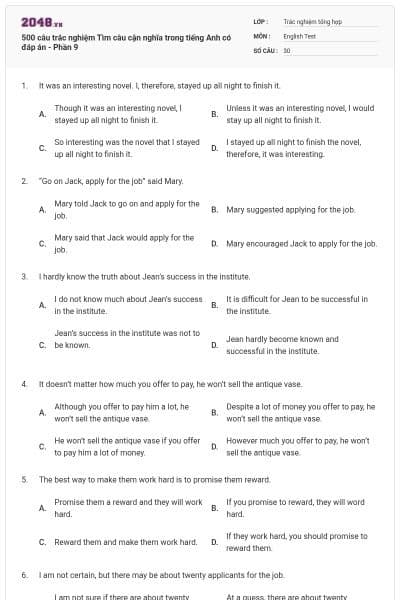
Though it was an interesting novel, I stayed up all night to finish it.
Unless it was an interesting novel, I would stay up all night to finish it.
So interesting was the novel that I stayed up all night to finish it.
I stayed up all night to finish the novel, therefore, it was interesting.
Chọn đáp án C
Mary told Jack to go on and apply for the job.
Mary suggested applying for the job.
Mary said that Jack would apply for the job.
Mary encouraged Jack to apply for the job.
Chọn đáp án D
I do not know much about Jean’s success in the institute.
It is difficult for Jean to be successful in the institute.
Jean’s success in the institute was not to be known.
Jean hardly become known and successful in the institute.
Chọn đáp án A
Đáp án A: Tôi không biết nhiều về thành công của Jean ở học viện
B. sai nghĩa: Khó cho Jean để thành công ở học viện
C. Sự thành công của Jean ở học viện không được biết
D. Jean hầu như không được biết đến và thành công ở học viện
Although you offer to pay him a lot, he won’t sell the antique vase.
Despite a lot of money you offer to pay, he won’t sell the antique vase.
He won’t sell the antique vase if you offer to pay him a lot of money.
However much you offer to pay, he won’t sell the antique vase.
Chọn đáp án D
A. Dù bạn có đề nghị trả anh ấy nhiều tiền, anh ấy cũng sẽ không bán cái bình hoa sổ.
B. Dù nhiều tiền bạn đề nghị trả anh ấy, anh ấy cũng sẽ không bán cái bình hoa cổ.
C. Anh ấy sẽ không bán cái bình hoa cổ nếu bạn đề nghị trả anh ấy nhiều tiền
D. Dù bạn có đề nghị trả anh ấy nhiều tiền thế nào, anh ấy cũng sẽ không bán cái bình hoa cổ.
Promise them a reward and they will work hard.
If you promise to reward, they will word hard.
Reward them and make them work hard.
If they work hard, you should promise to reward them.
Chọn đáp án B
A. Hứa trao thưởng cho họ và họ sẽ làm việc chăm chỉ
B. Nếu bạn hứa trao thưởng cho họ, họ sẽ làm việc chăm chỉ.
C. Trao thưởng cho họ và khiến họ làm việc chăm chỉ.
D. Nếu họ làm việc chăm chỉ, bạn nên hứa trao thưởng cho họ.
I am not sure if there are about twenty applicants for the job.
At a guess, there are about twenty applicants for the job
I guess that there are twenty applicants for the job
Twenty people are guessed to have applied for the job
Chọn đáp án B
A. Tôi không chắc nếu có 20 thí sinh ứng tuyển cho công việc.
B. Theo phỏng đoán, có khoảng 20 thí sinh ứng tuyển cho công việc.
C. Tôi đoán có khoảng 20 người ứng tuyển cho công việc.
D. 20 người được dự đoán là đã ứng tuyển cho công việc.
Đáp án A và D không hợp về nghĩa
Đáp án C phải sửa thành “ I guess that there are about twenty people applying for the job”
At a guess= I guess: theo phỏng đoán, đoán là.
I bought an Italian pair of shoes that went missing after two days.
The Italian pair of shoes that I bought for $150 went missing after two days.
The Italian pair of shoes, which I had bought for $150, went missing after two days.
My Italian pair of shoes that went missing after two days were bought for 150$.
Chọn đáp án C
A. Tôi đã mua 1 đôi giày Ý, đôi giày mà mất sau 2 ngày.
B. Đôi giày Ý tôi mua 150 $ mất sau 2 ngày.
C. Đôi giày Ý mà tôi mua 150 $ mất sau 2 ngày.
D. Đôi giày Ý của tôi, đôi giày mà mất sau 2 ngày được mua với giá 150$.
Không chọn A và D do không hợp về nghĩa.
Không chọn B do hành động mua đôi giày ( bought) xảy ra trước sự việc đôi
giàu bị mất ( went missing) nên phải chia quá khứu hoàn thành ( had bought)

Học thông minh hơn mỗi ngày
Xem toàn bộ 30 câu hỏi và nhiều hơn nữa với tài khoản miễn phí
Ann finds it pleasure to paint landscape pictures
Ann takes great pleasure in painting landscape pictures
Painting landscape pictures makes Ann feel pleasure
Ann feels pleasant in painting landscape pictures
Chọn đáp án C
A. Tôi đã mua 1 đôi giày Ý, đôi giày mà mất sau 2 ngày.
B. Đôi giày Ý tôi mua 150 $ mất sau 2 ngày.
C. Đôi giày Ý mà tôi mua 150 $ mất sau 2 ngày.
D. Đôi giày Ý của tôi, đôi giày mà mất sau 2 ngày được mua với giá 150$.
Không chọn A và D do không hợp về nghĩa.
Không chọn B do hành động mua đôi giày (bought) xảy ra trước sự việc đôi
giàu bị mất (went missing) nên phải chia quá khứu hoàn thành (had bought)
We just have met her at the station.
We have just met her at the station.
We have met just her at the station.
We have just her met at the station.
Chọn đáp án B
He looks in hospital. He was unhealthy last week.
He unhealthy. He was looks in hospital last week.
He looks unhealthy. He was in hospital last week.
He looks unhealhy. He was hospital in last week.
Chọn đáp án C
A new source of energy has discovered.
A new source of energy was discovered.
A new source of energy have been discovered
A new source of energy has been discovered
Chọn đáp án D
That is said he was born in London.
It was said that he was born in London.
He was said to be born in London.
He is said to have been born in London.
Đáp án: D
Giải thích:
Cấu trúc bị động của động từ tường thuật (say, think, believe, etc.):
It is said that + S + V
S + be said to + V (nếu hành động ở hiện tại hoặc tương lai)
S + be said to have + V3/V-ed (nếu hành động đã xảy ra trong quá khứ)
Ở đây, hành động "was born" ở quá khứ, nên ta dùng "to have been born".
Xét các đáp án:
A. That is said he was born in London. → Sai cấu trúc bị động.
B. It was said that he was born in London. → Sai thì, vì động từ "say" ở hiện tại đơn (People say).
C. He was said to be born in London. → "to be born" chỉ dùng khi nói về hành động xảy ra trong hiện tại hoặc tương lai, nhưng ở đây là quá khứ (was born), nên sai.
D. He is said to have been born in London. → Đúng, vì dùng "to have been born" cho hành động quá khứ.
Dịch: Người ta nói rằng anh ấy được sinh ra ở London.
All the seats for the concert next Sunday have been booked
All the seats were sold for the concert next Sunday.
The concert next Sunday had no seats for us.
No seats left for us for the concert next Sunday.
Chọn đáp án A
She hardly had begun to speak when people started interrupting.
Hardly she had begun to speak when people started interrupting.
Hardly had she begun to speak when people started interrupting.
She hadn’t begun to speak when people started interrupting.
Chọn đáp án C
A lot of trees were blown down last night by the storm.
A lot of trees were cut down last night
The storm could have blown a lot of trees down.
The storm was strong enough to blow down old trees.
Chọn đáp án A
This road is not used very often
Not very often this road is not used
This road very often is not used
This road not very often is used
Chọn đáp án A
Despite very tired, he kept on working.
Though his tiredness, he kept on working.
Although he was very tired, but he kept on working.
He kept on working although he was very tired.
Chọn đáp án D
In spite of the rain heavily, they went on working.
In spite of the raining heavily, they went on working.
Despite the heavy rain, they went on working.
Though the fact that it rained heavily, they went on working.
Chọn đáp án C
Because cars cause pollution, people want them.
Despite the fact that cars cause pollution, people want them.
Cars cause pollution although people want them.
Cars cause pollution because people still want them.
Chọn đáp án B
Near the airport a new hospital has been built.
A new hospital has been built near the airport by them.
A new hospital near the airport has been built.
A new hospital has been built near the airport.
Đáp án: D
Giải thích:
Kiến thức: Câu bị động
Câu trên ở thể chủ động (They have built a new hospital near the airport.), khi chuyển sang bị động, ta thực hiện các bước sau:
Xác định tân ngữ trong câu chủ động (a new hospital), đây sẽ là chủ ngữ mới trong câu bị động.
Động từ chính (have built) ở thì hiện tại hoàn thành → công thức bị động: S + has/have + been + V3/ed.
Loại bỏ chủ ngữ "They" vì không cần thiết trong câu bị động.
Giữ nguyên trạng ngữ chỉ nơi chốn đặt cuối câu (near the airport).
Chọn D.
Dịch: Một bệnh viện mới đã được xây dựng gần sân bay.
People should send their complaints to the head office.
Complaints should be sent to the head office.
Complaints should be sent to the head office by people.
Their complaints should be sent to the head office by people.
Đáp án: A
Giải thích:
Kiến thức: Chủ động – Bị động
Câu đề bài: Their complaints to the head office should be sent. (Câu bị động)
➝ Chuyển về chủ động theo công thức:
S + should + V (động từ nguyên mẫu) + O
Chủ ngữ "People" được thêm vào vì câu bị động không đề cập đến người thực hiện hành động.
"Their complaints" giữ nguyên làm tân ngữ.
"Should be sent" → chuyển thành "should send" trong thể chủ động.
Xét các đáp án khác:
B. Bị động, không phải câu chủ động như đề yêu cầu.
C. Bị động, không phù hợp.
D. Vẫn là câu bị động, không đúng yêu cầu chuyển về chủ động.
Dịch: Mọi người nên gửi khiếu nại của họ đến trụ sở chính.
If they got unbiased information, they could know the true story.
If they had unbiased the information, they could have known the true story.
If they had been exposed to unbiased information, they would have known the true story.
If they have exposed to the unbiased information, they could have seen the true story.
Chọn đáp án C
13 is believed to have been an unlucky number.
It is believe 13 to have been an unlucky number.
13 is believed to be an unlucky number.
It believes that 13 is an unlucky number.
Chọn đáp án C
The building was said to have demolished.
The building was said to have been demolishing.
The building was said to be demolished.
The building was said to have been demolished.
Chọn đáp án C
rằng.... Hai động từ cùng thời nên dùng dạng to V
It was until we arrived at the airport that we realize our passports were still at home.
We arrived at the airport and realized that our passports are still at home.
Not until had we arrived at the airport, we realized our passports were still at home.
Not until we arrived at the airport did we realize that our passports were still at home.
Chọn đáp án D
He wasn’t driving fast enough to avoid an accident.
He did’t have an accident although he was driving very fast.
If he had been driving very fast, he would have had an accident.
An accident happended, and it was caused by his very fast driving.
Chọn đáp án B
I said if she lets her son do whatever he wants, she will spoil him.
I warned her that if she let her son do whatever he wanted, she would spoil him.
I warned her that if she let her son do whatever she wanted, she would spoil him.
I told her if her son did whatever she wanted, she would spoil him.
Chọn đáp án B
Fried tried very hard to start the car, and succeeded.
Fried tried hard to start the car, and with success.
However hard he tried, Fried couldn’t start the car.
It’s hard for Fried to start the car because he never succeeded.
Chọn đáp án C
What the lecturer wrote and said was too difficult for me to understand.
I found it very difficult to understand what the lecturer said in his book.
I would have understood what the lecturer was saying if I had read his book.
The lecturer’s book which I had not read was difficult to understand.
Chọn đáp án C
Finishing the report, I went out for a cup of coffee.
Having finished the report, i went out for a cup of coffee.
Going out for a cup of coffee, I finished my report.
To finish the report, I went out for a cup of coffee.
Chọn đáp án B
Bạn có thích hoạt động này không?
Ý kiến của bạn sẽ giúp chúng tôi đề xuất nội dung phù hợp hơn.
Gợi ý cho bạn
![[Năm 2022] Đề thi thử môn Vật lí THPT Quốc gia có lời giải - Đề số 21](/_next/image?url=https%3A%2F%2Fvideo.vietjack.com%2Fupload%2Fimages%2Fvj-image%2Fimage-3izficdefgfoel0s9j8s-1786772791.jpg&w=3840&q=75)
![[Năm 2022] Đề thi thử môn Vật lí THPT Quốc gia có lời giải - Đề số 20](/_next/image?url=https%3A%2F%2Fvideo.vietjack.com%2Fupload%2Fimages%2Fvj-image%2Fimage-emy0gtcksawvorajezvv-1786772460.jpg&w=3840&q=75)
Tài liệu phổ biến Trắc nghiệm tổng hợp

Tài liệu phổ biến English Test