500 câu trắc nghiệm Tìm câu cận nghĩa trong tiếng Anh có đáp án - Phần 11
30 câu hỏi
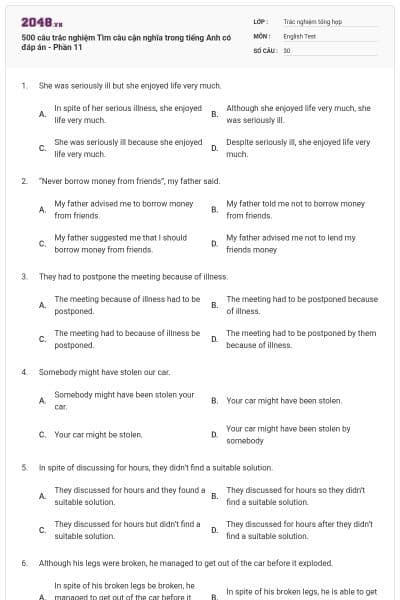
In spite of her serious illness, she enjoyed life very much.
Although she enjoyed life very much, she was seriously ill.
She was seriously ill because she enjoyed life very much.
Despite seriously ill, she enjoyed life very much.
Chọn đáp án A
My father advised me to borrow money from friends.
My father told me not to borrow money from friends.
My father suggested me that I should borrow money from friends.
My father advised me not to lend my friends money
Chọn đáp án B
Bố tôi nói “Đừng bao giờ mượn tiền từ bạn bè”.
The meeting because of illness had to be postponed.
The meeting had to be postponed because of illness.
The meeting had to because of illness be postponed.
The meeting had to be postponed by them because of illness.
Chọn đáp án B
Somebody might have been stolen your car.
Your car might have been stolen.
Your car might be stolen.
Your car might have been stolen by somebody
Chọn đáp án B
They discussed for hours and they found a suitable solution.
They discussed for hours so they didn’t find a suitable solution.
They discussed for hours but didn’t find a suitable solution.
They discussed for hours after they didn’t find a suitable solution.
Chọn đáp án C
In spite of his broken legs be broken, he managed to get out of the car before it exploded.
In spite of his broken legs, he is able to get out of the car before exploding.
Despite his legs were broken, he managed to get out of the car before it exploded.
Despite his broken legs, he managed to get out of the car before it exploded.
Đáp án: D
Giải thích:
Although/ though/ even though/ despite the fact that/ in spite of the fact that + mệnh đề: mặc dù
In spite of/ Despite + N/V-ing: mặc dù
Đáp án A và C sai cấu trúc.
Đáp án B sai thì của mệnh đề chính (câu gốc ở thì quá khứ đơn, câu này ở thì hiện tại)
Đáp án D đúng cấu trúc và đúng thì.
Dịch: Mặc dù chân bị gãy, anh vẫn kịp ra khỏi xe trước khi nó phát nổ.
There is none of her book which I haven't read.
There is one of her book which I haven't read.
I read some of her books.
I have read many books of hers.
Đáp án: B
Giải thích:
Dịch: Tôi đã đọc tất cả các cuốn sách của bà ngoại trừ một cuốn.
A. Không có cuốn sách nào của bà mà tôi chưa đọc.
B. Có một cuốn sách của bà mà tôi chưa đọc.
C. Tôi đã đọc một số cuốn sách của bà.
D. Tôi đã đọc nhiều cuốn sách của bà.
Dựa vào nghĩa, đáp án B phù hợp nhất.

Học thông minh hơn mỗi ngày
Xem toàn bộ 30 câu hỏi và nhiều hơn nữa với tài khoản miễn phí
Your speech is very sorry for being interrupted in the middle.
I’m sorry to interrupt your speech in the middle.
It’s my pity to interrupt your speech in the middle.
I apologized for having interrupted your speech in the middle.
Chọn đáp án D
The date of the meeting has been changed.
The date of the meeting has been changed by them.
The meeting has been changed the date.
The date of the meeting ahs changed.
Đáp án: A
Giải thích:
Kiến thức: Câu bị động
Bị động thì hiện tại hoàn thành:
S + have/has + been + VpII (+ by someone)
Ở câu này, với chủ ngữ là các đại từ bất định như “someone”, “somebody”, “no one”, “nobody”, hoặc các đại từ như “he”, “she”, “it”. “they”, trong câu bị động, được bỏ “by”.
Vậy chọn đáp án A.
Dịch: Họ đã thay đổi ngày họp.
→ Ngày họp đã được thay đổi.
I was told by Brian that somebody had attacked him in the street.
I was told by Brian that he had been attacked in the street.
Brain told me to have been attacked in the street.
Brian told me that he had been attacked in the street.
Chọn đáp án B
You will be asked a lot of questions at the interview.
You will be asked a lot of questions at the interview by them.
A lot of questions will be asked you at the interview.
A lot of questions will be asked at the interview.
Chọ đáp án A
I was told that George was ill
I wasn't told that George was ill
George wasn't told to be it
George was told not to be ill
Chọn đáp án B
Contrary to my expectations, his lecture on wildlife conservation was the most fascinating of all.
I was fascinated by what he said in his lecture on wildlife conservation though I hadn’t expected to be.
I hadn’t expected him to lecture on wildlife conservation, but he spoke well.
It was at his lecture on wildlife conservation that I realized I needed to study it.
Chọn đáp án B
You will be sent the results as soon as they are ready.
You will be sent the results as soon as they are ready by us.
The results will be sent you by us as soon as they are ready.
The results will be sent you as soon as they are ready by us.
Chọn đáp án B
I think Tom should have been offered the job by them.
I think Tom should have been offered the job.
I am thought they should have offered Tom the job.
I think the job should have been offered Tom
Chọn đáp án B
They say many people to have been homeless after the tsunami.
They say many people to be homeless after the tsunami.
Many people are said to have been homeless after the tsunami.
Many people are said to be homeless after the tsunami.
Đáp án: D
Câu bị động kép chuyển đổi từ cấu trúc:
S1 + say/tell/consider/… that + S2 + V2
→ S2 + be said/told/considered/… to V/to have VpII
Dùng to V nếu hai động từ cùng thì, to have VpII nếu có sự lệch thì.
Cả hai mệnh đề đều ở thì hiện tại đơn, do đó không dùng “to have VpII”, loại A và C.
Loại A vì không có cấu trúc “say somebody to do something”
Đáp án D đúng nghĩa và ngữ pháp.
Dịch: Họ nói rằng có rất nhiều người mất nhà cửa sau trận sóng thần.
→ Nhiều người được cho là mất nhà cửa sau trận sóng thần.
I am not tall enough to reach the top shelf.
I am too tall to reach the top shelf.
I cannot reach the top shelf because I am very tall.
In spite of being tall, I cannot reach the top shelf.
Chọn đáp án A
The government is expected to have lost the election.
The government is expected to lose the election.
They expect the government to lose the election.
They expect the government have lost election.
Chọn đáp án B
rằng.... Hai động từ V1, V2 cùng thời nên chia to V
Janet tried to convince her boyfriend that the book was not worth reading.
Janet opposed her boyfriend’s idea that reading the book was not useful.
Janet managed to persuade her boyfriend that reading the book was worthwhile.
Janet suggested to her boyfriend that reading the book was useful.
Chọn đáp án A
Almost every Vietnamese people were somewhat statisfied when watched U23 Asian Cup Final.
U23 Asian Cup Final was somewhat satisfying almost every Vietnamese people.
Almost every Vietnamese people, who watched U23 Asian Cup Final, were somewhat statisfied with it.
U23 Asian Cup Final was somewhat satisfying by the way Vietnamese people
Chọn đáp án C
So intelligent is he that he can solve all the problems in no time.
He is very intelligent that he can solve all the problems in no time.
An intelligent student is he that he can solve all the problems in no time.
So intelligent a student is he that he can solve all the problems in no time.
Chọn đáp án D
Three men are said to be arrested after the explosion.
Three men are said to have been arrested after the explosion.
Three men are said to have arrested after the explosion.
Three men are said to arrest after the explosion.
Chọn đáp án B
rằng.... Hai động từ V1, V2 lệch thời nên chia to have Ved
The box was carried by the boys into the room.
The box was carried into the room.
The box into the room was carried by the boys.
The box was carried into the room by the boys.
Chọn đáp án D
That book was bought yesterday by Tom.
That book was bought by Tom yesterday.
That book yesterday was bought by Tom.
That book was bought yesterday.
Chọn đáp án B
The little boy was treated by the old man badly.
The little boy was badly treated by the old man.
The little boy badly was treated by the old man.
The little boy was treated baldly by the old man.
Chọn đáp án B
The job wasn't offered Ann by them.
Ann wasn't offered them the job.
Ann wasn't offered the job by them.
Ann wasn't offered the job.
Chọn đáp án D
It was essential to make your children do housework as soon as they were able to do so but you didn’t.
You didn’t make your children do housework as they were able to do so.
You should make your children do housework as soon as they are able to do so.
You made your children do housework but they weren’t able to do so.
Chọn đáp án A
Dịch: Bạn lẽ ra nên bắt bọn trẻ làm bài tập ngay khi chúng có thể.
The birth rate and the expectation of life are high and low respectively.
The higher the birth rate, the lower the expectation of life
The birth rat is as high as the expectation of life.
The high rate of giving birth depends on the low rate of expectation of life.
Chọn đáp án B
Richard thanked Bob for being very kind to him the day before.
Richard thanked to Bob as he had been very kind to him yesterday.
Richard thanked Bob for he had been very kind to him the day before.
Richard said thanks to Bob as he was very kind to him yesterday.
Chọn đáp án A
Since they are difficult to get, he should have brought the tickets for 2018 World Cup beforehand.
Although he bought the tickets for 2018 World Cup in advance, he wasn’t wise enough to do so.
Such is the difficulty in getting the tickets for 2018 World Cup that it was wise of him to buy them beforehand.
The tickets for 2018 World Cup is so difficult to get that he had enough wisdom to buy them.
Chọn đáp án C
Bạn có thích hoạt động này không?
Ý kiến của bạn sẽ giúp chúng tôi đề xuất nội dung phù hợp hơn.
Gợi ý cho bạn
![[Năm 2022] Đề thi thử môn Vật lí THPT Quốc gia có lời giải - Đề số 21](/_next/image?url=https%3A%2F%2Fvideo.vietjack.com%2Fupload%2Fimages%2Fvj-image%2Fimage-3izficdefgfoel0s9j8s-1786772791.jpg&w=3840&q=75)
![[Năm 2022] Đề thi thử môn Vật lí THPT Quốc gia có lời giải - Đề số 20](/_next/image?url=https%3A%2F%2Fvideo.vietjack.com%2Fupload%2Fimages%2Fvj-image%2Fimage-emy0gtcksawvorajezvv-1786772460.jpg&w=3840&q=75)
Tài liệu phổ biến Trắc nghiệm tổng hợp
Tài liệu phổ biến English Test