15 Bài tập Trắc nghiệm Unit 15 Reading
15 câu hỏi
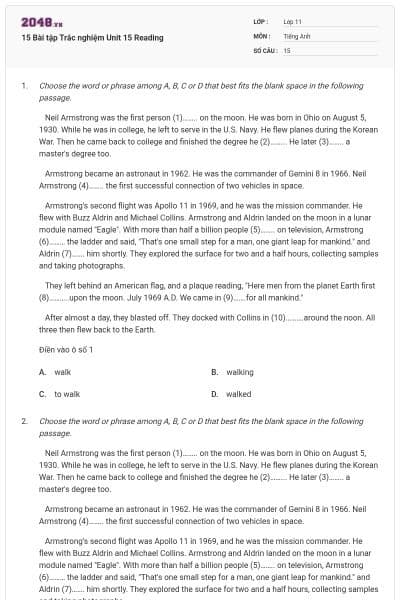
Choose the word or phrase among A, B, C or D that best fits the blank space in the following passage.
Neil Armstrong was the first person (1)…….. on the moon. He was born in Ohio on August 5, 1930. While he was in college, he left to serve in the U.S. Navy. He flew planes during the Korean War. Then he came back to college and finished the degree he (2)……... He later (3)…….. a master's degree too.
Armstrong became an astronaut in 1962. He was the commander of Gemini 8 in 1966. Neil Armstrong (4)…….. the first successful connection of two vehicles in space.
Armstrong’s second flight was Apollo 11 in 1969, and he was the mission commander. He flew with Buzz Aldrin and Michael Collins. Armstrong and Aldrin landed on the moon in a lunar module named "Eagle". With more than half a billion people (5)…….. on television, Armstrong (6)……… the ladder and said, "That's one small step for a man, one giant leap for mankind." and Aldrin (7)……. him shortly. They explored the surface for two and a half hours, collecting samples and taking photographs.
They left behind an American flag, and a plaque reading, "Here men from the planet Earth first (8)………..upon the moon. July 1969 A.D. We came in (9)…….for all mankind."
After almost a day, they blasted off. They docked with Collins in (10)……….around the noon. All three then flew back to the Earth.
Điền vào ô số 1
walk
walking
to walk
walked
Đáp án: C
Giải thích: The first person + to V (người đầu tiên làm gì)
Choose the word or phrase among A, B, C or D that best fits the blank space in the following passage.
Neil Armstrong was the first person (1)…….. on the moon. He was born in Ohio on August 5, 1930. While he was in college, he left to serve in the U.S. Navy. He flew planes during the Korean War. Then he came back to college and finished the degree he (2)……... He later (3)…….. a master's degree too.
Armstrong became an astronaut in 1962. He was the commander of Gemini 8 in 1966. Neil Armstrong (4)…….. the first successful connection of two vehicles in space.
Armstrong’s second flight was Apollo 11 in 1969, and he was the mission commander. He flew with Buzz Aldrin and Michael Collins. Armstrong and Aldrin landed on the moon in a lunar module named "Eagle". With more than half a billion people (5)…….. on television, Armstrong (6)……… the ladder and said, "That's one small step for a man, one giant leap for mankind." and Aldrin (7)……. him shortly. They explored the surface for two and a half hours, collecting samples and taking photographs.
They left behind an American flag, and a plaque reading, "Here men from the planet Earth first (8)………..upon the moon. July 1969 A.D. We came in (9)…….for all mankind."
After almost a day, they blasted off. They docked with Collins in (10)……….around the noon. All three then flew back to the Earth.
Điền vào ô số 2
starts
started
would start
had started
Đáp án: B
Giải thích: Sau đó, anh ta quay lại trường đại học và hoàn thành tấm bằng anh ta bắt đầu
Choose the word or phrase among A, B, C or D that best fits the blank space in the following passage.
Neil Armstrong was the first person (1)…….. on the moon. He was born in Ohio on August 5, 1930. While he was in college, he left to serve in the U.S. Navy. He flew planes during the Korean War. Then he came back to college and finished the degree he (2)……... He later (3)…….. a master's degree too.
Armstrong became an astronaut in 1962. He was the commander of Gemini 8 in 1966. Neil Armstrong (4)…….. the first successful connection of two vehicles in space.
Armstrong’s second flight was Apollo 11 in 1969, and he was the mission commander. He flew with Buzz Aldrin and Michael Collins. Armstrong and Aldrin landed on the moon in a lunar module named "Eagle". With more than half a billion people (5)…….. on television, Armstrong (6)……… the ladder and said, "That's one small step for a man, one giant leap for mankind." and Aldrin (7)……. him shortly. They explored the surface for two and a half hours, collecting samples and taking photographs.
They left behind an American flag, and a plaque reading, "Here men from the planet Earth first (8)………..upon the moon. July 1969 A.D. We came in (9)…….for all mankind."
After almost a day, they blasted off. They docked with Collins in (10)……….around the noon. All three then flew back to the Earth.
Điền vào ô số 3
took
make
earned
scored
Đáp án: A
Giải thích: Sau này anh cũng đã lấy bằng thạc sĩ.
Choose the word or phrase among A, B, C or D that best fits the blank space in the following passage.
Neil Armstrong was the first person (1)…….. on the moon. He was born in Ohio on August 5, 1930. While he was in college, he left to serve in the U.S. Navy. He flew planes during the Korean War. Then he came back to college and finished the degree he (2)……... He later (3)…….. a master's degree too.
Armstrong became an astronaut in 1962. He was the commander of Gemini 8 in 1966. Neil Armstrong (4)…….. the first successful connection of two vehicles in space.
Armstrong’s second flight was Apollo 11 in 1969, and he was the mission commander. He flew with Buzz Aldrin and Michael Collins. Armstrong and Aldrin landed on the moon in a lunar module named "Eagle". With more than half a billion people (5)…….. on television, Armstrong (6)……… the ladder and said, "That's one small step for a man, one giant leap for mankind." and Aldrin (7)……. him shortly. They explored the surface for two and a half hours, collecting samples and taking photographs.
They left behind an American flag, and a plaque reading, "Here men from the planet Earth first (8)………..upon the moon. July 1969 A.D. We came in (9)…….for all mankind."
After almost a day, they blasted off. They docked with Collins in (10)……….around the noon. All three then flew back to the Earth.
Điền vào ô số 4
performed
operated
functioned
carried
Đáp án: B
Giải thích: Neil Armstrong đã đưa ra kết nối thành công đầu tiên của hai phương tiện trong không gian.
Choose the word or phrase among A, B, C or D that best fits the blank space in the following passage.
Neil Armstrong was the first person (1)…….. on the moon. He was born in Ohio on August 5, 1930. While he was in college, he left to serve in the U.S. Navy. He flew planes during the Korean War. Then he came back to college and finished the degree he (2)……... He later (3)…….. a master's degree too.
Armstrong became an astronaut in 1962. He was the commander of Gemini 8 in 1966. Neil Armstrong (4)…….. the first successful connection of two vehicles in space.
Armstrong’s second flight was Apollo 11 in 1969, and he was the mission commander. He flew with Buzz Aldrin and Michael Collins. Armstrong and Aldrin landed on the moon in a lunar module named "Eagle". With more than half a billion people (5)…….. on television, Armstrong (6)……… the ladder and said, "That's one small step for a man, one giant leap for mankind." and Aldrin (7)……. him shortly. They explored the surface for two and a half hours, collecting samples and taking photographs.
They left behind an American flag, and a plaque reading, "Here men from the planet Earth first (8)………..upon the moon. July 1969 A.D. We came in (9)…….for all mankind."
After almost a day, they blasted off. They docked with Collins in (10)……….around the noon. All three then flew back to the Earth.
Điền vào ô số 5
watch
to watch
watching
watched
Đáp án: C
Giải thích: Rút gọn mệnh đề quan hệ chủ động
Choose the word or phrase among A, B, C or D that best fits the blank space in the following passage.
Neil Armstrong was the first person (1)…….. on the moon. He was born in Ohio on August 5, 1930. While he was in college, he left to serve in the U.S. Navy. He flew planes during the Korean War. Then he came back to college and finished the degree he (2)……... He later (3)…….. a master's degree too.
Armstrong became an astronaut in 1962. He was the commander of Gemini 8 in 1966. Neil Armstrong (4)…….. the first successful connection of two vehicles in space.
Armstrong’s second flight was Apollo 11 in 1969, and he was the mission commander. He flew with Buzz Aldrin and Michael Collins. Armstrong and Aldrin landed on the moon in a lunar module named "Eagle". With more than half a billion people (5)…….. on television, Armstrong (6)……… the ladder and said, "That's one small step for a man, one giant leap for mankind." and Aldrin (7)……. him shortly. They explored the surface for two and a half hours, collecting samples and taking photographs.
They left behind an American flag, and a plaque reading, "Here men from the planet Earth first (8)………..upon the moon. July 1969 A.D. We came in (9)…….for all mankind."
After almost a day, they blasted off. They docked with Collins in (10)……….around the noon. All three then flew back to the Earth.
Điền vào ô số 6
lowered
climbed down
descended
stepped
Đáp án: D
Giải thích: Step (v) bước đi
Choose the word or phrase among A, B, C or D that best fits the blank space in the following passage.
Neil Armstrong was the first person (1)…….. on the moon. He was born in Ohio on August 5, 1930. While he was in college, he left to serve in the U.S. Navy. He flew planes during the Korean War. Then he came back to college and finished the degree he (2)……... He later (3)…….. a master's degree too.
Armstrong became an astronaut in 1962. He was the commander of Gemini 8 in 1966. Neil Armstrong (4)…….. the first successful connection of two vehicles in space.
Armstrong’s second flight was Apollo 11 in 1969, and he was the mission commander. He flew with Buzz Aldrin and Michael Collins. Armstrong and Aldrin landed on the moon in a lunar module named "Eagle". With more than half a billion people (5)…….. on television, Armstrong (6)……… the ladder and said, "That's one small step for a man, one giant leap for mankind." and Aldrin (7)……. him shortly. They explored the surface for two and a half hours, collecting samples and taking photographs.
They left behind an American flag, and a plaque reading, "Here men from the planet Earth first (8)………..upon the moon. July 1969 A.D. We came in (9)…….for all mankind."
After almost a day, they blasted off. They docked with Collins in (10)……….around the noon. All three then flew back to the Earth.
Điền vào ô số 7
joined
connected
joined in
involved
Đáp án: C
Giải thích: Và Aldrin tham gia cùng anh ta ngay.
Choose the word or phrase among A, B, C or D that best fits the blank space in the following passage.
Neil Armstrong was the first person (1)…….. on the moon. He was born in Ohio on August 5, 1930. While he was in college, he left to serve in the U.S. Navy. He flew planes during the Korean War. Then he came back to college and finished the degree he (2)……... He later (3)…….. a master's degree too.
Armstrong became an astronaut in 1962. He was the commander of Gemini 8 in 1966. Neil Armstrong (4)…….. the first successful connection of two vehicles in space.
Armstrong’s second flight was Apollo 11 in 1969, and he was the mission commander. He flew with Buzz Aldrin and Michael Collins. Armstrong and Aldrin landed on the moon in a lunar module named "Eagle". With more than half a billion people (5)…….. on television, Armstrong (6)……… the ladder and said, "That's one small step for a man, one giant leap for mankind." and Aldrin (7)……. him shortly. They explored the surface for two and a half hours, collecting samples and taking photographs.
They left behind an American flag, and a plaque reading, "Here men from the planet Earth first (8)………..upon the moon. July 1969 A.D. We came in (9)…….for all mankind."
After almost a day, they blasted off. They docked with Collins in (10)……….around the noon. All three then flew back to the Earth.
Điền vào ô số 8
went
set a foot
set food
set feet
Đáp án: B
Giải thích: Set a foot = đặt chân vào
Choose the word or phrase among A, B, C or D that best fits the blank space in the following passage.
Neil Armstrong was the first person (1)…….. on the moon. He was born in Ohio on August 5, 1930. While he was in college, he left to serve in the U.S. Navy. He flew planes during the Korean War. Then he came back to college and finished the degree he (2)……... He later (3)…….. a master's degree too.
Armstrong became an astronaut in 1962. He was the commander of Gemini 8 in 1966. Neil Armstrong (4)…….. the first successful connection of two vehicles in space.
Armstrong’s second flight was Apollo 11 in 1969, and he was the mission commander. He flew with Buzz Aldrin and Michael Collins. Armstrong and Aldrin landed on the moon in a lunar module named "Eagle". With more than half a billion people (5)…….. on television, Armstrong (6)……… the ladder and said, "That's one small step for a man, one giant leap for mankind." and Aldrin (7)……. him shortly. They explored the surface for two and a half hours, collecting samples and taking photographs.
They left behind an American flag, and a plaque reading, "Here men from the planet Earth first (8)………..upon the moon. July 1969 A.D. We came in (9)…….for all mankind."
After almost a day, they blasted off. They docked with Collins in (10)……….around the noon. All three then flew back to the Earth.
Điền vào ô số 9
silence
freedom
communication
peace
Đáp án: D
Giải thích: Chúng tôi đã đến trong hòa bình cho cả nhân loại.
Choose the word or phrase among A, B, C or D that best fits the blank space in the following passage.
Neil Armstrong was the first person (1)…….. on the moon. He was born in Ohio on August 5, 1930. While he was in college, he left to serve in the U.S. Navy. He flew planes during the Korean War. Then he came back to college and finished the degree he (2)……... He later (3)…….. a master's degree too.
Armstrong became an astronaut in 1962. He was the commander of Gemini 8 in 1966. Neil Armstrong (4)…….. the first successful connection of two vehicles in space.
Armstrong’s second flight was Apollo 11 in 1969, and he was the mission commander. He flew with Buzz Aldrin and Michael Collins. Armstrong and Aldrin landed on the moon in a lunar module named "Eagle". With more than half a billion people (5)…….. on television, Armstrong (6)……… the ladder and said, "That's one small step for a man, one giant leap for mankind." and Aldrin (7)……. him shortly. They explored the surface for two and a half hours, collecting samples and taking photographs.
They left behind an American flag, and a plaque reading, "Here men from the planet Earth first (8)………..upon the moon. July 1969 A.D. We came in (9)…….for all mankind."
After almost a day, they blasted off. They docked with Collins in (10)……….around the noon. All three then flew back to the Earth.
Điền vào ô số 10
space
orbit
height
distance
Đáp án: B
Giải thích: Sau gần một ngày, họ đã nổ tung. Họ cập bến với Collins trên quỹ đạo vào khoảng giữa trưa. Cả ba sau đó bay trở lại Trái đất.
Read the passage, and choose the correct answer A, B, C or D for each question.
The Shuttle Era Comes to an End
The set of Space Shuttle missions run by NASA captivated the world and proved that reusable spacecraft could be used to bring astronauts and cargo into space. The Space Shuttle programme had a total of six separate orbiters, five of which actually went into space. The first-made orbiter was only used to gather data about how the shuttles would glide back to the earth. This shuttle would be brought up into the air by a specially modified Boeing 747 and released to glide down without any power of its own.
The Space Shuttle Era ran from the first launch on April 12, 1981, and ended when the final shuttle landed on July 21, 2011. During this time, there were 135 missions flown. Of the five shuttles that did go into space, two met with disasters that killed all the crew members aboard.The first disaster happened on January 28, 1986 when Space Shuttle Challenger ran into severe problems and exploded less than two minutes after take-off. It was a major blow to NASA as a school teacher was on board the orbiter, and the launch was being watched by children from schools across the United States. The second disaster came on February 1, 2003. After having completed its mission, Space Shuttle Columbia was returning to the earth from space. During damage done to a wing during its launch, the orbiter disintegrated as it hit the earth’s atmosphere during re-entry.
Because the Space Shuttle programme was running, it largely made possible the construction of the International Space Station (ISS). The shuttles brought astronauts to the station, replenished supplies, and carried actual pieces to the Space Station up from the earth.As the Space Shuttle Era came to an end, many space lovers have been left wondering, “What’s next?” There is still plenty to explore, so we will all just have to wait and see.
What was captivated in the passage?
The world
An astronaut
A mission
A space shuttle
Đáp án: D
Giải thích: Toàn bộ bài đọc nói về tàu con thoi.
Read the passage, and choose the correct answer A, B, C or D for each question.
The Shuttle Era Comes to an End
The set of Space Shuttle missions run by NASA captivated the world and proved that reusable spacecraft could be used to bring astronauts and cargo into space. The Space Shuttle programme had a total of six separate orbiters, five of which actually went into space. The first-made orbiter was only used to gather data about how the shuttles would glide back to the earth. This shuttle would be brought up into the air by a specially modified Boeing 747 and released to glide down without any power of its own.
The Space Shuttle Era ran from the first launch on April 12, 1981, and ended when the final shuttle landed on July 21, 2011. During this time, there were 135 missions flown. Of the five shuttles that did go into space, two met with disasters that killed all the crew members aboard.The first disaster happened on January 28, 1986 when Space Shuttle Challenger ran into severe problems and exploded less than two minutes after take-off. It was a major blow to NASA as a school teacher was on board the orbiter, and the launch was being watched by children from schools across the United States. The second disaster came on February 1, 2003. After having completed its mission, Space Shuttle Columbia was returning to the earth from space. During damage done to a wing during its launch, the orbiter disintegrated as it hit the earth’s atmosphere during re-entry.
Because the Space Shuttle programme was running, it largely made possible the construction of the International Space Station (ISS). The shuttles brought astronauts to the station, replenished supplies, and carried actual pieces to the Space Station up from the earth.As the Space Shuttle Era came to an end, many space lovers have been left wondering, “What’s next?” There is still plenty to explore, so we will all just have to wait and see.
How many orbiters are there in the Space Shuttle programme mentioned in the passage?
Four
Five
Six
Seven
Đáp án: C
Giải thích: The Space Shuttle programme had a total of six separate orbiters, five of which actually went into space.
Dịch: Chương trình Tàu con thoi có tổng cộng sáu quỹ đạo riêng biệt, năm trong số đó thực sự đi vào vũ trụ.
Read the passage, and choose the correct answer A, B, C or D for each question.
The Shuttle Era Comes to an End
The set of Space Shuttle missions run by NASA captivated the world and proved that reusable spacecraft could be used to bring astronauts and cargo into space. The Space Shuttle programme had a total of six separate orbiters, five of which actually went into space. The first-made orbiter was only used to gather data about how the shuttles would glide back to the earth. This shuttle would be brought up into the air by a specially modified Boeing 747 and released to glide down without any power of its own.
The Space Shuttle Era ran from the first launch on April 12, 1981, and ended when the final shuttle landed on July 21, 2011. During this time, there were 135 missions flown. Of the five shuttles that did go into space, two met with disasters that killed all the crew members aboard.The first disaster happened on January 28, 1986 when Space Shuttle Challenger ran into severe problems and exploded less than two minutes after take-off. It was a major blow to NASA as a school teacher was on board the orbiter, and the launch was being watched by children from schools across the United States. The second disaster came on February 1, 2003. After having completed its mission, Space Shuttle Columbia was returning to the earth from space. During damage done to a wing during its launch, the orbiter disintegrated as it hit the earth’s atmosphere during re-entry.
Because the Space Shuttle programme was running, it largely made possible the construction of the International Space Station (ISS). The shuttles brought astronauts to the station, replenished supplies, and carried actual pieces to the Space Station up from the earth.As the Space Shuttle Era came to an end, many space lovers have been left wondering, “What’s next?” There is still plenty to explore, so we will all just have to wait and see.
What were considered to be unfortunate?
The supplies
The disasters
The Space Stations
The different eras
Đáp án: B
Giải thích: Thông tin nằm toàn bộ ở đoạn 2.
Read the passage, and choose the correct answer A, B, C or D for each question.
The Shuttle Era Comes to an End
The set of Space Shuttle missions run by NASA captivated the world and proved that reusable spacecraft could be used to bring astronauts and cargo into space. The Space Shuttle programme had a total of six separate orbiters, five of which actually went into space. The first-made orbiter was only used to gather data about how the shuttles would glide back to the earth. This shuttle would be brought up into the air by a specially modified Boeing 747 and released to glide down without any power of its own.
The Space Shuttle Era ran from the first launch on April 12, 1981, and ended when the final shuttle landed on July 21, 2011. During this time, there were 135 missions flown. Of the five shuttles that did go into space, two met with disasters that killed all the crew members aboard.The first disaster happened on January 28, 1986 when Space Shuttle Challenger ran into severe problems and exploded less than two minutes after take-off. It was a major blow to NASA as a school teacher was on board the orbiter, and the launch was being watched by children from schools across the United States. The second disaster came on February 1, 2003. After having completed its mission, Space Shuttle Columbia was returning to the earth from space. During damage done to a wing during its launch, the orbiter disintegrated as it hit the earth’s atmosphere during re-entry.
Because the Space Shuttle programme was running, it largely made possible the construction of the International Space Station (ISS). The shuttles brought astronauts to the station, replenished supplies, and carried actual pieces to the Space Station up from the earth.As the Space Shuttle Era came to an end, many space lovers have been left wondering, “What’s next?” There is still plenty to explore, so we will all just have to wait and see.
When did the second disaster take place?
1981
1986
2003
2011
Đáp án: C
Giải thích: The second disaster came on February 1, 2003.
Dịch: Thảm họa thứ hai xảy ra vào ngày 1 tháng 2 năm 2003.
Read the passage, and choose the correct answer A, B, C or D for each question.
The Shuttle Era Comes to an End
The set of Space Shuttle missions run by NASA captivated the world and proved that reusable spacecraft could be used to bring astronauts and cargo into space. The Space Shuttle programme had a total of six separate orbiters, five of which actually went into space. The first-made orbiter was only used to gather data about how the shuttles would glide back to the earth. This shuttle would be brought up into the air by a specially modified Boeing 747 and released to glide down without any power of its own.
The Space Shuttle Era ran from the first launch on April 12, 1981, and ended when the final shuttle landed on July 21, 2011. During this time, there were 135 missions flown. Of the five shuttles that did go into space, two met with disasters that killed all the crew members aboard.The first disaster happened on January 28, 1986 when Space Shuttle Challenger ran into severe problems and exploded less than two minutes after take-off. It was a major blow to NASA as a school teacher was on board the orbiter, and the launch was being watched by children from schools across the United States. The second disaster came on February 1, 2003. After having completed its mission, Space Shuttle Columbia was returning to the earth from space. During damage done to a wing during its launch, the orbiter disintegrated as it hit the earth’s atmosphere during re-entry.
Because the Space Shuttle programme was running, it largely made possible the construction of the International Space Station (ISS). The shuttles brought astronauts to the station, replenished supplies, and carried actual pieces to the Space Station up from the earth.As the Space Shuttle Era came to an end, many space lovers have been left wondering, “What’s next?” There is still plenty to explore, so we will all just have to wait and see.
Who was mentioned as being on board the Space Shuttle Challenger?
A doctor
A teacher
A reporter
A scientist
Đáp án: B
Giải thích: It was a major blow to NASA as a school teacher was on board the orbiter …
Dịch: Đó là một cú đánh lớn đối với NASA khi một giáo viên trường học đang ở trên quỹ đạo …..