VI. Câu đồng nghĩa và câu kết hợp có đáp án

147 câu hỏi
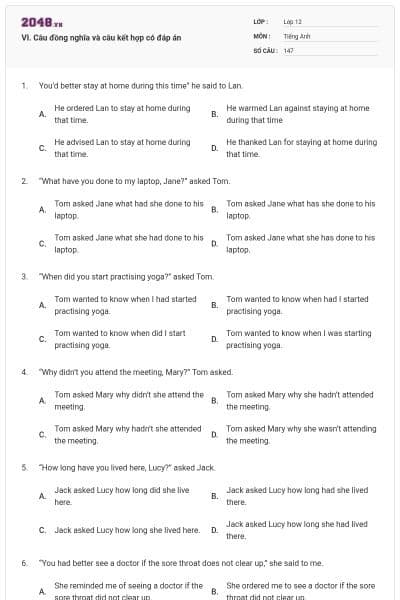
He ordered Lan to stay at home during that time.
He warmed Lan against staying at home during that time
He advised Lan to stay at home during that time.
He thanked Lan for staying at home during that time.
Chọn C
Tom asked Jane what had she done to his laptop.
Tom asked Jane what has she done to his laptop.
Tom asked Jane what she had done to his laptop.
Tom asked Jane what she has done to his laptop.
Chọn C
Tom wanted to know when I had started practising yoga.
Tom wanted to know when had I started practising yoga.
Tom wanted to know when did I start practising yoga.
Tom wanted to know when I was starting practising yoga.
Chọn A
Tom asked Mary why didn’t she attend the meeting.
Tom asked Mary why she hadn’t attended the meeting.
Tom asked Mary why hadn’t she attended the meeting.
Tom asked Mary why she wasn’t attending the meeting.
Chọn B
Jack asked Lucy how long did she live here.
Jack asked Lucy how long had she lived there.
Jack asked Lucy how long she lived here.
Jack asked Lucy how long she had lived there.
Chọn D


Học thông minh hơn mỗi ngày
Xem toàn bộ 147 câu hỏi và nhiều hơn nữa với tài khoản miễn phí
She reminded me of seeing a doctor if the sore throat did not clear up.
She ordered me to see a doctor if the sore throat did not clear up.
She insisted that I see a doctor unless the sore throat did not clear up.
She suggested that I see a doctor if the sore throat did not clear up.
Đáp án: D
Giải thích:
Dịch: “Tốt hơn là bạn nên đi khám bác sĩ nếu cơn đau họng không khỏi,” bà ấy nói với tôi.
A. Bà ấy nhắc tôi đi khám bác sĩ nếu cơn đau họng không khỏi.
B. Bà ấy ra lệnh cho tôi đi khám bác sĩ nếu cơn đau họng không khỏi.
C. Bà ấy khăng khăng bắt tôi đi khám bác sĩ trừ khi cơn đau họng không khỏi.
D. Bà ấy gợi ý tôi đi khám bác sĩ nếu cơn đau họng không khỏi.
Dựa vào nghĩa, chọn D. Các động từ “reminded”, “ordered”, “insisted” không thể hiện phù hợp sắc thái khuyên bảo.
Ta có cấu trúc bàng thái cách:
S + suggest/advise/command/order/request/recommend/… + S + (should) + V
(Động từ không chia với mọi thì và chủ ngữ)
Jim suggested going out for dinner that night.
Jim refused to go out for dinner that night.
Jim denied going out for dinner that night.
Jim promised to go out for dinner that night.
Chọn A
Peter encouraged his classmate to get an A in Chemistry.
Peter persuaded his classmate to get an A in Chemistry.
Peter insisted on getting an A in Chemistry for his classmate.
Peter congratulated his classmate on getting an A in Chemistry.
Chọn D
Sally refused to go to work at the weekend.
Sally promised to go to work at the weekend.
Sally apologized for not going to work at the weekend.
Sally regretted not going to work at the weekend.
Chọn A
The customers promised to leave before they saw the manager.
The customers refused to leave until they saw the manager.
The customers agreed to leave before they saw the manager.
The customers decided to leave because they did not see the manager.
Chọn B
He denied going camping at the weekend.
He suggested going camping at the weekend.
He objected to going camping at the weekend.
He apologized for going camping at the weekend
Đáp án: B
Giải thích:
- "Why don't we go camping at the weekend?" là một câu đề nghị trong tiếng Anh. Khi chuyển câu trực tiếp này sang câu gián tiếp, ta dùng "suggest".
Dịch:Anh ấy đề nghị đi cắm trại vào cuối tuần.
Mary denied giving John the money.
Mary admitted giving John the money.
Mary suggested giving John the money.
Mary remembered giving John the money.
Chọn A
Anna reminded Bella to go to the show with her.
Anna persuaded Bella to go to the show with her.
Anna encouraged Bella to go to the show with her.
Anna invited Bella to go to the show with her.
Chọn D
Tom’s mother promised to take better care of his health.
Tom’s mother ordered him to take better care of his health.
Tom’s mother required him to take better care of his health.
Tom’s mother advised him to take better care of his health.
Chọn D
The teacher reminded the students to submit their assignments by Thursday.
The teacher allowed the students to submit their assignments by Thursday,
The teacher ordered the students to submit their assignments by Thursday.
The teacher encouraged the students to submit their assignments by Thursday
Chọn A
Fiona denied having finished the assignment.
Fiona regretted having finished the assignment.
Fiona refused to finish the assignment.
Fiona apologised for not finishing the assignment
Chọn D
He objected to calling me as soon as he arrived at the airport.
He promised to call me as soon as he arrived at the airport.
He denied calling me as soon as he arrived at the airport.
He reminded me to call him as soon as he arrived at the airport.
Chọn B
Kevin asked Anne what was she going to do after school.
Kevin asked Anne what she was going to do after school.
Kevin wanted to know what Anne would do after school.
Kevin wanted to know what would Anne do after school.
Chọn B
He apologized for not to reply to the letter.
He apologized for not to replying to the letter.
He apologized for didn’t reply to the letter.
He apologized for not replying to the letter.
Chọn D
Our manager suspected Tom of having leaked the document not Mike.
Our manager blamed Tom for having leaked the document instead of Mike.
Our manager showed his uncertainty about who leaked the document: Mike or Tom.
Our manager made it clear that Tom was the one who leaked the document, not Mike.
Chọn A
Jane told Tom please don’t tell anyone my new telephone number.
Jane asked Tom not to tell anyone her new telephone number.
Jane said to Tom not to tell anyone her new telephone number, please.
Jane wanted Tom didn’t tell anyone my new telephone number.
Đáp án: B
Giải thích:
Kiến thức: Câu gián tiếp
Câu gốc là câu mệnh lệnh với từ "please", nên khi chuyển sang câu gián tiếp, ta dùng asked + (someone) + not to + V để diễn đạt lời yêu cầu hoặc đề nghị không làm gì.
Xét các đáp án khác:
A. Sai – Vì giữ nguyên lời nói trực tiếp mà không chuyển đổi thì.
C. Sai – Vì cấu trúc "said to" không đi với mệnh lệnh dạng này.
D. Sai – Vì "wanted" không đi với mệnh đề "didn't tell".
Dịch: “Tom, làm ơn đừng nói với ai số điện thoại mới của tôi nhé,” Jane nói.
→ Jane yêu cầu Tom không nói với ai số điện thoại mới của cô ấy.
The woman insisted on breaking her glasses.
The woman advised me to break her glasses.
The woman told me to break her glasses.
The woman blamed me for breaking her glasses.
Chọn D
Jasmine’s doctor insisted that she should rest for a few days.
The doctor suggested that Jasmine should take a short rest.
The doctor strongly advised Jasmine to take a few days’ rest.
It is the doctor’s recommendation that Jasmine rested shortly.
Đáp án: C
Giải thích:
Dịch: Bác sĩ đã nói, “Jasmine, bạn thực sự nên nghỉ ngơi vài ngày.”
A. Bác sĩ của Jasmine khẳng định rằng cô ấy nên nghỉ ngơi vài ngày.
B. Bác sĩ đề nghị rằng Jasmine nên nghỉ ngơi một chút.
C. Bác sĩ khuyên Jasmine nên nghỉ ngơi vài ngày.
D. Bác sĩ khuyến nghị rằng Jasmine nên nghỉ ngơi trong thời gian ngắn.
Câu gốc dùng “ought to” dùng để đưa ra lời khuyên, vậy chọn C.
He told me that I shouldn’t forget to go to the supermarket after work.
He requested me not to forget to go to the supermarket after work.
He reminded me to go to the supermarket after work.
He asked me no to forget to go to the supermarket after work
Đáp án: C
Giải thích:
- Câu gốc là một lời nhắc nhở, không phải mệnh lệnh hay yêu cầu gay gắt.
- “Don’t forget to...” → cấu trúc thường được chuyển thành "remind someone to..." trong câu gián tiếp.
Các đáp án sai:
- A. shouldn’t forget... → đúng ngữ nghĩa nhưng không tự nhiên bằng “remind”.
- B. requested me... → "request" mang nghĩa yêu cầu, không đúng mức độ nhẹ nhàng.
- D. asked me no to... → sai ngữ pháp, phải là “not to”, không phải “no to”.
Dịch: Anh ấy nhắc tôi đi siêu thị sau giờ làm.
John asked me to do morning exercise regularly.
John prevented me from doing morning exercise regularly.
John advised me to do morning exercise regularly.
John congratulated me on doing morning exercise regularly.
Chọn C
John’s sister told him to leave the house when she got back.
John’s sister told him not to go out until she gets back.
John’s sister told him not to leave the house until she got back.
John’s sister told him to stay at home till she got back.
Chọn C
Mary accused Jim of having broken her vase.
Mary said she knew that Jim broke her vase.
Mary asked Jim of having broken her vase.
Mary told Jim to break the vase.
Chọn A
John offered Mary to carry the suitcase for Mary.
John offered to carry the suitcase for Mary.
John offered carrying the suitcase for Mary.
John offered Mary if he should carry the suitcase for her
Chọn B
He denied to have been there at the time.
He denied that he had not been there at the time.
He denied to be there at the time.
He denied having been there at the time.
Chọn D
The lady threatened to call the police if the man didn’t leave her house.
The lady said that she would call the police if the man didn’t leave her house.
The lady told the man that she would call the police if he didn’t leave her house.
The lady informed the man that she would call the police if he didn’t leave her house.
Chọn A
The woman said that her grandchild’s job was great and she was so proud of his work achievement.
The woman told her grandchild that she was proud of his achievement at work.
The woman told her grandchild to do a great job so that she could be proud of his achievement.
The woman complimented her grandchild on his achievement.
Chọn D
Tim suggested giving Jane the answer by the end of the week.
Tim promised to give Jane the answer by the end of the week.
Tim insisted on letting Jane know the answer by the end of the week.
Tim offered to give Jane the answer by the end of the week.
Đáp án: B
Giải thích:
A. suggest doing something: gợi ý làm gì
B. promise to do something: hứa sẽ làm gì
C. insist on doing something: năn nỉ, khăng khăng làm gì
D. offer to do something: đưa ra đề nghị sẵn sàng làm gì
Dựa vào nghĩa câu gốc: Tim nói với Jane: "Tôi sẽ cho cô biết câu trả lời vào cuối tuần này".
Chọn B.
Dịch: Tim hứa sẽ trả lời Jane vào cuối tuần.
Janet suggested John went on a picnic with her the nest weekend.
Janet suggested John go on a picnic with her the next weekend.
Janet suggested John should go on a picnic with her next weekend.
Janet suggested John to go on a picnic with her next weekend.
Chọn B
Jenny’s father told her not go home late and it was dangerous.
Jenny’s father told her not to go home late because it was dangerous.
Jenny’s father advised her go home early.
Jenny’s father asked her against being home late because it may be dangerous.
Chọn B
His wife told him to write to her as often as he can
His wife told him to write to her as often as he could.
His wife told him writing to her as often as he could.
His wife told him writing to her as often as he can.
Chọn B
Steve warned Mike about not touching the electric wires as it might be deadly.
Steve warned Mike against touching the wires as it might have been deadly.
Steve warned that Mike not touch the electric wires as it might be deadly.
Steve warned Mike not to touch the electric wires as it might be deadly.
Đáp án: D
Giải thích:
Dịch: Steve nói với Mike: “Đừng chạm vào dây điện. Nó có thể gây chết người.”
Xét các đáp án:
A. Sai cấu trúc
Cấu trúc: warn somebody about/against (doing) something: cảnh báo ai về điều gì (không làm gì)
Câu A thừa “not”
B. Sai mệnh đề sau, không cần đưa về “might have been”
C. Sai cấu trúc
D. Steve cảnh báo Mike không được chạm vào dây điện vì nó có thể gây chết người.
Đúng nghĩa và đúng cấu trúc
The doctor advised me to give up smoking to avoid illness.
The doctor suggested smoking to treat illness.
I was warned against smoking a lot of cigarettes.
I was ordered not to smoke to recover from illness.
Chọn A
John accused with Tom to have damaged his laptop.
John accused Tom of damaging his laptop.
John accused Tom to damage his laptop.
John accused to Tom for damaging his laptop.
Chọn B
Bill suggested that I should talk to her face-to-face.
Bill advised that I could talk to her face-to-face.
Bill asked me why I hadn’t talked to her face-to-face.
Bill wondered why I don't talk to her face-to-face.
Chọn A
Jean admitted stealing the money.
Jean refused to steal the money.
Jean did not intend to steal the money.
Jean denied having stolen the money.
Chọn D
Peter regretted lending him some money
Peter thanked him for lending him some money.
Peter wished not to lend him some money.
Peter suggested not lending him some money.
Chọn A
The manager denied being narrow-minded.
The manager admitted being narrow-minded.
The manager refused to be narrow-minded.
The manager promised to be narrow-minded.
Chọn B
Nick warned Lucy not to tell the truth.
Nick criticized Lucy for not telling the truth
Nick accused Lucy of telling the truth.
Nick decided that Lucy was to blame for telling the truth.
Chọn B
Peter promised to buy Mary a beautiful dress.
Peter said thanks to Mary for her beautiful dress.
Peter asked Mary how she had just bought her beautiful dress.
Peter complimented Mary on her beautiful dress.
Chọn D
Tom said that he was doing that exercise with her brother now.
Tom said that he was doing that exercise with her brother then.
Tom said that he had been doing that exercise with her brother then.
Tom said that he is doing that exercise with her brother now.
Chọn B
She hasn't visited her home country for ten years.
She didn’t visit her home country ten years ago.
She has visited her home country for ten years.
She was in her home country for ten years.
Chọn A
It's 4 years since she last lived in her hometown.
She didn't come back to her hometown 4 years ago.
She started coming back to her hometown 4 years ago
She hasn’t come back to her hometown for 4 years.
Chọn D
He last worked as a bank clerk 3 months ago.
He didn't work as a bank clerk 3 months ago.
He has been working as a bank clerk for 3 months.
The last time she worked as a bank clerk was 3 months ago.
Chọn C
We haven't met each other for a long time.
The last time we met each other is a long time ago.
We last met each other for a long time.
We started meeting each other a long time ago.
Đáp án: A
Giải thích:
It is + khoảng thời gian + since + S + last + V (quá khứ đơn)
= S + haven't/hasn't + V3/ed + for + khoảng thời gian
Chọn A.
Xét các đáp án khác:
B. The last time we met each other is a long time ago. → Sai vì động từ đúng phải là "was", không phải "is".
C. We last met each other for a long time. → Sai vì "for a long time" không đi với "last met".
D. We started meeting each other a long time ago. → Sai vì câu này mang nghĩa chúng ta bắt đầu gặp nhau từ lâu, không phù hợp với nghĩa gốc.
Dịch: Đã lâu rồi chúng ta không gặp nhau.
The last time I had my hair cut was since November.
I haven't had my hair cut since November.
I didn't have my hair cut in November.
I started having my hair cut in November
Chọn B
I haven't had such a delicious meal before.
This is the most delicious meal I have ever had.
I didn't have such a delicious meal.
I didn’t have such a delicious meal before.
Chọn A
The last time she worked as a teacher was 5 years ago.
It is 5 years since she last worked as a teacher.
She began working as a teacher 5 years ago.
She hasn’t been working as a teacher for 5 years.
Chọn C
I often met my grandparents five years ago.
I last met my grandparents five years ago.
I have met my grandparents for five years.
I didn't meet my grandparents five years ago.
Chọn B
He has been in London for three years.
He hasn't visited London for three years.
He didn't visit London three years ago.
He was in London for three years.
Chọn B
I have been in my hometown for a few years.
I last visited my hometown a few years ago.
I didn't visit my hometown a few years ago.
I was in my hometown for a few years.
Chọn B
I last heard from Susan several months ago.
Susan didn't hear from me several months ago.
Susan heard from me several months ago.
I didn't hear from Susan several months ago.
Chọn A
I can’t help keeping getting in touch with them for over 20 years.
I haven't gotten in touch with them for over 20 years.
I used to get in touch with them for over 20 years.
I have been getting in touch with them for over 20 years.
Chọn B
He had tested his eyes ten months before.
He didn’t have any test on his eyes ten months before.
He had not tested his eyes for ten months then.
He hasn’t had his eyes tested for ten months.
Chọn D
I have not been to the museum for a year.
A year ago, I often went to the museum.
My going to the museum lasted a year.
At last I went to the museum after a year.
Chọn A
I haven't seen Peter since a chance meeting with him at the station when I was setting off for Glasgow
The last time I went to Glasgow, I happened to meet Peter at the station.
When I last saw Peter at the station when I was on my way to Glasgow, I ran after him.
I finally saw Peter at the station when I was on my way to Glasgow.
Chọn A
We have been working here for three years.
We worked here for three years.
We will work here for three years.
We have no longer worked here for three years.
Chọn A
It has been raining at 2 o’clock.
It has been raining in 2 o’clock.
It has been raining for 2 o’clock.
It has been raining since 2 o'clock
Chọn D
I haven't seen Rose since three years.
I haven’t seen Rose three years ago.
I didn’t see Rose for three years.
I haven't seen Rose for three years.
Đáp án: D
Giải thích:
Dịch: Lần cuối tôi nhìn thấy Rose là ba năm trước.
Xét các đáp án:
A. Sai vì “for + khoảng thời gian”, “since + mốc thời gian”
“two years” (hai năm) là khoảng thời gian, không dùng với “since”
B. Sai vì: “thời gian + ago”: cách đây bao lâu → chỉ dùng trong thì quá khứ đơn
C. Sai thì, không dùng thì quá khứ đơn, cần dùng thì hiện tại hoàn thành.
D. Tôi đã không nhìn thấy Rose trong được ba năm rồi.
Đúng nghĩa và cấu trúc thì hiện tại hoàn thành, cách dùng “for + khoảng thời gian”.
We have rarely written to each other for eight years.
Eight years is a long time for us to write to each other.
We have been writing to each other for eight years.
We wrote to each other eight year ago.
Chọn C
It has been 10 years when I have heard this song.
It was 10 years since I last heard this song.
It is 10 years since I last heard this song.
It is 10 years when I have heard this song.
Chọn C
You may take photos in the museum.
You should take photos in the museum.
You mustn’t take photos in the museum.
You needn’t take photos in the museum.
Đáp án: C
Giải thích:
Kiến thức: Động từ khuyết thiếu
allow somebody to do something: cho phép ai làm gì
Bị động: somebody be allowed to do something: ai đó được cho phép làm gì
Dịch: Bạn không được phép chụp ảnh trong bảo tàng.
A. Bạn có thể chụp ảnh trong bảo tàng.
may V: có thể làm gì
B. Bạn nên chụp ảnh ở bảo tàng.
should V: nên làm gì
C. Bạn không được chụp ảnh trong bảo tàng.
mustn’t V: không được làm gì
D. Bạn không cần phải chụp ảnh trong bảo tàng.
needn’t V: không cần làm gì
Dựa vào nghĩa, chọn C.
Joe could have attended the ceremony as he can vividly recount the event.
Joe must have attended the ceremony as he can vividly recount the event.
Joe mightn’t have attended the ceremony as he can vividly recount the event.
Joe needn’t have attended the ceremony as he can vividly recount the event.
Chọn D
I needn’t have booked tickets for the film in advance.
I couldn’t have booked tickets for the film in advance.
I should have booked tickets for the film in advance.
I must have booked tickets for the film in advance
Chọn C
They couldn’t have practiced hard for the games as they won a lot of medals
They must have practiced hard for the games as they won a lot of medals
They shouldn’t have practiced hard for the games as they won a lot of medals
They might have practiced hard for the games as they won a lot of medals.
Chọn B
You could have criticised your son in front of his friends.
You must have criticised your son in front of his friends.
You mightn’t have criticised your son in front of his friends.
You shouldn’t have criticised your son in front of his friends.
Chọn D
Luisa must be very disappointed when she failed the exam.
Luisa must have been very disappointed when she failed the exam.
Luisa may be very disappointed when she failed the exam.
Luisa could have been very disappointed when she failed the exam.
Chọn B
John might be very surprised to receive my letter
John might have been very surprised to receive my letter.
John must be very surprised to receive my letter.
John must have been very surprised to receive my letter.
Chọn D
Sally needn’t have paid for her travel in advance
Sally might not have paid for her travel in advance.
Sally may not have paid for her travel in advance.
Sally couldn’t have paid for her travel in advance.
Chọn A
It was not necessary for you to take so many warm clothes there.
You have taken so many warm clothes there that I don’t need.
There’s no need for you to take so many warm clothes there.
You took lots of warm clothes there but it turned out not necessary.
Chọn D
When Mary let to swim in the sea alone, she said new what she was doing.
It would probably be wrong to let Mary swims in the sea on her own.
No one could have stopped Mary from trying to swim in the sea by herself.
Someone ought to have stopped Mary from
Chọn D
He should have worn the helmet
He must have worn the helmet
He might have forgot to wear the helmet
He needn’t have forgot wearing the helmet
Chọn C
He must have forgot to feed the fishes.
He should have fed the fishes.
He needn’t have fed the fishes.
He might have forgot feeding the fishes.
Chọn A
He should have told his parents about his absence from school
He might have told his parents about his absence from school.
He must have told his parents about his absence from school.
He can have told his parents about his absence from school.
Chọn A
She mustn’t have killed him because she was with me at the supermarket when the murder happened.
She needn’t have killed him because she was with me at the supermarket when the murder happened.
She can’t have killed him because she was with me at the supermarket when the murder happened.
She shouldn’t have killed him because she was with me at the supermarket when the murder happened
Chọn C
He may be returning before you called.
He may/might have returned before you called.
He should have returned before you called.
He may return before you call.
Chọn D
You mustn’t type the letter right now because you can do it later.
You can’t have typed the letter right now because you can do it later.
You needn’t type the letter right now because you can do it later.
You needn’t have typed the letter right now because you can do it later.
Chọn C
You don’t need to hunt the endangered species.
You mustn’t hunt the endangered species.
You needn’t hunt the endangered species.
You can’t hunt the endangered species.
Chọn B
He must be knowing all about the secret because he was there when we were talking.
He should have known all about the secret because he was there when we were talking.
He must have known all about the secret because he was there when we were talking.v
He might have known all about the secret because he was there when we were talking.
Chọn C
I mustn’t submit my assignment today.
My assignment must have been submitted today.
I needn’t submit my assignment today.
My assignment is required to submit by today.
Chọn C
Tom can’t have apologized. I quite understand.
Tom shouldn’t have apologized. I quite understand.
Tom wouldn’t have apologized. I quite understand.
Tom needn’t have apologized. I quite understand.
Đáp án: D
Giải thích:
can’t have done: không thể làm gì trong quá khứ
shouldn’t have done: lẽ ra không nên làm gì trong quá khứ
wouldn’t have done: sẽ không làm gì (trong quá khứ)
needn’t have done: lẽ ra không cần làm gì trong quá khứ
Dựa vào nghĩa, chọn D.
Dịch: Tom tiếp tục xin lỗi về điều đó, điều đó hoàn toàn không cần thiết.
→ Tom không cần phải xin lỗi. Tôi khá hiểu mà.
She might have not heard what I said.
She might not hear what I said.
She may not hear what I said.
She may not have heard what I said.
Chọn D
You shouldn’t have betrayed her because she was kind to you.
You needn’t have betrayed her because she was kind to you.
You can’t have betrayed her because she was kind to you.
You mustn’t have betrayed her because she was kind to you.
Chọn A
He must have done this because I saw him standing there.
He can have done this because I saw him standing there
He need have done this because I saw him standing there.
He may have done this because I saw him standing there.
Chọn A
It mustn’t have been Mr. Pike you saw because he is in London.
It can’t have been Mr. Pike you saw because he is in London.
It mightn’t be Mr. Pike you saw because he is in London.
It couldn’t be Mr. Pike you saw because he is in London.
Chọn B
The house has been cleaned every morning because there is a lot of smoke out there.
The house has to do by you every morning because there is a lot of smoke out there.
The house has to be done every morning because there is a lot of smoke out there.
The house have to be done every morning because there is a lot of smoke out there.
Chọn C
Her letter must have been sent today.
I mustn’t send her letter today.
Her letter was required to send today.
You needn’t send her a letter today
Chọn C
Will I phone you at about 10 pm tomorrow?
Can I phone you at about 10 pm tomorrow?
Must I phone you at about 10 pm tomorrow?
Could phone you at about 10 pm tomorrow?
Chọn B
I should start to think about the job I will do in the future.
I may start to think about the job I will do in the future.
I needn’t start to think about the job I will do in the future.
I must have started to think about the job I will do in the future.
Chọn A
James did not tell the news a long time ago.
James had not told the news for a long time.
James was not told the news although it was necessary for him.
James has not been told the news for a long time although he should know it.
Đáp án: C
Giải thích:
Dịch: James đáng lẽ phải được thông báo tin tức từ lâu rồi.
A. James đã không thông báo tin tức từ lâu rồi. (sai nghĩa – câu gốc ở dạng bị động, câu này ở dạng chủ động)
B. James đã không thông báo tin tức trong một thời gian dài. (sai nghĩa – câu gốc ở dạng bị động, câu này ở dạng chủ động)
C. James đã không được thông báo tin tức mặc dù anh ấy cần biết. (đúng nghĩa và thì)
D. James đã không được thông báo tin tức trong một thời gian dài mặc dù anh ấy đáng lẽ phải biết. (Sai thì, câu gốc ở thì quá khứ, câu này ở thì hiện tại hoàn thành, mệnh đề với “should” cũng nên đưa về dạng “should have VpII”)
You needn’t smoke in public places such as: hospitals, schools.
You mustn’t smoke in public places such as: hospitals, schools.
You don’t smoke in public places such as: hospitals, schools.
You may smoke in public places such as: hospitals, schools.
Chọn B
All the students needn’t obey the class rules.
All the students needn't obey the class rules.
All the students can't obey the class rules.
All the students must obey the class rules.
Chọn D
The students may keep silent during the exam.
The students must keep silent during the exam.
The students needn’t keep silent during the exam.
The students shouldn’t keep silent during the exam
Chọn B
People can wear face masks when going out during the Covid-19 pandemic.
People must wear face masks when going out during the Covid-19 pandemic.
People should wear face masks when going out during the Covid-19 pandemic.
People may wear face masks when going out during the Covid-19 pandemic.
Chọn C
The workers at the factory should wear protective clothing.
The workers at the factory must wear protective clothing.
The workers at the factory need to wear protective clothing.
The workers at the factory may wear protective clothing.
Chọn B
We must get to the meeting on time.
We should get to the meeting on time.
We needn't get to the meeting on time.
We may not get to the meeting on time.
Chọn D
Having realised that she had missed one question, Olga handed in her exam paper.
Not until Olga had handed in her exam paper did she realise that she had missed one question.
Had Olga realised that she had missed one question, she wouldn’t hand in her exam paper.
Only after Olga realised that she had missed one question did she hand in her exam paper.
Đáp án: B
Giải thích:
Dịch: Olga nộp bài thi. Sau đó, cô nhận ra rằng mình đã bỏ lỡ một câu hỏi.
A. Nhận ra rằng mình đã bỏ lỡ một câu hỏi, Olga nộp bài thi. (sai nghĩa)
B. Phải đến khi Olga nộp bài thi, cô mới nhận ra rằng mình đã bỏ lỡ một câu hỏi. (đúng nghĩa)
Cấu trúc đảo ngữ với “Not until”:
Not until + thời gian + trợ động từ + S + V: mãi đến khi… thì mới…
C. Nếu Olga nhận ra rằng mình đã bỏ lỡ một câu hỏi, cô sẽ không nộp bài thi. (sai nghĩa)
D. Chỉ sau khi Olga nhận ra rằng mình đã bỏ lỡ một câu hỏi, cô mới nộp bài thi. (sai nghĩa)
Not until he had badly suffered cyberbullying himself did he realize the true dangers of social media
Such was his suffering of cyberbullying that he didn’t realize the true dangers of social media.
Only when he had realized the true dangers of social media did he badly suffer cyberbullying himself.
But for his terrible suffering of cyberbullying, he wouldn’t realize the true dangers of social media.
Chọn A
But for the coach’s change of tactics in the second half, his football team could have won the match.
Not until his football team had won the match did the coach change his tactics in the second half.
Only if the coach had changed the tactics in the second half could his football team have won the match.
Had it not been for the coach’s change of tactics in the second half, the football team wouldn’t have won the match.
Chọn D
Had the local people not strongly supported the green campaign, the neighborhood wouldn’t look fresh and clean now.
sacredly had the green campaign been strongly supported by the local people when the neighborhood looked fresh and clean.
Only if the local people had strongly supported the green campaign would the neighborhood look fresh and clean now.
But for the strong support of the local people for the green campaign, the neighborhood would look fresh and clean now.
Chọn A
Whatever new applications smartphones have, they are becoming more appealing with reasonable prices.
No matter how reasonable the prices OS smartphones are, they are not so appealing with new applications.
Appealing though smartphones are with new applications, they are becoming less affordably priced.
Not only are smartphones becoming more affordable but, with new applications, they are also more appealing.
Chọn D
Although she didn’t try hard to pass the driving test, she could pass it.
Despite being able to pass the driving test, she didn’t pass it.
No matter how hard she tried, she could hardly pass the driving test.
She tried very hard, so she passed the driving test satisfactorily.
Chọn C
Only when Mary realised how much her family meant to her did she leave home to start an independent life.
To realise how much her family meant to her, Mary decided to leave home to start an independent life.
Not until Mary had left home to start an independent life did she realise how much her family meant to her.
Mary left home to start an independent life with a view to realising how much her family meant to her.
Đáp án: C
Giải thích:
Dịch: Mary rời nhà để bắt đầu cuộc sống tự lập. Cô nhận ra gia đình có ý nghĩa với mình như thế nào.
A. Chỉ khi Mary nhận ra gia đình có ý nghĩa với mình như thế nào, cô mới rời nhà để bắt đầu cuộc sống tự lập.
B. Để nhận ra gia đình có ý nghĩa với mình như thế nào, Mary quyết định rời nhà để bắt đầu cuộc sống tự lập.
C. Phải đến khi Mary rời nhà để bắt đầu cuộc sống tự lập, cô mới nhận ra gia đình có ý nghĩa với mình như thế nào.
D. Mary rời nhà để bắt đầu cuộc sống tự lập với mục đích nhận ra gia đình có ý nghĩa với mình như thế nào.
Dựa vào nghĩa, chọn C.
Hardly had Laura practised playing the instrument a lot when she could improve her performance.
Had Laura practised playing the instrument a lot, she could have performed much better.
However much Laura practised playing die instrument, she could hardly perform any better.
As soon as Laura practised playing the instrument a lot, she could perform much better.
Chọn C
If his friends had given him support and encouragement, he could have done really well in the competition.
No matter how much his friends supported and encouraged him, he couldn’t do well in the competition.
Such were his friends’ support and encouragement that he couldn’t do really well in the competition.
Had it not been for his friends’ support and encouragement, he couldn’t have done so well in the competition.
Chọn D
Only after his leaving the school did Peter inform us of his arrival at the meeting.
Not until Peter told us that he would leave the school did he arrive at the meeting.
Hardly had Peter informed us about his leaving the school when he arrived at the meeting.
No sooner had Peter arrived at the meeting than he told us about his leaving the school.
Chọn D
Amazing as her artistic talent is, we don’t know about her great performance at the festival.
Hardly had we known about her artistic talent when she gave a great performance at the festival.
Although she gave a great performance at the festival, now we still don’t know she has artistic talent.
But for her great performance at the festival, we wouldn’t know about her artistic talent now.
Chọn D
Were Mike to become a father himself, he would feel a strong sense of responsibility towards his parents.
Only after Mike had become a father himself did he feel a strong sense of responsibility towards his parents.
Had Mike become a father himself, he would have felt a strong sense of responsibility towards his parents.
Not until he felt a strong sense of responsibility towards his parents did Mike become a father himself.
Chọn B
No sooner had he left the office than the phone rang.
No sooner he had left the office than the phone rang.
No sooner he had left the office when the phone rang.
No sooner he did left the office than the phone rang.
Đáp án: A
Giải thích:
Kiến thức: Đảo ngữ với No sooner... than.
Cấu trúc đảo ngữ với No sooner... than được dùng để nhấn mạnh một hành động xảy ra ngay sau một hành động khác. Cấu trúc đúng là:
No sooner + had + S + V3/ed + than + S + V (quá khứ đơn)
Chọn A.
Dịch: Anh ấy vừa rời khỏi văn phòng thì điện thoại reo.
Fred tried very hard to start the car, and succeeded.
However hard Fred tried, he couldn’t start the car.
It’s hard for Fred to start the car because he never succeeded.
Fred tried hard to start the car, and with success
Chọn B
Despite of his tiredness, he was eager to help his child with his homework.
Tired as he was, he agreed to help his child with his homework.
Even if feeling very tired, he agreed to help his child with his homework.
He would have helped his child with his homework if he hadn’t been tired.
Chọn B
It was not until after midnight that the noise next door stopped.
It was midnight that the noise next door stopped.
Not until after midnight did the noise next door stopped
The noise next door stopped at midnight.
Chọn A
The runners can’t finish the race as a result of their exhaustion.
The runners are so exhausted that they can’t finish the race,
The runners were not exhausted enough to finish the race.
So exhausted were the runners that none of them finished the race.
Đáp án: D
Giải thích:
Dịch câu gốc: Sự kiệt sức đã ngăn cản bất kỳ vận động viên nào hoàn thành cuộc đua.
Phân tích đáp án:
A. The runners can’t finish the race as a result of their exhaustion.
→ Sai thì: Câu gốc ở thì quá khứ (prevented), còn câu này ở thì hiện tại (can’t).
B. The runners are so exhausted that they can’t finish the race.
→ Sai thì: Câu gốc diễn tả sự việc trong quá khứ, còn câu này dùng hiện tại (are).
C. The runners were not exhausted enough to finish the race.
→ Sai nghĩa: Câu này có nghĩa là "Các vận động viên không đủ kiệt sức để không thể hoàn thành cuộc đua", trong khi câu gốc nói rằng họ bị kiệt sức nên không thể hoàn thành.
D. So exhausted were the runners that none of them finished the race.
→ Cấu trúc đảo ngữ "So + adj + be + S + that + clause" diễn tả mức độ mạnh của tính từ (so exhausted were the runners), phù hợp với nghĩa câu gốc.
Chọn D.
Dịch: Các vận động viên đã kiệt sức đến mức không ai trong số họ hoàn thành cuộc đua.
No sooner had he started computer programming than he left school.
Hardly had he started computer programming when he left school.
No sooner had he left school than he started computer programming.
After he left school, he had started computer programming
Chọn C
Despite the hotel is noisy, we stayed here.
We stayed in the noisy hotel and we liked it.
No matter how noisy the hotel was, we stayed there.
Because of the noise, we stayed in the hotel.
Đáp án: C
Giải thích:
Câu gốc: Chúng tôi vẫn ở khách sạn đó mặc dù rất ồn ào.
despite + N/V-ing: mặc dù
no matter how + adj/adv + S + V: dù cho…
because of + N/V-ing: vì
Loại A vì sai ngữ pháp
Xét các đáp án còn lại:
B. Chúng tôi ở trong khách sạn ồn ào và chúng tôi thích điều đó.
C. Bất kể khách sạn ồn ào thế nào, chúng tôi vẫn ở đó.
D. Vì tiếng ồn, chúng tôi vẫn ở trong khách sạn.
Đáp án C phù hợp về nghĩa.
However he seems friendly, he’s not to be trusted.
However friendly he seems, he’s not to be trusted.
He may have friends, but he’s not to be trusted.
He’s too friendly to be trusted.
Chọn B
Although he retired early, but he found no peace in life.
His early retirement has brought him peace in life.
He found no peace in life because he retired early.
Early as he retired, he found no peace in life.
Chọn D
We were not sure about how serious the problem was at the time.
That the problem was serious was not made clear to us.
Little did we know anything about the seriousness of the problem.
Little did we realise at the time how serious the problem was.
Chọn D
Unless you want to save your eyesight, you mustn’t operate immediately.
Only by operating immediately can you save your eyesight.
Provided that you must operate immediately, you can save your eyesight.
If you did operate immediately, you couldn’t save your eyesight.
Chọn B
Only after I had realized what I had missed did they tell me about it later.
As soon as they told me about it I realized what I had missed.
Only when they told me about it later did I realize what I had missed.
They told me about it and I realized what I had missed.
Chọn C
So great was the demand that they had to reprint the book immediately.
So great the demand was that they had to reprint the book immediately.
Such great was the demand that they had to reprint the book immediately.
Such was the demand great that they had to reprint the book immediately.
Chọn A
Mrs Jones is the most dedicated worker you won’t find anywhere.
Nowhere will you find a more dedicated worker than Mrs Jones.
Nowhere will not you find a more dedicated worker than Mrs Jones.
Mrs Jones can’t be found in nowhere.
Đáp án: B
Giải thích:
Câu gốc: Bạn sẽ không tìm được một nhân viên tận tụy nào hơn bà Jones.
A. Bà Jones là người lao động tận tụy nhất mà bạn có thể tìm thấy ở bất cứ đâu.
→ Sai nghĩa
B. Không nơi nào bạn có thể tìm thấy một người lao động tận tụy hơn bà Jones.
Đảo ngữ: Nowhere + trợ động từ + S + V
→ Đúng nghĩa và cấu trúc
C. Không nơi nào bạn không thể tìm thấy một người lao động tận tụy hơn bà Jones.
→ Sai vì thừa phủ định “not”
D. Không nơi nào có thể tìm thấy bà Jones.
→ Sai nghĩa
At no time was the outcome of the election in doubt.
At no time the outcome of the election was in doubt.
Never in doubt was the outcome of the election.
By no means was the outcome of the election been suspected
Đáp án: A
Giải thích:
Dịch: Kết quả của cuộc bầu cử không bao giờ nghi ngờ.
Xét các đáp án:
A. At no time was the outcome of the election in doubt. → Cấu trúc đảo ngữ với cụm từ chứa “no”: Phrase + Auxiliary + S + V (inf).
B. At no time the outcome of the election was in doubt. → Cấu trúc đảo ngữ với cụm từ chứa “no”, sau cụm từ chứa no là trợ động từ, không phải mệnh đề.
C. Never in doubt was the outcome of the election. → Never = at no time, sau cụm từ chứa “no” là trợ động từ.
D. By no means was the outcome of the election been suspected. → Trợ động từ phải là “has”, không phải “was”.
Only with united opposition could we eliminate terrorism.
Only by united opposition can we eliminate terrorism.
Only in this way can world terrorism be eliminated.
Only then can we eliminate terrorism.
Đáp án: B
Giải thích:
Dịch: Cách duy nhất để loại bỏ chủ nghĩa khủng bố trên thế giới là phải có sự phản đối thống nhất.
A. Chỉ với sự phản đối thống nhất, chúng ta mới có thể loại bỏ được chủ nghĩa khủng bố. => sai “could”, câu gốc ở thì hiện tại đơn, nên đáp án A dùng “could” không phù hợp.
B. Chỉ bằng sự phản đối thống nhất, chúng ta mới có thể loại bỏ được chủ nghĩa khủng bố. => đúng nghĩa và ngữ pháp
C. Chỉ bằng cách này mới có thể loại bỏ được chủ nghĩa khủng bố trên thế giới. => sai nghĩa
D. Chỉ khi đó chúng ta mới có thể loại bỏ được chủ nghĩa khủng bố. => sai nghĩa
Not until he got home did he forget about the gun.
Not until he got home did he remember about the gun.
Not until he had got home did he remember about the gun.
Not until he had got home did he forget about the gun.
Chọn B
Only by publishing the general’s personal diaries, did the truth come out.
Not until the general’s personal diaries published did the truth come out.
Hardly were the general’s personal diaries published than the truth came out.
Only when the general’s personal diaries were published did the truth come out.
Chọn D
But for his awareness of the importance of preventive measures, he could have contracted the disease.
Hardly had he been aware that preventive measures were essential when he contracted the disease.
Not until he was aware of the importance of preventive measures did he contract the disease.
Only after he had contracted the disease was he aware that preventive measures were essential.
Chọn C
So influential is the #Trashtag Challenge that people around the world have started to clean up their nearby polluted areas.
Only if the #Trashtag Challenge greatly influenced people around the world would they start cleaning up their nearby polluted areas.
Not until people around the world had started cleaning up their nearby polluted areas did the #Trashtag Challenge greatly influence the
But for the great influence of the #Trashtag Challenge, people around the world would have started cleaning their nearby polluted areas.
Chọn A
It was the temporary closure of all the schools nationwide that led to the severity of the Covid-19 pandemic.
Not until all the schools nationwide were temporarily closed did the Covid-19 pandemic turn severe.
Such was the severity of the Covid-19 pandemic that all the schools nationwide were temporarily closed.
Severe as the Covid-19 pandemic was, all the schools nationwide were temporarily closed.
Chọn C
It is their detriment to the environment that makes single-use plastic products convenient.
Convenient though single-use plastic products are, they are detrimental to the environment.
Not only are single-use plastic products convenient, they are also detrimental to the environment.
Were single-use plastic products convenient, they would be detrimental to the environment.
Chọn B
Under no circumstances are students prohibited from bringing their phones into the exam room.
On no account are students permitted to bring their phones into the exam room.
At no time were students permitted to bring their phones into the exam room.
In no way are students prohibited from bringing their phones into the exam room.
Đáp án: B
Giải thích:
Kiến thức: Đảo ngữ
Dịch câu gốc: Học sinh bị cấm mang điện thoại vào phòng thi. Không có ngoại lệ nào cả.
Xét các đáp án:
A. Under no circumstances are students prohibited from bringing their phones into the exam room. → Sai vì cấu trúc này ngụ ý rằng học sinh bị cấm, nhưng lại dùng từ "prohibited from", không chính xác với nghĩa "forbidden to".
B. On no account are students permitted to bring their phones into the exam room. → Đúng: "On no account" nghĩa là "dưới bất kỳ điều kiện nào", phù hợp với nghĩa "không có ngoại lệ", và "permitted" ở đây nghĩa là "được phép", ngược lại với "forbidden" trong câu gốc.
C. At no time were students permitted to bring their phones into the exam room. → Sai vì cấu trúc này không chính xác với nghĩa "forbidden to", mà lại mang nghĩa "được phép", không phù hợp với câu gốc.
D. In no way are students prohibited from bringing their phones into the exam room. → Sai vì cấu trúc "in no way" không diễn đạt chính xác ý "không có ngoại lệ", và "prohibited from" không tương đương với "forbidden to".
Chọn B.
Lan wishes she had applied for the job in the library.
Lan wishes she hadn’t applied for the job in the library.
Lan wishes she would apply for the job in the library.
Lan wishes she applies for the job in the library.
Chọn A
Maria wishes that she will be put in a higher class.
Maria wishes that she is put in a higher class.
Maria wishes that she had been put in a higher class.
Maria wishes that she were put in a higher class.
Chọn C
He wishes he hadn't broken up with her.
He wishes not to have broken her up.
He regrets having not broken up with her.
He was mistaken with breaking up with her.
Chọn A
I wish I had gone to the airport to see her off.
If only I would go to the airport to see her off.
I regret to go to the airport to see her off.
If I were you, I would go to the airport to see her off.
Chọn A
If only my mother could attend my birthday party.
If only my mother had attended my birthday party.
I am very sorry that my mother didn't attend my birthday party.
I wonder why my mother can't attend my birthday party.
Chọn A
You must have offended other people because you are not tactful.
If you were tactful, you would satisfy other people.
I wish you were tactful so that you don’t offend other people.
You should have been tactful so that you didn’t offend other people.
Đáp án: C
Giải thích:
Câu gốc đề cho có động từ chia thì hiện tại đơn => ước trái với hiện tại.
Cấu trúc câu ước trái với hiện tại: S + wish + S + V-quá khứ đơn
Cấu trúc phỏng đoán với động từ khuyết thiếu:
- should have P2: lẽ ra đã nên làm gì ở quá khứ => loại vì câu gốc là ở hiện tại
- must have P2: chắc hẳn là đã làm gì ở quá khứ => cũng loại vì câu gốc ở hiện tại
Câu điều kiện loại 2: If + S + V-quá khứ đơn, S + would (not) + V-nguyên thể
Dịch: Bạn không khéo léo; đó là lý do tại sao bạn luôn làm mất lòng người khác.
A. Bạn hẳn đã xúc phạm người khác vì bạn không khéo léo. => sai nghĩa
B. Nếu bạn khéo léo, bạn sẽ làm hài lòng người khác. => sai nghĩa, không làm mất lòng khác với làm hài lòng
C. Tôi ước bạn là người khéo léo để bạn không xúc phạm người khác. => đúng nghĩa
D. Bạn lẽ ra đã nên khéo léo để không làm mất lòng người khác. => sai nghĩa
I wish I could speak English as a native speaker.
I wish I couldn’t speak English as a native speaker.
I wish I can speak English as a native speaker.
I wish I have spoken English as a native speaker
Chọn C
As long as his parents are at home, they will be able to help him.
He wishes his parents were at home and could help him now.
If his parents are at home, they can help him now.
If only his parents had been at home and could have helped him.
Chọn B
I wish I had read the book from which the film was made.
If I had read the book from which the film was made, I could have told you about it.
I wish I had read the book from which the film was made and could tell you about it.
As long as I didn’t read the book from which the film was made, I can’t tell you about it.
Chọn C
As long as he has much money now, he can lend his friend some.
If he has much money now, he can lend his friend some.
He wishes he had money now and could lend his friend some.
If only he had had money now and could have lent his friend some.
Chọn C
If only Nam had been here, he could have given you some advice.
If Nam were here, he couldn't give you any advice.
Provided that Nam is here, he can't give you any advice.
If Nam were here, he could give you some advice.
Chọn D
If Jane didn't have some work to do this weekend, she could attend her sister's wedding.
If only Jane had had some work to do this weekend, she could have attended her sister's wedding.
Provided that Jane has some work to do this weekend, she can't attend her sister's wedding.
If Jane had some work to do this weekend, she could attend her sister's wedding.
Chọn A
Bạn có thích hoạt động này không?
Hãy lưu hoặc chia sẻ nội dung này đến mọi người.
Gợi ý cho bạn

Ý tưởng của bạn, bài học của bạn
Tự thiết kế đề thi, bài giảng hoặc flashcard theo cách riêng.