2000 câu trắc nghiệm tổng hợp Tiếng Anh 2025 có đáp án (Phần 6)
148 câu hỏi
1. What kind of course was it? Where was it? Who was it for?
2. What did you learn there? What were the classes like?
3. What made this course special?
Paragraph 1:
I did a...
Paragraph 2:
During the course, we...
Paragraph 3:
The best part of the course was…
Sample 1:
I did a creative writing course at the local community center. The course was designed for adults interested in exploring their writing skills and expressing themselves through storytelling. It was a diverse group with people from various backgrounds and levels of writing experience.
During the course, we learned different writing techniques and styles, such as fiction, poetry, and memoir. Our classes were interactive and engaging, with hands-on writing exercises and group discussions. Our instructor provided valuable feedback and guidance, helping us develop our writing skills and find our unique voices.
The best part of the course was the supportive and encouraging environment created by both the instructor and my fellow classmates. We formed a tight-knit community where we felt comfortable sharing our work and offering constructive feedback to each other. This sense of camaraderie motivated us to push ourselves creatively and explore new ideas. The course not only helped me improve my writing skills but also inspired me to continue writing and pursue my passion for storytelling.
Sample 2:
I participated in a captivating photography course held at a local community center. The course catered to photography enthusiasts of all levels, from beginners to seasoned hobbyists.
During the course, we delved into the fundamentals of photography, learning about composition, lighting techniques, and the technical aspects of using DSLR cameras. Each class was a blend of theory and practical exercises, where we applied our newfound knowledge in real-world settings like parks and cityscapes.
The best part of the course was the hands-on learning experience facilitated by our knowledgeable instructor. Their passion for photography and patient guidance made every session engaging and inspiring. Moreover, the opportunity to connect with fellow participants who shared a similar passion created a supportive learning environment that enhanced the overall experience.
Sample 3:
I joined an exciting cooking course at a local culinary school. It welcomed people who were eager to learn how to cook better.
During the course, we learned basic cooking skills like chopping vegetables and using kitchen tools. Classes were fun and practical, where we made dishes from different cuisines every week.
The best part of the course was tasting the dishes we made together. The instructor was patient and made learning easy. Being with others who loved cooking made it a special experience that I'll always remember.
Sample 4:
I enrolled in a vibrant dance course at a local dance studio. It was designed for people of all ages who wanted to learn new dance moves and have fun.
During the course, we learned various dance styles including salsa, hip-hop, and ballroom dancing. Classes were energetic and interactive, with lively music and step-by-step instructions to help us grasp each dance routine.
The best part of the course was the friendly atmosphere and supportive instructors who encouraged us to express ourselves through dance. Meeting new friends who shared a passion for dancing made the experience even more enjoyable and memorable.
Sample 5:
I recently completed an engaging digital marketing course offered by a local community college. This course was designed for individuals eager to learn about online marketing strategies and techniques.
During the course, we explored various aspects of digital marketing, including social media marketing, search engine optimization (SEO), and email marketing. Classes were interactive, with practical assignments that allowed us to apply what we learned in real-world scenarios.
The standout feature of the course was the expertise of our instructor, who provided valuable insights and personalized guidance throughout the sessions. Networking with classmates from diverse professional backgrounds also enhanced the learning experience, fostering collaboration and knowledge-sharing. Overall, this course equipped me with essential skills and knowledge to excel in the dynamic field of digital marketing.
Sample 6:
I recently joined an exciting art workshop at a local studio. It was open to anyone interested in exploring their creativity through painting and drawing.
During the workshop, we learned different art techniques like watercolors and sketching. Classes were relaxed, with step-by-step instructions to help us improve our skills and create our own artwork.
The best part of the workshop was the friendly atmosphere and helpful guidance from the instructor. Meeting new people who shared a love for art made the experience even more enjoyable and inspiring.
Sample 7:
I participated in a fun baking class at a local bakery. It was designed for people who wanted to learn how to bake delicious treats.
During the class, we learned baking basics like measuring ingredients and mixing dough. Each session included hands-on practice making cookies, cakes, and bread.
The best part of the class was tasting our freshly baked creations. The instructor was patient and made learning easy. Being with others who enjoyed baking made it a special experience that I'll always remember.
Sample 8:
I enrolled in an engaging fitness training program at a nearby gym. The program was tailored for individuals looking to improve their strength and endurance.
During the program, we focused on exercises like weightlifting and cardio workouts. Classes were energetic, with trainers demonstrating proper techniques and motivating us to achieve our fitness goals.
The highlight of the program was the supportive environment and personalized guidance from our trainers. Working out with a dedicated group of participants encouraged camaraderie and helped us stay motivated throughout the program.
Sample 9:
I recently attended an informative gardening workshop at a local botanical garden. The workshop catered to gardening enthusiasts of all skill levels.
During the workshop, we learned essential gardening techniques such as soil preparation, planting, and pruning. Classes were hands-on, with practical demonstrations and tips on cultivating various plants and flowers.
The highlight of the workshop was the knowledgeable instructor who shared their passion for gardening. Connecting with fellow participants who shared a love for plants and nature made the experience enriching and memorable.
Sample 10:
I enrolled in an engaging pottery making course at a community art center. The course was open to individuals interested in learning the art of pottery.
During the course, we explored different pottery techniques like wheel throwing and hand-building. Classes were creative and relaxed, allowing us to experiment with clay and create unique ceramic pieces.
The best part of the course was the supportive atmosphere and expert guidance from our instructor. Seeing our pottery projects come to life and sharing our creations with classmates made the course both fulfilling and enjoyable.
Imagine you have bought a new piece of equipment for a hike in the mountains. Write the review.
1. What is it? What does it do? Why is it special?
2. What do you like about it?
3. What is the biggest disadvantage of this product?
Paragraph 1:
For people who ... a lot, this is a ... for you!
Paragraph 2:
The biggest advantage ... I like …
Paragraph 3:
My problem with it is ... I've been using it for …
Sample 1:
For people who travel to places where there isn't any clean water a lot, this is a perfect bottle for you!
The biggest advantage is that you don't buy water in plastic bottles anymore! I like that because it is really light to carry and easy to use.
My problem with it is the price. I've been using it for four months now and I've stopped buying bottled drinks.
Sample 2:
For people who explore the outdoors frequently, this new lightweight tent is a must-have for your camping adventures! It's designed to be easy to set up and pack away, with durable materials that protect against weather and insects.
The biggest advantage of this tent is its spacious interior and excellent ventilation. I like how it provides ample room for sleeping and storing gear, while the mesh panels keep bugs out and allow for airflow on warm nights.
My problem with it is that the stakes could be sturdier. I've been using it on various camping trips, and while it stands up well to wind and rain, I've had a few instances where the stakes bent or didn't hold securely in rocky terrain.
Sample 3:
For people who love outdoor adventures, this new waterproof jacket is a game-changer for you! It's designed to keep you dry and comfortable in rainy and windy conditions, featuring breathable fabric and sealed seams for ultimate protection.
The biggest advantage of this jacket is its lightweight and packable design. I like how it fits into my backpack easily and doesn't weigh me down during hikes. The adjustable hood and cuffs also ensure a snug fit.
My problem with it is that the zipper can be a bit stiff at times. I've been using it for several outings now, and while it keeps me dry in heavy rain, I've had moments where the zipper gets stuck, especially when I'm in a hurry to put it on or take it off.
Sample 4:
For people who hike often, this is a must-have backpack for you! It's designed to carry all your gear comfortably and safely, with extra pockets and strong straps that keep everything secure.
The biggest advantage of this backpack is how comfortable it feels on long hikes. I like the padded shoulder straps and breathable back panel that make carrying heavy loads easier.
My problem with it is that the zippers sometimes get stuck. I've been using it for a few months now, and while it's durable overall, the zippers can be frustrating when they don't glide smoothly.
Sample 5:
For people who enjoy hiking in the mountains, this new trekking pole is a great addition to your gear! It's designed to provide stability and support on rough terrain, with a lightweight yet sturdy build that makes it easy to carry.
The biggest advantage of this trekking pole is its adjustable height and ergonomic grip. I like how it helps maintain balance and reduces strain on my knees during steep descents.
My problem with it is that the locking mechanism can sometimes slip. I've been using it for a couple of hiking trips now, and while it generally holds well, I've had instances where the pole's length adjusted unexpectedly during use, which can be inconvenient.
Sample 6:
For people who love hiking in all seasons, these new waterproof hiking boots are essential for your outdoor adventures! They're designed to keep your feet dry and comfortable, with rugged soles that provide excellent traction on slippery trails.
The biggest advantage of these boots is their durability and ankle support. I like how they protect my feet from rough terrain and provide stability on uneven surfaces. The waterproof lining also keeps moisture out, which is great for hiking in wet conditions.
My problem with them is that they can feel a bit stiff initially. I've been using them for a few hikes now, and while they're breaking in nicely, they were a bit rigid at first, which took some time to get used to.
Sample 7:
For people who enjoy camping under the stars, this new sleeping bag is a must-have for your outdoor trips! It's designed to keep you warm and cozy in chilly nights, with a lightweight build that's easy to carry.
The biggest advantage of this sleeping bag is its insulation and comfort. I like how it retains heat well and has a soft lining that feels comfortable against the skin. The hood and draft collar also help trap warmth inside during cold nights.
My problem with it is that it's a bit bulky when packed. I've used it on a few camping trips, and while it keeps me warm, it takes up more space in my backpack than I'd prefer.
Sample 8:
For those who enjoy hiking in rugged terrain, this new GPS navigation device is a must-have for your outdoor adventures! It's designed to provide accurate location tracking and mapping capabilities, ensuring you stay on course even in remote areas.
The biggest advantage of this GPS device is its ease of use and reliability. I like how it quickly acquires satellite signals and displays detailed maps that help navigate unfamiliar trails with confidence. The long battery life is also impressive, lasting for extended hikes without needing a recharge.
My problem with it is the screen can be hard to read in direct sunlight. I've been using it on various hikes, and while it performs well overall, there are times when glare makes it challenging to see the screen clearly, especially during bright days.
Sample 9:
For those who enjoy camping and cooking outdoors, this new portable stove is a must-have for your outdoor kitchen! It's designed to provide efficient cooking performance, with adjustable burners and a compact design that's easy to transport.
The biggest advantage of this portable stove is its versatility and ease of use. I like how quickly it heats up and how stable it is on various surfaces. The wind guards and precise flame control allow for cooking in windy conditions without compromising heat efficiency.
My problem with it is that the fuel canisters can be expensive to replace. I've used it on camping trips, and while it's reliable for cooking meals outdoors, the cost of fuel can add up over time, especially with frequent use.
Sample 10:
For avid hikers seeking reliable gear, this new hydration pack is a game-changer for your outdoor expeditions! It's designed to keep you hydrated on the trail with a sleek, lightweight design that includes multiple storage compartments.
The standout feature of this hydration pack is its comfort and functionality. I appreciate how well it fits my back and shoulders, providing stability while hiking. The easy-access hydration bladder and hose make it convenient to stay hydrated without slowing down.
However, my main issue with it is the durability of the bladder's bite valve. After using it for a few trips, I noticed the bite valve started to leak slightly, which was inconvenient during hikes. Despite this, the overall performance and comfort of the pack make it a worthwhile choice for outdoor enthusiasts.
Imagine that your school has decided to change the duration of lessons. They will now last for ninety minutes each. Write a letter to your friend and talk about this change.
1. What has changed in your school? How long are the lessons in your school now and how long were they before?
2. What do you think the advantage of longer lessons is? What benefits do your teachers think it will have?
3. What do you not like about this change?
4. Speculate about the future of this change. Do you think it will last? Say why or why not.
Paragraph 1:
There are some changes …
Paragraph 2:
I suppose this change might …
We’ve got a new …
Paragraph 3:
Our head teacher also hopes that …
I wonder that …
Sample 1:
Dear An,
How are you? How is studying at your new school? Last week, you asked me how many minutes my class lesson lasted and how it went. Recently my school has made many changes in the length of lessons. Now, each lesson will last 90 minutes at a time. Knowledge is therefore more difficult and lessons will take longer.
I think this change could lead to some serious problems. We feel overwhelmed by the vast amount of knowledge. This learning requires students to have high attention and concentration. Perhaps because school hours are long, we are given less homework and summer vacation is longer. We are very happy about that.
However, our principal hopes that extending this lesson will help us have continuity and connection in knowledge, helping us achieve higher results in learning. I wonder if this change is really suitable for the health and level of the students.
Are there any changes at your school? If so, please write back to me. I look forward to hearing from you soon. Hope we can meet again soon.
Best regards,
Tuan Anh
Sample 2:
Dear [Friend's Name],
There are some changes happening at our school. Starting next term, all our lessons will now last for ninety minutes each. Previously, our lessons were only sixty minutes long. This means we'll have fewer classes each day, but each one will be significantly longer.
I suppose this change might have some benefits. We’ve now got more time in each class to dive deeper into subjects, which means we can cover more material and have more discussions. Our teachers believe that longer lessons will give us a better understanding of the topics because we won’t be as rushed. They also think it will allow for more interactive and engaging activities, which can make learning more enjoyable and effective.
Our head teacher also hopes that this change will lead to better academic performance since we’ll have more time to grasp complex concepts. However, I wonder if the longer lessons will make it harder to stay focused. Ninety minutes is a long time to concentrate, and it might be challenging for some students to stay attentive for that entire period.
I’m not sure if this change will last. It could depend on how well students and teachers adapt to the new schedule. If it turns out that longer lessons improve our learning and make classes more interesting, then it might become a permanent change. But if it causes too much fatigue and makes it harder for us to stay engaged, the school might decide to revert to the old schedule.
Looking forward to hearing your thoughts on this!
Best,
[Your Name]
Sample 3:
Dear [Friend's Name],
There are some changes happening at our school that I want to tell you about. Starting next week, our lessons will now last for ninety minutes each. Before this change, our classes were only fifty minutes long, so this is quite a big shift for us.
I suppose this change might have some benefits. With longer lessons, we’ll have more time to work on group projects and collaborative activities, which can be really engaging and fun. Our teachers think that this extra time will allow for more comprehensive experiments in science classes and more thorough exploration of topics in other subjects. We’ve also got more time for creative assignments and deeper discussions, which can help us understand the material better.
Our head teacher also hopes that these longer lessons will reduce the stress of constant transitions between classes. They believe it will give us more time to settle into a subject and reduce the amount of homework we get, as there will be more time to complete assignments in class. However, I don’t like that it might be harder to stay focused for such a long period without a break. Ninety minutes can feel very long, especially for subjects that aren't my favorite, and it could lead to feeling more tired by the end of the day.
As for the future of this change, I’m not sure if it will last. It might depend on how well both students and teachers adapt to the new schedule. If we find that the longer lessons lead to better understanding and less homework stress, then it might stick around. But if we all find it too exhausting or if it impacts our concentration negatively, the school might reconsider and go back to shorter classes.
Let me know what you think about this change and if your school has ever tried anything similar!
Best,
[Your Name]
Sample 4:
Dear [Friend's Name],
There are some changes happening at our school. Starting next term, all our lessons will be ninety minutes long instead of the usual forty-five minutes. This means we will have fewer classes each day but with more time for each subject.
I suppose this change might help us focus more deeply on each subject without feeling rushed. We’ve now got more time to complete projects and engage in discussions during class. Our teachers think the longer periods will allow us to dive into complex topics and provide more comprehensive lessons.
Our head teacher also hopes that this change will reduce the amount of homework since we can accomplish more during class. However, I worry that it might be hard to stay engaged for ninety minutes straight, and it could lead to more boredom and fatigue.
I’m not sure if this change will last. It will depend on how well students and teachers adapt to the new schedule. If we find it beneficial and it improves our learning experience, it might stay. But if it leads to decreased attention and enthusiasm, they might reconsider and go back to shorter lessons.
Looking forward to hearing your thoughts on this!
Best,
[Your Name]
Sample 5:
Dear [Friend's Name],
There are some changes happening at our school that I want to tell you about. Starting next week, our lessons will now last for ninety minutes each. Before this change, our classes were only fifty minutes long, so this is quite a big shift for us.
I suppose this change might have some benefits. With longer lessons, we’ll have fewer classes each day, which means less time spent moving between rooms and more time for focused learning. Our teachers think that this extra time will allow for more in-depth discussions and extended project work. We’ve also got new breaks scheduled between classes to give us time to relax and prepare for the next long lesson.
Our head teacher also hopes that these longer lessons will lead to better understanding and retention of material. They believe it will give teachers more time to answer questions and provide individual help to students who need it. However, I wonder if this change might make some subjects feel too long, especially if the material isn’t very engaging. It could be challenging to stay interested for ninety minutes straight in every class.
As for the future of this change, I’m not sure if it will last. It might depend on how well both students and teachers adapt to the new schedule. If it turns out that longer lessons do improve our learning and engagement, then it might stick around. But if we all find it too tiring or less effective, the school might reconsider and go back to shorter classes.
Let me know what you think about this change and if your school has ever tried anything similar!
Best,
[Your Name]
Write a discussion essay with the title Film first or book first? Discuss.
1. Introduce the topic.
2. Why is it better to read the book first? Present the arguments.
3. Why is it better to watch the film first? Present the arguments.
4. In your opinion, which is better: watching the film first or reading the book first?
Paragraph 1: Most people... But is it better to ...?
Paragraph 2: On the one hand, ...
Paragraph 3: On the other hand, ...
Paragraph 4: All things considered, ...
Sample 1:
Nowadays, most people either read a book or watch a movie in their free time, for entertainment purposes. Printed books and movies have some similarities and differences. Some people argue that books are better than movies and vice versa. However, this is a controversial issue that has been discussed a lot recently.
On the one hand, imagination plays a very important role when we speak of books and movies. Reading allows us to imagine the situation, environment, characters and their personality. Basically, movies are made from our imagination. Studies show that reading does improve a person’s creativity due to imagination: because you are using your brain while reading, your concentration and focus levels improve. On the other hand, movies leave viewers with little imagination, but they focus on visual effects.
However, movies take at most 4 hours of your time, such as the movie “Lord of the Rings 3”, but the average length of a movie is between 1.5 to 2 hours. A lot of people would rather watch a movie than read a book, claiming that it is not worth spending effort and time as you can watch the movie without requiring much effort from your side.
A final point to share is that even though books and movies are different entities, they have some similarities. For instance: the ideas of both topics share the same main idea. Also, both books and movies are considered as sources of media, as they are both sources of knowledge and are used for entertainment purposes. However, they differ in some ways. For example: Books, as we all know, tend toward focusing on details while movies cut out the over-detailed parts so that the viewer doesn’t feel bored while watching the movie. In addition, movies are considered as visual media while books are typographic media.
In conclusion, we can’t conclude which media is better because this all depends on the individuals’ choice, personality and even age. Older people read books more than they watch movies, while the youth would rather watch a movie at their recreation time. Movies and Books have different ways of presenting the story. However, they provide some similar prospects such as main ideas.
Sample 2:
Most people enjoy both books and movies as forms of entertainment. Many popular films are adaptations of well-loved books, sparking a common debate: is it better to read the book first or watch the film first?
On the one hand, reading the book first has several advantages. Books often contain more detailed plots, deeper character development, and richer world-building than their film adaptations. By reading the book first, one can fully immerse themselves in the author's original vision and understand the subtleties that might be lost in the film. Additionally, reading the book first allows for a more personal interpretation of the story, as one's imagination creates unique images and feelings that are not influenced by the film's portrayal. This can lead to a more profound and personalized experience.
On the other hand, watching the film first can also be beneficial. Films are more accessible and less time-consuming than books, providing a quick and engaging introduction to the story. For those who struggle with reading or have limited time, watching the film can spark interest in the book and make the reading experience more enjoyable by providing a visual and emotional context. Moreover, watching the film first can prevent disappointment from unmet expectations, as viewers will not have preconceived notions about how the story should unfold, allowing them to appreciate the film on its own terms.
All things considered, whether it is better to watch the film first or read the book first depends on individual preferences and circumstances. In my opinion, reading the book first is generally better because it allows for a deeper and more personal connection to the story. However, watching the film first can be a great way to get a quick overview and generate interest in the book, especially for those with limited time or different learning preferences. Ultimately, both approaches have their merits, and the best choice varies from person to person.
Sample 3:
Lots of people wonder whether it's better to read the book before watching the movie or the other way around. Let's talk about the pros and cons of each.
On the one hand, reading the book first has its perks. Books usually have more details and deeper stories than movies. When you read the book first, you get to imagine the characters and scenes in your own way. Plus, you can really connect with the story and characters on a personal level. Also, you get to understand the author's original ideas better.
But on the other hand, there are good reasons to watch the movie first. Movies are often easier to access and understand than books. They give you a quick taste of the story and can make you curious about the book. Watching the movie first lets you enjoy the director's take on the story without any expectations from the book.
So, whether you choose to read the book or watch the movie first depends on what you like. Some people prefer reading first to dive deep into the story, while others like watching the movie for a quick introduction. Personally, I think it's up to you! Both ways have their own fun and can help you enjoy the story in different ways.
Sample 4:
Most people enjoy experiencing stories through both books and films. But is it better to read the book first or watch the film first? This question has been debated by many book lovers and movie enthusiasts. Each approach has its own advantages and drawbacks, and deciding which is better depends on what you want to gain from the experience.
On the one hand, reading the book first has several benefits. Books often provide more detailed backgrounds, character development, and intricate plot lines that films might condense or overlook. Reading the book allows you to create your own interpretations and imaginations of the story's world and characters without being influenced by the film's visual representation. Additionally, books can delve deeper into the characters' thoughts and emotions, offering a richer and more immersive experience. By reading the book first, you can appreciate the full depth of the author's original vision.
On the other hand, watching the film first can also be advantageous. Films provide a visual and auditory experience that can make the story more accessible and engaging, especially for those who might find reading challenging or time-consuming. Watching the film first can serve as a gateway to the book, sparking interest in readers who want to explore the story further. Additionally, films can enhance the story with special effects, music, and performances by actors, which can bring the characters and scenes to life in a way that might enhance your enjoyment of the book later on.
All things considered, whether it is better to watch the film first or read the book first depends on personal preferences and what you seek from the story. If you prefer a detailed and imaginative experience, reading the book first might be the best choice. However, if you enjoy visual storytelling and want a quick introduction to the plot, watching the film first could be more suitable. In my opinion, reading the book first is better because it allows for a deeper understanding and appreciation of the story, which can then be enriched by the film adaptation.
Sample 5:
Most people love enjoying stories through books and movies. But is it better to read the book first or watch the film first? This is a question many book lovers and movie fans often discuss. Each choice has its own benefits and drawbacks, and deciding which is better depends on what you want from the experience.
On the one hand, reading the book first has several good points. Books often give more detailed stories and background that films might not show because of time limits. By reading the book first, you can understand the full story, including side plots and character details that might be left out of the film. This way, you can imagine the characters and settings in your own way. Also, books can build suspense and develop the plot more slowly and deeply.
On the other hand, watching the film first can also be helpful. Films can make complicated stories easier to understand by shortening and simplifying the plot, which can be good for those who find long texts hard to read. Watching the film first gives you a clear and simple idea of the story, making the book easier to follow and enjoy later. Plus, films can create strong emotional responses with their visuals and music, making you connect with the story and characters quickly.
All things considered, whether it is better to watch the film first or read the book first depends on personal taste and what you want from the story. If you like detailed and imaginative experiences, reading the book first might be the best choice. However, if you enjoy visual storytelling and want a quick overview of the plot, watching the film first could be better. In my opinion, reading the book first is better because it gives a deeper understanding and appreciation of the story, which the film can then enhance.
Think about a film with a happy or surprising ending. Write the story, using past narrative tenses.
Sample 1:
Once upon a time, in a faraway kingdom, there lived a young girl named Ella. She was kind-hearted and had a gentle spirit, despite the hardships she faced after her father's untimely death.
Ella’s stepmother, Lady Tremaine, and her two stepsisters, Anastasia and Drizella, treated her as a servant in her own home. They forced her to do all the household chores while they lived a life of luxury and indulgence.
One day, news spread throughout the kingdom that a grand ball would be held at the palace. Every eligible maiden was invited, as the prince sought a bride. Ella's stepsisters were thrilled at the prospect of attending, but Ella knew she would never be allowed to go.
As the day of the ball approached, Ella’s fairy godmother appeared, granting her a beautiful gown, glass slippers, and a magical carriage. With a wave of her wand, she transformed Ella into a vision of grace and beauty.
Ella arrived at the ball, capturing the attention of everyone in the room, including the prince himself. They danced and talked, and for a brief moment, Ella felt like a princess. But as midnight struck, she remembered her fairy godmother’s warning and rushed away, leaving behind one of her glass slippers.
The prince was determined to find the mysterious maiden who had captured his heart. He traveled throughout the kingdom, searching for the girl whose foot would fit the glass slipper. Many tried, but none succeeded.
Finally, the prince arrived at Ella’s home. Her stepsisters eagerly tried to squeeze their feet into the delicate slipper, but it was too small for them. As a last resort, Ella’s stepmother reluctantly allowed her to try it on.
To everyone’s astonishment, the slippers fit perfectly. Ella’s true identity was revealed, and she was whisked away to the palace to marry the prince. The kingdom rejoiced, and Ella’s life was forever changed.
In her new role as princess, Ella used her position to bring kindness and compassion to the kingdom. She advocated for the less fortunate and worked tirelessly to make the kingdom a better place.
And so, Ella’s story of resilience and love became a legend in the kingdom. She showed the world that true beauty lies within, and that kindness and courage can overcome any adversity.
Cinderella’s tale serves as a reminder that dreams can come true, and that even in the darkest of times, there is always hope.
Sample 2:
Once upon a time in the cozy town of Willow Creek, there lived a girl named Lily. Lily was always cheerful and believed that good things could happen even in tough times.
One sunny day, Lily found an old bookstore. Inside, she discovered a dusty book called "The Secret Garden of Dreams." She started reading and got lost in the magical story. It was about hope, love, and how dreams can come true.
Lily kept going back to the bookstore to read more. Every page made her feel happier and more hopeful.
One night, as Lily finished the book, she made a wish upon a shooting star. The next morning, something amazing happened: her dull garden was now full of beautiful flowers and plants!
Lily realized that the magic from the book had come to life in her own garden. From then on, she believed in the power of dreams and promised to always stay hopeful.
And so, Lily's story teaches us that wonderful things can happen when we least expect them.
Sample 3:
Once upon a time, in a small seaside town, there lived a young girl named Emma. She loved the sea and spent her days exploring the beach and collecting seashells. One summer, a new family moved into the old house on the cliff. They had a son named Jack, who was about Emma's age. Unlike Emma, Jack liked staying inside, reading books, and playing with his gadgets.
Emma was curious about her new neighbor and decided to meet him. She knocked on their door one sunny afternoon, and Jack’s mother welcomed her in. Jack was sitting in the living room, reading. When he saw Emma, he gave a shy smile. Emma invited him to the beach, but Jack said he wasn’t interested.
Days turned into weeks, and Emma kept visiting Jack, trying to get him to come outside. Little by little, Jack started to like Emma's company. He joined her for short walks and, eventually, agreed to go to the beach. Emma showed him her favorite spots, taught him how to find the best seashells, and introduced him to swimming in the ocean.
As the summer went on, Jack became more adventurous. He and Emma spent hours exploring the shore, finding hidden caves, and watching the sunset together. They became close friends, sharing stories and secrets. Jack’s shyness disappeared, and he began to laugh and play freely.
One day, while exploring a new cave, they found a chest buried in the sand. Excited, they opened it and discovered old coins, jewelry, and a map. It was a treasure left by pirates who had once sailed near their town. This discovery made their adventures even more exciting.
Summer was ending, and Jack’s family had to move again. Emma was sad to see her friend go, but they promised to stay in touch. On their last day together, they went to their favorite spot on the beach to watch the sunset. Jack gave Emma a small box. Inside was a beautiful necklace made from a seashell they had found together. Emma was very touched by this gift.
Years later, Emma and Jack kept their promise and stayed in touch. They visited each other whenever they could, and their friendship grew stronger. Their friendship, which started unexpectedly, became a source of joy for both of them.
The story of Emma and Jack shows that sometimes, the best things in life come from unexpected places. Their friendship, made by the sea, was a happy and surprising end to a summer that started with curiosity and uncertainty.
Sample 4:
In a busy city, there was a small, forgotten amusement park hidden away. Among its attractions was an old carousel with colorful horses that seemed to come alive under the twinkling lights.
One summer day, a girl named Sarah found the deserted park while exploring. Intrigued, she entered and was drawn to the carousel. Despite its age, Sarah felt a special connection to it.
As Sarah climbed onto one of the horses, a breeze swept through the park, and the carousel began to spin faster. Suddenly, Sarah found herself whisked away into a world of magic.
The carousel took Sarah on an amazing journey through enchanted forests, sparkling lakes, and grand castles. Along the way, she met talking animals and friendly fairies who helped her overcome challenges and learn important lessons about kindness and bravery.
Sarah also discovered that the carousel had the power to grant wishes. She met people with their own dreams and saw how believing in oneself could make dreams come true.
After her incredible adventure, Sarah made a wish to always remember the magic she had experienced. The carousel gently slowed down, bringing her back to the quiet park where she had started.
Filled with wonder, Sarah left the amusement park with memories of her magical journey. She knew that magic could be found in unexpected places and hoped to share her story to inspire others to believe in their dreams.
Sarah's tale teaches us that sometimes, a bit of imagination and belief can lead to extraordinary adventures and discoveries.
Sample 5:
In a quiet village, there was a small, old forest that everyone said was magical. The trees were tall, and the paths were hidden by thick bushes. One sunny afternoon, a girl named Mia decided to explore the forest. She had always heard stories about its magic but had never dared to go in.
As Mia walked deeper into the forest, she saw bright flowers and heard the sound of birds singing. Suddenly, she found a small, sparkling pond. Curious, she bent down to look at her reflection. To her surprise, the pond began to glow, and a soft voice spoke, “Welcome, Mia. You have found the magic of the forest.”
Mia was amazed and a little scared. The voice told her that the forest would show her its magic if she believed in it. As Mia walked further, she saw animals talking to each other and trees that seemed to move. A friendly deer approached her and said, “Follow me, Mia. I will show you the heart of the forest.”
The deer led Mia to a large, ancient tree with a door carved into its trunk. The tree opened, revealing a glowing path inside. Mia stepped in and found herself in a beautiful, magical world with floating lights and sweet music. She saw fairies dancing and flowers that sparkled like jewels.
The fairies welcomed Mia and showed her their secret world. They taught her how to make flowers bloom with a touch and how to sing with the birds. Mia had so much fun, but soon she knew it was time to go home. The fairies gave her a small, glowing stone and said, “This stone will remind you of the magic you found here.”
Mia thanked the fairies and returned to the village, carrying the glowing stone. From that day on, Mia often visited the forest, where she felt happy and free. She knew that as long as she believed in the magic, the forest would always be her special place.
Mia’s story shows us that magic is everywhere if we believe in it. The forest taught her that with a little courage and a lot of imagination, amazing things can happen.
Write a blog post (100-120 words) about a good or bad experience which you had on holiday.
Paragraph 1: Set the scene. What had happened before the main action started?
Paragraph 2: What were the main events and what was happening in the background?
Paragraph 3: What happened at the end? How did everyone feel?
Sample 1:
Holidays are meant to be a time of relaxation and enjoyment, but sometimes they can take an unexpected turn. During my recent vacation to a serene coastal town, I had an unforgettable experience that was a mix of both good and bad moments. The journey began with high hopes and excitement as I arrived at the picturesque destination. The breathtaking beaches and charming local culture instantly captivated me. However, my enthusiasm soon turned into frustration when I encountered some unfortunate events. First, my accommodation had a plumbing issue, leaving me without water for a day. Then, a sudden storm disrupted my plans for a beach picnic. Despite these setbacks, I decided to make the most of my holiday. I explored the town's hidden gems, indulged in delicious local cuisine, and connected with friendly locals.
Sample 2:
Our holiday in the countryside started with excitement and anticipation. We had planned to visit charming villages and enjoy the beauty of nature.
But things didn't go as planned when our car broke down. Stranded in the middle of nowhere, we decided to make the best of it. We went for a walk along a nearby trail and found ourselves surrounded by the peacefulness of nature.
As night approached, we stumbled upon a cozy inn. We were welcomed with warmth and delicious food. Despite the unexpected turn of events, we enjoyed each other's company and shared many laughs.
In the end, our holiday may have had its ups and downs, but it turned out to be an unforgettable adventure. We left feeling grateful for the simple joys of life and the beauty of the countryside.
Sample 3:
Last summer, my friends and I went hiking in the mountains. We were excited to explore the trails and enjoy the beautiful scenery.
During our hike, the weather suddenly changed. Dark clouds gathered, and it started to rain heavily. We got drenched and had to find shelter quickly.
We found a small hut and stayed there until the storm passed. We were cold and tired but relieved to be safe. Despite the tough hike, we felt proud of making it through together. It turned out to be an unexpected adventure that taught us to appreciate nature's power and each other's support.
Sample 4:
During spring break, I traveled to a bustling city with my friends. We were eager to explore the famous landmarks and experience the vibrant culture.
We visited museums, tried local foods, and wandered through bustling markets. The city's energy and diversity fascinated us, and we couldn't get enough of the exciting activities.
However, on the last day, we got lost while trying to find a famous landmark. It was stressful, but we eventually found our way back with the help of friendly locals. Despite the hiccups, we laughed about our adventure and returned home with unforgettable memories of our city exploration.
Sample 5:
Last summer, I visited a historic town with my family. We were eager to immerse ourselves in its rich history and quaint charm.
We spent our days touring ancient cathedrals, wandering through cobblestone streets lined with centuries-old buildings, and learning about the town's fascinating past in museums.
However, one afternoon, we encountered unexpected road closures due to a local festival. It was chaotic trying to navigate through the crowded streets, but we eventually found a quieter area to explore. Despite the brief inconvenience, we enjoyed discovering hidden gems and returned home with a deeper appreciation for the town's history and vibrant culture.
Imagine you are on a TY. Write a paragraph about things you have already done and things you want to do but haven't done yet.
Sample 1:
During my Transition year, I have already participated in various extracurricular activities such as volunteering at a local charity organization, learning a new musical instrument, and attending a leadership workshop. These experiences have helped me develop new skills and broaden my horizons. However, there are still many things I want to do but haven’t done yet. I aspire to travel to a foreign country to immerse myself in a different culture, participate in a challenging outdoor adventure like hiking in the mountains, and learn a new language to expand my communication abilities. Additionally, I am eager to explore career options through internships and gain practical experience in fields that interest me. Overall, I look forward to seizing every opportunity to learn, grow, and make the most of my Transition year.
Sample 2:
During my TY (Transition Year) experience, I've already had the opportunity to explore various interests and activities. I've participated in volunteering projects, attended workshops on entrepreneurship, and even tried my hand at different sports and arts. Additionally, I've had the chance to develop important life skills through work experience placements and personal development programs. However, there are still many things I hope to accomplish during this year. I'm eager to delve deeper into subjects like coding and graphic design, join more extracurricular clubs, and perhaps even travel to new places if the opportunity arises. Overall, I'm excited to make the most of my TY experience and continue discovering new passions and opportunities along the way.
Sample 3:
During my TY journey, I've already had a whirlwind of experiences. From participating in drama productions to volunteering at local charities, I've explored various avenues of personal growth and skill development. Additionally, I've had the chance to engage in exciting outdoor adventures like hiking and camping trips with my classmates, fostering bonds and memories that will last a lifetime. Looking ahead, there's still so much I hope to accomplish during this year. I aspire to learn a new language, delve into the world of photography, and perhaps even start a small business venture with my peers. With each passing day, I'm eager to seize new opportunities, challenge myself, and make the most of this transformative year.
Sample 4:
In my transition year (TY), I've already tried many new things like volunteering at a local animal shelter and learning to cook. These experiences have been fun and taught me a lot. There are still things I want to do, like join a photography club and try hiking in the nearby mountains. I also hope to learn basic coding skills and maybe even try out for the school play. TY has been a great time for exploring new interests and discovering what I enjoy the most.
Sample 5:
During my transition year (TY), I've already had the chance to participate in a drama workshop and help out at a community garden. These activities were exciting and helped me learn new skills. Looking ahead, I'm eager to join the school's debating team and take part in a weekend camping trip with my classmates. I also want to improve my painting skills and learn how to play a musical instrument. TY has been a time of discovery and growth, and I'm excited to see what else I can experience and achieve before the year ends.
308. Do a class survey about the questions below. Then write a report (100-120 words) about the results.
Do we really need school exams every year? Why/Why not?
1. Study the class survey results and calculate the percentages.
2. What are some comments from the 'yes' side?
3. What are some comments from the 'no' side?
4. What is the majority opinion?
Paragraph 1: Introduction and statistics
Paragraph 2: Explanation of comments
Paragraph 3: Summary
Sample 1:
Survey report: School exams
In our survey in our class, we asked people ‘Do we really need school exams every year?’ Of the sixty students who participated, 50% said ‘yes’ and 40% said ‘no’. However, 10% of people were undecided.
Those in favour said that these annual tests allow schools to assess student’s progress and identify areas which require improvement. According to 50 per cent of respondents, examinations help them measure their academic development and understand where further effort is needed. In contrast, some claim that frequent assessment leads to stress and anxiety among young learners who lack confidence in their abilities. Another comment from the ‘yes’ side was that examinations encourage hard work and discipline among students as they prepare for upcoming testing sessions, strengthening their learning skills, whereas people who said ‘no’ question whether the proficiency gauged from annual exams translates into employability once they graduate because most job sectors do not rely solely upon test scores. Those who were undecided didn’t make comments.
All in all, the results indicate that the majority of students think that school examinations play a vital role in evaluating student achievement.
Sample 2:
Survey report: School exams
In a recent class survey about the necessity of school exams every year, 70% of students expressed the view that exams are necessary. They believe exams help measure understanding and prepare students for future challenges. On the other hand, 30% of students disagreed, arguing that exams create unnecessary stress and don't always accurately reflect knowledge.
From the 'yes' side, students commented that exams provide a clear way to assess learning progress and help in setting academic goals. They feel exams are essential for maintaining academic standards and preparing for higher education or careers.
Conversely, students on the 'no' side mentioned that exams can be too stressful, focusing more on memorization than understanding. They suggested alternative assessment methods like projects and continuous evaluation to better reflect students' true abilities.
While a majority of students support the need for school exams, there is a notable minority that questions their effectiveness and impact on student well-being. The survey highlights a diverse range of opinions on how assessments should be conducted in schools to balance academic rigor with student welfare.
Sample 3:
Survey report: School exams
A recent survey conducted in our class revealed that opinions are divided on the necessity of school exams every year. 55% of students believe that school exams are necessary, emphasizing that they provide a structured way to measure academic progress and readiness for higher education or careers. Conversely, 45% of students oppose annual exams, arguing that they create undue stress and may not accurately reflect students' true abilities and knowledge.
From those in favor of school exams, students highlighted that exams motivate them to study consistently throughout the year and help teachers identify areas needing improvement. They also mentioned that exams prepare them for the pressure of future assessments and professional challenges.
On the other hand, students against annual exams expressed concerns about the anxiety exams can cause, suggesting that alternative assessment methods such as projects and presentations could better assess practical skills and critical thinking abilities.
In conclusion, while a slight majority of students support the necessity of school exams for academic and future preparation, there is a significant minority that advocates for alternative assessment methods to reduce stress and better gauge comprehensive learning. The survey underscores the importance of balancing academic rigor with student well-being in educational practices.
Imagine you are going shopping. Write a paragraph about your plans and predictions using as many different future forms as you can.
Sample 1:
Tomorrow, I will be embarking on a shopping trip to the bustling city mall. I will navigate through the aisles, carefully selecting items from my shopping list. I am going to buy the ingredients for a delectable dinner I plan to prepare later that evening. Perhaps I will buy some clothes if they fit perfectly. As I conclude my shopping excursion, I predict that I will have acquired all the necessities and even indulged in a few luxuries. Overall, it promises to be an exciting and productive outing.
Sample 2:
Tomorrow, I'm going shopping for groceries. I will start by making a list of the things I need, like bread, milk, and fruits. After that, I'm going to walk to the supermarket because it's nearby. I think it will be crowded because it's the weekend, so I might have to wait in line at the checkout. I'm hoping to find some good deals on my favorite snacks, and I think I'll buy some extra vegetables for dinner. Overall, I'm looking forward to my shopping trip, and I'm sure I'll come back home with everything I need.
Sample 3:
Next week, I'm going shopping for new clothes. I've already looked online and found some great deals, so I'm going to visit a few stores in person to try them on. I think I'll find the perfect outfit for the party next weekend. I might take a friend with me to get a second opinion on what looks best. I'm sure I'll have a lot of fun browsing through all the different styles and colors. After I buy the clothes, I'm planning to treat myself to lunch at my favorite cafe. Overall, I'm excited about my shopping trip and can't wait to see what I'll find!
Sample 4:
Tomorrow, I will go shopping at the mall. I am going to buy a new pair of shoes because my old ones are worn out. I think they will have a sale on clothes, so I might also pick up a new sweater. If I find a good deal, I might buy some accessories too. After shopping, I will probably have lunch at my favorite café. It's going to be a fun day out, and I'm looking forward to it!
Sample 5:
Next weekend, I'm planning to go shopping downtown. I'll be looking for a birthday gift for my sister because her birthday is coming up. I think I might choose a nice book from her favorite author. There's a big bookstore that I've heard will have a discount on bestsellers, so I'll probably check that out. After shopping, I might grab a coffee at the new café that just opened nearby. It's going to be a busy but enjoyable day!
1. Address and date
2. Salutation
3. Pleasantries
4. Body
Paragraph 1: What future career are you interested in?
Paragraph 2: Why are you suitable for the career?
Paragraph 3: What will you do to achieve your goal?
5. Closing
Sample 1:
100 Hoàng Văn Thụ Street
Hà Nội
20th December, 20...
Dear Sam,
I hope this letter finds you well. It’s been a while since our last correspondence, and I’ve been eager to catch up with you. How are things going at school? I trust you’re having a fulfilling term.
I’m excited to share with you my future career plans. After much contemplation, I’ve decided to pursue a career as a teacher. Teaching has always been a passion of mine, and I believe it’s a profession where I can make a meaningful impact on the lives of young learners. I’m drawn to the opportunity to inspire curiosity, foster critical thinking, and nurture a love for learning in students. I envision myself creating a supportive and engaging learning environment where every student feels valued and empowered to reach their full potential.
I’m currently exploring educational programs and opportunities to gain relevant experience in the field. I’m enthusiastic about embarking on this journey and look forward to the challenges and rewards that come with being an educator.
I’d love to hear about your future career aspirations as well. What are you interested in pursuing? Please share your thoughts with me.
Thank you for being such a supportive pen pal. Your encouragement means a lot to me.
I eagerly await your response.
Take care,
Hoa
Sample 2:
[Your Name]
[Your Address]
[City, State, Zip Code]
[Date]
Dear [Pen Pal's Name],
I hope this letter finds you well! How have you been? It's been a while since we last caught up. I wanted to share some exciting news with you about my future career aspirations.
I've always been passionate about [mention interest, e.g., technology], and I've decided to pursue a career in [mention future career, e.g., software engineering]. I believe my analytical skills and problem-solving abilities make me well-suited for this field.
To achieve my goal, I plan to enroll in a computer science program at university and gain practical experience through internships and projects. Additionally, I'm committed to continuously learning and staying updated on the latest technologies and trends in the industry.
I'm excited about the possibilities that lie ahead and grateful for your friendship and support along the way. Looking forward to hearing about your own aspirations and catching up soon!
Best wishes,
[Your Name]
Sample 3:
[Your Name]
[Your Address]
[City, State, Zip Code]
[Date]
Dear [Pen Pal's Name],
I hope this letter finds you in good spirits! It's been a while since we last wrote, and I wanted to share some exciting news with you about my future career plans.
After much thought and consideration, I've decided to pursue a career in [mention future career, e.g., environmental conservation]. I've always felt a deep connection to nature and a strong desire to protect the environment for future generations.
I believe my passion for sustainability and my strong communication skills make me well-suited for this field. I'm committed to making a positive impact on the world around me and am eager to contribute to meaningful projects and initiatives.
To achieve my goal, I plan to pursue a degree in environmental science and gain hands-on experience through internships and volunteer opportunities. I also hope to collaborate with like-minded individuals and organizations to drive positive change in our communities.
I'm excited about the journey ahead and grateful for your friendship and support. I look forward to sharing more updates with you as I embark on this new chapter in my life.
Warm regards,
[Your Name]
Sample 4:
[Your Name]
[Your Address]
[City, State, Zip Code]
[Date]
Dear [Pen Pal's Name],
I hope this letter finds you well. It's been some time since we last connected, and I wanted to share some exciting news about my future career plans with you.
After much reflection, I've decided to pursue a career in [mention future career, e.g., education]. I've always had a passion for working with children and helping them reach their full potential.
I believe my patience, empathy, and strong communication skills make me well-suited for this field. I'm dedicated to creating a positive and nurturing learning environment where every student feels valued and supported.
To achieve my goal, I plan to enroll in a teaching program at university and gain practical experience through internships and volunteer work. I'm also eager to participate in professional development opportunities to further enhance my skills and knowledge.
I'm excited about the opportunity to make a difference in the lives of young people and inspire them to achieve their dreams. Thank you for your continued friendship and support.
Best wishes,
[Your Name]
Sample 5:
[Your Name]
[Your Address]
[City, State, Zip Code]
[Date]
Dear [Pen Pal's Name],
I hope this letter finds you doing well. It's been a while since we last corresponded, and I wanted to share some exciting news with you about my future career aspirations.
After much contemplation, I've decided to pursue a career in [mention future career, e.g., healthcare]. I've always had a passion for helping others and making a positive impact on people's lives.
I believe my compassionate nature, strong work ethic, and desire to make a difference make me well-suited for this field. I'm committed to providing quality care and support to those in need, and I'm eager to contribute to improving health outcomes in my community.
To achieve my goal, I plan to pursue a degree in [mention relevant field, e.g., nursing] and gain practical experience through internships and clinical rotations. I also intend to stay updated on the latest advancements in healthcare and participate in continuing education opportunities to further develop my skills.
I'm excited about the opportunity to embark on this fulfilling career path and grateful for your friendship and encouragement along the way.
Warm regards,
[Your Name]
Choose one of the situations and write a post (100-120 words) giving advice to the person with the problem.
- I've been receiving annoying texts and I don't know who they're from. Mai
- My friend's probably moving to another town eighty kilometres away soon. Huy
1. What do you think of the situation?
2. Is this a common problem?
3. Who should the person talk to first?
4. What other advice can you think of?
5. What can you say to support and sympathise with this person?
Paragraph 1: Talk about the problem and say who to speak to.
Paragraph 2: Give more ideas and advice.
Paragraph 3: End the post and reassure the person.
Sample 1:
Hey Mai,
That sounds really frustrating! If you’re getting annoying texts from an unknown sender, the first thing I’d suggest is not responding to them. Sometimes, people send these messages just to get a reaction, so ignoring them might make them stop. Hey - you could also block the number if it’s possible. If it keeps happening, consider talking to someone you trust, like a friend or family member, about it. They might have some good advice or could help you figure out who might be behind the messages. Hang in there, and hopefully, the texts will stop soon!
Take care,
Hoa
Sample 2:
Hi Mai,
It sounds like you're dealing with a frustrating situation. Receiving annoying texts from an unknown sender can be unsettling, but you're not alone in facing this issue. It's unfortunately quite common for people to receive spam or unwanted messages.
The first step I recommend is to block the number sending the texts. This will prevent any further messages from reaching you. If the problem persists or escalates, consider reaching out to your mobile service provider for assistance. They may be able to help identify the sender or provide additional support.
In the meantime, it's important to stay safe and avoid engaging with unknown numbers. Remember, you have the right to feel comfortable and secure in your communication channels.
Take care and don't hesitate to reach out if you need further assistance.
Best,
[Your Name]
Sample 3:
Hi Huy,
It sounds like your friend's potential move is weighing heavily on your mind. Transitioning to a long-distance friendship can be tough, but it's not uncommon. Many people experience changes in their social circles due to relocation.
Firstly, it's important to acknowledge your feelings and allow yourself time to process them. It's okay to feel sad or worried about your friend's departure. Remember to communicate openly with your friend about your concerns and discuss ways to stay connected despite the distance.
Additionally, consider exploring new ways to maintain your friendship, such as scheduling regular video calls or planning visits to each other's towns. Embracing technology can help bridge the gap and keep your bond strong.
Lastly, take comfort in knowing that true friendships can withstand distance. Although things may change, your friendship can continue to thrive with effort and communication.
Hang in there, and know that your friend values your relationship just as much as you do.
Warm regards,
[Your Name]
Sample 4:
Hi Mai,
Dealing with annoying texts from an unknown sender can be really frustrating. You're not alone in facing this issue - it's unfortunately quite common these days. The first step I recommend is to block the number sending the texts. This will prevent any further messages from reaching you. If the problem persists or escalates, consider reaching out to your mobile service provider for assistance. They may be able to help identify the sender or provide additional support. Remember, your safety and peace of mind are paramount, so don't hesitate to take action to protect yourself.
Take care,
[Your Name]
Sample 5:
Hi Huy,
It's tough to hear that your friend might be moving away soon. Adjusting to a long-distance friendship can be challenging, but it's definitely manageable. Firstly, it's important to acknowledge your feelings and allow yourself time to process them. It's okay to feel sad or worried about your friend's departure. Make sure to communicate openly with your friend about your concerns and discuss ways to stay connected despite the distance. Consider scheduling regular video calls or planning visits to each other's towns to maintain your bond. Remember, true friendships can withstand distance with effort and communication.
Hang in there,
[Your Name]
1. What do you know about this subject?
2. Why does it happen?
3. Are you in favour of it or against it? Why?
4. Are there any alternatives?
5. Do you think that the alternatives would work?
Paragraph 1: Explain the situation. Say if you're in favour of it or against it.
Paragraph 2: Give your main reasons for being in favour of or against the situation.
Paragraph 3: Summarise your arguments and repeat your opinion.
Sample 1:
If I were to consider the use of animals in scientific research, I would advocate for stringent ethical guidelines and alternatives wherever possible.
While acknowledging the invaluable contributions that animal research has made to medical advancements, it’s essential to minimize animal suffering and prioritize humane treatment. Furthermore, if a comprehensive framework were in place, including strict regulations, transparent reporting, and increased funding for alternative methods such as computer simulations and tissue cultures, we could significantly reduce the number of animals used in experiments while still advancing scientific knowledge and medical breakthroughs.
In summary, striking a balance between scientific progress and animal welfare is paramount in shaping a more ethical and compassionate approach to research.
Sample 2:
Animal testing in scientific research is a contentious issue that raises ethical concerns. Personally, I am against the use of animals in scientific research. While it is true that animal testing has contributed to significant medical advancements, such as the development of vaccines and treatments for diseases, the ethical implications cannot be overlooked. Animals subjected to experimentation often endure pain, suffering, and even death, raising questions about the morality of such practices. Furthermore, advancements in technology have provided viable alternatives to animal testing, such as in vitro testing and computer modeling. These alternatives not only spare animals from unnecessary harm but also offer more accurate and cost-effective methods of research. In conclusion, while scientific research is essential for progress, it should not come at the expense of animal welfare. We must prioritize the development and implementation of humane alternatives to animal testing.
Sample 3:
The use of animals in scientific research is a contentious issue. It involves conducting experiments on animals to study diseases, develop new medicines, and understand biological processes. Personally, I am against the use of animals in scientific research.
Animals are sentient beings capable of experiencing pain and suffering. Subjecting them to experiments where they may endure pain or distress raises ethical concerns. Additionally, advances in technology and alternative methods, such as computer simulations, cell cultures, and human-based research, offer viable alternatives to animal testing.
In summary, while scientific research is crucial for medical progress, I believe it should not come at the expense of animal welfare. Alternative methods can provide reliable data without causing harm to animals. Therefore, I advocate for the reduction and eventual elimination of animal testing in favor of more humane and effective research practices.
Sample 4:
Using animals in scientific research involves testing them to learn about diseases and find new treatments. Personally, I think it's sometimes necessary to use animals in research, but we need to be careful about how we do it.
Animals have helped scientists understand how medicines work and find cures for illnesses. Many important medical discoveries, like vaccines, have come from studying animals. Without this research, it would be hard to make sure new treatments are safe and effective for people.
In summary, while I understand the concerns about animal welfare, I believe that using animals in research can be important for medical progress. We should work to find ways to make sure animals are treated well and to use other methods when possible. This way, we can keep learning and improving medicine while being kind to animals.
Sample 5:
Using animals for scientific research involves testing them to understand diseases and develop new medicines. Personally, I support using animals in research because it helps us find better ways to treat illnesses and improve human health.
Animals have been crucial in discovering treatments like antibiotics and vaccines that save lives. Their biology is similar to humans in many ways, so studying them gives us important insights into how our bodies work and how diseases affect us.
In conclusion, while I respect concerns about animal welfare, I believe responsibly using animals in research is necessary for medical progress. We should continue to find ways to reduce harm to animals and use alternatives, when possible, but sometimes using animals is the best way to make new discoveries that benefit everyone's health.
Sample 6:
The use of animals in scientific research is a topic that sparks debate. It involves conducting experiments on animals to study diseases, test new drugs, and understand biological processes. Personally, I have mixed feelings about this practice.
While I understand the importance of scientific research for medical advancements, I am hesitant about the ethical implications of using animals in experiments. Animals can experience pain and distress, and it's essential to consider their welfare when conducting research.
In summary, I believe there should be strict regulations and ethical guidelines in place to ensure the humane treatment of animals in research. We should also continue to explore and invest in alternative methods, such as computer simulations and cell cultures, to reduce our reliance on animal testing. Ultimately, finding a balance between scientific progress and animal welfare is crucial for ethical research practices.
Write a letter (100-120 words) requesting information about a volunteer programme.
Make notes on the following topics:
• What programme are you interested in?
• What type of person are you?
• Why are you suitable for the programme?
• What are your plans and ambitions?
Paragraph 1: Who you are and the purpose of your letter
Paragraph 2: The reasons for your interest in the programme
Paragraph 3: Personality and relevant experience
Paragraph 4: Practical details and final request
Sample 1:
Dear Sir/Madam,
I am writing to inquire about the volunteer programme advertised on your website. Specifically, I am interested in learning more about the environmental conservation project you mentioned.
The reason for my interest stems from my deep passion for environmental issues. Having grown up surrounded by nature, I feel a strong sense of responsibility to protect and preserve our planet. Furthermore, I believe that volunteering for such a programme would provide me with valuable hands-on experience in contributing to environmental sustainability.
As a conscientious and dedicated individual, I possess excellent teamwork and problem-solving skills. In addition, I have previous volunteer experience working with local environmental organizations, where I gained practical knowledge in areas such as wildlife conservation and habitat restoration.
Looking ahead, my ultimate goal is to pursue a career in environmental advocacy and conservation. Participating in your volunteer programme would not only help me gain relevant skills and experience but also align with my long-term ambitions.
I would greatly appreciate it if you could provide me with further details about the programme, including the duration, requirements, and application process. Thank you for considering my request, and I look forward to your prompt response.
Yours faithfully,
Hoa
Sample 2:
Dear [Recipient's Name],
I am writing to inquire about your volunteer program and to request more information regarding the opportunities available. I am particularly interested in [mention specific volunteer program or initiative] and would like to learn more about how I can get involved.
I am drawn to your volunteer program because of its commitment to [mention values or goals of the program, e.g., environmental conservation, community development]. I am passionate about giving back to the community and making a positive impact on the lives of others. Your program aligns with my values, and I believe it offers meaningful opportunities for service and personal growth.
As a dedicated and compassionate individual, I believe I am well-suited for the program. I have previous volunteer experience [mention any relevant experience, e.g., working with children, environmental projects] and possess excellent communication and interpersonal skills. I am eager to contribute my time and energy to support your organization's mission and initiatives.
In terms of my plans and ambitions, I hope to gain valuable experience and skills through my participation in the volunteer program. I am committed to making a difference in the lives of others and am excited about the opportunity to contribute to meaningful projects and initiatives within your organization.
I would greatly appreciate any additional information you can provide about the volunteer program, including details about upcoming opportunities, required commitments, and how to apply. Thank you for considering my request, and I look forward to hearing from you soon.
Sincerely,
[Your Name]
Sample 3:
Dear [Recipient's Name],
I am reaching out to inquire about the volunteer program offered by your organization and to express my interest in participating. I am particularly intrigued by the [mention specific volunteer program or initiative] and would appreciate more information about the opportunities available.
The reason I am drawn to your volunteer program is because of its focus on [mention values or goals of the program, e.g., animal welfare, youth empowerment]. I am deeply passionate about contributing to causes that make a positive impact on society and believe that your program provides an ideal platform for me to do so.
As an individual, I am highly motivated, empathetic, and dedicated to serving others. I have previous experience volunteering [mention any relevant experience, e.g., with shelters, tutoring programs] and possess strong interpersonal and organizational skills. I am confident that I can contribute effectively to your program and support its objectives.
In terms of my aspirations, I hope to gain valuable experience and make meaningful connections through my involvement in the volunteer program. I am committed to making a difference in the lives of others and am eager to contribute my time and skills to furthering your organization's mission.
I would greatly appreciate any additional information you can provide about the volunteer opportunities available, including details about the application process and any upcoming events or projects. Thank you for considering my inquiry, and I look forward to the possibility of working together.
Warm regards,
[Your Name]
Sample 4:
Dear [Recipient's Name],
I am writing to express my interest in your organization's volunteer program and to request further information about the opportunities it offers. I am particularly intrigued by the [mention specific volunteer program or initiative] and would like to learn more about how I can contribute to your organization's mission.
I am drawn to your volunteer program because of its dedication to [mention values or goals of the program, e.g., environmental conservation, community outreach]. I am deeply passionate about making a positive impact on the world around me and believe that your program provides an excellent platform for me to do so.
As an individual, I am compassionate, dedicated, and eager to make a difference. I have previous experience volunteering [mention any relevant experience, e.g., with humanitarian organizations, fundraising events] and possess strong communication and teamwork skills. I am committed to supporting your organization's initiatives and contributing to its success.
In terms of my goals and ambitions, I am eager to gain valuable experience and skills through my participation in the volunteer program. I hope to make meaningful connections and contribute to projects that align with my values and interests.
I would appreciate any additional information you can provide about the volunteer opportunities available, including details about the application process and any upcoming events or projects. Thank you for considering my inquiry, and I look forward to the possibility of volunteering with your organization.
Best regards,
[Your Name]
1. Where is it located?
2. When was it built?
3. What style is it?
4. Is there anything interesting to see inside / outside the building?
5. What is the history of the building?
Sample 1:
Nestled on an islet in the picturesque Hoàn Kiếm Lake, Hanoi, Ngọc Sơn Temple was built in the 18th century. This architectural gem showcases traditional Vietnamese temple design with intricately carved details and vibrant colors. Inside, ancient artifacts, including a giant preserved turtle symbolizing longevity and luck, can be admired. Outside, visitors can marvel at the stunning panoramic views of the lake and its surroundings. With its rich history, Ngọc Sơn Temple has served as a place of worship and remains a cultural symbol of Hanoi’s heritage. Experience the tranquility and charm of this historic site during your visit to Vietnam's capital city.
Sample 2:
Experience the Timeless Beauty of Hue's Imperial City
Located in the heart of Hue, a city steeped in history in central Vietnam, the Imperial City is a majestic complex that offers a glimpse into the country's royal past. Constructed in the early 19th century during the Nguyen Dynasty, this architectural masterpiece served as the political and cultural center of Vietnam for over a century.
Built in the traditional Vietnamese architectural style, the Imperial City boasts magnificent gates, ornate palaces, and sprawling gardens that showcase the grandeur of past dynasties. Visitors can explore the well-preserved buildings and pavilions, including the iconic Thai Hoa Palace, the Forbidden Purple City, and the Imperial Enclosure, which once housed the royal court.
Inside the Imperial City, visitors can marvel at ancient artifacts and historical relics that offer insight into Vietnam's imperial history. The sprawling grounds also provide a peaceful retreat from the hustle and bustle of the city, with tranquil ponds, lush greenery, and scenic walkways perfect for leisurely strolls.
With a history dating back over two centuries, the Imperial City of Hue stands as a testament to Vietnam's rich cultural heritage and royal legacy. Recognized as a UNESCO World Heritage Site, the Imperial City attracts visitors from around the world to admire its architectural splendor and immerse themselves in the timeless beauty of Hue's imperial past. Don't miss the opportunity to explore this historic treasure during your visit to central Vietnam.
Sample 3:
Experience the Rich Heritage of Hanoi's Imperial Citadel
Situated in the heart of Hanoi, Vietnam's vibrant capital city, the Imperial Citadel of Thang Long is a testament to the country's rich history and cultural heritage. Constructed in the 11th century during the Ly Dynasty, this historic complex served as the political and cultural center of Vietnam for over a millennium.
Built in the traditional Vietnamese architectural style, the Imperial Citadel features imposing stone walls, majestic gates, and ornate pavilions that reflect the grandeur of past dynasties. Visitors can explore the well-preserved ruins of the citadel, including the Forbidden City, the Hanoi Flag Tower, and the Kinh Thien Palace, which once housed the royal court.
Inside the citadel, visitors can marvel at ancient artifacts and archaeological treasures that offer insight into Vietnam's feudal past. The citadel's expansive grounds also provide a tranquil escape from the bustling city, with lush gardens and scenic ponds perfect for leisurely strolls.
With a history dating back over a thousand years, the Imperial Citadel of Thang Long has played a pivotal role in shaping Vietnam's cultural identity. Originally built as a military fortress, the citadel later became the seat of royal power and witnessed numerous dynastic changes and historical events throughout the centuries.
Today, the Imperial Citadel stands as a symbol of Vietnam's enduring resilience and is recognized as a UNESCO World Heritage Site, attracting visitors from around the world to explore its storied past and architectural splendor. Don't miss the opportunity to immerse yourself in the rich history and cultural legacy of Hanoi's Imperial Citadel during your visit to Vietnam's capital city.
Sample 4:
Explore the Charming Old Quarter of Hoi An
Located in the heart of Hoi An, a picturesque city in central Vietnam, the Old Quarter is a charming neighborhood that transports visitors back in time. Dating back to the 15th century, this historic district is renowned for its well-preserved architecture, narrow winding streets, and vibrant cultural scene.
Built in the traditional Vietnamese architectural style, the Old Quarter features colorful colonial buildings, ancient temples, and bustling markets that reflect the city's rich heritage. Visitors can wander through the maze-like streets, admire the ornate facades of historic buildings, and explore hidden alleyways filled with local shops and eateries.
Inside the Old Quarter, visitors can discover a treasure trove of cultural attractions, including the iconic Japanese Covered Bridge, the ancient Tan Ky House, and the bustling Hoi An Market. Whether you're exploring the vibrant lantern-lit streets at night or browsing the eclectic array of handicrafts and souvenirs during the day, the Old Quarter offers a truly immersive experience that captures the essence of Hoi An's unique charm and character.
Write about your time you were scared of, or nervous about something. What happened?
Sample 1:
Once, I had to give a presentation at a conference on a topic I wasn’t very familiar with. Despite preparing extensively, I was nervous about delivering it convincingly. As the presentation approached, my anxiety peaked. However, once I started speaking, I focused on the content rather than my nerves. Surprisingly, the presentation went smoothly, and I managed the Q&A session well. It taught me that anticipation can be scarier than the experience itself.
Sample 2:
One time, I was incredibly nervous about giving a presentation in front of my entire class. It was for a project that counted for a significant portion of our grade, and I had spent weeks preparing for it. However, as the day approached, my anxiety skyrocketed, and I couldn't shake the feeling of dread.
When the moment arrived, I stood in front of the class, my heart pounding in my chest, and my hands trembling. As I began speaking, I could feel my voice quavering, and my mind went blank. It felt like all the hours of preparation had vanished, and I struggled to string together coherent sentences.
Despite my nerves, I pushed through the presentation, stumbling over my words and feeling the weight of everyone's eyes on me. When it was finally over, I let out a sigh of relief, grateful to have survived the ordeal. Although it wasn't my finest moment, I learned that sometimes, facing your fears head-on is the only way to overcome them.
Sample 3:
Once I felt scared when I went bungee jumping for the first time. Standing on the edge of the platform, looking down at the vast drop below, my heart raced with fear. I questioned my decision to jump and felt a wave of panic wash over me.
As the instructor counted down, I felt a surge of adrenaline coursing through my veins. With trembling legs, I took a deep breath and leaped off the platform. For a moment, it felt like time stood still as I plummeted towards the ground below.
But then, as the bungee cord stretched, I felt a rush of exhilaration unlike anything I had ever experienced before. The fear melted away, replaced by a sense of freedom and euphoria as I bounced back up towards the sky.
In the end, I realized that sometimes, the things that scare us the most can also be the most rewarding experiences of our lives.
Sample 4:
I remember a time when I was nervous about starting a new job. It was my first day, and I was filled with uncertainty about whether I would be able to meet the expectations of my new role and fit in with my colleagues.
As I walked into the office, my palms were sweaty, and my heart raced with anticipation. Meeting my new coworkers felt daunting, and I worried about making a good first impression. Throughout the day, I second-guessed myself and felt a constant knot of anxiety in my stomach.
However, as the day progressed, I gradually started to feel more at ease. My coworkers were welcoming and supportive, and I quickly realized that I wasn't expected to know everything from the start. With each task I completed and each interaction I had, my confidence grew, and by the end of the day, I felt like I was beginning to find my place in the team.
Looking back, I realized that my initial nervousness was simply a natural response to stepping out of my comfort zone. Starting something new can be intimidating, but it's also an opportunity for growth and learning.
Write a paragraph (100-120 words) about your unpleasant experience in life.
Make notes on the following questions:
- When and where did you experience something unpleasant?
- Why was it annoying or displeasing?
- What lesson can you learn from that frustrating experience?
Sample 1:
I experienced something unpleasant during a camping trip with friends last summer. We had planned a weekend getaway to a remote forest area, hoping to enjoy nature and unwind from our busy lives. However, our experience turned sour when we encountered relentless rain and unexpected leaks in our tents. The incessant downpour made it impossible to enjoy outdoor activities, and we spent most of our time huddled inside our damp and cramped shelters. The discomfort and frustration of being stuck in such unpleasant conditions taught me the importance of adaptability and resilience. Despite the setbacks, I learned to make the most of the situation and appreciate the simple joys of companionship and shared laughter, even in less-than-ideal circumstances.
Sample 2:
I encountered an unpleasant experience during a road trip to a distant city with my family last year. We were excited about exploring new places and spending quality time together, but our journey took a turn for the worse when our car broke down in the middle of nowhere. Stranded on the side of the road with no cell service, we felt helpless and frustrated as we waited for assistance to arrive. The hours seemed to drag on, and tensions ran high as we faced the uncertainty of how we would continue our journey. However, amidst the stress and inconvenience, we learned the value of patience and teamwork. We came together as a family, supporting each other and finding ways to stay positive until help finally arrived. This challenging experience taught us to appreciate the importance of resilience and perseverance in the face of adversity.
Sample 3:
An unpleasant experience I faced was during a job interview for my dream position at a prestigious company. I had prepared extensively, rehearsing my answers and researching the company thoroughly. However, when the interview began, I found myself struggling to articulate my thoughts coherently and stumbling over my words. The pressure of the situation weighed heavily on me, and I could feel my confidence faltering with each passing minute. Despite my best efforts to regain my composure, I left the interview feeling disappointed and defeated. However, in hindsight, I realized that failure is a part of the learning process, and every setback presents an opportunity for growth. This experience taught me the importance of resilience and perseverance in the face of adversity and inspired me to continue striving towards my goals with determination and grit.
Sample 4:
One unpleasant experience I had was when I lost my wallet while shopping at the mall. I remember feeling frustrated and worried as I searched frantically for it, but it was nowhere to be found. Losing my wallet meant losing important cards and money, which caused a lot of inconvenience. However, from that experience, I learned the importance of keeping track of my belongings and being more careful when handling valuable items in public places.
Sample 5:
Another unpleasant experience I encountered was when I missed my bus while traveling to visit my family. I arrived at the bus stop just a few minutes late, only to see the bus pulling away without me. It was frustrating and disappointing, knowing that I would have to wait for the next bus and potentially arrive late at my destination. However, this experience taught me the importance of time management and planning ahead to avoid similar situations in the future.
Write about a moral dilemma that you have experienced. Describe the situation and what you did. What happened in the end?
Sample 1:
One moral dilemma I faced was when I found a wallet lying on the sidewalk while walking home from school. As I picked it up, I noticed that it contained a substantial amount of money, along with identification cards. I was torn between keeping the money for myself or returning the wallet to its rightful owner. On the one hand, I was tempted by the thought of having extra cash, especially as a student with limited funds. However, I couldn't shake the feeling of guilt and empathy for the person who had lost their wallet. After much deliberation, I decided to do the right thing and return the wallet to the address listed on the identification card.
When I arrived at the address, I explained the situation to the person who answered the door, and they were incredibly grateful for my honesty. They explained that they had been frantic with worry since realizing their wallet was missing and thanked me profusely for returning it. In the end, I felt a sense of relief and pride in knowing that I had made the right choice, even though it meant sacrificing a potential windfall. This experience taught me the importance of integrity and doing what is morally right, even when faced with difficult decisions.
Sample 2:
A moral dilemma I encountered was when a close friend confided in me about cheating on a test. They were struggling with the pressure to perform well academically and felt desperate to improve their grades. They asked me to keep their secret and not report them to the teacher. I found myself torn between loyalty to my friend and upholding academic integrity. While I valued our friendship, I also understood the importance of honesty and fairness in education.
In the end, after much internal debate, I chose to encourage my friend to come clean and accept the consequences of their actions. I explained that cheating was not only dishonest but also unfair to their classmates who worked hard to achieve their grades honestly. Although my friend was initially upset with me for not supporting their decision to cheat, they eventually realized the gravity of their actions and confessed to the teacher. While our friendship faced a temporary strain, I ultimately felt proud of my decision to uphold my values and promote integrity.
Sample 3:
A moral dilemma I faced was when I witnessed a coworker taking credit for a project that I had worked hard on. We were both up for a promotion, and I knew that if my coworker received recognition for my work, it could potentially affect my chances of advancement. I struggled with whether to confront my coworker about the situation or to remain silent and let it go.
In the end, I decided to address the issue directly with my coworker. I calmly explained how their actions made me feel and emphasized the importance of honesty and fairness in the workplace. While it was a difficult conversation to have, I felt that it was necessary to stand up for myself and advocate for the recognition I deserved.
Fortunately, my coworker was understanding and apologetic once they realized the impact of their actions. They acknowledged their mistake and offered to rectify the situation by giving me proper credit for my contributions. In the end, our professional relationship was strengthened, and I learned the importance of speaking up for myself and asserting my worth in the workplace.
Sample 4:
A moral dilemma I faced was when I discovered that a friend was spreading hurtful rumors about another friend behind their back. I felt torn between confronting my friend about their behavior and remaining loyal to them. On the one hand, I wanted to protect the friend who was being talked about and prevent further harm. On the other hand, I didn't want to betray the trust of the friend who confided in me.
After careful consideration, I decided to have a candid conversation with my friend about the rumors and how they were impacting others. I emphasized the importance of honesty and kindness in our friendships and urged them to reconsider their actions. While it was a difficult conversation to have, I believed it was necessary to uphold my values and stand up for what was right.
In the end, my friend apologized for their behavior and agreed to stop spreading rumors. They expressed gratitude for my honesty and understanding, and our friendship grew stronger as a result. This experience taught me the importance of speaking up against injustice and standing up for those who are being treated unfairly.
Sample 5:
A significant moral dilemma I encountered revolved around the discovery that my best friend was stealing money from other students at our school. The situation unfolded during a casual hangout at my friend’s house, where I stumbled upon a stash of cash hidden in her room. Initially, I brushed off the discovery, assuming it was her own money. However, my suspicions grew when I overheard her bragging about how easy it was to “borrow” money from unsuspecting classmates without getting caught.
I felt a wave of shock, betrayal, and moral conflict wash over me as I grappled with the implications of my friend’s actions. On one hand, I valued my friendship with her and feared the potential fallout of confronting her about the theft. On the other hand, I couldn’t ignore the ethical imperative to speak up and prevent further harm to others.
After much internal struggle and deliberation, I resolved to confront my friend about what I had witnessed. I arranged to meet her in private, away from prying eyes and potential interruptions, to have a candid conversation about the situation. I expressed my deep concern for their well-being and the consequences of her actions, highlighting the harm she was causing to their victims and the erosion of trust within our community.
At first, my friend was defensive and denied any wrongdoing, insisting that she was innocent and accusing me of betraying her trust. However, as I presented evidence and shared my genuine concern for her future, she gradually opened up and admitted to the theft. She confessed to feeling overwhelmed by financial pressures and succumbing to temptation as a means of coping.
Together, we discussed the gravity of their actions and brainstormed potential solutions to address the situation and make amends. With my support and encouragement, my friend took the courageous step of confessing to her misdeeds and returning the stolen money to its rightful owners. We also sought guidance from trusted adults and school authorities to ensure accountability and support for my friend’s rehabilitation.
While the conversation was emotionally taxing and strained our friendship temporarily, I ultimately felt a sense of relief and moral clarity knowing that I had upheld my principles and intervened to prevent further harm. The experience reinforced the importance of honesty, integrity, and accountability in relationships, even in the face of difficult decisions and potential consequences. In the end, my friend received the help and support she needed to address the root causes of her behavior and rebuild trust within our community.
It is sometimes said that social media friends are not real friends. Give your own opinion of this view, commenting on the best and worst aspects of online friendships and how face-to-face interactions are different.
Sample 1:
In today's digital age, friendships have expanded into the realm of online connections, offering various benefits. Making new friends is effortless in the virtual world, fostering diverse connections that transcend geographical boundaries. Online friendships often revolve around shared interests, bringing together like-minded individuals. The immediacy of online communication enhances interaction.
However, online friendships come with potential drawbacks. Superficiality is a common issue, compromising the depth of relationships. Privacy concerns and limited non-verbal communication pose additional challenges.
In contrast, face-to-face relationships offer unique features. Connections are deeper, enriched by non-verbal cues. In-person interactions provide immediate emotional support and foster trust more effectively.
In conclusion, while online friendships provide convenience and diversity, face-to-face relationships stand out for their depth, emotional richness, and effective trust-building. Balancing these aspects is crucial as human connections evolve in the modern world.
Sample 2:
In today's digital age, social media has become an integral part of our lives, connecting us with people from all over the world. However, the question of whether social media friends are real friends is a topic of debate. In my opinion, while online friendships have their merits, they cannot fully replace the depth and authenticity of face-to-face interactions.
One of the best aspects of online friendships is the ability to connect with people who share similar interests and experiences, regardless of geographical boundaries. Social media platforms provide a convenient platform for maintaining relationships and staying in touch with friends and family, especially in today's fast-paced world.
However, online friendships also have their drawbacks. One of the worst aspects is the lack of physical presence and genuine emotional connection that comes with face-to-face interactions. While social media allows us to communicate instantly, it often lacks the nuances of non-verbal communication, making it difficult to truly understand someone's feelings or intentions.
Face-to-face interactions, on the other hand, offer a level of intimacy and closeness that cannot be replicated online. Meeting someone in person allows for deeper conversations, shared experiences, and a greater sense of trust and connection. Additionally, face-to-face interactions enable us to pick up on subtle cues such as body language and tone of voice, enhancing our understanding of the other person.
In conclusion, while social media friends can provide valuable connections and support, they are not a substitute for real-life friendships. While online friendships have their benefits, they lack the depth and authenticity of face-to-face interactions. Ultimately, the best friendships are those that combine the convenience of social media with the richness of real-life interactions.
Sample 3:
In today's digital age, the concept of friendship has evolved with the rise of social media platforms. While some argue that social media friends are not real friends, I believe that the nature of friendship has simply adapted to the digital landscape, presenting both advantages and disadvantages.
One of the best aspects of online friendships is the accessibility and convenience they offer. Through social media, we can connect with people from different backgrounds and cultures, forming bonds based on shared interests and experiences. These online friendships provide a sense of belonging and support, especially for those who may feel isolated or marginalized in their offline lives.
However, the downside of online friendships is the potential for superficiality and lack of depth. Social media platforms often encourage curated versions of ourselves, where we showcase only the highlights of our lives. This can lead to a sense of disconnection and loneliness, as we compare ourselves to others' seemingly perfect lives.
In contrast, face-to-face interactions foster genuine connections and intimacy. Meeting someone in person allows for deeper conversations, emotional support, and shared experiences. These real-life friendships provide a sense of trust and authenticity that is difficult to replicate online.
In conclusion, while social media friends can offer valuable connections and support, they should not replace real-life friendships. The best friendships are those that strike a balance between online and offline interactions, combining the convenience of social media with the depth of face-to-face connections.
Sample 4:
Social media is a new place for young people to engage and converse. Some people feel that social media connections are deep and long-lasting. Others, however, think that online connections are ephemeral and lack the depth of actual friendships. In my opinion, I don’t agree that social media friendships are not reliable. In the following paragraphs, I shall explain my point of view with supporting reasons.
These days, we spend our lives in the digital era, engaging with our fellow humans through several social media platforms. Social media assists people in communicating with friends, family and coworkers more efficiently. Because everyone’s lives are so hectic, social media allows them to interact with individuals who share their interests. Also, an individual can track and identify their friends’ actions on social media and the kind of posts they publish and their intentions.
Additionally, it has recently been found that certain social media friends are more genuine than those that individuals meet in person. Apart from that, many introverted people are uncomfortable conversing with others face to face. As a result, they turn to social media sites to meet friends and express their emotions and sentiments. Social media is vital in connecting adolescents with new friends.
However, it is indeed true that knowing someone physically allows you to share your feelings and understand their body language. However, that is something that can now be done through social media.
Overall, social media plays a significant part in the lives of all people in our period. The majority of today’s youth believe that social media better links them to their friends’ feelings and lifestyles.
Sample 5:
Social media friends are those people you interact with on the various social media platforms, but they are the people you never or rarely encounter in real life. I do believe that cyber friends are not reliable.
It is essential that meeting new friends and building friendships are risky ways to have a good relationship. Twitter, Instagram, Snapchat have played a vital role in which you can talk to your loved ones at any time for many to feel less lonely. As a study, each year, internet users are exceeding with a steep percentage so that with cheaper fees, internet access is widely available at a minimum price, while going out in restaurants has become quite extravagant.
However, other groups think that social media groups are not a suitable replacement for face-to-face meetings. Direct meetings create more emotions and bonds among peers, especially organized in hectic life these days only to show respect to them. Furthermore, meeting up with humans, such as doing activities together to have fun, is the best way to release toxic elements each day from work. It is important that having online friends is harmful to our private bubble because those people do not exist. Taking personal documents as an example, all individual information could leak out if one of us using social media accidentally publish sensitive images, or fake news. Needless to say, those career paths might be permanently destroyed even if we are trying to handle it.
While many people consider having friends online is a reasonable way to create bonds in social media, I do believe some drawbacks in the opposite outweigh its merit.
It is often said that teens and their parents rarely get on well. Write an essay (180-200 words) to give your opinion on this view and suggest advice to help make the relationship better.
Sample 1:
The perception that teens and their parents seldom get along well is a common stereotype that doesn't universally hold true. While it's true that adolescence can bring about challenges in parent-teen relationships due to changes in emotions, independence, and identity, a harmonious connection is not unattainable.
In my opinion, fostering open communication is pivotal. Parents should actively listen to their teens, acknowledging their perspectives and concerns. Similarly, teens need to express themselves respectfully, understanding that parents often have valuable insights borne from experience.
Setting clear expectations and boundaries is another crucial aspect. Mutual respect for each other's space and opinions helps in maintaining a healthy balance between independence and guidance. Moreover, spending quality time together, engaging in shared activities or family outings, can strengthen the bond and create lasting memories.
Patience is key on both sides. Recognizing that the teenage years are a period of self-discovery and experimentation helps parents understand the challenges their teens may be facing. On the other hand, teens should appreciate the efforts of parents in navigating this complex phase together.
In conclusion, while conflicts may arise, the notion that teens and parents rarely get along oversimplifies the diverse range of relationships. By prioritizing communication, setting boundaries, spending quality time, and practicing patience, families can nurture stronger connections that endure the challenges of adolescence.
Sample 2:
The relationship between teens and their parents is often characterized as tumultuous and fraught with conflict. While it is true that disagreements and tensions can arise during adolescence, I believe that it is possible for teens and parents to foster a strong and healthy relationship based on mutual respect and open communication.
One reason for the perceived conflict between teens and parents is the natural process of individuation, where adolescents seek autonomy and independence from their parents. This desire for freedom can sometimes lead to clashes as teens assert their identity and test boundaries. Additionally, differences in perspectives and expectations can contribute to misunderstandings and friction within the parent-teen relationship.
To improve the relationship between teens and their parents, it is essential for both parties to practice empathy and understanding. Teens should recognize that their parents have their best interests at heart and appreciate the guidance and support they provide. Similarly, parents should listen to their teens' concerns and opinions without judgment and be willing to compromise when appropriate.
Open and honest communication is also key to building a strong relationship between teens and parents. Both parties should feel comfortable expressing their thoughts and feelings without fear of judgment or reprisal. Regular family meetings or discussions can provide a forum for addressing issues and finding solutions together.
Ultimately, the relationship between teens and their parents can be strengthened through patience, empathy, and communication. By fostering a supportive and respectful environment, both teens and parents can navigate the challenges of adolescence and emerge with a deeper understanding and appreciation for one another.
Sample 3:
The dynamic between teens and their parents is often characterized by conflict and tension, but it doesn't have to be this way. While it's true that adolescence is a period of significant change and growth, with teens striving for independence and parents grappling with their shifting roles, it is entirely possible for them to maintain a positive and harmonious relationship.
One common source of conflict between teens and parents is a lack of understanding and communication. Teens may feel misunderstood or stifled by their parents' rules and expectations, while parents may struggle to relate to their teen's perspective. However, by fostering open and honest communication, both parties can bridge the gap and gain insight into each other's viewpoints.
Another factor that contributes to strained parent-teen relationships is a failure to establish boundaries and mutual respect. Teens need autonomy to explore their identities and make their own decisions, but they also require guidance and support from their parents. By setting clear boundaries and expectations, and respecting each other's autonomy and individuality, teens and parents can cultivate a healthy balance in their relationship.
Additionally, it's essential for both teens and parents to practice empathy and patience towards one another. Adolescence is a challenging time for teens as they navigate peer pressure, academic stress, and self-discovery, while parents grapple with their own worries and uncertainties. By acknowledging and validating each other's feelings, teens and parents can build trust and strengthen their bond.
In conclusion, while conflicts between teens and parents are common, they are not inevitable. By fostering open communication, establishing boundaries, and practicing empathy, teens and parents can cultivate a positive and supportive relationship that withstands the challenges of adolescence. With mutual understanding and respect, teens and parents can navigate this transitional period together and emerge with a deeper appreciation for one another.
Sample 1:
In today's digital age, mobile phones have become indispensable tools for communication, especially among young people. While the ability to always be in contact with parents offers several advantages, it also comes with its fair share of disadvantages.
Firstly, the availability of mobile phones ensures safety and security for young individuals, providing them with a means to reach out to parents in case of emergencies or when feeling unsafe. This not only offers peace of mind for parents but also fosters a sense of trust and independence in young people as they navigate through various situations.
However, there is a downside to constant connectivity. Overreliance on parents via mobile phones may lead to a lack of self-reliance and problem-solving skills among young individuals. Additionally, the dependency on technology for communication can erode face-to-face interaction skills and contribute to a generation that struggles with interpersonal relationships. Moreover, the potential for constant distraction posed by mobile phones can hinder productivity and focus, impacting academic performance and overall well-being.
In conclusion, while the ability to always be in contact with parents through mobile phones offers undeniable advantages in terms of safety and peace of mind, it's essential to recognize and mitigate the drawbacks such as overreliance, dependency on technology, and the potential for distraction. Balancing connectivity with healthy boundaries is crucial for fostering independence and well-rounded development among young individuals.
Sample 2:
The prevalence of mobile phones has revolutionized communication, especially for young people who can now easily contact their parents in case of emergencies or problems. While this constant connectivity offers several advantages, it also comes with its fair share of drawbacks.
One of the main advantages of always being in contact is the sense of security it provides. With a mobile phone in hand, young people can reach out to their parents immediately in case of emergencies, such as accidents or dangerous situations. This rapid communication can potentially save lives and provide peace of mind to both parents and their children.
Moreover, constant connectivity allows for easier coordination and planning. Whether it's arranging transportation, coordinating schedules, or simply staying in touch throughout the day, mobile phones facilitate seamless communication between young people and their parents.
However, there are also disadvantages to always being in contact. One downside is the potential for overdependence on mobile phones, leading to a lack of independence and problem-solving skills among young people. Constant communication with parents may hinder their ability to navigate challenges and make decisions on their own.
Additionally, always being in contact can blur the boundaries between parental oversight and personal privacy. Young people may feel constantly monitored and scrutinized by their parents, leading to feelings of resentment and frustration.
In conclusion, while the ability to always be in contact with parents through mobile phones offers numerous advantages in terms of safety and convenience, it also poses challenges in terms of independence and privacy. It is essential to strike a balance between staying connected and fostering independence, allowing young people to develop crucial life skills while still maintaining a sense of security and support from their parents.
Sample 3:
The advent of mobile phones has significantly transformed the way young people communicate with their parents, enabling them to stay in constant contact. While this accessibility offers numerous advantages, it also presents certain drawbacks that warrant consideration.
One notable benefit of always being in contact is the enhanced sense of safety and security it provides. With a mobile phone readily available, young people can quickly reach out to their parents in case of emergencies or unsafe situations, allowing for swift assistance and intervention when needed.
Additionally, constant communication fosters a stronger bond between young people and their parents. Through regular interactions via calls, texts, or social media, they can share updates, seek advice, and maintain a sense of closeness despite physical distance or busy schedules. This ongoing connection nurtures trust and understanding within the parent-child relationship.
However, the downside of always being in contact is the potential for overreliance and diminished independence among young people. Continuous access to parental guidance may hinder their ability to develop problem-solving skills and navigate challenges autonomously, leading to a lack of self-confidence and resilience.
Furthermore, constant connectivity can blur boundaries between personal and family life, resulting in intrusive monitoring and a loss of privacy. Young people may feel pressured to constantly update their parents on their activities, sacrificing individual freedom and space.
In conclusion, while the ability to stay in constant contact with parents through mobile phones offers benefits in terms of safety and connection, it also poses challenges related to independence and privacy. It is essential to strike a balance between maintaining communication and fostering autonomy, allowing young people to develop self-reliance while still receiving parental support and guidance when needed.
Sample 4:
Mobile phones have changed our lifestyle forever, but not all the changes are for the best. Discuss the pros and cons of owning a mobile phone.
Our lives have greatly changed thanks to the development of modern technology including mobile phones. Some people believe that mobiles bring only benefits to human beings. However, they also have some disadvantages.
Mobile phones are the best way for us to communicate with each other. We can make a phone call or send a message to our friends, families and colleagues much easier and quicker. In addition, it is more convenient when using mobile phones, especially with people who usually have to travel long distances. For example, my father works very far from home, and he always comes home at the weekend. Therefore, he uses a mobile to keep in touch with my mother and me to make sure everything at home is all right. Sometimes, he calls us to announce that he has to work overtime. In this occasion, using mobile is the quickest and cheapest way of communication because his office does not allow staff use telephone for private, and my father do not have enough money to buy a laptop so as to connect the Internet.
Moreover, modern mobiles have a lot of functions. Some mobile phone producers have introduced many types of mobiles which can be used as cameras or video recorders. Most mobiles are designed to replace music players or even computers. Thus, we can not only talk to others but also see them on the screen.
However, mobile phones cause some problems. The first one is the time we spend on them. For instance, young people like students spend much time on talking with friends by mobiles. While adults such as businessmen use mobile phones for its major function, younger usually uses them for listening to music or playing games. Hence, young people depend much on mobiles that some of them become addicted to mobile phones. Furthermore, mobile phones are difficult to clean. According to some latest studies, a mobile phone is much dirtier than a bathroom so that it can make people who own it become sick.
In conclusion, mobiles have changed our lifestyle forever since they were invented. Even though they have some disadvantages, they are essential in modern life.
Young people tend to show all aspects of their life on their social media network page. Write an essay (180-200 words) in which you present the advantages and disadvantages of displaying private life online.
Sample 1:
In today's digital age, social media has become an integral part of many young people's lives. While there are advantages to displaying one's private life online, there are also notable disadvantages to consider.
One advantage of sharing private life on social media is the ability to connect with friends and family, especially those who may be geographically distant. By sharing personal updates, photos, and videos, individuals can maintain relationships and stay connected with loved ones, fostering a sense of closeness and belonging.
However, there are also disadvantages to displaying private life online. One major concern is privacy and security risks. Sharing personal information and photos online can make individuals vulnerable to identity theft, cyberbullying, and other online threats. Furthermore, once something is posted online, it can be difficult to control who sees it or how it is shared, potentially leading to unintended consequences or embarrassment.
In conclusion, while sharing private life online can facilitate connection, self-expression, and creativity, it also comes with risks such as privacy concerns and negative social comparisons. It's essential for individuals to be mindful of what they share online and to consider the potential consequences before posting personal information or photos on social media platforms.
Sample 2:
The widespread use of social media among young people has led to the sharing of various aspects of their lives on their online profiles. While this practice offers certain advantages, it also comes with notable disadvantages that warrant consideration.
One advantage of displaying one's private life online is the opportunity for self-expression and identity exploration. Social media platforms serve as digital canvases where young people can showcase their interests, passions, and experiences to a wide audience. This sharing fosters creativity and allows individuals to curate their online persona according to their preferences.
Additionally, sharing private life online can facilitate connection and community-building. By sharing personal experiences and interests, young people can find like-minded individuals and form meaningful connections with others who share their values and beliefs. This sense of belonging and camaraderie can provide support and validation, especially in times of loneliness or uncertainty.
However, the downside of displaying private life online is the potential for privacy invasion and exposure to risks. Sharing intimate details of one's life on social media can leave individuals vulnerable to cyberbullying, identity theft, and exploitation. Additionally, the permanence of online content means that once shared, it can be difficult to retract or erase, leading to potential consequences in the future.
Furthermore, excessive sharing of private life online can contribute to feelings of inadequacy and comparison among young people. Constant exposure to curated and idealized versions of others' lives on social media may lead individuals to perceive their own lives as lacking or inferior, fostering feelings of insecurity and discontent.
In conclusion, while displaying private life online offers opportunities for self-expression and connection, it also poses risks related to privacy invasion and psychological well-being. It is essential for young people to exercise caution and discretion when sharing personal information online, prioritizing their safety and well-being above all else.
Sample 3:
Displaying one's private life on social media networks has become a prevalent practice among today's youth, bringing both advantages and disadvantages. On the positive side, sharing personal experiences fosters a sense of connection and belonging within online communities. It allows individuals to express themselves freely, showcase their achievements, and document memorable moments for themselves and others to cherish. Moreover, sharing personal struggles can lead to empathy and support from peers, fostering a culture of openness and understanding.
However, this openness comes with its drawbacks. Oversharing can lead to privacy breaches, leaving individuals vulnerable to identity theft, cyberbullying, or exploitation. Moreover, the pressure to maintain a perfect online persona can lead to stress and anxiety, as individuals feel compelled to curate their lives for public consumption. Additionally, sharing too much personal information can have long-term consequences, such as damaging one's reputation or jeopardizing future opportunities.
In conclusion, while sharing aspects of one's private life online can enhance social connections and facilitate self-expression, it is essential to strike a balance and exercise caution. Respecting one's privacy and being mindful of the potential risks associated with oversharing is crucial in navigating the digital landscape responsibly.
The local newspaper published an article suggesting that schools should no longer have a long holiday over the summer. Write a blog post (180-200 words) outlining the benefits of summer holidays and describing a long summer holiday you have enjoyed.
Sample 1:
As the warmth of summer envelops us and the school year draws to a close, the debate over the length of summer holidays has once again emerged. Despite some advocating for shorter breaks, I firmly believe that summer holidays hold immense value and should remain an integral part of the academic calendar.
Summer holidays serve as a vital period for students to rejuvenate and recharge after the rigors of the academic year. Beyond providing much-needed rest, they offer a myriad of opportunities for personal growth, exploration, and enrichment.
Last summer, I embarked on a journey to the breathtaking coastal regions of my country. The pristine beaches, with their azure waters and golden sands, provided the perfect backdrop for relaxation and adventure. Engaging in various water sports and cultural activities allowed me to immerse myself fully in the beauty of nature and the richness of local traditions.
In conclusion, summer holidays are not merely a break from school but a time of immense value and significance. They provide students with the opportunity to rejuvenate, explore, and grow, enriching their lives in countless ways.
Sample 2:
While the idea of cutting short or eliminating summer holidays from school calendars may seem appealing to some, it's essential to recognize the numerous benefits that these long breaks bring to students, families, and communities.
Summer holidays provide a much-needed opportunity for students to unwind, recharge, and explore their interests outside of the classroom. It's a time for them to engage in outdoor activities, pursue hobbies, travel, or simply spend quality time with family and friends. These experiences are invaluable for their personal growth and development, fostering creativity, independence, and resilience.
Personally, I have fond memories of long summer holidays spent with my family at our beach house. Waking up to the sound of waves crashing, spending lazy afternoons building sandcastles, and evenings gathered around bonfires roasting marshmallows – these are moments I cherish dearly. The long break allowed me to escape the pressures of school, rejuvenate my mind and body, and return to the classroom feeling refreshed and ready to learn.
Moreover, summer holidays benefit families by providing them with opportunities to bond and create lasting memories together. It's a time for parents to reconnect with their children, away from the demands of work and school schedules.
In conclusion, while the idea of shorter school breaks may seem logical from an academic perspective, it's essential to consider the holistic benefits that summer holidays offer. They play a vital role in the overall well-being and development of students, families, and communities alike.
Sample 3:
In a recent local newspaper article, there was a suggestion that schools should reconsider the length of summer holidays. While this proposal may spark debate, it's crucial to recognize the significance of these extended breaks.
Summer holidays offer students a valuable opportunity for relaxation and rejuvenation. It's a time when they can step away from the rigors of academic life and engage in activities that nurture their physical, mental, and emotional well-being. Whether it's exploring nature, pursuing creative endeavors, or simply enjoying quality time with loved ones, these experiences contribute to a holistic education that extends beyond the classroom.
Reflecting on my own memorable summer breaks, one stands out vividly. It was a summer spent camping in the mountains with my family. From hiking through breathtaking trails to stargazing by the campfire, every moment was filled with adventure and wonder. These experiences not only provided me with lifelong memories but also taught me valuable lessons about resilience, teamwork, and the beauty of the natural world.
Moreover, summer holidays foster stronger family bonds by allowing parents and children to reconnect without the distractions of school and work. It's a time for shared experiences and meaningful conversations that lay the foundation for lasting relationships.
In conclusion, while the idea of shortening summer holidays may have its merits, it's essential to recognize the irreplaceable benefits these breaks offer. They play a vital role in nurturing well-rounded individuals and strengthening family ties, contributing to a more enriching and fulfilling educational experience.
Some students choose to go backpacking in the holidays. Is this a good idea? Write an essay (180-200 words) in which you express your opinion considering the impact of this kind of holiday on the students and on the countries they visit.
Sample 1:
Among the various forms of travel, backpacking stands out as a particularly adventurous and immersive way to discover the world. However, while the allure of backpacking during holidays is undeniable, it's crucial to consider its impact, both on the students undertaking the journey and on the countries they visit.
Backpacking during holidays can have a profound impact on students. Firstly, it provides them with a valuable opportunity for personal growth and development. Traveling independently requires students to step out of their comfort zones, navigate unfamiliar territories, and overcome unexpected challenges. These experiences not only foster resilience and self-reliance but also instill crucial life skills such as problem-solving, decision-making, and adaptability. Moreover, backpacking promotes cultural exchange and understanding.
Furthermore, backpacking can have a significant impact on the countries students visit. On one hand, responsible backpacking can contribute positively to local economies and communities. Additionally, cultural exchange between backpackers and locals can promote mutual understanding, break down stereotypes, and build bridges between different cultures.
In conclusion, while backpacking during holidays offers students unparalleled opportunities for personal growth, cultural enrichment, and global engagement, it's essential to approach it responsibly and mindfully. By fostering intercultural understanding, supporting local communities, and practicing sustainable tourism, students can ensure that their backpacking adventures leave a positive impact, both on themselves and on the countries they visit.
Sample 2:
Embarking on a backpacking adventure during the holidays can be an enriching and transformative experience for students, offering a myriad of benefits both personally and culturally.
Firstly, backpacking allows students to step out of their comfort zones and immerse themselves in new environments, fostering independence, resilience, and adaptability. It encourages self-discovery as they navigate unfamiliar territories, overcome challenges, and interact with people from diverse backgrounds. These experiences not only broaden their perspectives but also enhance their interpersonal skills and cultural competence.
Furthermore, backpacking can have a positive impact on the countries students visit. By engaging with local communities, respecting their customs, and supporting sustainable tourism practices, students contribute to the economic growth and cultural exchange of these destinations. Additionally, exposure to different cultures fosters empathy and understanding, promoting global citizenship and cross-cultural communication.
However, it's essential for students to approach backpacking responsibly, prioritizing safety, environmental conservation, and cultural sensitivity. Proper planning, research, and respect for local customs and regulations are paramount to ensuring a positive experience for both the students and the countries they visit.
In conclusion, while backpacking holidays offer invaluable opportunities for personal growth and cultural exchange, it's essential for students to approach them with mindfulness and responsibility. When done thoughtfully, backpacking can be a transformative experience that benefits not only the students but also the countries they explore.
Sample 3:
Backpacking during holidays can be an enriching experience for students. It allows them to explore new cultures, meet different people, and gain independence. This kind of travel helps students develop important life skills such as problem-solving, budgeting, and planning. By navigating new environments, they become more adaptable and confident.
For the countries they visit, student backpackers bring economic benefits. They spend money on accommodation, food, and local attractions, which supports small businesses and boosts the local economy. Additionally, they often engage in cultural exchanges, promoting mutual understanding and respect between different cultures.
However, there are some challenges. Backpacking can be physically and mentally demanding. Students need to be prepared for potential issues like language barriers, unfamiliar customs, and health risks. Moreover, the influx of tourists can sometimes put a strain on local resources and the environment. It's important for backpackers to travel responsibly, respecting local traditions and minimizing their environmental impact.
In conclusion, backpacking during holidays is generally a good idea for students. It offers valuable personal growth and economic benefits to host countries. However, it is crucial for students to be prepared and mindful travelers to ensure a positive experience for themselves and the places they visit.
Sample 4:
Backpacking during holidays offers students a unique opportunity for adventure and learning. It allows them to step outside their comfort zones and experience new environments. Traveling independently teaches students responsibility and self-reliance as they navigate unfamiliar places and manage their travel plans.
For the students, backpacking can be a time of personal growth. They learn to adapt to different situations and make quick decisions. This type of travel often encourages a minimalist lifestyle, helping students appreciate what they have and prioritize experiences over material possessions. Additionally, interacting with locals and other travelers broadens their perspectives and enhances their social skills.
The impact on the countries visited can also be significant. Student backpackers often visit off-the-beaten-path locations, spreading tourism benefits to less-known areas. This can help in promoting cultural heritage and preserving traditional practices by increasing awareness and interest. However, it is essential to manage tourism sustainably to avoid negative effects like overcrowding and environmental degradation.
In conclusion, backpacking during holidays can be highly beneficial for students, fostering independence and cultural awareness. It also supports local economies and cultural preservation when done responsibly. Thus, it is a worthwhile pursuit that can offer enriching experiences for both students and the destinations they explore.
Sample 5:
Backpacking during holidays can be a great idea for students. It allows them to explore new places and learn about different cultures. Traveling independently helps students become more responsible and confident. They learn to plan their trips, manage their money, and solve problems on their own.
For students, backpacking can be an eye-opening experience. They meet people from various backgrounds and see how others live. This can make them more open-minded and understanding. Visiting new places also helps them learn about history, geography, and different traditions firsthand, which can be more interesting than reading about these topics in books.
The countries that students visit can also benefit from backpackers. When students spend money on food, lodging, and activities, it helps the local economy. Small businesses, in particular, can gain from this. Additionally, students often visit less touristy places, spreading the benefits of tourism more widely.
However, it is important for students to be respectful travelers. They should follow local customs, be mindful of their environmental impact, and support sustainable tourism. This helps ensure that their visit is positive for both themselves and the locals.
In conclusion, backpacking during holidays can be very beneficial for students. It promotes personal growth and helps the countries they visit, as long as it is done respectfully and responsibly.
no food available
overcrowded
queues for everything
shop / swimming pool, etc. was closed
showers/restaurants, etc. were dirty
staff were impolite / unhelpful
Sample 1:
Dear Sir or Madam,
I am writing to express my deep dissatisfaction with my recent stay at your campsite. Despite our anticipation of a refreshing holiday, our experience was marred by several significant issues that need urgent attention.
Firstly, the lack of food options or on-site dining facilities was highly disappointing. We found ourselves scrambling to find suitable meals, leading to unnecessary stress and inconvenience. Additionally, the long queues for essential facilities like showers and recreational areas were unacceptable. It felt as though we spent more time waiting than enjoying our time at the campsite.
Furthermore, the behavior of your staff was less than satisfactory. We encountered impolite and unhelpful attitudes, which only served to exacerbate our frustrations. Additionally, the poor cleanliness standards in essential facilities like showers and restaurants were appalling. It was disheartening to see such neglect in areas crucial to the overall guest experience.
In light of these issues, I urge you to take immediate action to improve the campsite's amenities and staff training. Providing a wider variety of food options, implementing better queue management systems, and maintaining higher cleanliness standards are essential steps towards enhancing guest satisfaction.
I suggest you should address these concerns promptly to ensure a more enjoyable experience for future visitors. Thank you for your attention to this matter.
Yours faithfully,
Sample 2:
Dear Campsite Owner,
I am writing to express my dissatisfaction with my recent stay at your campsite. Unfortunately, the experience was marred by several significant issues.
Firstly, the lack of food availability and the closure of essential facilities like the shop and swimming pool made our stay inconvenient and disappointing.
Additionally, the campsite was overcrowded, leading to long queues for showers and other amenities. The cleanliness of these facilities was also subpar.
Furthermore, the staff's attitude was unhelpful and impolite, further adding to our frustration.
To improve the campsite, I suggest enhancing food options, limiting campsite capacity, ensuring all facilities are operational and well-maintained, and providing staff training on customer service.
I hope you will take these suggestions seriously to enhance the experience for future campers.
Sincerely,
[Your Name]
Sample 3:
Dear Campsite Owner,
I am writing to express my deep dissatisfaction with my recent stay at your campsite. Unfortunately, the experience fell far short of our expectations, and there are several issues that need urgent attention.
Firstly, the lack of food availability was a significant inconvenience. With no onsite dining options and the closure of the shop, our group struggled to find suitable meals, resulting in unnecessary stress and discomfort.
Furthermore, the overcrowding was unbearable. The campsite felt claustrophobic, with limited space to relax or move around. This led to long queues for essential amenities such as showers and restrooms, exacerbating the already frustrating situation.
Speaking of amenities, the closure of the swimming pool and shop added to our disappointment. These facilities were part of the appeal when we booked our stay, and their closure was a major letdown.
Moreover, the cleanliness of the showers and restrooms left much to be desired. They were unkempt and unhygienic, detracting from the overall experience.
Lastly, the attitude of the staff was unacceptable. We encountered rudeness and unhelpfulness, which only added to our dissatisfaction.
To improve the campsite, I suggest implementing the following measures: increase food options or provide information about nearby dining options, limit the number of campers to prevent overcrowding, ensure all amenities are operational and adequately maintained, implement regular cleaning schedules for showers, restrooms, and other communal areas, and provide staff training on customer service and hospitality.
I hope you will take these suggestions into consideration and take prompt action to address these issues. As a frequent camper, I believe these improvements are essential to enhancing the overall experience for future guests.
Sincerely,
[Your Name]
You have just come back from a class trip which did not meet your expectations. Write a letter (180-200 words) to the organiser of the trip stating your dissatisfaction with the programme and transport and offering suggestions to avoid future problems.
Sample 1:
Dear Sir or Madam,
I hope this letter finds you well. I am writing to express my disappointment regarding the recent class trip. While I appreciate the effort put into planning the trip, I must convey my dissatisfaction with certain aspects of the program and transportation arrangements.
Firstly, the itinerary lacked variety and depth, failing to engage the interests of the participants fully. Many of us were looking forward to more interactive and educational experiences, but unfortunately, the activities provided fell short of our expectations.
Moreover, the transportation arrangements were subpar. The bus we traveled in was uncomfortable and inadequately equipped, which made the journey unpleasant for everyone involved. Additionally, the lack of communication regarding departure times and delays caused confusion and frustration among the participants.
To avoid similar issues in future trips, I would like to suggest a few improvements. Firstly, please consider diversifying the itinerary to include a broader range of activities that cater to the varied interests of the participants. Additionally, ensuring that the transportation provided is comfortable, safe, and well-maintained would greatly enhance the overall experience.
Thank you for considering my feedback. I believe that by addressing these concerns, future class trips can be more enjoyable and memorable for all involved.
Your faithfully,
Jane
Sample 2:
Dear Trip Organizer,
I am writing to express my dissatisfaction with the recent class trip, which unfortunately did not meet our expectations. Both the program and transportation arrangements left much to be desired, and I believe there are areas for improvement to avoid similar issues in the future.
The program lacked organization and failed to deliver on the promised activities. This left many of us feeling disappointed and unfulfilled. Additionally, the transportation provided was inadequate, resulting in delays and discomfort throughout the journey.
To avoid future problems, I suggest ensuring a well-planned and organized itinerary with clear expectations for activities and schedules. Choose reliable transportation options that can accommodate the group comfortably and punctually. Communicate effectively with participants, providing updates and any necessary information before and during the trip. Solicit feedback from participants to identify areas for improvement and address any concerns promptly.
By implementing these suggestions, I believe future class trips can be more enjoyable and successful for all involved.
Sincerely,
[Your Name]
Sample 3:
Dear Trip Organizer,
I am writing to express my disappointment regarding the recent class trip. Unfortunately, the experience did not meet our expectations, particularly in terms of the program and transportation arrangements.
The program lacked depth and variety, leaving many of us feeling underwhelmed. It would have been beneficial to have more engaging and educational activities planned. Additionally, the transportation provided was not up to standard, resulting in discomfort and inconvenience for the participants.
To ensure better experiences in the future, I suggest the following: incorporate more interactive and educational elements into the program to enhance the learning experience, prioritize safety and comfort when arranging transportation, ensuring adequate space and amenities for all participants, and consider diversifying the destinations and activities to cater to different interests and preferences within the group.
By implementing these suggestions, I am confident that future class trips can be more fulfilling and enjoyable for all involved.
Sincerely,
[Your Name]
Read the task below. Make notes. Then write your letter (180-200 words).
WORK FOR SCHOOL COFFEE
School Coffee is a gathering point for high school students.
Do you have excellent communication skills? Can you work in a team? Are you willing to learn?
A lot of teenagers and adults come and work with us,
so start your weekend job with us:
• Choose the hours you work
• Gain work experience
• Meet talented peers and mentors
Join us as a team member, assistant manager or content writer.
Contact Ms. Thu An
789 Dinh Tien Hoang Street, Binh Thanh District
Sample 1:
Dear Ms. Thu An,
I am writing to express my interest in the opportunities available at School Coffee, as advertised. With a passion for effective communication, a proven ability to collaborate within a team, and a strong desire for continuous learning, I believe I would be a valuable addition to your team.
I am particularly drawn to the flexibility offered in choosing working hours, as it would allow me to balance my academic commitments effectively while gaining valuable work experience. Moreover, the prospect of interacting with both teenagers and adults presents an exciting opportunity for personal and professional growth.
As someone who values teamwork and thrives in collaborative environments, I am eager to contribute as a team member or assistant manager. Additionally, my writing skills and creative flair make me well-suited for the role of a content writer.
I am keen to further discuss how my skills and experiences align with the needs of School Coffee. Please find enclosed my resume for your consideration. Thank you for considering my application. I look forward to the possibility of contributing to your team.
Your sincerely,
Tom
Sample 2:
Dear Ms. Thu An,
I am writing to express my interest in the weekend job opportunity at School Coffee. As a high school student with strong communication skills and a keen ability to work effectively in a team, I am excited about the prospect of joining your team and contributing to the vibrant atmosphere at School Coffee.
The idea of flexible working hours and the opportunity to gain valuable work experience while meeting talented peers and mentors greatly appeals to me. I am enthusiastic about the chance to learn and grow in a dynamic environment like School Coffee.
I am particularly interested in the positions of team member or content writer, where I believe I can utilize my skills and contribute positively to the team.
I look forward to the opportunity to discuss my application further and am available for an interview at your earliest convenience. Thank you for considering my application.
Sincerely,
[Your Name]
Sample 3:
Dear Ms. Thu An,
I hope this letter finds you well. I am writing to express my interest in the weekend job opportunities available at School Coffee. Having heard about the vibrant atmosphere and the positive experiences of both teenagers and adults who have worked with you, I am eager to join your team.
As a high school student, I possess excellent communication skills and have a proven track record of working collaboratively in team environments. I am also highly motivated and eager to learn, making me well-suited for the dynamic environment at School Coffee.
The prospect of gaining work experience while having the flexibility to choose my hours is particularly appealing to me. Additionally, the opportunity to meet talented peers and mentors is something I greatly value and look forward to.
I am interested in exploring roles as a team member or assistant manager, where I believe I can contribute effectively and continue to develop my skills.
Thank you for considering my application. I am available for an interview at your convenience and look forward to the possibility of working together.
Sincerely,
[Your Name]
Sample 4:
Dear Ms. Thu An,
I am writing to express my interest in the weekend job opportunities advertised at School Coffee. As a high school student with a passion for teamwork and a willingness to learn, I believe I would be a valuable addition to your team.
The idea of being able to choose my working hours while gaining valuable work experience is highly appealing. Moreover, the opportunity to meet talented peers and mentors is something I am eager to explore.
I am particularly interested in the role of content writer, as I have a strong interest in writing and believe I can contribute creatively to the content produced by School Coffee. However, I am open to other positions within the team and am confident in my ability to adapt and excel in any role.
Thank you for considering my application. I am available for an interview at your earliest convenience and look forward to the opportunity to discuss how I can contribute to School Coffee.
Sincerely,
[Your Name]
Sample 5:
Dear Ms. Thu An,
I am writing to express my interest in joining School Coffee. I am excited about the vibrant and social environment that School Coffee offers and believe it would be a perfect place for me to contribute and grow.
I have strong communication skills and enjoy working as part of a team. I am passionate about coffee culture and customer service, and I am eager to learn more about the industry. The flexibility in choosing working hours is particularly appealing, as it would allow me to manage my school responsibilities while gaining valuable work experience.
I am interested in the roles of team member, assistant manager, or content writer. As a team member or assistant manager, I can bring my collaborative spirit and organizational skills to help create a welcoming atmosphere. As a content writer, I can utilize my creativity to engage customers through compelling content.
I am keen to discuss how my skills and enthusiasm align with the needs of School Coffee. Please find my resume enclosed for your consideration. Thank you for considering my application. I look forward to the opportunity to contribute to your team.
Yours sincerely,
Catherine
Sample 1:
Dear Editor,
I am writing to propose a suitable candidate for our school's annual career counselling presentation. I highly recommend Ms. Nguyen Thi Lan, a seasoned career counsellor with extensive experience and expertise in this field.
Ms. Nguyen Thi Lan has over a decade of experience working in career counselling, having previously served at various universities and private counselling organizations. With her profound understanding of the job market and different industries, she possesses the ability to provide effective guidance to students regarding suitable career choices.
The presentation could cover a range of topics, including:
- The significance of making informed career choices.
- Emerging career opportunities in growing industries.
- Strategies for preparing for future careers.
- Guidance on selecting universities and majors.
I am confident that Ms. Nguyen Thi Lan will offer valuable insights and contribute to the career development of our students. I hope the editorial board will consider and evaluate this proposal.
Your sincerely,
Mary
Sample 2:
Dear Editor,
I am writing to propose a candidate for this year's career counsellor presentation at our school. After careful consideration, I believe Ms. Laura Sanchez would be an excellent choice. Ms. Sanchez is a seasoned career advisor with over a decade of experience working with students from various educational backgrounds. She holds a Master's degree in Career Counseling and has a passion for helping young individuals explore and achieve their career goals.
Ms. Sanchez's presentation could cover a wide range of relevant topics beneficial to students of all grades. Some suggested topics include:
- Exploring Career Options: A comprehensive overview of different career paths and how to navigate them.
- Building a Strong Resume: Tips and strategies for crafting effective resumes and cover letters.
- Interview Skills: Techniques to excel in interviews and make a lasting impression.
- The Importance of Internships: How internships can provide valuable hands-on experience and enhance career prospects.
Her interactive approach and real-world insights would undoubtedly inspire and guide us as we prepare to make important decisions about our future careers.
Thank you for considering my suggestion. I look forward to the possibility of welcoming Ms. Sanchez to our school for what promises to be a highly informative and beneficial presentation.
Sincerely,
[Your Name]
[Your Class/Grade]
Sample 3:
Dear Editor,
I have a suggestion for this year's career counselor presentation at our school: Ms. Emily Carter. She's known for her expertise in helping students like us plan for the future.
Here are some topics Ms. Carter could discuss:
- Choosing the Right College or Training Program: Ms. Carter can guide us on how to research and decide on the best college or training program for our career goals.
- Financial Planning for Education: She could explain how to plan and save for college expenses, including scholarships and financial aid options.
- Building Skills Outside the Classroom: Ms. Carter can talk about the importance of extracurricular activities, internships, and part-time jobs in developing valuable skills for future careers.
- Networking and Building Professional Relationships: She could give us tips on how to network and build connections that can help us in our future careers.
I believe Ms. Carter's insights would be incredibly valuable and informative for all students at our school. I hope you consider inviting her to share her knowledge with us soon.
Best regards,
[Your Name]
[Your Class/Grade]
Sample 4:
Dear Editor,
I have a suggestion for our upcoming career counselor presentation: Mr. Michael Harris. He has a lot of experience helping students like us explore different career paths and plan for our futures.
Here are a few topics Mr. Harris could cover:
- Entrepreneurship and Starting Your Own Business: Mr. Harris can share insights on what it takes to start and run a successful business, including risks and rewards.
- Career Opportunities in Emerging Fields: He could discuss new and exciting career fields like technology, sustainability, and healthcare that are growing fast.
- Global Careers and Working Abroad: Mr. Harris can talk about opportunities to work internationally and how to prepare for a global career.
- Balancing Work and Life: He could share strategies for managing work responsibilities while maintaining a healthy personal life and well-being.
I think Mr. Harris would be a great choice to inspire and educate us about the diverse possibilities in our future careers. I hope you consider inviting him to our school.
Thank you for considering my suggestion.
Best regards,
[Your Name]
[Your Class/Grade]
Sample 5:
Dear Editor,
I have a recommendation for the career counselor presentation at our school: Ms. Jessica Brown. She's known for her engaging presentations and practical advice that students find really helpful.
Here are some topics Ms. Brown could cover:
- Career Exploration: Ms. Brown can help us understand different career paths and what each involves, from healthcare to creative industries.
- Digital Skills for the Future: She could discuss the importance of digital literacy and skills like coding, graphic design, and digital marketing in today's job market.
- Personal Branding and Networking: Ms. Brown can teach us how to build a professional online presence and network effectively to enhance our career prospects.
- Adapting to Changing Job Markets: She could talk about how technology and global trends are shaping job opportunities and what skills will be valuable in the future.
I believe Ms. Brown's insights would be incredibly valuable as we prepare for our futures. I hope you consider inviting her to inspire and guide us through our career journeys.
Thank you for considering my suggestion.
Best regards,
[Your Name]
[Your Class/Grade]
You've read an article about teenagers and fast food. Write an article (180-200 words) for your school website about the dangers of teenagers eating too much fast food, and how students can be persuaded to eat less of it.
Sample 1:
In an era where convenience often outweighs health concerns, it's imperative to address the issue of teenagers' fast-food consumption. Fast food, though delicious and readily available, poses significant dangers to our well-being, particularly in the teenage years.
Excessive consumption of fast food can lead to a plethora of health problems, including obesity, heart disease, diabetes, and high blood pressure. Moreover, fast food is often laden with unhealthy fats, sugars, and excessive sodium, which can wreak havoc on developing bodies and minds.
To combat this alarming trend, we must educate and persuade our students to make healthier dietary choices. Encouraging teenagers to opt for homemade meals or healthier alternatives can make a substantial difference. Additionally, fostering a culture of wellness and promoting nutritious eating habits within our school community is crucial.
Furthermore, involving students in meal planning and preparation can instill a sense of ownership and pride in their food choices. By making healthier options accessible and appealing, we can gradually shift the paradigm towards a healthier lifestyle.
In conclusion, the dangers of teenagers' fast-food consumption are undeniable. By raising awareness and implementing strategies to promote healthier eating habits, we can empower our students to make positive choices for their well-being and future. Let's embark on this journey towards a healthier generation together.
Sample 2:
Fast food has become a staple in many teenagers' diets, but its consequences go far beyond the momentary satisfaction of a quick meal. Consuming too much fast food poses significant risks to teens' health and well-being. From obesity and heart disease to poor academic performance and mental health issues, the impact can be profound.
One of the primary dangers of excessive fast-food consumption is its contribution to obesity. Fast food tends to be high in calories, unhealthy fats, and sugars, leading to weight gain over time. This not only affects physical health but can also take a toll on self-esteem and mental health.
Moreover, a diet heavy in fast food can impair cognitive function and academic performance. Studies have shown that consuming unhealthy foods regularly can lead to decreased focus, memory problems, and difficulty in learning.
To combat these dangers, it's essential to educate teenagers about the importance of a balanced diet and the risks associated with excessive fast-food consumption. Schools can implement initiatives such as nutrition education programs, offering healthier food options in cafeterias, and promoting cooking classes to teach students how to prepare nutritious meals at home.
By empowering teenagers with knowledge about healthy eating habits and providing them with alternatives to fast food, we can help them make better choices for their long-term health and well-being. Together, let's encourage our students to prioritize nutritious foods and embrace a healthier lifestyle.
Sample 3:
In an era of convenience and fast-paced lifestyles, it's easy for teenagers to fall into the habit of frequenting fast-food joints. However, the allure of quick, tasty meals comes with a host of health hazards that can't be ignored.
One significant danger of excessive fast-food consumption among teens is its impact on cardiovascular health. Many fast-food items are loaded with unhealthy fats, sodium, and cholesterol, which can increase the risk of heart disease and hypertension over time.
Furthermore, indulging in fast food regularly can disrupt hormonal balance and metabolism, contributing to conditions like insulin resistance and diabetes. These health issues not only affect physical well-being but can also have long-lasting repercussions on mental health and quality of life.
To address this issue, it's crucial to empower teenagers to make informed choices about their dietary habits. Schools can play a pivotal role by incorporating nutrition education into the curriculum, hosting workshops on meal planning and preparation, and promoting the importance of eating whole, unprocessed foods.
Additionally, parents and guardians can lead by example by modeling healthy eating habits at home and involving teens in meal planning and cooking. By fostering a culture of wellness and equipping teens with the knowledge and skills to make healthier choices, we can help them steer clear of the pitfalls of excessive fast-food consumption and embrace a lifestyle that prioritizes long-term health and vitality.
Sample 4:
While fast food may seem like a convenient and tasty option for busy teenagers, the hidden costs of this dietary choice can't be overlooked. Beyond the immediate gratification of a quick meal, excessive fast-food consumption can exact a heavy toll on teens' physical and mental well-being.
One of the most pressing dangers of teen fast food consumption is its link to mental health issues. Research has shown that diets high in processed foods and sugars can increase the risk of depression and anxiety among adolescents. Additionally, the chemicals and additives found in many fast-food items can disrupt neurotransmitter function, further exacerbating mental health challenges.
Furthermore, frequenting fast food establishments often means missing out on essential nutrients and vitamins crucial for growth and development during adolescence. This nutritional deficiency can impair cognitive function, weaken the immune system, and hinder overall academic and athletic performance.
To mitigate these risks, it's imperative to encourage teenagers to opt for healthier food choices and limit their intake of fast food. Schools can collaborate with local communities to promote farmers' markets, community gardens, and cooking classes that emphasize the importance of fresh, whole foods.
By shedding light on the hidden costs of teen fast food consumption and providing resources and support for healthier alternatives, we can empower adolescents to make choices that nourish their bodies and minds, setting them on a path towards lifelong health and wellness.
Sample 5:
In today's fast-paced world, fast food has become a staple in many teenagers' diets. While convenient and tasty, excessive consumption of fast food poses significant health risks that cannot be ignored. Research consistently links frequent intake of fast food to obesity, cardiovascular diseases, high blood pressure, and even mental health issues like depression.
To encourage students to reduce their fast-food intake, it's important to emphasize the following strategies. Firstly, education and awareness are crucial. Educating students about the nutritional content and health implications of fast food empowers them to make informed choices. Secondly, promoting a balanced diet is essential. Encouraging the consumption of nutritious meals with fruits, vegetables, lean proteins, and whole grains both at school and at home can help establish healthier eating habits. Thirdly, providing healthy alternatives in school cafeterias and vending machines, such as salads, wraps, and fruit options, can make it easier for students to choose nutritious options.
By fostering an environment that supports healthy eating and providing resources that promote nutritious choices, we can help students prioritize their health and well-being now and in the future.
Sample 1:
Rediscovering the Healing Power of Old-Fashioned Remedies
In a world inundated with modern medicines and treatments, it's easy to overlook the simple yet effective remedies that have been passed down through generations. Recently, I had the opportunity to rediscover one such remedy within my own family: the use of honey and lemon for soothing sore throats and relieving cold symptoms.
Growing up, whenever someone in my family caught a cold or developed a sore throat, my grandmother would whip up a concoction of warm water mixed with honey and freshly squeezed lemon juice. This age-old remedy was always our go-to solution for alleviating discomfort and promoting healing.
Not only does honey possess natural antibacterial properties that can help fight infections, but it also soothes irritated throats and provides relief from coughing. Meanwhile, lemon is rich in vitamin C, which boosts the immune system and aids in recovery from illnesses. Together, these simple ingredients create a powerful elixir that can rival many over-the-counter cold remedies.
In an era where we often turn to pharmaceuticals for quick fixes, it's essential to remember the wisdom of our ancestors and the efficacy of traditional remedies. Next time you find yourself under the weather, consider reaching for the honey and lemon—it's a timeless remedy that stands the test of time.
Sample 2:
Title: Grandma's Wisdom: Honey and Lemon for Sore Throats
In our family, when someone got a sore throat or a cough, Grandma always had a simple fix: honey and lemon. She'd mix warm water with a spoonful of honey and a squeeze of lemon juice. It tasted sweet and tangy, but more importantly, it helped our throats feel better.
Another thing we learned from Grandma was using aloe vera for cuts and burns. We had a plant in the kitchen, and whenever someone got a small burn or cut, Mom would cut off a piece of the plant and rub the gel on the skin. It felt cool and soothing, and it helped the boo-boo heal faster.
These old-fashioned remedies might seem basic, but they really work. Grandma knew what she was doing, and now we do too. Sometimes, the simplest things are the best, and it's nice to have these tricks from the past to help us feel better when we're not at our best.
Sample 3:
Old-Fashioned Remedies: The Healing Power of Garlic
In today's world of modern medicine, it's interesting to remember the old remedies our grandparents used. One such remedy in my family is using garlic to treat colds and boost the immune system.
Whenever someone in our family feels sick, my mother makes a garlic remedy. She chops a few cloves of fresh garlic and mixes them with a teaspoon of honey. This strong mixture is taken once or twice a day when cold symptoms start.
Garlic is known for its powerful ability to fight bacteria, viruses, and inflammation. It contains a special compound called allicin, which helps fight infections and boost the immune system. Honey helps soothe the throat and has antibacterial properties. Together, they make a natural remedy that fights colds effectively.
I have used this remedy many times, and it has always helped me get better faster. While it might not taste great, the results are worth it. This old-fashioned remedy shows the healing power of nature and the wisdom of our ancestors.
Next time you feel a cold coming on, try this garlic remedy. It’s a simple, natural way to support your health and keep traditions alive.
Sample 4:
Title: Tea Time: Nature's Comfort
Whenever someone in our family feels sick or stressed, we turn to herbal tea for comfort. Chamomile tea helps us relax and sleep better, like a cozy blanket for our insides. And peppermint tea soothes our tummies when they're upset, like a gentle hug from nature.
These remedies might seem old-fashioned, but they're like a warm embrace when we need it most. Nature has a way of providing just what we need to feel better, and it's nice to have these simple tricks to help us through tough times.
Sample 5:
Old-Fashioned Remedies: The Comfort of Ginger Tea
In today's fast-paced world, it's interesting to remember the simple remedies our grandparents used. One such remedy that has been trusted in my family for generations is ginger tea for treating an upset stomach and nausea.
Whenever someone in our family feels nauseous or has a stomachache, my grandmother quickly prepares ginger tea. She slices a piece of fresh ginger root and boils it in water for about ten minutes. After straining the liquid, she adds a little honey for taste.
Ginger is well-known for its natural ability to soothe the stomach and reduce nausea. It contains compounds called gingerols and shogaols, which help to calm the digestive system. Honey adds a touch of sweetness and also has its own soothing properties.
I have used this remedy many times, especially when I've had a stomachache or felt queasy. The warm ginger tea always helps me feel better quickly. This old-fashioned remedy is a reminder that sometimes the best solutions are simple and natural.
Next time you have an upset stomach or feel nauseous, try making some ginger tea. It’s an easy and effective way to feel better, using the wisdom passed down through generations.
The table presents the data for the percentage of people in Vietnam using social networks in May 2022 and May 2023. In about 120-150 words, summarise the information in the table by selecting and reporting the main features, and making comparisons where relevant.
The percentage of social media users in Vietnam compared to the total population (Stacounter) | ||
Social media | May 2022 | May 2023 |
62.3% | 77.2% | |
YouTube | 14.4% | 5.2% |
0.5% | 2.2% | |
4.1% | 2.6% | |
Sample 1:
The table reveals significant shifts in social media usage percentages among the Vietnamese population between May 2022 and May 2023. Facebook experienced a substantial increase from 62.3% to 77.2%, solidifying its position as the dominant social media platform in both years. In contrast, YouTube witnessed a sharp decline from 14.4% to 5.2%, indicating a significant drop in user engagement during this period. Despite starting from a lower base, Instagram demonstrated remarkable growth, jumping from 0.5% to 2.2%, showcasing its increasing popularity among Vietnamese users. Similarly, Pinterest also experienced a modest decrease, moving from 4.1% to 2.6%. These comparisons underscore the dynamic nature of social media trends in Vietnam, with Facebook's dominance strengthening, while other platforms experienced varying degrees of fluctuation in user percentages over the observed period.
Sample 2:
In May 2022 and May 2023, the usage of social networks among people in Vietnam showed notable shifts. Facebook remained the dominant platform, with a substantial increase from 62.3% to 77.2% of the population using it over the year. This indicates Facebook's enduring popularity despite other platforms gaining traction.
Conversely, YouTube experienced a significant decrease in users, dropping from 14.4% to 5.2%. This decline suggests a potential shift in how Vietnamese users engage with video content or preferences towards other platforms. Instagram and Pinterest both saw increases, albeit modest in comparison to Facebook, with Instagram rising from 0.5% to 2.2%, and Pinterest declining slightly from 4.1% to 2.6%.
Overall, the data highlights Facebook's continued dominance in Vietnam's social media landscape, contrasting with YouTube's decline and smaller but noteworthy rises for Instagram and Pinterest. These trends underscore the dynamic nature of social media usage patterns among Vietnamese users over the surveyed year.
Sample 3:
Between May 2022 and May 2023, there were noticeable changes in how people in Vietnam used social media. Facebook remained the most popular platform, with its usage increasing significantly from 62.3% to 77.2% of the population. This shows that many more people are using Facebook compared to other platforms.
On the other hand, YouTube saw a big decrease in users, dropping from 14.4% to 5.2%. This suggests that fewer people are watching videos on YouTube in Vietnam. Instagram and Pinterest had smaller changes: Instagram's use went up from 0.5% to 2.2%, while Pinterest went down slightly from 4.1% to 2.6%.
Overall, these numbers highlight how Facebook continues to be the favorite social media choice in Vietnam, while YouTube's popularity has declined. Instagram and Pinterest are also gaining some popularity, but not as much as Facebook. These shifts show how social media habits are changing among Vietnamese users over time.
Sample 4:
The data between May 2022 and May 2023 reveals significant shifts in social media usage among Vietnamese individuals. Facebook experienced a substantial rise from 62.3% to 77.2%, solidifying its position as the leading platform. Conversely, YouTube saw a sharp decline from 14.4% to 5.2%, indicating reduced user engagement. In contrast, Instagram showed notable growth, increasing from 0.5% to 2.2%, signaling its rising popularity. Pinterest experienced a slight decrease from 4.1% to 2.6%.
These changes underscore Facebook's enduring dominance in Vietnam's social media landscape, contrasting with YouTube's decline and highlighting the increasing appeal of Instagram. These trends reflect evolving preferences and behaviors among Vietnamese social media users over the surveyed period.
Sample 5:
Between May 2022 and May 2023, there were significant shifts in how social media platforms were used in Vietnam. Facebook saw a substantial increase from 62.3% to 77.2%, solidifying its position as the most popular platform. In contrast, YouTube experienced a sharp decline, dropping from 14.4% to 5.2%, indicating a notable decrease in user engagement. Meanwhile, Instagram saw a notable rise from 0.5% to 2.2%, suggesting a growing preference among users for photo-sharing platforms. Pinterest, on the other hand, experienced a slight decrease from 4.1% to 2.6%.
These changes highlight the strong presence of Facebook in Vietnam, while YouTube's popularity has noticeably declined. The rise of Instagram also shows a shift towards platforms focusing on visual content, whereas Pinterest's minor decrease suggests a stable but less dominant position among social media users. These trends reflect how Vietnamese users are adapting their social media habits over time, favoring platforms that cater to specific content preferences and engagement styles.
In about 120-150 words, summarise the information in the table below.
The number of schools in Vietnam from 2019 to 2021 | |||
| 2019 | 2020 | 2021 |
Upper Secondary Schools | 2,371 | 2,373 | 2,380 |
Lower Secondary Schools | 9,047 | 8,820 | 8,744 |
Primary Schools | 12,961 | 12,665 | 12,527 |
Sample 1:
The table provides data on the number of schools in Vietnam from 2019 to 2021, categorized into upper secondary, lower secondary, and primary schools. From 2019 to 2021, there was a slight increase in the number of upper secondary schools, rising from 2,371 to 2,380. However, there was a decrease in both lower secondary and primary schools during the same period. Lower secondary schools decreased from 9,047 in 2019 to 8,744 in 2021, while primary schools decreased from 12,961 to 12,527. Overall, the trends indicate a slight fluctuation in the number of schools, with some categories experiencing minor increases and others showing slight declines over the three-year period.
Sample 2:
From 2019 to 2021, there were fluctuations in the number of schools across different levels in Vietnam. The number of Upper Secondary Schools saw a slight increase each year, from 2,371 in 2019 to 2,380 in 2021. In contrast, Lower Secondary Schools decreased from 9,047 in 2019 to 8,744 in 2021, showing a steady decline over the period. Similarly, Primary Schools also decreased annually from 12,961 in 2019 to 12,527 in 2021. These trends indicate a slight growth in upper secondary education facilities alongside a gradual reduction in lower secondary and primary school numbers. These changes likely reflect demographic shifts, educational policies, and adjustments in school infrastructure development across Vietnam during this period.
Sample 3:
Over the span of 2019 to 2021, Vietnam experienced varied trends in school numbers across different educational levels. The count of Upper Secondary Schools showed a marginal increase annually, rising from 2,371 in 2019 to 2,380 in 2021. In contrast, Lower Secondary Schools saw a steady decrease from 9,047 in 2019 to 8,744 in 2021, while Primary Schools also declined slightly from 12,961 to 12,527 during the same period. These changes illustrate a pattern of growth in upper secondary education facilities alongside a reduction in lower secondary and primary schools, possibly influenced by demographic shifts or educational policy adjustments. The data underscores the evolving educational landscape in Vietnam, reflecting efforts to adapt school infrastructure to changing population dynamics and educational needs over the surveyed years.
Read the task below. Write your report (180-200 words).
Your school has asked you for a report on transport to and from the school. Give an outline of the ways in which students get to and from school, and make recommendations for how things could be improved.
Sample 1:
Introduction:
The purpose of this report is to evaluate the current state of transportation to and from the school, highlighting existing methods and proposing recommendations for improvement.
Current transport methods:
Students primarily commute to school using private cars or parental drop-off/pick-up services. Additionally, a considerable number utilize school-provided buses, while a smaller percentage opt for alternative modes such as walking, cycling, or public transportation.
Recommendations for improvement:
To enhance transportation efficiency and sustainability, the following recommendations are suggested:
- Encourage alternative transportation modes through awareness campaigns and incentives.
- Implement carpooling schemes among parents to alleviate traffic congestion.
- Improve the accessibility and frequency of school bus services.
- Collaborate with local authorities to enhance pedestrian and cycling infrastructure around the school premises.
Conclusion:
By implementing these recommendations, the school can promote sustainable transportation practices, reduce traffic congestion, and create a safer commuting environment for students.
Sample 2:
Introduction:
This report examines the current transport methods utilized by students to commute to and from school and proposes recommendations for enhancements.
Current Transport Methods:
Students predominantly commute using private cars, public buses, bicycles, and walking. A significant portion of students arrives by private vehicles due to limited public transport options in our area. Some students cycle or walk, particularly those residing nearby.
Recommendations for Improvement:
- Enhanced Public Transport: Advocate for improved bus routes and schedules to provide more reliable and accessible public transport options for students.
- Promotion of Cycling and Walking: Encourage more students to cycle or walk to school by improving bicycle lanes and pedestrian pathways around the school vicinity.
- Car Pooling Initiatives: Introduce carpooling schemes among parents and guardians to reduce traffic congestion and emissions around the school.
- Safety Measures: Implement safety measures such as speed limits and designated drop-off zones to ensure the safety of students arriving by private vehicles.
Conclusion:
By implementing these recommendations, the school can promote sustainable and safe transport alternatives while reducing traffic congestion and environmental impact. This will contribute to a healthier and more efficient commuting experience for students.
Sample 3:
Introduction:
This report examines the current transportation methods used by students to travel to and from school and proposes recommendations for improvements.
Current Transport Methods:
Students primarily commute using private cars, public buses, bicycles, or by walking. Many rely on cars due to limited public transport options, while some prefer cycling or walking, especially those living nearby.
Recommendations for Improvement:
- Invest in Public Transport: Advocate for expanded bus routes and more frequent services to accommodate more students and reduce reliance on private cars.
- Safe Cycling Initiatives: Develop safer bike lanes and crossings around the school area to encourage more students to cycle safely.
- Walking Zones: Establish designated walking zones and pedestrian-friendly paths near the school to promote walking as a viable transportation option.
- Parental Engagement: Encourage parents to organize carpooling groups to reduce traffic congestion and emissions during peak school hours.
Conclusion:
Implementing these recommendations could enhance safety, reduce environmental impact, and provide more sustainable transportation options for students commuting to school.
Your school is proposing replacing all of the textbooks with e-books. The school wants to listen to the ideas of students. Write a report (180-200 words) to the school presenting the advantages and disadvantages of the scheme.
Sample 1:
Introduction:
Our school administration is contemplating the replacement of traditional textbooks with e-books in the curriculum. This report aims to provide an assessment of the advantages and disadvantages associated with this proposed transition, with a focus on student perspectives.
Advantages:
Transitioning to e-books offers several benefits. Firstly, e-books are generally more cost-effective than printed textbooks, potentially reducing financial strain on students and parents. Moreover, e-books enhance accessibility, allowing students to access learning materials remotely with internet-enabled devices. Additionally, the interactive features of e-books, such as multimedia content and quizzes, can enhance engagement and comprehension. Lastly, adopting e-books aligns with sustainability goals by reducing paper usage and promoting eco-friendly practices.
Disadvantages:
Despite the advantages, there are potential drawbacks to consider. Some students may lack access to electronic devices or reliable internet connections, limiting their ability to use e-books effectively. Prolonged screen time associated with e-book usage may also lead to health issues such as eye strain. Furthermore, increased digital distractions and the loss of the tactile reading experience are concerns for some students.
Conclusion:
In conclusion, while transitioning to e-books offers numerous advantages such as cost savings, accessibility, and interactivity, it also presents challenges related to technology dependence, health risks, and distractions. Therefore, it is imperative for the school administration to carefully evaluate these factors and gather input from stakeholders before making a final decision on implementing this transition.
Sample 2:
Introduction:
This report examines the proposal to replace traditional textbooks with e-books at our school, presenting the advantages and disadvantages as perceived by students.
Advantages:
Switching to e-books offers several benefits. Firstly, e-books are highly accessible, allowing students to study anywhere and anytime using electronic devices. They also enhance learning through interactive features like multimedia content and quizzes, which can improve engagement and understanding. Additionally, e-books are generally more cost-effective than printed textbooks, potentially reducing financial strain on students and parents. Moreover, adopting e-books contributes to environmental sustainability by reducing paper consumption.
Disadvantages:
However, there are challenges to consider. Dependence on technology for learning may pose issues if devices malfunction or if students lack access to reliable internet. Prolonged screen time from reading e-books can lead to eye strain and other health concerns. Electronic devices also present distractions that could affect students' concentration and academic performance. Furthermore, some students may prefer the tactile experience and readability of physical books over digital formats.
Conclusion:
In conclusion, while e-books offer significant advantages such as accessibility and cost savings, careful consideration of technological reliance and potential health impacts is essential. Balancing these factors will be crucial in determining the feasibility and acceptance of transitioning to e-books at our school.
Sample 3:
Introduction:
This report assesses the proposal to replace traditional textbooks with e-books at our school, outlining the advantages and disadvantages as perceived by students.
Advantages:
Transitioning to e-books presents several benefits. Firstly, e-books provide instant access to a wide range of educational materials, facilitating flexible and convenient learning. They also support interactive learning experiences with multimedia features such as videos and interactive quizzes, which can enhance engagement and comprehension. Furthermore, e-books are often more cost-effective than printed textbooks, potentially reducing financial burdens on students and their families. Additionally, adopting e-books promotes environmental sustainability by reducing paper usage and the carbon footprint associated with printing and distribution.
Disadvantages:
However, challenges exist with the adoption of e-books. Dependency on electronic devices for studying can lead to distractions, affecting students' focus and productivity. Moreover, not all students may have equal access to digital devices or reliable internet connectivity at home, potentially creating disparities in learning opportunities. Concerns also arise regarding the durability and longevity of e-books compared to physical textbooks, which can be used without reliance on technology and do not require batteries or charging.
Conclusion:
In conclusion, while e-books offer advantages such as accessibility, interactivity, and cost-efficiency, careful consideration of technological dependence, accessibility issues, and concerns about durability is essential. Balancing these factors will be crucial in making an informed decision about implementing e-books in our school.
Write a paragraph (about 100 words) about your favourite community helper. Use the answers to the questions below to help you.
- What is his / her job?
- What does he / she look like?
- What is he / she like?
- What does he / she do for the community?
- How do you feel about him / her?
Start your paragraph with:
My favourite community helper is _________
Sample 1:
My favourite community helper is a firefighter. He typically wears specialized uniforms that include protective gear. He is a dedicated, brave, and quick-thinking individual. He can handle various emergency situations, often risking his lives to ensure the safety of others. He responds to fire incidents, accidents, and natural disasters to protect lives and property for communities. Beyond extinguishing flames, he engages in rescue operations, administering emergency medical aid. He also engages in public programs, educating people on fire safety and prevention. I have immense respect and gratitude for him. His selfless, tireless dedication to serving the community is admirable. He is a true hero in real life.
Sample 2:
My favorite community helper is the local librarian, Ms. Thuy. She exudes warmth with her kind smile and gentle demeanor. With her neatly arranged glasses perched on her nose and her hair tied back in a bun, she embodies the epitome of knowledge and grace. Ms. Thuy is always eager to assist patrons in finding the perfect book, whether it's for leisure or research. She organizes engaging reading programs for children and adults alike, fostering a love for literature within the community. Her dedication to promoting literacy and fostering a sense of belonging makes her a cherished figure in my eyes.
Sample 3:
My favorite community helper is Mr. Tuan, our local police officer. He's a big guy with a friendly smile and a confident walk. Officer Tuan is always ready to help and listen to people. Whether he's walking around the neighborhood or talking to kids at school, he works hard to keep us safe. He teaches us about staying away from trouble and being kind to each other. I really like him because he cares about our neighborhood and makes it a better place to live.
Sample 4:
My favourite community helper is Nurse Sarah. She wears blue scrubs and has a friendly smile. Sarah is very caring and patient with everyone she meets at the clinic. She helps our community by checking people's health, giving advice on staying well, and making sure everyone feels safe and cared for. Sarah is so kind and helpful that everyone in our neighborhood depends on her. I really look up to her because she always helps others with a big heart, and I feel lucky to have her helping our community.
Sample 5:
My favourite community helper is Mr. Chang, our neighborhood gardener. He wears a wide-brimmed hat and gardening gloves, always with a cheerful demeanor. Mr. Chang is diligent and passionate about maintaining our community garden, ensuring it thrives with colorful flowers and healthy vegetables. He beautifies our surroundings and teaches us about plants and gardening techniques. Mr. Chang's hard work and green thumb bring joy to our neighborhood, fostering a sense of pride and unity. I admire his dedication to making our environment more beautiful and sustainable, and I feel grateful for his positive impact on our community.
- What I like about city life: easy shopping, good health services, beautiful buildings, green space
- What I dislike about city life: too much noise, air pollution, high crime rate, heavy traffic
You can use the following outline:
I love / dislike city life. First, __________
Second, __________
Third, __________
In conclusion, __________
Sample 1:
I dislike city life. First, the constant noise can be overwhelming, making it hard to find peace and quiet. Second, air pollution is a serious concern, affecting both health and the environment. Third, the high crime rate often makes me feel unsafe, especially at night. In conclusion, while city living offers convenience and opportunities, the drawbacks of noise, pollution, and crime make it a challenging environment to thrive in.
Sample 2:
I dislike city life. First, the heavy traffic congestion makes getting around a daily struggle, wasting valuable time and causing frustration. Second, the air pollution not only affects our health but also dims the beauty of the cityscape. Third, the high cost of living often creates financial stress and limits opportunities for many residents. In conclusion, while cities offer amenities and services, the drawbacks of traffic, pollution, and expenses make it a less desirable place to call home.
Sample 3:
I love city life. First, the easy access to a variety of shops and services makes daily errands convenient and efficient. Second, the abundance of green spaces, parks, and gardens provide much-needed respites from the urban hustle, allowing for moments of tranquility and relaxation. Third, the diverse architecture and vibrant cityscape offer endless opportunities for exploration and appreciation of beauty. In conclusion, despite its drawbacks, the perks of easy shopping, green spaces, and architectural beauty make city living an exciting and fulfilling experience for me.
Sample 4:
I love city life. First, the array of cultural experiences and events, from museums to theaters, offers endless opportunities for enrichment and entertainment. Second, the convenience of having quality health services nearby ensures timely access to medical care when needed. Third, the diverse and eclectic mix of people creates a vibrant tapestry of cultures and perspectives, fostering a sense of belonging and community. In conclusion, the richness of cultural offerings, access to healthcare, and diversity of residents make city living an enriching and fulfilling experience for me.
Sample 5:
I dislike city life. First, the constant hustle and bustle can feel overwhelming, leaving little room for relaxation and peace of mind. Second, the high levels of noise pollution disrupt tranquility and make it difficult to escape from the urban cacophony. Third, the lack of green spaces and nature within city limits deprives residents of opportunities for outdoor recreation and connection with the natural world. In conclusion, while cities offer many amenities, the drawbacks of noise, congestion, and limited access to nature detract from the overall quality of life.
Sample 6:
I love city life. First, the availability of good and reliable health services that are available whenever needed is an important aspect that ensures a sense of security and well-being. Second, the convenience of easy shopping with numerous markets and malls, so that buying daily necessities is quicker and simpler. Third, cities offer a wealth of public amenities, ranging from parks and recreational spaces to cultural institutions and educational facilities, making city living a well-rounded and fulfilling experience. In conclusion, the combination of these factors collectively contributes to a vibrant and livable urban lifestyle, and enhance the quality of city life.
There are many things we should do to manage our time effectively. Firstly, __________
Sample 1:
There are many things we should do to manage our time effectively.
Firstly, making a plan or schedule for things you need to do, including appointments, projects, homework and tests. You can plan your work ahead by using a calendar, a diary, or a mobile app. It helps you remember what you need to accomplish and when you should do it.
Secondly, giving priority to the most important task. You should decide which is the most urgent and important task so that you can concentrate on it first. By doing this, you may not be at a loss to deal with too much work at the same time.
Finally, building an effective daily routine. An effective routine can help you accomplish the things you need to do. The more you follow a daily routine, the less you will worry or get stressed.
Sample 2:
There are many things we should do to manage our time effectively. Firstly, it's important to prioritize tasks by their urgency and importance. This helps in focusing on what truly matters and prevents wasting time on less significant activities. Secondly, creating a schedule or to-do list can provide a clear roadmap for the day, ensuring that each task is allocated the appropriate amount of time. Thirdly, breaking larger tasks into smaller, manageable chunks can make them feel less daunting and more achievable. Lastly, learning to say no to non-essential commitments helps in avoiding overloading our schedule and preserving time for essential activities and relaxation.
Sample 3:
There are many things we should do to manage our time effectively. Firstly, it's important to make a list of what needs to be done. This helps us see what's most important. Then, we can decide which tasks to do first. Secondly, setting a schedule can help us stay on track. We can decide when to do each task and how much time to spend on it. Thirdly, it's helpful to take breaks between tasks. This keeps us from getting tired and helps us stay focused. Lastly, learning to say no to things we don't have time for can help us manage our time better.
Sample 4:
There are many things we should do to manage our time effectively. Firstly, it's important to prioritize tasks by their urgency and importance. This helps in focusing on what needs immediate attention while also planning for long-term goals. Secondly, creating a schedule or to-do list can provide a clear outline of tasks and deadlines, making it easier to stay organized and on track. Additionally, setting specific goals and breaking them down into smaller, manageable steps can make daunting tasks more achievable. Finally, learning to say no to unnecessary distractions or tasks that don't align with priorities is crucial in maintaining productivity and focus. These strategies together help in effectively managing time and accomplishing tasks efficiently.
Sample 5:
There are several effective strategies for managing time efficiently. Firstly, it's beneficial to set clear goals and prioritize them based on their significance and deadlines. This helps in focusing efforts on tasks that contribute most to your objectives. Secondly, using time-blocking techniques can enhance productivity by allocating specific time slots for different activities throughout the day. This method ensures that each task receives dedicated attention without distractions. Additionally, practicing regular breaks and incorporating relaxation activities helps in maintaining mental freshness and productivity levels. Lastly, reviewing and adjusting your schedule regularly allows for flexibility and ensures that tasks are completed on time. By employing these methods consistently, individuals can optimize their time management skills and achieve greater efficiency in daily activities.
- What are the three things that make you proud of your community?
- Why does each of them make you feel proud?
I feel proud of three things in my community. Firstly, __________
Sample 1:
I feel proud of three things in my community. Firstly, the strong sense of unity among its residents, fostering a supportive and inclusive environment. People in the community always help and support each other in difficult times. Secondly, the residents actively engage in various charitable activities, from organizing fundraisers to participating in community service projects, which ensure the well-being of community members. Finally, the extensive green spaces such as well-maintained parks, community gardens and nature reserves provide a breath of fresh air in urban life. They not only offer spaces for relaxation and recreation but also contribute to a healthier environment.
Sample 2:
I feel proud of three things in my community. Firstly, our strong sense of unity and support for one another is truly inspiring. Whenever there's a need, whether it's a fundraiser for a family in crisis or a community cleanup, everyone comes together to help. This unity makes me proud because it shows that we care about each other and are willing to lend a hand whenever it's needed. Secondly, our commitment to diversity and inclusion makes me proud. We celebrate our differences and strive to create a welcoming environment for everyone, regardless of background or identity. Lastly, our dedication to environmental sustainability makes me proud. From community gardens to recycling programs, we actively work to protect and preserve our natural resources for future generations. These three aspects of our community make me proud to call it my home.
Sample 3:
I feel proud of three things in my community. Firstly, our vibrant local arts scene is a source of great pride. From colorful murals adorning our streets to lively performances at the community theater, our artistic community brings joy and creativity to our everyday lives. Their passion and talent showcase the unique character of our town, making it a more vibrant and culturally rich place to live. Secondly, our commitment to education and lifelong learning makes me proud. We have excellent schools that prioritize academic excellence and offer diverse opportunities for students to excel. Additionally, adult education programs and libraries provide resources for lifelong learners of all ages, promoting a culture of intellectual curiosity and growth. Lastly, our strong spirit of volunteerism and community service is commendable. Whether it's organizing food drives, mentoring youth, or caring for the elderly, our community members consistently give back and make a positive impact on the lives of others. Their selflessness and dedication to serving others make me proud to be a part of this community.
Write a paragraph (100-120 words) about school days in the past.
- school time (When ...)
- school subjects (What...)
- leisure time activities (What...)
- summer holiday (How long...)
- means of transport to school (How ...)
You can begin your writing with:
In the past, students had lessons in the morning only. __________
Sample 1:
In the past, students had lessons in the morning only. They had the usual subjects like Math, Literature, Ethics, History, and Geography. They often do not take extra classes and have little homework. Therefore, they have a lot of time to have fun as well as help their parents with housework and farm work. During leisure time, they immersed themselves in the world of books and engaged in traditional games. Summer holidays were a cherished break, extending for about three months, creating a sense of endless freedom. They used to go to school on foot or by bike. For them, although the old school life had many difficulties, there was a great time with many beautiful memories.
Sample 2:
In the past, students had lessons in the morning only. School typically started early in the morning and ended by mid-afternoon. The curriculum focused on core subjects like mathematics, science, language arts, and history, with limited options for elective courses. During leisure time, students engaged in a variety of activities such as playing outdoor games, reading books from the school library, or participating in extracurricular clubs like sports teams or drama clubs. Summer holidays were eagerly awaited and usually lasted for about two to three months, offering students ample time to relax, travel, and enjoy time with family and friends. Many students walked or biked to school, while others relied on public transportation like buses or trains, fostering a sense of independence and responsibility.
Sample 3:
In the past, students typically attended school from early morning until mid-afternoon. The curriculum included a range of subjects such as reading, writing, arithmetic, and history, with a focus on traditional teaching methods like lectures and textbooks. During leisure time, students often engaged in simple yet enjoyable activities such as playing tag, drawing with chalk on the sidewalk, or exploring nature in nearby parks. Summer holidays were a cherished time, usually lasting around two to three months, providing ample opportunities for family vacations, trips to the beach, or attending summer camps. To commute to school, some students walked or rode bicycles, while others might have taken horse-drawn carriages or early forms of public transportation like trams or trolleys, depending on the time period and location.
Dịch câu hỏi:
Hãy viết một đoạn văn (100-120 từ) về trải nghiệm dễ chịu nhất hoặc khó chịu nhất mà bạn từng có ở trường.
Đáp án:
- Pleasant experience: doing community service, winning a competition (Trải nghiệm dễ chịu: làm công việc phục vụ cộng đồng, thắng cuộc thi).
- Unpleasant experience: taking wrong things, not revising lessons, arguing with a friend, coming to school late (lấy nhầm đồ, không ôn bài, cãi nhau với bạn, đến trường muộn).
Start as follows:
I still remember the most pleasant/ unpleasant experience I have had at school. It was ______.
(Bắt đầu như sau:
Tôi vẫn nhớ trải nghiệm dễ chịu/khó chịu nhất tôi đã có ở trường. Đó là ______.)
Sample 1 (Mẫu 1):
I still remember the most pleasant experience I have had at school. It was winning a competition.The happiness of hearing my name announced as the winner along with the cheers of my classmates filled me with a sense of pride. It wasn’t just about the victory itself, but also the recognition of my hard work honing skills and dedication. The moment I held the medal in my hand was unforgettable, etched in my memory as a highlight of my school years. Winning that competition taught me the value of perseverance and determination, creating a feeling of confidence and boosting my motivation to pursue my goals.
Dịch:
Tôi vẫn nhớ trải nghiệm dễ chịu nhất tôi đã có ở trường. Đó là khi tôi thắng một cuộc thi. Niềm hạnh phúc khi nghe tên mình được xướng lên là người chiến thắng cùng với tiếng cổ vũ của các bạn lớp tôi khiến tôi tràn đầy tự hào. Điều này không chỉ vì chiến thắng mà còn là sự ghi nhận những nỗ lực rèn luyện kỹ năng và sự tận tâm của tôi. Khoảnh khắc tôi cầm huy chương trong tay là điều không thể quên, đã khắc sâu trong ký ức tôi như một dấu ấn tuyệt vời trong những năm học. Thắng cuộc thi đó đã dạy tôi giá trị của sự kiên trì và quyết tâm, mang lại cảm giác tự tin và khích lệ tôi tiếp tục theo đuổi các mục tiêu của mình.
Sample 2 (Mẫu 2):
I still remember the most pleasant experience I had at school. It was during our annual talent show when I nervously took the stage to perform a song I had been practicing for weeks. As I began to sing, the warmth of the spotlight melted away my anxiety, and I found myself lost in the music, surrounded by supportive cheers from my classmates. The applause at the end, the happiness of hearing my name announced as the winner filled me with a sense of pride. It was a memory I cherished dearly that left an enduring imprint on my school years.
Dịch:
Tôi vẫn nhớ trải nghiệm dễ chịu nhất tôi đã có ở trường. Đó là khi tôi tham gia vào buổi biểu diễn tài năng hàng năm của trường, khi tôi lo lắng bước lên sân khấu để biểu diễn một bài hát mà tôi đã luyện tập trong suốt nhiều tuần. Khi bắt đầu hát, ánh sáng sân khấu ấm áp dường như xua tan sự lo âu của tôi, và tôi hoàn toàn chìm đắm trong âm nhạc, xung quanh là tiếng cổ vũ từ các bạn lớp tôi. Tiếng vỗ tay sau đó, cùng với niềm vui khi nghe tên mình được xướng lên là người chiến thắng, khiến tôi cảm thấy tự hào. Đây là một kỷ niệm tôi rất trân trọng, để lại một dấu ấn sâu đậm trong những năm tháng học trò của tôi.
Sample 3 (Mẫu 3):
I still remember the most unpleasant experience I have had at school. It was when I arrived late to class one morning. Rushing through the school gates, I realized I had missed the bell and the classroom was already silent. As I entered, all eyes turned toward me, and the teacher's disappointed gaze added to my embarrassment. Not only did I disrupt the lesson, but I also missed important instructions and fell behind in my studies. The feeling of being late lingered throughout the day, casting a shadow over what could have been a productive and positive learning experience. This experience taught me the importance of punctuality and the consequences of not respecting others’ time.
Dịch:
Tôi vẫn nhớ trải nghiệm không dễ chịu nhất tôi đã có ở trường. Đó là khi tôi đến lớp muộn một buổi sáng. Vội vã chạy qua cổng trường, tôi nhận ra mình đã trễ chuông và lớp học đã yên tĩnh. Khi tôi bước vào, tất cả ánh mắt đều đổ dồn về phía tôi, và ánh nhìn thất vọng của thầy cô càng làm tôi thêm xấu hổ. Không chỉ làm gián đoạn bài học, tôi còn bỏ lỡ những chỉ dẫn quan trọng và bị tụt lại phía sau trong học tập. Cảm giác đến muộn ấy cứ ám ảnh tôi suốt cả ngày, làm ảnh hưởng một buổi học vốn có thể rất tích cực và hiệu quả.Trải nghiệm này dạy tôi tầm quan trọng của việc đúng giờ và hậu quả của việc không tôn trọng thời gian của người khác.
Sample 4 (Mẫu 4):
I still remember the most unpleasant experience I had at school. It was when I got into a heated argument with my best friend during recess. The disagreement escalated quickly, and hurtful words were exchanged. The once-close bond we shared seemed to unravel before my eyes, leaving me feeling distraught and alone. The rest of the day felt like a blur as the weight of the argument hung heavily on my mind. The sense of sadness and regret lingered long after the argument had ended, and I realized the importance of communication and resolving conflicts peacefully in maintaining healthy relationships.
Dịch:
Tôi vẫn nhớ trải nghiệm không dễ chịu nhất tôi đã có ở trường. Đó là khi tôi cãi nhau với người bạn thân nhất của mình trong giờ ra chơi. Cuộc tranh cãi nhanh chóng trở nên căng thẳngvà những lời nói tổn thương đã được thốt ra. Mối quan hệ thân thiết chúng tôi từng có dường như đã sụp đổ ngay trước mắt, khiến tôi cảm thấy buồn bã và cô đơn. Cả ngày hôm đó như một mớ hỗn độn khi nỗi buồn vì cuộc cãi vã vẫn đeo bám trong tâm trí tôi. Cảm giác buồn bã và hối tiếc kéo dài lâu sau khi cuộc tranh cãi đã kết thúc, và tôi nhận ra tầm quan trọng của việc giao tiếp và giải quyết mâu thuẫn một cách hòa bình để duy trì mối quan hệ lành mạnh.
Sample 5 (Mẫu 5):
I still remember the most pleasant experience I had at school. It was when I got to help clean up the local park with my classmates as part of a community service project. We spent the day picking up litter, planting flowers, and painting benches. It felt really good to make a positive impact on our neighborhood and work together with my friends. Seeing the park transform into a clean and beautiful space brought a sense of pride and accomplishment. It taught me the importance of giving back to our community and working as a team to make a difference.
Dịch:
Tôi vẫn nhớ trải nghiệm dễ chịu nhất tôi đã có ở trường. Đó là khi tôi tham gia vào một dự án cộng đồng cùng các bạn học sinh khác để dọn dẹp công viên địa phương. Chúng tôi đã dành cả ngày để nhặt rác, trồng cây và sơn lại các băng ghế. Cảm giác thật tuyệt khi có thể tạo ra sự thay đổi tích cực cho cộng đồng và làm việc cùng với các bạn mình. Nhìn công viên trở nên sạch đẹp khiến tôi cảm thấy tự hào và mãn nguyện. Điều này dạy tôi tầm quan trọng của việc đóng góp cho cộng đồng và làm việc nhóm để tạo ra sự khác biệt.
1. Family type / members
2. Home facilities
3. Ways of spending free time
4. Relationships among members
Start and end the email as follows:
From: ______
To: ______
Subject: Changes in my family
Hello ______,
It's nice to hear from you again. Let me tell you about the changes ______
All the best,
Sample 1:
From: Quynh
To: Ann
Subject: Changes in my family
Hello Ann,
It's nice to hear from you again. Let me tell you about the changes in my family!
Firstly, our family structure remains nuclear, but we've welcomed a new member – my baby brother! In terms of our living space, we've made significant upgrades to our home facilities with eco-friendly amenities and smart home technology for added convenience and security.
As for how we spend our free time, we've been focusing more on family-oriented activities like gardening and cooking together. We've been actively sharing, communicating openly, and listening to one another, which has deepened our bonds.
All the best,
Quynh
Sample 2:
From: [Your Name]
To: [Penfriend's Name]
Subject: Changes in my family
Hello [Penfriend's Name],
It's nice to hear from you again. Let me tell you about the changes in my family over the past five years. Firstly, our family has grown with the addition of a new baby sister. With her arrival, our home has become livelier, and we've had to make some adjustments to accommodate her needs. We've also renovated our house, adding more space and modern facilities to make it more comfortable for everyone. In terms of spending free time, we now enjoy more outdoor activities together, like hiking and picnics, which has strengthened our bond as a family. Overall, these changes have brought us closer together, and we're grateful for the blessings and challenges they've brought.
All the best,
[Your Name]
Sample 3:
From: [Your Name]
To: [Penfriend's Name]
Subject: Changes in my family
Hello [Penfriend's Name],
It's wonderful to reconnect with you. Let me share some of the changes in my family over the past five years. Firstly, we've moved to a new house in the suburbs, which has provided us with more space and better amenities. With this change, our family dynamics have also evolved. We've become more involved in outdoor activities like gardening and biking, fostering stronger bonds and creating cherished memories together. Additionally, my parents have started working from home, allowing us to spend more quality time together during evenings and weekends. These changes have brought us closer as a family and enriched our lives in unexpected ways.
Best regards,
[Your Name]
Sample 4:
From: [Your Name]
To: [Penfriend's Name]
Subject: Changes in my family
Hello [Penfriend's Name],
I hope this email finds you well. Let me tell you about the changes in my family lately. Firstly, my older brother got married last year, so now we have a new member in our family. It's been exciting adjusting to having a sister-in-law and welcoming her into our home. Secondly, we've renovated our house, adding a new playroom for my younger siblings and upgrading our kitchen appliances. These changes have made our home more comfortable and enjoyable for everyone. Lastly, we've started a weekly family game night tradition, which has strengthened our relationships and provided us with fun and laughter. I'm grateful for these changes that have brought us closer together as a family.
Warm regards,
[Your Name]
Sample 5:
From: [Your Name]
To: [Penfriend's Name]
Subject: Changes in my family
Hello [Penfriend's Name],
I hope you're doing well. I wanted to share some updates about my family with you. Firstly, my parents decided to adopt a rescue dog last year, and she has become a beloved member of our family. Taking care of her has brought us closer together and filled our home with joy and laughter. Secondly, we've recently started hosting regular family movie nights, complete with homemade popcorn and cozy blankets. It's been a wonderful way to unwind and spend quality time together. Despite life's ups and downs, these changes have brought us closer and made our family bond even stronger.
Take care,
[Your Name]
Write a paragraph (100-120 words) about the natural wonder/beautiful landscape in your area. Using the following prompts.
- Name of the natural wonder/beautiful landscape
- Location
- Natural features
- Activities
- Ways to protect it
You can start your paragraph as follows:
There is a beautiful _______ near my home. _______
Sample 1:
There is a beautiful landscape near my home. It is known as Hoan Kiem Lake. It is located in the heart of Hanoi, the capital city of Vietnam. Hoan Kiem Lake is surrounded by lush greenery and ancient pagodas and the lake is crystal-clear water. Visitors can engage in a variety of activities at Hoan Kiem Lake. They can take leisurely strolls around the lake, enjoy the serene atmosphere, visit the Ngoc Son Temple, rent paddle boats to explore the lake, or simply relax at the lakeside cafes. To protect Hoan Kiem Lake, it's essential to implement measures to preserve its natural beauty and ecological balance, prevent overbuilding or encroachment on its shores, and reduce pollution to maintain water quality in the lake.
Sample 2:
There is a beautiful natural wonder near my home called Ha Long Bay in Vietnam. Located in the Quang Ninh Province, Ha Long Bay is renowned for its stunning limestone karsts and emerald-green waters. These towering rock formations, adorned with lush vegetation, create a mesmerizing landscape that captivates visitors from around the world. Popular activities in Ha Long Bay include cruising among the karsts on traditional junk boats, kayaking through hidden caves and lagoons, and exploring the floating villages inhabited by local fishermen. To protect this natural treasure, efforts such as sustainable tourism practices, strict regulations on waste disposal, and community involvement in conservation initiatives are essential in preserving the beauty and ecological balance of Ha Long Bay for future generations.
Sample 3:
There is a stunning natural marvel nestled in Vietnam known as Phong Nha-Ke Bang National Park. Situated in the Quang Binh Province, this UNESCO World Heritage Site boasts an extensive cave system, including the world's largest cave, Son Doong. The park's lush jungles, pristine rivers, and limestone mountains create a breathtaking landscape rich in biodiversity. Visitors can explore the caves, trek through the dense forests, or take boat rides along the Son River to admire the park's beauty. To safeguard this ecological gem, conservation efforts focus on promoting responsible tourism, implementing sustainable development practices, and collaborating with local communities to protect the park's fragile ecosystems.
Sample 4:
There is a stunning place near my home in Vietnam called Sapa Valley. It's in the northern part of the country and is famous for its beautiful rice fields that stretch across the mountains. The valley is also home to villages where different ethnic groups live, like the Hmong and Dao. People love to trek through the rice fields, visit local markets, and learn about the traditional ways of these communities. To protect Sapa Valley, we need to use farming methods that don't harm the environment, take care of the rice terraces, and support tourism that helps local people. By doing these things, we can make sure that Sapa Valley stays beautiful and remains a special place for everyone to enjoy.
Sample 5:
There is a beautiful place near my home in Vietnam called Ba Be Lake. It's in the northeastern part of the country and is the largest natural lake in Vietnam. The lake is surrounded by green forests and tall limestone mountains, making it really peaceful and full of different plants and animals. People love to go boating on the lake, see the clear water, and visit caves and waterfalls nearby. You can also hike through the forest, visit villages where different groups of people live, and stay in homes where locals live to learn about their way of life. To keep Ba Be Lake safe, we need to protect the animals and plants that live there, make sure tourists are careful, and teach people about how important it is to keep nature clean. If we do these things, Ba Be Lake will stay beautiful and be a special place for everyone to visit.
1. Length of the tour: 5 hours
2. Transportation: mini bus
3. The place(s):
- Thien Mu Pagoda: oldest pagoda in central and south Vietnam, built in 1602.
- The Citadel: see the palace ruins, learn about the history of the Nguyen Dynasty, and visit the altars of the Kings.
- Dong Ba Market + lunch (at tourists' own expense): biggest market in the city. Get to know about the local products and chat with the locals.
You can start with:
This is the itinerary for a five-hour tour. ...
Sample 1:
This is the itinerary for a five-hour tour exploring the historical wonders of Hue on a minibus. The first stop is the Thien Mu Pagoda, oldest pagoda in central and south Vietnam, established in 1602. Continuing the voyage, the tour explores the majestic Citadel, where remnants of the Nguyen Dynasty's palace ruins. Here, visitors will immerse themselves in tales of royal legacy, learn about the history of the Nguyen Dynasty, while paying homage at the Kings' altars. Dive into local life at Dong Ba Market, the city's largest, you have an opportunity to savor the flavors of Hue cuisine (at your own expense), and engage in delightful conversations with locals, completing a memorable half-day adventure.
Sample 2:
This is the itinerary for a five-hour tour in Hue. Hop on a comfortable mini bus and begin your journey at Thien Mu Pagoda, the oldest pagoda in central and southern Vietnam, built in 1602. Next, explore the Citadel, where you can see the palace ruins, delve into the history of the Nguyen Dynasty, and visit the altars of the Kings. Conclude your adventure at Dong Ba Market, the largest market in the city. Here, you can discover local products and interact with the locals. Lunch will be at your own expense, offering you the flexibility to choose from a variety of local delicacies.
Sample 3:
This is the itinerary for a five-hour tour in Hue. Start by riding a mini bus to Thien Mu Pagoda, the oldest pagoda in central and south Vietnam, built in 1602. Then, visit the Citadel to see the palace ruins, learn about the Nguyen Dynasty, and visit the Kings' altars. Finish the tour at Dong Ba Market, the biggest market in the city, where you can explore local products and chat with the locals. You can buy your own lunch here, with many local dishes to choose from.
Sample 4:
This is a five-hour tour that explores the highlights of Hue. Traveling by mini bus, visitors will discover important historical and cultural sites. We start at Thien Mu Pagoda, built in 1602 and one of the oldest in central and south Vietnam. Then, we visit the Citadel to see ancient palace ruins and learn about the Nguyen Dynasty. After that, we head to Dong Ba Market, the city's biggest market. Here, you can explore local products and chat with friendly locals. Lunch is available at the market (at your own cost), allowing you to taste Hue's delicious food. This tour offers a great way to experience Hue's history, culture, and local life in just half a day.
Sample 5:
This is the itinerary for a five-hour tour exploring Hue's history and culture. We'll travel by mini bus, starting at Thien Mu Pagoda, built in 1602 and known as the oldest pagoda in central and south Vietnam. Then, we'll visit the Citadel to see old palace ruins and learn about the Nguyen Dynasty. After that, we'll explore Dong Ba Market, the city's biggest market, where you can check out local products and chat with locals. You can have lunch there too, trying local food. Join us for a day packed with Hue's cultural highlights in just five hours!
Write a paragraph (100-120 words) about the most challenging thing you face when learning English and what you have done to improve it.
You can start your paragraph as follows:
When learning English, I find ______ the most challenging, and I have done several things to improve it. Firstly, ______
Sample 1:
When learning English, I find pronunciation the most challenging, and I have done several things to improve it. Firstly, I utilize online resources such as dictionaries and language learning apps to check pronunciation and refine my skills. Furthermore, I actively listen to English audio, such as podcasts and news, then repeat phrases and mimic their accents and intonations to enhance my pronunciation. Moreover, I also take pronunciation classes or workshops to practice pronunciation in a supportive environment. These classes provide me with opportunities to practice with native English speakers and receive feedback from partners and instructors. These efforts have contributed significantly to the improvement of my English pronunciation.
Sample 2:
When learning English, I find understanding native speakers in conversation the most challenging, and I have done several things to improve it. Firstly, I started watching English movies and TV shows with subtitles, which helped me get used to different accents and speeds of talking. Secondly, I joined language exchange groups where I could practice speaking with native speakers, allowing me to adapt to real-life conversations. Additionally, I listened to English podcasts and repeated phrases to improve my pronunciation and listening skills. These practices have gradually made it easier for me to follow and engage in English conversations with confidence.
Sample 3:
When learning English, I find mastering the grammar rules the most challenging, and I have done several things to improve it. Firstly, I dedicated time to studying grammar books and online resources, breaking down complex rules into simpler parts. Secondly, I practiced writing essays and short stories, paying close attention to proper grammar usage and seeking feedback from teachers and peers. Additionally, I used language learning apps with grammar exercises to reinforce my understanding. These efforts have significantly improved my grasp of English grammar.
Sample 4:
When learning English, I find expanding my vocabulary the most challenging, and I have done several things to improve it. Firstly, I started reading a variety of English books, articles, and blogs, noting down new words and their meanings. Secondly, I used flashcards and vocabulary apps to regularly review and memorize these new words. Additionally, I tried to use new vocabulary in daily conversations and writing assignments to reinforce my learning. These strategies have helped me build a more robust English vocabulary over time.
Sample 5:
When learning English, I find pronunciation the most challenging, and I have done several things to improve it. Firstly, I used online pronunciation guides and videos to learn the correct way to pronounce difficult words. Secondly, I practiced speaking with native speakers through language exchange programs, where they could correct my pronunciation in real-time. Additionally, I recorded myself reading aloud and compared my pronunciation with native speakers, identifying areas for improvement. These methods have helped me enhance my English pronunciation skills considerably.
Write a paragraph (100-120 words) about what your favourite electronic device can do now and what it will be able to do in the future. Use the ideas below or of your own.
- What is your favourite electronic device?
- What can it do for you now?
- What will it be able to do for you in the future?
My favourite electronic device is ________
Sample 1:
My favourite electronic device is a smartwatch.
Not only does it have timer functions like a regular watch, but it also offers an array of health and fitness monitoring features. It can monitor heart rate, steps taken, calories burned, daily exercise routines and stress levels. It allows me to stay connected without constantly checking smartphones. With just a smartwatch, I can receive notifications, text messages, call, and even immerse myself in my favorite music.
In the future, it can have more advanced health tracking features like blood oxygen, and blood pressure monitoring. In the context of constantly evolving technological innovation, it might use algorithms to predict health issues or provide personalized health recommendations based on gathered data.
Sample 2:
My favorite electronic device is my smartphone. Currently, it allows me to stay connected with friends and family through calls and messaging apps, browse the internet, take high-quality photos and videos, and manage my schedule with various productivity apps. In the future, I envision my smartphone being even more advanced, with capabilities such as real-time language translation, advanced artificial intelligence that can predict my needs and preferences, and enhanced augmented reality features for immersive experiences. Additionally, I hope it will have improved health monitoring tools, providing real-time health diagnostics and personalized wellness advice. These advancements will make my smartphone an even more indispensable tool in my daily life.
Sample 3:
My favorite electronic device is my laptop. Currently, it allows me to work efficiently with powerful software, browse the internet, stream movies and music, and connect with others through video calls and social media. In the future, I expect my laptop to have even more advanced features, such as seamless integration with virtual reality for immersive work and entertainment experiences, enhanced artificial intelligence to assist with tasks and provide personalized recommendations, and longer battery life with faster processing speeds. These improvements will make my laptop an even more essential and versatile tool in both my professional and personal life.
Sample 4:
My favorite electronic device is my tablet. At present, it serves as a portable tool for reading e-books, watching videos, playing games, and managing daily tasks with various apps. It also allows me to take notes and sketch with a stylus, making it perfect for both work and leisure. In the future, I hope my tablet will feature advanced augmented reality capabilities, more powerful processors for seamless multitasking, and enhanced battery life. Additionally, I look forward to improved handwriting recognition and AI-driven personal assistants that can help organize my life more efficiently.
Sample 5:
My favorite electronic device is my smartwatch. Right now, it tracks my fitness activities, monitors my heart rate, displays notifications from my smartphone, and even makes calls. It also helps me stay organized with reminders and calendar alerts. In the future, I envision my smartwatch becoming even more advanced, with features like comprehensive health monitoring that can detect potential health issues early, more sophisticated AI that offers personalized health and fitness advice, and seamless integration with other smart devices in my home. These advancements will make my smartwatch an even more integral part of my daily routine.
Write an email (100-120 words) to your friend telling him/her about your future favourite job. You can use the ideas below.
1. What is your favourite job?
2. What does this job involve?
3. What skills does this job need?
4. What personal qualities do you need to have for this job?
Start and end the email as follows:
Dear ________,
It's nice to hear from you again.
Let me tell you about ________
_____________
Write to me soon.
Cheers,
Sample 1:
Dear Duong,
It's nice to hear from you again. Let me tell you about my future favourite job. In the future, I want to become a photographer. As a photographer, I'll get to capture moments and tell stories through my lens to create stunning images. I'll also be honing my skills in using photo editing software like Adobe Photoshop or Lightroom, and learning about camera settings, composition principles, and lighting techniques. I need patience and perseverance, as capturing the perfect shot may require waiting for the right moment or dealing with challenging conditions. Moreover, a keen sense of observation and effective communication skills with models are also important to create beautiful photos.
I'm really excited about this new journey and hope to share my photography adventures with you soon!
Write to me soon.
Cheers,
Quynh
Sample 2:
Dear [Friend's Name],
It's nice to hear from you again.
Let me tell you about my future favorite job. I aspire to be a software developer. This job involves designing, coding, and testing software applications to meet users' needs. It requires strong skills in programming languages, problem-solving, and understanding software development methodologies. Additionally, staying updated with the latest technology trends is crucial. Personal qualities essential for this job include creativity, attention to detail, and perseverance. Being a good team player and having strong communication skills are also important, as developers often work in teams. I’m excited about the possibilities and challenges this career offers.
Write to me soon.
Cheers,
[Your Name]
Sample 3:
Dear [Friend's Name],
It's nice to hear from you again.
Let me tell you about my future favorite job. I want to be a teacher. This job involves helping students learn new things, preparing lessons, and grading assignments. It requires skills in communication, patience, and the ability to explain things clearly. Personal qualities needed for this job include kindness, creativity, and a passion for helping others. I love the idea of making a difference in students' lives and inspiring them to reach their full potential.
Write to me soon.
Cheers,
[Your Name]
Sample 4:
Dear [Friend's Name],
It's nice to hear from you again.
Let me tell you about my future favorite job. I dream of being a chef. This job involves cooking delicious meals, creating new recipes, and managing a kitchen. It requires skills in cooking techniques, time management, and creativity. Personal qualities needed for this job include passion for food, attention to detail, and the ability to work under pressure. I love the idea of making people happy with my food and exploring different cuisines.
Write to me soon.
Cheers,
[Your Name]
Sample 5:
Dear [Friend's Name],
It's nice to hear from you again.
Let me tell you about my future favorite job. I want to be a graphic designer. This job involves creating visual content for websites, advertisements, and magazines. It requires skills in using design software, understanding color theory, and being able to communicate ideas visually. Personal qualities needed for this job include creativity, attention to detail, and the ability to meet deadlines. I enjoy expressing myself through art and helping brands tell their stories through design.
Write to me soon.
Cheers,
[Your Name]
Write an email (100-120 words) to your friend telling him/her about an organisation which protects the ocean. You can use the ideas below.
- Name of the organisation: Save the Oceans
- Importance of ocean habitats: produce half of the earth's oxygen; adjust the climate; create homes for plants and animals
- Current situation: habitat loss due to overfishing and pollution
- What the organisation does: promotes smart fishing, encourages people to use fewer plastic bags; organises campaigns to clean up the beach and the sea
Start and end the email as follows:
Dear _______,
It's nice to hear from you again. I've read an article about _______. Let me tell you about it.
________________
Write to me soon.
Cheers,
Sample 1:
Dear [Friend],
It's nice to hear from you again. I've read an article about an organization called Save the Oceans, and I thought you'd be interested to learn about it. Save the Oceans focuses on protecting ocean habitats, which are crucial for our planet. As we know, ocean habitats produce half of the earth's oxygen, play a vital role in regulating the climate, and create homes for plants and animals. Unfortunately, these habitats are facing threats like overfishing and pollution. However, Save the Oceans is actively working to combat these issues by promoting smart fishing practices, reducing plastic bag usage, and organizing beach and sea cleanup campaigns. It's heartening to see efforts aimed at preserving such essential ecosystems.
Write to me soon.
Cheers,
Quynh
Sample 2:
Dear [Friend's Name],
It's nice to hear from you again. I've read an article about an organization called Save the Oceans. Let me tell you about it.
Save the Oceans is dedicated to protecting ocean habitats, which are crucial because they produce half of the earth's oxygen, regulate the climate, and provide homes for countless plants and animals. Unfortunately, these habitats are currently threatened by overfishing and pollution. Save the Oceans promotes smart fishing practices, encourages people to use fewer plastic bags, and organizes campaigns to clean up beaches and the sea. Their work is vital for the health of our planet and its marine life.
Write to me soon.
Cheers,
[Your Name]
Sample 3:
Dear [Friend's Name],
It's nice to hear from you again. I've read an article about an organization called Save the Oceans. Let me tell you about it.
Save the Oceans is an important group that works to protect our ocean habitats. These habitats are vital because they produce half of the earth's oxygen, regulate the climate, and provide homes for many plants and animals. Sadly, overfishing and pollution are causing serious damage. Save the Oceans promotes smart fishing methods, encourages people to reduce their use of plastic bags, and organizes beach and sea clean-up campaigns. Their efforts are essential to keep our oceans healthy and vibrant.
Write to me soon.
Cheers,
[Your Name]
Sample 4:
Dear [Friend's Name],
It's nice to hear from you again. I've read an article about an organization called Save the Oceans. Let me tell you about it.
Save the Oceans focuses on protecting ocean habitats, which are crucial for producing half of the earth's oxygen, regulating the climate, and providing homes for marine life. Currently, these habitats face threats from overfishing and pollution. The organization promotes smart fishing practices, urges people to use fewer plastic bags, and organizes campaigns to clean up beaches and seas. Their work is vital for preserving the health and biodiversity of our oceans.
Write to me soon.
Cheers,
[Your Name]
Sample 5:
Dear [Friend's Name],
Great to hear from you again. I recently learned about an organization called Save the Oceans, and I thought you might be interested in hearing about it.
Save the Oceans is dedicated to protecting ocean habitats, which are vital for producing half of the earth's oxygen, regulating the climate, and providing homes for countless plants and animals. Unfortunately, these habitats are threatened by overfishing and pollution. To combat this, Save the Oceans promotes sustainable fishing practices, encourages the reduction of plastic bag usage, and organizes beach and sea cleanup campaigns. Their efforts are crucial for ensuring the health and sustainability of our oceans.
Looking forward to hearing from you soon.
Cheers,
[Your Name]
Write a biography (180 words) of Walt Disney for your school newspaper. Select and combine information below, and use the following outline and suggestions to help you.
WALT DISNEY - THE FATHER OF MICKEY MOUSE
Walt Disney is famous around the world for ...
Childhood and education
He was born in …
He attended …
Achievements
He was a very successful film-maker, who created ...
Apart from making films, he was also famous for ...
Family
He had … brothers and sisters/ ... children.
Death and the continued success of The Walt Disney Studios
He died in …
QUICK FACTS ABOUT WALT DISNEY · Born: 1901, in Chicago · Died: 1966 (aged 65), Cause of death: cancer · Talent: drawing and painting · Education: attended Brenton Grammar School, but dropped out (aged 16) · Jobs: artist, animator, film producer, businessman · Family and relatives: three older brothers and a younger sister, wife Lillian Bounds (married for 41 years) and two daughters (one biological and one adopted) · Awards: 26 Oscars, 3 Golden Globe Awards, 1 Emmy Award |
Sample 1:
WALT DISNEY - THE FATHER OF MICKEY MOUSE
Walt Disney is famous around the world for making a lot of successful films, which are loved by children and adults of many generations.
Childhood and education
Walt Disney was born in Chicago in 1901. During his childhood, he loved drawing and painting. He attended Brenton Grammar School, but he left school when he was 16.
Achievements
Disney was a very successful film maker, who created Mickey Mouse and produced successful animated films such as Snow White and the Seven Dwarfs. Throughout his career, Disney won or received 26 Oscars, three Golden Globe Awards, one Emmy Award - a record in history.
He is also famous for building the first theme park in the world, called Disneyland. Now many more Disney parks have been built and have become popular worldwide.
Family
Walt Disney had three older brothers and a younger sister. He married Lillian Bounds, and they were together for 41 years. They had one biological daughter and one adopted daughter.
Death and the continued success of the Walt Disney Studios
Disney died from cancer in 1966, but the Walt Disney Studios continued to make live-action and animated films. These films inspire people of all ages to follow their dreams.
Sample 2:
WALT DISNEY - THE FATHER OF MICKEY MOUSE
Walt Disney, renowned as the father of Mickey Mouse, is celebrated worldwide for revolutionizing the entertainment industry.
Childhood and education
Born in 1901 in Chicago, he showed early talent in drawing and painting. Though he attended Brenton Grammar School, Disney left at 16 to pursue a career in art.
Achievements
His visionary creativity propelled him to become a pioneering filmmaker, creating iconic characters like Mickey Mouse and establishing The Walt Disney Studios. Beyond animation, Disney ventured into theme park development, notably founding Disneyland and later Disney World.
Family
Family was central to Disney's life; he had three older brothers and a younger sister. He married Lillian Bounds, and together they raised two daughters, one biological and one adopted.
Death and the continued success of the Walt Disney Studios
Disney's legacy extends far beyond his death in 1966 from cancer; The Walt Disney Studios continued to thrive, expanding into television and global entertainment. His contributions earned him 26 Oscars, 3 Golden Globe Awards, and 1 Emmy Award, underscoring his lasting impact on animation and popular culture worldwide.
Sample 3:
WALT DISNEY - THE FATHER OF MICKEY MOUSE
Walt Disney was known as the visionary behind Mickey Mouse and a pioneer in animation and entertainment.
Childhood and education
Born on December 5, 1901, in Chicago, Illinois, Walt Disney displayed artistic talent from a young age, nurturing his skills in drawing and painting throughout his childhood. Despite attending Brenton Grammar School, Disney left at 16 to pursue his passion for art and animation.
Achievements
In 1923, Disney co-founded The Walt Disney Company with his brother Roy. The studio quickly gained recognition for its innovative animations, including the creation of Mickey Mouse in 1928, which became an enduring symbol of Disney's creative genius. Over the years, Disney expanded his repertoire beyond animation, venturing into feature films with classics such as "Snow White and the Seven Dwarfs" (1937) and pioneering technologies like synchronized sound and Technicolor.
Beyond his artistic achievements, Disney was a visionary businessman, establishing Disneyland in 1955 and later Disney World in Florida.
Family
He married Lillian Bounds in 1925, and together they had two daughters, Diane and Sharon (adopted).
Death and the continued success of the Walt Disney Studios
Walt Disney passed away on December 15, 1966, leaving behind a legacy of creativity, innovation, and imagination that continues to shape the world of entertainment. His influence remains profound, with The Walt Disney Company continuing to thrive as a global leader in family entertainment.
Sample 4:
WALT DISNEY - THE FATHER OF MICKEY MOUSE
Walt Disney, known as the creator of Mickey Mouse, is celebrated worldwide for his beloved films that have captured the hearts of generations.
Childhood and education
Born in Chicago in 1901, Disney developed a passion for drawing and painting from a young age. Although he attended Brenton Grammar School, he left at 16 to pursue his artistic ambitions.
Achievements
As a filmmaker, Disney achieved tremendous success, creating iconic characters like Mickey Mouse and producing classics such as "Snow White and the Seven Dwarfs." His work earned him a record-setting 26 Oscars, three Golden Globe Awards, and one Emmy Award.
Disney's vision extended beyond animation; he also pioneered the concept of theme parks with the opening of Disneyland in 1955.
Family
He married Lillian Bounds, and together they had two daughters, one biological and one adopted.
Death and the continued success of the Walt Disney Studios
Disney passed away from cancer in 1966, but his legacy lives on through The Walt Disney Studios, which continues to produce inspiring films that resonate with audiences worldwide. His creations and achievements continue to inspire people of all ages to pursue their dreams and find joy in imagination and storytelling.
Sample 5:
WALT DISNEY - THE FATHER OF MICKEY MOUSE
Walt Disney is famous around the world for his timeless creations that have captivated audiences of all ages for generations.
Childhood and education
Walt Disney was born in Chicago in 1901. He showed a talent for drawing and painting from a young age. He attended Brenton Grammar School but left at 16 to pursue his passion for art.
Achievements
Disney became a highly successful filmmaker, best known for creating Mickey Mouse and producing groundbreaking animated films like "Snow White and the Seven Dwarfs." Besides films, he revolutionized entertainment with the world's first theme park, Disneyland.
Family
Walt Disney had three older brothers and a younger sister. He married Lillian Bounds, and they were married for 41 years. They had two daughters, one biological and one adopted.
Death and the Continued Success of The Walt Disney Studios
Disney passed away in 1966 at the age of 65 due to cancer. Despite his death, The Walt Disney Studios continued to thrive, producing live-action and animated films that inspire people worldwide.
Write an opinion essay (180 words) on the following topic. Use the ideas below and the outline and suggestions below to help you.
Nowadays, more and more young Vietnamese people celebrate festivals such as Christmas and Halloween. Some people think there is nothing wrong with this while others are worried about the influence of foreign cultures. What is your opinion?
- Positive: encourage extracurricular activities, bring a lot of fun, happiness, and joy, help young people learn about other cultures
- Negative: encourage people to buy things they don't need, may make people lose their sense of identity, may make young people ignore local festivals
Introduction
Nowadays, more and more young people... In my opinion, this has a positive/negative impact on young Vietnamese people.
Body
Firstly, ... Secondly, ... Finally, ...
Conclusion
In conclusion, I firmly believe that ...
Sample 1:
Nowadays, more and more young Vietnamese people are embracing the celebration of festivals like Christmas and Halloween. In my opinion, this trend has both positive and negative impacts on the youth in Vietnam.
Firstly, the positive aspect of this trend is the encouragement of extracurricular activities. Celebrating global festivals provides opportunities for creative expression, fostering a sense of teamwork and skill development among young individuals. This contributes positively to their personal growth and well-rounded development.
Secondly, there is a concern that such global celebrations may lead to the loss of cultural identity among the youth. It is crucial to strike a balance between embracing foreign cultures and preserving traditions. The risk of neglecting local festivals must be acknowledged to maintain a strong sense of identity.
Finally, exposure to different cultures during global festivals helps young Vietnamese people learn about the world. This cultural exchange fosters understanding and building a more interconnected global community.
In conclusion, I firmly believe that while celebrating international festivals has its positive aspects, the youth in Vietnam needs to maintain a balance. Embracing foreign cultures should not come at the expense of neglecting their rich traditions. A balanced approach will ensure the positive impacts outweigh the potential negative consequences.
Sample 2:
Nowadays, more and more young Vietnamese people are embracing festivals such as Christmas and Halloween. In my opinion, this trend has both positive and negative impacts on young Vietnamese individuals.
Firstly, celebrating these festivals encourages participation in extracurricular activities, fostering a sense of community and social interaction. These celebrations bring immense joy, fun, and happiness, providing opportunities for young people to unwind and create lasting memories with friends and family. Moreover, engaging in festivities like Christmas and Halloween allows young people to learn about different cultures, promoting diversity and understanding.
However, there are negative aspects to consider as well. The commercialization of these festivals may encourage unnecessary consumerism, leading people to buy things they don't need. Additionally, excessive focus on foreign festivals may dilute local traditions and cultural identities. There is a risk that young people may prioritize foreign festivals over local ones, potentially leading to the neglect of important cultural heritage.
In conclusion, while embracing foreign festivals can bring joy and cultural awareness, it is essential to strike a balance and not overlook the significance of local traditions. Ultimately, young Vietnamese individuals should celebrate both foreign and local festivals in a way that preserves their cultural identity and values.
Sample 3:
Nowadays, more and more young Vietnamese people are embracing festivals like Christmas and Halloween, and in my opinion, this trend brings about significant positive impacts on their lives.
Firstly, the participation in these international festivals provides young individuals with valuable opportunities for cultural exchange and learning. By celebrating Christmas and Halloween, Vietnamese youth gain exposure to different customs, traditions, and ways of life from around the world. This exposure fosters cross-cultural understanding and appreciation, enriching their perspectives and broadening their horizons.
Secondly, the festive atmosphere created by these celebrations brings joy, happiness, and a sense of unity among young people. Whether it's decorating Christmas trees or dressing up for Halloween parties, these activities provide opportunities for social interaction and bonding. Such shared experiences strengthen friendships, build community ties, and create lasting memories that contribute to the overall well-being of the youth.
Finally, the adoption of international festivals encourages creativity and innovation among young Vietnamese individuals. From designing festive decorations to planning themed events, young people have the chance to showcase their artistic talents and organizational skills. This creative expression not only adds vibrancy to the celebrations but also fosters personal growth and self-confidence.
In conclusion, I firmly believe that the embrace of festivals like Christmas and Halloween has overwhelmingly positive impacts on young Vietnamese people. From promoting cultural understanding and unity to fostering creativity and personal development, these international celebrations play a valuable role in enriching the lives of the youth.
Sample 4:
Nowadays, more and more young Vietnamese people are enthusiastically adopting festivals like Christmas and Halloween, yet in my opinion, this trend carries negative impacts on the youth of Vietnam.
Firstly, the increasing popularity of foreign festivals may encourage unnecessary consumerism among young people. Festivals like Christmas and Halloween have become heavily commercialized, promoting the purchase of decorations, costumes, and gifts. This consumer-driven culture can lead to overspending and financial strain, especially among impressionable youth.
Secondly, the emphasis on foreign festivals may result in the erosion of local cultural identity. As young Vietnamese individuals prioritize celebrating international holidays, they may neglect or even forget about their own cultural traditions and customs. This loss of cultural heritage can weaken the sense of national identity and cohesion among the youth.
Finally, the adoption of foreign festivals may lead to the homogenization of global culture, diminishing the diversity and richness of local traditions. As more countries embrace Western holidays like Christmas and Halloween, unique cultural practices and celebrations risk fading into obscurity.
In conclusion, I firmly believe that while the celebration of foreign festivals may seem appealing, it ultimately brings about negative consequences for young Vietnamese people. From encouraging consumerism to eroding cultural identity and diversity, the adoption of these festivals poses significant challenges to the youth and society at large.
Sample 5:
In today's Vietnam, many young people are embracing festivals like Christmas and Halloween. I believe there's nothing wrong with this trend. These celebrations bring joy and cultural exchange, allowing us to appreciate different customs and values from around the world. They also promote unity and understanding among people of different backgrounds.
Critics may worry about the impact of foreign cultures on our traditions. However, participating in these festivals doesn't mean losing our identity. Instead, it enriches our cultural tapestry by fostering tolerance and respect for diversity.
Moreover, these festivals can boost local economies through tourism and business opportunities. They create jobs and help communities thrive.
In conclusion, embracing Christmas and Halloween in Vietnam is a positive step towards global harmony and mutual respect. It's a chance to celebrate together and learn from each other's traditions while preserving our own rich heritage.
Problems:
- Many single-use plastic products are thrown in rubbish bins. They take many years to decompose in landfills.
- People leave the lights on and the water running in restrooms. This is a waste of electricity and water.
- Dry leaves are sometimes burnt in the schoolyard. This can cause air pollution and fires.
- Many parents drive their children to school and pick them up from school every day. This causes traffic jams, noise, and air pollution at the school gate.
Introduction
This report describes the problem of ... and suggests ... solutions to the problem.
Problems
As a result/Therefore, ...
... can damage/have a harmful effect on ...
Solutions
To solve ... we suggest/propose the following solutions.
First, we suggest/recommend that the students/the school should ...
Second, it is important for students to ...
Conclusion
... will lead to .../ will help promote a green lifestyle/green habits ...
Therefore, I recommend ...
Sample 1:
This report describes the problem of traffic congestion, noise and air pollution at the school gate and suggests two main solutions to the problem.
Many parents at our school drive their children to school and pick them up at the school gate. Therefore, it has caused severe traffic jams, increased noise levels and air pollution. This not only disrupts the flow of traffic but also has a harmful effect on the environment.
To solve this issue, we propose the following solutions. First, we recommend that the school should establish designated drop-off and pick-up zones away from the main entrance in collaboration with local authorities to alleviate congestion. Second, it is important for students to cycle, walk, or use public transport to go to school frequently to reduce the amount of pollution.
Implementing these solutions will undoubtedly lead to reduced traffic congestion, decreased noise pollution, and improved air quality around the school gate. Therefore, we recommend you put the suggested solutions into practice as soon as possible.
Sample 2:
This report describes the problem of single-use plastic products being thrown in rubbish bins and suggests green solutions to the problem.
As a result, many single-use plastic products end up in landfills, where they take hundreds of years to decompose. This can damage the environment and have a harmful effect on wildlife.
To solve the problem of single-use plastics, we suggest the following solutions. First, we recommend that the school implements a comprehensive recycling program. Students should be educated on the importance of recycling and provided with designated bins for plastic waste. Additionally, the school can collaborate with local recycling facilities to ensure proper disposal and recycling of plastic materials.
Second, it is important for students to adopt eco-friendly alternatives to single-use plastics. This includes using reusable water bottles, lunch boxes, and shopping bags. The school can organize awareness campaigns and workshops to encourage students to make sustainable choices in their daily lives.
Implementing these solutions will lead to a reduction in plastic waste and promote a green lifestyle among students. Therefore, I recommend that the school takes proactive measures to address the issue of single-use plastics and encourages environmentally friendly habits among its students.
Sample 3:
This report addresses the problem of people leaving lights on and water running in restrooms, leading to wastage of electricity and water, and suggests green solutions to mitigate this issue.
As a result of people leaving lights on and water running in restrooms, there is significant wastage of electricity and water resources. This wasteful behavior not only increases utility bills but also contributes to environmental degradation and strains on water and energy supplies.
To address this problem, we propose the following solutions. Firstly, installing motion sensor lights in restrooms can help automatically turn off lights when the restroom is not in use, reducing unnecessary electricity consumption. Secondly, implementing water-saving devices such as low-flow faucets and sensor-activated faucets can help minimize water wastage by controlling the flow of water and reducing leaks.
Additionally, raising awareness among restroom users about the importance of conserving electricity and water is crucial. Educational campaigns can be organized to inform people about the environmental and financial benefits of turning off lights and faucets when not in use.
Implementing these solutions will help reduce wastage of electricity and water in restrooms, leading to cost savings and environmental conservation. Therefore, I recommend adopting these green solutions to promote sustainable practices and resource efficiency in restroom facilities.
Sample 4:
This report addresses the problem of dry leaves being burnt in the schoolyard, posing risks of air pollution and fires, and suggests green solutions to mitigate this issue.
The burning of dry leaves in the schoolyard can result in air pollution due to the release of harmful pollutants and can also increase the risk of fires, endangering lives and property. This practice not only harms the environment but also poses health hazards to students and staff members.
To address this problem, we propose the following solutions. Firstly, implementing a ban on burning dry leaves in the schoolyard and instead promoting alternative methods of disposal, such as composting or mulching, can help mitigate air pollution and fire risks. Providing designated composting areas or bins for collecting organic waste, including dry leaves, can encourage environmentally friendly disposal practices.
Secondly, raising awareness among students, teachers, and staff about the negative consequences of burning dry leaves and the benefits of adopting greener alternatives is essential. Educational campaigns, workshops, and posters can be used to inform the school community about the importance of protecting air quality and preventing fires.
Implementing these solutions will help reduce air pollution and fire hazards associated with the burning of dry leaves in the schoolyard, promoting a safer and healthier environment for students and staff. Therefore, I recommend adopting these green solutions to encourage sustainable waste management practices and protect the well-being of the school community.
Sample 5:
This report addresses the problem of many parents driving their children to school and picking them up every day, resulting in traffic jams, noise, and air pollution at the school gate, and suggests green solutions to mitigate this issue.
The frequent use of private vehicles for dropping off and picking up children at school contributes to traffic congestion, noise pollution, and air pollution in the vicinity of the school gate. This not only causes inconvenience for pedestrians and other road users but also poses health risks to students and residents living nearby due to increased exposure to vehicle emissions.
To address this problem, we propose the following solutions. Firstly, promoting alternative modes of transportation such as walking, cycling, carpooling, or using public transportation can help reduce the number of vehicles on the road during school drop-off and pick-up times. Providing safe walking and cycling paths, as well as designated drop-off and pick-up zones away from the school gate, can encourage parents to choose greener transportation options.
Secondly, raising awareness among parents about the negative impacts of excessive car use and the benefits of adopting sustainable transportation practices is essential. Educational campaigns, newsletters, and school events can be used to inform parents about the importance of reducing traffic congestion, noise, and air pollution at the school gate.
Implementing these solutions will help alleviate traffic congestion, noise pollution, and air pollution caused by excessive car use at the school gate, promoting a safer and healthier environment for students, parents, and residents. Therefore, I recommend adopting these green solutions to encourage sustainable transportation habits and improve the overall well-being of the school community.
Use the information about Ton That Tung below and details from 2 in Reading to write a biography (180 words) about Ton That Tung.
- Born: 1912 (Thanh Hoa Province)
- Died: 1982 (aged 70, Ha Noi)
- Education:
+ 1931: moved to Ha Noi and studied at Chu Van An High School
+ 1935-1939: studied at the Indochina School of Medicine and Pharmacy
Sample 1:
Ton That Tung, born in 1912 in Thanh Hoa Province, Vietnam, was a renowned surgeon in the field of medicine. His educational journey began in 1931 when he moved to Hanoi and studied at Chu Van An High School. However, it was from 1935 to 1939 that he truly honed his medical skills, attending the Indochina School of Medicine and Pharmacy. During this period, he performed operations on over 200 livers of dead bodies and analysed them. After the Revolution in August 1945, he served as a private doctor, dedicated to the care of Uncle Ho. His passion for healing and thoroughness in healthcare leadership propelled him to the position of director at Phu Doan Hospital, known today as Viet Duc Hospital.
In 1958, Ton That Tung became the first doctor to successfully perform heart surgery in Vietnam. Later, in the 1960s, he found a new surgery method to reduce bleeding and shorten operation times to a remarkable four to eight minutes. He passed away in Hanoi in 1982 at the age of 70 but his contributions to inspire and shape the medical landscape in Vietnam remain to this day.
Sample 2:
Ton That Tung, born in 1912 in Thanh Hoa Province, was a prominent Vietnamese figure known for his contributions to medicine and education. After relocating to Ha Noi in 1931, Tung pursued his education at Chu Van An High School, where he exhibited remarkable academic prowess. Driven by a passion for healthcare, he furthered his studies at the prestigious Indochina School of Medicine and Pharmacy from 1935 to 1939, honing his medical skills and knowledge.
Throughout his career, Tung dedicated himself to the advancement of healthcare in Vietnam, serving as a beacon of hope for countless patients. His commitment to excellence and compassion earned him widespread respect and admiration within the medical community. Additionally, Tung played a pivotal role in shaping the future of education, advocating for accessible and quality schooling for all.
Despite facing numerous challenges and obstacles, Ton That Tung's legacy continues to inspire generations of Vietnamese individuals to pursue excellence in medicine and education. His passing in 1982 marked the end of an era, but his enduring impact on Vietnamese society lives on.
Sample 3:
Ton That Tung, born in 1912 in Thanh Hoa Province, Vietnam, left an indelible mark on the fields of medicine and education. He embarked on his academic journey in Ha Noi, attending Chu Van An High School before pursuing higher education at the Indochina School of Medicine and Pharmacy from 1935 to 1939. Graduating with distinction, Tung's passion for healthcare led him to dedicate his life to serving others.
As a medical practitioner, Tung exhibited exceptional skill and compassion, earning him the respect and admiration of both colleagues and patients. He played a pivotal role in advancing healthcare in Vietnam, advocating for improved access to medical services and the implementation of modern medical practices.
In addition to his contributions to medicine, Tung was a staunch advocate for education. He believed in the transformative power of knowledge and worked tirelessly to promote educational opportunities for all. Through his leadership and vision, Tung left behind a lasting legacy that continues to inspire generations of Vietnamese individuals to pursue excellence in medicine and education. His passing in 1982 marked the end of a remarkable life, but his impact on Vietnamese society remains immeasurable.
Sample 4:
Ton That Tung was a renowned Vietnamese doctor and medical researcher, celebrated for his contributions to liver surgery. Born in 1912 in Thanh Hoa Province, he moved to Ha Noi in 1931 to attend Chu Van An High School. His academic excellence led him to the Indochina School of Medicine and Pharmacy, where he studied from 1935 to 1939.
Ton That Tung's groundbreaking research in liver surgery revolutionized medical procedures. He developed the "Ton That Tung method," which allowed surgeons to perform liver surgeries more efficiently and safely. This technique significantly reduced blood loss during operations, earning him international recognition.
Throughout his career, he published numerous scientific papers and was a respected lecturer. He dedicated his life to improving medical practices and training future generations of doctors.
Ton That Tung's contributions extended beyond surgery; he was a key figure in the establishment of modern medical education in Vietnam. His legacy lives on through the advancements in liver surgery and the many lives saved by his techniques.
Ton That Tung passed away in 1982 at the age of 70 in Ha Noi, leaving behind a lasting impact on the medical field both in Vietnam and worldwide.
Sample 5:
Ton That Tung was a famous Vietnamese doctor and medical researcher known for his work in liver surgery. He was born in 1912 in Thanh Hoa Province. In 1931, he moved to Ha Noi to study at Chu Van An High School. From 1935 to 1939, he attended the Indochina School of Medicine and Pharmacy.
Ton That Tung made important advances in liver surgery. He created the "Ton That Tung method," which helped doctors perform liver surgeries more safely and with less blood loss. This method gained worldwide recognition and improved many lives.
Throughout his career, Ton That Tung wrote many scientific papers and taught many students. He played a significant role in developing modern medical education in Vietnam.
Ton That Tung passed away in 1982 at the age of 70 in Ha Noi. His contributions to medicine continue to benefit people today, and he is remembered as a pioneer in liver surgery and medical education.
The line graph shows population trends in Vietnam from 1960 to 2020. Overall, the urban population ...
In 1960, most Vietnamese people ...
However, from 1960 to 1980, ... From 1990, ...
By contrast, the urban population rose throughout the same period. In 1960, ...
In 1980, ... From 1990, ...'
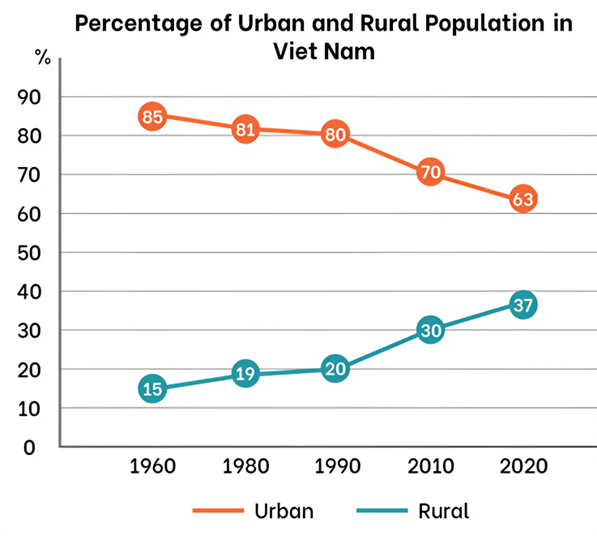
Sample 1:
The line graph shows the urban and rural population in Vietnam from 1960 to 2020. Overall, the urban population increased while the rural population decreased.
In 1960, most Vietnamese people lived in rural areas. However, from 1960 to 1980, the percentage of the rural population fell slightly to 81 per cent. Then the figure remained stable for the next ten years. From 1990 to 2000, the proportion of the population living in rural areas continued to decrease gradually. In 2020, the rural population was only 63 per cent of the total population of Vietnam.
By contrast, the urban population rose throughout the same period. In 1960, the percentage of the city population was just around 15 per cent. The figure went up slightly in 1980 and remained stable until 1990 when less than 20 per cent of the population lived in urban areas. Since 1990, the proportion of the urban population has increased gradually and in 2020, it reached 37 per cent of the total population.
Sample 2:
The line graph provides information about the proportion of urban and rural population in Vietnam between 1960 and 2020.
Overall, what stands out from the line graph is that the percentage of rural population followed an upward trend, while it was opposite for urban.
To commence with, most Vietnamese people lived in urban areas, accounted for 85%, which was the highest number in the chart in 1960. By contrast, this number decreased slightly by 4% in the next 20 years. Moreover, from 1990 to 2020, the percentage of urban population went down significantly, particularly from 80% to only 63%.
A closer look at the remaining data reveals that the proportion of rural population was approximately 15% throughout the same period, which was the smallest figure in the line graph. However, this number increased moderately to 19% in 1980, rising sharply from 20% to 37%, between 1990 and 2020 respectively.
Sample 3:
The line graph shows population trends in Vietnam from 1960 to 2020. Overall, the urban population has decreased significantly, while the rural population has increased over the same period.
In 1960, most Vietnamese people (85%) lived in urban areas, with only 15% residing in rural areas. However, from 1960 to 1980, the urban population slightly decreased to 81%, while the rural population rose to 19%. From 1980 to 1990, the urban population continued to decrease to 80%, and the rural population increased marginally to 20%.
A more pronounced change occurred from 1990 onwards. By 2010, the urban population had dropped to 70%, while the rural population had risen to 30%. This trend continued, and by 2020, the urban population had further decreased to 63%, with the rural population increasing to 37%.
Overall, the data indicates a shift from a predominantly urban population to a more balanced distribution between rural and urban residents in Vietnam over the six-decade period.
Sample 4:
The line graph illustrates changes in the urban and rural population percentages in Vietnam from 1960 to 2020. It is notable that while the proportion of rural residents showed a consistent upward trend, the urban population trended downwards.
Initially, the urban population was predominant, peaking at 85% in 1960, the highest point on the graph. However, over the next two decades, this figure decreased slightly by 4%. From 1990 onwards, there was a significant decline in urban population percentage, dropping notably from 80% to 63% by 2020.
Conversely, the rural population started at approximately 15% in 1960, the lowest point shown. This percentage saw a moderate increase to 19% by 1980 and then rose sharply to 37% by 2020.
Sample 5:
The line graph shows population trends in Vietnam from 1960 to 2020. Overall, there is a clear shift from a predominantly urban population to a more balanced urban-rural distribution.
In 1960, a vast majority of Vietnamese people (85%) lived in urban areas, with only a small fraction (15%) residing in rural areas. However, from 1960 to 1980, the urban population decreased modestly, falling to 81%, while the rural population grew to 19%.
The trend continued from 1980 to 1990, with the urban population slightly declining to 80% and the rural population rising to 20%. The most significant changes occurred after 1990. By 2010, the urban population had decreased to 70%, and the rural population had increased to 30%.
From 2010 to 2020, the urban population continued to decline, reaching 63%, while the rural population rose to 37%. This indicates a significant migration from urban to rural areas in Vietnam over the past 60 years, leading to a more balanced urban-rural distribution.
Write a letter (150-180 words) applying for the position of a part-time receptionist. Use the model and tips in 1, and the suggestions below to help you.
2222 Nguyen Trai Road, Thanh Xuan District, Ha Noi
1036 Hang Dau Street, Hoan Kiem District, Ha Noi
16 July, 20...
Dear Sir or Madam,
I am writing to apply for ...
I am ... Last summer, ...
I consider myself .../ I am ...
I would be delighted to ...
I am available for an interview on ...
If my application is successful, I will be able to start work ...
I look forward to hearing from you soon.
Yours faithfully,
Sample 1:
2222 Nguyen Trai Road, Thanh Xuan District, Ha Noi
1036 Hang Dau Street, Hoan Kiem District, Ha Noi
16 July, 2023
Dear Sir or Madam,
I am writing to apply for a part-time receptionist, which you advertised on your website on 11 July. I believe having a part-time job is a great opportunity to learn valuable skills.
I am in my final year of high school. I have some experience in this job before. Last summer, I worked at a hotel as a receptionist. My duties included welcoming guests, making and confirming guest bookings. I also answered incoming calls and managed reservations to make sure the customers were satisfied with their services.
I am friendly, sociable and hard-working. I can also speak English, so I can wait on foreign customers.
I would be delighted to meet you in person to discuss my application.
I am available for an interview on weekdays.
If my application is successful, I will be able to start work after 31 July.
I look forward to hearing from you soon.
Yours faithfully,
Linh
Nguyen Khanh Linh
Sample 2:
2222 Nguyen Trai Road
Thanh Xuan District
Ha Noi
16 July, 2024
1036 Hang Dau Street
Hoan Kiem District
Ha Noi
Dear Sir or Madam,
I am writing to apply for the position of a part-time receptionist as advertised.
I am a second-year student at Hanoi University, majoring in Business Administration. Last summer, I worked as a front desk assistant at a local hotel, where I gained valuable experience in customer service, handling phone calls, and managing appointments. I am proficient in English and have excellent communication skills.
I consider myself a diligent and reliable person, capable of multitasking and managing time effectively. I am confident that my friendly demeanor and professional attitude will contribute positively to your team.
I would be delighted to have the opportunity to further discuss my qualifications. I am available for an interview at your convenience and can be reached at [your phone number] or [your email address]. If my application is successful, I will be able to start work immediately.
I look forward to hearing from you soon.
Yours faithfully,
[Your Name]
Sample 3:
Dear Sir or Madam,
I am writing to apply for the position of a part-time receptionist at your esteemed company.
I am currently a third-year student at the University of Social Sciences and Humanities, majoring in English Language. Last summer, I worked as a receptionist at a language center, where I gained experience in managing front desk operations, assisting visitors, and handling administrative tasks. My strong organizational skills and ability to communicate effectively in both Vietnamese and English make me a suitable candidate for this role.
I am a hardworking and enthusiastic individual, always eager to learn and adapt. My attention to detail and commitment to providing excellent customer service would be an asset to your team.
I am available for an interview at your earliest convenience and can be reached at [your phone number] or [your email address]. If selected, I can start work immediately.
I look forward to the possibility of contributing to your organization.
Yours faithfully,
[Your Name]
Sample 4:
Dear Sir or Madam,
I am writing to apply for the part-time receptionist position at your company.
I am a first-year student at Hanoi University of Science and Technology, majoring in Information Technology. Last summer, I worked part-time at a small business, where I handled customer inquiries, managed schedules, and provided general administrative support. My technical skills and proficiency with office software enhance my ability to perform well in this role.
I am a dedicated and organized individual, known for my punctuality and reliability. My ability to stay calm under pressure and my friendly demeanor would be valuable assets to your team.
I am available for an interview at your convenience and can be contacted at [your phone number] or [your email address]. If successful, I can commence work immediately.
I look forward to discussing how I can contribute to your team.
Yours faithfully,
[Your Name]
Sample 5:
Dear Sir or Madam,
I am writing to express my interest in the part-time receptionist position advertised by your company.
I am a sophomore at Hanoi Open University, studying International Business. Last summer, I worked as a receptionist at a local health clinic, where I managed patient appointments, greeted visitors, and handled phone calls. This experience has equipped me with excellent customer service skills and the ability to manage front desk operations efficiently.
I consider myself a proactive and friendly individual, with a strong ability to multitask and prioritize tasks. My fluency in English and attention to detail make me an ideal candidate for this position.
I am available for an interview at your earliest convenience and can be reached at [your phone number] or [your email address]. If selected, I am ready to start immediately.
Thank you for considering my application. I look forward to the opportunity to contribute to your team.
Yours faithfully,
[Your Name]
NOW RECRUITING: AN ENGLISH TUTOR
Are you looking for a job that impacts the life of children? Are you enthusiastic about teaching English? Join us as an English tutor to make a difference in children's education.
We offer flexible working hours, and you can choose to teach morning, afternoon or evening classes. You will be responsible for planning and presenting your lessons and marking students' assignments. If you want to be considered for this position, please contact:
The Human Resource Department, Language School
1150 Hang Dau Str., Ha Noi
Sample 1:
8080 Truong Chinh Road, Dong Da District, Ha Noi
The Human Resource Department, Language School
1150 Hang Dau Str., Ha Noi
16 August, 2023
Dear Sir or Madam,
I am writing to apply for a part-time English tutor, which you advertised on your website on 11 August. I believe having a part-time job is a great opportunity to learn valuable skills.
I am in my final year of high school. I have some experience in the job of “teaching assistant”. Last summer, I worked at a language center in my neighborhood. My duties included checking attendance, marking students’ assignments and helping teachers prepare lessons. I also plan interactive lessons to attract students.
I am friendly, sociable and hard-working. I am fluent in English, so I can transmit the lessons easily.
I would be delighted to meet you in person to discuss my application. I am available for an interview on weekdays. I have attached my CV for reference. If my application is successful, I will be able to start work at the beginning of September.
I look forward to hearing from you soon.
Yours faithfully,
Trang
Tran Thu Trang
Sample 2:
2222 Nguyen Trai Road
Thanh Xuan District
Ha Noi
16 July, 2024
The Human Resource Department
Language School
1150 Hang Dau Street
Ha Noi
Dear Sir or Madam,
I am writing to express my interest in the English Tutor position advertised by your Language School. I am enthusiastic about teaching English and committed to making a positive impact on children's education.
I am a third-year student at Hanoi University, majoring in English Language Teaching. Over the past year, I have gained valuable experience as a part-time tutor, helping students improve their language skills through personalized lesson plans and interactive teaching methods. My approach emphasizes student engagement and active learning, which has consistently resulted in improved student performance.
I am particularly drawn to this position because of the flexible working hours, which would allow me to balance my studies and work effectively. I am available to teach morning, afternoon, or evening classes, as needed. Additionally, I am well-prepared to plan and present lessons and to mark assignments promptly and accurately.
I would be delighted to discuss how my background, skills, and enthusiasm can contribute to your school. Please feel free to contact me at [your phone number] or [your email address] to schedule an interview.
I look forward to the opportunity to join your team and make a difference in children's education.
Yours faithfully,
[Your Name]
Sample 3:
2222 Nguyen Trai Road
Thanh Xuan District
Ha Noi
16 July, 2024
The Human Resource Department
Language School
1150 Hang Dau Street
Ha Noi
Dear Sir or Madam,
I am writing to apply for the position of English Tutor as advertised by your Language School. I am passionate about teaching English and am eager to contribute to the educational development of children.
I hold a Bachelor's degree in English from Hanoi University, and I have over two years of experience teaching English to children in various settings. My previous role involved creating engaging lesson plans, delivering interactive classes, and assessing students' progress. I am skilled in using a variety of teaching methods to cater to different learning styles, ensuring that each student can reach their full potential.
The flexible working hours you offer are particularly appealing, as they will allow me to effectively manage my teaching schedule. I am available for morning, afternoon, or evening classes, and I am committed to providing high-quality education to all my students.
I would welcome the opportunity to discuss how my skills and experiences align with your needs. Please contact me at [your phone number] or [your email address] to arrange an interview.
Thank you for considering my application. I look forward to contributing to your team and helping children achieve their language learning goals.
Yours faithfully,
[Your Name]
Sample 4:
2222 Nguyen Trai Road
Thanh Xuan District
Ha Noi
16 July, 2024
The Human Resource Department
Language School
1150 Hang Dau Street
Ha Noi
Dear Sir or Madam,
I am writing to express my interest in the English Tutor position at your Language School. I am enthusiastic about teaching English and dedicated to making a positive impact on children's education.
I am currently completing my degree in English Language and Literature at Hanoi University. Over the past year, I have gained valuable experience as a volunteer English tutor at a local community center, where I developed and delivered engaging lesson plans tailored to the needs of young learners. My approach focuses on creating a supportive and interactive learning environment that encourages students to actively participate and develop their language skills.
I am attracted to the flexible working hours your school offers, as it would allow me to balance my academic commitments and my passion for teaching. I am available to teach morning, afternoon, or evening classes and am committed to ensuring that each lesson is well-prepared and effective.
I would be delighted to further discuss my qualifications and how I can contribute to your school. Please contact me at [your phone number] or [your email address] to schedule an interview.
Thank you for considering my application. I look forward to the opportunity to contribute to your team.
Yours faithfully,
[Your Name]
Sample 5:
2222 Nguyen Trai Road
Thanh Xuan District
Ha Noi
16 July, 2024
The Human Resource Department
Language School
1150 Hang Dau Street
Ha Noi
Dear Sir or Madam,
I am writing to apply for the position of English Tutor at your Language School, as advertised. I am passionate about teaching and committed to making a significant impact on children's education through effective English instruction.
I am a graduate of Hanoi University, holding a degree in English Education. My experience includes two years of part-time tutoring, where I developed comprehensive lesson plans, taught diverse groups of students, and assessed their progress through assignments and tests. My teaching philosophy centers on fostering an engaging and inclusive classroom environment that motivates students to improve their language skills.
The flexibility of the working hours you offer is particularly appealing, as it will allow me to balance my personal schedule while dedicating myself fully to teaching. I am available to teach morning, afternoon, or evening classes, according to your needs.
I am eager to bring my skills and enthusiasm to your team and help your students achieve their language learning goals. Please feel free to contact me at [your phone number] or [your email address] to arrange an interview.
Thank you for considering my application. I look forward to contributing to your school.
Yours faithfully,
[Your Name]
- Advantages:
+ People will have more time for leisure activities and family bonding.
+ They can answer questions about many topics.
- Disadvantages:
+ Humans can become dependent on Al technologies.
+ The cost of development and maintenance of robots is high.
Introduction
• People are beginning to use home robots.
• They have advantages and disadvantages.
______________
Body
• Advantages: Using home robots has several advantages. ______________
• Disadvantages: ______________
Conclusion
• Home robots may make lives easier and happier, but there are certain problems as well.
Sample 1:
People are beginning to use home robots. They have advantages and disadvantages. We must carefully consider the pros and cons before welcoming these robotic helpers into our homes.
Using home robots has several advantages. They free us from repetitive chores like cleaning, allowing more time for leisure activities and family bonding. Some robots even interact and play games, becoming companions, especially for those living alone.
However, there are downsides to consider. Reliance on AI can lead to a decline in critical thinking skills. Just like relying on calculators weakens mental math abilities, constantly turning to robots for solutions could weaken our ability to think creatively and solve problems independently. Additionally, robots can cultivate laziness, as tasks are completed without effort. Furthermore, the cost of development and maintenance is high. Robots require expensive parts and programming for each specific task. This investment may not be feasible for everyone.
Home robots may make lives easier and happier, but there are certain problems as well. While home robots can answer questions, provide information, and work tirelessly, the potential drawbacks cannot be ignored.
Sample 2:
People are beginning to use home robots, and while they offer various advantages, there are also notable disadvantages.
Using home robots has several advantages. Firstly, they allow people to have more time for leisure activities and family bonding. With robots handling household chores such as cleaning, cooking, and laundry, individuals can spend more quality time with their loved ones or pursue hobbies and relaxation. Additionally, home robots equipped with artificial intelligence can answer questions about many topics, providing instant information and assistance with tasks such as scheduling, shopping, and managing home security.
However, there are disadvantages to relying on home robots. One significant concern is that humans may become dependent on AI technologies, potentially losing essential skills and reducing human interaction. Over-reliance on robots for daily tasks could lead to a decline in problem-solving abilities and social interactions. Moreover, the cost of development and maintenance of robots is high. Investing in advanced home robots can be expensive and maintaining them may require ongoing expenses for repairs and updates.
In conclusion, while home robots can make lives easier and happier by saving time and providing valuable assistance, there are potential drawbacks, including dependency on technology and high costs. It is essential to balance the benefits with these challenges to ensure a harmonious integration of robots into daily life.
Sample 3:
As technology advances, home robots are becoming more prevalent in households. While they offer numerous benefits, they also come with certain drawbacks.
Using home robots has several advantages. Firstly, they provide people with more time for leisure activities and family bonding by taking over mundane household chores. For example, robots can handle tasks such as cleaning and cooking, allowing individuals to spend more quality time with their loved ones. Secondly, home robots are equipped with artificial intelligence, enabling them to answer questions on a wide range of topics. This can be especially useful for quick information retrieval, educational purposes, or even assisting with work-related queries.
However, there are also disadvantages associated with home robots. One significant concern is the potential for humans to become overly dependent on AI technologies. This reliance might lead to a decrease in essential life skills and a reduction in human interaction. Additionally, the cost of developing and maintaining these robots is high. Purchasing a home robot can be expensive, and ongoing maintenance and updates add to the financial burden, making it a less accessible option for many households.
In conclusion, while home robots can make life easier and potentially happier by saving time and providing valuable information, they also pose challenges such as dependency on technology and high costs. It is crucial to balance the benefits and drawbacks to fully integrate home robots into daily life.
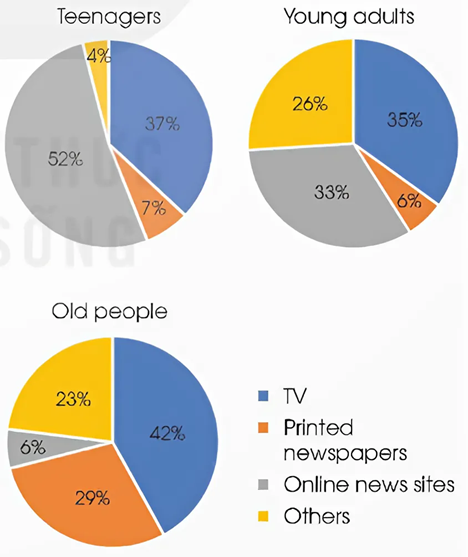
Sample 1:
The pie charts illustrate the main news sources for teenagers, young adults, and old people according to a survey conducted in 2022.
Overall, television was the most popular source for all age groups. It was chosen by 42 per cent of old people, and more than one third of teenagers and young adults. Meanwhile, the Internet source emerged as a strong contender for younger audiences. While only 6 per cent of old people rely on the internet for news, this number jumps to 33 per cent for young adults and a surprising 52 per cent for teenagers. By contrast, printed newspapers were the second choice of news source for old people with 29 percent, while only 7 per cent for teenagers and 6 per cent for young adults. Young adults and old people relied on "other" sources for news around a quarter, while teenagers only had 4 per cent.
Sample 2:
The tiger is one of the most endangered animals in the world. The Wildlife Magazine is holding a writing competition to raise people's awareness about conserving tigers. Write a report (180-200 words) describing the threats facing tigers and suggesting possible solutions.
To: ...
From: ...
Subject: ...
Date: ...
Introduction
• This report describes the threats ... and suggests some solutions to the problem.
Threats
• Research has shown that ...
• Another serious threat is ...
Solutions
• One solution is ...
• Second, it is important to ...
• In addition, we should ...
Conclusion
• In conclusion, there are ...
• Therefore, we recommend ...
Sample 1:
To: Wildlife Magazine Competition Committee
From: Kathy
Subject: Threats to tigers and proposed solutions
Date: 2024-03-06
Introduction
This report describes the critical threats facing tigers in the wild and suggests solutions to ensure their survival.
Threats
Research has shown that habitat loss due to deforestation is a major threat to tigers. As their natural habitats shrink, tigers lose access to the food and shelter they need to survive. Another serious threat is poaching, driven by the illegal wildlife trade. Tiger parts are mistakenly believed to have medicinal value, leading to their targeted killing.
Solutions
One solution is to implement stricter forest protection laws. This will help prevent deforestation and ensure healthy habitats for tigers to thrive. Second, it is important to increase anti-poaching efforts by strengthening law enforcement and imposing harsher penalties for poaching offenses. In addition, we should focus on raising public awareness about the importance of tiger conservation. Educational campaigns can encourage people to participate in protecting these magnificent creatures.
Conclusion
In conclusion, there are a number of critical threats pushing tigers towards extinction. However, by implementing solutions like habitat protection, increased anti-poaching efforts, and public awareness campaigns, we can ensure a future where tigers continue to roam free in their natural habitat.
Sample 2:
To: The Wildlife Magazine
From: [Your Name]
Subject: Urgent: Protecting Tigers from Extinction
Date: May 29, 2024
Introduction:
This report highlights the pressing threats facing tigers and offers viable solutions to address these challenges.
Threats:
Research has shown that habitat destruction due to deforestation, urbanization, and agricultural expansion severely threatens tiger populations. Moreover, illegal poaching for traditional medicine and luxury goods exacerbates the decline of tiger populations.
Solutions:
One solution is to strengthen law enforcement and penalties for poaching and illegal wildlife trade. Authorities must collaborate across borders to combat organized crime networks involved in wildlife trafficking. Second, it is crucial to prioritize habitat conservation through the establishment and expansion of protected areas and wildlife corridors. Additionally, community-based conservation initiatives can empower local communities to safeguard tiger habitats while providing sustainable livelihood options.
Conclusion:
In conclusion, the survival of tigers hinges on immediate action to address habitat loss and poaching. By implementing robust conservation strategies, such as stringent law enforcement and community engagement, we can secure a future for these majestic creatures. Therefore, we urge governments, organizations, and individuals to join forces in protecting tigers from extinction.
Sample 3:
To: The Wildlife Magazine
From: Catherine
Subject: Protecting Tigers: A Call to Action
Date: May 29, 2024
Introduction:
This report highlights the serious problems tigers face and suggests new ideas to keep them safe.
Threats:
Tigers face many dangers, like their homes being broken into smaller pieces, conflicts with people over land, and changes in the weather that affect their food supply. These threats make it hard for tigers to find mates and live peacefully.
Solutions:
To help tigers, we need to connect their homes with wildlife corridors, so they can move around freely and meet other tigers. We should also teach communities how to share their space with tigers without hurting them. It's crucial to tackle climate change by reducing pollution and using land in ways that don't harm tigers.
Conclusion:
In conclusion, saving tigers requires us to solve these big problems together. By protecting where they live, helping people and tigers live together safely, and fighting climate change, we can make sure tigers thrive in the wild. It's time for everyone to take action to protect these amazing animals.
Sample 4:
To: The Editor, Wildlife Magazine
From: Catherine
Subject: Report on Threats to Tigers and Potential Solutions
Date: July 15, 2024
Introduction
This report outlines the challenges facing tigers and proposes ways to tackle these issues.
Threats
Tigers are facing serious threats due to the loss of their natural habitats caused by deforestation and urban development. This fragmentation of their habitats disrupts their ability to find food and mates. Additionally, illegal poaching for tiger parts, driven by demands for traditional medicines and luxury goods, poses a grave threat to their survival.
Solutions
To address these challenges, it is crucial to establish and protect more wildlife reserves and corridors that connect fragmented habitats. This would provide tigers with larger areas to roam and breed safely. Strengthening law enforcement efforts to combat poaching, through increased patrols and stricter penalties, is also essential. Furthermore, educating local communities about the importance of tiger conservation and offering alternative livelihoods can reduce dependency on activities that harm tiger populations.
Conclusion
In conclusion, tigers face significant threats from habitat loss and illegal poaching. Therefore, it is vital to prioritize habitat protection, enforce anti-poaching laws rigorously, and engage communities in conservation efforts to secure a future for these majestic animals.
Best regards,
Catherine
Sample 5:
To: The Editor, Wildlife Magazine
From: Catherine
Subject: Report on Threats to Tigers and Potential Solutions
Date: July 15, 2024
Introduction
This report looks at the dangers tigers face and suggests ways to help them.
Threats
Tigers are in trouble because people are building on their homes and sometimes hurting them when they come near farms. Also, changes in weather patterns are making it harder for them to find food.
Solutions
We can protect areas where tigers live by making sure there are spaces between where people live and where tigers live. This can help reduce conflicts and keep both safe. Teaching people in these areas how to live alongside tigers without harming them is also important. We should also work on ways to help tigers find food even when their usual prey is scarce.
Conclusion
In conclusion, saving tigers means finding ways for people and tigers to live together peacefully. By protecting tiger habitats, teaching communities about tiger conservation, and finding solutions to food shortages, we can ensure tigers continue to thrive in the wild.
Best regards,
Catherine
Write an essay (180-200 words) about the benefits of using AI in creating content for the mass media and the problems caused by it. Select and combine information from Reading and the suggested ideas below.
Problems caused by Al in creating content for the mass media
• Increasing costs of the mass media (high costs for developing, installing, and maintaining the software)
• Reducing people's creativity (automated content creation using Al tools)
• Replacing human's jobs in the mass media (Al's capability of reporting and writing)
Sample 1:
Nowadays, AI is a powerful tool which can support people to do all things. While AI offers a variety of benefits, it also presents challenges that need consideration.
On the positive side, AI excels at efficiency and data analysis. It can sift through vast amounts of information to identify reliable stories or transform complex data into engaging visuals. Additionally, AI can personalize content for diverse audiences, enhancing viewer engagement.
However, AI's cost can be a burden. Developing, installing, and maintaining sophisticated software requires significant financial investment. Furthermore, AI tools can stifle creativity. Overreliance on automation for content creation lacks the unique human idea. Perhaps the most concerning issue is the potential for AI to replace human journalists altogether. While AI can write basic reports, it lacks the critical thinking and emotional intelligence necessary for nuanced analysis and storytelling.
In conclusion, AI offers powerful tools for the mass media. However, its successful integration requires balancing efficiency with human creativity to ensure engaging and high-quality content.
Sample 2:
Integrating AI into making media content has some good sides and some not-so-good ones. On the bright side, AI can help make content faster and more tailored to what people want. This means news and other info can reach us quicker, which is important in today's fast world.
But there are challenges too. Using AI can be expensive for media companies. They have to spend a lot on fancy software and keeping it running smoothly. This can be tough for smaller companies with limited resources.
Another worry is that AI might make content less creative. When everything's automated, there's a risk that content might start looking the same and lose its originality. This could mean we miss out on diverse perspectives and voices in the media.
Lastly, there's the concern about jobs. If AI can do reporting and writing tasks as well as humans, it could lead to fewer jobs in the media industry. This means people might lose their jobs, and we'd need to rethink how the media workforce looks.
In short, while AI can improve media content, we need to be careful about how we use it to make sure we don't lose out on creativity, diversity, or jobs in the process.
Sample 3:
Using AI to create media content has its upsides and downsides.
On the positive side, AI can speed up the process of making content and make it more personalized. This means we can get news and information faster, which is handy in today's fast-paced world.
However, there are challenges too. AI tools can be expensive for media companies to develop and maintain. This might be tough for smaller companies with limited budgets.
There's also a concern that relying too much on AI might make content less creative. If everything's automated, there's a risk that content could become boring and lose its originality. This could mean we miss out on different viewpoints and voices in the media.
Lastly, there's the worry about jobs. If AI can do tasks like reporting and writing as well as humans, it could lead to fewer jobs in the media industry. This could mean people losing their jobs, and we'd have to think about how to handle that.
In summary, while AI can improve media content, we need to be cautious about how we use it to make sure we don't sacrifice creativity, diversity, or jobs along the way.
Look at the job advert below. Imagine that you also want to apply for the job. Write your own CV.
TEACHING ASSISTANTS NEEDED
• Do you have a passion for teaching children?
• Are you a good communicator?
• Are you interested in organising learning activities?
We need 10 volunteer teaching assistants to help at a summer camp for primary school students.
If this interests you, please send your CV to summercamp@webmail.com
Sample 1:
CURRICULUM VITAE
Personal details
Full name: Nguyen Mai Linh
Phone: 1234567890
Email: mailing@email.com
Personal statement
Enthusiastic and hard-working high school student at Phu Nhuan with a strong interest in teaching and child development. Possess excellent communication and organizational skills. Eager to contribute to a positive learning environment at your summer camp and gain valuable experience working with children.
A. Education
Phu Nhuan High School, Ho Chi Minh city 2022-present
Nquyen Du Junior Secondary School, Ho Chi Minh city 2018-2022
Subjects and predicted grades: English – 9.5, Maths – 9.7, Literature – 9.0
Awards: prize for Student of 3 merits 2023
Extracurricular activities: member of debate team, participated in school sports festival
B. Work experience
Teaching assisstant 2023-present
- Helped teachers make learning materials
- Supported students with homework
Volunteer campaign Nov - Dec 2023
- Make a meal and give gifts to poor person
C. Skills
Fluent English: IELTS score 6.5
Digital skills: Good understanding of common digital software and platforms, basic coding skills
Highly organized, with strong time management skills.
Effective communication skills
D. Hobbies and interests
Reading, music
References
Available upon request
Sample 2:
CURRICULUM VITAE
[Your Name]
[Your Address]
[City, State, ZIP Code]
[Your Email Address]
[Your Phone Number]
Objective:
To utilize my passion for teaching children, strong communication skills, and enthusiasm for organizing learning activities as a Teaching Assistant at the summer camp for primary school students.
Education:
[Degree Name], [University Name], [Year of Graduation]
[Relevant Coursework or Specialization]
Experience:
Volunteer Tutor, [Organization Name], [Dates]
- Assisted elementary school students with homework assignments and provided additional support in subjects such as math, science, and English.
- Facilitated educational games and activities to reinforce learning concepts in an engaging manner.
- Communicated effectively with students to build rapport and create a positive learning environment.
Camp Counselor, [Summer Camp Name], [Dates]
- Supervised and mentored children aged 6-12 during daily camp activities, ensuring their safety and well-being.
- Planned and coordinated recreational and educational programs, including arts and crafts, sports, and team-building exercises.
- Collaborated with fellow counselors to address behavioral issues and promote positive social interactions among campers.
Skills:
- Strong communication skills, both verbal and written
- Ability to engage and motivate children in learning activities
- Organizational skills to plan and coordinate educational programs
- Patience and empathy when working with children of diverse backgrounds and abilities
- Teamwork and collaboration to support fellow staff members and create a cohesive camp environment
References:
Available upon request.
I am excited about the opportunity to contribute to the summer camp and make a positive impact on the lives of primary school students. Thank you for considering my application.
Sample 3:
CURRICULUM VITAE
Personal Information:
- Name: Catherine
- Email: catherine@email.com
- Phone: +1234567890
- Address: [Your Address]
Profile:
I am a dedicated and enthusiastic individual with a strong passion for teaching children and fostering their academic and personal development. With excellent communication skills and a proactive approach to organizing learning activities, I am eager to contribute as a Teaching Assistant at your summer camp for primary school students.
Education:
- Bachelor of Education (Expected Graduation: [Month, Year])
[University Name], [City, Country]
Key Skills:
- Passionate about teaching and working with children.
- Strong communication skills, both verbal and written.
- Organized and capable of planning and implementing learning activities.
- Patient, empathetic, and able to create a supportive learning environment.
Relevant Experience:
- Teaching Assistant Intern
[School Name], [City, Country]
[Month, Year] - [Month, Year]
- Assisted lead teachers in classroom activities, helping students with assignments and projects.
- Facilitated group activities and discussions to enhance learning outcomes.
- Supported classroom management and maintained a positive learning atmosphere.
Volunteer Experience:
- Volunteer Tutor
[Organization Name], [City, Country]
[Month, Year] - [Month, Year]
- Provided one-on-one tutoring sessions to primary school students in English and Mathematics.
- Developed tailored learning plans to meet individual student needs and improve academic performance.
Additional Skills:
- Proficient in Microsoft Office (Word, Excel, PowerPoint).
- Fluent in [Languages Spoken].
References:
Available upon request.
I am excited about the opportunity to contribute to your summer camp as a Teaching Assistant and look forward to discussing how my skills and enthusiasm can benefit your program. Please feel free to contact me at your earliest convenience at [Phone Number] or via email at [Email Address].
Benefits and Challenges of Lifelong Learning
Lifelong learning is self-motivated learning that is focused on both personal and professional development. This type of learning is essential in today's rapidly changing world. It brings many benefits as it helps us understand the world around us and provides us with better opportunities. Lifelong learners can also face challenges. So, what are these benefits and challenges?
Let's start with the benefits. ___________
What about the challenges? ___________
In conclusion, lifelong learning has many benefits, but it can also be challenging. In my opinion, ___________
Sample 1:
Benefits and Challenges of Lifelong Learning
Lifelong learning is self-motivated learning that is focused on both personal and professional development. This type of learning is essential in today's rapidly changing world. It brings many benefits as it helps us understand the world around us and provides us with better opportunities. Lifelong learners can also face challenges. So, what are these benefits and challenges?
Let's start with the benefits. Lifelong learning keeps you up-to-date on the latest advancements in your field, allowing you to make better decisions and solve problems more effectively. It keeps your brain active and boosts memory. Besides, it leads to a deeper understanding of the world, allowing you to make informed decisions in all aspects of life. It also equips you with the knowledge and skills to adapt to new technologies, changing demands, and evolving industries.
What about the challenges? It's easy to get sidetracked by daily routines or lose focus. Finding ways to stay motivated is crucial. You need money, time, and space to continue your pursuit of knowledge and skills. Moreover, simply acquiring knowledge isn't enough. It's essential to apply what you learn to truly benefit from lifelong learning.
In conclusion, lifelong learning has many benefits, but it can also be challenging. In my opinion, the rewards of staying engaged and constantly learning far outweigh the challenges. With effort, anyone can reap the benefits of lifelong learning.
Sample 2:
Benefits and Challenges of Lifelong Learning
Lifelong learning, characterized by self-motivated pursuit of knowledge for personal and professional growth, is indispensable in our fast-evolving society. Its benefits are manifold. Firstly, lifelong learning broadens our understanding of the world, fostering intellectual curiosity and critical thinking skills. By continuously acquiring new knowledge and skills, individuals remain adaptable and resilient in the face of change, enhancing their employability and career prospects.
Moreover, lifelong learning offers opportunities for personal development, enriching our lives beyond the confines of the workplace. It encourages self-reflection and personal growth, leading to greater fulfillment and satisfaction. Additionally, lifelong learners tend to be more socially engaged and connected, fostering a sense of community and belonging.
However, challenges accompany the pursuit of lifelong learning. Balancing learning commitments with other responsibilities can be demanding, requiring strong time management and discipline. Moreover, overcoming self-doubt and fear of failure may deter some individuals from embarking on learning journeys.
In conclusion, while lifelong learning promises numerous benefits, it also presents challenges that must be navigated. Nevertheless, the rewards of continuous learning far outweigh the difficulties. Embracing a lifelong learning mindset is essential for personal growth, professional success, and overall well-being in today's dynamic world.
Sample 3:
Benefits and Challenges of Lifelong Learning
Lifelong learning, a proactive approach to continuous personal and professional development, is increasingly recognized as essential in navigating today's rapidly changing world. Its benefits are multifaceted. Firstly, lifelong learning expands our knowledge base, enabling us to better understand the complexities of our surroundings and adapt to evolving circumstances. This deepened understanding empowers individuals to make informed decisions and seize opportunities for growth.
Furthermore, lifelong learning fosters innovation and creativity. By exposing ourselves to new ideas and perspectives, we cultivate the ability to think critically and problem-solve creatively. This not only enhances our professional capabilities but also enriches our personal lives, allowing for greater self-expression and fulfillment.
Despite its advantages, lifelong learning is not without challenges. One common obstacle is time constraints. Juggling work, family, and other responsibilities can make it difficult to dedicate sufficient time to learning pursuits. Additionally, overcoming inertia and stepping out of comfort zones can be daunting, especially when faced with the prospect of acquiring new skills or knowledge in unfamiliar domains.
In conclusion, while lifelong learning offers numerous benefits, including personal growth, adaptability, and innovation, it requires dedication and perseverance to overcome challenges such as time constraints and inertia. Embracing a mindset of continuous learning is crucial for thriving in an ever-changing world, where the ability to adapt and learn is paramount to success and fulfillment.
Fashion assistant required
• Want to take your first step into a career in fashion design?
• We are hiring a fashion assistant to join our team at Teen Fashion Culture, a leading fashion retail group. We will offer on-the-job training and support to the right candidate.
• Job responsibilities:
- Researching current fashion trends.
- Assisting the fashion design team in developing ideas for new products and designing sketches.
Please send your CV to: fashionabledesign@webmail.com
Sample 1:
Curriculum Vitae
Personal Details
Full Name: Nguyen Mai Linh
Phone: 1234567890
Email: mailing@email.com
Personal Statement
A school graduate with a strong passion for fashion design. Eager to learn and contribute to a fast-paced fashion retail environment. Possess excellent research and communication skills, with a keen eye for current trends.
A. Education
Phu Nhuan High School, Ho Chi Minh city 2022-present
Nquyen Du Junior Secondary School, Ho Chi Minh city 2018-2022
Subjects and predicted grades: English – 9.5, Art – 9.0, Literature – 9.0
Awards: prize for school art competition
Extracurricular activities: member of fashion club, participated in school fashion show
B. Work experience
Teaching assistant of Art 2023-present
- Helped teachers prepare drawing tools before class
- Supported students draw
C. Skills
Communication: to collaborate effectively with a team.
Soft skills: Familiarity with design software (Adobe Photoshop basics).
Creativity: Strong sense of style and ability to generate new design ideas.
D. Hobbies and interests
Fashion design and trends
Sketching and drawing (if applicable)
References
Available upon request.
Sample 2:
Curriculum Vitae
Personal Information:
- Name: Catherine
- Email: catherine@email.com
- Phone: +1234567890
- Address: [Your Address]
Profile:
An aspiring fashion enthusiast eager to embark on a career in fashion design. With a keen eye for current trends and a passion for creativity, I am excited about the opportunity to contribute to the dynamic team at Teen Fashion Culture and grow professionally through hands-on training and mentorship.
Education:
- Bachelor of Arts in Fashion Design (Expected Graduation: [Month, Year])
[University Name], [City, Country]
Key Skills:
- Knowledgeable about current fashion trends and industry developments.
- Proficient in fashion sketching and design software.
- Strong attention to detail and creative flair.
- Excellent research skills and ability to analyze fashion trends effectively.
Relevant Experience:
- Fashion Design Intern
[Fashion Company Name], [City, Country]
[Month, Year] - [Month, Year]
- Conducted extensive research on fashion trends, fabrics, and color palettes.
- Assisted in developing design concepts and creating sketches for new collections.
- Collaborated closely with the design team to refine and finalize product designs.
Projects:
- Designed and created a mini fashion collection as part of coursework, focusing on [theme or concept]. Presented collection at [University Fashion Show].
Additional Skills:
- Proficient in Adobe Creative Suite (Photoshop, Illustrator).
- Strong communication and teamwork skills, with a collaborative approach to problem-solving.
- Fluent in [Languages Spoken].
References:
Available upon request.
I am enthusiastic about the opportunity to contribute to Teen Fashion Culture as a Fashion Assistant and am eager to bring my creativity and dedication to your team. Please feel free to contact me at [Phone Number] or via email at [Email Address]. Thank you for considering my application.
Write a biography (180 words) of Bill Gates for your school newspaper. Select and combine information from the Speaking section and the following quick facts. Use the outline below to help you.
Bill Gates’ achievements (b.1955, USA) 1. one of the most successful businessmen ever; one of the most influential people of the 20th century 2. 1975: developed a computer program and founded Microsoft with his friend Paul Alien 3. 1980: persuaded IBM to use Microsoft software (Windows) in their personal computers (PCs); soon almost every PC used Windows 4. 1995 – 2017: richest man in the world 5. 2000: started the Bill and Melinda Gates Foundation with his then-wife (valued nearly 50 million dollars, 2023) to improve healthcare and reduce poverty across the world |
QUICK FACTS ABOUT BILL GATES' EARLY LIFE - Full name: William Henry Gates III - Born: 28 October, 1955 in Seattle, Washington (father: famous lawyer, mother: director of a big company) - Interested in computers and computer programming; wrote his first software program at the age of 13 - went to Harvard College (1973) but dropped out (1975) |
BILL GATES' LIFE AND ACHIEVEMENTS
Bill Gates (aka William Henry Gates III) is considered __________
Early life and education
__________
Achievements
__________
Sample 1:
Bill Gates (aka William Henry Gates III) is considered one of the most successful businessmen ever and one of the most influential people of the 20th century. Born on October 28, 1955, in Seattle, Washington, Gates was the son of a famous lawyer and a director of a big company. From a young age, he showed a keen interest in computers and computer programming, writing his first software program at the age of 13.
Gates attended Harvard College in 1973 but dropped out in 1975 to pursue his passion for software development. That same year, he co-founded Microsoft with his friend Paul Allen. Their company revolutionized the personal computer industry, especially after Gates persuaded IBM to use Microsoft software in their PCs in 1980. This move led to the widespread adoption of Windows, making Microsoft a household name.
From 1995 to 2017, Gates held the title of the richest man in the world. In 2000, he and his then-wife Melinda founded the Bill and Melinda Gates Foundation, which aims to improve healthcare and reduce poverty worldwide. By 2023, the foundation was valued at nearly 50 billion dollars. Gates' contributions to technology and philanthropy have left an indelible mark on the world.
Sample 2:
BILL GATES' LIFE AND ACHIEVEMENTS
Bill Gates, born William Henry Gates III on October 28, 1955, in Seattle, Washington, is celebrated as one of the most successful businessmen and influential figures of the 20th century.
Early Life and Education
Gates developed a passion for computers early on, writing his first software program at the age of 13. He attended Harvard College from 1973 but dropped out in 1975 to pursue his dream of developing software.
Achievements
In 1975, Gates co-founded Microsoft with his friend Paul Allen, marking the beginning of a transformative journey in technology. His pivotal moment came in 1980 when he convinced IBM to use Microsoft's software, specifically Windows, on their personal computers (PCs). This decision catapulted Windows to become the dominant operating system for PCs globally.
From 1995 to 2017, Gates held the title of the world's richest person. In 2000, he and his then-wife established the Bill and Melinda Gates Foundation, valued at nearly $50 billion in 2023, focusing on improving healthcare and reducing poverty worldwide. Gates' contributions to technology and philanthropy continue to leave a profound impact on society.
Sample 3:
BILL GATES' LIFE AND ACHIEVEMENTS
Bill Gates, born William Henry Gates III on October 28, 1955, in Seattle, Washington, is widely regarded as one of the most successful businessmen and influential figures of the 20th century.
Early Life and Education
Gates showed an early interest in computers, programming his first software at 13. He attended Harvard College from 1973 but dropped out in 1975 to pursue his passion for software development.
Achievements
In 1975, Gates co-founded Microsoft with Paul Allen, launching a company that would revolutionize personal computing. His strategic move in 1980 to secure IBM's adoption of Microsoft software, notably Windows, paved the way for its widespread use in PCs globally.
For much of the late 20th century, Gates was recognized as the world's wealthiest person. In 2000, he and his then-wife established the Bill and Melinda Gates Foundation, now valued at nearly $50 billion, dedicated to improving global health and reducing poverty. Gates' entrepreneurial vision and philanthropic efforts continue to shape technology, business, and humanitarian initiatives worldwide.
Studying abroad can be an exciting opportunity for many young people. While it may have some advantages, some students prefer to stay home to avoid the difficulties they may have when living in a different culture. What is your opinion?
Introduction:
Nowadays, studying abroad has become very popular among young people ...
Body:
Advantages:
- be more successful in life
- learn to live independently
Disadvantages:
- have difficulties in adapting to new environment
- face discrimination
- have language barriers
Conclusion:
In short ... In my opinion ...
Sample 1:
Nowadays, studying abroad has become very popular among young people. Many students dream of experiencing education in a foreign country, hoping to gain unique benefits. While this can be an exciting opportunity, some students prefer to stay home to avoid the potential challenges they may face.
One of the main advantages of studying abroad is the potential to be more successful in life. Students who study overseas often receive a high-quality education, which can open doors to better career opportunities. Additionally, living independently in a different culture helps students develop essential life skills and self-reliance, which are crucial for personal growth.
However, there are notable disadvantages. Some students may have difficulties adapting to a new environment, experiencing culture shock and homesickness. Furthermore, they might face discrimination, making it hard to integrate into the local community. Language barriers can also pose significant challenges, affecting their academic performance and social interactions.
In short, studying abroad offers both exciting opportunities and considerable challenges. In my opinion, while it may be difficult, the advantages of studying abroad, such as personal growth and better career prospects, outweigh the disadvantages. It is a valuable experience that can greatly contribute to a student's development.
Sample 2:
Nowadays, studying abroad has become very popular among young people. It offers a unique opportunity to experience different cultures, gain valuable skills, and broaden one's horizons. However, while studying abroad has numerous advantages, some students may prefer to stay home to avoid the challenges that come with living in a different cultural environment.
Studying abroad can significantly enhance one's personal and professional growth. Exposure to diverse cultures fosters a broader perspective, equipping students with the adaptability and cultural competency crucial for success in an increasingly globalized world. Moreover, living independently in a foreign country encourages self-reliance and resilience, nurturing essential life skills that contribute to long-term success.
Despite these benefits, studying abroad is not without its challenges. Many students may struggle to adapt to the new environment, facing cultural differences, discrimination, and language barriers. These difficulties can be overwhelming and may hinder academic and personal progress, leading some students to prefer staying home where they feel more comfortable and secure.
In short, while studying abroad offers numerous advantages, it also presents challenges that may deter some students. Ultimately, the decision to study abroad or stay home depends on individual preferences, goals, and readiness to embrace new experiences and overcome obstacles. In my opinion, studying abroad can be a transformative experience for those willing to navigate the challenges and seize the opportunities it offers.
Sample 3:
In today's interconnected world, studying abroad has become an increasingly popular choice for young people seeking new experiences and academic opportunities. While the prospect of living in a different country can be exciting, it also comes with its own set of challenges. Some students may prefer to stay home to avoid these difficulties and remain within their comfort zone.
Studying abroad offers a plethora of advantages. It provides students with the opportunity to immerse themselves in a new culture, develop language skills, and broaden their global perspective. Additionally, navigating life in a foreign country fosters independence and resilience, qualities that are highly valued in today's competitive job market.
However, there are drawbacks to studying abroad as well. Some students may struggle to adjust to a new environment, experiencing homesickness or culture shock. Furthermore, language barriers and discrimination can pose significant challenges to academic and social integration, leading some students to feel isolated and unsupported.
In conclusion, studying abroad presents both opportunities and challenges for young people. While it can be an enriching and transformative experience, it may not be suitable for everyone. Ultimately, the decision to study abroad or stay home should be based on individual preferences, goals, and readiness to embrace the uncertainties and complexities of living in a different culture.
Sample 4:
In the contemporary era, studying abroad has emerged as a coveted avenue for young individuals eager to explore new horizons and expand their academic and personal horizons. However, while the allure of international education is undeniable, there are valid concerns about the potential difficulties that students may encounter when navigating unfamiliar territories. Consequently, some students may opt to remain in their home country to avoid the challenges associated with living in a foreign culture.
The advantages of studying abroad are manifold. It offers students the opportunity to gain exposure to diverse perspectives, cultures, and academic approaches, thereby fostering intellectual growth and cross-cultural understanding. Additionally, studying abroad promotes independence and self-reliance, as students learn to navigate unfamiliar environments and overcome challenges on their own.
Despite these benefits, studying abroad can present significant challenges. Cultural adaptation may prove to be a daunting task, as students grapple with language barriers and cultural differences. Moreover, feelings of homesickness and isolation are not uncommon among students living far away from their support networks.
In conclusion, studying abroad presents a unique blend of opportunities and challenges for young individuals. While it offers the chance for personal and academic growth, it also requires students to navigate unfamiliar terrain and overcome obstacles. Ultimately, the decision to study abroad or stay home should be based on individual preferences, goals, and readiness to embrace the complexities of international education.
Write a problem-solving report (180-200 words). Use the outline below to help you.
Introduction
This report describes the problem of paper pollution at school and suggests two main solutions to it.
Problems
As students often use worksheets or scrap paper in class, they often write on one side of the paper and throw it away when they are done.
_________
Solutions
We propose two solutions _________
Conclusion
_________
Sample 1:
Introduction
This report addresses the issue of paper pollution within our school environment and presents two potential solutions to mitigate it.
Problems
The predominant problem stems from the common practice among students of using worksheets or scrap paper for various tasks, such as note-taking or completing assignments. Due to the single-sided usage, these papers are often discarded after initial use, leading to unnecessary waste accumulation. Moreover, the lack of awareness regarding the environmental impact of paper disposal exacerbates the problem.
Solutions
To combat paper pollution effectively, we propose two primary solutions. Firstly, implementing a paper recycling program would encourage students to collect used papers and deposit them in designated recycling bins placed strategically throughout the school premises. Secondly, promoting the use of digital platforms and technologies for educational purposes could significantly reduce paper consumption. By integrating e-learning platforms and digital tools into the curriculum, students can minimize their reliance on paper-based materials.
Conclusion
In conclusion, addressing paper pollution requires proactive measures and collective efforts. By adopting paper recycling initiatives and embracing digital alternatives, we can significantly reduce our ecological footprint and foster a more sustainable learning environment within our school community.
Sample 2:
Introduction
This report addresses the issue of paper pollution within our school environment and proposes two primary solutions to mitigate it.
Problems
The predominant problem stems from the common practice among students of utilizing worksheets or scrap paper for academic tasks, resulting in single-sided usage and subsequent disposal.
Solutions
Firstly, implementing a paper recycling program can significantly reduce paper waste. By providing designated bins for paper recycling and educating students on the importance of recycling, we can divert a substantial amount of paper from ending up in landfills.
Secondly, promoting digital alternatives such as e-books and online resources can minimize the reliance on traditional paper-based materials. Encouraging teachers to utilize digital platforms for assignments and course materials can significantly decrease paper consumption.
Conclusion
In conclusion, combating paper pollution requires proactive measures such as implementing a paper recycling program and embracing digital alternatives. By adopting these solutions, we can mitigate the environmental impact of paper waste within our school and cultivate a culture of sustainability among students and staff.
Sample 3:
Introduction
This report addresses the pressing issue of paper pollution within our school premises and proposes two viable solutions to tackle this challenge effectively.
Problems
The primary problem lies in the widespread practice of students using paper for various academic tasks, such as taking notes and completing assignments. Consequently, a significant amount of paper is discarded after single-sided use, contributing to paper pollution.
Solutions
Firstly, promoting double-sided printing and copying can substantially reduce paper consumption. By encouraging teachers to utilize both sides of the paper for worksheets and handouts, we can effectively halve the amount of paper waste generated within the school.
Secondly, introducing a paper reduction campaign can raise awareness and encourage behavioral change among students and staff. This campaign can include initiatives such as organizing paperless days, where digital alternatives are utilized for all academic tasks, and providing incentives for reducing paper usage.
Conclusion
In conclusion, addressing the issue of paper pollution requires a multi-faceted approach involving both structural changes and behavioral interventions. By implementing solutions such as promoting double-sided printing and launching a paper reduction campaign, we can significantly mitigate paper waste and foster a culture of environmental stewardship within our school community.
Sample 4:
Introduction
This report aims to address the detrimental issue of paper pollution prevalent within our school environment and proposes two strategic solutions to combat this problem effectively.
Problems
One of the primary problems contributing to paper pollution in our school is the widespread use of single-sided paper for various academic activities. Students often discard paper after using only one side, resulting in unnecessary waste generation.
Solutions
Firstly, implementing a paper-saving initiative can significantly reduce paper consumption. This initiative can involve providing students with reusable notebooks or encouraging them to use both sides of the paper for notetaking and assignments. Additionally, organizing paper collection drives and incentivizing students to recycle paper can further promote sustainable paper usage practices.
Secondly, integrating digital platforms and e-learning tools into the curriculum can offer alternative solutions to traditional paper-based methods. By utilizing digital resources for assignments, quizzes, and reading materials, students can minimize their reliance on paper and contribute to a paperless learning environment.
Conclusion
In conclusion, addressing paper pollution in our school requires proactive measures and a commitment to promoting sustainable practices. By implementing solutions such as paper-saving initiatives and embracing digital alternatives, we can significantly reduce paper waste and create a more environmentally conscious school community.
Write a description (120-150 words) of the graph. Use the suggestions below to help you.
The line graph shows population trends in Thailand from 1960 to 2020. Overall, the urban population...
In 1960, most Thai people ... However, from 1960 to 1980, ... From 2000, ...
By contrast, the urban population rose throughout the same period. In 1960, ... In 1980, ... From 2000, ...
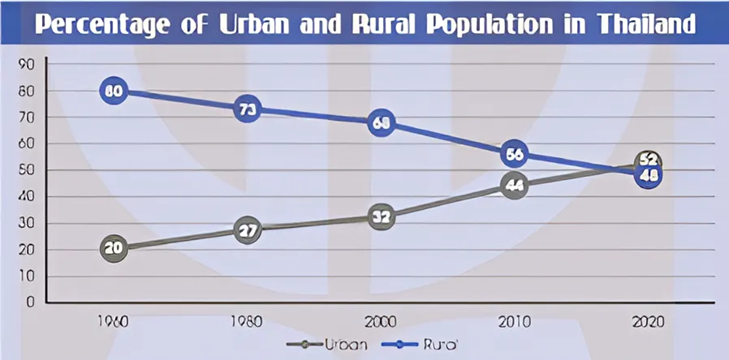
Sample 1:
The line graph illustrates population trends in Thailand spanning from 1960 to 2020. Initially, in 1960, the majority of Thai people resided in rural areas, constituting a substantial portion of the population. However, from 1960 to 1980, there was a notable shift as urbanization gained momentum, leading to a steady increase in urban dwellers. This trend continued to surge from 2000 onwards, indicating a significant migration of people from rural to urban areas. Conversely, the rural population exhibited a contrasting trajectory. Despite starting with a higher proportion in 1960, it experienced a gradual decline over the decades, particularly evident in the period from 1980 to 2000. Overall, the graph highlights a substantial urbanization trend in Thailand over the depicted timeframe, reflective of broader socio-economic shifts.
Sample 2:
Summer jobs | |
WE ARE LOOKING FOR 5 part-time SHOP ASSISTANTS. - No experience is required. - Hourly wage, plus free meals and overtime pay. - Send your letter of application to bshop@webmail.com. | THREE ENGLISH TEACHING ASSISTANTS ARE NEEDED. Requirements: - Good English skills. - Must be responsible and enthusiastic. - For more information, call Ms. Lan on 0985545ххх. |
Sample 1:
Dear Hiring Manager,
I am writing to apply for the part-time shop assistant position advertised for the summer. As a secondary school student, I am eager to gain work experience and earn some pocket money during the holidays.
Although I do not have previous experience in a shop, I am a quick learner and very enthusiastic about providing excellent customer service. I am responsible, punctual, and have good communication skills. I am confident that these qualities will make me a valuable addition to your team.
I am available to work flexible hours, including weekends and overtime, as needed. I am also excited about the opportunity to receive free meals and the possibility of earning overtime pay.
Thank you for considering my application. I look forward to the opportunity to discuss how I can contribute to your shop.
Sincerely,
Janet
Sample 2:
Dear Hiring Manager,
I hope this letter finds you well. I am writing to apply for the part-time Shop Assistant position advertised. I am a secondary school student looking for a summer job to gain experience and earn some extra money.
Even though I haven't worked in a shop before, I am eager to learn and have a strong work ethic. I enjoy helping people and believe I can provide friendly customer service.
The idea of earning an hourly wage, getting free meals, and overtime pay is exciting to me. I can work flexible hours and am keen to start as soon as possible.
Thank you for considering my application. I would love the opportunity to talk more about how I can contribute to your team. Please find my resume attached.
Best regards,
[Your Name]
[Your Contact Information]
Sample 3:
Subject: Application for English Teaching Assistant Position
Dear Ms. Lan,
I am writing to express my interest in the English Teaching Assistant position advertised. As a secondary school student with strong English skills and a passion for helping others learn, I am excited about the opportunity to contribute as part of your team.
I have a solid grasp of English grammar and vocabulary, and I am known for being responsible and enthusiastic in my studies and extracurricular activities. I believe these qualities will allow me to effectively assist in your teaching efforts.
I am eager to learn more about this opportunity and discuss how I can contribute to your team. Please feel free to contact me at [Your Phone Number] to schedule a convenient time for an interview.
Thank you for considering my application. I look forward to the possibility of working with you.
Sincerely,
[Your Name]
Sample 4:
Subject: Application for English Teaching Assistant Position
Dear Ms. Lan,
I am writing to apply for the English Teaching Assistant position recently advertised. I am a secondary school student with a strong command of English and a genuine enthusiasm for helping others learn.
I have consistently excelled in English classes and have participated actively in school debates and language clubs. These experiences have honed my communication skills and ability to explain concepts clearly.
I am known for my responsibility and dedication, qualities that I believe are crucial for this role. I am eager to assist in creating a supportive learning environment and to contribute positively to the students' English language development.
I would appreciate the opportunity to discuss how my skills and enthusiasm can benefit your team further. Please feel free to contact me at [Your Phone Number] to arrange an interview at your earliest convenience.
Thank you for considering my application. I look forward to hearing from you soon.
Best regards,
[Your Name]
Sample 5:
Subject: Application for Part-Time Shop Assistant Position
Dear Hiring Manager,
I am writing to apply for the part-time Shop Assistant position recently advertised. As a secondary school student eager to gain practical work experience and contribute positively to your team, I am excited about the opportunity presented.
Although I have not previously worked in retail, I am a dedicated student known for my reliability and strong interpersonal skills. I am quick to learn new tasks and thrive in fast-paced environments. I am eager to apply my enthusiasm for customer service and teamwork to support your shop's operations.
The offer of an hourly wage, along with free meals and overtime pay, is very appealing to me as I strive to save money for future endeavors. I am available to work flexible hours throughout the summer.
Thank you for considering my application. I look forward to the possibility of discussing how my skills and eagerness to learn can contribute to your shop. Please find my attached resume for your review.
Warm regards,
[Your Name]
[Your Contact Information]
Introduction
• Robots are widely used in many fields ...
• They have advantages and disadvantages ...
Body
• Advantages:
- Robots can help solve labour shortages in some industries ...
-
• Disadvantages:
Robots need to be pre-programmed by engineers and can only follow a set of instructions ...
-
Conclusion
In short, robots are ...
Sample 1:
Robots are increasingly prevalent in various industries, offering both advantages and disadvantages to the workplace.
Robots alleviate labor shortages in industries with high demand and low availability of skilled workers. They can perform repetitive tasks with precision and efficiency, increasing productivity and reducing errors.
However, robots require pre-programming by engineers and can only operate within the parameters of their programming. This limits their flexibility and ability to adapt to unexpected situations. Moreover, the initial investment and maintenance costs of robots can be substantial, posing financial challenges for smaller businesses.
In short, robots are valuable assets in the workplace, streamlining operations and boosting efficiency. However, their reliance on programming and high costs underscores the need for careful consideration of their implementation. Balancing the advantages and disadvantages of robots is essential for maximizing their potential while mitigating potential drawbacks in the workplace.
Sample 2:
Robots have become integral to modern workplaces, offering a range of benefits alongside some drawbacks.
Robots address labor shortages by handling repetitive or dangerous tasks, reducing the risk of accidents and injuries. Their precision and consistency enhance productivity and product quality, contributing to competitive advantages for businesses. Moreover, robots can operate in challenging environments unsuitable for human workers, such as extreme temperatures or hazardous conditions.
However, robots lack the adaptability and problem-solving skills of humans, requiring precise programming by skilled engineers. This reliance on programming limits their versatility and ability to handle complex tasks. Additionally, the upfront costs of acquiring and maintaining robots can be prohibitive for some companies. Furthermore, concerns about job displacement and the impact on employment opportunities for human workers persist.
In summary, while robots offer significant advantages in workplace efficiency and safety, their limitations and associated costs warrant careful consideration. Striking a balance between harnessing the benefits of robotics technology and addressing its potential drawbacks is essential for sustainable and equitable workforce development.
Sample 3:
The integration of robots into the workplace has revolutionized various industries, presenting both advantages and disadvantages.
Robots enhance efficiency by automating repetitive tasks, allowing employees to focus on more complex and creative endeavors. They can work around the clock without the need for breaks, leading to increased productivity and faster turnaround times. Moreover, robots improve safety by handling hazardous tasks, reducing the risk of workplace accidents and injuries.
Despite their benefits, robots require significant upfront investment and ongoing maintenance costs, which may pose financial challenges for businesses, particularly smaller enterprises. Additionally, the reliance on robotics technology can lead to job displacement for some workers, raising concerns about unemployment and economic inequality. Furthermore, robots lack human intuition and empathy, limiting their ability to handle customer service roles effectively.
In conclusion, robots offer undeniable advantages in terms of efficiency, productivity, and safety in the workplace. However, their implementation requires careful consideration of the associated costs and potential impacts on employment dynamics and human-machine interactions. Striving for a balanced approach to integrating robots into the workforce is crucial for maximizing their benefits while mitigating potential drawbacks.
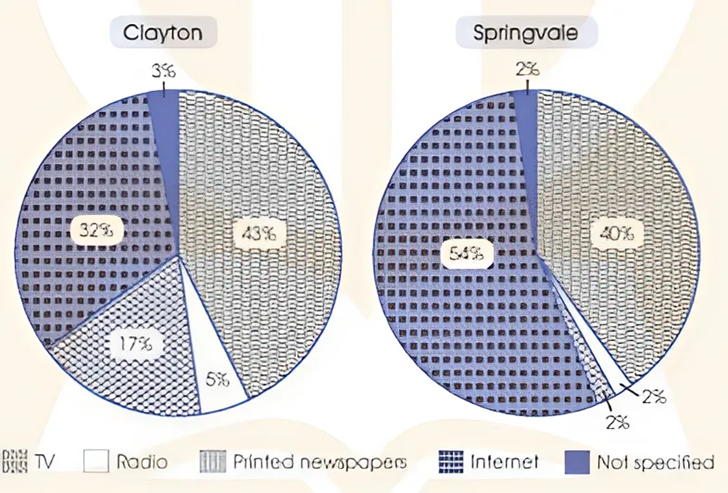
Sample 1:
This report describes the threats ... and suggests some solutions to the problem.
Threats
It is estimated / believed that ...
Another serious threat ...
Solutions
What can we do to save ...?
One solution is ...
Second, it is important to ... / In addition, we should ...
Conclusion
In conclusion, there are ...
Therefore, we recommend ...
Sample 1:
Introduction
This report outlines the threats facing the saola, an endangered species, and proposes solutions to address these challenges.
Threats
It is estimated that habitat loss due to deforestation and agricultural expansion is one of the primary threats to the saola population. Additionally, illegal hunting and poaching for its horns, believed to have medicinal properties, pose a significant danger to the species.
Solutions
To safeguard the saola, concerted conservation efforts are essential. One solution is to establish and enforce protected areas to preserve the saola's natural habitat and prevent further deforestation and encroachment. Additionally, implementing community-based conservation initiatives can engage local communities in conservation efforts and provide alternative livelihoods to reduce reliance on hunting and habitat destruction.
Conclusion
In conclusion, the saola faces multiple threats to its survival, including habitat loss and illegal hunting. To ensure the species' long-term survival, collaborative conservation measures are imperative. By implementing protected areas and community-based conservation programs, we can work towards preserving the saola and its habitat for future generations.
Sample 2:
Introduction
This report sheds light on the pressing threats confronting the saola, an endangered species, and offers actionable solutions to mitigate these challenges.
Threats
It is believed that habitat fragmentation and degradation due to human activities, such as logging and agricultural expansion, pose a significant threat to the saola's survival. Furthermore, the saola is vulnerable to accidental entanglement in snares set for other animals, leading to unintentional deaths.
Solutions
To protect the saola, proactive measures must be taken. One solution is to establish wildlife corridors and buffer zones to connect fragmented habitats and provide safe passage for the saola. Additionally, implementing anti-poaching patrols and increasing enforcement of wildlife protection laws can help reduce the threat of snaring and illegal hunting.
Conclusion
In conclusion, the saola faces imminent threats from habitat loss and accidental trapping, necessitating urgent conservation action. By implementing strategies such as habitat connectivity initiatives and anti-poaching measures, we can safeguard the future of the saola and ensure its continued existence in the wild.
Sample 3:
Introduction
This report aims to highlight the imminent threats faced by the saola, an endangered species, and proposes viable solutions to mitigate these risks.
Threats
The saola is confronted with various threats, including habitat destruction caused by deforestation, agricultural expansion, and infrastructure development. Additionally, illegal poaching for its distinctive horns, highly prized in traditional medicine, poses a severe threat to the species' survival.
Solutions
To address the threats to saola conservation, concerted efforts are required. One solution involves implementing strict laws and regulations to combat illegal hunting and trade of saola products, along with increasing law enforcement and penalties for offenders. Furthermore, promoting sustainable land-use practices, such as reforestation and habitat restoration, can help mitigate habitat loss and fragmentation.
Conclusion
In conclusion, the saola faces imminent extinction due to habitat destruction and illegal poaching. However, by implementing stringent conservation measures and promoting sustainable land-use practices, we can work towards ensuring the long-term survival of this remarkable species. It is imperative that stakeholders, including governments, conservation organizations, and local communities, collaborate to protect the saola and its fragile ecosystem for future generations.
Read the following job advert. Write your CV (150-180 words) to apply for the job.
Interns needed
• Do you have a passion for reading books?
• Are you a responsible person?
• Are you free at weekends?
We need interns to help librarians organise books and other materials in the local library.
If this interests you, please send your CV to locallibrary@webmail.com.
Sample 1:
[Your Name]
[Your Address]
[City, State, ZIP Code]
[Your Email Address]
[Your Phone Number]
Objective:
To apply for the Intern position at the local library, where I can utilize my passion for reading, responsible nature, and availability on weekends to assist librarians in organizing books and materials effectively.
Education:
[Degree Name], [University Name], [Year of Graduation]
- Relevant coursework: Literature, Library Science
Experience:
Library Volunteer, [Library Name], [Dates]
- Assisted librarians in shelving and organizing books according to the Dewey Decimal System.
- Helped with inventory management and cataloging new acquisitions.
- Provided assistance to library patrons with locating books and answering inquiries.
Skills:
- Passionate about reading and promoting literacy
- Highly responsible and reliable
- Strong organizational skills with attention to detail
- Excellent communication and interpersonal abilities
- Availability on weekends for internship duties
References:
Available upon request.
I am enthusiastic about the opportunity to contribute to the local library and support its mission of fostering a love for reading and learning within the community. Thank you for considering my application.
Sample 2:
Sample 1:
Learning a foreign language offers a plethora of benefits alongside its fair share of challenges. On the bright side, mastering a new language opens doors to diverse cultures, fostering cross-cultural understanding and appreciation. It enhances communication skills, enabling individuals to connect with people from different backgrounds and broaden their perspectives. Moreover, studies suggest that bilingualism can improve cognitive abilities, such as problem-solving and multitasking.
However, learning a foreign language comes with its challenges. It requires dedication, persistence, and patience to attain proficiency, especially when grappling with unfamiliar grammar rules and pronunciation nuances. Time constraints and competing priorities can also pose obstacles to consistent language learning. Additionally, fear of making mistakes and embarrassment in speaking can hinder progress and confidence.
Despite these challenges, the rewards of learning a foreign language are manifold. It enhances career prospects, providing a competitive edge in a globalized job market. It also promotes personal growth, boosting self-confidence and adaptability. Embracing the journey of learning a new language offers not only practical advantages but also enriches one's life with new experiences, friendships, and opportunities for cultural exploration.
Sample 2:
Learning a foreign language brings many good things, but it's not always easy. On the positive side, it helps you understand different cultures and talk to more people. It also makes your brain work better, helping you solve problems and do more things at once.
However, it can be hard work. Learning new words and grammar rules takes time and effort. Sometimes, you might feel like you're not making progress or get frustrated when you can't say things right. Plus, finding time to practice can be tough when you have other things to do.
Still, learning a foreign language has its rewards. It can help you get better jobs and make you more confident. Plus, it's fun to discover new words and ways of saying things. So, even though it can be challenging, the benefits of learning a foreign language make it worth the effort in the end.
Sample 3:
Learning a foreign language can be both exciting and challenging. On the positive side, it allows you to discover new cultures, make new friends, and travel to new places with ease. Learning a new language also exercises your brain, improving memory and problem-solving skills.
However, there are hurdles to overcome. Learning a foreign language takes time and dedication. It can be frustrating to memorize vocabulary and understand grammar rules. Plus, speaking fluently in a new language can be intimidating, especially in front of native speakers.
Despite the challenges, the benefits of learning a foreign language are significant. It can enhance career opportunities, increase cultural awareness, and boost confidence. Plus, the sense of achievement from mastering a new language is incredibly rewarding.
In conclusion, while learning a foreign language may have its difficulties, the lifelong benefits far outweigh the challenges. With perseverance and determination, anyone can embark on the journey of language learning and reap its many rewards.
Sample 1:
Subject: Exciting English Practice Tips!
Hi Lisa,
I hope you're doing well!
I wanted to share some fantastic ways to practice and improve your English skills. Here's a step-by-step guide:
First, consider joining English Conversation Clubs or Meetups. These provide opportunities for real-life practice and interaction with native speakers or fellow learners.
Second, try watching English movies or TV shows with English subtitles. It's a fun way to immerse yourself in the language and pick up new vocabulary.
Third, playing English language games or using language learning apps can make studying enjoyable and effective.
Finally, don't forget to read English books, articles, or listen to podcasts regularly to enhance your comprehension skills.
Give these methods a try and let me know how they work for you!
Best regards,
Tiên
Sample 2:
Subject: Tips for Practicing English
Hey [Pen Pal's Name],
I hope this email finds you well! I wanted to share some tips on practicing English that have helped me improve my language skills. Firstly, try to immerse yourself in English as much as possible by watching English movies or TV shows, reading English books, and listening to English podcasts or music. Additionally, consider finding a language exchange partner or joining online forums or discussion groups to practice speaking and writing with native English speakers. Don't forget to practice speaking aloud, even if it's just talking to yourself in front of the mirror! Consistency is key, so try to incorporate English practice into your daily routine.
I hope you find these tips helpful! Let me know if you have any questions or need further advice.
Take care,
[Your Name]
Sample 3:
Subject: Enhancing Your English Skills
Hey [Pen Pal's Name],
I hope you're doing great! I wanted to share some tips with you on how to improve your English skills. Firstly, try setting aside some time each day to practice English. This could include reading English books or articles, watching English movies or TV shows, or even listening to English podcasts or songs. Additionally, consider finding a language partner or joining an online language exchange platform to practice speaking with native English speakers. Don't be afraid to make mistakes – it's all part of the learning process! Finally, try to use English in your daily life as much as possible, whether it's writing grocery lists or chatting with friends online.
I hope you find these suggestions helpful! Let me know if you have any questions or if there's anything else I can do to support your language learning journey.
Take care,
[Your Name]
Sample 4:
Subject: Tips for Improving Your English Skills
Hey [Pen Pal's Name],
I hope you're doing well! I wanted to share some advice with you on how to practice English and improve your language skills. Firstly, try to read English books, newspapers, or articles regularly. This will help you expand your vocabulary and improve your reading comprehension. Additionally, consider watching English movies or TV shows with subtitles to help you understand spoken English better. Another great way to practice is by finding a language exchange partner or joining online forums where you can converse with native English speakers. Lastly, don't forget to practice speaking English aloud, even if it's just talking to yourself or recording your voice.
I hope you find these tips helpful! Let me know if you have any questions or if you need further assistance.
Take care,
[Your Name]
Sample 5:
Subject: Tips for Enhancing Your English Fluency
Hey [Pen Pal's Name],
I hope you're doing well! I wanted to share some strategies to help you improve your English fluency. Firstly, consider incorporating English into your daily routine by setting aside time for activities like reading English books, watching English movies or TV shows, and listening to English podcasts or music. Additionally, try practicing speaking English with a language partner or even by talking to yourself in front of a mirror. Don't worry about making mistakes – they're a natural part of the learning process! Lastly, make use of online resources such as language learning apps or websites to reinforce your skills and track your progress.
I hope you find these tips useful! Let me know if you have any questions or if there's anything else I can assist you with.
Best regards,
[Your Name]
Sample 1:
My grandfather's life was filled with rich experiences and valuable lessons. Growing up in a small village in the countryside, he spent his childhood days playing in the fields and helping his family with farming chores. Despite facing financial challenges, he always maintained a positive outlook on life. One vivid memory I have is when he patiently taught me how to ride a bike, instilling in me the importance of perseverance and resilience. As we bonded over shared stories of his childhood adventures, I gained a deeper understanding of our family's history and values. Every holiday gathering was a cherished moment, where we celebrated love, unity, and the bonds that held us together. Through his life's journey, I've learned the significance of hard work, resilience, and the enduring power of family.
Sample 2:
My uncle John lives an exciting life full of travel and photography. He loves exploring different places and capturing beautiful scenes with his camera. In his job in finance, he has worked in different countries and is well-respected for his smart thinking and leadership skills. John also cares a lot about nature and spends time volunteering to protect the environment. He's a kind person who enjoys sharing his adventures and teaching us about the world. Everyone in our family looks up to him for his curiosity and love of life.
Sample 3:
My aunt Mary leads a busy yet fulfilling life. She works as a nurse, where her compassion and dedication to helping others shine through every day. Mary's career has allowed her to care for patients from diverse backgrounds, and she takes pride in making a positive impact on their lives. Outside of work, she enjoys gardening and cooking, often sharing her love for fresh produce and homemade meals with family and friends. Mary is known for her warm smile and supportive nature, always ready to lend a helping hand to those in need. Her unwavering kindness and generosity make her a cherished member of our family and community alike.
Sample 4:
My cousin Sarah is a spirited individual with a passion for creativity and art. From a young age, she displayed a natural talent for painting and drawing, often surprising her family with her vivid imagination and colorful works. Sarah pursued her interest in art through formal education, where she honed her skills in various mediums and techniques. Today, she freelances as a graphic designer, blending her artistic flair with modern digital tools to create captivating visuals for clients. Beyond her professional pursuits, Sarah enjoys volunteering at local art workshops, nurturing creativity in children and aspiring artists. Her infectious enthusiasm for art and dedication to community engagement make her a cherished member of our family and a source of inspiration to those around her.
Sample 5:
My dad, David, leads a busy life as a mechanic. He's been fixing cars since he was a teenager, and he's really good at it. Every day, he goes to work at the garage, helping people with their cars and making sure everything runs smoothly. Dad loves what he does because he enjoys solving problems and seeing happy customers drive away in their repaired cars. When he's not at work, he enjoys spending time with our family, especially on weekends when we go fishing together. Dad's kind heart and hard work inspire me to do my best in everything I do.
Sample 1:
My dream house is a small, pretty cottage in the countryside, surrounded by big trees and pretty gardens. It has two floors, and a nice porch in the front covered in flowers. Inside, there's lots of sunlight from big windows, and the floors are made of warm wood. The kitchen is where I love to be, making delicious meals that fill the house with yummy smells. Upstairs, the bedrooms are cozy and comfy. Outside, there's a big backyard where we can have fun, with a fire pit for making s'mores under the stars. This house is where I imagine feeling really happy and making lots of good memories with my family and friends.
Sample 2:
My dream house is a cute little cabin in the woods, surrounded by tall trees and colorful flowers. It's cozy inside, with lots of sunshine streaming through big windows, making everything feel warm and bright. The kitchen is my favorite place, where I can cook tasty meals and share them with loved ones. Upstairs, there are soft beds to sleep in, and I can hear the sound of nature outside my window. Outside, there's plenty of space to play and explore, with trails leading to hidden treasures in the forest.
Sample 3:
My dream house is a charming bungalow by the sea, with a sandy beach right in front. It's small but comfortable, with big windows that let in the salty breeze and the sound of crashing waves. Inside, the décor is simple and cozy, with plush sofas and soft rugs. The kitchen is small but well-equipped, perfect for cooking fresh seafood caught just offshore. Upstairs, there's a balcony where I can watch the sunset over the ocean, painting the sky in shades of pink and orange.
Sample 4:
My dream house is a rustic farmhouse in the countryside, surrounded by rolling hills and fields of green. It's spacious and airy, with high ceilings and plenty of room for family gatherings. The kitchen is the heart of the home, with a big farmhouse table where we can share meals and stories. Upstairs, there are cozy bedrooms with fluffy blankets and soft pillows. Outside, there's a big red barn and a vegetable garden where we can grow our own food, living close to nature and enjoying the simple pleasures of country life.
Sample 5:
My dream house is a sleek apartment right in the middle of the city, with big windows offering breathtaking views of the bustling streets below. Inside, it's stylish and contemporary, with clean lines and modern furniture. The kitchen is compact yet functional, equipped with all the latest appliances. Upstairs, there's a rooftop terrace where I can unwind and take in the city skyline at night. Outside, there's an abundance of cafes, shops, and cultural hotspots just waiting to be explored, making it the perfect place for someone who loves the energy and excitement of urban living.
Sample 6:
My dream house is nestled in the tranquil countryside, providing a peaceful retreat from the hustle and bustle of urban life. It exudes rustic charm with its thatched roof and ivy-covered walls, while a welcoming wrap-around porch invites relaxation and connection with nature. Inside, the house boasts a cozy living room with a crackling fireplace, a spacious kitchen adorned with modern amenities, and a serene master bedroom featuring a comfortable canopy bed. A dedicated home office offers a quiet space for work and creativity. Outside, a lush garden blooms with colorful flowers and aromatic herbs, while a charming gazebo beckons for fresco dining and gatherings under the stars. With its warm and inviting atmosphere, my dream house is a haven where cherished memories are made and cherished.
Sample 7:
Now I will tell you about my house in the future. It will be a large and modern house in a big city. My house will have 3 floors and eight rooms: a living room, three bedrooms, a kitchen, two bathrooms and a entertainment room. In the living room, there will be a big TV, a table, sofas and some pictures. In each bedroom, there will be a king-size bed, an air-conditioner and a table and a chair. In the kitchen, there will be a stove, a fridge, a microwave, a cupboard and some pots. In each bathroom, there will be a lot of things such as a toilet, a sink, a mirror, some toothbrushes, some soaps and some towels. In the dining room, there'll be a big table and some chairs. In the entertainment room, there will be a computer and a TV. I hope it will come true in the future.
Sample 8:
My dream house is hi tech house by the sea with many sands and water surroundings. There will be 10 large rooms and it will plant many green trees and flowers and have a big swimming pool in the garden. In each room, there will be a super smart TV, a super smart car, high-tech robot. The super smart TV will help me surf the Internet, send and receive my email, order food from the supermarket and contact my friends on other planets. High-tech robots will clean the floors, cook the meals, wash the clothes, water the flowers and feed the dogs and cats.
Sample 9:
My dream house is a UFO house above a forest with a mountain range and cloudy surroundings. There will be 6 large rooms. In each room, it will have a super smart TV, a super smart car, high-tech robot Super smart TV help me surf the Internet and watch video online. Hi-tech robots do the household chores and take care of the baby.
Sample 10:
My dream house would be a spacious, modern villa located in a peaceful and secluded area surrounded by nature. It would have large windows that let in plenty of natural light, and an open-concept layout that creates a feeling of space and freedom. The kitchen would be a chef's dream, with high-end appliances and plenty of counter space for preparing meals. The living room would have a cozy fireplace, perfect for curling up with a good book on a cold winter day. The master bedroom would be a luxurious retreat, with a king-size bed, a private balcony, and an en-suite bathroom featuring a jacuzzi tub and a rainfall shower. The backyard would be a perfect oasis for relaxation, with a swimming pool, a hot tub, and a beautiful garden filled with flowers and fruit trees. Overall, my dream house would be a sanctuary of comfort, luxury, and peace.
Sample 11:
My dream house is a villa. It is located by the sea, on the coast. My house has 10 rooms: 3 bedrooms, 3 bathrooms, 2 kitchens, a living room and a book room. There is a garage next to my house where I store my cars. My dream house is surrounded by blue sea, white sand, flowers and rows of coconut trees. In my house, there are a lot of essential appliances to make life easier. A TV helps me to watch news, movies and listen to music. A fridge allows me to keep food fresh and cool. I use the stove to cook delicious dishes for my family. Air conditions help to adjust the temperature in the house... I am trying my best with my studying to turn my dream house into the truth one day.
Sample 12:
I am very happy to tell you about my dream house. In the future, I want to live in a big house next to the coast. Because I love admiring the romantic and adorable sunrise and sunset. My house will have 6 rooms: a living room, a kitchen, a bathroom and 3 bedrooms.
In the living room, I want to have such a big room that I can enjoy the sight with my parents and my brother every day. My kitchen will be cozy and bright. I imagine that I will tell a story and get together to have a great meal with the members of my family. The bedroom is one of my favourite rooms. I will decorate it with my favourite color stuffs – pink. My house in my imagination is fully furnished and modern.
Moreover, I also want to have a small garden with many kinds of colorful flowers. When I feel stressed out, I will go there and relax, water, enjoy the fresh air. I will try to study hard so that when I am mature, I can buy a house as I dream.
Sample 13:
My dream house is a cottage not far from the sea. On the ground-floor, there're four rooms. There is a living room with a white sofa, a black armchair and a coffee table. My living room has a lot of paints and bibelots, ... There is a lamp, a French window with a view of the garden, a television set and a phone. My dream house has a fully equipped kitchen, with a fridge and a door out to the garden. There is a bathroom with a shower and a toilet. Finally, there is a study-room with a desk and a computer.
On the first floor, there are three bedrooms and a bath. In my bedroom, there is a wardrobe, a king-sized bed. There are a lot of pictures of me, and a television set. There is a balcony with a view of the sea. My house is really beautiful and spacious. In the garden, there are a lot of fruit trees. The is a patio in front of the house, and there is a driveway with a gate. The walls of my house are pure white because white walls look fresh. And all of the windows in my dream house have blinds.
Sample 14:
House is a place where we can shelter and it gives us a protection from rain, heat, storm etc. Everyone has their own choice on what type of house they feel comfortable to live, so do I. I enjoy living in a calm and open environment, so a house built on small land won't be my choice. I want a large open space surrounded by compounds where I can stroll especially when I feel bored on my job. I want the garden in front of my house which will give me a natural environment. One more thing to mention here, I want a house which is far from the main city and industrial area since I don't like a noisy environment. About the size of the house, I prefer a medium size house having 2 or 3 floors. I don't like very large buildings because I have a small family and I don't like to rent my home. I prefer to stay in second or ground floor during the summer season because the top floor is excessively heated during the very season whereas I like to stay in second or third floor during the winter as ground floor will be excessively cold during that period. Next thing is about gym room, I would like to have a fitness center within my premise as I am a young boy and I want to be a healthy person.
Sample 15:
My future house will be a big villa in my hometown. There will be a garden in front of the house and a large pond behind it. In the pond I will keep some special fish. Every day I will feed them. I will also grow flowers, fruit trees and vegetables in the garden. I really like apples as eating them may help us lose weight. There will be a lot of modern furniture inside the house. There will be an automatic washing machine to help me wash and dry clothes, and an automatic dishwasher to help me wash and clean the dishes. In the bedroom there will be an air conditioner so the summer will not be so terrible. It will be a lovely house.
Sample 16:
My dream house will be a big villa. It will be in the suburbs. The house will be surrounded by many trees and beautiful flowers. My house will have a garden behind it and a swimming pool in front. My house will have six rooms: a living room, bathroom, kitchen and six bedrooms. My house will have a robot to help me to do some housework. In the living room, we will have a wireless TV. In the kitchen, we will have a smart fridge to order the food and an automatic dish washer. And in the bedroom, we will have an automatic air - conditioner to keep the temperature always just right when we sleep.
Sample 17:
In the future, I will live in a hi-tech house. It might be by the sea, and it will be surrounded by the blue sea. There are twenty rooms in my house. My house will have a big garage so that I can store my super cars. My future house will have wind and solar energy. I will use hi-tech and automatic machines such as a smart clock, modern fridge, and so on. There is a super smart TV in my house. I might surf the internet, watch my favourite TV programme from space or contact friends on other planets on this TV. I might also join online classes on TV and not have to go to school. I love my house very much.
Sample 1:
Vietnam offers a mix of vibrant cities, stunning natural landscapes, and rich cultural experiences. Start in Hanoi, the capital, to explore ancient temples and taste delicious street food in the Old Quarter. Cruise through the breathtaking limestone karsts of Ha Long Bay for an unforgettable adventure. Visit the historic city of Hue to see the Imperial Citadel and explore ancient pagodas. In Hoi An, wander through charming lantern-lit streets and get tailor-made clothes. Discover the bustling streets of Ho Chi Minh City, formerly Saigon, and learn about Vietnam's turbulent history at the War Remnants Museum. Don't miss the serene beauty of the Mekong Delta, where you can cruise along winding waterways and visit floating markets.
Sample 2:
Explore the vibrant city of Da Nang, home to beautiful beaches like My Khe and Marble Mountains, where you can climb ancient pagodas and enjoy panoramic views. Then, head to the peaceful town of Sapa in the northern mountains, where you can trek through terraced rice fields and meet local ethnic minority groups. Finally, relax on the sandy shores of Phu Quoc Island, known for its stunning sunsets and clear waters perfect for snorkeling and diving. With its diverse attractions, Vietnam promises an unforgettable journey for travelers of all ages.
Sample 3:
Discover the enchanting beauty of Nha Trang, famous for its pristine beaches and colorful coral reefs. Snorkel or dive in crystal-clear waters teeming with marine life, or simply relax on the soft sand. Then, venture to the charming town of Hoi An, renowned for its lantern-lit streets and ancient architecture. Explore local markets, sample mouthwatering street food, and immerse yourself in the town's rich cultural heritage. With its blend of natural wonders and cultural treasures, Vietnam offers endless opportunities for unforgettable experiences and adventures.
Summarise the main information from the text below on page 122. Use the Writing Skill box, the reading model, and your speaking notes to help you. Write 100 to 120 words.
Every day there is more information available about how to stay healthy.
Understand the dangers of air pollution at home
The World Health Organization (WHO) says that 2.3 billion people or 29% of the world's population - use cooking methods that pollute their homes. That means almost one in three people have health problems just from cooking the wrong way. It's important to understand which cooking methods are safe.
Check your health regularly, even if you feel OK
Most people only go to see a doctor when they feel sick. However, it's also a good idea to check your health when you feel fine. In the USA, only 8% of people get health checks when they feel healthy. Healthy people should also see a doctor often. Technology makes it easier to find health problems you might not know you have.
Children's rights to access free health services
Every child should be able to access health services. However, in many countries in the world, children aren't able to use them. If we want children to grow into strong, healthy adults, we should give them access to hospitals and doctors. Children under six years old should have the right to free health services. Ask a health expert for more information about staying healthy.
Sample 1:
Every day, there's more advice on staying healthy. Air pollution at home, caused by cooking methods, affects nearly one in three people worldwide, leading to health issues. Regular health checks are vital, even if you feel well, as they can catch problems early. Only 8% of healthy people in the USA get regular check-ups, but technology can help detect hidden issues. Every child deserves access to healthcare, yet many lack it. To ensure children grow up healthy, they should have free access to hospitals and doctors. For more tips on staying healthy, ask a health expert.
Sample 2:
Staying healthy is a growing concern, with more information available every day. Air pollution from cooking methods affects nearly one-third of the world's population, leading to health problems. Regular health checks are important, even if you feel well, as they can detect issues early. Unfortunately, only a small percentage of healthy individuals get regular check-ups. Access to healthcare is essential for children to grow into healthy adults. Free health services should be provided to children under six to ensure their well-being. For additional guidance on maintaining good health, consult a healthcare professional.
Sample 3:
With a rising focus on health, new information emerges daily. Air pollution from household cooking affects almost a third of the global population, leading to health complications. Regular health screenings are crucial, even if one feels well, as they can identify problems early. Surprisingly, only a small fraction of healthy individuals undergoes routine check-ups. Ensuring children's access to healthcare is paramount for their development into healthy adults. Free healthcare services should be readily available to children under six years old. Seek advice from healthcare professionals for further guidance on maintaining good health.
Sample 4:
The text discusses the increasing availability of health information, emphasizing the hazards of indoor air pollution caused by improper cooking methods, affecting nearly one in three individuals globally. Regular health check-ups are advocated, even for asymptomatic individuals, with only a mere 8% adhering to this practice in the USA. Additionally, technology facilitates early detection of latent health issues. The passage underscores the necessity of children's access to healthcare services for fostering healthy development, highlighting the right to free health services for children under six years old in ensuring their well-being.
Sample 1:
Mount Everest, the tallest mountain in the world, is a majestic giant in the Himalayas, reaching 29,032 feet (8,848 meters) high. People from all over are fascinated by its towering height and tough terrain. Many adventurers try to climb Everest every year, wanting to conquer the highest peak on Earth. But it's not easy – the weather is harsh, and the high altitude can make people sick. Still, for those who brave the journey, reaching the top of Mount Everest is an amazing feat, showing how determined and strong humans can be when facing big challenges.
Sample 2:
Mount Everest, located in the Himalayas, is the tallest mountain on Earth, standing at a staggering height of 8,848.86 meters above sea level. It is a symbol of human endurance and exploration, attracting adventurers and climbers from around the globe. Known as Sagarmatha in Nepali and Chomolungma in Tibetan, Everest has a rich cultural and spiritual significance to the people of Nepal and Tibet. Despite its awe-inspiring beauty, conquering Everest is a dangerous feat, with treacherous weather conditions and altitude sickness posing significant challenges to climbers. Nevertheless, each year, brave individuals embark on expeditions to reach the summit, pushing the limits of human achievement. Mount Everest remains an iconic symbol of courage, determination, and the indomitable spirit of exploration.
Sample 3:
Mount Everest is the tallest mountain on Earth, towering over 29,000 feet high in the Himalayas. It's famous for its challenging climbs and extreme weather. Sir Edmund Hillary and Tenzing Norgay were the first to reach its summit in 1953, a historic achievement. Climbing Everest is tough because of its high altitude and harsh conditions. Many climbers train for years before attempting the ascent. Despite the risks, adventurers from around the world are drawn to Everest for its stunning views and the thrill of standing at the highest point on the planet.
Write a problem and solution passage about your city. Write 100 to 120 words.
Sample 1:
In my city, traffic congestion has become a major problem, leading to frustration and delays for commuters. One solution to alleviate this issue is to invest in public transportation infrastructure, such as expanding bus routes and building new metro lines. By providing efficient and accessible public transit options, more people may choose to leave their cars at home, reducing traffic congestion and air pollution. Additionally, implementing policies to promote alternative modes of transportation, such as cycling or walking, can further alleviate traffic congestion and improve overall air quality. With strategic planning and investment in sustainable transportation solutions, my city can tackle the challenge of traffic congestion and create a more livable and vibrant urban environment.
Sample 2:
In my city, waste management has become a critical issue. Overflowing garbage bins and inefficient waste disposal systems lead to unsanitary conditions and environmental pollution. To tackle this problem, the city has introduced a comprehensive waste management program. This includes the installation of more recycling bins and the implementation of a strict waste segregation policy. Regular awareness campaigns educate residents about the importance of recycling and proper waste disposal. Additionally, the city has partnered with private firms to enhance waste collection and processing facilities. These efforts aim to create a cleaner, more environmentally friendly city.
Sample 3:
Air pollution is a growing concern in my city, primarily due to industrial emissions and vehicular exhaust. This poses serious health risks to residents, particularly those with respiratory conditions. To combat this issue, the city has introduced stringent regulations on industrial emissions and promoted the use of electric vehicles. Green spaces and urban forests are being expanded to improve air quality. Additionally, the city encourages the use of public transportation and bicycles to reduce the number of cars on the road. These initiatives are designed to lower pollution levels and enhance the overall air quality, making the city a healthier place to live.
Sample 4:
Traffic congestion is a pressing issue in my city, Harmonyville. The increasing number of vehicles on the roads leads to prolonged commute times, heightened stress levels, and decreased productivity among residents. If left unaddressed, this congestion could severely hinder the city's economic growth and quality of life.
To tackle this issue, Harmonyville plans to invest in robust public transportation systems such as an expanded subway network and enhanced bus rapid transit. Additionally, initiatives promoting alternative modes of transportation like carpooling and telecommuting will be encouraged. By implementing these solutions, Harmonyville aims to alleviate traffic congestion, improve air quality, and foster a more efficient and sustainable urban environment.
Sample 5:
In Hanoi, traffic congestion is a major problem due to the increasing number of vehicles on narrow streets. This leads to longer commute times and air pollution. To tackle this issue, city planners are promoting public transportation and cycling. They are expanding bus routes and building more bike lanes to encourage people to use these eco-friendly options. Additionally, the city is investing in modernizing traffic management systems to reduce congestion and improve traffic flow. By promoting sustainable transportation and improving infrastructure, Hanoi aims to create a cleaner and more efficient city for residents and visitors alike.
Write an article about the most popular jobs in the future. Write 100 to 120 words.
Sample 1:
In the future, remote work facilitators will become highly popular. As more companies adopt remote and hybrid work models, there will be a growing need for professionals who can manage and optimize remote work environments. These facilitators will ensure seamless communication, collaboration, and productivity for remote teams. They will also focus on creating virtual team-building activities and maintaining employee engagement. With skills in technology, human resources, and project management, remote work facilitators will help companies navigate the challenges and opportunities of a remote workforce, making them indispensable in the modern job market.
Sample 2:
In the future, virtual reality (VR) designers will be in high demand. As VR technology becomes more advanced, it will be used in various fields such as gaming, education, and training. VR designers will create immersive experiences, helping people learn, play, and work in new and exciting ways. They will need skills in computer graphics, storytelling, and user experience design. This job will be popular as VR continues to transform how we interact with digital worlds.
Sample 3:
Green urban planners will play a crucial role in shaping sustainable cities. As more people move to urban areas, there will be a need for experts who can design eco-friendly infrastructure. These planners will focus on creating green spaces, improving public transportation, and implementing energy-efficient building practices. Their work will help reduce pollution, conserve resources, and improve the quality of life for city residents. This job will be essential for building a sustainable future.
Sample 4:
In the ever-evolving landscape of careers, two roles are poised to become exceptionally popular: AI Engineer and Renewable Energy Specialist.
With technological advancement at the forefront, the demand for AI engineers is skyrocketing. These professionals are sought after for their expertise in developing and implementing AI solutions across diverse industries. As businesses increasingly rely on data-driven decision-making, the role of AI engineers becomes indispensable.
Environmental sustainability is driving the surge in demand for renewable energy specialists. Amidst the global effort to combat climate change, there's a heightened focus on transitioning to renewable energy sources. Specialists in this field are instrumental in designing, implementing, and maintaining renewable energy systems, paving the way for a greener and more sustainable future.
In summary, the popularity of these jobs reflects society's dual focus on technological innovation and environmental responsibility.
Sample 5:
Looking into the future, some of the most popular jobs will be in technology and healthcare. In the tech sector, jobs like software developers who create computer programs, data analysts who interpret data to help businesses make decisions, and cybersecurity experts who protect computer systems from hackers will be in high demand. Healthcare will also see a growing need for nurses who care for patients, doctors who diagnose and treat illnesses, and medical researchers who work to find new treatments and cures.
Additionally, as the world focuses more on protecting the environment, jobs in renewable energy, such as solar and wind power technicians, and environmental conservation, like wildlife biologists and environmental engineers, will become increasingly important. These fields offer promising career paths with opportunities for growth and making a positive impact on society and the planet.
Sample 1:
My favorite English study method is immersing myself in the language through reading and listening. I enjoy reading English novels, newspapers, and articles, which helps me improve my vocabulary and understand sentence structure. Additionally, listening to English podcasts, audiobooks, and watching movies with subtitles enhances my listening skills and pronunciation. To reinforce what I learn, I keep a journal where I write summaries of what I read and hear, and practice using new words in sentences. Engaging in conversations with native speakers, either in person or online, also boosts my confidence and fluency. This immersive approach makes learning English enjoyable and effective.
Sample 2:
I love using flashcards and language learning apps to study English. Flashcards help me remember new words and phrases by showing the word on one side and the meaning on the other. I use apps like Duolingo and Quizlet, which make learning fun with games and quizzes. These tools allow me to practice anytime, anywhere. Repeating the flashcards and using the apps daily helps me improve my vocabulary and grammar in a simple and effective way.
Sample 3:
My favorite way to study English is by practicing speaking. I join language exchange groups where I can talk with native English speakers and other learners. We have conversations about different topics, which helps me improve my pronunciation and fluency. Speaking regularly boosts my confidence and helps me use new words and phrases in real-life situations. It’s a fun way to learn and make new friends at the same time.
Sample 4:
One of my favorite ways to study English is by watching TV shows and movies. I choose content in English with subtitles, which helps me understand the dialogue and pick up new words and phrases. This method makes learning fun and engaging. I also try to mimic the actors' pronunciation and intonation, which improves my speaking skills. Watching different genres exposes me to various accents and colloquial expressions, making my language learning experience diverse and enjoyable.
Sample 5:
Another effective method I use to study English is writing practice. I keep a daily journal where I write about my day, my thoughts, and anything interesting I learned. This helps me improve my writing skills and expand my vocabulary. Additionally, I participate in online forums and write short stories or essays. I also use grammar and spell-check tools to correct my mistakes and learn from them. Regular writing practice enhances my ability to express myself clearly and correctly in English.
Sample 6:
My favorite English study method is immersive reading. I enjoy diving into English literature, articles, and essays that cover a wide range of topics. Immersing myself in well-written English texts not only helps improve my vocabulary and grammar skills but also exposes me to different writing styles and perspectives. I find that by immersing myself in the language, I develop a deeper understanding of its nuances and subtleties. Additionally, reading extensively in English enhances my comprehension and critical thinking abilities, making it a comprehensive approach to language learning that I thoroughly enjoy and find effective.
Write about what your family used to do when you were little. Write 100 to 120 words.
Sample 1:
When I was little, my family had a lot of wonderful traditions. Every summer, we would go on a road trip to visit my grandparents in the countryside. We spent our days playing outside, exploring the woods, and having picnics by the river. In the evenings, we would gather around the campfire, roasting marshmallows and listening to my grandfather's stories. During the holidays, my family and I would decorate the house together, bake cookies, and exchange gifts. We also had a weekly movie night where we would watch a family-friendly film and enjoy homemade popcorn. These simple, joyful moments created lasting memories and brought us closer together.
Sample 2:
When I was little, my family loved to have Sunday picnics in the park. We would pack sandwiches, fruits, and snacks and spend the whole day playing games like frisbee and soccer. Sometimes, we'd even bring along our dog and play fetch with him. It was a time for us to relax, enjoy nature, and bond as a family.
Another thing we used to do was to have family game nights every Friday. We'd gather around the dining table and play board games like Monopoly, Scrabble, and Uno. It was always a lot of fun, and there was a lot of laughter and friendly competition. These game nights brought us closer together and created cherished memories that I'll always treasure.
Sample 3:
When I was young, my family had a special tradition of gardening together every weekend. We would gather in the backyard, armed with shovels and watering cans, and spend hours planting flowers, vegetables, and herbs. It was a time of laughter and bonding as we worked side by side, tending to our garden. My parents taught me the importance of caring for the environment and the joy of watching plants grow. After our gardening sessions, we would enjoy a delicious meal made with fresh ingredients from our garden. These moments fostered a strong sense of unity and appreciation for nature within our family.
Sample 4:
When I was little, my family and I used to have a monthly movie night. We'd all gather in the living room, snuggle up on the couch with blankets and pillows, and watch our favorite movies together. My parents would let my siblings and me take turns choosing the movie, so we'd get to enjoy a variety of films. We'd also make popcorn and sometimes have homemade snacks. It was a time for us to relax, unwind, and share in the magic of storytelling. These movie nights were some of the happiest moments of my childhood, filled with laughter, excitement, and togetherness.
Sample 5:
When I was little, my family used to take weekend hikes in the nearby mountains. We'd wake up early, pack some sandwiches and water bottles, and head out for a day of adventure. Along the way, we'd admire the scenic views, spot wildlife, and explore hidden trails. My parents would teach us about the plants and animals we encountered, turning our hikes into outdoor classrooms. We'd have picnic lunches at beautiful spots overlooking valleys or beside bubbling streams. These hikes not only kept us active and healthy but also strengthened our family bonds as we conquered challenges and created lasting memories together in nature.
Sample 6:
When I was little, my family used to have many traditions and customs that brought us together and shaped our daily lives. One of the most cherished traditions was our family meals. Every evening, we would gather around the dinner table to enjoy homemade Vietnamese dishes, prepared with love by my parents. These meals were not just about nourishment but also served as a time for bonding and sharing stories about our day.
Another tradition that I fondly remember is celebrating Lunar New Year, or Tet, with my extended family. Weeks before Tet, we would clean and decorate our house, prepare special foods, and visit relatives to exchange well wishes and gifts. The atmosphere during Tet was always filled with joy, laughter, and the sound of firecrackers, as we welcomed the new year with hope and optimism.
- Who are you writing to?
- What did you use to do when you were little?
- Who did you use to do it with?/ Where did you use to do it?
- Why did you stop doing it?
- What about now? What do you usually do now?
Sample 1:
Subject: Remembering Our Childhood Adventures
Hey [Friend's Name],
Hope you're doing well! I was reminiscing about our childhood memories recently and thought I'd drop you a quick email to share some of them.
Remember those days when we used to spend endless hours exploring the woods behind our neighborhood? We'd build forts, climb trees, and pretend we were on grand adventures. It was always so much fun, especially with you by my side.
Sadly, as we grew older, life got busier, and we drifted away from those carefree days of exploration. But hey, now that we're adults, we still find time to catch up and make new memories, whether it's grabbing coffee, going for hikes, or simply chatting on the phone.
Looking forward to our next adventure together!
Take care,
[Your Name]
Sample 2:
Subject: Childhood Adventures: A Trip Down Memory Lane
Hey [Friend's Name],
I hope this email finds you well! I've been reflecting on my childhood lately and thought I'd share some memories with you.
When I was little, I used to spend most of my days playing outdoors in the backyard with my siblings and neighborhood friends. We'd build forts, play tag, and have epic water balloon fights during the summer. Those were some of the happiest times of my life.
As I grew older, my interests shifted, and I became more focused on school and other activities. Unfortunately, with the busyness of life, I stopped spending as much time outdoors and playing with friends.
Nowadays, I try to make time for outdoor activities whenever I can. Whether it's hiking, gardening, or simply taking a walk in the park, being in nature brings me a sense of peace and joy.
How about you? What are some of your favorite childhood memories?
Take care,
[Your Name]
Sample 3:
Subject: Reminiscing Our Childhood Adventures
Hey [Friend's Name],
I hope you're doing well! Recently, I've been reminiscing about my childhood and wanted to share some memories with you.
When I was little, one of my favorite things to do was visit my grandparents' house on weekends. They lived in the countryside, and we'd spend our days exploring the fields, climbing trees, and picking fresh fruits from their garden. My cousins and I would often play games like hide-and-seek or tag until the sun went down.
As I grew older, our visits became less frequent due to various reasons, and I started spending more time with school and other activities.
Nowadays, I try to visit my grandparents whenever I can. Even though we don't play the same games anymore, I cherish the time spent with them, listening to their stories and learning from their wisdom.
What about you? Do you have any fond memories from your childhood?
Take care,
[Your Name]
Sample 4:
Subject: Recollecting Childhood Adventures
Hey [Friend's Name],
I hope you're doing well! Lately, I've been thinking a lot about my childhood and wanted to share some of those memories with you.
When I was little, my family and I used to go on camping trips during the summer. We'd pack up the car with tents, sleeping bags, and plenty of snacks, and head out to explore nature. We'd spend our days hiking, swimming in lakes, and roasting marshmallows around the campfire. Those trips were filled with laughter, adventure, and unforgettable experiences.
As I grew older, our family schedules became busier, and we stopped going on camping trips as often. But the memories of those trips still hold a special place in my heart.
Nowadays, I try to make time for outdoor adventures whenever possible. Whether it's a hike in the mountains or a day at the beach, being in nature brings me a sense of peace and joy.
What about you? Do you have any favorite childhood memories?
Take care,
[Your Name]
Sample 5:
Subject: Sharing Childhood Memories
Hi [Friend's Name],
I hope you're doing great! I've been feeling nostalgic lately and wanted to share some memories from my childhood with you.
When I was little, my family and I used to have movie nights every Friday. We'd pick out a couple of movies, make popcorn, and snuggle up on the couch together. It was a time for us to relax, laugh, and bond over our favorite films. Whether it was a classic Disney movie or a new release, those movie nights were always the highlight of my week.
As I got older, our schedules became busier, and we stopped having movie nights as regularly. But the memories of those cozy evenings with my family still bring a smile to my face.
Nowadays, I still enjoy watching movies, although it's usually on my own or with friends. But I'll always cherish those movie nights with my family.
What about you? Do you have any special childhood traditions or memories?
Take care,
[Your Name]
Sample 6:
To: jenny4728@gmail.com
Subject: Memories of Childhood Soccer Games
Hey Tom,
I hope you're doing well! I was reminiscing about our childhood recently and remembered the fun times we used to have playing soccer in the park. Remember how we used to gather with our neighborhood friends every weekend and kick the ball around until the sun went down? Those were some of the best times of my life.
Unfortunately, as we grew older, our priorities shifted, and we stopped playing soccer regularly. Schoolwork and other interests took up more of our time. But those memories still hold a special place in my heart.
These days, I find myself enjoying simpler pleasures like going for walks, watching movies, and catching up with friends. How about you? What childhood memories have you been thinking about lately?
Take care,
Jenny
Sample 1:
I love my house and neighborhood. The house has a cozy feel with lots of natural light, perfect for relaxing or hosting gatherings with friends. Our neighborhood is peaceful and family-friendly, with tree-lined streets and parks nearby. I enjoy taking walks and chatting with neighbors, creating a sense of community. However, I wish there were more local amenities like shops and restaurants within walking distance. Sometimes, it feels a bit isolated, and I have to drive everywhere. Overall, I appreciate the tranquility and warmth of my house and neighborhood, but I'd love to see more opportunities for convenience and socializing closer to home.
Sample 2:
I really like my house and the neighborhood it's in. The house is cozy and has a big backyard where I can play with my dog. Our neighborhood is quiet and safe, with friendly neighbors who always say hello. I enjoy riding my bike around and exploring the nearby parks. But sometimes, I wish there were more fun things to do within walking distance, like a playground or a café where I could hang out with friends. It would also be nice if there were more sidewalks for walking safely. Overall, I'm happy here, but a few more amenities nearby would make it even better.
Sample 3:
I'm quite fond of my house and the neighborhood it's in. Our house has a lovely garden where I like to spend time reading or having a picnic with my family. The neighborhood is peaceful, with beautiful trees lining the streets and chirping birds in the morning. I appreciate the sense of safety and tranquility here. However, I wish there were better public transportation options nearby, as it can be challenging to get around without a car. Additionally, more community events or activities would be nice to help neighbors connect and socialize. Overall, I'm grateful for my home and neighborhood, but a few improvements would make it even more enjoyable.
Sample 4:
I live in a cozy house nestled in a peaceful neighborhood. I love the tranquility here, especially in the evenings when I can unwind and enjoy the quiet surroundings. The neighbors are friendly, and there's a sense of community that I appreciate. However, I wish there were more green spaces or parks nearby where I could relax and enjoy nature. Additionally, better access to public transportation would be convenient for commuting. Overall, I'm grateful for my comfortable home and the sense of belonging in my neighborhood, but some improvements could enhance the overall quality of life.
Sample 5:
I live in a cozy house in a quiet neighborhood surrounded by friendly neighbors. I love the peaceful atmosphere and the green parks nearby where I can relax and take walks. The local schools and stores are convenient, making everyday tasks easy. However, I wish there were more community activities and events to bring everyone together. Also, better public transportation options would be helpful for commuting. Overall, I enjoy the comfort and safety of my home and neighborhood, but some improvements could make it even more vibrant and connected.
Write a short travel review for visitors to Vietnam. Write 100 to 120 words.
Sample 1:
For travelers visiting Vietnam, prepare for an unforgettable journey filled with rich culture, breathtaking landscapes, and mouthwatering cuisine. Start your adventure in Hanoi, where ancient temples and bustling markets offer a glimpse into Vietnam's vibrant history. Cruise through the majestic limestone karsts of Ha Long Bay, a UNESCO World Heritage Site, for an awe-inspiring experience. Explore the charming lantern-lit streets of Hoi An, known for its picturesque architecture and delectable street food. Don't miss the bustling streets of Ho Chi Minh City, where modern skyscrapers blend with historic landmarks. Throughout your journey, savor the flavors of Vietnamese cuisine, from savory pho to fresh spring rolls. With its diverse attractions and warm hospitality, Vietnam promises an unforgettable travel experience.
Sample 2:
Traveling to Vietnam is a feast for the senses! In Hanoi, immerse yourself in the city's lively atmosphere, where street vendors offer delicious snacks and historic temples invite exploration. Ha Long Bay's stunning scenery, with its towering limestone islands, is a must-see. In Hoi An, wander through charming lantern-lit streets and sample local specialties like banh mi and cao lau. Ho Chi Minh City's bustling markets and historic landmarks provide a glimpse into Vietnam's past and present. Throughout your journey, be sure to try Vietnamese coffee and indulge in a relaxing massage. With its vibrant culture and diverse landscapes, Vietnam offers an unforgettable adventure for every traveler.
Sample 3:
Visiting Vietnam is an incredible experience! In Hanoi, you'll encounter bustling streets filled with tasty treats and ancient temples to explore. Ha Long Bay's mesmerizing beauty, with its tall limestone rocks, will leave you in awe. Don't miss the charming town of Hoi An, where lanterns light up the streets and delicious food awaits. Ho Chi Minh City is a vibrant hub of activity, with busy markets and fascinating history to discover. Be sure to try the local coffee and treat yourself to a relaxing spa day. Vietnam's diverse culture and stunning scenery make it a must-visit destination for travelers of all ages.
Sample 4:
For travelers visiting Vietnam, don't miss out on the culinary delights recommended by locals like Jenny. Indulge in a steaming bowl of pho, a flavorful noodle soup that's a staple of Vietnamese cuisine, and savor the delicious banh mi, a tasty baguette sandwich filled with an array of savory ingredients. When it comes to exploring, immerse yourself in the vibrant energy of Ho Chi Minh City, where bustling markets and historical landmarks await. Then, embark on a breathtaking cruise through the iconic limestone formations of Ha Long Bay, marveling at its natural beauty and tranquil waters. Vietnam offers a perfect blend of culinary delights and unforgettable experiences for every traveler.
Sample 5:
Visiting Vietnam is a vibrant and enriching experience. From the bustling streets of Hanoi's Old Quarter to the serene waters of Ha Long Bay, there's something for everyone. Explore the rich history at the Imperial City of Hue and the ancient town of Hoi An, a UNESCO World Heritage site. Indulge in the diverse flavors of Vietnamese cuisine, from pho noodle soup to fresh spring rolls. Don't miss the scenic landscapes of Sapa's rice terraces or the floating markets of the Mekong Delta. Vietnam's warm hospitality and cultural richness make it a must-visit destination for travelers seeking adventure and discovery.
Write a paragraph about a travel destination you like. Write 100 to 120 words.
- Destination?
- Where is it?
- What's it like? List at least two adjectives.
- What can you do there? List at least two activities.
- How can you get there? List at least two ways.
- Anything else tourists should know?
Sample 1:
One of the travel destinations in Vietnam that I cherish is Da Nang city. Situated along the central coast, Da Nang boasts expansive sandy beaches that beckon beachgoers to unwind and soak up the sun. Beyond its natural beauty, the city is steeped in history, with landmarks like the iconic Dragon Bridge and the mystical Marble Mountains, offering a glimpse into Vietnam's rich cultural heritage. Culinary enthusiasts will delight in Da Nang's diverse gastronomic scene, from savory seafood dishes to tantalizing street food flavors. With its dynamic energy and welcoming ambiance, Da Nang captivates visitors with its blend of coastal charm and vibrant urban life, making it a must-visit destination in Vietnam.
Sample 2:
One of my favorite travel destinations in Vietnam is Hoi An, located on the central coast. Known for its charming old town and preserved architecture, Hoi An is picturesque and enchanting. It's often described as quaint and atmospheric, with its lantern-lit streets and historic buildings. Visitors can explore ancient temples and shop for tailor-made clothing, a specialty of the town. Relaxing on the nearby beaches is also a popular activity. You can reach Hoi An by flying into Da Nang Airport and taking a short drive or by train from major cities like Hanoi and Ho Chi Minh City. Tourists should be aware that Hoi An is best visited during the dry season from February to April for pleasant weather and fewer crowds.
Sample 3:
One of the best places to visit in Vietnam is Ha Long Bay, located in the northeast. It's known for its stunning natural beauty, often described as breathtaking and tranquil. Visitors can take boat cruises to explore the thousands of limestone islands and caves. Kayaking and swimming in the emerald-green waters are popular activities. You can get to Ha Long Bay by taking a bus or private car from Hanoi, which is about a 3–4-hour drive. Tourists should know that visiting during the dry season from October to April offers the best weather for enjoying outdoor activities and sightseeing.
Sample 4:
Phu Quoc Island, off Vietnam's southwestern coast, is a tropical paradise known for its pristine beaches and clear turquoise waters. It's often described as serene and idyllic, perfect for relaxation and water activities like snorkeling and diving. Visitors can explore lush forests, visit pearl farms, and indulge in fresh seafood. You can reach Phu Quoc by flying directly from major cities like Hanoi and Ho Chi Minh City or take a ferry from Rach Gia or Ha Tien on the mainland. Tourists should note that the best time to visit is during the dry season from November to April, when the weather is sunny and ideal for beach activities.
Sample 5:
Mui Ne, located on Vietnam's southeast coast, is a picturesque coastal town known for its stunning sand dunes and unique landscape. It's often described as peaceful and scenic, offering a relaxed atmosphere away from the hustle and bustle. Visitors can enjoy activities such as kite surfing on the windy shores or exploring the iconic red and white sand dunes. You can reach Mui Ne by taking a bus or private car from Ho Chi Minh City, which is about a 4-5 hour drive. Travelers should be aware that the best time to visit Mui Ne is from December to April, during the dry season, for pleasant weather and optimal conditions for outdoor adventures.
Write about ways to stay healthy and which ones you do. Write 100 to 120 words.
Sample 1:
Staying healthy involves a combination of lifestyle choices that promote physical and mental well-being. Regular exercise is crucial, and I make sure to engage in activities like jogging and yoga to stay active. Additionally, maintaining a balanced diet rich in fruits, vegetables, and lean proteins is essential for providing the body with the necessary nutrients. Hydration is another priority, so I ensure to drink plenty of water throughout the day. Moreover, prioritizing adequate sleep and managing stress through relaxation techniques like meditation contribute to overall health. By incorporating these habits into my daily routine, I aim to maintain a healthy lifestyle and optimize my well-being.
Sample 2:
Staying healthy is important, and there are many ways to do it. Eating a balanced diet with lots of fruits and vegetables is one way. It's also good to exercise regularly, like walking or playing sports. Drinking enough water and getting plenty of sleep each night help too. I personally try to eat vegetables with every meal and go for a walk or bike ride most days. It's also important to take breaks and relax, maybe by reading or doing something you enjoy. Taking care of your body and mind helps you stay strong and feel good every day.
Sample 3:
Staying healthy involves several simple habits. Eating nutritious meals, including plenty of fruits and vegetables, is crucial. Regular exercise, such as jogging or dancing, keeps your body strong and active. Drinking water throughout the day and getting enough sleep each night are important for your overall well-being. Personally, I focus on cooking balanced meals at home and doing yoga or stretching exercises to stay flexible and relaxed. It's also beneficial to manage stress with activities like meditation or spending time outdoors. By adopting these habits, you can maintain a healthy lifestyle and feel your best every day.
Sample 4:
To maintain good health, it's essential to prioritize regular physical activity, such as walking, swimming, or cycling, to keep your body strong and fit. Eating a balanced diet rich in fruits, vegetables, and whole grains provides essential nutrients. Drinking plenty of water and limiting sugary drinks helps maintain hydration and overall health. Additionally, getting enough sleep each night and practicing good hygiene habits, like washing hands frequently, supports your immune system. Personally, I make sure to incorporate exercise into my daily routine and choose wholesome foods like salads and lean proteins. Taking breaks to relax and unwind, whether through hobbies or spending time with loved ones, also contributes to overall well-being. These habits together help me stay healthy and energized.
Sample 5:
To stay healthy, it's important to prioritize mental well-being alongside physical health. Engaging in activities that reduce stress, such as yoga or deep breathing exercises, helps maintain a balanced mind. Building strong social connections and spending time with friends and family supports emotional health. It's also crucial to schedule regular health check-ups and screenings to monitor any potential health issues. Personally, I practice mindfulness meditation daily to relax and clear my mind. I also enjoy cooking nutritious meals at home using fresh ingredients. Making time for hobbies like painting or reading helps me unwind and stay mentally sharp. By focusing on both physical and mental health, I can lead a balanced and fulfilling life.
• Victoria Falls is in between Zambia and Zimbabwe. • Victoria Falls is also known as “The Smoke That Thunder”. • It is one of the largest waterfalls in the world. • More than 500 million liters of water fall every minute. | • It is over 100 m tall and 1,700 m wide. • David Livingstone first saw the waterfall in 1855. • David Livingstone named it “Victoria Falls” after the Queen of England, Queen Victoria. • The best time to visit is between February and May. • The Zambezi River is the strongest then. |
Sample 1:
Victoria Falls, also known as "The Smoke That Thunders," is a breathtaking natural wonder located between Zambia and Zimbabwe in Southern Africa. Named by explorer David Livingstone in 1855 after Queen Victoria of England, this majestic waterfall is one of the largest in the world. With a height of over 100 meters and a width of 1,700 meters, Victoria Falls captivates visitors with its awe-inspiring beauty and powerful cascade of water. More than 500 million liters of water plunge over the falls every minute, making it a truly remarkable sight to behold. The best time to experience Victoria Falls is between February and May when the Zambezi River is at its strongest, offering visitors a truly unforgettable experience in the heart of Africa's wilderness.
Sample 2:
Victoria Falls, also known as "The Smoke That Thunders," is a majestic natural wonder situated on the border between Zambia and Zimbabwe. It is celebrated as one of the largest waterfalls globally, cascading over 100 meters tall and spanning an impressive 1,700 meters wide. Every minute, more than 500 million liters of water plummet over its edge, creating a breathtaking spectacle of mist and roar. Named by David Livingstone in 1855 after Queen Victoria of England, this iconic waterfall is best experienced between February and May when the Zambezi River, at its peak strength, enhances the grandeur of Victoria Falls to its fullest. Visitors flock to witness its awe-inspiring beauty during this period, marveling at nature's raw power and stunning display.
Sample 3:
Victoria Falls, known as "The Smoke That Thunders," is a huge waterfall between Zambia and Zimbabwe. It's one of the largest in the world, over 100 meters tall and 1,700 meters wide. Every minute, it pours down more than 500 million liters of water, making a lot of mist and noise. David Livingstone found it in 1855 and named it after Queen Victoria. The best time to visit is from February to May when the Zambezi River is strongest, making the falls even more impressive to see. Many people come to marvel at its natural beauty and powerful flow during this time.
- Health myth?
- Why is it a myth?
- What do doctors suggest doing instead?
Sample 1:
One common health myth is that "starving yourself helps in losing weight." In reality, this myth can have detrimental effects on one's health. Starvation deprives the body of essential nutrients and can lead to muscle loss, a weakened immune system, and even organ damage. Instead of starving, doctors suggest adopting a balanced diet that includes a variety of nutrients and regular exercise. This approach helps boost metabolism, maintain muscle mass, and promote overall well-being. It's important to prioritize sustainable and healthy lifestyle changes rather than resorting to extreme measures that can harm your health in the long run.
Sample 2:
A widely held misconception is that "you need to drink eight glasses of water a day." While staying hydrated is important, the idea that everyone needs exactly eight glasses is a myth. The amount of water each person needs varies depending on factors like age, weight, and activity level. Instead of focusing on a specific number, doctors recommend listening to your body's thirst cues and drinking water throughout the day to stay adequately hydrated.
Sample 3:
One common health myth is that "cracking your knuckles causes arthritis." This belief has been debunked by medical research. Knuckle cracking doesn't lead to arthritis, but it can irritate the people around you! Instead, doctors suggest finding healthier ways to relieve stress, like deep breathing or going for a walk.
Sample 4:
Another common myth is that "eating late at night causes weight gain." While it's true that late-night snacking can contribute to weight gain if it leads to consuming excess calories, the timing of meals itself isn't the main factor. What matters more is the total amount of calories consumed throughout the day and the types of foods eaten. Doctors suggest focusing on balanced meals and snacks, regardless of the time, and being mindful of portion sizes to maintain a healthy weight.
Sample 5:
One more common myth is that "you should always avoid all fats to stay healthy." While it's true that some fats, like trans fats found in processed foods, can be harmful to health, not all fats are bad. In fact, certain types of fats, such as those found in avocados, nuts, and olive oil, are essential for good health. Doctors suggest focusing on incorporating healthy fats into your diet in moderation, while still being mindful of overall calorie intake. Balancing fats with other nutrients like protein and carbohydrates is key to maintaining a healthy diet and overall well-being.
Sample 6:
There are many health myths circulating in society that can lead to confusion and misinformation. One prevalent myth is that eating late at night causes weight gain. However, doctors debunk this myth by explaining that weight gain is more about the total number of calories consumed versus expended over time, rather than the timing of meals. They recommend focusing on overall dietary habits, making healthier food choices, and listening to your body's hunger cues. Another common myth is the belief that you need to drink eight glasses of water a day. Despite popular belief, there is no scientific evidence to support this claim. Instead, doctors advise staying hydrated by drinking water whenever you're thirsty and considering factors such as age, gender, activity level, and climate. By understanding and dispelling these myths, individuals can make more informed decisions about their health and well-being.
Sample 1:
In my town, there's too much traffic, especially during busy times. One solution is to make public transport better, like adding more buses or trains. Also, we can encourage people to share rides or use apps to find others going the same way. Another problem is that there's too much trash lying around because we don't manage it well. We can teach everyone how to throw away trash properly, and we need more places to recycle things. It's also important to make sure people follow the rules about not littering to keep our town clean.
Sample 2:
In my town, many streets have potholes that can damage cars and cause accidents. One solution is for the government to fix these potholes regularly to keep the roads safe. Also, we can encourage people to report potholes they see so they can be repaired faster. Another problem is that some areas don't have enough streetlights, which can be dangerous at night. Adding more streetlights in these areas can help people feel safer and reduce the risk of accidents or crime.
Sample 3:
In my town, there's a lack of affordable housing for many people. One solution could be to build more affordable housing units so that everyone has a place to live. This might involve the government working with developers to create more affordable options. Additionally, providing financial assistance or subsidies to those in need can help make housing more affordable. It's important to ensure that everyone has access to safe and secure housing, regardless of their income level.
Sample 4:
In Ho Chi Minh City, traffic congestion and air pollution are significant issues affecting residents' quality of life. To alleviate traffic congestion, the city could invest in improving public transportation infrastructure, such as expanding the metro system and implementing dedicated bus lanes. Additionally, promoting alternative modes of transportation like cycling and walking through the development of bike lanes and pedestrian-friendly areas could help reduce reliance on private vehicles. To address air pollution, stricter emission standards for vehicles and industries, along with increased green spaces and urban reforestation efforts, could improve air quality. Implementing these solutions would not only mitigate traffic congestion and air pollution but also create a more sustainable and livable city for residents.
Sample 5:
Hanoi faces two main problems: air pollution and traffic jams. The air often gets very dirty, which can harm people's health. To fix this, the city could encourage more electric cars and buses, make stricter rules about emissions from vehicles, and create more parks and green spaces.
Traffic jams are also a big issue because there are too many cars and not enough space. To help with this, Hanoi could improve how traffic is managed, promote sharing rides in cars, and make more lanes for bicycles. They could also suggest that people work from home more and have different times for starting work. These changes could make life in Hanoi healthier and less stressful for everyone.
Write about the things you want and expect to experience from media and entertainment companies in the future. Write 100 to 120 words.
Sample 1:
In the future, I hope media and entertainment companies will make shows, movies, and games that feel like they're made just for me. I want them to use cool technology to make stuff that feels real and lets me be a part of the action. It would be awesome to see all kinds of people in the stories, so everyone feels included. I also want these companies to be fair to the people who make the stuff we love, and to be honest about how they do business. Overall, I'm excited to see fun and exciting stuff that makes me happy and maybe even teaches me something new.
Sample 2:
In the future, I want media and entertainment companies to tell stories that include everyone and show different parts of our world. I expect them to use technology to make fun and exciting experiences that feel real. They should also make shows and movies that are made just for each person, based on what they like. It's important that they do this in a fair way and tell us how they use our information. I'm excited for media that makes us feel happy and interested, and also teaches us new things and makes us think.
Sample 3:
Looking ahead, I hope media and entertainment companies will prioritize creativity and innovation. I expect them to create more interactive content where viewers can influence storylines or outcomes. Additionally, I want to see a greater focus on sustainability and environmental awareness in production and operations. It's important that they promote diverse voices and cultures, representing a wide range of perspectives authentically. I also anticipate advancements in virtual reality and augmented reality experiences that bring stories to life in immersive ways. Ultimately, I look forward to media that not only entertains but also engages, educates, and inspires positive change in society.
Sample 4:
Looking ahead, I hope media and entertainment companies will prioritize authenticity and diversity in their content. I expect them to showcase more stories that represent different backgrounds and experiences accurately. It would be great if they also focused on creating content that promotes positive messages and values, like kindness and respect. I anticipate advancements in how we consume media, with more options for personalized and interactive experiences. Additionally, I hope they continue to innovate with new technologies like artificial intelligence and virtual reality to enhance storytelling and engagement. Ultimately, I look forward to media that not only entertains but also uplifts and connects people from all walks of life.
Sample 5:
In the future, I hope media and entertainment companies prioritize mental health and well-being in their content. I expect them to create shows and games that promote positivity and resilience, helping viewers cope with stress and anxiety. It would be great if they also focus on fostering community and social connections through interactive experiences. I anticipate advancements in how media addresses global issues such as climate change and social justice, raising awareness and inspiring action. Moreover, I look forward to seeing more ethical practices in content creation, ensuring fair representation and responsible use of technology. Ultimately, I hope for media that not only entertains but also empowers and enriches our lives in meaningful ways.
Write an article about changes to the city. Write 100 to 120 words.
Sample 1:
Ho Chi Minh City, once known as Saigon, has changed a lot recently. Tall buildings now fill the skyline, showing how fast the city is growing. New roads and better buses have helped with traffic, but there are also new problems like pollution and keeping old buildings safe. The city is trying to solve these issues by making more parks and using cleaner energy. Despite these changes, Ho Chi Minh City still keeps its lively markets, rich history, and friendly people that attract tourists. As the city keeps growing, it's important to keep its unique charm while making life better for everyone who lives there.
Sample 2:
Da Nang city has changed a lot recently. It's become a busy place with new buildings and better roads, which make it easier to get around. The city has also added bridges and highways to help with traffic. This growth has brought more jobs and tourists who come for the beautiful beaches and cultural sites. Da Nang is working on keeping its environment clean by planting more trees and using cleaner energy. Despite all the changes, Da Nang still keeps its local markets and friendly atmosphere, making it a great place to visit and live. As the city continues to grow, it's important to keep its special character while making life better for everyone.
Sample 3:
Lately, the city has been going through some major changes. You might notice new tall buildings springing up all over, changing the way our city looks. Places that used to look a bit worn down have been getting some TLC, making them much nicer to visit. Getting from place to place has become easier, with more trains and bikes available for everyone to use. And if you're looking for something fun to do, there are plenty of new parks and theaters to check out. These changes are making our city feel more alive and bustling than ever before. People from all over are excited to see what's new and dive into all the cool stuff our city has to offer.
Sample 4:
New York City, the bustling metropolis known for its vibrant energy and iconic skyline, has undergone significant changes to tackle urban challenges in recent years. One prominent issue was traffic congestion, leading to high pollution levels. The city addressed this by implementing congestion pricing in Manhattan, reducing vehicle traffic and air pollution. Another pressing concern was the shortage of affordable housing, resulting in high homelessness rates. To combat this, initiatives such as subsidized housing programs and low-income housing developments were introduced. Additionally, rising crime rates prompted increased public safety measures, including community policing strategies and crime prevention programs. Through these efforts, New York City continues to evolve, striving to create a more sustainable, inclusive, and safe urban environment for its residents and visitors alike.
Sample 5:
Hanoi, Vietnam's bustling capital, has undergone significant changes in recent years. The city has seen rapid urbanization with new skyscrapers and modern infrastructure reshaping its skyline. Improved transportation systems, including new highways and bridges, have eased traffic congestion to some extent. However, with this development comes challenges such as environmental issues and preserving cultural heritage. Efforts are underway to balance growth with sustainability, promoting green spaces and reducing pollution. Additionally, Hanoi continues to attract tourists with its rich history, vibrant street life, and delicious cuisine. As the city evolves, initiatives to maintain its unique charm while embracing modernity are crucial for its future development and the well-being of its residents.
Sample 1:
To learn English, I employ various methods to improve my language skills. Firstly, I engage in regular reading to enhance vocabulary and comprehension. Immersing myself in English-speaking environments, whether through movies, TV shows, or podcasts, helps me grasp pronunciation and colloquial expressions. Additionally, I practice writing by journaling or participating in online forums to strengthen grammar and sentence structure. Conversing with native speakers, either in person or through language exchange programs, enables me to refine my speaking and listening abilities. Consistency and dedication are key, and I believe combining these methods ensures a well-rounded approach to mastering English effectively.
Sample 2:
Learning English involves various methods tailored to individual preferences and needs. Personally, I enjoy using language-learning apps and websites, which provide interactive lessons and exercises to improve vocabulary, grammar, and pronunciation. Immersion in English-speaking environments, such as watching English-language movies and TV shows or listening to podcasts and music, helps me absorb the language naturally. Additionally, practicing speaking with friends, tutors, or language exchange partners enhances fluency and confidence. Writing regularly, whether it's keeping a journal, writing essays, or participating in online discussions, reinforces grammar and composition skills. By combining these methods consistently, I aim to achieve proficiency in English communication.
Sample 3:
Learning English can be approached through diverse methods suited to personal preferences. I find that attending language classes or hiring a tutor provides structured learning and individualized feedback. Immersing myself in English-speaking cultures by traveling or participating in cultural exchange programs exposes me to authentic language use and cultural nuances. Utilizing language-learning apps and online resources offers flexibility and convenience for self-paced study. Joining English-speaking clubs or discussion groups allows for interactive practice and peer support. Additionally, consuming English media like books, movies, and music enhances language skills in an enjoyable way. By integrating these varied methods, I aim to develop proficiency in English communication.
Sample 4:
To learn English effectively, I use a variety of methods tailored to my learning style. Firstly, I regularly watch English movies and TV shows with subtitles to enhance my listening and comprehension skills. Secondly, I maintain a vocabulary journal where I note down new words and their meanings encountered during reading or conversations. Additionally, I engage in language exchange sessions with native English speakers to practice speaking and gain insights into cultural nuances. Furthermore, I allocate time for self-study using language learning apps and online resources to reinforce grammar and vocabulary. Lastly, I immerse myself in English music and podcasts, singing along and mimicking pronunciation to improve fluency. By combining these methods, I strive to achieve proficiency in English.
Sample 5:
To learn English effectively, I believe in using a combination of methods. Regular practice through conversation with native speakers or language partners helps improve speaking and listening skills. Reading books, articles, and news in English enhances vocabulary and comprehension. Watching movies, TV shows, and listening to music in English aids in understanding colloquial expressions and accents. It's also beneficial to take structured language classes or use online resources for grammar and writing practice. Personally, I find using language apps and setting specific learning goals helpful to track progress. By integrating these methods, I aim to become more proficient in English and confidently communicate in various situations.
Write about three reasons for learning English. Explain your ideas. Write 100 to 120 words.
Sample 1:
Learning English opens doors to countless opportunities, making it a valuable skill for several reasons. Firstly, English is the lingua franca of the modern world, facilitating communication across borders and cultures in business, academia, and travel. Proficiency in English enhances career prospects by increasing access to global job markets and multinational companies. Moreover, learning English grants access to a vast repository of knowledge and information available in English-language literature, scientific journals, and online resources. Additionally, English proficiency fosters cultural exchange and understanding, enabling individuals to connect with people from diverse backgrounds and perspectives. In essence, mastering English empowers individuals to navigate the complexities of our interconnected world with confidence and ease.
Sample 2:
Learning English offers numerous benefits that extend beyond communication. Firstly, English proficiency provides access to a wide range of educational opportunities globally. Many prestigious universities worldwide offer courses and programs in English, allowing learners to pursue academic excellence and expand their intellectual horizons. Secondly, English is the language of technology and innovation, with a significant portion of online content, software, and technological advancements being available exclusively in English. By mastering English, individuals can stay abreast of the latest developments in various fields and contribute to cutting-edge research and innovation. Lastly, English fluency enhances cultural appreciation and fosters connections with people from diverse backgrounds, enriching personal and professional relationships. In essence, learning English equips individuals with the tools to thrive in an increasingly interconnected and knowledge-driven world.
Sample 3:
Learning English is essential for global communication and career advancement. Firstly, English is the primary language used in international business and trade. Proficiency in English allows individuals to participate in global markets, negotiate contracts, and collaborate with international partners effectively. Secondly, English is the language of the internet and digital communication. Access to vast online resources, social media platforms, and digital content is predominantly in English, making it indispensable for staying connected in the digital age. Additionally, English proficiency opens doors to diverse cultural experiences, enabling travelers to navigate foreign countries with ease and interact with people from different backgrounds. Ultimately, mastering English empowers individuals with the skills and opportunities to succeed in today's interconnected world.
Sample 4:
Learning English is essential for various reasons. Firstly, it facilitates communication on a global scale. English is widely spoken and understood in many parts of the world, making it the primary language for international communication, travel, and business. Secondly, proficiency in English enhances career opportunities. In today’s interconnected world, many multinational companies require employees who can communicate effectively in English. Lastly, mastering English opens doors to educational opportunities. Many universities worldwide offer courses and programs in English, providing access to a wealth of knowledge and resources. Overall, learning English empowers individuals to connect with others, advance professionally, and pursue academic endeavors on a global platform.
Sample 5:
I think learning English is really important.
One reason is because it’s essential for studying overseas. Since universities in English - speaking countries study in English, you have to learn how to speak, listen, read and write in English.
Another reason is to enjoy English movies and TV shows. My favorite movies are made in English. I want to understand English because I don’t like watching movies or shows with Vietnamese subtitles.
Finally, English is really important because it increases the number of career opportunities people have. I need to learn English because I want to work for a big international company. I also hope to work overseas in the future.
Write a short article about what family traditions and customs were like in the past and what they're like now. Write 100 to 120 words.
Sample 1:
Family traditions and customs have seen considerable changes over the years. In the past, it was common for multiple generations to live under one roof, fostering close-knit family bonds and shared daily routines. Rituals like Sunday church visits, family picnics, and handwritten letters were integral parts of family life.
Nowadays, with families often living in different cities or countries, traditions have adapted. Video calls and social media help maintain connections across distances. Family gatherings are now frequently scheduled around holidays or special occasions, with traditions like online games or virtual cooking sessions becoming popular. Despite the changes, the essence of spending time together and cherishing family bonds remains a vital part of both past and present customs.
Sample 2:
In the past, family traditions were strong and centered around gatherings for special occasions like holidays. We would come together to share meals, stories, and celebrations, often following cultural or religious customs. However, today, things have changed a bit. While we still cherish some old traditions, we've also started new ones. Families might travel together, volunteer in their communities, or celebrate different cultural festivals. Technology has also made a difference, helping us stay connected even when we're far apart. Despite these changes, the heart of family remains the same: a place of love, support, and togetherness across generations.
Sample 3:
Family traditions and customs have changed significantly over time. In the past, families often spent a lot of time together, with activities like cooking, farming, or storytelling being central to daily life. Celebrations like weddings and festivals were large community events with everyone participating in traditional dances, music, and feasts.
Today, modern life has altered these customs. With busy schedules and technology, families might not gather as often. Instead of big community events, celebrations are more private and may involve going out to restaurants or traveling. However, new traditions have emerged, such as family game nights, movie nights, and online gatherings. While the way we spend time together has changed, the importance of family connections and creating shared experiences remains strong.
Sample 4:
In the past, family traditions and customs were deeply rooted in cultural and religious practices. Generations would gather regularly for meals, celebrations, and religious observances, fostering strong bonds and passing down values and rituals. Marriage was often arranged, and extended families lived together, providing support and guidance. However, in modern times, family dynamics have evolved. With greater individual autonomy and changing societal norms, families now embrace diversity in traditions. Nuclear families are more common, and traditions may vary greatly between households. Technology has also reshaped how families interact, with virtual gatherings supplementing or replacing traditional gatherings. Despite these changes, the importance of family remains, albeit expressed in new and diverse ways.
Sample 5:
Family traditions and customs have evolved over time. In the past, families often gathered for meals every day, with Sunday dinners being particularly significant. Celebrations like birthdays and holidays were marked with large, extended family gatherings, and many families followed specific rituals passed down through generations, such as storytelling or specific holiday traditions.
Today, while some traditions remain, changes in lifestyle and technology have influenced family customs. Many families now live far apart, so virtual gatherings via video calls have become common. Mealtimes may be less structured due to busy schedules, and celebrations are often smaller or shared with friends. Despite these changes, the core value of spending quality time together and creating lasting memories remains important in modern family traditions.
Sample 1:
As I gaze at the old photo, memories of that special day flood my mind. Life back then was simpler yet filled with joy and warmth. We didn't have smartphones or social media, but we had something better: genuine connections and cherished moments spent with loved ones. Our days were marked by simple pleasures like family dinners, afternoon walks in the park, and lively gatherings with friends. We found happiness in the little things and valued each other's company above all else. Looking back, I realize that those were some of the happiest times of my life, and I'm grateful for the memories captured in this photo.
Sample 2:
Looking at this old photo takes me back to the summer of 1975. I was in my mid-twenties, full of energy and dreams. Life was a whirlwind of activity - working a 9-to-5 at the local newspaper, spending weekends at the beach with friends, and nights filled with music and laughter. The fashion was all bell-bottoms and tie-dye, and the air buzzed with the spirit of change. That day in the photo, we had a family picnic by the lake. I remember the kids running around, my husband grilling burgers, and the warm sun shining on our faces. Life felt simple yet full, a tapestry of small moments that wove together into something beautiful.
Sample 3:
This photo takes me back to the fall of 1982. I was a young teacher, passionate about shaping young minds. My days were spent in a classroom, surrounded by eager students, and evenings grading papers. My husband and I had just bought our first home, a cozy little place with a garden out back. That day in the photo, we were celebrating our first Thanksgiving there, with family gathered around the table, the smell of roasted turkey filling the air, and laughter echoing through the house. Life was busy but rewarding, filled with love and new beginnings.
Sample 4:
Looking at this old photo, I remember the spring of 1968. I was a recent college graduate, full of dreams and hope. I had just started my first job as a nurse, working long hours but loving every moment of helping people. My friends and I would spend weekends exploring the city, enjoying concerts and new cafes. That day in the photo, we were at a friend's wedding, dancing and celebrating under the stars. Life was vibrant and exciting, a mix of hard work and joyful moments shared with friends.
Sample 5:
This photo takes me back to the winter of 1990. I was a young parent then, juggling a full-time job and taking care of two energetic kids. My days were a blur of school runs, work meetings, and bedtime stories. That Christmas in the photo, we had just built our first snowman in the backyard. The kids were bundled up in colorful scarves and hats, their faces red from the cold but beaming with joy. My spouse and I were tired but happy, watching them play from the porch. Life was hectic but filled with love and laughter, each day an adventure.
Sample 6:
Ah, looking at this photo brings back memories of the summer of 1965, when our family went on a picnic at the park. Life was quite different back then. I worked at the factory, and though the work was tough, the joy was coming home to your grandma and the kids. In the evenings, we often sat together, listening to the radio and sharing stories and laughter. There were no mobile phones or computers, so we spent a lot of time talking and truly connecting. On holidays, the whole neighborhood would have gatherings, cooking, and singing together. It was a simple time, but full of warmth and beautiful memories.
Imagine you are designing a house of the future. Write about its features and who would like to live there. Write 100 to 120 words.
Sample 1:
The house of the future is an eco-friendly, smart home designed for tech-savvy and environmentally conscious individuals. Solar panels cover the roof, providing sustainable energy. The walls are made of advanced insulating materials, keeping the home energy-efficient. Inside, every room is equipped with smart technology: voice-activated lights, climate control, and security systems. The kitchen features automated appliances that can prepare meals with minimal human intervention. Large windows with adjustable tinting offer natural light and privacy. The home also has a vertical garden, providing fresh produce year-round. This house is perfect for young professionals and families who value innovation, convenience, and sustainability, offering a seamless blend of comfort and cutting-edge technology.
Sample 2:
The house of the future is a floating home designed for those who love adventure and the sea. It’s built on a sturdy platform that can move to different locations. Solar panels and wind turbines provide clean energy. Large windows offer stunning ocean views, and a water purification system supplies fresh drinking water. Inside, there are cozy rooms with smart furniture that can change shape to save space. A drone delivers groceries and other supplies. This home is perfect for ocean lovers and explorers who want to live sustainably and experience life on the water.
Sample 3:
The house of the future is an underground home, perfect for nature lovers and those who seek peace and quiet. Built into a hillside, it stays cool in summer and warm in winter. The roof is covered with grass and flowers, blending into the landscape. Solar tubes bring in natural light, and a rainwater collection system provides water. Inside, there are open spaces with movable walls to change the layout. Smart technology controls lighting, temperature, and security. This home is ideal for people who value privacy and want to live in harmony with nature.
Sample 4:
The house of the future is a modular home, perfect for people who like flexibility and change. It’s made of units that can be easily added or removed to change the size and layout. Solar panels and wind turbines provide green energy. The home has smart windows that adjust to the light and temperature outside. Inside, there are smart appliances and furniture that can be controlled with a smartphone. A vertical garden wall grows fresh herbs and vegetables. This home is ideal for families and individuals who want a customizable living space that can grow with their needs.
Sample 5:
The house of the future is a treehouse home, designed for those who love adventure and nature. Built high in the trees, it has a strong and eco-friendly structure. Solar panels and wind turbines provide energy, and a rainwater system collects water. Large windows offer breathtaking views of the forest. Inside, the home has cozy spaces with smart technology for lighting, heating, and security. Rope bridges and slides connect different parts of the house. This home is perfect for thrill-seekers and nature enthusiasts who want a unique and sustainable way to live close to the outdoors.
Sample 6:
Introducing the EcoSmart Home, a cutting-edge residence designed for environmentally conscious and tech-savvy individuals. This house features solar panels integrated into the roof and walls, providing all the electricity needed. Smart windows adjust tint for optimal natural light and temperature control. Inside, a voice assistant manages everything from lighting to security systems. The kitchen boasts advanced robots that prepare meals and self-cleaning appliances. Additionally, the home includes a garden with automated watering and monitoring systems.
Ideal for professionals who value sustainability and convenience, the EcoSmart Home offers a perfect blend of modern technology and eco-friendly living. Families and individuals alike will appreciate the time-saving features and reduced environmental impact.
"Take sunblock, sunglasses, and hats" (your dad) |
"Buy fanny packs. I often use mine for carrying small items" (your sister) |
"Stay at a bed and breakfast" (your mom) |
"Try the dumplings at the night market" (your brother) |
Sample 1:
Subject: Phú Quốc Trip Suggestions
Hi Trang,
I'm really excited about our trip to Phú Quốc next month! I've got some suggestions from my family: My dad recommends taking sunblock, sunglasses, and hats to protect us from the sun. My sister suggests buying fanny packs for carrying small items conveniently. My mom thinks we should stay at a bed and breakfast for a cozier experience. And my brother insists we try the dumplings at the night market – they're supposed to be delicious!
What do you think of these suggestions? I'm really looking forward to our adventure!
See you soon!
Mi
Sample 2:
Hi Trang,
I'm excited about our trip to Phú Quốc next month! I got some great suggestions from my family. My dad recommended we take sunblock, sunglasses, and hats to protect ourselves from the sun. My sister suggested buying fanny packs to carry small items easily; she uses hers all the time. My mom thinks we should stay at a bed and breakfast for a more personal experience. And my brother says we must try the dumplings at the night market – he says they’re amazing! Let me know what you think about these ideas. Looking forward to our adventure!
Best,
[Your Name]
Sample 3:
Hi Trang,
I'm really looking forward to our trip to Phú Quốc next month! I got some tips from my family that might be useful. My dad suggested we bring sunblock, sunglasses, and hats to protect us from the sun. My sister said we should buy fanny packs to carry small items; she finds hers very handy. My mom recommended staying at a bed and breakfast for a cozy and personal experience. And my brother insists we try the dumplings at the night market – he says they are delicious! What do you think of these suggestions?
Can't wait for our adventure!
Best,
[Your Name]
Sample 4:
Hi Trang,
I’m so excited about our trip to Phú Quốc next month! My family gave us some great tips. Dad emphasized the importance of taking sunblock, sunglasses, and hats to stay protected from the sun. My sister recommended we buy fanny packs since she uses hers all the time for carrying small items. Mom suggested staying at a bed and breakfast for a more personal touch. My brother advised us not to miss the dumplings at the night market – they’re his favorite! Let me know what you think of these ideas.
Can't wait to explore Phú Quốc with you!
Cheers,
[Your Name]
Sample 5:
Hi Trang,
I’m really excited about our Phú Quốc trip next month! I’ve got some suggestions from my family that might be helpful. Dad suggested we pack sunblock, sunglasses, and hats to protect us from the sun. My sister recommended getting fanny packs; she finds them great for carrying small items. Mom thinks we should stay at a bed and breakfast for a cozy experience. My brother mentioned we must try the dumplings at the night market – he says they’re a must-have! What do you think about these ideas?
Looking forward to our adventure together!
Best,
[Your Name]
You are making a travel guide for Vietnam. Write a short travel guide for the destinations you chose. Write 100 to 120 words.
• two ways to describe Vietnamese people and three things they are famous for
• three places in your country to introduce to foreign tourists
• what to do at each place and some food and drinks the tourists should try
Sample 1:
Vietnam Travel Guide
Vietnamese People
Vietnamese people are known for their warmth and hospitality. They are also hardworking and resilient. Famous for their rich culture, delicious cuisine, and vibrant festivals, Vietnamese people make visitors feel welcome and immersed in their traditions.
Destinations
1. Hanoi
Explore the Old Quarter with its bustling streets and ancient temples. Visit Hoan Kiem Lake and the Temple of Literature. Try pho, a flavorful noodle soup, and sip on Vietnamese egg coffee.
2. Hoi An
Wander through the charming ancient town with its lantern-lit streets and historic buildings. Visit the Japanese Covered Bridge and local markets. Enjoy cao lau, a local noodle dish, and taste fresh spring rolls.
3. Ho Chi Minh City (Saigon)
Discover the War Remnants Museum and the Notre-Dame Cathedral Basilica. Explore Ben Thanh Market for souvenirs. Relish banh mi, a Vietnamese baguette sandwich, and enjoy a refreshing glass of iced Vietnamese coffee (ca phe sua da).
Vietnam offers a unique blend of cultural experiences, stunning landscapes, and mouth-watering cuisine that will leave any traveler enchanted.
Sample 2:
Sample 1:
Many teens struggle with mental health issues such as anxiety and depression. Overcoming these problems is challenging due to stigma, lack of understanding, and limited access to mental health resources. Teens may also find it hard to open up about their feelings, fearing judgment from peers and adults.
Obesity is another common issue among teens, often resulting from poor diet and lack of exercise. This condition increases the risk of diabetes and heart disease. Changing eating habits and incorporating physical activity into daily routines can be difficult. Peer pressure and body image issues further complicate efforts to stay motivated and maintain a healthy lifestyle.
Substance abuse is also a significant problem. Some teens experiment with drugs and alcohol, leading to addiction. Overcoming this issue requires strong support systems, which may not always be available. Teens might face social pressures and a lack of access to rehabilitation programs, making recovery difficult.
Sample 2:
A common health issue among teens is sleep deprivation, often due to academic demands, extracurricular activities, and screen time. Overcoming this challenge can be hindered by the normalization of sleeplessness in youth culture, as well as the addictive nature of electronic devices. Additionally, societal expectations, such as the pressure to excel academically or socially, may lead teens to sacrifice sleep to meet these demands. Overcoming sleep problems requires education on the importance of sleep hygiene, establishing consistent bedtime routines, and creating a supportive environment that prioritizes rest. However, balancing these needs with the demands of modern life can be a significant challenge for teens.
Sample 3:
Teens commonly face challenges related to substance abuse, including alcohol and drugs. Overcoming these issues can be complicated by peer pressure and a desire to fit in, making it hard for teens to resist experimentation or peer influence. Moreover, accessing adequate support services or treatment options may pose difficulties due to limited availability or awareness. Additionally, issues like eating disorders, such as anorexia or bulimia, are prevalent among teens, often linked to body image concerns and societal pressures. Overcoming these disorders can be hindered by shame and secrecy, making it challenging for teens to seek help or discuss their struggles openly. Thus, addressing these health problems necessitates breaking down barriers to treatment and fostering supportive environments where teens feel comfortable seeking assistance.
Sample 4:
A common health issue among teens is the prevalence of sleep disorders, such as insomnia or sleep apnea. Overcoming these challenges can be difficult due to a variety of factors, including irregular sleep schedules, excessive screen time before bed, and academic pressures. Additionally, the demands of extracurricular activities and social commitments often leave teens with limited time for adequate rest. Furthermore, accessing professional help for sleep disorders can be challenging, as there may be limited availability of specialists or long waiting times for appointments. Thus, overcoming sleep-related health problems requires implementing healthy sleep habits, managing time effectively, and advocating for improved access to sleep healthcare services for teens.
Sample 5:
Skin problems like acne are prevalent among teens, often causing self-esteem issues and social anxiety. Overcoming these challenges can be hindered by misinformation about skincare and unrealistic beauty standards promoted by media. Moreover, accessing effective treatments may be limited by financial constraints or lack of healthcare access. Additionally, reproductive health issues, including menstrual disorders or sexually transmitted infections (STIs), can affect teens. Overcoming these obstacles can be daunting due to stigma, inadequate sex education, and barriers to accessing confidential healthcare services. Thus, addressing teen health problems requires comprehensive education, destigmatization efforts, and improved access to affordable and confidential healthcare services tailored to adolescents' needs.
Many of us know it can be difficult to achieve our health goals. Dr. Wombat shares his suggestions for setting the right goals.
Set real-life goals and not wishes
Sometimes we want to do something that is too difficult. Over 90% of people set New Year's Eve health goals that they never achieve. It's important to set real goals.
Don't give up if you make a mistake
If your health improvements aren't going as quickly as you expected, don't give up. If you eat something unhealthy or didn't go for a run, it's OK. Keep trying to achieve your goals and you will see a difference.
Find support from friends and family
Find other people who share your goals and try to achieve them together. These could be classmates, friends, or family. It's much easier to reach your goals when you have help from others that care.
Focus on one goal at a time
If you try to exercise, lose weight, and stop playing video games at the same time, you risk failing. Pick one goal that is important to you. Something you really want to improve. Set one goal and go after it.
Note down important information in a diary
Write things down that help you check your progress. You can write down any information that you think you need to keep checking to help you achieve your goal.
Sample 1:
Dr. Wombat advises setting achievable health goals rather than wishes, emphasizing the importance of realism over aspiration. He encourages perseverance, urging individuals not to give up if progress is slower than expected. Seeking support from friends and family who share similar goals is highlighted as a crucial factor in success. Dr. Wombat suggests focusing on one goal at a time to avoid overwhelming and maximize effectiveness. Additionally, he recommends maintaining a diary to track progress and maintain accountability. By following these strategies, individuals can enhance their likelihood of achieving their health objectives effectively.
Sample 2:
Dr. Wombat says it's important to set goals that you can actually achieve, not just things you wish for. He tells us not to give up if we make mistakes along the way. It's okay if progress is slow. Finding friends or family who want to reach the same goals can really help. He also says it's best to focus on just one goal at a time, so you don't get overwhelmed. And keeping a diary can help you see how far you've come. Following these tips can make it easier to get healthier.
Sample 3:
Dr. Wombat advises choosing goals that are within reach, rather than just wishing for things. He emphasizes the importance of perseverance, encouraging us not to give up even if we stumble along the way. Finding support from friends or family members who are also working towards similar goals can provide a valuable boost. Moreover, Dr. Wombat suggests focusing on tackling one goal at a time to avoid feeling overwhelmed by too many changes at once. Keeping a diary to record progress and setbacks can offer valuable insights and motivation. By following these straightforward suggestions, achieving better health becomes a more manageable and rewarding journey.
Sample 4:
Achieving health goals can be challenging, but Dr. Wombat offers helpful advice. First, set realistic goals instead of difficult wishes, as over 90% of New Year's health goals fail. If you make a mistake, like eating unhealthy food or skipping a run, don't give up; keep trying. Support from friends and family who share your goals can make a big difference. Focus on one goal at a time to avoid being overwhelmed and choose something you really want to improve. Lastly, keep a diary to track your progress and note important information. Writing things down helps you stay on track and achieve your health goals.
Sample 5:
Dr. Wombat provides valuable advice for setting and achieving health goals. He emphasizes the importance of setting realistic goals rather than ambitious wishes, noting that over 90% of New Year's resolutions fail. Persistence is key; if you make a mistake, like eating unhealthily or skipping a workout, keep going and don’t give up. Seeking support from friends and family who share your goals can significantly boost your chances of success. It's also essential to focus on one goal at a time to avoid becoming overwhelmed. Lastly, keeping a diary to track your progress and record important information can help you stay on course and achieve your health objectives.
Write about problems and potential solutions at a natural wonder you know. Write 100 to 120 words.
Sample 1:
At the Grand Canyon, too many people visiting can be a problem. This can hurt the environment and make it unsafe for visitors. One solution is to make a system where people have to reserve a spot to visit. Also, some popular trails are getting damaged because of too many people walking on them. To fix this, we can take care of the trails better and show people other paths they can use. Plus, littering and not throwing away trash properly can harm the animals and plants. We can teach visitors to clean up after themselves and provide more trash cans. These changes can help keep the Grand Canyon beautiful and safe for everyone.
Sample 2:
At Yellowstone National Park, wildlife encounters can become problematic when visitors get too close or feed animals, risking harm to both people and wildlife. One solution is to increase education about wildlife safety and enforce strict regulations to maintain a safe distance from animals. Moreover, invasive species threaten the park's delicate ecosystem. Implementing measures to control and prevent the spread of invasive species through monitoring and removal programs can help preserve native plants and wildlife. Additionally, natural features like geysers and hot springs are at risk due to vandalism and pollution. Enhanced monitoring and increased visitor education on the importance of preserving these unique geological wonders can mitigate these threats. By addressing these challenges, Yellowstone can continue to thrive as a cherished natural wonder for future generations.
Sample 3:
At the Mekong Delta in Vietnam, water pollution from industrial and agricultural activities threatens the health of the ecosystem. To combat this, implementing stricter regulations on wastewater discharge, promoting sustainable farming practices, and investing in water treatment infrastructure can help improve water quality in the delta. Additionally, deforestation and land conversion for agriculture disrupts the natural habitat and reduces biodiversity. Implementing reforestation programs and establishing protected areas can help restore and conserve the delta's natural landscapes. Furthermore, climate change-induced sea-level rise exacerbates flooding and saltwater intrusion, impacting agriculture and livelihoods. Implementing adaptation strategies such as building flood defenses and promoting resilient farming practices can help mitigate the effects of climate change on the Mekong Delta. By addressing these challenges, the Mekong Delta can remain a vital and resilient ecosystem for both wildlife and communities.
Sample 4:
At Ha Long Bay in Vietnam, pollution from littering and improper waste disposal threatens the pristine beauty of the area. To address this, implementing strict regulations on littering, increasing waste management infrastructure, and conducting regular cleanup efforts can help preserve the bay's natural environment. Additionally, overfishing and destructive fishing practices endanger marine life and disrupt the delicate ecosystem. Implementing sustainable fishing practices, enforcing marine protected areas, and promoting community-based conservation initiatives can help safeguard marine biodiversity. Furthermore, erosion of limestone karsts due to tourism activities poses a threat to the unique geological formations. Implementing visitor management strategies, such as limiting boat access and promoting responsible tourism practices, can mitigate erosion and preserve the natural wonder of Ha Long Bay for future generations.
Sample 5:
At Phong Nha-Ke Bang National Park in Vietnam, deforestation and habitat destruction threaten the biodiversity of the region. To address this, implementing strict regulations on logging, promoting reforestation efforts, and establishing protected areas can help preserve the park's diverse ecosystems. Additionally, illegal wildlife trade poses a significant threat to endangered species in the area. Strengthening law enforcement against poaching and raising awareness about the importance of wildlife conservation can help protect vulnerable animal populations. Furthermore, unregulated tourism activities can lead to environmental degradation and disturbance of sensitive habitats. Implementing sustainable tourism practices, such as limiting visitor numbers, providing eco-friendly transportation options, and promoting responsible tourism guidelines, can help minimize the impact of tourism on the park's natural resources. By addressing these challenges, Phong Nha-Ke Bang National Park can continue to thrive as a precious natural wonder in Vietnam.
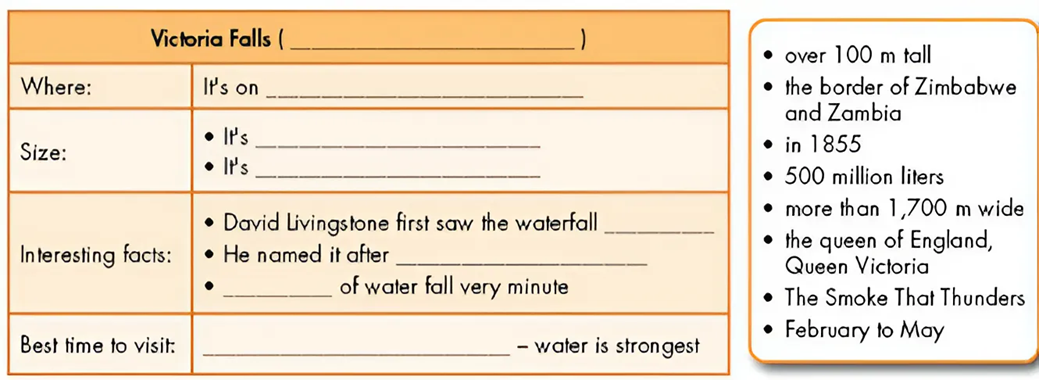
Sample 1:
Victoria Falls, also known as "The Smoke That Thunders," is a breathtaking natural wonder located between Zambia and Zimbabwe in Southern Africa. Named by explorer David Livingstone in 1855 after Queen Victoria of England, this majestic waterfall is one of the largest in the world. With a height of over 100 meters and a width of 1,700 meters, Victoria Falls captivates visitors with its awe-inspiring beauty and powerful cascade of water. More than 500 million liters of water plunge over the falls every minute, making it a truly remarkable sight to behold. The best time to experience Victoria Falls is between February and May when the Zambezi River is at its strongest, offering visitors a truly unforgettable experience in the heart of Africa's wilderness.
Sample 2:
Victoria Falls, also known as "The Smoke That Thunders," is a breathtaking natural wonder located on the border of Zimbabwe and Zambia. This magnificent waterfall is over 100 meters tall and more than 1,700 meters wide. David Livingstone, the first European to see the waterfall in 1855, named it after Queen Victoria of England. An astounding 500 million liters of water cascade over the falls every minute. The best time to visit Victoria Falls is between February and May when the water flow is at its strongest. This incredible sight is a must-see for anyone visiting the region, offering a powerful display of nature's beauty and strength.
Sample 3:
Victoria Falls, famously known as "The Smoke That Thunders," is situated on the border of Zimbabwe and Zambia. It is one of the largest waterfalls in the world, standing over 100 meters tall and stretching more than 1,700 meters wide. Discovered by David Livingstone in 1855, he named it after Queen Victoria of England. The falls are truly magnificent, with 500 million liters of water plunging over the edge every minute. The best time to visit is between February and May when the Zambezi River is at its peak flow, making the waterfall even more spectacular. Victoria Falls is a remarkable natural wonder that captivates all who visit.
Sample 4:
Victoria Falls, also called "The Smoke That Thunders," is on the border between Zimbabwe and Zambia. It is over 100 meters tall and more than 1,700 meters wide, making it one of the biggest waterfalls in the world. David Livingstone first saw the falls in 1855 and named them after Queen Victoria of England. Every minute, 500 million liters of water flow over the falls. The best time to visit is from February to May when the water is strongest. Victoria Falls is a beautiful and powerful sight, attracting many visitors each year.
Sample 5:
Victoria Falls, known as "The Smoke That Thunders," is located between Zimbabwe and Zambia. The waterfall is more than 100 meters tall and 1,700 meters wide. David Livingstone discovered it in 1855 and named it after Queen Victoria. A huge amount of water, 500 million liters, falls every minute. The best time to see Victoria Falls is from February to May when the river is fullest. This amazing natural wonder is famous for its size and beauty, making it a popular place for tourists to visit.
Write about what a student should do if they want to do the jobs below. Write 100 to 120 words.
• Engineer
• Soccer player
• Skincare specialist
Sample 1:
To become an engineer, a student should focus on excelling in math and science subjects during school. They should pursue a bachelor's degree in engineering from a reputable university, choosing a specialization that aligns with their interests, such as civil, mechanical, electrical, or computer engineering. Gaining practical experience through internships or co-op programs during their studies is valuable. Additionally, participating in engineering-related extracurricular activities, joining professional organizations, and networking with professionals in the field can provide valuable insights and opportunities. Pursuing advanced degrees or professional certifications may also be beneficial for career advancement. Continuous learning and staying updated on emerging technologies are essential for success in the ever-evolving field of engineering.
Sample 2:
To pursue a career as a soccer player, a student should prioritize their passion for the sport and dedicate themselves to regular practice and training. They should join youth soccer teams and participate in local leagues to gain experience and develop their skills. Seeking guidance from experienced coaches and attending soccer camps or academies can help improve technique and tactical understanding. Additionally, maintaining physical fitness through regular exercise and a healthy lifestyle is crucial. Aspiring soccer players should also focus on academic success, as education provides a strong foundation for their future career, and many professional leagues require a minimum level of education. Finally, perseverance, resilience, and a positive attitude are essential qualities for navigating the competitive world of professional soccer.
Sample 3:
To become a skincare specialist, a student should start by learning about skincare. They can join classes or programs that teach about different treatments and products. It's important to practice these skills by working at spas or skincare clinics. They may need a license to work professionally. Continuing to learn about new treatments and products is also important. Being friendly and good at talking to people can help build a loyal client base. With dedication and practice, they can become successful skincare specialists.
Sample 4:
If a student wants to become an engineer, they should concentrate on math and science subjects. Joining science clubs and participating in engineering workshops can be helpful. After high school, they need to attend college to earn an engineering degree and take part in internships for practical experience.
To become a soccer player, a student should start playing soccer from a young age and join a local club. Regular practice and staying in good physical shape are essential. They should play in school teams and attend soccer camps to improve their skills and gain exposure.
For a career as a skincare specialist, a student should take biology and chemistry courses. After high school, they should enroll in a cosmetology school to learn about skincare techniques. Gaining experience by working in beauty salons and keeping up with the latest skincare products and treatments is important.
Sample 5:
If a student wants to become a soccer player, they should start playing soccer at a young age and join a local team. Regular practice is essential to improve skills, so they should train daily, focusing on dribbling, passing, and shooting. Maintaining good physical fitness through exercises and a healthy diet is also important. They should participate in school teams and local leagues to gain experience and exposure. Attending soccer camps can help them learn from experienced coaches and meet other players. Watching professional games to understand strategies and techniques can also be beneficial. Finally, they should stay committed and never give up on their dream, even when facing challenges.
Sample 6:
If a student wants to become a skincare specialist, they should focus on biology and chemistry in school to understand skin and its treatments. After high school, they should enroll in a cosmetology or esthetician school to receive professional training. It’s helpful to attend skincare workshops and seminars to learn the latest techniques and trends. Gaining hands-on experience through internships at beauty salons or dermatology clinics is crucial. They should also practice good skincare habits themselves and try different products to understand their effects. Building a portfolio and getting certified will enhance their credentials. Staying updated with new skincare innovations and continuously learning is key to becoming a successful skincare specialist.
Sample 7:
To become an engineer, a student should focus on excelling in mathematics and science subjects throughout school. Building a strong foundation in subjects like physics and chemistry is crucial. Developing problem-solving skills and a curiosity for how things work is also essential. Engaging in hands-on projects, joining science clubs or engineering competitions, and seeking internships or mentorship opportunities can provide valuable practical experience. Pursuing a relevant engineering degree in fields such as mechanical, electrical, civil, or computer engineering at a reputable university is typically required. Continuous learning, staying updated with technological advancements, and networking within the engineering community are key to a successful career as an engineer.
Write a biography about Yvonne Young Clark or Nguyễn Ngọc Ký. Write 180-200 words.
Yvonne Young Clark (known as Y.Y.) - "The First Lady of Engineering" Early life: • 1929: was born in Houston, Texas, the USA • loved building and fixing things as a child • 1947- 1951: attended Howard University • only woman in her class and the first woman to earn a degree in mechanical engineering Career and achievements: • struggled to find jobs because of her skin color and gender • 1955: got married and moved to Tennessee at the age of 25 • worked as an engineering professor at Tennessee State University for the next 55 years • first female member of her department • worked for NASA during her summer breaks • contributed to the development of the engine of the rocket Saturn V and the box used to bring moon samples back Death and influence: • received many awards for her contributions • 2019: died at the age of 89 • A scholarship in her name was established at Tennessee State University. | Nguyễn Ngọc Ký - Vietnamese teacher and writer Early life: • June 28, 1947: was born in Hải Hậu, Nam Định Province • got sick at the age of four and couldn't use his arms afterwards • wanted to go to school as a boy but wasn't allowed • learned to write with his feet • 1963: got 5th place in a math competition and given an award by President Hồ Chí Minh • 1960s: studied literature at Đại học Tổng hợp Hà Nội Career and achievements: • as a young man, became a teacher in his hometown • 1993: received the title "Outstanding Teacher" • 2005: Vietnam Book of Records awarded him the title "First Teacher to Use His Feet to Write". Death and influence: • September 28th, 1970: died at the age of 75 • Vietnamese students are still taught about him as an example of why you should believe in yourself. |
Sample 1:
Yvonne Young Clark was known as Y.Y. and she was "The First Lady of Engineering".
She was born in Houston, Texas, USA in 1929. She loved building and fixing things as a child. In 1945 she graduated from high school at age 16 and spent the next two years studying at Girls Latin School in Boston. From 1947 to 1951, she attended Howard University. She was the only woman in her class and also the first woman to earn a degree in mechanical engineering.
She struggled to find jobs because of her skin color and gender. In 1955, she got married. After that, Yvonne moved to Tennessee at the age of 25. She worked as an engineering professor at Tennessee State University for the next 55 years. Yvonne was the first female member of her department. She worked for NASA during her summer breaks. She contributed to the development of the engine of the rocket Saturn V and the box used to bring moon samples back.
She received many awards for her contributions. In 2019, she died at the age of 89. A scholarship in her name was established at Tennessee State University.
Sample 2:
Yvonne Young Clark, affectionately known as Y.Y., was born in 1929 in Houston, Texas, USA. From a young age, she displayed a passion for building and fixing things, which laid the foundation for her groundbreaking career in engineering.
Y.Y. attended Howard University from 1947 to 1951, where she distinguished herself as the only woman in her mechanical engineering program and the first woman to earn a degree in that field. Despite facing discrimination due to her gender and race, she persevered. In 1955, she married and moved to Tennessee, where she joined Tennessee State University's faculty as an engineering professor, a role she held for an impressive 55 years. Y.Y. became the first female member of her department and made significant contributions to NASA during her summers, notably aiding in the development of the Saturn V rocket engine and the lunar sample return box.
Sample 3:
Yvonne Young Clark, known as Y.Y., was born in 1929 in Houston, Texas, USA. As a child, she loved building and fixing things. She went to Howard University from 1947 to 1951 and became the first woman there to graduate with a mechanical engineering degree, even though she was the only woman in her class.
After facing challenges finding jobs because she was a woman and African American, Y.Y. got married in 1955 and moved to Tennessee. She taught engineering at Tennessee State University for an incredible 55 years and was the first woman in her department. During summers, she worked with NASA, helping with projects like designing parts of the Saturn V rocket engine and a box for bringing moon samples back to Earth.
Y.Y. received many awards for her work over the years. She passed away in 2019 at the age of 89. Her legacy lives on through the Yvonne Young Clark Scholarship at Tennessee State University, which helps students in engineering, honoring her dedication to education and breaking barriers for women in STEM fields.
Sample 4:
Nguyễn Ngọc Ký, a prominent Vietnamese teacher and writer, was born on June 28, 1947, in Hải Hậu, Nam Định Province. At the age of four, he fell ill and lost the use of his arms, but this did not deter his determination to learn. Despite facing obstacles, including being initially denied admission to school as a young boy, Nguyễn Ngọc Ký persevered and learned to write using his feet.
In 1963, his academic prowess was recognized when he achieved 5th place in a math competition, an achievement that earned him an award from President Hồ Chí Minh. During the 1960s, he pursued his passion for literature at Đại học Tổng hợp Hà Nội.
Nguyễn Ngọc Ký dedicated his career to teaching in his hometown, becoming known for his dedication and innovative spirit. In 1993, he was honored with the title "Outstanding Teacher." His remarkable ability to write with his feet earned him recognition in 2005 from the Vietnam Book of Records as the "First Teacher to Use His Feet to Write."
Nguyễn Ngọc Ký passed away on September 28, 1970, leaving behind a legacy of perseverance and belief in oneself. Vietnamese students continue to learn about his life as an inspiring example of overcoming challenges and achieving greatness through determination.
Sample 5:
Nguyễn Ngọc Ký was born on June 28, 1947, in Hải Hậu, Nam Định Province, Vietnam. When he was four years old, he got sick and lost the use of his arms. Despite this challenge, he was determined to go to school and learn. Nguyễn Ngọc Ký learned to write using his feet because he couldn't use his hands.
In 1963, he won 5th place in a math competition and received an award from President Hồ Chí Minh for his achievement. He studied literature at Đại học Tổng hợp Hà Nội in the 1960s.
Nguyễn Ngọc Ký became a teacher in his hometown when he was young and was known for his dedication to teaching. In 1993, he was honored as an "Outstanding Teacher." In 2005, he was recognized by the Vietnam Book of Records as the first teacher in Vietnam to write with his feet.
He passed away on September 28, 1970, at the age of 75. Vietnamese students still learn about Nguyễn Ngọc Ký today because he inspires them to believe in themselves and overcome challenges in life.
Set the context of the trip:
- Where:
- When:
- Who with:
- Season/Weather:
- Your feelings before the trip:
Beginning of trip/event 1:
- Event:
- Strong adjectives:
Middle of trip/event 2:
- Event:
- Strong adjectives:
End of trip/event 3:
- Event:
- Strong adjectives:
Summarize feelings:
- Overall feelings:
- Go on the trip again? Why?/Why not?
Sample 1:
I went to Da Lat city last summer with my best friends.
To begin with, we had to do some preparation for this trip. First, my friends and I read several travel blogs to pick a suitable destination. After checking the weather forecast, we finally decided to go to Da Lat – a city located in the Central Highlands of Vietnam. Because we did not contact any travel agencies, a detailed itinerary had to be planned carefully. One of my friends even suggested buying travel insurance for the sake of our safety. Having successfully booked the flight tickets in advance, I did the packing immediately. The plane took off at 8 a.m. if my memory serves me right.
In the beginning, we took some photos together by the town signs as soon as we reached Da Lat city. We befriended many local people along the trip and then also bought souvenirs for our family members. Next, the four of us sampled the delicious local cuisine at the night market while having a chinwag, you know, we even discussed some travel plans in the near future. After coming back from that trip, I posted plenty of awesome photos on Facebook and Instagram, which received a lot of comments.
Finally, I didn’t forget to write a review of all the restaurants we visited and posted it on a well-known travel blog to share our group’s travelling experience. That was such an enjoyable trip that I would never forget.
Sample 2:
I went to South Korea two years ago with my mom and dad. We went in January, and it’s always freezing at that time of year. However, I like cold weather, so I was overjoyed to go.
We stayed in Seoul. It’s a huge, exciting city. My family loved eating Korean food, and we ate local dishes for every meal. The kimchi was delicious.
My dad likes visiting historical sites, so we went to some ancient palaces. My favorite place was Gyeongbokgung Palace. It was spectacular.
We spent a whole day shopping in Myeong-dong shopping district. It’s famous for its shops and restaurants. My mom and I love shopping, but my dad doesn’t like it at all.
People in Seoul are really fashionable, and it was interesting to see all the different clothes and hairstyles. Korean music is amazing, too, and most shops and restaurants play K-Pop music for their customers to enjoy.
I would definitely like to visit South Korea again. Next time, I want to spend more time shopping in Myeong-dong because we didn’t have enough time to visit all the shops.
Sample 3:
In the heart of Vietnam, my friend and I embarked on a journey to Hạ Long Bay, a UNESCO World Heritage site known for its stunning landscapes. As we arrived in early spring, the weather was warm and pleasant, perfect for exploring.
Our adventure began with a cruise through the bay's emerald waters, surrounded by thousands of limestone islands topped with lush greenery. The scenery was breathtaking, with cliffs jutting out dramatically from the sea, creating a peaceful and picturesque atmosphere.
During our trip, we visited one of the bay's famous caves, adorned with intricate stalactites and stalagmites that formed over centuries. Inside, the air was cool and refreshing, a stark contrast to the warmth outside.
As the sun began to set, we found ourselves on deck, watching the sky transform into a canvas of vibrant colors reflected on the tranquil waters below. It was a magical sight, filling us with a sense of wonder and appreciation for Vietnam's natural beauty.
Reflecting on our journey, I felt a deep connection to the tranquility and splendor of Hạ Long Bay. Its serene waters and majestic cliffs left an indelible mark on our hearts, making us eager to return and explore more of Vietnam's captivating landscapes.
Sample 4:
During spring, my family and I visited Da Nang, Vietnam, a city famous for its beautiful beaches and cultural sites. When we arrived, we were amazed by the colorful Dragon Bridge glowing in the night sky.
We spent our days relaxing at My Khe Beach, which had soft sand and clear water perfect for swimming. The gentle breeze and sound of waves made it a peaceful place to unwind.
One day, we explored the Marble Mountains, climbing old stairs through green forests to find hidden caves and temples. From the top, we saw stunning views of Da Nang and the coastline.
Looking back, I loved the natural beauty and friendly people of Da Nang. The delicious food also made our trip special. I would love to visit again someday to discover more of this amazing city and create more happy memories with my family.
Sample 5:
Our trip to Thailand was in December with my friends. We started in Bangkok, amazed by the stunning Grand Palace and the beautiful Emerald Buddha temple. The markets at Chatuchak were lively and colorful, offering delicious food and handmade goods.
Later, we relaxed on the beaches of Phuket, enjoying the clear waters and sunny weather. Finally, we visited Chiang Mai, where ancient temples and peaceful surroundings made a strong impression.
Overall, Thailand's mix of culture, history, and natural beauty left me feeling happy and grateful. I would love to go back someday to explore more of this amazing country and make more memories with my friends.
Write an advantage and disadvantage essay about a family member's job. Write 180-200 words.
Sample 1:
My father is a doctor. He treats people who are ill or injured, and he really likes it. However, some people prefer not to work as a doctor. This kind of job has both advantages and disadvantages.
My father’s job has some pretty good advantages. One advantage is that he has lucrative salaries because of his high-value work and extensive academic requirements needed to perform in his roles. He can save a lot of money and plan for his children’s future easily. Furthermore, my dad spends long hours saving lives, diagnosing diseases and prescribing his patients with the proper medications to address their health concerns. When he sees his patients get better and recover, he may feel personal satisfaction knowing my dad was able to make a difference in his patients' lives.
On the other hand, I think there are some disadvantages of working as a doctor. Becoming a doctor takes an extensive amount of time and dedication to complete. It can take my father more than ten years to earn the necessary academic qualifications. He needs to complete a doctorate degree and residency before he can get his medical license to work as a physician. Besides, doctors work in stressful environments where there is a lot of risk involved for their patients. My father has a substantial amount of pressure to support good patient outcomes, sometimes in time-sensitive situations.
In conclusion, there are some good benefits to my dad’s job, but not every job has them. It’s great to have a high salary, but some people might prefer another better job.
Sample 2:
My aunt works as a flight attendant, a job that comes with its own set of advantages and disadvantages. One advantage is the opportunity to travel to various destinations around the world. She gets to explore different cultures, try new foods, and see breathtaking sights, all while getting paid. Additionally, the job offers flexibility in scheduling, allowing her to balance work with personal commitments.
However, there are downsides to being a flight attendant. One disadvantage is the irregular work hours and frequent time away from home. This can lead to fatigue and disrupt personal routines. Furthermore, the job requires dealing with demanding passengers and managing unexpected situations onboard, which can be stressful and challenging.
In conclusion, while being a flight attendant offers exciting travel opportunities and flexibility, it also entails irregular schedules and dealing with demanding situations. While some may thrive in this dynamic environment, others may find it difficult to manage the lifestyle.
Sample 3:
My cousin works as a freelance graphic designer, a job with its own pros and cons. One advantage is the freedom to work from anywhere, setting his own schedule and having more time for family and hobbies. He enjoys the creative freedom this job offers, allowing him to explore different design styles and techniques.
However, there are downsides to freelancing. The inconsistent workload and income can be stressful, with projects coming in sporadically and payments not always guaranteed. Additionally, competition in the industry is fierce, requiring constant self-promotion and staying up-to-date with trends to stay ahead.
Despite the challenges, my cousin appreciates the flexibility and creative fulfillment that comes with freelancing. While it may not be without its difficulties, the ability to work on diverse projects and pursue his passion for design makes it worthwhile for him.
Sample 4:
My father works as a software engineer, a job that comes with both advantages and disadvantages. One of the major advantages is the stability it provides. Software engineering is in high demand, offering job security and good pay. This stability allows our family to live comfortably and plan for the future with confidence. Additionally, my father's job often allows for flexibility in work hours and sometimes even remote work, which helps him balance work and family life effectively.
However, there are also challenges. One disadvantage is the demanding nature of the job. Deadlines and project pressures can sometimes lead to long work hours and stress. This can affect family time and personal well-being. Moreover, the rapid pace of technological change in the field means my father must constantly update his skills, which requires ongoing learning and adaptation.
In conclusion, while my father's job as a software engineer provides financial stability and flexibility, it also comes with the pressure of meeting deadlines and staying updated with new technologies. Despite the challenges, we appreciate the opportunities it provides for our family's well-being.
Sample 5:
My sister works as a nurse, which has both advantages and disadvantages. One big advantage is that nursing is a stable career. There's always a need for nurses, so she has job security. This helps her support herself and our family.
Another advantage is the rewarding feeling she gets from helping people. She makes a positive difference in patients' lives every day, which is very fulfilling.
However, there are challenges too. One disadvantage is that nursing can be physically and emotionally demanding. She often works long shifts and deals with stressful situations, which can be exhausting.
Another challenge is the irregular work hours. Nurses often have to work nights, weekends, and holidays, which can make it hard to spend time with family and friends.
In summary, my sister's job as a nurse provides stability and fulfillment from helping others. However, it also comes with challenges like long hours and irregular schedules. Despite the difficulties, she finds her work meaningful and valuable.
Write a blog post about possible challenges of lifelong learning and solutions. Write 180-200 words.
Sample 1:
In today's rapidly changing world, the pursuit of lifelong learning has become essential for personal and professional development. However, lifelong learners may encounter various challenges throughout their learning journey. What can they do to overcome these problems?
First, it can be challenging to balance learning with other commitments such as work, family, and personal responsibilities. To overcome this challenge, lifelong learners can prioritize their tasks, create a schedule, and allocate specific time slots for learning activities. Moreover, they can leverage technology to access learning materials on-the-go and maximize their productivity.
Second, limited access to learning resources, such as libraries or educational institutions can hinder lifelong learning. The solution is that they can explore online platforms and digital libraries that offer a wide range of educational materials. Besides, they can seek out mentors or instructors for guidance and support.
Last but not least, it can be difficult to adapt to new technologies or digital platforms for learning, especially for older adults or individuals with limited digital literacy Lifelong learners can overcome technological barriers by seeking training or support to improve their digital skills, exploring user-friendly platforms with intuitive interfaces, and gradually integrating technology into their learning routines.
Overall, lifelong learners can overcome challenges by adopting a proactive mindset, staying adaptable and resilient in the face of obstacles. By continuously learning and growing, they can unlock new opportunities and enrich their lives intellectually, professionally, and personally.
Sample 2:
Learning new things throughout life can be really exciting, but sometimes it's hard to keep going. One challenge is finding the time to learn when we're already so busy with work and other stuff. It's also tough to stay focused and motivated, especially when we hit roadblocks or get discouraged.
But don't worry, there are ways to tackle these challenges. First, setting clear goals and making a plan can help manage our time better and keep us on track. Breaking big goals into smaller steps can make them feel more doable. Also, having support from friends or joining a learning group can keep us motivated and accountable. Plus, using online resources can make learning more flexible and convenient.
By taking these steps, we can overcome the challenges of lifelong learning and keep growing and discovering new things throughout our lives.
Sample 3:
Learning new things throughout life can be both exciting and challenging. One obstacle is feeling overwhelmed by the vast amount of information available. It can be difficult to know where to start or how to focus our learning efforts. Another challenge is maintaining motivation and staying committed to learning over the long term, especially when faced with setbacks or slow progress.
To overcome these challenges, it's helpful to break down learning goals into smaller, manageable steps. This makes them feel less daunting and more achievable. Setting specific, measurable goals can also provide clarity and direction. Additionally, finding a learning buddy or joining a study group can offer support and accountability, making the learning journey more enjoyable and engaging. Lastly, taking breaks and celebrating milestones along the way can help maintain motivation and prevent burnout.
By implementing these strategies, we can navigate the challenges of lifelong learning and continue to expand our knowledge and skills throughout our lives.
Sample 4:
Many people stop learning after university. This is often because they face challenges with learning as adults. However, there are solutions to overcoming the difficulties of lifelong learning.
First, you may think there’s no reason to learn. You might feel you’re doing fine at your job, for example. Well, working methods are changing. If you want to get a better job or to keep your current one, you should be competitive in your world. Understanding the benefits that lifelong learning brings could help you see the reasons for doing it.
Next, you may not have motivation. Learning can sometimes be boring. However, if you learn something that you find interesting or if you join a group, it can increase your enthusiasm for learning. People with shared interests usually learn more effectively.
Finally, most people think learning is expensive. However, there are so many free clubs that you probably won’t need to spend anything. Look online for free clubs to get started.
In conclusion, it’s important to know that lifelong learning can bring benefits, be fun, interesting and free. If you look hard, you may find a lifelong learning program that is perfect for you.
Sample 5:
Engaging in lifelong learning offers numerous advantages, yet it presents several significant challenges. Time management stands out as a primary concern, as individuals must balance professional commitments, familial responsibilities, and educational pursuits. A practical solution involves establishing dedicated study periods and leveraging the flexibility of online learning platforms.
Maintaining motivation over an extended period presents another obstacle. The journey of acquiring new skills or knowledge can be arduous, often testing one's perseverance. Breaking down objectives into smaller, attainable goals and celebrating milestones can sustain motivation effectively.
Access to educational resources is crucial but can be limited, particularly for those without proximity to traditional educational institutions or libraries. Addressing this challenge involves exploring online resources and utilizing community-based facilities such as public libraries.
Moreover, overcoming psychological barriers like fear of failure or perceived age-related limitations is essential. Adopting a growth mindset and seeking encouragement from peers or mentors can mitigate such concerns and foster a proactive approach to lifelong learning.
In conclusion, while lifelong learning poses challenges, proactive planning, persistence, resourcefulness, and a resilient mindset are key to navigating these obstacles successfully and embracing the lifelong pursuit of knowledge and personal development.
Sample 1:
Hey, everybody! Many tourists love visiting my country, Vietnam. Here are some dos and don'ts if you visit here:
1. DO try the local street food. Vietnamese cuisine is renowned for its delicious flavors and unique dishes. Sampling street food is an essential part of experiencing the vibrant culinary culture of Vietnam.
2. DON'T litter. Vietnam places a strong emphasis on keeping the environment clean and littering is considered disrespectful. Dispose of your trash properly in designated bins to contribute to the cleanliness of the streets and natural landscapes.
3. DO respect local customs and traditions. When visiting temples or pagodas, dress modestly and remove your shoes before entering sacred spaces. Additionally, be mindful of Vietnamese cultural norms regarding greetings and interactions with elders.
4. DON'T haggle aggressively. While bargaining is common in markets and street vendors, it's important to do so respectfully. Pushing too hard for a lower price can be seen as rude or disrespectful.
5. DO learn a few basic Vietnamese phrases. Even just knowing how to say "hello" (xin chào) and "thank you" (cảm ơn) can go a long way in showing respect for the local culture and fostering positive interactions with Vietnamese people.
By following these dos and don'ts, you can have a more enjoyable and culturally enriching experience during your visit to Vietnam.
Sample 2:
Hey, everybody! Many tourists love visiting my country, Vietnam. Here are some dos and don'ts if you visit here:
1. DO dress modestly. Dress modestly when visiting religious sites or rural areas to show respect for local customs.
2. DON'T disrespect religious sites. Avoid loud or disruptive behavior at temples and pagodas; dress modestly and speak softly.
3. DO try the local cuisine. Explore Vietnamese street food and traditional dishes like pho and banh mi for an authentic culinary experience.
4. DON'T disrespect local customs. Avoid touching someone's head, which is considered disrespectful, and use both hands when giving or receiving items.
5. DO bargain politely. Negotiate prices at markets and street vendors respectfully, as bargaining is expected but aggressive haggling is frowned upon.
By observing these dos and don'ts, you can make your trip to Vietnam more enjoyable and culturally fulfilling.
Sample 3:
Hey, everybody! Many tourists love visiting my country, Vietnam. Here are some dos and don'ts if you visit here:
1. DO respect culture. Learn about Vietnamese customs and traditions, such as removing shoes before entering homes and temples.
2. DON'T use offensive gestures. Avoid pointing with your finger or showing the soles of your feet, as these gestures can be considered rude.
3. DO learn basic phrases. Learn basic Vietnamese greetings and phrases like "xin chào" (hello) and "cảm ơn" (thank you) to connect with locals.
4. DON'T ignore safety. Don't ignore traffic rules or take unnecessary risks, especially when crossing streets in busy cities like Hanoi or Ho Chi Minh City.
5. DO respect the environment. Dispose of trash properly and support eco-friendly practices to preserve Vietnam's natural beauty.
By adhering to these guidelines, you can enhance your experience and gain deeper cultural insights while visiting Vietnam.
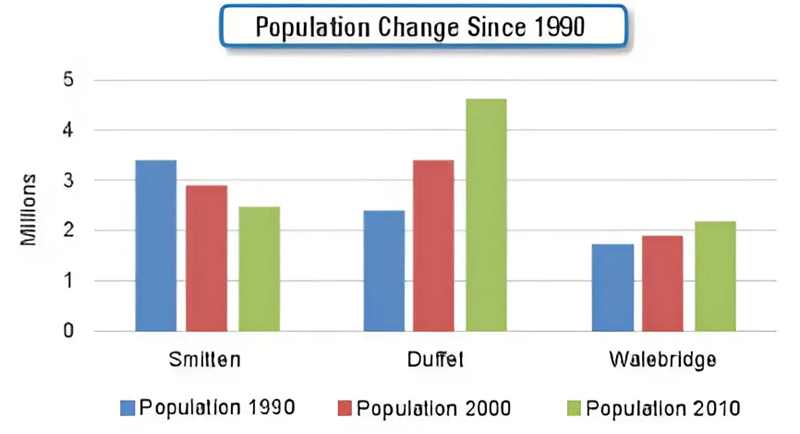
Sample 1:
This report summarizes the population changes in Smitten, Duffet, and Walebridge between 1990 and 2010.
While Duffet and Walebridge experienced population growth, Smitten's population exhibited a contrasting trend.
Smitten experienced a moderate decrease in population over the specified period. In 1990, the population stood at more than 3 million residents. However, by 2010, this figure had dropped to approximately 2.5 million. This represented a significant decline of nearly 24%. Duffet's population growth was significant compared to the population increase of Walebridge. The town's population increased from 2.3 million in 1990 to 4.5 million in 2010, reflecting an approximate 50% increase.
Walebridge experienced moderate population growth. Walebridge experienced a slight increase in population from 1.8 million in 1990 to 2.2 million in 2010. Although the growth rate is lower compared to Duffet, it still demonstrates a positive trend in population growth. In 1990, Smitten had the largest population, but by 2010, that position was taken by Duffet due to Smitten's relative population decline. Walebridge always had the smallest population compared to Smitten and Duffet in the three years from 1990 to 2010.
Sample 2:
Sample 1:
The internet offers a wealth of information and opportunities for teenagers, but it also poses significant risks. One of the biggest risks is exposure to inappropriate content, such as violence, pornography, and hate speech. This can have negative effects on teenagers' mental health and wellbeing, leading to desensitization, anxiety, and distorted perceptions of reality.
Another major risk is cyberbullying, which involves the use of electronic communication to harass, intimidate, or humiliate others. Cyberbullying can have devastating consequences for teenagers, including depression, anxiety, and even suicidal thoughts.
To address these risks, it's crucial for parents and educators to educate teenagers about online safety and responsible internet use. This includes setting clear guidelines and boundaries for internet use, monitoring online activity, and encouraging open communication about any concerns or issues that arise.
Additionally, schools and community organizations can implement programs to raise awareness about cyberbullying and provide support for victims. This may include counseling services, peer support groups, and training for educators on how to address cyberbullying effectively.
By taking proactive steps to address the biggest risks on the internet for teenagers, we can help ensure that they can safely navigate the online world and enjoy its benefits without falling victim to its dangers.
Sample 2:
The internet can be a risky place for teenagers, and one big concern is online predators. These are people who use social media, games, or chat rooms to trick teenagers into doing bad things or meeting up in person. This can lead to dangerous situations and even harm.
Another problem is fake news. Sometimes, it's hard to tell what's true and what's not online. Teenagers might believe rumors or wrong information they see online, which can cause problems and make it hard to trust real news.
To stay safe, it's important for parents and teachers to talk to teenagers about these risks. They can teach them how to spot and avoid online predators and how to check if information is true. Schools can also teach students how to think critically about what they see online, so they don't fall for fake news.
By working together to teach teenagers about these risks, we can help them stay safe and make smart choices online.
Sample 3:
A significant risk for teenagers on the internet is addiction to social media and online gaming. Spending too much time online can interfere with schoolwork, social interactions, and physical activity, leading to negative effects on mental and physical health.
Furthermore, there's the risk of encountering harmful online challenges and trends. These can encourage risky behaviors or self-harm, posing serious dangers to teenagers' well-being.
To address these risks, it's important for parents and educators to promote healthy internet habits and balance. This includes setting limits on screen time, encouraging offline activities and hobbies, and fostering open communication about online experiences. Schools can also implement programs to educate students about the dangers of harmful online trends and provide resources for support.
By promoting healthy internet use and awareness of potential risks, we can help teenagers develop positive online behaviors and navigate the digital world safely.
Sample 4:
The internet, a vast landscape of information and connectivity, presents both opportunities and risks, especially for teenagers. As digital natives, adolescents often navigate the online world with ease, but they are also vulnerable to its dangers. Among the myriad risks, the biggest ones for teenagers include exposure to inappropriate content, cyberbullying, and privacy breaches.
Teenagers frequently encounter inappropriate content such as violence, pornography, and substance abuse materials online. This exposure can desensitize them to harmful behaviors and negatively impact their mental and emotional well-being. Additionally, cyberbullying has become a pervasive issue, with teens facing harassment, intimidation, and social exclusion through various digital platforms. Moreover, teenagers often underestimate the importance of safeguarding their privacy online, inadvertently sharing personal information that can be exploited by malicious individuals.
To mitigate these risks, a multifaceted approach is required. Education on digital literacy and online safety should be integrated into school curricula and parenting practices. Technology companies must enhance their moderation tools to filter inappropriate content and combat cyberbullying effectively. Furthermore, policymakers should enact stricter regulations to protect teenagers' privacy rights on the internet. By addressing these challenges collaboratively, we can create a safer online environment for teenagers to explore and thrive.
Sample 5:
The internet offers lots of benefits, but it also brings risks for teenagers. One big problem is online predators. They pretend to be friends online to trick and harm young people. Another issue is cyberbullying, where hurtful messages or threats are sent online, causing sadness or even worse feelings.
Another danger is seeing things online that are not suitable for young people, like violence or adult content. This can affect how they see the world and make them feel numb to serious issues.
To solve these problems, education is key. Schools and parents need to teach teens about staying safe online. This includes setting privacy settings, using social media responsibly, and knowing when something online might be dangerous. Social media platforms should also have stricter rules to stop bad behavior.
Open communication between parents and teens is crucial too. If teens know they can talk to their parents about bad online experiences, they can get help sooner.
By working together to teach and protect teens online, we can make the internet a safer place for everyone.
• What do eco-resorts usually look like?
• What things can a resort do to be eco-friendly?
• What eco-friendly activities do they have?
• What else do they have or offer?
Sample 1:
Hi everyone, I'm excited to share with you my recent experience at Lotus Eco-Resort, nestled in the heart of Phong Nha-Ke Bang National Park, a UNESCO World Heritage Site renowned for its stunning karst landscapes, pristine rivers, and rich biodiversity. The resort offers rustic yet comfortable accommodations inspired by traditional Vietnamese architecture, blending seamlessly with the natural surroundings.
During my stay, I was captivated by the stunning panoramic views of lush forests and limestone cliffs from my spacious bungalow adorned with locally sourced materials and adorned with handcrafted bamboo furnishings. I was drawn to Lotus Eco-Resort for its sustainable construction, renewable energy, and waste management.
First, Lotus Eco-Resort prioritizes environmental sustainability. They utilize eco-friendly building materials and techniques, such as bamboo, reclaimed wood, and natural clay, to minimize its environmental footprint during construction.
Second, the resort harnesses solar power to meet its electricity needs, utilizing photovoltaic panels installed on rooftops to generate clean, renewable energy.
Next, Lotus Eco-Resort implements comprehensive waste management practices, including recycling, composting organic waste, and reducing single-use plastics. They also collaborate with local recycling initiatives to ensure proper disposal of waste materials.
Moreover, the resort offers some eco- friendly activities such as nature treks and river conservation tours. In nature treks, guests can embark on guided treks through the lush jungles and rugged karst landscapes of Phong Nha-Ke Bang National Park, led by knowledgeable local guides who share insights into the region's unique flora and fauna. And in river conservation tours, visitors can join educational boat tours along the pristine Son River, learning about the importance of river conservation and efforts to protect the aquatic ecosystems of Phong Nha-Ke Bang.
Last, Lotus Eco-Resort features an organic garden where guests can participate in farm-to-table dining experiences, harvesting fresh produce and herbs to be prepared by skilled chefs into delicious Vietnamese dishes. Besides, the resort offers cultural activities such as traditional cooking classes, lantern-making workshops, and visits to nearby ethnic minority villages, providing guests with opportunities to engage with local communities and learn about their customs and traditions.
In conclusion, my stay at Lotus Eco-Resort was truly exceptional. I encourage you to share your own eco-resort experiences in the comments below, as I continue to explore and review sustainable destinations for future adventures.
Until next time!
Sample 2:
Green Haven Eco-Resort invites you to unwind in harmony with nature while embracing sustainable practices. Nestled in serene landscapes like forests or by the sea, eco-resorts like Green Haven are designed with natural materials and powered by renewable energy like solar power.
To protect our environment, Green Haven focuses on saving water, using less energy, and recycling. They also support local communities by hiring local staff and showcasing local traditions.
Guests at Green Haven enjoy eco-friendly activities such as guided nature walks, wildlife watching, and joining in conservation projects like planting trees or cleaning beaches. Alongside these, the resort offers relaxing spa treatments with natural products and delicious meals made from organic and local ingredients.
Whether you're seeking relaxation or adventure, Green Haven Eco-Resort provides a sustainable escape where luxury meets environmental care.
Sample 3:
Eco Haven Retreat offers a peaceful getaway where nature and sustainability come together. Nestled in beautiful places like forests or near the sea, Eco Haven Retreat uses eco-friendly materials and solar power.
Eco Haven Retreat takes care of the environment in several ways. They use solar power and energy-saving lights and appliances to save energy. They also use natural cleaning products and collect rainwater to save water.
At Eco Haven Retreat, guests can enjoy activities that are good for the environment. You can rent bicycles to explore nearby trails, join workshops to learn about wildlife, or help with gardening using natural methods. These activities teach guests how to protect nature and let them be a part of it during their stay at Eco Haven Retreat.
Whether you want to relax or explore, Eco Haven Retreat provides a place where you can enjoy nature responsibly while taking care of it.
Sample 1:
Artificial intelligence (AI) is a kind of technology that can do things like analyze data and make decisions without human help. It's useful because it can do tasks quickly and accurately, making work easier and more efficient. For example, it helps in things like organizing data and giving helpful suggestions online.
However, there are some concerns about AI. One big worry is that it might take away jobs from people because it can do some tasks better and faster. There are also worries about fairness and privacy because AI can sometimes make mistakes or be used in ways that aren't good for everyone.
In my opinion, AI is helpful, but we need to be careful about how we use it. We should make sure it's fair and doesn't harm anyone. It's important to use AI responsibly and think about how it affects people's lives.
Sample 2:
There is growing interest in Artificial Intelligence (AI), which offers numerous benefits and also presents significant challenges and concerns. In this essay, I will explore the pros and cons of AI and whether the advantages outweigh the disadvantages.
There are several reasons why its potential to address pressing humanitarian challenges. AI technologies can be deployed in disaster response efforts to analyze data, predict outcomes, and coordinate emergency responses more effectively. In healthcare delivery, AI-powered tools and systems can improve diagnosis, treatment, and patient care, particularly in underserved communities. Moreover, AI has emerged as a powerful tool for fostering innovation and driving scientific discovery. By processing vast amounts of data and identifying patterns, AI algorithms can uncover insights and trends that may lead to new discoveries and advancements in various fields. From drug discovery and materials science to space exploration and renewable energy, AI-powered technologies hold the promise of unlocking new frontiers and solving complex challenges facing humanity.
On the other hand, there are also some potential drawbacks of using AI. First, despite its potential benefits, the widespread adoption of AI raises significant ethical concerns related to privacy, bias, accountability, and control. AI algorithms may inadvertently perpetuate or amplify existing biases present in training data, leading to discriminatory outcomes or reinforcing societal inequalities. Second, the rapid development and deployment of AI technologies have implications for the environment, including increased energy consumption, resource depletion, and environmental degradation. Data centers and AI infrastructure require significant amounts of energy to operate, leading to carbon emissions and contributing to climate change.
In conclusion, the benefits of AI, particularly its potential to address humanitarian challenges and drive innovation, outweigh the drawbacks associated with ethical and environmental concerns. However, it is essential to approach the development and deployment of AI technologies with caution and responsibility.
Sample 3:
Artificial Intelligence (AI) presents both advantages and disadvantages in our modern world. On the positive side, AI enhances efficiency across various industries, automating repetitive tasks and increasing productivity. This technology also improves decision-making processes by analyzing vast amounts of data quickly and accurately, leading to better outcomes in fields like healthcare and finance. Moreover, AI enables innovations in robotics, autonomous vehicles, and smart technologies, promising safer and more convenient living environments.
However, AI also raises concerns. One major issue is job displacement, as automation may replace human workers in certain roles, potentially leading to unemployment and economic inequality. There are also ethical dilemmas surrounding AI, such as privacy violations and biases in algorithms, which can perpetuate discrimination.
In my view, while AI offers significant benefits in terms of efficiency and innovation, its deployment must be accompanied by strict regulations to safeguard against misuse and ensure equitable distribution of its benefits. Education and upskilling programs are crucial to mitigate job displacement and prepare the workforce for AI-driven industries. Ultimately, a balanced approach that embraces AI's potential while addressing its ethical and societal implications is essential for harnessing its full potential for the betterment of society.
Sample 1:
One experience that had a significant impact on me was volunteering at a local homeless shelter during my college years. It was an eye-opening and humbling experience that changed my perspective on life and the importance of giving back to the community.
Seeing the struggles and challenges faced by homeless individuals firsthand made me realize how fortunate I was and how easily I could have been in their shoes. Interacting with them on a personal level, listening to their stories, and understanding their struggles taught me empathy, compassion, and the value of human connection.
Moreover, volunteering at the shelter exposed me to the harsh realities of poverty and homelessness, igniting a passion within me to advocate for social justice and equality. It inspired me to become more involved in community service and volunteer work, dedicating my time and efforts to making a positive difference in the lives of others.
Overall, this experience taught me the importance of kindness, empathy, and generosity, and it reinforced my belief in the power of community and collective action to create meaningful change in the world. It's an experience that continues to shape my values and influence my actions to this day.
Sample 2:
One experience that left a lasting impact on me was my first solo trip to a foreign country. I vividly remember stepping off the plane, feeling a mix of excitement and nervousness. The unfamiliar sights, sounds, and smells enveloped me as I navigated through bustling streets and interacted with locals.
During that trip, I discovered the beauty of spontaneity. Without a rigid itinerary, I wandered aimlessly, stumbling upon hidden gems - a cozy café tucked away in an alley, a serene park where locals practiced tai chi, and a vibrant market bursting with colorful textiles and exotic fruits.
But it wasn’t just the places that left an impression; it was the people. Conversations with strangers transcended language barriers. A smile, a shared laugh, or a simple gesture conveyed more than words ever could. I learned that human connection knows no borders.
As I boarded the plane back home, I carried with me newfound courage, resilience, and a broader perspective. That trip ignited my passion for exploration and taught me that stepping out of my comfort zone leads to growth. It was a turning point - an experience that shaped my outlook on life and continues to inspire me to seek adventure and connection wherever I go.
Sample 3:
One experience that profoundly impacted me was participating in a leadership program focused on environmental conservation. During this program, I had the opportunity to work with a team on a project aimed at restoring a local park's ecosystem. This experience not only deepened my understanding of environmental issues but also instilled in me a sense of responsibility towards protecting our natural world.
Working hands-on to plant trees, restore habitats, and educate the community about sustainability opened my eyes to the tangible impact of collective efforts. It made me realize the interconnectedness of environmental health with social well-being and economic stability.
Moreover, collaborating with diverse individuals who shared a passion for environmental stewardship taught me valuable lessons in teamwork, communication, and problem-solving. We faced challenges such as securing funding, coordinating logistics, and engaging stakeholders, which strengthened my leadership skills and resilience.
This experience continues to inspire me to advocate for environmental conservation and sustainability in my daily life and future endeavors. It reinforced my belief in the power of grassroots movements and collective action to address pressing environmental challenges facing our planet.
Sample 4:
One experience that had a significant impact on me was studying abroad in a culturally rich and diverse country. Living and learning in a new environment immersed me in unfamiliar customs, languages, and traditions, which broadened my perspective and enriched my understanding of global interconnectedness.
Navigating daily life in a different cultural context challenged me to adapt, communicate effectively across language barriers, and embrace cultural differences with openness and respect. It forced me out of my comfort zone, encouraging personal growth and self-discovery as I learned to navigate unfamiliar situations independently.
Interacting with local communities and forming friendships with people from diverse backgrounds provided me with insights into different worldviews and lifestyles. It fostered empathy and appreciation for cultural diversity, reinforcing the value of mutual understanding and collaboration across borders.
Moreover, studying abroad sparked my curiosity to explore new ideas and pursue interdisciplinary learning opportunities. It ignited a passion for global citizenship and inspired me to contribute positively to cross-cultural dialogue and international cooperation in my future endeavors.
Overall, studying abroad was a transformative experience that shaped my worldview, expanded my horizons, and continues to influence my personal and professional development journey.
Sample 5:
One experience that had a big impact on me was participating in a beach cleanup with a local environmental group. Walking along the shore and seeing the amount of trash washed up made me realize the importance of taking care of our environment.
Picking up litter with others showed me how small actions can make a big difference. It felt good to know that our efforts were helping to keep the beach clean and safe for wildlife.
Meeting people who cared about the environment as much as I do was inspiring. It made me want to do more to protect nature and spread awareness about the importance of keeping our oceans and beaches clean.
Since then, I've been more conscious about reducing waste and recycling. This experience taught me that even simple actions, like picking up trash, can have a positive impact on our environment and encourage others to do the same.
Sample 1:
One of the most interesting experiences I’ve had was visiting a local animal shelter and adopting a dog. I had been thinking about getting a pet for a while, and one Saturday, I finally decided to go.
Walking into the shelter, I felt a mix of excitement and nervousness. The sounds of barking and the sight of so many dogs in need of a home were overwhelming. I walked past each kennel, looking at the dogs and reading their stories. One dog, in particular, caught my eye - a small, mixed-breed with big, soulful eyes. Her name was Bella.
When I asked to meet Bella, the staff took her to a small play area. She was shy at first, but after a few minutes, she started to warm up to me. Seeing her wagging tail and hopeful eyes made my heart swell with affection. I knew she was the one.
The adoption process was straightforward, and soon Bella was on her way home with me. Bringing her home was a joyful experience. She explored every corner of the house, and it didn’t take long for her to settle in. Adopting Bella filled my life with love and companionship, and I felt incredibly happy and fulfilled. She brought so much joy into my life, and every day with her is a reminder of how wonderful it is to give and receive love.
Sample 2:
One summer, I decided to learn how to surf while on vacation at the beach. I signed up for a beginner's lesson, feeling a mix of excitement and nervousness. I had always admired surfers and their ability to ride the waves, but I knew it wouldn't be easy.
The instructor taught us the basics on the sand first, like how to paddle and stand up on the board. When we finally went into the water, the waves seemed much bigger and more intimidating. I struggled at first, falling off the board repeatedly. But with each attempt, I started to get the hang of it.
After what felt like countless tries, I finally managed to stand up and ride a small wave. The feeling was exhilarating! The rush of the water beneath the board and the sense of balance and control made me feel alive and accomplished. By the end of the lesson, I was exhausted but thrilled with my progress.
Learning to surf taught me the importance of perseverance and patience. It was a humbling experience that showed me the rewards of pushing through challenges. The sense of achievement and joy I felt was incredible, and it sparked a new passion for me.
Sample 3:
One of the most interesting things I’ve done was joining a local community theater play. I always loved watching plays but had never acted in one. When I saw an audition notice for a small production, I decided to try it out. I was both excited and nervous.
At the auditions, I felt a bit scared because some of the other actors had more experience. I did my best and was thrilled when I got a small part. The following weeks were filled with rehearsals. Learning my lines, practicing scenes, and working with the cast and director was hard work but also very fun.
On opening night, I felt both excited and scared as I waited backstage. When it was my turn to go on stage, the bright lights and the audience made my heart race. But as the play went on, I found my rhythm and started to enjoy performing.
The applause at the end of the show was amazing. I felt so happy and proud. Being part of the play taught me a lot about teamwork and stepping out of my comfort zone. It was an unforgettable experience that boosted my confidence and made me love theater even more.
Sample 4:
I did a presentation for my English class the other day. It went really well, and I am very proud of myself. The morning before, I felt sick, and I was really nervous. I thought I was going to forget my ideas or say something silly. I really wanted to pretend I was sick and go home. Just before I stood up in front of the class, it felt like there were butterflies in my stomach. I was so anxious. But once I started, I just said everything I needed to say. After the presentation, I asked for questions from my classmates. I think I answered most of them well, but one of them I couldn’t answer at all. But that’s OK. I didn’t feel as if it was the end of the world. My teacher told me that I did well, and then I felt as if I was on cloud nine. She was really impressed with me. I don’t think I will be nervous for the next presentation that I do.
Sample 5:
One of the most memorable experiences for me was performing in a local talent show. I've always been shy, especially about singing in front of others. But I decided to challenge myself and share my passion.
Standing on stage, I felt nervous and excited at the same time. When I started singing, though, I got lost in the music. The applause and cheers from the audience boosted my confidence, and I ended up really enjoying myself.
Afterward, I felt proud and accomplished for facing my fears and stepping up. It taught me that trying new things and pushing past my comfort zone can lead to great things. It also showed me how music can bring people together and make emotions come alive.
Looking back, that experience reminds me to take chances and pursue what I love, even if it feels scary at first. It's a lesson in growth and embracing opportunities that stick with me to this day.
Sample 1:
Dr. Maya Patel: A Beacon of Compassion and Innovation
Dr. Maya Patel, born on March 10, 1978, in Mumbai, India, has dedicated her life to improving healthcare access for undeserved communities. Her journey began with a childhood fascination for science and a deep empathy for those facing health disparities.
Early Life:
Growing up in a modest neighborhood, Maya witnessed the struggles of neighbors who lacked proper medical care. She volunteered at a local clinic, translating for patients and observing doctors. By age 16, she had already learned basic medical terminology and developed a passion for bridging gaps in healthcare.
Career:
After completing her medical degree at Mumbai Medical College, Maya joined a rural health initiative. She worked tirelessly, providing vaccinations, prenatal care, and health education to remote villages. Her fluency in multiple languages allowed her to connect with diverse populations.
Achievements:
Maya’s groundbreaking research on community-based interventions led to improved maternal and child health outcomes. She developed innovative mobile clinics that reached nomadic tribes and isolated islands. Her work earned her the "Health Hero” award from the World Health Organization.
Legacy:
Dr. Maya Patel’s legacy extends beyond research papers. She inspired a new generation of healthcare professionals to serve with compassion and creativity. Her motto – “Healthcare is a right, not a privilege” - continues to guide her work.
Sample 2:
One person in Vietnam who inspires me greatly is Lê Thị Thành. She is a teacher in a rural village who has dedicated her life to providing education to underprivileged children. Despite facing many challenges, including limited resources and difficult living conditions, Lê Thị Thành has persevered in her mission to empower young minds through education.
Lê Thị Thành's passion for teaching and her unwavering commitment to her students' futures make her a true hero in her community. She goes above and beyond her duties as a teacher, often spending her own time and resources to ensure that her students receive a quality education. Her selflessness and dedication serve as a shining example of the impact that one person can have on the lives of others.
Through her efforts, Lê Thị Thành not only provides academic knowledge but also instills values of resilience, compassion, and hope in her students. Her story inspires me to believe in the transformative power of education and the importance of making a positive difference in the lives of those in need.
Sample 3:
H'Hen Niê is a Vietnamese model and beauty queen known for winning the Miss Universe Vietnam title in 2017. She comes from the Ê Đê ethnic minority in Đắk Lắk Province. Her win was historic because she was the first woman from an ethnic minority background to win this competition in Vietnam.
In 2018, H'Hen Niê represented Vietnam at the Miss Universe pageant, where she gained international attention. She used her platform to speak out about issues like the rights of ethnic minorities, equality between genders, and the importance of education.
H'Hen Niê's confident personality and her efforts to raise awareness about social issues have inspired many people, especially young ones from ethnic minority groups. Her story shows how she broke stereotypes and barriers in beauty pageants and beyond, becoming a role model for empowerment and resilience.
Sample 4:
Greta Thunberg is a young activist from Sweden who inspires many people. She was born on January 3, 2003, in Stockholm. Greta became famous for fighting against climate change. When she was 15, she started to skip school on Fridays to protest outside the Swedish parliament. She held a sign that said, "School Strike for Climate," asking for more action to protect the environment.
Her protest became very popular, and students from all over the world joined her. They called it "Fridays for Future." Greta gives strong speeches about why we need to take care of our planet, even speaking at the United Nations.
Despite facing criticism, Greta stays determined. She has been nominated for the Nobel Peace Prize and has won many awards. Greta's bravery inspires me to do my part for the Earth. Her story shows that even one young person can make a big difference.
Sample 5:
One person from Vietnam who inspires me deeply is Võ Nguyên Giáp. He was a famous military leader who played a crucial role in Vietnam's fight for independence and unity. Born in 1911, Giáp joined the movement for freedom at a young age and became a key figure in the Vietnam People's Army.
General Giáp is best known for leading important battles, like the Điện Biên Phủ campaign against the French in 1954, which helped Vietnam gain independence. His clever military strategies, like guerrilla tactics, earned him respect worldwide.
Besides his military achievements, General Giáp was admired for his humility, dedication to socialist ideas, and care for the Vietnamese people. He also worked as a statesman and advisor, helping Vietnam grow and build relationships with other countries until he passed away in 2013.
General Võ Nguyên Giáp's life and leadership inspire me because of his determination, smart planning, and strong commitment to Vietnam's freedom and success. His legacy shows how determination and smart thinking can achieve big goals in history.
museum | ________________________ |
local currency | ________________________ |
dry cleaning | ________________________ |
breakfast | ________________________ |
theater nearby | ________________________ |
To: customerservice@besthotel.com Subject: Questions about staying at your hotel Dear customer services, I am staying at your hotel next week. Before I arrive, I have a few questions please. 1. ________________________ 2. ________________________ 3. ________________________ 4. ________________________ 5. ________________________ Best regards, | |
Sample 1:
To: customerservice@besthotel.com
Subject: Questions about staying at your hotel
Dear customer services,
I am staying at your hotel next week. Before I arrive, I have a few questions please.
1. Would you mind telling me what time the museum opens?
2. Do you know if I can get any local currency at the hotel?
3. Could you tell me if you do dry cleaning?
4. I was wondering if breakfast is included in the room price.
5. Could you tell me how to get to the theater?
Best regards,
Sample 2:
To: customerservice@besthotel.com
Subject: Questions about staying at your hotel
Dear customer services,
I am staying at your hotel next week. Before I arrive, I have a few questions please.
1. Could you please provide information about any museums or cultural attractions near the hotel?
2. Do you offer currency exchange services? What is the current exchange rate for local currency to [guest's currency]?
3. Are there dry cleaning and laundry services available? What are the pricing and turnaround times?
4. What breakfast options are offered at the hotel? Are there options for guests with dietary restrictions?
5. Are there any theaters or entertainment venues within walking distance of the hotel? Any notable performances during my stay?
Best regards,
Sample 3:
To: customerservice@besthotel.com
Subject: Questions about staying at your hotel
Dear customer services,
I am staying at your hotel next week. Before I arrive, I have a few questions please.
1. Can you recommend any local museums or historical sites that are worth visiting?
2. Do you provide currency exchange services? What is the exchange rate for local currency to [guest's currency]?
3. What are the options and costs for dry cleaning and laundry services at the hotel?
4. Could you please provide details about the breakfast options available? Is breakfast included in the stay?
5. Are there any theaters or entertainment venues within walking distance of the hotel? Are there any performances scheduled during my stay?
Best regards,
Sample 1:
The job I really want to do is be a graphic designer. I love the idea of using my creativity to make things look great and catch people's eyes. To do this job well, I need to have a few things.
Firstly, I need to be really creative. This means I have to be good at coming up with new and cool ideas for designs. I also need to know how to use computer programs like Adobe Photoshop and Illustrator to make those ideas real.
Understanding things like how to arrange stuff on a page, what fonts to use, and which colors go well together is also important. Learning about design and keeping up with what's new in the field helps too.
Being able to talk to people and understand what they want is another big part of the job. Sometimes I'll need to work with others, like writers and marketers, to make sure everything fits together nicely.
Lastly, I need to pay attention to the little details and be okay with people giving me advice on how to make my designs better. Being open to feedback helps me improve and grow as a designer.
Sample 2:
The job I dream of is being a veterinarian. I've always had a passion for animals and want to ensure they live healthy and happy lives. To excel in this field, I need several key attributes.
Firstly, I must possess a deep understanding of animal biology, anatomy, and veterinary medicine. Continuous learning is essential to stay updated with new treatments and techniques.
Secondly, empathy and compassion are crucial. Animals can't always express their pain or discomfort verbally, so I must be sensitive to their needs and provide gentle care.
Effective communication skills are also vital. I'll need to communicate clearly with pet owners about their animal's health and explain medical procedures in a way that's easy for them to understand.
Lastly, I must be emotionally resilient. The job may involve delivering difficult news or making tough decisions, and I need to handle these situations with professionalism and care.
Becoming a veterinarian isn't just a job; it's a commitment to improving the lives of animals and their owners. I'm eager to pursue this career path and make a positive impact in the veterinary field.
Sample 3:
A career path that intrigues me is becoming a software developer. I'm fascinated by technology and enjoy problem-solving, which makes this field appealing to me. To excel as a software developer, I need several key skills and qualities.
Firstly, I need to have a strong understanding of programming languages and concepts. This involves learning languages like Python, Java, or JavaScript and understanding how to use them to create software and applications.
Secondly, attention to detail is crucial. Writing code requires precision, and even small mistakes can lead to big problems. Being able to identify and fix errors efficiently is essential.
Additionally, creativity is important in software development. Finding innovative solutions to problems and thinking outside the box can lead to better software and more efficient processes.
Lastly, effective communication skills are vital, especially when working on team projects. Being able to collaborate with others, share ideas, and explain complex concepts in simple terms is essential for success in this field.
Sample 4:
Becoming a chef offers the opportunity to express creativity, passion, and skill through food, and I'm eager to pursue this career path and share my love of cooking with others.
Another career path that intrigues me is becoming a nurse. I've always been drawn to helping others and making a positive impact on people's lives. To excel in this field, I need several key attributes.
Firstly, compassion and empathy are essential qualities for a nurse. Being able to connect with patients, understand their needs, and provide emotional support is crucial for delivering quality care.
Secondly, strong communication skills are vital. Nurses must be able to effectively communicate with patients, families, and other healthcare professionals to ensure that everyone is on the same page regarding treatment plans and medical needs.
Additionally, critical thinking and problem-solving skills are important in nursing. Being able to assess situations quickly, make decisions under pressure, and adapt to changing circumstances is essential for providing safe and effective care.
Lastly, resilience and emotional stability are crucial in a demanding and sometimes stressful environment like healthcare. Nurses must be able to cope with difficult situations, handle stress effectively, and maintain a positive attitude even during challenging times.
Becoming a nurse offers the opportunity to make a meaningful difference in people's lives, and I'm excited to pursue this career path and contribute to the health and well-being of others.
Sample 5:
One career path that I find fascinating is becoming a marine biologist. I've always been captivated by the ocean and its diverse ecosystems, and I'm passionate about protecting marine life and conserving our oceans. To excel in this field, I need several key attributes.
Firstly, a strong foundation in biology and environmental science is essential. Understanding the biology, behavior, and ecology of marine organisms is crucial for studying and protecting them.
Secondly, curiosity and a love for exploration are important qualities for a marine biologist. Exploring underwater habitats, conducting research expeditions, and discovering new species are all part of the job, and a sense of wonder and excitement drives this work.
Additionally, perseverance and patience are vital attributes in marine biology. Research projects can take months or even years to complete, and setbacks are common. Being able to stay focused, persistent, and resilient in the face of challenges is essential for success in this field.
Lastly, effective communication skills are important for sharing research findings with the scientific community, policymakers, and the general public. Being able to convey complex scientific concepts in clear and engaging ways is crucial for raising awareness and promoting conservation efforts.
Becoming a marine biologist offers the opportunity to explore some of the most fascinating and diverse ecosystems on the planet while contributing to conservation and scientific knowledge. I'm excited to pursue this career path and make a positive impact on our oceans and marine life.
Sample 6:
I want to be an accountant in the future. In order to be a good accountant, I need to learn about and know a lot about the law, especially tax laws. This is an important part of being an accountant because there are lots of regulations about accounting. I also need to be careful and organized because I’m sure I will need to work with lots of numbers. If I make a mistake, it can cause lots of trouble. I think I also need to be able to talk to my customers clearly and explain difficult things to them in an easy-to-understand way, especially when we talk about the law. I should also have good IT skills because I will work on a computer a lot. Being able to use accounting software well will help me save lots of time. I also need to be able to manage my stress well because I know there will be times when I need to work a lot. Finally, I should be adaptable to new situations because each company will have different problems.
Sample 1:
I think I'd do well as a data analyst. I'm good at maths and using computers, which helps me understand and organize big sets of data. I like finding patterns and trends, and I can use programs like Python and R to make graphs and charts to show what I find. I'm also good at solving problems logically, which is important in this job.
However, I don't think I'd do well as a salesperson. Even though I'm friendly and like talking to people, I'm not really competitive and don't like pushing others to buy things. I prefer working with a team rather than trying to beat others in sales. Also, I'm not great at handling rejection or criticism, which are common in sales jobs. Overall, I think my skills and personality are better suited for jobs where I can analyze data and solve problems, rather than convincing people to buy things.
Sample 2:
I believe I would thrive in a career as a teacher. I enjoy helping others learn and explaining things in simple ways. With my patience and understanding, I can support students who may struggle with certain subjects. I also have good communication skills, which would allow me to explain concepts clearly and connect with students. Additionally, I'm organized and can plan lessons effectively, ensuring that students receive a well-rounded education. Overall, my passion for education and my ability to connect with others make me well-suited for a career in teaching.
On the other hand, I don't think I would be a good fit for a job in customer service. While I'm friendly and like helping people, I can sometimes get stressed when dealing with difficult situations or unhappy customers. I also struggle with staying calm under pressure, which is essential in customer service roles where you need to handle complaints or resolve issues quickly. Additionally, I'm not always great at multitasking, which is often required in customer service jobs where you have to juggle multiple inquiries at once. Overall, I think my personality and strengths are better suited for roles where I can focus on one task at a time and work independently.
Sample 3:
I think I'd do well as a chef. I enjoy cooking and trying out new recipes, and I'm good at making tasty meals. Cooking allows me to be creative and experiment with different ingredients and flavors. I also like the idea of making people happy with delicious food. I'm organized in the kitchen and can handle multiple tasks at once, which is important when preparing meals. Overall, I think my passion for cooking and my ability to be creative in the kitchen make me a good fit for a career as a chef.
On the other hand, I don't think I'd be good at a job in construction. While I admire the hard work and skill that goes into building things, I'm not very handy with tools and machinery. I also prefer working in cleaner and less physically demanding environments. Additionally, I'm not great at following technical instructions or understanding building plans, which are important aspects of construction work. Overall, I believe my strengths and interests lie in different types of jobs that don't involve construction.
Sample 4:
I believe I would excel in a career as a librarian. I love books and enjoy helping others find information. With my organizational skills, I can keep the library neat and well-arranged, making it easier for patrons to locate what they need. I also have good research skills, which would allow me to assist patrons in finding resources and conducting effective searches. Additionally, I'm friendly and approachable, which would create a welcoming atmosphere in the library. Overall, my passion for books and my ability to assist others make me well-suited for a career as a librarian.
However, I don't think I would be good at a job in event planning. While I enjoy organizing small gatherings with friends, I find the idea of planning large events overwhelming. There are so many details to consider, from coordinating vendors to managing budgets, and I'm not sure I could handle the pressure. Additionally, I prefer working behind the scenes rather than being in the spotlight, which is often required in event planning roles. Overall, I believe my skills and interests are better suited for jobs that involve working with information and assisting others, rather than planning big events.
Sample 5:
I believe I would do well as a receptionist. I am friendly and approachable, which would make me good at greeting visitors and answering phones. I also have good organizational skills, which would help me keep track of appointments and manage paperwork efficiently. Additionally, I am proficient in using computers and office software, which are essential skills for a receptionist. Overall, my friendly demeanor and organizational abilities make me well-suited for a career as a receptionist.
On the other hand, I don't think I would be good at a job in retail sales. While I enjoy helping people, I find it difficult to persuade them to buy things they may not need. I am also not very competitive and would struggle with meeting sales targets. Additionally, I prefer working in quieter environments and find it challenging to handle busy crowds. Overall, I believe my personality and strengths are better suited for jobs that involve assisting others in a more relaxed setting.
Sample 6:
One job I think I would be good at is being a software developer. I’ve always been interested in technology and coding. I think I’d be able to learn the necessary knowledge and skills very quickly. I also enjoy problem-solving, and I think I’d be able to spend hours working on a problem without getting bored. I can work well on my own or on a team, and as a software developer, I’d need to do both. I’m also very careful and patient, and I think those characteristics would help me become a good software developer. A job I think I would be bad at is being a surgeon. It’s a stressful job, and I would find it difficult to manage the stress. It’s also a really important and difficult job. If I make a mistake, I might kill someone, and I wouldn’t be able to live with that. Also, I wouldn’t be able to work with blood because I’m scared of it. A surgeon also needs to study a lot, and I’m not interested in biology, so I wouldn’t be able to become a surgeon.
Sample 1:
When looking for a university, there are a few things I pay attention to. First, I want a school with a good reputation in the subjects I'm interested in. That way, I know I'll get a quality education that employers will recognize.
Next, I like universities that offer chances to do real work while studying. Things like internships and research projects help me learn practical skills that I can use in a job later on.
It's also important to me that the university has support for finding a job after graduation. Career services that help with things like writing resumes and setting up interviews can be really useful.
Another thing I look for is a diverse campus where I can meet people from different backgrounds. This helps me learn about different cultures and ways of thinking, which can be valuable in a future job where I might work with people from all over the world.
Overall, I want to go to a university that gives me a good education, practical experience, and support for finding a job, all while being part of a diverse and inclusive community.
Sample 2:
When choosing a university, one important thing for me is the quality of the teachers. I want to learn from experts in their field who can explain things clearly and help me understand difficult concepts. Good teachers make a big difference in how much I learn and how well I do in my classes.
Additionally, I look for a university with a nice campus and good facilities. A campus with modern buildings, libraries, and labs makes studying more enjoyable and gives me access to the resources I need to succeed. Having a comfortable and well-equipped environment helps me focus on my studies and makes my university experience more fulfilling.
Sample 3:
When picking a university, I want a place with a good reputation for the subjects I'm interested in. That way, I know I'll learn important things that employers will like. I also want a university that helps me get practical experience. Things like internships and projects where I can use what I've learned in the real world are super helpful.
Another important thing is that the university has good support for finding a job after I graduate. This might include things like career counseling, resume help, and job fairs. I want to know that I'll have help finding a job when I finish my studies.
Also, I like universities that have diverse communities. Meeting people from different backgrounds and cultures can help me learn new things and prepare me for working with lots of different people in the future.
Overall, I want to go to a university that gives me a good education, helps me get practical experience, supports me in finding a job, and lets me meet lots of different people. That way, I can be ready for a good job when I finish my studies.
Sample 4:
There are lots of things that I would look for in a university.
First, I think a university should put on a lot of social events. These could be trips, music events, or sports clubs. I think it’s a important to make friends and have a good time at university. I think I’ll be pretty stressed and have a lot of things to deal with. Having good friends makes that much easier.
Second, I think they should have someone to give career advice and maybe put on career fairs. I think talking to someone and having them help me figure out what I want to do in the future would be really helpful. Career fairs can really help people out and show them a lot of different jobs at once.
Finally, I think they should have spaces for people to work together. I don’t like studying alone. I like to talk about the information and ask people to help me out sometimes. Places like libraries, meeting rooms, or computer rooms would really help me get better grades.
I think all these things would be important for me and would help me get a better job in the future.
Sample 5:
When choosing a university, I focus on a few important things that I believe will help me get a good job later on. First, the university should have a good reputation for the subjects I'm interested in, with great teachers and chances to do advanced research.
Second, practical experience is key. I look for programs that offer internships or partnerships with companies where I can learn real-world skills and make connections.
Another important factor is career services. I want a university that helps students with resumes, interviews, and finding jobs after graduation. This support is crucial for starting a career smoothly.
Lastly, I value a diverse campus where I can meet people from different backgrounds. This helps build communication skills and prepares me for a global job market.
By choosing a university that combines strong academics, practical experience, career support, and a diverse environment, I believe I'll be well-prepared to succeed in my future career.
Write about the positive and negative aspects of two jobs. Write about how you could improve on some of the negative aspects. Write 180-200 words.
Sample 1:
Being a banker or a beautician could be an interesting career.
I think I could enjoy being a banker. I could earn a lot of money as a banker and meet some rich and interesting people. I think I would have to get better at math and do well in my other school subjects to become a banker, though. However, I don’t think I would like working long hours and doing math all day. I think if I had flexible work hours, then I might enjoy being a banker. I also think I could be a beautician. I could meet lots of new people every day and learn about their lives. I could also learn how to make my hair and face look beautiful, which I would enjoy. working with other beauticians could also be lots of fun. However, I don’t think beauticians make that much money. I would like to earn a lot so I can have nice things. I think if I started my own company, I could make enough money as a beautician.
I think I could enjoy both careers if I work hard and manage my time.
Sample 2:
Sample 1:
Subject: Let's Learn Photography Together!
Hi [Friend's Name],
I hope you’re doing well! I’ve been thinking it would be awesome for us to learn a new skill together. What do you think about learning photography?
Photography is such a cool skill to have. We could explore different techniques, learn how to capture beautiful moments, and even experiment with editing photos. It’s a creative and rewarding hobby that we could both enjoy. Plus, with smartphones, it’s easier than ever to get started!
We could go on photo walks together, take pictures of interesting things we see, and share our favorite shots with each other. It would be a lot of fun, and we’d both end up with some amazing photos to cherish.
I’m really excited about this idea and would love to know if you’re interested. Let me know what you think!
Best,
[Your Name]
Sample 2:
Subject: Let's Learn Guitar Together!
Hi [Friend's Name],
Hope you're doing well! I've been thinking it would be super cool for us to learn a new skill together. How about learning to play the guitar?
Playing guitar is not only fun but also a great way to express ourselves through music. We could start with the basics together, learn chords, strumming patterns, and maybe even some of our favorite songs. It's a skill that can bring so much joy and creativity into our lives.
We could have jam sessions together, practice new songs, and even write our own music if we feel inspired. Plus, learning together means we can support and motivate each other along the way.
I'm really excited about the idea and think it could be a lot of fun! Let me know if you're up for it.
Best,
[Your Name]
Sample 3:
Subject: Let's Learn Cooking Together!
Hi [Friend's Name],
I hope you’re doing well! I’ve been thinking it would be really fun and useful for us to learn a new skill together. How about we start learning cooking?
Cooking is such a valuable skill to have. We could explore different cuisines, try out new recipes, and improve our cooking techniques. It’s not only a practical skill but also a great way to relax and enjoy some delicious homemade meals. Plus, cooking together would make it even more enjoyable and give us the chance to share our creations with each other.
We could set aside some time each week to try out a new recipe or technique, and then share our experiences and tips. It will be a lot of fun, and we’ll both end up with a skill that will benefit us for the rest of our lives.
I’m really excited about this idea and would love to know what you think. Looking forward to hearing from you soon!
Best,
[Your Name]
Sample 4:
Subject: Let's Learn Spanish Together!
Hi [Friend's Name],
I hope you're doing well! I've been thinking it would be really cool for us to learn a new language together. What do you think about learning Spanish?
Spanish is one of the most widely spoken languages in the world, and learning it could open up so many opportunities for us. We could practice speaking, listening, and even try out some fun language-learning games together. Plus, it's a great way to connect with Spanish-speaking cultures and communities.
We could set aside some time each week to practice, maybe even watch some Spanish movies or listen to Spanish music to immerse ourselves in the language. Learning together will make it more fun and keep us motivated to reach our language goals.
I'm really excited about the idea and would love to hear your thoughts on it!
Best,
[Your Name]
Sample 5:
Subject: Let's Learn Coding Together!
Hi [Friend's Name],
I hope you're doing well! I've been thinking it would be really exciting for us to learn a new skill together. What do you think about learning coding?
Coding is an invaluable skill in today's world and learning it could open up so many doors for us. We could start with the basics together, learn programming languages like Python or JavaScript, and work on fun coding projects. Plus, there are tons of free resources and tutorials available online to help us get started.
We could set aside some time each week to practice coding, maybe even work on building a simple website or creating a fun game together. Learning together will make it more enjoyable, and we can support each other as we tackle new challenges.
I'm really excited about the idea and think it could be a great way for us to learn and grow together. Let me know if you're interested!
Best,
[Your Name]
Sample 6:
Hi Trang,
I want to start a tennis lesson at the sports club, but my mom says I need a partner to go with me. Would you like to learn how to play tennis with me?
If we learn together, it will be cheaper to pay for lessons from the tennis coach. It’s better for two people to learn together anyway, because it’s a game for two people. We can also motivate each other to practice.
Tennis is a competitive game, so it’s a lot of fun to play. You’ll also get really fit because there’s lots of running around. We can also invite some friends to play when we improve. It’d be nice to catch up and spend some time together.
Learning how to play new sports is a passion of mine, and now I finally found one I like. I really hope you can join me. If you still have any questions, call or message me. I’ve found a couple of places where you can rent rackets and shoes, so you don’t have to worry about that.
See you,
Huy
Sample 1:
Vietnamese culture is colorful and rich, shaped by its long history and diverse traditions. Family and community are super important, and respecting elders and getting along with everyone is a big deal.
The food in Vietnam is amazing! They have tasty dishes like pho, banh mi, and spring rolls. Everything is fresh and delicious, reflecting the country's love for good food.
Vietnamese art and music are also really cool. They have things like water puppet shows and beautiful traditional clothes called ao dai. These show how people lived and what they believed in the past.
People in Vietnam also follow different religions like Buddhism and Taoism. They have temples and pagodas where they go to pray and find peace.
Even with all the changes happening, Vietnam holds onto its traditions. They still celebrate festivals and keep their customs alive, showing how proud they are of their culture.
Sample 2:
Vietnam's culture is like a big family, full of warmth and tradition. Family ties are super strong, and people take care of each other like brothers and sisters.
When it comes to food, Vietnam is a real paradise! Just imagine delicious soups, tasty sandwiches, and crispy rolls. Food is a big part of Vietnamese life, and everyone loves sharing meals with friends and family.
Vietnamese art and music are like colorful dreams. From beautiful paintings to lively folk dances, there's always something amazing to see and hear. Traditional clothes, called ao dai, are like works of art themselves!
Religion is also a big part of life in Vietnam. People follow different beliefs, like Buddhism and Taoism, and they have special places, like temples and pagodas, where they go to pray and find peace.
Even with all the changes happening, Vietnam stays true to its roots. They still celebrate festivals, honor their ancestors, and keep their traditions alive. It's what makes Vietnam so unique and special!
Sample 3:
Vietnamese culture is all about family and tradition. Respect for elders and ancestors is super important, shown through stuff like ancestor worship and big family get-togethers during holidays like Tet, the Lunar New Year.
Food is a huge deal in Vietnam, with dishes like pho, banh mi, and spring rolls being really popular both at home and abroad.
Art and literature are also big parts of Vietnamese culture. They've got cool stuff like water puppet shows, silk painting, and traditional music.
And let's not forget about the ao dai, the fancy dress worn for special occasions. It's all about elegance and grace.
Even with all the changes happening nowadays, Vietnamese culture still holds onto its old traditions and strong sense of community.
Sample 4:
Vietnamese culture is a colorful tapestry woven with diverse customs and traditions. One of its unique aspects is the custom of respecting elders and ancestors, which is deeply ingrained in society. This reverence is often expressed through rituals and ceremonies, including ancestor worship and family reunions during festive occasions like Tet, the Vietnamese New Year.
Vietnamese cuisine is another integral part of the culture, celebrated for its bold flavors and regional specialties. From savory dishes like pho and bun cha to sweet treats like che, Vietnamese food reflects the country's rich culinary heritage and agricultural abundance.
Art and literature also flourish in Vietnam, with traditional forms like water puppetry and classical poetry coexisting alongside modern expressions. These artistic traditions serve as a reflection of Vietnam's history, beliefs, and societal values.
Moreover, Vietnamese culture embraces the significance of community and solidarity. Whether in rural villages or bustling cities, communal activities like festivals, communal meals, and neighborhood gatherings foster a strong sense of belonging and unity among the people.
Despite the influences of globalization and modernization, Vietnamese culture continues to thrive, maintaining its distinct identity while adapting to the changing times.
Sample 5:
Vietnamese culture is a mix of old traditions and new influences shaped by its long history and diverse people. Family is very important, and respect for elders and strong family ties are key values. People often follow Confucian ideas about respecting authority and getting along well in society.
Food is a big part of Vietnamese culture. Dishes like pho, a noodle soup with tasty broth and herbs, are famous worldwide for their fresh flavors and variety.
Vietnamese art and music, like water puppet shows and folk songs, show the country's creativity and storytelling traditions. The ao dai, a beautiful traditional dress worn for special events, reflects Vietnamese style and elegance.
Vietnam has many religions, including Buddhism, Catholicism, and others, which add to its cultural diversity. Festivals like Tet (Lunar New Year) and the Mid-Autumn Festival celebrate family, community, and ancestors, bringing people together.
In summary, Vietnamese culture blends ancient customs with new ideas, creating a unique and lasting cultural identity that's both traditional and modern.
Write about cultural norms in your country. Give your opinion about them and compare them to other cultures you know. Write 180-200 words.
Sample 1:
In Vietnam, it's super important to respect older people and keep the community happy. These norms help everyone stick together, but they can sometimes mean people have less freedom to do their own thing. Personally, I think it's cool how Vietnamese culture values everyone looking out for each other, but it can sometimes feel a bit restrictive.
Compared to places like the US, where people really value doing their own thing, Vietnam focuses more on everyone getting along and working together. This can make people feel more connected, but it might also mean less freedom for individuals.
Overall, both ways have their pros and cons, showing how different cultures have their own ways of doing things.
Sample 2:
In Vietnam, showing respect to elders and keeping harmony in the community are big deals. These norms help keep families close and make sure everyone gets along, but they can sometimes limit personal freedom. While I admire the strong sense of unity these norms promote, they may also discourage people from expressing themselves freely.
Comparing Vietnamese cultural norms to those in Western countries like Canada, for instance, there's a noticeable difference. In Canada, individual rights and personal freedoms are highly valued, often prioritized over group harmony. This can lead to a more diverse and dynamic society, but it might also result in less emphasis on community support and cohesion.
Overall, both approaches have their strengths and weaknesses, highlighting the diversity of cultural values around the world.
Sample 3:
In Vietnam, cultural norms emphasize the importance of family cohesion and respect for authority. These values contribute to a strong sense of community but can also limit individual autonomy. While I appreciate the emphasis on communal harmony, it may sometimes hinder personal growth and self-expression.
Comparing Vietnamese cultural norms to those in Japan, for instance, reveals some similarities and differences. In both cultures, there is a strong emphasis on respecting elders and maintaining social harmony. However, in Japan, there is also a concept called "wa" or harmony, which extends to all aspects of life, including work and social interactions. This can lead to a more structured and orderly society, but it may also suppress individual opinions and creativity to maintain harmony.
Overall, cultural norms shape societal behaviors and values differently across the world, highlighting the diversity of human experiences and perspectives.
Write a dos and don'ts blog post for visitors coming to Vietnam. Write about the cultural differences in Vietnam and how to deal with them. Write 180-200 words.
Sample 1:
Write about the changes to Wellstone over the last ten years. Write about potential problems caused by urbanization and suggest ways to fix them. Write 180-200 words.
Wellstone Population: +3.1 million Population density: +19% Land area: +7 km² Housing: • 28 new apartment buildings • 2,600 new houses Infrastructure: • 19 new roads • 28 projects to upgrade power grid |
Sample 1:
Over the last ten years, Wellstone has experienced significant growth, with its population increasing by over 3.1 million and population density rising by 19%. The town has expanded its land area by 7 km² and developed 28 new apartment buildings and 2,600 new houses to accommodate this growth. Infrastructure improvements include 19 new roads and 28 projects to upgrade the power grid.
However, rapid urbanization has brought several challenges. Traffic congestion has worsened due to the increased number of residents and vehicles, leading to longer commute times and higher pollution levels. The surge in housing demand has driven up property prices, making it difficult for long-time residents to afford housing. Additionally, the pressure on local resources and services, such as schools, healthcare, and public utilities, has increased, causing strain on the town's infrastructure.
To address these issues, Wellstone could implement a robust public transportation system to alleviate traffic congestion and reduce pollution. Investing in affordable housing projects can help maintain community diversity and support long-term residents. Furthermore, expanding and upgrading essential services like schools, healthcare facilities, and public utilities will ensure that the growing population's needs are met. By balancing growth with thoughtful urban planning, Wellstone can effectively manage the challenges of urbanization.
Sample 2:
Over the past decade, Wellstone has undergone significant changes due to rapid urbanization. The city's population has grown by 3.1 million people, leading to a 19% increase in population density and expanding its land area by 7 square kilometers. This growth has been accompanied by the construction of 28 new apartment buildings and 2,600 new houses to accommodate the expanding population.
Infrastructure development has also kept pace with population growth. Nineteen new roads have been built to ease transportation, and the power grid has been upgraded through 28 projects to ensure reliable electricity supply.
However, rapid urbanization poses challenges. Increased traffic congestion due to more vehicles on the road, strain on utilities like power and water, and environmental concerns such as air and noise pollution are potential issues.
To address these challenges, Wellstone could focus on improving public transportation options to reduce traffic, promoting sustainable building practices to minimize environmental impacts, and planning neighborhoods that encourage walking and reduce reliance on cars. By implementing these measures, Wellstone can manage its growth effectively while maintaining a high quality of life for its residents.
Sample 3:
Over the last ten years, Wellstone has grown a lot. The population is now over 3.1 million, and the city is more crowded with a 19% increase in population density. To support this growth, Wellstone has added 7 km² of land, 28 new apartment buildings, and 2,600 new houses. The city also built 19 new roads and upgraded the power grid with 28 projects.
This fast growth brings some problems. More people mean more traffic and longer travel times. New buildings and roads can harm the environment, leading to fewer green spaces and more pollution.
To fix these issues, Wellstone should plan its growth carefully. Building homes and offices with eco-friendly materials can help protect the environment. Expanding public transportation and encouraging people to use it can reduce traffic and pollution. Creating more parks and green spaces can make the city nicer to live in and help protect nature. Using renewable energy sources for the power grid can meet the city's energy needs in a sustainable way. By taking these steps, Wellstone can grow in a way that keeps the city livable and healthy for everyone.
Sample 1:
Urbanization brings several challenges. One major problem is traffic congestion. As more people move to cities, the number of vehicles increases, leading to traffic jams and longer commutes. This not only wastes time but also increases air pollution. Solutions include expanding public transportation systems to reduce the number of cars on the road and promoting carpooling or cycling to decrease traffic density.
Another problem is the strain on public services. Rapid population growth can overwhelm healthcare, education, and sanitation services. This can result in crowded hospitals, overburdened schools, and poor waste management. Solutions include investing in more healthcare facilities and schools to meet the growing demand and improving waste management systems to handle the increased volume of waste efficiently.
Finally, urbanization can lead to environmental degradation. The construction of new buildings and roads often results in the destruction of green spaces and wildlife habitats, contributing to air and water pollution. Solutions include enforcing strict environmental regulations on construction projects to protect natural areas and increasing green spaces within cities to improve air quality and provide residents with recreational areas.
By addressing these problems with targeted solutions, cities can manage urbanization in a way that supports sustainable growth and enhances the quality of life for their residents.
Sample 2:
Urbanization brings both good and bad changes. One big problem is the housing shortage. As more people move to cities, there aren't enough affordable homes for everyone. To fix this, cities can build more affordable houses and give developers reasons to include cheaper homes in their projects.
Another issue is the loss of green spaces. When cities grow, parks and natural areas often get replaced by buildings and roads, leaving less nature for people to enjoy. To solve this, cities can protect existing parks and create new ones. Adding green roofs and vertical gardens to buildings can also help keep greenery in the city and improve air quality.
A third problem is increased social inequality. Urbanization can lead to bigger gaps between rich and poor. To tackle this, cities can offer job training and education programs to help people get better jobs. Providing good healthcare and social services can also reduce inequality and help everyone live better lives.
By working on these solutions, cities can manage the problems of urbanization and create better places for everyone to live.
Sample 3:
Urbanization brings many changes, both positive and negative. One common problem is overcrowding. As more people move to cities, public spaces, schools, and hospitals become crowded. To solve this, cities can build more facilities like schools and hospitals to keep up with the growing population. Another solution is to develop suburban areas and improve transportation, encouraging people to live outside the crowded city center.
Another issue is pollution. More factories and cars in the city mean more air and water pollution. To address this, cities can promote public transportation, cycling, and walking to reduce the number of cars on the road. They can also enforce stricter regulations on factories to limit their emissions and encourage the use of cleaner energy sources.
A third problem is the loss of community. As cities grow, people often feel less connected to their neighbors. To fix this, cities can create community centers and parks where people can gather and get to know each other. Organizing community events and activities can also help build a sense of belonging and strengthen social ties.
By focusing on these solutions, cities can better manage the challenges of urbanization and create a more sustainable and enjoyable environment for everyone.
Sample 4:
Urbanization brings many changes, both positive and negative. One big problem is the increase in waste. As more people move to cities, the amount of garbage and pollution increases. To address this, cities can improve waste management systems, such as by increasing recycling programs and encouraging people to reduce waste. Another solution is to invest in modern waste treatment facilities that can process garbage more efficiently and reduce pollution.
Another issue is the strain on public services. With more people, services like water supply, electricity, and public transportation can become overloaded. To solve this, cities can invest in upgrading their infrastructure to handle the increased demand. This can include building new water treatment plants, expanding power grids, and improving public transit systems to make them more reliable and efficient.
A third problem is the lack of affordable housing. As cities grow, housing prices often go up, making it hard for people to find affordable places to live. To fix this, cities can build more affordable housing units and provide incentives for developers to include affordable housing in their projects. They can also implement rent control measures to keep housing prices stable.
By working on these solutions, cities can better manage the challenges of urbanization and create a more sustainable and livable environment for everyone.
Sample 5:
Urbanization brings both benefits and challenges. One major problem is the increased demand for water. As more people move to cities, the demand for clean water rises, sometimes leading to shortages. To address this, cities can invest in better water management systems, including modern treatment plants and efficient distribution networks. Promoting water conservation practices among residents, such as fixing leaks and using water-saving devices, can also help reduce demand.
Another issue is the rise in energy consumption. With more people living and working in urban areas, the demand for electricity increases, often leading to higher carbon emissions. To solve this, cities can invest in renewable energy sources like solar and wind power to reduce their carbon footprint. Encouraging energy efficiency through the use of LED lighting, energy-efficient appliances, and better building insulation can also help reduce energy consumption.
A third problem is the lack of green spaces. As cities expand, parks and natural areas are often replaced by buildings, reducing residents' access to nature and recreational areas. To address this, cities can prioritize the creation and maintenance of parks, community gardens, and green rooftops. Urban planning should include preserving existing green spaces and incorporating new ones into development projects to ensure residents have access to nature.
By focusing on these solutions, cities can effectively manage the challenges of urbanization and create healthier, more sustainable living environments for their residents.
Write a report about the information in the bar chart. Summarize the information by selecting and reporting the main features, and make comparisons where relevant. Write 180-200 words.
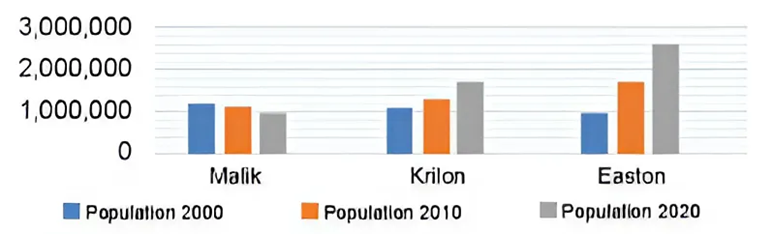
Sample 1:
The bar chart illustrates the population growth in three cities - Malik, Krilon, and Easton - over the years 2000, 2010, and 2020.
In 2000, Malik and Krilon had similar populations, both around 1.2 million. However, by 2010, Malik's population remained relatively stable, while Krilon's population saw a slight increase to just over 1.5 million. In 2020, Malik experienced a modest increase to about 1.6 million, while Krilon's population grew more significantly, reaching approximately 2 million.
Easton, on the other hand, showed substantial population growth over the two decades. In 2000, Easton's population was about 1 million, lower than both Malik and Krilon. By 2010, Easton's population had increased dramatically to around 1.8 million, surpassing both Malik and Krilon. This trend continued, and by 2020, Easton's population had surged to nearly 3 million, making it the most populous city among the three.
In summary, Malik experienced minimal population growth over the 20-year period, while Krilon saw a steady increase. Easton, however, showed the most significant growth, with its population nearly tripling from 2000 to 2020. This suggests that Easton has been a major center of population growth compared to the more moderate increases in Malik and Krilon.
Sample 2:
The bar chart compares the population changes in the cities of Malik, Krilon, and Easton over the years 2000, 2010, and 2020.
In 2000, Malik and Krilon had similar populations, both around 1.5 million, while Easton had the smallest population at approximately 1 million. By 2010, Malik’s population remained almost unchanged at 1.5 million, whereas Krilon saw a slight increase to just over 1.5 million. Easton, however, experienced significant growth, with its population rising to about 1.8 million, surpassing both Malik and Krilon.
The trend continued over the next decade. By 2020, Malik’s population grew modestly to around 1.6 million. Krilon’s population increased more significantly to approximately 2 million. Easton, on the other hand, witnessed dramatic growth, with its population almost tripling from its 2000 figure, reaching nearly 3 million by 2020. This made Easton the most populous city among the three.
In summary, Malik showed the least population growth over the 20-year period, maintaining a relatively stable population. Krilon experienced steady growth, overtaking Malik by 2020. Easton displayed the most remarkable increase, with its population soaring to almost three times its initial size, highlighting Easton as a major hub of population growth compared to the more moderate increases in Malik and Krilon.
Sample 3:
The bar chart highlights notable population changes in the cities of Malik, Krilon, and Easton from 2000 to 2020.
In 2000, Malik and Krilon had similar populations, around 1.5 million each, while Easton was the smallest with about 1 million residents. By 2010, Malik’s population remained steady at approximately 1.5 million, whereas Krilon experienced a modest increase to just over 1.5 million. In contrast, Easton saw significant growth, with its population rising to about 1.8 million, surpassing both Malik and Krilon.
By 2020, Malik's population had only grown slightly to about 1.6 million, indicating minimal change over the 20 years. Krilon’s population increased more substantially to around 2 million, showing a steady growth trend. Easton exhibited the most dramatic change, with its population nearly tripling from its 2000 figure to reach almost 3 million by 2020.
In summary, Easton demonstrated the most significant population growth, far outpacing Malik and Krilon. While Malik saw minimal changes, Krilon experienced steady growth. Easton’s rapid expansion highlights it as a major center of population growth over the two decades.
The Ocean Heroes
Rescue injured marine life
Breed endangered marine life and reintroduce them
Teach children about the importance of protecting the oceans
Protest to fight for laws to reduce overfishing
Sample 1:
The Ocean Heroes is a charity dedicated to protecting marine life and oceans. They do important work in several areas. First, they rescue injured marine animals. When a marine animal is hurt, the Ocean Heroes provide medical care and rehabilitation, giving these creatures a chance to heal and return to their natural habitats.
Second, the charity breeds endangered marine species and reintroduces them into the wild. This helps increase the population of species that are at risk of extinction, ensuring that these animals have a future in our oceans.
Third, the Ocean Heroes teach children about the importance of protecting the oceans. They visit schools and hold workshops to educate young people about marine life and the impact humans have on the environment. By raising awareness, they hope to inspire the next generation to take action to protect our oceans.
Finally, the charity protests to fight for laws that reduce overfishing. Overfishing is a major problem that depletes fish populations and harms marine ecosystems. By advocating for stricter fishing regulations, the Ocean Heroes aim to protect marine life and ensure sustainable fishing practices.
If the Ocean Heroes did not do this work, many marine animals would suffer and possibly die from injuries. Endangered species could become extinct, leading to imbalances in the marine ecosystem. Children would miss out on learning how to care for the oceans, which could result in less awareness and action in the future. Overfishing would continue unchecked, further damaging marine environments. The work of the Ocean Heroes is crucial for the health and future of our oceans.
Sample 2:
The Ocean Heroes is a charity dedicated to protecting marine life and preserving our oceans. They carry out crucial activities to achieve their mission. Firstly, they rescue injured marine animals. When these animals are hurt, the Ocean Heroes provide medical care and help them recover so they can return to their natural habitats.
Secondly, the charity breeds endangered marine species and reintroduces them into the wild. This effort helps boost the populations of species that are at risk of disappearing, ensuring they continue to exist in the oceans.
Thirdly, the Ocean Heroes educate children about the importance of protecting the oceans. They visit schools and hold workshops to teach kids about marine life and the impact humans have on the environment. This education helps raise awareness and encourages young people to take action to save our oceans.
Finally, the charity protests to fight for laws that reduce overfishing. Overfishing is a serious problem that depletes fish populations and damages marine ecosystems. By pushing for stricter fishing regulations, the Ocean Heroes aim to protect marine life and promote sustainable fishing practices.
If the Ocean Heroes didn't do this work, many injured marine animals would suffer and die without help. Endangered species could become extinct, disrupting the balance of marine ecosystems. Without education from the Ocean Heroes, children might grow up unaware of the importance of protecting the oceans, leading to less action in the future. Overfishing would continue unchecked, causing further harm to marine environments. The work of the Ocean Heroes is vital for the health and future of our oceans.
Sample 3:
The Ocean Heroes is a charity dedicated to saving marine life and educating the public about ocean conservation. They rescue injured marine animals like sea turtles and dolphins, providing crucial medical care to help them recover and return to their habitats. By breeding endangered species such as sea otters and releasing them back into the wild, they contribute to preserving biodiversity in our oceans.
Their educational programs teach children about why it's vital to protect the oceans. Through interactive lessons and field trips, they inspire future generations to become stewards of marine environments. The charity also campaigns for laws that limit overfishing, advocating for sustainable practices that ensure fish populations can thrive.
If The Ocean Heroes didn't exist, marine ecosystems would suffer. Injured sea creatures might not receive the help they need, leading to declines in species populations. Endangered marine life could face greater risks of extinction without efforts to breed and reintroduce them. Children might not learn about ocean conservation, impacting awareness and future actions to protect marine environments. Moreover, without advocacy for laws to reduce overfishing, marine ecosystems could collapse, affecting millions who depend on oceans for food and livelihoods.
In essence, The Ocean Heroes' work is crucial for the health of our oceans and the well-being of both marine life and human communities worldwide.
Sample 1:
Businesses and governments both play crucial roles in fostering an eco-friendly future.
Businesses can adopt sustainable practices such as reducing waste and energy consumption. By implementing recycling programs and minimizing packaging, businesses can significantly cut down on waste. Reducing energy consumption through the use of energy-efficient appliances and renewable energy sources can lower their carbon footprint. These actions not only help the environment but also reduce operational costs, enhance corporate image, and attract eco-conscious consumers.
Another effective step for businesses is to source materials sustainably. Choosing suppliers that adhere to environmental standards and using eco-friendly materials can reduce environmental impact. This can lead to a healthier planet and improve the company’s reputation, potentially increasing customer loyalty and market share.
The government can contribute by enacting strict environmental regulations. Laws that limit emissions, reduce plastic use, and encourage renewable energy adoption can drive significant environmental improvements. These regulations can decrease pollution, slow climate change, and promote public health. Governments can also offer incentives for green practices, such as tax breaks for companies that invest in renewable energy or sustainable technologies. This encourages businesses to adopt eco-friendly practices, furthering environmental goals.
By taking these actions, businesses and governments can collaboratively create a more sustainable future, ensuring a healthier planet for generations to come.
Sample 2:
Businesses and governments both have significant roles in promoting eco-friendly practices.
Businesses can focus on reducing their carbon footprints by incorporating energy-efficient technologies. By switching to LED lighting, improving insulation, and using energy-efficient machinery, businesses can decrease their energy consumption. This reduces greenhouse gas emissions and operational costs, leading to a more sustainable and cost-effective operation.
Another step businesses can take is to implement green supply chain practices. This includes selecting suppliers committed to sustainable practices, using eco-friendly packaging, and optimizing logistics to reduce fuel consumption. These actions minimize environmental impact and can enhance a company's reputation, attracting environmentally conscious customers.
Governments can contribute by implementing policies that promote renewable energy. Providing subsidies for solar, wind, and other renewable energy sources encourages businesses and individuals to switch from fossil fuels to cleaner energy. This can significantly reduce national carbon emissions and promote sustainable energy use.
Additionally, governments can invest in public transportation infrastructure. Improving and expanding public transit systems can reduce the number of vehicles on the road, leading to lower emissions and less traffic congestion. Promoting the use of electric vehicles through incentives and building charging stations can further reduce the environmental impact of transportation.
By taking these measures, businesses and governments can work together to create a greener, more sustainable future. These efforts will lead to cleaner air, reduced greenhouse gas emissions, and a healthier environment for all.
Sample 3:
Businesses can become more eco-friendly by implementing energy-efficient practices, such as using renewable energy sources like solar or wind power. This reduces their carbon footprint and helps conserve natural resources. Another way businesses can contribute is by reducing waste through recycling and adopting packaging that's biodegradable or easily recyclable. This minimizes landfill waste and lessens the environmental impact of their operations.
Governments can support eco-friendly initiatives by implementing stricter environmental regulations and policies. This includes enforcing laws that limit pollution from industries and incentivizing businesses to adopt sustainable practices through tax breaks or subsidies. Additionally, governments can invest in public transportation and infrastructure for cycling and walking, reducing reliance on cars and lowering carbon emissions.
These actions would have a significant effect on the environment. Businesses adopting renewable energy and waste reduction practices would decrease greenhouse gas emissions and conserve resources like water and materials. Government regulations and incentives would encourage industries to operate more sustainably, leading to cleaner air and water for communities. Investments in green transportation would reduce traffic congestion and air pollution, promoting healthier cities and lifestyles. Overall, these steps would contribute to a healthier planet for current and future generations.
Sample 4:
One way businesses can be more eco-friendly is by implementing telecommuting and flexible work arrangements for employees. This reduces the need for daily commuting, cutting down on fuel consumption and greenhouse gas emissions from transportation. Additionally, businesses can support local and sustainable sourcing practices. By sourcing materials and products locally and from suppliers committed to sustainable practices, businesses can reduce the environmental impact of transportation and promote responsible production methods.
On the governmental side, another effective action would be to invest in renewable energy infrastructure on a national scale. This includes funding and supporting research and development in renewable energy technologies like solar, wind, and geothermal power. By expanding renewable energy sources, governments can reduce dependence on fossil fuels, decrease carbon emissions, and promote energy independence. Additionally, governments can create and enforce policies that promote the restoration and protection of natural ecosystems, such as wetlands and forests. This helps preserve biodiversity, mitigate climate change impacts, and improve resilience against natural disasters.
These actions would collectively contribute to a more sustainable and eco-friendly future. Businesses would reduce their environmental footprint through innovative work arrangements and sustainable sourcing practices, while governments would lead by example through investment in renewable energy and conservation efforts. Together, these efforts would foster a cleaner, healthier environment for all.
Sample 5:
An impactful action businesses can take to be more eco-friendly is to implement water conservation measures. This includes installing water-saving technologies such as low-flow faucets and toilets, as well as implementing processes to recycle and reuse water within their operations. By reducing water consumption and minimizing wastewater discharge, businesses can contribute to preserving freshwater resources and reducing pollution in water bodies.
For governments, a significant step towards eco-friendliness would be to promote sustainable agriculture practices. This can include providing incentives for farmers to adopt organic farming methods, reduce chemical pesticide and fertilizer use, and implement soil conservation techniques. Sustainable agriculture helps preserve soil fertility, biodiversity, and water quality, while also mitigating greenhouse gas emissions from agriculture.
These actions would have profound effects on the environment. Businesses conserving water would help alleviate water scarcity issues and reduce the energy required for water treatment and distribution. Governments supporting sustainable agriculture would improve soil health, protect ecosystems, and ensure food security for future generations. Together, these efforts would contribute to a more resilient and sustainable planet, benefiting both human societies and natural ecosystems.
Sample 1:
AI will revolutionize various aspects of people's lives, bringing both benefits and challenges.
In the job sector, AI will automate routine tasks, increasing efficiency and productivity. However, it may also lead to job displacement as certain roles become redundant. While AI can create new job opportunities in fields like data analysis and AI development, there is a need for retraining programs to equip workers with the skills needed for the evolving job market.
At home, AI-powered smart devices will enhance convenience and comfort, from controlling home appliances to managing household tasks. While this may streamline daily life, concerns about privacy and data security arise with the collection of personal information by these devices.
In education, AI will personalize learning experiences, catering to individual student needs and enhancing educational outcomes. However, there are concerns about the digital divide and ensuring equitable access to AI-powered educational resources for all students.
In health, AI will enable more accurate diagnostics and personalized treatment plans, improving patient outcomes. However, ethical considerations regarding patient privacy and the responsible use of AI in healthcare decision-making must be addressed.
In shopping, AI-driven recommendation systems will personalize the shopping experience, but there are concerns about data privacy and the potential for algorithmic bias.
In entertainment, AI will revolutionize content creation and delivery, offering immersive experiences like virtual reality. However, there are concerns about the impact of AI on creativity and human expression.
Overall, while AI holds tremendous potential to improve various aspects of life, addressing ethical and societal implications is crucial to ensure its responsible and equitable deployment.
Sample 2:
AI is going to change how we live in many ways, but there are good and not-so-good parts to it.
At work, AI will help us do things faster and better. It can take care of boring tasks so we can focus on more interesting stuff. But some people might lose their jobs because of it. We need to make sure everyone has the skills they need for the new jobs AI creates.
At home, smart devices powered by AI will make life easier. They can control things like lights and heating, and even suggest movies to watch. But we need to be careful about our privacy because these devices collect a lot of our personal information.
In school, AI will make learning more fun and help us learn at our own pace. But we have to make sure everyone has access to these cool tools, so no one gets left behind.
In healthcare, AI will help doctors diagnose diseases faster and give better treatments. But we need to make sure our information is safe, and that AI doesn't replace human doctors completely.
When we shop, AI will recommend things we might like, which is cool. But we also need to be careful not to spend too much or buy things we don't really need because of these recommendations.
For fun, AI will make movies and games more exciting. But we also need to make sure there's still room for human creativity and different kinds of entertainment.
Overall, AI can do a lot of good things for us, but we need to be careful and make sure it's used in the right way.
Sample 3:
AI is going to change how we live in many ways. In jobs, it will automate tasks so people can focus on more creative work. This might create new jobs in AI and data analysis but also means workers will need new skills. At home, AI devices will make life easier by managing things like energy use and security. They might even help with shopping, though people worry about privacy.
In education, AI can personalize learning for students, adjusting how things are taught based on how each student learns best. This could make learning more effective, but some wonder about the role of teachers and how AI uses data. In healthcare, AI will improve how we diagnose and treat illnesses, making medical care better and more accessible. But there are concerns about keeping medical data safe and how much we trust AI with important decisions.
When it comes to shopping and entertainment, AI will suggest products we might like and personalize our entertainment choices. This could make shopping easier and entertainment more enjoyable, but it also means AI could influence what we buy and watch.
Overall, AI offers a lot of benefits, like making things more efficient and giving us new ways to do things. But we need to think carefully about how we use AI, making sure it helps everyone and doesn't cause problems with privacy or fairness.
Write about the features of five jobs and what AI's future impact will be for each job.
Sample 1:
In today's evolving job market, artificial intelligence (AI) is reshaping various industries in profound ways. Let's examine how AI is influencing different professions:
In transportation, AI-powered autonomous vehicles are poised to revolutionize the way people and goods are moved. Self-driving cars and trucks promise safer roads, reduced congestion, and more efficient logistics. However, this shift may require transportation professionals to adapt to new roles in managing and overseeing AI-driven systems.
In retail, AI-driven analytics are transforming customer experiences and business operations. Predictive algorithms analyze consumer behavior to optimize inventory management and personalize marketing strategies. Retailers are increasingly using AI chatbots and virtual assistants to enhance customer service and streamline shopping experiences.
In environmental science, AI is aiding in climate modeling, biodiversity monitoring, and natural resource management. Machine learning algorithms analyze satellite data to track deforestation, predict environmental changes, and develop sustainable practices. Environmental scientists are leveraging AI tools to address complex ecological challenges more effectively.
In hospitality, AI technologies are enhancing guest services and operational efficiency. Hotels use AI-powered chatbots for booking inquiries and personalized recommendations. AI systems can also manage room preferences and streamline check-in processes, allowing staff to focus on providing exceptional guest experiences.
In telecommunications, AI-driven networks and predictive maintenance algorithms are optimizing connectivity and infrastructure management. Telecom engineers utilize AI to detect and resolve network issues proactively, ensuring reliable service delivery. AI is also driving innovations in 5G deployment and enhancing telecommunications technologies.
Overall, while AI presents opportunities for efficiency and innovation across these diverse fields, it also requires professionals to adapt and acquire new skills. Success in an AI-enabled future will depend on embracing technological advancements while maintaining a human-centric approach to solving complex challenges in each industry.
Sample 2:
Today, many jobs are changing because of AI, which can do tasks like coding, diagnosing illnesses, analyzing finances, handling customer inquiries, and managing logistics more efficiently than before.
Software developers create and fix computer programs. AI tools can now write code and find mistakes, making developers' jobs easier but also changing what they do.
Doctors and nurses use AI to diagnose illnesses and plan treatments better. This helps patients, but it means healthcare workers might need to learn new skills to work with AI.
Financial analysts study money trends and investments. AI can now analyze data and predict how markets will change, which could mean fewer jobs for analysts who do basic tasks but more opportunities for those who understand AI.
Customer service reps answer questions from customers. AI chatbots now handle simple questions, so reps might focus more on helping with harder problems that need a human touch.
Logistics managers organize how things are moved and stored. AI helps them plan better, but it also means they might need to learn how to use AI tools to do their jobs well.
Overall, AI makes many jobs easier and faster, but it also means workers might need to learn new things to keep up with these changes.
Sample 3:
In today's rapidly changing job market, artificial intelligence (AI) is transforming various fields in significant ways. Let's explore how AI is influencing different professions:
In agriculture, AI technologies are revolutionizing farming practices. Automated drones and sensors can monitor crops, soil conditions, and livestock health with precision. This data-driven approach improves productivity and resource management, though it requires farmers to learn new skills in data analysis and technology integration.
In education, AI-powered learning platforms personalize teaching methods and provide adaptive feedback to students. AI tutors can assess individual learning patterns and tailor educational content accordingly, enhancing learning outcomes. Educators are now exploring how to integrate these technologies effectively into classrooms while maintaining the human touch in teaching.
In law enforcement, AI tools assist in analyzing vast amounts of data to predict crime patterns and optimize patrol routes. Facial recognition technology helps in identifying suspects and enhancing public safety. However, concerns about privacy and bias in AI algorithms require careful regulation and ethical considerations.
In creative industries like art and media, AI is pushing boundaries in content creation and storytelling. AI-generated music, artwork, and literature challenge traditional notions of creativity and raise questions about authorship and originality. Artists and media professionals are experimenting with AI tools to enhance their work while preserving artistic integrity.
In manufacturing, AI-driven automation is transforming production lines with robotics and predictive maintenance systems. This improves efficiency and reduces errors, though it also shifts job roles towards managing and maintaining AI-driven machinery.
Overall, while AI presents exciting opportunities for innovation across these diverse fields, it also demands adaptation from professionals. Success in an AI-enhanced future will require a balance of technical expertise, ethical considerations, and creativity to harness the full potential of these technologies responsibly.
From: _______@quickmail.com (your email address)
To: mark@fastmail.us
Subject: My lovely community
Dear Mark,
I’m happy to have received your email. I’m going to tell you about the things I like in my community.
________________
________________
________________
That’s all for now, Mark. Tell me about your community.
Cheers,
_______
Sample 1:
From: hoa@quickmail.com
To: mark@fastmail.us
Subject: My lovely community
Dear Mark,
I’m happy to have received your email. I’m going to tell you about the things I like in my community. We have a beautiful park where I often go for walks. There’s a vibrant local market every weekend with fresh produce and handmade crafts. Our community center organizes fun activities like yoga classes and movie nights. I also love the small café near my house; it’s a great place to relax and catch up with friends.
That’s all for now, Mark. Tell me about your community.
Cheers,
Hoa
Sample 2:
From: catherine@quickmail.com
To: mark@fastmail.us
Subject: My lovely community
Dear Mark,
I’m happy to have received your email. I’m going to tell you about the things I like in my community.
We have a vibrant local market every weekend where I enjoy browsing fresh produce and handmade crafts. Our community center hosts fun events like movie nights and art workshops that bring everyone together. One of my favorite spots is the peaceful park nearby, perfect for picnics and jogging.
That’s all for now, Mark. Tell me about your community.
Cheers,
Catherine
Sample 3:
From: catherine@quickmail.com
To: mark@fastmail.us
Subject: My lovely community
Dear Mark,
I hope you're doing well! Thanks for asking about my community. Here are some things I really enjoy:
Firstly, we have a fantastic library that hosts book clubs and workshops, perfect for book lovers like me. Secondly, our local park is beautifully maintained with walking trails and a playground, great for relaxation and family outings. Lastly, our neighborhood organizes seasonal festivals that celebrate our cultural diversity, with music, food, and community activities.
That’s all for now, Mark. Tell me about your community.
Cheers,
Catherine
Sample 4:
From: catherine@quickmail.com
To: mark@fastmail.us
Subject: My lovely community
Dear Mark,
I hope you're doing well! Thank you for asking about my community. Here are a few things that make it special to me:
Firstly, we have a lively community garden where neighbors come together to grow vegetables and flowers, fostering a sense of community and sustainability. Secondly, our local theater hosts fantastic productions, from plays to concerts, providing entertainment for all ages. Lastly, we have a network of scenic hiking trails nearby, perfect for outdoor enthusiasts like me to explore nature.
That’s all for now, Mark. Tell me about your community.
Cheers,
Catherine
Sample 5:
From: catherine@quickmail.com
To: mark@fastmail.us
Subject: My lovely community
Dear Mark,
I hope you're well! Thanks for asking about my community. Here are a few things I really enjoy:
Firstly, we have a nice park with playgrounds and trails, great for walks and relaxing outdoors. Secondly, our community center organizes fun events like movie nights and craft workshops for families. Lastly, we have a friendly neighborhood with a library that hosts book clubs and storytime for kids.
That’s all for now, Mark. Tell me about your community.
Cheers,
Catherine
Wonderland | |
Location | A city near the mountain |
In the past | A small and poor town No high buildings Narrow and empty streets Not many people |
Now | A modern city Huge entertainment centres Many good department stores A big library Excellent public transport |
A liveable place or not? | A liveable place + Exciting life + Reasonable cost of living |
Sample 1:
Nestled near the base of a picturesque mountain, Wonderland has undergone a remarkable transformation over the years. Once a small and impoverished town, it has evolved into a vibrant modern city, bustling with life and opportunity. Gone are the days of narrow, desolate streets; now, towering high-rises adorn the skyline, housing an array of bustling department stores and colossal entertainment centers. The once sparse population has swelled, drawn by the city’s newfound allure. But amidst the bustling commerce and thriving social scene, Wonderland has retained its charm, boasting a magnificent library and efficient public transport system. Despite its rapid development, Wonderland remains eminently livable, offering an exciting lifestyle at a reasonable cost.
Sample 2:
Wonderland, once a small and impoverished town nestled near the mountains, has transformed into a bustling modern city. In the past, its streets were narrow and empty, lacking tall buildings and bustling crowds. Today, Wonderland boasts towering skyscrapers and vibrant entertainment centers that draw residents and tourists alike. The city features numerous department stores, a sprawling library, and efficient public transportation networks. Despite its rapid development, Wonderland remains a livable place with a vibrant social scene and reasonable cost of living. Residents enjoy an exciting urban lifestyle without the exorbitant expenses often associated with larger cities.
Sample 3:
Wonderland, a city near the mountains, has changed a lot over the years. It used to be a small, poor town with narrow streets and not many people around. Now, it's a modern city with tall buildings, big entertainment centers, and lots of good stores to shop in. There's also a large library and great public transportation. People find it a nice place to live because there's always something fun to do, and the cost of living is reasonable compared to bigger cities. Wonderland has become lively and inviting, making it a great place for both residents and visitors.
Sample 4:
Wonderland, once a small town near the mountains, has grown into a big, modern city. In the past, it was quiet with few buildings and not many people. Now, it's bustling with tall buildings and exciting places like entertainment centers and large stores. There's a big library and easy buses and trains to get around. People like living here because there's a lot to do and it's not too expensive. Wonderland has become a lively and comfortable place for everyone to enjoy.
Sample 5:
Wonderland, situated near mountains, has evolved from a small, quiet town into a bustling modern city. In the past, it had few buildings and quiet streets with not many residents. Today, it boasts tall skyscrapers, lively entertainment spots, and large stores for shopping. There's a big library and convenient public transport. People enjoy living here because it's lively, affordable, and offers plenty of activities. Wonderland has transformed into a vibrant and welcoming place where everyone can find something they enjoy.
We must know how to achieve a well-balanced life because it is necessary for our overall well-being and happiness. Firstly, _________
Sample 1:
We must know how to achieve a well-balanced life because it is necessary for our overall well-being and happiness. Firstly, effective time management is crucial; scheduling tasks and prioritizing activities help in balancing work, study, and personal time. Secondly, maintaining strong relationships with friends and family provides emotional support and enhances life satisfaction. Regular communication and quality time with loved ones are essential. Thirdly, managing stress through mindfulness, physical activity, and hobbies keeps our mental health in check. Lastly, setting realistic goals and establishing boundaries between work and personal life prevents burnout. By integrating these practices, we can create a harmonious and fulfilling life.
Sample 2:
We must know how to achieve a well-balanced life because it is necessary for our overall well-being and happiness. Firstly, it's crucial to balance work and leisure time by setting clear boundaries. This helps prevent feeling overwhelmed. Secondly, taking care of our bodies with regular exercise, healthy eating, and enough sleep is essential for feeling good. Thirdly, building strong relationships with family and friends provides support and makes life more enjoyable. Additionally, practicing mindfulness or meditation helps reduce stress and keeps our minds clear. Lastly, setting achievable goals and managing time wisely helps us stay organized and productive without feeling stressed. Finding balance in these areas helps us lead a satisfying and harmonious life.
Sample 3:
We must know how to achieve a well-balanced life because it is necessary for our overall well-being and happiness. Firstly, it's good to have hobbies or things we enjoy doing outside of work. This helps us relax and feel refreshed. Whether it's reading, painting, or playing sports, these activities give us a break from daily stress. Secondly, staying positive by focusing on what we're grateful for and trying to see the good in things helps our mental well-being. It's like keeping a sunny outlook even when things are tough. Thirdly, learning to set limits and say no when needed helps us manage our time better and avoid getting too busy. Also, finding peace through meditation, prayer, or just spending time in nature can calm our minds and make us feel more centered. Lastly, having people we can talk to for advice and support, like mentors or friends, helps us through tough times and makes us feel connected. Balancing these things helps us live a happier and more fulfilling life.
Sample 4:
We must know how to achieve a well-balanced life because it is necessary for our overall well-being and happiness. Firstly, it's helpful to have a routine that includes time for work or school, but also time for relaxation and fun activities. This way, we don't feel too stressed out. Secondly, taking care of our bodies by eating well, exercising regularly, and getting enough sleep helps us stay strong and energized. Thirdly, spending quality time with family and friends makes us feel happy and supported. It's nice to have people we can talk to and have fun with. Additionally, finding ways to relax and clear our minds, like taking walks or listening to music, helps reduce stress. Finally, setting small goals and celebrating achievements along the way helps us stay motivated and positive. Balancing these things helps us lead a balanced and satisfying life.
Sample 5:
We must know how to achieve a well-balanced life because it is necessary for our overall well-being and happiness. Firstly, it's good to manage our time wisely by prioritizing important tasks and setting realistic goals. This helps us feel productive without getting overwhelmed. Secondly, taking breaks and resting when needed allows our bodies and minds to recharge. Getting enough sleep each night is also crucial for feeling refreshed and ready for the day. Thirdly, staying connected with loved ones through regular communication and spending quality time together helps us feel supported and happy. Additionally, finding activities that bring us joy, like hobbies or creative pursuits, adds fulfillment to our daily lives. Lastly, practicing self-care, such as meditation, exercise, or simply enjoying nature, promotes mental clarity and reduces stress. Balancing these aspects helps us maintain a healthy and enjoyable lifestyle.
- holding festivals and celebrations
- worshipping ancestors
- cooking traditional food
- teaching children about traditions
Sample 1:
In my neighbourhood, traditions and customs are observed with vibrant enthusiasm. Festivals and celebrations are major highlights, where streets come alive with colourful decorations, music, and dance. Families gather to worship ancestors, often setting up elaborate altars with offerings of food and incense. Cooking traditional food is a cherished activity, with neighbours sharing recipes and dishes passed down through generations. Elders play a crucial role in teaching children about these customs, imparting stories and practices that connect them to their heritage. This blend of festive joy, reverence for the past, culinary traditions, and intergenerational education creates a rich tapestry of cultural continuity in our community.
Sample 2:
In my neighborhood, traditions and customs are cherished and celebrated in various ways. Throughout the year, we hold vibrant festivals and celebrations that bring the community together. These events showcase our cultural heritage through music, dance, and traditional rituals. Worshipping ancestors is a significant part of our customs, with special ceremonies and offerings made to honor those who came before us. Cooking traditional food plays a central role during these gatherings, where recipes passed down through generations are prepared and shared with neighbors and family. It's common to see elders teaching children about our traditions, ensuring they understand and appreciate our cultural practices. These activities not only preserve our heritage but also foster a strong sense of unity and belonging among everyone in the neighborhood.
Sample 3:
In our neighborhood, traditions and customs are deeply rooted and cherished by residents. Throughout the year, we come together to celebrate various festivals and events that highlight our cultural identity. These gatherings are marked by colorful decorations, traditional music, and performances that showcase our rich heritage. Worshipping ancestors is another important aspect of our customs, with families setting aside time for prayers and rituals to honor their predecessors. Cooking traditional dishes is a shared activity during these occasions, where neighbors exchange recipes and techniques that have been handed down over generations. Teaching children about our traditions is a priority, with elders passing on stories and values that are integral to our community's history and identity. These practices not only strengthen our bonds but also ensure that our customs continue to be cherished and passed on to future generations.
Complete the suggested ideas below about your most pleasant experience. Then use the ideas to write a paragraph (100-200 words) about that pleasant experience.
My most pleasant experience was (1) ________.
It was/ happened when (2) ________.
I was with (3) ________.
This happened in/ on (4) ________.
We (5) ________.
We also (6) ________.
Sample 1:
My most pleasant experience was when I visited Paris for the first time. It was a sunny day in spring, and I was with my closest friends. This happened in May, a month filled with blooming flowers and lively streets. We explored the charming cobblestone alleys, admired the iconic Eiffel Tower, and indulged in delicious pastries at local cafes. We also took a leisurely boat ride along the Seine River, enjoying the breathtaking views of the city’s landmarks. It was a perfect day filled with laughter, adventure, and unforgettable memories.
Sample 2:
My most pleasant experience was attending a music festival with friends. It happened during the summer break after graduating from college. I was with my closest friends from university. This happened in July at a large outdoor venue. We danced and sang along to our favorite bands and artists, creating unforgettable memories together. We also camped out under the stars and shared stories around a bonfire, feeling a sense of freedom and camaraderie. It was a time of celebration, friendship, and enjoying life to the fullest, marking the end of an era and the beginning of new adventures.
Sample 3:
My most pleasant experience was snorkeling in the Great Barrier Reef. It happened during a vacation with my family to Australia. I was with my parents and siblings. This happened in August last year. We explored vibrant coral reefs and swam alongside colorful fish, marveling at the stunning underwater world. We also relaxed on pristine beaches and enjoyed local seafood, soaking in the natural beauty and tranquility of this iconic destination. It was an unforgettable adventure filled with awe-inspiring sights and cherished moments with my loved ones.
Sample 4:
My most pleasant experience was hiking to the top of a mountain. It happened during a weekend getaway with friends. I was with a group of close friends from college. This happened in September last year. We climbed steep trails and enjoyed breathtaking views from the summit, feeling a sense of accomplishment and awe. We also camped overnight and shared stories around a campfire, bonding over our shared love for adventure and the great outdoors. It was a refreshing escape from daily life, filled with laughter, challenges, and the beauty of nature.
Sample 5:
My most pleasant experience was volunteering at an animal shelter. It happened during my summer break from high school. I was with a group of classmates and volunteers. This happened in July at a local shelter. We cared for and played with rescue animals, providing them with love and attention they deserved. We also organized adoption events and helped find loving homes for several animals, which was incredibly rewarding. It was a fulfilling experience knowing that our efforts made a positive difference in the lives of these animals and their new families.
- what change you will talk about.
- what it was like in the past.
- what change happened; how it is like now.
- how you feel about the change.
Sample 1:
Over the past three years, my lifestyle has changed dramatically as I transitioned from primary school to secondary school. In primary school, I had a lot of free time to hang out with friends, play video games, and watch TV. Homework was light, and weekends were for fun. Now, in secondary school, my schedule is much busier with tougher classes, more homework, and extracurricular activities like debate club and soccer practice. While I sometimes miss the carefree days of primary school, I feel more accomplished and focused now. This change has made me more responsible and better at managing my time, which makes me feel proud and prepared for the future.
Sample 2:
Over the past three years, a significant change in my lifestyle has been adopting a healthier diet and regular exercise routine. In the past, my diet was often filled with fast food and sugary snacks, and I rarely made time for physical activity. Recognizing the need for better health, I gradually introduced more fruits, vegetables, and whole grains into my meals while cutting down on processed foods. Additionally, I started exercising three times a week, incorporating activities like jogging and yoga into my routine. Now, I feel more energized and motivated, and my overall well-being has improved noticeably. I appreciate the positive effects of these changes on both my physical health and mental clarity. Embracing this healthier lifestyle has been transformative, and I am committed to maintaining these habits for the long term.
Sample 3:
Over the past three years, a significant change in my lifestyle has been prioritizing regular sleep patterns and creating a bedtime routine. In the past, I often struggled with irregular sleep and found it hard to wind down before bed. However, I decided to make a change by setting a consistent bedtime and waking up at the same time every day. I also established a relaxing bedtime routine, such as reading or listening to calming music before sleep. Now, I feel more rested and refreshed each day, and my overall mood and productivity have improved. This change has positively impacted my health and well-being, and I appreciate the importance of a good night's sleep in maintaining a balanced lifestyle.
Sample 4:
Over the past three years, a major change in my lifestyle has been becoming more active. Before, I used to spend a lot of time sitting and not exercising much. Now, I make it a point to go for walks or do simple exercises like jogging or dancing several times a week. This change has helped me feel stronger and more energetic. I enjoy being active and it has become a fun part of my routine.
Sample 5:
In the past three years, I've started reading every day. Before, I didn't read much outside of school or work. Now, I take time each day to read books, magazines, or articles that interest me. This change has helped me learn more and imagine new things. Reading is relaxing and enjoyable for me, and it's now a part of my daily routine that I really like. It's also helped me spend less time looking at screens before bed, which has made it easier for me to sleep. Overall, making reading a habit has made my life more interesting, and I'm excited to keep exploring new books and topics.
In recent years, many small local shops have closed because customers travel to large shopping centers and malls to do their shopping. Is it a positive or negative development?
Sample 1:
In the past years, individuals shifted their location of shopping from small retail stores to shopping centres, resulting in the shutdown of many local shops. In my opinion, this trend is negatively affecting the economy in various ways.
To begin with, small shops closing down have a big influence on the unemployment rates of a country. In other words, when retail stores are unable to compete with big malls for not having enough resources, they are obliged to dismiss all their employees. As a result, job opportunities are harder to find, and competition in the work field is higher, especially for individuals who are above years old. For example, newly graduates have a better chance to find a new job vacancy because companies prefer to have youth in their teams due to their adaptability skills, leaving the individuals within the age range above 40 unemployed.
Secondly, large centres can control the market price wise when there is no more competition. To put it differently, it is commonly known that owning a mall or a shop within a centre can lead to high expenses. Consequently, when competition gets lower large shops increase the prices of their goods in order to start gaining profits. For instance, business researchers showed that a very common strategy new businesses use is to cut their profits to Zero if necessary to attract new customers where they wait for their competitors to close to start increasing the prices gradually.
In conclusion, large centres taking over the market, forcing retailers to close their businesses affect the economy in both increases of prices and unemployment rates.
Sample 2:
The customer is a king. The recent transition of small outlets from the streets to a store in a mall has impacted the lives of the smaller vendors. They belong to an unorganized sector of the economy and constitute a major part.
Firstly, in the older days, when everyone was familiar with the street shops they were comfortable as well. The modern trade methodology shifted more to the shopping malls and online portals; the impact on micro industries and vendors is huge. Since the capital available with these shopkeepers is low, they could not afford the advanced equipment that could help their business grow. As a result, when they could not cope with products and technologies they rapidly vanished from the market. However, there are some examples of businessmen who translated their small business to macro level, for instance, DMART in India.
On the whole, these examples are few in number and could not be used as a justification.
Secondly, the malls have huge spaces where you could get almost all items under one roof. This is another reason why local outlets get affected. For example, one has to go in different directions and travel some miles to do grocery shopping and some clothes to wear. Consequently, they have become an occasional place to visit, when a buyer is in urgent need of an item. In addition, they also get affected by the unavailability of parking spaces in the city. Due to these numerous circumstances, they often shut down in a short span of time since they opened.
To conclude, it is worth considering the adverse effects on this class of business. Ultimately, they are pushed below the poverty line and the liability on the government has surged.
Sample 3:
Decades with the high dependence of big department stores and malls by the customer results in shut down of many small markets. I think this approach has both pros and cons which I am inclined to articulate in the next paragraphs.
To commence with, purchasing items from huge brands or stores has enormous benefits. Firstly, buying from such markets provides pupils with comfort and convenience as they are easily able to receive all types of products in one shopping centre. To illustrate, items related to groceries, clothes, gadgets and cosmetics are available on a single floor thus saving time and effort while buying. Secondly, doing transactions from the shopping malls and departmental shops develops the status of the individuals by receiving goods or services of the branded quality. For example, purchasing things from showrooms such as Amazon, Nike, and CK in malls gives the consumer a status which shows the services they avail would be unique, different and better in quality. Therefore, that policy brings positive development by eventually distributing tremendous facilities and status symbols in one roof.
However, despite its interesting advantages that approach might not be free from drawbacks. Small businesses were wiped out owing to such advancements which further created big problems or issues, related to unemployment among individuals and the low level of income in society. In other words, many businesses will lose their jobs or might not be able to earn enough money for their livelihood while ultimately lowering the flow of funds in society. For instance, several shops in the Anandpur sahib had closed due to the construction of a shopping complex named the City plus.
To conclude, although with the growth of large department markets have led to many changes like the availability of every item in one floor, issues like employment loss and low distribution in the market might arise which ultimately results in the closing of little stores.
Sample 4:
It is believed that people have increased their reliance on shopping complexes and malls, which has resulted in the closure of the street shops. I contend that it could have both negative and positive effects as people would get better goods and services in big shopping centres while the over-dependence on these places has made people forget about their culture.
People, nowadays, are more inclined towards those products that speak quality and prefer to buy goods with unlimited choice from renowned brands namely Adidas, Victoria secret, Zara. Moreover, the facilities which are offered to them at shopping malls like better infrastructure, air conditioning and refreshments are incomparable to the filthy street shops. For example, recently Suvidha, a shopping complex opened in my hometown, and it has become a shopping hub for locals owing to better amenities and high-quality products than the small shops. Therefore, it is considered a positive development because of the luxurious amenities that are being rendered by these shopping malls.
However, over reliance of people on the malls for shopping would make the popularity of local street shops suffer and this also would influence people to follow the culture of other countries over their oriental. For example, Khadi clothes, which was introduced by the Mahatma Gandhi, are only worn by the elderly people as youngsters consider the Khadi clothes out of style and because of that their cultural values which are attached to their clothing are fading. Moreover, this would also affect the economy of the country owing to the preference of international brands over locals. Therefore, these malls and shopping complexes have not only affected local shops, but also made the young generation neglect their culture.
To conclude, in my opinion, with the introduction of shopping complexes, people have forgotten their culture, but this has also facilitated them with popular brands and their qualitative products, which would be a positive development.
Sample 5:
A trend has been observed in the contemporary era, related to the rise in the number of shopping malls in the urban areas to facilitate the buying experience of the citizens, however this has been attributed to the closure of small shops in local areas. This essay believes that this growth in the increasing number of showrooms is a negative development as it promotes inflation and joblessness.
Price rise is apparent in a plethora of basic amenities, such as ready-made clothes and food. If a person wants to buy 10 kg flour from a shopping mall, it will cost him or her at least 15-20% extra as compared with the price by a local vendor. Fancy super-stores are affecting the shopping experience of buyers on the one hand, and their pockets on the other hand. Thus, this marketing gimmick is adversely impacting the buying capacity of shoppers.
More so, materialism is being promoted as people tend to buy some products unnecessarily just by getting aroused through some TV commercials. This not only encourages the individuals to purchase items not in use but also spoils the habits of young members of a family. Besides this, the problem of unemployment is also inclining as a result of giant mall culture. To further corroborate my opinion, when small shops are shut, these small-scale businesses lose their jobs. Considering all the above factors, materialism and unemployment are increasing due to shopping malls.
In conclusion, rather than benefiting the citizens, this modern buying culture acts as a negative effect on the pockets of the masses, and also leads to joblessness in rural areas.
Sample 1:
Nowadays, most societies have some problems for kids, especially teenagers. In some regions of the US, there is a rule which prohibits going out during the night without an adult. Some people believe that it is the best way to protect and monitor them. I completely disagree with this idea, and in this essay, I will support my opinion with examples.
First of all, children must stay with their friends or classmates when they have time. The time is mostly evenings. Spending time with friends may broaden their horizons. Secondly, parents cannot protect or follow their kids all the time because the kids have to solve regular problems on their own. For example, the parents let kids go to summer camping when they reach 8 in Australia according to ABC News in 2023, and this is the beginning of making decisions for them. Lastly, this must be the last choice to take care of children all the time for parents unless the government can solve any crime which may affect teenagers.
On the other hand, if parents do not know the best three to five friends of their child, it may show that they really do not pay attention to their kids to exactly know what they are doing right now. This is one of the main reasons why their boys are mostly in trouble. For instance, a statistic shows that 70 per cent of boys already have been recorded by the police when parents do not know any friends' names of their kids.
In conclusion, staying at home in the evenings is a good thing, however, kids have the right to go out when they are free. Personally, going out with adults must be the last option for teenagers.
Sample 2:
In some regions of the US, compulsory rules exist about curfew and youngsters must not be out of the doors after a certain time at night unless they spend time with adults. I strongly agree with this statement, because the majority of crimes occur at night and midnight, also, it may have bad consequences on their life and future.
Nowadays, people hear about different crimes and the majority occur at night. Youngsters try to do something exciting without focusing on the consequences like struggling and driving when they are drunk because they have no experience and would rather have a joyful time. These kinds of activities can be harmful to other communities and their lives. As a result, the government of the US makes strong regulations to make limitations for being out of the doors at midnight. For instance, teenagers who are under 18 in the UK cannot spend time out of the doors after 11 midnight without their parents.
In addition, spending time out of the doors after midnight is not a purposeful activity. In other words, by being out of doors at midnight they waste their time and do not do any useful activities. As a consequence, it will be their habit and they cannot abandon this activity and it may affect their education efficiency and family relationships. Due to that, if they spend time out of the doors with adults, parents can control them to prevent bad effects on their life. For example, in Iran, adolescents spend most of their time in the street to find a girlfriend or boyfriend and it can be seen they cannot concentrate on their professional life.
In conclusion, spending time out of the doors at midnight is a dangerous activity for teenagers unless they spend time with their parents, because they may perpetrate crimes or do harmful activities, moreover, they cannot focus on their professional lives because they waste time, and their parents can control them.
Sample 3:
In some parts of the US, there is a fixed time and after this time, young people are not permitted to go outside, and they can go only with mature people. While I accept that this phenomenon can be beneficial in terms of protecting teenagers, I believe that this can deprive them of their autonomy.
On the one hand, as in recent years, robbing has become a significant issue, teenagers can face this problem when they go outside without any adults. They can be beaten by robbers and even killed. For example, in many large cities, many young children are killed or beaten, and their money is taken. Therefore, setting a fixed time for all teenagers can be good for their lives and if there is a mature person with them, robbers can deter this tendency.
On the other hand, I believe that levying a curfew can take away children's independence, because when they are accompanied by mature people, they may not do what they want. They can do what adults want, which can result in depriving them of autonomy, ultimately leading to problems in their mental health. For example, since fixed time has been implemented in the UK, the young cannot do what they want when they go outside with their adults and thus, it has led to the deprivation of rights and many mental health concerns in the long run.
Taking everything into account, although imposing a curfew in some parts of the US can be advantageous for teenagers' safety, I am of the opinion that it is important to acknowledge that it can take away children's independence.
Sample 4:
Government in a major part of the United States restricts outdoor movement of teens provided an adult is along them. Although it would be inconvenient for certain segments of society, in the long run, youngster's supervision will be beneficial for both authorities and citizens. In my perspective, this will lead to building the United States as a safe and secure nation.
Monitoring youngsters at night could be a hassle for many people, especially those who are working parents. Since they already exhaust themself in their hectic routines, it might be challenging for them to opt for it. For instance, in this fast-paced era, everyone has already set goals to progress in his career and needs lots of dedication at the workplace including socialising with colleagues, meeting deadlines for their tasks, and seeking knowledge of tools and skills relevant to one domain. Moreover, along with this, they need to manage commuting and household chores due to which they are tired enough and unable to spare some time. Hence, professional and personal commitments seem to be a hurdle to accompany Young at night every time he needs to go out.
Adolescents are vulnerable to illicit activities. As there is a presence of criminals in the community, they always seek for the younger generation to join them so they can expand their network. For example, after research, it is analysed that 30 per cent of crimes are done by adolescents. Furthermore, Criminal investigation gives insights into how they indulge in crimes while joining other gang members at night. First, for enjoyment purposes. Next, they started snatching bags, mobiles, and jewellery. Then, they involved themself in drug dealing, bank robbery, or even target killing. Therefore, youngsters need a great deal of care so that they cannot risk the lives of themself and others.
In conclusion, authorities are in action, enforcing the guidance of elders at night. On the one hand, people have issues managing time. On the other hand, citizens' security is the first priority of authorities. According to me, the action itself is a contributing factor for the United State prosperity.
Sample 5:
As per the recent news in the United States of America, a curfew is enacted in some cities for six months to control religious issues. This curfew bans youngsters under the age of 16 from travelling out of their homes without any adult’s company from 8 p.m. to 6.a.m. In my opinion, even though some teenagers may not like this rule, it is a great decision to help them hugely in these types of situations.
First of all, I believe that situations like religious riots and attacks happening in some areas are really dangerous for everyone to travel safely within the cities. Considering this, no one would like to give permission to their kids to go outside of their homes on their own. I think not all of the youngsters are capable of dealing with such unsafe situations as they may have never faced these riots before in their life. Therefore, it is a wise action taken by the US government to impose a curfew by banning youth under 16 years of age from travelling outdoors unless they are accompanied by an adult.
Furthermore, there have been some cases that happened recently in which some people from one religion attack the kids of another religion just based on their appearance. For example, in New York City, a Muslim adult brutally killed two Sikh children last month. Those kids were playing in a playground alone near their home. The police found the attacker and took him into their custody. After this, the authorities took the curfew decision to avoid similar situations from happening again. Even though some teenagers may not like this as they feel this is restricting their freedom, I am sure that every parent would be happy with this implementation of the curfew.
In a nutshell, I reckon that imposing a curfew is really a well-required decision in current situations to keep American youngsters safe from the circumstances that occurred owing to the recent issues.
Sample 6:
As per recent news, some of the places in the US applied a curfew or restrictions and one of the impositions is adolescents are not allowed to roam freely outside by themselves at night after a particular time. Although they can go out with grown-up people. In my opinion, it is an absolutely necessary step, as young people will not be able to handle unforeseen circumstances that may arise, in addition to that, they may be misguided and may become part of a criminal act unknowingly.
The primary reason, which I could foresee, is that youngsters may not be able to manage potential or real danger. They may fail to identify horrendous unexpected situations. It may lead to a potential threat to their life. For example, a stone-pelting mob runs towards teenagers and then instead of hiding or calling the police. Young people may react to those people and indulge with them and end up hurting their life, in some rare cases it may lead to death. Moreover, the probability of these incidents happening at late night is high.
Furthermore, in some cases teenagers may get involved in criminal activity unintentionally, such as a person may contact them for handover packet to another person waiting at a different place, which eventually leads to disaster either by carrying a bomb, cash or drugs and may get caught which may lead to entire life gets spoiled. This will not only suffer teenagers but also their whole family financially as well as socially.
In conclusion, in my opinion, restricting adolescent's movement at night should be mandatory and fair to avert the consequences which will impact everyone in their family, because teenager's less knowledge or experience which leads to either attract a crime or failure to respond to these horrific instances.
Sample 7:
Teenagers are forbidden from roaming around the city after zero hours in some regions of the United States. Although they are allowed to be outdoors with the supervision of a mature person, it is still dangerous for them considering today’s society. From my point of view, I completely agree with this action taken by the authorities as it is dangerous for young adults to stay outside late. Some more reasons will be stated below in the essay.
The most compelling reason for holding to my view is that the crime rate has been rising rapidly. One clear example is the increasing section for crime reports in the local newspapers. Parents are concerned about the well-being of their children since youngsters are easily affected by a negative influence. By wandering around at night, there are always chances of getting themselves into illegal actions and bad habits like drug cases as a consequence.
Another reason for my position is the safety of the youngsters. For example, it is common in many countries, not only in the US, that some teenagers tend to rebel at some point in their life, and elders may find it difficult to control their activities and time. Therefore, having local restrictions can help them to guide their teens and keep them safe at home. A final reason in support of my thought is that wildlife is often observed to disturb the livelihoods in several districts of America. To illustrate, leopards and bears were reported in a few locations hunting for food and tried attacking pet animals and children. Thus, guardians should avoid letting young people go out alone after midnight in order to be out of harm’s way.
In conclusion, I fully support the idea of imposing a curfew for youths as it is a beneficial and secure approach to prevent them from various unfavourable routes. Hence, young adults are vulnerable and less likely to understand the difference between good and bad, it is best to be accompanied by guardians while staying late outside.
Sample 8:
Some countries such as the US add rigorous restrictions on the time of the day the youngsters are permitted to walk alone in the street. Even though this can ensure they are protected from danger, I do not fully agree with this opinion, as it can detrimentally affect them and their families.
On the one hand, the rate of crimes that are being committed nowadays is significantly increasing. As we can see in daily TV news and social media, there are numerous stories of horrible crimes which are carried out by psychotics or drug addicts. Consequently, teenagers are most likely the preferable targets of those criminals. For example, high school students tend to have frequent parties where they go drunk and end up using drugs. Which is the best chance for stalkers to take advantage of and harm those innocents.
On the other hand, preventing young individuals from freely going out on their own can bring detrimental consequences if not addressed properly. In some emergency situations, there is no alternative option but to allow the youngsters to go out in order to seek help. Which, if not possible, a lot of lives would be probably at stack. Not to mention, if our minors are subject to this sort of restriction, it will bring terrible effects on their mental health such as depression, anxiety and a tendency for isolation. For these reasons, I do not agree with such kinds of restrictions and I believe that our youth have the right to be free, provided that we ensure that they are fully aware of the outer world.
To conclude, despite the fact that it is not always safe to let our teenagers go out alone at night, I disagree with restricting them from practising normal daily life routines. However, it is still our responsibility as parents to spread awareness among them.
Sample 9:
These days, the excessive number of incidents happening to teenagers drives some countries to impose laws in order to protect them in which teenagers are not allowed to be out of doors after a particular time at night unless they are accompanied by an adult. While some people are against this approach and argue it may affect their freedom. I believe that in most cases, a curfew could be a good option to protect them.
Firstly, I think some places are more dangerous than others; accordingly, we cannot impose the same law as a general law, but it is known that youngsters are easily attracted to try new things, even if those experiments could be harmful to them. To illustrate, if a specific community is affected by drugs, most probably teenagers will try drugs unless there are strict rules to save them from this action.
Moreover, youngsters do not have adequate experience to handle emergency situations. As we mentioned previously, in some cities there are specific conditions like tough weather or heavy snow; hence, sometimes if there is no one with sufficient experience available to support below 20 years old folks, a crisis could happen. For example, in most cases the young are not allowed to drive due to lack of experience; consequently, an adult should be able to help.
To conclude, due to the aforementioned reasons, we may safely conclude that an imposed curfew could be beneficial in most cases to help protect teens from outsiders and keep them in a safe environment.
Sample 10:
Nowadays, juvenile delinquencies are very common worldwide. In the United States, youngsters are not allowed to leave their homes at a specific period of the night for the purpose of safety. However, if elders accompany the juniors, then there is no issue. I agree with the topic because of many reasons which will be explained in the upcoming paragraphs along with a valid conclusion.
To begin with, in many countries, especially in the USA, teenagers are prohibited to visit outside their homes alone or with their friends as many crime scenes take place during nighttime when everyone is at their home and the streets are completely empty. Crimes such as kidnappings, theft and murder are very common in the United States so for the sake of youngsters' safety curfew is imposed by the higher authorities of the state. For example, most well-off students' lives get destroyed by roaming at nighttime without the supervision of their elders. Furthermore, students ought to go to bed early, consequently, they will get up early in the morning in a good and fresh mood. For instance, most teenagers spend their late nighttime on the streets with their friends and, as a result, they miss their college and university in the morning.
In contrast, teenagers are busy the whole day long with their studies and hectic schedules which leads to a sedentary lifestyle. They only get nighttime in which they can walk and keep themselves healthy by doing some physical exertion. To illustrate this, most of the students get overweight and face health-related issues.
To sum up, though, youngsters keep themselves healthy by walking at nighttime when the streets are not busy with traffic. Nevertheless, in my opinion, there are many other ways to have good health by concentrating first on diet and arranging some gymnasium machinery at home as remaining safe from crimes is more pivotal.
Sample 1:
In all periods of time, the medicians' job was crucial for mankind. Hence, some people claim that the invaluable quality of medics is their intelligence. While others argue that despite the smartness, there are more other standards that they need to be professional. The following essay will aim at outlining both sides further, and then my personal opinion.
To commence, it is an undeniable fact that one of the paramount qualities of nurses is their knowledge of the medical field. To elaborate, basically, nurses are as important as doctors, since they work with patients more than docs. So, without enough knowledge, the patient's condition may be worse or even he may pass away. Furthermore, the medical field requires more intelligence than many other working industries. For instance, any individual goes to the hospital not for the fun, by contrast, they are suffering from some sort of illness, such as heart disease, some broke or even flu, so that, they go with extreme fear, and exactly in this time, if some nurse does their job without smartness, namely careless, they will face huge problems, since one's life in their hands. All in all, any employee who works in the medical field should be knowledgeable.
However, on the other hand, only intelligence is not enough for one of the hardest occupations in existence, nursing. In detail, despite knowledge, they should be masters of some other skill sets, such as tolerance, communication skills, and sometimes even lying. As an example, medication worktime lasts extremely long hours, folk who got 3 degrees of a burn cannot wait till the next day, or for some reason, ill clients become exceedingly capricious and treating them is not a very easy task. Besides, some people are under death, and medical assistants need to give motivation to them, in order to encourage them to make an effort to live. As a result, despite wisdom, medical caregivers must gain some other skills too.
To conclude, both sides cited extremely relevant facts. However, my personal position is medical caregivers need to be experts on both sides since the occupancy of nurses is not a joke, some human's lives are in their hands.
Sample 2:
With the dawn of the 21st century, healthcare is facing significant challenges across the globe due to the coronavirus pandemic. Consequently, it is often argued by a stratum of society that nurses should be well-versed in medical knowledge and procedure. However, a certain fraction of the population believes there are some other qualities that are equally important. I opine that nurses should have both skills in order to provide better care for their patients.
On the surface, nurses should occupy roles and possess other qualities such as empathy and patience, that are outside of their job description. This would greatly aid in the recovery process of their patients. For instance, according to the report published by the NHS in the U.K., the recovery rate has significantly improved when the ‘Compassion in Practice’ strategy was introduced to nurses in hospitals in London. Hence, apart from strong medical knowledge, they should have these qualities that will bring overall benefit to sick people.
Irrefutably, nursing is a challenging profession, which requires a wide range of knowledge in medicine and medical practices as nurses act as a communicator between doctors and patients. If they fail to understand instructions from their superiors, it might have serious consequences on patients’ health as they are unlikely to receive necessary care. Moreover, they assist doctors in complex surgeries and monitor their patients in case of emergency during the absence of the medical-in-charge. To illustrate, the article published in DW reported that nurses in Indian villages have been at the forefront in fighting against the coronavirus pandemic. They stepped up to the challenge and filled the gap left by the lack of doctors in rural areas. Therefore, it is of utmost importance for these professionals to update their skills and expertise since they play a crucial role in the healthcare sector.
In conclusion, people practising nursing should be capable of handling a wide range of roles along with excellent medical skills. I strongly believe that these qualities will be important for patient care.
Sample 3:
It is argued by many individuals that nurses should be well-versed with medical knowledge while others believe that they should possess other important qualities besides medical therapies. This essay will discuss both views with valid reasons, suitable examples and conclude with my own opinion.
Nursing is the noblest profession, they not only assist the doctors but also, they selflessly take care of the patients in their absence; thus, they need to have good medical knowledge. Firstly, a good idea of medical science will help them to assist the surgeons in complex surgeries. Moreover, they can check their patients in case of emergency or absence of the medical in charge. For instance, as per the statistics given by the Medical Council of India, every 500 patients have only 1 doctor to treat them; therefore, it is very important for them to have the good medical knowledge to assist the doctors.
To the sharp contrast, other qualities such as management, speaking skills, and a positive attitude are equally important. To begin with, the patients not only required adequate medical services but also required emotional support and motivation to fight the disease they are struggling with. To add to this, spiritual support by the hospital staff can help the family to bear the pain in case of any misfortunate incident. Furthermore, technical knowledge will help them to manage the number of patients in one go. For example, as per the job openings by the Monster job portal, 60% of hospitals require nurses with technical knowledge.
To conclude, although it is good to have other skills such as communication and technical knowledge, I agree that nurses must be well-versed with medical knowledge.
Sample 4:
Many people believe that nurses must have strong medical skills. Some, in contrast, argue that there is other important knowledge such as compassion, patience and detail-orientedness. I think while nurses need some medical understanding, other qualities are equally important.
It is clear that technical knowledge is crucial for healthcare workers. Nurses need to follow their patients' condition every day, thus quickly recognising new symptoms can be extremely helpful. They need to report them to doctors so that the doctors may adapt by changing medicines, which help to cure patients quicker. Furthermore, highly skilled nurses may also reduce the chances of failure in tasks they perform every day such as taking blood or finding vends.
However, there are other skills that healthcare workers need to be trained. The most important one may be patient as they need to take care of sick people. In fact, since patients often face frustration and tiredness due to their illness, they may refuse to eat or to consume medicine. Therefore, nurses need to calm them down and persuade them to continue with the treatment. Secondly, compassion is also a key value because without understanding the needs of patients, nurses may not be able to feel for them and treat them nicely. Finally, detail-oriented is also needed because nurses often have to prepare medicines. If they do not check them carefully, they may make wrong proportions, which can cause severe issues.
To conclude, I believe that there are some important qualities of nurses such as medical, compassion, patient and detail oriented. The training may not only focus on technical skills but also need to enhance soft skills.
Sample 5:
It is considered by many that well-qualified medical staff possess plenty of wisdom, while there are others who think that characteristics are vital. In my opinion, I believe that top-level nursing assumes having professional skills.
On the one hand, the effective way to heal any sickness is knowledge. If a hospital’s workers know a lot about how the disease appeared, which way is the best to treat it, and even what they are supposed to establish in the medical chamber, then it is a real professional. For instance, in comparison with nurses who have just started their career, the mature ones have seen a lot of lethal and cured cases. Their knowledge in such crucial things as measuring blood pressure, splinting a body part, results in a high number of cured patients.
On the other hand, the more attention receives a patient the better way he would feel. Not only solid information about medicine would help nurses in treatment but also a cheerful personality and attention to others are required for them. As an example, recent research shows that the preference would be given to the medical supervisor who is doing injections accurately rather than just know how to do them. In my opinion, knowledge would come with experience, but it is hard to acquire care, and this is why it is significant for health nurses to have special attention.
In conclusion, well-educated nurses are important for one whereas others consider qualities are higher in evaluation. In my point of view, I agree with the least.
Sample 6:
It has been an issue of debate about what qualities are crucial for a health practitioner. While some people claim that the proper knowledge of the medical field or their position and their respective duties is more important to be a nurse, I believe that along with it they should also have some other significant skills such as empathy and good communication skills which could complement their role. This essay will elucidate both these notions along with my perspective as well.
On the one hand, the details about the anatomy and medical treatment are the basis of the job of any nurse for which they hire. Since without any proper and detailed information, they would not be able to assist the patient and doctor as well. In a recent survey, for instance, conducted in the UK has shown that in hospitals the healthcare workers have the experience to work with different doctors and with the time they acquire all intelligence and become able to treat the patients by themselves and even they can sort out the issues of the majority of patients by themselves as well. Thus, field related particulars are vital for any job field.
On the other hand, I opine that alongside this huge knowledge of their medical ground they must possess some other useful qualities be it empathy or communication. Since in hospitals, it is extremely hard to handle patients and be patient with them all the time and provide them with required treatment, an assistant should have empathy and concern with the patients and listens to them carefully when needed. Moreover, they should have the finest skill of communication with their patient; hence it will make them feel comfortable and relaxed. This has been confirmed by a recent study in the USA which has shown that knowledgeable and skilled healthcare assistants can help the patient in the greatest method. Therefore, they should also have such skills along with their basic knowledge.
To conclude, this essay has discussed that not only pragmatic knowledge, but also some other helpful skills such as communication and concern towards patients is equally imperative for the job of any healthcare nurse.
Sample 1:
The number of people immigrating to cities has increased currently which has made cities more populated. This has influenced society in many ways and there are major reasons for this phenomenon.
One of the most significant causes that more people are eager to move to urban areas is numerous job opportunities. There are many job vacancies offered in a city that enable people to pick one of them in accordance with their needs and desires. Due to living in villages, the youth had no other choices other than working on farmlands. Moreover, the lack of recreational areas and comprehensive healthcare systems in the countryside has attracted a great population to large cities. It is a fact that many villagers are deprived of an efficient number of nurses and doctors and have to travel to cities to find appropriate treatments.
Moving to cities has affected the areas in many aspects including culture and population. The more people live in an area, the more probable it is to become overcrowded. In Italy, the number of residents has decreased as the youth decided to replace their residential areas with larger cities. In addition, what is quite noticeable is that the differences in culture are hard to deal with and it might take much time to get used to the new environment. Sometimes newcomers do not observe ethics and the rules of living in a cosmopolitan. That is why old inhabitants find newcomers' behaviours quite frustrating. These two factors may negatively affect megacities.
In conclusion, in spite of the existence of various facilities and higher employment rates in cities, effective measures should be taken into account to prevent the population of small places from moving to cities to avoid cultural conflicts and being crowded.
Sample 2:
These days, more people tend to migrate from rural areas to the cities. This trend causes some cities to become overpopulated. It is obvious that there are root causes behind this phenomenon and the continuation of this trend may have a great impact on city dweller's lives.
There are two main reasons why individuals migrate to urban areas. Firstly, there are more job opportunities in cities. That is because the majority of big companies and factories are located in cities, and many people move to cities to find a job with decent salaries. If these people find a job in one of these companies, they will stay in cities permanently. Secondly, most cities are facilitated with basic amenities. In other words, since most of the government's budget is allocated to urban areas, the people living in the countryside do not have access to basic amenities. Take recreational facilities, which are an important factor for the young's happiness for example; it can be impossible to find a cinema or theatre in the countryside. This persuades young individuals to move to cities.
It is evident that this trend will bring consequences. One of the most important effects is concerned with the environment. The more people move to cities, the more polluted cities are bound to be. An increase in city dwellers means that there would be more carbon dioxide emissions and more waste produced by households. This may result in a decrease in air quality and soil contamination. Furthermore, this trend may cause economic difficulties. It is more probable the price of accommodation will rise sharply as a result of people migrating to the cities. This may cause managing the family budget to become an impossible mission for many citizens.
To sum up, considering the point discussed above, there are some causative factors behind this social event. As a result of migration to cities, the life of people living in cities will change drastically, so it is the government's obligation to facilitate the rural area so that individuals do not have enough incentive to migrate to the cities.
Sample 3:
Migration of people from the countryside to cities has increased with great speed which eventually resulted in crowded cities. There are multiple reasons behind this fact and the effects of these kinds of movements are various.
Firstly, people tend to move to urban places for jobs. Industrialization created more and more employment, furthermore the unemployed youth get attracted towards it. Few of them come for permanent settlement nevertheless, this increases the overpopulation in the city, for example, youngsters get married and produce children, is the leading cause of the growing population and making cities overcrowded.
Secondly, most of the students need higher education for further career, however, these students apply for the universities in the towns. This makes a city livelier and more energetic; moreover, it develops the economy as well as literacy and ultimate grace of the town. Nevertheless, these educated students further help in economic advancement by setting up their own business or doing jobs with more accuracy. Many of them can attract foreign funds by means of attracting western companies to invest in profitable ventures.
Lastly, the patients from rural areas who are in need of specialised consultation and management move to larger cities for their treatment. Along with the diseased person, few of the family members also accompany them; this ultimately results in an unhealthy atmosphere of the city and an overburdening of sick people.
In conclusion, shifting of individuals from villages to towns has been raised and so have the effects. Although the impacts are varied, they need to be managed properly to enhance the healthy atmosphere and standard of living of society.
Sample 4:
Today the great majority of people are moving to urgent areas instead of rural ones, which causes problems with overpopulation. I do have an opinion, that there are many reasons as well as possible effects of that trend
Let us start by looking at the reasons why the population still continues to move out of villages. Firstly, it is the scarcity of workplaces and other facilities as well, which ordinary citizens usually have. If we compare the city and the village, the salaries in the rural areas tend to be lower. Another problem is about obligations: due to the lack of workplaces the main source of villagers' income is agriculture. However, it is easier for many of us to work in an office rather than grow plants or look after animals.
Turning to another point, it is obvious that the possible consequences of that trend may be detrimental. Except for congestion, cities will face a lack of natural things, such as milk, eggs and meat. Of course, it can be produced by factories, but the quality would be worse. Another issue is the increased amount of violence. According to statistics, many redneck people find it difficult to live in modern conditions, and their way of communication is different from city-dwellers' way. Consequently, conflicts between them become a usual thing.
Taking everything into consideration, I would say that many of us can face different problems connected with the relocation of villagers and we must do something to help them to avoid these problems.
Sample 1:
One of the most prevalent trends in the contemporary world is the cumulative increase in science and technology. Many people believe that science must make humans live better so they can enjoy healthy lifestyles. It is completely agreed with the given notion because many use it for the betterment of their career, meeting with family members and education purposes. This stance will be proven by carefully analysing why science must improve society's lives.
Firstly, the main reason is that the community can utilise it as a study tool. Many institutions are adopting new technologies, where their students are doing online study, sending and receiving homework from schoolteachers. Another factor is that it helps us to develop new ideas because many developers upload a lot of useful information on their web pages, where users can download it free of cost. For example, in Australia, teachers send and receive assignments over the Internet and teach in their classrooms on digital whiteboards.
Secondly, the primary reason is that the owners of the business organise online meetings over the Internet and transfer information, so it saves time instead of sending letters by post. In addition, family members and friends keep in touch with each other even if they may be anywhere in the world, this modern technology connects them in seconds. For instance, in New South Wales many companies organise toolbox meetings every month over Zoom meetings, where they discuss their company's output.
In contrast, science brings some drawbacks such as militant activities, these robbers use weapons and kill innocent populations, but it does not outweigh the advantages, because every country has a good police management system in place and the Authorities control them in a legal way.
In conclusion, following the analysis of science must improve the community's lives better and get in touch with their near and dear, it is clear that science is improving adults' lives and making them successful in their lives. Further, it is predicted that science will contribute in the future to making humans live safe and healthy.
Sample 2:
In the modern days, science has a tremendous expansion as compared to a few decades ago. Some people believe that its motive must be to improve human lives. It is completely agreed that science helps to uplift the population’s living standard. This essay will discuss how it can play an important role in making society wealthy.
Firstly, the main reason is that the support of science brings more knowledge about the universe. It motivates us to look after environmental issues. For example, global warming was not possible previously to measure the parameters of the environment’s problems. Another factor is that it helps the population to warn them in advance to be safe from upcoming dangers like Tsunamis and major disasters. For example, in Japan, the T-Sunami came but the satellite systems saved the lives of millions and received weather warnings in advance. Additionally, residents can make video calls and text messages with their near and dear. It helps to spread the message among the group in case of happiness or in an emergency. These days, people save a lot of time and the environment due to less emission of carbon dioxide into the atmosphere, which is best for the earth including habitats.
Secondly, the primary reason for science is to provide education online with the support of web-based applications, where learners can learn about their subjects and send and receive information on both sides. In addition, science also made it easy to travel from one distance to another due to the use of motors and aeroplanes, where passengers travel thousands of miles in a day and cross the countries’ boundaries. It helps us to understand the different languages to translate with the support of available applications on the Internet. For instance, it is possible with science invented, folks can communicate with anyone on the globe as well as in the sky with astronomers in seconds. As a result, it is evident that it has become easier to communicate with society.
To conclude, following the analysis of the contribution of science, it makes people’s lives easier to perform tasks easily and exchange information in a short period of time, so the population makes necessary arrangements for their safety. Further, it is predicted that the contribution of science will continue in the future as well.
Sample 3:
The most essential purpose of science is to lead to the advancement of human lives. I tend to agree with this quote because of the human obstacles and ideology implementation for individuals’ well-being, here are some of my outlines.
Firstly, problems have occurred every day in human lives since our ancestor's age. Thus, it has positive and negative impacts on folks' growth development. To prevent the negative effect of any obstacles then there is the utilization of knowledge. For instance, Thomas Alfa Addison was a scientist who founded a lamp. This invention was inspired by people’s condition which could not look clearly in 1800. Then, converting from a physics approach to a real project becomes the solution for that problem, which can make easier folks’ activities.
Secondly, action is more important than textbooks, it means explaining much theory will not be perfect if there is no effort to make it happen. The same as a lecturer, sometimes any particular faculty such as the medical faculty provides practitioners on their subjects to make sure the lecturer is not only theoretically brilliant but also practically intelligent, particularly when encountering patients. For instance, in 2020, the world screamed by Covid-19 cases. To solve this virus, it takes about 2 years to invent a vaccine to prevent it, as a result, the condition is better than before because of the invention.
In conclusion, human difficulties and real knowledge application are reasons why I am inclined to agree with the purpose of science to contribute to human growth and development. People must consider the crucial of balancing both thesis and implementation in their lives.
Sample 4:
We are standing at the early dawn of a developed world, so most residents believe technology and science's vital purpose should be to develop the human quality of life. This essay will present some reasons why I am partly convinced by the mentioned idea.
On the one hand, scientific research has created innovations and improvements in society that boost the inhabitants’ lives. Particularly, new findings in fields such as communication, transportation, and healthcare have been discovered. Take communication for example, many decades ago, people had to send letters if they wanted to exchange information with someone. This method was quite time-consuming and ineffective. But since the appearance of smartphones, now we can connect with our friends or family conveniently and easily. Besides, technologies have also profoundly impacted pharmaceuticals. For instance, COVID-19 has caused fear worldwide because anyone who has been infected died. Luckily, thanks to continuous attempts of experienced specialists, some vaccines have been created to deal with this disease.
On the other hand, some issues need to be paid attention to such as global warming, environmental pollution, overpopulation, and climate change. For example, nowadays, the number of people born in the world has been out of control. Therefore, this will lead to a shortage of natural resources. Additionally, the environment may be seriously polluted, and many species might vanish. Experienced and knowledgeable specialists and experts should collaborate and invent more inventions to address these issues effectively.
In conclusion, I agree with the opinion that science should be developed to improve life, but science should be concerned about other objects apart from human beings.
Sample 5:
Many individuals hold the view that the most vital role of science is to improve the living standard. This writer utterly concurs with the notion, because of the invention of medications as well as the appearance of renewable power for using electrical facilities.
One of the most focal advantages of science is the innovation in medicine. Intrinsically, plenty of therapies have the same purpose is to alleviate the damage of illness on humans. Moreover, the breakthrough of medications mitigating mortality rates, providing the body with a better immune system against bacteria and pathogens. Take antibiotics as a compelling reason, which can reduce the impact of inflammation, this cure has been adopted in numerous ways to tackle many pressing situations, especially in war, where profusion soldiers died because of injuries.
Another point to be considered is that scientists have created renewable power. To put it simply, that innovation has alleviated a huge amount of carbon dioxide in the atmosphere, fostering people to use renewable powers such as solar power, wind or tidal power instead of fossil fuel. Consequently, the invention of new energy reduces the greenhouse effect and deals with global warming by restricting the proportion of emissions. For example, residents are inclined to put solar panels on the roof to generate electricity to use in the house. Furthermore, it could be sold for financial purposes.
In conclusion, science has offered a lot of benefits for residents in medicine which has rescued an enormous number of lives. Then, the advantages of alleviating the climate change issue. Thus, science plays a crucial role in improving the quality of people's lives.
Sample 6:
It is argued by some that the most essential goal of science should be to improve individual’s lives. I completely agree with this opinion and in this essay, I will state the reasons for my view.
One of the most focal advantages of science is the innovation in medicine. Intrinsically, plenty of therapies have the same purpose is to alleviate the damage of illness in humans. Moreover, the breakthrough of medications mitigating mortality rates, providing the body with a better immune system against bacteria and pathogens. Take antibiotics as a compelling reason, which can reduce the impact of inflammation, this cure has been adopted in numerous ways to tackle many pressing situations, especially in war, where profusion soldiers died because of injuries. Therefore, scientific innovation in medicine, like antibiotics, reduces illness impact, improves immune response, and saves lives, especially in wartime.
Another point to be considered is that scientists have created renewable power. To put it simply, that innovation has alleviated a huge amount of carbon dioxide in the atmosphere, fostering people to use renewable powers such as solar power, wind or tidal power instead of fossil fuel. Consequently, the invention of new energy reduces the greenhouse effect and deals with global warming by restricting the proportion of emissions. For example, residents are inclined to put solar panels on the roof to generate electricity to use in the house. Furthermore, it could be sold for financial purposes. As a result, renewable energy innovations reduce carbon emissions, combat global warming, and provide financial benefits through solar panel electricity generation.
In conclusion, I totally agree with this view that science should consider elevating the quality of people’s lives in all walks of life such as medical services, medications, renewable powers and so on. Given this situation, it is recommended that governments ought to protect the kinds of research and provide a great fund in order to support scientists in this way.
Sample 7:
In this day and age, it is widely believed that the primary goal of science is to enhance the quality of human life. The writer of this essay agrees with this notion due to bringing convenience to housework and providing modern means of transportation.
To commence with, scientific products are able to support people in housekeeping. In other words, electronic appliances such as vacuums and fridges are the tools that can reduce challenges in doing housework for individuals, especially those who are busy with their work and do not have sufficient time for their families. As a result, people will be less burned out and will possess more leisure time for other crucial activities. Take, for example, Japan, where 30% of citizens in 2021 said that they were more comfortable in cleaning dishes since individuals bought washing machines for their kitchens.
Producing new vehicles, moreover, is one of the accomplishments of science that makes human life more convenient. To be more specific, since traffic transportation was upgraded, people have been able to reach their destinations swiftly. Furthermore, the existence of transportation also fosters commercial trade between various nations that improves human amenities all around the world. For instance, The New York Times in 2019 showed that in Vietnam, there were 20 million motorbikes which helped 23 million commuters go to their workplaces punctually.
Thus, science reduces the difficulty of doing housework and supplies various traffic transits for people. Hence, enhancing the quality of living is the most crucial target of science.
Sample 8:
Many believe that the overarching objective of science should undeniably be the improvement of people's lives. I wholeheartedly concur with this notion, as science has the power to revolutionize society, address pressing issues, and enhance the well-being of individuals on a global scale.
Firstly, the primary reason why science should prioritize the betterment of people's lives is its impact on healthcare. Scientific research has led to remarkable breakthroughs in the field of medicine, resulting in the development of life-saving drugs, innovative treatments, and advanced surgical procedures. For instance, the discovery and widespread use of antibiotics have revolutionized the treatment of infectious diseases, significantly reducing mortality rates worldwide. Additionally, the development of vaccines against diseases like polio and measles has saved countless lives and eradicated or significantly reduced the occurrence of these once-debilitating illnesses. By allocating resources toward medical research, science can continue alleviating human suffering and enhancing overall health outcomes.
Secondly, science plays a crucial role in addressing societal challenges and improving living conditions. Thanks to scientific research in areas such as agriculture, energy, and technology, sustainable solutions to ensure food security, clean energy access, and efficient infrastructure can be developed. For example, advancements in agricultural science have led to increased crop yields, combating hunger, and ensuring food availability for growing populations. Similarly, scientific innovations in renewable energy have the potential to mitigate climate change and reduce dependence on fossil fuels, thus improving environmental conditions and fostering a more sustainable future.
In conclusion, I firmly believe that the primary aim of science should be to enhance people's lives. This is because, through advancements in healthcare and contributions to solving societal challenges, science has the capacity to bring about positive transformation in our lives.
Sample 9:
It is argued that the purpose of science must be to develop people’s lives. I wholeheartedly agree with this notion because, over the past few years, we witnessed a lot of massive changes happening to individual lives, like improvements in the healthcare system and agriculture.
To begin with, in the past, a lot of distinctive diseases were so deadly to people that these diseases took so many lives. For instance, flu and cholera killed so many people in the past. This was until the advancement of science, many people discovered cures for those deadly illnesses and saved so many lives, moreover, they came up with so many solutions for all kinds of illnesses like creating vaccines and medical equipment.
Another major improvement which science has brought to individual lives is in the farming industry which we can see that these days the quality of foods is better than it used to be. In addition, the quality of food storage has been developed which has allowed so many fresh vegetables and fruits to be used by humans. Also, due to science, farming products do not get destroyed because of insects.
For example, in the past, if farmers wanted to kill insects and bugs, they would use some kinds of chemicals which had so many negative effects on individuals and made them sick.
To sum up, I believe science only has one aim, which is to improve people’s lives, because, as we can see, a lot of areas have been changed and become better, such as health and the farming industry.
Sample 10:
It is true that in this day and age, opinion is divided over whether the most significant purpose of science is to raise people’s standard of living. In this essay, I will look at both sides of this argument as well as offer my point of view.
Turning first of all to the argument in favour of this idea, it goes without saying that scientific development can improve the rate of people’s lives because it may have some new investments or discoveries which can assist people. For example, some electrical devices like computers and smartphones have continued to support people's lives since they developed, and it has become indispensable things today so scientists have developed new materials to make our lives more comfortable and convenient.
As far as the other side of this argument is concerned, it is generally acknowledged that the aim of science should not be to help people’s living. In 1945, America decided to drop atomic bombs on Japan. As a result, a lot of Japanese died because of that. Like this example, some development materials with science can make people unhappy and hinder opportunities for future development.
By way of conclusion, from the ideas and examples above, it can be seen that there are valid arguments on both sides of this debate. However, I am of the opinion that in the grand scheme of things, the most important goal of science is to improve people's lives, because new scientific developments may make people miserable, but they also save many people and make their lives more convenient.
Employers sometimes ask people applying for jobs for personal information, such as their personal information, such as their hobbies and interests, and whether they are married or single. Some people say that this information may be relevant and useful. Others disagree. Discuss both views and give your opinion.
Sample 1:
Nowadays finding appropriate job vacancies to apply for is really hard. Some employers ask candidates for their personal information such as their relations, hobbies, and interests. Some people agree that this kind of information is necessary, and the other side believes that asking for this information is against human privacy. I somehow agree with the former one.
Some employers try to find personal information such as hobbies and interests from the candidate in different ways. Based on their policy and company’s roles they should know the usual personal information about their employees. For instance, the usual questions in every job offering session such as marriage, the number of children, and their family nationality are the most important questions in every job offering session. As an illustration, if a company knows how many families with their children are related to their monthly payment. They can help them more. So based on the cons of personal information, it is necessary for employers to know their employees more.
On the other side of the outlook of the proponents of asking for personal information in job offering sessions, there are so many proponents who believe that asking questions such as personal hobbies is against human rights and personal privacy. For example, personal information such as religion which is not relevant to the job is not necessary. Also asking these kinds of questions does not make sense. Based on the proponent approach, employers must take into account all employees have their human rights and should be respected.
In conclusion, based on opponents' and proponents' views, it is necessary to come up with a role for all employers to ask for some usual information which is important for their companies.
Sample 2:
Submitting job applications and following through with subsequent interviews are essential to landing a job, especially in the competitive society we are in. Occasionally, companies tend to inquire about a candidate’s private information. I personally find it appropriate to do so as it could be advantageous to both parties. However, the following essay will explore different opinions regarding this enquiry.
Many individuals claim that there are advantages to companies getting to know their workers on a personal note. For example, knowing an employee’s family status, such as having a spouse and kids, may enable an employer to offer incentives, such as a family health insurance plan, in order to attract the desired candidate. In addition, they may organize team bonding events focusing on their employee's fields of interest or hobbies. Undoubtedly, I agree with this. Extra incentives would improve an employee's overall satisfaction with their job.
Others, however, might argue that this is an invasion of privacy. Some individuals could be uncomfortable with sharing sensitive information with their boss. This may be due to several reasons, such as a fear of judgment from their respective company. For example, individuals with complicated family situations tend to be weary that an employer would assume that they would not be efficient at their assigned roles. Reservations about sharing private details of one's life are understandable; therefore, companies should handle sensitive information with care and without judgment.
To conclude, the above essay discussed how enquiring about a worker’s personal data could be advantageous to the said worker, such as being offered additional incentives. Furthermore, opposing views, including reservations regarding mixing work and personal life together, were also explored. Nevertheless, I find disclosing private details to be a positive development.
Sample 3:
People have contradictory views about whether companies should ask job seekers for their private information. While asking for that is sometimes sensitive, I believe it is necessary for both interviewers and interviewees.
On the one hand, it is accepted that a recruiter asking for private details has some negative effects. Firstly, many people like to keep their personal information secret, just simply because they do not feel comfortable giving it out, and they do not like catching others’ attention. Secondly, some inside stories are so delicate that candidates are reluctant to mention them in their curriculum vitae. Finally, providing that may be the main reason that a candidate loses their work opportunities. For example, some employers still discriminate against job seekers from LGBT groups, and they often eliminate those CVs from their candidate pool.
On the other hand, personal information is essential for some reasons. It helps employers find the right person for their jobs, as some positions require specific interests and hobbies, and this can save time for both recruiters and applicants at the very first stage of job seeking. For example, if you want to apply for the position of sales manager but you state in your CV that you have car sickness, you will not be an ideal person for that post. In addition, work-life balance is one of the most important things for employee retention, and thus the more detailed records the more easily the employers allocate the responsibilities to the employees. I used to work in the HR department, and I found a CV with detailed personal news impressive.
In conclusion, I would argue that the advantages of providing personal details when submitting a CV do outweigh the disadvantages.
Sample 4:
At certain times while applying for a job, people are asked to give details on private information like their marital status, hobbies, and things that interest them. The importance of requesting details such as this is often argued about, while some feel it is relevant, others feel otherwise. However, I feel that it is not useful, they should rather focus on the skills and level of education of an applicant.
To begin with, personal information about a job seeker is usually required by companies for data-keeping purposes. It might prove useful when collecting data to know which gender searches for a job more. In addition, such information is required when a job institution wants to be a part of their employee's life. For example, A friend of mine who works at the Federal Medical Centre Owerri receives birthday messages and allowances on her birthday from her company.
On the other hand, a company should focus more on the skills of individuals. The ability to do the work is what should really matter because that is what would contribute to the growth of any organization. Additionally, they should also check if the person has the required educational background and job experience to support the position he/she is aiming at. To illustrate further, to work in a bank, one should possess experience in banking or sales and have an academic background in either accounting, banking and finance or Economics.
In summary, it is required that applicants sometimes submit their personal details such as hobbies. However, I strongly feel that those are irrelevant, companies should focus more on traits that will improve the financial and social standing of their organization.
Sample 5:
People have to pass the interview stage to become accepted as employees in a company. This stage is important because employers have to know more about their staff before employing them. Interviewers have their own different ways to know the participants better, for example questioning them, asking them to solve problems, discussing one topic, etc. The controversy of this stage is that sometimes the interviewer asks for the person's detailed information. For instance, folks often ask the same question: "Is that info relevant to their tasks in the future?"
To answer this question, we have to see it from the employer's perspective first. Firstly, the board has the right to know more about the employee, such as hometown and marital status data. This right is not about how they judge you that status would affect your task in the future, but it is solely about the salary issues. However, a single person will cost less than a married person, because married people have additional bonuses, such as a wife and child bonus, additional health insurance, etc. In big companies that require you to work onsite, they usually pay for your tickets back to your hometown.
Secondly, hobbies and interests’ information are sometimes required to know more about your enjoyment. Employees are not robots; they likely have time when they feel bored. When it comes, employers have to know more about how you tackle that boring feeling, it can be sleeping, reading comics, watching movies, playing games, etc. In addition, the boss needs to know this information material to decide whether you are suited for the company's environment or not. If you get the task to communicate with clients frequently, some companies have several criteria that must match to make the tasks possible by yourself.
To conclude these discussions, employees probably don't see this statement from the employer's point of view, so they feel that information is too much for the hiring committee. But, in my opinion, as employees and executives, we have to believe that our recruiters use our personal information in the right ways. That means they will give the credential information to the right positions only.
Sample 6:
In spite of the fact that requesting for an employee's confidential details can be an infringement of rights, it is also very crucial to get these details from job seekers. However, I will be extensively discussing both sides as well as giving my own views with relevant examples.
Firstly, there are people who believe that asking for their secret affairs before giving them a job should be erased because it means taking advantage of their lack of a job. For instance, a lady who has decided to keep her marital status a secret might frown at the opinion that the employer wants to use her unemployment status as a means of getting into her private life. This is going to be very discouraging. Again, they are of the opinion that confidentiality should be paramount because an individual's personal life should be respected. For example, just yesterday, a woman was lamenting on social media about how someone broadcasted her social life. She reported that it was only an employer that knew about that and insisted that the organization was careless.
Conversely, it could help in ascertaining if individuals meet the company's requirements, hence, if they can be taken for a job or not. Let's take, for instance, a production company that needs a person's full attention and would not employ anyone who is married due to the fact that marriage might pose a big distraction. In this case, getting full information would be a great step to achieve this aim. Next, some organizations would want to allocate their workers to a department that fits their capability. For example, if someone likes to care for children, he or she can be sent to a children’s ward to work. This can enable one to perform any task with excitement and produce excellent results. Finally, being married might cause a big drawback to a place of production when a female worker becomes pregnant or constantly requesting maternity leave. Consequently, there might be no available worker to temporarily fit into the position. This could lead to a breach of task.
In summary, I think that asking for private details such as people's likes and relationship status is mandatory as it would help in the growth of an organization.
Sample 7:
Interviewers sometimes ask personal questions like their daily routine, interest and marital status. A group of people believe it is crucial information and others think the opposite. I will discuss both views and will give my opinion.
Some masses believe that this statement is true because it helps employers to decide the best suitable position, time and team for a particular employee. In other words, personal information reveals a brief personality, which further helps companies in making the best decision for both. For example, A critical job like social services does not prefer to hire one who does not have an interest in working for others.
On the other hand, who believes that personal information is not relevant to ask during job interviews because work and personal experience are enough to finalise a decision? To elaborate, a candidate's achievements and past jobs are the best inquiries to ask during the hiring process. As we know, A company seeks the best worker and it could be only possible by personal talents, which they could utilise for their own growth. For instance, an entertainment-based job like acting, and looks for talented people, who are not interested in their personal lives.
In conclusion, I would say, it is not best to ask about any hobbies, likings and marital status as jobs are significant for people and personal information and activities are for the purpose of leisure time at home. There should be the same criteria for every job and only approved questions should be asked, it should be monitored under supervision, so no rules be broken.
Sample 8:
Some are of the opinion that candidates who apply to a certain job position should render their personal information, including their hobbies, interests and marriage, to recruiting companies while other advocators possess the opposite trend. In the following paragraphs, I will cover the views by analyzing both sides with relevant demonstrations and portray my own viewpoint.
To commence with, it can be commonly seen that numerous employers require job seekers to demonstrate their personal preference or even their marital status. It might serve as a way of seeking individuals who fascinate the same things to work effectively in a team and exert themselves to attain the overall goals. For those who have utterly different tastes, it would be tough sometimes to achieve perfect teamwork which plays an integral role in the development of any enterprise. For instance, a newly established company about Gaming with numerous staff who are keen on playing games has a tendency to select candidates who considerably own similar preferences.
On the other hand, it is largely believed that individual information is deemed to be not relevant and useful. The more significant factors which are encouraged to portray include working experience and academic certifications. These features have created opportunities for recruiters to gain general judgement about people applying for jobs and consider whether they can work efficiently and boost the company's productivity. For example, when an English Teaching centre recruits full-time English teachers, employers plainly pay attention to applicants' experiences and relevant certifications, such as IELTS or TOEIC.
In conclusion, I strongly believe that employers would rather place great emphasis on analyzing the working experience and academic certifications to employ potential employees than focusing on the personal information of job seekers.
Sample 9:
Personal information such as what people do in their free time or whether they are in a relationship or not. Sometimes asked by employers which caused an argument about this trend, some masses believe that it should not be asked, and some folks disagree. If it does not provide discrimination, I agree with the statement. In other words, I believe that could help find how one fits into a job position.
First of all, why employers might ask about the hobbies and interests of applicants? I would like to mention that sometimes there are lots of applicants which have all the job requirements, thus employers have to select the best one among them, using personal information. For instance, when a construction company wants to employ some simple workers without any special skills, they should know about their hobbies like which of them do some sports because being robust can be one of the factors which will affect the workers' performance.
Moreover, employers might ask about marital status which could have logical reasons. For example, In Iran male teachers who are single are not allowed to teach in female high schools. Thus, a school principal who wants to add a new male member to his staff team has to ask about it. However, famous manufacturers asking about being single or married is prohibited and they have just paid attention to the individual's qualification for the position.
In conclusion, it is clear that sometimes employers ask about personal backgrounds. While I emphasize that asking these kinds of questions must have logical reasons, to some extent I agree with the statement because it can lead to finding the right person.
Sample 1:
Obesity is a major concern nowadays. It is often thought that the amount of time which students are involved in physical activities at schools should be increased for ones who are not in shape. This essay will reflect whether this is the most effective method and what are other possible solutions.
The more hours spent on exercise, the higher your physical fitness. Expanding the number of hours in schools leads to adaptation of the mentality from the very beginning of life. For instance, athletes start their journey within the first decade of their life. As a result, they are accustomed to training in their twenties and ready for competition. This behaviour could be taught at schools as a life lesson. Therefore, in my opinion, it is of utmost importance to commence sport activities with a high number of hours.
As for solutions, one can be the reduction of consuming fatty foods. Schools, parents, and the government can incentivize utilisation of healthy foods as opposed to snacks which are admittedly desirable and often preferred. Secondly, the media can advertise the effects of exercise on health such as: reduced risk of development of dementia, diabetes, and high blood pressure. Finally, the government can establish public activities to fight obesity, for example: weekly marathons. All the mentioned factors would alleviate the probability of being overweight.
To sum up, everyone plays a crucial role in the battle with obesity in different ways as previously stated. I personally feel schools contribute the most and increasing sport lessons is the prime manner for this vital battle.
Sample 2:
Addressing the issue of overweight children, some propose increasing the time allocated to sports and exercise in schools as a solution. However, this essay argues that while physical activity is essential, solely increasing sports time in schools might not be the most effective strategy. Instead, a multifaceted approach involving nutritional education and parental involvement offers more viable solutions.
Merely increasing sports and exercise time in schools might not sufficiently address the complex issue of childhood obesity. Children spend a limited time in school and solely relying on this period for physical activity may not counterbalance sedentary lifestyles outside of school hours. Additionally, focusing solely on increased sports time may overlook the crucial role of diet and nutritional habits in combating obesity.
One alternative solution involves integrating comprehensive nutritional education into the school curriculum. Educating children about healthy eating habits, balanced diets, and the importance of nutritional choices can instil lifelong healthy practices. For instance, introducing practical nutrition classes or workshops can empower children to make informed dietary decisions, complementing physical activity for a holistic approach to health.
Another solution revolves around fostering parental involvement and awareness. Parents play a pivotal role in shaping children's lifestyles, including diet and physical activity. Schools can organize workshops or information sessions targeting parents, educating them on creating a conducive home environment that promotes healthy eating and active lifestyles.
In conclusion, while increasing sports time in schools is beneficial, it alone cannot effectively address childhood obesity. A comprehensive strategy that includes nutritional education within schools and encourages parental involvement holds more promise. By combining physical activity with nutritional education and parental engagement, a holistic approach can significantly mitigate the challenge of childhood obesity.
Sample 3:
In this modern era where people often lead a sedentary lifestyle, children are becoming obese and prone to chronic health issues. It is believed that by increasing the time of physical training in schools, the problem of obesity among students can be cured. I, on the other hand, hold the opinion that by encouraging children to lead a healthy lifestyle, the problem of increasing weight can be controlled.
To commence with, in these days, schools have vast syllabus and subjects to cover in a limited period of time and to cover this voluminous curriculum, teachers and school staff work hard during a class of thirty to forty minutes. If the time period of physical exercise is increased in the schools, teachers and students would struggle to complete their academic syllabus and it might hamper their performance in the examinations. Moreover, after doing sports and exercises, children feel exhausted and lack of energy that impede their concentration on studies. For example, in most of the American schools, children have a mandatory physical training period of sixty minutes after which most of the pupils have reported to feel worn out and if this time is extended to more than one hour then, they will certainly complain of being exploited beyond their physical stamina.
There are, undoubtedly, other ways to improve the health of children rather than forcing them to spend more time on sports in schools. First and foremost, parental control and guidance plays an essential role in keeping children healthy. Most of the children tend to spend their free time in front of television or on mobile phones. Also, the consumption of fast food has been escalating among children. If parents encourage their children to eat healthy and take a balanced diet then the problem of obesity can be cured. Moreover, parents can take their kids for morning walks and enroll them into weekend sports classes. By doing this, students can strike a balance between their study and health.
To conclude, it is not the responsibility of the schools alone to counter the problem of overweight among children, parents’ contribution is necessary to keep students fit and therefore, increasing the time of sports and physical exercise is not the solution but adapting a healthy way of living and eating will prove to be more advantageous.
Sample 4:
Obesity has become one of the major health issues among children. Some people believe schools should increase the time duration of sports and exercise in order to reduce this problem. In this essay, I will explain why this is one of the best ways to handle it and suggest another solution to overcome the problem.
To begin with, compared to the past, children are more focused on academic studies than recreational activities within the current education system. Due to the lack of exercise and other physical activities, obesity has become a colossal problem for youngsters nowadays. In order to alleviate the problem, health experts suggest that children should spend more time doing sports and exercise activities in schools, which I believe is a good solution. For instance, during school hours, it is more convenient to guide children to exercise properly and involve them in sports, because these can be done as group activities rather than doing those individually. Even though it is incontrovertible that academic education is important, it is intuitively obvious that physical health is more important, so that increasing the time to spend on those activities would help to deal with the overweight problem.
Furthermore, though physical activities help to tackle these health issues, it is irrefutable that better food habits prevent people from getting overweight. For example, since most parents are working, they do not have time to prepare food at home, so that their kids are encouraged to get food from restaurants. These foods contain excess fat and other artificial ingredients which cause several health problems such as obesity. Because of this reason, it is important that children should be given home-made clean and healthy food in order to ameliorate these problems.
In summary, due to lack of physical activities and bad food habits, many teenagers suffer from overweight problems. To tackle this problem, some people believe that schools should increase the amount of time spent on sports and exercise. In this essay, I discussed why I think it is one of the best ways to handle the issue while suggesting another solution to ameliorate the problem further.
Sample 5:
One of the biggest concerns that parents are facing today is obesity among their children. In my opinion, schools should provide extended physical training for youngsters to keep them fit. Additionally, parents also play a vital role in controlling the intake of their child as well as nurturing a healthy lifestyle.
It has been observed that an obese child faces difficulty not only in competitive sports but in academics as well. Therefore, schools are required to provide sufficient time slots for youngsters in sports and other physical activities. Furthermore, modern educational institutions have facilities such as swimming pools and gymnasiums, where students can develop new hobbies and improve their physical well-being. In addition to that, children can learn from their classmates and friends; therefore, they will be motivated to work on their health.
Having said that, parents must also play a key role and support their offspring to reduce extra weight. They must ensure their children do not indulge in consuming fast food, which can aggravate the obesity problem. Instead, they must follow a balanced diet, consisting of healthy nutrients like protein and vitamins. Moreover, people must enforce a disciplined routine on their children such as waking up early and meditation, which will help in the development of a healthy mind and soul.
To conclude, schools must establish a routine that will encourage youngsters to perform physical exercise and shed some weight. However, parents ought to teach discipline to their children and discourage them from eating junk food, rather they must develop a habit of consuming healthy meals.
Sample 6:
Nowadays, obesity has become a common issue among children. There are some suggestions about increasing the sports activity time in schools to solve the overweight problem. From my point of view, I opine that this perspective will partially help out students because it is not the only factor affecting their weight. However, supervision on their eating habits is crucial as well.
Firstly, sports and exercises are vital for students' fitness and health. Not only will exercise boost their strength, but they will gain positive energy and release the gruelling study stress as well. Moreover, fat children will be motivated by their peers to burn more calories. This can be proven by a research study conducted by the faculty of education, Baghdad university, which has manifested that, the offsprings who are considered overweight compete with their peers at school to lose weight, and their results are higher than children who are exercising at home alone.
Furthermore and more importantly, schools' authorities should apply a supervision program on what children eat at school. To illustrate, despite the fact that sports activities are crucial, eating habits play a vital role in children's weight as well. Therefore, if we diagnose this issue, parents and teachers should cooperate to mitigate it. For instance, lunch at school should contain healthy food, and fast food should be banned. This can be proven by a report published by a medical magazine, which has shown that fat children who cut instant food from their meals have noticed a good drop in their weight.
Having presented the ideas above, I have drawn the conclusion that healthy offsprings need both sport and healthy food. I want to reiterate my stance that schools have a vital role in raising students' awareness about the proper habits for their lifestyle.
Sample 7:
Obesity is likely to become a problem for people because it might cause some health problems and unfortunately, children are not an exception to that. Some people think that adding extra time for physical activities in school could help children lose weight. It might be a good way, but it’s still not the most effective way. I believe, another method likely promoting an awareness about healthy lifestyle is the best method for reducing obesity.
Exercises do help burn the extra fat, which is piled up inside our body, thus will reduce heaviness. Children who are doing a lot of exercises are likely lighter than children who do not do enough exercise. For example, kids with the same diet, yet with different physical activities could have a different condition. Moreover, kids with less physical activities have a higher probability of becoming fat.
Having said that, another approach which would be best is to introduce a healthy attitude as early as possible. Furthermore, children who understand what is good or bad for the body are tending to avoid things that could harm their health. For instance, kids are willing to do sports every day because they were told that it would make them hardly get sick. Another example is children avoiding several types of food as they know it would make them become overweight. That is why this consciousness is crucial to be kept as long as they could.
In conclusion, more sports at school are just a short-term plan to prevent the child from getting obese, while raising awareness is best as a long-term plan which could be carried by children as they grow up. Both are welcome to be applied at the same time to make a greater impact.
Sample 8:
It is believed that spending more time on physical exercise and sports is the best way of curbing the issue of obesity in kids. I believe the most effective way to deal with excess weight in children is to minimize the amount of junk intake. Likewise, promoting the consumption of healthy meals will help eradicate overweight amongst youngsters.
First of all, giving extra hours for school children to participate in various exercises and sports reduces excess weight. During this engagement in physical activities, there is blood circulation and excess fat is removed through sweat. A health magazine recently published an article on more than 100 benefits of exercise for kids. With this, it shows that engaging in sport activities and exercise has a role to play in reducing increased body weight. Therefore, more time should be given to activities relating to sports and exercise in schools to curb the problem of obesity in children.
Primarily, the diet of a child should be considered first in tackling the issue of obesity. The uprising of fast food and junk food which is accompanied with development is the leading cause of overweight in people. A relevant survey shows that most families feed junk on a daily basis. However, fast food consists of high carbohydrates. Therefore, reducing the intake of junk foods is a primary way of curbing the problem of excessive weight in children. Furthermore, overweight kids should be placed on a diet plan as another method of controlling overweight. This ensures a healthy diet which will include all the necessary vitamins and minerals vital for body weight control.
In conclusion, although adding more time spent on physical exercise in school is necessary to curb overweight, it is very crucial to control what these kids consume as well as advocate for consumption of healthy meals in order to stay fit.
Sample 9:
The issue of being overweight in children can be resolved by ensuring that the period spent on exercising and other recreation activities is increased. One of the major ways to tackle this issue among children in my opinion is through regular exercising and in this essay, I will be giving my tangible opinion as to why it is important for educational institutions to give a more period for exercising.
Firstly, the problem of overweight increase is becoming alarming recently and a great concern to parents. One of the smartest ways to reduce it in children is through regular exercise and engaging in other sport activities. As it is known that exercising the body helps in ensuring that excessive fat in the system is reduced. If school students are given more periods to jog around the school first thing in the morning before resuming class, this will in a great way help to reduce overweight.
In addition, it is known that good sport and regular exercising results in a healthy body system. Let's take for example the body structure of most sportsmen and women, it is hard to find a person among them who is overweight, which is because of their regular exercising. This is a clear illustration that exercising and engaging in sport activities will go a long way in helping school children to reduce weight adding. So therefore, schools are encouraged to provide more time for pupils to participate in sporting programs and regular exercising.
Another best way in dealing with the problem of excessive weight adding in children is by ensuring that children are not allowed to consume too much fatty foods as this can over time result in adding weight. Children should also be encouraged to eat only when hungry and the time children spend sitting in watching TV should be reduced.
In conclusion, parents should be role models for their children by engaging in active activities that children will see and encourage a healthy eating lifestyle.
Sample 10:
Many people think that students, especially overweight ones, should be involved more in physical training. Doing exercise is an admirable way to relieve the situation, as we shall see.
Children who are obese may result from a sedentary lifestyle. For example, according to national statistics, more and more teenagers get addicted to playing too many computer games, leading to worse health conditions. In this way, increased participation in athletics helps. Students can lead a positive lifestyle by attending competitive sports including races, matches and so on. However, some youths may have diseases related to the heart or other facets and thus they are advised to avoid sports by doctors. Furthermore, doing too many physical activities increases the possibility of being hurt or injured.
In fact, plenty of measures can be taken into consideration. Firstly, many doctors or health experts should be invited to give lectures about a balanced diet. Students and parents should learn about how to eat healthily and food full of nutrition. Secondly, it is advisable for young scholars to develop more positive interests in art or music areas. Their time could be occupied by handicrafts, painting, singing, playing an instrument, etc. All of them not only offer a colourful life but also gain useful talent. Finally, teenagers can join in more voluntary work, which is both healthy and meaningful. By attending social work, students possibly get fully physical practice and being volunteers can even be an asset to the CV, adding higher admission chances to higher or further education.
In conclusion, I don't think doing exercise is the best solution. Although sports programmes are effective methods for students to lose weight, multiple actions can also be involved to add more choices.
Sample 1:
Unquestionably, every coin has two sides and so is the crowd. Society's people are divided into two groups and therefore, the impact of climate change on business has become a topic of debate among the population. This essay will compare and contrast both of the opinions along with my opinion which is in favour of the latter view which will be discussed in a sensible conclusion.
Initiating with the points supporting the first school of thought, firstly, it gives an opportunity to many businesses to expand their turnover which further increases their revenue. Additionally, people who support this say that climatic change increases the demand for products which directly affects the supply. For example, during summer, the sales of fans, coolers and air conditioners shows tremendous growth due to hot weather. Secondly, it also encourages the advent of new inventions which can help to cope with poor climatic conditions.
On the contrary, supporters who held another viewpoint say that, primarily, no rainfall or low rain can adversely affect the fertility of the soil. As a consequence, it affects the crops grown by farmers which in turn declines the yields of the agricultural sector. For instance, many industries like the food industry, are dependent on this sector which will also suffer due to the above causes. Furthermore, it led to a decline in the fishing sector as well. In other words, it has a negative effect on the coastal regions.
To conclude, I would like to reiterate that there are both views. Although, if I consider it logically then in my opinion, the latter view is more powerful and effective. However, it will depend upon the mindsets of the people which view they are in favour of.
Sample 2:
In this contemporary era, pollution has changed our climate pattern drastically. There are a few who argue that it has a downward impact on the business sectors, however, others advocate that because of this many new industries will grow rapidly. In this essay, I will discuss both views and I opine that environmental change would provide new opportunities to grow more.
Excessive use of natural energy resources has a drastic impact on our ecological system. Farming is one of the businesses which would affect more cause of climate alteration. A few or over rainfall would be devastating for the farmers. Directly or indirectly, it affects the GDP of a country. Moreover, many other small or medium-sized businesses are highly dependent on farming products. India, for instance, 70% of the population are involved in the farming industry. Worst weather conditions would not only affect a farmer but also other general people too. Therefore, alteration in climate has the worst impact on much commerce in the end.
On the flip side of it, because of weather change, it provides an innovative plan development for many citizens. Hot weather in such a country would lead people to harness energy from the sun and utilize it for different purposes. In addition, in a hot summer, industries producing fans and air conditioners might get chance to proliferate with the situation. For example, in Canada, last year the selling of fans increased by 2% compared to selling in the year 2019, surveyed by a business magazine. In the end, different situations would provide a new way to develop and grow business with time.
In conclusion, weather change has a bad impact on a few corporations, however, with proper measures and future vision would create a way to start a new business along with the climate situation. I personally believe that it could give us many ways to begin a new business.
Sample 3:
It is almost undeniable at this point that climate change might be the most dangerous threat that humanity has to encounter and will need to be addressed immediately. Even though an abrupt change in climate around the world might force people to adjust their way of living and therefore, give new ideas for businesses to come up with new products. I believe that in the long term the impacts that climate change has on both people and businesses around the globe will trump its benefit and I will elaborate more on this in the following paragraphs.
First and foremost, climate change does not just mean that the storms will be more severe or there will be floods more often. Change in climate includes the rise in overall temperatures and sea levels around the world. A slight change in the environment could potentially harm numerous animal species and natural habitats and completely change those areas forever. Lands that are suitable for farming and growing crops might be affected by this environmental issue, combined with unpredictable weather could halt the production of raw outputs that will be used in producing goods later on. Moreover, with climate change becoming more severe, a lot of areas will be underwater in the future which will force people to lose their homes and way of living. And as a result, they are likely to lose their ability to spend on goods and products which in the long term will lead the economy into a recession and negatively affect the business. Most importantly, unsustainable business practices are one of the main factors that accelerate climate change. Hence, the faster businesses try to come up with new goods by using immoral practices and destroying natural resources, and emitting pollution and toxic chemicals to the environment, the more severe climate disasters are going to be. It is a vicious cycle that needs to be broken by the cooperation of people, governments, and most importantly the businesses themselves.
On the other hand, businesses can still benefit from these changes in the environment which will eventually lead to people having to adjust their lifestyles. For example, air pollution and PM 2.5 problems have been one of the most prominent issues for Thai people over the past 5 years. Because of this issue, a lot of people were forced to wear masks when going outside even before COVID and air purifier quickly became the default electronic appliance that every house needs to have which in a way, helped businesses to thrive and quickly innovate better products for the market to keep up with the high demand.
In conclusion, it is possible that climate change will give an idea for people to invent new products and have positive impacts on business, but this tiny advantage is comparable to catastrophic results that climate change can bring upon us.
Sample 4:
In the contemporary era, alteration in a climate is the main hurdle, not only for human beings but also for employment which depends on farming. Few people advocate that changes in an atmosphere open new doors of innovation, while others believe it is responsible for the scarcity of food and produces a devastating impact on farming. In this essay, I will discuss both views and opine my view, why I think climate change proliferates new business options.
Environmental changes have a significant effect on farming and the business which depends on it. The research found that more than 40% of work directly depends on the crops. For example – Macdonald’s is very popular not only among kids but also among adults, it consumes more than 10,000 kg of potatoes daily, and other outlets like KFC and Ashirvad are few brands that are directly dependent on farming. In addition to that, any devastation in farms increases scarcity for the food and produces a huge impact on the GDP of the country.
On the flip side, a variation in an atmosphere also opens the gate for new innovations and increases new business options. For instance – a study was done about how to harvest solar energy in a peak summer season and use it for business. Indeed, human are responsible for any changes happened in the atmosphere, and we need to control it but it also required to take it as an opportunity for a new business option like- selling of the air purifier increased by 50% than last year, furthermore, selling of air conditioner also increase by 60% from last year. So it will not only give lots of options for the entrepreneur but also open the gate for existing business to grow further.
In conclusion, atmosphere changes produce a harmful effect on farming and business which depend on farming but along with this it also gives an opportunity to give birth to new business options and grow an existing one.
Sample 5:
Some people think climate change has a negative impact on business, while others think that it provides more business opportunities. Discuss both views and give your own opinion.
Climate change has become one of the most pressing global issues of our time. Some people argue that climate change has a negative impact on business, while others believe that it creates new opportunities. In my opinion, while climate change does pose significant challenges for businesses, it also creates new opportunities.
On the one hand, those who argue that climate change has a negative impact on business point to the increasing costs associated with implementing measures to mitigate the effects of climate change. For example, businesses may need to invest in more expensive technology to reduce their carbon footprint or adapt to changing weather patterns. This can increase the cost of production and reduce profits. In addition, extreme weather events, such as hurricanes and droughts, can disrupt supply chains and cause financial losses. For instance, Hurricane Katrina, which was one of the deadliest and costliest natural disasters in US history, caused widespread damage to offshore oil and gas facilities and disrupted the transportation of oil and gas across the region.
On the other hand, there are those who argue that climate change provides new business opportunities. To illustrate, the shift towards renewable energy sources creates a demand for new technology and infrastructure. This can create jobs and stimulate economic growth. In addition, businesses that adopt sustainable practices can benefit from a positive public image and increased customer loyalty. Additionally, nowadays, as more people become concerned about the impact of buildings on the environment, there is a growing demand for green building technologies and services. Therefore, this has created new business opportunities for architects, engineers, contractors, and suppliers who specialize in sustainable building practices.
In conclusion, climate change is a complex issue that affects businesses in different ways. While it presents challenges, it also creates new opportunities. By embracing sustainable practices and adapting to changing market conditions, businesses can thrive in a changing climate.
Sample 1:
Nowadays, television is considered one of the best platforms that can bring pieces of information on any matter around the world. There is a general opinion that all broadcasts including amusement programs should be focused on delivering social issues. I believe that it would be better to render channels that show social matters and comedy, or reality shows separately.
Firstly, in this modern era, many people are interested to know about problems that are surrounding them irrespective of gender or age. In addition, they know the requirements of learning about current issues in a country. As a result, they preferably watch the news and other national geographic channels. To illustrate, in India NDTV is popular and gets traction for reporting genuine and relevant news on different social issues. Moreover, discovery channels teach the importance of sustainability of the ecosystem. Both these channels ensure a wide range of knowledge for the people.
Secondly, it would be tiring to watch only serious matters all the time. Living in a competitive world makes humans workaholics. Most of them like to entertain themselves by watching sitcoms or other programs that can unwind their stressed mind. If these programs also enhance only the problems faced by society, then the channel rating would dwindle tremendously. For instance, a comedy TV show named the 'Kapil Sharma show' really helps people to make their minds off depression and anxiety. If this program is decided to play other political or environmental conditions, eventually this program would turn out to be a big failure.
To conclude, people in society need knowledge about current affairs and for this they can really rely on adequate mediums. In addition, mental health is also imperative and for this entertainment channels also should be promoted.
Sample 2:
There are many means of bringing awareness to teach everyone about social issues. I think it would be exaggerated to rely just on TV channels therefore I strongly do not agree with the above statement.
Firstly, the public has the choice to see different TV channels as per their interests, some prefer entertainment and sports while others may prefer it for watching the news and devotional. Some shows are just meant to entertain folks and the actors and crew working on them have the best skill of making everyone happy if they are given a role to aware of the social issue, they might sometimes fail to present it in a proper way, what I suggest it let it be the duty of preferred person do their role. For example, shows such as 'Comedy Nights with Kapil Sharma' are laughter shows and if they start presenting social issues the TRPs will go down as the people will have no interest in further seeing the show.
Secondly, for example, TV channels such as Discovery and National Geographic display the earth and history around it where it has nothing to do with social causes, thus they are not the right way to bring awareness to humans. Although televisions are the right means of spreading social matters to the public, the concerned officials need to make changes to what, when and where to present them. The matters are for our good cause and cannot be neglected though.
To conclude, let entertainment be it and do not mix up with other matters and measures of social issues to be taken on different ideas.
Sample 3:
There is a tremendously controversial statement heating a debate over whether or not all amusement TV channels raise people’s awareness about uneased issues of society. Personally, while I believe that notorious recreational TV programmes can be an effective tool to widely disperse severe global issues, not all of them should be used for this purpose.
It is evident that an eclectic mix of hilarious TV shows can make such a great contribution in educating people from all walks of life about social matters. To illustrate, the majority of people might have a tendency to go for amusing programmes when sitting in front of the TV screen after nerve-racking working hours at the workplace rather than breaking news programmes such as CNN which mostly brings political news or currency fluctuation. For instance, National Geography or the BBC Earth are internationally acclaimed channels that broadcast dire issues related to global warming, the deterioration of environmental qualities or animal extinction with vivid documentaries. By doing so, viewers can gain such a profound understanding of the urgent situation that society is in.
Despite the aforementioned redeeming features, it is irrefutable that not all recreational TV shows should focus on spreading social problems as this can distract the audience from the core value that the show originally delivers. For example, Master Chef can be cited as a telling example since the show’s main purpose is to share unique cooking recipes and the cuisine culture all over the world so it would be unimaginable if it aired social issues such as overeating or food wasting. Without a shadow of a doubt, several TV game shows are probably unfit for dispersing society problems.
To sum up, I am of the opinion that airing global matters on entertaining TV programmes can tremendously aid people to acknowledge pressing issues of the community, however, it should not be all of the shows.
Sample 4:
There is a controversial perspective heating a debate over the fact that whether all amusement television programmes should raise ordinary inhabitants’ awareness about the significance of urgent community issues or not. In my opinion, while this statement is valid to some extent, I would contend that not all of them should be aired only for educational purposes.
Without a shadow of a doubt, there is a steady stream of channels that are broadcast to entertain citizens, which should serve dual purposes as an educational dispersing tool. Apparently, these classifications of shows usually have high viewership since watchers have a burning desire to unwind after a daunting working day. Hence, data about unease problems will be easily absorbed in light-hearted tactics. For example, “who wants to be a millionaire”, which is such an internationally ubiquitous program, usually has questions that are closely related to current social alarming issues. Due to these redeeming features, it is irrefutable to note that dual purpose as an educational dispersing tool channel plays such a vital role for inhabitants.
On the other hand, it is significant for channels to air programmes that provide residents various advantageous skills that are crucial in their life, especially cooking. It is reasonable to note that cooking is a necessary survival skill that every adult should possess since the benefits of knowing how to cook are tremendous. For instance, the well-known gameshow “MasterChef” is watched all over the world since a steady stream of unique recipes is provided to citizens. Hence, the upsides of programmes that bring crucial skills cannot be neglected.
In conclusion, while it is true that programmes that raise residents’ awareness about alarming social issues play such a paramount role for them, the channel should not ignore the wealth of tremendous benefits that skill programs bring to watchers.
Sample 5:
Some people believe that television programs designed to entertain should also contain educational content on social issues. I completely disagree with this idea and will discuss my reasons in the following essay.
Firstly, people should be free to watch television programs simply to be entertained, without having to be subjected to educational content. Quite often, people use television as an escape from their daily life, and as a tool for relaxation. It is unfair to suggest that they must be educated on social issues when they are simply wanting to escape by watching their favourite sitcom or cartoon. Furthermore, people should be free to choose whether they want to be educated about social issues or not. If they do, they are free to do the research themselves. Secondly, producers and directors should be free to create entertainment programs as they choose. Forcing them to incorporate ideology around social issues would be a violation of their freedom and artistic expression.
In addition, it is not the role of television channels to educate people about what is right and what is wrong within society. These are the responsibilities of parents and communities. There are many current social issues that remain controversial, such as climate change and LGBTQ issues. It would be impossible for a television program to give an unbiased opinion surrounding these issues, and therefore it would not be appropriate for television channels to spread propaganda through their programs, as this may only be to the benefit of certain groups of people with a particular way of thinking or opinion. For example, if a television program director had negative views about the LGBTQ community, it could have a particular effect on the way they manipulate their educational content.
In conclusion, I believe it is unfair to say that all entertainment programs should have educational value concerning social issues, as it would be almost impossible to create unbiased opinions and could result in the spread of propaganda.
Sample 6:
It is often said that all influential TV entertainment programs should be geared towards raising people's awareness about social issues that matter. While some TV programs could be suitable for this purpose, I disagree with the view that it should be mandatory for all of them, as the decision whether to do so must take into account the nature of the TV content and the channel's audience.
There is a large group of professionals who would benefit from deepening their understanding of what is happening in the world. Stock traders and bankers, for example, must always keep track of numerous business trends on a global scale, and they would appreciate this type of information on their favourite TV shows. Young people are another suitable audience due to the fact that they enjoy learning about popular topics from TV programmes. For instance, SDGs or the Sustainable Development Goals has now become an important topic to learn for children at school. Educational TV would provide a welcome alternative to textbooks, making learning more fun.
Despite the potential advantages of incorporating educational content in TV programs, it is important to remember that the purpose of entertainment TV is for people to escape reality, to take a break from their hectic lives. Being reminded about some troubling social issues would not be appreciated by those who just want to unwind after a long day at work. Another consideration is how the content is perceived by the audience, because broadcasting serious topics as part of a comedy show might lead some viewers to believe they are of lesser significance. This would make TV shows of light-hearted nature a poor choice for inclusion of content on pressing social issues.
In conclusion, entertainment TV programs can be an effective form of education for some people and a great tool to spread information. However, not all of them should be used for this purpose as there are various ways people appreciate them.
Sample 7:
It is widely discussed that all well-known television shows should attempt to raise public awareness about social concerns. In my opinion, such initiatives by well-known entertainment shows are necessary. The main reason for my viewpoint is that the general public extensively watches all popular entertainment programmes. Therefore, by communicating a social message, they may educate people about it. In the forthcoming paragraphs, I shall explain my point of view.
These days, entertainment shows are popular among all ages and genders. Suppose TV shows focus on teaching people about social concerns in their communities. Then it’s without a doubt that it will reach the masses and subliminally inform and help people become more conscious of the country’s problems. Moreover, these messages raise awareness of social concerns such as rising crime, environmental difficulties, and many others that occur on a daily basis and pose possible hazards and threats to people’s lives. Hence it allows people to defend themselves and enhance their quality of life.
Another aspect to consider is that there aren’t enough mediums for individuals to learn about the concerns. Because the publications that usually cover these topics, such as newspapers and magazines, are not regularly read by the general public, especially young people. The best method to reach out to them and pass on information, whether directly or indirectly, is through entertainment programmes. Even if a portion of the show’s time is devoted to educational programming, this would have a ripple effect on society at large.
In a way, it might also be true that such inclusion would jeopardize the essence of the programs. However, program directors’ creativity can assist in delivering the social message while still protecting the program’s core in a unique way.
To conclude, popular entertainment programmes are the most successful means of reaching and influencing the public. Hence inclusion of social awareness segments is a laudable initiative from the program owner.
Because of traffic and housing problems in the cities, the government encourages businesses to move to the rural area. Do you think the advantages outweigh the disadvantages?
Sample 1:
It is prevalent that governments are recommending firms to relocate to the countryside to alleviate issues regarding transport and housing in urban areas. Although this tendency poses a threat to the environment and may result in a shortage of skilled labour in rural areas, the benefits including more job opportunities for local people and the narrowed wealth gap between regions are more significant.
On the one hand, there are two drawbacks associated with encouraging enterprises to move to the countryside. The first is that it can trigger environmental damage in the area. This is explained by the fact that industrial activities implemented by these companies often release a substantial amount of waste. If such businesses pay scant attention to proper waste treatment, more untreated waste could be discharged into local water bodies and land, contaminating the living areas of rural residents. Another demerit is the lack of highly qualified labour. More specifically, as most people living in small towns and villages are less likely to receive sufficient education to pursue more intellectually involved professions, firms in such places often find it challenging to recruit skilled employees.
On the other hand, the relocation of corporations to the hinterland offers more noticeable benefits. The first one is there can be more employment opportunities for rural dwellers. To be more specific, although it may be hard to employ white-collar workers, businesses can still provide jobs for numerous blue-collar ones. As a result, they can acquire higher income and have a better quality of life. Additionally, this can minimise the financial gap between rural and urban areas. This is because an increasing number of companies operating in the countryside can enable the rural economy to thrive and attract more foreign investment, thus discouraging more people from residing in big cities.
In conclusion, I completely agree that the merits such as the provision of better job opportunities and the narrower financial gap in different areas over the demerits of environmental contamination and the shortage of highly skilled workers because these downsides can be tackled by offering relocation packages to skilled workers to convince them to work in rural regions and rigorous monitoring by environmental agencies to prevent any major environmental harm from discharge of waste.
Sample 2:
In the past, factories were often built close to city areas as the lack of transportation forbade people to do otherwise. However, this is not exactly the case today, when industries and businesses are moving from municipal and into countryside areas in flocks. This essay will elaborate on both positive and negative effects of this trend.
On the positive side, firstly, this movement makes perfect environmental sense. Due to industrial activities, residents of many cities around the world are still breathing in air and consume water dirty enough to cause numerous health diseases. Therefore, moving businesses out of the cities will rid human and other species of pollution. A further advantage of this trend is reducing the gap between the rich and the poor in a country, as countryside dwellers can opt to work in factories with higher pay, rather than agricultural work. This will eventually bring about peace and harmony to society.
On the negative side, doing business in the countryside also represents some notable drawbacks. To begin with, skilled workers are a rarity in rural areas. Most people living in small towns and villages do not receive sufficient education to undertake intellectual jobs. What is also disadvantageous is based in regional areas, companies risk distancing themselves further from their customers, their suppliers and other partners in their business transactions, which can weaken their profitability.
In conclusion, moving business from cities to rural areas can be a smart decision. However, there are disadvantages that should be weighed carefully against the advantages.
Sample 3:
In large urban areas throughout the world, there has been a rise in accommodation and transport problems. This has caused businesses to consider relocating to rural areas, which can bring both loss and gain. In my opinion, the drawbacks of this decision outweigh the benefits.
Certain advantages exist for businesses which move to the countryside, the first of which is related to profitability. Rural areas tend to have lower property prices, helping businesses to reduce overheads. In some territories where governments provide tax breaks to incentivize rural businesses, it would also be beneficial to relocate one’s firm away from cities. Moreover, if companies start operating more in the countryside, more employment opportunities could be created for rural residents. This would certainly ease the influx of people migrating to the cities for employment, so overcrowding in urban regions, as a problem, may be alleviated.
However, the disadvantages are nothing to scoff at. One of the issues caused by moving business operations away from cities is the dearth of skilled labor. Rural areas’ usually smaller populations mean that the pool of skilled workers available is more limited. This would hamper businesses’ ability to recruit the right people, as a result. Additionally, businesses which decide to relocate to the countryside may experience transportation difficulties that staff from urban areas will have trouble commuting. This is due to the change in traveling distance and more limited transportation options. Many of those workers, consequently, might try to leave the company if such a decision becomes official. The expenses incurred from retaining employees and training new replacements might end up canceling out any cost saving made.
In conclusion, despite the benefits in cost savings and government incentives, it might ultimately be detrimental for a business to operate in rural areas. As this decision’s disadvantages outweigh the gains, it is best taken cautiously.
Sample 4:
In today's world, traffic and housing have become one of the most concerning issues. Some individuals believe that due to traffic congestion and housing problems, it is better for businesses to move to rural areas. Although this has many benefits, there are some drawbacks too. I believe that the advantages outweigh the disadvantages, and in this essay, I will discuss the relevant reasons behind this issue.
To begin with, one of the most advantages of moving businesses to rural areas is reducing traffic congestion. In other words, many people go to companies and businesses every day, and they prefer to use their own cars rather than public transportation. For example, each company has a lot of workers, employees, and other staff that make traffic by going to their offices every single day. Therefore, by moving businesses to suburban or rural areas a major part of traffic will decrease and it reduces air pollution in cities. Another major benefit is creating job situations for people living in rural areas. This helps the economic cycle and improves the economic situation. Furthermore, people living in rural areas prefer to stay in their hometowns rather than immigrate to big cities due to the lack of jobs. So, the housing problem will be removed.
Turning to the other side of the argument, one of the biggest disadvantages of moving the businesses outside the city is difficult to access. In this case, people should go to their offices by public transportation or their own cars which is not affordable. For instance, many people are accustomed to going to work by bicycle or they do not have a car. So, it becomes difficult and expensive for them to get to the office outside the city.
To sum up, some think that the government should encourage businesses to move outside the city, while others believe that it has many drawbacks. Although moving businesses to rural areas have a major role in traffic congestion and housing problems, it makes access to business difficult.
Sample 5:
Traffic and housing in urban areas is a common problem in the contemporary world. In reaction to the issues, governments encourage these companies to relocate to suburban areas. In my opinion, this coping strategy has more benefits than drawbacks.
One of the primary advantages of encouraging companies to move to rural areas is the potential relief of urban congestion. Urban centres are often characterized by heavy traffic, leading to increased pollution and decreased quality of life for residents. If these companies can be resettled in areas outside of cities, traffic problems can be eased, which will effectively reduce exhaust fumes and other toxic gasses. This, in turn, enhances the overall living conditions for urban dwellers. Additionally, the relocation of businesses to rural areas can address housing problems in cities. Overcrowded urban spaces contribute to skyrocketing property prices and a shortage of affordable housing. When businesses move to rural areas, the demand for housing in urban centres may decrease, stabilizing property markets and providing citizens with more accessible housing options. This can contribute to a more equitable distribution of resources and opportunities among urban and rural populations.
However, it is essential to acknowledge the potential disadvantages of this strategy. One significant concern is the impact on urban employment. As businesses relocate, urban workers may face job displacement, leading to unemployment and social challenges. To counteract this, the government must implement comprehensive retraining programs and initiatives to facilitate the transition of the urban workforce to emerging industries and sectors.
In conclusion, the relocation of businesses to rural areas helps tackle urban congestion, addresses housing problems and brings an overall benefit to cities and the countryside. Therefore, I believe these advantages outweigh any disadvantages that will seem less important by comparison.
It is important for children to learn the difference between right and wrong at an early age. Punishment is necessary to help them learn this distinction.
To what extent do you agree or disagree with this opinion?
What sort of punishment should parents and teachers be allowed to use to teach good behaviour to children?
Sample 1:
In our contemporary era, it is acknowledged that youth need to acquire the difference between right and wrong at an early stage of their development, accompanied by punishment policies to help them thrive. In my opinion, it is an old-fashioned method to stimulate the young generation's self-awareness studies which could lead to a harmful environment, triggering more murder in the future.
The early years stage plays a vital role in developing responsible individuals and improving the community's safety perspectives. Over the decades, the traditional methods in kids' education predominantly included punishment rules, increasing the violence rates among families in most countries. For instance, in 2001, according to the statistics, in the Russian city of Kazan, 45% of child abuse incidents took place in families, including some significant injuries among children. These accidents were not taken to court by lawyers or the community itself due to the fact that it is a common practice.
On the other hand, with the advent of new educational measures and improving social regulations in the 21st century, adults could implement alternatives in fostering children's crime education. For example, in Moscow, the government supported families with free workshops, webinars and supplementary materials, implementing more flexible and open-minded methods to teach pupils at home with some rewarding strategies. Furthermore, in 2010, the city authorities conducted festivals where kids were able to experience professions like judges, police officers, and advocates. Those continuing actions played a crucial role in a notable decline of violence rates by 10% among young citizens in 2015.
In conclusion, in the modern world, parents have various alternative ways to teach their kids to distinguish between right and wrong, including the traditional one with punishment rules and the new one with rewarding strategies. In my opinion, the former is becoming less popular with increasing pressure on families, while the latter, which I also tend to support, stands out with its moral flexibility and more fun activities.
Sample 2:
Positive and negative feedback must be implemented in young people in order to show them the importance of having appropriate behaviours and the consequences of having those that are inappropriate. Then, I staunchly believe that children and youngsters should be rewarded and punished according to their performances, respectively. In this essay, I will explain my reasons in detail and how the professors and parents should manage the punishments.
To start with, teachers and parents are considered authority figures who should be respected by humankind. Thus, they are in charge of teaching not only children but adolescents all manners, ethics, and values which should be fulfilled in order to be part of society. As a consequence of this, many debates have been carried out to establish the proper education people should receive as well as whether punishments are required from an early age. Then, psychologists and sociologists have proved that the most crucial range of age for teaching behaviours and patterns is between 1 and 5 years old because of the development of the brain. Therefore, some penalties should be implemented as a way to show the impact of bad actions.
Additionally, types of punishments to be performed among schools and households have been set by governments to establish boundaries and avoid severe actions. Then, it is clear that not only physical but also psychological violence is forbidden. Besides, in the case of considering punishments as a unique way of teaching, they must be proportional to the age and the action that was committed. For instance, parents could restrict the usage of technological devices or social media, or children cannot stay outside with their friends unless they accomplish all their homework. Conversely, professors should implement community service for those who have no respect and empathy.
To sum up, it is well-known, and it has been proven that children should be taught from early stages to respect and follow the rules. Nevertheless, many characteristics should be considered to establish fair punishments by teaching the importance of having proper behaviours.
Sample 3:
Some people believe that teaching children at a young age to make differences between good and wrong acts is highly recommended, and punishment can be a good way to let them understand. I totally agree with this belief as unpleasant experiences can provide an effective way for children to know their boundaries.
First, toddlers are fast learners, therefore, it is not a huge issue to teach them. They learn immediately from their surroundings. If at a younger age, they could be directed to the good path and let themself connect the bad acts to the uncomfortable feelings, as they are growing up, they automatically can behave rightly in a difficult situation. For instance, parents can limit the TV time or postpone the game time based on the children’s performances. If a child brings home a bad mark from school, parents can oblige the child to practice more.
Moreover, at school, teachers also try to find suitable methods to punish bad-mannered students. Of course, not with force. As far as I know, violence does not help to solve any problem and in most cases, it brings adverse effects. Therefore, nowadays in China, teachers have not been allowed to use physical penalties anymore since around 2000. In Hungarian, middle schools’ children receive black points after bad manners and earn red points for excellent behaviors or answers.
To sum up, all children are different, hence, there might be different methods needed. Self-disciplined children realize very quickly how to behave right after the first time they get punished. Needless to say, there cannot be a perfect punishment for bad acts. Whether parents or teachers should apply penalties carefully and consciously.
Sample 4:
Kids tend to make mistakes very often, and it is necessary to teach them the understanding of the distinction between good and bad at an appropriate age. Not only a normal discussion on correct and incorrect things but also some types of disciplinary actions are needed on time while handling the different situations with children. In my point of view, punishments are a good way to bring discipline out of students. However, a rigid punishment is not necessary most of the time, parents or teachers could think of soft but impactful penalties for their youngsters.
To begin with, penalizing young people, to make them aware of the difference between right and wrong at an early age, is a part of progressive character development. Additionally, with punishment, they could learn to admit their mistakes or misdeeds, which is a wonderful behavioral skill. Often, children never forget the ways they had been scolded for their inappropriate doings and furthermore, they try to avoid a similar mistake in future. For instance, when I was in school, we all were scolded by our teacher for bunking the class to play cricket, and after this incident, I never bunked classes anymore.
Although punishing the kids could impact positively on their bad habits, there should be certain patterns to follow while disciplining the children from different age groups. Parents as well as professors could start treating them differently as regards their good or bad practices. Appreciating youngsters for their nice work is a welcomed gesture whereas, escalating their misdeeds is also an important practice. For example, teaching toddlers through discussion, scolding students by assigning some tasks, and forcing juveniles for community work are considered good policies that help to learn correct and incorrect acts.
To conclude, kids are the future of the world, and we should put some effort into making them aware of right and wrong at their correct stage of life. However, some sorts of disciplinary actions are much needed because only a discussion may not work every time against some unwanted acts by our young individual.
Sample 5:
At an early age, it's necessary for youngsters to learn how to distinguish between correct and wrong, but it is often argued that punishments are required to make them learn the difference. I utterly disagree with this opinion and think that parents' and faculty's way of nurturing and guidance will make them do it.
First of all, parents and teachers should set an example to kids about their behaviour. Instead, if children get punished by their parents or faculty often to keep them on the right track, they may get annoyed and become helpless to differentiate between correct and incorrect. In other words, children have the capacity to understand the information quickly after seeing it and hence, they can learn this distinction from their parent's or tutors' way of behaving. For example, most of the researchers say that kids under 7 years learn to behave from their mother and father and few offsprings and one of their parents are like 2 peas in a pod.
Last but not least, parents and teachers can guide their children and teach them moral ethics and values by which youngsters can have the ability to differentiate between true and misleading. Parents can be close to their heirs and guide them along their journey until they know the difference independently. This will not only help them with differentiating but also help improve the nurturing by parents, which will improve the relationship between the family. For instance, my father guided me since my childhood to distinguish between bad and good and now with lots of experience from him I can make my decisions correctly.
To sum up, I strongly believe that punishments will not help children distinguish between right and wrong, rather parents' behaviour and guidance will make them learn better to differentiate.
Sample 6:
It is vital for children to be able to distinguish between right and wrong, and due to the importance of this, they need to learn it in the early stages of their life. It is argued that punishment is necessary for them, in order to learn this distinction. I totally disagree with this suggestion. In my opinion, if we consider the disadvantages of punishment, it is not a good parenting method at all.
It is essential for each human being to be able to tell the difference between right and wrong, and there are some nice ways to teach that to our children. Firstly, we can try to reinforce their good behaviour. For example, if we give a 4-year-old boy a gift whenever he shares his toys with a friend, he will learn that this is a good thing. Secondly, we can educate them by telling them thought-provoking stories about desirable and undesirable traits in other individuals. Finally, parents can play educational games, which are known as serious games, with their children, and this can play a major role in helping them to develop the desired personality. Overall, I believe there are several better ways to ensure that our children will be able to differentiate between good and bad.
In terms of punishment, I imagine that it is not the safest way to bring up happy and healthy children. It is scientifically proven that punishing children could have a negative impact on their mental health condition. As a matter of fact, there is a positive association between experiencing punishment in childhood and struggling with mental disorders. In addition, punished children might develop some feelings like anger and hate towards their parents, and I suppose that this is a deal breaker.
In conclusion, I restate that although punishment has immediate effects on the way children behave, the drawbacks of that outweigh the advantages. As a result, I suggest that there are more effective methods for training our children.
Sample 7:
It is being argued that punishing younger people is necessary to let them know the difference between good and bad at the start of their lives. I strongly agree with this statement because they would be able to become better citizens of society. Further, parents and teachers should punish them by keeping them away from their favourite things.
Young people would become responsible citizens of society. In other words, if they know the difference between what is righteous and what is not then they will treat others with respect irrespective of the status of another person. For instance, Japanese people teach their young ones to treat everyone equally and with full respect, and as a result, their offspring never treat anyone badly. Therefore, teaching the young generation right and wrong at a young age would help them in becoming a model citizen of society.
Further, teachers and parents should punish children by keeping things which they love the most away. That is to say, they should let the child know that they have done wrong and once the child realizes it they give it back to them. For example, in India, teachers punish students by changing their seats so that they would be away from their best friends, and when students accept that they have done wrongdoing then they let them sit again with their best friends.
In conclusion, parents and teachers should let the children know about right and wrong at a young age because it would let them become model citizens of society and they should get punished by keeping the things away from them which they love the most.
Sample 8:
Upbring children is one of the most difficult tasks for those who hold this responsibility. In addition, the ability to explain what is correct and incorrect has challenged families, schools, etc. Children's needs should be heard in order to identify the scenario that infants are dealing with. Punishment may be a tool that helps children understand which actions right and allowed and which ones are prohibited.
Establishing boundaries for boys and girls is based on parents' and teachers' behaviours. Moreover, there are many paediatricians, therapists and educators who corroborate the importance of creating a loving and caring environment during the process of absorbing the concept of what is right and wrong by toddlers, youth, etc. I totally agree with the idea that educating kids requires positive action and patience from whoever holds this duty. Likewise, it is necessary to introduce these explanations at an early age.
Many punishments are supported by experts in the matter, however never physical ones. Those professionals claim that when rules are broken, penalizing is necessary. In my opinion, the limits created by parenting should be found in examples, positive conversations, attention given, quality listening, time-out and consequences. Furthermore teaching respect for others, manners to kids, exact love and patience.
To conclude, I believe that respectful and polite behaviours should be taught in a loving and caring way. Rules' broken demand efficient disciplines not only preserve toddlers' well-being but make them understand the matter. Physical penalization is not an option to be considered.
Sample 9:
It is a common belief that parents and teachers should take responsibility for educating their kids about the difference between right and wrong at an early age. In this case, punishment is a pivotal factor. While there are some arguments among people, I still strongly approve of this statement and that scolding is needed to teach children.
To begin with, informing children of this distinction can later facilitate them with analysing skills. Daily, there are numerous events taking place which are either good or bad. If the juveniles know how to manage in advance, they will easily investigate the situations and cope with those without hesitation. For instance, when children see their classmates cheating in exams, they will assess the case immediately and choose whether to report it to their teachers or advise their peers. As a result, they will be respected and become useful people.
To teach good manners to children, it is unavoidable for teachers and parents to resort to reprimand. Although the complaints are sometimes negative, they can help to threaten the kids and make them obedient. Therefore, parents and teachers will be able to restrain their children from bad behaviours. According to recent research, juveniles whose parents are strict tend to follow the regulations at school more efficiently than those who are pampered.
In conclusion, it is advisable to teach children about the distinction between right and wrong at an early age. During this period, a reprimand is an indispensable factor to educate them.
Sample 10:
It is of paramount importance for the young ones to be able to differentiate between correct and incorrect. Although some people recommend that a penalty is essential for the kids to understand this, I disagree with them. Nevertheless, the elders should punish them in ways that will benefit the children.
There are two important reasons to substantiate my support for the given statement. Firstly, the young pupils are too innocent to be punished at such a tender age because their mistakes are purely unintentional. To be precise, if a child has scribbled on the walls of the school, he/she should be explained about the unnecessary expenses that would incur to rectify the concerned wall. Secondly, if they are punished severely for their faults, not only would they become introverted, but they may also consider that big people can easily torment small ones. For example, my nephew who was scolded in his school for mischief started bullying other younger kids in the building.
Well, the teachers and parents should punish these children, for them to just understand, not to leave a permanent scar on their mind. To begin with, they should ask them to wash the walls, pick up rubbish, and withdraw privileges or rewards, so as to know that their deeds were incorrect and will not be tolerated if repeated again. Moreover, the parents should also make active efforts to consider the actions of their little ones. For instance, my teachers and parents never resorted to any violence but to certain funny penalties that helped me in the long run.
To conclude, after having a glance at the above explanation, I truly feel that a simple punishment is a good trick to maintain discipline and it works well for everyone. It is recommended to consider having in-depth knowledge of child psychology before taking any further steps.
Some university students want to learn about other subjects in addition to their main subject. Others believe it is more important to give all their time and attention to studying for a qualification.
Discuss both these views and give your own opinion.
Sample 1:
Whether or not university enlistment should dedicate all their academic endeavours to their main major is a debatable matter. While some state that focusing on only one field is of higher importance, others and I adhere to the belief that the profits of gaining knowledge in distant fields cannot be neglected.
Many recruiters do not adopt proper research before stepping into an unknown field; therefore, they are more prone to simply follow the footprint of others which would lead to job dissatisfaction in the long term. As a result, it can be beneficial if they could acquire studies from different domains in order to find their true vocation. Furthermore, nowadays, many scientific breakthroughs are the results of multiple majors contributing to a specific cause which is why many enlistments/students are studying multiple majors simultaneously under consideration. A recent study demonstrates that more than half of the research conducted now is a product of compounding 2 to 3 subjects.
On the other hand, many people with a more conventional mindset would argue that multi-tasking will cause distraction for current students. Besides, not everyone is capable of these huge responsibilities so they rather broaden their knowledge in only one subject so that they would not end up feeling confused about their future career path. Moreover, there is also the risk of not being qualified to get a degree since many students immerse themselves in the process of juggling various tasks that would heighten their chance of failing them all. Take my aunt as an example; before she was aware that undergraduates are able to attend multiple courses, she was doing spectacularly well in her studies but now she says it is getting challenging and confusing to follow
In a nutshell, there is controversy around the matter of studying several subjects as a university admission. Even though it is believed by some to be problematic, others believe that the pros of this scheme prevail over the cons. I tend to side with the second group due to the factors that have been elaborated on in this essay.
Sample 2:
The majority of university students opt for learning various fields as well as their major while others believe paying attention solely to their qualification is more crucial. This essay will discuss both views and suggest my opinion in favour of the latter.
On the one hand, focusing and doing one's utmost to qualify is considerable as it leads to profound education. To be specific, the more students concentrate on their fields, the more they are exposed to higher-quality knowledge and information. For example, a student who spends 10,000 hours reading a biology thesis is likely to understand the lecture and the textbooks easily compared to others who only studied for 1000 hours and learned other subjects. Thus, concentrating on their subject only and studying hard for their qualification often results in excelling and obtaining a deep knowledge in their fields.
On the other hand, seeking various subjects in addition to their department enables people to experience various studies and to broaden their insight. Furthermore, studying a wide range of fields leads to flexible perspectives. For instance, people who learn Korean literature, social science, and biology will effectively comprehend social, environmental, and gender disparity issues as they have widened their knowledge and understanding. Hence, learning many subjects helps individuals to cultivate multi-abilities and deter them from having narrow perspectives.
However, in my view, I believe that doing one's best and endeavouring to get a qualification is needed since I highly benefit from obtaining my master's degree. I was able to learn an in-depth section of law, which is my major. Also, I found a job with a high salary and work-life balance. It was possible because I was more outstanding than other applicants as I studied further and harder. In conclusion, although some individuals think that studying different departments is favourable, I stress that solely focusing on qualifying is crucial.
Sample 3:
Academic studies have become a gateway to skills and prospective jobs. Yet, there remains some disagreement as to whether concentrating on qualifying in merely main subjects or pursuing some other related knowledge. While there are certainly valid arguments to the contrary, in this essay I would contend that gaining as much information as possible related to the main subjects is more advisable. Two primary reasons for this are as follows.
First of all, it is an indisputable fact that extending the horizon of knowledge could play a complementary role in fulfilling the future profession. According to my own experiences, a salient example of this could be learning Python programming language geographic information systems and remote sensing students at universities, which can broaden their analytical skills in processing satellite images. So, rather than concentrating on the main subjects, learning about other subjects is likely to be more constructive in the future job.
Secondly and even more importantly, though, is the fact that focusing solely on the issue is likely to be insufficient as the pace of life increases significantly. For instance, having a grasp of psychological principles could provide better company for doctors with their patients, which would climb the process of treatment. So, having grown up in a technological era, insisting on such a limited attitude would result in unsatisfying consequences.
By way of conclusion, I once again reaffirm my position that although studying for a qualification would lead to being an expert in a future job, spending time learning related subjects would be accompanied by significant advantages for the betterment of societies.
Sample 4:
Some argue that pupils in further education have the freedom to only learn their major or learn about additional fields if they opt to do so. Others think it is more crucial to solely focus on qualifying. In this essay, I will discuss both views and suggest my own opinion.
To begin with, advocates of diverse education claim that it is highly beneficial to be exposed to numerous study sections as it assists in obtaining various job opportunities. To be specific, in recent years, companies tend to prefer employers with multiple skills. For example, employees would definitely give a chance of work experience to those who majored in more than two subjects rather than those who took a major in one subject, as they believe the former group will have more comprehensive educational sources and flexibility in the workforce. Hence, studying different subjects during university years is favourable.
However, others believe that concentrating on their subjects is paramount for acquiring a qualification. Proponents of this thought claim that individuals who only study in their department often find themselves excelling in their field as they can foster profound knowledge. As a result, good grades lead to better chances for a qualification and occupation.
In my opinion, while diversity in learning can widen people's perspectives, I believe that students should do their utmost to study for official achievement since more professions require a certificate of individual abilities.
To conclude, there are two perspectives on pupils' behaviour during their tertiary education. Although both views have merits, I contend that focusing on a practical outcome is essential.
Sample 5:
There is a debate among university students regarding the choice between focusing solely on their main subjects and incorporating additional courses into their academic curriculum. While some advocate for the importance of devoting all their time and attention to studying for their qualification, others argue in favour of pursuing a broader range of subjects alongside their specialized studies. Personally, I align with the viewpoint that supports the inclusion of supplementary subjects to the primary academic focus as it not only facilitates the acquisition of diverse knowledge but also enhances employability.
In essence, it is beneficial for young people to seek additional knowledge in subjects related to their major. This provides them with an advantage as it opens up opportunities for pursuing additional qualifications, such as a PhD. Moreover, it enables them to address the needs within their community. For example, a student studying psychology may benefit from taking additional social work-related units to fulfil the desire to address the needs within her society
Another reason for desiring to learn about other subjects may be related to employability. Students may seek additional subjects to broaden their job prospects. For instance, a student majoring in accounting may choose to minor in business law, thereby enhancing their opportunities to work as a tax accountant. Despite the advantages of pursuing additional subjects, some individuals argue that focusing solely on specialized units is crucial. This approach minimizes distractions and enables students to excel in their primary qualifications. In other words, a student studying psychology can devote their full attention to this field in order to enhance their proficiency.
In conclusion, I wholeheartedly support the notion that students should broaden their academic horizons by taking supplementary courses related to their majors. This approach is conducive to developing a multifaceted skill set that can be advantageous in the competitive job market. Furthermore, it can serve as a means to enrich their knowledge base, should they aspire to pursue advanced qualifications in the future.
Sample 6:
When you enter a university, you have the chance to research and learn what you are truly curious about. Some students tend to concentrate on their basic courses and others want to stick their necks out of it and get to know more about other subjects. In my view, there shouldn't be any limit to educating more, if we have the capacity. In this essay, I will examine both attitudes and introduce my standpoint.
Firstly, it seems that the type of personality which contains more energetic and curious characters may be more likely to take various courses in their educational periods. For instance, I, as a person with this personality, always want to participate in different architectural workshops besides my main subjects and I have never regretted it. In my view, you just in this way can broaden your horizon and if you never try new things, you will never know what you truly want to pursue for further education.
On the other hand, some students prefer to focus on their core studies as they can deepen their knowledge. To build upon my point a little more, I had friends who did not attend any workshops or conferences only if they related to their exact measure. They are somehow selective people and in a short period of time, became masters of a specific area of architecture. Although they've got significant education in that, they hardly can participate in different architectural meetings. In this measure especially, you should have a wide attitude toward so many aspects of architecture and life in order to have the ability to design better spaces for people.
To put it in a nutshell, there are advantages to both methods of study at universities but in some measures such as architecture, it is more important to try to broaden your horizon in order to design better.
Sample 7:
The ongoing debate about whether university students should diversify their studies beyond their primary field or concentrate solely on their major is multifaceted. In my view, while a focused approach to the major subject is essential for depth of knowledge, the inclusion of additional subjects can significantly enrich a student’s educational experience and future professional capabilities.
On one hand, dedicating oneself exclusively to a major subject allows for an in-depth mastery of the field. For example, medical pupils who devote their entire curriculum to medical courses can attain a level of specialization crucial for effective healthcare practice. This focused approach ensures that learners develop a profound understanding of their chosen field, potentially leading to groundbreaking advancements within that speciality. Moreover, in professions where precision and expertise are paramount, such as engineering or law, a singular focus on the core subject matter is often necessary to meet the high standards of these professions.
On the other hand, integrating subjects outside the primary field of study broadens one's perspective and fosters adaptability. For instance, an engineering student taking courses in environmental studies may gain valuable insights into sustainable design, an increasingly important aspect in today's construction industry. Similarly, a finance major exploring psychology could better understand consumer behaviour, enhancing their ability to devise effective financial strategies. This interdisciplinary approach not only supplements the scholars' primary knowledge but also prepares them for a dynamic work environment where cross-disciplinary skills are increasingly valued.
In conclusion, while a concentrated study in one’s major is vital for attaining specialized expertise, the inclusion of diverse subjects offers a broader educational perspective, crucial for navigating the complexities of the modern professional world. Balancing depth with breadth in education equips readers with a versatile skill set, preparing them to excel in an ever-evolving career landscape.
Sample 8:
In today's world, a huge number of jobs other than requesting enough skills in the main subject, require basic knowledge about another subject. This trend has made the students want to study additional subjects in universities. Although others think they must concentrate on their main major and it prevents them from focusing 100% on their subject, in my opinion, it is a necessity to learn today's job requirements to enter the workplace more easily.
To begin with, what is an advantage for students in the workplace is having another skill related to their main ability which enables them to focus on the work which most people are not able to do. It gives them more job opportunities and a higher chance of finding suitable work. For instance, with the advances in technology, a noticeable number of works require computer skills which forces students to learn them through their study.
On the contrary, some individuals' concern is that a student's performance in their main major might be bred by the minor course. It can result in a lack of skills in the main major and a huge loss in the future as well. Moreover, the minor subject may be completely irrelevant to their future and all the efforts they put in might be time-wasting for them. For example, today, learning fundamentals of AI is meaningfully popular among students because of the huge advertisement; however, most of them will not use it in the future and they just miss their chance to improve themselves in relevant required skills in their job.
To conclude, it is argued among people whether studying a minor subject in university is an effective plan or not. In my opinion, it gives them an advantage in the workplace while some individuals believe it is highly likely a waste of time and they should focus on their main subject.
Sample 9:
Education is fundamental for everyone to widen the borders of our horizons. Some students attend subjects in their university duration behind their main educational subject. However, some advocate that they should only excel in their field of study to gain a qualification, whereas others believe that it is important for them to study not only their main field but also different areas, I would agree with the latter viewpoint.
To begin with, one significant factor which must be considered why some would say focusing only on university lectures is important is that they should choose a career in future. Therefore, if they put time into various study branches, they would definitely lose their concentration on their main field of education. Additionally, they argue that university topics are enough for students' development. This is because educational lectures are designed to provide various criteria which educate a person to be professional enough for their upcoming job opportunities. For example, if a person studies electrical engineering, he or she will take some management or economics classes which help them in their working fields. As a result, students by only focusing on their main topic significantly benefited.
However, I believe they should take extracurricular classes because education is not just about winning a competition for qualification. The reason is that the vast majority of jobs in the market need more than just one certificate. For example, computer engineering students learn some coding languages like C++ or Java, and they send applications to attend jobs and more skills such as programming with Python are requested from them. Despite this fact, if a student wants to move up the career ladder and find his or her dream job, they will have to learn new traits by attending inside subjects. This will result in finding better jobs with more security for them in future.
To conclude, although some individuals claim that education on the main subject at university is completely enough for students, in my point of view, other factors are necessary to be involved in other subjects and learn more than what is offered in universities if they want to be successful while they are entering career fields.
Sample 10:
The academic curriculum in the university requires it to be relevant to one’s chosen field. It is the opinion of others that some schools should focus on learning other subjects together with the main ones while others oppose it. In this essay, I will discuss both standpoints and briefly state my side regarding this proposition.
First of all, going to school means a person’s role is to learn and be knowledgeable. Being exposed to and involved not only in main subjects but also in other alternative topics may improve their mental, social and practical skills, which are important for work qualifications. For example, incorporating general psychology will definitely aid people to be emphatic and be trained to adapt to coworkers. Moreover, an introduction to stocks and tax will improve an individual’s skill of saving and investing their money.
On the other hand, attending the school’s time and attention to preparing students for qualification will support them in the bits and pieces of the work they will be choosing in the future. It gives them more opportunities to try and experience the real side of their job. Including lessons related to their occupation will prepare them for doing work tasks and taking their roles appropriately and accurately. For example, including numerous mathematical equations and logical analysis will help a student to be an engineer or be trained in hospitals if they would like to be a nurse or medical practitioner.
To sum up, it will have affectations on an individual’s life. Personally speaking, I support the viewpoint of having minor courses to expand a person’s knowledge and build more possibilities that may add to their experiences before entering the real world.
Sample 1:
For the time being, the exponential growth of technology has given rise to social networking sites, especially some popular applications such as Facebook, Twitter, Instagram or Tumblr. Consequently, face-to-face conversation is being superseded by online conversations by way of those mentioned apps. From my perspective, I concur with the aforementioned opinion due to these following reasons.
First and foremost, it is indubitably a bitter reality that the overuse of social media worsens the quality of interpersonal delivery among people. Such is a great addiction to the social network that a large number of people intently stare at their screens during meetings such as meals or other special occasions without paying any heed to people around them. It is not hard to catch sight of a little boy absorbing video games on smartphones, whose mother is sitting nearby, working on her laptop. Another popular scenario is that however convenient social media remains, it does not embody the real emotions or feelings for each other in terms of using digital devices, thus deteriorating social relationships. Moreover, excessive reliance on social networking sites could result in people being familiar with sharing their feelings and thoughts with virtual friends rather than family members or true friends. By doing so, they are alienating themselves from their family or social groups, losing the sense of community.
Secondly, the most serious downsides when it comes to social media applications are dangerous risks to cyber users ranging from the lack of privacy of certain computerized issues. In regard to privacy loss, researchers show that more and more developments of social media platforms harm personal privacy than ever before. Nowadays, a lot of hackers can break network security and steal confidential personal information. As a result, the situation of personal information leaking causes a great deal of considerable repercussions. With respect to cyber issues, cyber bullying takes an increasing toll on a lot of social media users. Since people can make friends easily via social media platforms, once they make a mistake that is unpleasant to someone else, they may be severely bullied. Another aspect of using social networks occurs in children, who are at an impressionable age and easily addicted. Due to the overuse of online contact, young people may be under the adult’s impression. In addition, a lot of children are addicted to online interaction on social networks.
On the other hand, there are some arguments that social media platforms are becoming an indispensable tool in our life as they contribute significantly to facilitate conversation and better life quality such as the dissemination of information or a means of business. Be that as it may, online conversations undeniably can completely replace real interaction for the reason that it can break social relationships and the sympathy for each of 7 billion people around the world.
In conclusion, it is unlikely that face-to-face interaction between one person and another will be overshadowed by social networking sites, since it can easily disrupt social bonding along with manifold computerized risks which can have a detrimental impact on personal life.
Sample 2:
Nowadays, social media has become an essential thing in our lives. In some cases, social media is replacing the traditional community way. It is agreed that social media will be totally substituted for face-to-face society. Analyzing the unlimited communication with different countries' people, as well as the easy expressing emotions of people communicating with social media. This essay will explain and prove this question.
To begin with, social media is an international tool for different countries. To explain, in today's time, most pupils use technological devices to connect to the world and share messages and find some extra useful information on the internet. Therefore, it helps people's communication become easier. For example, if someone has a very niche hobby in his country and does not know how to make friends with the same hobby, he could find some information on YouTube or other websites. Moreover, using an app to take notes and sort them out is more effective compared to face-to-face.
On the other hand, social media is very easy to express emotions for people. In modern culture, people have more pressure and burden than before, and have less time to communicate with friends directly, social media does not have any time and place limit, and you can express your emotions anytime and anywhere to decompress and get comfort and encouragement from friends. For instance, someone who needs comfort when they are upset but has no friends around to keep their company can quickly turn to social media for help. In this case, it solves people's emotional expression, and it is an important part of modern culture.
In conclusion, social media has become an important part of modern society, and it is a very good way to connect with each other. This is an easier way than fact-to-fact and more effectively strengthens people's direct communication and exchange. More and more connections will be replaced by the Internet and applications.
Sample 3:
In the modern world, the usage of gadgets such as smartphones and computers has increased tremendously. People of every age group are getting more and more involved in interacting online rather than meeting in person. Some people think social media is used more in comparison with face-to-face conversation. Notwithstanding, the disclosures delves into these vantage points, and subsequently will explain why I agree with the notion.
Firstly, with the advent of these new technologies everyone spends their time either on the phone or on the internet. They hardly go out and meet new people which is restricting their connection with others. For example, everyone nowadays likes to play video games, and they give their time either playing on smartphones or PlayStations. This is not only restricting their face-to-face meetings but also affecting their health by having no physical exercise.
On the other hand, I think the new technology has given us so many ways to communicate with people of different races and religions and get to know them better. One can sit at their laptops and can talk to someone on the other part of the earth. For instance, the Zoom video conferencing app allows having conversations with people all around the world with the help of just simple clicks.
In conclusion, I think social media has affected the way we talk or live. Although it has many advantages, it has some disadvantages as well which outweigh the advantages.
Sample 4:
There are people who believe that the advent of digital communications has taken the place of in-person communications. I am of the opinion that this is rather exaggerated.
First of all, while social media has in recent times become a preferred method of engaging with people around us, it has not replaced human interaction. If anything, it has fostered it and presented an opportunity for us to make quicker plans with people we want to see in real life. Across social media platforms, there are calls, posters and many other informational contents that talk about physical meetups.
Additionally, another point that reinforces my opinion is that the advent of social media and the internet has made the world "smaller". We are now able to connect with citizens of several other countries with whom we have shared interests. Being able to meet so many people has expanded the pool of people we are friends with. For example, in a personal experience, I met with a few friends from all over the world in a central location last month, these friends are people I met off the internet.
To conclude, many people believe that the advent of social media has caused physical meetings to be on a decline, however, with the points expanded above, I reiterate that, if anything, has fostered in-person engagements and thus, it is the reason why I believe that it has not replaced face-to-face interaction.