Trắc nghiệm Tiếng Anh 7 Global Success Unit 1 Writing (có đáp án)
20 câu hỏi
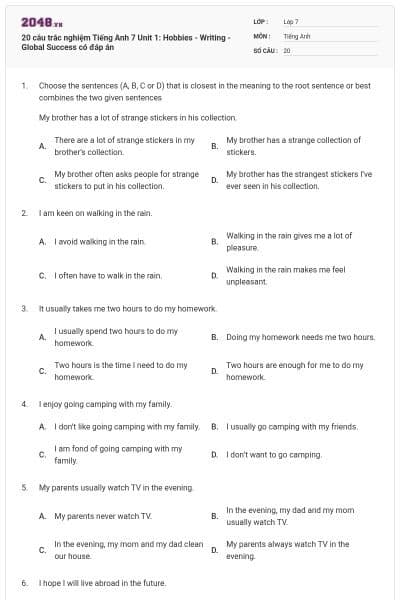
Choose the sentences (A, B, C or D) that is closest in the meaning to the root sentence or best combines the two given sentences
My brother has a lot of strange stickers in his collection.
There are a lot of strange stickers in my brother’s collection.
My brother has a strange collection of stickers.
My brother often asks people for strange stickers to put in his collection.
My brother has the strangest stickers I’ve ever seen in his collection.
Đáp án đúng là: A
Dịch: Anh trai tôi có rất nhiều nhãn dán lạ trong bộ sưu tập của mình.
A. Có rất nhiều nhãn dán kỳ lạ trong bộ sưu tập của anh trai tôi.
I avoid walking in the rain.
Walking in the rain gives me a lot of pleasure.
I often have to walk in the rain.
Walking in the rain makes me feel unpleasant.
Đáp án đúng là: B
Be keen on = thích
Dịch: Tôi thích đi trong mưa.
B. Đi trong mưa cho tôi nhiều niềm vui.
I usually spend two hours to do my homework.
Doing my homework needs me two hours.
Two hours is the time I need to do my homework.
Two hours are enough for me to do my homework.
Đáp án đúng là: C
A sai cấu trúc: spend + Ving (dành thời gian làm gì)
B sai nghĩa
C đúng
D sai ngữ pháp (dùng tobe là “is”)
Dịch: Tôi thường mất hai giờ để làm bài tập về nhà.
= Hai giờ là thời gian tôi cần làm bài tập về nhà.
I don’t like going camping with my family.
I usually go camping with my friends.
I am fond of going camping with my family.
I don’t want to go camping.
Đáp án đúng là: C
Cấu trúc: tobe fond of Ving = enjoy Ving (thích làm gì)
Dịch nghĩa: Tôi thích đi cắm trại cùng gia đình.
My parents never watch TV.
In the evening, my dad and my mom usually watch TV.
In the evening, my mom and my dad clean our house.
My parents always watch TV in the evening.
Đáp án đúng là: B
Dịch: Bố mẹ tôi thường xem TV vào buổi tối.
B. Vào buổi tối, bố và mẹ tôi thường xem TV.
I wish I would live abroad in the future.
I don’t want to live abroad in the future.
I want living abroad in the future.
I lived abroad when I was small.
Đáp án đúng là: A
Cấu trúc:
- Hope + mệnh đề (tương lai đơn): hi vọng điều gì sẽ xảy ra
- Wish + mệnh đề: ước điều gì sẽ xảy ra
- Want + toV: muốn làm gì. Don’t want to V: không muốn làm gì
Dịch: Tôi hi vọng tôi sẽ sống ở nước ngoài trong tương lai.
Use the suggested words to make complete sentences. Choose the best answer
Nga/ my/ younger sister.
Nga is my younger sister.
Nga are my younger sister.
Nga my younger sister.
Nga am my younger sister.
Đáp án đúng là: A
Câu nói lên sự thật hiển nhiên. Đáp án B, C, D sai ngữ pháp (sai tobe)
Dịch: Nga là em gái của tôi.
Our brother/ share/ the hobby/ her.
Our brother share the hobby to her.
Our brother shares the hobby to her.
Our brother share the hobby with her.
Our brother shares the hobby with her.
Đáp án đúng là: D
Share st with sb (chia sẻ cái gì với ai)
Dịch: Anh trai của chúng tôi chia sẻ sở thích với cô ấy.
She/ start/ the hobby/ when/ she/ 6.
She started the hobby when she was 6.
She starts the hobby when she will be 6.
She started the hobby when she was 6.
She starts the hobby when she 6.
Đáp án đúng là: C
Câu diễn tả điều đã xảy ra trong quá khứ nên dùng quá khứ đơn cho cả 2 vế.
Dịch: Cô ấy đã bắt đầu sở thích của mình khi cô ấy 6 tuổi.
Both/ them/ spend/ all/ pocket money/ buy/ books.
Both of them spends all pocket money to buy books.
Both of them spends all pocket money buying books.
Both of them spend all pocket money to buy books.
Both of them spend all pocket money buying books.
Đáp án đúng là: D
Spend money/ time + Ving (dành tiền/dành thời gian để làm gì)
Dịch: Tất cả họ đều dành tiền để mua sách.
She/ sometimes/ library/ borrow/ books.
She sometimes go to library to borrrow books.
She sometimes goes to library to borrow books.
She is sometimes go to library to borrow books.
She goes to sometimes library to borrow books.
Đáp án đúng là: B
Vị trí của trạng từ chỉ tần suất: trước động từ thường, sau tobe.
Dịch: Cô ấy thỉnh thoảng đến thư viện để mượn sách.
Choose the sentences (A, B, C or D) that is closest in the meaning to the root sentence or best combines the two given sentences
Staying at home alone scares me.
I am used to staying at home alone.
I find staying at home alone scary.
I don’t like staying at home alone.
Staying at home alone causes me no fear.
Đáp án đúng là: B
Find st + adj: cảm thấy cái gì như thế nào
Dịch: Staying at home alone scares me.
B. I find staying at home alone scary.
Use the suggested words to make complete sentences. Choose the best answer
She/ think/ read books/ interesting/ useful.
She think reading books is interesting and useful.
She think read books is interesting and useful.
She thinks reading books is interesting and useful.
She think reads books is interesting and useful.
Đáp án đúng là: C
Cấu trúc thì hiện tại đơn cần thêm “s” vào động từ với chủ ngữ là ngôi 3 số ít
Dịch: Cô ấy nghĩ việc đọc sách thì thú vị và có ích.
It/ develop/ her imagination/ widen/ her knowledge.
It develops her imagination and widen her knowledge.
It develop her imagination and widen her knowledge.
It develops her imagination and widens her knowledge.
It develop her imagination and widens her knowledge.
Đáp án đúng là: C
Cấu trúc thì hiện tại đơn. Chủ ngữ (it) là số ít nên động từ cần chia.
Dịch: Nó phát triển trí tưởng tượng và mở rộng hiểu biết của cô ấy.
They/ often/ go/ park.
They often go to park.
They often goes to park.
They are often go to park.
They go to park oftenly.
Đáp án đúng là: A
Thì hiện tại đơn (dấu hiệu: often).
Vị trí của trạng từ chỉ tần suất: trước động từ thường, sau tobe.
Dịch: Họ thường tới công viên.
How/ your father go/ work?
How do your father go to work?
How does your father goes to work?
How do your father goes to work?
How does your father go to work?
Đáp án: D
Giải thích:
Cấu trúc câu nghi vấn thì hiện tại đơn:
(Từ hỏi) + trợ động từ + S + V?
Động từ chính sẽ giữ nguyên do đã có trợ động từ rồi. Loại B và C.
Chủ ngữ “your father” (bố của bạn) là ngôi thứ ba số ít, do đó cần dùng “does”.
Chọn D.
Dịch: Bố của bạn đi làm như nào?
She/ hope/ have/ her/ own/ book/ future.
She hopes she will has her own book in the future.
She hopes she will have her own book in the future.
She hope she will have her own book in the future.
She hopes she will has her own book in a future.
Đáp án đúng là: B
Cấu trúc: hope + mệnh đề (tương lai đơn): hi vọng điều gì sẽ xảy ra.
Dịch: Cô ấy hi vọng rằng cô ấy sẽ có cuốn sách của riêng mình trong tương lai.
She/ enjoy/ read/ books.
She enjoys to read books.
She enjoy reading books.
She enjoys reading books.
She enjoy to read books.
Đáp án đúng là: C
Cấu trúc: enjoy + Ving/ N ( thích làm gì/ thích gì)
Dịch: Cô ấy thích đọc sách.
Nga/ often/ read/ book/ before/ bed.
Nga often reads a book before going to bed.
Nga often read a book before going to bed.
Nga reads a often book before going to bed.
Nga often read book before going to bed.
Đáp án đúng là: A
Vị trí của trạng từ chỉ tần suất: trước động từ thường, sau tobe.
Dịch nghĩa: Nga thường đọc sách trước khi đi ngủ.
Choose the sentences (A, B, C or D) that is closest in the meaning to the root sentence or best combines the two given sentences
This math exercise is too difficult for me to solve.
I have no difficulty solving this math exercise.
This math exercise is difficult enough for me to solve.
This math exercise is easy enough for me to solve it.
This math exercise isn’t easy enough for me to solve.
Đáp án đúng là: D
Be + ADJ + enough + to V = đủ … để làm gì
Dịch: Bài tập toán này quá khó đối với tôi.
D. Bài tập toán này không đủ dễ để tôi giải.