Trắc nghiệm Tiếng Anh 12 Global Success Unit 7 Reading (có đáp án)
20 câu hỏi
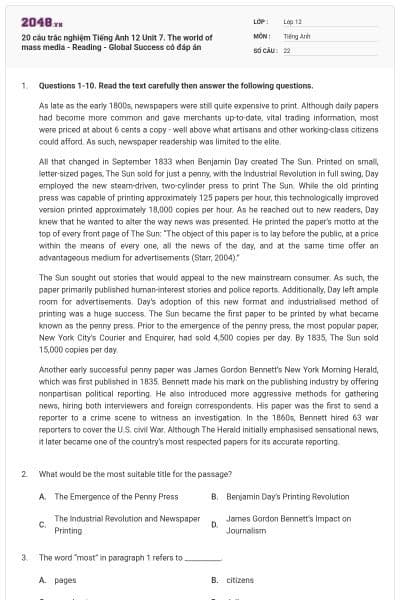
Questions 1-10. Read the text carefully then answer the following questions.
As late as the early 1800s, newspapers were still quite expensive to print. Although daily papers had become more common and gave merchants up-to-date, vital trading information, most were priced at about 6 cents a copy - well above what artisans and other working-class citizens could afford. As such, newspaper readership was limited to the elite.
All that changed in September 1833 when Benjamin Day created The Sun. Printed on small, letter-sized pages, The Sun sold for just a penny, with the Industrial Revolution in full swing, Day employed the new steam-driven, two-cylinder press to print The Sun. While the old printing press was capable of printing approximately 125 papers per hour, this technologically improved version printed approximately 18,000 copies per hour. As he reached out to new readers, Day knew that he wanted to alter the way news was presented. He printed the paper’s motto at the top of every front page of The Sun: “The object of this paper is to lay before the public, at a price within the means of every one, all the news of the day, and at the same time offer an advantageous medium for advertisements (Starr, 2004).”
The Sun sought out stories that would appeal to the new mainstream consumer. As such, the paper primarily published human-interest stories and police reports. Additionally, Day left ample room for advertisements. Day’s adoption of this new format and industrialised method of printing was a huge success. The Sun became the first paper to be printed by what became known as the penny press. Prior to the emergence of the penny press, the most popular paper, New York City’s Courier and Enquirer, had sold 4,500 copies per day. By 1835, The Sun sold 15,000 copies per day.
Another early successful penny paper was James Gordon Bennett’s New York Morning Herald, which was first published in 1835. Bennett made his mark on the publishing industry by offering nonpartisan political reporting. He also introduced more aggressive methods for gathering news, hiring both interviewers and foreign correspondents. His paper was the first to send a reporter to a crime scene to witness an investigation. In the 1860s, Bennett hired 63 war reporters to cover the U.S. civil War. Although The Herald initially emphasised sensational news, it later became one of the country’s most respected papers for its accurate reporting.
What would be the most suitable title for the passage?
The Emergence of the Penny Press
Benjamin Day’s Printing Revolution
The Industrial Revolution and Newspaper Printing
James Gordon Bennett’s Impact on Journalism
Đáp án đúng: A
Giải thích: Đoạn văn tập trung nói về sự ra đời và ảnh hưởng của báo giá rẻ (penny press).
The word “most” in paragraph 1 refers to __________.
pages
citizens
merchants
daily papers
Đáp án đúng: B
Giải thích:
Dựa vào câu: Although daily papers had become more common and gave merchants up-to-date, vital trading information, most were priced at about 6 cents a copy - well above what artisans and other working-class citizens could afford. (Mặc dù báo ngày càng phổ biến và cung cấp cho các thương gia những thông tin giao dịch quan trọng và cập nhật, hầu hết đều có giá khoảng 6 xu một bản - cao hơn nhiều so với mức giá mà các nghệ nhân và những công dân thuộc tầng lớp lao động khác có thể mua được.)
The word “artisan” in paragraph 1 is CLOSEST in meaning to __________.
craftsman
mailman
fireman
teacher
Đáp án đúng: A
Giải thích: artisan = người thợ thủ công → đồng nghĩa với craftsman.
What motivated Benjamin Day to create The Sun?
to provide elite readers with exclusive news
to focus on political reporting
to make news affordable for a broader audience
to publish sensational stories
Đáp án đúng: C
Giải thích:
Dựa vào câu: “The object of this paper is to lay before the public, at a price within the means of every one, all the news of the day, and at the same time offer an advantageous medium for advertisements (Starr, 2004).” (“Mục đích của bài báo này là cung cấp cho công chúng tất cả các tin tức trong ngày với mức giá phù hợp với khả năng của mọi người và đồng thời cung cấp một phương tiện quảng cáo có lợi (Starr, 2004).”)
What technological advancement allowed The Sun to print 18,000 copies per hour?
the old printing press
the steam-driven, two-cylinder press
the Industrial Revolution
the new paper material
Đáp án đúng: B
Giải thích:
Dựa vào câu: Printed on small, letter-sized pages, The Sun sold for just a penny, with the Industrial Revolution in full swing, Day employed the new steam-driven, two-cylinder press to print The Sun. (Được in trên những trang giấy nhỏ khổ letter, tờ The Sun chỉ được bán với giá một xu, khi cuộc Cách mạng Công nghiệp đang diễn ra sôi nổi, Day đã sử dụng máy in hai xi-lanh chạy bằng hơi nước mới để in tờ The Sun.)
What made James Gordon Bennett’s New York Morning Herald unique?
sensational reporting
nonpartisan political reporting
industrialised printing
elite readership
Đáp án đúng: B
Giải thích: Đoạn 4 nêu rõ Bennett nổi bật nhờ “nonpartisan political reporting”.
Which of the following is NOT true according to the passage?
The Sun sold 15,000 copies per day by 1835.
Newspaper readership was limited to the elite in the early 1800s.
The Herald did not cover sensational news from the beginning.
Day left large room for advertisements in his newspaper.
Đáp án đúng: C
Giải thích:
Dựa vào câu: Although The Herald initially emphasised sensational news, it later became one of the country’s most respected papers for its accurate reporting. (Mặc dù ban đầu The Herald nhấn mạnh vào những tin tức giật gân, nhưng sau đó nó đã trở thành một trong những tờ báo được kính trọng nhất cả nước vì đưa tin chính xác.)
The word “sensational” in paragraph 4 is CLOSEST in meaning to __________.
outstanding
exciting
recent
shocking
Đáp án đúng: D
Giải thích: sensational news = tin giật gân, gây sốc.
The word “it” in paragraph 4 refers to __________.
reporter
investigation
The Herald
news
Đáp án đúng: C
Giải thích:
Dựa vào câu: Although The Herald initially emphasised sensational news, it later became one of the country’s most respected papers for its accurate reporting. (Mặc dù ban đầu The Herald nhấn mạnh vào những tin tức giật gân, nhưng sau đó nó đã trở thành một trong những tờ báo được kính trọng nhất cả nước vì đưa tin chính xác.)
Which can be inferred from the passage?
Working-class citizens could not afford papers until 1833.
The new technology could not make the printing process faster.
The Herald newspaper is not respected in the country.
The Sun did not print a motto in his newspaper.
Đáp án đúng: A
Giải thích:
Dựa vào câu: Although daily papers had become more common and gave merchants up-to-date, vital trading information, most were priced at about 6 cents a copy - well above what artisans and other working-class citizens could afford. (Mặc dù báo ngày càng phổ biến và cung cấp cho các thương gia những thông tin giao dịch quan trọng và cập nhật, hầu hết đều có giá khoảng 6 xu một bản - cao hơn nhiều so với mức giá mà các nghệ nhân và những công dân thuộc tầng lớp lao động khác có thể mua được.)
Trước 1833, báo giá 6 cent vượt khả năng người lao động → họ không mua nổi.
Dịch bài đọc:
Cho đến tận đầu những năm 1800, việc in báo vẫn còn khá tốn kém. Mặc dù báo ngày đã trở nên phổ biến hơn và cung cấp cho các thương gia những thông tin thương mại cập nhật, quan trọng, hầu hết đều có giá khoảng 6 xu một bản - cao hơn nhiều so với khả năng chi trả của các nghệ nhân và những người lao động khác. Do đó, độc giả của báo chỉ giới hạn ở giới thượng lưu.
Tất cả đã thay đổi vào tháng 9 năm 1833 khi Benjamin Day sáng lập tờ The Sun. Được in trên những trang giấy nhỏ, khổ letter, The Sun được bán với giá chỉ một xu, trong bối cảnh Cách mạng Công nghiệp đang diễn ra mạnh mẽ, Day đã sử dụng máy in hai xi-lanh chạy bằng hơi nước mới để in The Sun. Trong khi máy in cũ có khả năng in khoảng 125 tờ mỗi giờ, thì phiên bản cải tiến về công nghệ này có thể in khoảng 18.000 bản mỗi giờ. Khi tiếp cận những độc giả mới, Day biết rằng ông muốn thay đổi cách trình bày tin tức. Ông in khẩu hiệu của tờ báo lên đầu mỗi trang nhất của tờ The Sun: “Mục tiêu của tờ báo này là cung cấp cho công chúng, với mức giá phù hợp với khả năng của mọi người, tất cả tin tức trong ngày, đồng thời cung cấp một phương tiện quảng cáo thuận lợi (Starr, 2004).”
The Sun tìm kiếm những câu chuyện hấp dẫn đối với nhóm độc giả chính thống mới. Vì vậy, tờ báo chủ yếu đăng những câu chuyện thú vị về con người và các báo cáo của cảnh sát. Ngoài ra, Day còn dành nhiều chỗ cho quảng cáo. Việc Day áp dụng định dạng mới này và phương pháp in công nghiệp đã thành công vang dội. The Sun trở thành tờ báo đầu tiên được in bằng loại máy in mà sau này được gọi là máy in xu. Trước khi máy in xu xuất hiện, tờ báo phổ biến nhất là Courier và Enquirer của Thành phố New York đã bán được 4.500 bản mỗi ngày. Đến năm 1835, The Sun đã bán được 15.000 bản mỗi ngày.
Một tờ báo penny thành công khác là tờ New York Morning Herald của James Gordon Bennett, xuất bản lần đầu năm 1835. Bennett đã tạo dấu ấn trong ngành xuất bản bằng cách cung cấp các bài tường thuật chính trị phi đảng phái. Ông cũng giới thiệu những phương pháp thu thập tin tức táo bạo hơn, tuyển dụng cả phóng viên phỏng vấn và phóng viên nước ngoài. Tờ báo của ông là tờ báo đầu tiên cử phóng viên đến hiện trường vụ án để chứng kiến một cuộc điều tra. Vào những năm 1860, Bennett đã thuê 63 phóng viên chiến tranh để đưa tin về Nội chiến Hoa Kỳ. Mặc dù ban đầu, The Herald tập trung vào tin giật gân, nhưng sau này đã trở thành một trong những tờ báo được kính trọng nhất nước Mỹ nhờ những bài tường thuật chính xác.
Questions 11-20. Read the text carefully then decide each statement is True or False.
The very first large-format billboard (or more accurately a giant poster) was introduced by Jared Bell in 1835. Years later, more and more businesses began to utilise outdoor spaces for advertising. As billboards became popular, many billboard associations were established to regulate the standards of billboard advertising.
In the 20th century, billboard advertising had become one of the most preferred promotion methods as more highways and roads were built. By showing advertisements to drivers and road users, billboards have a much greater reach and can help businesses to boost their brand awareness effectively.
Today, billboards own the biggest share in the outdoor advertising market. While billboards are mostly used for commercial applications, they can also be used in relaying messages such as public service announcements, government information, and personal opinion.
In the early 21st century, billboard advertising was constantly challenged by other forms of advertising. Thanks to the invention of better televisions such as Plasma TV and LCD TV, TV managed to invite some people to spend more time at home. TVs with better screen resolutions have also set a very high standard of viewing experience.
Besides, the invention of smartphones also led to the era of online and social media. With so much interesting content, why do consumers bother to look at the static and boring billboard content?
Billboards must evolve and go digital to retain people’s attention. Digital billboards are made possible due to advanced display technology. While the earliest form of digital billboard was only equipped with a low screen resolution, advertisers quickly realised that it was a successful breakthrough. Why would anyone not want to pay attention to a giant outdoor digital screen?
In addition to solving all the challenges that traditional billboards faced previously, a digital billboard can offer many extra benefits to businesses. Tracking impressions and measuring performance are easier now. Advertising cost is more affordable as printing and labour costs are eliminated. Besides, instead of buying the whole ad space 24/7, businesses can now choose to buy their preferred time slots.
The first large-format billboard was introduced in 1835 by Jared Bell.
True
False
Đáp án đúng: A
Giải thích:
Dựa vào câu: The very first large-format billboard (or more accurately a giant poster) was introduced by Jared Bell in 1835. (Tấm biển quảng cáo khổ lớn đầu tiên (hay chính xác hơn là tấm áp phích khổng lồ) được Jared Bell giới thiệu vào năm 1835.)
Billboard associations were created to prevent people from advertising outdoors.
True
False
Đáp án đúng: B
Giải thích:
Dựa vào câu: Years later, more and more businesses began to utilise outdoor spaces for advertising. As billboards became popular, many billboard associations were established to regulate the standards of billboard advertising. (Nhiều năm sau, ngày càng nhiều doanh nghiệp bắt đầu sử dụng không gian ngoài trời cho mục đích quảng cáo. Khi biển quảng cáo trở nên phổ biến, nhiều hiệp hội biển quảng cáo đã được thành lập để điều chỉnh các tiêu chuẩn quảng cáo biển quảng cáo.)
Billboards became more effective when highways and roads were developed.
True
False
Đáp án đúng: A
Giải thích:
Dựa vào câu: In the 20th century, billboard advertising had become one of the most preferred promotion methods as more highways and roads were built. (Vào thế kỷ 20, quảng cáo trên biển quảng cáo đã trở thành một trong những phương pháp quảng bá được ưa chuộng nhất khi ngày càng nhiều đường cao tốc và đường bộ được xây dựng.)
Billboards are used only for commercial purposes today.
True
False
Đáp án đúng: B
Giải thích:
Dựa vào câu: While billboards are mostly used for commercial applications, they can also be used in relaying messages such as public service announcements, government information, and personal opinion. (Trong khi biển quảng cáo chủ yếu được sử dụng cho mục đích thương mại, chúng cũng có thể được sử dụng để truyền tải các thông điệp như thông báo dịch vụ công cộng, thông tin của chính phủ và ý kiến cá nhân.)
Television once posed a challenge to billboard advertising in the 21st century.
True
False
Đáp án đúng: A
Giải thích:
Dựa vào câu: In the early 21st century, billboard advertising was constantly challenged by other forms of advertising. Thanks to the invention of better televisions such as Plasma TV and LCD TV, TV managed to invite some people to spend more time at home. (Vào đầu thế kỷ 21, quảng cáo biển quảng cáo liên tục bị thách thức bởi các hình thức quảng cáo khác. Nhờ sự ra đời của những chiếc tivi tốt hơn như TV Plasma và TV LCD, TV đã thu hút được nhiều người dành nhiều thời gian ở nhà hơn.)
Digital billboards became successful even though they had low screen resolution at first.
True
False
Đáp án đúng: A
Giải thích:
Dựa vào câu: While the earliest form of digital billboard was only equipped with a low screen resolution, advertisers quickly realised that it was a successful breakthrough. (Mặc dù hình thức biển quảng cáo kỹ thuật số đầu tiên chỉ được trang bị màn hình có độ phân giải thấp, các nhà quảng cáo đã nhanh chóng nhận ra đây là một bước đột phá thành công.)
Digital billboards require more labour and printing costs than traditional ones.
True
False
Đáp án đúng: B
Giải thích:
Dựa vào câu: Advertising cost is more affordable as printing and labour costs are eliminated. (Chi phí quảng cáo phải chăng hơn vì không phải tốn chi phí in ấn và nhân công.)
Businesses can now buy specific time slots instead of renting billboard space all day.
True
False
Đáp án đúng: A
Giải thích:
Dựa vào câu: Besides, instead of buying the whole ad space 24/7, businesses can now choose to buy their preferred time slots. (Bên cạnh đó, thay vì mua toàn bộ không gian quảng cáo 24/7, giờ đây doanh nghiệp có thể chọn mua khung giờ quảng cáo mà họ muốn.)
Digital billboards were considered successful even when their screen resolution was low.
True
False
Đáp án đúng: A
Giải thích:
Dựa vào câu: While the earliest form of digital billboard was only equipped with a low screen resolution, advertisers quickly realised that it was a successful breakthrough. (Mặc dù hình thức biển quảng cáo kỹ thuật số đầu tiên chỉ được trang bị màn hình có độ phân giải thấp, các nhà quảng cáo đã nhanh chóng nhận ra đây là một bước đột phá thành công.)
Digital billboards provide easier ways to track and measure advertisement performance.
True
False
Đáp án đúng: A
Giải thích:
Dựa vào câu: Tracking impressions and measuring performance are easier now. (Việc theo dõi lượt hiển thị và đo lường hiệu suất hiện nay dễ dàng hơn.)
Dịch bài đọc:
Tấm biển quảng cáo khổ lớn đầu tiên (hay chính xác hơn là một tấm áp phích khổng lồ) được Jared Bell giới thiệu vào năm 1835. Nhiều năm sau đó, ngày càng nhiều doanh nghiệp bắt đầu sử dụng không gian ngoài trời để quảng cáo. Khi biển quảng cáo trở nên phổ biến, nhiều hiệp hội biển quảng cáo đã được thành lập để điều chỉnh các tiêu chuẩn quảng cáo biển quảng cáo.
Vào thế kỷ 20, quảng cáo biển quảng cáo đã trở thành một trong những phương pháp quảng bá được ưa chuộng nhất khi ngày càng nhiều đường cao tốc và đường bộ được xây dựng. Bằng cách hiển thị quảng cáo cho tài xế và người tham gia giao thông, biển quảng cáo có phạm vi tiếp cận lớn hơn nhiều và có thể giúp các doanh nghiệp nâng cao nhận thức về thương hiệu một cách hiệu quả.
Ngày nay, biển quảng cáo chiếm thị phần lớn nhất trên thị trường quảng cáo ngoài trời. Mặc dù biển quảng cáo chủ yếu được sử dụng cho các ứng dụng thương mại, nhưng chúng cũng có thể được sử dụng để truyền tải các thông điệp như thông báo dịch vụ công cộng, thông tin chính phủ và ý kiến cá nhân.
Vào đầu thế kỷ 21, quảng cáo biển quảng cáo liên tục bị thách thức bởi các hình thức quảng cáo khác. Nhờ sự ra đời của những chiếc tivi tốt hơn như TV Plasma và TV LCD, TV đã thu hút được nhiều người dành nhiều thời gian hơn ở nhà. TV có độ phân giải màn hình tốt hơn cũng đã thiết lập một tiêu chuẩn rất cao về trải nghiệm xem.
Bên cạnh đó, sự ra đời của điện thoại thông minh cũng dẫn đến kỷ nguyên của mạng xã hội và trực tuyến. Với rất nhiều nội dung thú vị, tại sao người tiêu dùng lại bận tâm xem những nội dung quảng cáo tĩnh và nhàm chán?
Biển quảng cáo phải phát triển và chuyển sang kỹ thuật số để thu hút sự chú ý của mọi người. Biển quảng cáo kỹ thuật số ra đời nhờ công nghệ hiển thị tiên tiến. Mặc dù hình thức biển quảng cáo kỹ thuật số ban đầu chỉ được trang bị độ phân giải màn hình thấp, nhưng các nhà quảng cáo đã nhanh chóng nhận ra rằng đó là một bước đột phá thành công. Tại sao mọi người lại không muốn chú ý đến một màn hình kỹ thuật số khổng lồ ngoài trời?
Bên cạnh việc giải quyết tất cả những thách thức mà biển quảng cáo truyền thống phải đối mặt trước đây, biển quảng cáo kỹ thuật số có thể mang lại nhiều lợi ích bổ sung cho doanh nghiệp. Việc theo dõi lượt hiển thị và đo lường hiệu suất giờ đây dễ dàng hơn. Chi phí quảng cáo cũng phải chăng hơn do chi phí in ấn và nhân công đã được loại bỏ. Bên cạnh đó, thay vì mua toàn bộ không gian quảng cáo 24/7, giờ đây các doanh nghiệp có thể chọn mua các khung giờ quảng cáo ưa thích của mình.